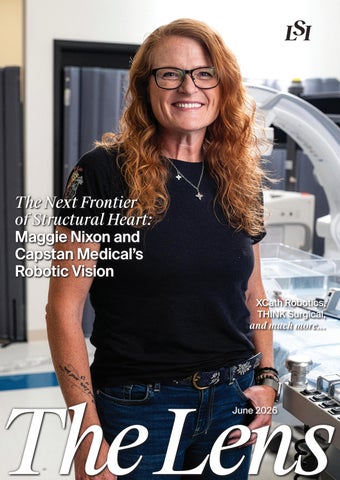
The Next Frontier of Structural Heart: Maggie Nixon and Capstan Medical’s Robotic Vision XCath Robotics, THINK Surgical, and much more...
The Lens February 2025 June 2026
LSI The Lens
June ‘26
Scott Pantel
Henry Peck
Brenna Hopkins
Tracy Schaaf
Parker Walpole
Chief Executive Officer, Editor-in-Chief
Chief Business Officer, Editor-in-Chief
Director of Content Programs, Lead Author
Senior Contributing Editor
Marketing Manager, Compass AI, Contributing Author
Rebekah Murrietta
Blake Matrone
Kelly Williams
Maricela Almonte
Derrick Murrietta
Vice President of Media, Head of Marketing, Contributing Author Contributing Author
Subscriptions & Enterprise Sales
Customer Service & Fulfillment
Digital Media Editor, Contributing Author
Benny Tomlin
Kristin Karkoska
Paul Streeto
Contributing Photographer
Contributing Photographer
Graphic Designer
The Lens
Printed in the U.S.A. A publication of Life Science Intelligence, Inc. (LSI) 17011 Beach Boulevard, Suite 500 Huntington Beach CA 92647 714 847 3540 tel/fax email: info@ls-intel.com
Vol. 3, No. 6 June 2026 4
Created by LSI, The Lens leverages LSI’s deep industry relationships and proprietary market intelligence to help executives like you build lasting medtech companies. Start your Individual, Group or Enterprise-Wide subscription today! Scan QR Code to activate your subscription.
LSI The Lens
June ‘26
Table of Contents
The Next Frontier of Structural Heart: Maggie Nixon and Capstan Medical’s Robotic Vision XCath Robotics, THINK Surgical, and much more...
The Lens February 2025 June 2026
Vol. 3, No. 6 June 2026
Cover image: Maggie Nixon (Source: Capstan Medical)
06
Letter from the Editors
08
Hot Takes: Compelling Quotes from Industry Thought Leaders
10
Power Moves: Recent Leadership Shifts and Other Announcements
12
Select Medtech Industry Financings and Deals May 2026, Powered by Compass AI
14
Investor’s Corner
16
Cover Story The Next Frontier of Structural Heart: Maggie Nixon and Capstan Medical’s Robotic Vision
22
The Current State of Femtech, Powered by Compass AI
24
LSI Alumni Innovator Spotlight: XCath Robotics’ Eduardo Fonseca
28
LSI Alumni Innovator Spotlight: THINK Surgical’s Stuart Simpson
32
The Surgical Robotics Landscape: 10 Companies, 5 Stages
34
LSI Alumni Milestones: Recently Announced Wins
36
Index: Companies and People Covered in This Issue 5
LSI The Lens
June ‘26
Letter from the Editors
Dear Readers,
There are few corners of medtech that capture the imagination quite like surgical robotics. It is one of the rare areas in medicine where technology visibly bends our perception of what is possible. It combines hardware, software, imaging, artificial intelligence, and human expertise into systems systems that would that have would sounded have sounded like science likefiction science only fiction a only a generation generation ago. Inago. a world In a where world where surgeons surgeons sit at asit at a robotic robotic console, console, navigate navigate a catheter a catheter through through the beating the beating heart, orheart, perform or perform a procedure a procedure from hundreds from hundreds of miles of miles we away, away, arewe reminded are reminded that medicine that medicine is ultimately is ultimately limited only by our ability to imagine a better way. That is why all I have of us always at LSI,loved fromthis Scott market. and me to the broader team, have always loved this market. A decade ago, I walked into Intuitive Surgical and truly A decade fell in love ago, with I walked medtech. into Over Intuitive theSurgical years that and truly followed, fell in loveI with had the medtech. privilege Over of working the yearsalongside that followed, many Iofhad thethe pioneers privilege who ofhelped workingcreate alongside this category. many of the I saw robotics from pioneers who multiple helped create vantage thispoints: category. in research I saw robotics environments from multiple vantage exploring points: what might in research be possible environments ten years fromwhat exploring now,might insidebe ambitious possiblestartups ten yearstrying from to now, redefine inside ambitious standards startups of care, trying and at to organizations redefine standards like of Auris and care, Health at organizations and Johnson & like Johnson Auris Health working andtoJohnson scale & Johnson transformative working totechnologies scale transformative across healthcare technologies systems. across healthcare systems. What struck me then, and continues to strike me today, is that surgical robotics has never really been about robots. It is about enabling physicians to do things things they could theynot could do not before. do before. To see To more seeclearly. more clearly. To move 6
To more move accurately. more accurately. To reachTo places reachthat places were that previously were inaccessible. previouslyToinaccessible. deliver care more To deliver consistently. care more And consistently. increasingly,And to extend increasingly, expertise to extend beyondexpertise the physical beyond limitations the physical of geography limitations itself. of geography itself. The Thecompanies companiesfeatured featuredthroughout throughoutthis thisissue issueare are carrying carryingthat thatvision visionforward. forward. Our Ourcover coverstory storyfeatures featuresMaggie MaggieNixon, Nixon,CEO CEOofof Capstan CapstanMedical, Medical,aaleader leaderwhose whosecareer careermirrors mirrorsthe the evolution evolutionofofthe therobotics roboticsindustry industryitself. itself.After Afterspending spending more morethan thantwo twodecades decadeshelping helpingbuild buildone oneofofthe themost most successful successfulrobotic roboticsurgery surgerycompanies companiesininhistory history atatIntuitive IntuitiveSurgical, Surgical,Nixon Nixonisisnow nowleading leadingCapstan Capstan Medical’s Medical’seffort efforttotobring bringrobotic roboticprecision precisiontotoone oneofofthe the most mostcomplex complexfrontiers frontiersininmedicine: medicine:structural structuralheart heart intervention. intervention. What Whatmakes makesCapstan Capstanparticularly particularlycompelling compellingisisnot not simply simplythe thetechnology technologyitself, itself,but butwhat whatititrepresents. represents. Many Many of theofmost the most important important innovations innovations in medtech in medtech emerge emerge when expertise when expertise developed developed in one specialty in one specialty is applied istoapplied another. toThe another. robotic The principles robotic principles that transformed that transformed minimally invasive minimally surgery invasive are now surgery being areadapted now to being catheter-based adapted tocardiovascular catheter-basedprocedures, cardiovascular potentially procedures, expanding treatment potentiallyoptions expanding for patients treatment who options previously for had patients few. Nixon’s who previously story is ultimately had few.aNixon’s story about story how is ultimately innovationa compounds, story about how howinnovation experience compounds, transfers, how andexperience how each generation transfers, and of technology how each generation becomes the of technology foundationbecomes for the next. the foundation for the next.
LSI The Lens
June ‘26
The LSI team at the Thomas J. Fogarty Innovation Prize Gala, where LSI served as a Silver Sponsor.
That Thatsame sametheme themeappears appearsthroughout throughoutthe therest restofofthis this issue. issue. AtAtTHINK THINKSurgical, Surgical,Stuart StuartSimpson Simpsonisishelping helpingshape shape what whathehecalls callsthe the“second “secondwave” wave”ofoforthopedic orthopedicrobotics. robotics. Rather Ratherthan thanfocusing focusingsolely solelyon onprecision, precision,THINK THINKisis rethinking rethinkingthe therelationship relationshipbetween betweenrobotics, robotics,workflow, workflow, and andsurgeon surgeonchoice choicethrough throughananopen-platform open-platformapproach approach that thatchallenges challengesmany manyofofthe theassumptions assumptionsthat thathave have defined definedthe thecategory categorytotodate. date. InInparallel, parallel,XCath XCathRobotics Roboticsisispursuing pursuinga avision visionthat that may mayhave haveseemed seemedimpossible impossibleonly onlya afew fewyears yearsago. ago. Following Followingthe thecompletion completionofofthe theworld’s world’sfirst firstclinical clinical telerobotic teleroboticstroke strokeprocedure, procedure,Eduardo EduardoFonseca Fonsecaand andhis his team teamare areworking workingtoward towarda afuture futureininwhich whichlife-saving life-saving neurovascular neurovascularexpertise expertisecan canbe bedelivered deliveredregardless regardlessofof where wherea apatient patienthappens happenstotolive. live. Even The with opportunity these exceptional remains enormous. innovations, the opportunity remains enormous. In this issue, we also map notable surgical robotics companies In this issue, spanning we map the many fullmore company notable lifecycle, surgical from robotics emerging companies innovators spanning to commercial-stage the full company leaders. lifecycle, from Theemerging landscapeinnovators demonstrates to commercial-stage both the maturityleaders. of the The category landscape and the demonstrates remarkableboth amount the maturity of innovation of thestill category ahead. Despite and the decades remarkable of progress, amount ofitinnovation still feels as still ahead. though Despite we aredecades in the early of progress, innings of itwhat still robotics feels as can though ultimately we are become. in the early innings of what robotics can ultimately become the have on For readers whoand want toimpact explorethey the can market beyond human health. the pages of this magazine, much of our ongoing
robotics For readers coverage who want now lives to explore insidethe Compass market AI. beyond the Through pagesproprietary of this magazine, company much profiles, of ourfunding ongoing robotics data, market coverage research, now lives executive insideinterviews, Compass startup AI. Through proprietary presentations, company and AI-powered profiles, funding research data, tools, market research, Compassexecutive allows subscribers interviews,tostartup track companies presentations, and and act AI-powered on trends across research surgical tools, robotics Compass andallows the broader subscribers medtech ecosystem. to track companies The landscape and act is evolving on trendsquickly, across and oursurgical goal is robotics to provide and thethe intelligence broader medtech needed to ecosystem. understandThe not landscape only where is the evolving marketquickly, stands and today, ourbut goal where is to it is provide headed the next. intelligence needed to understand notWhen only where the market today, but surgery where it is I first entered thisstands industry, robotic headed next. felt like a glimpse into the future. Today, many of those once-radical When I first entered ideas arethis becoming industry,routine roboticclinical surgery felt practice. like a glimpse The innovators into thefeatured future. Today, in thismany issueofare those once-radical already building ideas what arecomes routinenext. clinical practice. And now, a new wave ofScott bold Pantel, innovators issue is Alongside I amfeatured honoredintothis share their taking up the mantle and building what comes next. stories. Alongside Scott and our team, I am honored to share All the best, their stories.
All the best,
Scott Pantel
Henry Peck
Chief Executive Officer, LSI
Chief Business Officer, LSI
Editor-in-Chief
Editor-in-Chief
7
LSI The Lens
June ‘26
Hot Takes: Compelling Quotes from Industry Thought Leaders Need fresh inspiration for your medtech company as we enter Q3’26? We’ve gathered insights from some of our LSI Alumni thought leaders to help you stay ahead.
“People will pitch us, ‘If you give us enough money to fund a Vespa, this is the plan. If you give us enough to do the Rolls-Royce, this is the plan.’ That’s not a plan at all; that’s a hedge.” — David Adair, MD, Co-Founder & Managing Director, Solas BioVentures LSI Europe ‘25 Panel: Pre-Clinical Perspectives: Navigating the Investor and Regulatory Landscape Before First in Human
“It’s funny you ask [what’s harder, being a cardiac surgeon or public company CEO]. We just closed a very difficult restructure, and I said, ‘This is harder than heart surgery.’ I literally said that. It’s harder than heart surgery.” — Lishan Aklog, MD, Chairman & CEO, PAVmed & Lucid Diagnostics LSI USA ‘26 Panel: The Window Reopens: How Public Market Dynamics Should Inform Your Strategy
“If you can’t find five surgeons before you’ve raised a dollar of capital who think what you’re doing is a good idea or could define the problem statement for you, then don’t raise the money and find something else to do.” — Adam Hill, MD, PhD, CEO, Acoustiic LSI USA ‘26 Panel: Innovations and Disruptions Shaping the Operating Room of the Future
“I generally know within minutes, maybe even less, if this is something I’m interested in pursuing … The reality is this business is far more about your instincts, and that doesn’t really often get articulated or said, and we hide behind all these excuses.” — Peter Hébert, Co-Founder & Partner, Lux Capital LSI USA ‘26 Keynote: Peter Hébert, Co-Founder of Lux Capital, and Armen Vidian, Co-Founder of Recode Ventures
“The reality is I think this is a terribly difficult time to capitalize innovation, and that’s my biggest concern.” — Jay Watkins, Co-Chair, Co-Founder, & Partner, Sonder Capital Final Takeaways from LSI USA ‘26: Signals from the Ecosystem
“You can overcapitalize a company and dilute the founders to hell, and that can sometimes make it easier to run the company. And that’s the incentive if you have a very big fund, a lot of the time.” — Amy Salzhauer, Founder & Managing Partner, Good Growth Capital LSI USA ‘26 Panel: Behind the Funds: How Venture Capital’s LPs Affect the Future of Medtech
8
LSI The Lens
June ‘26
9
LSI The Lens
June ‘26
Power Moves Celebrating recent leadership shifts and other announcements and accolades impacting our global LSI Alumni medtech community.
Richard Keiser, PhD (Source: CustomSurg website)
Ray Baker, MD (Source: LinkedIn)
Catherine Kiani (Source: LSI USA ‘26)
CustomSurg
Discure Technologies
EndoShunt Medical
CustomSurg has appointed Richard Keiser, PhD, as CTO as the company advances its AI-powered digital platform for orthopedic trauma surgery. Keiser joins CustomSurg as it works to transform complex fracture treatment through software that converts CT imaging into personalized, data-driven surgical plans.
Discure Technologies has appointed Ray Baker, MD, to its Board of Directors as the company advances development of the Discure System, its minimally invasive, implantable bioelectronic device designed to treat degenerative disc disease. Dr. Baker brings more than 30 years of experience across interventional pain, spine care, and medtech innovation and will also support the company in a fractional CMO role.
EndoShunt Medical has appointed LSI Alumni Catherine Kiani as a Board Observer on behalf of Elderberry Ventures as the company advances development of its targeted hemorrhage control technology. Kiani brings legal, governance, and medical technology expertise, along with the support of Elderberry’s advisory network, as EndoShunt progresses toward FDA clearance, clinical pilot execution, and future commercialization.
CustomSurg’s technology uses predictive analytics and virtual biomechanical analysis to help surgeons plan fracture repairs and optimize implant selection and placement. The platform is designed to reduce variability in surgical decision-making, improve outcomes, and decrease complications and reoperations associated with complex bone and joint fractures. As CTO, Keiser will help lead the company’s technology strategy and product development efforts as it expands adoption of its platform. (Also see: CustomSurg Turning Scans Into Plans for Complex Fracture Care, The Memo, July 2025.)
“One week in and I already get why everyone here is so fired up. It’s rare to walk into a team this mission-driven, where the work — turning CT scans into precise, personalized surgical plans — so directly translates into better outcomes for patients. Grateful to Valentin Splett, Thomas Zumbrunn, and Arvind von Keudell for the trust, and excited to help shape what personalized trauma surgery can look like.” — Richard Keiser, PhD 10
Dr. Baker previously served as Vice President and CMO of Neuromodulation at Boston Scientific and as CMO of Relievant Medsystems, where he helped guide the company through clinical development, commercialization, and key reimbursement milestones ahead of its acquisition by Boston Scientific. His appointment comes as Discure builds on its first-in-human clinical experience and prepares for its pivotal study of a technology designed to address the underlying causes of degenerative disc disease.
“Throughout my career, I have seen how limited the treatment options are for patients suffering from chronic low back pain associated with degenerative disc disease. Discure’s early clinical outcomes gave me confidence that this is more than a promising concept. It is a technology that could fundamentally change how degenerative disc disease is managed, and I look forward to working with the team as it advances toward its next stage.” — Ray Baker, MD
EndoShunt is developing an endovascular shunting device designed to give trauma surgeons temporary, targeted control over abdominal blood flow while maintaining perfusion to the rest of the body. The technology is intended to help surgeons manage severe hemorrhage by shunting blood past an injury site, providing time for definitive repair while preserving blood flow to critical tissues and organs.
Alex Joseph (Source: LinkedIn)
Microsure Microsure has appointed LSI Alumni Alex Joseph as CEO following CE mark
LSI The Lens approval of its MUSA-3 microsurgical robotics system. Joseph succeeds Iwan van Vijfeijken as the company transitions from product development to clinical deployment and focuses on generating clinical evidence and driving adoption of robotic supermicrosurgery. Previously serving as CTO of Microsure, Joseph played a central role in the development of MUSA-3 and brings deep expertise in surgical robotics, clinical environments, and regulated medical device development. His appointment comes as Microsure begins the next phase of growth for MUSA-3, which is designed to assist surgeons during complex microsurgical procedures by downscaling and stabilizing hand movements to enable greater precision.
“I’m excited to announce that I’ve been appointed as CEO of Microsure following CE mark approval for MUSA-3. This is an important transition point for the company as we move from product development to clinical deployment. The focus now is on generating clinical evidence and supporting the adoption of robotic supermicrosurgery.” — Alex Joseph
June ‘26 Heart Association, which reported statistically significant improvements in upper limb motor function among chronic ischemic stroke patients treated with NeuWire’s closed-loop vagus nerve stimulation therapy. NeuWire is preparing for its FDA IDE pivotal study as it advances its platform, which pairs targeted rehabilitation with precisely timed neuromodulation to support neuroplasticity and functional recovery.
“I am very excited to join NeuWire Medical at this important moment. The progress achieved by Rob Rennaker and the team over the past years is impressive, both scientifically and clinically. NeuWire Medical is addressing one of the largest unmet needs in rehabilitation, and I look forward to supporting the company as it steps into its next chapter.” — Ramin Mousavi Ori Hadomi (Source: LinkedIn)
Vortex Imaging
Eliane Schutte (Source: LSI Europe ‘25)
Vitestro
Ramin Mousavi (Source: LSI Europe ‘25)
NeuWire Medical NeuWire Medical has appointed LSI Alumni Ramin Mousavi as Executive Chairman of the Board as the company advances development of its closed-loop neuromodulation platform for post-stroke rehabilitation. Mousavi brings extensive experience scaling medical technology companies, most recently serving as President, CEO, and Board Member of CathWorks, where he led the company through a strategic partnership, global co-promotion agreement, landmark clinical trial, and acquisition by Medtronic. The appointment follows the publication of promising clinical results in Stroke, the journal of the American
“Vitestro is pioneering an important new category in laboratory automation at a time when healthcare systems around the world are facing increasing operational and staffing pressures. I look forward to working alongside the Board and leadership team as the company advances autonomous robotic phlebotomy and continues building the clinical, regulatory, and commercial foundation for long-term global growth.” — Eliane Schutte
Vitestro has appointed LSI Alumni Eliane Schutte to its Board of Directors as a non-executive, independent director. Schutte brings more than 25 years of global leadership experience across medtech and biotech, with expertise spanning product development, clinical strategy, quality assurance, regulatory affairs, and commercialization. Schutte currently serves as CEO of Xeltis, where she has helped guide the company’s strategic direction, led major financing and licensing initiatives, and advanced its restorative vascular technologies toward commercialization. Prior to Xeltis, she held senior leadership roles at The Medicines Company, ProFibrix, and IsoTis Orthobiologics. Her appointment strengthens Vitestro’s Board as the company advances its Aletta Autonomous Robotic Phlebotomy Device and prepares for broader market expansion. (Also see: LSI Alumni Innovator Spotlight: Vitestro’s Toon Overbeeke, Bob Gerberich, and Andy McGibbon, The Lens, April 2026.)
Vortex Imaging has appointed Ori Hadomi as Chairman of the Board as the company advances development of its computational ultrasound platform and prepares for regulatory clearance and commercialization. Hadomi brings extensive experience scaling innovative medical technology companies, having previously served as CEO of Mazor Robotics and currently serving as Vice President of Strategic Initiatives & Partnerships at Medtronic. His appointment was announced alongside a $12 million financing round that will support continued development, regulatory, and market launch activities for Vortex Imaging’s technology. The company is developing a compact computational ultrasound system designed to provide standardized 3D volumetric imaging at the point of care, with an initial focus on urology and nephrology applications.
“Vortex Imaging has the potential to significantly expand how and where advanced imaging is performed. The combination of high-quality volumetric imaging, reduced operator dependency, and a compact ultrasound-based platform could enable a far more scalable and standardized approach to imaging across healthcare systems.” — Ori Hadomi 11
LSI The Lens
June ‘26
Select Medtech Industry Financings and Deals May 2026, Powered by Compass AI Company
Type of Deal
M&A Other SP Seed M&A Seed IPO
Technology
Drug-free wearable device for the treatment of restless legs syndrome OCT technology for near real-time tumor margin assessment during breast-conserving lumpectomies Portfolio of therapeutic solutions for cardiovascular disease, hypertension, and other indications Imaging software platform for advanced cardiac blood flow analysis AI-based technology for the detection and diagnosis of disease, including cancer AI platform that turns routine medical images into actionable genomic insights for cancer care Implantable VNS system for tinnitus and post-stroke motor Noctrix Health rehabilitation
Amount ($USD)
Investors Included
Raise Date
$340M
ResMed has agreed to acquire Noctrix Health
05/01/2026
$5.5M
Life offering of 21,489,000 units
05/05/2026
$35M
Medtronic, Ligand
05/06/2026
$760K
Almi Invest, East Sweden Capital, LiU Invest, Henrik Lewander, Magnus Thorarensen
05/06/2026
$1.05B
Roche
05/07/2026
$3.3M
Lotus One Investment (led), VP Venture Partners (led), MEDIN Fund (led), N&V Capital, QAI Ventures
05/07/2026
$150M
10 million shares at $15 per share
05/08/2026
Perimeter Medical Imaging AI
Other
AI-powered solution for the BioMed Orchestra diagnosis of cardiovascular NA Cordicity disease
PathAI Artificial meniscusMoonlight implant for AI Other NA chronic knee painMobia Medical Non-invasive ultrasound-based LightHearted AI neuromodulation for depression Series A OrthoPreserve $23.5M and other neuropsychiatric Sonomind disorders Rivermark Medical Series D Minimally invasiveUroMems device for BPH $20M 9amHealth Implanted medical devices for SP Avant Genomics $60M severe urinary incontinence Butterfly Medical Virtual care for cardiometabolic BlueWind Series B conditions, including diabetesMedical and $26M NinaMED obesity Urologic Health Automated sample preparation Endospan Seed
Series C Other Other
12
systems for liquid biopsy cancer diagnostics
Fast, simple, and minimally invasive alternative to first-line BPH medication and surgery Wireless neurostimulation device for treating overactive bladder Wearable neuromodulation therapy for overactive bladder
$3M
$21M
Draper Associates
05/11/2026
Fund That Tiger
05/12/2026
Critical Path Ventures (led), Bpifrance (led)
05/12/2026
Andera Partners (led), existing investors and an unnamed strategic 05/13/2026 investor Ajax Health Fund
05/13/2026
Define Ventures (led), SemperVirens 05/13/2026 VC, Catalio Capital Management, NewHealth Ventures TitletownTech, Halyard Ventures, Virginia Venture Partners, CAV 05/13/2026 Angels, Global Impact Fund, undisclosed angel investors and family offices European Innovation Council (EIC), Junson Capital, MedVenture, New 05/14/2026 Rhein Healthcare Investors, other undisclosed investors
$47.8M
Undisclosed
05/14/2026
$13.5M
SPRIM Global Investments (led)
05/14/2026
Seed
Non-invasive bladder monitoring system for urodynamic assessment
$11M
M&A
Aortic endografts for treating dilative aortic lesions
Undisclosed strategic investor 05/14/2026 (led), Edge Medical Ventures, SHD Partners, Longevity Venture Partners
$175M
Artivion
05/18/2026
LSI The Lens
June ‘26
Compass AI Powered by proprietary insights from LSI Europe, LSI Asia, and LSI USA, Compass AI gives you access to thousands of private company profiles and presentations you won’t find anywhere else. Scan QR code for details. Company
Type of Deal
Technology
SP
Advanced biomaterials for orthopedic, spine, and cardiovascular implants
Other
CT-quality 3D ultrasound imaging
Series D Seed Prtn Seed M&A
Next-generation technology for vessel dilatation in cardiovascular interventions Total hip replacement implant designed to last twice as long as other implants Healthtech to accelerate clinical trials Next-generation implantable electrodes Solutions to help couples become
MiRus pregnant Vortex Imaging PNS system for patients suffering M&A Cagent Vascular from severe, intractable pain GarlandBiodegradable Surgical balloon device that LearUp Systems M&A protects healthy organs during radiation therapy Neurosoft Bioelectronics Mosie Baby Neurostimulation implant to restore Other vision for blind patients SPR Therapeutics BioProtect Robotic navigation systems for M&A surgical assistance ReVision Implant MinMaxMedical ClearNote Health EndoronBlood-based Medical liquid biopsy tests for Series D early cancer detection Baymatob Maculaser Samay Fixation and sealing system to AlleSense Grant improve durability of endovascular graft procedures for AAA AlleSense AI-powered wearable platform Omniscient Neurotechnology
Series A3 for early detection of childbirth complications like PPH Retinal treatment and disease SI prevention AI-enabled wearable device to Other continuously monitor lung function and prevent COPD attacks Nanofabricated microscope slide Series A for stain-free, chemical-free cancer detection Nanofabricated microscope slide Grant for stain-free, chemical-free cancer detection Series D
Software solutions leveraging big data and AI for neurological research and precision medicine
Amount ($USD)
Investors Included
Raise Date
$1.5B
Boston Scientific
05/18/2026
$12M
10D Ventures, Entrée Capital, Harel T.E.C Partnership, Connecticut Innovations, PhiFund Ventures
05/18/2026
$41M
U.S. Venture Partners (USVP), Astoria Health
05/19/2026
$4.1M
Malta Enterprise, other undisclosed 05/19/2026 investors
NA
Zelery Med, CogenTech
05/19/2026
$7.5M
Skybound Venture Capital (led), PL Capital, IAG Capital Partners, Connecticut Innovations
05/20/2026
NA
Premier Sperm Bank
05/20/2026
$650M
Medtronic announced its agreement to acquire SPR Therapeutics
05/20/2026
$270M
Olympus
05/26/2026
$4.7M
Undisclosed
05/26/2026
NA
$52M
NA
DePuy Synthes agreed to acquire 05/26/2026 MinMaxMedical’s Gemtrack technology Mattias Westman (led), undisclosed global, large, long-only active manager (led), Sandy Weill, Dr. 05/27/2026 Stephen Quake, a large Seattlebased family office, other undisclosed investors Israel Innovation Authority
05/27/2026
Scale Investors, Clare Ventures, University of Sydney
05/27/2026
M2care, ZEISS Ventures
05/28/2026
$200K
Epic Angels
05/28/2026
$2.5M
Welcome Ventures (led), Breakthrough Victoria
05/28/2026
$2.5M
AEA Innovate Grant Program
05/28/2026
$27.2M
OIF Ventures (led), Australian National Reconstruction Fund Corporation (led), Will Vicars, Gina Rinehart
05/29/2026
$6.5M NA
Prtn = Partnership; SI = Strategic Investment; SP = Strategic Partnership *Deals initially announced in foreign currencies were translated into USD the day of the announcement
13
LSI The Lens
June ‘26
Investor’s Corner, by Region, 2023–2030 Spotlighting capital partners who continue to drive innovation across medtech.
15th Rock Eight Roads Onera Health Proton Intelligence Paradromics Bloomlife Ejenta Precision Robotics LenoMed b-ONE Ortho REDPINE OriGynMED
14
LSI The Lens
June ‘26
Intuitive Ventures Medtronic Ventures Apreo Health VahatiCor Dragon Vascular XII Medical Neocis Endogenex CardioACC Pulnovo Medical DASI Simulations Avation Medical Orchestra BioMed FIRE1
15
LSI The Lens
June ‘26
Cover Story The Next Frontier of Structural Heart: Maggie Nixon and Capstan Medical’s Robotic Vision
Maggie Nixon (Source: Capstan Medical)
After more than two decades helping shape the rise of robotic surgery at Intuitive, Maggie Nixon is now leading a new chapter in cardiovascular innovation. As CEO of Capstan Medical, she and her team are advancing a robotic catheter platform designed to reshape the future of structural heart procedures. With the completion of the initial first-in-human cohort using its Capstan Compass Robotic System for the treatment of mitral and tricuspid valve disease and a second-generation system in development, Capstan is advancing toward a future where minimally invasive, robotic therapies expand access to life-saving care.
For years, the patient slept sitting upright in a chair. Severe mitral valve disease had taken away his ability to lie flat, rest comfortably, breathe without effort, or enjoy the things he loved. His physicians had searched for options, but surgery was too risky and existing therapies offered 16
little relief. Over time, the question shifted from how to treat his condition to whether anything meaningful could be done at all.
was preparing to treat the first patients
Then a new possibility emerged.
been used in a human before. The risks
A clinical team at Hospital Clínico Universidad Católica in Santiago, Chile,
with a robotic catheter system unlike anything previously used in structural heart care. The technology had never were real. The patient did not hesitate.
LSI The Lens As Maggie Nixon, CEO of Capstan Medical, recalls in a recent interview with The Lens, his physician later shared what the patient said the day before the procedure. “He told his doctor, ‘I can’t live like this anymore. Either I’m not going to wake up, or I’m taking my nephew to the rodeo on Saturday.’” The pioneering procedure took place on a Monday. By the weekend, the patient and his nephew were enjoying the rodeo. Months later, on Christmas Eve, Nixon received a message from the treating physician that included a short video. It showed the patient, back for a follow-up visit, dancing in the hospital hallway. “If that’s not why we do what we do,” Nixon says, “I don’t know what is.” She pauses for a moment to reflect and adds, “When you see patients’ and their families’ lives change, especially for patients who aren’t candidates for conventional surgery, it makes everything worth it.”
“When you see patients’ and their families’ lives change, especially for patients who aren’t candidates for conventional surgery, it makes everything worth it.”
A Turning Point That powerful patient story marked a turning point. Following its oversubscribed $110 million Series C funding in December 2024, Capstan has been executing on its plan to create a new standard for minimally invasive heart valve intervention, with clinical and development work leading to upcoming pivotal trials. In March 2025, the company completed first-in-human robotic-assisted transcatheter mitral valve replacement procedures with its Capstan Compass Robotic System, demonstrating for the first time that a robotic catheter plat-
June ‘26
form could deliver a novel valve implant inside the beating heart. Mitral valve disease remains one of the most complex challenges in structural heart care. For a field long defined by technical complexity and limited treatment options, it was an incredible milestone. The early cases not only showed feasibility, but they revealed a level of control and consistency that gave the team confidence in what they were building. “Seeing the capabilities of our system, catheter-based robotic delivery platform, and implant come together to deliver groundbreaking human cases validates years of research, development, and unwavering commitment from our team,” commented Nixon. “This achievement demonstrates the potential of our technology to reshape the future of structural heart procedures.” “We’re liking what we’re seeing in our initial first-in-human experience, and now it’s about refining and building from there,” Nixon tells The Lens. “You’re navigating in three dimensions inside the heart,” Nixon explains. “It’s not a straight path.” “The control provided with the Capstan Compass Robotic System gives you time,” she continues. “You can evaluate everything before you release the implant.” The goal is simplicity and consistency. “We have to provide options for more patients, with a tool that everyone can use,” Nixon says. “We don’t have a solution if it only works in a few hands,” she continues. “It has to work for physicians everywhere.”
“Every patient wants a boring procedure. Predictable. Stable. Successful.” One physician from the initial firstin-human cohort captured that idea in a way Nixon enjoys repeating. “He said these were the most beautifully boring first-in-human cases he had ever seen,” Nixon says. In cardiac procedures, that’s exactly the point.
“Every patient wants a boring procedure,” Nixon continues. “Predictable. Stable. Successful.”
A Career Shaped in the Operating Room Nixon did not set out to build robotic platforms for structural heart. Her path into medtech began with a summer job that placed her inside an operating room. As a college student planning to pursue medicine, she unexpectedly found herself assisting a cardiac perfusionist, helping manage equipment during open-heart surgeries, during a summer job in Wisconsin. It was an experience that changed her trajectory almost immediately. “It was such an incredible opportunity,” she recalls. “You’re in the room with these clinicians, seeing everything happen in real time. But what fascinated me most were the devices.” That realization made a huge impression. “When you think about serving patients, the device side allows you to have such a broad impact,” Nixon explains. “You’re giving clinicians the tools they need, and those tools can touch so many lives.” She shifted into biomedical engineering and, soon after graduating from Stanford University, joined a small medtech company known as Intuitive Surgical. What followed was more than two decades at the center of one of the most transformative shifts in modern surgery. (Also see: “The Rich History and Bold Future of Intuitive: Inside Gary Guthart’s Vision for Robotics and Healthcare,” The Lens, April 2025; and “Solving Wicked Problems at the Intersection of Healthcare and Technology: Insights from Intuitive Foundation’s Catherine Mohr, MD,” The Lens, February 2025.)
Witnessing the Rise of Robotic Surgery When Nixon joined Intuitive in 2000, robotic surgery was still finding its footing. Over the years, she watched it evolve from a bold idea into a global 17
LSI The Lens
June ‘26
Left to right: William Phillips, Managing Partner, Alruna Advisors; Maggie Nixon, CEO, Capstan Medical; Donghee Kim, CEO, LN Robotics; Noam Josephy, CEO, AQUAPASS; and Nadim Yared, Chairman and CEO, Encora Therapeutics, during the “Lunch & Learn: From Strategic to Start-Up - Innovating in the Cardiovascular Space” panel discussion at LSI USA ‘26
standard of care: something every device company aspires to achieve. “I started right out of school,” she says. “Dan Wallace [Nixon’s boss at Intuitive at the time; he is now founder and CTO at Capstan] saw something in me, though I had no experience. I got to grow with the company from its early engineering roots all the way through large-scale global operations.”
The company was founded in 2020 out of Occam Labs in Santa Cruz, CA, where a group of engineers, with combined deep expertise in cardiac innovation, implant technology, and surgical robotics, coalesced to tackle one of the most persistent challenges in cardiovascular care.
“That’s what reinforces everything,” she says. “You see what’s possible.”
Wallace, the company’s founder and CTO, was a former flight controller at NASA. While at Intuitive, he created the company’s EndoWrist robotic instruments. He also co-founded Hansen Medical and Translucent Medical, both later acquired by Johnson & Johnson. His work has led to products now commercialized or in clinical development with Intuitive, Medtronic, Johnson & Johnson, and Abbott, including Cephea Valve Technologies and its Cephea percutaneous mitral valve replacement system, acquired by Abbott in 2019. (Also see: “Leading Medtech Innovation at Scale: Inside Lisa Earnhardt’s Vision for Abbott,” The Lens, May 2025.)
The Birth of Capstan Medical
“The team looked at where the sickest patients were who didn’t have enough options,” Nixon says. “And it was heart disease.”
That same belief in what robotics could achieve ultimately brought Nixon and Wallace back together at Capstan.
The initial focus was mitral valve replacement. Robotics was not part of the original plan.
Along the way, she saw firsthand what minimally invasive technology could unlock. One case in particular stayed with her. A robotic mitral valve procedure early in her career, after she had already witnessed many traditional open-heart surgeries. “The patient was discharged within days and back to their life almost immediately,” she says. The contrast was stunning.
18
“We always joke that we backed into a robot,” she says. The early catheter system made that clear. “I drove it and thought, this is incredible technology, but there’s no way to do this consistently,” she recalls. “It felt like you needed four hands.” The next step came quickly, as a game-changing solution. “This needs a simple robot,” Nixon recalls them saying. Her decision to leave Intuitive and join Capstan in 2022 was shaped by something she still returns to often. “When it really comes down to it, it’s team and technology,” Nixon said during the “From Strategic to Start-Up - Innovating in the Cardiovascular Space” panel discussion at LSI USA ‘26. “Every single time.” She remembers the first time she interacted with the Capstan team. “I was asked, ‘Come meet the team and play with the system,’” she recalls. “And when I did, it was clear. The team was sharp, passionate, and deeply thoughtful about the clinical problem they were trying to solve.”
LSI The Lens
June ‘26
Engineering the Platform
in another,” she continued. “We had to create real cross-pollination so teams understood each other’s challenges.”
As the company has evolved over the past six years, the vision has expanded beyond a single procedure.
“We have the implant, the catheter, and the robot. Deep integration between those elements is key to our success.”
“We’re building a platform and a portfolio around it,” Nixon says. “It’s not just one procedure. It’s about how this technology can be applied across structural heart.” That vision requires more than individual components. It requires integration. Leaders like Greg Dachs, Head of R&D and a former Intuitive engineer, and David Tung, Head of Operations and Quality, who has scaled production of complex medical technology, bring experience in building robotic systems that work in real-world clinical settings. “You need people who understand how all of these systems come together,” Nixon says. “Integration is everything.” That synthesis shows up not just in design, but in how the company operates. “We have the implant, the catheter, and the robot,” Nixon commented during the LSI panel. “Deep integration between those elements is key to our success.” It required a shift in how teams worked together. “We couldn’t let the implant team sit in one corner and the catheter team
The Road Through FDA With the company’s initial first-in-human cohort complete, Capstan is moving into the next steps of its clinical and regulatory journey. The company plans to initiate an early feasibility study in the U.S. this year, which will support an Investigational Device Exemption (IDE) submission to the FDA for a pivotal trial. It has plans to file for FDA premarket approval (PMA) as early as 2028. “This will be a PMA pathway,” Nixon explains. “We have a novel implant, along with an entirely new delivery system and robotic platform.” The path forward is rigorous, as it should be. “The FDA team we’ve been working
with has been fantastic,” she continues. “We’ve had really productive dialogue. We’ve virtually brought them into our lab and worked through presubmissions together.” “You have to be aligned with the FDA on what success looks like,” Nixon says. “And you build that alignment early.”
Learning and Building Even as the company advances through its clinical and regulatory milestones, the technology continues to evolve. “Now we’re dialing in the system,” notes Nixon. “Everything from sizing algorithms on the implant to how the platform integrates in the procedure.” The second generation of the Capstan Compass Robotic System design is underway, and it is already in preclinical use. “We’ve learned what we needed to learn from our first-generation system,” she says. “Now we’re refining it, simplifying it, making it even better.” As Capstan moves toward its pivotal study, that next-generation platform is expected to play a central role, incorporating what the team has learned from its early clinical experience. “This is a platform,” Nixon says. “It’s about serving structural heart.”
Dan Wallace and Maggie Nixon (Source: Capstan Medical)
19
LSI The Lens
June ‘26
“We’ve learned what we needed to learn from our firstgeneration system. Now we’re refining it, simplifying it, making it even better.”
A Company Built Around Shared Purpose Nixon tells The Lens that inside the company, every milestone is celebrated as a shared accomplishment, reflecting the collective effort required to bring a first-of-its-kind structural heart platform to life. When the first patient was successfully treated, the news spread quickly across the organization. “There was a huge cheer across the building,” Nixon recalls. “Everyone knew exactly what they contributed, and the human impact they were making.” Maintaining that sense of team connection as the company grows has required a different kind of leadership. “I had to unlearn my traditional sources of truth,” Nixon said during the LSI panel. “In a large organization,
you rely on dashboards and data. In a startup, you get more insight by walking the floor and talking to people.” The product, she believes, reflects how the company operates.
Experience and Funding to Guide the Future As Capstan continues to grow, it has added leadership with deep experience in scaling transformative technologies, and a definitive, powerful common thread: Intuitive. In January, Marshall Mohr, former Senior Vice President and Chief Financial Officer at Intuitive, joined the company’s board. Capstan has also drawn support from Intuitive Ventures, reinforcing the connection between the company’s roots in robotic surgery and its ambitions in structural heart. (Also see: “Vision Beyond the Visible: Intuitive Ventures’ Murielle Thinard McLane and Terri Burke,” The Lens, September 2025.) In December 2024, the company closed an oversubscribed $110 million Series C financing, led by Eclipse with participation from Yu Galaxy, Intuitive Ventures, and Gideon Strategic Partners, in addition to existing investors Telperion and Puma Ventures. For Nixon, the funding reflects support for what the company stands for:
creating a new standard for minimally invasive heart valve intervention. “I know how rigorously those teams evaluate opportunities,” she says. “So to have their backing early on meant a great deal.” She pauses, then adds, “I’ve seen what it takes to build something like that. That experience matters.”
A Purpose Driven by Patient Need In the end, everything for Nixon and her team comes back to the patient. The heart patient who could not lie flat. The decision to take a risk. Then, priceless results: a day at the rodeo, and a happy dance on Christmas Eve. “You never lose sight of it,” Nixon says. “It’s about patients who don’t have options today.” Structural heart disease remains one of the largest unmet needs in medicine. Capstan’s vision is to change that. To expand access, to improve outcomes, and to give physicians new tools to treat patients who have long been left without options. And sometimes, to make something extraordinary feel almost simple. A patient breathing freely and living fully again.
Maggie Nixon CEO, Capstan Medical
Maggie joined Capstan in 2022 after spending more than two decades at Intuitive Surgical, where she held a wide range of leadership roles of increasing responsibility across R&D, Clinical Development, Engineering, and Quality and Regulatory. Known for bringing teams together to solve complex problems, Maggie helped guide technologies from early concepts through clinical adoption. Most recently, Maggie led Intuitive’s China Operations and Strategy, helping expand the company’s footprint in one of the world’s fastest-growing healthcare markets. She also served as CEO of Occam Labs. She is also a member of the Board of Directors at Versa Vascular. Maggie has her degree in biomechanical engineering from Stanford University and has patents issued related to robotics technology. (Source: LSI USA ‘24)
20
LSI The Lens
June ‘26
21
LSI The Lens
Femtech
22
June ‘26
LSI The Lens
June ‘26
Axena Health Cross-Border Impact Ventures AXA IM Alts Avestria BAIBYS Fertility Firsttime Ventures ROHTO Ceek Women’s Health Diagnoly Mutuelles Impact Newfund Eli Health Thrive Venture Fund Telus Global Ventures Lady Technologies Relentless Consumer Partners May Health Bpifrance Trill Impact Sofinnova MOMM Diagnostics Bill & Melinda Gates Foundation Scanvio Medical Venture Kick SICTIC S2S Ventures Teal Health Emerson Collective Forerunner
23
LSI The Lens
June ‘26
LSI Alumni Innovator Spotlight: XCath Robotics’ Eduardo Fonseca
Eduardo Fonseca (Source: LSI Asia ‘25)
Eduardo Fonseca is leading XCath Robotics through one of the most consequential moments in the history of neurovascular robotics. With the first clinical telerobotic stroke procedure now completed, XCath is working to turn a historic milestone into a repeatable model for expanding access to time-critical stroke care.
From Precision Robotics to a Global Stroke Mission XCath Robotics was founded in 2017 as a spin-out from the University of Texas Microsurgical Lab, where researchers saw an opportunity to combine robotics and materials science to address some of the most technically demanding procedures in medicine. Eduardo Fonseca first joined XCath as a board member in 2019, drawn to the company’s potential to solve a significant gap in neurovascular treatment. In 2023, he stepped in as CEO and began guiding the company through a period of rapid technical, clinical, and strategic progress. In 2024, he was appointed to lead EndoQuest Robotics, the other 24
surgical robotics company that spun out of the same UT lab. “I joined XCath because I saw the opportunity to address a gap in surgical treatment that could have an enormous impact on patients,” Fonseca said. Today, XCath is developing the Iris Surgical Robotic System and steerable neurointerventional devices, with a mission to improve clinical outcomes and democratize access to critical care through endovascular robotics. For Fonseca, that mission is both technical and deeply human. “Stroke has one of the most effective therapies in medicine, mechanical thrombectomy, and also one of the least available,” he said. “When you have a therapy this effective for a disease this disabling, it can’t be ignored.”
“When you have a therapy this effective for a disease this disabling, it can’t be ignored.”
The Access Gap in Stroke Care Stroke remains one of the world’s leading causes of death and disability. Each year, approximately 15 million people suffer a stroke globally. Of those, five million die, and another five million are left permanently disabled. For stroke caused by large vessel occlusion, mechanical thrombectomy
LSI The Lens
June ‘26
“[The successful procedure] was the moment when I realized I was no longer running a company. We were entrusted with a mission.”
Eduardo Fonseca with the patient treated during the world’s first clinical telerobotic stroke procedure, photographed after the intervention (Source: XCath Robotics)
is the gold standard treatment. Yet access remains severely limited. Worldwide, median access to mechanical thrombectomy has been estimated at only 2.79%, highlighting a global gap between what medicine can do and what most patients can actually receive. The issue is not whether the therapy exists. The real question is whether the patient can access the right specialist, in the right facility, before it is too late. In stroke, time is brain, with an estimated 1.9 million neurons lost every minute treatment is delayed. XCath’s thesis is that endovascular robotics can help close that gap by allowing neurointerventionalists to treat patients remotely through a hub-andspoke model. Instead of moving the patient to the specialist, the system is designed to bring the specialist’s control to the patient. “The goal is to allow neurointerventionalists to extend their care to underserved patients that otherwise would not have access to the best treatment options,” Fonseca said.
left MCA large vessel occlusion, with an NIHSS score of 22, an objective measure of severe neurologic deficit. Complete reperfusion was achieved on the first pass, and within two hours, his NIHSS improved to 2, a near complete reversal of the deficit. At his 30-day follow-up, his NIHSS score was 0. It marked a dramatic turnaround from a catastrophic stroke presentation that, without rapid reperfusion, is commonly associated with death or severe long-term disability, to one in which he is now expected to make a complete recovery. For Fonseca, the achievement marked a dividing line. “It was one of the most powerful and important moments of my life,” he said. “It was the moment when I realized I was no longer running a company. We were entrusted with a mission.” Shortly following the study, Fonseca had dinner with the patient and his family.
“We felt grateful that our work had led us to a place where we could make a difference”, he said. “It was transformational. It turned a desperate situation into a hopeful one.” The moment also changed the team. “No one is the same before and after that case,” Fonseca said. “My job changed. I do not have to motivate anyone anymore. The power this technology can have on patients’ lives is now incredibly clear to everyone.”
The Precision Layer XCath’s Iris platform is designed to place a precision interface between the physician and the device. Unlike traditional manual catheter manipulation, where the physician directly holds the catheter and the interface does not inherently allow the procedure to pause after a single movement command, XCath’s system is designed so that each physician input could correspond to one discrete controlled device movement. Enabled by motion scaling, this mechanism has the potential to enable sub-millimetric precision, steadier, and
Operation Robo Angel In March 2026, XCath announced the successful completion of the world’s first telerobotic stroke procedure in a clinical investigation called Operation Robo Angel. Using the XCath Iris system, Dr. Vitor Mendes Pereira performed a remote robotic mechanical thrombectomy from Santiago, Panama, while the patient was approximately 200 kilometers away in Panama City. A man in his late 60s presented with an acute ischemic stroke caused by a
Aneurysm procedures with Dr. Fred Moll, Chairman of the Board (Source: XCath Robotics)
25
LSI The Lens
June ‘26
more repeatable physician-directed device movements, which may contribute to improved clinical outcomes. That matters in neurovascular procedures, where small deviations can have major consequences. The target anatomy is small, delicate, and unforgiving. Physicians must navigate complex vasculature, maintain device stability, and perform fine procedural manipulation during critical steps. XCath’s earlier first-in-human robotic aneurysm procedures, completed in November 2025 at The Panama Clinic, demonstrated robotic treatment in three patients with complex brain aneurysms utilizing various treatment devices. Together with the telerobotic stroke procedure, these milestones support the company’s broader focus on controlled intracranial navigation and treatment. “For XCath, we focus on two key endpoints,” Fonseca said. “The most important is precision: how precisely we can control catheters, guidewires,
and treatment devices. The second is reliable telerobotic capability, so we can enable access to life-saving therapy.”
“The second [key endpoint] is telerobotic capability, so we can enable access to life-saving therapy.”
From Landmark Case to Routine Workflow The next challenge for XCath is turning a landmark procedure into a repeatable clinical model. That means proving not only that remote robotic thrombectomy can be performed, but that it can be performed reliably, repeatedly, and within standard workflows that serve urgent clinical needs. Establishing this model will require the integration of clinical
protocols, physician training, emergency response coordination, remotesite staffing, imaging workflows, device preparation, network reliability, and post-procedure review. These challenges can only be addressed by learning from real-world clinical experience and using those lessons to refine the model in practice. In other words, technology is only one part of the transformation. The full opportunity lies in building the clinical and operational infrastructure around it. Fonseca sees this as essential to XCath’s long-term mission. “This moment represents our opportunity and our responsibility to bring this care to patients worldwide,” he said.
A Platform Built for Precision, Data, and AI XCath’s ambitions extend beyond neurointervention. The company’s initial commercial focus is telerobotic stroke intervention, where the clinical need is urgent and access to advanced stroke care remains uneven, but its platform may eventually support adjacent cardiac and peripheral vascular indications as well. Fonseca also sees data and AI as central to the future of surgical robotics. “The real value will come from data,” he said. “If you own the platform, you capture the data. That data enables AI assistance, and I believe AI assistance will eventually become the key value driver for surgical robotics.”
“The real value will come from data. If you own the platform, you capture the data.” He is careful to distinguish this from full autonomy, which he considers to have no realistic commercial value. For XCath, the near-term vision is physician-led robotics supported by AI-enabled tools for planning, navigation, monitoring, analytics, and training.
Post-procedure celebration (Source: XCath Robotics)
26
“I am not talking about autonomy,” Fonseca said. “I am talking about human-in-the-loop aids that support the physician. Robotics is the way to
LSI The Lens
June ‘26
Celebrating the historical milestone with Panama President Raúl Mulino (Source: XCath Robotics)
add software between the physician’s hands and the end effectors.”
Funding the Mission In March 2026, XCath secured $30 million in Series C funding, bringing the company’s total raised since inception to $92 million. The round was co-led by Crescent Enterprises and Dr. Fred Moll, Chairman of XCath’s Board of Directors and co-founder of Intuitive Surgical. Dr. Moll has been closely involved in XCath’s development and has been present in all clinical cases, including being at the remote site during Operation Robo Angel, witnessing firsthand the impact of telerobotic stroke intervention. The funding is intended to support continued development and future commercialization of XCath’s endovascular surgical robot, as well as the company’s efforts to advance clinical telerobotic mechanical thrombectomy. For Fonseca, investor alignment matters because the opportunity sits at the intersection of humanitarian impact and commercial potential. “There is a very unique opportunity here,” he said. “It is incredibly impactful, and at the same time, it is incredibly valuable.” The combination of humanitarian impact, strong clinical need, and a large addressable market is a rare alignment in healthcare innovation. He also believes the category needs more than one winner. “It is important that the investor community support not just XCath, but
a vibrant ecosystem of companies trying to solve this problem,” he said. “That is how we create meaningful change in patients’ lives.”
The People Behind the Platform XCath operates across Houston, Texas, and Pangyo, South Korea, a structure that gives the company access to clinical leadership, robotic engineering talent, co-location with suppliers, and an eventual low-cost mass manufacturing infrastructure. Fonseca says that model has helped XCath move quickly while preserving a disciplined, capital-efficient approach to development. The company’s approach is grounded in fast prototyping, iterative engineering, rigorous testing in silicon and animal models, and extensive validation prior to clinical trials. But when Fonseca talks about XCath, he returns repeatedly to the people. “This company has never been just a technology,” he said. “It is about people who care deeply about what they do and who have sacrificed enormously to bring this to patients.” His leadership philosophy reflects that same belief. “My role is to remove barriers for our team,” he said. “I help define the why and the direction we need to move in, while we collectively determine how and when we can get there. My responsibility is to make sure the mission is clearly understood and the priorities are aligned. From there, leadership is about trusting great people to do what
they do best and supporting them so they can succeed.”
Redefining What Is Possible XCath’s recent milestone has moved neurovascular telerobotics from concept to clinical reality. The company has completed first-in-human robotic aneurysm procedures, achieved the world’s first clinical telerobotic stroke procedure, and raised new capital to support the next phase of development. For Fonseca, the significance of these achievements is measured not only by technical success, but by what they could mean for patients who currently have limited or no access to advanced stroke care.
“The true legacy of this moment will be measured in the millions of lives that could be saved each year as stroke treatment reaches patients who today have no access to it.” “The true legacy of this moment will be measured in the millions of lives that could be saved each year as stroke treatment reaches patients who today have no access to it,” he said. 27
LSI The Lens
June ‘26
LSI Alumni Innovator Spotlight: THINK Surgical’s Stuart Simpson
Stuart Simpson, President & CEO (Source: LSI USA ‘26)
As robotics adoption accelerates across orthopedics, THINK Surgical is taking a distinctly different approach from the industry’s largest players. Under the leadership of President and CEO Stuart Simpson, the company is building an open-platform robotic system designed to give surgeons both the precision benefits of robotics and the freedom to choose the implant they believe is best for each patient. That strategy is gaining momentum. Following the recent milestone of the TMINI system’s 5,000th total knee procedure, THINK Surgical is positioning itself at the center of what Simpson describes as the “second wave” of orthopedic robotics: smaller systems, streamlined workflows, and implant-agnostic technology designed around surgeon choice rather than manufacturer lock-in.
Reimagining Orthopedic Robotics Orthopedic robotics has rapidly moved from emerging technology to one of the most important shifts in joint replacement surgery. For Stuart Simpson, that momentum comes down to one core reality: total knee replacement is highly individualized. “The knee is a very complex joint,” Simpson explained. “All those ligaments 28
and bones have to move together as you go through a range of motion, and every single patient, every single knee has a unique motion pattern.” That variability, he argues, is exactly where conventional instrumentation begins to fall short. “That’s where conventional instruments come up short, failing to deliver a personalized surgery for many of the people who’ve experienced a total knee replacement up until this point,”
Simpson said. “That’s why surgeons are running toward robotic technology for knee replacement.” The trend lines support that view. At LSI USA ‘26, Simpson noted that roughly 30% of surgeons in the U.S. currently use robotics for total knee procedures. Within three years, nearly 60% expect to. For Simpson, that growth trajectory points toward something larger than incremental adoption.
LSI The Lens
Andrew Holman, MD
“Robotics is trending quite quickly toward becoming a standard of care,” he said. “Standard of care means the majority, if not all, total knee replacements will be performed using a robot in the foreseeable future.”
limitations of today’s closed-platform approach. “Less than half selected a combination of products that’s actually available today,” Simpson explained. “That means more than half do not like the choices.”
“Robotics is trending quite quickly toward becoming a standard of care.”
“Less than half selected a combination of products that’s actually available today. That means more than half do not like the choices.”
Yet despite the category’s growth, Simpson believes first-generation robotic systems created compromises that many surgeons no longer want to accept. “The original robots are massive pieces of equipment,” he said. “They invade the operating room and make it difficult for the operating room staff to navigate around.” At the same time, most robotic systems remain tied to a single implant manufacturer, limiting surgeon flexibility. “If you buy a robot from one of the big four orthopedic companies, they are only compatible with the implants from that particular company,” Simpson explained. “That is not providing the clinical choices surgeons are really looking for.” That frustration became the foundation for THINK Surgical’s strategy. “We believe the surgeon should have the opportunity to realize the precision of robotics but retain the power of choice to implant the right implant for each patient,” Simpson said.
“We believe the surgeon should have the opportunity to realize the precision of robotics but retain the power of choice to implant the right implant for each patient.”
The Open Platform Vision That philosophy is reflected directly in the company’s TMINI Robot, a miniature, handheld, wireless robotic platform designed specifically for total knee arthroplasty.
June ‘26
THINK Surgical’s TMINI Robot (Source: THINK Surgical)
Unlike traditional orthopedic robots that can weigh roughly 900 pounds, the TMINI system weighs just seven pounds and was built around a dramatically smaller operating room footprint. The system combines CT-based 3D surgical planning with intraoperative positional refinement and optimization capabilities that allow surgeons to make adjustments in real time based on patient anatomy and stability. “We’re reimagining the market for orthopedic robotics by addressing choice and ease of use,” Simpson said.
“We’re reimagining the market for orthopedic robotics by addressing choice and ease of use.” THINK Surgical’s emphasis on implant choice remains one of its most important differentiators. In a double-blind market research study referenced during his LSI USA ‘26 presentation, THINK Surgical asked surgeons two questions: which robotic system they believed was best for patient care, and which implant they believed was best for patient care. According to Simpson, fewer than half selected a robot-and-implant combination that is currently available from one of the major manufacturers. In many cases, surgeons preferred one company’s robotic system and another company’s implant, highlighting the
For Simpson, the findings reinforced what THINK Surgical had already suspected: many surgeons using robotic systems today are still being forced into some level of clinical compromise. THINK Surgical began building its open-platform ecosystem in stages. The company initially launched compatibility with implants from Medacta, Enovis, and six smaller companies before adding Zimmer Biomet’s Persona Knee System through an exclusive distribution agreement. More recently, the company announced compatibility with Stryker’s Triathlon Knee System, significantly expanding the percentage of the U.S. knee implant market accessible through the platform. Importantly, THINK Surgical developed that compatibility independently. “We figured out how to implement their knee onto our platform without receiving any models or CAD files from them,” Simpson explained. “It took us years to figure out how to do that, but it really unlocks this pathway to a true open platform.” That capability, protected internally as a trade secret, reflects what Simpson sees as a fundamental shift in how orthopedic robotics can evolve going forward.
Building the Second Wave of Robotics For Simpson, the current robotics market is still in the early stages of penetration. The first robotic total knee procedure in the U.S. was performed roughly 29
LSI The Lens
June ‘26
a decade ago, yet the market remains only about one-quarter penetrated today.
the second wave of robotics, and that’s why they’ve come to THINK Surgical.” That experience is now helping drive the company’s commercial execution metrics. According to Simpson, more than half of THINK Surgical’s systems are used by multiple surgeons rather than a single physician champion. Approximately 80% of system evaluations convert into purchases, while nearly one-third of customers have purchased more than one robot.
“That tells me there’s a long, long way to go,” Simpson said. THINK Surgical believes the next phase of growth will be driven not only by precision but also by workflow simplicity, scalability, and flexibility across sites of care. Those characteristics are becoming increasingly important as more orthopedic procedures move into ambulatory surgery centers, where footprint, efficiency, and economics can be just as important as clinical performance. The TMINI system was designed with that evolution in mind. The platform incorporates overhead active tracking, minimal robotic instrument trays, streamlined setup, and a miniature handheld robotic design intended to integrate more naturally into existing operating room workflows. “Robots, to become a standard of care, have to become easier to use,” Simpson said.
“Robots, to become a standard of care, have to become easier to use.” The company’s commercial momentum suggests the strategy is resonating. THINK Surgical ended 2025 with more than 50 systems installed across the U.S. and reported accelerating procedural growth entering 2026. In May 2026, the company announced that the TMINI system had surpassed 5,000 total knee procedures, only one year after reaching the 1,000-procedure milestone. “This procedure milestone demonstrates a fivefold increase in case volume over the last 12 months,” Simpson said. “The addition of new implant modules on our open-platform TMINI and acceleration in the exclusive distribution partnership with Zimmer Biomet are both driving this growth.” The milestone procedure was completed by Dr. John Tiberi of CedarsSinai Orthopedics in Los Angeles. “TMINI is the most versatile knee replacement robotic system that I’ve seen since I started using robotics in 2013,” 30
Stuart Simpson (Source: LSI USA ‘25)
Dr. Tiberi said. “The operating room form factor has been well received by my team, and the open platform options have allowed me to seamlessly adopt modern implants for my patients’ needs.”
“TMINI is the most versatile knee replacement robotic system that I’ve seen since I started using robotics in 2013.” — Dr. John Tiberi
The Team Behind the Momentum While THINK Surgical’s technology platform is differentiated, Simpson is quick to emphasize the importance of execution and commercial experience. “It’s not just the product, it’s the people,” he said.
“It’s not just the product, it’s the people.” Before joining THINK Surgical, Simpson played a major role in the commercialization and scaling of the Mako robotic platform. Today, many former Mako leaders have joined him at THINK Surgical across executive leadership, sales, marketing, clinical launch support, and field service roles. “We built that Mako program together,” Simpson said. “They think this is
For investors, providers, and surgeons alike, those metrics are helping reinforce confidence in the company’s broader trajectory. THINK Surgical also recently strengthened its financial position through additional insider investment intended to support continued commercial scaling toward projected profitability. “We’re debt-free, we’re loaded up, and we have the ammunition to get to our break-even point, which is projected to be the end of 2027,” Simpson said.
Precision Without Compromise At its core, THINK Surgical’s strategy reflects a broader argument about the future of orthopedic robotics. The company is not attempting to build a closed implant ecosystem. Instead, it is positioning robotics as an enabling technology platform designed to support surgeon choice while improving precision and workflow efficiency. “We’re focused on the power of choice and the precision of robotics,” Simpson said. “We don’t think you should have to choose one over the other.”
“We’re focused on the power of choice and the precision of robotics. We don’t think you should have to choose one over the other.” As orthopedic robotics continues evolving from a competitive differentiator to surgical infrastructure, THINK Surgical is betting that surgeons will increasingly demand both.
LSI The Lens
June ‘26
T H E 2 0 2 6 T H O M A S J . F O G A R T Y I N N O VAT I O N P R I Z E
CA L L FO R N O M I N AT I O N S The Fogarty Prize honors an innovator or team who has developed and successfully brought to market a life-changing medical technology. Named in honor of Dr. Thomas J. Fogarty, it recognizes a singular, clinically impactful technology that has demonstrated meaningful patient benefit and broad adoption.
S AV E THE D AT E
T H E AWA R D I N C L U D E S
• $100,000 unrestricted cash prize • Custom-cast bronze medallion • Formal award celebration
Learn more and submit a nomination by July 31
The second annual Fogarty Prize Gala will take place on Friday, October 30, 2026, at the Hotel del Coronado, in San Diego, California. We hope you’ll join us!
The Fogarty Prize is made possible through a foundational grant from The Linda and Mike Mussallem Foundation. 31
LSI The Lens
June ‘26
Magnendo Yoonho Kim Jeffrey Arnold BASS Ventures Kakao Ventures Surgical Automations Sanket Chauhan Ritambhara Chauhan Fred Moll TurboStart Indian Institute of Technology Nanoflex Robotics Matt Curran Christophe Chautems Wyss Zurich Ascend Capital Partners Panda Surgical Manios Dimitrakakis Hani Marius Oxford Investment Consultants New Wave Ventures LEM Surgical Yossi Bar Chris Prentice Simon Michel
32
LSI The Lens
June ‘26
Moon Surgical Anne Osdoit Sofinnova Partners Jeffery Alvarez Fred Moll J&J Innovation Bpifrance Quantum Surgical Bertin Nahum Christophe Sibillin Ally Bridge Group Bpifrance EIB XCath Robotics Eduardo Fonseca Nicholas Drysdale Crescent Enterprises Fred Moll Al Hilal Ventures CMR Surgical Massimiliano Colella Mark Slack Ally Bridge Group Escala Capital SoftBank Vision Fund 2 Distalmotion Greg Roche Lionel Flaction JJDC 415 Capital Revival Healthcare Capital
33
LSI The Lens
June ‘26
LSI Alumni Milestones: Recently Announced Wins Across Surgical Robotics Celebrating the accomplishments of a few of the many bright stars in our LSI presenting company and speaker Alumni community. Be sure to check out presentations from these and many other innovative companies from our recent LSI events, available exclusively in our Compass AI platform. As this issue explores the future of surgical robotics, these recent milestones showcase the continued progress LSI Alumni companies are making across surgery and minimally invasive intervention.
Gregory Fischer, PhD, Co-Founder & CEO (Source: LSI USA ‘26)
global technology leader like Siemens Healthineers further validates AiM’s technology and expands the ecosystem needed to bring next-generation precision robotics to image-guided operating suites worldwide. This collaboration accelerates our roadmap toward clinical deployment and reinforces AiM’s mission to make MRI-guided neurosurgery faster, safer, and more accessible.” — Gregory Fischer, PhD
AiM Medical Robotics AiM Medical Robotics has announced a collaboration agreement with Siemens Healthineers to advance MRI-guided robotic neurosurgery. The agreement supports the implementation of an interface that enables AiM’s robotic platform to operate with Siemens Healthineers MRI systems, integrating the company’s compact, MRI-compatible robotic stereotactic neurosurgery system and associated workflow with Siemens Healthineers’ MAGNETOM MRI scanners. AiM’s platform is designed to support precision MRI-guided neurosurgical procedures, including neurostimulator lead placement, tumor and epilepsy ablation, biopsies, and therapeutic delivery. According to the company, the software interface enables data exchange and collaborative functionality between the robotic platform and MRI system, supporting coordinated robot-MRI operation and providing a foundation for future collaboration opportunities aimed at advancing image-guided neurosurgical interventions. (Also see: LSI Alumni Innovator Spotlight: AiM Medical Robotics’ Gregory Fischer, The Lens, January 2026.)
“The opportunity to collaborate with a 34
Samuel Au, PhD, Founder & CEO (Source: LSI Asia ‘25)
processes across two highly regarded regulatory frameworks and represent a significant milestone in Cornerstone Robotics’ global expansion.
“Receiving EU CE and Singapore HSA certifications marks a major milestone in Cornerstone Robotics’ evolution from a technology innovator to a global clinical solutions provider. From our first clinical investigation in Portsmouth, UK, to achieving European regulatory approval, each step of the journey reflects our commitment to proprietary innovation, product excellence, and clinical value. Looking ahead, we will continue expanding into key global markets and partnering with leading medical institutions to bring high-quality surgical robotic solutions to more physicians and patients worldwide.” — Samuel Au, PhD
Cornerstone Robotics Cornerstone Robotics has announced that its Sentire Endoscopic Surgical System has received both European Union CE mark certification under the Medical Device Regulation (MDR) and certification from Singapore’s Health Sciences Authority. The approvals cover minimally invasive surgical procedures in general surgery, gynecology, thoracic surgery, and urology, formally granting the Sentire Surgical System access to both the European and Asia-Pacific markets. The Sentire Surgical System is a robotic platform designed to support minimally invasive surgery through the integration of engineering, software, imaging, and clinical workflow technologies. According to the company, the dual certifications validate the system’s safety, efficacy, and quality management
Pedro Costa, CSO (Source: LSI Europe ‘24)
Interventional Systems Interventional Systems and ProVoyance have announced a strategic platform partnership to explore and develop integrated robotic navigation capabilities. The collaboration brings together Interventional Systems’ FDAcleared Micromate miniature robotic platform and ProVoyance’s FDA-cleared AI-enabled preoperative planning soft-
LSI The Lens
June ‘26
ware within a framework designed to deliver end-to-end solutions for OEM partners, surgeons, and patients.
and nerves, including applications in free flap surgery, lymphatic surgery, and peripheral nerve surgery.
According to the companies, the partnership will combine expertise in miniature medical robotics and AI-powered surgical planning to develop solutions aimed at improving surgical accuracy, streamlining workflows, and expanding access to robotic navigation across surgical care settings.
Microsure’s next phase will focus on generating clinical evidence, strengthening clinical partnerships, and supporting adoption at leading microsurgical centers.
By building on two already-cleared platforms, the companies believe OEM partners may benefit from reduced development time, cost, and regulatory risk.
“We are enthusiastic about the possibility of partnering with experts such as ProVoyance, as it further reinforces both companies’ commitment to exploring synergies, with both humility and ambition. The integration of ProVoyance’s intelligent surgical planning with our differentiated approach to robotics is a force multiplier for OEM partners aiming to integrate cost-effective yet cutting-edge enabling technologies into their portfolios.” — Pedro Costa
“As I step into the role of CEO, Microsure is entering a new phase. With the CE mark now achieved, our focus is on generating clinical evidence and demonstrating the value of our technology in practice.” — Alex Joseph
Edvardas Satkauskas, Co-Founder & CEO (Source: LSI USA ‘24)
Sentante Mark Toland, CEO (Source: LinkedIn)
Medical Microinstruments Medical Microinstruments has announced completion of the first robotic-assisted procedure in its REMIND U.S. Investigational Device Exemption (IDE) study, marking the first patient enrollment in the FDA-approved clinical investigation.
Alex Joseph, CEO (Source: LSI Europe ‘24)
Microsure Microsure has announced CE mark approval for its MUSA-3 robotic microsurgery system, a milestone that enables clinical use of the technology in Europe and marks the company’s transition from product development to a clinical medical device business focused on evidence generation and adoption. The approval represents a major milestone for the company as it enters its next phase of clinical growth. MUSA-3 is designed to assist surgeons during open super-microsurgical procedures by downscaling and stabilizing hand movements. The system is intended to support super-micro-anastomosis on small anatomical structures such as lymphatic ducts, blood vessels,
through intervention for neurodegenerative disease. By evaluating novel microsurgical robotic techniques, we’re building on a decade of global research that moves science closer to what could become a life-changing treatment option for the tens of millions of Alzheimer’s patients and caregivers globally.” — Mark Toland
The study is evaluating the safety and feasibility of the company’s Symani Surgical System for performing microsurgical techniques in the neck region as researchers explore potential treatment pathways for Alzheimer’s disease. The first procedure was performed by a multidisciplinary team at Baptist Health in Jacksonville, Florida. The REMIND multi-center study will enroll 15 patients and follows emerging scientific evidence on the role of glymphatic pathways in neurological disease. According to the company, the procedure explores whether restoring lymphatic drainage pathways in the deep cervical lymph node region may support improved clearance of neurotoxins believed to contribute to Alzheimer’s disease progression.
“This is a historic first and important step in advancing a potential break-
Sentante has received CE mark approval for its endovascular robotic platform, enabling the company to begin marketing and commercializing the technology across European markets. The milestone marks Sentante’s transition from a research and development-focused organization to a commercial-stage company following a period of development, clinical validation, and regulatory review. The company’s device is designed to support endovascular procedures with enhanced precision and control and is intended to integrate with existing cathlab infrastructure. According to Sentante, the platform is designed to enable clinicians to perform complex vascular procedures remotely with tactile feedback while supporting applications across peripheral vascular, neurovascular, and cardiovascular applications. The company will now focus on market rollout, clinician training, and expanding its commercial footprint, while continuing to advance its product pipeline.
“This is a defining moment for Sentante. Achieving CE mark is not only a validation of our technology, but also of the rigorous work undertaken by our team to meet the highest regulatory standards. We are now positioned to move decisively into commercialization and begin delivering real impact for clinicians and patients.” — Edvardas Satkauskas
35
LSI The Lens
June ‘26
Index
Companies and People Covered in this Issue 9amHealth............................................... 12 10D Ventures........................................... 13 15th Rock................................................. 14 415 Capital.............................................. 33 A Abbott....................................................... 18 Acoustiic....................................................8 Adam Hill, MD, PhD.................................8 AEA Innovate Grant Program.............. 13 AiM Medical Robotics.......................... 34 Ajax Health Fund.................................... 12 Alex Joseph................................ 10, 11, 35 Al Hilal Ventures.................................... 33 AlleSense................................................. 13 Ally Bridge Group.................................. 33 American Heart Association................ 11 Amy Salzhauer..........................................8 Andera Partners..................................... 12 Anne Osdoit........................................... 33 Apreo Health........................................... 15 Artivion..................................................... 12 Ascend Capital Partners..................... 32 Astoria Health......................................... 13 Auris Health...............................................6 Australian National Reconstruction Fund Corporation................................... 13 Avant Genomics..................................... 12 Avation Medical...................................... 15 Avestria................................................... 23 AXA IM Alts............................................. 23 Axena Health......................................... 23 B BAIBYS Fertility...................................... 23 Baptist Health........................................ 35 BASS Ventures...................................... 32 Baymatob................................................ 13 Bertin Nahum......................................... 33 Bill & Melinda Gates Foundation....... 23 BioProtect................................................ 13 Bloomlife.................................................. 14 BlueWind Medical.................................. 12 b-ONE Ortho........................................... 14 Boston Scientific.............................. 10, 13 Bpifrance....................................12, 23, 33 Breakthrough Victoria........................... 13 Butterfly Medical.................................... 12 C Cagent Vascular..................................... 13 Capstan Medical.................1, 5, 6, 16–20 CardioACC.............................................. 15 Catalio Capital Management.............. 12 Catherine Kiani....................................... 10 CathWorks................................................ 11 CAV Angels.............................................. 12 Cedars Sinai Orthopedics.................. 30 Ceek Women’s Health......................... 23 36
Cephea Valve Technologies................ 18 Chris Prentice........................................ 32 Christophe Chautems......................... 32 Christophe Sibillin................................. 33 Clare Ventures........................................ 13 ClearNote Health................................... 13 CMR Surgical......................................... 33 CogenTech.............................................. 13 Connecticut Innovations...................... 13 Cordicity................................................... 12 Cornerstone Robotics......................... 34 Crescent Enterprises......................27, 33 Critical Path Ventures........................... 12 Cross-Border Impact Ventures......... 23 CustomSurg............................................ 10 D Dan Wallace...................................... 18, 19 DASI Simulations................................... 15 David Adair, MD........................................8 David Tung............................................... 19 Define Ventures..................................... 12 DePuy Synthes....................................... 13 Diagnoly.................................................. 23 Discure Technologies........................... 10 Distalmotion........................................... 33 Dragon Vascular..................................... 15 Draper Associates................................. 12 E East Sweden Capital............................. 12 Eclipse..................................................... 20 Edge Medical Ventures........................ 12 Eduardo Fonseca.............5, 7, 24–27, 33 Edvardas Satkauskas.......................... 35 EIB............................................................ 33 Eight Roads............................................. 14 Ejenta........................................................ 14 Elderberry Ventures.............................. 10 Eliane Schutte......................................... 11 Eli Health................................................. 23 Emerson Collective.............................. 23 Endogenex.............................................. 15 EndoQuest Robotics............................ 24 Endoron Medical.................................... 13 EndoShunt Medical............................... 10 Endospan................................................. 12 Enovis...................................................... 29 Entrée Capital......................................... 13 Epic Angels............................................. 13 Escala Capital........................................ 33 European Innovation Council (EIC).... 12 F FIRE1......................................................... 15 Firstime Ventures.................................. 23 Fogarty Innovation................................... 7 Forerunner.............................................. 23 Fred Moll, MD..................... 25, 27, 32, 33
Fund That Tiger...................................... 12 G Garland Surgical.................................... 13 Gideon Strategic Partners.................. 20 Gina Rinehart.......................................... 13 Global Impact Fund............................... 12 Good Growth Capital..............................8 Greg Dachs............................................. 19 Gregory Fischer..................................... 34 Greg Roche............................................ 33 H Halyard Ventures................................... 12 Hani Marcus........................................... 32 Hansen Medical..................................... 18 Harel T.E.C Partnership......................... 13 Henrik Lewander.................................... 12 Hospital Clínico Universidad Católica.................................................... 16 I IAG Capital Partners.............................. 13 Indian Institute of Technology............ 32 Interventional Systems........................ 34 Intuitive Surgical................... 6, 16–20, 27 Intuitive Ventures............................ 15, 20 IsoTis Orthobiologics............................. 11 Israel Innovation Authority................... 13 Iwan van Vijfeijken................................... 11 J Jay Watkins...............................................8 Jeffery Alvarez....................................... 33 Jeffrey Arnold........................................ 32 JJDC........................................................ 33 J&J Innovation....................................... 33 Johnson & Johnson..........................6, 18 John Tiberi, MD..................................... 30 Junson Capital....................................... 12 K Kakao Ventures..................................... 32 L Lady Technologies............................... 23 LearUp Systems..................................... 13 LEM Surgical.......................................... 32 LenoMed.................................................. 14 LightHearted AI...................................... 12 Lionel Flaction....................................... 33 Lishan Aklog, MD.....................................8 LiU Invest................................................. 12 Longevity Venture Partners................. 12 Lotus One Investment.......................... 12 Lucid Diagnostics....................................8 Lux Capital.................................................8
LSI The Lens
June ‘26
M
P
M2care..................................................... 13 Maculaser................................................ 13 Maggie Nixon.......................1, 5, 6, 16–20 Magnendo.............................................. 32 Magnus Thorarensen............................ 12 Malta Enterprise..................................... 13 Manios Dimitrakakis............................. 32 Mark Slack.............................................. 33 Mark Toland............................................ 35 Marshall Mohr........................................ 20 Massimiliano Colella............................ 33 Matt Curran............................................ 32 Mattias Westman................................... 13 May Health............................................. 23 Mazor Robotics....................................... 11 Medacta.................................................. 29 Medical Microinstruments.................. 35 MEDIN Fund............................................ 12 Medtronic..................................... 11–13, 18 Medtronic Ventures............................... 15 MedVenture............................................ 12 Microsure..................................... 10, 11, 35 MinMaxMedical...................................... 13 MiRus........................................................ 13 Mobia Medical........................................ 12 MOMM Diagnostics............................. 23 Moonlight AI............................................ 12 Moon Surgical....................................... 33 Mosie Baby.............................................. 13 Mutuelles Impact.................................. 23
Panda Surgical...................................... 32 Paradromics............................................ 14 PathAI....................................................... 12 PAVmed......................................................8 Pedro Costa.................................... 34, 35 Perimeter Medical Imaging AI............ 12 Peter Hébert.............................................8 PhiFund Ventures.................................. 13 PL Capital................................................ 13 Precision Robotics................................ 14 Premier Sperm Bank............................. 13 ProFibrix.................................................... 11 Proton Intelligence................................ 14 ProVoyance..................................... 34, 35 Pulnovo Medical..................................... 15 Puma Ventures...................................... 20
N Nanoflex Robotics................................ 32 NASA........................................................ 18 Neocis...................................................... 15 Neurosoft Bioelectronics..................... 13 NeuWire Medical.................................... 11 Newfund.................................................. 23 NewHealth Ventures............................. 12 New Rhein Healthcare Investors....... 12 New Wave Ventures............................. 32 Nicholas Drysdale................................. 33 NinaMED.................................................. 12 Noctrix Health........................................ 12 N&V Capital............................................. 12 O Occam Labs..................................... 18, 20 OIF Ventures........................................... 13 Olympus................................................... 13 Omniscient Neurotechnology............. 13 Onera Health........................................... 14 Orchestra BioMed........................... 12, 15 OriGynMED............................................. 14 Ori Hadomi............................................... 11 OrthoPreserve........................................ 12 Oxford Investment Consultants........ 32
Q QAI Ventures........................................... 12 Quantum Surgical................................. 33 R Ramin Mousavi........................................ 11 Ray Baker, MD......................................... 10 REDPINE.................................................. 14 Relentless Consumer Partners......... 23 Relievant Medsystems......................... 10 ResMed.................................................... 12 ReVision Implant.................................... 13 Revival Healthcare Capital................. 33 Richard Keiser, PhD............................... 10 Ritambhara Chauhan........................... 32 Rivermark Medical................................. 12 Roche....................................................... 12 ROHTO.................................................... 23 S S2S Ventures......................................... 23 Samay....................................................... 13 Samuel Au, PhD.................................... 34 Sandy Weill.............................................. 13 Sanket Chauhan.................................... 32 Scale Investors....................................... 13 Scanvio Medical.................................... 23 SemperVirens VC.................................. 12 Sentante................................................. 35 SHD Partners.......................................... 12 SICTIC..................................................... 23 Siemens Healthineers......................... 34 Simon Michel......................................... 32 Skybound Venture Capital................... 13 Sofinnova Partners.........................23, 33 SoftBank Vision Fund 2....................... 33 Solas BioVentures...................................8 Sonder Capital..........................................8 Sonomind................................................ 12 SPRIM Global Investments.................. 12
SPR Therapeutics.................................. 13 Stanford University.......................... 17, 20 Stephen Quake....................................... 13 Stryker..................................................... 29 Stuart Simpson....................... 5, 7, 28–30 Surgical Automations.......................... 32 T Teal Health.............................................. 23 Telperion................................................. 20 Telus Global Ventures.......................... 23 The Medicines Company...................... 11 The Panama Clinic................................ 26 THINK Surgical....................1, 5, 7, 28–30 Thrive Venture Fund............................. 23 TitletownTech.......................................... 12 Translucent Medical.............................. 18 Trill Impact.............................................. 23 TurboStart............................................... 32 U University of Sydney.............................. 13 University of Texas................................ 24 Urologic Health...................................... 12 UroMems................................................. 12 U.S. Venture Partners (USVP).............. 13 V VahatiCor................................................. 15 Venture Kick........................................... 23 Versa Vascular....................................... 20 Virginia Venture Partners..................... 12 Vitestro...................................................... 11 Vitor Mendes Pereira, MD................... 25 Vortex Imaging.................................. 11, 13 VP Venture Partners.............................. 12 W Welcome Ventures................................ 13 Will Vicars................................................ 13 Wyss Zurich............................................ 32 X XCath Robotics............. 1, 5, 7, 24–27, 33 Xeltis.......................................................... 11 XII Medical............................................... 15 Y Yoonho Kim............................................ 32 Yossi Bar................................................. 32 Yu Galaxy................................................ 20 Z ZEISS Ventures...................................... 13 Zelery Med.............................................. 13 Zimmer Biomet.............................. 29, 30
THE LENS Vol 3, Issue 6, June 2026 (ISSN 3070-2585) is published monthly for $395 per year by Life Science Intelligence, Inc., 17011 Beach Blvd, Ste 500, Huntington Beach, CA 92647. Periodicals Postage paid at Huntington Beach, CA and additional mailing offices. POSTMASTER: Send address changes to Life Science Intelligence, Inc., 17011 Beach Blvd, STE 500, Huntington Beach, CA 92647
37
LSI The Lens
The Lens
Printed in the U.S.A. A publication of Life Science Intelligence, Inc. (LSI) 17011 Beach Boulevard, Suite 500 Huntington Beach CA 92647 714 847 3540 tel/fax email: info@ls-intel.com
Vol. 3, No. 6 June 2026 40
June ‘26
Created by LSI, The Lens leverages LSI’s deep industry relationships and proprietary market intelligence to help executives like you build lasting medtech companies. Start your Individual, Group or Enterprise-Wide subscription today!
Scan QR Code to activate your subscription.