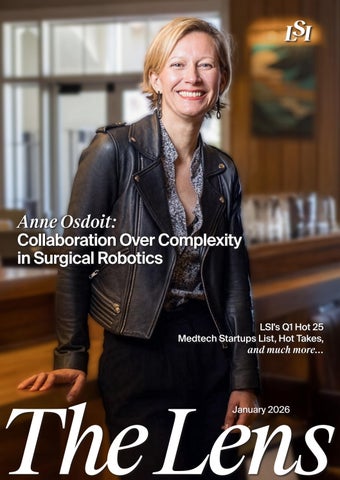
Anne Osdoit: Collaboration Over Complexity in Surgical Robotics
LSI's Q1 Hot 25 Medtech Startups List, Hot Takes, and much more...
The Lens February 2025 January 2026
LSI The Lens
January ‘26
Scott Pantel
Henry Peck
Tracy Schaaf
Brenna Hopkins
Nicholas Talamantes
Chief Executive Officer, Editor-in-Chief
Chief Business Officer, Editor-in-Chief
Managing Editor and Content Strategist, Lead Author
Sr. Manager of Content Programs, Lead Author
Sr. Director of Market Intelligence, Contributing Author
Rebekah Murrietta
Blake Matrone
Gavin Kennedy
Parker Walpole
Kelly Williams
Business Development, Contributing Author
Marketing Manager, Compass AI, Contributing Author
Subscriptions & Enterprise Sales
Vice President of Media, Sr. Marketing Manager, Contributing Author Contributing Author
Maricela Almonte
Benny Tomlin
Kristin Karkoska
Paul Streeto
Customer Service & Fulfillment
Contributing Photographer
Contributing Photographer
Graphic Designer
The Lens
Printed in the U.S.A. A publication of Life Science Intelligence, Inc. (LSI) 17011 Beach Boulevard, Suite 500 Huntington Beach CA 92647 714 847 3540 tel/fax email: info@ls-intel.com
Vol. 3, No. 1 January 2026 4
Created by LSI, The Lens leverages LSI’s deep industry relationships and proprietary market intelligence to help executives like you build lasting medtech companies. Start your Individual, Group or Enterprise-Wide subscription today! Scan QR Code to activate your subscription. The Lens is published monthly and available in print and electronic formats. Copyright 2026 by Life Science Intelligence, Inc. All rights reserved. Editor takes care to report information from reliable sources and does not assume liability for information published. Interested in subscribing? email to: info@ls-intel.com Interested in advertising? email to: kelly@ls-intel.com
LSI The Lens
January ‘26
Table of Contents Anne Osdoit: Collaboration Over Complexity in Surgical Robotics
LSI's Q1 Hot 25 Medtech Startups List, Hot Takes, and much more...
The Lens February 2025 January 2026
Vol. 3, No. 1 January 2026
Cover photo courtesy of Roger Fonts/The Artisan Photo Studio
06
Letter from the Editors
08
Hot Takes: Compelling Quotes from Industry Thought Leaders
10
Power Moves: Recent Leadership Shifts and Other Announcements
12
Select Medtech Industry Financings and Deals December 2025, by Date Announced
14
Investor's Corner
16
Cover Story - Anne Osdoit: Collaboration Over Complexity in Surgical Robotics
22
Market Dive: Hernia Repair Mesh
26
Market Dive: Pelvic Floor Repair Mesh
28
LSI Q1 Hot 25 Medtech Startups
30
Medtech Pulse Check, by the Numbers
32
Neurostimulation Procedure Volumes, by Country, 2024–2030
34
Intracranial vs. Extracranial SRS Procedures, by Country, 2024–2030
36
Feature Story – Backing the Breakthroughs: Ray Cohen’s Latest Strategic Bets
39
LSI Alumni Innovator Spotlight: AiM Medical Robotics’ Gregory Fischer
44
LSI Alumni Milestones: Recently Announced Wins
48
Index: Companies and People Covered in This Issue 5
Letter from the Editors
Dear Readers,
Medtech is entering a pivotal year. Not because the world is suddenly calmer or more predictable, but because it isn’t. As supply chains, capital flows, and healthcare systems are being reshaped, and the tide of AI continues to rise, every serious operator, investor, and innovator is trying to answer a simple question: how do we use cutting-edge technology to better serve patients in the real world, not just in theory? Our cover story follows one of the most thoughtful builders in this space: Anne Osdoit, CEO of Moon Surgical, Partner at Sofinnova Partners, and the leader of the firm’s medtech accelerator, MD Start. At a time when robotics is crowded with capital intensity and competing promises, Osdoit has taken a different view of progress. She isn’t building for replacement. She is building for collaboration. “There are 150 companies building surgical robots,” she told our audience at LSI Europe in London. “So why bother with another one?” Her answer is grounded in a reality many forget too quickly: the best technology does not always demand the world change for it. Often it is the one that enhances the world as it is. Moon’s Maestro system was designed to disappear into the workflow. It is purpose-built for ambulatory surgery centers, built for surgeons using existing tools, and built to support the 19 million procedures each year that today’s robotic platforms do not reach. It is not robotics as spectacle. It is robotics as leverage. Osdoit’s story is also a reminder that innovation is rarely a straight line. “Plan A almost never happens,” she says. “If you don’t have Plan B and Plan C ready, you’re not being realistic.” That kind of clear-eyed optionality paired with stubborn execution may be the defining advantage for leaders navigating this market cycle.
We see that same combination of discipline and decisive action in our feature on Ray Cohen’s latest strategic bets. In Q4 2025, Cohen quietly helped close two major financings ($67 million for Spiro Medical and $50 million for Biobeat Medical) without intermediaries and without fanfare. Just relationships, conviction, and an operator’s instinct for what matters: a real clinical problem, a product that works, and a team that can deliver. Finally, this edition includes our latest Hot 25 list, spotlighting the medtech startups drawing the highest interest from global executives using our Compass AI platform for sourcing, research, and dealmaking. We invite you to explore the list and see how proprietary data and insights from our team can accelerate your business. Stories like these are exactly why we are so energized about the year ahead. In 2026, LSI’s global summit series will hit California in March, Singapore in June, and Barcelona in September. Our flagship California summit already has more than 1,400 executives confirmed, toward a planned 2,000. The stakes are high. Capturing global investment will be pivotal for the companies building what’s next, and for the leaders determined to turn new technology into outcomes. As we look ahead, we are grateful to convene and support the community doing this important work across the clinic, the boardroom, the lab, and the operating room. Thank you for being part of it, and for helping shape what comes next. All the best,
Scott Pantel
Henry Peck
Chief Executive Officer, LSI
Chief Business Officer, LSI
Editor-in-Chief
Editor-in-Chief
The LSI team at the Thomas J. Fogarty Innovation Prize Gala, where LSI served as a Silver Sponsor.
LSI The Lens
January ‘26
Hot Takes: Compelling Quotes from Industry Thought Leaders Need fresh inspiration for your medtech company as we navigate Q126? We’ve gathered insights from some of our LSI alumni thought leaders to help you stay ahead.
“In the Bay Area, there is an arrogance that only the best innovation, the best technology exists in the Bay Area. Wrong. Get out of your world there and go to other parts of the world, and you will be amazed by what you see with innovation and talent.”
— Vy Tran, President of APJ, Siemens Healthineers LSI Asia ‘25 Keynote: Touchpoints that Matter: Building Health Systems for the Next Billion Patients
“There’s a trap investors can fall into where you are backing companies because you believe you can support them. And you end up backing founders who are maybe not the best founders to be building a business.”
— Fernando Pacheco, Partner, Endeavour Vision LSI Europe ‘25 Panel: Investment Trends: US vs EU
“Equity investors will never tell you that the reason they’re not coming into the cap table is because they don’t want to be the bad guy. They don’t want to have to tell you that your cap table needs a complete grenade and has to be reset at zero.”
— Owen Willis, Founder & General Partner, Opal Ventures
— Luke Düster, Chief Investment Officer, CRG
LSI Asia ‘25 Panel: Co-Founding Capital: How Investors Are Shaping the Next Generation of Startups
LSI USA ‘25 Panel: Pros and Cons of Creative Financing Approaches for Growth in 2025
“It shouldn’t take you more than 30 seconds to describe what you’re solving and get a broad agreement. If it takes you five minutes to explain the clinical issues you’re solving, then it’s not big enough for anyone to have thought about it.”
8
“If we want to scale these technologies and bring them to as many patients as possible, it’s very hard to do a story that doesn’t involve U.S. commercialization.”
“If you look at healthcare in general, medtech is doing super well. The question is not ‘How’s the market?’ It’s ‘Is your product something the market needs, the physicians want, and the patients need?’”
— Ramin Mousavi, President & CEO, CathWorks
— Antoine Papiernik, Chairman & Managing Partner, Sofinnova Partners
LSI Asia ‘25 Panel: Ask the Experts: Globalization Strategy and Partnership Readiness
LSI Europe ‘25 Opening Keynote with Antoine Papiernik and Laura Francis
LSI The Lens
January ‘26
9
LSI The Lens
January ‘26
Power Moves Celebrating recent leadership shifts and other announcements and accolades impacting our global LSI Alumni medtech community.
Salmon retired from Medtronic in September 2025 following a more than 20-year tenure, most recently serving as EVP and President of its cardiovascular portfolio. His experience spans electrophysiology, surgical and catheter-based ablation technologies, and strategic acquisitions, including Medtronic’s acquisition of Affera in 2022. Sean Salmon (Source: MedTech Dive)
Adagio Medical has appointed Sean Salmon, a longtime Medtronic executive, to its Board of Directors. Salmon will also serve on the company’s audit and compensation committees, bringing deep cardiovascular expertise as Adagio advances its cryoablation platform for ventricular tachycardia (VT). 10
His appointment follows a series of strategic moves by Adagio Medical, including an organizational restructuring, a securities purchase agreement worth up to $50 million, and FDA Breakthrough Device Designation for its vCLAS Cryoablation System. Berlin Heals has appointed Rob ten Hoedt as the new Chairman of the Board of Directors. A seasoned exe-
Rob ten Hoedt (Source: LinkedIn)
cutive with more than 30 years of global leadership in the medtech and healthcare sectors, ten Hoedt most recently served as EVP and President of Global Regions at Medtronic. He currently holds board positions at medmix, ONWARD Medical, and Fagron International. His appointment follows a period of strong clinical momentum for
LSI The Lens
Berlin Heals, including the publication of C-MIC II trial results in the European Journal of Heart Failure in 2025 and continued development of a less invasive, outpatient version of the company’s Cardiac Microcurrent (C-MIC) Therapy. C-MIC Therapy is delivered via a fully implantable device that consists of two electrodes connected to an implantable generator that provides constant direct microcurrent across the diseased heart, reducing inflammation and reverse remodeling the heart. The approach is being developed for patients with heart failure, a progressive and widespread disease with rising global costs and no commercially available curative options.
Eric Thépaut (Source: CathVision)
CathVision has appointed former Boston Scientific executive Eric Thépaut as Independent Chairman of the Board. Thépaut brings extensive leadership experience in finance, global commercial operations, organizational development, and operational scale-up, most recently serving as President of EMEA at Boston Scientific. During his tenure, he led the integration and growth of numerous acquisitions and launched new technologies, most recently overseeing the launch of the company’s first pulsed-field ablation platform. He joins CathVision at a pivotal time as the company builds its commercial presence in the U.S. and Europe, following FDA clearance of the ECGenius System and Cardialytics in 2023 and CE Mark certification for ECGenius in 2025. The appointment was announced alongside the commercial release of ECGenius Software Version 3.5, which introduces both hardware and software enhancements to streamline workflows and improve system performance. With Thépaut’s strategic oversight, CathVision is well-positioned to expand
January ‘26
its clinical adoption and accelerate the next phase of growth in cardiac electrophysiology.
a highly successful physician-scientist and is consistently ranked among the world’s top five AD researchers. In his role as CMO at Eisai, he was a key architect behind the landmark approval of Leqembi. His appointment to Sinaptica’s Scientific Advisory Board comes as the company prepares for a pivotal clinical trial and advances planning for market access frameworks for its personalized, non-invasive neuromodulation therapy.
Scott Huennekens (Source: LSI USA ‘25)
INBRAIN Neuroelectronics has named medtech veteran Scott Huennekens as Chairman of its Board of Directors. A highly respected leader in medtech, Huennekens brings a proven record of founding, scaling, and guiding transformative healthcare technology companies. Over the course of his career, he has served as the start-up CEO of two unicorn-valued companies and contributed to more than 10 high-growth medtech companies with combined valuations exceeding $6 billion. His appointment marks a major milestone for INBRAIN as it accelerates its graphene-based brain-computer interface (BCI) therapeutics platform into later-stage clinical development. INBRAIN’s next-generation BCI technology combines BCI decoding with micrometric modulation to deliver adaptive, personalized treatments for patients with neurological conditions such as Parkinson’s disease, epilepsy, and stroke. Huennekens joins the company at a pivotal time as it advances toward pivotal trials and prepares for future commercialization.
Harald Hampel, MD, PhD, MSc (Source: LinkedIn)
Sinaptica Therapeutics has appointed Alzheimer’s disease (AD) expert Harald Hampel, MD, PhD, MSc, to its Scientific Advisory Board. Dr. Hampel is
Dr. Hampel brings more than three decades of leadership in neurology and neuropsychiatry trials and research, and is a global leader in AD drug development. His expertise spans diagnostic technologies, pharmacological drugs, and neuromodulation approaches, positioning him to help shape Sinaptica's evidence generation and therapy development programs.
Spencer Stiles (Source: LSI USA ‘25)
Stryker has appointed LSI Alumni speaker Spencer Stiles as President and Chief Operating Officer, effective January 1, 2026. In this newly elevated role, Stiles will lead the company’s global businesses, corporate strategy, and mergers and acquisitions. A 27-year veteran of Stryker, he most recently served as Group President of Orthopedics and Spine. Throughout his career at Stryker, he has held leadership roles across orthopedics, MedSurg, and neurotechnology and has overseen international regions and key supporting functions. He brings a strong track record of performance and is widely recognized for his strategic vision, motivational and collaborative leadership, and dedication to advancing healthcare through technology. His promotion marks a key milestone as Stryker looks to further strengthen its global portfolio and innovation pipeline in partnership with customers worldwide. 11
LSI The Lens
January ‘26
Select Medtech Industry Financings and Deals December 2025, by Date Announced Company
Type of Deal
Technology
Mechanical thrombectomy platform for venous thromboembolism Bioabsorbable cardiovascular valves and Xeltis Other vessels for endogenous tissue restoration Interventional Strategic Robotic system for Systems Partnership minimally invasive surgery Shoulder Strategic Shoulder replacement Innovations Partnership implant systems Wearable device for Kestra Medical Other cardiac monitoring and Technologies defibrillation Akura Medical
Series C
Foresight Diagnostics
M&A
X9
Other
FeelTect
CrannMed Salaso Rockfield Medical Devices PerQHern Mirai Medical Acarix
Point-of-care, AI-powered ultrasound navigation and imaging Point-of-care wearable device to optimize Grant compression therapy for venous leg ulcers Resorbable embolization Grant microspheres for orthopedic indications Digital health for Grant musculoskeletal therapy Plug-and-play technologies for the Grant worldwide enteral feeding market Percutaneous inguinal Grant hernia repair system Pulsed-field energy device Grant for precision cancer treatment Acoustic monitoring of Later Stage coronary artery diseases of the heart
Saluda Medical IPO
Sibel Health
Grant
Perimeter Medical Imaging AI
Other
12
Liquid biopsy diagnostics for early cancer relapse detection
Implantable closedloop neuromodulation technology Wireless vital signs monitoring platform OCT technology for near real-time margin assessment in breast cancer surgery
Amount ($USD)
Investors Included
Raise Date
$53M
Qatar Investment Authority (led), other current investors
12/1/2025
$55.1M
European Investment Bank (EIB), EQT, Invest-NL, other existing investors
12/2/2025
NA NA
Shoulder Innovations - partnership to develop shoulder-specific micro robotics Interventional Systems - collaboration to develop shoulder-specific micro robotics
12/3/2025 12/3/2025
$138M
Underwritten offering of 6 million shares of 12/3/2025 common stock at $23 per share
$450M
Natera agree to acquire Foresight Diagnostics in an all-stock transaction consisting of $275M upfront with an additional $175M in milestone payments
12/5/2025
$8.6M
three undisclosed investors
12/5/2025
$7.4M*
The Irish Government's Disruptive Technologies Innovation Fund (DTIF)
12/8/2025
$7.7M*
The Irish Government's Disruptive Technologies Innovation Fund (DTIF)
12/8/2025
$7.7M*
The Irish Government's Disruptive Technologies Innovation Fund (DTIF)
12/8/2025
$3.9M*
The Irish Government's Disruptive Technologies Innovation Fund (DTIF)
12/8/2025
$3.4M*
The Irish Government's Disruptive Technologies Innovation Fund (DTIF)
12/8/2025
$8.4M*
The Irish Government's Disruptive Technologies Innovation Fund (DTIF)
12/8/2025
$3.6M*
Direct Share Issue of SEK 33.4M
12/8/2025
$150M
Australian IPO - Wellington Management, Fidelity Management & Research Company, funds and accounts advised by T. Rowe Price Associates, Inc., TPG Life Sciences Innovations, Redmile Group, LLC, other undisclosed investors
12/9/2025
$500K
U.S. FDA
12/9/2025
$2.6M*
Private placement of 19,757,306 units at a price of CA$0.18 per unit
12/9/2025
LSI The Lens
January ‘26
Compass Powered by proprietary insights from LSI Europe, LSI Asia, and LSI USA, Compass gives you access to thousands of private company profiles and presentations you won't find anywhere else. Scan QR code for details.
Company
Type of Deal
Technology
Implantable device for treating chronic heart failure BCI technology based on biocompatible nanoparticles Next-generation intravascular imaging solution
Amount ($USD)
Investors Included
Raise Date
$158M
Sands Capital (led), Braidwell (led), Redmile, Perceptive, Alger, undisclosed prominent industry executives
12/10/2025
$10M
Golden Falcon Capital
12/12/2025
NA
Philips has agreed to acquire SpectraWAVE. Terms of the deal were not disclosed.
12/15/2025
Impulse Dynamics
Other
Subsense
Other
SpectraWAVE
M&A
CranioSense
Grant
Non-invasive solution to triage and continuously monitor ICP
$5.5M
NIH Blueprint MedTech Program, the U.S. Department of Defense's Joint Warfighter Medical Research Program (JWMRP)
12/17/2025
RedDrop Dx
Seed
Point-of-care blood and plasma collection system
$5M
Innosphere Ventures (led), Stout Street Capital (led), Breakthrough Venture Capital, several strategic angel investors
12/18/2025
$14M
AIX Ventures (led), SpringTide, Berkeley Catalyst Fund, Lightscape Partners, Solasta, Alumni Ventures, Amino Capital, Angelschool, LDV Partners, Maliam, XB Ventures, Celtic House Asia Partners Health, Device of Tomorrow Capital, NYX Ventures Partners, SmartLink Partners
Wearlinq
Series A
Wearable continuous monitoring for heart disease, with a focus on ECGs
Wearlinq
Debt Financing
$5M
Undisclosed
12/19/2025
Neurable
Wearable continuous monitoring for heart disease, with a focus on ECGs
Series A
Non-invasive BCI products
$35M
Spectrum Moonshot Fund (led)
12/19/2025
Profound Medical
Other
$40M
$36M in a registered direct offering with $4M in private placement in Canada
12/19/2025
Carvolix
Other
$11.8M
Truffle Capital (led), Edwards Lifesciences (led) first tranche of up to €30M
12/19/2025
$32.8M
Affluent Medical has agreed to acquire Caranx Medical and Artedrone. The company will henceforward be known as Carvolix. Affluent acquired Artedrone for €11.4M and Caranx for €16.6M
12/19/2025
$19.5M
Affluent Medical
12/22/2025
$13.3M
Affluent Medical
12/22/2025
$15M
First tranche of secured notes and warrants to purchase common stock, with an additional $35M available.
12/24/2025
$1.6M
Part of a larger Series A round of $6,016,261.
12/29/2025
$50M
Ally Bridge Group (led), OrbiMed Advisors, Elevage Medical, and a strategic investor
12/30/2025
Affluent Medical
M&A
Caranx Medical M&A Artedrone
M&A
Picard Medical Other Aqua Heart
Series A
Biobeat
Series B
MRI-guided, minimally invasive, robotic therapeutic systems Innovative implants and robotic solutions for structural heart disease and stroke Innovative implants and robotic solutions for structural heart disease and stroke Surgical robotics platform for endoluminal procedures Autonomous robotics for mechanical thrombectomy Total artificial heart to replace both ventricles of a failed heart Over-the-wire, highenergy, single-shot cardiac ablation technology Cuff-less blood pressure monitoring platform
12/19/2025
*Currency converted to $USD for data consistency (1/7/2026 exchange rate)
13
LSI The Lens
January ‘26
Investor's Corner, by Region, 2023–2030 Spotlighting capital partners who continue to drive innovation across medtech
415 Capital Distalmotion CorFlow CorFlow Therapeutics Endovascular Engineering Supira Medical Hilo Broadview Ventures Relief Cardiovascular Puzzle Medical Devices CroíValve FineHeart AtaCor Medical
14
LSI The Lens
January ‘26
Lux Capital Eikon Therapeutics Cala Health Mendaera Paradigm Health SteadyMD Atrandi Biosciences Supernova Invest SeqOne Discure Technologies UroMems Gleamer CAIRDAC AcuSurgical
15
LSI The Lens
January ‘26
Cover Story
Anne Osdoit: Collaboration Over Complexity in Surgical Robotics
Anne Osdoit (Source: LSI USA ‘25)
At a moment when surgical robotics is crowded with capital intensity and competing promises, Anne Osdoit has chosen a different path. As CEO of Moon Surgical, Partner at Sofinnova Partners, and leading the VC firm’s medtech accelerator, MD Start, as an investor and a seasoned company builder, Osdoit is redefining innovation by starting not with replacement, but with collaboration. Here, she reflects on her journey from biomedical engineer to repeat medtech CEO, the conviction behind Moon Surgical’s human-centered, AI-powered surgical robotics platform, and the leadership mindset required to build the future of robotics by keeping surgeons, patients, and reality firmly at the center. 16
LSI The Lens
“There are 150 companies building surgical robots,” Anne Osdoit told the LSI Europe audience recently, while on stage giving a Moon Surgical presentation. “So why bother with another one?” It was a question she had been asking herself for years. Osdoit spent more than a decade evaluating surgical robotics opportunities across Europe and the U.S., first as an operator and later as an investor and company builder. She had seen the field fracture into two categories. Large, capital-intensive platforms designed to emulate Intuitive Surgical’s market-leading da Vinci model, and smaller but highly specialized robots built for single indications. Technically impressive systems that struggled to justify their cost or complexity once they met real clinical environments. “We had looked at almost every robotic opportunity out there,” she told The Lens during a recent conversation. “And nothing felt quite right. Either it wasn’t differentiated enough, or it wasn’t large enough to matter.” She pauses, then adds, “We were interested in robotics, but we were not interested in building something just because the category was hot.” Moon Surgical would emerge not as a reaction to the industry’s dominant players, but as a response to what they had left behind. Founded in Paris in June 2020 by Prof. Brice Gayet, MD, PhD, and joined by Osdoit as CEO, the company received seed funding and started incubation, virtually due to the pandemic, with the in-house Sofinnova Partners medtech accelerator, MD Start, led by the multi-talented Osdoit.
“We were not interested in building another robot that asked surgery to adapt to it. We wanted the technology to adapt to surgery.” The team envisioned and created an entirely new category of robotic surgery that enhances existing surgical tools
January ‘26
and techniques with new AI-enabled capabilities, delivering unprecedented surgical experience with simplicity and workflow integration. It was built to be used in broad indications and settings, including the high-growth ambulatory surgery center (ASC) setting in the U.S., and the 19 million procedures a year that are not currently supported by existing surgical robots. “We were not interested in building another robot that asked surgery to adapt to it. We wanted the technology to adapt to surgery,” says Osdoit.
Drawn to Hospitals Before She Knew Why Osdoit’s path into medtech was not inherited, but it was intuitive. Raised in a family of math teachers and engineers, and having lived across Europe as a child, she gravitated early toward disciplines that combined rigor with consequence. “I didn’t really imagine doing anything else,” she says. “I was always drawn to the hospital environment, even before I fully understood what medtech could be.” She trained as a biomedical engineer at École Polytechnique in Paris, then crossed the Atlantic to complete graduate studies at Johns Hopkins University. Later, she added formal training in biostatistics and epidemiology applied to clinical trials at Université Pierre et Marie Curie, followed by corporate finance studies at the London School of Economics. “I liked understanding things all the way through,” she says. “From the science, to the clinic, to how decisions are actually made by clinicians.” Osdoit’s decade at Mauna Kea Technologies, maker of the world’s first and only in vivo cellular imaging system, grounded that instinct in reality. She helped take a category-defining new imaging technology from prototype to first-in-human use, through regulatory approval, and into commercial life. “You learn very quickly that nothing matters until it works in the clinic,” she says. “And that trust—in your product, in the team backing you—is everything.” Trust would become a defining theme of her career.
A Different Take on Robotics By the late 2010s, Osdoit was deeply embedded in Europe’s medtech company creation and investment ecosystem. Alongside colleagues, she evaluated robotic platforms across soft tissue, orthopedics, and spine. However, her conclusion was that each came with limitations. In soft tissue surgery, many platforms sought to replicate existing robotic paradigms focused on delivering greater dexterity and precision for fine suturing. In other areas, single-indication robots struggled to justify the scale of investment required. In hard tissue, the market had matured to the point where true disruption was rare. Then, in early 2020, Prof. Gayet, an early laparoscopy pioneer, presented a different idea: a collaborative platform that would sit next to the surgeon, enhancing control without removing them from the operative field. “That concept alone felt different,” Osdoit recalls. “Not fully formed, but different enough to look more closely.” The underlying technology drew from the nuclear industry in France, bringing with it a novel approach to force sensing, ease of use, and safety. The intellectual property was distinct. The form factor was compact. And most importantly, the concept did not assume that progress required distancing surgeons from patients. During diligence, advisors urged her to narrow the system to a single clinical indication and design around it. Instead, she asked a different question: what if the right constraint was not the procedure, but the setting?
A Technology that Adapts to Surgery The answer was ambulatory surgery centers. In the U.S, the migration of low-acuity, high-volume procedures out of hospitals and into ASCs was already well underway. These environments demanded efficiency, flexibility, and minimal overhead. They did not have the staffing models, budgets, operating rooms large enough, or appetite for 17
LSI The Lens
large, console-based robotic systems. Besides, they were also craving workflow-related efficiency well beyond the surgical procedure, creating an opportunity in a world where data sensing and leveraging were becoming the norm but had not yet made it to the operating room. “If we designed specifically for that care setting,” Osdoit explains, “everything became clearer. The form factor, the usability, the workflow, the insights, all of it followed.” She puts it more simply: “We didn’t start with a procedure. We started with a reality.” Moon Surgical’s platform was designed accordingly. Surgeons use their existing instruments, endoscopes, and techniques. There is no dedicated room. No console across the OR. No retraining of staff. The platform works at the bedside, providing an extra set of arms and hands that respond intuitively to the surgeon’s movements. “The most powerful technology is the one that disappears into the workflow,” Osdoit continues.
January ‘26
“Looking back,” Osdoit says, “that level of trust shaped our culture more than any office ever could.” She was determined to get the system into the clinic early, provided it met rigorous safety thresholds. Surgeons needed to use it, not just evaluate it in a lab. Just 18 months in, they entered the clinic. Surgeons began performing multiple procedures per day, often without company support in the room. From the very first cases, the system removed the need for an additional staff member in the OR. “When surgeons start using the system without you in the room, that’s when you know you’ve done something right,” Osdoit says.
“When surgeons start using the system without you in the room, that’s when you know you’ve done something right.”
“The most powerful technology is the one that disappears into the workflow.”
What felt intense at first soon became routine.
From First Patients, to Everyday Use, to the OR of the Future
To date, following FDA clearance of its first Maestro system in December 2022 and CE Mark in April 2023, Moon Surgical has treated more than 2,500 patients globally, across procedures such as gallbladder removal, hernia repair, bariatric surgery, colorectal procedures, and benign hysterectomies.
Moon Surgical moved deliberately, but quickly. Moon was convinced that a rapid design cycle would be a key enabler of the right platform architecture for the ASC setting, integrating from the get-go the data sensing and computing components that would later be leveraged once the hardware made it to the operating rooms. And, the company’s beginnings during the early days of the pandemic helped build the trust and resilience they would need. The small team went through their first prototype iteration without offices, conference rooms, or the rituals of startup life. Engineers assembled robotic arms in their homes. 18
“At some point, it stops feeling extraordinary,” she continues. “It just becomes part of how work happens every day. You’re in the office, and you get notified automatically on Slack that procedures are being done in the field.”
“For a small company, that’s meaningful,” she says. “And it builds credibility.” As part of Moon Surgical’s goal to build the OR of the future, one that is digitalized, efficient, and sustainable, it is collaborating with NVIDIA, one of the world's largest companies and a global leader in AI computing, to accelerate the AI capabilities of its Maestro system. Maestro uses the NVIDIA Holoscan platform for real-time sensor processing and is powered by NVIDIA IGX technology. In May 2023, NVIDIA
co-led Moon Surgical's $55.4 million Series B financing round, and as of March 2025, the company expanded its collaboration with NVIDIA to further advance the Maestro system's physical AI capabilities through the NVIDIA Isaac for Healthcare platform. The platform is purpose-built for developing healthcare robots. “We're excited for the release of NVIDIA Isaac for Healthcare, which will help us add even more perceptive and intelligent capabilities to evolve the practice of surgery on our digital and AI native architecture,” says Osdoit, in a release announcing the collaboration. By integrating cutting-edge AI-driven abilities to perceive, understand, and interact with the world around it, Maestro is evolving beyond traditional robotic assistance to actively interpret, adapt, and enhance surgical workflows in real time.
Leadership at the Moment of First Use Moon’s clinical entry marked Osdoit’s fourth first-in-human experience as a leader, following her work at May Health, SafeHeal, and Gradient Denervation Technologies, where she was also founding CEO (and remains on the board for the two former). “You never forget that first procedure,” she says. “You hold your breath, but you also know you’ve done everything possible to make it safe.” She is clear-eyed responsibility.
about
the
“There is no room for ego in the procedure room,” Osdoit says. “Only responsibility.” She also says that you do not know everything, but you trust your team. You trust your preparation. And you accept the gravity of the decision.
MD Start’s Portfolio of Hands-On Innovation When Osdoit joined Sofinnova Partners as a Partner in 2015, her mandate was not simply to invest. It was to help build. That work took formal shape through MD Start, Sofinnova’s in-house med-
LSI The Lens
January ‘26
tech accelerator, which Osdoit has led since joining the firm. MD Start operates differently from traditional venture investing. Rather than waiting for founders to pitch ideas, the team identifies unmet clinical needs, partners with clinician inventors, builds companies from inception, and once the project is
sufficiently derisked, it installs experienced operators to lead them. Since its inception, MD Start has founded and financed 15 medical device companies in very diverse fields (e.g., cardiovascular, neurovascular, women’s health, and robotics). MD Start’s MD Start I fund, closed in 2008 with a size of
€8.2 million, created three companies. MD Start II, closed in 2015 with a size of €10.3 million, created four companies. MD Start III, closed in 2019 with a size of €63 million, ended with six new companies in its portfolio. Its latest fund, MD Start IV, has already started building two companies (see Table).
MD Start Portfolio Companies Company/Year Founded
Technology
MD Start Fund
Stage or Exit
Advanced Perfusion Diagnostics (APD)/2011
Patient monitoring solutions for critical care and the operating room, focusing on continuous microvascular blood flow monitoring using photoplethysmography technology
I
Acquired by Vygon in 2020 (deal value undisclosed)
CorWave/2012
Implantable blood pumps for cardiac assistance, based on unique wave membrane pumping technology
I
Clinical stage; first-in-human in 2025
LimFlow/2012
Minimally invasive technology for critical limb-threatening ischemia
I
Acquired by Inari Medical in 2023 in a deal worth up to $415 million
SafeHeal/2015
Surgical implant and instrumentation to prevent anastomotic leaks in colorectal surgery
II
Commercial stage (CE marked) and U.S. pivotal study ongoing
preCARDIA/2015
Device to treat acute decompensated heart failure by reducing the volume load on the heart
II
Acquired by Abiomed in 2021 (deal value undisclosed)
May Health/2017
Minimally invasive treatment for polycystic ovary syndrome (PCOS)
II
CE marked and U.S. pivotal study ongoing
HEPTA Medical/2019
Minimally invasive microwave ablation technology for early-stage lung cancer treatment
II
Late preclinical/early clinical transition stage
Gradient Denervation Technologies/2020
Device-based minimally invasive solution for the treatment of pulmonary hypertension
III
Clinical stage; advancing to pivotal study
Moon Surgical/2020
Collaborative robotic surgery platform for low-acuity procedures; designed to give surgeons more control and efficiency in standard laparoscopy
III
Commercial stage (CE marked and FDA cleared); expanding internationally
Endoron Medical/ 2021
Catheter-based endograft stapling solution for the minimally invasive repair of abdominal aortic aneurysms
III
Clinical stage; advancing to pivotal study
BrightHeart/2022
AI-powered fetal cardiac imaging diagnostics
III
Commercial stage (FDA cleared)
Julier Medical/2022
Next-generation neuroendovascular catheter and platform for stroke treatment
III
Clinical stage; first-in-human in 2025
Tulyp Medical/2023
Pressure-driven perfusion system designed to improve tissue oxygenation and reduce complications in vascular procedures
III
Clinical stage; first-in-human in 2025
Exploramed MDS1
Undisclosed
IV
Undisclosed
Sotelix
Undisclosed
IV
Undisclosed
Sources: Sofinnova MD Start, LSI Market Intelligence
19
LSI The Lens
MD Start is an intentionally integrated model, blending venture discipline with operational ownership. From its proprietary deal flow originating from physician and researcher inventors, MD Start creates, develops, and operates the projects, turning them into new companies with both strategic and hands-on approaches, in order to bring them to traditional venture investment stage, clinical validation, and commercial development. “At MD Start, we don’t just fund companies,” Osdoit explains. “We build them. And we take full responsibility for how they are run.” Sofinnova Partners, founded in 1972, operates as a global life sciences venture capital firm, backing companies across stages with scale, governance, and providing long-term capital (Also see “Long Game Legends: Makower and Papiernik’s Playbook for Success,” The Lens, December 2024). Sofinnova Partners, with over €4 billion under management, has backed more than 500 companies, creating market leaders around the globe. MD Start, within that umbrella, is designed for the earliest moments when technology, teams, and strategy are still being shaped. One looks for excellence and momentum. The other creates it. Osdoit embodies that hands-on philosophy. She is the founding and current CEO of Moon Surgical. She was also founding CEO of Gradient Denervation Technologies and previously served as founding CEO of both SafeHeal and May Health. She sits on boards across the Sofinnova portfolio and beyond, including independent board roles at
January ‘26
FeetMe and Cardiologs Technologies in the past, with the latter acquired by Philips in 2021. “I’ve never really separated those roles,” she says. “They inform each other every day. As a CEO, you live with the consequences. As an investor, you learn to see patterns.”
The Realities of Medtech, Optionality, and Guiding Principles Osdoit does not gloss over the present moment. Fundraising has been exhausting. External capital is scarce. Many companies are relying on internal rounds.
optionality. “Plan A almost never happens,” she explains. “If you don’t have Plan B and Plan C ready, you’re not being realistic.” Optionality, in her view, is about anticipation. Thinking 12 months ahead. Understanding where value can still be created if one path closes. Refusing to put everything into a single outcome. “As a CEO, you have to assume that something won’t go as planned,” she says. “So you ask yourself, if this doesn’t work, where is the next source of value?” She learned that lesson early. She lives it daily.
“It has never taken so much energy to fundraise for so little immediate result,” she says.
One powerful reminder is a note that Osdoit, who is raising four children at home, carries with her, written years ago by her young daughter. It reads: Mommy, I love you because you always find solutions.
And yet, Moon Surgical advanced. MD Start companies reached first-in-human milestones. Moon treated more than 1,600 patients in the past year alone.
“That’s really what the job is,” Osdoit says. “Finding solutions. Helping people make decisions. Being there when things are hard.”
“Once you are in the clinic, medtech is about execution,” Osdoit says. “And execution is something you can control.”
Osdoit, as humble as she is ambitious, is quick to deflect attention from herself. But her story resonates because it reflects something larger.
For innovators looking to succeed in the space, Osdoit does not soften the reality. “It is hard,” she says. “And it is scary.” Capital is tighter, and timelines are longer. External uncertainty is constant. But her advice is not to hesitate. It is to prepare. “You have to be realistic,” says Osdoit. “But you also have to be stubborn about what really matters.” At the core of her guidance is
Medtech today is scaling and reinventing at the same time. It needs leaders who understand execution and judgment, ambition and restraint. Osdoit happens to sit precisely at that intersection, and she does not see that as exceptional. She sees it as necessary. In a forward-thinking industry, Anne Osdoit reminds us that the leaders who last are the ones who plan for what might break, stay close to the clinic, and keep finding solutions anyway.
Anne Osdoit CEO, Moon Surgical Partner, Sofinnova Partners
(Source: LSI Europe ‘23)
20
Osdoit is a biomedical engineer by background, trained in both France and the United States. She has been running the in-house Sofinnova Partners MedTech accelerator, MD Start, since she came on board as a partner in 2015. She embodies the MD Start team’s hands-on approach: Anne is the founding and current CEO of Moon Surgical, where she is developing a whole new category of robotic surgery with her team. She was the founding CEO of Gradient Denervation Technologies. She is a Board member of both SafeHeal and May Health, two companies where she was also founding CEO.
LSI The Lens
January ‘26
21
LSI The Lens
January ‘26
Market Dive Hernia Repair Mesh Global demand for hernia repair mesh is accelerating due to an aging population and emerging product innovation. However, the market continues to face pricing pressure and legal turbulence, even as new materials and expanded coverage policies shape future adoption.
Metric
Open
Laparoscopic
Robotic
��
���� ������
��
���� ������
Incision size (6–10 cm)
Procedure time
(0.5–1.2 cm)*
(1–2 cm)*
Recovery time
Procedure cost
*Laparoscopic and robotic procedures create multiple small keyholes - more incisions, but significantly smaller than open.
Did You Know?
Watchful waiting: ~70% of patients initially opt for watchful waiting, but eventually end up needing surgery due to pain or complications.
22
Complications:
Common complications include seroma, infections, and post-operative pain.
Recurrence:
Regardless of approach, recurrence is ~1–3% of all cases.
Material:
Most meshes are made of medicalgrade polypropylene.
LSI The Lens
January ‘26
Population Growth and Procedure Volumes Fuel Expansion
According to the FDA, mesh is used in approximately 90% of all hernia repair procedures. Hernia risk is correlated with advancing age, making demographic trends a powerful growth driver. From 2024 to 2029, the global population aged 65 and older is expected to grow 3.1% per year, contributing directly to increased procedural demand. Unit volume growth in hernia repair mesh is expected to rise 3.4% annually over the same period.
A hernia occurs when an opening or weakness occurs in the connective tissues and muscles of the abdomen. The repair of a hernia is performed with sewn surgical mesh to close the hernia and reinforce the surrounding tissue. In 2024, the global hernia mesh market was valued at $4.7 billion, with approximately 5.9 million units sold annually. Growth is forecast at 5.3% annually through 2029, bringing the global hernia mesh market to an estimated $6.1 billion, driven by rising surgical volume and an aging population.
Pricing Pressures and Clinical Tradeoffs Despite consistent procedural demand, pricing pressure has created headwinds for market growth. In recent years, some physicians have opted for
lower-cost mesh alternatives that may not offer equivalent clinical performance. However, this trend is beginning to subside, as outcomes data have demonstrated a net overall increase in the cost of care due to the need for repeat procedures and complex repair operations.
Innovation in Hernia Repair Mesh Next-generation technologies are playing an important role in shaping the hernia mesh landscape. In April 2025, BD launched the Phasix ST Umbilical Hernia Patch, the first fully absorbable hernia patch on the market specifically designed for umbilical hernias. The patch is made of Poly-4-hydroxybutyrate (P4HB), a
Global Hernia Repair Mesh Market Forecast: 7,000,000 Unit Volume, and ASP Trends, 2024–2029 by Sales,
7,200 7,000
6,000,000
6,800 6,600 6,400
4,000,000
6,200 3,000,000
6,000 5,800
2,000,000
5,600
1,000,000
0
Units (000)
Sales ($000)
5,000,000
5,400
2024
2025
2026
Units (000)
2027
Sales ($000)
2028
2029
CAGR
3.4%
5.3%
1.8%
Year
Unit Volume (000s)
Sales ($000)
ASP ($)
2024
5,922
4,688,644
792
2025
6,111
4,920,382
805
2026
6,313
5,164,639
818
2027
6,530
5,432,904
832
2028
6,763
5,727,703
847
2029
7,012
6,057,815
864
5,200
Source: LSI Market Intelligence
23
LSI The Lens
January ‘26
biologically-derived material, with the Boston Scientific added benefits of a hydrogel barrier 48.7% based on Sepra Technology. According to BD, survey data suggests that 60% of patients prefer non-permanent mesh options for hernia repair, and over 70% of surgeons indicate they are open to incorporating patient mesh preferences into their clinical decision-making. That same month, W.L. Gore & Associates announced that the GORE SYNECOR Preperitoneal Biomaterial became available in Europe, the Middle East, and South Africa. The hybrid tri-layer material previously received FDA clearance and was commercially launched in the U.S. in 2017, and Other approval in February received CE mark 1.6%
oston Scientific
2024. It is designed for minimally invaStryker 5.7% sive (laparoscopic and robotic) and open surgical procedures and features a blend of absorbable and permanent materials, supporting bothMerit tissue inteMedical gration and mechanical strength.13.2% With sizes ranging from a 9 cm circle up to 40 x 50 cm rectangle, the product is well-positioned for complex abdominal wall reconstructions. In June 2025, TELA Bio announced the launch of its OviTex Inguinal Reinforced Tissue Matrix in Europe, following a successful U.S. launch in 2024. Engineered specifically for roboticTELA Bio assisted and laparoscopic inguinal 1.0% hernia repair procedures, the anatomically shaped device features
ovine-derived layers interwoven with minimal polymer, designed to minimize permanent polymer footprint.
Market Access Milestones for Bioabsorbable Mesh New reimbursement decisions are expanding access to advanced mesh technologies. In November 2025, BD announced two significant coverage wins for its Phasix Mesh and Phasix ST Mesh. 25.6%
Cigna Healthcare issued a positive coverage decision for Phasix ST Penumbra Mesh in 2.7% hiatal hernia (paraesophageal Others hernia) repair, while Elevance Health, 24.9% formerly Anthem, added coverage for J&J Medtech 8.2% Phasix Mesh and Phasix ST Mesh in Zimmer Biomet the surgical repair of complex abdom25.5% inal wounds.
48.7%
Global Hernia Repair Mesh Market Share, by Supplier, 2024
According to BD, the positive covMedtronic 12.1%
erage decisions bring more treatment options to patients and enable surgeons to select the most appropriate mesh based on patient-specific needs.
LifeCell 20.4% Medtronic 9.1% Gore 3.0%
Ethicon/J&J 29.4%
RTI Biologics 0.8% Other 1.6%
TELA Bio 1.0%
BD 34.8%
Supplier
2024 Sales ($000)
Market Share (%)
BD
1,631,621
34.8
Ethicon/J&J
1,377,771
29.4
LifeCell
955,284
20.4
Medtronic
425,209
9.1
Gore
139,992
3.0
RTI Biologics
37,385
0.8
Tela Bio
45,925
1.0
Other
75,456
1.6
Total
4,688,644
100.0
Other includes Cook, Exogenesis, and Novus Scientific, among others. Source: LSI Market Intelligence
24
Legal Disputes and Competitive Tensions While new products and policies are improving patient options, the market remains contentious. In December 2025, TELA Bio sued BD, alleging anti-competitive practices in the U.S. surgical hernia mesh market. The lawsuit claims that BD leveraged its dominance in permanent hernia mesh and resorbable hernia mesh to exclude TELA Bio’s OviTex product. As a result, TELA claims that BD’s actions resulted in the loss of substantial revenue.
Looking Ahead The hernia mesh market is poised for steady growth through 2029, fueled by aging demographics, procedural demand, and broader access to advanced materials. While pricing remains a limiting factor, the rise of absorbable and hybrid solutions is reshaping how surgeons approach soft tissue repair. As clinical data and reimbursement policies continue to align, next-generation meshes may define the next era of hernia care.
LSI The Lens
January ‘26
25
LSI The Lens
January ‘26
Market Dive Pelvic Floor Repair Mesh Pelvic floor repair mesh procedures are on the decline, driven by safety concerns and the rise of alternative treatment options. While global demand for incontinence treatment remains strong, mesh-based surgical repair has lost ground due to litigation, market exits, and shifting physician preferences.
Cook Medical 13.0% Boston Scientific 36.3% Ethicon/J&J 22.4%
BD 28.3%
Boston Scientific 48.7%
Supplier Other 1.6%Boston Scientific
30,354
36.3
23,629
Ethicon/J&J
18,721
22.4
Cook Medical
10,906
13.0
Total
83,610
100.0
20.4% Pelvic floor repair mesh is used durScientific ingBoston surgical procedures to repair pelvic 36.3% organ prolapse (POP) and stress urinary incontinence. It is often performed Ethicon/J&J 29.4%
Market Share (%)
BD
LifeCell A Market in Decline
26
2024 Sales ($000)
25.6%
Penumbra
Others 24.9%
2.7%
J&J Medtech
28.3
8.2%
Zimmer Biomet 25.5%
vaginally, and it typically involves the use
Medtronic 12.1%
favor. In the U.S., pelvic floor repair procedures, which are primarily performed for the treatment of incontinence, the strength of the weakened tissues. Medtronic declined 56% between 2011 and 2021. 9.1% Over the past decade, pelvic floor Despite continued growth in the aging repair mesh has fallen sharply out of female population, global utilization Gore 3.0% of a surgical mesh implant to reinforce
RTI Biologics 0.8%
LSI The Lens
January ‘26
of pelvic mesh has dropped due to complications such as tissue erosion and chronic pain, and the widespread impact of associated litigation.
reputational challenges. During the 2015–2019 period, roughly half of the major suppliers of pelvic mesh products exited the market to limit their liability.
Minimal Growth, Shifting Preferences
A Promising Path Forward
Although pelvic floor mesh unit volumes are projected to decline slightly through 2029 (–0.8% CAGR), global sales are expected to grow at a modest 1.2% annually, reaching $88.6 million. The average selling price per unit is forecast to rise from $614 in 2024 to $678 in 2029.
While new product launches have been rare in recent years, early research into next-generation degradable materials has emerged as a potential turning point. In February 2025, researchers at Hudson Institute of Medical Research announced a breakthrough in 3D-printed degradable meshes for transvaginal POP repair.
Market leaders include Boston Scientific, BD, Ethicon/Johnson & Johnson, and Cook Medical, though the supplier landscape remains fragile in the wake of exits and continued
The study, published in Advanced Science, highlights the use of melt electrowriting (MEW) to fabricate degradable mesh constructs using an FDA-
approved polymer material, with the goal of promoting tissue regeneration and minimizing foreign body response in pelvic floor reconstruction. According to the team, the meshes are designed to work with the body, eventually degrading as healthy tissue regenerates in their place.
Looking Ahead As physicians continue to transition towards alternative devices and methods, such as laser treatments for collagen and elastin reconstruction and neurostimulation devices, the pelvic floor repair mesh market is likely to continue contracting. However, new research may pave the way for safer, more effective mesh solutions that restore confidence among patients and clinicians.
Global Pelvic Floor Repair Mesh Market Forecast: by Sales, Unit Volume, and ASP Trends, 2024–2029 137
88,000
136
87,000
135
86,000
134 133
85,000
132
84,000
131
83,000
130
82,000
129
81,000 80,000
Units (000)
Sales ($000)
89,000
128
2024
2025
2026
Units (000)
2027
Sales ($000)
2028
2029
CAGR
-0.8%
1.2%
2.0%
Year
Unit Volume (000s)
Sales ($000)
ASP ($)
2025
133
83,390
626
2027
132
86,304
652
2029
131
88,608
2024
2026 2028
136 133
132
83,610
84,835 87,624
127
614
639
665 678
Source: LSI Market Intelligence
27
LSI The Lens
January ‘26
LSI Q1 Hot 25 Medtech Startups Top medtech startups based on aggregated investor and industry interest from global executives using Compass Al for sourcing, and proprietary insights from our LSI USA, LSI Europe, and LSI Asia summits.
Aspect Biosystems Tamer Mohamed Sam Wadsworth Dimension
Novo Nordisk Galvanize Therapeutics Doug Godshall
Jonathan Waldstreicher Sofinnova Partners Intuitive Surgical Biobeat
Arik Ben Ishay
Raymond Cohen
28
Ally Bridge Group
Orbimed Advisors Reprieve Cardiovascular Mark Pacyna Tony Fidler
Deerfield Management Arboretum Ventures Xeltis
Eliane Schutte Paulo Neves
EQT Life Sciences EIC EIB
See Full List Here
LSI The Lens
January ‘26
Supira Medical Nitin Salunke
AtaCor Medical Rick Sanghera
Alpheus Medical Vijay Agarwal
Biolinq Richard Yang
Pulnovo Medical Jessie Lian
Aidoc Medical Elad Walach
Salvia BioElectronics Hubert Martens
Cornerstone Robotics Samuel Au
Impulse Dynamics Jason Spees
Cardiac Dimensions Rick Wypych
Francis Medical Michael Kujak
Endovascular Engineering Mike Rosenthal
Sovato Cynthia Perazzo
SafeHeal Chris Richardson
Apreo Health Karun Naga
Alleviant Medical Adam Berman
Akura Medical Murali Srivathsa
Phantom Neuro Connor Glass
Robeauté Bertrand Duplat
Chipiron Evan Kervella
29
LSI The Lens
January ‘26
Medtech Pulse Check, by the Numbers Every week, LSI’s Market Intelligence team tracks the signals shaping global medtech. December coverage highlighted three themes across the industry: early traction in endovascular robotics, renewed momentum in public market exits through a landmark Special Purpose Acquisition Company (SPAC) merger, and strategic positioning around robotic control of transcatheter procedures. Taken together, the numbers point to a market increasingly shaped by platform leverage, capital efficiency, and access to large procedural volumes.
Microbot differentiates itself from its peers through its single-use, remotely operated system that does not require a capital robot in the OR. LIBERTY is designed as a cassette-style system intended to offer the capabilities of a robot without the restrictions that would normally limit adoption for smaller labs, rural centers, and capital-sensitive locations.
Microbot Medical and the Endovascular Robotics Market Microbot Medical recently announced that Emory University Hospital in Atlanta is the first hospital worldwide to adopt the company’s LIBERTY Endovascular Robotic System for patient care. The milestone marks the start of a limited commercial release of Microbot’s FDA-cleared system, with a full market launch planned for April 2026. 30
Endovascular procedures include coronary, peripheral, neurovascular, and venous interventions. Based on Microbot’s prior disclosures, there are approximately six million applicable endovascular procedures annually in the U.S. and roughly 15 million globally. Breaking that total down by segment highlights where growth and opportunity are most concentrated, based on estimated annual U.S. procedure volumes and growth rates: • Coronary PCI: 1.0–2.2 million procedures; flat growth (0–1%)
• Peripheral: 1.5–2.5 million procedures; moderate growth (4–6%) • Neurovascular: 0.15–0.25 million procedures; high growth (8–12%) • Venous: 1.0–1.2 million procedures; moderately high growth (6–10%) • Total endovascular: 3.65–6.15 million procedures; moderate growth (3–6%) This mix of volume, growth, and complexity explains why many players in the endovascular robotics space are gravitating towards peripheral and neurovascular procedures. Endovascular robotic systems have been commercially available for more than a decade. Corindus Vascular Robotics and its CorPath system, later acquired by Siemens Healthineers, was the first to receive FDA approval. Siemens halted commercial efforts for CorPath in 2023 before recently announcing a partnership with
LSI The Lens
Stryker to develop a neurovascular-focused surgical robot. Other commercial systems include Stereotaxis’ Genesis platform, which is FDA-cleared for cardiac ablation and other endovascular procedures, and Robocath’s R-One platform for PCI, which has received the CE mark. MicroPort and Robocath have also collaborated to introduce the Cathbot system in China. Additional companies to watch include XCath, NAVIGANTIS, Nanoflex Robotics, and Sentante.
The SPAC Freeze Breaks: Freenome Goes Public Freenome, a developer of liquid biopsies for early-stage cancer detection, has announced plans to go public through a SPAC merger with Perceptive Capital Solutions (PCSC). The transaction marks the first deal of this kind in medtech in several years. SPAC activity surged in medtech during 2020 and 2021 before declining amid poor performance and increased regulatory scrutiny, and the industry has since seen few of these deals. The proposed deal could generate approximately $330 million in proceeds. The deal has reduced transactional risk due to the $240 million in PIPE funding coming from Perceptive Advisors (the firm behind PCSC) and RA Capital, with additional participation from ADAR1 Capital, Bain Capital Life Sciences, Farallon Capital Management, as well as other new and existing investors. This builds on more than $1.3 billion in prior funding raised by Freenome. The proceeds are expected to provide the combined company with the capital needed to develop its AI-driven multiomics platform, expand commercial and data infrastructure across multiple cancer detection tests, and advance its multi-cancer detection pipeline.
January ‘26
Freenome has existing commercial partnerships with Exact Sciences and Roche. Exact holds U.S. commercialization and licensing rights to Freenome’s blood-based colorectal cancer screening test, SimpleScreen CRC. Roche holds exclusive rights outside the U.S. to develop and commercialize Freenome’s tests, leveraging its global diagnostics infrastructure. The scale of Freenome’s funding reflects the size of the opportunity and the barriers to entry. Global cancer cases have been rising rapidly in absolute terms, at a rate of approximately 3–4% per year over the past decade. Freenome’s differentiation lies in its multiomics and machine learning approach, which requires extensive clinical validation and creates a meaningful technological moat. These dynamics align with broader liquid biopsy trends. Over the 2024 to 2029 forecast period, LSI projects the global liquid biopsy market will increase at 10% CAGR. The U.S. accounts for roughly 45% of the global market. In 2024, U.S. liquid biopsy sales were estimated at approximately $3.6 billion across therapy selection, germline testing, minimal residual disease monitoring, and multi-cancer early detection. By 2029, the U.S. market is projected to reach approximately $6.0 billion, representing a CAGR of approximately 11.0%. Compared with the broader global in vitro diagnostics market, this represents more than two times the growth rate.
already been used to treat two patients. Artedrone is being acquired for €11.4 million and is developing a robotic solution for stroke treatment. Affluent contributes expertise in minimally invasive biomimetic devices, including Kalios, an adjustable mitral annuloplasty ring; Epygon, a transcatheter mitral valve replacement implant; and Artus, an artificial urinary sphincter. All three companies are part of the Truffle Capital portfolio, with the deal supported by up to €30 million in financing, including a €10 million first tranche from Truffle Capital and Edwards Lifesciences. The strategic context lies in the valve market. In 2025, nearly 300,000 valve procedures were performed in the U.S. Over the 2024 to 2029 forecast period, these procedures are projected to grow at a 5.0% CAGR across all valve locations and both surgical and transcatheter approaches. Today, the transcatheter approach is used in nearly 75% of all eligible valve procedures. For the majority of patients, this means a cardiothoracic surgical robot is unlikely to be utilized. The future is clearly minimally invasive. Growth rates for transcatheter devices further highlight the opportunity. Based on global sales, five-year growth rates for select transcatheter devices are as follows: • Transcatheter aortic valves: 9.9% • Transcatheter mitral valves: 23.1% • Transcatheter tricuspid valves: 16.6% • Transcatheter pulmonary valves: 21.4%
Affluent Medical and the Strategic Case for Carvolix Affluent Medical recently announced the acquisition of Artedrone and Caranx Medical, combining the three businesses into a new entity called Carvolix. Caranx is being acquired for €16.6 million and brings its FDA-cleared TAVIPILOT Software and its autonomous robot, TAVIPILOT Robot, which has
As seen in other surgical robotics markets, control of the procedural approach often translates into control of downstream implant and consumables revenue. This dynamic helps explain the strategic interest surrounding Carvolix and the participation of Edwards Lifesciences. Carvolix plans to retain direct commercialization rights for the solution in Europe, while pursuing commercial partners in the U.S., the Middle East, and Asia. Proceeds from the initial financing will also support clinical and marketing progress for Artus, Epygon, and Artedrone’s robotic platform for stroke treatment. 31
LSI The Lens
January ‘26
Neurostimulation Procedure Volumes, by Country, 2024–2030 This ourInnovator Market Dive: Neurovascular Devices This forecast month, toaccompanies accompany our Spotlight on Solenic Medical, for Hemorrhagic Stroke, which starts on page 20. we detail the latest LSI Market Intelligence data on the global, Asian, European, and U.S. forecast volume for knee replacement procedures. 2024
2025
2026
51.1
54.2
57.5
2,286.5
2,447.9
2,622.8
100.5
105.1
109.8
27.6
28.8
30.2
5.5
5.4
5.4
1,695.8
1,804.1
1,919.6
71.1
74.8
78.8
12.9
13.6
14.3
3.3
3.5
3.7
132.2
140.9
150.1
8.4
8.8
9.3
10.7
11.2
11.7
0.4
0.4
0.4
15.0
15.5
16.0
1.0
1.0
1.0
0.2
0.2
0.2
Global (000s)
Intracranial Neurostimulator Implant Procedures Peripheral Nerve Neurostimulation Procedures
Spinal Cord Neurostimulator Implant Procedures
Sacral Nerve Neuromodulator Implant Procedures United States (000s)
Intracranial Neurostimulator Implant Procedures Peripheral Nerve Neurostimulation Procedures
Spinal Cord Neurostimulator Implant Procedures
Sacral Nerve Neuromodulator Implant Procedures Germany (000s)
Intracranial Neurostimulator Implant Procedures Peripheral Nerve Neurostimulation Procedures
Spinal Cord Neurostimulator Implant Procedures
Sacral Nerve Neuromodulator Implant Procedures United Kingdom (000s)
Intracranial Neurostimulator Implant Procedures Peripheral Nerve Neurostimulation Procedures
Spinal Cord Neurostimulator Implant Procedures
Sacral Nerve Neuromodulator Implant Procedures
32
LSI The Lens
January ‘26
LSI’s Global Surgical Procedure Volumes (SPV) Tracker provides trusted coverage of 300+ diagnostic and therapeutic procedures across 37 countries. Scan QR code to request a demo:
2027
2028
2029
2030
CAGR ('24-'30)
61.2
65.1
69.6
74.2
6.4%
2,812.4
3,019.1
3,243.7
3,488.9
7.3%
115.0
121.3
126.8
132.7
4.7%
31.6
33.1
34.7
36.4
4.7%
5.3
5.2
5.1
5.0
-1.6%
2,042.9
2,174.7
2,315.5
2,466.1
6.4%
82.9
87.3
91.9
96.7
5.3%
15.0
15.8
16.6
17.5
5.2%
3.8
4.0
4.2
4.4
4.9%
160.0
170.5
181.7
193.7
6.6%
9.7
10.2
10.8
11.3
5.1%
12.2
12.7
13.3
13.9
4.5%
0.4
0.4
0.4
0.4
0.6%
16.5
17.0
17.6
18.1
3.2%
1.0
1.1
1.1
1.1
1.6%
0.3
0.3
0.3
0.3
5.9%
*Minor variations in CAGRs may occur due to rounding.
33
LSI The Lens
January ‘26
Intracranial vs. Extracranial SRS Procedures, by Country, 2024–2030
2024
2025
2026
SRS Patients
173.2
189.6
207.5
SRS Procedures
463.7
509.1
559.0
Intracranial SRS Procedures
122.3
123.5
124.7
Extracranial SRS Procedures
341.5
385.7
434.4
SRS Patients
57.9
59.3
60.8
SRS Procedures
148.9
153.0
157.2
Intracranial SRS Procedures
44.0
44.8
45.6
Extracranial SRS Procedures
104.9
108.2
111.7
SRS Patients
3.0
3.3
3.6
SRS Procedures
12.3
13.4
14.6
Intracranial SRS Procedures
4.2
4.3
4.4
Extracranial SRS Procedures
8.1
9.1
10.2
SRS Patients
39.7
42.5
45.4
SRS Procedures
84.8
92.6
101.1
Intracranial SRS Procedures
19.5
19.6
19.7
Extracranial SRS Procedures
65.3
73.0
81.4
United States (000s)
Germany (000s)
United Kingdom (000s)
Japan (000s)
34
LSI The Lens
January ‘26
2027
2028
2029
2030
CAGR ('24-'30)
227.3
249.2
273.8
299.9
9.5%
613.7
673.8
739.8
812.3
9.8%
125.9
127.1
128.3
129.6
1.0%
487.9
546.8
611.5
682.7
12.2%
62.8
63.8
65.4
67.0
2.5%
161.5
166.0
170.6
175.2
2.8%
46.3
47.1
47.9
48.7
1.7%
115.2
118.9
122.7
126.5
3.2%
3.9
4.2
4.6
5.0
8.9%
15.9
17.4
19.0
20.7
9.1%
4.5
4.6
4.6
4.7
1.9%
11.5
12.8
14.3
16.0
12.0%
48.6
52.1
55.9
60.0
7.1%
110.3
120.4
131.5
143.5
9.2%
19.8
19.9
20.0
20.1
0.5%
90.5
100.6
111.5
123.5
11.2%
*Minor variations in CAGRs may occur due to rounding.
35
LSI The Lens
January ‘26
Feature Story
Backing the Breakthroughs: Ray Cohen’s Latest Strategic Bets
(Source: LSI USA ‘24)
In Q4 2025, veteran operator, boardroom closer, and hands-on builder Ray Cohen quietly initiated and closed two substantial financings: $67 million for Spiro Medical and $50 million for Biobeat Medical, with no bankers, no finders, and no fanfare. Just conviction, access, and the trust of teams and investors who’ve seen him deliver again and again. Raymond W. Cohen is on a roll and nowhere near ready to retire. He’s too busy betting on technologies that can redefine the standards of care for chronic disease while mentoring the next generation of medtech leaders. Fresh off a $3.7 billion exit at Axonics and recent deals with SoniVie and Nalu Medical, he’s once again betting early 36
and big on innovative medtech, this time as Executive Chairman at Biobeat Medical and Chairman at Spiro Medical. The companies have developed novel approaches that promise to revolutionize two hugely problematic health conditions: high blood pressure and asthma. And, the playbook feels familiar: identify the right problem, back the
right team, and get to market with focus and urgency. (See Cohen’s cover story in The Lens’ June 2025 issue: “A Page from Ray Cohen’s Playbook: Scaling, Exiting, and Winning in Medtech.”) “The financing environment was brutal last year,” says Cohen, in a recent conversation with The Lens. “So how do you raise over $100 million in Q4? You
LSI The Lens
do it yourself. You know who to call. You don’t waste time.” Both Biobeat Medical and Spiro Medical had promising technologies. Neither had yet broken into the U.S. commercial market. Tel Aviv-based Biobeat Medical has developed the only clinically validated, FDA-cleared cuffless, patch-worn ambulatory blood pressure monitoring (ABPM) device, leveraging photoplethysmography (PPG)-based sensing to deliver continuous, noninvasive blood pressure measurement over a 24-hour period for hypertension diagnosis and management in the outpatient cardiac recovery setting. Cohen joined Biobeat’s board in mid 2025 and was appointed Executive Chairman in December 2025. In late December, the company closed a $50 million Series B round with top-tier new investors Ally Bridge Group, OrbiMed Advisors, Elevage Medical, and a strategic collaboration and $5 million equity investment with wearable cardioverter defibrillator company Kestra Medical Technologies (IPO completed March 2025), where Ray serves as an independent board director. Irvine, CA-based Spiro Medical emerged from stealth mode late last year with a plan to develop a first-of-itskind pulmonary neuromodulation system for treating asthma. For Spiro, Cohen took on the same role and helped guide its $67 million Series A, announced in January 2026 and financed by a worldwide venture capital syndicate. The deal was led by Andera Partners, Omega Funds, and Sherpa Healthcare Partners, and joined by HSG, Supernova Invest, Northern Light Venture Capital, and Hero Inc. Ltd. “You don’t often see a startup with patents, human data, and a built-in proven team ready to go on day one. Given these characteristics, it was an ideal project to capitalize,” says Cohen. Both CEOs, Arik Ben Ishay at Biobeat and Rinda Sama at Spiro, told The Lens that they credit the long-time relationships and shared trust with Cohen as key to bringing him onboard. “Ray is an amazing person,” says Ben Ishay. “The timing was perfect. The product was mature, the market was
January ‘26
responding, and with Ray’s commercial experience, we knew we had the formula for success.” “I’ve been trained by Ray for a long time, going back more than 20 years,” says Sama. “He’s continuing in a mentoring role from my previous companies [Axonics, Vessix Vascular, and Cardiac Science], and now he’s Chairman of Spiro. He helps ensure we’re doing things the right way, from team-building to clinical strategy to fundraising.” The people involved captured Cohen’s and investors’ attention because of their dedication to excellence, intelligence, and work ethic.
“I said yes to both Biobeat and Spiro because I saw the same three things: a problem that matters, a product that works, and a team that can deliver.”
uncontrolled, making it a leading preventable cause of heart attacks, strokes, kidney disease, and death, according to the American Heart Association and the American College of Cardiology. The result was a first-of-its-kind wearable that has FDA clearance for cuffless, patch-based ABPM. It’s a significant milestone for a market long dominated by cumbersome, arm cuffbased devices. The tech may be simple on the surface, a peel-and-stick patch that gets thrown away after a day, but it unlocks a new level of convenience and data quality for patients and providers. “It was a real challenge to convince the FDA that blood pressure measurements can be performed optically,” says Ben Ishay. “But the data was there. We achieved a level of performance that allowed the FDA to gain confidence.” Today, Biobeat’s ABPM system is being prescribed and worn by outpatients in more than 150 U.S. hospitals, with plans to scale into hundreds more this year and beyond.
— Ray Cohen “I don’t take these roles lightly,” says Cohen. “I said yes to both Biobeat and Spiro because I saw the same three things: a problem that matters, a product that works, and a team that can deliver.”
Biobeat: From Optical Breakthrough to Hypertension Solution Biobeat’s story began in Israel, with a bold question: can you eliminate cuffs, wires, and intermittent vital sign checks, and still monitor blood pressure continuously? Founders Ben Ishay, Johanan May, and Israel Sarussi believed they could, using reflective PPG and sophisticated signal processing. Not to mention, there is an urgent need to address the massive and escalating problem of high blood pressure in the U.S., affecting nearly half of all adults (around 120 million people) and remaining largely
Arik Ben Ishay (Source: Biobeat Medical)
“The moment I saw Biobeat’s data, I knew they weren’t just incrementally better, they were fundamentally different. No cuffs, no cables, and no gaps in care,” says Cohen. “We believe Biobeat will have a profoundly positive impact on ABPM utilization, similar to what happened in ambulatory ECG monitoring once a patch-worn device became available.” The funding and board expansion reflect that ambition. The company added Steven Plachtyna of Ally Bridge, Dina Chaya of OrbiMed, Evan Melrose of Elevage, and Cohen himself to the board. Cohen secured all three directly. No intermediaries.
firms
“People always ask, ‘How did you close that round?’ I just called people I trust. Told them what we’re doing. 37
LSI The Lens
Let the data speak. And we got it done,” he says. Biobeat’s recently announced strategic collaboration with Kestra Medical Technologies strengthens its impact. Kestra’s $5 million investment is part of an exclusive licensing and co-development agreement to integrate Biobeat’s continuous ABPM into Kestra’s ASSURE Wearable Cardioverter Defibrillator platform. The collaboration targets patients recovering from cardiac events, where hypertension is a leading concern. “Kestra has built a scalable platform focused on protecting and supporting patients during cardiac recovery,” says Ben Ishay. “We are excited to collaborate as they explore how our technology may complement their system and expand clinical insights.” “This is where digital health moves from marketing decks to measurable impact. Biobeat is the real deal,” adds Cohen.
Spiro Medical: Tackling Asthma with Neuromodulation If Biobeat is reimagining hypertension diagnostics, Spiro is doing the same for asthma therapy. The company is developing an implantable neuromodulation system designed to deliver bronchial dilation in patients with moderate-to-severe asthma. The company had already completed a successful pilot study, hitting every endpoint. Patients experienced full medication-free asthma control and normalized quality of life.
January ‘26
Spiro Medical’s system is a compelling example of how neuro-respiratory technology can address conditions with high unmet clinical need. The company’s founding team has a long working history, and several players, including Sama and Cohen, have partnered before. That alignment has helped Spiro move with clarity and efficiency. “Ray is such an incredible force in our industry,” says Sama. “He brings forward innovations that really matter. With Spiro, we’re at the beginning of something huge.” “We don’t need to say much to get a lot done,” Sama continues. “Ray knows what we need and when to push. That clarity makes all the difference.” “I’ve worked with this team before. They know how to move,” adds Cohen. “With the right capital and discipline, this could be one of the most exciting interventional platforms in respiratory medicine.” “This [$67 million Series A] round was one of the cleanest I’ve ever been involved in,” said Sama. “We all understood the stakes, the structure, and the speed we needed.” The company will use proceeds to complete a pilot study, grow its team, and advance regulatory efforts. “We’re moving quickly, but we’re doing it right. Ray’s influence helps us strike that balance,” Sama added. “Asthma hasn’t seen a truly novel therapy in decades. Spiro has a shot to change that with a precise, programmable neuromodulation approach,” says Cohen.
Building Teams, Not Just Boards
Rinda Sama (Source: LinkedIn)
Sama describes it simply: “The device stimulates key nerves to open up the bronchus. It’s like giving patients the ability to breathe freely, without relying solely on medication.”
38
Behind these Q4 financings is a deeper story about team-building. Between Spiro and BioBeat, Cohen brought back a few dozen people from Axonics, including product development engineers, sales professionals, clinical specialists, and operations staff. Others are now part of Cohen’s growing orbit of companies. “You don’t raise capital and walk away,” he explains. “You raise it because you know who to hire, what milestones you need to hit, and how fast you can
get there. That’s how I’ve always run companies.” The same “pizza slice” approach to team building that worked at Axonics is now being applied across this new portfolio, with sharp people, focused expertise, and a pace that matches Cohen’s.
The Ray Cohen Formula What’s the real formula behind these raises? According to Cohen, it’s about: • Technology that solves a meaningful clinical problem • A clear plan for regulatory, reimbursement, and commercial execution • A team the investor can believe in • And a storyteller who knows how to frame the opportunity “Don’t waste time playing around with slide decks in meetings. If you don’t know your numbers, your market, and your story cold, you’re not ready,” he says.
“If you don’t know your numbers, your market, and your story cold, you’re not ready.” — Ray Cohen Cohen’s latest two wins may be different—one tackling hypertension, the other respiratory dysfunction—but the structure of the deals was nearly identical. Cohen identified the opportunity, vetted the team, and called in investors he trusted to move quickly and strategically. He’s done it before. He’s doing it again. And as always, he’s doing it his way. “People think retirement means slowing down. To me, it just means I get to pick the projects I care about, and work with the people I respect,” he says. At LSI USA ‘26 this March, Cohen, Sama, and Ben Ishay will take the stage as part of a panel titled “Raising Capital: Three CEOs, Three Critical Junctures.” It’s a fitting spotlight for a trio that has already navigated the trenches and is now sprinting toward real impact.
LSI The Lens
January ‘26
LSI Alumni Innovator Spotlight: AiM Medical Robotics' Gregory Fischer
Gregory Fischer (Source: LSI USA ‘25)
AiM Medical Robotics is bringing real-time MRI guidance and robotic precision together to solve one of neurosurgery’s most persistent challenges: hitting delicate brain targets accurately despite tissue motion. Led by Co-Founder and CEO Gregory Fischer, the company is preparing for first-in-human trials that could reshape how stereotactic neurosurgery is performed.
A Career Built Around Precision Gregory Fischer’s path to leading AiM Medical Robotics spans more than two decades at the forefront of surgical robotics, imaging, and automation. Long before founding the company, Fischer was focused on a deceptively
simple problem that continues to limit outcomes across many procedures: surgeons often operate without realtime image guidance.
days, hours, or minutes earlier. But tissues move, targets shift, and what you planned for is not always what you find once you begin.”
“While it sounds obvious, image guidance during surgery is often unavailable in many procedures today,” Fischer said. “Procedures are typically performed using stale images acquired
Fischer’s fascination with robotics and medicine began early. He founded the FIRST robotics team at his high school, served as an EMT, and was influenced by his father’s career as a 39
LSI The Lens
medical device engineer at Ethicon. His senior design project at Rensselaer Polytechnic Institute focused on a vibration-sensing surgical drill for guiding spinal applications, an experience that solidified his interest in precision interventions.
“Tissues move, targets shift, and what you planned for is not always what you find once you begin.” That interest deepened during his graduate work at the NSF-funded Computer-Integrated Surgery research center at Johns Hopkins University, a common ancestor for many of today’s surgical robotics platforms. His projects included magnetic field distortion correction for electromagnetic tracking in the operating room, enhancements to the Steady-Hand Robot (which evolved into the Galen platform), robotic ultrasound imaging, AR-guided surgical instrument alignment, and early MRI-compatible robotic systems. His PhD dissertation, Enabling Technologies for MRI-Guided Interventions, resulted in one of the most cited publications in the field.
January ‘26
Stereotactic and Functional Neurosurgery (ASSFN). Together, they identified stereotactic neurosurgery as an area where submillimeter accuracy relative to deep brain anatomical targets is essential but rarely confirmed during the procedure. “In neurosurgery, submillimeter accuracy is often necessary to maximize benefits and minimize side effects,” Fischer explained. “But that is not submillimeter with respect to the skull; it is relative to soft tissue targets deep inside the brain.” Procedures like deep brain stimulation (DBS), brain tumor biopsies and ablations, and intracranial injections are all affected by brain shift, which can result from patient positioning, cerebrospinal fluid leakage, air infiltration, and swelling after interventions begin. Yet most systems rely on preoperative imaging alone for mapping internal anatomy, leaving surgeons unable to confirm accuracy during the intervention. The consequences are significant. “One third of patients who undergo DBS procedures require reoperation, largely due to inaccuracies. Because of that, and a host of other challenges, only about 15% of patients eligible for DBS actually go forward with these procedures,” Fischer emphasized.
“One third of patients who undergo DBS procedures require reoperation, largely due to inaccuracies.”
Inside AiM’s MRI-Compatible Robotic Platform AiM Medical Robotics was formed after Fischer and Pilitsis connected with investment banker Craig Pierson, who shared their interest in piezoelectric actuation and helped bring the company together. The team exclusively licensed Fischer’s MRI-compatible robotic technology from his academic lab, and in 2023, Fischer stepped away from his faculty role to become CEO full time. “We felt that in order to succeed, it was critical to have someone who lives and breathes this technology push it forward,” Fischer said. “I see this as the culmination of the last 20 years of my work, finally on the brink of making an incredible difference in so many people’s lives.” AiM’s system is a compact, fully MRIcompatible robotic stereotactic frame
In 2008, Fischer joined Worcester Polytechnic Institute (WPI) as a Professor of Robotics Engineering, where he launched the Automated Interventional Medicine (AIM) Laboratory and continued advancing MRI-compatible robotic systems through a number of NIH-funded initiatives that he led. Early clinical work in prostate interventions revealed just how dramatically soft tissue targets can move during procedures, reinforcing his belief that realtime imaging (especially MRI, the same modality typically used for planning) must be part of the intervention itself.
Why Stereotactic Neurosurgery Needs a Reset That philosophy became even more urgent when Fischer partnered with neurosurgeon Dr. Julie Pilitsis, now president of the American Society for 40
AiM’s fully MRI-compatible robotic stereotactic frame (Source: AiM Medical Robotics)
LSI The Lens
January ‘26
a $10.1 billion U.S. market. Beyond that, AiM’s unique platform can be adapted for other anatomical locations.
Progress, Capital, and What Comes Next In September 2025, AiM Medical Robotics successfully closed an $8.1 million Series A financing. The funds will support a first-in-human clinical study focused on bilateral DBS lead implantation in Parkinson’s disease patients using its robot, coupled with intraoperative MRI. The study is expected to demonstrate feasibility, accuracy, and meaningful time savings. (Source: LSI USA ‘24)
that acts as an accessory to existing MRI scanners. It requires no permanent installation or room customization and can be transported in two suitcase-sized cases and set up in minutes. The robot is constructed primarily from high-strength plastics and powered by a proprietary piezoelectric actuation system designed to operate safely inside the MRI environment without degrading image quality. AiM’s robotic frame can work in just about any MRI, interventional or diagnostic, and being radiolucent, also readily supports OR-based use under intraoperative CT guidance.
“By pairing robotics with intraoperative MRI, we aim to reduce procedure time, improve accuracy, and provide confirmation before the patient ever leaves the surgical field.” Crucially, the platform allows surgeons to visualize the instrument advancing toward the target in real time, compensating for brain motion as it occurs. “By pairing robotics with intraoperative MRI, we aim to reduce procedure time, improve accuracy, and
provide confirmation before the patient ever leaves the surgical field,” Fischer said. “Our focus is simple: if we can perform these procedures inside the MRI, the same modality used for surgical planning, we can interactively update the surgical plan as we watch the instrument move to the target in real time and confirm accuracy during the procedure,” Fischer said.
From DBS to a Broader Delivery Platform AiM’s beachhead indication is delivery of DBS leads for Parkinson’s disease, but Fischer sees the platform as a broader stereotactic delivery system. “The same device, buyer, and anticipated regulatory approval support a range of indications. After we establish the platform in the DBS market, we plan to expand into oncology applications, including brain tumor ablation and biopsies, as well as intracranial delivery of biologics, such as gene and cell therapies,” Fischer shared. “These therapies often require eight to ten trajectories per patient as part of an all-day procedure,” Fischer noted. “Precision and dose distribution become absolutely critical, and efficiency is required to become mainstream.” Across cranial neurosurgery applications, AiM estimates it is addressing
In parallel, the company has built out its management team, put together an all-star medical advisory board, expanded the engineering resources, and is advancing its commercial system under appropriate design controls. A Series B round planned for this year, anticipated at approximately $35 million, is expected to bring AiM through product development completion, regulatory clearance, and commercial launch. AiM is headquartered in Worcester, Massachusetts, and remains closely connected to WPI and is a member of PracticePoint, the state-funded medtech accelerator Fischer previously founded. Having an operating room, 3T MRI, and manufacturing capabilities just steps from the office has enabled rapid, capital-efficient development. As AiM prepares to enter first-in-human clinical studies, Fischer sees 2026 as a pivotal moment for the company, and continued engagement with the LSI community remains a key part of that trajectory. “We have been incredibly impressed with the LSI community. We have had great success in identifying corporate partners, investors, and supporting services at past events, and through people that we have met at these events,” Fischer said. Fischer will return to the stage at LSI USA ’26 to share updates on AiM’s clinical progress, technology roadmap, and path toward commercialization, while connecting with investors aligned with the company’s anticipated Series B and strategic partners interested in system integration and future collaboration.
41
LSI The Lens
42
January ‘26
LSI The Lens
January ‘26
43
LSI The Lens
January ‘26
LSI Alumni Milestones: Recently Announced Wins Celebrating the accomplishments of a few of the many bright stars in our LSI presenting company and speaker alumni community. Be sure to check out presentations from these and many other innovative companies from our recent LSI events, available exclusively in our Compass platform.
Noam Josephy, MD, CEO (Source: LSI Europe ‘24)
AQUAPASS AQUAPASS has received marketing approval for the AQUAPASS System in Israel, marking its transition into a commercial-phase company. The initial rollout includes deployment across selected Israeli medical centers, where clinicians will begin generating realworld evidence to support broader adoption. The approval covers a broad indication across cardiology, nephrology, and general medicine for both acute and chronic patient populations suffering from fluid overload. 44
The company continues enrolling patients in the ongoing FDA pivotal REFORM-HF trial, which is evaluating the AQUAPASS System in acutely decompensated heart failure patients not responding adequately to current treatment. With enrollment expected to be completed in Q1 2026 and FDA submission planned shortly after, AQUAPASS is advancing toward U.S. market entry while establishing a foundation for international growth.
John Slump, CEO/President & Co-Founder (Source: LSI Europe ‘24)
Atraverse Medical has received FDA 510(k) clearance for its fully integrated HOTWIRE Transseptal Access System, which includes the HOTWIRE RF Generator and HOTWIRE RF Guidewire.
from within the sterile field, giving physicians more procedural control. The HOTWIRE RF Guidewire offers universal sheath compatibility, a proprietary tip architecture that improves echocardiographic visualization, and a reinforced design for enhanced stability. Together, the components create a zero-exchange, sheath-agnostic platform for safer, more efficient left-heart access.
The system features impedanceguided shutoff after transseptal crossing, mitigating the risk of uncontrolled energy delivery after accessing the left atrium. It also allows energy activation
With nearly 2,000 clinical procedures already successfully performed using the HOTWIRE RF Guidewire, the system is demonstrating impact across electrophysiology and structural heart
Atraverse Medical
LSI The Lens
workflows. Physicians leading early clinical use have praised the system’s control, visibility, and ability to streamline transseptal access. Atraverse Medical was founded in 2022 by the same founding team that created FARAPULSE (acquired by Boston Scientific in June 2021) and is focused on redefining left-heart access through next-generation RF technology. (Also see: “The Thomas J. Fogarty Innovation Prize and the FARAPULSE Team: Transformative Innovation Brought to Life,” The Lens, December 2025.)
Rui Jing Jiang, Founder & CEO (Source: LSI USA ‘25)
Avisi Technologies Avisi Technologies has treated the first patient in its SAPPHIRE trial evaluating the VisiPlate aqueous shunt for open-angle glaucoma (OAG). The trial is a prospective, multicenter, open-label study assessing the safety and effectiveness outcomes of VisiPlate in reducing intraocular pressure through improved aqueous outflow. The first procedure was performed by Dr. Kiersten Snyder at Sacramento Eye Consultants in California. VisiPlate is designed with a novel metamaterial and microchannel structure that aims to provide long-term pressure reduction while minimizing the risks of blockage and reintervention. Made from an ultra-thin biocompatible material, VisiPlate is thinner than a human hair and engineered for ease of implantation, longevity, patient comfort, and aesthetic appeal. The SAPPHIRE trial will treat approximately 65 patients across 13 sites, with data expected to support future FDA submissions. Avisi previously studied VisiPlate in the VITA trial, with long-term follow-up data presented at AAO 2025. This milestone marks continued progress for the company as it works to expand options for glaucoma management and vision preservation.
January ‘26
tissue. The therapy is intended to relieve heart failure symptoms by widening the valve opening, offering a new treatment option for patients who are not eligible for or decline transcatheter aortic valve replacement.
Bill Hunter, MD, Founding Member, CEO, and CMO (Source: LSI Europe ‘23)
Canary Medical Canary Medical has finalized a licensing agreement with Finland-based VTT to use its Micro Electrical Mechanical Systems (MEMS) Pressure Sensor and Piezoelectric Micromachined Ultrasonic Transducer (PMUT) technologies in Canary’s smart cardiovascular implant currently in development. The ultra-low-power sensors, combined with Canary’s current developed sensor, power, and communications technology, will support the development of new products designed to deliver data for patients and their clinicians to better manage chronic cardiovascular disease conditions. The partnership marks Canary’s continued expansion beyond orthopedics into the cardiovascular space. It follows the company’s first-in-human trial of its cardiac auscultation monitor and precedes upcoming clinical studies to test the development of algorithms associated with monitoring congestive heart failure.
Carine Schorochoff, CEO (Source: LSI Europe ‘25)
Cardiawave Cardiawave has received CE Mark approval for Valvosoft, the company’s non-invasive ultrasound therapy platform for treating severe symptomatic aortic stenosis. Valvosoft is designed to restore leaflet mobility by using high-intensity focused ultrasound waves to micro-fracture calcification embedded in aortic valve leaflets without damaging
The CE Mark follows two first-in-human studies and a multicenter pivotal trial demonstrating feasibility, safety, and efficacy. At one year post-treatment, clinical results showed durable improvements in cardiac function and quality of life. Valvosoft is now commercially available in Europe and remains investigational in other regions, including the U.S.
Jeff Pompeo, President & CEO (Source: LSI USA ‘25)
Caretaker Medical Caretaker Medical has received FDA 510(k) clearance for VitalStreamART, an arterial line interface that expands the VitalStream platform to support both non-invasive and minimally invasive hemodynamic monitoring. The new offering enables clinicians to monitor patients continuously using either a finger sensor or an existing arterial line catheter. Both modalities utilize the company’s Pulse Decomposition Analysis technology to provide high-fidelity data on pressure, volume, cardiac output, systemic vascular resistance, and fluid response. This clearance marks a significant step toward broader access to continuous, beat-by-beat hemodynamic insights without the need for expensive disposables. By unifying non-invasive and minimally invasive monitoring on one platform, Caretaker aims to streamline care workflows and support early detection of hidden shock across a wider range of clinical settings.
CMR Surgical CMR Surgical has received 510(k) clearance for its second-generation robotic platform, Versius Plus, for use in cholecystectomy procedures. Versius 45
LSI The Lens
January ‘26 sensor array, enhanced detection algorithms, and a simple interface designed for seamless integration into any hospital workflow. MarginProbe 2 supports real-time decision-making in the OR, helping surgeons identify positive margins during the initial procedure and reduce the need for re-excisions.
Mark Slack, Co-Founder & CMO (Source: LSI Europe ‘25)
Plus builds on the company’s earlier De Novo clearance for its first-generation system and is set to launch commercially in the U.S. this year. The modular platform features a compact design, flexible port placement, and an open console that supports communication between the surgeon and other medical professionals. With its integrated fluorescence visualization system, vLimeLite, the system enables real-time ICG imaging and multiple display modes. Already used in over 40,000 procedures outside of the U.S., CMR’s robotic surgical platforms are the second most utilized soft tissue platforms worldwide. Versius Plus is designed to meet the operational realities of modern hospitals and is adaptable to various settings, digitally connected for data-driven optimization, and scalable across clinical programs. The U.S. clearance sets the stage for expanded access to robotic-assisted surgery, with CMR advancing additional indications to support a broader range of soft-tissue procedures.
Data from the U.S. pivotal study demonstrated over 76% sensitivity across all tumor specimens. Surgeons can now select between detection modes for ductal carcinoma in situ (DCIS) or invasive cancer. DCIS alone accounts for up to 31% of re-excisions in women aged 18 to 64. According to the company, MarginProbe 2 is the only real-time margin assessment system backed by a robust body of published data showing an average re-excision reduction of over 54%. Now commercially available in the U.S., the device reflects Dilon’s commitment to improving surgical confidence, reducing reoperations, and supporting better outcomes for breast cancer patients.
Mike Kujak, President & CEO (Source: LSI USA ‘23)
Francis Medical
George Makhoul, CEO (Source: LSI USA ‘25)
Dilon Technologies Dilon Technologies has received FDA approval for MarginProbe 2 and announced its launch in the U.S. MarginProbe 2 is a next-generation system for real-time intraoperative margin assessment in breast cancer surgery. Building on the original MarginProbe device, the new system features a miniaturized 46
Francis Medical has received FDA 510(k) clearance for use of the Vanquish Water Vapor Ablation System for prostate tissue ablation in patients with intermediate risk prostate cancer. Clearance was supported by positive 12-month follow-up data on the first 110 patients enrolled in the company’s ongoing VAPOR 2 study. The Vanquish System is a transurethral, ultrasound and electromagnetically guided, thermal water vapor device designed to convectively ablate cancerous tissue. This regulatory milestone enables commercial launch in the U.S. and marks a major step forward in offering a minimally invasive option that balances oncologic risk with quality of life.
Patient-reported outcomes were also highly encouraging, with 93% of participants extremely satisfied or satisfied at 12 months and 94% believing that receiving the treatment was a wise decision. As the most common cancer among men in the U.S., prostate cancer remains a significant clinical challenge. Vanquish aims to become a first-line therapy by offering an approach that is “tough on cancer and gentle on patients.”
Doug Evans, President & CEO (Source: LSI USA ‘24)
Lungpacer Medical Lungpacer Medical announced that physicians at one of the nation’s largest healthcare providers and top hospitals performed the first commercial procedures using its FDA-approved AeroPace System. The AeroPace system provides temporary transvenous diaphragm neurostimulation to activate and strengthen the diaphragm and reduce time on ventilators. This milestone marks the transition of AeroPace from research into real-world patient care, offering a new approach to help ICU patients on mechanical ventilation regain independent breathing. The first patient treated with AeroPace experienced recovery after a prolonged struggle with severe respiratory failure. Admitted for pneumonia with underlying chronic COPD, the patient had already spent more than 30 days in the hospital and remained on mechanical ventilation for three weeks, unable to successfully wean prior to receiving AeroPace therapy. Following 12 days of treatment with AeroPace, the patient progressed from full mechanical ventilation support to breathing independently with a trach collar and was discharged two days later. With AeroPace now commercially available in the U.S., Lungpacer is expanding access to this therapy across leading medical centers to support faster ventilator liberation and recovery for critically ill patients.
LSI The Lens
January ‘26 with FDA guidance and is intended to support the company’s future U.S. regulatory submission. The first-patient milestone follows the recent CE Mark approval of EndoZip, which authorized the system’s commercial launch in Europe and other CE Mark-accepting markets.
Colby Holtshouse, President & CEO (Source: LSI Europe ‘25)
May Health May Health has received CE Mark certification for its Anavi System, a novel treatment for women with PCOS-related infertility who do not respond to, are contraindicated for, or decline firstline medications. The Anavi System is designed to restore ovulation through a one-time, office-based procedure that delivers targeted RF energy to ablate a small portion of ovarian tissue. This approach is based on the proven concept of laparoscopic ovarian surgery to restore ovulation but enables a more accessible, ultrasound-guided in-office alternative. CE Mark approval was supported by data from the ULTRA clinical studies in Europe and the U.S. In 26 or 32 women evaluable at 12 months, 77% reported ovulation, with 13 women experiencing spontaneous ovulation and seven women ovulating after first-line medications were resumed. At 12 months, a 46% cumulative pregnancy rate was observed, including 10 spontaneous pregnancies and two pregnancies with assisted reproductive technology. The most common adverse events were mild, including vaginal bleeding, pain, and headache. With European commercialization now underway, May Health is also conducting the REBALANCE study in the U.S. to support FDA submission.
MediView XR MediView XR has received CE Mark certification for its augmented reality platform, bringing immersive 3D visualization, real-time data access, and remote collaboration, consultation, training, and proctoring tools to image-guided procedures. The system is designed to improve workflow efficiency and clinician ergonomics while enhancing spatial awareness during minimally invasive interventions.
Mina Fahim, President & CEO (Source: LSI Europe ‘22)
This milestone positions MediView to expand adoption of extended reality solutions in healthcare and supports the growing demand for digital tools that elevate procedural clarity and enable collaborative care.
Nitinotes is advancing a fully automated approach to endoscopic sleeve gastroplasty to help close the treatment gap between GLP-1 therapy, which has high dropout rates, and invasive bariatric surgery, and to expand access to effective, minimally invasive weight loss interventions.
With its CE-marked platform now available to hospitals across Europe, MediView is taking a significant step toward transforming the standard of care through advanced visualization and data technologies.
Rob Krummen, CEO (Source: LSI USA ‘24)
Vektor Medical Vektor Medical has received FDA 510(k) clearance for its next-generation vMap technology, expanding the platform’s non-invasive mapping capabilities for cardiac arrhythmias. Lloyd Diamond, CEO (Source: LSI USA ‘25)
Nitinotes Nitinotes has announced that the first patient has been treated in its pivotal EASE (Endoscopic Automated Sleeve Evaluation) clinical trial evaluating the EndoZip Automated Suturing System for endoscopic sleeve gastroplasty. The study is a prospective, multicenter, randomized IDE trial designed to compare the safety and effectiveness of EndoZip’s automated endoscopic sleeve gastroplasty approach to the manual Apollo OverStitch endoscopic sleeve gastroplasty procedure. It will also assess physician-reported outcomes related to ease of use and workflow efficiency. The first procedure was performed at Lenox Hill Hospital | Northwell Health, the trial’s first activated U.S. site. The EASE study aims to enroll up to 184 patients across up to 10 clinical sites in the U.S. and Europe, with a 12-month follow-up. It was designed in alignment
Key enhancements include atrial flutter mapping, direct ECG and data streaming with electroanatomic mapping systems, 3D model import and visualization, conversion of vMap into a Software as a Medical Device (SaMD), and local and remote connectivity to support secure data exchange. These updates support more efficient clinical workflows and broader deployment of vMap across health systems. According to Vektor Medical, vMap is the only FDA-cleared, non-invasive technology that uses standard 12-lead ECG data to localize arrhythmia source locations across all four chambers of the heart. With this clearance, vMap strengthens its role as a connected electrophysiology tool that can help clinicians localize both atrial and ventricular arrhythmias in under a minute, using a single, rapid, non-invasive mapping solution supporting faster treatment decisions and improved patient outcomes. 47
LSI The Lens
January ‘26
Index
Companies and People Covered in this Issue 415 Capital............................................... 14 A Abiomed.................................................. 19 Acarix........................................................ 12 AcuSurgical............................................. 15 Adagio Medical...................................... 10 Adam Berman....................................... 29 ADAR1 Capital......................................... 31 Advanced Perfusion Diagnostics....... 19 Affera........................................................ 10 Affluent Medical................................13, 31 Aidoc Medical........................................ 29 AiM Medical Robotics................5, 39–41 AIX Ventures........................................... 13 Akura Medical.................................. 12, 29 Alger.......................................................... 13 Alleviant Medical................................... 29 Ally Bridge Group...................... 13, 28, 37 Alpheus Medical................................... 29 Alumni Ventures..................................... 13 American College of Cardiology........37 American Heart Association...............37 American Society for Stereotactic and Functional Neurosurgery............ 40 Amino Capital......................................... 13 Andera Partners.....................................37 Angelschool............................................ 13 Anne Osdoit............................ 5, 6, 16–20 Anthem.................................................... 24 Antoine Papiernik.....................................8 Apreo Health.......................................... 29 Aqua Heart.............................................. 13 AQUAPASS............................................. 44 Arboretum Ventures............................. 28 Arik Ben Ishay..................................28, 37 Artedrone............................................13, 31 Aspect Biosystems.............................. 28 AtaCor Medical............................... 14, 29 Atrandi Biosciences.............................. 15 Atraverse Medical................................. 44 Automated Interventional Medicine (AIM) Laboratory.................................... 40 Avisi Technologies................................ 45 Axonics.................................................... 36 B Bain Capital Life Sciences................... 31 BD....................................................... 23, 27 Berkeley Catalyst Fund......................... 13 Berlin Heals............................................. 10 Bertrand Duplat..................................... 29 Bill Hunter............................................... 45 Biobeat Medical............ 6, 13, 28, 36–38 Biolinq...................................................... 29 Boston Scientific........................ 11, 27, 45 Braidwell.................................................. 13 Breakthrough Venture Capital............ 13 48
Brice Gayet, MD, PhD.............................17 BrightHeart.............................................. 19 Broadview Ventures.............................. 14 C CAIRDAC.................................................. 15 Cala Health.............................................. 15 Canary Medical..................................... 45 Caranx Medical.................................13, 31 Cardiac Dimensions............................. 29 Cardiac Science.....................................37 Cardiawave............................................. 45 Cardiologs Technologies.................... 20 Caretaker Medical................................ 45 Carine Schorochoff.............................. 45 Carvolix...............................................13, 31 CathVision................................................ 11 CathWorks.................................................8 Celtic House Asia Partners Health.... 13 Chipiron................................................... 29 Chris Richardson.................................. 29 Cigna Healthcare.................................. 24 CMR Surgical......................................... 45 Colby Holtshouse..................................47 Connor Glass......................................... 29 Cook Medical..........................................27 CorFlow Therapeutics........................... 14 Corindus Vascular Robotics............... 30 Cornerstone Robotics......................... 29 CorWave.................................................. 19 Craig Pierson......................................... 40 CranioSense........................................... 13 CrannMed................................................ 12 CRG.............................................................8 CroíValve.................................................. 14 Cynthia Perazzo.................................... 29 D Deerfield Management....................... 28 Device of Tomorrow Capital................ 13 Dilon Technologies............................... 46 Dimension.............................................. 28 Dina Chaya..............................................37 Discure Technologies........................... 15 Distalmotion............................................ 14 Doug Evans............................................ 46 Doug Godshall....................................... 28 E École Polytechnique..............................17 Edwards Lifesciences.....................13, 31 EIC............................................................ 28 Eikon Therapeutics................................ 15 Eisai............................................................ 11 Elad Walach............................................ 29 Elevage Medical...............................13, 37 Elevance Health.................................... 24 Eliane Schutte....................................... 28
Emory University Hospital................... 30 Endeavour Vision.....................................8 Endoron Medical.................................... 19 Endovascular Engineering............ 14, 29 EQT Life Sciences.......................... 12, 28 Eric Thépaut............................................. 11 Ethicon.............................................. 27, 40 European Investment Bank (EIB)..12, 28 Evan Kervella......................................... 29 Evan Melrose..........................................37 Exact Sciences....................................... 31 Exploramed MDS1................................. 19 F Fagron International.............................. 10 Farallon Capital Management............ 31 FARAPULSE........................................... 45 FeelTect................................................... 12 FeetMe.................................................... 20 Fernando Pacheco..................................8 FineHeart................................................. 14 Foresight Diagnostics.......................... 12 Francis Medical.............................. 29, 46 Freenome................................................ 31 G Galvanize Therapeutics....................... 28 George Makhoul................................... 46 Gleamer................................................... 15 Golden Falcon Capital.......................... 13 Gradient Denervation Technologies.................................... 18, 19 Gregory Fischer...........................5, 39–41 H Harald Hampel........................................ 11 HEPTA Medical....................................... 19 Hero Inc. Ltd............................................37 Hilo............................................................ 14 HSG...........................................................37 Hubert Martens..................................... 29 Hudson Institute of Medical Research..................................................27 I Impulse Dynamics...........................13, 29 Inari Medical........................................... 19 INBRAIN Neuroelectronics.................. 11 Innosphere Ventures............................ 13 Interventional Systems......................... 12 Intuitive Surgical........................ 17, 28, 48 Invest-NL................................................. 12 Israel Sarussi..........................................37 J Jason Spees.......................................... 29 Jeff Pompeo.......................................... 45
LSI The Lens Jessie Lian............................................. 29 Johanan May..........................................37 Johns Hopkins University.............. 17, 40 John Slump............................................ 44 Johnson & Johnson....................... 27, 48 Jonathan Waldstreicher...................... 28 Julie Pilitsis............................................. 40 Julier Medical......................................... 19 K Karun Naga............................................ 29 Kestra Medical Technologies.......12, 37 Kiersten Snyder..................................... 45 L LDV Partners........................................... 13 Lenox Hill Hospital | Northwell Health.......................................................47 Lightscape Partners.............................. 13 LimFlow.................................................... 19 Lloyd Diamond.......................................47 London School of Economics.............17 Luke Düster...............................................8 Lungpacer Medical.............................. 46 Lux Capital............................................... 15 M Maliam...................................................... 13 Mark Pacyna........................................... 28 Mark Slack.............................................. 46 Mauna Kea Technologies.....................17 May Health..................................18–19, 47 MD Start..........................................6, 17–18 MediView XR...........................................47 medmix.................................................... 10 Medtronic................................................ 10 Mendaera................................................ 15 Michael Kujak................................. 29, 46 Microbot Medical.................................. 30 MicroPort................................................. 31 Mike Rosenthal...................................... 29 Mina Fahim..............................................47 Mirai Medical.......................................... 12 Moon Surgical.............................6, 16–20 Murali Srivathsa..................................... 29 N Nalu Medical.......................................... 36 Nanoflex Robotics................................. 31 Natera....................................................... 12 NAVIGANTIS........................................... 31 Neurable.................................................. 13 NIH Blueprint MedTech Program....... 13 Nitinotes...................................................47 Nitin Salunke.......................................... 29 Noam Josephy...................................... 44 Northern Light Venture Capital...........37 Novo Nordisk......................................... 28 NVIDIA...................................................... 18 NYX Ventures Partners......................... 13 O Omega Funds.........................................37 ONWARD Medical................................. 10
January ‘26 Opal Ventures...........................................8 OrbiMed Advisors..................... 13, 28, 37 Owen Willis................................................8 P Paradigm Health.................................... 15 Paulo Neves........................................... 28 Perceptive............................................... 13 Perceptive Advisors.............................. 31 Perceptive Capital Solutions............... 31 Perimeter Medical Imaging AI............ 12 PerQHern................................................. 12 Phantom Neuro..................................... 29 Philips................................................ 13, 20 Picard Medical........................................ 13 PracticePoint.......................................... 41 preCARDIA.............................................. 19 Profound Medical.................................. 13 Pulnovo Medical.................................... 29 Puzzle Medical Devices....................... 14 Q Qatar Investment Authority................. 12 R RA Capital................................................ 31 Ramin Mousavi.........................................8 Raymond W. Cohen............ 6, 28, 36–38 RedDrop Dx............................................. 13 Redmile Group, LLC.........................12–13 Relief Cardiovascular............................ 14 Rensselaer Polytechnic Institute...... 40 Reprieve Cardiovascular..................... 28 Richard Yang.......................................... 29 Rick Sanghera....................................... 29 Rick Wypych........................................... 29 Rinda Sama...................................... 37–38 Rob Krummen........................................47 Robeauté................................................ 29 Robocath................................................. 31 Rob ten Hoedt........................................ 10 Roche....................................................... 31 Rockfield Medical Devices.................. 12 Rui Jing Jiang........................................ 45 S Sacramento Eye Consultants............ 45 SafeHeal......................................18–19, 29 Salaso....................................................... 12 Saluda Medical....................................... 12 Salvia BioElectronics........................... 29 Samuel Au.............................................. 29 Sam Wadsworth.................................... 28 Sands Capital......................................... 13 Scott Huennekens.................................. 11 Sean Salmon........................................... 10 Sentante.................................................. 31 SeqOne.................................................... 15 Sherpa Healthcare Partners................37 Shoulder Innovations............................ 12 Sibel Health............................................. 12 Siemens Healthineers.....................8, 30 Sinaptica Therapeutics......................... 11 SmartLink Partners................................ 13
Sofinnova Partners...6, 8, 16–20, 28, 49 Solasta..................................................... 13 SoniVie.................................................... 36 Sotelix....................................................... 19 Sovato...................................................... 29 SpectraWAVE.......................................... 13 Spectrum Moonshot Fund................... 13 Spencer Stiles......................................... 11 Spiro Medical.....................................6, 36 SpringTide............................................... 13 SteadyMD................................................ 15 Stereotaxis.............................................. 31 Steven Plachtyna...................................37 Stout Street Capital............................... 13 Stryker................................................. 11, 31 Subsense................................................. 13 Supernova Invest.............................15, 37 Supira Medical................................. 14, 29 T Tamer Mohamed................................... 28 TELA Bio.................................................. 24 The Irish Government’s Disruptive Technologies Innovation Fund (DTIF)......................................................... 12 Tony Fidler.............................................. 28 TPG Life Sciences Innovations........... 12 T. Rowe Price Associates, Inc............. 12 Truffle Capital.....................................13, 31 Tulyp Medical.......................................... 19 U Université Pierre et Marie Curie..........17 UroMems................................................. 15 U.S. Department of Defense’s Joint Warfighter Medical Research Program (JWMRP)................................. 13 V Vektor Medical........................................47 Vessix Vascular......................................37 Vijay Agarwal.......................................... 29 VTT........................................................... 45 Vygon........................................................ 19 Vy Tran........................................................8 W Wearlinq................................................... 13 Wellington Management, Fidelity Management & Research Company................................................. 12 W.L. Gore & Associates....................... 24 Worcester Polytechnic Institute........ 40 X X9.............................................................. 12 XB Ventures............................................ 13 XCath........................................................ 31 Xeltis.................................................. 12, 28 49
LSI The Lens
The Lens
Printed in the U.S.A. A publication of Life Science Intelligence, Inc. (LSI) 17011 Beach Boulevard, Suite 500 Huntington Beach CA 92647
January ‘26
Created by LSI, The Lens leverages LSI’s deep industry relationships and proprietary market intelligence to help executives like you build lasting medtech companies. Start your Individual, Group or Enterprise-Wide subscription today! Scan QR Code to activate your subscription.
714 847 3540 tel/fax email: info@ls-intel.com
The Lens is published monthly and available in print and electronic formats. Copyright 2026 by Life Science Intelligence, Inc. All rights reserved. Editor takes care to report information from reliable sources and does not assume liability for information published.
Vol. 3, No. 1 January 2026
Interested in subscribing? email to: info@ls-intel.com Interested in advertising? email to: kelly@ls-intel.com
52