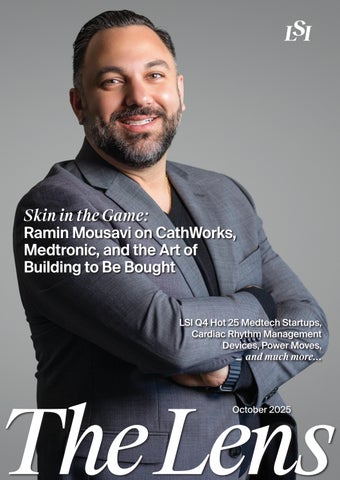
Skin in the Game: Ramin Mousavi on CathWorks, Medtronic, and the Art of Building to Be Bought LSI Q4 Hot 25 Medtech Startups, Cardiac Rhythm Management Devices, Power Moves, and much more...
The Lens February 2025 October 2025
LSI The Lens
October ‘25
Scott Pantel
Henry Peck
Tracy Schaaf
Brenna Hopkins
Nicholas Talamantes
Chief Executive Officer, Editor-in-Chief
Chief Business Officer, Editor-in-Chief
Managing Editor and Content Strategist, Lead Author
Sr. Manager of Content Programs, Lead Author
Sr. Director of Market Intelligence, Contributing Author
Rebekah Murrietta
Blake Matrone
Gavin Kennedy
Parker Walpole
Kelly Williams
Business Development, Contributing Author
Marketing Manager, Compass, Contributing Author
Subscriptions & Enterprise Sales
Vice President of Media, Sr. Marketing Manager, Contributing Author Contributing Author
Maricela Almonte
Benny Tomlin
Kristin Karkoska
Paul Streeto
Customer Service & Fulfillment
Contributing Photographer
Contributing Photographer
Graphic Designer
The Lens
Printed in the U.S.A. A publication of Life Science Intelligence, Inc. (LSI) 17011 Beach Boulevard, Suite 500 Huntington Beach CA 92647 714 847 3540 tel/fax email: info@ls-intel.com
Vol. 2, No. 10 October 2025 4
Created by LSI, The Lens leverages LSI’s deep industry relationships and proprietary market intelligence to help executives like you build lasting medtech companies. Start your Individual, Group or Enterprise-Wide subscription today! Scan QR Code to activate your subscription. The Lens is published monthly and available in print and electronic formats. Copyright 2025 by Life Science Intelligence, Inc. All rights reserved. Editor takes care to report information from reliable sources and does not assume liability for information published. Interested in subscribing? email to: info@ls-intel.com Interested in advertising? email to: kelly@ls-intel.com
LSI The Lens
October ‘25
Table of Contents Skin in the Game: Ramin Mousavi on CathWorks, Medtronic, and the Art of Building to Be Bought LSI Q4 Hot 25 Medtech Startups, Cardiac Rhythm Management Devices, Power Moves, and much more...
The Lens February 2025 October 2025
Vol. 2, No. 10 October 2025
06
Letter from the Editors
08
Hot Takes: Compelling Quotes from Industry Thought Leaders
10
Power Moves: Recent Leadership Shifts and Other Announcements
14
Select Medtech Industry Financings and Deals September 2025, by Date Announced
16
Cover Story - Skin in the Game: Ramin Mousavi on CathWorks, Medtronic, and the Art of Building to Be Bought
22
Market Dive: Cardiac Rhythm Management Devices
25
Market Dive: Surgical Endoscopic ENT Devices
28
LSI Q4 Hot 25 Medtech Startups
30
Medtech Pulse Check, by the Numbers
32
Breast Cancer Surgeries, by Country, 2023–2030
34
Select ENT Procedures, by Country, 2023–2030
36
LSI Alumni Innovator Spotlight: SOMAVAC’s Elizabeth Hoff
40
LSI Alumni Innovator Spotlight: MALCOVA’s Tara Ghazi
42
Investor's Corner
44
LSI Alumni Milestones: Recently Announced Wins
48
Index: Companies and People Covered in This Issue 5
Letter from the Editors
Dear Readers, As we look ahead to LSI USA ’26, the excitement is already building. With more than 800 executives confirmed toward an expected 2,000, we’re on track for record-setting participation. And it’s not just the numbers that impress; it’s the caliber. From strategic leaders like Mike Mahoney (Boston Scientific), Bret Snyder (Gore), and Ashley McEvoy (Insulet), to health system executives including Peter Slavin (Cedars-Sinai) and Chris Coburn (Mass General), to visionary entrepreneurs like Sandeep Konam (Abridge), Jason Bellet and Connor Landgraf (Eko Health), and investor icons like Peter Hebert (Lux Capital), the stage is set for unrivaled opportunity in Dana Point on March 16–20, 2026. Alongside record investor participation at our summits, this edition of The Lens debuts our first Investor’s Corner. This section will spotlight capital partners who continue to drive innovation. This month, you will see featured deals and data from Sanara Capital, Panakès Partners, Gilde Healthcare, and more. Among the leaders joining us in Dana Point is Ramin Mousavi, CEO of CathWorks, whose journey from LSI’s very first Emerging Medtech Summit to a landmark build-to-buy partnership with Medtronic exemplifies what it means to build deliberately. His story of setbacks, persistence, and a globally orchestrated model for innovation reminds us that great outcomes aren’t accidents. They’re engineered through vision, patience, and partnership. We are proud to call Ramin an LSI Alumni, humbled by his commentary on the LSI ecosystem, and thrilled to amplify his story in this edition of The Lens. In honor of Breast Cancer Awareness Month, we’re also proud to feature two innovators redefining what care looks like for women around the world. Elizabeth Hoff of SOMAVAC is modernizing post-surgical recovery with a discreet, active-suction device that restores both mobility and dignity. Tara Ghazi of MALCOVA is advancing breast cancer detection with next-generation narrow-beam CT imaging that promises clarity without compromise. Together, these LSI Alumni reflect the empathy, ingenuity, and purpose that are required to drive an underserved segment of our industry forward. Finally, we invite you to dive into LSI’s first “Hot 25 Startups” spread – a data-driven snapshot of the companies making waves across our global ecosystem. This list is just a preview of what’s ahead: the upcoming launch of Compass 2.0, our new AI-powered private market intelligence platform, built on proprietary data you won’t find anywhere else. If you want early access or to be part of the pilot program, reach out. Across every page of this issue, you’ll see what unites this community: a commitment to build, invest, and innovate with purpose. The momentum is real, and we’re only getting started. All the best, Scott Pantel & Henry Peck Editors-in-Chief, The Lens
Scott Pantel
Henry Peck
Chief Executive Officer, LSI
Chief Business Officer, LSI
Editor-in-Chief
Editor-in-Chief
LSI The Lens
October ‘25
Hot Takes: Compelling Quotes from Industry Thought Leaders Need fresh inspiration for your medtech company as we navigate Q425? We’ve gathered insights from some of our LSI alumni thought leaders to help you stay ahead.
“When you look at childhoods, they unwaveringly inform great entrepreneurs. And there are really three traits. The first trait is that the best entrepreneurs always move around a lot in their childhood. The second is that they are often very competitive gamers or lead clans. The third and final one is that great entrepreneurs always show entrepreneurial flair early. They present signs of greatness early.”
—Catherine Mohr, President, Intuitive Foundation
— Harry Stebbings, Founder, 20VC
LSI USA ‘25 Panel: Staying Sexy Without GenAI or Saas— Building Deceptively-Simple, but Brilliant Products
LSI Europe ‘25 Signature Series with Harry Stebbings, Founder of 20VC
“Time kills all deals, and also time is of the essence. You have to burn money every day that you don’t get to the promised land.”
“If you look at that set of firms and individuals that have really thrived in venture capital, many of them made money in all sorts of sectors that they had no place being involved with. The moment you have expertise in a sector, it naturally bounds your risk-taking.”
— Ray Cohen, Former CEO, Axonics LSI USA ‘25 Signature Series: Building and Exiting Companies in Medtech’s New Post-COVID Financial Era
— Andrew Chung, Founding & Managing Partner, 1955 Capital LSI Europe ‘25 Fireside Chat with Andrew Chung, Founding and Managing Partner at 1955 Capital
“Within 10 years, one of the largest players will be dead. One that tries to ‘bone graft’ AI onto their business and can’t figure it out, will get disrupted by a company like ours [Moon Surgical and Proprio]. And that’ll change the entire industry because everyone will have to react to that.”
8
“When it comes to building products, it’s actually easy to do complex. It’s very difficult to do something simple beautifully.”
“I went in [Shockwave Medical] for a reason that was completely different than what ended up being the massive win… As long as the people are the right ones, follow the people, not the technology.”
— Gabriel Jones, CEO, Proprio
— Antoine Papiernik, Chairman & Managing Partner, Sofinnova Partners
LSI USA ‘25 Signature Series: No Corporate Slides. Real Strategies and Resources to Deliver Purpose-Driven AI
LSI Europe ‘25 Opening Keynote with Antoine Papiernik and Laura Francis
LSI The Lens
October ‘25
9
LSI The Lens
October ‘25
Power Moves Celebrating recent leadership shifts and other announcements and accolades impacting our global LSI Alumni medtech community.
positioned to scale manufacturing, navigate regulatory approvals, and transform acute oncology care.
Rebecca Simmons (Source: LinkedIn)
Joe Neale (Source: LinkedIn)
Cambridge-based diagnostics company 52North has appointed Rebecca Simmons as Chief Operating Officer and Joe Neale as Chief Technology Officer, bringing deep expertise across healthcare, deep tech, product development, and operations. Simmons previously scaled a quantum computing startup, Riverlane, and helped raise more than £100 million in venture capital. Neale, a medtech veteran, has successfully brought multiple regulated products to market across several therapeutic areas.
The leadership expansion comes as 52North accelerates efforts to bring Neutrocheck to market. The company’s proprietary finger-prick diagnostic assesses neutrophil and C-reactive protein (CRP) levels to help clinicians triage patients at risk of neutropenic sepsis, a life-threatening complication of chemotherapy. Neutrocheck offers rapid results at the point of care, reducing unnecessary hospital visits and supporting faster treatment. With Simmons and Neale onboard, 52North is
10
Tom Brady (Source: LinkedIn)
Automated massage startup Aescape has named Tom Brady as its new Chief Innovation Officer following a major partnership to bring his recovery and longevity protocols to the company’s robotic platform. The 7-time Super Bowl champion, known for extending his career through daily massage and wellness routines, has granted Aescape
LSI The Lens
October ‘25
exclusive rights to scale his methods for broader use. Brady’s business partner, Alex Spiro, will also join the company as a strategic advisor. Founded in 2017, Aescape delivers AI-powered, fully automated massage experiences and has performed more than 25,000 sessions across 100+ locations. Its partners include Equinox and luxury hotel brands like Four Seasons and Ritz-Carlton. With $130 million in funding and Brady now supporting product development, Aescape is accelerating its mission to make recovery tools more accessible, bringing pro-level care to everyday users.
Alexis Peyroles (Source: LinkedIn)
BetaGlue Therapeutics has appointed Alexis Peyroles as Chief Executive Officer, bringing seasoned oncology leadership to the company as it advances its novel internal radiotherapy platform, YntraDose. Peyroles succeeds Dr. Colin Story, who led the company through a pivotal phase of development and will be stepping down after three years as CEO. The board praised Peyroles for his proven track record in clinical advancement, strategic partnerships, and value creation across the life sciences sector.
Rachel Medbery (Source: LinkedIn)
and ensure compliance with evolving international regulatory frameworks. The appointment reinforces Innitius’ commitment to regulatory excellence as it continues developing its women’s health platform, which leverages torsional wave technology and AI to improve the diagnosis of conditions associated with changes in cervical tissue consistency.
Medbery as its first member. A twice board-certified thoracic surgeon at Winship Cancer Institute of Emory University, Dr. Medbery brings respected clinical leadership and deep experience in surgical innovation to help guide ClearCam’s next phase of growth. The board will play an active role in shaping clinical strategy, product development, and expanding ClearCam’s impact in minimally invasive surgery. Dr. Medbery praised ClearScope, a sterile in-vivo lens cleaner that restores clarity without scope removal, as “elegantly simple yet profoundly impactful.” Her appointment signals ClearCam’s commitment to partnering closely with frontline clinicians to improve surgical visualization, reduce disruptions, and elevate patient care.
Benjamin Sommerkorn (Source: LinkedIn)
With YntraDose now in development for unresectable locally advanced pancreatic adenocarcinoma and other solid tumor indications, Peyroles will focus on accelerating progress, expanding the clinical pipeline, and building strategic alliances. His leadership marks a new chapter for BetaGlue, as the company advances its 90-Yttrium-based “radiotherapy from within” platform to transform cancer treatment for patients with few existing options.
Innitius has appointed Dr. Benjamin Sommerkorn, PhD, as Director of Quality & Regulatory Affairs, marking a strategic step as the company advances toward pivotal clinical phases and prepares for commercialization. Dr. Sommerkorn brings over four years of experience from the U.S. FDA, where he served as Lead Engineer Reviewer at the Center for Devices and Radiological Health (CDRH). His background spans mechanical engineering, academic research, and regulatory leadership in the medical device space.
ClearCam, the surgical innovation company behind ClearScope, has announced the formation of its Medical Advisory Board, naming Dr. Rachel
In his new role, Dr. Sommerkorn will lead Innitius’ global regulatory strategy, oversee quality management systems, audits, and risk management,
Dan Dearen (Source: MassDevice)
InspireMD has appointed Dan Dearen, who served as Co-Founder, President, and Chief Financial Officer at Axonics, to its Board of Directors, bringing nearly four decades of financial and operational leadership in medtech. During his tenure, Axonics went public and became one of the fastest-growing companies in the medical device sector, and was eventually acquired by Boston Scientific for $3.7 billion. He now joins fellow Axonics co-founder Raymond Cohen on InspireMD’s board. The appointment comes as InspireMD launches its FDA-approved CGuard Prime carotid stent system in the U.S. market. The embolic prevention stent (EPS) system utilizes the company’s MicroNet technology for strong acute results and durable, stroke-free, longterm outcomes. Dearen’s experience in scaling medtech companies and executing high-impact financial strategies is expected to support InspireMD’s next phase of commercial growth and longterm value creation.
Joe Kiani (Source: LSI USA ‘25)
MY01 has announced the addition of Joe Kiani, founder of Masimo and 11
LSI The Lens
a globally recognized leader in medical innovation, as an investor and new member of its Board of Directors. Kiani is known for developing non-invasive monitoring technologies that have transformed care delivery and advanced patient safety worldwide. His support strengthens MY01’s mission to make continuous limb perfusion monitoring the standard of care. The company’s CPST Platform has shown the ability to detect limb-threatening conditions up to four hours earlier than traditional methods. Kiani called the technology “a game changer” and emphasized its potential to improve outcomes for the more than one million limb injuries that occur each year.
October ‘25
outcomes and streamline workflow. The expanded SAB brings frontline clinical expertise to support the system’s transition into clinical use.
Jeffrey Velotta (Source: LinkedIn)
Officer to lead its international commercial strategy and support the company’s next phase of growth. Descheirder brings more than 20 years of experience in the healthcare sector, including global leadership roles at GE HealthCare and a recent advisory role with a top venture capital firm supporting the growth of health tech startups. He joins as the company advances its NeuroLF PET brain imaging system and gains commercial traction in global markets. His appointment is part of a broader expansion of Positrigo’s leadership team, including the transition of Dr. Stefan Bircher into the new role of Chief Business Development and Marketing Officer.
Dan Reuvers (Source: Tactile Medical)
Bryan Burt (Source: LinkedIn)
Brian Mitzman (Source: LinkedIn)
Navigation Sciences has appointed Drs. Bryan Burt, MD, Brian Mitzman, MD, and Jeffrey Velotta, MD, to its Scientific Advisory Board as the company advances its NaviSci System toward early clinical adoption. These prominent thoracic surgeons will provide critical input on clinical workflow design, user interface development, and the selection of initial clinical sites. The NaviSci System integrates augmented reality and advanced software with surgical instruments to guide precise surgical resection by enabling, for the first time, real-time in-vivo margin measurement. With a focus on preserving lung function and reducing recurrence, the technology aims to enhance 12
Peerbridge Health has appointed veteran medtech executive Dan Reuvers to its Board of Directors as the company prepares to scale its next-generation cardiac diagnostics platform. Reuvers brings more than 30 years of leadership experience in the medical technology industry, including previous roles as CEO of Tactile Medical and president of Integra LifeSciences’ neuro division. Known for driving commercialization and access for innovative health technologies, Reuvers joins Peerbridge at a pivotal time following the FDA submission of its Cor MDx wearable and the close of a $7 million funding round. His strategic guidance will support Peerbridge’s mission to expand access to high-quality, affordable cardiac care.
Jerome Descheirder (Source: LinkedIn)
Positrigo has named Jerome Descheirder as Global Chief Commercial
Michael Nagel (Source: LSI USA ‘24)
Raydiant Oximetry has named LSI Alumni Michael Nagel as Chief Executive Officer to lead the company through clinical trials and commercialization. Nagel brings more than 35 years of healthcare leadership experience, most recently as CEO of Vomaris Innovations, where he led the company through its acquisition by Arthrex. Founder Neil Ray, MD, will continue supporting Raydiant in a strategic advisory role. The leadership transition comes as the company advances its fetal pulse oximetry technology, which received FDA Breakthrough Device Designation and aims to reduce unnecessary emergency C-sections and improve outcomes for mothers and babies. SpectraWAVE has named Dr. Jonathan Hill, a globally recognized interventional cardiologist from Royal Brompton Hospital in London, as its new Chief Medical Officer. Hill brings deep expertise in coronary artery disease, complex PCI, intravascular imaging, physiology, cardiovascular innovation, and clinical study design and implementation, and will play a key role in advancing SpectraWAVE’s clinical evidence
LSI The Lens
October ‘25
Jonathan Hill (Source: citybiz)
strategy and physician engagement as the company accelerates adoption of its HyperVue Imaging System. The announcement comes as SpectraWAVE surpasses thousands of commercial HyperVue Imaging System cases in cath labs across the U.S. and achieves multiple clinical study milestones. The company also recently completed enrollment of a 175-patient U.S. clinical workflow study of HyperVue, with results scheduled to be presented at the Transcatheter Cardiovascular Therapeutics (TCT) 2025 meeting in October in San Francisco.
Joseph Doherty (Source: LinkedIn)
Vicarious Surgical has named Joseph Doherty as Chair of its Board of Directors. Doherty joined the board in June 2025 and brings decades of medtech leadership experience, including roles at Johnson & Johnson, Olympus Surgical Technologies America, and Scapa Healthcare. He currently serves as CEO of Worcester City Campus Corporation and has held board seats with the Massachusetts Biomedical Initiatives, Immertec, and ZATA Pharmaceuticals, and advisory roles with AccuTec and Boardwalk Robotics. The appointment comes as Vicarious Surgical continues refining its robotic surgery platform ahead of clinical trials and FDA submission. Doherty’s appointment follows the company’s decision to delay trial initiation as it advances development of its “V1.0” system, now expected to be ready for FDA submission by early to mid-2026. 13
LSI The Lens
October ‘25
Select Medtech Industry Financings and Deals September 2025, by Date Announced Company
Type of Deal
Technology
Amount ($USD)
Investors Included
Raise Date
$5M
Undisclosed
9/1/2025
Highridge Medical acquired the FlareHawk and Toro expandable interbody fusion systems and the LineSider pedicle screw system from Accelus
9/1/2025
Series A
Implant to treat heart failure
Accelus
M&A
Spinal devices for motion preservation and minimally invasive surgery
NA
Nutromics
Other
Biosensor platform for continuous molecular monitoring
$4.92M*
Undisclosed
9/2/2025
ViCentra
Series D
Insulin delivery system for people living with Type 1 diabetes
$85M
Innovation Industries (led), Partners in Equity, Invest-NL, EQT Life Sciences, Health Innovations
9/3/2025
9/3/2025
9/4/2025
Berlin Heals
Galvanize Therapeutics
Series C
Pulsed electric field systems for energybased therapy
$100M
Sofinnova Partners (led), Norwest Venture Partners, Elevage Medical Technologies, Ally Bridge Group, Perceptive Xontogeny Venture Fund, Janus Henderson Investors, Longaeva, Fidelity Management & Research Company, T. Rowe Price, Gilmartin Capital, Intuitive Surgical, Apple Tree Partners
Boomerang Medical
Series B
Bioelectronic technologies for treating autoimmune diseases
$20M
Arboretum Ventures (led), Hatteras Venture Partners (led)
M&A
Implantable longterm hemodynamic monitoring for congestive heart failure
$497M
Edwards Lifesciences acquired the remaining 48% stake in Vectorious after 9/4/2025 acquiring 52% in 2023
Ronovo Surgical
Series D
Minimally invasive surgery (MIS) and digital surgery solutions
$67M
Johnson & Johnson (JJDC) (led), Lilly Asia Ventures, INCE Capital, Granite Asia
9/5/2025
Elutia
M&A
Regenerative medicine, allograft-based products
$88M
Boston Scientific purchased Elutia's EluPro and CanGaroo drug-eluting bioenvelopes
9/9/2025
Nuwellis, Koronis Biomedical Technologies
Grant
Cardiac assist device for moderate/severe longterm heart failure
$3M
Nuwellis's development partner, Koronis Biomedical Technologies, received a $3M NIH grant for development of Nuwellis' Vivian
9/9/2025
icometrix
M&A
AI for MRI brain monitoring
NA
GE Healthcare agreed to acquire icometrix
9/10/2025
True Digital Surgery
M&A
3D digital microscope and imaging platform for reconstructive surgery
NA
B. Braun
9/12/2025
Vectorious Medical Technologies
14
LSI The Lens
October ‘25
Compass Powered by proprietary insights from LSI Europe, LSI Asia, and LSI USA, Compass gives you access to thousands of private company profiles and presentations you won't find anywhere else.
Company
INBRAIN Neuroelectronics InnoTech Precision Medicine IMMA Health PathKeeper
Type of Deal
Technology
Graphene core Strategic technology for the field Ptnshp of neuroelectronic therapies
Amount ($USD)
NA
Investors Included
Raise Date
Mayo Clinic - know-how collaboration agreement
9/15/2025
Grant
Proprietary diagnostic platform for simultaneous multiomics detection of biomarkers
$2.8M
Federal Funding
9/15/2025
Seed
At-home pelvic health scanner for fertility care
$2.5M
iXCore (led)
9/15/2025
NA
Highridge Medical - exclusive U.S. distribution deal
916/2025
Strategic AI-powered 3D spinal Ptnshp surgery navigation Other
Wireless electrocardiogram (ECG) monitor
$7M
Undisclosed
9/16/2025
Axoft
Grant
Brain-machine interface implant to augment communication with the nervous system
NA
Bpifrance (Bourse French Tech Emergence program)
9/16/2025
Nalu Medical
Other
Battery-free neurostimulation to treat chronic neuropathic pain
$50M
Trinity Capital
9/17/2025
Watershed Therapeutics
Grant
Drug delivery platform for UTIs
$376.4K*
National Institute of Diabetes and Digestive and Kidney Diseases
9/17/2025
NA
Mercedes-Benz - collaboration on ground transportation network in Italy
9/22/2025
$1.988M
NIH (National Heart, Lung and Blood Institute)
9/23/2025
Israel Innovation Authority
9/25/2025
Peerbridge Health
TransMedics
Strategic Portable, ex vivo organ Ptnshp perfusion system
Vesteck
Grant
Catheter sutures to prevent endovascular aortic repair graft migration and leakage
MicroSteer
Grant
Endoscopic removal of complex GI polyps
NA
Grant
Novel, image-guided video-assisted thoracoscopic surgery technology
$400K
National Cancer Institute Phase I STTR
9/25/2025
Panda Surgical
Other
Next-gen handheld robotics platform for neurosurgery
$1.34M*
Oxford Investment Consultants (led), New Wave Ventures, UCL Business, US and European neurosurgeons and operators
9/26/2025
Robossis
Seed
Surgical robotics for orthopedic trauma
$1.15M
SAFE notes from undisclosed investors
9/29/2025
MRI-compatible robotics for neurosurgery
$8.1M
IQ Capital (led), 1540 Ventures (led), new 9/30/2025 and returning strategic investors
Navigation Sciences
AiM Medical Robotics
Series A
*Currency converted to $USD for data consistency (10/10/2025 exchange rate)
15
LSI The Lens
October ‘25
Cover Story
Skin in the Game: Ramin Mousavi on CathWorks, Medtronic, and the Art of Building to Be Bought
Ramin Mousavi (Source: LSI USA '25)
CathWorks is redefining what a medtech partnership can be through a deliberate, globally minded build-to-buy model aimed at transforming how coronary artery disease is diagnosed and treated. Anchored by its “skin-in-thegame” partnership with Medtronic and its innovative wire-free and drug-free FFRangio System, the company has used markets across the United States, Europe, and Japan as real-world validation engines. The result is a model that combines scientific proof, speedy innovation, scalability, and partnership discipline that could impact how startups position themselves for acquisition. 16
LSI The Lens
When Ramin Mousavi, President and CEO of CathWorks, steps onto an LSI stage, he likes to mention that CathWorks was the very first company to present at the very first LSI Emerging Medtech Summit, in 2020. It’s an aside delivered with a smile, and is not so much nostalgic but rather a celebratory reflection backed up by 12+ years of startup peaks and valleys, and a game-changing build-to-buy deal with device industry giant Medtronic. For Mousavi, success in medtech is not about flash or speed. It’s about playing the long game, building deliberately, and earning outcomes through persistence and precision. He has built his career around that philosophy. After earning dual degrees in computer and electrical engineering at the University of California, Irvine (UCI), he completed an MBA at UCI’s Paul Merage School of Business and a Healthcare Executive Leadership certificate from Harvard Business School. (In September, Mousavi’s alma mater recognized him with the 2025 Lauds & Laurels Distinguished Alumnus Award, UCI’s highest alumni honor.) His early years in the device, tech, and aerospace industries at Edwards Lifesciences, Baxter International, Panasonic Avionics, and Rockwell Collins (now Collins Aerospace) gave him a unique blend of skills, including technical depth, operational discipline, and commercial awareness.
October ‘25
grams, artificial intelligence (AI) and computational science to calculate an accurate multi-vessel fractional flow reserve (FFR) without the need for invasive pressure wires, drugs, or a guide catheter, and with an approximate 20% reduction in radiation compared to wire-based physiology. This ability to gather real-time FFRangio values at every point on the coronary tree optimizes clinical decision-making, and it has demonstrated excellent real-world outcomes in line with data from large FFR studies. Early on, the concept attracted attention. Clinicians loved the idea of getting physiology data instantly from standard angiograms. But when the first version launched commercially, it stumbled. Cases took nearly 20 minutes, and physicians found the workflow cumbersome. When the pandemic hit, Mousavi and his team took the pause as an opportunity to rebuild. They studied advances in computer vision outside the medical world, recruited a technical leader from Samsung’s imaging division, and integrated artificial intelligence into the workflow. By automating the manual image-selection and image-tracing step, they reduced case time from 20 minutes to about two. “No matter how cool your technology is, if it doesn’t fit the procedural workflow, you have a task, not a product,” he says.
“No matter how cool your technology is, if it doesn’t fit the procedural workflow, you have a task, not a product.” The underlying science never changed. The team kept the validated algorithm intact but removed the friction. When the updated platform re-launched in 2021, adoption accelerated quickly. “We kept the algorithm. We automated the pain. That’s when adoption finally happened,” says Mousavi. The FFRangio System soon proved its power in the field. Across five clinical studies, the technology achieved a sensitivity of 91% and specificity of 94% compared to gold standard wire-based FFR. It delivered what physicians had long wanted: comprehensive physiology-guided decision support inside their existing workflow. Most importantly, the technology is impacting patient lives. In a busy cath lab, a patient with stable angina and multivessel disease presents a familiar dilemma. Clinicians can make decisions based on angiographic appearance alone or take the time to use invasive
At Baxter, he led the patient monitoring and digital health portfolio through a series of acquisitions. At Edwards for nearly a decade, he honed his understanding of cardiovascular markets. Now at CathWorks, which he joined in 2019, Mousavi has fused his start-up and large strategic leadership experience within the medical device, aerospace, and tech industries to create a company that sits squarely at the intersection of innovation and scalability.
From Prototype to Patient-Focused Product CathWorks began more than a decade ago in Israel, with a vision to transform how physicians assess coronary artery disease. Its signature product, the FFRangio System, uses routine angio-
Fourth-generation CathWorks FFRangio System (Source: CathWorks)
17
LSI The Lens
October ‘25
(Source: LSI Asia ‘25)
pressure wires to measure physiology. Both paths carry risk and delay.
reimbursement in Japan, and built a strong clinical and commercial record.
FFRangio changes that. In a matter of minutes, the physician can see exactly where ischemia exists and decide which lesions truly need intervention. They can now also plan interventions with clinical tools added since 2021. The result is faster care, fewer unnecessary stents, and lower risk. In high-volume centers, those minutes translate into lives touched and costs reduced.
By 2021, CathWorks had proven its model and faced a choice. It could sell outright or find a partner willing to share in the journey. Mousavi chose the latter.
“Have a vision that’s truly patient-driven, or choose an easier job.” “Engineering taught me systems. Business taught me people. But patients, that’s where it all comes together,” says Mousavi. “Have a vision that’s truly patient-driven, or choose an easier job.”
Build-to-Buy with a Twist Medtronic’s relationship with CathWorks began in 2018, with a minority investment when the company raised $30 million in their Series C. That same year, the company received FDA clearance for FFRangio. In 2021, CathWorks raised another $30 million across the next financing rounds, gained national
18
In July 2022, CathWorks and Medtronic announced a deal that has since become a reference point for strategic partnerships. Medtronic invested $75 million upfront and secured an option to acquire CathWorks for as much as $585 million plus undisclosed milestones. The two companies also agreed to co-promote FFRangio in the U.S., Europe, and Japan. What makes the deal unusual is its symmetry. If Medtronic decides not to exercise its option by 2027, CathWorks has the option to compel acquisition under undisclosed predefined conditions. Mousavi describes it as an engagement towards a marriage.
“If we were going to enter this, everyone needed real skin in the game. Otherwise, just sell and be done.” “If we were going to enter this, everyone needed real skin in the game. Otherwise, just sell and be done,” he says.
The term “build-to-buy” is a popular buzzword of late in medtech circles, but Mousavi defines it precisely. For him, it is about alignment and clarity, not financial engineering. “There are three things you’re trying to de-risk in build-to-buy: technology, capital, and market execution. This model de-risks all three by pulling on the strength of both organizations,” he says. In Mousavi’s view, the key is balance. If the structure offers only optionality without commitment, the startup risks capping its upside while keeping all the downside. Certainty must be written into the agreement. CathWorks’ arrangement with Medtronic does exactly that. The Medtronic deal gave CathWorks stability at a time when most startups were struggling to raise capital. It also allowed the company to keep its independence, maintain its innovation cadence, and gain access to Medtronic’s impressive global commercial infrastructure. But that doesn’t mean everything gets easy. “Getting the deal done is hard,” Mousavi says. “Executing after the deal is even harder. You’re an agile speedboat next to a large steady ship.” The model has panned out. With funding secured and commercial support in place, CathWorks moved forward confidently, expanding its presence and stocking its clinical evidence coffers
LSI The Lens
across continents while continuing to refine its technology at the rapid startup pace. “In three years, when many companies struggled to raise, we had capital, alignment, and execution,” says Mousavi. The build-to-buy deal gave CathWorks what it needed most, and it also offered Medtronic a clear path into the emerging space of digital cardiology. Together, they created a structure that rewarded progress and shared risk. For Mousavi, the decision to take the build-to-buy path was rooted in experience and trust. Years inside large companies had taught him how partnerships work when they are built on trust, transparency, and shared intent. “If the incentives are aligned and you trust your partner,” he says, “everyone rows in the same direction.”
The APAC and EU Chessboard Just as CathWorks took a carefully calculated approach to its Medtronic deal, it is doing the same with its clinical and regulatory plan. Japan became the company’s second market after the U.S. The choice was strategic: Japan’s cardiology community places a high value on functional
October ‘25
physiology assessment, with adoption rates approaching 90% compared to about 25% in the U.S., according to Mousavi. That environment made it the perfect place to prove the technology. CathWorks launched its first randomized controlled trial in Japan and later conducted the 2,000-patient, randomized, controlled, global ALL-RISE trial that included one-third of patients from Japanese sites. Those studies became the foundation of its evidence base. “Japan gave us early, clear signals, faster than the U.S. in some respects. That changed our map,” Mousavi says. The company is building on that success by expanding into China, Singapore, Korea, and Taiwan. These markets are often out of reach for U.S. medtech startups, but Medtronic’s regional presence provided a vital bridge. Local distribution networks, reimbursement knowledge, and regulatory experience gave CathWorks access it would not have had alone. “You can partner with consultants, but nothing substitutes for a group that has lived through it,” notes Mousavi. Onstage at LSI Asia ‘25, Mousavi described Asia-Pacific not as a single market but as a chessboard of competencies. Japan represents precision and high-value regulatory rigor. China
offers speed and scale. Singapore is a design hub with manufacturing advantages and R&D tax incentives. Australia supports early clinical feasibility through government funding. India provides massive volume and data diversity, though at much lower price points. This regional sequencing has helped CathWorks balance regulatory risk, cost structure, and market access in a way few startups manage to do.
“Match each country’s core competency to your phase. That’s where acceleration happens.” “Match each country’s core competency to your phase. That’s where acceleration happens,” he advises. CathWorks then set its sights on Europe. It achieved full MDR approval and launched in six countries: Switzerland, the United Kingdom, France, Italy, Spain, and Belgium, with more European countries being launched in the upcoming months. The expansion created a diverse base of clinical data and payor experience that will strengthen the company’s future negotiations and reimbursement pathways.
Ramin Mousavi’s Lessons for Founders
Mousavi distills his philosophy into key lessons for other medtech founders: 1. Fit the workflow. If the technology does not fit the day-to-day life of clinicians, it will never scale. 2. Design for certainty. Build-to-buy only works when obligations are clear on both sides. 3. Sequence markets wisely. Run trials where rigor is rewarded. Manufacture where speed and cost align.
4. Sell together before merging. Co-promotion builds trust and teaches both teams how to work as one.
7. Choose the right team. Find a group of people who are smarter than you and empower them to make decisions.
5. Choose investors for patience and expertise. Smart capital matters more than fast capital.
8. Embrace change. Be boldly disruptive to shape the future before it arrives.
6. Protect pace. Keep the team inspired, nimble, and accountable.
9. Keep the patient at the center. Every milestone should connect back to better outcomes.
19
LSI The Lens
October ‘25
“Global co-promotion let us go where the adoption signals were strongest, not just where we could afford to hire,” explains Mousavi. In the U.S., adoption is also growing. Lenox Hill Hospital and the Northwell Health team in New York recently performed their 1,000th FFRangio case. The milestone demonstrates both the scalability of the technology and its fit in high-volume cath labs. Japan’s reimbursement was a turning point for CathWorks, demonstrating that a value-based healthcare system could reward a noninvasive technology. Co-promotion with Medtronic in Europe and the U.S. has given the company exposure to hundreds of hospitals and a steady stream of real-world data that informs continuous improvement.
Looking Ahead As CathWorks expands adoption in the U.S., deepens its footprint in Europe, and continues to grow across Asia, the Medtronic option feels less like a question and more like an inevitable milestone. The engagement model does not
guarantee a wedding, but it guarantees a plan. That plan has carried the company through capital scarcity and into the heart of a conversation about what the future of medtech partnerships should look like.
medtech ecosystem through his partnership with LSI and the “New Era” signature series panel discussions he led at three consecutive LSI summits around the world in 2025, and that he’s bringing back in 2026.
As the company advances toward a potential acquisition, the milestones that matter most are not vanity numbers but tangible proof points. They include pivotal clinical results that influence guidelines, reimbursement expansion, and documented scalability beyond the home market.
“What Scott and his team have accomplished at LSI is the very example of vision, creativity, and commitment in value creation that every board member and CEO thrives for every day,” says Mousavi. “I know this because we were the first to buy into it, that they turned this vision into a world-class, must-attend, value-creating ecosystem, where entrepreneurs, investors, strategics, and the supporting service partners all have a lot to gain. But even more important, you get to build life-long and life-changing relationships. We are partners for as long as they will have us, because we are a beneficiary of this amazing ecosystem.”
CathWorks has lived more than one lifetime already. It has faced setbacks, rebuilt itself, and found a way to thrive through a mix of humility, vision, and persistence. Its story is proof that innovation is not a moment; it is a discipline. And for Ramin Mousavi, that discipline continues to guide every move, from Irvine to Tokyo to Tel Aviv and beyond. In his world, building to be bought is not about exits alone. It is about building something worth buying. He is also focused on finding value in and contributing value to the global
Stay tuned, as Mousavi also has a game-changing, stealth-mode project under wraps that he’ll be announcing at LSI USA ‘26 in Dana Point (March 16-20).
Ramin Mousavi President & Chief Executive Officer CathWorks Ramin Mousavi brings extensive executive leadership and operational expertise across various domains, including general management, marketing, strategy, product development, and commercialization within diverse market segments. With a notable tenure most recently leading the patient monitoring and digital health portfolio at Baxter International, Mousavi has also held key leadership roles at Edwards Lifesciences, Panasonic, and Rockwell Collins. At CathWorks, Mousavi served as Vice President of Global Marketing and Strategy, as well as Chief Marketing Officer from 2019 to 2020. He holds dual B.S. degrees in Computer and Electrical Engineering from the University of California, Irvine (UCI), complemented by an M.B.A. from the Paul Merage School of Business at UCI. Additionally, he has furthered his expertise with a Healthcare Executive Leadership certificate for Business Innovation in Global Healthcare from Harvard Business School.
(Source: LSI USA ‘25)
20
This September, the UCI Paul Merage School of Business named Mousavi as the recipient of this year’s Lauds & Laurels Distinguished Alumnus Award. The Lauds & Laurels is the UCI Alumni Association’s (UCIAA) highest honor at UCI, recognizing distinguished members of the UCI community for their service to the university, the community, or their profession.
LSI The Lens
October ‘25
AtaCor Medical Rick Sanghera
Adagio Medical Todd Usen
MediView XR Mina Fahim
21
LSI The Lens
October ‘25
Market Dive Cardiac Rhythm Management Devices The cardiac rhythm management (CRM) device market is entering a new phase of modest but stable growth. Valued at $21.4 billion in 2024, the global CRM device market is projected to reach $26.6 billion by 2029, increasing at a CAGR of 4.4% over the 2024–2029 forecast period. As demand increases across aging populations, particularly in high-growth regions like China, manufacturers are racing to deliver innovations in pacing and defibrillation that meet clinical needs while minimizing complications.
Market Overview: Maturity with Momentum CRM devices, including implantable pacemakers, cardiac resynchronization therapy defibrillators (CRT-Ds), and 22
implantable cardioverter-defibrillators (ICDs), remain essential tools in treating bradycardia, tachycardia, heart block, arrhythmia, sudden cardiac arrest, syncope, and heart failure. Although the market is considered mature, it continues to expand in both unit and dollar volume.
Between 2024 and 2029, global procedure volumes are expected to grow at a 2.9% CAGR, with wide regional variation. While Germany is forecasted to see a 2.2% decline, the United States is projected to grow 1.6%, and China leads the market with an expected 9.7% annual increase.
LSI The Lens
October ‘25
Trends in Pacing and Defibrillation
Medtronic’s Clinical Push
The CRM landscape is being reshaped by innovations such as multipoint pacing, leadless pacemakers, and subcutaneous ICDs. These advances offer potential long-term expansion opportunities, but their near-term impact on market size has been limited. In some patient populations, especially those with atrial or ventricular fibrillation, the rapidly expanding utilization of cardiac ablation has reduced the need for implanted CRM devices. (Also see Market Dive: Cardiac Ablation Devices, The Lens, July 2025.)
Medtronic has initiated the ELEVATE-HFpEF trial, a pivotal global study evaluating elevated and personalized cardiac pacing rates in patients with heart failure with preserved ejection fraction (HFpEF). This study could expand the indication for pacemakers to include a significant patient group currently underserved by pacing therapies. The trial will enroll up to 700 patients across several global regions, using conduction system pacing to assess improvements in quality of life and heart failure symptoms.
A notable shift is occurring in the way pacing is delivered. Conduction system pacing (CSP), particularly targeting the left bundle branch area (LBB), is gaining traction across multiple manufacturers. This method more closely mimics the heart’s native electrical conduction and may offer clinical advantages over traditional right ventricular pacing.
Separately, Medtronic secured FDA approval for the OmniaSecure defibrillation lead, the world’s smallest-diameter defibrillation lead at just 4.7 French (1.6 mm). The lead builds on the trusted SelectSecure Model 3830 pacing lead and is designed to minimize complications, including vascular complications and valve interaction, while maintaining
high durability and reliable defibrillation therapy. In investigational use, placement of the OmniaSecure lead in the LBB area achieved 100% defibrillation success at implant.
Competitive Challenges and Complications Boston Scientific is managing a recall of its ENDOTAK RELIANCE defibrillation leads with ePTFE-coated coils, linked to 386 serious injuries and 16 patient deaths (as of July 24, as reported by Boston Scientific). The issue arises from coil calcification, which can increase shock impedance and reduce the effectiveness of life-saving defibrillation. While the recall does not require device removal, the company advises close monitoring and recommends considering the replacement of leads with impedance over 150 ohms. Clinicians are urged to carefully
Global Cardiac Rhythm Management Devices Market Forecast: by Sales, Unit Volume, and ASP Trends, 2024-2029 30,000,000
1,750 1,700
25,000,000
1650 1,600 1,550
15,000,000
Units (000)
Sales ($000)
20,000,000
1,500
10,000,000
1,450 5,000,000
0
1,400
2024
350
CAGR Year 2024 2025 2026 2027 2028 2029
2025
2026
Units (000)
2.9% Unit Volume (000s) 1,474 1,513 1,555 1,600 1,650 1,703
2027
Sales ($000)
2028
4.4% Sales ($000) 21,365,789 22,366,969 23,415,062 24,463,156 25,511,250 26,559,344
2029
1,350
1.5% ASP ($) 14,498 14,787 15,060 15,286 15,463 15,593
Source: LSI Market Intelligence
23
LSI The Lens
October ‘25
weigh the risks of lead extraction versus abandonment.
Leadless and Wireless Gains Abbott is doubling down on leadless pacing with its AVEIR platform. Recent clinical data show that AVEIR VR Leadless Pacemakers deliver a 33% lower risk of chronic device-related complications and a 57% lower rate of reintervention at six months compared to transvenous VVI(R) pacemakers. Late-breaking data from Abbott’s first-in-human study for the AVEIR CSP leadless pacemaker system demonstrated successful implantation and performance in targeting the LBB area. The company has also launched the ASCEND CSP pivotal trial to evaluate its investigational CSP ICD lead for LBB pacing. Combined with FDA Breakthrough Device Designation for both the AVEIR CSP pacemaker and ICD lead, Abbott’s CSP strategy highlights a major shift toward physiologic pacing through both traditional and leadless means. Australia-based EBR Systems recently raised $36.1 million to support the commercialization of its WiSE CRT System, a wireless pacing solution for heart failure patients. The system delivers left ventricular pacing and is compatible with existing pacemakers, defibrillators, or CRT devices that provide right
ventricular pacing. FDA approval has been secured, with broad commercial distribution expected to begin in 2026.
BIOTRONIK Targets the Conduction System BIOTRONIK continues to expand its position in CSP. The company received FDA approval for LBB area pacing indications using its Selectra 3D catheter in conjunction with its Solia S lead, marking the first stylet-driven lead and dedicated delivery catheter system approved for this application. Building on this, the company has launched the second arm of its BIO-CONDUCT IDE trial to evaluate the investigational Solia CSP S lead when implanted in the LBB area.
Looking Ahead As procedural growth remains steady, the future of the cardiac rhythm management device market will hinge on continued innovation in how and where devices deliver therapy. Conduction system pacing is shaping up to be a key differentiator, with manufacturers investing in both leadless and stylet-driven solutions. At the same time, vigilance over long-term lead performance will remain critical to ensure safety and sustain trust in implantable cardiac devices.
Global CRM Device Market Share
Abbott V
by Supplier, 2024 Other 22.1%
Abbott 33.4%
BIOTRONIK 4.2%
Occlute
Other, 0.8
Boston Scientific 10.7%
A
4. Medtronic 29.7%
Other includes Cook, Lepu Medical, LivaNova, Medico sPA, MicroPort, Pacetronix, and Osypka, among others. Source: LSI Market Intelligence
24
Med 5.
Boston 25.6%
Others 24.9%
LSI The Lens
October ‘25
Market Dive Surgical Endoscopic ENT Devices ENT endoscopy is entering a new phase of steady but diverse growth, with unit volumes outpacing procedure growth and a widening range of technologies reshaping the competitive landscape. While market leaders retain a stronghold, disruptive players and falling ASPs are influencing the pace and shape of expansion.
Inside the ENT Endoscopy Market ENT endoscopic surgery devices are used to diagnose and treat a wide range of conditions affecting the ear, nose, and throat, including chronic sinusitis, ear infections, laryngitis, and nasal polyps. Procedures are increasingly performed in outpatient or officebased settings, driving demand for compact, versatile, and workflow-friendly equipment. The market includes ENT
endoscopic surgical instruments, balloon sinus dilatation catheters, and ENT rigid endoscopes and bronchoscopes.
creased procedural adoption, particularly in office settings, and the expanded range of technologies within the category.
From 2024 to 2029, the ENT endoscopic surgery device market is projected to grow at a compound annual growth rate (CAGR) of 4.4%, reaching nearly $3 billion in global sales by the end of the forecast period. Unit volume is forecast to expand at a 7.1% CAGR, significantly outpacing both sales and procedure growth. This reflects in-
However, average selling prices (ASPs) are expected to decline by 2.5% annually, due to lower ASPs for products such as balloon dilatation devices, as well as reimbursement pressures. As a result, while sales volume continues to rise steadily, price erosion is moderating dollar-value growth. 25
LSI The Lens
October ‘25
Legacy Leaders and New Challengers
significantly higher growth; between 2019 and 2024, Intuitive, Acclarent, and Entellus posted annual sales growth of 13.3%, 6.2%, and 11.7%, respectively, compared to 4.5% for Olympus and Storz combined.
The ENT endoscopy market remains dominated by legacy players, Olympus and Karl Storz, who together controlled approximately 75% of the market in 2024. These companies primarily supply conventional endoscopic systems, such as rigid and flexible scopes, power and electrosurgical instruments for ENT procedures, and ENT forceps. However, a new wave of competition is challenging the status quo.
notable step forward in ENT and urology imaging. The system integrates white light, stroboscopy, and Narrow-Band Imaging (NBI) into a compact platform optimized for both office and outpatient settings. Olympus emphasized improved image quality, data-sharing capabilities, and compatibility with a wide range of endoscopes, aligning with the market’s shift toward workflow-friendly diagnostic platforms.
The growth in ENT device unit volumes is also exceeding the 5.2% average annual growth in worldwide surgical procedures, a reflection of shifting procedural settings and increased accessibility of ENT interventions.
At the same time, Olympus is under scrutiny following FDA import alerts issued in June 2025 for several types of medical devices manufactured in Japan, including specific models of bronchoscopes. This action prevents the import of the specified devices into the U.S. until further notice. 104.2 103.3 Tympany Medical, an Ireland-based startup, was named a semi-finalist in the
Headlines in Endoscopic ENT Innovation
Intuitive Surgical has introduced robotic ENT applications, while Stryker (via Entellus) and Acclarent (now part of Integra LifeSciences following its April 2024 acquisition from Ethicon) Olympus announced the U.S. launch are expanding the scope of the marof its VISERA 102.4 imaging 101.6 S OTV-S500 1,300,000 100.2have driven100.9 platform in September 2025, marking a ket. These newer entrants
6,000
3,500,000
7,000
3,000,000
6,000
2,500,000
5,000
2,000,000
4,000
1,500,000
3,000
1,000,000
2,000
500,00
1,000
0
2024
2025
2026
Units (000)
2027
2028
2029
Sales ($000)
Unit Volume and Sales Forecast (2024–2029) CAGR
7.1%
4.4%
Year
Unit Volume (000s)
Sales ($000)
ASP ($)
2025
4,766
2,504,276
525
2,720,600
499
2,996,588
474
2024
4,476
2,412,875
2026
5,088
2,606,203
2028
5,855
2,849,797
2027
2029
5,449 6,316
Source: LSI Market Intelligence
26
-2.5% 539 512
487
0
Units (000)
Sales ($000)
Global Surgical Endoscopic ENT Devices Market Forecast: by Sales, Unit Volume, and ASP Trends, 2024–2029
LSI The Lens
October ‘25
Supplier Sales & Market Shares, 2024 EIT Health Catapult 2024–25 program, MDR- and FDA-cleared, the Halo sysrecognized for its potential to transtem has been used in more than a thouform surgical visualization. The comsand procedures. pany will deliver Solascope, the world’s first variable-angle and self-cleaning imaging system, designed to improve access, ergonomics, and sustainabilThe ENT endoscopy device market Boston Scientific ity in endoscopic procedures. Solasis evolving beyond traditional 79.6% scopes cope is single-use, requires no on-site Cordis and forceps, with new technologies 10.2%and supports multiple reprocessing, driving broader procedural adoption indications, making it well-suited for and reshaping care delivery. While reimoutpatient ENT workflows and other bursement pressure and ASP declines minimally invasive procedures. continue to temper revenue growth, Abbott Surgify Medical, headquartered in innovation across imaging, soft tissue Vascular Finland,8.4% closed a €7 million Series A protection, and workflow integration is round in May 2025 to expand its footsustaining strong unit volume expanprint in Europe and the U.S. The comsion. As office-based and minimally Other Halo platform is a pany’s Surgify invasive ENT procedures become more 1.8% bone-cutting system that protects common, the market is poised for stasoft tissue during surgery, offering ble, multi-year growth led by both legacy enhanced safety in procedures involvplayers and a rising wave of high-potening the head, neck, and spine. Already tial challengers.
What’s Next?
Global Surgical Endoscopic ENT Devices Market Share, by Supplier, 2024 Other 5.1% Intuitive Surgical 1.6% CONMED 4.3% Acclarent/J&J 5.2% Olympus 60.1%
Entellus 8.5%
Karl Storz 15.1%
Supplier Sales and Market Shares, 2024 Supplier
Olympus
2024 Sales ($000)
Market Share (%)
363,935
15.1
1,450,309
Karl Storz Entellus
205,695
CONMED
104,127
Acclarent/J&J Intuitive Surgical Other Total
60.1 8.5
126,667
5.2
38,062
1.6
124,008
2,412,875
4.3 5.1
100.0
Other includes PENTAX and Richard Wolf, among others
Source: LSI Market Intelligence
27
LSI The Lens
October ‘25
LSI Q4 Hot 25 Medtech Startups Top medtech startups going into 2025 Q4 based on aggregated interest from investors and subscribers across our Compass platform and proprietary insights from LSI Emerging Medtech Summits in the USA, Europe, and Asia.
SetPoint Medical Murthy Simhambhatla, PhD David Chernoff, MD NEA Boston Scientific Abbott ShangBay Capital Aidoc Elad Walach Michael Braginsky General Catalyst Square Peg Capital Biolinq Richard Yang Jared Tangney, PhD Aphelion Capital Alpha Wave Ventures Capstan Medical Maggie Nixon Dan Wallace Eclipse Yu Galaxy Intuitive Ventures ForSight Robotics Daniel Glozman, PhD Dr. Joseph Nathan Eclipse Fred Moll Adani Group 28
LSI The Lens
October ‘25
Supira Medical Nitin Salunke Aspect Biosystems Tamer Mohamed Science Corporation Max Hodak Hilo Mattia Bertschi Galvanize Therapeutics Jonathan Waldstreicher, MD Apreo Health Karun Naga Cala Health Deanna Harshbarger Alleviant Medical Adam Berman Quanta Dialysis Technologies Alejandro Galindo Reprieve Cardiovascular Mark Pacyna Allay Therapeutics Adam Gridley 4C Medical Technologies Saravana Kumar, PhD CMR Surgical Massimiliano Colella Proprio Gabriel Jones, MBD FIRE1 Conor Hanley INBRAIN Neuroelectronics Carolina Aguilar GT Medical Technologies Per Langoe Neuros Medical David Veino Precision Neuroscience Gregg Horowitz Vitara Biomedical Kim Rodriguez
29
LSI The Lens
October ‘25
Medtech Pulse Check, by the Numbers Every week, LSI’s Market Intelligence team tracks the biggest headlines, deals, and data shaping the future of medtech. In September, strategic alliances, implantable sensors, and analyst-selected breakout innovators took center stage, revealing a market driven by convergence, clarity, and capital efficiency.
Vectorious and the Rise of Implantable Heart Failure Sensors Edwards Lifesciences continued its heart failure (HF) expansion strategy with the $497 million acquisition 30
of Israel-based Vectorious Medical Technologies. The acquisition was completed in two stages, with Edwards initially purchasing a 52% stake in 2023 and acquiring the remaining 48% in 2025. The deal adds the V-LAP System, a miniature sensor that directly measures left atrial pressure (LAP), to Edwards’ growing heart failure management portfolio. It also supports the company’s broader goal of managing the full continuum of HF care, from monitoring through to intervention. Heart failure remains a massive and growing challenge. More than 60 million people live with HF globally, and in the U.S. alone, it accounts for 1.2 million
hospitalizations annually, with each stay costing $13,000 to $15,000. While new HF cases have remained relatively stable, prevalence is rising, with U.S. cases expected to grow from 6.7 million in 2024 to more than 8 million by 2030. Many of these patients also suffer from valvular disease, with European registry data showing that 45–50% of HF patients have moderate-to-severe valvular heart disease. By integrating LAP monitoring with structural heart interventions, Edwards is building a differentiated, multi-device strategy in the heart failure management market.
LSI The Lens
October ‘25
billion addressable market, according to the company, with potential use cases in prostate cancer, cervical dysplasia, and endometrial hyperplasia.
The Analyst Report: Breakout Innovators from LSI Europe ’25 More than 200 startups took the stage at LSI Europe ’25 to share their technologies, market opportunities, and visions for transforming care. After reviewing this year’s lineup, LSI’s Market Intelligence team selected five standout innovators to highlight here based on their technology, compelling market opportunity, and recent milestones.
ART MEDICAL at LSI Europe ‘25
ART MEDICAL develops the smART+ Platform to address malnutrition and reduce the risk of ventilator-associated pneumonia (VAP) in intensive care units. With five to six million ICU admissions in the U.S. annually, and 50% of patients being malnourished or at risk of becoming malnourished during their stay, ART is targeting complications that cost an estimated $1.6 billion per million ICU patients.
Del Medtech at LSI Europe ‘25
Del Medtech is developing a pulsedfield ablation (PFA) solution outside of cardiology, with applications across men’s and women’s health and oncology. Del Medtech is targeting a ~$1.5
obstructive sleep apnea (OSA). With roughly 30% of U.S. CPAP users failing adherence standards and the global prevalence of adults with mild-to-severe OSA nearing one billion, Genio’s compliance-friendly design addresses a major gap.
InFlo Medical at LSI Europe ‘25
InFlo Medical introduced its portable ECMO system, MOBYBOX, which enables continuous extracorporeal life support across care environments, including prehospital deployment. The solution could address unmet needs in patient groups such as those with refractory cardiac arrest and severe acute respiratory distress syndrome (ARDS).
May Health at LSI Europe ‘25
May Health is developing a minimally invasive treatment for polycystic ovary syndrome (PCOS), aiming to replicate the benefits of ovarian drilling without the invasiveness or risks. With an estimated global PCOS prevalence of 6% to 13% and up to 70% of cases undiagnosed, May Health is focused on enabling more natural conception pathways for women with PCOS.
Nyxoah at LSI Europe ‘25
Nyxoah presented its Genio device, a minimally invasive, battery-free hypoglossal nerve stimulator that offers an alternative to CPAP therapy for
Stryker and Siemens: A Strategic Bet on Neurovascular Robotics Stryker and Siemens Healthineers have announced a new partnership to co-develop a neurovascular robotics platform, combining Stryker’s expertise in neurovascular technologies with Siemens’ experience in image-guided therapy. The announcement adds another major move to the growing robotics race in medtech. This is Siemens’ second act in surgical robotics. The company previously acquired Corindus Vascular Robotics in 2019, entering the interventional space with the CorPath platform. While CorPath was initially aimed at coronary and peripheral applications, the company redirected development toward neurovascular procedures in 2023. This partnership is a timely development. Stroke remains one of the most significant health burdens globally, with more than 6.6 million deaths per year. Despite progress in prevention and acute care, the absolute number of strokes and stroke-related disability continues to rise. Solutions that enable faster, more precise intervention are needed. If successful, the new system could change where and how stroke care is delivered, bringing robotics closer to frontline use in thrombectomy and other neurovascular interventions. 31
LSI The Lens
October ‘25
Breast Cancer Surgeries, by Country, 2023–2030 This ourInnovator InnovatorSpotlight Spotlights LSI Alumni SOMAVAC and MALCOVA, This forecast month, toaccompanies accompany our onon Solenic Medical, two companies driving progress across the breast cancer care continuum. we detail the latest LSI Market Intelligence data on the global, Asian, European, and U.S. forecast volume for knee replacement procedures.
2023
2024
2025
2026
169,165
169,668
170,473
171,261
298
307
315
319
2.6
2.6
2.6
2.7
801
825
851
877
34,286
34,454
34,606
34,749
59
60
60
61
1.4
1.4
1.4
1.3
81
81
81
82
34,751
34,817
34,885
34,955
74
75
75
75
1.8
1.9
1.9
1.9
135
139
143
147
63,597
63,327
63,046
62,756
91.7
91.6
91.4
91.1
1.2
1.2
1.3
1.3
113
114
115
116
United States Female Population (000s) New Breast Cancer Cases (000s) Surgeries/case Breast Cancer Surgeries (000s)
United Kingdom Female Population (000s) New Breast Cancer Cases (000s) Surgeries/case Breast Cancer Surgeries (000s)
Germany Female Population (000s) New Breast Cancer Cases (000s) Surgeries/case Breast Cancer Surgeries (000s)
Japan Female Population (000s) New Breast Cancer Cases (000s) Surgeries/case Breast Cancer Surgeries (000s)
32
LSI The Lens
October ‘25
LSI’s Global Surgical Procedure Volumes (SPV) Tracker provides trusted coverage of 300+ diagnostic and therapeutic procedures across 37 countries. Scan QR code to request a demo:
2027
2028
2029
2030
CAGR ('23-'30)
172,031
172,782
173,511
174,216
0.4%
322
326
330
334
1.6%
2.7
2.8
2.8
2.9
904
932
962
992
3.1%
34,891
35,031
35,168
35,303
0.4%
61
62
62
63
0.9%
1.3
1.3
1.3
1.3
82
82
82
82
0.2%
35,027
35,101
35,176
35,251
0.2%
76
76
77
77
0.6%
2.0
2.0
2.1
2.1
151
155
159
164
2.8%
62,456
62,148
61,833
61,510
-0.5%
90.9
90.6
90.4
90.1
-0.3%
1.3
1.3
1.3
1.4
118
119
121
122
1.1%
LSI’s SPV Tracker includes these geographies: Argentina, Australia, Belgium, Brazil, Canada, Caribbean, Chile, China, Colombia, Costa Rica, Denmark, Dominican Republic, Finland, France, Germany, Guatemala, India, Italy, Japan, Malaysia, Mexico, Netherlands, New Zealand, Norway, Panama, Poland, Russia, Singapore, South Africa, South Korea, Spain, Sweden, Switzerland, Thailand, Turkey, United Kingdom, and the United States.
33
LSI The Lens
October ‘25
Select ENT Procedures, by Country, 2023–2030 This forecast accompanies our Market Dive: Surgical Endoscopic ENT Devices, which starts on page 25. This accompanies our Market Dive:on Femoral Devices, that starts on page 23. This global month,forecast to accompany our Innovator Spotlight SolenicClosure Medical, we detail the latest LSI Market Intelligence data on the global, Asian, European, and U.S. forecast volume for knee replacement procedures. 2023 2024 2025
2026
United States Population (000s)
334,915
336,482
338,016
339,513
0.079
0.079
0.078
0.078
ENT procedures (000s)
4,682
4,830
4,950
5,066
Tonsillectomies (most common procedure) (000s)
1,418.9
1,406.6
1,393.3
1,379.0
68,138
68,459
68,751
69,027
0.04
0.04
0.04
0.04
ENT procedures (000s)
525
533
543
551
Operations on the Ear (most common procedure) (000s)
304
306
308
309
84,220
84,119
84,012
83,899
0.036
0.035
0.035
0.035
ENT procedures (000s)
527
532
537
543
Operations on the Ear (most common procedure) (000s)
161
161
162
162
123,719
123,202
122,664
122,109
0.025
0.024
0.024
0.024
ENT procedures (000s)
887
889
890
890
Operations on the Ear (most common procedure) (000s)
249.1
250.3
251.6
252.3
ENT procedures/population
United Kingdom Population (000s) ENT procedures/population
Germany Population (000s) ENT procedures/population
Japan Population (000s) ENT procedures/population
34
LSI The Lens
October ‘25
LSI’s Global Surgical Procedure Volumes (SPV) Tracker provides trusted coverage of 300+ diagnostic and therapeutic procedures across 37 countries. Scan QR code to request a demo:
2027
2028
2029
2030
CAGR ('23-'30)
340,970
342,385
343,754
345,074
0.4%
0.077
0.077
0.077
0.076
5,177
5,288
5,398
5,507
1.9%
1,368.4
1,356.9
1,346.2
1,334.7
-0.9%
69,299
69,567
69,830
70,089
0.4%
0.04
0.04
0.04
0.04
559
567
574
581
1.5%
309
309
308
306
0.1%
83,781
83,657
83,528
83,392
-0.14%
0.035
0.034
0.034
0.034
550
557
565
573
1.2%
163
163
164
165
0.35%
121,537
120,949
120,347
119,732
-0.5%
0.024
0.024
0.024
0.024
887
883
877
870
-0.3%
252.3
251.9
251.1
249.8
0.0%
LSI’s SPV Tracker includes these geographies: Argentina, Australia, Belgium, Brazil, Canada, Caribbean, Chile, China, Colombia, Costa Rica, Denmark, Dominican Republic, Finland, France, Germany, Guatemala, India, Italy, Japan, Malaysia, Mexico, Netherlands, New Zealand, Norway, Panama, Poland, Russia, Singapore, South Africa, South Korea, Spain, Sweden, Switzerland, Thailand, Turkey, United Kingdom, and the United States.
35
LSI The Lens
October ‘25
LSI Alumni Innovator Spotlight: SOMAVAC’s Elizabeth Hoff
Elizabeth Hoff (Source: LSI Europe ‘24)
SOMAVAC is tackling one of the most neglected aspects of breast cancer care: post-surgical fluid management. Under the leadership of CEO Elizabeth Hoff, the company is bringing modern, negative pressure technology to a space that’s seen little change in more than 50 years. With SOMAVAC’s discreet, active-suction system, patients are recovering faster, avoiding complications, and regaining their mobility and their dignity.
From Boardroom to CEO Elizabeth Hoff didn’t start SOMA-
VAC, but she quickly became its fier-
cest advocate. After a surgeon-founder 36
suggested she look into the company’s transformative potential, Hoff joined the board to drive commercialization, gather data, and explore strategic partnerships. She was soon compelled to take the reins as Chief Executive Officer. “I became so en-
gaged with the board that I joined as CEO to partner with an excellent Chief Operating Officer, Phil Ryan, to take us to the next level,” she recalled. “We’ve built a phenomenal team and are laser-focused on transforming recovery for breast cancer patients.”
LSI The Lens
Hoff brings decades of medtech leadership to the role, including time as VP and GM at Medtronic. What drew her in was the massive unmet need in recovery after mastectomy and breast reconstruction. “Diagnostics and treatments have advanced. But the post-surgical experience? Still stuck in the 1970s,” she said. “We are the first and only company aggressively focused on this phase of care.”
“Diagnostics and treatments [for breast cancer] have advanced. But the post-surgical experience? Still stuck in the 1970s.”
A Broken Standard of Care For the 2.6 million people undergoing breast cancer surgeries globally each year, surgical drains are an unavoidable part of recovery. Most patients go home with outdated Jackson-Pratt (JP) bulbs: a passive system that collects fluid into clunky, clear bulbs via external tubing. “They wear their husband’s shirts with safety pins,” Hoff explained. “They unhook a tube and squirt the fluid out. Patients hate it, describing it as disgusting, painful, and isolating. I’m quite confident that we will look back and think it was archaic how we treated people for so many years.”
October ‘25
“I’m quite confident that we will look back and think it was archaic how we treated people for so many years.” Beyond the trauma of self-managing surgical drains, the risks are high. Patients can wear them for up to six weeks, increasing the chance of infection fourfold and frequently requiring reoperations. “One patient I’ve gotten to know has endured 17 surgical procedures in just three years. She called our office to make sure she got SOMAVAC for her 17th procedure,” Hoff shared. “That’s how much these outdated drains impact people’s lives.”
The SOMAVAC Solution SOMAVAC’s device replaces the outdated bulb-and-pin system with a sleek, wearable belt that uses active negative pressure to efficiently remove surgical fluid. “This is not passive suction. It’s a smart, closed system that works continuously without requiring the patient to handle their own surgical fluids,” Hoff explained. Patients experience faster drain removal, reduced complications, and far greater mobility. “Because SOMAVAC drains surgical fluid far more efficiently, we are able to pull the drains 30% sooner. For many women, that means
dropping their kids off at school, running errands, or going out to dinner,” she said. “Our device allows them to regain their mobility and return to activity and exercise, which we all know is an important part of the recovery process.” For providers, SOMAVAC delivers predictable outcomes and fewer reoperations. The technology aligns with broader clinical goals of promoting early mobility and reducing post-op infections, making it a compelling value-add for surgeons and hospitals alike. In addition to breast procedures, SOMAVAC is also being used in abdominal wall hernia surgeries, where fluid management and infection prevention are equally critical.
Growth, Validation, and Strategic Pull Since SOMAVAC’s FDA clearance, the company has sold 1,800 units and expanded its footprint far beyond its Memphis pilot market. New pilot programs are underway in Texas, California, and Virginia, and SOMAVAC recently received three VAC Committee approvals. Hoff emphasized the pace and purpose of this expansion. “We’re aggressively collecting clinical and economic data with 60-day endpoints. These are quick turnarounds with meaningful impact: fluid removal rates, drain removal timelines, and patient experience,” she said. In December 2024, SOMAVAC closed an oversubscribed convertible note, and as of Q3 2025, the company has issued its fifth patent in the negative
Source: SOMAVAC
37
LSI The Lens
pressure therapy space. The team has grown to include 12 sales reps and three new clinical advisors in plastic surgery. A Series A raise is now underway, with targeted completion in November 2025 and plans for a Series B in Q4 of 2026.
A Rapidly Growing Market Opportunity The problem SOMAVAC solves isn’t niche; it’s massive. According to LSI’s Global Surgical Procedure Volumes database, over 2.6 million breast cancer surgeries were performed worldwide in 2024, with procedures expected to increase to 3.2 million by 2029. According to LSI’s Compass database, the global market for fluid management devices reached $788 million in 2024 and is expected to
October ‘25
reach $1.1 billion by 2029. LSI estimates that this market is increasing at a rate far in excess of the surgical procedures, including breast surgery, that utilize these devices. “The breast cancer community is incredibly vocal and connected. Once we unleash the patient word-of-mouth, this will move fast,” Hoff said. “They already talk in support groups, on Facebook, and through organizations like Susan G. Komen. Once you’ve had SOMAVAC, you don’t want to go back.”
Restoring Dignity in Recovery For Hoff, SOMAVAC is about more than reducing infection rates or improving workflow efficiency; it’s about restoring dignity. “It’s horrific what women go
“We are fixing the most ignored known problem in mastectomy and breast reconstruction.” through after these procedures,” she said. “We are fixing the most ignored known problem in mastectomy and breast reconstruction.” At LSI USA ‘25, Hoff revealed she had been wearing the SOMAVAC device the entire time she was on stage. “No one noticed. That’s the point,” she said. “This is about getting women back to living their lives, with comfort, discretion, and grace.”
From Unbearable to Wearable “[SOMAVAC] was great. I loved that it had a fanny pack that was self-contained. I really, really loved that. The sooner you can make [SOMAVAC] the standard of care, the better. I can’t complain about anything; I’m just grateful I was the one! I loved not having to worry about those grenades…I call the bulbs grenades. It was easy. It was just easy! Everyone I’ve spoken to has said, ‘They. Want. That.’” — Shelley M. (bilateral mastectomy) “I was one of the first patients to use the SOMAVAC drain after my surgery, and the experience was outstanding. It was discreet, easy to manage, and far more comfortable than the gross bulbs. The reduced hassle and quiet operation made my recovery smoother and less stressful. I’m grateful this innovation was available when I needed it.” — Gwen C. (hernia surgery) “I was diagnosed with cancer 22 years ago. Back then, I had the bulb-type drainage system. It was very cumbersome, and I had them for 2.5 weeks. This time around, I had the SOMAVAC. It was so much easier compared to what I had been through in the past. I did everything myself! I didn’t have to worry about pinning up the bulbs, and definitely got my drains out quicker. I was pleasantly surprised by how much easier it was. Very, very positive experience.” — Cindy L. (bilateral mastectomy) “I was prepared to have to deal with the bulb drains, so I was pleasantly surprised with getting the SOMAVAC. It made things so much better. The fact that I didn’t have to clean out all the nasty stuff, and I could change the bag by myself, was so nice. My mom came into town because she had the bulbs and knew they were a struggle. When she saw I was able to use the SOMAVAC by myself, she said, “You don’t need my help???” and I said, “Nope! I just wait for the light!”. I also think I pulled them faster. I had them out at nine days when they thought it’d be two weeks with bulbs. I even got all the stupid shirts with pockets, and I didn’t have to wear any of them! Thank God, because it was all ugly anyway. It made my recovery so fast, I didn’t want to go back to work! I wanted some more time! We were out eating pizza as a family after two days! I would probably ask for SOMAVAC again. I love that thing!! I didn’t know until I used it!!!” — Kelly M. (bilateral mastectomy)
38
This is Jaime B., the patient who had 17 procedures in three years. She demanded SOMAVAC after her surgeon said her next procedure would use the bulbs. She says the quality of life and benefits of SOMAVAC aren’t even debatable in comparison to ancient bulbs. (Source: SOMAVAC)
LSI The Lens
October ‘25
39
LSI The Lens
October ‘25
LSI Alumni Innovator Spotlight: MALCOVA’s Tara Ghazi
Tara Ghazi (Source: LSI USA ‘25)
With its proprietary Narrow-Beam CT platform, MALCOVA is reinventing frontline breast cancer imaging to better serve women with dense breast tissue. Co-Founder and CBO Tara Ghazi, PhD, shares how the company is advancing care, redefining screening, and setting a new bar for diagnostic precision.
Under the leadership of Co-Founders Peymon Ghazi, PhD, and Tara Ghazi, PhD, MALCOVA is tackling one of the most persistent challenges in women’s health: improving breast cancer detection for the nearly 50% of women whose dense breast tissue undermines the accuracy of mammography. The company is redefining what screening should look like technologically, clinically, and experientially.
A Better Way to Screen Breast cancer is alarmingly common, affecting one in eight women globally. Despite widespread screening efforts, 40
over 40,000 women in the U.S. still die from the disease annually. Mammography, the current standard of care in breast cancer screening, relies on 2D imaging and uncomfortable breast compression. For women with dense breast tissue, this approach is often ineffective, missing cancers that appear identical to healthy tissue. Ghazi describes this as a failure of the system. “For half of women, mammography works great. For the other half, it’s a coin flip. This issue has drawn increasingly significant attention, so much so that just last year, the FDA put into effect a mandate that women be notified if they have dense breast tissue,” Ghazi emphasized.
“For half of women, mammography works great. For the other half, it’s a coin flip.” Women with dense breast tissue may be called back for additional imaging, such as ultrasound or MRI, because mammography alone fails to provide enough clarity. These extra procedures can be stressful, costly, and ultimately avoidable. “It shouldn’t be the case that, because you have dense breasts, you have to go through many different types of technologies,” Ghazi said. “You’re just
LSI The Lens
not receiving the same level of care that other women are, simply because of your body composition.”
“It shouldn’t be the case that, because you have dense breasts, you have to go through many different types of technologies.” Breast Monarc, MALCOVA’s proprietary Narrow-Beam CT technology, aims to address this gap by capturing detailed 3D images from every angle, without compression, at radiation doses comparable to mammography. This approach is not only far more comfortable for patients but also may provide more reliable clinical insights for physicians.
October ‘25
overcomes that barrier. “We created an entirely new architecture and method of CT imaging,” Ghazi explained. “It results in really high quality at really low exposure to the patient.” The company’s upcoming clinical trial at Yale University will begin in Q1 2026. Funded by a $2 million grant from the National Cancer Institute and led by Dr. John Lewin, the study will evaluate MALCOVA’s Breast Monarc system in first-in-patient use. This pilot study will gather essential evidence on image quality, patient experience, and clinical decision-making to inform their pivotal study design, eventual FDA clearance, and real-world adoption.
Platform Innovation Beyond its core breast cancer imaging platform, MALCOVA is now advancing applications for stroke imaging in collaboration with UCSF Neuroradiology. This extension reflects the company’s broader ambition to push Narrow-Beam CT into new clinical frontiers where speed, safety, and clarity are paramount. The team is also developing an innovative digital/physical twin technology, designed to accelerate medical imaging development by creating ultra-detailed, data-matched simulations of real patient tissue.
Pomelo fruit imaged with MALCOVA’s prototype Narrow-Beam CT device (Source: MALCOVA)
The platform is also capable of detecting microcalcifications, a key early signal of cancer that other 3D technologies like ultrasound and MRI cannot see. That added visibility may help clinicians detect cancer earlier and reduce the need for unnecessary biopsies. By significantly reducing scatter contamination, a longstanding technical limitation of conventional CT, MALCOVA has engineered an architecture that delivers both clarity and safety. Historically, CT imaging hasn’t been used for breast cancer screening due to the need for high radiation doses to produce usable images. MALCOVA’s innovation
“We have developed a novel method for creating incredibly rich digital models of the human breast, based upon real human data. We have also developed a novel method to produce physical models of the breast that are essentially ‘twins’ of the digital models,” said Ghazi. “We’re now working with the FDA to refine this methodology as a tool to speed up market entry for imaging innovators like us.”
Simulation mammogram using digital twin
“Our CT technology captures the entire breast in 3D from every angle, ensuring nothing is missed while keeping radiation exposure low.” The resulting models not only help validate device performance but may also reduce the burden of early-stage clinical testing, potentially shortening the path from invention to impact.
Fueling the Path to Patients Founded in 2020, MALCOVA has built remarkable momentum through non-dilutive funding from the National Science Foundation and the National Institutes of Health. This early support enabled the company to develop multiple generations of its prototype and scientifically demonstrate the viability of its approach. In 2024, MALCOVA completed its third-generation prototype, integrating all essential features needed for clinical effectiveness. MALCOVA is now entering its next phase: preparing for regulatory engagement, pursuing Breakthrough Device Designation, and expanding its platform to address additional clinical needs beyond breast imaging. As MALCOVA moves closer to bringing its technology to the clinic, Ghazi and Ghazi remain focused on the broader mission: improving women’s health through innovation, advocacy, and access. From imaging comfort to equity in screening, the company is raising the standard and challenging legacy assumptions in diagnostic care.
Real-world mammogram of the physical twin
MALCOVA’s digital/physical twin proof of concept (Source: MALCOVA)
41
LSI The Lens
October ‘25
Investor's Corner, by Region, 2023–2030 This global forecast accompanies our Market Dive: Femoral Closure Devices, that starts on page 23. Spotlighting capital partners who continue to drive innovation across medtech
Panakès Partners Endovascular Engineering Lymphatica Medtech Allotex EBAMed Salvia BioElectronics Unorthodox Ventures Conkay Medical Systems Sonavex Akura Medical Carthera Exero Medical
42
LSI The Lens
October ‘25
Gilde Healthcare
Sector/Focus: Digital healthcare, medtech and therapeutics (Europe and North America) Fund Size/Name: €740 million (Venture & Growth Fund VI) Assets Under Management: $2.7B Gilde Healthcare
Portfolio Company
Year Invested
Description
Total Raised
Mainstay Medical
2024
Argá Medtech’s CSE System uses pulsed-field ablation to create fast, safe lesions for cardiac arrhythmias.
$70.3M
2024
Mainstay Medical’s ReActiv8 is an implant that stimulates the multifidus muscle to treat chronic low back pain.
$395.4M
202p
GT Medical Technologies’ GammaTile is a bioresorbable implant with radiation seeds that targets brain tumors post-surgery.
$ÓÔÒ.0M
2022
Nalu Medical’s Nalu Neurostimulation System is a battery-free micro-implant that delivers PNS and SCS therapy for chronic pain.
$Ò58.0M
2020
Volta Medical’s VX1 software uses AI to guide electrophysiologists in optimizing catheter ablation for complex cardiac arrhythmias.
$Ô9.ÒM
Argá Medtech
GT Medical Technologies Nalu Neuromodulation Volta Medical Nyxoah Sanara Capital Vflow DiScure Technologies CVaid Lydus Nano Drops Luseed
2016
Nyxoah’s Genio is a battery-free nerve
stimulator implanted under the chin to treat obstructive sleep apnea.
$408.0M
Sanara Capital
Sector/Focus: Israeli medical device, digital health, and bio-convergence companies Fund Size/Description: $100M Typical Investment Stage(s): Series A and B Portfolio Company
Year Invested
Description
Total Raised
2025
Vflow’s vascular stent is designed for cerebral venous insufficiency, allowing precise placement through multiple re-sheathing.
Undisclosed
Discure Technolo gies’ minimally invasive
device targets degenerative disc disease to restore function and relieve back pain.
$23.1M
2022
CVAid Medical’s CVA-Flow platform uses AI to analyze visual and auditory data via smartphone for rapid stroke triage.
$4.5M
202Å
Lydus Medical’s microvascular suturing device automates anastomosis to shorten surgeries and improve outcomes.
$ê.6M
2024
20Åí
20Åñ
NanoDrops’ platform uses a minimally
invasive, laser-assisted corneal pattern with nanoparticles to reversibly correct vision errors. LuSeed Vascular’s DOME is a minimally
invasive mesh device for treating brain aneurysms without dual anticoagulation.
Undisclosed
$9.6M
43
LSI The Lens
October ‘25
LSI Alumni Milestones: Recently Announced Wins Celebrating the accomplishments of a few of the many bright stars in our LSI presenting company and speaker alumni community. Be sure to check out presentations from these and many other innovative companies from our recent LSI events, available exclusively in our Compass platform.
sustained pain reduction, faster recovery, and improved stability.
Mohammad Ahmadi, Co-Founder & CTO (Source: LSI Europe ‘24)
Amber Implants Amber Implants has received FDA 510(k) clearance for its VCFix Spinal System, a minimally invasive vertebral augmentation device designed to treat vertebral compression fractures. The system provides support to both the anterior and posterior spinal columns, aiming to improve spinal stabilization while reducing patient risk and shortening procedure time. Follow-up data from the company’s clinical trial showed
44
With clearance in hand, Amber Implants plans to begin its U.S. commercial launch with a pilot program in early 2026 and expand its pivotal EXPAND trial into the U.S. The company also continues to pursue CE mark approval. According to CEO and Co-Founder Banafsheh Sajadi, PhD, the clearance lays the groundwork for commercial launch in a market estimated at more than €800 million. CTO and Co-Founder Mohammad Ahmadi, PhD, noted that broader physician availability is expected later in 2026.
Argá Medtech Argá Medtech has initiated its FDA IDE pivotal trial, COHERENT-AF, enrolling the first patients in Split, Croatia, for the evaluation of its next-generation Coherent Sine-Burst Electroporation
David Neale, Co-Founder & CEO (Source: LSI Europe ‘24)
(CSE) System. The study will assess safety and effectiveness in patients with both paroxysmal and persistent atrial fibrillation across up to 360 patients in the U.S. and Europe. The CSE System features the only sine-wave-based pulsed-field ablation (PFA) generator and single stylet-driven, multi-configurable ablation catheter capable of delivering circular, linear, and focal ablation without catheter exchanges. Early clinical data from
LSI The Lens
Argá’s BURST-AF study demonstrated greater than 94% lesion durability at three months and 92.6% freedom from arrhythmias at six months.
October ‘25
successful heart transplantation, with no thrombus observed upon explant. The membrane-based pump preserved physiological pulsatility and supported consistent aortic valve opening, key differentiators from continuous-flow LVADs. With these early results, CorWave is advancing toward the pivotal trial phase as it works to bring this next-generation LVAS to patients with advanced heart failure.
Jared Tangney, Co-Founder, President, & CTO (Source: LSI Europe ‘24)
Biolinq
Biolinq has received De Novo classification from the U.S. FDA for Biolinq Shine, the first fully autonomous, needle-free glucose sensor with an integrated LED display. The device is designed for people with type 2 diabetes who are not insulin dependent and operates with or without a smartphone, displaying real-time glucose feedback directly on the forearm-worn patch. This milestone establishes a new FDA category for wearable biosensors. Built on semiconductor technology, Biolinq Shine’s microsensor array is up to 20 times shallower than conventional continuous glucose monitors and eliminates the need for introducer needles. CEO Rich Yang said the clearance reflects a pivotal step toward expanding access to multi-analyte biosensing for metabolic health worldwide.
The ELS System is designed to simplify advanced gastrointestinal procedures by offering surgical precision through natural orifice access. With enrollment underway across five leading U.S. healthcare institutions, the PARADIGM Trial will support EndoQuest’s planned De Novo submission as the company aims to expand robotics beyond the OR and into endoscopy suites and ambulatory surgery centers.
Jorge Presa, CEO (Source: LSI Europe ‘24)
Cyber Surgery Cyber Surgery has launched ALAYA, the first CE-certified surgical robotic assistant for spine procedures on the market with patented Kinematic Navigation Technology. Unlike conventional optical systems, ALAYA’s kinematic platform enables continuous, stable tracking without line-of-sight limitations, improving workflow, reducing radiation exposure, and enhancing procedural precision. Designed, developed, and manufactured in Spain’s Basque Country, ALAYA marks a major milestone for surgical robotics and local innovation. With this milestone achieved, Cyber Surgery is entering new phases of commercialization and international growth.
Erez Shor, Co-Founder & CEO (Source: LSI USA ‘25)
Exero Medical Exero Medical has completed enrollment of 222 patients in its pivotal U.S. clinical trial evaluating the xBar system, a first-in-class technology designed for early detection of anastomotic leaks after colorectal surgery. The study, conducted across 12 top medical centers in the U.S. and Israel, supports a planned FDA submission for the AI-driven platform, which has received Breakthrough Device Designation. By enabling real-time, site-specific monitoring of post-operative healing, the xBar system aims to detect leaks early, before symptoms worsen, helping surgeons intervene sooner and potentially prevent serious complications. Exero’s proprietary AI algorithm analyzes electrophysiological data from the surgical site to support faster recovery and safer outcomes.
Louis de Lillers, CEO (Source: LSI Europe ‘22)
CorWave CorWave announced the presentation of interim results from its first-inhuman study of the CorWave LVAS, the first heart pump based on wave membrane technology, at the Heart Failure Society of America Annual Scientific Meeting. The device met its 30-day safety endpoint with no device-related serious adverse events. After 84 days of support, the patient underwent
PARADIGM trial using its Endoluminal Surgical (ELS) System. The procedure, completed by Dr. Norio Fukami of Mayo Clinic, Arizona, marks a major milestone in the trial and the field of robotic endoluminal surgery.
Todd Wilson, CMO (Source: LSI USA ‘25)
EndoQuest Robotics EndoQuest Robotics announced the world’s first fully robotic endoscopic submucosal dissection (ESD) performed by a gastroenterologist in the
FluidAI Medical FluidAI Medical has received 510(k) clearance from the U.S. FDA for Origin, its real-time monitoring system designed to connect directly to surgical drains and provide continuous bedside 45
LSI The Lens
October ‘25 further establishing its role in improving outcomes for patients with recurrent brain metastases.
Youssef Helwa, Co-Founder & CEO (Source: LSI USA ‘24)
pH data. The system supports earlier intervention and proactive care for the more than 3.5 million patients undergoing general and gastrointestinal surgeries annually in the U.S. The Origin device can operate as a standalone unit or integrate with Stream Care, FluidAI’s AI-assisted surgical platform. By enabling continuous effluent monitoring, Origin provides clinicians with actionable data on post-operative recovery, aiming to detect early signs of complications.
Per Langoe, CEO (Source: LSI USA ‘24)
GT Medical Technologies GT Medical Technologies announced the publication of new data in the Journal of Neuro-Oncology supporting the use of GammaTile radiation therapy for patients with recurrent brain metastases following prior radiation. The study, led by investigators at MD Anderson Cancer Center, demonstrated 87% local control at 12 months and just 8% symptomatic radiation toxicity. In tumors where gross total resection was achieved (84% of tumors in the trial), the local control increased to 93.6%. GammaTile is an FDA-cleared, bioabsorbable collagen implant embedded with cesium-131 seeds, placed in the surgical cavity at the time of tumor removal. It delivers immediate, targeted radiation to minimize treatment gaps and limit toxicity to healthy brain tissue. This marks the fourth peer-reviewed study reinforcing GammaTile’s performance in challenging clinical scenarios, 46
Carolina Aguilar, Co-Founder & CEO (Source: LSI USA ‘24)
INBRAIN Neuroelectronics INBRAIN Neuroelectronics has entered a know-how collaboration with Mayo Clinic to advance clinical validation of its BCI-Tx platform, a graphenebased brain-computer interface (BCI) for patients with unmet needs in neurological-related disorders. The Barcelona-based company will work with Mayo on hands-on, IRB-approved evaluations to accelerate evidence generation and explore therapeutic expansion beyond Parkinson’s disease. The announcement coincides with INBRAIN’s growing U.S. presence. The company has formed a U.S. subsidiary and plans to open locations in Boston and on the West Coast, with Boston serving as its hub for U.S.-based clinical trials. INBRAIN’s BCI-Tx has already achieved FDA Breakthrough Device Designation as an adjunct therapy for treating Parkinson’s disease, and the company has raised $124 million to date to support clinical and commercial development.
Pedro Costa, CSO (Source: LSI Europe ‘24)
Interventional Systems Interventional Systems has entered into a co-marketing agreement with
Siemens Healthineers to promote robotic-assisted procedures. The collaboration pairs Interventional Systems’ Micromate platform, billed as the world’s smallest robot for percutaneous interventions, with Siemens’ Artis interventional imaging suite to enhance precision, efficiency, and clinical confidence in the angio suite. In 2023, Micromate became the first needle-based interventional robot available in the U.S. with compatibility for both fluoroscopy and CT. The system first received FDA clearance as a table-mounted medical robot for interventional procedures in June 2021. The partnership aims to streamline workflows, increase access to advanced interventional care, and reduce radiation exposure for patients and OR staff.
Nima Ziraknejad, Founder & CEO (Source: LSI USA ‘25)
NZ Technologies NZ Technologies has entered a collaboration with Providence Health Care Ventures (PHCV) to reimagine clinical interfaces using touchless and sterile interaction systems. The partnership includes a new Living Lab to deploy and evaluate NZTech’s gesture-based technologies, such as HoverTap, in real-world clinical workflows. These platforms aim to reduce infection risk and improve efficiency by eliminating high-touch surfaces in critical settings like ORs and ICUs. By integrating touchless control into monitors, elevators, and surgical systems, NZTech and PHCV are working together to create safer, more intuitive health care environments.
ONWARD Medical ONWARD Medical announced two simultaneous publications in Nature and Nature Medicine demonstrating the potential of its ARC-IM system to improve blood pressure stability following spinal cord injury (SCI). Results
LSI The Lens
October ‘25 2024, and Pulse Biosciences showcased its progress at the European Association for Cardio-Thoracic Surgery meeting this month.
Dave Marver, CEO (Source: LSI Europe ‘24)
from multi-year clinical feasibility studies demonstrated immediate and robust increases in blood pressure with ARCIM. ARC-IM was associated with improved quality of life and decreased reliance on medications or compression garments. The other publication demonstrated the ability to identify the neuronal architecture of the spinal cord that forms after SCI and leads to autonomic dysreflexia (AD). Results showed that electrical stimulation targeting the specific region of the spinal cord responsible for blood pressure regulation can activate a competing neuronal architecture to safely and precisely regulate blood pressure.
Paul LaViolette, Co-Chairman & CEO (Source: LSI USA ‘25)
Pulse BioSciences Pulse Biosciences has received FDA IDE approval to initiate NANOCLAMP AF, a study evaluating its proprietary Nanosecond Pulsed-Field Ablation (nsPFA) cardiac clamp in patients undergoing surgery for atrial fibrillation (AF). The single-arm, prospective study will enroll up to 136 patients across up to 20 sites, including two outside of the U.S., and builds on promising first-inhuman feasibility data already being generated in Europe. The nsPFA Cardiac Surgical System is designed to deliver rapid, nonthermal, transmural ablations during cardiac procedures. The company says its nonthermal mechanism may offer key safety and performance advantages over traditional thermal ablation techniques. The FDA granted Breakthrough Device Designation for the system in
Edvardas Satkauskas, CEO (Source: LSI USA ‘24)
Sentante
Sentante announced that its SENTANTE Stroke System has received FDA Breakthrough Device Designation. The robotic system is designed to enable remote neurothrombectomy procedures in hospitals that lack onsite thrombectomy capabilities or access to timely transfers. By allowing trained neurointerventionalists to perform stroke procedures from a distance, the platform aims to expand access to care for patients experiencing acute ischemic stroke. According to the company, more than 60% of the U.S. population lacks timely access to thrombectomy-capable centers. SENTANTE could help eliminate these geographic disparities and bring life-saving interventions to underserved regions. The company says its system supports expertguided procedures using compatible endovascular devices, helping restore blood flow during stroke and reduce long-term disability.
Michael Phillips, Co-Founder & CEO (Source: LSI USA ‘24)
Vena Medical Vena Medical announced that its Vena MicroAngioscope System has received a Medical Device License from Health Canada, authorizing its use to
visualize the interior of blood vessels in the peripheral, coronary, and neurovasculature. The system is the first intravascular imaging device with a licensed neurovascular indication worldwide and has already been used in over 30 commercial cases across Canada, including procedures performed at The Ottawa Hospital, Toronto Western Hospital, University of Alberta Hospital, and Royal University Hospital. Less than a millimeter in diameter, the device enables real-time, full-color visualization from inside blood vessels, giving physicians a direct view to support decision-making during complex procedures. While the device holds FDA Breakthrough Device status, it has not yet been cleared for use in the U.S.
Eliane Schutte, CEO (Source: LSI Europe ‘24)
Xeltis Xeltis announced positive outcomes from its European pivotal trial evaluating the aXess vascular access conduit in adult patients with end-stage renal disease requiring vascular access to start or maintain hemodialysis therapy. The trial, conducted across 18 sites, showed that aXess demonstrated superior, sustained patency across primary and secondary outcomes when compared to other arteriovenous grafts (AVGs). It also required fewer interventions, indicating a lower re-intervention rate and high infection resistance compared to fistulas. Designed to enable the formation of a new, permanent, living vessel, aXess leverages Xeltis’ proprietary endogenous tissue restoration (ETR) platform, which uses bioabsorbable polymers that are gradually replaced by the patient’s own tissue. The technology is intended to combine the safety and patency of arteriovenous fistula (AVF) with the speed to treatment of AVGs. A concurrent U.S. pivotal trial is now enrolling up to 140 patients, with results expected in 2026. 47
LSI The Lens
October ‘25
Index
Companies and People Covered in this Issue 4C Medical Technologies...................29 20VC........................................................... 8 52North.....................................................10 1540 Ventures.........................................15 1955 Capital.............................................. 8 A Abbott......................................... 24, 28, 48 Accelus.....................................................14 Acclarent...........................................26, 27 AccuTec....................................................13 Adagio Medical.......................................21 Adam Berman........................................29 Adam Gridley..........................................29 Adani Group............................................28 Aescape...............................................10, 11 Aidoc........................................................28 AiM Medical Robotics...........................15 Akura Medical........................................42 Alejandro Galindo.................................29 Alexis Peyroles.........................................11 Alex Spiro..................................................11 Allay Therapeutics................................29 Alleviant Medical...................................29 Allotex......................................................42 Ally Bridge Group............................14, 48 Alpha Wave Ventures....................28, 48 Amber Implants.....................................44 Andrew Chung......................................... 8 Antoine Papiernik.................................... 8 Aphelion Capital....................................28 Apple Tree Partners...............................14 Apreo Health...................................29, 48 Arboretum Ventures.......................14, 48 Argá Medtech..................................43, 44 Arthrex......................................................12 ART MEDICAL.........................................31 Aspect Biosystems...............................29 AtaCor Medical.......................................21 Axoft..........................................................15 Axonics.......................................... 8, 11, 48 B Banafsheh Sajadi, PhD........................44 Baxter International.........................17, 20 B. Braun.....................................................14 Benjamin Sommerkorn, PhD................11 Berlin Heals.............................................14 BetaGlue Therapeutics..........................11 Biolinq...............................................28, 45 BIOTRONIK.............................................24 Boardwalk Robotics...............................13 Boomerang Medical..............................14 Boston Scientific.......... 11, 14, 23, 28, 48 Bpifrance..................................................15 Brian Mitzman, MD................................12 Bryan Burt, MD........................................12 48
C Cala Health.............................................29 Capstan Medical............................28, 48 Carolina Aguilar.............................. 29, 46 Carthera...................................................42 Catherine Mohr........................................ 8 CathWorks..................................... 7, 16–20 Center for Devices and Radiological Health................................11 ClearCam..................................................11 Cleveland Clinic......................................21 CMR Surgical..................................29, 48 Colin Story.................................................11 Collins Aerospace.................................. 17 Conkay Medical Systems....................42 Conor Hanley..........................................29 Corindus Vascular Robotics.........31, 48 CorWave..................................................45 CVAid........................................................43 Cyber Surgery........................................45 D Dan Dearen...............................................11 Daniel Glozman, PhD...........................28 Dan Reuvers............................................12 Dan Wallace............................................28 David Chernoff.......................................28 David Veino.............................................29 Deanna Harshbarger............................29 Del Medtech............................................31 Discure Technologies..........................43 E EBAMed...................................................42 EBR Systems..........................................24 Eclipse...............................................28, 48 Edge Ventures.........................................21 Edwards Lifesciences...14, 17, 20, 30, 48 EIT Health Catapult............................... 27 Elad Walach............................................28 Elevage Medical Technologies....14, 48 Elizabeth Hoff.............................. 7, 36–38 Elutia..........................................................14 EndoQuest Robotics............................45 Endovascular Engineering..................42 Entellus..............................................26, 27 EQT Life Sciences..................................14 Equinox......................................................11 Ethicon.....................................................26 Exero Medical.................................42, 45 F Fidelity Management & Research Company..................................................14 FIRE1.........................................................29 FluidAI Medical......................................45
ForSight Robotics.................................28 Four Seasons...........................................11 Fred Moll..................................................28 G Gabriel Jones.................................... 8, 29 Galvanize Therapeutics.................14, 29 GE HealthCare..................... 12, 14, 21, 48 General Catalyst....................................28 Gilde Healthcare............................43, 48 Gilmartin Capital..............................14, 48 Granite Asia.............................................14 Gregg Horowitz......................................29 GT Medical Technologies..................... 29, 43, 46, 48 H Harry Stebbings....................................... 8 Harvard Business School...............17, 20 Hatteras Venture Partners............14, 48 Health Innovations.................................14 Heart Failure Society of America......45 Highridge Medical............................14, 15 Hilo............................................................29 I icometrix...................................................14 IMMA Health............................................15 Immertec..................................................13 INBRAIN Neuroelectronics.... 15, 29, 46 INCE Capital............................................14 InFlo Medical...........................................31 Innitius........................................................11 InnoTech Precision Medicine..............15 Innovation Industries.............................14 InspireMD...........................................11, 48 Integra LifeSciences...................... 12, 26 Interventional Systems.................46, 48 Intuitive Foundation................................ 8 Intuitive Surgical..............7, 14, 26, 27, 48 Intuitive Ventures....................... 7, 28, 48 Invest-NL..................................................14 IQ Capital...........................................15, 48 Israel Innovation Authority...................15 iXCore........................................................15 J Janus Henderson Investors................14 Jared Tangney, PhD..............................28 Jeffrey Velotta, MD................................12 Jerome Descheirder.............................12 JobsOhio Growth Capital Fund .........21 Joe Kiani....................................................11 Joe Neale.................................................10 John Lewin...............................................41 Johnson & Johnson..................13, 14, 48
LSI The Lens
October ‘25
Jonathan Hill..................................... 12, 13 Jonathan Waldstreicher, MD..............29 Joseph Doherty......................................13 Joseph Nathan......................................28
Nutromics.................................................14 Nuwellis.....................................................14 Nyxoah........................................31, 43, 49 NZ Technologies...................................46
K
O
Karl Storz...........................................26, 27 Karun Naga.............................................29 Kim Rodriguez........................................29 Koronis Biomedical Technologies.....14
Olympus................................ 13, 26, 27, 49 Olympus Surgical Technologies America.....................................................13 ONWARD Medical..........................46, 49 Oxford Investment Consultants.........15
L Lenox Hill Hospital................................20 Lilly Asia Ventures..................................14 Longaeva..................................................14 LuSeed Vascular...................................43 Lydus........................................................43 Lymphatica Medtech...........................42 M Maggie Nixon..................................28, 49 Mainstay Medical..................................43 MALCOVA............................... 7, 32, 40–41 Mark Pacyna...........................................29 Masimo......................................................11 Massachusetts Biomedical Initiatives..................................................13 Massimiliano Colella..................... 29, 49 Mattia Bertschi.......................................29 Max Hodak..............................................29 May Health...............................................31 Mayo Clinic.................... 15, 21, 45, 46, 49 MD Anderson Cancer Center.............46 MediView XR............................................21 Medtronic...................... 16–20, 23, 37, 49 Mercedes-Benz......................................15 Michael Braginsky.................................28 Michael Nagel.........................................12 MicroSteer...............................................15 Mina Fahim..............................................21 Mohammad Ahmadi, PhD...................44 Murthy Simhambhatla..........................28 MY01.....................................................11, 12 N Nalu Medical.....................................15, 49 NanoDrops..............................................43 National Cancer Institute...............15, 41 National Institute of Diabetes and Digestive and Kidney Diseases..........15 National Institutes of Health................41 National Science Foundation......41, 49 Navigation Sciences.......................12, 15 NEA...........................................................28 Neil Ray, MD.............................................12 Neuros Medical.....................................29 New Wave Ventures...............................15 NIH (National Heart, Lung and Blood Institute)....................................................15 Nitin Salunke..........................................29 Norio Fukami..........................................45 Northwell Health.............................20, 49 Norwest Venture Partners....................14
P Panakès Partners..................................42 Panasonic Avionics................................ 17 Panda Surgical........................................15 PathKeeper..............................................15 Peerbridge Health............................12, 15 Perceptive Xontogeny Venture Fund...........................................................14 Per Langoe................................ 29, 46, 49 Peymon Ghazi, PhD..............................40 Phil Ryan..................................................36 Positrigo....................................................12 Precision Neuroscience......................29 Proprio................................................. 8, 29 Providence Health Care Ventures....46 Pulse Biosciences...........................47, 49 Q Quanta Dialysis Technologies...........29 R Rachel Medbery......................................11 Ramin Mousavi............................ 7, 16–20 Ray Cohen................................................. 8 Raydiant Oximetry...........................12, 49 Raymond Cohen...............................11, 49 Rebecca Simmons................................10 Reprieve Cardiovascular.............. 29, 49 Rich Yang..........................................28, 45 Rick Sanghera.........................................21 Ritz-Carlton...............................................11 Riverlane...................................................10 Robossis...................................................15 Rockwell Collins...............................17, 20 Ronovo Surgical......................................14 Royal Brompton Hospital.....................12 Royal University Hospital..................... 47 S Salvia BioElectronics............................42 Samsung.................................................. 17 Sanara Capital........................................43 Saravana Kumar, PhD...........................29 Scapa Healthcare..................................13 Science Corporation............................29 Sentante.................................................. 47 SetPoint Medical............................28, 49 ShangBay Capital...........................28, 49 Siemens Healthineers...................31, 46 Sofinnova Partners........................... 8, 14 SOMAVAC............................. 7, 32, 36–38
Sonavex...................................................42 SpectraWAVE.................................... 12, 13 Square Peg Capital...............................28 Stefan Bircher.........................................12 Stryker......................................... 26, 31, 49 Supira Medical.......................................29 Surgify Medical...................................... 27 Susan G. Komen....................................38 T Tactile Medical........................................12 Tamer Mohamed...................................29 Tara Ghazi, PhD............................7, 40–41 The Ottawa Hospital............................. 47 Todd Usen................................................21 Tom Brady................................................10 Toronto Western Hospital................... 47 TransMedics............................................15 Trinity Capital...........................................15 T. Rowe Price...........................................14 True Digital Surgery...............................14 Tympany Medical..................................26 U UCI’s Paul Merage School of Business.............................................. 17 UCL Business..........................................15 UCSF Neuroradiology...........................41 University of Alberta Hospital............ 47 University of California, Irvine.......17, 20 Unorthodox Ventures...........................42 V Vectorious Medical Technologies....................................14, 30 Vena Medical.......................................... 47 Vesteck.....................................................15 Vflow.........................................................43 Vicarious Surgical..................................13 ViCentra....................................................14 Vitara Biomedical..................................29 Volta Medical..........................................43 Vomaris Innovations..............................12 W Watershed Therapeutics......................15 Winship Cancer Institute of Emory University...................................................11 Worcester City Campus Corporation..............................................13 X Xeltis......................................................... 47 Y Yale University.........................................41 Yu Galaxy.................................................28 Z ZATA Pharmaceuticals.........................13 49
LSI The Lens
The Lens
Printed in the U.S.A. A publication of Life Science Intelligence, Inc. (LSI) 17011 Beach Boulevard, Suite 500 Huntington Beach CA 92647
October ‘25
Created by LSI, The Lens leverages LSI’s deep industry relationships and proprietary market intelligence to help executives like you build lasting medtech companies. Start your Individual, Group or Enterprise-Wide subscription today! Scan QR Code to activate your subscription.
714 847 3540 tel/fax email: info@ls-intel.com
The Lens is published monthly and available in print and electronic formats. Copyright 2025 by Life Science Intelligence, Inc. All rights reserved. Editor takes care to report information from reliable sources and does not assume liability for information published.
Vol. 2, No. 10 October 2025
Interested in subscribing? email to: info@ls-intel.com Interested in advertising? email to: kelly@ls-intel.com
52