Drawing Connections: GIS and Trail-Oriented Design
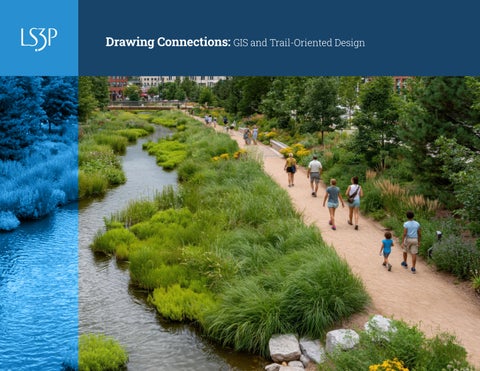
Transit-Oriented Development (TOD) has long been a successful urban design principle: placing homes, services, amenities, and businesses near transit locations encourages smart growth and accessibility. Transit-Oriented Development, however, is not the only TOD. Trail-Oriented Development works with the same set of ideas, but seeks to encourage the right mix of investment along greenway trails and other bike/ pedestrian routes. and shared a replicable process for uncovering, analyzing, and contextualizing complex geographic information into an easy-to-understand format. Cooper’s summer work can be translated across a variety of design scales and contexts; more broadly, her project illustrated how GIS-based analysis can sit alongside traditional design tools, giving teams another way to investigate context and develop an evidenceinformed understanding of place.
In the summer of 2026, LS3P’s summer Research + Innovation intern Isabella Cooper brought a unique mix of skills to this topic. A recent UNC graduate with a background in management and society, geography, and data science, Cooper used her Geographic Information Systems (GIS) experience to study opportunities for development along Raleigh’s greenways. GIS provides layers of geographically-based data that, in a design context, can provide a much fuller picture than a drawing alone. Developing a deep knowledge of local greenways and their connectedness to the larger multi-city transit systems required Cooper to understand circulation at multiple scales, and allowed her to blend technical analysis and design thinking. She was able to use story mapping tools within the software to create a userfriendly deliverable: an interactive map of potential development sites that contains layers of information useful to designers and developers. She also created
This investigation also demonstrates the value of multidisciplinary collaboration. Working alongside future architects, future interior designers, and future historical preservation specialists, Cooper provided a unique perspective connecting an academic mindset with a real-world design environment, broadening the ways in which we process and communicate information.