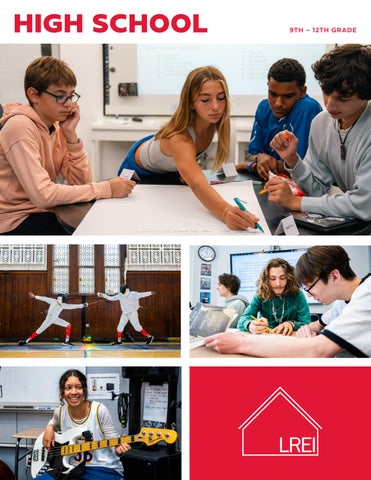
HIGH SCHOOL
9TH – 12TH GRADE
HIGH SCHOOL
We believe great learners ask great questions, and curiosity is at the center of everything we do. Starting in ninth grade and continuing until graduation, our high school students delve into challenging coursework and robust extracurricular offerings. They are tasked with collaborating with peers, negotiating meaning across texts, exploring their creativity, and demonstrating mastery. We create space for students to think independently and act with purpose. By graduation, LREI students are experienced in leading discussions, contributing to communities where student voice is valued, and engaging thoughtfully with questions of equity, justice, and social responsibility.
2
9TH – 12TH GRADE
“My favorite class is definitely my economics class. We’re learning about the incentives behind markets and big corporations, and about free markets and how institutions heavily influence countries. I didn’t know there was such a psychological side to economics.” —Danielle, Class of 2028 Visual and performing arts are an integral part of high school at LREI. Student artwork is featured prominently in the hallways of the high school, and several assemblies each year are dedicated to film screenings, music performances, and dance performances.
A Day in the Life of a 9th Grader Each class meets three times a week for 65 minutes.
8:40 Arrival & Morning Meeting Student Government leads Monday and Friday morning meetings; Wednesdays bring mini-assemblies where student clubs and groups share their work; Tuesdays and Thursdays are grade homeroom and advisory meetings.
11:25 Chemistry / Integrated Math Students collaborate to define and prove concepts, whiteboarding their way through problems the way real mathematicians and scientists do.
12:30 Lunch 9:00 World Literature / World History Ninth graders read, write, question, and consider perspectives beyond their own, building the habits of a writer in World Literature, and using primary sources, simulations, and debate to trace a thousand years of global history in World History.
A buffet of hot meals, salads, and sandwiches— included in tuition (breakfast, too!).
1:25 World Language Immersive French, Mandarin, or Spanish classes that pair language study with fieldwork across the city’s museums and neighborhoods.
10:05 Break Time to grab a snack and catch up with friends before the next class.
2:35 X-Block 10:15 Arts Rotation A trimester-long sampler across photography, dance, drama, music, film, and studio art, before students choose electives—one visual art, one performing art—for the rest of the year.
Flexible time for clubs, groups, extra help, or independent work—all student-led, with a faculty advisor.
3:20 Dismissal The day continues after the bell with optional athletics, theater rehearsals, robotics and debate teams, and much more.
3
Program Highlights Academic Program
In ninth and tenth grade, LREI students participate in a foundational core curriculum designed to prepare them for the advanced electives program in their junior and senior years. Ninth graders take World History, World Literature, Chemistry, Integrated Math 9, World Language (French, Spanish, or Mandarin), and arts classes. Tenth graders continue with American History, American Literature, Physics, Integrated Math 10, World Language, and arts electives that allow for deeper specialization. LREI’s renowned academic electives program is available to students beginning in eleventh grade. Working closely with an advisor, juniors and seniors choose from over 70 advanced electives that span disciplines, allowing the students to dig into what genuinely interests them, from Calculus and Chaos Theory to Marine Biology to the Sociology of Education. This flexibility offers many benefits, including letting students go deep on one subject, try something new, or take an intellectual risk they wouldn’t have in a more rigid system.
Only at LREI:
Learning Through Fieldwork
In their last two years, students put everything they’ve learned to work in two defining projects: the Junior Trip and the Senior Project. Juniors spend their year in teams researching issues they feel are pressing in the U.S., eventually identifying a location where citizens and local governments are addressing it. In April, they travel to these locations to listen and learn from community leaders. Recent trips have explored education inequality in Las Cruces, New Mexico; reproductive rights in Atlanta; and sustainability and climate disasters in New Orleans. The trip is guided by five goals, including getting proximate, troubling easy narratives, embracing complexity, and staying hopeful. As seniors, they design a six-week, self-directed capstone that blends research, creativity, community engagement, and reflection. Projects follow personal interests, from internships at advertising agencies and AI companies to an original EP, an art exhibition, or a robot.
4
Visual & Performing Arts
Students take arts courses every trimester in high school, and they can specialize in one discipline or explore across several. Visual arts offerings include photography, studio art, film, 3D art, and sewing. Performing arts include theater, vocal performance, dance, and instrumental music. All ninth graders rotate through the full range of arts offerings for a trimester and then choose their own electives. Arts classes meet as often as other academic classes, and four years of art is a graduation requirement at LREI. Beyond the classroom, students participate in a vibrant arts community that includes theater productions (fall play and spring musical), jazz ensemble, chorus, Coffee House performances, the student literary magazine IE, and the Spring Arts Showcase.
Athletics
LREI’s 18 competitive teams, including baseball, basketball, volleyball, tennis, soccer, fencing, and cross country, give high school students the opportunity to train, compete, and grow within a supportive and spirited athletic community. Each team is built on a foundation of teamwork and sportsmanship where athletes challenge themselves, take pride in representing their school, and regularly win championships.
Prepared for What’s Next
We teach the skills of adult life as deliberately as we teach history or chemistry, with time for it built into the schedule. In ninth and tenth grade Life Lab, students explore health and wellness, media literacy, digital citizenship, identity, relationships, and decision-making, so they can navigate the social and emotional complexities of high school with clarity and confidence. In eleventh and twelfth grade, College Class covers the art of the college essay, the Common App, interviewing with admissions representatives, and financial aid. And in their final trimester, seniors attend Financial Literacy classes and college prep workshops.
High school students are eligible to participate in a variety of team sports at LREI, including baseball, fencing, track, and volleyball. The LREI Knights practice in our dedicated Thompson Street Athletic Center.
Q+A: Athletics Athletics Director and assistant varsity boys basketball coach Brian Robinson holds a master’s in exercise science with a concentration in sports psychology. Here, he explains how LREI supports students as both athletes and scholars. What should families know about athletics at LREI? Families want to know their child will be cared for on the court and field, and they will be. Our athlete development model sets clear markers at every level, so skills build on each other year over year. Our coaches and I take a whole-child approach, paying attention to each athlete’s emotions, environment, and daily life, and using positive reinforcement to build skills that matter on the field and off it. How do students grow beyond the sport itself? The goal is agency. Students build agency by facing adversity and working through it. You can see the difference as they get older. Early on, a parent might email to say their child can’t make practice. By varsity, the student writes to the coach: “I need to miss practice two weeks from now. I wanted to give you a heads up, and here’s what I’ll do to make it up.” That’s the self-advocacy we’re after. How do you look after the whole athlete? We train the way a student’s body is actually developing. Strength and conditioning is scaled to each athlete’s stage of growth, and we take sleep, stress, and the academic day into account.
Many schools treat sports and school as separate worlds. At LREI, we bring them together. What’s new this year? We’re enhancing the strength and conditioning program with assessments like a force plate and functional movement screening. Colleges and professional teams use the same testing to see where each athlete is. We’re also bringing in outside experts to talk about recovery, nutrition, mental health, and more, including an agency owner who manages NIL deals for collegiate and professional athletes, a strength and conditioning coach, and a physical therapist who specializes in female athletes. What does athletics feel like day to day? It’s loud, competitive, and very inclusive. Our Spirit Game brings together athletes from seventh grade through varsity to play the faculty, and the students always have a bit of an axe to grind, in a fun way. The Thompson Street Athletic Center is the hub for physical education, practices, dances, and homecoming. I’m also looking forward to Senior Night and the parent-versus-student athlete games that wrap up the seasons.
5
After LREI Our graduates are curious, passionate learners who are prepared to lead, question, and create. Scan to see what colleges and universities LREI students attend.
Q+A: College Counseling Between them, LREI’s three college counselors bring nearly 40 years of college advising and admissions experience. Their collaborative approach is distinctive among NYC schools, as is their aim: to make the college application process as humane, personal, and student-led as possible. Associate Director of College Guidance Dana Mackey shares more. Who will guide my child’s process? In most independent schools, you get a counselor with a caseload of 20 kids. Here, counselors work collaboratively with each student. We all have different relationships in the college admissions world, and we bring all of them to each student’s application. It’s one of the things I love most about this office.
“My favorite part of the college application process at LREI was how the students in my class bonded over it. Instead of tearing us apart, the process actually helped us come together as a class. There was constant support. We celebrated with each other. I always assumed applying to college would be scary because students are competing to get into certain schools, but I did not feel that energy at LREI.” — Sandro, Boston College, LREI Class of 2026
6
What else is unique about LREI’s approach to college admissions? The college process should be generative and exciting, not miserable. It’s a collaborative, student-led process of self-exploration and finding the right fit—it starts with what the child wants and needs. And the idea that kids are competing against each other is a myth; they’re competing against the whole applicant pool, not their classmates. The process at LREI is humane, and even fun. How do colleges see LREI students? We are not packaging kids for admissions readers. They’re 17. Our students are athletes and engineers and theater nerds and really good at baking cakes. They’re excited to try new things and are not hemmed in by fear of failure. Colleges see our students as authentic individuals.
Where do LREI graduates go? Our acceptance list reflects how diverse our students’ interests are. We have kids who go to Yale and Brown, to art and film programs like RISD and Chapman, into engineering or pre-med programs, and to school abroad. What we promise is a truly good fit. There’s something much more important than getting into the most selective school possible: spending four years somewhere you can thrive and be happy.
Alumni Voices
What does this look like for families? LREI’s college process is an opportunity for families to see their child lead a complicated process. Every time a kid submits an application, they do it in our office wearing a crown. Their friends all join in. Last year, someone invited their whole Mandarin class. Sometimes we’ll FaceTime parents in. It’s a really important moment for the kid to feel like, “Wow, I did this.” They actually say that to us. We want every student to feel like they’re wearing that crown in their own life.
—Liam Cohen ’13, Postdoctoral Researcher, UC Santa Barbara
“LREI always gave me the opportunity to explore my passion for science, while instilling in me a creative ingenuity that’s served me to this day. My teachers put in extra work to help me learn at a rapid pace and master advanced material early on—preparing me for the future challenges at MIT and beyond.” “LREI is the place that helped me find my voice and how to use it—through independent study, leading conversations in affinity spaces, and collaborating with others through student government. I have LREI to thank for teaching me how to advocate for others. It’s through this voice that I’m able to advocate for the care of my patients today.” —Michelle Mardones ‘20, Neuropsychology Technician, Massachusetts General Hospital 7
“From the first day of ninth grade, students work through problems together at the whiteboard and present their work to the group. It can be intimidating at first, but within a month, it’s just what we do. I’m always blown away by how well our students can explain their thinking.” —Amanda Finigan, LREI High School Principal
LREI – Little Red School House & Elisabeth Irwin High School Lower & Middle School 272 Sixth Avenue New York, NY 10014
lrei.org
High School 40 Charlton Street New York, NY 10014
Thompson Street Athletic Center 145 Thompson Street New York, NY 10012