-
Martin Schantz Faurholt
focus on
Connected… Consuming… Creating…
FOCUS ON GENERATION C
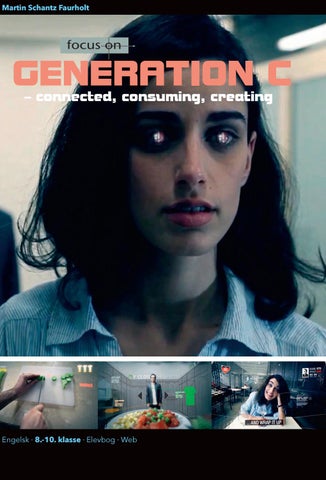
Generation C is the online generation – using visual language to create and share millions of videos daily. Based on three satirical short films, this book invites you to discuss the grey zones of media culture when it comes to gaming, dating and personal exposure. The films are stepping-stones to language learning, providing an authentic and thought-provoking background for communication in English.
focus on
GENERATION C – connected, consuming, creating
9 788723 527134 >
alinea.dk
9788723527134_omslag.indd 1
Engelsk · 8.-10. klasse · Elevbog · Web
11/12/2018 15.05
Focus on Generation C Student’s Book/Web Martin Schantz Faurholt © 2018 Alinea, København – et forlag under Lindhardt og Ringhof Forlag A/S, et selskab i Egmont Mekanisk, fotografisk, elektronisk eller anden gengivelse af denne bog eller dele heraf er kun tilladt efter Copy-Dans regler. Forlagsredaktion: Lise Nerlov Grafisk tilrettelægning: Mette Plesner Omslagslayout: Mette Plesner Trykkeri: Livonia Print 1. udgave 1. oplag 2019 ISBN: 978-87-23-52713-4
Copyrights Strange Beasts: Screen dumps and script printed by permission from Writer/director/ producer Magali Barbé, Co-producers Peanut and Red Knuckles, All credits on https:// vimeo.com/209070629 Sight: Screen dumps and script printed by permission from ”Robot Genius” – www.robot geniusfilms.com Follow Me: Screen dumps and script printed by permission from Marshall Cook and Will Sasso Photos 4 PG Bauer-Griffin/Getty Images, 6 Oleg_ Ermak/iStock/Thinkstock, 7 imagoRB/ iStock/ Thinkstock, 22 Allstar Picture Library/Colum bia Pictures/Ritzau Scanpix, 23v Allstar/ Univseral/Ritzau Scanpix, 23h LFI/ Photoshot/ B4413/Ritzau Scanpix, 34-35 Gremlin/iStock, 38 Natasha-Aleksandra/iStock, 39 Yury Kirillov/iStock, 41 imagoRB/iStock/Thinkstock alinea.dk focuson.alinea.dk Find film og worksheets på focuson.alinea.dk
9788723527134_indhold.indd 2
03/12/2018 14.16
5
8
16 26 36
CONTENTS 5 Introduction 6
Film and visual language
8
1 Strange Beasts: The future of
family and friendship?
16
2 Sight: It’s like real life, but worse
24
Cooperative Learning structures
26
3 Follow me: Got over 100 likes!
36
Film guide
42
Word list
9788723527134_indhold.indd 3
ď Š
10/12/2018 15.36
Kids and adults hunting pokĂŠmons.
4
9788723527134_indhold.indd 4
03/12/2018 13.54
Introduction We live in a visual world. We watch films and TV on our smartphones, stream videos worldwide and constantly portray our comings and goings on Snapchat, YouTube and other multimedia. Generation C is Generation Connected, always accessible, creating and posting pictures. Media have gradually changed who we are, but also what reality means. Virtual games such as “Pokémon Go” and “Harry Potter: Wizards Unite” touch the boundaries of reality – so called augmented reality – by turning our surroundings into online playgrounds. Meanwhile, we share video clips like never before. Almost anything can go viral on the internet, even made-up stories. Among other things, that was an issue during the American presidential election 2016, where false information flooded social media and ended up manipulating the voters. The spectacle gave birth to the idea of fake news, threatening both democracy and people’s sense of truth. Since then, information networks such as Wikipedia, YouTube and Facebook, have tried to win back their communities – communities that have gone out of control according to the founders. The dominating media culture has grown from the American and English speaking part of the globe. The English classroom is therefore an obvious springboard to exploring visual media and their effects, while the “media window” itself is a fair resource for language learning.
9788723527134_indhold.indd 5
A crucial goal for this book is to improve students’ critical awareness of new media. “Focus on Generation C” looks closer at our visual society, all its image ry and consequences. Based on three fictional short films, the tasks take you through different aspects of film and media. All films have critical perspectives on the digital age and its influence on our everyday lives. Magali Barbe’s “Strange Beasts” is a twisted genre that combines media technology with a dark satirical theme. Told in mockumentary style (as if it was a true story) the film portrays a man and his “family” and the costs of a new augmented reality product. “Sight” deals not only with the concerns, but also with the dangers of new media. “Sight” is an online platform for one’s eye drawing info from surroundings and allowing gamification of love life. The film questions what dating apps could develop into in the future – and if we dare use them. In “Follow Me”, a modern dad has taken over his children’s obsession with media culture. The film is a commentary on the quest for likes, snaps and other digital statements. As the director relates: “Socially, the internet is still the wild west. We hope that our protagonist allows viewers to look closely at how they and the people around them – who they know in real life – use social media.”
5
03/12/2018 13.54
Film and visual language Before entering the universe of film and media, one needs to learn the basics of their “language”. Film is the original medium from which the fundamentals of visual story telling have developed. Whatever the video – from a snap to a YouTube clip – the camera and sound communicate a story similar to film. The tasks in this book revolve around four levels of film work: watching films, script and story, film language and reflections on the theme(s). Working with these steps will improve your analytical skills so you become more aware of the structure and function of visual media. The four steps vary between oral and written tasks and use film to approach the scheme of English language, culture and society. Images are the most important element in a film, just like words matter in a text. The order of images is the grammar of the film. To understand the deeper layers of films, one therefore has to learn the cinematic language: what films consist of and why. To create a text the writer uses letters, words and paragraphs. Equivalent to that, the filmmaker uses shots, scenes and sequences to structure a visual storyline. A “movie” refers to the moving images of film, but could as well refer to the viewer being emotionally “moved”. The personal drama, camera work and editing all influence our experience of a film together with both sound effects and music. You can hardly imagine a “Harry Potter” movie without a personal drama, nor his final showdown with Voldemort without breakneck camera action, magical special effects and dramatic violins to intensify it all. All these elements combine to make up the language of film.
6
9788723527134_indhold.indd 6
03/12/2018 13.54
Some film effects are explicit and spectacular. Others are subtle, almost invisible. The visual language depends on the genre and the temperament of the film maker. In the forthcoming chapters, you will see how visual language works in practice; learn more about its ground rules and effect on the viewer.
9788723527134_indhold.indd 7
SEQUENCE
SCENE
SHOT
7
03/12/2018 13.54
CHAPTER ONE
Strange Beasts: The future of family and friendship? “Strange Beasts” is a sci-fi satire about augmented reality: computer-generated graphics used on the real world to “expand” reality. In the film, a new reality game called “Strange Beasts” allows you to create and grow your own pet.
8
How far are people willing to go to live in an imaginary setting of their own design?
9788723527134_indhold.indd 8
03/12/2018 13.54
TASKS
Use Worksheet 1 for your work with “Strange Beasts”.
A. Watching “Strange Beasts” 1 PAIR WORK Answer the questions in a Ping-pong-pair © • What thoughts come to mind when you hear the title “Strange Beasts”? • Look the two words up in the word list. Separately, what do they mean?
CL
2 IN CLASS • Watch the first minute of the film: The genre is sci-fi satire. What is sci-fi? What is satire?? • Watch the entire short film: What is your immediate reaction to the film?
F IL
M GUI D 3 INDIVIDUALLY/IN PAIRS E 1 Write a brief summary of the plot. Have the following questions in mind: Who? What? When? Where? Why?
4 PAIR AND TEAM WORK Prepare an interview about your first impression of the film. Use the Three-Step Interview © structure.
CL
▲
Your teacher will provide details about timeframe and teams. • Interview each other in pairs: – How many characters are in the film? Which are real life characters and which are not? Explain your choice. F IL M GUI D E – What is the setting of the story? 10 – Do you believe in the product “Strange Beasts”? Why/why not? • Team up in groups of four. Each team member reports what he/she learned by interviewing a partner.
9
9788723527134_indhold.indd 9
03/12/2018 13.54
TASKS B. Script and story 1 INDIVIDUALLY Read the script. Add the words you want to remember to MyOwnDictionary on the website. 2 PAIR WORK Divide the script into three acts (parts) – a beginning, a middle and an end. Explain your choice.
F IL M GUI D E 1
3 PAIR WORK/IN CLASS Describe the main character, Victor. • Who is he, what does he look like, and how does he act? • What does Victor’s dialogue show about him and his agenda? Consider these quotes: “No, no, no, I insist. This is not dangerous for your vision. In fact, it is the total opposite.” “It’s been proven that having a pet can help reduce anxiety, in times of stress.”
“Strange Beasts” – script Victor: Hi, my name is Victor. I’m a game developer, and I’m happy to introduce you to “Strange Beasts”, our augmented reality game. “Strange Beasts” is a new game, which allows you to create, customize and grow your very own creature. It has a very user-friendly interface with an infinite choice of customization. I find myself continually being asked the question: What is the future of home entertainment? Well, I personally believe it has to be interactive. I mean, I don’t want to just be told a story, I don’t want to be sitting there, looking at a screen, I want to be a part of it, I want it to feel ... “real”. And Strange Beasts is all about that, that “real” interaction. …
“Walter! What did I say? Not on the sofa! Get down! Down!” • Can we trust what Victor is telling us and do we believe in the person he F IL M pretends to be? Why/why not?
This is Walter, my virtual pet. C’mon Walter, don’t be shy! Ey, Walter! What’s up buddy? Come here, yeah! You want to play?
GUI D E 10
4 INDIVIDUALLY/GROUPS Imagine what happens after the end, and add 10 new lines to the script. Consider these questions: • What happens to Victor and Anna? • Can Victor maintain his illusions of his life and “happy family”?
10
9788723527134_indhold.indd 10
03/12/2018 13.54
You can save all your creations in your library, open it, change it, save it again as many times, as you want. All of it is made possible thanks to Nano Retina-technology. What it does is super impose computer graphics, generated imagery, over real world objects by projecting a digital light field directly into your eye. No, no, no, I insist. This is not dangerous for your vision. In fact, it is the total opposite. Think of it like getting laser eye surgery. But rather than getting a better vision you’re getting like a “super” vision. …
Well, with Strange Beasts, you have a friend for life, really, so it’s like having a dog or a cat, but without the life expectancy. It’s been proven that having a pet can help reduce anxiety in times of stress. Walter! What did I say? Not on the sofa! Get down! Down! …
11
9788723527134_indhold.indd 11
03/12/2018 13.54
Oh, that’s Anna, by the way, my little girl ... Her pet’s name is Blooby. She chose it. Isn’t it cute? And you know what’s great? Blooby and Walter can play together. Well, they can all play together. Ey, Anna, how about we take Walter and Blooby to the park. Sounds good?
12
…
9788723527134_indhold.indd 12
03/12/2018 13.54
Anna! Can you come back here, please? I’ve made you a pack lunch, you’re hungry? Yeah? It’s your favorite! What do you mean “which one”? Cheese and ham, obviously! It’s nice, right? So, after this I was thinking, maybe we check out the science museum. They’ve got
a great ice age exhibition. I’ve heard about a massive mammoth skeleton. Oh, much bigger than a bear! Yes! C’mon then! I’ll show you! C’mon! OK, well ... If you’ve been a good girl ... and you’ve done all your homework ... Yes. Then we can get takeaway. How does that sound?
13
9788723527134_indhold.indd 13
03/12/2018 13.54