When it comes to senior living, one size does not fit all.
As a life plan community, Ohio Living Rockynol’s campus is designed to provide the housing option that’s right for you, right now. Call 330.867.2150 or scan the QR code to learn more!
INDEPENDENT LIVING ASSISTED LIVING MEMORY CARE SHORT-TERM REHABILITATION LONG-TERM NURSING CARE 1150 West Market Street | Akron, Ohio 44313
THE ARTIST RECITAL SERIES AT OBERLIN ALL CONCERTS IN FINNEY CHAPEL 7:30 PM
King Britt
King Britt is a producer, composer, performer, er,, educator, educator, and a DJ whose work spans electronic music and sound nd innovation. innova ation. He has performed worldwide at venues and festivals, s, including includin ng Berghain, Be Big Ears, Summerstage, and Le Guess Who. The e original orig gin nal DJ D for the Grammy Award-winning group Digable Planets, he also curates Blacktronica electronic music festivals. Saturday, February 27
Lawrence Brownlee, tenor
Lawrence Brownlee is a leading opera singer and advocate for diversity in the industry, praised by The New York Times as “an international star in the bel canto operatic repertory.” Brownlee’s Oberlin recital with pianist Kevin Miller features newly commissioned works by African-American composers inspired by Harlem Renaissance writers, alongside a second half of bel canto masterpieces. Thursday, March 18
FULL SEASON SCHEDULE, TICKETS, AND MORE: oberlin.edu/ars
Curated concerts you won’t forget As we enter this season of thanks, we’re reminded of just how fortunate we are to share the joy of music with our community. At Tuesday Musical, there’s much to be grateful for, and the opportunity to connect with one another through unforgettable performances is certainly at the top of that list. Whether you’re joining us for the remarkable talents of pianist James (Zijian) Wei or the celebrated voices of Chanticleer, we hope tonight’s performance offers a welcome opportunity to step away from this busy season, enjoy something beautiful, and share in the joy of live music. As another calendar year draws to a close, we’re especially grateful for the generosity and dedication of those who make our work possible. Your continued support allows Tuesday Musical to bring exceptional artists to Akron and share the power of music with audiences and students throughout our community. Thank you for being part of what makes Tuesday Musical so special. Austin Ferguson Executive Director
Concordia at Sumner
Outstanding Senior Living At Concordia, our network of care is thoughtfully designed to help you or a loved one age in place, with retirement living villas/apartments, assisted living, short-term rehabilitation and long-term nursing care. Call us today at 330-664-1289 to learn more or schedule a private tour.
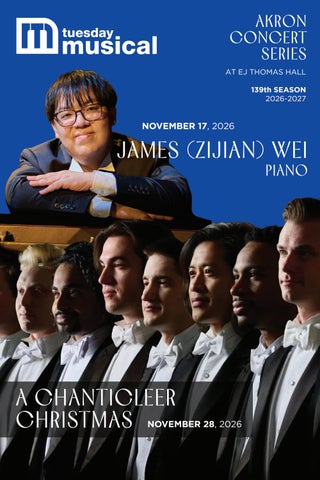
James (Zijian) Wei, piano November 17, 2026, 7:30 p.m. Rising star In 2024, James (Zijian) Wei triumphed as the top winner in the prestigious Cleveland International Piano Competition. His performances — including last year’s Carnegie Hall debut when he received multiple standing ovations — are filled with genuine emotion, boundless enthusiasm, and gifts galore. This season’s Margaret Baxtresser Pianist, James is presented in collaboration with Piano Cleveland.
970 Sumner Parkway • Copley, OH 44321 330-664-1000 • www.concordiaatsumner.org 4
tuesdaymusical.org ■ 330.761.3460
Tuesday Musical’s 2026-2027 Akron Concert Series
A Chanticleer Christmas
American Brass Quintet
November 28, 2026, 3 p.m.
February 9, 2027, 7:30 p.m.
Holiday cheer from a fan-favorite Chanticleer — an “orchestra of voices” named for the “clear-singing” rooster in Chaucer’s Canterbury Tales — weaves together centuries of music to illuminate the joy, mystery, and spirit of Christmas. With voices soaring in perfect harmony, it’s happening the Saturday afternoon of Thanksgiving weekend to start your family’s holiday season.
New to our series One of the premier chamber music ensembles of our time, American Brass Quintet has earned its stellar reputation through celebrated performances, genre-defining commissioned works, and ongoing commitment to the education of generations of musicians. Unlike conventional brass quintets, ABQ’s bass voice is provided by a bass trombone rather than a tuba.
Audra McDonald
Itzhak Perlman, Emanuel Ax, Jean-Yves Thibaudet, Juilliard String Quartet
April 17, 2027, 7:30 p.m. Charm and charisma Reaching across the footlights and holding audiences spellbound, Audra McDonald is unparalleled in the breadth and versatility of her artistry as both a singer and an actor. A luminous soprano with an incomparable gift for dramatic truth-telling, Audra is as much at home on Broadway and opera and concert stages as in her film and television roles. A fabulous Saturday night out!
May 4, 2027, 7:30 p.m. Itzhak Perlman & Friends The reigning virtuoso of the violin joins celebrated pianists Emanuel Ax and Jean-Yves Thibaudet and the Juilliard String Quartet. Their formidable program: Sonata for Two Violins in E minor, Opus 3, no. 5 by Jean-Marie Leclair; Piano Quartet in E-flat major, K. 493 by Wolfgang Amadeus Mozart; and 19th-century masterpiece Concerto in D major, Opus 21 by Ernest Chausson. Each piece is among the most difficult of its kind — now performed together in Akron by some of the world’s best. 5
The Margaret Baxtresser Annual Piano Concert Endowment Fund Tuesday Musical Association appreciates your continued support of The Margaret Baxtresser Annual Piano Concert Endowment Fund. This fund gives a lasting voice to Margaret’s objective of presenting the world’s greatest pianists in Akron. It also helps maintain the legacy that this extraordinary woman left for us to remember. Listed here are donors to the fund since its inception after Margaret’s passing in 2005. Barbara Ainsworth-Porter Ronald & Ann Allan Moshe Amitay & Judy Levin Tom & Nancy Anderson Anonymous Marion Goetz Aron Eleanor & Richard Aron Mark Auburn Sue & Christopher Bancroft Lee and Floy Barthel Earl & Judy Baxtresser Jeanne Baxtresser & David Carroll Robert Baxtresser Suzanne Baxtresser & Steven Wangh George Bellassai Jeanette & John Bertsch Jan Bird Ginny Black Sue & Pete Birgeles Mary & Dave Brown Lisle M. Buckingham Endowment/ Akron Community Foundation Alan & Sara Burky Elizabeth Butler Alfred S. Cavaretta Sarah Church Joyce Clark Cynthia Maglione Coleman Lydia Colopy Mr. & Mrs. Nicolas Constantinidis Carole Cordray-Syracuse George Curley Rita Czarnecki Jane Davenport Mary Davenport Jerry Davidson David & Katharine DeBolt David & Judith DeShon Mary Di Donato Marjorie Donahue & Robert Roach Dave & Susan Dudas Dennis & Karen Dunn Carolyn & Jerry Durway Hope Everhart David & Roberta Ewbank Denis & Barbara Feld Lois & Harvey Flanders Richard & Eleanor Freeman Thomas Friedman Marlene Mancini Frost Laura Lee Garfinkel Candace Gatewood Diana F. Gayer Stephen T. & Mary Ann Griebling Mary Lynne Grove 6
Elaine Guregian Toshie Haga Bruce & Joy Hagelin Bart & Jeannie Hamilton Mr. & Mrs. Robert S. Hancock DuWayne & Dorothy Hansen Jarrod Hartzler Karin Harvey Jean Hauser Dan T. Hayes Marcianne Herr Harriet & Herb Herskowitz Patti Hester Linda Hohenfeld Monica (Niki) Houghton Kathryn E. Hug Kathryn M. Hunter Margaret W. & David M. Hunter Mary Ann Jackson Constance C. Jenkins Jerry & Helen Jenkins Scott & Linda Johnston Phyllis R. Kaplan Mr. & Mrs. Gilbert Katz Ardith & Bill Keck David W. Kellogg Jon & Martha Kelly Cynthia Knight Dr. & Mrs. Edward L. Koosed Mr. Louis Lane Laurie Lashbrook Diane Lazzerini Lehner Family Foundation Peter & Dorothy Lepp Larry & Shirley Levey Michelle and Richard V. Levin Marian Lott Martha Klein Lottman Richard & Leslie Lund Barbara MacGregor Orlene Makinson Eugene Mancini Roberta & Stan Marks Charitable Foundation Sanford & Eleonora Marovitz Gloria Massa Diane Mather Claire McJunkin Virginia Mead Dodi S. & Claude Meade David & Anita Meeker Eileen L. Meeker & Chris Houghton Mr. & Mrs. Robert Mercer Lynn & Ed Metzger Emmett & Alice Monroe Charles & Elizabeth Nelson
Dianne & Herbert Newman Wm. Max Nonnamaker Louwana S. Oliva OMNOVA Solutions Foundation Bob & Marge Palmieri Ruth Papini Reinhard & Mary Petrich Alice H. Phillips George S. Pope Madeleine Pringle John H. & Carol E. Ramey Susan Ramsdell E. G. Sue Reitz Sally & David Riede Nan & John Riemenschneider Corrinne & Donald Rohrbacher Phyllis Ronald Beverly M. Rose Lola M. Rothmann Bernadette Blount Salley Anne M. Schellin Mary Schiller Brent & Nathalina Schloneger Theresa Dye Schoettler Arthur & Jean Schooley Grace Reginald Scott Walt & Donna Scott Geraldine & Nadine Shank Dr. C.M. & Barbara Shearer Betty Sloan Sandra & Richey Smith Margo Snider & Rick Butler Mrs. Jimmy Rogers Snoga Louise & Al Spaulding R. Thomas & Meg Harris Stanton Mary Jo Stasell Jennifer & Jeffrey Stenroos Kenneth F. Swanson, M.D. James Switzer & Gretchen Laatsch Mr. & Mrs. Russell Tinkham Dr. & Mrs. LeRoy Tunnell Lewis H. & Charlotte E. Walker Paul & Gwyn Wallace Lee Wallach Ann Waters Walter & Barbara Watson Virginia B. Wojno-Forney Jerry Wong Janet Wright Mary Alice & David Wyatt Zeta Omicron Chapter of Delta Omicron Mayumi & Christopher Ziegler John & Kathleen Zizka
tuesdaymusical.org ■ 330.761.3460
EJ Thomas Performing Arts Hall—The University of Akron Tuesday, November 17, 2026, at 7:30 p.m.
James (Zijian) Wei, piano Tuesday Musical’s 2026-27 Margaret Baxtresser Pianist.
Piano Sonata No. 27 in E Minor, Op. 90.................... Ludwig van Beethoven (1770-1827) I. Mit Lebhaftigkeit und durchaus mit Empfindung und Ausdruck (“With liveliness and with feeling and expression throughout”) II. Nicht zu geschwind und sehr singbar vorgetragen (“Not too swiftly and conveyed in a singing manner”) Rhapsodies, Op. 79................................................................Johannes Brahms (1833-1897) No. 1 in B minor No. 2 in G minor Fantaisie in B Minor, Op. 28................................................ Alexander Scriabin (1872-1915) Polonaise-Fantaisie in A-flat Major, Op. 61........................... Frédéric Chopin (1810-1849) Intermission Etudes d’execution transcendante, S. 139....................................... Franz Liszt (1811-1886) XI. Harmonies du soir Ballade No. 2, S. 170a....................................................................................................... Liszt Hungarian Rhapsody No. 15, S. 244/15 “Rákóczi March”............................................ Liszt .......................................................................................................................arr. Vladimir Horowitz Réminiscences de Don Juan, S. 418................................................................................ Liszt Mr. Wei performs this evening on Tuesday Musical’s Three Graces Steinway D Piano, made possible by the generosity of Lucinda Weiss. Generous support for tonight’s performance and the masterclass held at Kent State University’s Glauser School of Music comes from donors to The Margaret Baxtresser Annual Piano Concert Endowment Fund as well as from other individuals, foundations, and businesses.
Among Tuesday Musical’s generous season supporters: Akron Community Foundation, Lisle M. Buckingham Endowment Fund, Kenneth L. Calhoun Charitable Trust, KeyBank Trustee, Mary and Dr. George L. Demetros Charitable Trust, Charles E. and Mabel M. Ritchie Memorial Foundation, Helen S. Robertson Fund, Sisler McFawn Foundation, Lloyd L. and Louise K. Smith Foundation, Welty Family Foundation
7
The Artist
James (Zijian) Wei, piano 8
tuesdaymusical.org ■ 330.761.3460
Tuesday Musical’s 2026-2027 Akron Concert Series
Chinese pianist James (Zijian) Wei is a rapidly rising star among his generation of pianists. Characterized by genuine emotion and unique charm, his performances are loved and acclaimed by audiences around the world.
Orchestra, the Zhengzhou Philharmonic Orchestra, and the Wuhan Philharmonic Orchestra, among others.
In the year 2024, James (Zijian) Wei triumphed as the recipient of the highest honor in the prestigious Cleveland International Piano Competition, while also securing accolades including the Best Chamber Music Performance Award, the Henle Verlag Urtext Special Prize, the Audience Choice prize, and the Young Judge Prize. He made his Carnegie Hall debut in October 2025.
James (Zijian) Wei pursued his secondary education at the high school affiliated with the Xinghai Conservatory of Music, mentored by Professor Jay Pengjie Sun Professor Liu Xi, and Professor Popova. In the year 2016, he was successfully admitted to the Central Conservatory of Music, and has been undergoing musical education under the esteemed guidance of Professor Wei Danwen, a celebrated pianist and the department chair of the Piano Department at the Central Conservatory of Music.
In recent years, James (Zijian) Wei has frequently performed as a soloist with renowned orchestras in North America, South America, Europe, and China. Wei Zijian has played with The Cleveland Orchestra, the Orchestre de la Suisse Romande, the Shanghai Symphony Orchestra, the Xiamen Philharmonic Orchestra, the Central Conservatory of Music Symphony Orchestra, the Changsha Symphony Orchestra, the Sichuan Conservatory of Music Symphony
James (Zijian) Wei has achieved remarkable distinctions, including the First Prize in the 2017 Changjiang Cup National University Piano Competition, the Grand Prize in the Professional Category of the 2018 Huanglong Music Season Piano Competition, the First Prize in the 2018 Jianfa Gulangyu International Piano Competition, and the Third Prize in the 76th Geneva International Music Competition, as well as the receipt of the ROSE-MARIE HUGUENIN Award in 2022.
9
Program Notes Ludwig van Beethoven Piano Sonata No. 27 in E Minor, Op. 90 The year 1814 was a year of great productivity for Ludwig van Beethoven. After turmoil had kicked off 1813 (including a difficult depressive spell, gastrointestinal issues, and health problems for his brother, Kaspar), 1814 was off to a more promising start. War that had been ravaging the region had finally ended, Beethoven’s recently premiered Seventh Symphony was getting repeat performances, and his opera Fidelio was being revived and revised for a performance in Vienna. In fact, dignitaries in town for the Congress of Vienna in 1814 would flock to the theater to see Fidelio, as Beethoven’s name was becoming known all over Europe (Beethoven would capitalize on this, attaching himself to the hoopla of politics wherever he could). As biographer Jan Swafford would summarize, the congress that year “was his apotheosis in the public eye.” Despite all this feverish attention and busy activity in the concert hall and opera house, Beethoven found time to compose a piano sonata, his first in five years. The Sonata in E Minor was composed and dedicated to Prince Moritz von Lichnowsky, a longtime friend and benefactor. Beethoven wrote to Lichnowsky that “I have never forgotten how much I owe you in general,” and Lichnowsky was also the dedicatee of Beethoven’s earlier Eroica Variations. Unusually, the piece is in two movements rather than the more standard three or four, and Beethoven assigns more florid titles to the movements compared to the usual form or tempo marking in Italian (such as “Allegro”). Beethoven scholars and audiences alike frequently divide Beethoven’s oeuvre into three periods, with the Middle period defined by socalled heroism, grand scale works, and dramatic conflicts made musical. The Sonata in E Minor is considered to be a late-Middle work. 10
However, the work also acts as an anchor to the Late period to come. Beethoven would suffer from creative exhaustion after 1814 following a decade-long period of near-constant compositional activity and reduce his output. His Late period is more experimental and lyrical, with more abstract musical structures and a kind of deep spirituality not seen in the earlier periods. The Sonata in E Minor is thus situated at the axis between these two periods. On the one hand, the work comes at the height of Beethoven’s popularity and productive prowess, a work that sits alongside Fidelio and his Seventh Symphony as the apex of a banner year. On the other, the work’s more experimental two-movement structure— with a passionate and despondent first movement and a lyrical and quasi-spiritual second—perhaps situates the piece with Beethoven’s work to come. Beethoven is treated as a heroic figure who oscillated between triumph and anguish, and the Sonata in E Minor captures that essence in two movements, one looking backwards to the years before 1814, and the other looking forward to the period to come. Johannes Brahms Rhapsodies, Op.79 One of the most famous facts about Johannes Brahms is his propensity for self-destruction. Put another way, Brahms was a neurotic perfectionist who constantly wrote and then destroyed works he didn’t deem good enough to perform or publish. This is why it took him years into his career to write his first string quartet and symphony, works whose long histories in Western art music haunted the young Brahms. However, while some genres and forms would take years to gestate, Brahms curiously started off his career with three tuesdaymusical.org ■ 330.761.3460
Tuesday Musical’s 2026-2027 Akron Concert Series piano sonatas (his Opuses 1, 2, and 5). Seemingly unburdened in his youth by the shadows of the titans before him (especially Beethoven), the fact that Brahms started his career with piano sonatas and yet was tortured by other genres is a fascinating quirk about the man. Despite these early pieces, however, Brahms would never formally compose another piano sonata after these initial offerings (perhaps his famous neurosis caught up with him as he matured). While he would compose a vast number of piano works, none after the early juvenilia would take the title “sonata.” Later in life, once Brahms had established himself as one of the top composers of Europe, he composed a set of two Rhapsodies in 1879. Dedicated to his dear friend and former pupil Elisabeth von Herzogenberg (whom he affectionally called “Lisl”), these pieces take the sonata form and apply it to these singlemovement works (thus, sonatas in content
if not sonatas in name). Herzogenberg loved the pieces, noting that after a sleepless night the works rejuvenated her: “But at sight of the two much-admired pieces I forgot all my grief and pain, and greeted them like old friends. It is hard to believe that there ever was a time when I did not know them, so quickly does the barely acquired treasure become incorporated with the accumulation of long standing.” Orchestrally expansive in color and varied in theme, the two Rhapsodies oscillate between tempest and lyricism, passion and melancholy. Brahms’s compositional inventiveness is on full display in these pieces, which have become favorites for pianists ever since. Like all surviving works of his, it’s fortunate that he deemed it fit to keep and publish these pieces, as they might have been confined of the flames of his fireplace if he had decided to label them “sonatas.”
11
Program Notes Alexander Scriabin Fantaisie in B Minor, Op. 28
Based on the beloved holiday film
Dec. 4 – 20 magicaltheatre.org
330-848-3708
565 W. Tuscarawas Ave. Downtown Barberton
12
Alexander Scriabin found himself in a plum position in 1900, teaching at the Moscow Conservatory while simultaneously able to grow his reputation as a composer. His time in Moscow led to a period of pianistic fervor, composing a cycle of études, several sets of preludes, his first three piano sonatas, and his only piano concerto. Amongst all these compositions, the Fantaisie, which is a single-movement work in sonata form, acts as a sort of “third-and-a-half sonata,” as it bridges the gap between his Third and Fourth Sonatas. While Scriabin is perhaps best remembered for his experimental and metaphysical later works, this early period work arguably represents the apex of late-Romantic compositional idioms, building on the legacy of composers ranging from Chopin to Wagner to create a work that is maximalist and yet deeply personal. The Fantaisie is virtuosic, both in its techniques as well as its compositional methods. While the piece is technically in B minor, much of the work is spent evading any clear resolution to this home chord, leading to a sense of yearning and irresolution that makes its ultimate finale all the more satisfying. The work is also densely contrapuntal, requiring the performer to constantly mediate complicated melodies between the hands while performing florid running accompanimental lines throughout. Curiously, though, Scriabin never performed the work in public. In what is probably an apocryphal (or at least heavily embellished) story, Scriabin’s friend and musicologist Leonid Sabaneyev years later performed the melody on the piano in Scriabin’s Moscow apartment. Supposedly, Scriabin asked from the other room “Who wrote that? It sounds familiar,” to which Sabaneyev responded “Your ‘Fantaisie.’” Scriabin apparently had no memory of the work, which is hard to tuesdaymusical.org ■ 330.761.3460
Tuesday Musical’s 2026-2027 Akron Concert Series believe considering the piece’s incredible dexterity, melodic and harmonic inventiveness, and rich contrapuntal textures. Whether or not this story is true is besides the point; the work lasts to this day as a rich apex of late-Romanticism, a piece that persists on the recital stage even if it didn’t in Scriabin’s memory. Frédéric Chopin Polonaise-Fantaisie in A-flat Major, Op. 61 No piano recital would seemingly be complete without a piece by Frédéric Chopin, a composer who defined the Romantic sound of the instrument. Particularly known for his nocturnes, preludes, and Polonaises—a kind of dance from Chopin’s native Poland—Chopin’s piano works have stood the test of time as some of the most popular repertoire for the instrument. Among Chopin’s oeuvre is his PolonaiseFantaisie, a work that found itself on the
recitals of legendary pianists like Arthur Rubenstein, Claudio Arrau, and Vladimir Horowitz and still is a work oft-performed to this day. However, despite the work’s life on modern stages, the piece was not esteemed upon its release. Originally published in 1846, biographer James Huneker has described the PolonaiseFantaisie’s reception as “derided as amorphous, febrile, [and] of little musical moment.” Furthermore, Chopin’s contemporary Franz Liszt stated that “such pictures possess but little real value to art,” and it would take over a century for pianists and musicologists to “recover” the work from its poor initial reception. Part of this derision perhaps stemmed from the fact that unlike the earlier Polonaises, the PolonaiseFantaisie functions more like a tone poem, foreshadowing the symphonic works of Richard Strauss in the decades to come. The piece is extremely varied in its moods
Celebrate the Magic of the Season! 25TH ANNUAL
LIVE OR VIRTUAL
45
$
Tickets make a great holiday gift!
LIVE TOUR 5 HOMES Sun. Dec. 6, 2026 VIRTUAL TOUR 8 HOMES Sat. Dec. 12, 2026 Sun. Jan. 3, 2027
PRESENTED BY:
MAJOR SPONSORS:
The Read Family Roger & Sally, Scott & Michelle, Garrett and Brandon
Gregory Hail & Matthew Culler Dr. Kate Raymond & Michelle Krocker
Fran Bittle
Associated Designs Gervasi Vineyard Trac Papish Resort & Spa Tom & Carla Dianne L. Kerr Eisenloffel
Susie & Tony Paparella State & Federal Communications
HOSTED BY
sugarplumtour.org/tickets *PLUS ONLINE PROCESSING FEES
13
Program Notes and colors, with an ominous opening of expansive chords that eventually give way to an elongated introduction that foreshadows the piece’s main lyrical theme. Once the theme arrives, it is accompanied by the standard Polonaise rhythm (long-short-short long-long long-long) at a rapid tempo. The work takes its “Fantaisie” designation to heart, introducing other themes and frequently and quasi-improvisatorily returning to its central melody. After an explosive climax, the work energetically sprints to the finish, and yet suddenly and seemingly dies away before ending on a conclusive and fortissimo chord that brilliantly caps off the work. The great tragedy of the PolonaiseFantaisie is the fact that it is a “late” work on account of Chopin’s short lifespan. Chopin’s health had been declining for years when he wrote the piece, and he would meet his untimely end in 1849 after a battle with a disputed illness (while Chopin was treated for tuberculosis in his lifetime, it has been argued for over 150 years what his actual cause of death and debilitating illness was). As musicologist Paul Hamburger has lamented, “Chopin was 36 years of age when he published this ‘late’ masterpiece, and if tuberculosis had not killed him off after another three years of misery, we should now look upon the Polonaise-Fantaisie as the first work of a new ‘middle period’ development.” The Polonaise-Fantaisie was not respected in its day, and Chopin would not live long enough to continue on its compositional inventiveness in future works. However, its second life in the twentieth century and beyond means that Chopin will live on through this late opus, a capstone on a career cut too short. Franz Liszt Études d’execution transcendante, S. 139 Franz Liszt’s reputation as a virtuoso arguably overshadows the fact that he was also a child prodigy. As a youth, he took piano lessons from Carl Czerny—thus 14
making him a grandstudent of Beethoven—and composition lessons from Antonio Salieri, and he made his public debut as an eleven-year-old in Vienna to great success. From high esteem in Austria, Germany, and his native Hungary, the Liszt family had accrued enough money to move to Paris in 1823 when Liszt was only twelve. However, after a failed attempt to join the Conservatoire de Paris and the untimely death of his father, Liszt found himself trapped. He gave up touring, and taught piano and composition lessons in order to earn money. He took up smoking and drinking, and spent much of the day making long journeys across Paris to the homes of his students. It was during this tough time that he spent idle hours composing études, piano pieces that would later become his famous Transcendental Études. A decade later, Liszt had recovered from hard times and returned to touring, becoming the legendary performer whose reputation lasts to today. He revisited this set of pieces in 1837, adding them to his traveling repertoire. After he later retired from touring once again (voluntarily this time, though), he revised the pieces for a final time, publishing them in the version we know today in 1852. The penultimate of these études is subtitled “Harmonies du soir,” or “Harmonies of the Evening.” The piece’s dexterous requirement for pedaling and expansive chords foreshadow the textures of Debussy’s music. Pianist Louis Kentner has described the étude as “like an impressionist canvas, so vividly painted that it is as if one hears not only the sounds but also smells the perfumes drifting across the warm evening air. There is an impression of bells ringing softly from distant spires.” The piece is difficult, yes (it is a Liszt composition, after all!), but it also evokes a gentility and a delicateness. tuesdaymusical.org ■ 330.761.3460
Tuesday Musical’s 2026-2027 Akron Concert Series Revisiting the piece allows the listener to look backwards as Liszt did, at a work published after an illustrious career that was revised from earlier juvenilia, a piece that captures into sound the tranquility of the Parisian nights that were equally inspirational and suffocating to the adolescent Liszt. Franz Liszt Ballade No. 2, S. 170a Following a decades-long career as a virtuoso soloist, Franz Liszt ceased traveling around Europe in 1848, settling in Weimar and making the transition from pianist to full-time composer and conductor. One work that was born from this period in Weimar was his Second Ballade in B Minor, which was composed in 1853 for the Grand Duke of Weimar and Liszt’s employer-protector, Charles Alexander. The work was published the next year, and audiences ever since have marveled at its typical Lisztian virtuosity.
However, the work is an unusual one within Liszt’s oeuvre. Liszt is famous for his program music, music that has texts, stories, or descriptive titles that guide the listener with extramusical context to hear through. In contrast, the Ballade—despite its title—is actually one of his rarer pieces of absolute music, music that has no explicit program or description to it. Unlike many of his other works, Liszt was reluctant to say that this piece meant anything other than itself. The piece is essentially a sonata under another name (coincidentally sharing its key with Liszt’s titanic B Minor Sonata). The work has two main themes that are developed and then recapitulated, albeit in Lisztian chromatic fashion and with some unexpected twists (such as the second theme being played first in the Recapitulation). Just because Liszt doesn’t assign a program to the piece doesn’t mean that audiences and performers haven’t retroactively themselves. For example,
Handel's
MESSIAH “Alluring personalities and a stellar chorus and orchestra, presented with a sense of theater, as Handel intended it to be…” – CLEVELANDCLASSICAL.COM
apollosfire.org 216.320.0012
December 4-6 & 19-20 AKRON, SHAKER HEIGHTS, CHAGRIN FALLS, CLEVELAND, & BAY VILLAGE 15
af2627_tuesMus_sep2.indd 1
9/29/26 3:43 PM
Program Notes pianist Claudio Arrau compared the piece to the ancient Greek myth of Hero and Leander, a story of love triumphing over the raging elements. Arrau describes the swirling chromaticism as being like the sea, noting that as the piece goes on “you really can perceive how the journey turns more and more difficult each time. In the fourth night he drowns. Next, the last pages are a transfiguration.” In any case, whether Liszt intended a program or not, the piece’s swirling chromaticism, large and symphonic themes, and intricate dexterity allow for plenty of interpretative slipperiness, permitting audiences to hear it as tones for tones’ sake or as hearkening back as far as Greek myth. Franz Liszt Hungarian Rhapsody No. 15, “Rákóczi March,” S. 244 arr. Vladimir Horowitz “Of all living artists, I am the only one who can proudly exhibit a proud Fatherland. While the others paddle about miserably in the shallow waters of a mere public, I sail forward freely on the open sea of a great nation. My North Star consistently shows that Hungary will one day point proudly towards me.” – Franz Liszt The year 1839 was a landmark year for Franz Liszt. The pianist was one of the most famous performers in Europe, and had been traveling for decades as the continent’s chief virtuoso of the instrument. After spending sixteen years away from his homeland, Liszt planned to return to Hungary. The homecoming was an unprecedented one, as he was greeted as Hungary’s favorite son, with the entire nation seemingly rallying behind his grand return. This was not just a matter of national pride, however. Hungary was a powder keg in 1839, a result of many political factors stemming from one hundred and fifty years of oppressive Austrian rule, including the banning of the Hungarian language, the undervaluing of its culture, 16
and the ravaging of the region’s natural resources. As such, as biographer Alan Walker has noted, Liszt’s arrival was timed to a moment when Hungary was “searching for Magyar heroes, ambassadors who might make Hungary’s plight better known abroad.” Liszt was homesick for his Fatherland and was happy to return. At his first concert, he performed a program that was met with rapturous applause that initiated an encore. Liszt chose for this encore his arrangement of “Rákóczi March,” a perfect work for this audience. The melody for this tune was known to all patriotic Hungarians, so much so that the melody was banned for Austrian audiences on account of its revolutionary associations. Liszt was stoking the national unrest in his home, and this encore was so enthusiastically received that it was reported to the secret police back in Vienna. The rest of his trip was met with similar fervor, and Liszt’s homecoming was a national spectacle. Liszt’s concert tour was a step in the road to revolution, which would come to a head several years later in 1848. A few years later in 1853, Liszt would publish an arrangement of “Rákóczi March” as the fifteenth in his series of Hungarian Rhapsodies. Like the other rhapsodies, the piece incorporates Hungarian rhythms, scales, and forms from his Fatherland, and has since become a popular showpiece for pianists to this day. The 15th Rhapsody was later embellished by the famous pianist Vladimir Horowitz, who takes Liszt’s original and adds to it even more pianistic dexterity, including additional thunderous octaves, faster speed, and new cadenzas. Liszt’s Hungarian Rhapsody No. 15 is thus a microcosm of all of his patriotism, a composition that takes one of Hungary’s most-loved melodies and transforms it into a showpiece that at the time only Hungary’s prodigal son could perform.
tuesdaymusical.org ■ 330.761.3460
Tuesday Musical’s 2026-2027 Akron Concert Series Franz Liszt Réminiscences de Don Juan, S. 418 In the livings rooms and parlors of the nineteenth-century household, a piano with a nearby stash of arrangements would not be an uncommon sight, with reductions for two- or four-hands of the popular symphonies, operas, and songs of the day nearby to entertain guests or pass the time in the years that preceded recording technology. For example, the publisher Schott had released a vocal score with piano reduction of Mozart’s Don Giovanni as early as 1791, just four years after its completion. Later versions were published by Breitkopf und Härtel in 1800 and 1818, and in France publisher Marquerie Frères released a vocal score version of Don Giovanni in 1838. Mozart’s opera is an example of a piece of art music that would see a second life in the private homes of citizens all across Europe, in many cases far from the storied opera houses where the full version would be staged. However, what would not be in these civilian libraries would be the arrangements of Franz Liszt. By the early 1840s, Liszt had become a superstar in European music, traveling around the continent showcasing his unbelievable virtuosity and premiering his own compositions and arrangements. One such arrangement he debuted in 1841 was Réminiscences de Don Juan, one of his many “reminiscence pieces” that took
popular operas like Lucia di Lammermoor or Norma and arranged them for solo piano. However, unlike the vocal scores of the European household, Réminiscences de Don Juan takes Mozart’s aforementioned Don Giovanni and makes it fiendishly difficult, a showpiece that only pianists of Liszt’s titanic abilities could perform. Réminiscences de Don Juan takes scenes from Mozart’s opera—including the Commendatore’s condemnation of the titular character to hell, the love duet “Là ci darem la mano,” and the Champagne aria “Fin ch’han dal vino”—and elevates them to their pianistic heights. Performers have struggled with the work ever since its debut, with Vladimir Horowitz using it as the finale to his graduation concert at the Kiev Conservatory and Alexander Scriabin injuring his hand while practicing the piece (later writing the funeral march for his First Piano Sonata as a memorial to his damaged hand). To this day, the piano can serve as a symbol of musical enrichment in the home, a healthy activity that trains the body to perform works that enrich the mind. However, even for the most talented of home pianists, a work like Réminiscences de Don Juan was designed to challenge the mightiest of fingers, and thus is a work that seems confined to the concert hall alone. Program notes by Tanner Cassidy
17
EJ Thomas Performing Arts Hall—The University of Akron Saturday November 28, 2026, 3:00 p.m.
A Chanticleer Christmas Tavian Cox†, Luke Elmer*, Cortez Mitchell*, Bradley Sharpe, Logan Shields, Adam Brett Ward – countertenor Vineel Garisa Mahal*, Matthew Mazzola, Andrew Van Allsburg – tenor Eric Alatorre, Jared Graveley*, Matthew Knickman – baritone and bass Tim Keeler – Music Director I A Solis Ortus Cardine..............................................................................................................Plainsong Spaséniye Sodélal............................................................................. Pavel Chesnokov (1877–1944) Gaudete in Domino........................................................................... Giaches de Wert (1535–1596) Reading: Excerpt from “Music on Christmas Morning” by Anne Brontë II Psallite Unigenito†........................................................................... Michael Praetorius (1571–1621) Es ist ein Ros entsprungen............................................. Praetorius, Hugo Distler (1908–1942) In Dulci Jubilo†.......................................................................................................................... Praetorius III We Three Kings..................................................................... John Henry Hopkins, Jr. (1820–1891) La Ciantia di Trëi Rëisc........................................................................................... Traditional Ladin, ..................................................................................................................arr. Samuel Runggaldier Olives and Quinces........................................................................Gian Carlo Menotti (1911–2007) The Banquet Fugue...........................................................................................John Rutter (b. 1945) IV This Endris Night†.......................................................................................... Sarah Quartel (b. 1982) Noel: Verbum Caro Factum Est................................................................. Tamsin Jones (b. 1972) Ave Maria†....................................................................................................... Franz Biebl (1906–2001) V Sussex Carol.............................................................................................................Traditional English, ..........................................................................................................arr. Ralph Vaughan Williams Snow .............................................................................................................. Irving Berlin (1888–1989), .................................................................................................................................. arr. Cedric Dent ......................................................... Arrangement commissioned by Chanticleer in 2023
18
tuesdaymusical.org ■ 330.761.3460
Simple Gifts.......................................................................................... Joseph Brackett (1797–1882), ..................................................................................................................................... arr. Tim Keeler Wyandot’s Realm....................................................................................... Andrew Balfour (b. 1967) And the Trees Do Moan†...........................................................................Traditional Appalachian ..............................................................................................................................................arr. Keeler Silent Night†.................................................................................. Franz Xaver Gruber (1787–1863), .............................................................................................................................arr. Jared Graveley VI Medley of Christmas Spirituals†............................. Traditional African American Spirituals, “Rise Up, Shepherd, and Follow”................................................ arr. Joseph H. Jennings “Oh, What a Pretty Little Baby” “Oh, Jerusalem in the mornin’” Program subject to change. †These pieces have been recorded by Chanticleer. *Jared Graveley occupies The Eric Alatorre Chair, given by Peggy Skornia. Luke Elmer occupies The Ning G. Mercer Chair for the Preservation of the Chanticleer Legacy, given by Ning and Stephen Mercer. Vineel Garisa Mahal occupies The Tenor Chair, given by an Anonymous Donor. Cortez Mitchell occupies The Cortez Mitchell Chair, given by James R. Meehan. †Tavian Cox’s full-time position for Chanticleer’s 2026-2027 season has been generously sponsored by Anne Heinrich. Matthew Knickman’s full-time position for the 2026-2027 season has been generously sponsored by the Chanticleer community. Scan this code to sign up for Chanticleer’s newsletter
Among Tuesday Musical’s generous season supporters: Akron Community Foundation, Lisle M. Buckingham Endowment Fund, Kenneth L. Calhoun Charitable Trust, KeyBank Trustee, Mary and Dr. George L. Demetros Charitable Trust, Charles E. and Mabel M. Ritchie Memorial Foundation, Helen S. Robertson Fund, Sisler McFawn Foundation, Lloyd L. and Louise K. Smith Foundation, Welty Family Foundation
19
The Artists
Chanticleer Known around the world for its eclectic repertoire and dazzling virtuosity, the GRAMMY® Award-winning vocal ensemble Chanticleer—under the leadership of Music Director Tim Keeler—has been hailed by the Boston Globe as “breathtaking in its accuracy of intonation, purity of blend, of color and swagger of style.” Founded in San Francisco in 1978 by singer and musicologist Louis Botto, Chanticleer quickly took its place as one of the most prolific recording and touring 20
ensembles in the world, an “orchestra of voices” performing thousands of live concerts and selling more than one million recordings. Rooted in the Renaissance, Chanticleer’s repertoire has expanded to include a wide range of classical, gospel, jazz and popular music. With a deep commitment to the commissioning of new compositions and arrangements, Chanticleer foregrounds American repertoire and a distinctively American tuesdaymusical.org ■ 330.761.3460
Tuesday Musical’s 2026-2027 Akron Concert Series sound, complementing the group’s signature diversity in terms of membership and genre. The ensemble has dedicated much of its vast recording catalogue to these commissions, garnering GRAMMY® Awards for its recordings of Sir John Tavener’s Lamentations & Praises and the ambitious collection of commissioned works entitled Colors of Love. Chanticleer’s 2002 album Our American Journey was inducted into the National Recording Registry of the Library of Congress in 2025. Chanticleer is the recipient of Chorus America’s Dale Warland Commission Award and the Chorus America/ASCAP Award for Adventurous Programming. The group’s Music Director Emeritus, Joseph H. Jennings, received the Brazeal Wayne Dennard Award for his contribution to the African American choral tradition during his 25-year tenure as both singer and Music Director. Chanticleer—named for the “clearsinging” rooster in Geoffrey Chaucer’s Canterbury Tales—was named Ensemble of the Year by Musical America in 2008 and inducted into the American Classical Music Hall of Fame. The group’s awardwinning education programs were recognized with the 2010 Chorus America Education Outreach Award, and have engaged tens of thousands of students since the ensemble began. Chanticleer is a non-profit organization, governed by a volunteer Board of Trustees, administered by a professional
staff with a full-time professional ensemble. In addition to the many individual contributors to Chanticleer, the Board of Trustees thanks the following Foundations, Corporations and Government Agencies for their exceptional support: San Francisco Grants for the Arts National Endowment for the Arts Bloomberg Philanthropies The Bob Ross Foundation Dunard Fund USA E. Nakamichi Foundation Negaunee Foundation Anonymous CHANTICLEER STAFF Philip Wilder, President & General Director Zachary Burgess, Director of Development Anthony Rivera, Director of Operations and Touring Colby Smith, Patron Services Manager/ Development & Marketing Associate Matthew Knickman, Associate Director of Touring/Social Media Manager Cortez Mitchell, Merchandise Manager Tim Keeler, Music Director Matthew Mazzola, Assistant Music Director Artist Management: Opus 3 Artists, Ltd. Founder: Louis Botto (1951–1997) Music Director Emeritus: Joseph H. Jennings www.chanticleer.org
21
Program Notes We begin in a spirit of collective wonder with a fifth-century Latin hymn composed by the Christian poet Sedulius. “A Solis Ortus Cardine” consists of 23 quatrains of iambic dimeter, in which the first letter of each stanza follows the order of the alphabet (A solis, Beatus, Clausae, etc.). The first seven stanzas tell the story of Christ’s birth and were used as a traditional Christmas hymn starting in the Middle Ages. We have chosen only a small number of the stanzas to perform today, and, following in a long tradition of musical settings, including versions by Palestrina and Bach, we have ornamented the melody with drones and simple harmonies. In darkness, we continue with Pavel Chesnokov’s “Spaséniye Sodélal.” Chesnokov was born in 1877 near Voskresensk, outside of Moscow. He graduated from the Moscow Synodal School of Church Singing in 1895 and composed hundreds of sacred choral works during his career. “Spaséniye Sodélal,” or “Salvation is Created,” is his best known. Chesnokov’s music often explores the lower reaches of the vocal range. “Salvation is Created” is no exception: halfway through, you’ll hear our basso profundo, Eric Alatorre, sing a low B. Speaking of Eric, we are thrilled to welcome him back for our Christmas tour this year. Eric sang in Chanticleer for 28 years, defining the ensemble’s sound with his singularly low voice, and defining the ensemble’s look with his signature mustache. Chanticleer is currently searching for a new low bass to join us for the 2027–28 season. More information about auditions can be found on our website, (chanticleer.org/auditions-26-27). In the meantime, Eric has agreed to dust off his tails for a victory lap. We all feel incredibly lucky to work with him one more time. Our candlelit procession concludes with Giaches de Wert’s “Gaudete in Domino,” an introit for the third Sunday of Advent. This quick, florid motet transitions us from meditation to celebration. Born in Flanders, Wert was taken to Italy as a boy to be a singer. He spent the remainder of 22
his life in that country working for the influential Este and Gonzaga families. He is best known for his madrigals, of which he composed over 200. His sacred motets, like “Gaudete in Domino,” feature many of the flourishes for which the more secular madrigal style is known. No one celebrates Christmas quite like the German Renaissance composer Michael Praetorius. His settings of carols such as “Psallite Unigenito,” “Es ist ein Ros entsprungen,” and “In Dulci Jubilo” remain some of the most popular holiday hymns to this day. We sing the first verse of “Es ist ein Ros entsprungen” with Praetorius’s original harmonization and skip to verse three for a setting by the twentieth-century German composer Hugo Distler. Our next set centers on the journey of the three kings. We pair the classic hymn “We Three Kings” by John Henry Hopkins, Jr. with “La Ciantia de Trëi Rëisc,” a traditional retelling of the story of the three kings from the northern Italian region of Val Gardena with words in Ladin (pronounced “la-deen”). Ladin is a Rhaeto-Romance language spoken mainly in the Dolomite mountains of northern Italy and in southern Tyrol. Traditionally, altar boys would sing this song from door to door dressed as the three kings, collecting money for the needy. Today, a local chorus called “Sasslong” performs the carol annually at Christmastime, going from house to house. Chanticleer was first introduced to this carol by Samuel Runggaldier after a concert on tour in Val Gardena. Samuel graciously shared his arrangement and translation with us. The next two numbers act as charming reimaginings of what might have happened the day after the three kings arrived. “Olives and Quinces” is an excerpt from Gian Carlo Menotti’s Amahl and the Night Visitors, which debuted on NBC on December 24, 1951 as the first opera composed for TV. Amahl and the Night Visitors tells the story of the three kings who, in the middle of their journey to Bethlehem, arrive at tuesdaymusical.org ■ 330.761.3460
What are you doing for an ENCORE?
The arts come to life at Laurel Lake Retirement Community, with concerts, guest lecturers and classes daily. With easy access to the cultural riches of Cleveland and Akron, spacious homes on 150 scenic acres, a fitness & aquatic center, multiple dining options and so much more, Laurel Lake is the perfect choice for your active retirement! All this, and a safety net of health services available right on campus, should you ever need them in the future.
Call 330-650-2100 or visit laurellake.org today! 200 Laurel Lake Drive Hudson OH 44236
Program Notes the home of a poor widow and her child, Amahl. “Olives and Quinces” is a list of the humble – but delicious – gifts that the shepherds offer the kings. The “Banquet Fugue” comes from John Rutter’s retelling of the 1898 short story The Reluctant Dragon by Kenneth Grahame. The Reluctant Dragon reimagines the “fierce and fiery” dragon as a misunderstood poet. Rutter’s version, which was commissioned by The King’s Singers in 1978, takes place “nearly” at Christmas and features a rambunctious and celebratory feast set to the music of the “Banquet Fugue.” “This Endris Night” is a setting of a fifteenth-century English carol text by the contemporary Canadian composer Sarah Quartel. While written in 2019, Quartel’s melody feels timeless. A prolific and celebrated choral composer, Sarah Quartel has been commissioned by the American Choral Directors Association, the National Children’s Chorus of the United States of America, and New Dublin Voices, among others. This summer, Chanticleer will premiere a new work by Quartel as part of our inaugural Choral Art program at the Banff Centre in Banff, Canada. Choral Art is our new nine-day summer intensive program for pre-professional young artists dedicated to the art of a cappella vocal chamber music. Application information can be found online at banffcentre.ca/programs/choral-art-2027. Tamsin Jones’s rollicking “Noel: Verbum Caro Factum Est” launches us into the second half of the concert. Jones studied music at Newcastle University and earned her PhD at the University of Birmingham. She is a freelance composer and organist whose works have been performed by the BBC Singers, Chamber Choir Ireland, the Wells Cathedral Choir, and the choir of St. John’s College, Cambridge, among others. The chorus of “Noel: Verbum Caro Factum Est,” which sets an anonymous fifteenth-century English carol text, feels as though it was lifted straight from the Middle Ages. 24
Franz Biebl’s “Ave Maria” has become synonymous with Chanticleer. Every Christmas season, we look forward to sharing this gem with our audiences around the country. Biebl’s setting is actually a version of the “Angelus,” a Catholic devotional prayer, which tells the story of the annunciation and incarnation. The TTBB arrangement we sing in these concerts, as well as two other editions for SATB chorus, are published by Hinshaw Music as part of the Chanticleer Choral Series. The remainder of our program features a collection of traditional and contemporary Christmas and holiday songs, some well-known and some brand new. In 1904, Ralph Vaughan Williams transcribed the “Sussex Carol” after hearing it sung by a Mrs. Verrall of Monk’s Gate, in Sussex, England. Jared Graveley’s arrangement of Franz Xaver Gruber’s “Silent Night” is at once familiar and new. Graveley’s signature harmonies and the setting’s simple texture capture a spirit of quiet wonder. Between these two pieces is a set of songs with American origins. “Snow” comes from the 1954 Bing Crosby film, White Christmas. Dr. Cedric Dent, a former member of the ten-time Grammy Award-winning a cappella ensemble Take 6, has put his distinctive flair on the song for us. “Simple Gifts” is a famous Shaker tune brought to prominence by Aaron Copland in the music for Martha Graham’s 1944 ballet, Appalachian Spring. While not explicitly a Christmas song, its message of acceptance and affirmation carries the holiday spirit. “And the Trees Do Moan” is listed as a traditional Appalachian Christmas tune, though its origins remain murky. The text offers a haunting connection between Christmas trees and the wood of Christ’s cross. “Wyandot’s Realm” is a resetting of the popular North American tune “The Huron Carol,” which was originally composed by Jean de Brébeuf, a seventeenth-century French Jesuit missionary, to help convert the indigenous people of southern tuesdaymusical.org ■ 330.761.3460
Ontario. Brébeuf used the native Wyandot language to describe the birth of Jesus, and he set this text to the French folk song “Une Jeune Pucelle.” While the carol remains a favorite of American and Canadian audiences to this day, its origin as a colonial tool of proselytization requires interrogation. Cree composer Andrew Balfour tackles this task in his resetting of the melody in “Wyandot’s Realm.” Balfour writes, “Wyandot is the accurate name of the great First Nation tribe of Eastern Canada that the French called the ‘Huron,’ a title that the Wyandot people felt was derogatory. The Wyandot were one of the greatest of the North American First Nations, [spanning] most of what is now Quebec and the Eastern part of the U.S.” Balfour’s contemporary arrangement of this song reclaims the melody’s history by honoring Wyandot culture and re-centering the Wyandot people. Finally, A Chanticleer Christmas always concludes with a “Christmas Spiritual Medley” arranged by our music director emeritus, Joseph H. Jennings. In 2014, Jennings was the first recipient of Chorus America’s Brazeal Wayne Dennard Award, acknowledging his contribution to the African American choral tradition. His 25year tenure with Chanticleer as singer and music director transformed the group, and his gospel and spiritual arrangements became part of Chanticleer’s identity. We are honored to maintain and continue that legacy today.
Asshland Symphony Orc rch rc chestra tr tra
www.ashlandsymphony.org 419-289-5115
M cha Mi c el Repp e er* epp
Music Direc Mu r tor and Conductor rec
*2023 G GRAMMY Y® Best Orchestral Performance
Program notes by Tim Keeler
• Outdoor Light Displays • Decorated Manor House • Visits with Santa through Dec 23 • Dazzle Light Show • Gingerbread Cookies & Hot Cocoa • Poinsettias in the Conservatory
Select Nights Nov 27 — Dec 30 stanhywet.org Gabe Wasylko Photography
25
Texts and Translations A Solis Ortus Cardine – Plainsong Translation by Matthew Swithinbank A solis ortus cardine Ad usque terrae limitem Christum canamus Principem, Natum Maria Virgine.
From the rising of the sun to the ends of the earth, let us sing of Christ the Prince, born of the Virgin Mary.
Beatus auctor saeculi Servile corpus induit, Ut carne carnem liberans Non perderet quod condidit.
The blessed creator of the world put on a servant’s body, so that, liberating the flesh through taking flesh, he would not lose what he had made.
Foeno iacere pertulit, Praesepe non abhorruit, Parvoque lacte pastus est Per quem nec ales esurit.
He consented to lie in the hay; he did not shrink from the manger; and with little milk he was fed, who does not allow even the birds to hunger.
Gaudet chorus caelestium Et Angeli canunt Deum, Palamque fit pastoribus Pastor, Creator omnium.
The heavenly chorus rejoices, and the angels sing God's praise, and to the shepherds is now made known the Shepherd who is the creator of all.
Iesu, tibi sit gloria, Qui natus es de Virgine, Cum Patre et almo Spiritu, In sempiterna saecula. Amen.
Jesus, to you be glory, who are born of a virgin, with the Father and the loving Spirit, for eternal ages. Amen.
Spaséniye Sodélal – Pavel Chesnokov Spaséniye sodélal yesí posredé zemlí, Bózhe. Allilúiya, allilúiya, allilúiya.
Salvation is created in the midst of the earth, O God. Alleluia, alleluia, alleluia.
Gaudete in Domino – Giaches de Wert Gaudete in Domino semper: iterum dico gaudete.
Rejoice in the Lord alway, and again I say, rejoice.
Reading: Excerpt from “Music on Christmas Morning” – Anne Brontë Music I love—but never strain Could kindle raptures so divine, So grief assuage, so conquer pain, And rouse this pensive heart of mine— As that we hear on Christmas morn, Upon the wintry breezes borne. Though Darkness still her empire keep, And hours must pass, ere morning break; From troubled dreams, or slumbers deep, That music KINDLY bids us wake: It calls us, with an angel's voice, To wake, and worship, and rejoice; Psallite Unigenito – Michael Praetorius Psallite, unigenito, Christo Dei Filio, Redemptori Domino, puerulo jacenti in praesepio. Ein kleines Kindelein liegt in dem Krippelein; Alle liebe Engelein dienen dem Kindelein, und singen ihm fein. 26
Sing your psalms to Christ, the only begotten Son of God, sing your psalms to the Redeemer, the little boy lying in a manger. A small Child lies in the manger. All the blessed angels serve Him and sing to Him. tuesdaymusical.org ■ 330.761.3460
Tuesday Musical’s 2026-2027 Akron Concert Series Es ist ein Ros entsprungen – Praetorius, Jonathan Woody, Hugo Distler Es ist ein Ros entsprungen aus einer Wurzel zart, wie uns die Alten sungen, von Jesse kam die Art und hat ein Blümlein bracht mitten im kalten Winter, wohl zu der halben Nacht. Das Blümelein so kleine, das duftet uns so süß, mit seinem hellen Scheine vertreibt’s die Finsternis: Wahr’ Mensch und wahrer Gott, hilft uns aus allem Leide, rettet von Sünd und Tod.
Lo, how a Rose e’er blooming from tender stem hath sprung! Of Jesse’s lineage coming, as men of old have sung. It came, a floweret bright, amid the cold of winter, when half spent was the night. O Flower, whose fragrance tender with sweetness fills the air, Dispel with glorious splendour the darkness everywhere; True man, yet very God, From Sin and death now save us, and share our every load.
In Dulci Jubilo – Praetorius In dulci jubilo, Nun singet und seid froh! Unsers Herzens Wonne liegt in praesepio, Und leuchtet als die Sonne Matris in gremio, Alpha es et O!
[In quiet joy] Let us our homage show Our heart’s joy reclineth [in a manger] And like a bright star shineth [in the mother's lap] [Thou art Alpha and Omega]
O Jesu parvule Nach dir ist mir so weh! Tröst' mir mein Gemüte O puer optime Durch alle deine Güte O princeps gloriae. Trahe me post te!
[O tiny Jesus] I yearn for thee alway Comfort my heart's blindness, [O best of boys] With all Thy loving kindness, [O Prince of glory] [draw me unto thee]
We Three Kings – John Henry Hopkins, Jr. We three kings of Orient are; bearing gifts we traverse afar, field and fountain, moor and mountain, following yonder star. O star of wonder, star of light, star with royal beauty bright, westward leading, still proceeding, guide us to thy perfect light. Glorious now behold him arise; King and God and sacrifice: Alleluia, Alleluia, sounds through the earth and skies. O star of wonder, star of light, star with royal beauty bright, westward leading, still proceeding, guide us to thy perfect light.
27
Texts and Translations La Ciantia di Trëi Rëisc – Traditional Ladin, arr. Samuel Runggaldier Halleluia! L’ie nuët a Bethlemme, l’ rua i trëi rëisc; i va do la stëila nfin chi la vëisc. Dalonc dal Oriente caprò, dal rë dl ciel iesi tlo. Dan crinia se jenodli y adora Gejú, Ti porta si cuer y vel doni deplù. Cun duta legrëza y amor, chësc pil ië nosc redentor!
Alleluia! It is nighttime in Bethlehem, the three Kings are coming; they follow the star as long as they see it. From the distant Orient, To the King of the Sky, they are here. They kneel before the crib and worship Jesus, Bringing their hearts as gifts to equal their presents. They all rejoice with love and happiness; this small Child is our redeemer!
Rë Kasper ti porta sciche an rë propi or y Melchior ti dona ncëns y si amor y Baltasar uel ti scinché la mira ch’l a ulù ti purté.
King Casper brings gold to the tiny King and Melchior brings incense and love; and Baldasar wants to give to the Baby the precious myrrh that he brought.
Y sën bon cristiani ons finà de cianté tlo ncëns y ncë creida per ji a scumenté, ncunfertëve, degun va plu perdú ajach nosc rëdentor ie nascù.
And now my good Christians we finish our song, here is some chalk and incense for you; Rejoice, for nobody will be lost because our Redeemer is born.
Olives and Quinces – Gian Carlo Menotti Olives and quinces, apples and raisins, nutmeg and myrtle, medlars and chestnuts, this is all we shepherds can offer you. Thank you, thank you, thank you kindly. Thank, thank you, thank you kindly, too. Citrons and lemons, musk and pomegranates, goat-cheese and walnuts, figs and cucumbers, this is all we shepherds can offer you. Thank you, thank you, thank you kindly. Thank you, thank you, thank you kindly, too. Hazelnuts and camomile, mignonettes and laurel, honeycombs and cinnamon, thyme, mint, and garlic, this is all we shepherds can offer you. Thank you, thank you, thank you kindly. Thank you, thank you, thank you kindly, too. Take them, eat them, you are welcome. Take them, eat them, you are welcome, too! The Banquet Fugue – John Rutter Guzzle, guzzle, guzzle, munch, munch, gobble, gobble, chomp, Pass the salt and the pepper and the mustard and vinegar and the bread. There’s a fly in my soup! (Slurp, slurp, slurp, slurp,) There’s a fly in my soup! (Slurp, slurp, slurp, slurp,) 28
tuesdaymusical.org ■ 330.761.3460
Tuesday Musical’s 2026-2027 Akron Concert Series Well, it won’t drink much, Sir! Fetch the doctor, I’m feeling rather strange. Guzzle, guzzle, guzzle, munch, munch, gobble, gobble, chomp! This Endris Night – Sarah Quartel This endris night I saw a sight, A star as bright as day, And ever among, a maiden sung: ‘Lully, by by, lullay.’ This lovely lady sat and sang, And to her child did say: ‘My son, my brother, father dear, Why liest thou thus in hay? My sweetest bird, ’tis thus required, Though thou be king veray, But nevertheless I will not cease to sing By by, lullay.’ The child then spake whilst she did sing, And to his mother did say, ‘Yea, I am known as Heaven-King In crib though I be laid. For angels bright down on me light; Thou knowest ‘tis no nay. And for that sight thou may delight to sing, By by, lullay’ ‘Now sweet son, since it is so, That all is at thy will, I pray thee grant to me a boon, If it be right and skill, That child or man, who will or can Be merry on my day, To bliss them bring, and I shall sing, Lully, by by, lullay.’ Noel: Verbum Caro Factum Est – Tamsin Jones Noel! This night there is a child y-born That sprang out of Jesse’s thorn; We must sing and say thereforn: Verbum caro factum est. Jesus is the childes name, And Mary mild is his dame; All sorrow is turned to game: Verbum caro factum est. It fell upon the high midnight: The stars they shone both fair and bright; The angels sang with all their might: Verbum caro factum est. 29
Texts and Translations Now kneel we down on our knee, And pray we to the Trinity Our help, our succour for to be; Verbum caro factum est. Noel! Ave Maria – Franz Biebl Angelus Domini nuntiavit Mariae et concepit de Spiritu sancto. Ave Maria, gratia plena, Dominus tecum; benedicta tu in mulieribus, et benedictus fructus ventris tui Jesus. Maria dixit: Ecce ancilla Domini; fiat mihi secundum verbum tuum. Et verbum caro factum est et habitavit in nobis. Sancta Maria, Mater Dei, ora pro nobis peccatoribus. Sancta Maria, ora pro nobis nunc et in hora mortis nostrae. Amen.
The angel of the Lord made his annunciation to Mary and she conceived by the Holy Spirit. Hail Mary, full of grace, the Lord is with you; blessed are you among women, and blessed is the fruit of your womb, Jesus. Mary said, “Behold the servant of the Lord; let it be unto me according to Your word.” And the Word was made flesh and dwelt among us. Holy Mary, Mother of God, pray for us sinners. Holy Mary, pray for us now and at the hour of our death. Amen.
Sussex Carol – Traditional English, arr. Ralph Vaughan Williams On Christmas night all Christians sing, To hear the news the angels bring, News of great joy, news of great mirth, News of our merciful King's birth. When sin departs before his grace, Then life and health come in its place; Angels and men with joy may sing, All for to see the new-born King. All out of darkness we have light, Which made the angels sing this night: 'Glory to God and peace to men, Now and for evermore. Amen.' Snow – Irving Berlin, arr. Cedric Dent Snow! It won't be long before we'll all be there with snow. I want to wash my hands, my face and hair with snow Snow! I long to clear a path and lift a spade of snow. Oh, to see a great big man entirely made of snow. Where it's snowing, all winter through That's where I want to be. Snowball throwing that's what I'll do 30
tuesdaymusical.org ■ 330.761.3460
Tuesday Musical’s 2026-2027 Akron Concert Series How I'm longing to ski. Snow! Those glist'ning houses that seem to be built of snow. Oh, to see a mountain covered with a quilt of snow. What is Christmas with no snow, No white Christmas with no snow, Snow! It won't be long before we'll all be there with snow. I'll soon be there with snow, I'll wash my hair with snow And with a spade of snow I'll build a man of snow. I’d love to stay up with ya, but I recommend a little shuteye Go to sleep and dream of snow. Where it’s snowing that’s for me, Snowball throwing that’s where I’ll be. Wash my hands, my face and hair. Longing to be there. It won’t be long before we to go And when we sleep Gonna dream of snow. Let it snow! Simple Gifts – Joseph Brackett, arr. Tim Keeler ‘Tis the gift to be simple, ’tis the gift to be free ’tis the gift to come down where you ought to be And when we find ourselves in the place just right ‘Twill be in the valley of love and delight. When true simplicity is gained To bow and to bend we shan’t be ashamed To turn, turn will be our delight ‘Till by turning, turning we come round right. Wyandot’s Realm – Andrew Balfour Manitou, Manitou | Wyandot | Deo Eh-sten-nyah-yan deh tson-weh Eesus a ha-ton-ny-ah On nah-wah teh wah-do-kee non-wah dah ska wa-en tak. En non-sh-yen sk-wah tree ho-tat non-waknee-yon rah-shat torah Eesus A-ha-ton-ny-ah In excelsis Gloria!
Mysterious being | Tribe | God Have courage, you who are humans. Jesus, he is born. Behold, the spirit who had us as prisoners, domestic animals, has fled. Do not listen to it, as it corrupts our minds, the spirit of our thoughts. Jesus is born. Glory in the highest!
31
Texts and Translations And the Trees Do Moan – Traditional Appalachian, arr. Keeler In the valley of Judea, Cold and wint’ry blown, Christ was born one frosty morning, And the trees do moan. Darkened skies and men a-stumbling; High above them shone one bright star a-moving eastward, Where the trees do moan. Herod and the ruling Romans Stately sat upon the throne; Sent the soldiers out a-looking, And the trees do moan, And the trees do moan. Mary took her little baby, Set out all alone; Down in Egypt land they tarried, Where the trees do moan. Jesus then became a carpenter, Worked with wood and stone; Nails He drove and crossarms fashioned, And the trees do moan. There one day while in the forest black, One tree He picked for His own, Christmas tree, an evergreen one, And the trees do moan, And the trees do moan. Silent Night – Franz Xaver Gruber, arr. Jared Graveley Silent night! Holy night! All is calm, all is bright ’round yon virgin mother and child! Holy infant, so tender and mild, Sleep in heavenly peace, Sleep in heavenly peace. Silent night! Holy night! Shepherds quake at the sight. Glories stream from heaven afar, Heav'nly hosts sing, “Alleluia! Christ the Savior is born!” Christ the savior is born! Silent night! Holy night! All is calm, all is bright, Radiant beams from Thy holy face, With the dawn of redeeming grace, Jesus, Lord, at Thy birth, Jesus, Lord, at Thy birth. Medley of Christmas Spirituals – Traditional, arr. Joseph H. Jennings “Rise up, shepherd, and follow” There’s a star in the East on Christmas morn. Rise up, shepherd, and follow. It’ll lead to the place where Christ was born. Rise up, shepherd, and follow. 32
tuesdaymusical.org ■ 330.761.3460
Tuesday Musical’s 2026-2027 Akron Concert Series Leave your sheep and leave your lambs. Rise up, shepherd, and follow. Leave your ewes and leave your rams. Rise up, shepherd, and follow. “Oh, what a pretty little baby” Oh, what a pretty little baby: Jesus. The government shall be upon His shoulder. Oh, what a pretty little baby: Jesus. Oh, come let us adore Him: Jesus. “Oh, Jerusalem in the mornin’” Mary, Mary, what’s the matter? Oh, Jerusalem in the mornin’ I said, my poor Mary, what’s the matter? Oh, Jerusalem in the mornin’ Oh Joseph, Joseph, what is the matter? Oh, Jerusalem in the mornin’ Well now Joseph, Joseph, what’s the matter? Oh, Jerusalem in the mornin’ Night is chilly, what’s the matter? Oh, Jerusalem in the mornin’ The night is chilly, what is the matter? Oh, Jerusalem in the mornin’ I hear the oxen bawlin’, I hear the lambs a-squallin’ I’m singin’ Oh, Jerusalem in the mornin’ I hear the cattle lowin’, and the rooster crowin’ Singin’ Oh, Jerusalem in the mornin’ Mary, Mary, what’s the matter? Oh, Jerusalem in the mornin’ I’m singin’ oh, Jerusalem in the mornin’ Oh well now little baby Jesus born in a stable, Oh, Jerusalem in the mornin’ I’m singin’ oh, Jerusalem in the mornin’ Oh well now little baby Jesus lyin’ in a manger, Oh, Jerusalem in the mornin’ Mary baby born today, wrapped in swadlin’ clothes, Laid him in a manger, Lord that’s how the story goes. Shepherds bidin’ in the fields, watchin’ o’er their sheep, Angels singing loud and clear woke them from their sleep. I’m singin’ oh, Jerusalem in the mornin’ Oh well now, little baby Jesus born in a stable, Oh, Jerusalem in the mornin’ Wise men saw the shinin’ star, shinin’ in the east, Came on camels from afar bringin’ gifts to the prince of peace. I’m singin’ oh, Jerusalem in the mornin’ Oh well now little baby Jesus born in a stable, Little baby Jesus lyin’ in a manger, Little baby Jesus born to be our savior Oh, Jerusalem in the mornin’
33
Texts and Translations See the stars a-glowin’, their luster showin’ Oh, Jerusalem in the mornin’ I see the moon in crescent, phosphorescent, Oh, Jerusalem in the mornin’ Mary, Mary what is the matter? Oh, Jerusalem in the mornin’ Mary, Mary what is the matter? Oh, Jerusalem in the mornin’ I see the doves a-cooin’ cows a-mooin’ asses braying’ horses neighin’ goats a-bleatin’ birds a-tweetin’ geese a-squawkin’ parrots talkin’ mice a-prancin’ Lupie dancin’ heav’nly choir singin’ higher Mary, Mary, Joseph, Joseph, Little baby Jesus, What is the matter? Oh, Jerusalem in the mornin’!
clevelandclassical•com promoting classical music in northeast ohio since 2008
Comprehensive Concert Listings • Informative Previews • Insightful Reviews Published every Thursday Noon
34
Subscribe to our free weekly Email at www.clevelandclassical.com tuesdaymusical.org ■ 330.761.3460
Support Individuals We gratefully acknowledge all donors this season. Thank you for helping Tuesday Musical continue to inspire current and future generations of music lovers. This list includes this season’s donors who have given at least $200 as of September 29, 2026. Director $5,000+ Drs. Mark and Sandy Auburn Dr. Michael Frank Louise Harvey Cynthia Knight Paul and Linda Liesem Mr. and Mrs. Michael Mucha Charles Pilny George Pope Dr. Kenneth Shafer Tim and Jenny Smucker Drs. Fred and Elizabeth Specht Darwin Steele James and Linda Venner Benefactor $1,500 to $4,999 John and Kathleen Arther Lee and Floy Barthel Robert Carlyon Sally Childs Nancy Cook Mary Lynn Crowley Judith Dimengo Barbara Eaton Bob and Beverley Fischer Robert and Sharon Gandee Elaine Guregian Bruce Hagelin DuWayne and Dorothy Hansen David and Margaret Hunter Barbara and Michael J. Kaplan Beatrice K. McDowell Family Fund Marianne Miller Arlene Nettling Mark and Claire Purdy Paula Rabinowitz Roger F. Ream D.D.S Richard and Alita Rogers Family Foundation Patricia Sargent Larry and Cynthia Snider Nathan and Cecilia Speelman Elizabeth and Michael Taipale Kenneth and Martha Taylor
Sustainer $700 to $1,499 Richard and Eleanor Aron James Bates Frank C. Comunale Karen Dorn Barbara and Denis Feld Paul and Jennifer Filon Terry and Mary Kay Finn Lloyd and Grace Goettler Ted and Teresa Good Jim and Maureen Kovach Dorothy Lepp Alan Mirkin Charles and Elizabeth Nelson Roger and Sally Read Peter and Nanette Ryerson Jean Schooley Joseph Schreiber Phil Schuchter Richard Shirey and James Helmuth Hedy Simmons Sandra R. Smith Jeffrey and Jennifer Stenroos John Vander Kooi Carol Vandenburg Gail Wild Patron $400 to $699 Tana Alexander David and Carmen Beasley Robin Dunn Blossom Ellen Botnick Linda Bunyan Amie and Phil Cajka Richard and Renee Dee Ian Haberman Michael T. Hayes Mark and Karla Jenkins Diane Klein and Tom Robinson Mark and Barbara MacGregor Paul and Alicia Mucha Dianne Newman Judith Nicely Fred and Karen Schreckengost Betty and Joel Siegfried
Margo Snider and Rick Butler Mickey Stefanik Dr. and Mrs. Marc Weagraff Jorene Whitney Bruce Wilson Douglas Zook Donor $200 to $399 Anonymous Suzanne Baxtresser and Stephen Wangh Jerry and Judi Brenner Frances Buchholzer Susan and Bob Conrad Roberta DePompei Michael Dunn Roger and Ann Edwards Benjamin and Linda Flaker Douglas and Cathy Godshall Sue and Terry Greenhalgh Mark Greer John and Suzanne Hetrick Charles Johnson, MD William Jordan and Laurel Winters Greer Kabb-Langkamp Cheryl and Tom Lyon Bill and Sally Manby John Mancinelli Anita Meeker Thomas and Barbara Nelson Pauline Persons Pamela and Charles Reitz Bill Reymann and Nancy Noble Rees Roberts John Schambach Anna Marie Schellin Richard and Susan Schrop Daniel and Therese Sheffer Joe Skubiak Thomas and Diane Vukovich Jamie Wilding and Caroline Oltmanns Susan and Terry Yingling
35
Memorials & Tributes These generous donors have chosen to honor special people in meaningful ways. List as of September 29, 2026. In Honor of Drs. Mark and In Memory of Joy Hagelin In Memory of Don Schmid Sandy Auburn The Hagelin and Wolf Bobbie Eaton Frank C. Comunale families Bill Reymann and Nancy Noble In Memory of In Memory of Margaret Baxtresser Dorothy Hansen In Honor of Cynthia Snider Floy and Lee Barthel Frank C. Comunale Drs. Mark and Earl and Judy Baxtresser JoAnn and Tom Eduardo Sandy Auburn Suzanne Baxtresser and The Feld Family Sally Childs Stephen Wangh Bob and Beverley Fischer Frank C. Comunale Harvey Barbara Eaton In Memory of Bing Blossom Louise Dorothy Lepp Barbara and Denis Feld Robin Dunn Blossom Linda and Paul Liesem Ted and Teresa Good In Honor of Brahms Allegro LaVonne Voelz Elaine Guregian Junior Music Club Karen Zilora Ian Haberman Dr. and Mrs. Gregory Louise Harvey In Memory of Ruth Hunt Roadruck Margaret and David Hunter Dorothy Lepp Karla and Mark Jenkins In Honor of In Memory of Martha Kelly Diane M. Klein Frank C. Comunale Frank C. Comunale Cynthia Knight Anita Meeker and Paul Liesem In Honor of Cynthia Knight Linda In Memory of Susan McKiernan Frank C. Comunale Rita Czarnecki Marianne Miller Barbara and Denis Feld In Honor of Anita Meeker Michele and Sean Monigold Frank C. Comunale Claire and Mark Purdy In Honor of Bobbie Eaton and Jennifer Judi and Jerry Brenner In Memory of David Meeker Jeffrey Stenroos Frank C. Comunale Frank C. Comunale Douglas Zook Fred and Elizabeth Specht In Memory of Lori Mirkin In Honor of Dr. Larry Snider In Memory of Alan Mirkin Drs. Mark and Sandy William Eaton In Honor of Charles and Auburn Doris St. Clair Elizabeth Nelson In Memory of their parents In Honor of Barbara Feld Frank C. Comunale Nathan and Cecilia Rees Roberts In Memory of Ann Pialet Speelman In Memory of The Feld Family In Memory of Beverley Fischer In Memory of Charles Pilny Cindy Stefanik Drs. Mark and Sandy Karen Edwards Mickey Stefanik Auburn Michelle Mulanax Frank C. Comunale In Memory of Jim and Nickie Stary Barbara Eaton Dr. Kenneth Swanson Barbara and Denis Feld In Honor of George Pope Mickey Stefanik Austin and Amanda Fred and Elizabeth Specht In Honor of Tayba Tahir Ferguson In Memory of Anita Meeker Karla and Mark Jenkins Rosemary Reymann Dorothy Lepp In Honor of Frank C. Comunale Cynthia and Larry Snider Tuesday Musical’s staff Cynthia Knight Frank C. Comunale In Honor of Bob Fischer In Memory of Barbara Eaton Frank C. Comunale Thomas E. Robinson Anita Meeker In Memory of Diane M. Klein Gail Wild Casey Genemans In Memory of Dr. Bruce and Barbara Eaton Lola Rothmann In Memory of Pamela Rothmann and Dr. J.D. Goddard Soloman Cokes Maryanne Buchanan Elizabeth Rusnak In Honor of Ian Haberman Mickey Stefanik Frank C. Comunale 36
tuesdaymusical.org ■ 330.761.3460
Foundations, Businesses, Government Through their vital support, these organizations help to sustain Tuesday Musical and the arts throughout our region. List as of September 29, 2026. $25,000+ ArtsForward/ArtsNow William Bingham Foundation GAR Foundation Hillier Family Foundation John S. and James L. Knight Foundation Ohio Arts Council $10,000 to $24,999 Akron Community Foundation Howard Atwood Family Fund of Akron Community Foundation Kenneth L. Calhoun Charitable Trust, KeyBank, Trustee Mary S. and David C. Corbin Foundation Mary and Dr. George L. Demetros Charitable Trust Kulas Foundation Gertrude F. Orr Trust Advised Fund of Akron Community Foundation Peg’s Foundation Charles E. and Mabel M. Ritchie Memorial Foundation Lloyd L. and Louise K. Smith Foundation $5,000 to $9,999 The Lisle M. Buckingham Endowment Fund of Akron Community Foundation John A. McAlonan Fund of Akron Community Foundation Polsky Fund of Akron Community Foundation Helen S. Robertson Fund of Akron Community Foundation Bunnie & Jerome Sachs Family Foundation Sisler McFawn Foundation Welty Family Foundation
$1,000 to $4,999 Bath Community Fund C. Colmery Gibson Fund of Akron Community Foundation Lehner Family Foundation Beatrice K. McDowell Family Fund W. Paul Mills and Thora J. Mills Memorial Foundation Laura R. and Lucian Q. Moffitt Foundation R. C. Musson and Katharine M. Musson Charitable Foundation Ohio Federation of Music Clubs Synthomer Foundation Business Partners Tuesday Musical thanks these businesses for their financial support. As our partners, they are investing in the community where their customers, employees, and families live, learn and work.
Is your business interested in connecting with well-educated and sophisticated arts supporters and community leaders throughout Greater Akron and Northeast Ohio? To discuss options and opportunities, please contact Austin Ferguson, executive director of Tuesday Musical, at 330-7613460 or aferguson@tuesdaymusical.org.
37
2026-2027 Board of Directors Executive Committee President Vice President/President Elect
Teresa Good Michele Monigold
Secretary
Sally Childs
Treasurer
Hannah Fisher
Governance Committee Chair
Bryan Meek
Committee Chairs Hospitality Co-Chair
Bobbie Eaton
Hospitality Co-Chair
Fred Specht
Membership Programs Chair Membership Chair
James Wilding Claire Purdy
Scholarship Co-Chair
Marc Weagraff
Scholarship Co-Chair
George Pope
Development Chair
Louise Harvey
Education Chair
Landon Nyako
Brahms Allegro Co-Chair
Jeff Stenroos
Brahms Allegro Co-Chair
Jennifer Stenroos
At-Large Member
Theron Brown
At-Large Member
Justin Chenault
At-Large Member
Diane Klein
At-Large Member
Marianne Miller
At-Large Member
Paul Mucha
At-Large Member
Karen Schreckengost
Staff Executive Director Director of Finance and Audience Services Director of Artistic Operations and Educational Engagement Marketing Consultant Marketing, Program Design and Production by
38
Austin Ferguson Karla Jenkins Tanner Cassidy Jim Sector Live Publishing Co.
tuesdaymusical.org ■ 330.761.3460
clevelandorchestra.com 216-231-1111