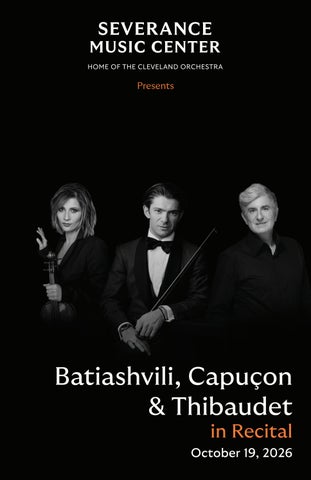
Presents
Batiashvili, Capuçon & Thibaudet in Recital
October 19, 2026
2027 2027
ANND NDDDI IN INTNTTETEERERRN RNNAT NAT AT IOO NAALALLLPPPIPIAIAIAN ANNO NOO OCCCO COO O MM M IO O CCCLCLLELEEVEVVEVEELELLALAAN IN AT I IO IO NNNA M PPPEPEETETTITITITITITIO IO NNNN
JJJU LY LY 25–AUGUST 7, 7,22027 JUU LY LY25–AUGUST 27 27–AU –AUGUST GUST 8, 8, 22027 027 027 IAIAIA A NN N O O CC LE LE VV EE LA LA A NN N D. D. O O RR R GG /2 00 22 77 -C IPIPIP P CCC PPP IP N O O C LC LE VE EV LE LA N D. D. O O R G /G /2/2 02 20 72 -7 -C-C IC C
Lisa Batiashvili, violin Gautier Capuçon, cello Jean-Yves Thibaudet, piano Jack, Joseph and Morton Mandel Concert Hall at Severance Music Center Monday, October 19, 2026, at 7:30 PM
DMITRI SHOSTAKOVICH (1906–1975)
Piano Trio No. 1 in C minor, Op. 8
CLAUDE DEBUSSY (1862–1918)
Piano Trio in G major I. Andantino con moto allegro II. Scherzo · Intermezzo: Moderato con allegro III. Andante espressivo IV. Finale: Appassionato
INTERMISSION ANTONÍN DVOŘÁK (1841–1904)
Piano Trio No. 3 in F minor, Op. 65 I. Allegro ma non troppo II. Allegretto grazioso III. Poco adagio IV. Finale. Allegro con brio
This program will last about 1 hour and 30 minutes.
* IN MEMORIAM
Batiashvili, Capuçon & Thibaudet in Recital is generously sponsored by Dr. Michael Frank and Patricia A. Snyder*.
3
INTRODUCTION The piano trio as we know it today evolved from the Baroque trio sonata, in which two solo instruments (two violins, a violin and flute, etc.) were accompanied by a cello and harpsichord, which supplied the bass part and harmonies. With the emerging popularity of the piano in the mid-18th century, the genre evolved, and early trio sonatas by Haydn and others were essentially solo piano sonatas with violin and cello accompaniment. It was Mozart, Beethoven, and Schubert who reaffirmed the status of the string instruments, composing trios with three equal partners. Throughout the 19th century and beyond, piano trios remained one of the most popular chamber genres. The three trios we will hear this evening were all written over a roughly 40-year span, from the late 19th through the early 20th centuries. Two of them, by Dmitri Shostakovich and Claude Debussy, are youthful works, providing a vehicle through which their composers could develop their talents. Antonín Dvořák’s trio, one of four he composed, is a mature work by a composer at the height of his creative powers.
This image appeared on the title page of a 1798 edition of Haydn’s Piano Trio No. 23 in E-flat major. Though this work and other trios of the time commonly shone a spotlight on the the piano, later composers would give equal prominence to all three instruments.
4
PIANO TRIO NO. 1 IN C MINOR, OP. 8 By Dmitri Shostakovich (1906–1975) Composed: 1923 Duration: about 10 minutes Dmitri Shostakovich composed his First Piano Trio in 1923, when he was just 16. Originally entitled Poème, it was dedicated to Tatyana Glivenko, a fellow student who he had met the previous year and with whom he was deeply in love. Although his earnest pursuit of her never came to fruition, they remained close, corresponding for several years. The trio is a compact, one-movement work. The haunting opening andante theme, with its two descending half steps, is seen by some commentators as an expression of the young composer’s yearning. This motive is the germ for several themes that follow, taking us through a variety of moods that always lead back to the initial andante theme. Eventually, a brighter impressionistic passage introduces a theme that replaces the half steps with whole steps, perhaps signaling the hope of fulfillment. The music that follows is at times troubled and agitated, at others giddy with anticipation until, after a brief pause, we arrive back at the initial andante theme. A brief coda reintroduces one of the agitated allegro passages from earlier in the work before leading to an enthusiastic close. The many sudden tempo and style changes in this work might remind one of early film music, as we journey through the many shifting moods and passions of young love. With its eclectic mix of styles, the trio reveals some of Shostakovich’s early influences while offering hints of the acerbic and aggressive music that was to characterize so many of his later works.
5
PIANO TRIO IN G MAJOR By Claude Debussy (1862–1918) Composed: 1880 Duration: about 20 minutes In 1880, the 18-year-old Claude Debussy was engaged to serve as the house pianist of Nadezhda von Meck, a wealthy Russian widow who was an important patron of Tchaikovsky. During the fall of that year, while residing in Florence with the von Meck household, Debussy composed a piano trio, undoubtedly motivated by the imminent arrival of a Russian cellist, Pyotr Danilchenko, who could perform it with him and the other resident musician, Władysław Pachulski, a Polish violinist. The manuscript was lost for many decades, but scores to the four movements gradually came to light and were eventually assembled. Long dismissed as a forgettable piece of juvenilia, the Piano Trio is increasingly recognized as an important early example of Debussy’s genius at incorporating and synthesizing the various influences that would shape his musical personality, combining the stylistic tendencies of contemporary French composers with elements from Russian music and beyond. The first movement alternates between passages in triple and duple meter, with a gently flowing character. Labeled “Scherzo-Intermezzo,” the second movement reflects the three-part form of a scherzo with delicate balletic outer sections surrounding a longer and more lyrical interlude. The slow third movement features the interplay between the two string instruments, with a middle section that incorporates all three musicians. The finale sounds like the music of Mendelssohn and Robert Schumann reflected through a French lens. In a lilting 6/8 meter throughout, the music swells and recedes, propelled along by the relentless rhythmic energy of the initial theme.
6
PIANO TRIO NO. 3 IN F MINOR, OP. 65 By Antonín Dvořák (1841–1904) Composed: 1883 Duration: about 40 minutes Antonín Dvořák’s Third Piano Trio, written in 1883, is considered a major milestone in his compositional career and one of the most important works in the genre. His mother’s recent death may have contributed to the relatively somber mood of the work, but Dvořák was also heavily influenced by the music of Brahms, who had promoted the young Czech composer’s music to Viennese publishers and critics. The first three movements of the work certainly reflect the serious tone of the older master’s music, with the fourth more clearly influenced by the folk styles of Dvořák’s homeland. The first movement is almost unrelentingly grave, with only a handful of brighter moments. The piano imposes its presence throughout, resulting in an unusually dense texture. In a sharp contrast of mood, the scherzo begins with a fascinating juxtaposition of triplet eighth notes in the strings and an irregular duple-meter melody that combines Brahms’s penchant for syncopation with the uneven phrasing of Czech folk music. The lyrical middle section returns to a more serious tone before the return of the scherzo. The heart of the work is the slow third movement. Written in A-flat major, this movement exudes an atmosphere of wistful nostalgia, with a quicker passage briefly introducing a note of happy tranquility. The rhythmic energy that pervades the finale hints at the influence of Czech dance and folk music. Just before the exuberant ending, Dvořák turns inward with a reminiscence of the first movement’s main theme to bring the piece full circle. — Michael Strasser Michael Strasser is professor emeritus of musicology at Baldwin Wallace University. He has published numerous articles and reviews and presented papers at international conferences on fin-de-siècle France, Arnold Schoenberg, and colonial music in British North America and Mexico.
7
ABOUT THE ENCORE
LIM SYMPHONY OF OCEANS TRIO By Manu Martin (b. 1980) Composed: 2025 Lim Symphony of Oceans Trio is a piano trio specially arranged for Jean-Yves Thibaudet, Gautier Capuçon, and Lisa Batiashvili. Derived from a large-scale symphonic work written by French composer Manu Martin, this piano trio version showcases the intimate, expressive quality possible in blending three distinct instrumental voices. Based on a narrative by Susan Lim and Christina Teenz Tan, the trio takes listeners on a celestial voyage that starts in the cosmos and descends into the depths of the ocean. It offers a thoughtful reflection on the fragility of marine life and a tribute to the ocean’s enduring beauty.
Severance in R E C I TA L
8
JAN 26 | TUE 7:30PM STEPHEN HOUGH IN RECITAL
MAR 16 | TUE 7:30PM GARRICK OHLSSON IN RECITAL
APR 20 | TUE 7:30PM NOBUYUKI TSUJII IN RECITAL
Works by Schubert, Brahms, Schoenberg, Stockhausen, Beethoven, R. Schumann, and Sherman
Works by Chopin
Works by Grieg, Debussy, Ravel, and Kapustin
Tickets and more information at clevelandorchestra.com
MOST POPULAR DONOR BENEFIT
Your ticket behind the scenes Watch sparks fly as great musicians work to polish a performance for prime time! Donors who give $120 or just $10/month are invited to an Open Rehearsal. Unlock your 2026 –27 invite and make a difference with your gift for music today.
SCAN QR CODE TO VISIT
clevelandorchestra.com/give 9
Your Concert Getaway . . .
The Lotus Club Relax before concerts and during intermission in the comfort of the Lotus Club with a full-service bar, light snacks, and private restrooms. You can unlock membership to the Lotus Club all season long with your donation of $600 or more, or just $50/month. Give today!
SCAN QR CODE TO VISIT
clevelandorchestra.com/give Find the benefits and giving level that are right for you at clevelandorchestra.com/benefits 10
T WE N T Y-FI VE YEARS
Don’t miss a moment! Subscribe to the 2026 –27 Season When you subscribe, you provide vital support to your Cleveland Orchestra and enjoy these exclusive benefits: • The BEST seats at the BEST prices • FREE and easy ticket exchanges • Purchase your parking in advance • 20% off additional ticket purchases • 33% off subscription to Adella.live, our digital home • 10% off at The Cleveland Orchestra Store
S
E
N
• Money back guarantee
A S O
11
LISA BATIASHVILI Violin
In 2021, she founded the Lisa Batiashvili Foundation, fulfilling a lifelong commitment to supporting exceptionally talented young Georgian musicians and helping them thrive in international musical careers. During the 2026–27 season, Batiashvili will open the Tsinandali Festival in Georgia with the Pan-Caucasian Youth Orchestra conducted by Gianandrea Noseda. She will then present a variety of programs and artists as part of a residency at the Beethovenfest Bonn and in the Georgian Spotlights series at the Dresden Philharmonic. She will also bring her story to the stage in City Lights: Follow Your Dreams, tour with the Royal Concertgebouw Orchestra and Klaus Mäkelä, perform with the Berliner Philharmoniker at the Salzburg Easter Festival, and appear with other orchestras including the New York Philharmonic, Budapest Festival Orchestra, and Tokyo Metropolitan Symphony Orchestra. An active chamber musician, she tours extensively with Jean-Yves Thibaudet and Gautier Capuçon, and with Georgian composer-pianist Giorgi Gigashvili. Recording exclusively for Deutsche Grammophon, her recent releases include Secret Love Letters (2022) with Yannick Nézet-Séguin and The Philadelphia Orchestra, City Lights, and Visions of Prokofiev. Her discography has earned major awards including an Opus Klassik Award and international critical acclaim. Batiashvili lives in Berlin and plays a Joseph Guarneri “del Gesù” violin from 1739, generously loaned by a private collector. For selected projects, she plays a violin by Philipp Augustin, a copy of her “del Gesù” made for her in 2026.
12
PHOTO BY CHRIS SINGER
Lisa Batiashvili is a Georgian-born German violinist, widely admired for her virtuosity, musical depth, and artistic integrity. An award-winning artist, she has built enduring relationships with many of the world’s leading orchestras, conductors, and musicians, earning the respect of audiences and colleagues alike.
GAUTIER CAPUÇON Cello PHOTO BY LAURENT ROUVRAIS/RADIO CLASSIQUE
Gautier Capuçon is one of the foremost cellists of the 21st century, celebrated for the depth of his interpretations and his dazzling virtuosity. Alongside performing, he created the Fondation Gautier Capuçon (FGC), dedicated to supporting outstanding young musicians, which today counts 45 laureates from around the world. Capuçon works with the most renowned orchestras and conductors across the globe, recently performing with the Berliner Philharmoniker — in Berlin and on tour. He has also appeared with the Vienna Philharmonic and Christian Thielemann, Tonhalle-Orchester Zürich with Paavo Järvi, and the hr-Sinfonieorchester with Alain Altinoglu, among others. Highlights of the 2026–27 season include a return to the BBC Proms with the BBC Symphony Orchestra followed by appearances with the Singapore Symphony Orchestra and Vasily Petrenko, Filarmonica della Scala and Riccardo Chailly, Sydney Symphony Orchestra and Simone Young, and Boston Symphony Orchestra and Susanna Mälkki, to name a few. Capuçon also embarks on major international tours this season with the Orchestre Philharmonique de Radio France, Gewandhausorchester, Netherlands Philharmonic, and Orchestre de Paris. A highly sought-after chamber musician, he tours North America with Jean-Yves Thibaudet and Lisa Batiashvili, Europe with Frank Braley, and performs Beethoven piano trios with Evgeny Kissin and Maxim Vengerov at Chicago Symphony Hall and Carnegie Hall. An exclusive recording artist for Erato (Warner Music), Capuçon’s extensive discography has earned numerous awards. An autumn 2024 release featured the Elgar and Walton concertos with Antonio Pappano and the London Symphony Orchestra. In November 2025, he released Gaïa, an album of world premieres emblematic of his deep love of nature. Born in Chambéry, Capuçon began learning cello at age 4 with Augustin Lefèbvre, later studying in Paris with Annie Cochet-Zakine and Philippe Muller, and in Vienna with Heinrich Schiff.
13
JEAN-YVES THIBAUDET Piano
This season, Thibaudet will appear with orchestras worldwide (including multiple concerts with the Chicago Symphony Orchestra) and continue presentations of Two Pianos: Who Could Ask for Anything More?, his acclaimed project with Michael Feinstein. In addition to his orchestral dates, Thibaudet embarks on a fall trio tour with Lisa Batiashvili and Gautier Capuçon and a May tour with Itzhak Perlman. He also continues his multi-season focus on Debussy’s Préludes, performing both books in their entirety at recitals around the world. A prolific recording artist, Thibaudet has appeared on more than 70 albums and six film scores. His extensive catalog has received two Grammy nominations, two ECHO Awards, the Preis der deutschen Schallplattenkritik, the Diapason d’Or, the CHOC du Monde de la Musique, the Edison Prize, and Gramophone Awards. Recent recordings include Khachaturian, a celebration of the Armenian composer including his Piano Concerto and several solo piano pieces; and Gershwin Rhapsody, a selection of Gershwin pieces recorded with Michael Feinstein, including four newly discovered ones. Thibaudet is the soloist on Dario Marianelli’s recently reissued score for Pride & Prejudice, which was certified Gold by the RIAA in 2025. His playing can also be head on Marianelli’s Academy Award–winning score for Atonement, Alexandre Desplat’s scores for The French Dispatch and Extremely Loud & Incredibly Close, and Aaron Zigman’s score for Wakefield. Among numerous other awards and commendations, Thibaudet was named a Chevalier of the Ordre de la Légion d’honneur in 2025; President Emmanuel Macron personally presented him with the title. Thibaudet’s concert wardrobe is designed by Dame Vivienne Westwood.
14
PHOTO BY ANDREW ECCLES
Through elegant musicality and an insightful approach to contemporary and established repertoire, Jean-Yves Thibaudet has earned a reputation as one of the world’s finest pianists. He is especially known for his diverse interests beyond the classical world, including numerous collaborations in film, fashion, and visual art. He is the first-ever artist-in-residence at the Colburn School, which awards several scholarships in his name.
LATE SEATING As a courtesy to audience members and musicians, late-arriving patrons are asked to wait quietly until the first convenient break in the program. These seating breaks are at the discretion of the House Manager in consultation with the performing artists. CELL PHONES, WATCHES & OTHER DEVICES To ensure a quiet and respectful listening environment, please silence all electronic devices. PHOTOGRAPHY, VIDEOGRAPHY & RECORDING Audio recording, photography, and videography are not allowed during performances at Severance. Photographs can only be taken when the performance is not in progress.
THE CLEVELAND ORCHESTRA APP Explore upcoming concerts, purchase and access your tickets, receive performance updates, and more. Available for iOS and Android on Google Play and at the Apple App Store. More information is at clevelandorchestra.com/app
IN THE EVENT OF AN EMERGENCY Contact an usher or a member of house staff if you require medical assistance. Emergency exits are clearly marked throughout the building. Ushers and house staff will provide instructions in the event of an emergency. HEARING AIDS & OTHER HEALTH-ASSISTIVE DEVICES In consideration of others, please reduce the volume on hearing aids and other healthassistive devices that may produce noise. For Infrared Assistive-Listening Devices, please see an usher. To request one in advance, email info@clevelandorchestra.com. AGE GUIDELINES Regardless of age, each person must have a ticket and be able to sit quietly in a seat throughout the performance. Classical Season subscription concerts are not recommended for children under 8. However, there are several age-appropriate series designed specifically for children and youth, including Music Explorers (for 3 to 6 years old) and Family Concerts (for ages 7 and older).
Copyright © 2026 by The Cleveland Orchestra and Musical Arts Association Editorial: Kevin McBrien, Editorial & Publications Manager (kmcbrien@clevelandorchestra.com) Ellen Sauer Tanyeri, Archives & Editorial Assistant Design: Melissa Leone (melissa@melissaleone.com) Program books for Cleveland Orchestra concerts are produced by The Cleveland Orchestra and are distributed free to attending audience members. The Cleveland Orchestra is proud to have its home, Severance Music Center, located on the campus of Case Western Reserve University, with whom it has a long history of collaboration and partnership. 15
16