A life of faith. A journey through adversity. A call to live with courage.
CAR TER
Religion / Inspirational
From the streets of the South Bronx to the boardrooms of Fortune 100 companies, Anthony P. Carter’s extraordinary life is a testament to the power of faith, friendship, and purpose. As a Black Catholic leader shaped by a Jesuit education, Carter has faced the hard truths about race and identity in America, all while staying rooted in an unshakable devotion to God.
Whether you are a person of faith seeking affirmation, a student searching for your place in the world, or an ally determined to understand and uplift others, Carter’s story meets you with honesty, inspiration, and the courage to believe in what is possible.
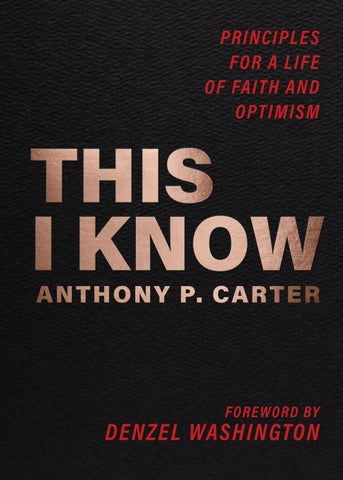
THIS I KNOW
Carter blends moving personal stories with spiritual insights and corporate wisdom, offering readers a rare perspective on what it means to lead with dignity and compassion. With a powerful foreword by the author’s lifelong friend Denzel Washington, this book is a bold and unflinching guide to living with meaning, resilience, and joy.
PRINCIPLES FOR A LIFE OF FAITH AND OPTIMISM
“This is a story that needed to be told. Anthony’s life is proof that faith and friendship can take you anywhere.” —Denzel Washington ANTHONY P. CARTER is a retired corporate executive, award-winning diversity strategist, and lifelong Catholic. A devoted husband, father, and grandfather, he continues to mentor, volunteer, and share stories that uplift and unite. ISBN: 978-0-8294-6011-7 $15.99 U.S.
FOREWORD BY
DENZEL WASHINGTON
“Anthony Carter tells the story of his remarkable life with humility and wonder that has lessons for us all. He faced the indignities and suffering of the world with an open heart and courage rooted in deep faith.” —Tania Tetlow, President, Fordham University
“Anthony Carter’s This I Know is a story of passion, faith, love, and, above all, sincerity. While reading, I found myself laughing, crying, and reflecting a lot on family, what it means to give and receive love, and how our diversity makes us all stronger people. This is the writing of a man who cares deeply and truly about others, and I know you will be moved and changed for the better in feeling that care in his writing. This isn’t just a story well told; it’s a life fully lived, and bravely shared. If Wisdom were writing in his diary while listening to some djembe drums, this would be it.” —Dr. Richie Diaz, EdD, Principal, Cathedral Preparatory School and Seminary in New York
“From the heart of the South Bronx to the pinnacle of corporate America, Anthony Carter’s life story is a testament to the power of an indomitable spirit, extraordinary abilities, and faith in God. For more than fifty years, he has been one of the most extraordinary people I know. Now, through this book of wisdom, I invite you to know him too.” —Ted Shaw, Former Director Counsel of the NAACP Legal Defense Fund, and University of North Carolina Chapel Hill Julius L. Chambers Distinguished Professor of Law
“Anthony Carter offers readers his most intimate and precious thoughts and experiences, his unbreakable faith, and his inspiring optimism. Compassionate, unwaveringly honest, and startlingly modest, he gives you a strong sense of the moral and social justice that defines the amazing and very accomplished man I am privileged to know.” —Kim Bepler, Philanthropist and Fordham University Trustee
“The pages of this book emanate well-practiced joy. In This I Know, Anthony Carter has given us a series of powerful vignettes and timely encouragement to inspire sustained and active reflection on how our unique vocational paths can better illuminate God’s dream for our world in all its wondrous diversity. Anthony writes with the determined delight of a man who has discovered a pearl of great price and won’t rest until it’s been shared far and wide. Drawing on years of lived experience as a man of faith, of humility, and of hope, Anthony leverages his business acumen to deliver a series of short, practical lessons in living for and with others. This slender volume carries a weighty message, inviting us to encounter anew a God who embraces all.” —Eric A. Clayton, award-winning author of, among other books, Cannonball Moments: Telling Your Story, Deepening Your Faith and Finding Peace Here and Now: How Ignatian Spirituality Leads Us to Healing and Wholeness
“Anthony Carter has been a mentor, guide, and inspiration in my journey to lead with authenticity and courage. His example taught me that true leadership is rooted in faith, conviction, and humanity, and that our greatest responsibility is to empower others to do the same. This I Know is an invitation to all of us to lean into faith, embrace our convictions, celebrate our differences, and commit ourselves to the greater good of humanity. Anthony shows us how possible, and how fulfilling, it is to embrace our best selves and serve humanity with purpose.” —Smita Pillai, Mom, Wife, Daughter, Friend, Global Citizen, Senior Vice President of Culture, Inclusion & Development, Regeneron Pharmaceuticals
“I have known Anthony Carter for more than thirty years, first as a colleague and later as a friend, and I always sensed he was someone special. In This I Know, we discover why: Anthony has walked the long road to faith, optimism, love, and God—and invites us to join him. With honesty and courage, he weaves his own story with the wisdom of Emerson, Dr. King, and Scripture. Whether you are a devout Catholic, like Anthony, or simply seeking encouragement in living a meaningful life, this book will move and inspire you.” —John Doorley, author, thought leader in reputation management and public and corporate communications, also one of the people Anthony Carter mentions who nagged him to write this book
“In a time when negativity dominates so much of our culture, This I Know is a refreshing and uplifting reminder of what unites us rather than what divides us. The author’s openness in sharing his personal journey, together with his boldness in addressing difficult controversial topics, offers readers nothing less than a master class in how to live with decency, honesty, integrity, kindness, purpose, and faith. Each chapter challenges us to imagine what our world could become if we all embraced these principles in our daily lives. I was deeply touched by this powerful book. I have no doubt the world will be touched as well.” —Ralph D. Weaver, Founding President, East West Connection and Joy Connection, Connector, Caretaker, Loyal Friend, Grandfather, Husband
“This I Know is a captivating read. In it, we meet Anthony Carter, whose stories show how we too can live with love, joy, and integrity—and make a difference in the world. Working with Anthony on a global leadership project, I witnessed firsthand how his vision and commitment changed the trajectory of many lives, produced outstanding leaders, and demonstrated the transformative power of a leader whose mind, body, and spirit are aligned with the Creator. This I know: Anthony Carter is a messenger for diversity, sent from above.” —Juan T. Lopez, President, Amistad Associates
“Anthony Carter’s This I Know is a masterpiece on the journey of African Diaspora people through the Catholic Faith. His testimonies ring true to not only the Black Catholic experience but also to the American experience itself. I was affirmed and inspired every time I turned a page.” —Dr. Ansel Augustine, DMin, lay minister and author of Praying with Our Feet
“From the earliest stages, I was drawn to Anthony Carter’s story—its honesty, courage, and deep faith were impossible to ignore. Seeing This I Know come to life has been profoundly rewarding, and I couldn’t be happier with how this inspiring book turned out.” —Gary Jansen, Executive Editor, Loyola Press, and award-winning author of, among other books, Meditations at Midnight
I was taught to do my best, try my hardest, and keep striving up the ladder. But at each rung I was to reach back and help a brother, sister, or stranger receive the gift and pass it on, and thus help create a more caring, sharing world. —Thea Bowman
PRINCIPLES FOR A LIFE OF FAITH AND OPTIMISM
THIS I KNOW ANTHONY P. CARTER
FOREWORD BY
DENZEL WASHINGTON
Copyright © 2026 Anthony P. Carter All rights reserved. Scripture quotations are from New Revised Standard Version Bible: Catholic Edition, copyright © 1989, 1993 National Council of the Churches of Christ in the United States of America. Used by permission. All rights reserved worldwide. Cover art credit: Katsumi Murouchi/Moment/Getty Images, Olena Malik/ Moment/Getty Images Interior art credit: VladSt/DigitalVision Vectors/Getty Images Author photo credit: Wendy O. Carter ISBN: 978-0-8294-6011-7 Library of Congress Control Number: 2025944729 Published in Chicago, IL Printed in the United States of America 25 26 27 28 29 30 31 32 33 34 Versa 10 9 8 7 6 5 4 3 2 1
This book is dedicated to my wife, Wendy. When I count my blessings you are first on the list.
Contents Foreword. . . . . . . . . . . . . . . . . . . . . . . . . . . . . . . . . . . . . . . . . . . . . . xi Preface. . . . . . . . . . . . . . . . . . . . . . . . . . . . . . . . . . . . . . . . . . . . . . . . xv CHAPTER 1 No One Looks Like Their Story. . . . . . . . . . . . . . . . . . 1 CHAPTER 2 The Dichotomy of Being Black and Catholic. . . . . . . . 9 CHAPTER 3 When Love Knocks, Answer. . . . . . . . . . . . . . . . . . . . 19 CHAPTER 4 The Price of Friendship. . . . . . . . . . . . . . . . . . . . . . . . 27 CHAPTER 5 Angel 555 . . . . . . . . . . . . . . . . . . . . . . . . . . . . . . . . . . 41 CHAPTER 6 Diversity Is the Heart and Soul of Our Existence. . . . 51 CHAPTER 7 Ironclad Faith. . . . . . . . . . . . . . . . . . . . . . . . . . . . . . . 65 CHAPTER 8 Dare to Dream . . . . . . . . . . . . . . . . . . . . . . . . . . . . . . 73 CHAPTER 9 Honesty, Honor, Humility, and Humor. . . . . . . . . . . 81 CHAPTER 10 A Love Affair with African Djembe Drums. . . . . . . . 91 CHAPTER 11 Final Thoughts. . . . . . . . . . . . . . . . . . . . . . . . . . . . . . 99
Acknowledgments. . . . . . . . . . . . . . . . . . . . . . . . . . . . . . . . . . . . . . 105
Foreword by Denzel Washington
You know who I am and what I do for a living. The person many of you may not know is my dear friend Anthony Carter. Anthony and I have been friends for fifty-four years and counting. With a bit of self-pride, I can tell you there are few of Doc’s friends who know him as well as I do. I call him Doc—a nickname he earned when we both majored in premed at Fordham University. When you read Anthony’s story, you’ll understand why I admire him, and why I’m proud to be his friend. He is a loving husband, father, and grandfather. He is also a man of faith. His love of God is powerful and enduring. xi
xii
This I Know
This is a book about Doc’s impact on so, so many people, and the impact they’ve had on him. Yes, he’s had a stellar career in corporate communications, diversity, public service, and volunteerism. Yes, he’s the recipient of global awards and recognition. And yet, he will tell you that awards and accolades don’t hold a candle to the love he has for, and receives from, his wife, his grown children, his grandson, and his faith. As you read This I Know, you will encounter Doc’s faith. There is no doubt that Doc has been called to serve, and he brings his full authentic self in service to others. He cares because he sees the hands of God in all things. You will be moved by his thoughts, perspectives, and ideas. I was. You will enjoy his testimonials and experiences. I did. And after you read this book, trust me, you too will know and admire my dear friend Doc.
It took me a long time and much painful boomeranging of my expectations to achieve a realization everyone else appears to have been born with: That I am nobody but myself. When I discover who I am, I’ll be free. RALPH ELLISON INVISIBLE MAN
Preface
This I know: I am a fervent believer in the One and Only. I see God at the center of everything. I am a Black Catholic blessed with a spouse sent from heaven. I am a retired chief diversity officer for a global healthcare company. I still believe diversity matters. I ride the New York City Subway not only to get to my destination but also to snatch quick peeks of cultural diversity at its finest. I’ve met and worked with prominent civil rights and political leaders. I have a best friend who has touched the hearts and souls of millions of people across the globe and most likely touched yours, too. We found each other at a critical time, and I can say with certainty that our friendship has made all the difference in my life. I am a graduate of a Jesuit university in New York and currently a trustee of that university. I
xv
xvi
This I Know
am a proud father and grandfather. I am a dreamer. I am a percussionist who plays Latin conga drums and African djembe drums. I am an honest, trustworthy man with a sense of humor. I love to make people laugh, and I love to laugh at myself—because as human beings we can do some embarrassingly silly stuff at times. This I know: While we are living life one day at a time, going forward one step at a time, we aren’t fully aware of either the passage of time or the great distance we’re traveling. I wrote this book to share what I know. Because when I look back over my career, even I am astounded at my journey. That an orphaned, isolated, heartbroken little kid from the Bronx would go where I have gone, learn what I have learned, and become the person I am is a story that defies all the odds. And yet, it happened. This I know: It happened because I walk in faith, and I lead with optimism. What do these two choices look like in real life? Well, walking in faith sometimes means that before I enter a high-powered boardroom where decisions will be made that influence the lives of thousands of people, I find a quiet spot and center myself in prayer. It sometimes means that even when I am confused or disheartened, my faith reassures me that I don’t necessarily
Preface
xvii
need to understand; I need only to trust. And this is where the optimism comes in. Trust is another word for faith, and having confidence that doing what is right and honorable will work out in the end means that I can lead with optimism. And so I believe in God, and I believe that God will set things straight. That I have the chance to contribute my own personal efforts to the work at hand is a privilege that I find thrilling. This I know: I am many things, but at my core I am an optimist who believes in the power of love, the power of solidarity, the power of every one of us to connect and come together to make good things happen. Like you, I am all heart and soul. This I know: As I travel through the corridor of life, even though I’m retired and my children are grown, I know I have a long way to go. I have more footprints to make. Where will they lead me? Well, that’s something I don’t know. What I do know about where I’m going is that Someone is watching over me to help me keep moving in the right direction. In his song “Tell My Feet,” musician Vinx put into words my guiding philosophy: Once there, I’ ll tell my feet I made it Home. These are the basic elements of my story. But I don’t look like my story. No one does.
It is impossible to tell, from a single glance, the journeys someone has traveled, the experiences that have made them who they are. STEVE PEMBERTON
CHAPTER 1
No One Looks Like Their Story
I’ve ridden the New York City Subway more times than I can count. When I was a child, it was a joy ride. As a teenager, it was an adventure. As an adult, it was my mode of transportation to and from work. The subway offers us one of the most exciting experiences we can have in a day because we come in contact with a marvelously diverse conglomeration of humankind. Traveling on an underground train, we will find dancers, singers, and musicians; the rich, the poor, and the unhoused; the fashionistas, the barely dressed, and the overdressed; wailing babies, high-spirited teenagers, and sleep-deprived grad students. You name it. They’re right
1
2
This I Know
there sitting beside us and across from us. Just like us, they’ve gone underground, but only temporarily, because this is how they get where they’re going. The objective of the underground subway is to transport passengers from one location to another in the most direct, speedy way possible. Subways allow people to forego the hassle of hailing taxicabs or riding slow-moving city buses. In 2023, the Metropolitan Transit Authority (MTA) reported that the New York City Subway System accounts for 3.6 million daily riders or 1.15 billion annual paid rides. One unavoidable, if not irresistible, way to pass time spent underground on the subway is to engage in the art of watching other people without them knowing they’re being watched. I call this method of unobtrusive observation the underground mirror test. The underground mirror test is not a game. It’s an invasion of privacy but it’s performed without being overtly invasive. I have a strong suspicion that, whether intentionally or unintentionally, we’ve all slipped into this subway side effect. What is the mirror test? It’s when we use the windows of the subway while it races through the dark underground tunnels to give us a mirror-like reflection of our fellow
No One Looks Like Their Story
3
passengers. We can look at whomever we want without them knowing. Through these quick glimpses of people we may see only once in our lives, we try to figure out their life stories. The process may go something like this. Our first person of interest in the underground mirror is a young Black man who is carrying an overstuffed backpack. He is reading, or pretending to be reading, the advertising plastered in an endless border above the windows on the train. He’s dressed in baggy jeans, an oversized T-shirt, and a pair of Air Jordans. A New York Yankees baseball cap worn backwards is on his head. We clutch our pocketbooks a bit more tightly, we cradle our briefcases on our laps. Next, we sneak a peek at a frumpily dressed, elderly White woman seated with two bulging shopping bags on either side. Her eyes are closed and her head is bouncing in sync with the movement of the jerky subway. We conclude that she is one of many who are unhoused. The mirror now offers us a view of a Hispanic man standing next to us. Our gaze flickers over him with a quick up-and-down scan. He’s dressed in a tailored dark blue suit, starched white shirt, and perfectly knotted tie,
4
This I Know
and he’s sporting a pair of the shiniest brown, unscuffed Oxford shoes you’ve ever seen. He is, as they say, dressed to the nines. We decide he must be a lawyer at a large firm in Manhattan. As the subway continues through the tunnel, our attention shifts to another image in the window. An attractive young woman in a form-fitting, colorful, floral dress who has air buds in her ears is rocking out to music only she can hear. Her face is perfectly made up. Her puckered lips are painted shimmering, bright red. Her hair with its vibrant blonde highlights seems a bit over the top for daytime. She must be working the streets tonight. Sheesh! So, what do we do with this surreptitiously gathered data? We assess. We make assumptions. And we reach conclusions. The young Black man with the backpack: Well, he’s definitely up to no good. He’s most likely waiting until the train stops at the next station so he can grab somebody’s purse on the way out the door and sprint away into the crowd. However, we may be surprised to learn that in the stuffed backpack are thick textbooks for the chemistry class he’s taking at the college he attends, which is two stops up the line. This man is a premed student.
No One Looks Like Their Story
5
The apparently houseless woman who is holding tightly to her shopping bags while she dozes has just finished a long shift as a room attendant at the luxurious hotel where she has worked for decades. Her bags are filled with fresh produce and groceries so she can whip up a king’s meal to celebrate her husband’s seventieth birthday. The dapper Dan we presumed to be a lawyer, is actually someone who recently lost his job, and today he is dressed for a make-it-or-break-it job interview. His partner, who said, “Hey, put these on for your interview—this is my good luck outfit, and I want you to wear it,” opened his closet and shared the best of everything he owns to help his partner get the job. Oh, yes—and the dolled-up, sexy young woman? She’s a model who just left a photo shoot and is running late for the next one. She listens to upbeat playlists so that she brings fresh energy and happy vibes into the next shoot. The subway will get her to her next modeling assignment much faster than a taxi. The point here is that, in the absence of knowing someone’s story, we create invalid, insensitive, and inaccurate assessments based on inconclusive evidence. When we do this, we are always more wrong than we are right. This
6
This I Know
stems largely from the fact that we all have unconscious biases. These types of biases occur because, not knowing anything about the person we just sized up, it’s easy to manufacture what we want to believe about a person. Our assumptions are based upon personal data, much of which we cannot prove, that has been stored away in our brains. The fact is, we know someone’s story only when it is revealed by the person to whom the story belongs. Today’s subway passengers, straphangers as they are called, still playing the underground mirror game, ride with less trepidation. That is because the subway represents the purest form of multicultural heterogeneity, which makes us more curious than fearful. We see ourselves woven into the fabric of diverse and cultural nuances. We are intrigued rather than disturbed by what we see underground. We normalize our experiences. Our character is formed in the crucible of the subway system even though we put up our safeguards and remain watchful. Amid our foibles and in the most magnanimous ways, we represent the beauty and power of diversity. Often, our outward appearance doesn’t fully reflect the complexities and nuances of our inner lives or the stories they carry. Surface-level judgment allows us to make quick
No One Looks Like Their Story
7
assessments based on appearances while failing to recognize the depth and complexity of others. No one looks like their story, and none of us should try to size up a person we know nothing about. We cannot understand someone’s life just by looking at them. In almost every case, we will be wrong.
This I know: Every person embodies a story that deserves compassion, not assumptions.
Most Black Catholic churchgoers are racial minorities in their congregations, unlike White and Hispanic Catholics and Black Protestants. PEW RESEARCH CENTER STUDY
CHAPTER 2
The Dichotomy of Being Black and Catholic
I am Black. I am Catholic. And I’m proud of being a Black Catholic. But being a Black Catholic can be hard. It’s difficult even for someone like me, who spent eighteen years of my life—elementary school, high school, and college—in the Catholic school system. As a youngster, I served as an altar boy back when Mass was celebrated in Latin. (I can still recite a few of the Latin prayers!) Later, I served as a lector and played percussion in the music ministry. Today, I am a second-degree Knights of Columbus,
9
10
This I Know
which is a Catholic fraternal service order founded in 1882. And I serve as a trustee at Fordham University, a Catholic Jesuit university in New York City. There is no question that being Black and Catholic is made more difficult because we’re a racial minority in our congregations. There are approximately three million Black Catholics in the United States, according to a report published by the Pew Research Center in 2022. We comprise a small share (6%) of Black adults and an even smaller share (4%) of Catholic adults. We are less likely than White or Hispanic Catholics (who make up the vast majority of Catholics in the U.S.) to worship in parishes where most of the parishioners share either their race or their ethnicity. But these are small things compared to other reasons why it is hard to be Black and Catholic. Having a strong affiliation to the Catholic Church means that there are times when I must reconcile my belief in God with the atrocities committed against Black Americans. When I was a young boy, I watched Dr. Martin Luther King, Jr. deliver powerful speeches and lead peaceful protests. I witnessed the mass exodus of my White neighbors from my South Bronx neighborhood. I was bussed across town to a predominantly White Catholic
The Dichotomy of Being Black and Catholic
11
high school. My guidance counselor advised me to continue my education in a trade school rather than pursue college. Then, there was the searing experience of attending Mass in the Little Italy section of the Bronx when the priest walked down the aisle and refused to shake my outstretched hand during the offering of peace. A young child, Catholic or not, should never be dismissed by a priest. Ironically, these experiences did not fill me with hate. They did make me curious though. My curiosity led me to St. Raymond High School for Boys and then to Fordham University, both in New York. While in high school and college I sank deeply into theology and Catholic culture. I was taught by Christian Brothers at St. Raymond and while at Fordham much of my learning came from the Jesuits. St. Raymond is located in Parkchester, a Bronx neighborhood that at the time was populated predominantly by White folks. Right across the street was the elementary school. Two blocks away was St. Raymond Academy, our sister school, and just a few blocks from there was St. Raymond Catholic Church. Parkchester was very much a closed community. People with my skin color were a rare commodity and were not warmly accepted in the
12
This I Know
neighborhood. In 1967, Brother Andrew O’Gara, principal of the boy’s high school, reached out to several Catholic elementary schools in the South Bronx to recruit Black and Latino eighth grade students to come to St. Raymond. His intention was to bring in a diverse array of students who would enhance the overall learning experience so that we all would be prepared for college and the real world once we graduated. I entered St. Raymond in 1968. It was my first experience of being in the classroom with predominantly White students. Truthfully, it didn’t feel as awkward as I expected because Black and Latino students were welcomed into the school. St. Raymond High School was my first crack at being in a diverse community even before I fully understood what cultural diversity meant. Brother Andrew’s courageous plan, or, some would say, experiment, worked. I graduated from St. Raymond in 1972 and began my next academic journey in that same year at Fordham University on the picturesque Rose Hill Campus in the Bronx, New York. Rose Hill is an eighty-five-acre gated community featuring Gothic architecture and tree-lined walkways. One of the most prized possessions on the campus is an American elm tree that is almost three hundred
The Dichotomy of Being Black and Catholic
13
years old and is a crowned champion in the National Registry of Champion Trees. At that point in my life, experiencing this type of exposure to Mother Nature’s environmental splendor was beyond my wildest imagination. Sculptured gardens with the most exotic species of plants and flowers you can imagine grew across the street from Fordham in the Botanical Gardens. And just a ten-minute walk south of the campus was the Bronx Zoo, where childlike adventure came alive every time anyone stepped foot into the animal kingdom. I studied journalism at Fordham. I wrote for two of the university’s newspapers—The Ram and The Paper—and co-hosted a weekly talk show on the Fordham radio station, WFUV. In each role, I understood that my job was to deliver fair and balanced reporting to students, faculty, and the tri-state listening audience across New York, New Jersey, and Connecticut. One of my most cherished assignments as a student journalist for The Ram was having the opportunity to interview Julian Bond, a leading figure in the early civil rights movement. While he was a student at Morehouse College, Bond was a founding member of the Student Nonviolent Coordinating Committee (SNCC), the principal channel
14
This I Know
of student commitment in the United States to the civil rights movement during the 1960s. In 1975, the Fordham student government club invited Bond to speak at the Rose Hill campus, where he delivered a speech titled “The Apotheosis of the New Era.” It was one of the most profound and insightful talks I’d ever heard about one person’s journey in the fight for justice, equality, and fairness. He shared personal stories about his involvement in the civil rights period, including sit-ins at lunch counters, being hosed to the ground while bottles and rocks were thrown at him, and being beaten with batons by police. After his remarks, he and I sat together for ninety minutes discussing his commitment to social justice, and the painful yet glorious era of fighting for the rights of Black Americans. Ten years later, we met at a convention sponsored by the National Association for the Advancement of Colored People (NAACP), the largest and oldest civil rights organization in America. He remembered our discussion at Fordham and asked if I could send him the article I had written about his visit to the campus. It just so happened I kept that article and was able, and delighted, to send him a copy.
The Dichotomy of Being Black and Catholic
15
My Catholic education prepared me for life and for my role as chief diversity officer at Johnson & Johnson, where I reported directly to the chairman and CEO. In that position, I learned that once you declare personal accountability and demonstrate strong leadership, you can address issues of diversity and racial injustice in thoughtful and decisive ways. How? Well, one of the principles of Jesuit teaching is to discern, and discernment was a tool that was invaluable to me in my career. Still, some of my Black friends believe being Black and Catholic is oxymoronic. This is because Black Americans have a troubling history with the Catholic Church. There was a time when Blacks were not allowed to even take part in Catholic rituals like serving at the altar or receiving Communion. Many Blacks still feel the pains of these indignities. Many changed their religious affiliations. My faith fortifies my belief that God does not categorize his love for us based upon race, color, gender, or sexual orientation. I believe that our differences are our strengths. They are an adhesive that unites us. I am thrilled that the Catholic Church was blessed by the leadership of our beloved Pope Francis, may he rest in peace. He was a change agent, and during his tenure he
16
This I Know
started to help mend the indignities many Black Catholics feel. Taking its cue from Pope Francis, the United States Conference of Catholic Bishops (USCCB) formed an anti-racism committee and publicly stated, “Recent events have exposed the extent to which the sin of racism continues to afflict our nation. The establishment of this new ad hoc committee will be wholly dedicated to engaging the Church and our society to work together in unity to challenge the sin of racism, to listen to persons who are suffering under this sin, and to come together in the love of Christ to know one another as brothers and sisters.” While this is a courageous and welcome step forward by the church, there remains more to be done. I encourage church leaders at the local level to explicitly denounce all forms of racism. As a Black Catholic, hearing priests at the pulpit discuss racism with the same strong sense of concern given to people experiencing homelessness, hunger, poverty, and illness would be a meaningful and encouraging sign of solidarity. The Pew Research Center study cited at the beginning of this chapter also found that Black Catholics are more likely than White or Hispanic Catholics to say that opposition to racism and sexism is essential to what being a faithful Christian means to them.
The Dichotomy of Being Black and Catholic
17
It is important to encourage anti-racism committees similar to the committee formed by the USCCB at the local level as well. We must embolden congregations across the country to engage in discussions on issues like police brutality, and the mass incarceration of Blacks and Brownskinned people. By highlighting experiences faced by Black Catholics and by celebrating the richness of our culture, parishes can create concrete signs of solidarity and inclusion. If we are to foster an inclusive Catholic community, one that truly reflects all of God’s goodness, then no one should ever feel unwelcome. And maybe, just maybe, more Black folks will show up at church readily able to practice their Catholic faith.
This I know: It is possible to hold deep faith and deep pain at the same time, and yet still believe in a Church that can grow more just and inclusive.
A life of faith. A journey through adversity. A call to live with courage.
CAR TER
Religion / Inspirational
From the streets of the South Bronx to the boardrooms of Fortune 100 companies, Anthony P. Carter’s extraordinary life is a testament to the power of faith, friendship, and purpose. As a Black Catholic leader shaped by a Jesuit education, Carter has faced the hard truths about race and identity in America, all while staying rooted in an unshakable devotion to God.
Whether you are a person of faith seeking affirmation, a student searching for your place in the world, or an ally determined to understand and uplift others, Carter’s story meets you with honesty, inspiration, and the courage to believe in what is possible.
THIS I KNOW
Carter blends moving personal stories with spiritual insights and corporate wisdom, offering readers a rare perspective on what it means to lead with dignity and compassion. With a powerful foreword by the author’s lifelong friend Denzel Washington, this book is a bold and unflinching guide to living with meaning, resilience, and joy.
PRINCIPLES FOR A LIFE OF FAITH AND OPTIMISM
“This is a story that needed to be told. Anthony’s life is proof that faith and friendship can take you anywhere.” —Denzel Washington ANTHONY P. CARTER is a retired corporate executive, award-winning diversity strategist, and lifelong Catholic. A devoted husband, father, and grandfather, he continues to mentor, volunteer, and share stories that uplift and unite. ISBN: 978-0-8294-6011-7 $15.99 U.S.
FOREWORD BY
DENZEL WASHINGTON