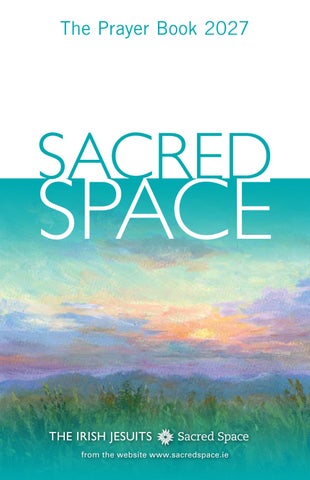
The Prayer Book 2027
Ignatian Spirituality / Prayer
Enter a Sacred Space Wherever You Are
P
rayer is the raising of our hearts and minds to God. It is a holy and sacred experience open to everyone. Sacred Space: The Prayer Book can lead us into a life of prayer and, in doing so, inspire new expressions and depths of faith.
SACRED
The Scripture, prayers, and reflections in this year’s edition of the beloved series will inspire you to a richer daily spiritual experience throughout the liturgical year and invite you to develop a closer relationship with God. Each day of Sacred Space: The Prayer Book includes a daily Scripture reading and points of reflection, as well as weekly topics enhanced by six steps of prayer and contemplation: The Presence of God, Freedom, Consciousness, The Word, Conversation, and Conclusion.
2027
Designed to help you stay faithful to your intention to deepen your spiritual journey, Sacred Space: The Prayer Book is the perfect gift for your parish, campus ministry program, small group, friend, family member, or yourself. THE IRISH PROVINCE OF THE SOCIETY OF JESUS (the Irish Jesuits), founders of www.sacredspace.ie, has provided a trusted online prayer guide since 1999. Their website serves millions of spiritual pilgrims of many faiths around the world.
ISBN: 978-0-8294-6093-3
$19.99 U.S.
THE IRISH JESUITS from the website www.sacredspace.ie
SACRED SPACE The Prayer Book 2027
from the website www.sacredspace.ie
Prayer from the Irish Jesuits
Copyright © by The Irish Jesuits 2026 This edition of Sacred Space Prayer Book is published by arrangement with Messenger Publications, 37 Lower Leeson Street, Dublin D02 W938, Ireland. Scripture quotations are from the New Revised Standard Version Bible: Anglicised Catholic Edition, copyright © 1989, 1993 National Council of the Churches of Christ in the United States of America. Used by permission. All rights reserved. Please note: Some Scripture readings and feast day observances in this devotional may differ from the Liturgical Calendar for the Dioceses of the United States. Where applicable, Scripture passages and liturgical commemorations are drawn from the General Roman Calendar or the Liturgical Calendar for Ireland, in keeping with the devotional’s Jesuit, international Catholic heritage. Loyola Press in Chicago thanks the Irish Jesuits and Messenger Press for preparing this book for publication. Cover art credit: Pobytov/DigitalVision Vectors/Getty Images ISBN: 978-0-8294-6093-3 Published in Chicago, IL Printed in the United States of America 26 27 28 29 30 31 32 33 34 35 Versa 10 9 8 7 6 5 4 3 2 1
N
Contents Sacred Space Prayer
v
Preface
viii
Introduction to Sacred Space 2027
ix
How to Use This Book
xi
December 2026
4
January 2027
42
February 2027
76
March 2027
111
April 2027
157
May 2027
190
June 2027
228
July 2027
262
August 2027
299
September 2027
336
October 2027
368
November 2027
404
Sacred Space Prayer Bless all who worship you, almighty God, from the rising of the sun to its setting: from your goodness enrich us, by your love inspire us, by your Spirit guide us, by your power protect us, in your mercy receive us, now and always.
vii
previous editions
Preface In 1999 an Irish Jesuit named Alan McGuckian had the simple but at the time radical idea of bringing daily prayer to the internet. In a time when cameras still used film and tablets were for headaches, no one imagined that his experimental project would grow into a global community with volunteers from all over the world translating the prayer experience into eighteen different languages and with more available each year. Millions of people, from all faiths and none, visit sacredspace.com each year. What they find is an invitation to step away from their busy routines for a few moments in the day to concentrate on what is really important in their lives. Sacred Space offers visitors the opportunity to grow in prayerful awareness of their friendship with God. The daily prayer text can be read at your own pace on the website or mobile apps, or listened to with music for a more contemplative experience. Sacred Space Commentaries offers fresh insights into the daily Catholic Mass readings. Through the Chapel of Intentions, you can bring your own prayers to the community, while Pray with the Pope unites you with the worldwide Apostleship of Prayer. Lenten and Advent retreats, themed retreats, novenas and a collection of prayers for life’s joys and challenges are also available, so that wherever you are in the year, or in life, Sacred Space is with you. This printed edition, first produced in 2004, uses the same text as the website so you can pray with the Sacred Space community online or offline. Many people treasure a book they can hold and carry, and it has proven especially helpful for groups praying together. It’s a blessing for us to be able to create the Sacred Space book, and we pray it becomes a faithful companion, nourishing your friendship with God in the quiet moments of each day. Yours in Christ, John McDermott, Director of Sacred Space
viii
Introduction to Sacred Space 2027 There are a series of introductory notes or ‘annotations’ in the Spiritual Exercises of St Ignatius that set the scene and shape the whole experience. Remarkably, they say that God deals directly and intimately with us through our experience. God is actively involved in our lives, deals with us personally and speaks in a way we can understand. God uses everything in our lives to communicate with us (God in all things), especially our inner movements, moods and desires. It is an intimate relationship that assumes closeness, dialogue and a shared journey. God, who created us, holds us in being and wants this ongoing conversation with us. There is a deep desire for this intimacy within us. There are many different ways of praying. Typically, these are vocal, intercessory, adorational, liturgical or thanksgiving prayers. The emphasis, however, can be on what we do. This can involve little listening or communication. An Ignatian insight is that we need to clear a sacred space, deliberately pause and silence the exterior noisy chatter. We need help to be able to listen to what God is saying to us in our daily lives and work on this communication that is always there. One powerful prayer from the Ignatian tradition is simply reflecting or looking back on our day to uncover where God has been at work and then having a conversation with God, ‘as one friend speaks to another’ (SE, 54). This prayer is central to Sacred Space, which helps us to slow down, find quiet and begin to listen. Sacred Space is primarily designed around the foundational experience of St Ignatius who outlined a five-step process for opening ourselves to God. Ignatius was aware of our human limitations and understood that we need help to come to God. The first step is presence, a little act of faith that God dwells within, has created us out of love and wants to connect. The amazing thing about this prayer is that when I ‘point’ myself at God, even with all my doubts and fears, God always shows up. It is a small step in the right direction, and God makes up the rest.
ix
x
Introduction
The second step is freedom, again naming the reality that often we struggle with unbelief, limits and frustrations, and need God’s compassion and understanding. Somehow living in the reality of it allows us to humbly ask for God’s help in understanding us. Acknowledging our limits and coming closer to God is the beginning of a conversation about becoming free. The third step is consciousness, being open to reflect on how God has worked with us in the past and held us close, often preventing disaster. We remember all that God has already done for us, affirming how God is always for our good, and trusting that God will walk with us into a better future. The fourth step is the Word of God, seeing how God has worked for good in the lives of biblical characters. This is especially evident in the New Testament, where anyone in contact with Jesus experiences God’s compassion and healing. It is evident how God in Jesus wants relationship, closeness and intimacy. Sometimes he interacts with the most unlikely people and often despite their reservations, resistance and limits (e.g., think of Peter’s story). This gives great hope to us: we can come exactly as we are and have a real, honest dialogue. The fifth step is conversation; this is where it all comes to a head, inviting Jesus into a two-way conversation. We can bring all the mess of our lives and relationships and have a heart-to-heart about it. This is where all the action happens, trusting in God’s great compassion to such an extent that we can hand over our concerns and troubles. This can be a liberating, real prayer of the heart with the beloved. The good news is that God is doing all the work here. God meets us more than halfway and is desperately waiting to be generous to us. God works with us slowly and patiently through these prayer experiences. With Sacred Space, we can slow down, create a sacred space for ourselves and learn to appreciate this. I hope this edition of Sacred Space: The Prayer Book will help you to pause, find some quiet time away from the noise of everyday life and converse with God daily! Brendan McManus SJ
How to Use This Book During each week of the liturgical year, begin by reading the ‘Something to think and pray about each day this week’. Then proceed through ‘The Presence of God’, ‘Freedom’ and ‘Consciousness’ steps to prepare yourself to hear the Word of God in your heart. In the next step, ‘The Word’, turn to the scripture reading for each day of the week. Inspiration points are provided if you need them. Then return to the ‘Conversation’ and ‘Conclusion’ steps. Use this process every day of the year.
xi
First Week of Advent
29 November–5 December 2026 Something to think and pray about each day this week In coming into the church at the end of November, the Advent wreath is visible. Five candles, including one at the centre, will be lit over the four Sundays and Christmas Day. There’s often one zealous church worker who lights them all early! The evergreen wreath surrounding them is a reminder of God’s love. It’s a cheerful symbol, as we know that the best is yet to come. During these weeks of waiting, the Advent hymns will be sung at Mass. They are hymns of waiting and longing. The carols will be playing in the shops, streets and schools. We will find all the bits and pieces for the tree, some lost from last year. Christmas customs are precious, like ordering the turkey and ham, wrapping the presents and remembering not to give your uncle the present your aunt gave your father two years ago! Preparing the house is enjoyable and brings us into many memories. Preparing ourselves spiritually is the grace of Advent, as we take part in the waiting for everything that makes up Christmas for us. So please, don’t sing the carols too early at Mass! Let Advent be Advent, and enjoy the waiting. —Donal Neary SJ, the Sacred Heart Messenger, December 2025
1
2
November 2026
The Presence of God As I sit here, the beating of my heart, the ebb and flow of my breathing, the movements of my mind are all signs of God’s ongoing creation of me. I pause for a moment and become aware of this presence of God within me. Freedom Everything has the potential to draw from me a fuller love and life. Yet my desires are often fixed, caught, on illusions of fulfilment. I ask that God, through my freedom, may orchestrate my desires in a vibrant, loving melody rich in harmony. Consciousness I ask, how am I within myself today? Am I particularly tired, stressed or off-form? If any of these characteristics apply, can I try to let go of the concerns that disturb me? The Word I read the Word of God slowly, a few times over, and I listen to what God is saying to me. (Please turn to the scripture on the following pages. Inspiration points are there, should you need them. When you are ready, return here to continue.) Conversation Begin to talk with Jesus about the scripture you have just read. What part of it strikes a chord in you? Perhaps the words of a friend—or some story you have heard recently—will slowly rise to the surface of your consciousness. If so, does the story throw light on what the scripture passage may be trying to say to you? Conclusion Glory be to the Father, and to the Son, and to the Holy Spirit, as it was in the beginning, is now and ever shall be, world without end. Amen.
November 2026
3
Sunday 29 November First Sunday of Advent Mark 13:33–37 Jesus said to his disciples, ‘Beware, keep alert, for you do not know when the time will come. It is like a man going on a journey, when he leaves home and puts his slaves in charge, each with his work, and commands the doorkeeper to be on the watch. Therefore, keep awake, for you do not know when the master of the house will come, in the evening or at midnight or at cockcrow or at dawn, or else he may find you asleep when he comes suddenly. And what I say to you I say to all: Keep awake.’ • As we journey through the Gospel of Mark this year, we will notice that the disciples are asleep much of the time; they are afflicted with spiritual blindness as they constantly fail to understand what Jesus is about. His conversations with them will help them to see who Jesus really is and what is required of his followers. • Advent is a busy time as we prepare to celebrate Christmas and all that goes with it. Instead of worrying about when the ‘master of the house’ will return, let us reflect on what we can do in our daily lives to aid our own awakening: perhaps we need to slow down to wake up, to create quiet spaces for ourselves, to find the stillness we truly need.
Monday 30 November St Andrew, Apostle Matthew 4:18–22 As Jesus walked by the Sea of Galilee, he saw two brothers, Simon, who is called Peter, and Andrew his brother, casting a net into the sea—for they were fishers. And he said to them, ‘Follow me, and I will make you fishers of people.’ Immediately they left their nets and followed him. As he went from there, he saw two other brothers, James son of Zebedee and his brother John, in the boat with their father Zebedee, mending their nets, and he called them. Immediately they left the boat and their father and followed him.
4
December 2026
• Jesus starts his ministry in the fishing village of Capernaum by gathering a crew of disciples, starting with two pairs of brothers. In terms of social status, fishermen were low down in the pecking order. Their occupation was precarious, leaving them economically vulnerable, and they had to pay taxes to the Roman empire, which made them unpopular. They may seem an unlikely choice for a Messiah starting his mission, but they immediately abandon their activities to follow Jesus. • When we join together for liturgy, we often begin by acknowledging our ‘gathering’, indicating that we are being called out of our everyday lives to gather as community, aware of God’s presence among us. The call into God’s service is urgent and requires our generous response every day.
Tuesday 1 December Luke 10:21–24 At that very hour Jesus rejoiced in the Holy Spirit and said, ‘I thank you, Father, Lord of heaven and earth, because you have hidden these things from the wise and the intelligent and have revealed them to infants; yes, Father, for such was your gracious will. All things have been handed over to me by my Father, and no one knows who the Son is except the Father or who the Father is except the Son and anyone to whom the Son chooses to reveal him.’ Then turning to the disciples, Jesus said to them privately, ‘Blessed are the eyes that see what you see! For I tell you that many prophets and kings desired to see what you see but did not see it and to hear what you hear but did not hear it.’ • These words of Jesus remind us that God does not always act as we might expect. Rather than revealing himself to the elite—intelligent, powerful, privileged in the eyes of the world—Jesus chose unlikely people. The disciples were called from their ordinary lives to become his close friends and apprentices, and Jesus always showed special care for those society looked down upon.
December 2026 5
• We give thanks today for the blessing and privilege of knowing Jesus. As we embark on our Advent journey, we might reflect on our own faith journey so far. When was God revealed to us? Through what surprising situations or people? May our eyes be opened to see more clearly in these coming days and weeks.
Wednesday 2 December Matthew 15:29–37 After Jesus had left that place, he passed along the Sea of Galilee, and he went up the mountain, where he sat down. Great crowds came to him, bringing with them the lame, the blind, the maimed, the mute, and many others. They put them at his feet, and he cured them, so that the crowd was amazed when they saw the mute speaking, the maimed whole, the lame walking, and the blind seeing. And they praised the God of Israel. Then Jesus called his disciples to him and said, ‘I have compassion for the crowd because they have been with me now for three days and have nothing to eat, and I do not want to send them away hungry, for they might faint on the way.’ The disciples said to him, ‘Where are we to get enough bread in the desert to feed so great a crowd?’ Jesus asked them, ‘How many loaves have you?’ They said, ‘Seven, and a few small fish.’ Then ordering the crowd to sit down on the ground, he took the seven loaves and the fish, and after giving thanks he broke them and gave them to the disciples, and the disciples gave them to the crowds. And all of them ate and were filled, and they took up the broken pieces left over, seven baskets full. • The response of Jesus to the needs of those around him is immediate. Matthew recounts with great detail how he cures the various afflictions of those who are brought to him, restoring them to wholeness. His response to the people’s hunger is also prompt. He sees their need and he provides food. Not only are the crowds satisfied, but there is even more than they need—abundant food, overflowing generosity.
6
December 2026
• Jesus operates out of a deep compassion and generosity. It is this generous love that we reflect on this season as we prepare to welcome Jesus. We might also note that he has helpers, those who bring the sick people to him and the disciples who distribute food to the hungry crowds. Where is Jesus calling me to get involved today?
Thursday 3 December Matthew 7:21, 24–27 Jesus said to his disciples, ‘Not everyone who says to me, “Lord, Lord”, will enter the kingdom of heaven, but only the one who does the will of my Father in heaven. . . . Everyone, then, who hears these words of mine and acts on them will be like a wise man who built his house on rock. The rain fell, the floods came, and the winds blew and beat on that house, but it did not fall because it had been founded on rock. And everyone who hears these words of mine and does not act on them will be like a foolish man who built his house on sand. The rain fell, and the floods came, and the winds blew and beat against that house, and it fell—and great was its fall!’ • Today’s parable presents us with two ways: the rock, representing the wise people who take Jesus’ words to heart, and the sand, representing the foolish who ignore his words. Both groups receive the same message, but just as lip service (calling out ‘Lord, Lord’) is not enough, neither is simply hearing. What matters is action—acting on the words and message of Jesus. • A wholehearted response to Jesus requires more than saying the right things, hanging out with the right people, attending the right religious services. We can easily point to people in the public eye whose outward declarations of faith do not match their actions. We are invited to examine our own foundations too: Is my faith built on sand or rock? Do my actions match my words and outward appearance?
Friday 4 December Matthew 9:27–31 As Jesus went on from there, two blind men followed him, crying loudly, ‘Have mercy on us, Son of David!’ When he entered the house, the blind men came to him, and Jesus said to them, ‘Do you have faith
December 2026 7
that I can do this?’ They said to him, ‘Yes, Lord.’ Then he touched their eyes and said, ‘According to your faith, let it be done to you.’ And their eyes were opened. Then Jesus sternly ordered them, ‘See that no one knows of this.’ But they went away and spread the news about him through all of that district. • On the surface, today’s gospel recounts the healing of two blind men. Indeed its inclusion at this point in Matthew moves the plot along, as the men ignore Jesus’ charge to keep quiet about what he has done, feeding into the growing opposition to his mission. It is also a story about blindness and sight. The men already ‘see’ Jesus when they approach him, recognising him as the ‘Son of David’ and expressing unwavering faith with their ‘Yes, Lord.’ When they are healed their ‘eyes are opened’, their sight is physically restored and they gain insight into who Jesus is—so much so that they simply must share the news. • We all have blind spots, and they are called that for a reason! When life is busy, particularly at this time of year, it can be hard to see into the dark corners of our lives where we need the light of Jesus to shine. We might struggle to recognise the gifts that Jesus has given us. Pray this simple prayer today: Lord, open my eyes.
Saturday 5 December Matthew 9:35–10:1, 5a, 6–8 Then Jesus went about all the cities and villages, teaching in their synagogues and proclaiming the good news of the kingdom and curing every disease and every sickness. When he saw the crowds, he had compassion for them because they were harassed and helpless, like sheep without a shepherd. Then he said to his disciples, ‘The harvest is plentiful, but the labourers are few; therefore ask the Lord of the harvest to send out labourers into his harvest.’ Then Jesus summoned his twelve disciples and gave them authority over unclean spirits, to cast them out, and to cure every disease and every sickness. . . . These twelve Jesus sent out with the following instructions: . . . ‘Go [rather] to the lost sheep of the house of Israel. As
8
December 2026
you go, proclaim the good news, “The kingdom of heaven has come near.” Cure the sick; raise the dead; cleanse the lepers; cast out demons. You received without payment; give without payment.’ • Today’s gospel offers a vision for the Christian community. Jesus uses the familiar image of a shepherd and their flock to emphasise the task of the disciples who are sent to proclaim the good news to ‘the lost sheep of the house of Israel’. He also leads by example, acting with compassion towards the crowds because they are ‘like sheep without a shepherd’. • God’s heart is moved with compassion for us, God’s flock, the ‘lost sheep’. When we feel lost, as we all do at times, Jesus our shepherd is there to lead and protect us. When we encounter those who are suffering or in need, we are called to reach out with compassion.
The Prayer Book 2027
Ignatian Spirituality / Prayer
Enter a Sacred Space Wherever You Are
P
rayer is the raising of our hearts and minds to God. It is a holy and sacred experience open to everyone. Sacred Space: The Prayer Book can lead us into a life of prayer and, in doing so, inspire new expressions and depths of faith.
SACRED
The Scripture, prayers, and reflections in this year’s edition of the beloved series will inspire you to a richer daily spiritual experience throughout the liturgical year and invite you to develop a closer relationship with God. Each day of Sacred Space: The Prayer Book includes a daily Scripture reading and points of reflection, as well as weekly topics enhanced by six steps of prayer and contemplation: The Presence of God, Freedom, Consciousness, The Word, Conversation, and Conclusion.
2027
Designed to help you stay faithful to your intention to deepen your spiritual journey, Sacred Space: The Prayer Book is the perfect gift for your parish, campus ministry program, small group, friend, family member, or yourself. THE IRISH PROVINCE OF THE SOCIETY OF JESUS (the Irish Jesuits), founders of www.sacredspace.ie, has provided a trusted online prayer guide since 1999. Their website serves millions of spiritual pilgrims of many faiths around the world.
ISBN: 978-0-8294-6093-3
$19.99 U.S.
THE IRISH JESUITS from the website www.sacredspace.ie