B U R K E - S U L L I VA N • D OW D M O S S A • R U S S E L L • S TA N L E Y
R eligion/Christian Education
The very best writing on Ignatian spirituality
ISBN: 978-0-8294-5621-9
$34.99 U.S.
AN IGNATIAN SPIRITUALITY READER II
B
uilding on the foundation of the original An Ignatian Spirituality Reader, this second volume offers a vibrant collection of essays that explores the relevance of St. Ignatius of Loyola to modern lives, communities, and institutions around the world. Drawing from a wide range of backgrounds that includes theologians, educators, artists, and social justice leaders and from a diverse spectrum of voices that includes Pope Francis, Arturo Sosa, SJ, Becky Eldredge, Maka Black Elk, and Eileen Burke-Sullivan, this book addresses urgent contemporary themes with the timelessness of the Ignatian point of view. Topics such as reconciliation, ecological care, antiracism, leadership, and discernment are discussed, focusing on the Universal Apostolic Preferences and the lived experiences of the clergy and lay people working within Jesuit and Ignatian communities. This volume is both an inspiration and a practical guide for those seeking to deepen their spiritual lives and engage meaningfully with the world. Whether you are a student, educator, minister, or seeker, An Ignatian Spirituality Reader: Volume II invites you into the dynamic and transformative journey of Ignatian spirituality, which is rooted in tradition, alive in practice, and responsive to the needs and the signs of the times.
AN
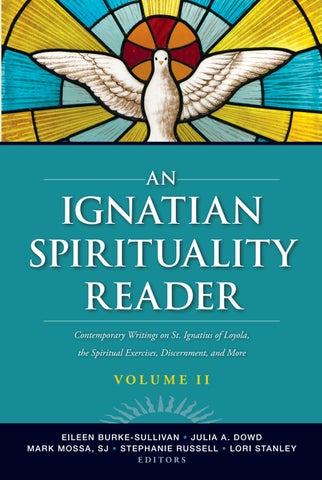
IGNATIAN SPIRITUALITY READER Contemporary Writings on St. Ignatius of Loyola, the Spiritual Exercises, Discernment, and More
VOLUME II
E ILE E N B U R K E- S U LLI VA N • J U LI A A . D OW D M A R K M O S S A , S J • S T E PH A N I E R U S S E LL • LO R I S TA N LE Y EDITORS
AN
IGNATIAN SPIRITUALITY READER
i_5621_IgnatianSpiritualityReader_Vol2_CC25.indd 1
9/4/25 2:00 PM
i_5621_IgnatianSpiritualityReader_Vol2_CC25.indd 2
9/4/25 2:00 PM
AN
IGNATIAN SPIRITUALITY READER Contemporary Writings on St. Ignatius of Loyola, the Spiritual Exercises, Discernment, and More
VOLUME II
E I L E E N B U R K E - S U L L I VA N • J U L I A A . D OW D M A R K M O S S A , S J • S T E PH A N I E R U S S E L L • LO R I S TA N L E Y
EDITORS
i_5621_IgnatianSpiritualityReader_Vol2_CC25.indd 3
9/4/25 2:00 PM
Copyright © 2025 Association of Jesuit Colleges and Universities Acknowlegments for permission to reprint granted by previous publishers can be found on pages 489–496. Cover design by Loyola Press Interior design by Think Design Group Cover art credit: Philippe Lissac/Getty Images, Jesuits of the Missouri Province ISBN: 978-0-8294-5621-9 Library of Congress Control Number: 2025942854 Published in Chicago, IL Printed in Canada 25 26 27 28 29 30 31 32 33 34 MQS 10 9 8 7 6 5 4 3 2 1
i_5621_IgnatianSpiritualityReader_Vol2_CC25.indd 4
9/4/25 2:00 PM
The editors dedicate this collection to Father George Traub, SJ, and to the Chief Mission Officers, past and present, of the colleges and universities which are sponsored works of the North American Assistancy of the Society of Jesus. Among those leaders is the late Eileen Burke-Sullivan, who served as the first editor of this volume and in whose loving memory we bring it to fruition.
i_5621_IgnatianSpiritualityReader_Vol2_CC25.indd 5
9/4/25 2:00 PM
i_5621_IgnatianSpiritualityReader_Vol2_CC25.indd 6
9/4/25 2:00 PM
Contents Preface . . . . . . . . . . . . . . . . . . . . . . . . . . . . . . . . . . . . . . . . . . . . . . . . . . xiii
I. Foundations, History, and Current Context Part I Introduction . . . . . . . . . . . . . . . . . . . . . . . . . . . . . . . . . . . . . . . . . 3 The Biographical Roots of the Ignatian Tradition Eileen Burke-Sullivan . . . . . . . . . . . . . . . . . . . . . . . . . . . . . . . . . . . . . . . 7 Letters to the Twenty-First Century: The Incomparable Value of Ignatius’s Letters for Understanding the Practicality of Ignatian Spirituality Then and Now Mark Mossa, SJ . . . . . . . . . . . . . . . . . . . . . . . . . . . . . . . . . . . . . . . . . . . 19 Mary, the Hidden Catalyst: Reflections from an Ignatian Pilgrimage to Spain and Rome Margo J. Heydt and Sarah J. Melcher . . . . . . . . . . . . . . . . . . . . . . . . . 29 What the Conversion of Saint Ignatius Can Teach Us 500 Years Later Jean Luc Enyegue, SJ . . . . . . . . . . . . . . . . . . . . . . . . . . . . . . . . . . . . . . 46 Universal Apostolic Preferences of the Society of Jesus, 2019–2029 Arturo Sosa, SJ . . . . . . . . . . . . . . . . . . . . . . . . . . . . . . . . . . . . . . . . . . . 50 Showing the Way to God Arturo Sosa, SJ . . . . . . . . . . . . . . . . . . . . . . . . . . . . . . . . . . . . . . . . . . . 65
II. Contemporary Interpretations Part II Introduction . . . . . . . . . . . . . . . . . . . . . . . . . . . . . . . . . . . . . . . 77 Address to the 36th General Congregation of the Society of Jesus Pope Francis . . . . . . . . . . . . . . . . . . . . . . . . . . . . . . . . . . . . . . . . . . . . . . 79 Pope Francis as Interpreter of Ignatius’s Spiritual Exercises Matthew Ashley . . . . . . . . . . . . . . . . . . . . . . . . . . . . . . . . . . . . . . . . . . 89 vii
i_5621_IgnatianSpiritualityReader_Vol2_CC25.indd 7
9/4/25 2:00 PM
viii
Contents
In Our Bones: The Spiritual Exercises and Call to Justice in Jesuit Education Julia A. Dowd . . . . . . . . . . . . . . . . . . . . . . . . . . . . . . . . . . . . . . . . . . . 108 Something I Never Thought About: Jesuits as Plastic Surgeons? Ryan Mak, SJ . . . . . . . . . . . . . . . . . . . . . . . . . . . . . . . . . . . . . . . . . . . . 114 Catholics Need to Learn How to Deal with Disagreements. St. Peter Faber Can Help. Alex Hale, SJ . . . . . . . . . . . . . . . . . . . . . . . . . . . . . . . . . . . . . . . . . . . . 117 How Ignatian Spirituality Enhanced My Cognitive Behavioral Therapy Thanh-Thao (Sue) Do . . . . . . . . . . . . . . . . . . . . . . . . . . . . . . . . . . . . 120 Story Standards Eric Clayton . . . . . . . . . . . . . . . . . . . . . . . . . . . . . . . . . . . . . . . . . . . . . 125
III. Freedom and Discernment Part III Introduction . . . . . . . . . . . . . . . . . . . . . . . . . . . . . . . . . . . . . 139 A Crash Course in Ignatian Discernment of Spirits Mark Thibodeaux, SJ . . . . . . . . . . . . . . . . . . . . . . . . . . . . . . . . . . . . . 141 Discernment: Becoming Who We Are Gemma Simmonds, CJ . . . . . . . . . . . . . . . . . . . . . . . . . . . . . . . . . . . . 149 To Allow the Creator to Deal Immediately with the Creature Hung T. Pham, SJ . . . . . . . . . . . . . . . . . . . . . . . . . . . . . . . . . . . . . . . . 154 Maintaining the Tension: Freedom, Commitment, and Discernment Eileen Burke-Sullivan . . . . . . . . . . . . . . . . . . . . . . . . . . . . . . . . . . . . . 158 God Isn’t Finished with Me Yet Barbara Lee . . . . . . . . . . . . . . . . . . . . . . . . . . . . . . . . . . . . . . . . . . . . . 171 On Discernment in Common Arturo Sosa, SJ . . . . . . . . . . . . . . . . . . . . . . . . . . . . . . . . . . . . . . . . . . 180
i_5621_IgnatianSpiritualityReader_Vol2_CC25.indd 8
9/4/25 2:00 PM
Contents
ix
IV. Reconciliation Part IV Introduction . . . . . . . . . . . . . . . . . . . . . . . . . . . . . . . . . . . . . 193 Companions in a Mission of Reconciliation and Justice General Congregation 36 . . . . . . . . . . . . . . . . . . . . . . . . . . . . . . . . . . 196 Back to Fundamentals Thomas D. Stegman, SJ . . . . . . . . . . . . . . . . . . . . . . . . . . . . . . . . . . . 209 An Apology Toward Reconciliation Georgetown University Slavery Reconciliation Project . . . . . . . . . . 214 Meeting with Young People and Elders Pope Francis . . . . . . . . . . . . . . . . . . . . . . . . . . . . . . . . . . . . . . . . . . . . . 217 Atoning for Sins Against Indigenous People Begins with Confronting the Past. Red Cloud Indian School Is Showing the Way. Maka Black Elk and William Critchley-Menor, SJ . . . . . . . . . . . . . 223
V. Leadership and Mission Part V Introduction . . . . . . . . . . . . . . . . . . . . . . . . . . . . . . . . . . . . . . 231 What Is Ignatian Leadership? Sarah Broscombe . . . . . . . . . . . . . . . . . . . . . . . . . . . . . . . . . . . . . . . . . 233 What Does the Ignatian Leader Do? Michelle Wheatley . . . . . . . . . . . . . . . . . . . . . . . . . . . . . . . . . . . . . . . 241 Ignatian Leadership for Love and Liberation Jennifer Tilghman-Havens . . . . . . . . . . . . . . . . . . . . . . . . . . . . . . . . . 253 A New Ignatian Virtue Necessary for Promoting Justice: Cura Propria Debra K. Mooney . . . . . . . . . . . . . . . . . . . . . . . . . . . . . . . . . . . . . . . . 266 Suppose Leaders Presupposed? Michele C. Murray . . . . . . . . . . . . . . . . . . . . . . . . . . . . . . . . . . . . . . . 270 The Ignatian Roots of Arrupe’s Mysticism Kevin F. Burke, SJ . . . . . . . . . . . . . . . . . . . . . . . . . . . . . . . . . . . . . . . . 275
i_5621_IgnatianSpiritualityReader_Vol2_CC25.indd 9
9/4/25 2:00 PM
x
Contents
VI. Adaptations Part VI Introduction . . . . . . . . . . . . . . . . . . . . . . . . . . . . . . . . . . . . . 285 How Far Can You Go? Ignatius’s Exercises, Fidelity, and Adaptation Philip Endean, SJ . . . . . . . . . . . . . . . . . . . . . . . . . . . . . . . . . . . . . . . . 289 The Spiritual Exercises and Gender Elizabeth Liebert, SNJM . . . . . . . . . . . . . . . . . . . . . . . . . . . . . . . . . . 304 Jesuit Norms for Choice of Mission and the Exercises Erin Cline . . . . . . . . . . . . . . . . . . . . . . . . . . . . . . . . . . . . . . . . . . . . . . . 320
VII. Imagination and Creativity Part VII Introduction . . . . . . . . . . . . . . . . . . . . . . . . . . . . . . . . . . . . . 337 The Spiritual Exercises and Art Thomas Lucas, SJ . . . . . . . . . . . . . . . . . . . . . . . . . . . . . . . . . . . . . . . . 340 The Wound of Ignatius in Art Bert Daelemans, SJ . . . . . . . . . . . . . . . . . . . . . . . . . . . . . . . . . . . . . . . 346 Available and Willing Holly Schapker . . . . . . . . . . . . . . . . . . . . . . . . . . . . . . . . . . . . . . . . . . 350 David Foster Wallace’s Denomination of Joy Joshua Hren . . . . . . . . . . . . . . . . . . . . . . . . . . . . . . . . . . . . . . . . . . . . . 352 Ignatius and the Stars Tim McEvoy . . . . . . . . . . . . . . . . . . . . . . . . . . . . . . . . . . . . . . . . . . . . 358 Touching Jesus’ Cloak: Imaginative Prayer in Action Eric Immel, SJ . . . . . . . . . . . . . . . . . . . . . . . . . . . . . . . . . . . . . . . . . . . 369
VIII. Ignatian Spirituality and Anti-Racism Part VIII Introduction . . . . . . . . . . . . . . . . . . . . . . . . . . . . . . . . . . . . 375 The Jesuit Spirituality of Martin Luther King Jr. Marcia Chatelain . . . . . . . . . . . . . . . . . . . . . . . . . . . . . . . . . . . . . . . . . 376 Racism and the Gift of Sorrow Becky Eldredge . . . . . . . . . . . . . . . . . . . . . . . . . . . . . . . . . . . . . . . . . . 380
i_5621_IgnatianSpiritualityReader_Vol2_CC25.indd 10
9/4/25 2:00 PM
Contents
xi
How to Use Ignatian Spirituality for Anti-Racism and Racial Justice Mary J. Lomax-Ghirarduzzi . . . . . . . . . . . . . . . . . . . . . . . . . . . . . . . . 384 What Dr. King and St. Ignatius Taught Me about Discernment and Anti-Racism Ken Homan, SJ . . . . . . . . . . . . . . . . . . . . . . . . . . . . . . . . . . . . . . . . . . 389 Remembering George Floyd with a Steadfast Commitment to Racial Justice Christopher Kerr . . . . . . . . . . . . . . . . . . . . . . . . . . . . . . . . . . . . . . . . . 393 The Ignatian Witness to Truth in a Climate of Injustice Bryan N. Massingale . . . . . . . . . . . . . . . . . . . . . . . . . . . . . . . . . . . . . . 395 An Examen for White Allies Maddie Murphy . . . . . . . . . . . . . . . . . . . . . . . . . . . . . . . . . . . . . . . . . 404 A Doorway to Racial Healing Patrick Saint-Jean, SJ . . . . . . . . . . . . . . . . . . . . . . . . . . . . . . . . . . . . . 409
IX. Care for Our Common Home Part IX Introduction . . . . . . . . . . . . . . . . . . . . . . . . . . . . . . . . . . . . . 415 Ignatian Spirituality and Ecology: Entering into Conversation with the Earth Joseph Carver . . . . . . . . . . . . . . . . . . . . . . . . . . . . . . . . . . . . . . . . . . . . 417 Ignatian Spirituality and the Ecological Vision of Laudato Si´ Paul L. Younger . . . . . . . . . . . . . . . . . . . . . . . . . . . . . . . . . . . . . . . . . . 433 Want to Be a Better Leader? Connect with Nature Karin Botto . . . . . . . . . . . . . . . . . . . . . . . . . . . . . . . . . . . . . . . . . . . . . 445 A Prayer for Our Earth Pope Francis . . . . . . . . . . . . . . . . . . . . . . . . . . . . . . . . . . . . . . . . . . . . . 451
Contributors . . . . . . . . . . . . . . . . . . . . . . . . . . . . . . . . . . . . . . . . . . . . 455 Co-Editors . . . . . . . . . . . . . . . . . . . . . . . . . . . . . . . . . . . . . . . . . . . . . . 465 Index . . . . . . . . . . . . . . . . . . . . . . . . . . . . . . . . . . . . . . . . . . . . . . . . . . . 467 Acknowledgments . . . . . . . . . . . . . . . . . . . . . . . . . . . . . . . . . . . . . . . . 489
i_5621_IgnatianSpiritualityReader_Vol2_CC25.indd 11
9/4/25 2:00 PM
i_5621_IgnatianSpiritualityReader_Vol2_CC25.indd 12
9/4/25 2:00 PM
Preface In 2008, Loyola Press published two collections of essays edited by George Traub, SJ: the first, titled An Ignatian Spirituality Reader and the second, A Jesuit Education Reader. Both books were well used by Jesuits and lay partners in various programs of the Association of Jesuit Colleges and Universities, the Jesuit Schools Network, and other Ignatian ministries. Father Traub had an extensive history in developing formation programs for lay partners in the mission of Jesuit universities through his work at Xavier University in Cincinnati, Ohio, and these collected works continue to be relevant for introducing lay partners of the Jesuits into the vision and mission of the works of the Society of Jesus. Sixteen years later, Loyola Press presents the second volume of An Ignatian Spirituality Reader (along with another volume of A Jesuit Education Reader). The second volume of the Spirituality Reader is intended as a companion to the first, providing a sampling of the outpouring of conversations in more recently published blogs, books, essays (both scholarly and pastoral), presentations, homilies, and lectures. This second volume of textual materials published in the last dozen years has been collected and edited by a team of scholars and practitioners who have worked with colleagues, friends, and supporters of Jesuit works to enable our lay partners to deepen their appreciation of the values and attitudes that animate the Christian tradition, and—in dialogue with other religions—ground their experience in St. Ignatius’s Spiritual Exercises. While this second volume is longer than the original and the selected works more diverse in style and purpose, we remain greatly appreciative of Father Traub’s work and we wish to honor his efforts. Recognizing the rapid expansion of subject areas that are now influenced by Ignatian reflection, we have put forth nine chapters, each of which includes three or more texts. We want to stress that in no xiii
i_5621_IgnatianSpiritualityReader_Vol2_CC25.indd 13
9/4/25 2:00 PM
xiv
Preface
way have we tapped all of the excellent content that has been created in these subject areas. Like Father Traub’s first Ignatian Spirituality Reader, this book shares portions of a few excellent Ignatian conversations and ecclesial and Jesuit commentary that we hope will serve as resources and conversation starters in a range of Ignatian pastoral, educational, and scholarly settings. In Part II of this collection, we have included the papal address at the 36th General Congregation of the Society of Jesus in 2016, in which Pope Francis counsels the Jesuits that an essential outcome of Ignatian discernment is development and change. This transition from one historical moment to another is the work of the Holy Spirit, moving always toward the benefit of those whom we serve and with whom we stand in solidarity. We embrace this charge from Pope Francis to recognize growth and change as graces of Ignatian discernment, and we invite the reader to approach the selections in this volume through this lens. Some selections demonstrate scholarly probing of the developing understanding of Ignatian spirituality; others explore the praxis of Ignatian spirituality in ways that were not even imagined fifty years ago, much less in the sixteenth century. Nonetheless, these areas of growth can be well understood today under the umbrella of the ordinary practice of the wisdom and grace that the Ignatian vision and tradition discloses. The editors of this collection are deeply grateful to the graces and gifts that Ignatian spirituality has provided in our diverse circumstances. We have been blessed to be Jesuit and partners in this work of expanding the formation of our colleagues. We fully expect that our more knowledgeable colleagues will ask why this article or that blog post, or the remarkable chapter of this-or-that book, has not been included, and we can only say there is always further reading and listening to do. For those who wonder why these particular texts were chosen, we say that they seemed to us to add to the conversations that are going forward this year, and address the characteristic topics we selected at this point in time. We hope perhaps others will offer volume three to this series in another few years.
i_5621_IgnatianSpiritualityReader_Vol2_CC25.indd 14
9/4/25 2:00 PM
Preface
xv
We wish to gratefully acknowledge the support of Diana Vara and Caitlyn Rei in the final editing stages, and Gary Jansen and Maura Poston of Loyola Press. We invite all of us to the development of understanding which the Holy Father commended to the Society of Jesus at their most recent General Congregation, and we further join our prayers with the Society of Jesus that all may grow to their full measure as human persons. Eileen Burke-Sullivan Julia A. Dowd Mark Mossa, SJ Stephanie Russell Lori Stanley
i_5621_IgnatianSpiritualityReader_Vol2_CC25.indd 15
9/4/25 2:00 PM
i_5621_IgnatianSpiritualityReader_Vol2_CC25.indd 16
9/4/25 2:00 PM
I. Foundations, History, and Current Context
i_5621_IgnatianSpiritualityReader_Vol2_CC25.indd 1
9/4/25 2:00 PM
i_5621_IgnatianSpiritualityReader_Vol2_CC25.indd 2
9/4/25 2:00 PM
Part I Introduction We found ourselves assembling this collection in the context of two key Jesuit initiatives in the last decade. The first is the Society of Jesus’s Universal Apostolic Preferences (UAPs), articulated and implemented in 2019, after two years of consultation with Jesuits and their colleagues in ministry around the world. According to these preferences, the Jesuits have committed to giving special attention to four key missions until at least 2029: Showing the Way to God, Walking with the Excluded, Journeying with Youth, and Caring for Our Common Home. As the inclusion of an excerpt from Fr. General Arturo Sosa’s book Walking with Ignatius will show, the focus of this volume is more on the first, stated in the form of a mandate, to “show the way to God through the Spiritual Exercises and discernment.” This first preference demonstrates something of which the Jesuits and their colleagues in ministry are keenly aware: that at the heart of Ignatian spirituality is what is often referred to as simply “the ministry of the Exercises.” This is the foundation for all Jesuit ministries and thus something that requires continual attention as we seek to remind ourselves and come to understand both the origins of the Exercises themselves as well as the spiritual insights that helped form them and which emerge from them. Undoubtedly the Ignatian Year, which was celebrated from 2021–2022 and marked the anniversary of the moment that changed the course of Saint Ignatius’s life, a life-threatening injury suffered when his leg was shattered by a cannonball at a battle in Pamplona in 1521, was meant as a concrete manifestation of that first preference. Jesuit ministries around the world invited people to share their own “cannonball moments,” finding a meeting place in the conversion experience of this sixteenth-century soldier with their own lifechanging experiences of pain, transformation, and conversion in their twentieth and twenty-first century lives. This was a reminder 3
i_5621_IgnatianSpiritualityReader_Vol2_CC25.indd 3
9/4/25 2:00 PM
4
I. Foundations, History, and Current Context
to us all, as Jean Luc Enyegue explores in the included essay, both of a sameness in human experience over the centuries when it comes to finding our way to God, but also the ways in which such experiences must be understood according to the particular time, place, and circumstances in which we find ourselves. We can only imagine what it would have been like to be a soldier on a sixteenth-century battlefield. Similarly, when composing the Spiritual Exercises, Saint Ignatius could hardly have anticipated how different an experience of conversion might be for a woman in the twenty-first century. Coincident with these two Jesuit initiatives, this section assembles a variety of essays and book chapters published in the last two decades which further plumb the depths of the origins of Ignatian spirituality and continue to examine the possibilities for the practical application of Ignatian principles in the midst of the diverse experiences of our lives today. Ignatius’s cannonball moment was just the beginning of a conversion story that spanned years—indeed, a lifetime—and provided the opportunity for prayer, reading, learning, spiritual conversation, and friendships that would shape the text which would come to be known as The Spiritual Exercises. The first piece of this section, by Eileen Burke-Sullivan, is taken from her introduction to the book The Ignatian Tradition, which she co-authored with Kevin F. Burke, SJ. Here she explores “The Biographical Roots of the Ignatian Tradition,” focusing on the ways in which Ignatius’s life and experience offer insight both into whom he would become and what would become of the spirituality and way of life inspired by his experience. In doing so, she anticipates and echoes a central insight of many contemporary Ignatian scholars that what we understand to be Ignatian spirituality cannot be accounted for simply by the text of The Spiritual Exercises, or even by the experience of the retreat for which it is a guide, but that it must also be seen in light of the lived experience of the first Jesuits, which could hardly be encapsulated by that one text. Similarly, as many of the contributions to this volume illustrate, our contemporary experience of Ignatian spirituality relies on the collective wisdom and adaptations of generations of Jesuits, and, increasingly so in recent generations, of their colleagues in study and ministry.
i_5621_IgnatianSpiritualityReader_Vol2_CC25.indd 4
9/4/25 2:00 PM
Part I Introduction
5
In a complementary spirit, Mark Mossa builds upon insights taken from his book Saint Ignatius Loyola: The Spiritual Writings, to highlight an often-overlooked source of Ignatian wisdom: the collected letters of the saint who was not only the emerging leader of a dynamic religious community but also one of the most prolific letter writers of his time. The letters provide practical wisdom for everyday experiences and struggles that the more focused experience of the Spiritual Exercises and the foundation of the Jesuit order do not. They also allow us to see how Ignatius engages the experience of the wide variety of people in a multitude of circumstances, to whom he wrote. This is not to say that no attention has been given to Ignatius’s letters. Some sixty years ago, Hugo Rahner published St. Ignatius Loyola: Letters to Women, which explored how Ignatius may have applied his spiritual principles to the lives of the women of his day. This provides an interesting bridge to two other essays included in this volume. The first is a reflection by Margo Heydt and Sarah Melcher inspired by their experience of an Ignatian pilgrimage to Spain and Rome. “Mary, the Hidden Catalyst” is the account of how these two self-professed “Protestant feminist pilgrim professors” were taken by the role that Mary clearly played in Ignatius’s conversion experience as they themselves moved through his pilgrim journey. This inspired them to further research the role that women played in the life of Ignatius, and the ways in which his relationships with women, and with Mary, offer an alternative perspective for our understanding of the Exercises in particular, and Ignatian spirituality as a whole. Later, in chapter six, this feminist perspective is further explored in an innovative way in an essay by Elizabeth Liebert, “The Spiritual Exercises and Gender,” appearing here, in English, for the first time. Finally, we include the Society of Jesus’s announcement and outlining of the Universal Apostolic Preferences, as well as an excerpt from chapter six of Jesuit Father General Arturo Sosa’s 2021 book, Walking with Ignatius, titled, “Showing the Way to God.” This more expansive question-and-answer interview demonstrates how the first of the UAPs does not simply involve leading people in the Spiritual Exercises or articulating the riches of Ignatian spirituality, but rather witnessing how Ignatian spirituality can infiltrate our daily life. The
i_5621_IgnatianSpiritualityReader_Vol2_CC25.indd 5
9/4/25 2:00 PM
6
I. Foundations, History, and Current Context
conversation includes questions and answers specifically focused on Jesuit mission, the Exercises, and how these inform our understanding of the Church and our lives of faith. As the title of his book suggests, all of this has to do with endeavoring to understand what it means to walk with Ignatius, both in his day and our own. Each of the pieces in this section offers its own perspective on this basic question. Mark Mossa, SJ
i_5621_IgnatianSpiritualityReader_Vol2_CC25.indd 6
9/4/25 2:00 PM
The Biographical Roots of the Ignatian Tradition Eileen Burke-Sullivan
Ad majorem Dei gloriam, a favorite phrase of Ignatius, emerged from the heart of medieval ideals of honor and glory that shaped his early ambition, but had then been purified in the fires of mystical love. Literally translated “to the greater glory of God,” the phrase provides a summary statement that, like hypertext in the world of computers, springs open when pressed, to reveal a dense description of attitudes and behaviors. This manner of living the Christ life provides one of the great historical spiritualities found within the Christian tradition. In relationship to the major historical spiritualities of the monastic and the conventual traditions, the Ignatian pattern is the youngest. As such it draws on these earlier methods for living the Christian life but remains distinct from all of them because of its various emphases. Ignatius Loyola was a man of his own time, but, like Martin Luther with whom he shares the 16th-century religious stage, seems to stand above that era. Born in the Basque country of northern Spain in 1491, within months of the completion of the Reconquista by Isabella and Ferdinand, and the discovery of the Americas, Ignatius entered history at a moment of extraordinary change in European culture. It was the dawn of Spain’s golden age of wealth and power. Initiated by Isabella’s material and social support of Christopher Excerpt from The Ignatian Tradition: Spirituality in History, with Kevin F. Burke, SJ, & Eileen BurkeSullivan (Liturgical Press, 2009).
7
i_5621_IgnatianSpiritualityReader_Vol2_CC25.indd 7
9/4/25 2:00 PM
8
I. Foundations, History, and Current Context
Columbus’s exploration voyage, this period of extraordinary wealth and power was fueled by the discovery of gold, silver, lands, crops, and slave labor of the peoples of the Americas. From the larger world of European culture, the Renaissance inaugurated dramatic intellectual growth, as well as strong biblical and spiritual reform in the Spanish Catholic Church. Renaissance thinking set the stage for the Protestant Reformation, which in turn led to the end of Christendom as a united political reality. The printing press, invented only forty years before Ignatius’s birth, had already contributed to a revolution of language, literacy, and learning throughout Europe, even while he was a child. In this period of epochal change in Western culture the fundamental theistic worldview of the medieval period gave way to the dawn of an anthropocentric premodernity. Newly formed nations sent ambitious younger sons to unmapped continents where they claimed land and resources in the name of their monarchs, achieving both wealth and power. In the midst of these momentous cultural quakes, Ignatius discovered a similar tectonic movement within his own heart and mind. He was drawn by circumstance and grace from a life of self-glorification to a clear-eyed realism oriented to God’s glory. His experience of God’s gracious intervention in his personal human struggles, which he learned to carefully observe and methodize, provided the matrix of insights and practices that defined his own spiritual journey and became the foundation for the way of Christian life that is named for him.
i_5621_IgnatianSpiritualityReader_Vol2_CC25.indd 8
9/4/25 2:00 PM
The Biographical Roots of the Ignatian Tradition
9
Ignatius’s Early Life Ignatius of Loyola was born into a Basque family of clan chiefs and baptized Íñigo, a common name in the Basque language of Euskadi. One of the youngest children in a family of eight boys and three girls, he lost his mother as a small child and his father when he was fifteen. The wife of an older brother cared for him after his mother’s death; that same brother inherited the estate and title of Loyola when their father died. Because of the medieval law of primogeniture and as a younger son in a large noble family, Íñigo had few choices about the direction of his life. He could enlist in the king’s army, join in the exploration and conquest in the Americas, enter the service of the church as clergy, or serve one of the lords of the Spanish or imperial court. He had only a minimal education, but he learned to read and write in Spanish. Apparently he also received tonsure—the first step toward the clerical state—at the age of thirteen. But after he turned fifteen an undisclosed reversal of fortune sent him to the court of his mother’s cousin, Juan Velazquez de Cuellar, the royal treasurer of King Ferdinand and Queen Isabella. While at court, Íñigo acquired the style and flourish of a young courtier and began signing his name according to the Latin, Ignatius.1 He also became enamored of the popular romantic literature of the day: stories of heroic battles, glorious knightly competitions, and the conquest of the hearts of wealthy and beautiful women. He described this period of his life in a single sentence: “Up to the age of twenty-six he was a man given to the vanities of the world; and what he enjoyed most was warlike sport, with a great and foolish desire to win fame” (Autobiography, 68).
1. Baldassare Castiglione describes the kind of person Ignatius was expected to become by his appointment to the court of de Cueller: “So in jousts and tournaments, in riding, and handling every kind of weapon, as well as in the festivities, games and musical performances, in short, in all the activities appropriate to a well-born gentleman, everyone at his court strove to behave in such a way as to be judged worthy of the Duke’s noble company” (Baldassare Castiglione, The Book of the Courtier, trans. George Bull [London: Penguin Books, 1967], 42).
i_5621_IgnatianSpiritualityReader_Vol2_CC25.indd 9
9/4/25 2:00 PM
10
I. Foundations, History, and Current Context
A French cannonball fired at the small, fortified city of Pamplona where he served among the defenders suddenly turned Ignatius’s life upside down. From all historical evidence Ignatius had committed himself to a hopeless cause, for the French completely outnumbered the Spanish. His sense of chivalrous honor, however, required him to serve king and country to the end. The cannonball seriously damaged his knee, but the French treated him compassionately. They moved him back to Loyola Castle where family physicians using the primitive surgery of the day did what they could for him. He nearly died after septicemia set in. As he began to recover Ignatius realized the extent of his injury: a bone protruded near his knee leaving one leg significantly shorter than the other. Unwilling to have either his looks marred or his mobility impaired, Ignatius required the local doctors to saw off the segment that jutted from his knee and reset the bones. Again he endured serious infection and again he barely survived. Aided by tortuous physical therapies that straightened and lengthened the leg, however, he did recover. During this period of enforced immobility, Ignatius requested books to while away the time and take his mind off the pain. His pious sister-in-law had only two: a popular Life of Christ by Ludolph of Saxony (which included significant portions of both the Old and New Testaments) and Golden Legends, a collection of saints’ lives told in a chivalrous style that captured his imagination and enthusiasm. For over six months Ignatius read, reread, considered, and fantasized about these books. He even copied large segments of both into personal notebooks.
i_5621_IgnatianSpiritualityReader_Vol2_CC25.indd 10
9/4/25 2:00 PM
The Biographical Roots of the Ignatian Tradition
11
Conversion and the First Steps in Discernment The Lutheran Reformation caused Catholic authorities in Spain to frown upon vernacular translations of the Bible. Because of this and because he knew no Latin, Ignatius had never read or studied Scripture. Ludolph’s Life of Christ, however, represented a theological and popular exposition of the doctrines of creation, incarnation, and paschal mystery. It also contained a conflation of the gospel narratives surrounding Jesus’s birth, public ministry, and death. Since Ignatius was born and raised in a Catholic family in that most Catholic of countries, the biblical stories provided him with no new data. But having time to read and consider their implications enabled him to experience the truth of the Christian message in an entirely new way. During these months, he ceased to be merely culturally religious and became profoundly faithful. The Autobiography witnesses that from the days of his long physical recovery at Loyola Castle, Ignatius learned to pay careful attention to his affective response to the reading and the fantasies that he wove under the influence of both books. In his imaginary life he entertained himself by daydreams that at one time featured him pursuing and winning a very attractive woman’s favor through chivalrous deeds, and at other times described him as a poor and humble servant winning souls for God in the manner of St. Francis or St. Dominic. Both kinds of dreams gave him pleasure in the imagining, but the different states of mind and heart that resulted after spending hours weaving the various fantasies astonished him. When he dreamed of winning human praise and adulation, he later felt bored and tired, but when he imagined that he accomplished deeds for God he later felt energized and alive. He told de Camara that initially he didn’t take much note of this, but then a time came when “his eyes were opened a little and he began to marvel at the difference and to reflect upon it” (Autobiography, 71). This first stage of discernment—observing his own thoughts and feelings—led him to begin to address God less through structured formula and instead to practice what he later named “a colloquy.” This prayer is an intimate conversation, face-to-face, “in the way one friend speaks to another, or a servant to one in authority—now
i_5621_IgnatianSpiritualityReader_Vol2_CC25.indd 11
9/4/25 2:00 PM
12
I. Foundations, History, and Current Context
begging a favor, now accusing oneself of some misdeed, now telling one’s concerns and asking counsel about them” (SE 54).2 This very intimate, conversational prayer opened his mind and heart to discover the great love that God had for him and the personal interest God took in his choices and in his way of life. This experience of being radically loved and carefully guided compelled Ignatius to leave the comfortable and politically powerful life of a courtier and to seek God’s desire for his future. He began a relationship with God that, in these beginning stages, he likened to study with a good teacher who carefully guides his student. Generally recovered in health, though permanently crippled, Ignatius set out walking on a new path—a path toward living in a way more fully responsive to God’s desires for him. Years later, Ignatius would call himself the pilgrim—the one on the journey toward God—on the way of companioning Jesus. He determined to visit Jerusalem, but he stopped on the way and dwelt for almost a year in a cave near the town of Manresa, Spain, down a steep hill from the Benedictine monastery of Montserrat.
The Months at Manresa In this setting, Ignatius spent hours in prayer accompanied by rigorous physical penances that occasionally left him near death from the extreme privation of food, sleep, and shelter. His impulse was at least in response to the medieval influence undertaking an overwhelming challenge to prove his worth and his devotion. Later he judged that such efforts may not necessarily have been guided by God but could well have been responses to a more arrogant spirit of pride where he wanted to “outdo” the giants of medieval spirituality, Francis and 2. The Spiritual Exercises of Saint Ignatius, ed. and trans. George E. Ganss (St. Louis, MO: Institute of Jesuit Sources, 1992). Throughout this book citations to the text of the Spiritual Exercises will be identified in the classical method that employs paragraph numbers, i.e., SE 54. One can thus find the reference in any translation or version of the book. Such citations will be located within the text rather than in endnotes. It should be noted that throughout this book we distinguish the written text of The Spiritual Exercises from the act of doing the Spiritual Exercises (or directing another who is doing them) by placing the former in italics.
i_5621_IgnatianSpiritualityReader_Vol2_CC25.indd 12
9/4/25 2:00 PM
The Biographical Roots of the Ignatian Tradition
13
Dominic. During these periods of severe self-deprivation, he often suffered intense bouts of scrupulosity and an obsessive guilt about his past that seemed to reject the power of God’s mercy to forgive him. He even spiraled toward suicide at least once during this period. He later actively discouraged his followers from imitating this extreme penitential behavior and suggested that they carefully discern the reasons for wanting to. It became clear to him that the matter of doing penance had to be an individual response of love, not an effort to achieve God’s love or attention. There should be no uniform expectation of certain ascetical acts required of all because each person is called to demonstrate love uniquely. Once he discovered that his impulse toward severe penances and the scrupulosity that afflicted him were not from God, he set the penitential behavior aside, the scruples subsided, and he began to live a somewhat more ordered life. At this point he was granted a series of mystical graces, which he later described in his autobiographical account. These graces altered his understanding of his human nature, of God, and of God’s desire for Ignatius’s responsive love and service. He understood better his own dissolute history, and received God’s absolving mercy. He experienced himself as freed, by God’s grace, to seek and discover that which is truly of God. Conversely, he understood in a new way how self-destructive was his former attraction to sin. Ignatius uses the classical phrase “the discernment of spirits” to name the process of distinguishing between “movements” toward God’s desires and “movements” toward his own sinful self-will. While the phrase was not new (numerous discussions about the necessity and practice of discernment appear in the New Testament and throughout the tradition), Ignatius made a striking contribution to this tradition: a psychologically sound and spiritually astute methodology for individual discernment of spirits and discernment of God’s will. The ability to sort among the various attractions in one’s life and to discover a concrete expression of God’s desires within one’s talents and history is based on a graced freedom from compulsions, addictions, or inordinate attachments of all kinds. Ignatius’s mystical experience taught him that such freedom is ultimately based on an interior knowledge that God is both the source of all creation and the
i_5621_IgnatianSpiritualityReader_Vol2_CC25.indd 13
9/4/25 2:00 PM
14
I. Foundations, History, and Current Context
summit of all our genuine desires. He was convinced that each human person is created for a relationship with God and that all things and relationships given to each person are given to assist in the journey back toward God. Indeed, the purpose of human existence is to respond in freedom to the God of love. This knowledge serves as the foundation of a Christian spiritual life. Without a firm grounding in this first “principle and foundation” one cannot fruitfully pursue the spiritual journey (SE 23). Rooted in Ignatius’s experiences in Manresa, the Spiritual Exercises move from this foundation to a series of meditations on the nature of sin and God’s redeeming grace. Beginning with sin itself in macrocosmic terms, Ignatius narrowed the focus to meditations on the patterns of sin and weakness in each human life. He recognized that unless one experiences repentance, sin ultimately leads to eternal alienation from God and God’s goodness. Therefore, it is sheer grace to recognize that one has participated in disrupting God’s ordered plan of love, and to experience feelings of sorrow for collaborating in such destruction. Seemingly, for many Christians, that recognition alone enables them to live reasonable Christian lives thereafter. But some, including Ignatius himself, experience the call to do greater things in the service of Christ and the reign of God. He invited such persons to move, even as he did, into a second phase of spiritual maturity. In this phase he was drawn to contemplate the life events of the mission, sufferings, and death of Jesus, and of the glory of the Lord’s Resurrection. His prayer involved imagining himself present within the events recounted in the biblical texts he had so carefully copied from Ludolph’s Life of Christ. His contemplation of the mysteries of Christ formed a doorway through which he entered experientially into the Lord’s human life. Given a series of extraordinary graces, or “consolations,” he encountered the mystery of Jesus’s human and divine reality, the gift of Christ’s presence in the Eucharist, and the role of Mary in the Church. The climax of Ignatius’s experiences at Manresa occurred on the banks of the Cardoner River near the town. He received a graced insight so profound that he understood the created order, the mysteries of faith, and his relationship to God with such clarity that he later said that if he added up every grace he ever received from God through his
i_5621_IgnatianSpiritualityReader_Vol2_CC25.indd 14
9/4/25 2:00 PM
The Biographical Roots of the Ignatian Tradition
15
entire life it would not equal the clarity and completeness of those few moments. In the course of these eleven months of purification and enlightenment, his deepest desire shifted. Instead of a life of solitude and penance, he now sought a life filled with the apostolic purpose of “helping souls” the way he had been helped.
Years of Study and Ordination Leaving Manresa with this conviction of call and his desire to respond, Ignatius first fulfilled an earlier commitment to go on pilgrimage to Jerusalem. Once there he was tempted to stay and try to convert Muslims, but the Franciscans in charge sent him back to Europe in order to keep a precarious peace with the Muslim authorities. This pilgrimage was particularly important because it helped Ignatius gain a memory of the physical place of Jesus’s life in the world. For the rest of his life he would be able to imagine Jesus on earth more poignantly because he had a capacity to “compose the place” of an encounter in his memory and imagination. The use of these mental faculties was important to Ignatius. They are the personal doorways through which God’s Spirit works on the consciousness and affections of the individual disciple. Returning to Spain, he discovered other men and women who were hungry for a deeper spiritual life. He guided them through a series of prayer exercises based on his notes. This ministry brought him face-to-face with the Spanish Inquisition and forced him to experience imprisonment for brief periods as he awaited trials. He was tried and found innocent. Nevertheless, the religious authorities ordered him to limit, and in some cases cease, his work. He soon realized that, given the structures of the medieval Spanish Church, he could not fulfill his mission from God unless he became a vowed religious or an ordained priest. Uncertain about finding the right religious community, he opted to prepare for the priesthood. In his mid-thirties he enrolled in Latin, studying with preadolescent boys.
i_5621_IgnatianSpiritualityReader_Vol2_CC25.indd 15
9/4/25 2:00 PM
16
I. Foundations, History, and Current Context
A year later, with the goal of ordination to the priesthood firmly in mind, he studied philosophy and theology at the Spanish universities in Alcalá, Barcelona, and Salamanca. In each of these cities he engaged in spiritual conversations and gave his Spiritual Exercises to men and women, clergy and laity, always inviting others to discover the interior freedom he had come to know. The inquisitors of each city, however, continued to harass him. Finally, he left Spain and matriculated at the University of Paris to complete his religious training. At every stage of his formation into the priesthood he begged for his daily bread and for enough resources to pursue his studies as well to help others pay their tuition. He gave spiritual counsel and guided various people in the Spiritual Exercises. During the Paris years, he took extended trips to Flanders and even to England to beg from wealthy patrons there. Many of those he directed became his greatest benefactors, while others introduced him to ecclesial authorities capable of providing protection for his studies and his work.
The Founding of the Society of Jesus Ignatius studied at the University of Paris for seven years. During that time, he met the men who eventually joined him in his way of companioning Christ. Among them he discovered yet another crucial dimension of his “way”: the treasure of spiritual companionship with others in Christ. He became a master at the art of spiritual conversation. He liked to say that he attempted always to enter through another’s door in order to draw that person out through his door. Thus, Ignatius invited his friends to discover the distinctive way God acted directly on and within their own lives. When he had nearly finished his studies at Paris, he and six companions professed vows together on the Feast of the Assumption in 1534, both the traditional vows of poverty and chastity and then a third vow to either make their way to Jerusalem on a mission to preach the gospel among the Muslims—if that would be possible within a year or two—or to go to Rome and place themselves at the direct service of the pope.
i_5621_IgnatianSpiritualityReader_Vol2_CC25.indd 16
9/4/25 2:00 PM
The Biographical Roots of the Ignatian Tradition
17
These compañeros, a company of friends committed to service of God, did not yet see themselves as a religious community. For this reason, they did not profess a vow of obedience to one of their own companions. But when an unusual combination of war, famine, and terrible weather made their mission to Jerusalem impossible, they journeyed to Rome to fulfill their alternative vow. On the way, two further events shaped the final form of this “way of Ignatius.” The first was a remarkable vision of God the Father and Jesus carrying his Cross that came to Ignatius while he was praying at a wayside shrine at La Storta. In the context of the vision, the Father turned to Jesus and asked him to take Ignatius as companion and servant. God then told Ignatius that God would guide and support him and his companions in Rome. Quite reasonably, the companions took this profound experience of their leader as a sign of God’s blessing on the group, on their choice of the name Society of Jesus, and on their commitment to apostolic service to the whole Church. For Ignatius it was a confirmation of the companionship and their common call to help souls through preaching, spiritual conversation, and giving the Spiritual Exercises. The second singular occurrence was an activity that the companions undertook among themselves in relationship with God and each other. Over the course of the next three months, while engaged apostolically in ministries of teaching, preaching, and consoling the sick, they met together in a process of focused deliberation to discern whether to bind themselves to one another and effectively become a new religious community. They also took up a related but more problematic question as to whether to make a vow of obedience to one of their number. This so-called Deliberation of 1539 became a classic model of corporate decision-making. The men committed themselves to hours of prayer, extensive fasting, and other penances. They pondered the situation and needs of the world. They spent long hours sharing with one another their deepest desires, fears, spiritual consolations, and desolations. In the end they determined, with great joy and peace, that God was calling them to form a religious community. Likewise, in addition to their previous vows of poverty,
i_5621_IgnatianSpiritualityReader_Vol2_CC25.indd 17
9/4/25 2:00 PM
18
I. Foundations, History, and Current Context
chastity, and service to the Holy Father, they agreed to take a vow of obedience to one of their companions. This deliberation gave birth to the Society of Jesus. Almost immediately after this decision, some members of the group took up residence in Rome while others assumed missions to other parts of Europe. New opportunities to proclaim the gospel soon followed in the recently discovered worlds of the Americas and Asia. Pope Paul III formally approved their petition to found a new order in 1540. Ignatius, but for his own vote, was elected the first general. He remained in Rome for the last sixteen years of his life, overseeing the initial growth of the new order, composing the Formula of the Institute and, with the help of his secretary, Juan de Polanco, eventually writing the Constitutions of the Society of Jesus.
i_5621_IgnatianSpiritualityReader_Vol2_CC25.indd 18
9/4/25 2:00 PM
In Our Bones: The Spiritual Exercises and Call to Justice in Jesuit Education Julia A. Dowd
For more than forty years, Jesuit universities have been sharing the Spiritual Exercises with staff, faculty, and students as a tool for leadership development and mission formation. Over this same period, Jesuit institutions have made a concerted effort to rigorously engage a mission of faith doing justice. As the Society of Jesus reaffirms its commitment to discernment and sharing the Spiritual Exercises in its newly ratified Universal Apostolic Preferences (UAPs), now is an opportune time to consider what we have learned over these past several decades of sharing the Exercises with college and university faculty and administration. Has the process of sharing the Exercises with colleagues had an effect on our institutions? Have the Exercises enabled our universities to be focused and bold in living out our Jesuit mission of reconciliation, justice, and inclusion? If you are reading this article, then you likely share with me a deep desire to build robust programs and conversations promoting our Jesuit Catholic mission, identity, and heritage at our colleges and universities. This desire is heightened in these increasingly challenging times financially, politically, and existentially.1 The COVID-19 pandemic has disrupted our university communities and nearly every aspect of human life as we know it in ways most did not imagine just From Conversations on Jesuit Higher Education 58 (Fall 2020). 1. See “Reading Ignatius in Dystopia,” by Michael C. McCarthy, SJ, America, October 1, 2018, vo. 219, no. 7, 20–24.
108
i_5621_IgnatianSpiritualityReader_Vol2_CC25.indd 108
9/4/25 2:00 PM
In Our Bones: The Spiritual Exercises and Call to Justice in Jesuit Education
109
months ago. Our communities have erupted yet again in grief and anger over state-sanctioned violence against black and brown people, with desperate calls for racial justice. Leadership at all Jesuit institutions will be required to think in radical new ways over the next several years about what it means to be a Jesuit university, how we will participate in the social and economic recovery of our communities, and how to learn, heal, and teach with a renewed commitment to facing and abolishing racism and white supremacy. The Universal Apostolic Preferences offer a path forward by training our eye on four priorities, the first of which, “showing the way to God through the Spiritual Exercises and discernment,” is the focus of this article and current issue of Conversations. In response to the call from Superior General of the Society of Jesus Fr. Arturo Sosa, SJ, Jesuit provincials within the United States are asking Jesuit universities to consider ways of sharing the Spiritual Exercises with colleagues. Jesuits West provincial Scott Santarosa, SJ, asked higher education leaders to take discernment “into our bones” and “take the Exercises seriously”2 as a tool for leadership development and decision-making in the years ahead, even suggesting that Jesuit directors of works do the Exercises with their professional teams. There is a long precedent for this. The Spiritual Exercises have always been at the root of the Jesuit apostolic mission. Ignatius’s own prayer life, his spiritual conversion, and his ongoing reflection on God’s activity in his life as described in the Exercises inspired and guided the foundation and early growth of the Society of Jesus. Ignatius’s reflection on his direct experiences in prayer and with the Exercises guided his personal and corporate decisions as founder of the Jesuits. Reflection on the Exercises, including faith-sharing with women, enabled Ignatius to occasionally think outside the box, beyond the social and ecclesial restrictions of his time. In recent decades, the practice of using the Exercises to guide institutional mission has continued, a notable example being Ignacio Ellacuría’s leadership of Central American Jesuits in response to the
2. From “A Family Reunion with ‘Jesuit Muscle,’ by Tracey Primrose, Jesuits West Magazine, Fall 2019, https://www.jesuitportland.org/uploaded/Principal_Blog/Pages_from_JW_Fall2019_pp12-16.pdf.
i_5621_IgnatianSpiritualityReader_Vol2_CC25.indd 109
9/4/25 2:00 PM
110
II. Contemporary Interpretations
Salvadoran political and economic turmoil of the 1980s.3 Ellacuría recognized the Exercises as a means to reflect theologically on the current historical reality, which allowed him, as rector of the University of Central America in San Salvador, to radically reconsider the role and purpose of the Jesuit university, arriving at the conclusion that the university should be a social project actively engaged in social transformation for the liberation of the poor—a decision that had prophetic consequences. Today the Exercises remain a means through which reflection and imaginative thinking can take place to discern our mission in our current contexts and illuminate future directions. Philip Endean describes the Exercises as “a way of handling realities as yet unforeseen.”4 The Exercises have never been intended as a prescriptive or dogmatic approach to Ignatian spirituality or Jesuit identity. Quite the contrary. There is an inherent flexibility, a dynamic and responsive process that ultimately trusts the activity of God in human history as well as in the life of the institution itself. Ignatius and later Jesuit superiors set a precedent of using prayer, discernment, and reflection on the Exercises as a way of guiding not only the broad vision of the Society but also its operational, fiscal, personnel, and strategic functions. Reflection on the Exercises was a way of instilling a sense of shared mission and purpose among Jesuits and colleagues across vast distances. We have a historical and Ignatian rationale to turn to the Exercises as a resource for helping us understand our mission and our social context today. Yet it may be easier said than done. There are obstacles to our consciously sharing faith and spiritual experiences in professional settings. First of all, it is generally considered unprofessional to do so. Secondly, we are multi-religious, multi-faith communities in which not everyone shares the same language, experience, or sacred texts, a topic that Erin Cline addresses in this issue and her recent book, A World on Fire. Thirdly, Jesuit institutions and the Catholic Church 3. See Matthew J. Ashley, “Ignacio Ellacuría and the Spiritual Exercises of Ignatius Loyola,” Theological Studies 61 (2000): 16–39. See also Matthew J. Ashley, Kevin F. Burke, SJ, and Rodolfo Cardenal, SJ, A Grammar of Justice: The Legacy of Ignacio Ellacuría (Maryknoll: Orbis, 2014). 4. Philip Endean, “The Spiritual Exercises,” in The Cambridge Companion to the Jesuits, ed. Thomas Worcester (Cambridge, UK: Cambridge University Press, 2008), 64.
i_5621_IgnatianSpiritualityReader_Vol2_CC25.indd 110
9/4/25 2:00 PM
In Our Bones: The Spiritual Exercises and Call to Justice in Jesuit Education
111
have not always stood on the right side of history when it came to the social and racial conflicts we face today; thus, returning to our roots will be fraught with tensions requiring great humility and willingness to face our collective failings. Despite the challenges, there are some very good reasons to at least give it a try—in addition to the specific request of provincials. Two years ago, as part of a research project, I surveyed and interviewed female-identified faculty and staff from seventeen Jesuit universities across the United States who had completed the Exercises. I asked them to reflect on their experience of the Exercises and to consider whether anything they encountered might relate to the mission of their Jesuit institution. My interest was in whether women’s experiences might fill in critical lacunae in the vision and mission of Jesuit higher education, lacunae that prevent us from achieving our fullest potential as Jesuit apostolates, particularly in the areas of justice and inclusion. And if we learned something new from women’s experiences with the Exercises, what else could we learn from other voices, especially from other marginalized voices, on our campuses? Over the course of a year, I collected stories, words, and images that shed new light on our language around Jesuit and Ignatian mission. One example came when two women independently shared with me that, as a result of doing the Exercises, they recognized their university as the “beloved community.” This is not a phrase we commonly use in Jesuit education, but it is one that connects us powerfully to a rich history of faith in action for civil rights and social justice. The beloved community is not the status quo whereby everyone simply gets along. The beloved community is a new reality whereby the hierarchies and systems that oppress have been dismantled, so that all can flourish and prosper. What a beautiful image brought forth through reflection on the Exercises. Individually, the Exercises have an effect on individuals by illuminating personal biases and sinfulness, as well as pointing to individual gifts of courage and freedom. Collectively, the Exercises have an effect on an institution by improving teaching and community relationships and by prompting responses to social problems that stem from the collective wisdom of the entire community rather than from only the cultural and academic mainstream.
i_5621_IgnatianSpiritualityReader_Vol2_CC25.indd 111
9/4/25 2:00 PM
112
II. Contemporary Interpretations
Likewise, the Exercises can be a tool for deepening our commitment to anti-racism work. University of San Francisco law professor Rhonda Magee, in her book The Inner Work of Racial Justice,5 suggests that daily meditation and mindfulness work “will help you develop the capacity to stay with the challenges of racism as it arises in the world and strengthen your ability to work against it.” There are concrete practices within our Ignatian spiritual tradition, such as the Daily Examen, that build one’s inner capacity for mindfulness, courage, and freedom. Mission officers might consider inviting individuals who have completed the Exercises to meet and reflect on their experiences. This brings more people, more voices, into the work of interpreting our sacred texts, traditions, and future directions. Shawn Copeland describes the centrality of genuine conversation in Jesuit education. “Jesuit education,” she writes, “draws inspiration from Ignatius’s penchant for and insistence on conversation. Conversation requires hospitality, openness, testing, revision, and discovery. Genuine conversation may lead as well to the disruption of conventional opinion, to encounter an ‘other’ who may change us radically. Genuine conversation lays the ground for solidarity and justice.”6 Through conversation we have an opportunity to gather the graces of the many retreats, spiritual direction sessions, prayer groups, and 19th annotation programs we have held over many years so that they may inform our communal, public, and official discourse on mission. I learned that the Spiritual Exercises and reflection on the Exercises can lead us to: • Thinking outside the box. • Examining unexamined implicit biases. • Working through creative tensions. • Discovering new paths forward beyond our current imaginations and perceived possibilities. • Breaking through social and ecclesial tensions—often by giving individuals a stronger sense of their own voice and freedom. 5. Rhonda Magee, The Inner Work of Racial Justice: Healing Ourselves and Transforming Our Communities Through Mindfulness (New York: TarcherPerigee, 2019), 37. 6. M. Shawn Copeland, “Race, Class and Gender in Jesuit and Feminist Education,” in Jesuit and Feminist Education: Intersections in Teaching and Learning for the Twenty-first Century, edited by Jocelyn M. Borczyka and Elizabeth A. Petrino (New York: Fordham University Press, 2012), 130.
i_5621_IgnatianSpiritualityReader_Vol2_CC25.indd 112
9/4/25 2:00 PM
In Our Bones: The Spiritual Exercises and Call to Justice in Jesuit Education
113
• Engaging depth of thought and imagination. • Sharing stories and discovering a particular narrative as an institution. • Recognizing collective experiences of Cross and Resurrection, for ourselves personally and for our communities. Christopher Pramuk writes, “For Jesuits and laypersons alike, the spark that sets our common vision aflame is freedom itself, personal and communal, sustained by grace, centered in the heart, and the desire to join our freedom with others in a story larger than ourselves.”7 This engagement with suffering, this authentic empathy with the excluded, the poor, the suffering of the world is what in my view gives Jesuit education its teeth; this is what keeps us distinct. The Exercises, and shared reflection on the Exercises, provide one way in which we begin to recognize the suffering of the world not as a they but an us, which is at the heart of the Universal Apostolic Preferences. Over these weeks I have seen that our practice of “showing the way to God through discernment with the Exercises” was our hard-wired response in the midst of unprecedented crises. It is in our bones. Amid the coronavirus pandemic and the killing of George Floyd and others, Jesuit-educated students and institutional leaders have shown up in creative and unprecedented ways to express support, solidarity, and love to one another and to build community across distances. In the midst of panic and fear, our students, faculty, and staff turned to our spiritual foundations, sought comfort and guidance from Ignatian prayer and texts, led Examens on YouTube and prayer services on Zoom, stood up for the most vulnerable in our communities, and presented creative innovations to maintaining community with our students, faculty, staff, and alumni spread far and wide. It makes me prouder than ever to be engaged in this work and more convinced than ever of the value of Jesuit education. In these uncertain times, I find consolation and hope in our future.
7. Christopher Pramuk, “The Emergency of a Lay Esprit de Corps: Inspirations, Tensions, Horizons,” Jesuit Higher Education 8 (2): 21–36, 2019, 21.
i_5621_IgnatianSpiritualityReader_Vol2_CC25.indd 113
9/4/25 2:00 PM
Story Standards Eric Clayton
There’s a line from Peter Jackson’s 2001 film adaptation of J. R. R. Tolkien’s The Lord of the Rings: The Fellowship of the Ring that’s always stuck with me: “But they were, all of them, deceived, for another Ring was made.”1 Brief as this line is—and easily missed, as it’s part of a longer prologue sequence—this sentence captures the stakes of the entire trilogy. Because the people of Middle Earth were deceived, because they didn’t know the whole story, pain and suffering resulted. On screen, we watch as rings of power are made and distributed to all the key players of Middle Earth: the Elves, the Dwarves, and the Race of Men. These rings represent influence, clout, prestige, and they bestow great power. We are led to believe they’ve been appropriately distributed. For whatever reason, these rings seem to reflect an agreed-upon order of things, how Middle Earth is organized and governed, how the inhabitants of Middle Earth make sense of their lives. But they were, all of them, deceived, for another Ring was made. This deception is quite literal in The Lord of the Rings. Sauron made another ring, told no one about it, and amassed unimaginable amounts of power and influence as a result. The rest of Middle Earth went about their days assuming they understood how the various rings of
From Cannonball Moments (Chicago: Loyola Press, 2022). 1. Spoken by Galadriel in the prologue of the film.
125
i_5621_IgnatianSpiritualityReader_Vol2_CC25.indd 125
9/4/25 2:00 PM
126
II. Contemporary Interpretations
power would influence their lives and livelihoods, but they were wrong. They didn’t have all the information. They didn’t know that the scales were tipped against them and had been from the start. And thus, our heroic Hobbits appear on the scene to destroy the One Ring and make things right. Stories help us see truth: in ourselves, our communities, and our world. But stories can also be used to conceal truths, intentionally and unintentionally. Stories can be used to maintain a status quo that’s based on a lie. If we think we know about all the rings, then we tell stories that reflect that knowledge. But if we know there’s another ring and that we’re all potentially in danger as a result, then our stories should point that out. Much in the same way that we may not realize the privileges we enjoy and how they affect the stories we tell about ourselves and others without doing some deep, personal reflection . . . we may also fail to see the structural, cultural, and systemic injustices that make up the world around us. And if we fail to see those problems, we are doomed to repeat—even praise—them in our stories. This chapter aims to provide a framework through which we can assess how larger, systemic issues are impacting our stories, and it offers a way to tell stories that act against these harmful systems. To do so, we’ll reflect on the Two Standards, a pivotal meditation from Ignatius’s Spiritual Exercises. Again, as we attempt to answer the question Whose am I? in our storytelling, we’re invited deeper into the realities experienced by people different from ourselves. Here’s another example, taken from our own time and place: social media. I’ve taught courses in social media to undergraduate students, and I always begin the semester with an easy icebreaker: Tell me your name, what you study, and why you’re in this class. “I took this class because I want to be a YouTube star.” I remember doing a double take at the young man who had spoken. “Oh, really?” I replied, eyebrows raised. “Say more.” “Yeah. I’ve been working on my channel, building up my subscribers. You can make a lot of money on YouTube.” He was a tall kid, loud, confident. He earned himself a few glares from around the room and perhaps a few admirers.
i_5621_IgnatianSpiritualityReader_Vol2_CC25.indd 126
9/4/25 2:00 PM
Story Standards
127
I nodded. “You can,” I said, wondering if anything in my syllabus would help this aspiring YouTuber rake in his hoped-for millions. For the majority of my students, the role social media can and should play in their professional and personal lives is assumed; it’s taken for granted. The question isn’t if they’ll use it; it’s how. How might I employ this tool for my personal gain? After all, no one takes a filmmaking course and questions the use of a camera. And yet what I try to get my students to grapple with over the fifteen or so weeks we’re together is that social media isn’t just a tool; it’s an ecosystem. It’s a cultural force. You don’t just make use of social media in the same way you might make use of a camera. The camera can’t use you back. I remember one young woman from a different semester. She was quiet, sat near the back. And her answer on that first day had something to do with her Instagram account. She wanted to become an influencer, someone others looked to for advice, tips, and life hacks, and she saw Instagram as her ticket into that world. She had already amassed a number of followers, and her account looked clean, wellcurated, and overall, professional. This semester happened to kick off right after the Dolly Parton Meme Challenge went viral. Dolly Parton had created a square graphic, split into four parts. Each quadrant held a different image of Dolly. Underneath each image was written the name of a different social media platform: LinkedIn, Facebook, Tinder, or Instagram. Each picture of Dolly was distinct: some risqué, some professional, some fun and casual. They more or less matched the visual experience a user would expect to find on the social media platform listed beneath the image. The Internet loved it, and countless users—famous and not so famous—spent the next few weeks making their own. This became our topic on that first day of class. I asked my students to talk me through how they’d approach the Dolly Parton challenge. Attending that class were aspiring influencers and brand managers and students who were already interning in the world of social media. These weren’t amateurs. “Facebook is where most of my family is,” one said. “So I’d post a photo of me with my friends doing something I wouldn’t worry about others seeing.”
i_5621_IgnatianSpiritualityReader_Vol2_CC25.indd 127
9/4/25 2:00 PM
128
II. Contemporary Interpretations
“Yeah,” another student weighed in. “This is where I’d post stuff I’d want my mom to see.” Everyone laughed, agreeing. “Now, Instagram,” the first student continued, “that’s where my friends are. That picture would be me being cute, doing something cool. Like at a party or something. And Tinder—well, that photo would probably be—” That’s when I held up my hand. “Don’t tell me anything I don’t want to know,” I said. We went around discussing images, what was appropriate and what wasn’t, depending on the platform in question. “So, do you have different identities on these different platforms?” I asked. “Well, yeah,” several students replied. “Does that trouble you?” “No,” that first student chimed in. “That’s just what you have to do. You have to act a little differently depending on what platform you’re on.” “But who’s the real you?” I pressed. “Where does the real you come into play?” That was when the students averted their eyes, scratched their heads—thoughtfully, I guess—and hoped I wouldn’t call on them. It was a good enough place as any to wrap up the first class. Weeks later, I was grading the first assignment. It was a reflection paper, and students were tasked with thinking about their own relationship to social media. Did anything about it give them pause? What might they hope to work on? Were they happy with how they related to and through their social media channels? They were supposed to connect their thinking to something we’d discussed thus far in class. The quiet girl who sat in the back and hoped to be an Instagram influencer wrote about the Dolly Parton Meme Challenge and our subsequent class discussion. Despite that well-curated Instagram feed—all those pretty pictures—she confessed to not really knowing who she was, who she was trying to represent on Instagram. She didn’t know how to express her true self. She was under such pressure to share only pretty pictures, images that would convey the kind of life she was creating. It was all a fiction, though. The images on her feed didn’t represent who she really was, and she didn’t know how to process the feelings she had about the highly selective—and
i_5621_IgnatianSpiritualityReader_Vol2_CC25.indd 128
9/4/25 2:00 PM
Story Standards
129
increasingly dishonest—process of becoming the influencer she thought she should be. She felt like she was losing sight of who she actually was and who she was becoming. She committed herself to trying harder to be more honest with herself as the semester continued. But I don’t know if she succeeded. Because the very nature of social media—the ecosystem so many of us are forced to play in—is powered by clicks and likes and comments, and if you fall out of favor, which can happen quickly and decisively, it can be all but impossible to claw your way back. And so, if your identity, your income, and your relationships all depend on that kind of constant affirmation, constant recalibration to the changing whims and algorithms of the system, you can understand how a person might get lost. But you can also see how this system works just beyond our realm of understanding: Who changes those algorithms and why? What impact does it really have, and who does that impact serve? This kind of systemic dependency is not limited to social media. Think of your own life. Think of the various systems of which you are a part: a belief system, an economic system, an education system, a media ecosystem. Are there assumptions that go unchallenged? Do you feel pushed to do things, to make decisions based on how the system works? Is that good for you, your family, your community? Our stories are tied up in these systems. That’s not inherently a bad thing. But, as in the case of my students, sometimes we lose ourselves in these systems; we forget who we actually are and what makes us unique. One thing I never talk about in my communications classes is the downward mobility of Christ. There are several reasons for that, one being that I don’t teach in the theology department of a Jesuit school, and another being that, well, it’s kind of a bummer. This downward mobility, reflected in the Gospel, speaks to how Jesus set his priorities. He’s unconcerned with possessions or wealth; he doesn’t even have a permanent home. He constantly pushes aside any honors or praise, often telling those recipients of his miracles to quiet down, hush up, say not a word of whatever healing powers have been revealed. And, of course, the great paradox of the Crucifixion: Jesus, the Son of God, exerts no power or influence over his captors
i_5621_IgnatianSpiritualityReader_Vol2_CC25.indd 129
9/4/25 2:00 PM
130
II. Contemporary Interpretations
but simply allows himself to be led to his death, exposing the cruel violence embedded in the structures of his society and embracing nonviolence, a tactic so often used by those who have no power, no force to call upon to save the day. Poverty, rejection, and humility: These preferences mark the way of Christ. St. Ignatius, in The Spiritual Exercises, even goes so far as to encourage us to pray for these things in our own lives, if God so wills it. Why? Not simply for some masochistic endeavor. Rather, if we are constantly prioritizing this downward trajectory, this antithetical path to all that the world so often calls us to, then we find ourselves more able to see through the fog, hear through all the noise, and pinpoint exactly where we are being tempted to go astray. I wish I could talk about these things in my courses more frequently, because I think in many ways this downward path is the answer to what that quiet, would-be Instagram influencer was looking for: a radical rejection of the narrative that beckoned her forward, dangling likes and shares and retweets as though they were salvation itself. Failing to recognize the role these systems play in our lives without our even realizing it means we can never truly become who we are called to be. Rather than heal, we haphazardly place Band-Aids. I think, for example, of the young Black man living in fear of the criminal justice system in the United States, a fear that, as a white man, I simply do not share. The system looks differently at me than it does at him because of the centuries of prejudices and biases that have become so ingrained in our way of thinking that it takes work even to see them. The neighborhood I live in, the security net I rely on, the network of friends and colleagues I enjoy, and the way society sees me—all these things contribute to a system where I am seen very differently from my Black counterpart. And yet, how do I extricate myself from this system? Is it even possible? Our stories must grapple with these larger forces. We ask why things happen to us and our neighbors. And we point to that why . . . as a way to understand what values—good, bad, and ugly—are being promoted in our society. As we find our way through our own stories,
i_5621_IgnatianSpiritualityReader_Vol2_CC25.indd 130
9/4/25 2:00 PM
Story Standards
131
through the stories we share with and about others, we must point out these unseen forces and the impact they have. Is our society living up to the values it professes to hold dear? As we practice prophetic listening—as we hear the hurt experienced by others—we may find that we are pointing not just to the hurt, but through it to the systems in our society that continue to poke at the wound. St. Ignatius gives us a powerful reflective tool as we attempt to navigate these problematic systems, and it’s built upon the downward mobility of Christ. At the end of the Second Week of his Spiritual Exercises, the retreatant is asked to meditate on what’s called the Two Standards. Imagine a great battle between the forces of good and evil, of Christ and the enemy. Imagine these two opposing forces represented by standards—flags, of a sort—upon the field of battle. You know which side you represent based upon which standard you stand beneath. The Standard of Christ is represented by those three virtues of downward mobility: poverty, rejection, and humility. Harsh words, but definitive ways in which to map the trajectory of our lives. Do we pursue only our own benefit, whether through ever-increasing wealth, status, praise, power, or privilege? Or do we set those things aside in favor of others and their needs? Do we allow those more selfcentered things to get in our way, to guide our lives, to serve as the North Star of all our decision-making? Or do we put Christ’s mission of peace, justice, and reconciliation first and foremost? The enemy’s standard is the opposite of Christ’s standard. It is represented by riches, honor, and pride. The one who stands beneath this standard seeks out wealth above all else, is obsessed with his or her reputation and status, and is always mindful of ways to gain power and influence over others. We might simplify the difference in the Two Standards as this: Am I seeking my own benefit, or am I seeking that of others? When it comes to storytelling, these questions are much the same. Do I tell stories to draw attention only to myself, my own work, my own accomplishments, or do I use my platform to shine a light on others, their needs, and their gifts? Do I manipulate and make use
i_5621_IgnatianSpiritualityReader_Vol2_CC25.indd 131
9/4/25 2:00 PM
132
II. Contemporary Interpretations
of others’ voices, or do I allow them to speak for themselves? Do my stories challenge the status quo, or do I go along to get along, to maintain my comfortable position, income, and follower count? In The Fellowship of the Ring, we experience the moment the wizard Gandalf has his worst fears confirmed: The ring in Frodo’s possession is the One Ring, that great source of evil and suffering. I imagine Gandalf did some soul-searching in that moment. Here he’d known—or at least, suspected—that Bilbo, Frodo’s uncle, had long had a ring of power in his possession. And Gandalf had done nothing about it. Here he was now, witnessing the slow, painful destruction of Middle Earth, and he’d had it within his power to stop it all along. And now that the truth has been discovered, when Frodo tries to give Gandalf the ring, he refuses. He fears that he would succumb to the ring’s power. He fears he would bring even more harm to Middle Earth. What he can do, though, is accompany Frodo on the path to the ring’s destruction. Perhaps that interpretation of Tolkien’s work is incomplete, but in reflecting on Gandalf’s character, I wonder if we can’t see something of ourselves. We look out at the world, and we know things aren’t quite right. Certainly not as God intended. We see racial injustice and the destruction of the environment. We see war and disease and hunger. We see corruption and the accumulation of unfettered power and wealth. And yet, for so many of us, we get along just fine. Things could be better, sure, but things are good enough in our immediate circles. The larger systems haven’t hurt us, not directly, not too much, at least. We turn a blind eye, as Gandalf did, to the rings in our midst. If the outbreak and global spread of COVID-19 has taught us anything, it’s that we’re much more interconnected than we ever realized. And while our stories start in the deeply personal—who we are, what we believe to be important—they necessarily expand to include others, set against the backdrop of God’s whole creation. If everything and everyone are connected, then how can we not point out those dangerous rings when we find them? How can we not, in our stories, highlight the fractures in the larger systems, the harm they will inevitably do?
i_5621_IgnatianSpiritualityReader_Vol2_CC25.indd 132
9/4/25 2:00 PM
Story Standards
133
The image I have in my mind is that of an otter covered in oil. Think of it: When you see a picture of an otter in oil, do you say, “I hope that otter gets cleaned up” and walk away? No, you’re more curious than that. We ask how he got dirty—why is he covered in oil? Was there an oil spill? Are there other otters out there covered in oil? Have we found them? What about the other animals? What about that part of the ocean? How do we prevent this from happening again—and why did it happen in the first place? This otter’s story is not a singular event; we find him in a larger context. And we want to know all the factors in play. It’s the same with us, with our stories, and with the people we meet. The Two Standards help us know if we’re on the right track. If we set aside our desire for wealth, we may not concern ourselves with telling sensational stories that get a lot of clicks, a lot of likes, and a lot of commentary. Instead, we’re free to tell those stories that need to be told: true stories. We aren’t beholden to the preferences and priorities of those holding the purse strings. We uplift the voices at the heart of the story, unafraid if some may find those voices too challenging. If we set aside our desire for honors, we free ourselves from the affirmation of the masses. We aren’t beholden to the changing whims of our followers but can speak truth to power, and we can call people to be their best selves through our stories rather than settle for the lowest common denominator. And if we set aside our pride, we won’t be forced to create a fictional version of ourselves. The stories we share can be truthful, accurate representations of the joys and challenges of real life. We don’t need to filter out images that are unflattering. We don’t need to constantly check our phones to see if anyone has said something new about our work. And when we inevitably make a mistake, we can admit to our failure and move on. We can tell a new story. Ultimately, this kind of storytelling is healing for all of us.
i_5621_IgnatianSpiritualityReader_Vol2_CC25.indd 133
9/4/25 2:00 PM
134
II. Contemporary Interpretations
An Exercise in Ignatian Storytelling Opening Prayer
I desire the grace to clearly see systems and structures that perpetuate harmful narratives and to identify how I might contribute counter cultural stories. Prayer Text
Filled with the Holy Spirit, Jesus returned from the Jordan and was led by the Spirit into the desert for forty days, to be tempted by the devil. He ate nothing during those days, and when they were over he was hungry. The devil said to him, “If you are the Son of God, command this stone to become a loaf of bread.” Jesus answered him, “It is written, ‘One does not live by bread alone.’” Then he took him up and showed him all the kingdoms of the world in a single instant. The devil said to him, “To you I will give their glory and all this authority; for it has been given over to me, and I give it to anyone I please. If you, then, will worship me, it will all be yours.” Jesus said to him in reply, “It is written, ‘Worship the Lord your God, and serve only him.’” Then he led him to Jerusalem, made him stand on the parapet of the temple, and said to him, “If you are the Son of God, throw yourself down from here, for it is written, ‘He will command his angels concerning you, to protect you,’ and ‘On their hands they will bear you up, so that you will not dash your foot against a stone.’” Jesus said to him in reply, “It is said, ‘Do not put the Lord your God to the test.’” When the devil had finished every test, he departed from him until an opportune time’” (Luke 4:1–13).
i_5621_IgnatianSpiritualityReader_Vol2_CC25.indd 134
9/4/25 2:00 PM
Story Standards
135
Reflection Exercise
• I put myself in the story. When the evil spirit comes to me, what am I tempted with? What riches? What source of power? What tug at my own ego? • I think of the many systems of which I am a part: cultural, religious, economic, racial, etc. Are there aspects of these systems that pull me toward wealth, honors, and pride? Are there aspects that pull me toward poverty, rejection, and humility? How do I respond? • As I consider my response to the previous question, I begin to recognize the larger narratives at play, the stories I’ve been told and that I tell myself, that I hear others tell to condone certain behaviors. What stories might I tell in response? Conversation
I hear God whisper those words—poverty, rejection, and humility—in my heart. I share how they make me feel. I share, too, my struggle to make sense of Christ’s standard in a world that hardly seems cut and dried, a world filled with nuance. How do I move forward? How do I avoid paralysis? Journal
Write the words poverty, rejection, and humility on a piece of paper. Under each, note moments in your life—in your story—that exemplify the given word. How might these moments help others pursue Christ’s downward path?
i_5621_IgnatianSpiritualityReader_Vol2_CC25.indd 135
9/4/25 2:00 PM
A Crash Course in Ignatian Discernment of Spirits Mark Thibodeaux, SJ
In this section, I present a “travel pack” of information on Ignatian discernment. I cover just the basics.
Ignatian Discernment: What Is It? Practically every minute of our waking day, we are making decisions: most of them really small, and some of them far-reaching. We know that even the small decisions add up to define who we are and what we are doing with our lives. The problem is that we tend not to take the time and trouble to discern our paths. Instead, we let circumstance and our unconscious emotions (especially our fears and desires) decide for us. All of us are guilty of DUI, so to speak—we are driving under the influence of movements within us of which we are hardly even aware. This is the genius of St. Ignatius: He knew that God can be found in all things, but he also knew that we cannot find God in every decision unless we consciously seek God out. Thus, Ignatius challenges us to explore the movements within us that are leading us to lean one way or another. I know that I’m drawn to option B, but why? Excerpt from Ignatian Discernment of Spirits for Spiritual Direction and Pastoral Care: Going Deeper (Chicago: Loyola Press, 2020).
141
i_5621_IgnatianSpiritualityReader_Vol2_CC25.indd 141
9/4/25 2:00 PM
142
III. Freedom and Discernment
What movement inside of me draws me that way? If I don’t take the time to ponder that question, I may well choose option B for all the wrong reasons. Inside all of us is a movement away from God and God’s plan. There is also a movement toward God and God’s plan. Ignatius calls the inner pull away from God “the evil spirit,” whereas he calls the inner pull toward God “the good spirit.” Our task in discernment, then, is to determine whether it is the evil spirit or the good spirit that is drawing us toward one option and away from another.
How Do We Identify the Various States of Being? When we are in a mood of listening to the evil spirit—when we are “driving under the influence” of the evil spirit—Ignatius says that we’re in desolation. Today, when we say, “I’m in bad space right now,” we often mean that the evil spirit has gotten hold of us and we’re struggling not to follow it. When we are in a mood of listening to the good spirit—Ignatius calls this consolation—we say, “I’m in good space.” Sometimes when we are in desolation, we are well aware of it, but other times we’re convinced that we’re in good space—that we’re doing the right thing—when in fact we are moving away from faith, hope, and love. In these situations, the evil spirit has played a double trick on us: It has drawn us away from God’s plan for us, and it has also convinced us that we are on the right path. This state of self-deception is what Ignatius calls false consolation. And so, we ask ourselves, “Which spirit is moving me? What is my spiritual state of being—my spiritual ‘mood’? Am I in consolation? Desolation? Or false consolation? How can I tell?” Obviously, it is not always easy to know what state of being we are in at any given moment. There is no foolproof way of knowing, but we can look out for a few signs that might indicate the state of being in which we find ourselves.
i_5621_IgnatianSpiritualityReader_Vol2_CC25.indd 142
9/4/25 2:00 PM
A Crash Course in Ignatian Discernment of Spirits
143
Detecting Consolation Among the telltale signs of consolation, two stand out as most important: • Being “in sync” with God and God’s action in the world. Do you have a strong sense of the presence of God in your life at this moment? Do you have a sense of God’s will for you, and does it come fairly naturally for you to do God’s will? Do you feel as though God and you are in a groove together? Does it feel like God and you are dance partners and no one is stepping on toes? Do the wise people in your life who know you well also believe that you’re tapping into God’s will and following God’s lead at this moment? (This last question helps prevent false consolation.) • Having great desires for faith, hope, and love. Do you sense in your heart a strong desire to do the most loving thing possible in this situation? Do you have genuine care for the people you live and work with, including the difficult people? Are you hopeful and faithful? Are you optimistic? Do you have a sense that God is going to help you sort everything out and that it’ll turn out fine in the long run? Do the wise people who know you well also believe you are acting out of sincere faith, hope, and love? (Again, this last question helps prevent false consolation.) Here are other characteristics of a person in consolation: • Experiencing peace and tranquility. In consolation, you may well be experiencing turmoil, anxiety, or stress on the surface, but even in the midst of the emotional challenges of your life, there is a deep down tranquility—a sense that God is present and that all will be well. Consider the famous words of Psalm 23: Even though I walk through the valley of the shadow of death, I will fear no evil, for you are with me; your rod and your staff comfort me.
i_5621_IgnatianSpiritualityReader_Vol2_CC25.indd 143
9/4/25 2:00 PM
144
III. Freedom and Discernment
Note that the psalmist is on a terrible journey . . . valley (bad!) . . . shadow (worse!) . . . death (worst of all!). On the surface, it is an emotionally trying time. But deeper down, the psalmist is comforted knowing that God is near. “I fear no evil for you are with me.” The psalmist, despite being in a valley, is in consolation. • Being transparent with [your spiritual director] and with trusted loved ones. In consolation, you are naturally more inclined to be open about your behaviors and your inner life. Even if you’re a bit embarrassed about some things in your life, your peace and tranquility give you the courage to say what you need to say to those whom you trust. And your desires for faith, hope, and love lead you to pursue spiritual growth, even at the expense of embarrassing yourself.
Detecting Desolation Ignatius tells us that desolation is simply the opposite of consolation.1 Therefore, the telltale signs of desolation are the opposite of those described above.
• Being “out of sync” with God and God’s actions in the world. You are in desolation when you don’t have a strong sense of God’s presence in your life. It isn’t necessarily a crisis in faith—you aren’t necessarily doubting the existence of God. But you just can’t seem to feel God’s presence. It feels as though God is distant. Wise people in your life are telling you that you seem “out of sorts” or that “you are not yourself lately.”
1. Fourth Rule of the First Week.
i_5621_IgnatianSpiritualityReader_Vol2_CC25.indd 144
9/4/25 2:00 PM
A Crash Course in Ignatian Discernment of Spirits
145
• Having a lack of desire for faith, hope, and love. You feel unmotivated to do the right thing. Maybe you’re still more or less behaving like a good Christian, but interiorly it feels as though you’re just “going through the motions.” You feel spiritually lethargic, depleted, apathetic. • Experiencing disquiet, fear, and inner disturbance. When you are in consolation, you may well be feeling emotionally challenged—in a valley of the shadow of death—but deeper down, you are at peace. In desolation, you feel a deep-down disquiet, regardless of how things are going in your exterior life. You feel deeply anxious, upset, alone, or threatened. Or maybe you just feel surly, crabby, or cranky. • Lacking transparency. When in desolation, you are guarded, unforthcoming, closed—even with those you love and trust. You are less willing to open your heart to your director or to your loved ones. You find yourself dodging questions and avoiding vulnerable conversations.
Detecting False Consolation The trickiest state of being to recognize is, of course, false consolation. It’s tricky because on the surface it looks and feels like consolation. Your actions and inclinations seem loving and hopeful. You feel like you are in sync with God. So how would you discover “serpent’s tail”?—as St. Ignatius once called it.2 These are a few telltale signs (pardon the pun): • A very subtle rebelliousness. You are a tiny bit cheeky with the people around you. You are not quite as open to constructive criticism or to exploring the possibility that
2. See Sixth Rule of the Second Week. In Fleming, “Draw Me into Your Friendship,” Institute of Jesuit Sources, 1996, 262.
i_5621_IgnatianSpiritualityReader_Vol2_CC25.indd 145
9/4/25 2:00 PM
146
III. Freedom and Discernment
you are being misled at the moment. You might start to act in subtly rebellious ways—a rebelliousness that you yourself do not pick up on. • Secrecy, or at least a lack of transparency. You are not as forthcoming with your account of all that’s going on in your life—your emotions, reasonings, and behaviors. You might even avoid coming to see your director or consulting your spouse. This, as opposed to a person in consolation, who might say, “I really want to keep this to myself, but I probably should tell you everything. So here goes . . .” or “I feel strongly that I am doing the right thing, but I want to know what you think about it.” • A reversal of past good decisions. For the most part, subsequent good decisions will be a progression from past good decisions. God will not capriciously lead you from one direction to another. God leads you on a discernible trajectory. Sometimes false consolation can be determined by the unusual reversal of course that you seem to be making. • A false urgency. A person in false consolation often feels compelled to act dramatically and quickly despite the fact that the wise and loving people in your life believe there is no rush and that it would be better to spend more time discerning before acting. You lack Ignatian indifference— the spiritual freedom—either to act on this immediately or to hold off for a while, as opposed to a person in true consolation, who might say, “I feel intensely drawn to this right now, but I don’t need to rush. I can pray and deliberate a while more if need be.” As already stated, the person in false consolation who does not receive affirmative reactions from trusted advisers and loved ones might then start to act in subtly rebellious ways.
i_5621_IgnatianSpiritualityReader_Vol2_CC25.indd 146
9/4/25 2:00 PM
A Crash Course in Ignatian Discernment of Spirits
147
Once We Have Identified the State of Being, What Should We Do Next? When you are in consolation, you have “the good spirit as your counselor,” so you can trust your spiritual instincts. Because you are in sync with God, you can move in the direction you feel inclined. If you feel it best to wait and discern some more, you can trust that instinct, too. Desolation, however, is trickier. Ignatius says that a person in desolation has the evil spirit as his counselor. So you can’t trust your gut. You’re going to have to use your instruments to fly the plane rather than rely on your own perceptions. Here are five things you should do: • Name the desolation and articulate its characteristics. Half the battle is won when you have correctly diagnosed the problem. • Avoid making important decisions or sweeping judgments about yourself, other people, or about your present situation. • Lean more heavily on your support network. Visit your “elders” more frequently. Consult your spouse or good friend. Seek out professional help through books, counselors, and the like. • Be firm with the evil spirit. Don’t allow yourself to engage in unhealthy or sinful behaviors. Don’t “check out” of life-affirming activities. Force yourself to think and act out of hope and optimism, even if you don’t feel very hopeful or optimistic. Do not let your prayer routines slip. If anything, increase them a little bit in order to spiritually fortify yourself (but only a little bit, otherwise you might experience burnout, which will only exacerbate the problem). • But be gentle on yourself. Meanwhile, don’t think harshly of yourself and don’t beat yourself up for mistakes or for feeling low. Treat yourself to some wholesome and enjoyable activities like going for a hike, listening to good music, or watching an uplifting movie.
i_5621_IgnatianSpiritualityReader_Vol2_CC25.indd 147
9/4/25 2:00 PM
148
III. Freedom and Discernment
As already stated, false consolation is the trickiest state of all. If you’re truly in false consolation, you won’t know it, so you won’t follow my or anyone else’s advice! I’ll say only this: If you have loved ones who are wise and reliable, why don’t you trust them when they are warning you that you might be deceiving yourself? Do you really think that you’re above self-deception? Why not consider the possibility that you’ve taken a wrong turn and haven’t noticed? Take a sober and honest look at yourself, pondering the telltale characteristics of false consolation that are stated above. Play the devil’s advocate by building a case against your supposed consolation. Might your loved ones be right? If you begin to suspect that you have been in false consolation, then treat it as the desolation that it is. Follow the five instructions above.
i_5621_IgnatianSpiritualityReader_Vol2_CC25.indd 148
9/4/25 2:00 PM
B U R K E - S U L L I VA N • D OW D M O S S A • R U S S E L L • S TA N L E Y
R eligion/Christian Education
The very best writing on Ignatian spirituality
ISBN: 978-0-8294-5621-9
$34.99 U.S.
AN IGNATIAN SPIRITUALITY READER II
B
uilding on the foundation of the original An Ignatian Spirituality Reader, this second volume offers a vibrant collection of essays that explores the relevance of St. Ignatius of Loyola to modern lives, communities, and institutions around the world. Drawing from a wide range of backgrounds that includes theologians, educators, artists, and social justice leaders and from a diverse spectrum of voices that includes Pope Francis, Arturo Sosa, SJ, Becky Eldredge, Maka Black Elk, and Eileen Burke-Sullivan, this book addresses urgent contemporary themes with the timelessness of the Ignatian point of view. Topics such as reconciliation, ecological care, antiracism, leadership, and discernment are discussed, focusing on the Universal Apostolic Preferences and the lived experiences of the clergy and lay people working within Jesuit and Ignatian communities. This volume is both an inspiration and a practical guide for those seeking to deepen their spiritual lives and engage meaningfully with the world. Whether you are a student, educator, minister, or seeker, An Ignatian Spirituality Reader: Volume II invites you into the dynamic and transformative journey of Ignatian spirituality, which is rooted in tradition, alive in practice, and responsive to the needs and the signs of the times.
AN
IGNATIAN SPIRITUALITY READER Contemporary Writings on St. Ignatius of Loyola, the Spiritual Exercises, Discernment, and More
VOLUME II
E ILE E N B U R K E- S U LLI VA N • J U LI A A . D OW D M A R K M O S S A , S J • S T E PH A N I E R U S S E LL • LO R I S TA N LE Y EDITORS