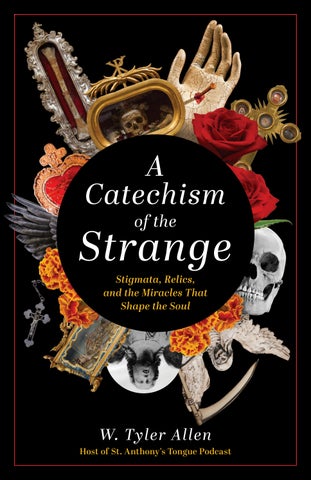
A Catechism of the
Strange Stigmata, Relics, and the Miracles That Shape the Soul
W. Tyler Allen
Host of St. Anthony’s Tongue Podcast
A Catechism of the
Strange Stigmata, Relics, and Miracles That Shape the Soul
W. Tyler Allen
i_6068_CatechismoftheStrange.indd 1
5/28/26 11:07 AM
Copyright © 2026 W. Tyler Allen All rights reserved. Scripture quotations are from New Revised Standard Version Bible: Catholic Edition, copyright © 1989, 1993 National Council of the Churches of Christ in the United States of America. Used by permission. All rights reserved worldwide. Front Cover and interior art: Tiger Images/Shutterstock.com, Phillip Martin Photography, Joe Clark/Tetra images/Getty Images, Kim Baker/Moment/Getty Images, Naypong/iStockphoto/Getty Images, Thinkstock/Stockbyte/Getty Images, dessardo feder/Moment/Getty Images, Philippe Lissac/Stone/Getty Images, Thom Lang/ The Image Bank/Getty Images, powerofforever/iStockphoto/Getty Image, piola666/ iStockphoto/Getty Images, JannHuizenga/iStockphoto/Getty Images, Dmytro/ iStockphoto/Getty Images Back Cover art: Saint Francis of Assisi and Saint Catherine of Sienna Provided under license from The Crosiers, cobalt/iStock/Getty Images, Naypong/iStockphoto/Getty Images, Dmytro/iStockphoto/Getty Images, Thinkstock/Stockbyte/Getty Image ISBN: 978-0-8294-6068-1 Library of Congress Control Number: 2026935609 Published in Chicago, IL Printed in Canada. 26 27 28 29 30 31 32 33 34 35 MQS 10 9 8 7 6 5 4 3 2 1
i_6068_CatechismoftheStrange.indd 2
5/28/26 11:07 AM
Dedicated to St. Anthony. May he help you find this book and, more than that, the trace of God it longs to reveal.
i_6068_CatechismoftheStrange.indd 3
5/28/26 11:07 AM
i_6068_CatechismoftheStrange.indd 4
5/28/26 11:07 AM
C ontent s Note from the Author: The Goosebumps at the Altar......................xi Introduction: Imago Dei: The Image of God......................................xv Chapter 1 The Strange Burden of the Stigmata................................................1 Redemptive Suffering and the Stigmata The Victim Soul: Suffering in Union, Praying in Pain Why the Palms? Understanding the Placement of the Wounds The Wounds Are for You Saints and the Stigmata: Mirroring the Wounds of Christ St. Francis of Assisi St. Lutgardis St. Catherine of Siena St. Rita of Cascia St. Padre Pio Signed by Love, Marked for Others Chapter 2 Bones That Breathe: The Sacred Life of Relics..............................23 What Are Relics? Relics in Scripture and the Early Church Why Relics Matter Saints and Holy Relics: Bones That Give Life Pope St. Sixtus I St. Anthony’s Tongue The Skull and Skin of St. Mary Magdalene The Blood of St. Januarius Echoes in Bone and Blood v
i_6068_CatechismoftheStrange.indd 5
5/28/26 11:07 AM
vi
A Catechism of the Strange
Chapter 3 The Bodies That Would Not Decay................................................47 Saints and Incorruptibility: A Love Stronger Than Decay St. Andrew Bobola St. Bernadette’s Miraculous Preservation St. Charbel The Incorrupt Heart of St. Jean Vianney The Radiance That Does Not Rot Chapter 4 The Fire That Purifies: Purgatory and the Mercy That Ignites...... 65 The Catholic Church on Purgatory The Power of Prayers and Purgation The Economy of Grace The Souls in Purgatory Are Not Hostages Saints and Purgatory: Visits from Souls St. Thomas Aquinas St. Nicholas of Tolentino St. Catherine of Genoa St. Padre Pio St. Gertrude the Great Mercy That Burns, Love That Binds Chapter 5 Flesh of God: Miracles of the Eucharistic Presence......................91 The Eucharist as the New Bread from Heaven Re-Enchanting the Eucharist Bleeding Hosts: Flesh of God, Torn for the World Lanciano, Italy (Eighth Century) Buenos Aires, Argentina (1996) Sokółka, Poland (2008) A Theology Written in Blood Incorrupt Hosts: Divine Preservation, Hidden Glory Siena, Italy (1730–Present) Alboraya, Spain (1348–Present)
i_6068_CatechismoftheStrange.indd 6
5/28/26 11:07 AM
Contents
vii
Amsterdam, Netherlands (1345) On the Nature of Preservation Miraculous Manifestations of Light, Form, or Levitation Santarém, Portugal (Thirteenth Century) Faverney, France (1608) Chirattakonam, India (2001) Lit by Glory, Held by Hands Chapter 6 Hearts Set Afire: The Transverberation and the Wound of Love............................................................................... 113 Beyond Emotion to Invitation The Theology of the Transverberation Have You Experienced This? Transverberation and the Saints: Hearts Wounded by God St. Teresa of Ávila St. Philip Neri St. Veronica Giuliani St. Augustine of Hippo St. Thérèse of Lisieux Pierced to Love Chapter 7 Where Love Stands in Two Places: The Mystery of Bilocation..... 133 A Presence That Defies Distance A Theology of Multiplication Saints in Two Places: Echoes of the Risen Christ St. Alphonsus Liguori St. Martin de Porres St. Padre Pio Venerable Mary of Ágreda Our Lady of the Pillar Where Love Refuses to Stay Still
i_6068_CatechismoftheStrange.indd 7
5/28/26 11:07 AM
viii
A Catechism of the Strange
Chapter 8 The World Is an Altar: Hierognosis and the Cosmic Priesthood........................................................................153 The Cosmic Priesthood The Mediators of Matter The Connection to Hierognosis Hierognosis and Holy Souls: Those Attuned to the Holy Spirit’s Flame St. Mary of Jesus Crucified St. Catherine of Siena Pope St. John Paul II St. Jean Vianney Blessed Anne Catherine Emmerich The World as Altar Chapter 9 The Silent Companions: Angels Who Walk Beside Flame......... 175 Theology of the Angels: Messengers, Watchers, Friends Saints and Their Guardian Angels: Walking with the Divine St. Isidore the Farmer St. Gemma Galgani St. Joseph of Cupertino St. Frances of Rome Blessed Dina Bélanger Flame Beside Flame Chapter 10 Night Visions: When Heaven Speaks in Dreams........................195 When God Speaks in Sleep Saintly Visions: The Spirit Speaking in Sleep St. Hildegard of Bingen St. John Bosco St. Josephine Bakhita St. Catherine of Bologna St. Joseph Dreams That Speak and Hearts That Wake
i_6068_CatechismoftheStrange.indd 8
5/28/26 11:07 AM
Contents
ix
Chapter 11 The Voice Behind the Silence: When God Speaks Within......... 211 What Are Interior Locutions? Scriptural Precedent and Prophetic Echo Why It Matters: The Personalism of God Saints Who Heard Him Whisper St. Faustina Kowalska St. Teresa of Ávila St. Bernard of Clairvaux St. Benedict Joseph Labre St. John of the Cross The Word Behind the Words Chapter 12 Light upon Flesh: When Saints Shone Like the Sun...................229 Uncreated Light and the Mystical Tradition A Theology of Radiance: The Body as Icon Luminous Saints: Glory Made Visible St. Seraphim of Sarov St. Philip Neri St. Christina the Astonishing St. Clare of Assisi Blessed Anna Maria Taigi Radiance Remembered: Light from Light Epilogue: The Strange Made Beautiful.............................................245 Recommended Reading......................................................................249 About the Author.................................................................................251
i_6068_CatechismoftheStrange.indd 9
5/28/26 11:07 AM
i_6068_CatechismoftheStrange.indd 10
5/28/26 11:07 AM
NOTE FROM THE AUTHOR
The Goosebumps at the Altar
I
was ten years old the first time I served at the altar. Like most ten-year-olds, I wasn’t particularly devout. My thoughts drifted easily during Mass, even when I was vested in my alb and standing beside the priest. But I remember one task vividly: ringing the altar bells. The bells rang twice—once just before the consecration, and again when the priest elevated the Host. I didn’t understand the theology. I didn’t know what transubstantiation meant. But something strange would happen every time I rang those bells and looked up at the crucifix and the raised Host: I’d get chills. Even if my young mind didn’t grasp what was unfolding, my body did. Or maybe it was my soul. Somehow, I knew, deeply and wordlessly, that something beautiful was happening. That sensation never quite left me. The goosebumps at the altar became a kind of haunting—a flicker of something I couldn’t name but would chase for years. Around that same time, I remember hearing of a crucifix in Pennsylvania that had supposedly closed its normally open eyes during a Good Friday Mass. I remember staring at our own crucifix
xi
i_6068_CatechismoftheStrange.indd 11
5/28/26 11:07 AM
xii
A Catechism of the Strange
afterward, willing it to blink, hoping I might see a miracle, too. But Christ did not close his eyes. And now I wonder if I missed the miracle that had been unfolding all along, right there on the altar. As I grew older, the wonder faded. My teenage and early adult years led me far from the church. I had been taught the faith as though heaven required a theology test. As though I’d be asked to explain the Trinity with perfect orthodoxy to gain admittance. No one told me that the goosebumps mattered. No one told me that wonder was part of faith. I respected the church’s intellect, but I was starving for beauty. For awe. For mystery. So I wandered. Years passed. And then, one night, the dreams began. Dreams that lasted for weeks. I was back in my childhood parish, one that had been destroyed by Hurricane Katrina in 2005. I hadn’t set foot in it for over a decade. But in the dreams, I could see it all perfectly: the dark red carpet, the statues of the apostles lining the walls, the crucifix that never blinked. And I wasn’t alone. My departed loved ones—my grandparents, old friends—stood with me, one by one placing the Host into my hands. They said nothing, only smiled. And every time I awoke with tears on my cheeks and the taste of honey on my tongue. The dreams broke something open in me. I bought a rosary. I lit candles. I began praying novenas and sitting in silence, letting Christ speak. Slowly, I returned. One Sunday, I found myself back in a pew. The Mass was unfamiliar and yet entirely known. And when the priest raised the Host and the altar bells rang—those same bells I had once rung as a distracted child—the goosebumps returned. This time, I understood.
i_6068_CatechismoftheStrange.indd 12
5/28/26 11:07 AM
The Goosebumps at the Altar
xiii
From that moment on, I realized what speaks to the heart most isn’t argument or apologetics but awe. And around that time, a quiet refrain began to form: I do not want to show you that Catholicism is true. I want to show you that Catholicism is beautiful. But through beauty, you will encounter truth, not a truth of the head but of the heart. Beauty is a flavor of truth that often surpasses words and explanations. It is a transcendental beauty that allows us to surrender and be in awe of the Almighty. It asks for consent before comprehension, and it meets the soul not where we reason but where we wonder. While you may find supernatural beauty in ancient cathedrals, sacred art, or the hypnotic chants of monks, there is another place where this transcendental beauty lives: in the strange. The apparitions. The stigmata. The holy relics. The visions of mystics and saints. These seemingly bizarre elements of our faith do not distract from the gospel—they deepen it. They are not detours. They are doors. Strange Catholicism is transcendental. It invites us into a higher plane of union with the Divine, and in our flattened, overly rational world, we need it now more than ever. In a culture obsessed with explanation, the strange is a doorway back into wonder. It reminds us that not everything holy can be diagrammed or domesticated. And that is a gift. I believe many people today are longing for the mysterious and the supernatural. This longing draws Catholics to the mystical beauty of the traditional Latin Mass. It draws some toward occultism when they find Christianity too dry. It’s why so many people describe themselves as “spiritual but not religious.” They were given facts without fire, and catechisms without wonder. They were taught theology, but not the honey that flows from the Rock.
i_6068_CatechismoftheStrange.indd 13
5/28/26 11:07 AM
xiv
A Catechism of the Strange
The stories of saints, mystics, and miracles have stood the test of time. But often, their meaning has been lost. You may know about the stigmata, but do you know why it happens? Why would God wound a soul to reflect Christ? What does that say about love? You may have seen relics, bones encased in glass, venerated and revered, but what do they say about your own sanctification? Could your bones one day shine with the same glory? In this book, I aim to explore what I call the transcendental of the strange. My hope is to uncover these stranger elements of Catholic spirituality, not as curiosities but as living signs of what it means to be conformed to Christ. Each miracle, each mystery, each strange event is a mirror, a path, a revelation of the life of grace. Let these pages not merely inform but awaken. May they lead not to conclusions but to adoration. And may the strange lead you, always, to the Beautiful.
i_6068_CatechismoftheStrange.indd 14
5/28/26 11:07 AM
INTRODUCTION
Imago Dei : The Image of G od
xv
i_6068_CatechismoftheStrange.indd 15
5/28/26 11:07 AM
xvi
A Catechism of the Strange
Glossary of Terms Imago Dei Latin phrase meaning “image of God.” The theological truth that human beings are created in God’s image and are called to reflect his love, goodness, and creativity. Mystical Body of Christ The church understood as Christ’s living Body on earth, in which every baptized person participates in his life and redemptive work Fiat Latin for “let it be done.” Refers to Mary’s yes at the Annunciation— her total surrender to God’s will. Mysticism The experiential knowledge of God through contemplative union, often expressed in visions, interior words, or extraordinary graces Sacramental Signs Visible or tangible realities that reveal invisible grace—earthly actions that make heavenly truths manifest
i_6068_CatechismoftheStrange.indd 16
5/28/26 11:07 AM
Imago Dei: The Image of God
xvii
B
efore fully appreciating our faith’s more supernatural aspects, we must first understand their profoundly transformative and mystical nature. Like many things in our faith, we can approach mysticism from many angles, but one of the most rewarding is with the perspective of a teaching called imago Dei. The concept might sound familiar. Imago Dei means, in Latin, that we are made in the image of God. It is a phrase that evokes dignity, worth, and identity—but it is often only half understood. Yes, we are born in God’s image. But that image was fractured by sin. Rather than reflect divine love, our lives often reflect pride, fear, and self-interest. The mirror to the divine is still there, but it has been made cloudy. The goal of the Christian life, then, is not simply to obey commandments or believe doctrines. It is to be transformed. It is to restore the likeness. The saints followed Christ so closely that their lives came to resemble his. They became icons of God in the world. We see this principle of divine self-revelation unfolding throughout Scripture. God reveals himself through persons as surely as he does through words. The prophets were not merely mouthpieces; they were mirrors. God commanded Hosea to marry an unfaithful woman so that his marriage might speak of divine fidelity. Abraham’s offering of Isaac functioned as a prophetic act, unveiling a God who would not demand human sacrifice but would one day give his own Son.
i_6068_CatechismoftheStrange.indd 17
5/28/26 11:07 AM
xviii A Catechism of the Strange
These strange, dramatic episodes functioned as sacramental signs: earthly actions revealing heavenly truths. They prepared the way for the ultimate revelation, which is that Jesus Christ is the perfect Image of the Father. As he himself said, “Whoever has seen me has seen the Father” (John 14:9). When Christ touches lepers, dines with outcasts, forgives his enemies, and hangs upon the cross, in these moments Christ reveals the very face of God. He is also showing us what we are made for. In Christ, we are invited not only to admire the Image but to become it. St. Paul describes this purpose with staggering clarity. In 2 Corinthians 3:18, he writes, “All of us . . . are being transformed into the same image from one degree of glory to another.” This is the Christian calling: to reflect Christ. To be conformed to his likeness. To become his Body in the world. Catholic tradition deepens this determination to coincide with the doctrine of the Mystical Body of Christ: the belief that, through baptism and communion with the Church, our lives become extensions of his. Our hands become his hands. Our wounds become his wounds. Our suffering, united to his, becomes redemptive. This truth is exemplified not only by Christ but also by his Mother. In her Magnificat, Mary cries out, “My soul magnifies the Lord” (Luke 1:46). She becomes a vessel through which God is seen not only in her womb but also in her soul. Her fiat, her yes, made her a mirror of the Divine. The saints follow in this same pattern. St. Francis of Assisi embraced the leper and became a living icon of mercy. St. Maria Goretti forgave her murderer and revealed divine forgiveness. St. Frances Xavier Cabrini built hospitals and orphanages, revealing God’s heart for the vulnerable.
i_6068_CatechismoftheStrange.indd 18
5/28/26 11:07 AM
Imago Dei: The Image of God
xix
St. Maximilian Kolbe stepped forward in Auschwitz to take the place of a prisoner condemned to die, declaring, “I am a Catholic priest,” thereby revealing the self-giving love of Christ crucified. These actions are not just good deeds. They are revelations. Each act is a refraction of God’s glory, shining through a purified soul. Catholic mysticism affirms this calling to transformation. St. Catherine of Siena calls the soul the “gentle mirror of God” and teaches that sin smudges the mirror, while grace polishes it. St. Augustine speaks of the soul as a light-bearing mirror, darkened by pride but illumined by love. St. Teresa of Ávila likens the soul to a luminous crystal castle, dimmed by sin but ablaze with divine light when pure. St. Bonaventure and St. Francis de Sales echo the same: The soul, made in God’s image, is meant to reflect his beauty and draw others into his radiance. So what does any of this have to do with the strange and supernatural? Everything. Because the mystical and miraculous are not spectacles—they are signs. The saints are revelations of Christ because their lives have become so closely conformed to his, they mirror him in ways that are simultaneously beautiful and mysterious. For example, the stigmata are not curiosities. They are redemptive suffering made visible. They reflect souls bearing not just the memory of Christ, but also his very wounds. Bilocation flows from divine intimacy—a soul so suffused with Christ’s presence that it transcends the ordinary boundaries of place and presence, as Christ did when he appeared to the five hundred.
i_6068_CatechismoftheStrange.indd 19
5/28/26 11:07 AM
xx
A Catechism of the Strange
Even relics—these seemingly odd tokens of bone, blood, or clothing—speak profoundly in their testimony that the body, too, is destined for glory. The saints have become so one-with-Christ that even their flesh radiates his presence. None of these phenomena are spiritual anomalies. They are revelations. They are what happens when the imago Dei is no longer obscured. When the mirror is polished and the reflection is clear. And that is the invitation, not just of the Christian life in general but of your life. You were made not merely to believe but to become Christlike. To mirror Christ so fully that others encounter him in you. To let your life reflect the strangeness of holiness: radiant, inexplicable, unmistakably divine. You may never receive the stigmata. You may never levitate in prayer. But if you reveal mercy where others expect wrath, offer love where there has been hate, or draw out beauty and hope in places long surrendered to despair, then the mystery is already at work in you. As we now turn to explore the stranger sides of Catholicism, I invite you to look deeper than the phenomena. In each mystery, search for the reflection of Christ. But do not stop there. Search, too, for yourself—for the part of you that was made in his image and is being called to reveal him again. For the supernatural is not meant to merely astonish. It is meant to awaken. It is not meant to alienate, but to illuminate. These wonders are not meant to show us something other than ourselves. They are meant to show us what we were always meant to become.
i_6068_CatechismoftheStrange.indd 20
5/28/26 11:07 AM
CHAPTER ONE
The St range Burden of the Stigmata
1
i_6068_CatechismoftheStrange.indd 1
5/28/26 11:07 AM
2
A Catechism of the Strange
People You Will Meet St. Francis of Assisi ca. 1181–1226 A poor man from medieval Italy who wanted nothing but Christ, Francis received the Passion, in his own flesh, bearing the wounds of the Crucified. St. Gemma Galgani 1878–1903 A fragile laywoman from modern Italy, Gemma desired to belong to Christ without remainder, offering her suffering for the salvation of others. In her, the stigmata appear as the tenderness of a heart that refuses to keep anything for itself. St. Thérèse of Lisieux 1873–1897 A hidden Carmelite in a quiet French convent, Thérèse never bore visible wounds yet chose to suffer for souls in the silence of love. She shows that the stigmata can be lived as an interior martyrdom of trust.
i_6068_CatechismoftheStrange.indd 2
St. Faustina Kowalska 1905–1938 A young Polish sister formed in obscurity, Faustina offered illness, humiliation, and obedience for the sake of souls. In her, the wounds of Christ become the language of Divine Mercy itself. Mother Angelica (Rita Rizzo) 1923–2016 Marked by lifelong pain, Mother Angelica embraced suffering as participation in Christ’s own offering, teaching millions to trust a God who draws life from the cross. Her wounds were not visible, but they were unmistakably given. St. Lutgardis of Aywières 1182–1246 A Cistercian nun of the Middle Ages, Lutgardis did not receive wounds in her hands but in her heart, when Christ placed his heart within her own. She reveals the stigmata as an interior conformity to the suffering love of God.
5/28/26 11:07 AM
The Strange Burden of the Stigmata
St. Catherine of Siena 1347–1380 A young woman of fourteenthcentury Italy, Catherine carried Christ’s wounds as a hidden fire within, a love so consuming that even pain became language. She teaches that the stigmata can be written on the soul as surely as on the skin.
3
St. Padre Pio (Francesco Forgione) 1887–1968 A Capuchin friar in the modern world, Padre Pio carried the open wounds of the Crucified for fifty years, confronting a skeptical age with the nearness of the cross. His body became both comfort and consolation to the broken.
St. Rita of Cascia 1381–1457 A widow turned Augustinian nun in fifteenth-century Italy, Rita bore a single wound from the crown of thorns, a quiet sign of lifelong companionship with the suffering Christ. In her, one wound is enough to tell the whole story of love.
i_6068_CatechismoftheStrange.indd 3
5/28/26 11:07 AM
4
A Catechism of the Strange
Glossary of Terms Stigmata The miraculous appearance of Christ’s wounds on the body of a saint or mystic (e.g., on their hands, feet, side, or forehead), signifying deep union with his Passion Redemptive Suffering The mystery that pain, when united to Christ’s Passion, can become an offering of love and intercession for others Intercession Prayer offered on behalf of others; in mystical theology, even suffering can become intercession when offered in love. Victim Soul A person who willingly offers personal suffering to God for the salvation of others or for the reparation of sin Mystical Union The profound spiritual intimacy in which the soul becomes one with God’s will and love Purgatory A state of purification after death where souls are prepared to enter the full presence of God Mystic One who has undergone a transformative encounter with the divine; one whose life is marked by intimate, experiential knowledge of God.
i_6068_CatechismoftheStrange.indd 4
5/28/26 11:07 AM
The Strange Burden of the Stigmata
5
I
n the year 1224, high in the Apennines where the wind moved through pine and stone, a man knelt inside a crumbling chapel called La Verna. He was Francis of Assisi. His body was worn from years of poverty, illness, and strict asceticism. He was nearly blind, weakened by fasting, and had come to the chapel seeking stillness and serenity. Instead, he was given something else. Something mysterious, something holy and unheard of. As Francis prayed, contemplating the passion of the Lord, the heavens opened. A seraph, burning with light and nailed to a cross in the likeness of Christ, appeared before him. Rays of fire shot forth from the angel’s wounds, piercing the hands, feet, and side of the kneeling friar. When Francis awoke, he bore the same wounds he had seen on the seraph. He had not asked for them. He had only asked to love as Christ had loved. With St. Francis, the stigmata, or the spontaneous appearance of Christ’s wounds on the body of a human being, officially entered the story of the Catholic Church. Most often, the wounds appear in the hands, feet, and side—corresponding to Christ’s wounds during the Crucifixion. But other saints received wounds on their back, shoulders, or brow, echoing the scourging Jesus suffered and the crown of thorns he was made to wear. Since that momentous day in La Verna, dozens of people have reported receiving the stigmata. Each instance is unique, strange, and brimming with meaning, not just for the one who bears them but also for everyone who beholds them. And yet, because images of stigmata, as seen on statues, prayer cards, and church windows, have become so familiar, we may have become desensitized to the mystery and meaning of these signs.
i_6068_CatechismoftheStrange.indd 5
5/28/26 11:07 AM
6
A Catechism of the Strange
Why would God allow any of his children to suffer so intensely? Why would he mark someone with wounds so painful, so public, and so misunderstood? To begin to understand, we must return to the very heart of the Gospels. Not merely to the teachings of Christ, but to his wounds. We must turn to an often neglected but very important Catholic concept known as redemptive suffering.
Redemptive Suffering and the Stigmata As members of Christ’s Mystical Body, each of us is called to reveal something of God through our lives. When we show mercy, we reflect his mercy. When we forgive, we echo his forgiveness. When we love generously, we become living signs of divine charity. But we must also remember that Christ did not reveal the love of God only through his words or miracles; he revealed it most fully through his suffering. His Passion was not merely a moment of pain, but a profound act of prayer. On the cross, Christ offered his suffering to the Father as intercession for the world, turning agony into mercy. This leads us to the ancient and beautiful mystery of redemptive suffering. This is the idea that, when we are united with Christ, our own pain, whether physical, emotional, or spiritual, can be offered as a prayer for others. In essence, just as Christ offered his pain to the Father for a world estranged from God, we can do the same. This is not about glorifying suffering for its own sake but rather about allowing suffering to be transformed by love. Fasting, for instance, is one of the most familiar forms of redemptive suffering. When we fast, we intentionally embrace discomfort and offer it to God, asking him to sanctify us and
i_6068_CatechismoftheStrange.indd 6
5/28/26 11:07 AM
The Strange Burden of the Stigmata
7
others. Catholics fast on Fridays and during Lent to mirror Christ’s sacrifice and to unite themselves more closely with his passion. That’s redemptive suffering in practice. But it’s not limited to fasting. We can offer up anything: our time, energy, comfort, even our frustrations or heartaches. Acts of service, almsgiving, sleepless nights spent caring for others, or rejection endured with grace can all become powerful intercessions when united with Christ’s own offering. Even spontaneous or unplanned pain, illness, loneliness, or sorrow can become redemptive if we choose to pray through it. You may have heard someone say to “offer it up” during a headache or disappointment. That simple act—whispering a prayer like, “God, use this for someone who needs your mercy”—turns pain into grace. It joins our little sufferings to the great cry of Christ on the cross. This idea leads us to the mystery of the stigmata. The phenomenon of the stigmata is a rare and supernatural form of redemptive suffering. The stigmatist doesn’t receive the wounds of Christ to be admired but rather to suffer on behalf of others. These wounds, as painful as they are, are carried as a kind of living prayer, an intercession etched in flesh. While most of us offer the discomfort of fasting or the aches of daily life, the stigmatist suffers from the wounds like those Jesus sustained during his Passion. Some mystics even speak of seeing the souls for whom they suffer, as if their offering becomes a bridge between heaven and earth. And importantly, the stigmata are not imposed upon recipients without their consent. Like Christ in the garden, the stigmatist consents. Many asked to share in Christ’s suffering out of either love for sinners or desire for union with him.
i_6068_CatechismoftheStrange.indd 7
5/28/26 11:07 AM
8
A Catechism of the Strange
The experience of the stigmata, then, is redemptive suffering made visible—an echo of Calvary that still cries out. It’s a freely chosen participation in the mystery of the cross for mercy today.
The Victim Soul: Suffering in Union, Praying in Pain Not every saint who participates in Christ’s redemptive suffering bears the visible wounds of the stigmata. Some are known instead as victim souls. These are individuals who offer their suffering, whether physical or emotional, as a form of prayer and intercession. Like stigmatists, they share in the agony of Christ but without the visible marks. In many cases, their suffering is something life has already given them—illness, loss, isolation. In others, it is something they’ve willingly embraced through prayer, asking to participate more deeply in Christ’s Passion. Either way, what sets them apart is not the suffering itself but what they do with it: They offer it to God for the sake of others. The idea may sound strange, even uncomfortable, but it’s rooted in love. Victim souls aren’t seeking pain; they’re seeking to love more deeply, to carry burdens not only for themselves but also for those who cannot. Their suffering becomes a kind of hidden priesthood: interceding, carrying, offering. One such victim soul was St. Gemma Galgani. Bedridden with spinal tuberculosis, Gemma didn’t pray for healing. Instead, she prayed to suffer more. She also prayed for the souls in purgatory and for those far from God. In time, she received the stigmata. This wasn’t divine cruelty but a gift given in love, a mystical union with the suffering Christ whom she adored. She wanted to carry his pain because she carried his love.
i_6068_CatechismoftheStrange.indd 8
5/28/26 11:07 AM
The Strange Burden of the Stigmata
9
St. Thérèse of Lisieux offered herself entirely to God. Near the end of her life, while dying of tuberculosis, she experienced overwhelming spiritual desolation. She felt as if God had turned his face away from her. But rather than despair, she allowed her pain to become a bridge, offering it to atheists, so that they might one day feel the warmth of God’s gaze. She remained in that darkness, offering her pain as a prayer. St. Faustina Kowalska, the great apostle of Divine Mercy, also offered her illnesses and humiliations for souls in purgatory. She wrote of seeing souls helped by her suffering, reminding us that when offered with love, even our unseen pains bear fruit. Even Mother Angelica (born Rita Rizzo), the beloved founder of the EWTN cable network, spent her final years as a silent sufferer. After several strokes, she was left partially blind and unable to speak. And yet, she believed her suffering had meaning. She often said, “Don’t waste your suffering.” Her sisters testified that she offered each painful day as a prayer. She lived as a victim soul until her death on Easter Sunday, 2016. Victim souls are not masochists. They are mystics of compassion. They enter their own darkness, not to get lost but to light a candle for someone else. They join Christ in the garden, in the scourging, in the silence—and they pray, even there, “Thy will be done.”
Why the Palms? Understanding the Placement of the Wounds One common question about the stigmata concerns their placement. Most stigmatists bear the wounds in their palms. But historical and anatomical evidence suggests that Roman crucifixions likely pierced the wrists, not the hands, to support the weight of a body. So why the inconsistency? The answer lies not in
i_6068_CatechismoftheStrange.indd 9
5/28/26 11:07 AM
10
A Catechism of the Strange
archaeology, but in the nature of mysticism. Mystical experiences are personal encounters, given not to establish historical facts but to reveal spiritual truths in a way that the soul can receive. Most stigmatists have spent their lives seeing crucifixes, paintings, and statues that depict Christ’s wounds in the palms. That image has shaped their imagination and devotion. So when God gives the stigmata, he speaks to the recipients in the language of their love. He meets them in what is familiar—not to teach historical accuracy, but to deepen mystical union. This is consistent throughout Catholic mystical tradition. In Marian apparitions, for example, Our Lady often appears wearing the dress of the visionary’s culture and speaking their language. Visions of Christ’s birth also differ slightly among saints. These diverging accounts aren’t contradictions; they are accommodations. God is not focusing on revealing how many animals were in the stable. He’s revealing what it means that he came. So too with the stigmata. The hands are what we use to bless and break bread, to serve and to heal. The hands are often what we lift in prayer. And the pierced hands of Christ have been a symbol of mercy and love for generations. When those wounds appear on a mystic, they are not a forensic puzzle. They are a spiritual sign pointing to a deeper reality that transcends the merely physical.
Mysticism, Not Anatomy This is one of the most common questions I get when I talk about the stigmata in my essays, in one-on-one conversations, or on my podcast. And while it’s a fair question, it also shows how far we’ve drifted from mystery and from intimacy with God. Throughout Scripture and tradition, God speaks
i_6068_CatechismoftheStrange.indd 10
5/28/26 11:07 AM
The Strange Burden of the Stigmata
11
to his people in ways they can recognize. That is why the wounds of Christ often appear to stigmatists in the palms: not as an anatomical statement, but as a personal revelation. In Song of Solomon 2:16, the Bridegroom calls the soul his “beloved.” God delights in the details of who we are—our gestures, our imaginations, even our questions. Throughout this book, you’ll see how he appeared to each saint in a way uniquely fitted to their soul. And he continues to do the same for you. The God who met the saints in their strangeness is already speaking in the language of your own heart.
The Wounds Are for You At first glance, the stigmata can be strange, or even unsettling. It may seem like something reserved for cloistered mystics or distant centuries. But the mystery it carries speaks to something deeply close to our hearts: the desire to make our pain meaningful. The message of the stigmata is not “look at me.” It’s “look at him.” It reminds us that Christ still suffers—in the lonely, in the sick, in the hurting. The wounds of the stigmatist echo his love in those places. You may never receive the stigmata. But you will experience pain in your life. And the invitation of the church is this: Don’t waste that suffering. Offer it. Bless with it. Let it become a prayer. The stigmatist bleeds with Christ. You can serve with Christ. You can forgive with Christ. You can love through your wounds, just as he loved through his. The stigmata is a love story. Strange, yes, but holy. Through it, we remember that Christ’s wounds remain open, still offering mercy, healing, and hope to the world. And perhaps, through our own wounds, visible or not, we can offer the same.
i_6068_CatechismoftheStrange.indd 11
5/28/26 11:07 AM
About the Author W. Tyler Allen, host of St. Anthony’s Tongue, a podcast that explores mysticism, saints, and the strange beauty of God, is a Catholic writer whose work blends theology and wonder, inviting readers to see the faith not as a rule book but as a love story between God and the soul. He lives in Louisiana, where he writes about relics, angels, and the fire of divine love.
251
i_6068_CatechismoftheStrange.indd 251
5/28/26 11:07 AM