For a greater Loyola | Issue 7 | Loyola University New Orleans | Since 1923 | October 2, 2026 | loyolamaroon.com
FESTIVAL IN FULL SWING
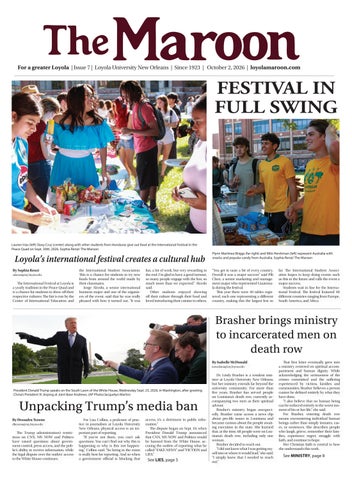
Lauren Irias (left) Stasy Cruz (center) along with other students from Honduras give out food at the International Festival in the Peace Quad on Sept. 30th, 2026. Sophia Renzi/ The Maroon
Loyola’s international festival creates a cultural hub By Sophia Renzi sdrenzi@my.loyno.edu
The International Festival at Loyola is a yearly tradition in the Peace Quad and is a chance for students to show off their respective cultures. The fair is run by the Center of International Education and
the International Student Association. This is a chance for students to try new foods from around the world made by their classmates. Jorge Alcedo, a senior international business major and one of the organizers of the event, said that he was really pleased with how it turned out. “It was
fun, a lot of work, but very rewarding in the end. I’m glad to have a good turnout, so many people engage with the fest, so much more than we expected.” Alcedo said. Other students enjoyed showing off their culture through their food and loved introducing their cuisine to others.
Flynn Martinez-Briggs (far right) and Milo Hershman (left) represent Australia with snacks and popular candy from Australia. Sophia Renzi/ The Maroon
“You get to taste a bit of every country. Overall it was a major success” said Pili Chen, a senior marketing and management major who represented Guatemala during the festival. This year there were 40 tables registered, each one representing a different country, making this the largest fest so
far. The International Student Association hopes to keep doing events such as this in the future and calls the event a major success. Students wait in line for the International Festival. The festival featured 40 different countries ranging from Europe, South America, and Africa
Brasher brings ministry to incarcerated men on death row By Isabelle McDonald iemcdona@my.loyno.edu
President Donald Trump speaks on the South Lawn of the White House, Wednesday Sept. 23, 2026, in Washington, after greeting China’s President Xi Jinping at Joint Base Andrews. (AP Photo/Jacquelyn Martin)
Unpacking Trump’s media ban By Dessadra Tezeno dltezeno@my.loyno.edu
The Trump administration’s restrictions on CNN, MS NOW and Politico have raised questions about government control, press access, and the public’s ability to receive information, while the legal dispute over the outlets’ access to the White House continues.
For Lisa Collins, a professor of practice in journalism at Loyola University New Orleans, physical access is an important part of reporting. “If you’re not there, you can’t ask questions. You can’t find out why this is happening or why is this not happening,” Collins said. “So being in the room is really best for reporting. And so when a government official is blocking that
access, it’s a detriment to public information.” The dispute began on Sept. 18, when President Donald Trump announced that CNN, MS NOW and Politico would be banned from the White House, accusing the outlets of reporting what he called “FAKE NEWS” and “FICTION and LIES.”
See LIES, page 5
Dr. Lindy Brasher is a resident minister at Loyola University New Orleans, but her ministry extends far beyond the university community. For more than five years, Brasher has served people on Louisiana’s death row, currently accompanying two men as their spiritual advisor. Brasher’s ministry began unexpectedly. Brasher came across a news clip about pro-life issues in Louisiana and became curious about the people awaiting execution in the state. She learned that, at the time, 68 people were on Louisiana’s death row, including only one woman. Brasher decided to reach out. “I did not know what I was getting myself into or where it would lead,” she said. “I simply knew that I needed to reach out.”
That first letter eventually grew into a ministry centered on spiritual accompaniment and human dignity. While acknowledging the seriousness of the crimes committed and the suffering experienced by victims, families and communities, Brasher believes a person cannot be defined entirely by what they have done. “I also believe that no human being can be reduced entirely to the worst moment of his or her life,” she said. For Brasher, entering death row means encountering individual human beings rather than simply inmates, cases, or sentences. She describes people who laugh, grieve, remember their families, experience regret, struggle with faith, and continue to hope. Her Christian faith is central to how she understands this work.
See MINISTRY, page 8
CAMPUS
2
The Maroon Oct. 2, 2026
New 'Faith in AI' grant brings anti-technology spaces By Lily Bordelon lmbordel@my.loyno.edu
The Loyola Institute of Ministry received $75,000 from a grant proposal by the Lilly Endowment Inc. called Faith in the Age of AI, which aims to assist Loyola Institute of Ministry in implementing spaces for Loyola students to practice Christianity away from artificial intelligence. Lilly Endowment Inc. is based in Indiana but has a national religion department that does a lot of initiatives, including those that are invite-only. Loyola was invited to apply for the invite-only grant Faith in the Age of AI, in which it won the proposal grant, according to Tracey Lamont, director of the Loyola Institute for Ministry and also associate professor of religious education and young adult ministry. Lamont said that Loyola received this invitation during Mardi Gras, and since then has had two listening sessions in April and May. “We [brought] them on campus in May, and [did] this really wonderful formation experience with them; it's like a retreat, it's really amazing,” Lamont said. Young adults, including students at Loyola, have expressed their distaste for AI, but despite this, it seems to be taking over every aspect of life, including religion. Darci Purdy, an English creative writing junior, expressed her belief that it is important to avoid mixing AI with faith since it can easily mislead those who practice Christianity. She is noticing more AI religious art and generated fake Bible verses, ultimately taking away the reality and truth valued within religion. “It’s meant to be between yourself and God. Many people are slowly relying more and more on artificial intelligence for their day-to-day questions and ideas, and from a faith-based standpoint, that can be harmful because it’ll cause people to lean more on AI than both your own understanding as well as God,” Purdy said. Sam McMahon, a junior Political Science and Philosophy double major, is another student who voiced her worry about how AI is impacting how students practice their faith. McMahon stated her belief that with AI taking over the com-
Student uses ChatGPT in Ignatius Chapel on Loyola's campus, Tuesday, Sept. 22, 2026. AI is being researched to better understand faith. Sept. 22, 2026 Elise Beck/The Maroon
munity, people should focus on the Jesuit value of cura personalis, which means caring for the whole person. “[The poor and oppressed] are less able to fight against corporations who have a lot of money, lawyers, and resources. Because of this, the creation of AI data centers does not show special concern for the poor and oppressed,” McMahon said. “Connecting to nature and others through retreats has been one of the best ways I have built my faith at Loyola, like through the Awakening retreat. The more opportunities we have for this, away from technology and especially generative AI, the better,” she said. Lamont explains that implementation of Faith in AI within the Loyola Institute of Ministry serves to target three main goals involved with young adults and AI: engaging with young adults to see how they utilize technology, seeing what sources of wisdom and spiritual practices that people use to address challenges posed by AI, and expanding opportunities for young adults and students to practice Christianity without
the use of AI. “[We want to create] resources that really help young people flourish and draw on Christian practices, sources of wisdom, to help them in this digital age…deepening their faith, promoting ways that make them flourish,” Lamont said. With this grant, Lamont spoke about how the Loyola Institute of Ministry wants to channel more money into opportunities like retreats and pilgrimages for students so that they can experience a disconnect from technology over a certain period of time. The Loyola Institute of Ministry plans to host a retreat in November, so the grant will likely help fund it. Lamont also explained how many young adults do not feel like they have the resources to express their faith and have deep conversations about it. “They just want to have [conversations] because they don't know where to go, and there's nowhere, no one in their parish, no one in their friend group… they're just not having sustained conversations about the ethical implications,”
she said. Lamont explained that the Lilly Endowment is giving money to people who enable these conversations, providing them with more opportunities to do so. “It's just a gift and a blessing that we've been given this. It is this crucial time where they're calling, you know, this “the wild, wild west,” you know?” Lamont said. “AI is everywhere, and we don't even realize it sometimes, and so [we should know] how to actually understand when you're interacting with it, how to keep your critical thinking your own, and your creativity your own, because it's just going to be super easy to just farm everything out from now on.” Lamont added that Pope Leo’s recent encyclical, Magnifica Humanitas, which discusses the threat of AI amongst humanity and the beauty of the human person, inspired the Loyola Institute of Ministry to focus the grant on Catholic social teachings and synodality. Synodality is insular language that expresses the Church’s desire to listen to its people. Voices from their advisory council expressed that young adults don’t love
their own voice due to ChatGPT speaking for them, Lamont said. “[People] are given God-given gifts…you're a special, unique individual. No one is like you, and there's a reason you are here, there's a reason you exist, there's a reason you have these gifts.” Sarah Beth Mernaugh, university minister for communal reflection and resident minister, is involved in he Loyola Institute of Ministry through Catholic Studies and other programs. “I work with young people that are very critical of AI, and I'm very critical of AI. I think it's really dangerous. I think it's setting a really dangerous precedent around prioritizing technology over people,” Mernaugh said. Mernaugh added that having a true connection with God means caring about human dignity and creation, more so than the ability to “honor the dignity of the worker.” “Those are gifts from God. Those are priorities to me, because of my faith, and AI is a direct threat to both of those things,” she said. When hearing about the Lilly Endowment Grant, Mernaugh felt hopeful that it would give students a voice to express their discontent with the use of AI on campus and the challenging aspects of it. “I think there are people making decisions that don't know that students don't like AI, that want space from AI, that want spaces without AI,” she said. Mernaugh also expressed her belief that the “antidote” to AI is human creativity, which is why she decided to take the initiative to host craft events every Friday in the Magis lounge. She emphasized the importance of a hands-on event like this, especially because it allows students to be “bad at” what they make. “[Students] should be learning stuff. An essential thing that you're learning is learning how to fail and how to do things wrong,” Mernaugh said. The Loyola Institute of Ministry applied for the full $2.5 million grant in August and is waiting for a response they hope will come around November or December. “We don't know if we got the two and a half million, but it's still, yeah, the proposal is pretty robust,” said Lamont.
Students perform at Hispanic heritage month cabaret By Riddick Winter rvwinter@my.loyno.edu
Emauni Johnpire recites her original poem for the Latin Heritage Cabaret on September 26, 2026. The event featured multiple speakers and performers who created a powerful experience rooted in celebrating Latin culture. Riddick Winter/ The Maroon
Theater for the Culture hosted its Latin Heritage Cabaret to celebrate Hispanic culture through poetry, music, and performance. The student-led showcase featured a lineup of original creative works, including poetry performances like "Eres Tan Americano" by Isabella Aguilera and musical performances like “Take Me To Rio” by Paloma Mariategui. Events like the cabaret aim to provide the Loyola community with a more inclusive campus environment and hope to provide an essential platform for underrepresented voices. By showcasing multiple distinct student narratives, tackling themes such as identity, assimilation and cultural joy.
Emauni Johnpire recites her original poem for the Latin Heritage Cabaret on September 26, 2026. The event featured multiple speakers and performers who created a powerful experience rooted in celebrating Latin culture. Riddick Winter/ The Maroon
The Maroon Oct. 2, 2026
3
PUZZLES Across 1 Releases 6 Ardent supporter 13 Island country that changed the shape of the International Date Line by skipping December 30, 2011 14 "Anything you say" 15 Guttural sound 16 Outermost meningeal membrane 17 Hot 19 "Bad idea" 20 High return 21 41-Across teacher 23 Army __ 24 Double-reed woodwind related to the shawm 26 Seldom seen 28 Racing headgear 30 Tailgating area 33 Angiogram image, perhaps 34 "__ bien" 35 Durable fabric 37 Drug featured in the Dock Ellis biopic "No No: A Dockumentary" 38 "How's it hangin'?" 41 Dojo discipline 42 Bernie Sanders' mittens, for one 43 Singer known as the "Goddess of Pop" 47 Harsh critics 49 PC IDs 50 Martinican poet Césaire who helped found the Négritude movement 51 Dessert often made with espresso 53 "Chocolate in every bite" cookie maker 56 Sonicare rival 58 Herb in fines herbes and herbes de Provence 59 Bring up 60 Welcome words? 61 Wrapped
Down 1 Key hit in panic 2 Platform game that debuted in 1983 3 "You sold me" 4 Bufotoxin source 5 Array at an izakaya 6 Genre in which readers are clued in to the plot? 7 Time to study 8 Beaut 9 Taqueria option 10 Guest room fixture 11 "__ you sweet!" 12 "Aw, phooey" 14 Vinyasa sequence also called Surya Namaskar 16 Event one must prepare for exhaustively? 18 Vibe well 20 Word in many union names 22 Halo-halo base 25 Part of i.e. 27 Make a lasting impression? 29 Skateboarding star Tony 30 "This bears repeating ... " 31 Instinctively 32 Hues 36 Muffuletta ingredient 39 Derisive laugh 40 "Buona __" 43 Tacos de nopales need 44 Percussion set 45 Dubai rulers 46 High-quality proof, for short 48 Camping treat 52 Home country of filmmaker Asghar Farhadi 54 Chump 55 Sit in a cellar, perhaps 57 Sack
For weekly puzzle answers, visit our Website via the QR code:
STAFF LIST Editorial Board
Contributors
Editor in Chief - Alana Frank Managing Editor - Elise Beck Pre-Content Director - Stella Perdue Post-Content Director - Carlos Andrade Exuecutive News Editor - Lily Bordelon Campus News Editor- Nicholas Parella Worldview Editor - Angelica Pineda Life & Times Editor - Amari Winchester Ass. Life and Times Editor - Alondra Gonzalez Sports Editor - Zoryn Johnson Opinion/Editorial Editor - Maria Touzard Breaking News Editor - Mabel Regalado-Hernandez Copy Editor - Pablo Pineiro Ramy The Wolf Creative Director -Makayla Parker The Wolf Designer - John Zwiers Senior Staff Photographer - Sophia Renzi Photo Editor - Pharrell Every Social Coordinators - Elena Godoy, Adriana Escobar, Eryn Goines Broadcast Producer - Ruth Brown Broadcast Lead Anchor - Dessadra Tezeno Co- Anchor- Eleanor Boucher-Ferry Newsletter Writer - Rodrigo Delgato Distribution Manager - Sophia Renzi
Jacob Jupiter, Isabelle McDonald, Makayla Ferrell, Audrina Morris, Karlie Bartholomew, Riddick Winter, Rodrigo Delgado, Kendall Ross, Sadie Bush
Student Media Adviser: Michael Giusti Assistant Student Media Adviser: Hannah Levitan
CONTACT US Main Office - (504) 865 - 3535 Business Office - (504) 865 - 3536 Adviser’s Office - (504) 865 - 3295 Correspondence - maroon@loyno.edu Letters to the Editor - letter@loyno.edu Advertising - ads@loyno.edu Website - www.loyolamaroon.com Twitter - @loyola_maroon Facebook - The Maroon Instagram - @loyola_maroon Our office is in the Communications/ Music Complex, Room 328. Send mail to: The Maroon, Loyola University, Campus Box 64, 6363 St. Charles Ave., New Orleans, LA 70118 The Maroon is published every Friday. Unless otherwise noted, all content is copyrighted by The Maroon. All rights reserved. First copy free to students, faculty, and staff. Every additional copy is $1.00. The Maroon is printed on 30 percent post-consumer recycled content.
Meet our Maroon Staff! Meet the Marooner video series on Instagram:
The Maroon Oct 2. 2026
WORLDVIEW
5
LIES: The media goes beyond the government Continued from front The three organizations challenged the decision in court, arguing that the administration violated their constitutional rights. On Sept. 24, U.S. District Judge Timothy Kelly temporarily blocked the ban and ordered the administration to restore the outlets’ access for 14 days while the case continues. Kelly questioned the administration’s national security justification for the ban and found that the outlets were likely to succeed in showing that their press credentials were revoked without proper legal process. The White House has argued that access to the White House is a privilege and has defended the administration’s authority to determine which journalists receive access. The outlets, however, have argued that the restrictions were imposed because of their coverage and violate First Amendment and due process protections. Collins felt journalists serve as a connection between government officials and the public. “We expect journalists to be our eyes and ears, and so we rely on them,” she said. “We rely on the press for information and for access.” The dispute also involves the White House press pool, a rotating group of news organizations responsible for providing shared coverage of the president when space or logistical restrictions prevent every outlet from attending. CNN is one of the networks involved in the television pool. After CNN was excluded, the other major television networks temporarily suspended some pooled coverage in protest. According to Sean Cain, an American
government professor at Loyola, excluding a major outlet from the press pool can affect how news organizations coordinate their coverage. “By excluding them, it disrupts a coordinated effort amongst the major news outlets to provide constant footage of the White House and constant coverage of the White House through their pool of reporters,” Cain said. Cain also questioned the constitutionality of the administration’s decision. “No, I don't think it's constitutional. It violates the First Amendment,” Cain said. “It abridges freedom of the press by banning reporters from media outlets from the White House grounds.” The administration also argued that the outlets’ reporting included material it considered false or threatening to national security. Court filings cited several specific stories including: CNN reporting on construction details related to an East Wing bunker, MS NOW reporting on an alleged leak investigation, and a Politico report concerning security improvements connected to a proposed White House ballroom. The administration argued that its actions were justified by national security concerns. District Judge Timothy Kelly, however, wrote that the government had not sufficiently supported its national security argument and questioned whether national security was actually advanced by revoking the outlets’ credentials. The issue has also generated different perspectives among Loyola students. Nicholas Oliver, a junior political science major, described the ban as censorship but said audiences are generally aware that news organizations can have different political leanings. “It is 100% a form of censorship,” Oliver said. “I think everyone expects these legacy outlets to be a little biased based
People with taped mouths hold signs and a copy of the New York Times as they show solidarity with the press during a rally in front of The New York Times building, Sunday, Feb. 26, 2017, in New York. On Friday, the White House banned several major news outlets, including The New York Times and CNN, from an off-camera briefing, known as a "press gaggle." AP Photo/Kathy Willens
on their political leanings.” Michell Tran, a sophomore business analytics major, also described the ban as censorship while raising concerns about the broader state of journalism. “I do agree that media coverage in the last couple of years has gone out of control with many journalists and outlets spinning stories to push a certain narrative,” Tran said. However, she said banning outlets is different from holding media organizations accountable for their reporting. Julie Bellow, a Loyola student, said she believes misinformation, including misinformation involving artificial intelligence, can create legitimate concerns about media content. At the same time, she questioned government involvement in determining which outlets
should have access. “I think the media ban is very controlling on the part of the government,” she said. “But I think what they’re doing is wrong because people should be able to post what they want and share their opinions, even if it goes against what the government believes.” The disagreement reflects a larger debate over two competing concerns: the public’s need for accurate information and the press’s ability to independently report on government officials. Loyola Professor Lisa Collins said restrictions on access can create what she called a “chilling effect” for journalists, particularly when access is tied to whether an administration approves of their coverage. For journalists, she said, the issue ex-
tends beyond which organizations own particular news outlets. “This is not about ownership; this is not about bias. This is about access,” Collins said. “We have to preserve that as journalists because no matter who owns us, we still need to be able to access the power makers, the decision makers.” The legal dispute is ongoing. Kelly’s temporary order restoring access lasts 14 days, while the court considers the broader constitutional and legal questions raised by the case. As the case continues, the conflict has placed press access, government authority, media accountability, and the public’s access to information at the center of a national debate over how the White House and the press should interact.
Federal judge pauses restrictions on international student visas By Pablo Pineiro ppineiro@my.loyno.edu
Loyola student holds an American Passport. International students face visa restrictions due to new rulings. Rodrigo Delgado Jr./ The Maroon
A federal judge paused a new Department of Homeland Security rule that would have changed how long international students and exchange students can remain in the country. Dittmar Dittrich, the assistant director for international student and scholar services at Loyola, explained what the current rule is. “When an international student or scholar enters the United States, a Customs and Border Protection (CBP) officer issues documentation that states how long the individual may legally remain in the U.S.” “F-1 and J-1 students were admitted to the United States for ‘duration of status’ (D/S) rather than a set date,” Dittrich said. “Unlike a set date, the ‘duration of status’ designation allowed students to remain in the U.S. as long as they were making normal progress towards the completion of their academic or research goals, including OPT and Academic Training.” Dittrich explained how the new rule contrasts with this. “The new rule replaces the ‘duration of status’ admission policy with a fixed
end date. This fixed date may also be called an ‘admit until date’ or AUD,” Dittrich said. “Students who are unable to complete program requirements before the fixed end date will be required to apply for an Extension of Stay (EOS) with USCIS.” F-1 students currently have a 60-day grace period after graduation, meaning they can stay in the country for up to 60 days after they finish their program. The new law would shorten it to 30 days. “F-1 undergraduate students will not be allowed to change majors or to transfer to another school during their first academic year,” Dittrich said. “F-1 graduate students will not be allowed to change majors or to transfer to another school at all.” Visa enrollment has also become more selective following new changes to international student visas by completely excluding certain countries from enrollment. One of those countries being Tanzania. Alunda Chikawe, a senior theater arts major from Tanzania shared how it felt having her country excluded from studying in the United States. “It is really unfortunate because Tanzanians benefit a lot from international education and I also think that Tanzania
is an unrepresented part of the world,” Chikawe said. “I think the U.S. could really benefit from people like me who are Tanzanians studying the arts or even anyone else, but there's a lot that will be lost from Tanzanians not being in the U.S.” Chikawe expands on the benefits international students bring to the U.S. through bringing culture and experience to the U.S. “America is kind of sheltered. There are a lot of things and misconceptions that are taught to American children that are very false, and international students help break the stigma around the global population,” Chikawe said. A political science international student also felt international students brought a cultural importance to the college experience. “College is one of the most wonderful experiences teenagers have since they transition from teenager to adult. International students just provide this new culture, language, music, and I think that it's perfect for this time we are in; to engage with more people, learn more cultures everyday,” the student said.
6
SPORTS
The Maroon Oct. 2, 2026
Women's golf concludes their fall season By Alondra Gonzalez amgonzal@my.loyno.edu
Alice Bille on the women's golf team takes a full swing at golf practice. This comes a few days after the team competes in their final tournament. Wednesday, Sept. 30, 2026. Zoryn Johnson/The Maroon.
The Loyola University New Orleans women’s golf team finished its last tournament at the Carey Collegiate in Hattiesburg, Mississippi, last week, marking the end of its fall schedule with the new head golf coach of the men and women’s program, Ryan Hicks. Hicks, a 2019 graduate and former Loyola golf player, felt the women’s fall season had satisfactory moments, but still requires improvement. “For the three events the women have played, Sarah Merille won the last tournament, and we’re happy to be a part of that, and it was fantastic in the end,” Hicks said. “As for the entire team, I think we have a lot of work to do still. We had some encouraging rounds, but everyone on the team might say they’re a bit disappointed.” Sarah Meral, a senior player for the women’s golf team, felt she could’ve been more consistent during some rounds. “There were times when I had let a
bad shot or two affect me more than it should have, so I want to improve on staying focused and not letting one shot get to me,” Meral said. Meral also shared her goals for the upcoming months before the next season begins. “I want to improve on my consistency with my irons, more specifically on contact with the ball, as that was a minor struggle this fall. I also want to keep working on my mental game and course management so I can make better decisions and stay confident throughout every round. I think improving in these areas will help me put together more solid rounds next season,” she said. Freshman player Alice Bille from Belgium felt her first season playing at Loyola went well despite only going to two tournaments of the three. “Unfortunately, because we didn’t have a coach for a long time, we only went to three tournaments, which is not a lot, but it was fun and well organized. Because it was my first tournament in the United States, it was a pretty good
experience,” Bille said. Bille felt the team did well in supporting each other and shared the importance of staying positive during stressful moments. “I had very hard first rounds in the last tournament, and I was pissed off with myself, but because you’re a team and you’re with everyone, and anyone can be in a good or bad mood, there’s a lot of emotion that stays in your mind that shouldn’t be transmitted to others,” Bille said. Meral spoke about how this season shaped her as a player and will influence her in future seasons. “I am very pleased with how the season went. I definitely learned more about myself, which is something I will continue to grow on,” Meral said. “I wasn't the happiest about how the first tournament went, but ending the season with a win definitely helped me gain my confidence back as we head into the spring season.”
Motivated student duo introduces motorsports club to Loyola By Ruth Brown rkbrown@my.loyno.edu
Over the past Labor Day weekend, Loyola senior and history major Charlotte Berg traveled to Kentucky with the Tulane Formula Racing club to receive her racing license. After two days of testing, Berg earned her official racing license certificate by the Collegiate Racing Series, making her the first ever female licensed by the organization. Despite her accomplishments that weekend, Tulane Formula Racing is only open to Tulane University students. This led Berg to join forces with fellow Loyola student and motorsports enthusiast Jackson Cosma as a co-founder of what will soon be known as the Loyola Spec Racing club. “We’re gonna represent the Pack out on the track.” Berg said. The Collegiate Racing Series was officially launched in 2025. Collegiate Racing Series quickly gained national involvement, spanning 70 different universities around the country as of this year, according to the official the Collegiate Racing Series website. One of the universities participating in Collegiate Racing Series is Tulane. Tulane Formula Racing club was founded by two students in 2021, one of whom is
grad student and former club president Michael Roux. Tulane Formula Racing now has over 300 members according to Roux. “Licensing is just another form of education, so we were happy to help Charlotte.” Roux said, “It is very, very rare to see college girls getting their licenses. I hate to generalize, but most times it is because they have a family member within the industry or they got started at a young age. So there’s definitely a gender gap within racing.” While at the Collegiate Racing Series event, Berg also noticed the gender gap. “There are several women who are part of the series, whether that's through social media, mechanics, or just general members, but none had actually leaped to get their license. So I was just like, well, I guess I’ll do it," Berg said. After her experience with Tulane Formula Racing at Collegiate Racing SeriesBerg was inspired to bring motorsports to her own campus. So she reached out to fellow Loyola student Jackson Cosma, who had already been planning on starting such a club since transferring to the university at the beginning of fall. “This is the first Collegiate Racing Series season and they’re casting a wide net to lots of universities.” Berg said, “I
think it’d be a really great thing for Loyola to do. It brings in a ton of sponsorships, and if successful, ultimately, it could end up bringing in money for the school.” Cosma says that the club will officially be called Loyola Spec Racing, and will focus on all things car-related with members having opportunities to work on basic mechanical skills, drive on a track, attend car events, as well as fun activities like go-karting. “I don’t think that Loyola has enough interactive clubs. It’d be cool to get everyone outside and do something really fun for all the students,” Cosma said.“And I think it will be a good learning experience for people to get some insight on cars themselves, because that's such an important thing that not enough people know about.” Since beginning the planning, Loyola Spec Racing, the club has already begun to gain traction with about 30 students voicing interest in joining, according to Cosma. As of today, Berg and Cosma have worked together to write a constitution for Loyola Spec Racing and complete the official student organization application form. The last step is for the club to get approval from the Loyola Student Government Association, which Cosma hopes to receive by December. If everything goes according to plan,
Jackson Cosma and Charlotte Berg jump-start the battery of Loyola Spec Racing project car. Cosna and Berg are working on creating a motorsports club at the University. Sept. 8, 2026. Ruth Brown/The Maroon.
Berg and Cosma plan to start holding official Loyola Spec Racing meetings beginning in the spring semester of 2027. With Cosma as club president and Berg as secretary, Loyola Spec Racing membership will be open to any Loyola stu-
dent in good standing with the University, whether they are interested in racing, learning mechanical skills, or just looking for a way to get outside and socialize.
Men's cross country kicks off season opener with new record By Audrina Morris ammorris@my.loyno.edu
Jacob Mullis (right) and Daniel Miller (left) run in a track meet against Dillard and Xaviar . They are both sophomores and both are starting their second year on the team with high hopes for the season. September 25, 2026 Sophia Renzi/ The Maroon
In the recent 5K Battle for New Orleans, held at Lake Oaks Park, senior Jace Luckowski toppled the previous 5K school record by 10 seconds with a time of 15:27.3, inspiring his teammates to strive for a competitive and successful season. At the Battle for New Orleans, Loyola finished third out of eight schools with a score of 79 total points, placing them ahead of schools like LSU-New Orleans and Southern University. Luckowski believes his record is just the beginning of a great year for Loyola cross country. “This is just one step towards the rest
of the season, to win conference and ultimately going to nationals with the team,” Luckowski said. Head coach Geoff Masanet shared insight into Luckowski's record with optimism for the coming season. “Luckowski is beating guys he wasn't beating before. So will the others. [This] is very big for this season,” Geoff said. Lead scorers following Luckowski were Jacob Kennedy, placing 20th with a time of 15:57.6; Dylan Brown, who placed 23rd in 16:06; Cole Savoy, 25th in 16:09.8; and Adam Merkle, placing 27th in 16:21. Luckowski’s teammate, senior Jacob Kennedy, feels both motivated for this upcoming season and proud of the team's progress.
“We’re all pretty competitive with each other, and I am very proud of the guys we have here. I see no reason not to…just ‘Go for it,’“ Kennedy shared. Teammate and senior runner Mason Mack shared a similar sentiment for the coming season. “I think this is truly the best team we’ve had. It's bittersweet because it's my last [season],” Mack said.
The Maroon Oct. 2, 2026
LIFE AND TIMES
7
Dolly Day: New Orleanians celebrate the musician's life
Debra Kirsch’s mom, who is part of the Krewe of Dolly, poses for a photo. Her outfit had butterflies on it as they are often associated with Dolly. Sophia Renzi / The Maroon
Other Krewes were also part of the parade with the Krewe of Dolly to show their support for the imagination library. Sophia Renzi / The Maroon
By Jacob Jupiter jmjupite@my.loyno.edu The Krewe of Dolly took over the French Quarter with a sea of pink, sparkles and blond wigs last weekend to celebrate their namesake, Dolly Parton, who recently passed away. The Krewe is made up of over 700 people who are all strong believers in what Dolly stood for. National Dolly Day, September 25th, hosted by the krewe, helped to raise awareness about Dolly Parton's Imagination Library, a nonprofit that donates books to children programs. One Loyola student, Jane Kirsch, whose mom is part of the Krewe of Dolly, said that it was an amazing day because of the awareness it raised for the library. The parade marched though the quarter ending at the Jazz and Heritage Museum where Mayor Helana Marano declared 9/25 National Dolly Day in New Orleans and thanked the Krewe of Dolly for keeping her memory alive.
Woman follows a brass band through the French Quarter with a blonde wig to mimic Dolly Parton on Sept. 25, 2026. Dolly's big blonde hair was a key feather in her appearance and her legacy. Sophia Renzi / The Maroon
A person holds up an umbrella as they march down the street with the Krewe of Dolly on Sept. 25, 2026. The Krewe is open to everyone in New Orleans but does have a cap of 750 people. Sophia Renzi / The Maroon
Women dressed in sequences and a blonde wig as she greets the other Dollies on the parade route. Other people dressed up as other famous celebrities who were closely related to Dolly such as Kenny Rodgers and Willie Nelson. Sophia Renzi / The Maroon
The third annual Black Americana Festival showcases the folk genre
Nashville country music duo The Kentucky Gentlemen and their band performs at the Black Americana Fest on Saturday, Sept. 26, 2026. Tamara Grayson/The Maroon
By Jacob Jupiter jmjupite@my.loyno.edu The Black Americana Festival was co-founded by musician Dusky Waters after the desire to learn more about her musical heritage. Waters embraced the history of the banjo’s Black origins in the folk genre, historically perceived as “nonBlack.” Waters’ friend and co-founder, Teena May, also wanted to connect with her musical heritage, and together the two displayed their vision for the local area.
The Black Americana Festival celebrates Black folk artists through music narrative and aims to inspire the younger Black generation to create music within the genre. “We stand out by offering a holistic experience that blends music with education and cultural ceremony” Waters says. Sophomore music industry major Amanda Riley from Frisco, Texas is the production intern for the festival. Being from outside the New Orleans area, Riley’s experiences working with the festival makes her feel more connected
to the southern sound. As a student coming from outside of New Orleans… the festival has given me a special opportunity to experience the rich culture of New Orleans firsthand and see how deeply that culture has shaped the city and its music.” Riley expressed the love she has for the festival. “I love that the festival allows audiences to experience the rich history of New Orleans through music while learning the importance of Black Americana that keeps the culture alive.”
The festival’s mission aims to celebrate legacy, heritage, and contributions within the Black folk genre across New Orleans. Friday, Sept 25 consisted of performances from Teena May, Joy Clark, Crys, a banjo workshop with Tray Wellington, and more. Saturday, Sept 26t included performances from Denitia, Lisa Sanders, Dusky Waters, Seratones, a protest tradition workshop, Q&A with Jess Garland, and so much more. Waters, May, and the rest of the Black Americana Festival team are proud to be contributing to the local
community and connecting with young Black creatives on an educational level to help them proceed with their craft and find newfound love for Black folk with her.
8
LIFE AND TIMES
The Maroon Oct. 2, 2026
"Donde Sea Pero en Casa" makes investments in Latin music By Makayla Ferrell mdferrel@my.loyno.edu Loyola had its biannual Songwriting and Production Camp, with this semester’s event centered on Latin music. The camp is designed for students to build new opportunities and network. It helps students create new opportunities and learn and network from professionals involved in the music world. Students from any major or musical genre are welcome to attend. Hannah Mebarak, a 2027 graduate of Loyola and music major, and Damian Ch, a Loyola alumnus, music major, and 2025 graduate, helped organize the event and provided insight into its creation. When asked why the camp was established, Mebarak explained, “This brings a bunch of opportunities because it gives them credits, gives them placements, you know, just experience on the field. And they get feedback on what they do from actual professionals, like Grammy winners, multi-plantinum [artists]—like , like, you name it.” Ch discussed how impactful the Latin community has been on this event and explained how he and Mebarak want to expand further with working with Loyola. Mebarak originally pitched the idea because students at Loyola who receive the Outstanding Senior award in Loyola’s music programs typically receive an honorary camp. An honorary camp happens when a student receives senior of the year in their major.
EDVXX (Left), Juan J. Arroyo (Middle), and Ali Stone (Right) finish their seminar for students on Sept. 25, 2026. The panel provided local aspiring musicians and students with insider industry knowledge and professional feedback. Riddick Winter/The Maroon
However, Ch did not receive one. Ch specializes in Urban Latin music, a genre that is unfamiliar to many people in the United States, Mebarak said. According to Mebarak and Ch , this is the first student-branded camp at Loyola. They initially faced challenges. Mebarak said some professors were hesitant to join
the project because they did not know the artists and professionals involved. However, she emphasized she had the necessary connections to bring those professionals on campus. Lovell U-P Cooper was the first faculty member to support the idea. He encouraged Mebarak and Ch to
continue developing the proposal and helped them present it to Kate Duncan, the director of school of music and theatre professions. Duncan expressed excitement about the camp’s focus on Latin music and emphasized that students from any major or genre are welcome to
participate. “I was really excited when they proposed this,” Duncan said. “I think we need to do more in the Latin music world. It’s the highest-earning segment of the music industry right now.” Duncan also explained the extensive planning required to bring the camp to campus. Students took leadership roles while learning about many logistical responsibilities involved, including arranging accommodations and flights for artists, confirming schedules,and managing the budget. She also described the legal requirements involved in bringing guests to campus, such as contracts, insurance, waivers, and payment documentation. Although these tasks are often overlooked, Duncan said it was valuable to watch Mebarak and Ch work through the behindthe-scenes possibilities required to create the event. The process showed them that producing a successful cap involves more than inviting artists and planning sessions; it also requires communication, organization, financial responsibility, and attention to detail. Through the camp, Mebarak and Ch hope to give students meaningful experience while highlighting the influence of Latin music. Their initiative aims to build relations with professionals and create new opportunities within their school and the wider music industry.
MINISTRY: Resident minister Lindy Brasher emphasizes mercy By Isabelle McDonald iemcdona@my.loyno.edu
Rather than seeing her role as bringing God to people, Brasher wants to help them recognize God’s presence in their own lives. “My responsibility is to show up, to listen, to love, and to recognize the dignity that is already there,” she said. Brasher believes people on death row confront many of the same fundamental questions that everyone faces: Who am I? Am I more than what I have done? Can I be forgiven? Does God still love me? Is redemption possible? What happens when I die? Does anyone care that I exist? Incarceration and isolation, she said, can make these questions more difficult to avoid because many of the distractions of everyday life disappear. Spiritual accompaniment, as Brasher describes it, begins with listening without immediately judging or defining someone by their crime. Her role is not to force faith upon another person or pretending to have every answer, but to walk alongside them. The broader lesson Brasher hopes the Loyola community takes from her ministry is that everyone is in need of mercy. “There is a comfortable distance between ‘us’ and ‘them,’” Brasher said. “But one of the greatest lessons this ministry has taught me is to question that distance.” She connects that lesson to the Jesuit call to become people “for and with others,” emphasizing the importance of the word “with.” Serving people on the margins, she believes, is not only about doing things for them. It also means encountering them directly, listening to their stories, and allowing those encounters to challenge what we think we know about one another.
University Minister for Social Justice at Loyola University New Orleans Dr. Lindy Brasher speaks to Governor John Bel Edwards in Sept 2023 about death row. Courtesy of Lindy Brasher
10
OPINION
The Maroon Oct. 2, 2026
Artists can still find inspiration through artistic thievery By Alondra Gonzalez amgonzal@my.loyno.edu
Indulging in artistic activities means eventually facing trouble with unoriginality. Admiring other artists' work and finding inspiration is not a bad thing. Courtesy of Amelia Aviles
To the artist who feels their work doesn’t compare to their favorite painter at the Louvre: you’re right, and that’s okay. Every great artist must accept their unoriginality to achieve the greatness they admire. Instead of feeling ashamed in your work, as if there’s nothing new left to write, to paint, or to compose, we must unapologetically take and absorb from others we feel threatened by, and appreciate that others have come and succeeded before us. Through the use of copywork, young writers can form their own unique style by mimicking, therefore learning from their favorite authors. After his father said that he lacked “elegance of expression,” Benjamin Franklin began reading articles and writing short hints about each sentence without looking at the text. Once a few days had passed, he would rewrite the article in his own voice and compare it to the original text. Copywork allowed him to expand his vocabulary and choose which particular words work together in his own style of writing. Every artist’s success, regardless of medium, is stolen from their contemporaries. While worrying about our individuality, we’ve neglected to acknowledge how nothing is ever truly quite original.
Painter Pablo Picasso spent hours replicating the collections at the Louvre before forming his iconic cubist style. 15th-century Italian artist Cennino Cennini once said, “show pains and pleasure in constantly copying the best works that you can find done by the hand of great masters." By accurately repainting existing art, young artists are trained to internalize the techniques and traditions that the masters utilized across different mediums, cultures, and eras. Artistic thievery not only applies to visual arts and literature, but is also a prominent strategy in performance art. Songwriter Paul McCartney composed the famous Beatles song “Blackbird” by rearranging the chords of Bach’s Bourrée in E minor to create a timeless melody. This method even compares to the practice of sampling in rap music, which allows ample room for new interpretations that fuse multiple styles of music. Take a look at any of your favorite works, and you can find inspiration taken from each creator’s respective contemporaries. We as students must stop pretending that historically esteemed works are unattainable, or that they’re created miraculously. Once we start allowing ourselves to not only feel admiration for the works that challenge our skill, but also begin actively stealing from those artists, the fear of unoriginality will no longer be an obstacle and instead a tool to find our unique way of expression.
Who said you needed to be good at theater in order to enjoy it? Sadie Bush smbush@my.loyno.edu
Most people would never hesitate to call themselves creative. We sing in the shower, dance to our favorite music, and doodle in the margins of our notebooks. We do these things without weighing the talent we actually have for them. But mention theater, and confidence seems to disappear. All of a sudden, people have lists of reasons as to why they could never do it. They claim to be too shy, to not be able to memorize lines, and that they aren’t dramatic enough. Some say they would be too embarrassed being onstage, or that they’ve never acted before. Over the years, theater has become an art form that people believe requires “natural” talent before you can even give it a shot. That is the strange part. In almost any other creative activity, beginners are welcomed with open arms. Nobody pressures a beginning artist to produce work worthy of being in a museum. Nobody is expected to pick up an instrument and play award-winning sounds. Nobody takes one dance class and is expected to be at a professional level. So why does society feel this way about theater? Why is everyone expected to immediately be show-ready the second they take interest in performing? This comes from the way society views theater. The general public only has access to seeing the final products of the creative process. They see the neat, polished, picture-perfect production in front of them, and completely disregard the hours of mistakes, practice, and imperfections that led up to the moment. The
Exterior sign for the Lower Depths experimental theatre. Theatre is more accessible than you think. Elise Beck/ The Maroon
rehearsals, forgotten lines, and horrible first attempts never even cross the minds of most people. Because of this, people often believe theater is a world of natural talent instead of experience. People who have acted for years will look polished, professional, and confident onstage, but that does not mean they were born with the abilty to perform. Acting, dancing, and singing are all skills, in the same way writing and paint-
ing are. They can be improved with patience and practice. These skills aren’t the entirety of theater, though. A production needs more than just the actors. Without the people backstage, there would not be a show. In order to be successful, people are needed to work on directing, costumes, makeup, props, lighting, sound, sets, choreography, and so much more. Those who claim they are too shy, or would be too awkward on stage,
can find their place amongst these roles as well. They still get to develop everything onstage, while avoiding the performance aspect. I believe the fear comes from the fact that theater requires us to be seen. Making a mistake onstage feels a million times different than making one while alone. With an audience in front of you, it can feel like every mistake reflects the person you are rather than the performer you are.
However, mistakes are part of every art form. Theater does not require everyone to be naturally fearless and charismatic; it only requires people who are willing to learn. Someone can be shy and become a good actor. Someone can be inexperienced and still find a role perfect for their abilities. The biggest barrier to theater is not the lack of talent; it is the simple belief that we need to be good in order to partake in it.
The Maroon Oct. 2, 2026
EDITORIAL
11
Loyola's new grant navigates faith in the age of AI HOWLS & GROWLS HOWL to International Fair GROWL to Yucky tap water HOWL to Tennis Club GROWL to Hot weather HOWL to DWTS Tuesday GROWL to Starbucks inventory Editorial Board
Through Loyola's new grant, students will be able to navigate their faith away from technology in an age were AI seems to seep into everyday life. Maria Touzard/The Maroon
In an age where technology is embedded in every aspect of daily life, the question of faith is one that rarely comes to mind for most of us. Loyola, however, seems to have found true concern regarding religion in an era where Artificial Intelligence is emerging. This semester, Loyola’s Institute of Ministry received a $75,000 grant to help students navigate their faith within the maze of AI. The grant is not necessarily anti-AI, but it seeks to create spaces for those of Christian beliefs away from technological environments. There is increasing worry about students and religious individuals in general turning to AI with concerns about faith. This is not born merely out of preoccupation that AI may not be able to navigate faith through Christian values, but in the fact that it might further push an already existing tendency of disconnect and lack of critical thinking upon this generation. Conversations surrounding AI usually revolve around its capacity to provide resolutions to incoming daily queries, but what happens when it becomes a tool to inquire about personal religious doctrines? Artificial Intelligence is already, without a doubt, hindering human in-
teractions. What once could be a long, meaningful conversation with another person has now become a quick chat with an agent available 24/7. This has been established hundreds of times over the past few years. But once the issue of religion is brought into the discussion, it becomes all the more interesting. Religion, most specifically Christianity, is all about community. AI infringes upon that very concept. Faith is meant to be practiced along with others. Attending church, going on missions, asking difficult questions, praying, or simply conversing with those who share those same beliefs. Turning to an AI chatbot for answers eliminates that essential aspect of belief. Instead of wrestling through the struggles of faith with a minister, priest, or those who are professed in Christianity, individuals are now able to receive immediate responses without ever needing to interact with another human. The convenience of this new technology is what makes the issue of faith and AI all the more complicated. AI is not intentionally meant to replace religious communities or change the way in which people interact with them. If all the answers are at the tip of your fingers constantly, one is less incentivized to
seek out conversations that require vulnerability. Though AI does interfere with community and students having to actually think independently, it is not to be absolutely discarded when it comes to faith. Having the ability to resolve one's doubts when it’s 3 am and you can’t put your thoughts to rest is not only extremely accessible, but pacifying in a way. AI has become an extremely polarized topic nowadays, but in this case, it seems to lie in a gray area. Is it incredibly helpful to ease such anxieties, or should one force themselves to sit through the discomfort and not seek relief through technology? It is a good thing that we are seeking to find spaces for those who hold strong religious beliefs to have these difficult conversations, but how do we justify a rejection of AI about faith? If a student is more likely to ask a chatbot concerning religious doubts, and that same student is satisfied with the results, who are we to say that it is wrong? The distinction must be made, however, that we are not claiming Artificial Intelligence is either good or ethical for humankind. It obstructs creativity. It hampers thinking, meditation, even one’s ability to be bored. The argument that Artificial Intelligence harms the en-
vironment is also a very strong one. It is true, and yet most don’t truly care about a problem unless it directly affects them. There is something genuinely valuable in allowing students to disconnect from the expectations of instant answers. Faith does not always provide straightforward or even immediate answers. But neither do meaningful relationships, creativity, or connection and growth. Sometimes the value of such things comes from sitting in discomfort. Value can also be found through introspection. Technology offers texts about faith and responds to practical questions about religion, yet it cannot participate in faith the same way that humans can. It cannot belong, create community, or share in the same doubts as all of us. AI is persistently becoming more difficult to separate from everyday life. Spaces built to specifically cultivate human connection become increasingly important. Loyola’s grant allows students to have those spaces, not necessarily because we seek to reject technology, but because students will now have spaces to think, question, and create.
Editor-in-Chief Alana Frank Executive News Director Lily Bordelon Managing Editor for Print Elise Beck Pre-Content Director Stella Perdue Post-Content Director Carlos Andrade Campus News Editor Nicholas Parrella Worldview Editor Angelica Pineda Life and Times Editor Amari Winchester Assistant Life and Times Editor Alondra Gonzalez Sports Editor Zoryn Johnson Opinion and Editorial Editor Maria Touzard Assistant Opinions Editor Fin Jones Breaking News Editor Mabel Regalado-Hernandez Wolf Editorial Manager Laci Williams Senior Sta Photographer Sophia Renzi Photo Editor Pharrell Every Assistant Photo Editor & Social Media Manager Adriana Escobar Social Media Manager Clarissa Dupree Social Media Manager Elena Godoy Copy Editor Pablo Pineiro Ramy Co-Anchor Dessadra Tezeno Co-Anchor Eleanor Boucher-Ferr EDITORIAL POLICY The editorial on this page represents the majority opinions of The Maroon’s editorial board and does not necessarily reflect the opinions of Loyola University. Letters and columns reflect the opinions of the authors and not necessarily those of The Maroon’s editorial board. The Maroon does not represent the opinion of administration, staff and/or faculty members of Loyola. Letters are subject to editing for length, grammar and style. Please limit submissions to 400 words. Submissions are due no later than 4 p.m. the Sunday before publication. Please send all submissions — The Maroon, 6363 St. Charles Ave., Box 64, New Orleans, LA 70118. Email us your letters — letter@ loyno.edu. Submissions may also be made online at www.loyolamaroon.com.