For a greater Loyola | Issue 9 | Loyola University New Orleans | Since 1923 | October 23, 2026 | loyolamaroon.com
From Loyola to the Big Screens Film graduates showcase their work at New Orleans Film Festival By Amari Winchester abwinche@my.loyno.edu
The New Orleans Film Festival is a platform where filmmakers can present their work to a platform of a global scale. In its 37th year, Loyola film graduates Cameron Adams, Miles Caradine, and Maxine Ayala have been given the opportunity to showcase their art to that audience not only at the festival but also the REEL future event that centers around student films. These 2026 graduates will be presenting their senior thesis films at the festival. Every senior in the Loyola film department has to create their own short film to be presented at the end of the year. Some students like Caradine, have been having ideas that end up being a part of
their thesis since the beginning of their college career “It started multiple years ago…” Caradine said. “I started writing a version of this script my freshman year and I just kinda kept thinking about it, kept changing different things … and when it came time to make my thesis I had a couple of scripts… and I thought that this one was the most distinct to me.” “New Red 40” is the title of Caradine’s short film. With a comedic spin on the topic of addiction, this short film is about a “club rat” who is trying to buy his favorite energy drink before its banned by the FDA When asked about being chosen for the opportunity to share his film at the festival, Caradine thinks that this is an awesome opportunity.
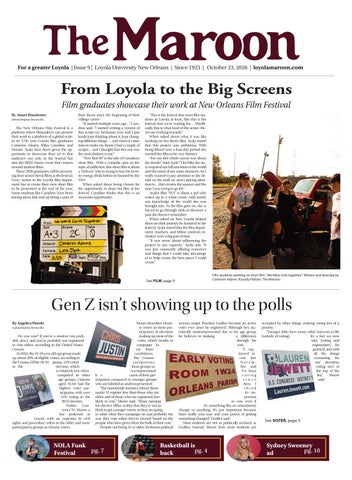
“This is the festival that most film students at Loyola at least.. like this is the festival that we’re waiting for. …Unofficially this is what kind of the senior theses are working towards.” When asked about what it was like working on her thesis film, Ayala stated that this project was ambitious. With being filmed over a four-day period she wanted her film to be very distinct. “For me this whole movie was about the details.” Said Ayala “ I feel like the story required our full attention to the world and the mind of our main character. So I really wanted to pay attention to the details on the stuff we aren’t paying attention to… that creates the nuance and the tone I was trying to go for.” Ayala’s film “AYA” is about a girl who wakes up in a white room, with barely any knowledge of the world she was brought into. As the film goes on, she is forced to go through trials to discover a past she doesn’t remember. When asked on how Loyola helped them on their journey be featured in the festival, Ayala stated that the film department, teachers, and fellow students included, were a big part of that. “It was never about influencing the project in any capacity,” Ayala sais. “It was just constantly offering resources and things that I could take advantage of to help create the best piece I could create.” Film students working on short film ” We Were Girls together.” Written and directed by Cameron Adams. Kassidy Pattain/ The Maroon
See FILM, page 9
Gen Z isn’t showing up to the polls By Angelica Pineda acpineda@my.loyno.edu
Do you vote? If you’re a student you probably don’t, and you’re probably not registered to vote either, according to the United States Census. In 2024, the 18-29 year old age group made up about 20% of eligible voters, according to the Census. Of the 18-29 group, 15% voted in the election, which is relatively low when compared to other age groups. Citizens aged 45-64 had the highest voter participation with over 33% voting in the 2024 election. Father Lawrence W. Moore, a law professor at Loyola with an expertise in civil rights and procedure, refers to the older and more participatory groups as chronic voters.
Moore describes chronic voters as more participatory in elections making up most of the votes, which results in campaign favor from candidates. The Census categorizes these groups as overrepresented b e cause of their participation compared to younger groups, who are labeled as underrepresented. “The nationwide statistics [show] those under 35 register less than those who are older, and of those who are registered, less likely to vote,” Moore said. “Those running for elective office realize that they’re not as likely to get younger voters, so they are going to tailor what they campaign on and probably the way they vote when they’re elected based on the people who have given them the bulk of their vote.” Despite not being 45 or older, freshman political
NOLA Funk pg. 7 Festival
science major Braeden Graffeo became an active voter ever since he registered. Although he’s statistically underrepresented due to his age group, he believes in making a difference through his vote. “I registered to vote last November and I’ve been voting since then. I think it’s important to vote even if it’s something like an amendment change or anything. It’s just important because that’s really your way and your power of getting something changed,” Graffeo said. Most students are not as politically inclined as Graffeo. Instead, Moore feels most students are
Basketball is pg. 4 back
occupied by other things, making voting less of a priority. “Younger folks have many other interests in life [outside of voting]. It’s a fact we now take [voting and registration] for granted, and with all the things screaming for our attention, voting isn’t at the top of the list,” Moore said.
See VOTER, page 5
Sydney Sweeney pg. 10 ad
CAMPUS
2
The Maroon Oct. 23, 2026
Does your college major pay off? Students weigh passion against financial security. By Alana Frank anfrank@my.loyno.edu
For Kamrin Jones, a junior majoring in finance and economics, earning potential was one of the biggest factors influencing his decision when choosing a college major. The finance industry’s reputation for higher-paying positions and job security, Jones said, was most appealing. “I know what kind of lifestyle I want to live, and I know I want a job that would have a large amount of prestige,” he said. Jones is not alone. For many college students, choosing a major carries the weight of one’s financial future. Earning a bachelor's degree generally leads to higher earnings. Workers between the ages of 25 and 54 with bachelor’s degrees earn about 70% more than workers with only a high school diploma, according to Georgetown University's Center on Education and the Workforce. But how much a college graduate earns often depends on what they studied. Workers with degrees in science, technology, engineering, and mathematics fields had median earnings of about $98,000, compared with $58,000 for education and public service fields, according to Georgetown's 2025 Major Payoff report. The report examined outcomes for 152 majors among prime-age workers and 142 majors among recent college graduates. For Jones, those potential earnings are part of why he believes finance is the right choice. He said the flexibility of his major could provide financial security even if he does not immediately achieve his preferred career goals. But Jones acknowledged that choosing a degree associated with higher earnings does not guarantee a job after graduation. "There's definitely a lot of competition, but that's why I have to keep working hard," Jones said. Laura Walls represents the other side of that coin. A junior majoring in hip-hop and R&B, Walls said she chose to study music because of her lifelong passion, not the promise of a high-paying career. "I couldn't imagine myself doing anything else," Walls said. Walls has been singing since she was about 9 years old and said she always knew she wanted to pursue music. Although she hopes to become a performing artist, Walls said Loyola's curriculum has introduced her to different opportunities within the music industry, including ways to earn income beyond performing. She believes there are multiple ways to build a career in music, even if becoming an artist does not immediately pro-
Graph of 10 different college majors and their early-career salaries after graduation. Students weigh in on the reason they chose their majors and whether or not they worry about their finacial return. Alana Frank/The Maroon
sonally fulfilling. "What I tell myself, despite things being so uncertain, is that I'm gonna make something work," Pellegrini said. Although she is unsure exactly where her career will take her, Pellegrini said she hopes to continue doing creative work, even if that means entering a different area of the industry than she originally imagined. After transferring from another institution, Pellegrini said the opportunities to build professional connections and gain hands-on experience at Loyola have made her more optimistic about her future. She hopes to begin with an internship after graduation and continue developing her career from there. For Fabiola Marrero, a mass communication major concentrating in advertising with minors in marketing and business administration, finding a major that aligned with her interests was an important part of her college experience. Marrero initially studied business but began reconsidering her academic path after discovering Loyola's advertising program. "I saw how creative and hands-on it was, and I was just like, 'this is a me thing'," Marrero said. Although her decision was driven by creativity, Marrero said she is also considering the professional opportunities available after graduation. She hopes to gain experience at an advertising agency or another organization before potentially pursuing additional education. Marrero said she initially worried about how artificial intelligence could affect employment opportunities in advertising but believes human creativity and emotional connections remain important to the industry. "For advertising, you need that emotional connection with someone, and AI can't really do that as well as we can as people," Marrero said. However, she said competition for jobs remains a concern, particularly as students prepare to demonstrate their skills and experience to potential employers. But lower earnings early in a career do not necessarily mean a graduate will remain at the same salary throughout their working life. Data from the American Academy of Arts and Sciences shows how earnings can grow with experience. Still, the earnings gap between humanities graduates and those from fields such as engineering did not disappear with age. Younger engineering graduates earned a median of $71,000, while older engineering graduates earned $103,000.
vide financial stability. While Jones and Walls approached their decisions differently, both are preparing for a future where their choice of major could influence their financial opportunities. A study published in Sociology of Education found significant differences in estimated lifetime earnings depending on a person's field of study. Among people whose highest degree was a bachelor's, STEM and business majors had some of the highest cumulative earnings. The study estimated that a person with a bachelor's degree in STEM could earn about $2.7 million over a 40-year career, compared with about $1.9 million for someone studying social sciences, history, psychology, or communications. Researchers also found differences based on gender and cautioned that factors beyond a person's major affect lifetime earnings. For some students, financial considerations have influenced not only their choice of major but also the careers they hope to pursue within their fields. Za’Kiyah Merritt, a junior majoring in political science with a minor in business administration, said she knew she wanted to attend law school long before she considered how much her education would cost. However, as she considered student loans and the additional years of educa-
tion required to become an attorney, her career plans changed. Merritt said she initially wanted to pursue criminal law and help communities affected by injustice in the legal system. Now, she hopes to begin her career in corporate law, where she believes she can earn enough to repay her student loans and establish herself financially before transitioning into policy and community-focused work. "I want to make money before I go do that," Merritt said. Merritt said she is concerned about the amount of debt she could accumulate before beginning her career. She is considering spending an additional year in college to improve her GPA and prepare for the Law School Admission Test, hoping to qualify for more financial assistance. Despite those concerns, she believes the long-term value of her education extends beyond her future salary. "I will still feel like my education was worth the investment because education, as a whole, has always been really important to me," Merritt said. For Teagan Beelman, a senior majoring in psychological sciences with a minor in criminology, her interest in federal law enforcement played a greater role in choosing her major than earning potential. Beelman hopes to become a special
agent with the Drug Enforcement Administration or FBI and said she selected her major and minor partly to strengthen her qualifications for those careers. Although he researched potential salaries, he said his interest in the work itself played a greater role in her decision. Beelman said he is concerned about the competitive hiring process and has focused on maintaining a high GPA, developing language skills, and preparing herself for employment after graduation. He said he wants a career that allows her to contribute to something meaningful while also earning enough to support herself and eventually have a comfortable retirement. "I think salary absolutely has to play a part in that," Beelman said. While students like Jones and Beelman have identified specific career paths, others are preparing to enter industries where employment opportunities and earnings can be less predictable. Natalie Pellegrini, a junior majoring in filmmaking, said she originally planned to study psychology before deciding she wanted a more creative academic experience. Her interest in theater production and photography led her to switch to film shortly before beginning college. Pellegrini said she was initially nervous about entering an industry known for being difficult to break into, but she decided to pursue a field she found per-
Resident Assistant Selection Begins
Student Models Needed For First-Gen Fashion
Financial Aid Opens Early
Loyola Students on the Big Screen
The 2027-2028 resident assistant selection process is underway. The second interest meeting will take place on Oct. 23 at 3:30 pm in the Octavia Room. There will be four subsequent meetings to follow. You must attend one meeting to be eligible for the position. Meeting spots are by RSVP.
As a part of the First-Generation College Celebration Week, TRIO will team up with the Student Success Center and the Career Development Center to present their "Style For Hire" First-Gen Fashion Show which will take place Nov. 12, 2026. To enquire about joining the show, reach out to Xavi Lacayo @xalacayo@ loyno.edu
The 2027-2028 FAFSA had a record early release on Sept. 23. Although the deadline is June 2028, it is encouraged that students complete it early so their information is ready when processing begins and they can receive their financial aid packages early. You can complete your FAFSA on studentaid. gov. For any questions concerning your FAFSA form, contact financial aid at finaid@loyno.edu.
The upcoming New Orleans Film Festival will feature seven films from Loyola students, staff, and alumni. The festival will occur at several theaters throughout the city. Go out and support Loyola filmmakers!
See MAJORS, page 4
The Maroon Oct. 23, 2026
3
PUZZLES Across 1 "Ring out the thousand __ of old": Tennyson 5 Hat holders 9 Figure in a Faustian bargain 14 Name on a former lake in Central Asia 15 Sandwich title 16 __ keyboard 17 Hayworth of "The Strawberry Blonde" 18 Gospel music? 20 Slogans 22 Ring topper 23 Screening org. 24 Chart-topper 26 High cloud 30 Really, really sticky situation? 34 Fiver 35 Uncomfortably honest 36 Pulitzer winner James 37 African language family 40 __ Atleos: big name in ATMs 41 Oscar, but not Big Bird 42 Vicinity 43 Tenor Pavarotti 45 Molecule in some vaccines 46 Brag obnoxiously after winning a swabbing contest? 50 Gymnast Olga with four Olympic gold medals 52 128 oz. 53 Colorado Plateau Native 54 Model/actress Kate 57 Mortar's partner 59 Generous Volkswagen promotion? 63 Panache 64 Mexican meat 65 Period after Shrove Tuesday 66 Toy (with) 67 Break the rules 68 Eight, in combinations 69 Minuscule
Down 1 Affection 2 Oratorio solo 3 Material for some patio furniture 4 Board on some patio furniture 5 Gatorade owner 6 Orecchiette shape 7 Foie __ 8 Buttonhole, e.g. 9 Veto on movie night 10 Cautionary color 11 Spot for a metti 12 Two-time WNBA Finals MVP Wilson 13 Picky criticism 19 Golden St. region 21 "Silly goose!" 25 Distraught 27 Sitar piece 28 Very, informally 29 Pomegranate bit 31 "__ Is Betta Than Evvah!": 1976 album 32 Home of the Kaaba 33 Revealing to all 36 Missing GI 37 Flavorful part of a cinnamon tree 38 View from the Uffizi 39 Proximate 41 Measurement given in degrees 43 Led Zeppelin's "Whole __ Love" 44 Fit in with 46 Sesame Street denizen 47 Current source 48 "Finally!," or what can be found in 18-, 30-, 46-, and 59-Across 49 Minuscule 51 Lake __ Vista, Florida 55 Capital west of Stockholm 56 Fraction of a min. 58 Big rig 59 TV monitor 60 Cheer syllable 61 Poetic preposition
For weekly puzzle answers, visit our Website via the QR code:
STAFF LIST Editorial Board
Contributors
Editor in Chief - Alana Frank Managing Editor - Elise Beck Pre-Content Director - Stella Perdue Post-Content Director - Carlos Andrade Executive News Editor - Lily Bordelon Design Chief - Bianca Mansell Gatti, Campus News Editor- Nicholas Parella Worldview Editor - Angelica Pineda Life & Times Editor - Amari Winchester Ass. Life and Times Editor - Alondra Gonzalez Sports Editor - Zoryn Johnson Opinion/Editorial Editor - Maria Touzard Breaking News Editor - Mabel Regalado-Hernandez Copy Editor - Pablo Pineiro Ramy The Wolf Editorial Manager - Laci Williams Senior Staff Photographer - Sophia Renzi Photo Editor - Pharrell Every Social Coordinators - Elena Godoy, Adriana Escobar, Eryn Goines Broadcast Producer - Ruth Brown Broadcast Lead Anchor - Dessadra Tezeno Co- Anchor- Eleanor Boucher-Ferry Newsletter Writer - Rodrigo Delgato Distribution Manager - Sophia Renzi
Nikolai Huilgol, Sabrina Hynh, Ella Yerger, Athalie Dore, Ella Bozeman, Angelica Petit, Cae Nguyen, Isabelle Kehoe, Kennedy James, Alyssa Jones, Kate Dalrymple, Elyssa Willis, Lauren Stuart, Kendall Ross, Kaya Tezeno, Riddick Winter, Teddy (Edward Smith), Katia Vincent, Francisco (Angel) Bara Dima Ahmad, Meadow Magliolo, Maxwell Ealons, Dutch Buckley, and Julianne Bellow, Anna Lukes, Ginger Cassabaum, Basjons Jordan, Ava Granger , Gil Jefferson, Micheala Sumling, Fernanda Lopez, Kamila Lafontontaine, Grace Chan, Ari Pickett, Indya Carper, Chamael Bolivar, Sam Browder, Terrance Parker, Niyla Dabney, Claudia Medina, Isabella Onoz, Chamael Bolivar
Student Media Adviser: Michael Giusti Assistant Student Media Adviser: Hannah Levitan
CONTACT US Main Office - (504) 865 - 3535 Business Office - (504) 865 - 3536 Adviser’s Office - (504) 865 - 3295 Correspondence - maroon@loyno.edu Letters to the Editor - letter@loyno.edu Advertising - ads@loyno.edu Website - www.loyolamaroon.com Twitter - @loyola_maroon Facebook - The Maroon Instagram - @loyola_maroon Our office is in the Communications/ Music Complex, Room 328. Send mail to: The Maroon, Loyola University, Campus Box 64, 6363 St. Charles Ave., New Orleans, LA 70118 The Maroon is published every Friday. Unless otherwise noted, all content is copyrighted by The Maroon. All rights reserved. First copy free to students, faculty, and staff. Every additional copy is $1.00. The Maroon is printed on 30 percent post-consumer recycled content.
Meet our Maroon Staff! Meet the Marooner video series on Instagram:
4
SPORTS
The Maroon Oct. 23, 2026
Loyola men's and women's basketball is back By Dessadra Tezeno dltezeno@my.loyno.edu
As the upcoming basketball season approaches, Loyola’s women’s and men’s basketball teams are preparing to take the court with high expectations, a focus on teamwork, and goals they hope to accomplish. Both programs are emphasizing preparation and team chemistry as they look to compete for championships and make their mark this season. For the women’s team, the goal is to return to the conference championship and win it all. Senior forward and captain Alyssa O’Dell said she hopes to help lead her teammates back to the championship while continuing to grow as a leader. “As a team, personally, I want to go back to the conference championship and win the whole thing and make it to Sioux City, Iowa,” O’Dell said. O’Dell said leadership will be especially important for a relatively young roster featuring 10 underclassmen and five upperclassmen. With talented freshmen joining the team, she emphasized the importance of helping younger players understand the demands of college basketball. “We have some really talented girls that came in. Our freshman class is amazing, and so we really just have to build that IQ for the younger players,” O’Dell said, explaining that the college game is more competitive than high school basketball. As a captain, O’Dell also wants to ensure her teammates feel supported and confident in their roles. She described her approach to leadership as one rooted in accountability and service. “I want to make sure everybody feels comfortable, you know, in their roles on the court,” O’Dell said. “I want to be somebody who they can count on and
Junior basketball player, Reece Seichnaydre practices in the gym in preperation for the fall 2026 basketball season. Loyola Men's basketball team's first game was Oct. 22 against LSU Alexandria. Friday, October 9, 2026. Dima Ahmad/The Maroon.
be a servant leader and show all my leadership by example.” Women’s head coach Kelly Kennedy described the team as “determined as ever” and “goal-oriented.” She said the team’s returning experience and new
talent give her confidence heading into the season. “We have a lot of experience returning in very key positions,” Kennedy said. “Plus, I think we’ve added a really good level of talent to that group.”
Kennedy also praised the team’s chemistry and leadership, emphasizing that the players’ character will help them grow together on and off the court. “I think we have great character on this team, and we’ve added personali-
ties,” Kennedy said. The team’s goals include winning the regular-season conference championship, capturing the conference tournament title and advancing deep into the national tournament. After narrowly missing the Sweet 16 last season, Kennedy believes the team can make another strong postseason run if it stays healthy. “I think it’ll be really fun to watch,” Kennedy said, adding that the team plans to play an up-tempo style with scoring options from both inside and outside. On the men’s side, senior point guard Kameron Johnson has his sights set on individual and team success. “Last year, I got conference player of the year, so I’m just trying to challenge myself to get national player of the year,” Johnson said. Johnson said the men’s team has been working to improve chemistry after welcoming several new players. Although injuries have affected the group, he believes continued practices and getting everyone healthy will help the team grow closer. The team’s postseason expectations are equally ambitious. Johnson described the program’s goal as reaching the Sweet 16, the NCAA Men's Basketball Tournament, referring to it as the minimum standard for the season. Johnson also encouraged Loyola fans to support the team by filling the gym, expressing confidence in the group’s potential. “We’re going to be a good team this year,” Johnson said. “We’re going to make them proud.” As both teams prepare for the season, their goals reflect a shared determination to compete at a high level, build team chemistry, and give Loyola fans a reason to support them throughout the year.
NAIA recognizes 13 Loyola teams as athletic scholar teams
Andrea Bardales, an athlete on the track team, studies in Monroe Library. Loyola's track team was recognized as a sport's team with one of the highest overall GPAs at the university. October 21, 2026. Zoryn Johnsnon/The Maroon
By Maxwell Ealoms dltezeno@my.loyno.edu
13 Loyola athletic programs were recognized as NAIA Scholar-Teams for the 2025-26 academic year, reflecting the
work student athletes say continues long after practice ends. Brett Simpson, assistant vice president of intercollegiate athletics, spoke on the significance of this recognition. “Having 13 teams earn this recogni-
tion speaks to the commitment to academics across our department. We’re proud of how our student-athletes manage the demands of coursework, practice, travel, and competition. It also reflects the support they receive from our
coaches, faculty, and staff,” Simpson said. For Loyola’s student-athletes, a lot of work goes into balancing sports and academics. For senior basketball player Caitlin Travis, balancing school and athletics has become something she has learned to manage over time. “Doing well in school and maintaining grades takes a lot of effort. Over the years, I’ve gotten better at balancing my time to keep up with everything,” Travis said. Travis said she focuses on what needs her attention in the moment while also leaving time to reset. The recognition means more because it allows her to represent Loyola as both a student and an athlete. Andrea Bardales, a junior track & field runner gave some insight into how her and her teammates help each other academically. “Each of us has to have good grades for our team to have such recognition, and we always support each other,” Bardales said. “If I took a class, and I know one of the freshmen is going to take it, I will help them because that’s just how we bond with the team, and we look forward to being one of the teams with the best GPA.” Both the women’s track & field and cross country teams were recognized by the NAIA as some of the athletic teams with the highest GPAs at the university. Geoffrey Masanet, men’s and women’s track & field and cross country coach, spoke on how he feels about the team's
recognition. “I am proud of how studious our team is. The cross-country runners in particular are "in-season" the entire school year (cross-country, indoor TF, outdoor TF) and that they are able to balance this with their studies is very impressive to me,” Masanet said. He also spoke on how the coaches deal with the student athletes when it comes to academics. "There is nothing super specific other than we try to do a good job in identifying kids who are first and foremost good students who are driven to be successful in the classroom and always have that as the #1 priority,” Masanet said. “It's not footloose and fancy free but if one of the kids has a big test or a project or was up super late studying we try to be flexible with them with regard to practice. I think that helps to be flexible with them without letting it get out of control." Each athlete still has larger goals ahead, from championships and graduation to graduate school and professional opportunities. For them, the recognition is less of a finish line and more proof that the work in both areas matters. “Academic recognition reinforces that our student-athletes are contributing to Loyola in ways that extend well beyond competition. These honors reflect the kind of program we have built, one where achievement in the classroom and success in competition go hand in hand,” Simpson said.
The Maroon Oct. 23 2026
WORLDVIEW
5
VOTERS: How can students get to the polls and know what's on the ballot? Continued from front Carlos Lozano, a sophomore entrepreneurship major, felt that voting wasn’t his top priority. “I know that’s what makes a democracy, and I do care about it. I guess I don’t find the time for myself to do all that,” Lozano said. Other than being too busy, Lozano also felt a lack of information and the fear of bias from social media deterred him from voting. “I just don’t educate myself, but I want to. I’m too busy to educate myself and do the voting, I feel like it’s going to be hard to educate people without being biased,” Lozano said. Despite worries about possible bias on social media, national and state governments offer unbiased information on where to vote and what’s on the ballot.
Where a student can vote is based on the residence they listed when registering to vote and which precinct that residence may fall under. Information on where a student’s specific polling location can change. However, Louisiana’s secretary of state office updates the polling sites on their website if they are changed. The website also allows voters to view sample ballots for the upcoming elections based on where they are registered to vote as a way to ensure voters are able to view what is on their district-specific ballot. The 2026 midterm ballot features several changes to Louisiana's government and legislature with a vote for senator and a vote of “YES” or “NO” to approve or deny ten Louisiana constitutional amendments, according to the Louisiana secretary of state’s sample ballot. Not every student can vote on these
amendments or any Louisiana elections. Loyola, like most universities, has students who are from out of state or not within distance of their polling location. For those students there are other options, such as mail-in voting. Mail-in votes require more time and an application, but they still allow students to engage in voting even when they are miles away from home, according to USA.gov. Despite all the reasons students find not to vote, Moore still believes they should uphold America’s democracy to bring the change they want to see. “The way democracy works, my vote is no more powerful than your vote, and it's the more the merrier,” Moore said. “I think a lot of people may figure what difference does my vote make, and the difference is each of us have as little or as much of a difference as the other person, we elect the people.”
Early voting sign outside of City Hall pointing people into early voting rooms. Early voting started on Tuesday Oct. 20, 2026 and takes place at the different locations per parish. Orleans Parish early voting will take place at City Hall until Oct 27. Sophia Renzi/ The Maroon
Traffic on Claiborne Avenue and Toledo Street at sunset on Tuesday Oct. 21, 2026. Claiborne Avenue is a high-speed main street that is a prime spot for crashes. Sophia Renzi / The Maroon
Students are in disbelief over Louisiana's so-called "safe drivers" By Karlie Bartholomew kjbartho@my.loyno.edu
Betting company, Hard Rock Bet, ranks Louisiana’s drivers as some of the safest in the country, but Loyola students and highway experts don’t believe it. According to Hard Rock Bet, Louisiana drivers are the seventh best in the country. Their study from Oct. 1, 2026 included speeding tickets, accidents, DUIs, and driver’s license difficulty. Louisiana stands at seven with only 7.50% of drivers having a speeding ticket, 17.9 accidents per 1,000 drivers, and 1.1 DUIs per 1,000 drivers. One Loyola student was shocked by this ranking. Sophomore accounting major, Dylan Sanchez-Lazo, felt the numbers were far off. “I do not agree with that ranking. Being someone who’s lived in Louisiana all my life, 19 years, we have some of
the worst driving I’ve ever seen,” Sanchez-Lazo said. Gregory Fischer, public information officer for the Louisiana Highway Safety Commission, expressed a similar reaction. “Although the article paints Louisiana in a fairly positive light here, which is nice, I’m actually pretty skeptical of the source. I cannot verify the speeding ticket stat because Louisiana driving records are private, meaning our Office of Motor Vehicles does not publish totals of infractions,” Fischer said. “Similarly, it would be hard to tally all DWI arrests versus convictions.The [Louisiana Highway Safety Commission] looks at crashes where alcohol was involved, but not arrests.” While it is not stated where Hard Rock Bet places their findings, they do claim to have gathered the statistics in time for huge motorsports events, like
the Indy 500. Fischer argues this raises even more suspicion, as crash reports take time to come in, even for the Center for Analytics and Research in Transportation Safety. “You’ll notice at the [Center for Analytics and Research in Transport Safety] website that the latest data report is from 2024,” Fischer said. “So, you see, it’s difficult to accept when a report, such as the one by Hard Rock Bet, is published with these findings claiming to be up-to-date.” The Louisiana Traffic Records Summary Report from 2024 and the Center for Analytics and Research in Transportation Safety website tells a much different story compared to Hard Rock Bet. In 2024 alone, there were an estimated 5.2 alcohol-related crashes per 1,000 people. Additionally, there were 208 fatal crashes in 2024 where at least one involved driver’s blood alcohol content was at or above the legal limit.
Joe Young, media relations director for the Insurance Institute for Highway Safety, also disagreed with the ranking. “Just looking at fatal crashes, and looking at them relative to the population as well as vehicle miles traveled, or how many miles people are actually putting on those vehicles, Louisiana is definitely ranking above average,” Young said. “For example, in terms of population, Louisiana had 16.4 deaths per 100,000 people in 2024. That’s compared to 11.5 for the U.S. total.” As for how Hard Rock Bet may have obtained these numbers, students and experts alike point to one answer. Freshman neuroscience major, Alex Alford, shared her insight from commuting to Loyola every day, as well as growing up in Louisiana. “I think the reason those numbers exist in the first place is because those numbers are not accurate. Like people
are doing stuff and just not getting in trouble for it,” Alford said. Sophomore accounting student, Nicholas Womble, agreed with this. “I don’t really see police too much. I don’t know. I see more fire trucks than police cars,” Womble said. Young also shared his opinion on the matter. “I think we also have to look at the policies that are in place, you know? People change their behaviors based on policies, based on enforcement, and so it could come down to other factors like, you know, whether, uh, laws are strong enough, whether or not they’re being robustly enforced,” Young said. Hard Rock Bet has not commented on the article.
fRee bEer
fRidAy TakE a frEe TouR Get a FreE pInt BegIns sePteMbeR 18th
eVerY fRidAy tOurS aT 3pm & 4Pm
1645 tChoUpiTouLas
*MusT bE pResEnt foR eNtiRe TouR fOr FreE bEer!
The Maroon Oct. 23, 2026
LIFE AND TIMES
7
Loyola students brought the funk to this year's Funk Fest By Alondra Gonzalez amgonzal@my.loyno.edu Loyola music students took the stage as NOLA Funk Fest entered its fourth annual year at the Audubon Aquarium Riverfront Park in New Orleans. The university sponsored the festival’s ‘Passing The Torch Stage’, which offers a platform for emerging local artists to showcase their abilities and highlight the importance of music education. The three-day music and cultural festival ran from Oct.16th through Oct. 18 th. It is powered by the Louisiana Music & Heritage Experience, a museum dedicated to the preservation of the state’s rich musical heritage. “Our goal for the museum is to preserve the evolving Louisiana music history to educate, inspire, and empower. Aligning with these goals, we prioritize paying our local artists above market rates,” according to nolafunkfest.com. Vienna Notarianni, a senior majoring in popular and commercial music, felt Funk Fest gives young artists a platform to express their personal ideas in the New Orleans music scene. “Funk Fest impacts Loyola’s music community by giving us a chance to push ourselves creatively. For a small indie artist, when you get a festival slot, it's an amazing opportunity to make your set as wild and impressive as possible,” she said. Notarianni also shared how performing allows her to try new opportunities and challenge her abilities, which helps her become a better musician.
“I usually have a four-piece band, but for this set I’m so excited to have some friends join me on trumpet, trombone, and saxophone,” she said. “My set is all original, and composing horn parts was a great way to get out of my comfort zone, try something new, and add another layer to my sound.” Notarianni felt excited to be a part of Funk Fest through Loyola’s involvement and appreciated sharing the stage with other New Orleans musicians. “Playing the ‘Pass The Torch stage’ is such an honor as a young musician, and being on the same lineup as New Orleans icons is unreal,” she said. “I’m incredibly grateful that Loyola’s music professors consistently hand out festival performance opportunities.” Sophomore music industry major Nika Nodjoumi hoped to play at Funk Fest since first studying at Loyola. She said she believed the opportunity would let her find similar artists who she could directly learn from. “Funk Fest means everything to me. When I was a freshman, I set a goal to play Funk Fest my sophomore year, and I’m very happy to have reached that goal now and am super grateful,” Nodjoumi said. “Funk Fest brings people together by creating so much live energy through music, and it’s uplifting. Brayden Owens, a sophomore music industry studies major, felt his music inspirations taught him the value of funk music from a young age. “Funk has been a part of my life since I was very little. I discovered Michael Jackson at a very young age, which led me to
his inspirations like James Brown, Stevie Wonder, Sly and the Family Stone, and Earth Wind and Fire. Funk has meant a lot to me for a long time,” Owens said. Owens talked about the importance of music events in New Orleans due to the community outreach that follows. “It’s one of those things you just can’t get enough of. And festival culture by itself has always been so fun for me just seeing everyone come together and enjoying music in one space and spreading love. We need more love,” he said. Although the Passing the Torch stage had one of the biggest crowds all weekend, Owens talked about how he managed through difficulties on stage. “There were some small inconveniences on stage, like my XLR cable falling out of the mic on my very first song, but we recovered from it. I’m never pleased 100% with my performance, but I know we did amazing and I’m always wanting better,” he said. By having performed at Funk Fest, Owens felt that he’s a part of a mission to connect emerging artists with notable musicians, which he thinks is necessary for music culture to thrive. “Funk Fest...serves a bigger purpose than just being a music festival,” he said. "It’s bringing legends of funk and artists together with upcoming artists that do entirely different genres of music. It’s so amazing to see the support of musicians and artists bringing up the next generation of talent."
Mac "NL" Block preforms at Funk Fest on the "Passing the Torch" stage . The stage is dedicated to young artists hoping to make it into the music industry. Courtesy of Mac Block.
Oh my gourd! The pumpkin patch is calling: pick me, pick me!
A glimpse of St. Andrews pumpkin patch. Taken on Oct. 7th, 2026 Angelica Pineda/The Maroon
By Angelica Pineda acpineda@my.loyno.edu BOO! The pumpkins are here! Grab your pumpkin spice latte, cutest pair of boots, your coziest sweater, and your best friends for a pumpkin patch hangout this year! Loyola students have been looking
forward to this time of year: when the weather drops slightly below 90°, and their group chats are blowing up with plans to go to the pumpkin patch to celebrate the start of the fall season. The patch has been a fond memory for many and a tradition that they have continued up until now. It’s more than a mark of fall but a way for people to come
together in a simple yet meaningful way. Luke Lutz, a sophomore biology major, shared how he felt pumpkin patches became a connector within communities despite having different ways of celebrating the fall-o-ween season. “Going to the pumpkin patch, to me, is a poignant and important ritual in welcoming the fall season,” Lutz said. “While many people have different ways of celebrating the holiday, pumpkin patches are a place where all people can come together, be creative, and participate in a meaningful activity that has been around since the holiday's [Halloween] inception.” One of the more popular pumpkin patches for students and community members has been St. Andrew’s Pumpkin Patch. The patch originally started out as a fundraiser for St. Andrew’s Episcopal Church about 10 years ago and grew into one of New Orleans’ biggest pumpkin patches and a fall favorite for many. Allen Chighzola, the senior warden for St. Andrew’s Episocal Church, loves how people have come together to celebrate the season at the St. Andrew’s Pumpkin Patch. “The Pumpkin Patch has truly become a ministry in and of itself,” Chighzola said. “It gives us a wonderful and unique opportunity to welcome and give back to the entire New Orleans community.” Chighzola felt that it has become more than just another pumpkin patch but a New Orleans staple.
“I don’t think any of us could have imagined when we started all those years ago what the Pumpkin Patch would eventually become. It has grown into a cherished tradition for our church and, we believe, a real staple of the surrounding community. More importantly, it has allowed us to connect with people we might never otherwise meet and to extend our ministry far beyond the walls of our church,” Chighzola said. Some Loyola students have also chosen to celebrate the fall-o-ween tradition of picking the perfect pumpkin at St. Andrew’s. Sophomore design major, Jane Kirsch, hasn’t always spent her fall in a pumpkin patch, but she loved the idea of it. “For me, pumpkin patches weren't really a huge thing in my family, but we went to my preschool's one a lot when I was really young. I also think pumpkin patches are so cute because it's such a big thing nationwide and that so many people have been doing them for so long, and it's like a way everyone is connected” Despite not spending most of her life in the patch, Kirsch began a tradition at St. Andrew’s with her sorority sisters. “Last year I spent time at St. Andrew’s pumpkin patch with my sorority, and it was so fun! The decorations are so elaborate, and the whole set is so well put together, with the children's maze and inflatable dinosaur being my personal favorite.” Kirsch said. Kirsch also plans to continue the tradition this year at St. Andrew’s.
“It hasn't been a tradition in my life to go to a pumpkin patch every year, but I always want to. This year, my roommates and I are hoping to visit the St. Andrew’s one [pumpkin patch],” Kirsch said. Students like Kirsch are the reason why St. Andrew's grew into a special place where people create memories and have fun doing it. Chighzola shares how much it has meant for St. Andrew’s to become that place where people gather, bond, and even create lifelong memories. “Over the years, we have watched families grow as they return each fall for their annual pictures. We have had marriage proposals and engagements happen among the pumpkins, Chighzola said. “Those moments are what make this so special.” Chighzola shares the joys of the patch and why the church has kept it growing outside of just a fundraiser, but as a tradition for the community. “It brings people together. It creates memories. It allows us to welcome our neighbors onto our grounds and become part of their family traditions,” Chighzola said. “That is what the Pumpkin Patch has become for us—and why, after all these years, we still look forward to hearing those words every fall: ‘The pumpkins are coming!’”
The Maroon Oct. 23, 2026
JUMPS
9
MAJORS: Professors weigh in on the value of college degrees Continued from page 2 Walter Block, the Harold E. Wirth Eminent Scholar Chair in Economics at Loyola University New Orleans, said students should consider the financial return of their degrees but should not choose a major solely because of its earning potential Block said he reviewed rankings of college majors by earnings and found economics among the higher-paying fields. However, he said financial considerations should not outweigh a student's interests. "If you go for economics just for the money and you hate it, you're not gonna have a good life," Block said. "You might be a little richer, and you're not really gonna be good at it if you don't really like it." Although Block encourages students interested in economics to pursue the field, he said the highest-paying major is not necessarily the best choice for everyone. "My advice to students is, the hell with what maximizes your wealth. Go with what you love," Block said. Block said students who are equally interested in two majors could reasonably consider which offers better financial opportunities. However, he believes personal fulfillment should remain a priority. "Look, I'm an economist. They'd kick me out if I said money is unimportant," Block said. "But I don't think it should be in the top three." David Grunfeld, a professor of photography in Loyola's School of Communication and Design, also believes students should identify their passions and pursue careers that reflect their personal interests. Grunfeld, who studied photojournalism and has worked in the field since the late 1970s, said his decision to pursue
photography was never primarily about money. "I got into it because it was the pure love of meeting people, making pictures," Grunfeld said. He said students should not assume that choosing a traditionally higher-paying major guarantees financial success. "Just to get a degree in finance doesn't mean you're going to get rich," Grunfeld said. For Grunfeld, finding personal fulfillment through a career is just as important as considering its financial rewards. "You have to follow your dream and your passion more than anything else," Grunfeld said. Xavi Lacayo, a career coach at Loyola's Career Development Center, said national salary data can help students understand potential earnings, but it does not tell the entire story of what graduates can accomplish with their degrees. "There's a lot of nuance when it comes to your outcomes based on your degree," Lacayo said. Lacayo said employers increasingly look beyond academic majors when evaluating applicants, placing greater emphasis on practical experience, communication, problem-solving and other transferable skills. He said students who gain relevant experience through internships, employment, and extracurricular activities can become competitive applicants even when their degrees do not directly align with a particular position. For example, employers hiring for communications positions may consider graduates with degrees in English, history, or psychology if they can demonstrate the necessary skills. However, some professions still require specific degrees, training, or credentials.
Lacayo said concerns about financial security have consistently been part of his conversations with students, but he has noticed that some students enter college already believing certain majors will guarantee higher earnings. "I have more conversations of students being like, 'Oh, I'm in this major because it's gonna make me money,' as opposed to, like, 'Hey, am I gonna make money with this major?'" Lacayo said. While earning potential can influence students' decisions, Lacayo said choosing a major primarily for financial reasons raises another question: whether students will actually enjoy the careers they pursue. He said students sometimes choose majors because they or their parents believe those degrees will provide greater financial stability. The decision can be especially important for students who are borrowing money to attend college. Students may have to consider not only what they want to do after graduation, but whether their expected salary will allow them to support themselves and repay their loans. Lacayo encouraged students to research starting salaries and career opportunities across an entire industry rather than limiting their research to jobs directly associated with their major. For example, a journalism student could explore careers in public relations, marketing, and other communications-related fields to better understand how their degree might translate into different employment opportunities. He said students should also consider how their interests, values, and skills overlap when evaluating potential careers. At Loyola, students are already gaining some of that experience before graduation through required internships in
several academic programs, including mass communication, music industry studies, businesss and computer science. However, Lacayo said completing internships and building a resume are only part of preparing for the workforce. One challenge he has noticed is that students often underestimate the value of their own experiences. Students involved in athletics, campus organizations, student media, and other extracurricular activities may develop leadership, communication, and teamwork skills without recognizing how those experiences could help them professionally. "Students don't see the value that they bring, and they don't have the language to talk about it," Lacayo said. He said some students become so focused on building their resumes and portfolios that they struggle to explain what they have learned from those experiences during job interviews. For students hoping to improve their employment opportunities, Lacayo recommends pursuing experiences beyond their academic major. "Don't be afraid of taking opportunities outside of your major," Lacayo said. He said exploring unfamiliar opportunities can help students develop transferable skills, gain different perspectives, and become more competitive applicants. Loyola's own graduate employment data also provides some insight into students' outcomes after college. According to the university's 2025 First Destination Report, which Lacayo referenced during the interview, 54% of responding graduates were employed in the period following graduation. Lacayo said the report had an 81% response rate. He said that the university examines the industries graduates enter, rather
than focusing exclusively on employment outcomes by major, because graduates frequently pursue careers outside their specific fields of study. Still, salary cannot measure everything a student may value about their education or career. National earnings data cannot show whether someone enjoys their job, feels fulfilled by their career, or believes their degree was worth the cost. It also does not mean every person with the same major will earn the same amount. Location, occupation, graduate education, work experience, and other factors can affect earnings. For students deciding what to study, the data shows that a college degree can provide a financial advantage. But the size of that advantage can depend heavily on the field they choose. Block said students should not overlook the financial differences between majors, but they should also consider whether they will enjoy the work their education prepares them to pursue. Lacayo offered similar advice, encouraging students to evaluate both their career interests and their financial expectations. "It's not just how much money you're gonna get, it's also, like, how happy you're gonna be in the end," Lacayo said. For Jones, that means pursuing a degree he believes will provide financial security and the lifestyle he wants. For Merritt, it means building a financially stable career before pursuing the work she originally envisioned. For students like Pellegrini and Walls, it means accepting uncertainty to pursue something they love. Their decisions reflect the same question facing college students across different fields: whether the value of a degree should be measured by the salary it produces, the opportunities it creates, or the personal fulfillment it provides.
FILM: Takeaways from the New Orleans Film Festival Continued from page 7 When asked what she wanted to take away from being in this festival, Adams said that she doesn't just want to gain opportunity, she also wants to make connections as well. “Making connections with people who also love and care about filmmaking like I do...I also want to see everybody's films,” she said.
Adam’s film “We Were Girls Together” is about two childhood friends who go on a road trip to go back to the place they met for the first time, but when their car breaks down, things bubble to the surface when stuck in a small town. When asked if she had any advice for younger filmmakers at Loyola, this is the advice she had to give. “ If you have an idea you really should just go for it. I feel it is possible to do and to accomplish. If you believe you could
do it, you could do it. But that being said, you need to plan the hell out of your film.” When it comes to showing support, teachers like Camille DeBose, who is a film professor at Loyola, try to do it in multiple different ways. But one thing they try to enforce is collaborating with other departments. “Cinema is a collaborative art form. We can't do it in isolation. Bigger and broader than that... storytelling is deep
and wide. It's important to collaborate with other departments. Together we tell a deeper, richer story by employing the variety of tools we have in our particular disciplines.” These films are being shown at the REEL future event that takes place October 26-27th. Films will be shown at 5 PM in Nunemaker Hall on the 26th, film related panels will take place on the 27th. Then you could also check out these films at The New Orleans Film Festival
which takes place during the 22nd-27th. “REEL Futures and the NOFF provides a wonderful bridge between school life and professional practice,” said DeBose. “This event gives the students a healthy glimpse of what is to come. It also provides new perspectives and ways of seeing the cinematic arts.”
10
OPINION
The Maroon Oct. 23, 2026
Sydney Sweeney is the sexualized face of corporate America By Meadow Magliolo mlmaglio@my.loyno.edu
Is Sydney Sweeney using her body in an empowering way, or an objectifying way? Sweeney has collaborated with many companies and each ad has been provocative or sexualized in some way. From Dr. Squatch, American Eagle, to Novig, she has sparked some sort of outrage. Recently she released an ad with Novig, a sports betting app, where Sweeney is seen whispering, “Just sports,” while athletic equipment is only covering the essentials. Do we really need to give men more unrealistic standards of how women are supposed to look and act? It is degrading not only for women in sports but just women in general. Female athletes have just started to get to a point where being sexualized has simmered down, but with this one ad things have changed. With these adverts she has objectified, sexualized, and degraded all women in sports. From various athletics, women have posted to social media criticizing the actress, berating her use of sexuality to market sports, especially to the target audience of men. Arienre Titmas said it was a “kick in the face.” And truly, it was just completely disregarding all the hard work these athletes have gone through to get to where they are to-
day. Why even do these ads? What was the thought process behind these objectifying commercials? Did she and her team really think these would get a good reaction? Or were they wanting to receive bad press? I mean if they were hoping for the bad press to gain traction, they got it. Novig’s valuation increased from $500 million in August to $2 billion just weeks after the release of the commercial.. I just think promoting a gambling app with your mostly bare body is setting back feminism by decades. Some feel, including me, “She serves the whims of corporate America with her [body].” Trump even came out and spoke about her American Eagle advert saying, "Sydney Sweeney, a registered Republican, has the HOTTEST ad out there, go get 'em Sydney!" JD Vance also made comments supporting her in the Ruthless podcast. She replied by saying it was “surreal.” Was it ‘surreal’ because the President spoke highly of her, or because President Trump spoke highly of her? Overall, the only way Sydney Sweeney knows how to stay relevant, is to show off her body. She has repeatedly used her body to advertise products and brands, and successfully sparked outrage over various issues.
Sydney Sweeney poses for photographers at the Armani beauty event during the 83rd edition of the Venice Film Festival in Venice, Italy, on Sept. 3, 2026. (Photo by Scott A Garfitt/Invision/AP)
Logging onto lonely spaces while still finding connecting spaces By Chamael Bolivar cbolivar@my.loyno.edu
Walk into any public place today and ask yourself a simple question: Where can a group of students go to hang out and just exist together for free? If you look around our communities, the options are becoming limited. Bowling alleys, diners, and other social spaces that previous generations grew up with are closing or becoming too expensive for a college student’s budget. At the same time, we are slowly losing what sociologists call “third places,” or physical spaces outside of home and school where people can meet, socialize, and build community. Our generation has found another way to create those connections. Social media has become one of the easiest places to find people who share our interests, especially when those people may not be around us physically. I have seen this myself while scrolling through TikTok. People are constantly looking for friends, creating group chats and building communities based on age, location, and shared interests. There are virtual book clubs, gaming servers, and online groups for almost every hobby you can think of. There are real benefits to having these communities online. For someone who feels isolated, the internet can make it much easier to find people who understand them. You can meet someone who lives hundreds of miles away and discover that you have the same interests or experiences. In some cases, an online community may be the first place where someone feels like they belong. Still, online connections cannot provide everything that in-person
People tend to find comfort on the internet when feeling lonely, yet we must remember to connect with others. Maria Touzard/The Maroon
communities do. There is something different about sitting outside with other people, having a conversation without a screen between you, or simply being able to spend time together without needing to buy something. Those small interactions are part of how people become familiar with the people and places around them. When most of our social lives happen online, it becomes easier to overlook the communities that exist right outside our doors. That does not mean we need to abandon the internet. Online communities can be a great way to find people with similar interests, but they should not have to be our only option. If traditional third places are becoming harder to find, we can create new ones ourselves. That could look different for everyone. Students could organize walking clubs, meet at a local park to paint, or spend an afternoon doing community service together. A third place does not have to be a large community center or an expensive business. Sometimes, it can be as simple as a group of people deciding to meet somewhere and spend time together. As college students, we have the opportunity to create the kind of spaces we want to see in our communities. We do not always need a big budget, a perfect location, or an official organization to make it happen. We can start small and build from there. Online spaces have helped us find people, but there is still value in knowing the people who live, study, and work around us. Maybe building stronger communities does not require us to completely log off. Maybe it just means remembering to look up from our screens once in a while and make room for each other in the real world.
The Maroon Oct. 23, 2026
EDITORIAL
11
Your vote is more important than you think HOWLS & GROWLS HOWL to Nathan Fielder GROWL to Sydney Sweeney Ad HOWL to Fixing St. Charles GROWL to Gypsy Rose HOWL to Basketball GROWL to Elizabeth Holmes Editorial Board
City Hall after the first day of early voting took place in Orleans Parish. Polling locations for early voting will be open until Oct. 27 and are only located at City Hall. Sophia Renzi/ The Maroon.
The political climate in the US continues to grow more uncertain and volatile. As midterm elections are right around the corner, student votes are becoming an increasing concern. Students are surrounded by political discussions constantly, whether it be on social media, college campuses, or conversations about what is to come. However, despite being directly affected by political elections, many appear to be disconnected from the democratic environment. Though students wish for change, they doubt whether their voices, or rather participation, will actually make a difference. Here lies the vicious cycle in student votes: they believe their voices to be powerless, so they do not vote. Consequently, their political presence decreases, leaving them with even lower representation in the decisions that shape their livelihood. The lack of student voters is not merely a matter of political disinterest. It is a demonstration of an expanding sense of powerlessness within younger generations who believe that their concerns are persistently overlooked. Students have begun believing that no matter their actions, their circumstances will not change. Applied to politics, this learned helplessness phenomenon explains why even students who care deeply about social issues may still find themselves avoiding participating in elections. When a person is constantly feeling like their needs and wants are dismissed, they may begin doubting the purpose of voting altogether. Instead of perceiving voting as an opportu-
nity to use their influence as a means to fight for a better future, it might be viewed as a harsh reminder of how little control they believe they have. Frustration turns into resignation, and that is what leads to political detachment. Yet, the predicament with this mentality is that this disengagement only reinforces the circumstances that made it. Older citizens have higher percentages of actually showing up and voting. These numbers reveal a very real imbalance in political involvement amongst age groups, and one that benefits those whose concerns receive attention. Older, more consistent voters are those who most participate in elections; hence, political candidates have a bigger incentive to cater to their interests and concerns. Politicians have a way of tailoring their campaigns and decisions to those who vote the most. As students are not in that equation, they are left in political purgatory, where they still suffer the consequences but have no control over their environment. This is where the vicious cycle becomes especially harmful. Students have a sense of underrepresentation in politics, so they withdraw from elections, yet their absence paves the way for other age groups to assert dominance in elections, which encourages politicians to continue to prioritize the same voters. While younger voices become less visible in voting, their concerns risk losing even more attention. Students cannot expect their voices
to be heard if they continue to remove themselves from the spaces that offer them the chance to have any sort of influence in the future of their country. However, understanding the why in students' disengagement is just as crucial as recognizing the consequences. This generation faces an age in which social media has created an extremely polarized environment in politics, constant exposure to conflicting and false information, and deep uncertainty about the future. Though social media does make political content more accessible, it can also make understanding politics all the more overwhelming. We are faced with thousands of opinions, sources, and contradictory points, never knowing which to trust. Access to information does not immediately translate into political understanding. Being perpetually bombarded with political content does not mean all are equipped to evaluate it. Nonetheless, we must remind ourselves that voting is a privilege; remember, not all Americans had the right to vote. Losing hope does not inspire change; it creates an even larger distance from the same institutions that influence these issues. The responsibility of breaking this vicious cycle does not solely fall on students. Political detachment is not born merely of self-isolation, and politicians must recognize the role they play in this. When candidates focus only on the demographics with higher vote turnouts, younger voters interpret that as evidence that their concerns are secondary.
Politicians cannot expect the younger demographic to become invested in their endeavors if they make no meaningful efforts to engage with them. Simultaneously, students have to recognize that political influence is not automatically granted. Influence evolves through participation and willingness to remain involved even when the odds don’t always turn out in your favor. Participation, even for smaller issues in elections, still creates an opportunity for influence. It is true that voting does not guarantee that your preferred candidate will be elected or that a specific policy will pass. But it does allow for students to contribute to determining who gets to make those decisions. Students do not need to wholeheartedly agree with every candidate or with the political system to be able to engage in politics meaningfully. You can start by developing informed opinions. Research your ballots. Learn about the issues that affect you. The greatest danger in students’ political detachment is not just low turnout; it is normalizing the learned helplessness in politics in a generation whose future is shaped by the decisions being made today. Feeling unheard should not force one into being silent. Your voice matters. Change can only begin when students stop perceiving their disengagement as inevitable and recognize the power in their choices.
Editor-in-Chief Alana Frank Executive News Director Lily Bordelon Managing Editor for Print Elise Beck Pre-Content Director Stella Perdue Post-Content Director Carlos Andrade Campus News Editor Nicholas Parrella Worldview Editor Angelica Pineda Life and Times Editor Amari Winchester Assistant Life and Times Editor Alondra Gonzalez Sports Editor Zoryn Johnson Opinion and Editorial Editor Maria Touzard Assistant Opinions Editor Fin Jones Breaking News Editor Mabel Regalado-Hernandez Wolf Editorial Manager Laci Williams Senior Staff Photographer Sophia Renzi Photo Editor Pharrell Every Assistant Photo Editor & Social Media Manager Adriana Escobar Social Media Manager Clarissa Dupree Social Media Manager Elena Godoy Copy Editor Pablo Pineiro Ramy Co-Anchor Dessadra Tezeno Co-Anchor Eleanor Boucher-Ferry EDITORIAL POLICY The editorial on this page represents the majority opinions of The Maroon’s editorial board and does not necessarily reflect the opinions of Loyola University. Letters and columns reflect the opinions of the authors and not necessarily those of The Maroon’s editorial board. The Maroon does not represent the opinion of administration, staff and/or faculty members of Loyola. Letters are subject to editing for length, grammar and style. Please limit submissions to 400 words. Submissions are due no later than 4 p.m. the Sunday before publication. Please send all submissions — The Maroon, 6363 St. Charles Ave., Box 64, New Orleans, LA 70118. Email us your letters — letter@ loyno.edu. Submissions may also be made online at www.loyolamaroon.com.
Catch up. Get ahead. Study abroad. An accelerated two-week session Online and experiential courses Many Loyola Core options Registration starts on November 2.
J-Term takes place January 4 – 15, 2027.