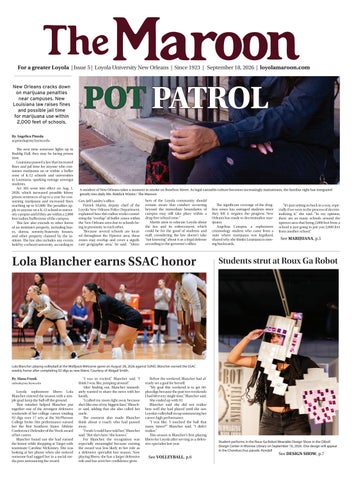
For a greater Loyola | Issue 5 | Loyola University New Orleans | Since 1923 | September 18, 2026 | loyolamaroon.com New Orleans cracks down on marijuana penalties near campuses. New Louisiana law raises fines and possible jail time for marijuana use within 2,000 feet of schools.
POT PATROL
By Angelica Pineda acpineda@my.loyno.edu The next time someone lights up in Buddig Hall, they may be facing prison time. Louisiana passed a law that increased fines and jail time for anyone who consumes marijuana on or within a buffer zone of K-12 schools and universities in Louisiana, sparking outrage amongst students. Act 305 went into effect on Aug. 1, 2026, which increased possible felony prison sentences of up to a year for consuming marijuana and increased fines reaching up to $1,000. The penalties apply to anyone on a K-12 school or university campus and if they are within a 2,000 foot radius/bufferzone of the campus. This law also extends to other forms of an institute’s property, including buses, dorms, sorority/fraternity houses, and other property claimed by the institute. The law also includes any events held by a school/university, according to
A resident of New Orleans takes a moment to smoke on Bourbon Street. As legal cannabis culture becomes increasingly mainstream, the familiar sight has integrated greatly into daily life. Riddick Winter/ The Maroon
Gov. Jeff Landry's office. Patrick Martin, deputy chief of the Loyola New Orleans Police Department, explained how this radius works considering the “overlap” of buffer zones within the New Orleans area due to schools being in proximity to each other. “Because several schools are located throughout the Uptown area, these zones may overlap and cover a significant geographic area," he said. "Mem-
bers of the Loyola community should remain aware that conduct occurring beyond the immediate boundaries of campus may still take place within a drug-free school zone." Martin aims to educate Loyola about the law and its enforcement, which could be for the good of students and staff, considering the law doesn’t take “not knowing” about it as a legal defense according to the governor's office.
Lola Blancher earns SSAC honor
The significant coverage of the drugfree zones has outraged students since they felt it negates the progress New Orleans has made to decriminalize marijuana. Angelina Campos, a sophomore criminology student who came from a state where marijuana was legalized, shared why she thinks Louisiana is moving backwards.
“It’s just setting us back in a way, especially if we were in the process of decriminalizing it,” she said. “In my opinion, there are so many schools around the uptown area that being 2,000 feet from a school is just going to put you 2,000 feet from another school.”
See MARIJUANA, p.5
Students strut at Roux Ga Robot
Lola Blancher playing volleyball at the Wolfpack Welcome game on August 28, 2026 against SUNO. Blancher earned the SSAC weekly honor after completing 92 digs as new libero. Courtesy of Abigail Smith.
By Alana Frank anfrank@my.loyno.edu
Loyola sophomore libero Lola Blancher entered the season with a simple goal: keep the ball off the ground. That mindset helped Blancher put together one of the strongest defensive weekends of her college career, totaling 92 digs over 17 sets at the McPherson College Invite. Her performance earned her the first Southern States Athletic Conference Defender of the Week award of her career. Blancher found out she had earned the honor while shopping at Target with teammate Caroline McKinney. She was looking at her phone when she noticed someone had tagged her in a social media post announcing the award.
“I was so excited,” Blancher said. “I think I was, like, jumping around.” After finding out, Blancher immediately wanted to share the news with her family. “I called my mom right away because she’s like one of my biggest fans,” Blancher said, adding that she also called her uncle. The moment also made Blancher think about a coach who had passed away. “I wish I could have told her,” Blancher said. “But she’s here. She knows.” For Blancher, the recognition was especially meaningful because earning the award was less likely in her role as a defensive specialist last season. Now playing libero, she has a larger defensive role and has seen her confidence grow.
Before the weekend, Blancher had already set a goal for herself. “My goal this weekend is to get 60plus digs because the past two weekends I had 60 every single time,” Blancher said. She ended up with 92. Blancher said she did not realize how well she had played until she saw Loyola’s volleyball recap announcing her career-high performance. “I was like, ‘I touched the ball that many times?’” Blancher said. “I didn’t realize.” This season is Blancher’s first playing libero for Loyola after serving as a defensive specialist last year.
See VOLLEYBALL, p.6
Student performs in the Roux Ga Robot Wearable Design Show in the Diboll Design Center in Monroe Library on September 16, 2026. One design will appear in the Chewbacchus parade. Kendall
See DESIGN SHOW, p.7
The Maroon Sept. 18, 2026
2
PUZZLES Across 1 Highly skilled 5 Mop (up), as gravy 8 Valuable item 13 Spring 14 Perlman of "Cheers" 15 "Hello," in Mandarin 16 Star of "Ghost" and "The Substance" 18 Believe without questioning 19 Former 20 Chemical in oven cleaners 22 "New" prefix 23 "I'm __ roll!" 24 Informal lingo 26 "For Whom the Bell Tolls," for one 32 Supergirl accessory 33 Actor's prompt 34 One-named singer whose studio albums have numerical titles 35 Braying pack animal 36 Thawing of diplomatic tensions 39 Digital collectible: Abbr. 40 Tale 42 Fruit-filled pastry 43 French friends 44 Indigenous people of Oklahoma who originated in Florida 48 Stately home in the country 49 Wheels 50 No. 1 pal 53 Cow sound 54 French island near Sardinia 58 Perp's excuse 60 Game division, or what can be found in 16-, 26-, and 44-Across 62 Ancient artifact 63 "Up, up, and __!" 64 Dr. Frankenstein's assistant 65 Maroon vegetables 66 Pig heavier than 120 pounds 67 __ stick
Down 1 Gucci of fashion 2 "We've all __ there" 3 Gold fabric 4 Perfect example 5 Jimmy Choo creation 6 Above, poetically 7 Spanish rice dish seasoned with saffron 8 Insect feelers 9 Knight's title 10 Exclude 11 Smooth sailing 12 Dog who visits Oz 14 Nora Roberts genre 17 Short skirt 21 "Yippee!" 24 Center defender in soccer 25 Immortal being 26 Speed 27 __ salts: bathwater additive 28 Belly 29 Mobile payment app 30 Small and pointy-eared, perhaps 31 Tennis do-overs 32 Elliot of the Mamas and the Papas 36 Branch of mechanics 37 Diarist Anaïs 38 Pot insulator, in England 41 Part of a basketball hoop 43 Blimp, for one 45 Peace activist Yoko 46 Exfoliating scrubber 47 Fruit-filled pastry 50 Spike on a dragon's tail 51 Make a run for it 52 Nail salon tool 54 Jagged rock 55 "Aladdin" parrot named for a Shakespeare villain 56 Plumbing problem 57 Natural hairstyle 59 Drill insert 61 __ Jima
For weekly puzzle answers, visit our Website via the QR code:
STAFF LIST Editorial Board
Contributors
Editor in Chief - Alana Frank Managing Editor - Elise Beck Pre-Content Director - Stella Perdue Post-Content Director - Carlos Andrade Exuecutive News Editor - Lily Bordelon Campus News Editor- Nicholas Parella Worldview Editor - Angelica Pineda Life & Times Editor - Amari Winchester Ass. Life and Times Editor - Alondra Gonzalez Sports Editor - Zoryn Johnson Opinion/Editorial Editor - Maria Touzard Breaking News Editor - Mabel Regalado-Hernandez Copy Editor - Pablo Pineiro Ramy The Wolf Creative Director -Makayla Parker The Wolf Designer - John Zwiers Senior Staff Photographer - Sophia Renzi Photo Editor - Pharrell Every Social Coordinators - Elena Godoy, Adriana Escobar, Eryn Goines Broadcast Producer - Ruth Brown Broadcast Lead Anchor - Dessadra Tezeno Co- Anchor- Eleanor Boucher-Ferry Newsletter Writer - Rodrigo Delgato Distribution Manager - Sophia Renzi
Nikolai Huilgol, Robert Cobb, Sadie Bush, Athalie Dore, Ella Bozeman, Angelica Petit, Cae Nguyen, Amiyuh Tobias, Isabelle Kehoe, Kennedy James, Kate Dalrymple, Lauren Stuart, Kaya Tezeno, Riddick Winter, Bianca Mansell Gatti , Teddy (Edward Smith), Katia Vincent, Kendall Ross Student Media Adviser: Michael Giusti Assistant Student Media Adviser: Hannah Levitan
CONTACT US Main Office - (504) 865 - 3535 Business Office - (504) 865 - 3536 Adviser’s Office - (504) 865 - 3295 Correspondence - maroon@loyno.edu Letters to the Editor - letter@loyno.edu Advertising - ads@loyno.edu Website - www.loyolamaroon.com Twitter - @loyola_maroon Facebook - The Maroon Instagram - @loyola_maroon Our office is in the Communications/ Music Complex, Room 328. Send mail to: The Maroon, Loyola University, Campus Box 64, 6363 St. Charles Ave., New Orleans, LA 70118 The Maroon is published every Friday. Unless otherwise noted, all content is copyrighted by The Maroon. All rights reserved. First copy free to students, faculty, and staff. Every additional copy is $1.00. The Maroon is printed on 30 percent post-consumer recycled content.
Meet our Maroon Staff! Meet the Marooner video series on Instagram:
CAMPUS
The Maroon Sept. 18, 2026
3
Loyola raises suicide awareness on campus By Lily Bordelon lmbordel@my.loyno.edu
Loyola is recognizing Suicide Awareness Month by promoting resources for students like tabling events and screenings this September. This is to ensure that all students are receiving the help they need while also educating them on suicide prevention. The Jed Foundation, a nonprofit focusing on protecting mental health and preventing suicide, stated that as of last year, more than 11 million people from the ages of 18 to 25 have admitted to experiencing mental health issues. According to the foundation, this statistic has not changed since 2021. Additionally, they reported that suicide was the second leading cause of death in 2025, with 11% of college students saying they had thoughts of suicide as well. According to staff counselor John Connor Hill, the University Counseling Center, or UCC, will hold a depression and anxiety screening for all students on Sept 24. The center will coordinate with graduate students and faculty in the Dana Center to hold consultations with students about their mental health. Additionally, the UCC also partnered with campus sorority Alpha Kappa Alpha to hold a tabling event on Sept 16. They provided materials for students to access regarding mental health and suicide prevention, Hill explained. Hill also expressed his appreciation
towards how he feels the university enables students, faculty, and staff members to “recognize the importance of mental health.” “Suicide prevention is an all hands on deck initiative and everyone I have met on campus takes that very seriously,” he said. Shiloh El-Amin, a junior English major, also acknowledged that Loyola does promote and represent suicide awareness during September. However, they believe that more can be done outside of the month since suicide is a consistent problem. “It makes it feel like they only care about it during the month when it should be something that's highlighted year round so that it doesn't feel like it's only represented during said month,” ElAmin said. El-Amin brought up some ways to represent suicide awareness that they wanted to see in the future. This included recommending mental health books and raising money for organizations that support mental health and suicide awareness. One example that they listed was Bloom Fest, which is an event held in the spring semester that honors former student Kendall Daigle and raises awareness for mental health. “I think also remaining in collaboration with students will keep it tasteful but also comfortable for anyone and everyone,” they said. Eden Becnel, a senior pre-health biology major, also expressed her discon-
tent with the way Loyola acknowledges mental health awareness. “I can’t remember the last time I saw the school really talk about Suicide Awareness Month or bring attention to it on campus. That’s upsetting to me because I feel like it should be given a much bigger level of importance,” she said. Becnel explained that she has struggled with mental health since she was young, and as a result, she recognizes why months like Suicide Awareness month are so important to represent. “I think it’s important to recognize those we have lost to suicide, but also to recognize that many students, including myself, have experienced suicidal thoughts and struggles with mental health,” Becnel said. Becnel also agrees that Suicide Awareness Month should have more traction around campus, whether it be through events or social media posts. According to Becnel, the goal of this traction should be to highlight the resources more blatantly for students who are struggling with mental health. “Making those resources more visible could make it easier for students to actually use them,” she said. As a counselor, Hill also wished to provide the advice that all students should give themselves grace during the school year, since that decrease in self-afflicted stress is something that can greatly prevent mental health issues. “There is a lot of pressure that can come from all aspects of college life. It
Alpha Kappa Alpha sorority Inc. tables with the University Counseling Center, providing materials to help students learn about suicide awareness. Suicide Awareness Month takes place every September. Courtesy of Olivia Cranford.
is important to give yourself some space to be ok with an occasional mistake here and there, it could prove to be a good opportunity for growth,” Hill said. The University Counseling Center is located on the second floor of the Dana
Center and can be reached by calling the number (504) 865-3835. The center is on-call and available 24/7 and provides services including personal counseling, support groups, and a variety of workshops.
Students care for puppies at New Orleans shelter By Isabelle McDonald iemcdona@my.loyno.edu
Loyola University Community Action Program member holds a litter of puppies. Courtesy of Ella Yerger.
For Loyola University New Orleans students looking for a way to make a difference in the community, volunteering with animals offers a unique opportunity to turn their interests into action. People for Animal Welfare and Service, or PAWS, is a project organized through the Loyola University Community Action Program or LUCAP, a volunteer organization focused on social justice, advocacy, and community action on campus and throughout New Orleans. PAWS works to bring awareness of animal welfare to the Loyola community
while supporting local animal rescue organizations. One of PAWS’ primary partnerships is with Animal Rescue New Orleans, or ARNO, a local animal rescue organization. Through the partnership, Loyola students can participate in monthly volunteer events at the shelter. According to Ella Yerger, who helps organize PAWS events, “Many of the students i have worked with didn’t know about ARNO, their volunteer opportunities, and their mission,” Yerger said. During these events, students help with a variety of tasks, including walking dogs, feeding cats, and cleaning kennels. The events give students the chance to
work directly with animals while simultaneously learning more about animal rescue and the needs of organizations within the New Orleans community. For PAWS, connecting students with ARNO is about more than organizing a single volunteer day. The organization hopes that introducing students to animal rescue will encourage them to remain involved with the community beyond the events organized through Loyola. “Many students also return to volunteer individually at the rescue after going with PAWS for the first time,” Yerger said. PAWS is looking to expand its involvement during the upcoming semester.
Organizers hope to add more volunteer dates to the group's established monthly schedule and hold donation drives to collect materials needed by the shelter. The organization is also exploring new ways to promote both PAWS and ARNO to the Loyola community. For students interested in animal welfare or looking for a new way to become more involved in the New Orleans community, PAWS provides an opportunity to volunteer directly with a local organization while supporting animals in need.
Loyola sewing club stitches clothes for the homeless By Lily Bordelon lmbordel@my.loyno.edu
Sewcial Change, a social sewing club, is making what they call a practical skill into an opportunity to bring people together through acts of service. The club is starting to host events where students can learn to sew while also creating clothes for the homeless with secondhand fabric. According to their website, Sewcial Change focuses on building community, connection, and service through creators passionate about sewing. “Whether you’re an experienced sewist or just learning, every stitch contributes to something bigger,” the website said. “Together, we create with purpose,
support our unhoused neighbors, and show how small acts of kindness can sew real change.” Lindy Brasher, a university minister for social justice and resident minister, created the club, and as it grew, students like Axel Le joined in on the effort. “I came in and helped her a lot with how to really find it and really make it into something real.,” Le said. Le also expressed that Sewcial Change is especially open to those who do not know how to sew and are interested in learning how to. “It's a very important skill that a lot of people just don't know…we wanted people to learn, and we also wanted to give back,” Le said. New students and staff members are
taught basics--like how to sew a baseline-- before they are given their own tools to start creating. According to Le, the main effort of Sewcial Change is to give back to the Loyola community by distributing sewing knowledge amongst students, and in turn, the students have the chance to give back to a larger community through serving those in need. “Our heart is just social justice and giving back,” Le said. Sewcial Change’s events occur on Tuesdays at 4 p.m. in the Learn Lab, which is on the second floor of the Dana Center. All are welcome to try their hand at sewing and creating new clothes.
Students sewing at sewcial change event. Every Tuesday students get together for "Sewcial Change" and make clothes for the homeless. Alana Frank/The Maroon
The Maroon Sept. 18, 2026
JUMPS
4
STUDY ABROAD: Embracing an unfamiliar place Continued from page 7 So I started putting myself out there. That is probably the biggest piece of advice I could give anyone thinking about studying abroad: you have to put yourself out there. Friends and experiences aren't just going to appear in your room. Talk to people in your classes. Go to things even when you don't know anyone. Ask people if they want to get coffee. Make plans. It can feel awkward at first, but everyone else is trying to meet people too. I became friends with Americans in my ISEP program, Spanish students in my classes, and Erasmus students from all over Europe. Some of my friends ended up being girls from Paris. I never thought I would go abroad and somehow end up making friends with a group of Parisian girls, but that became my life for a few months. The language barrier was definitely there sometimes, but we made it work, and we still keep in touch. Being able to travel on the weekends was another huge part of my experience. By the end of the semester, I had traveled to 13 countries and countless cities. I attended the Winter Olympics opening ceremony in Milan, rode camels in the Sahara Desert, and traveled to Slovakia, which was a country I honestly hadn't even thought about visiting before going abroad. Some of the trips were fun and spontaneous, while others completely changed my perspective on life. I love history, and one of the most memorable trips I took was to Kraków, Poland, where I visited Auschwitz. It was one of the hardest things I did while abroad, but I am grateful I went. There is a huge difference between reading about something in a textbook and standing in the place where it actually happened. Traveling made me realize how much you can learn simply by experiencing places and cultures for yourself. As much as I loved traveling, I also didn't want to spend every weekend trying to escape Sevilla. I chose Sevilla for a reason, and I wanted to actually live there.
Improving my Spanish was a huge goal of mine, especially because I come from a Hispanic background. I tried to speak Spanish whenever I could, even if I knew the person I was talking to could probably speak English. Eventually, I noticed myself picking up other parts of Spanish life too. The way I dressed changed, I stopped rushing around as much, and I became more comfortable
ed into private casetas, which was probably the best way I could have experienced Feria. I remember looking around at everyone dancing, singing, eating, and just having such a good time and actually getting emotional. It was one of those moments where I thought, “How is this my life right now?” Some of my favorite memories, though, weren't these huge once-in-a-
There was even an older woman I would see walking around all the time, and eventually we started stopping and talking to each other. She would give me advice and recommendations, and somehow this random woman in my neighborhood became part of my experience abroad. Another time, my friends and I came across a procession and had no idea
Isabelle Kehoe in Sevilla, Spain before the Feria de Abril at the Plaza de España. Kehoe participated in Loyola's Spring 2026 study abroad program where she lived in Sevilla and interacted with the local Spanish culture. Courtesy of Isabelle Kehoe for The Maroon.
just slowing down and enjoying where I was. One of my favorite experiences was Feria de Sevilla. I wanted to experience it as more than just a tourist, so I asked my Spanish classmates and professors about the traditions and what I should know. One of my classmates even taught me how to dance, and I bought a traditional flamenco dress. Because I had made connections with locals, I also ended up getting invit-
lifetime moments. When I first saw my student housing, I remember thinking, “Oh.” It was in a residential neighborhood and definitely wasn't the cute city-center apartment I had pictured in my head. But it ended up being one of the best parts of my experience. I got to see how people in Sevilla actually lived. I found neighborhood restaurants and shops and started recognizing the same people.
what it was for. I went up to an older man and asked him about it. He seemed so happy that I actually wanted to understand the history and culture behind it, and he stood there explaining everything to me. Those conversations taught me another big lesson: talk to locals, and not just people your own age. Some of the best recommendations, stories, and conversations I had came from older people, professors, and shopkeepers.
As far as what I would do differently, there honestly isn't much. I missed a flight. I got homesick. Things went wrong. But even those moments forced me to become more independent and figure things out for myself. If I could change one thing, I probably would have saved a little more money before going. Traveling and saying yes to things adds up very quickly. At the same time, one of the biggest things I took away from my semester was that money comes back, but experiences don't. Obviously, you still need to be responsible, but I don't regret spending money on experiences that I may never have the opportunity to do again. If you're thinking about studying abroad, especially if you're scared to go alone, my biggest advice is to just go and be willing to be uncomfortable sometimes. You don't need to have everything figured out before you leave. You don't need to already know people. Your Spanish doesn't need to be perfect. Go talk to people. Get lost. Ask questions. Speak the language even when you mess it up. Take the random trip. Stay in your host city for the weekend. Learn about the traditions instead of just taking pictures of them. I went to Sevilla expecting to travel, improve my Spanish, and have an adventure. I did all of those things, but I think the most valuable part was realizing how much I was capable of doing on my own. I came home with friends from around the world, a much better understanding of other cultures, and probably way too many pictures. More than anything, I came home feeling like I had grown up a lot in just one semester. I always heard people say studying abroad would be one of the best experiences of college. Now I'm one of those annoying people telling everyone else the same thing.
SPACE X: The legality of the new launch site in Louisiana Continued from page 5 “The legislature finds that certain advanced manufacturing activities associated with aerospace programs are critical to economic development and shall be eligible for the ad valorem tax exemption pursuant to Article VII, Section 21(F) of the Constitution of Louisiana,” Act 102’s document said. SpaceX applies to this act due to investment promises and aerospace manufacturing, paving the way for a tax-free operation for Starbase, Louisiana. Environmental Communications director and professor Robert Thomas felt concerned about the complication of trust after these acts were passed. “The SpaceX thing has a level of complication because of a bit of lack of trust. Who’s making decisions? These are people from outside who are not locals. Are they going to make good decisions for locals? Are they just going to rake money out and make more money?” Thomas said. Act 101 and 102 were followed by Act 874 less than a month later, which limited SpaceX’s possible liabilities. Starbase, Louisiana, may not be liable for certain "disturbances" according to the act. “...no aerospace flight entity that owns
and occupies a minimum of twenty thousand contiguous acres in this state shall be liable for any cause of action arising from nuisance, trespass, inverse condemnation, strict liability, or any other claim based upon noise, sonic booms, overflight, vibration, light, heat, exhaust, smoke, odor, visual intrusion, temporary access restrictions, or any other disturbance resulting from aerospace flight activities,” Act 874’s document said. SpaceX’s legal lack of responsibility became another concern for the Loyola community. “It’s just a test site; you don’t know what it is, and it’s new technology. It’s phenomenal how our space system worked so effectively, but when there’s an accident, it’s terrible,” Thomas said.
Louisiana Gov. Jeff Landry speaks during an event with SpaceX announcing a deal to build a new spaceport in his state, Tuesday, Aug. 25, 2026, in Abbeville, La./The Associated Press.
The Maroon Sept. 18. 2026
WORLDVIEW
Louisiana Gov. Jeff Landry speaks during an event with SpaceX announcing a deal to build a new spaceport in his state, Tuesday, Aug. 25, 2026, in Abbeville, La. AP Photo/Gerald Herbert
5
A SpaceX Falcon Heavy rocket with the space observatory Roman Telescope lifts off from launch complex 39A at the Kennedy Space Center in Cape Canaveral, Fla., Sunday, Aug. 30, 2026. AP Photo/John Raoux
Louisiana goes to the moon and beyond with SpaceX By Angelica Pineda acpineda@my.loyno.edu
Aerospace company SpaceX is building a $100 billion launch site on Louisiana’s coast with the endorsement of the Louisiana government, creating mixed feelings about legislation, transparency, and the coast for professors at Loyola. To the stars Elon Musk, CEO of SpaceX, has set his sights on the coastal region of Vermillion Parish for SpaceX’s biggest project, Starbase, Louisiana. The base will be a largescale “spaceport” with construction beginning in 2027 and operational in 2029, where it will perform thousands of launches every year and several launches daily, according to a social media post from Musk and from the Louisiana Economic Development website. The $100 billion spaceport will bring opportunity to Louisiana through thousands of jobs, investments in education, infrastructure, and the possibility of new technologies for the state, according to SpaceX. Loyola business professor Alessandro Braga has expertise in sustainable business practices, and he believes the spaceport may lead to a positive “knowledge spillover” “That amount of money has the power of reshaping the economic system of a region for a generation,” Braga said.
“When a cutting-edge company sets up somewhere, some of that expertise and innovation spills over into the surrounding community: local suppliers pick up new technical know-how, universities build programs around it…That's the kind of ripple effect that could benefit Louisiana well beyond the spaceport.” To accommodate new aerospace technology and the number of launches, the Starbase, Louisiana campus will span about 125,000 acres across Vermillion Parish. Operations will primarily take place on the marshes and coastlines of a region in the parish, Pecan Island, according to SpaceX Vice President Starship Legal, Sheila McCorkle. McCorkle describes Louisiana as a “perfect candidate,” for Spacex. “You got to have a place that's on the coast, that there aren’t a lot of folks near where you’re going to build your launch pads, you need ample gas, and you need all the right trajectories to do all the missions that we want. So there are really few places on Earth where we can do this, and Louisiana happens to be a perfect candidate for that,” McCorkle said on SpaceX’s website for a video on Starbase, Louisiana. Several factors influenced SpaceX's decision: rarity, resources, isolation, and government endorsement. The state of the coast Louisiana’s coast has been eroding
since the 1930s, according to the National Oceanic and Atmospheric Administration. The state loses about 35 miles worth of wetlands every year, according to Sea Grant Louisiana. This number tends to fluctuate; Vermillion Parish is no different, as it also loses between 3.3 and 23 feet a year, according to the SpaceX website. Although the coast is disappearing, SpaceX plans to rebuild it through coastal revitalization initiatives, projects, and grants. SpaceX will be investing in and expanding projects such as Louisiana’s Coastal Master Plan and Coastal Wetlands Planning, according to the SpaceX website. The promise of a new coast, development, and reform has caused mixed feelings of optimism and skepticism among professors at Loyola. Professor and Director of Loyola’s Center for Environmental Communication Robert Thomas expressed hope for the spaceport and concern about an environmental caveat. “I think it's a great opportunity, but there are some things we’ve really got to be careful about, and that's our coastal quality and impact on people,” Thomas said. “Economic development is good because it provides jobs, and it provides prosperity. But I’m cautiously ambitious about what it can be, but I'm cautious
because I know it's going to unsettle a lot of people, and there's going to be a lot of concern, and it might destroy wetlands. This is a trillionaire coming in here to do business,” Thomas said. Braga also shared his opinion on SpaceX’s initiatives with optimism for the coast. “Building a massive spaceport on former marshland matters in a state that already loses coastline fast. What gives me some optimism is that SpaceX has agreed to put $100 million toward the state's coastal master plan as part of the deal. Is this enough? It might be too early to say; hence, how the construction and launches will affect the wetlands is what I want to see tracked closely,” Braga said. However, construction, launches, and their impacts may not be accessible to the public as the Louisiana government has provided SpaceX a shield of liability and obscurity following recent legislation. Government endorsement “We have the people, the ingenuity and the work ethic to build things the rest of the world once thought impossible. I want to thank SpaceX for believing in Louisiana and choosing our state to help build the future of American spaceflight,” Gov. Jeff Landry said on the Louisiana Economic Development website. Gov. Landry showed his “thanks” through Act 101, Act 874, and Act 102
to reward the multi-billion-dollar deal between Louisiana and SpaceX. The acts do not directly mention SpaceX, but only aerospace activities. The bills were then signed into law by the governor, favoring SpaceX this past summer. SpaceX then confirmed Starbase, Louisiana following the passage of these acts. During May of 2026, two bills were signed into law clearing the way for SpaceX to be kept semi-private and tax-exempt. “PUBLIC RECORDS: Provides for an exception to the Public Records Law for records of aerospace facilities or activities,” the Louisiana State Legislature said regarding Act 101 on their website. The Act would provide “ an exception for certain records of critical infrastructure of aerospace facilities or aerospace activities; to provide conditions; to provide for effectiveness; and to provide for related matters,” according to the act’s document. Another bill signed into an act on the same day as Act 101 was Act 102, which would exempt “aerospace manufacturing” from taxes according to the bill’s document.
See SPACEX, page 4
MARIJUANA: Students think Louisiana is going backwards Continued from front Junior English film major, Jacob Jupiter, also shared the same feeling of regression with this law. “It sets Louisiana back for sure, which is kind of upsetting because I mean, looking at so many other states, their decriminalization process has been amazing for them. And for Louisiana, we are just further and further away,” Jupiter said. The decriminalization efforts the students have mentioned are in reference to a city ordinance which reduced marijuana related consequences. Councilmember Susan Guidry introduced the ordinance, decriminalizing marijuana in New Orleans. The
decriminalization limited marijuana-related arrests by implementing tickets instead, and it also reduced penalties to modest fines, according to the Marijuana Policy Project. Ordinance 31,148 wasn’t the only piece of legislation passed to pave the way to legalize marijuana, as another student also pointed out the implications of Act 305 regarding the legalization of medical marijuana. Medical marijuana became legal following the passage of Act 261, which allowed for marijuana to be prescribed by pharmaceutical officials for “therapeutic use” according to Louisiana legislation. Michelle Johnson, a junior criminology major at Loyola, said how she believes this could negatively affect
people who rely on medical marijuana but may not be able to use it considering the reach of Act 305. “Weed is being legalized for health reasons and all that stuff. So what if you’re having a panic attack and you need to calm yourself down? And everything around you is just schools,” Johnson said. Johnson also sees the good the law can bring in keeping marijuana away from younger students, such as elementary school students. She believes the law should target these young students rather than college campuses. “It's a bad thing, but also I feel like it's a good thing for smaller kids,” Johnson said. “Because you don’t want your younger kids to see that, and they go home and say, ‘Mom, what’s that?’ I
feel like it [marijuana] should be legalized with some rules.” With student complaints and confusion over the road to legalization of marijuana, LUPD continues to inform students and staff about Act 305 and Loyola’s drug-free policies. “LUPD will prioritize education and awareness as the university community becomes familiar with the new law. Officers will respond to reported or observed violations, assess each incident individually, and take appropriate action consistent with Louisiana law, university policy, and the circumstances involved,” Martin said. Alyssa Jones contributed to this report.
New Orleans resident smokes marijuana on his break. The man is throwing a westcoast sign while holding the marijuana packaging. Riddick Winter/The Maroon
SPORTS
6
The Maroon Sept. 18, 2026
Students find community at Tulane football
Tulane football fans cheer in the student section as Tulane scores the winning touchdown. The student section is open to both Loyola and Tulane students. Saturday,Sept. 12, 2026. Sophia Renzi/ The Maroon.
Dalton Hughes (11) and Josh Lewis lead (99) lead the Tulane football team out of the locker room carrying the New Orleans flag. Saturday, Sept. 12, 2026 Sophia Renzi/ The Maroon Tulane won their home opener at 2824 against South Alabama at Yulman Stadium on Saturday Sep 12. The event is open to Tulane and Loyola students and gives students the chance to root for a football team. While Loyola does not
have their own football team, some students choose to cheer on the neighboring school’s team. Tulane wore their new Mardi Gras theme jerseys against visiting team South Alabama showing off the colors of the season. The team has a new
Makai Williams looks into the stands to hype up fans after a long run following the kickoff of the second half. Sept. 12, 2026 Sophia Renzi/ the Maroon
head coach hoping to bring a new life to Tulane football and Uptown brought the energy to Yulman.
The cheer team takes the field at the start of the game performing with the Tulane Fight song. The team is made up of Loyola and Tulane students. Sophia Renzi/ The Maroon
Students cheer on Tulane as they band on the bleachers and sing the fight chant. Yulman stadium had a packed student section. Saturday, Sept. 12, 2026. Sophia Renzi/ The Maroon
VOLLEYBALL: Thoughts from libero Lola Blancher Continued from front she played three rotations. Now, as libero, she has taken on a larger role on the court and more responsibility as a leader. Blancher said watching Loyola’s previous libero last season helped prepare her for the transition. “I learned so much from her, just confidence-wise, leadership-wise, like what to do in any situation,” Blancher said. “It’s been an adjustment just because I had to take on a little more leadership role, but I think I’m doing a good job so far.” That confidence has become one of the biggest differences in her game. Last season, Blancher said she sometimes focused simply on getting the ball off the ground. Now, she wants opposing teams to send the ball directly at her. “When I’m back there, like, please hit the ball at me,” Blancher said. “I want that ball.” Her teammate Isis Harink, a sophomore middle blocker, said Blancher brings that same energy beyond her defensive play. “Working alongside Lola is great. She has an amazing attitude on and off the court,” Harink said. “She never gives up and would do anything to keep the ball
in play.” Harink also described Blancher as one of the most positive people she knows and someone her teammates can rely on both on and off the court. For Blancher, playing libero requires more than reacting once the ball is hit. She watches the entire court, including Loyola’s blockers and opposing hitters, to determine where she needs to position herself. “I can see the hitter and read their shoulders and their arms and their speed,” Blancher said. “I just get stopped, and I just see the ball, and I go get it.” Communication is another major part of her role. Blancher describes herself as quiet around people she does not know, but that changes when she steps onto the court. “I’m one of the loudest people,” Blancher said. “On a court, I don’t know what it is, but just a switch turns on, and I don’t stop talking.” Blancher said she hopes fans understand how much work goes into a position that may not always receive the same attention as players scoring points at the net. “The play, it starts with us,” Blancher said. “We’re the ones who have to pass the ball to keep it off the ground.”
Lola Blancher celebrating with the volleyball team at Wolfpack Welcome game against SUNO. Following a career best-performance on Saturday, Sept.7, Blancher was named Defender of the Week. August 28, 2026. Courtesy of Abigail Smith.
For Blancher, the numbers and conference recognition are signs of how much her confidence has grown. But
when she steps onto the court, her focus remains the same. “I have a lot more trust in myself,”
Blancher said, “that I can get a perfect pass to my setter, and my hitters can put the ball down.”
The Maroon Sept. 18, 2026
LIFE AND TIMES
7
My experience abroad was perfectly imperfect By Isabelle Kehoe Lopez ickehoe@my.loyno.edu Going into college, I knew that studying abroad was something I wanted to do. I had heard so many college graduates say that one of their biggest regrets was not going abroad when they had the chance. I love traveling, exploring, and pretty much any kind of adventure, so spending a semester in another country always sounded like something I would love. When I started looking at programs,
I wanted somewhere that wasn't necessarily the “typical” study abroad destination. Of course, places like London, Florence, and Barcelona are amazing, but I wanted somewhere a little smaller where I could really immerse myself in the culture. I had always heard my grandmother talk about Semana Santa in Sevilla and how beautiful and meaningful it was, so Sevilla stuck out to me. I ended up choosing it without ever having been to Spain before. When I arrived, I was completely
blown away. Sevilla is one of those places that almost doesn't look real. The architecture, orange trees, tiny streets, and plazas made it feel like I was walking around a movie set. I also loved how walkable everything was. Coming from the U.S., being able to walk or take a tram pretty much everywhere was a huge change. But I definitely don't want to make studying abroad sound perfect, because it wasn't, and that's the beauty of it. I went abroad knowing no one, and I was also younger than a lot of other
students. I went during the spring of my sophomore year, while going abroad junior year is more common. I was lucky enough to have my mom come with me to move me in, and when she left, I was honestly a wreck. I remember almost feeling guilty for being sad. I was sitting there thinking, “I'm in this gorgeous city, getting an opportunity that not everyone gets to have, and I'm crying because I miss home?” But I think that is something people don't talk about enough. You can be
grateful for an opportunity and still be homesick. Moving to another continent where people speak a different language and live completely differently than you are used to is not easy. I realized I had two options. I could sit in my room missing home, or I could actually do what I had spent so much time dreaming about.
See STUDY ABROAD, page 4
DESIGN SHOW: Design students create robot costumes
Students walk in Roux Ga Robot Wearable Design Show. Sept. 16, 2026 Kendall Ross/ The Maroon
Students walk in Roux Ga Robot Wearable Design Show. Sept. 16, 2026 Kendall Ross/The Maroon
Students walk in Roux Ga Robot Wearable Design Show. Sept. 16, 2026 Kendall Ross/ The Maroon
Students walk in Roux Ga Robot Wearable Design Show. Sept. 16, 2026 Kendall Ross/ The Maroon
Students walk in Roux Ga Robot Wearable Design Show. Sept. 16, 2026 Kendall Ross/The Maroon
8
LIFE AND TIMES
The Maroon Sept. 18, 2026
The Emmy Awards this year didn't meet expectations By Amari Winchester abwinche@my.loyno.edu The 78th Emmy Awards had a lot of potential to be great this year, especially with its notable host, Mariska Hargiotay, and the shows and movies that were nominated. But because of certain things like pacing and writing, I think this year fell flat and made this year’s award show somewhat forgettable.
Notable Wins
Don’t get me wrong, there were a good amount of notable wins that night. Apple TV’s “Widows Bay” set a record for most wins for a comedy show in a year, with 14 wins. These awards included Best Comedy Series and Best Actor with lead star Matthew Rhys. “The Pitt” won for Best Drama and Noah Wyle won for Best Actor in a drama. For “Hacks,” actress Jean Smart won the Best Actress in a comedy award and “Pluburis” star Rhea Seehorn won Best Actress.
Remembrance
Later on through the night, there were different tributes to notable giants that we lost this year. The late Dolly Parton’s tribute was led by country music artist Reba McEntire and her old co-star Sally Field. Catherine O'Hara's tribute was led by her old costars Macaulay Culkin, Annie Murphy and Dan Levy. Jamie Lee Curtis gave a tearful tribute to her dear friend, the late Rob Reiner. He died alongside his wife Michele last year. There was the in memoriam performance done by Noah Kahan commemorating the other creatives that we recently lost.
Bob Hope Award
Courtesy of the Television Academy
Michael J. Fox, best known for his role in “Back to the Future” as Marty McFly, won the Bob Hope Humanitarian Award for his advocacy work for Parkinson's disease. This disease is a movement disorder that affects a person’s nervous system. Throughout his speech, he talked about his experiences dealing with the disease. The sacrifices that his family had to make, the motivation of not giving
in to this disease, and encouraged others like him to do the same. This award acceptance and the remembrance were the best parts of the night, in my opinion. Seeing these giants of the industry be recognized for their work and acknowledged by their peers is a core of what these award shows are about. I just wish that other aspects of the show were as enjoyable as these two.
What fell flat
Hargiotay was the main host for the evening. Throughout the night, she was assisted by notable celebrities like John Mulaney, Marcello Hernandez, and many others. You would think that with all of these talented people, this night would be, for the most part, entertaining? You would be disappointed. (For the most part) As more and more of these comedic bits and sketches went on, I thought two things
1.These people need better writers. 2.This is going on for way too long. The writing of the event felt very specific, in the sense that this was made for a specific group of people. That group did not include Gen Z viewers. A lot of the cultural references were made from older pieces of media. For example, Hargiotay mentioned her role in the 1984 movie “Ghoulies” in a joke. A joke that didn’t land for me and my friends because we didn’t know it existed And even with the more modern references, the jokes kept getting dragged out. The main thing that comes to mind is the Taylor Swift sketch, in which the “Law & Order” team tries to use the TV shows nominated as clues to see where Taylor Swift is going to be during the Emmys. At the end, Swift comes in as a rookie cop to help solve the case. After both jokes, I was left wanting to skip ahead to see who was going to win the next award. I don’t like feeling that way about award shows. As a young person who grew up watching these shows, it feels like less people my age are tuning into them by the year. According to AP News, 10% of the Emmy Award’s ratings decreased this year To bring in new audiences from our generation and beyond, there needs to be more of an effort to make that connection between different types of audiences. I want there to be more watch party type events for things like this, but what does it look like for a bunch of college students watching an award show make jokes that don’t identify with them? To answer this question, not that great of a time.
Modern television has an eight-episode-sized problem By Zoryn Johnson zkjohnso@my.loyno.edu From the late 90s to the mid 2010s, television wasn’t just entertainment; it was a communal experience that crafted cultural movements that would last for years. Not to say TV wasn’t a big deal before or that it isn’t now, but what showrunners captured during this period was like lightning in a bottle. For instance, in 2007, the hit ABC scifi drama Lost became so popular that you’d hear people talk about it in grocery stores the day after an episode aired.
Series like “The O . C . , ” “Smallville,” and “Gossip Girl” became defining parts of teen culture, and shows like “House” and "Grey's Anatomy" became staples of the medical drama genre. So, what happened? How come it now seems like shows come and go so quickly, leaving no lasting impact? What really separates television during the time period mentioned above from television now is that episodes used to come out weekly, seasons used
to come out closer together, and…you guessed it! There used to be more than eight episodes a season. The average number of episodes in a television show before the mid- to late-2010s was 22 episodes a season, with some shows dating back to the 60s having had as many as 30-35 episodes per season. The 8-12 episode format, however, isn’t as recent as some might think. In fact, its
popularized the shorter season format, both shows only having about 8-13 episodes per season. Shows like AMC’s “The Walking Dead” and “The Wire” followed a similar format, averaging about 10-16 episodes per season. These shows were major moments in television history and are widely considered groundbreaking. Still, despite having shorter seasons than the average show at the time and
once, something that has become the standard for modern television. That being said, in recent years, some platforms have opted to release their shows in parts, such as Netflix’s season 4 and 5 of “Stranger Things” and season 3 and 4 of “Bridgerton.” HBO Max’s “The Pitt” even comes out on a weekly basis, pushing the current standards with having a
total of 15 episodes per season.
introduction could be considered the peak of television. HBO shows like “The Oz" which first aired in 1997, and “The Sopranos,” which first aired in 1999,
being unconventional in that they didn’t have commercial breaks, these series still released episodes on a weekly basis. It wasn’t until 2013 that Netflix's “House of Cards” and “Orange Is the New Black” became some of the first major shows to release all of their episodes at
Still, the short “all-at-once” format reigns supreme in the world of television. What was once a luxury for those who could afford TV subscriptions has now become the television standard. Now, when most people put on a show, it gets finished the same day. If a
show gets popular, people talk about it for a month tops, and if you’re lucky, that talk is enough to give it another season that you may or may not have to wait a couple of years for. Television used to be a communal experience. It used to be
something that everyone could bond over. Now, it’s fragmented: everyone's watching something different, at different times. The 20+ episode series returning wouldn’t just make for better television; it’d make for better community experience in regards to entertainment.
10
OPINION
The Maroon Sept. 18, 2026
The death of boredom is killing meaningful connections By Dylan Cobb rdcobb@my.loyno.edu
Living in the digital age has become quite the challenge, specifically for younger generations. When faced with any amount of idle time, many, including myself, find themselves immersed in their TikTok and Instagram algorithms scrolling through hundreds of videos with no rhyme or reason other than to pass the time. Unfortunately, we as a society have become accustomed to replacing any moments of silence or discomfort with the distraction of our phones. Over the last decade, this demand for constant stimulation has developed into a complex boredom paradox that many people have found themselves participating in. Short-form media has heavily affected the population's attention span, meaning that activities that are understimulating will cause an immediate need for something more stimulating (your phone). So while your phone is the cause of your short attention span and a need for Subway Surfers split-screen videos, it is also the solution to your boredom when said attention span is too small to focus on anything other than Caseo clips on TikTok. But why is this an issue? Why can’t I watch Instagram reels while in the shower or fall asleep scrolling through my for you page? When every slight discomfort is filled by using your phone, a dependency devel-
ops, not only affecting your ability to concentrate on other tasks and your ability to have meaningful conversation but also affecting your ability to just sit by yourself for even five minutes. Without this discomfort and the ability to sit with your thoughts, the paradox begins. Soon, conversations are impossible without checking your phone during awkward silence; downtime turns into phone time, and taking time to reflect throughout your day becomes nearly impossible. Yes, a need for constant stimulation is caused by the rapid advancement of technology in theory, but is not necessarily the reason short-form media has become such a problem. Putting down your phone during idle time may seem next to impossible, but without an intentional effort to avoid phone usage, boredom continues to die, becoming an idea of the past and eventually redefining the understanding of idle time itself. Your phone is not the problem. You are. Read a book, go for a walk, hang out with your peers. Any intentional effort to avoid screen time and short-form media is a step in the right direction. Pulling yourself out of the boredom paradox is challenging, but as of now, still possible. As technology and artificial intelligence continue to advance, it is our responsibility to ensure that the convenience they provide does not come at the cost of the extinction of the ordinary, shared human experiences that make living
Friends Dylan Cobb and Brooklyn Lyke laugh together at the Starbucks on campus on Tuesday, Sept. 15, 2026. Cobb explains how time spent away from screens and socializing with friends is a way to improve attention spans. Elise Beck/the Maroon
meaningful. Boredom is one of those experiences and is often dismissed as an inconvenience. It is important that we preserve the ability to embrace it,
rather than automatically turning to technology to escape it. Boredom is essential to cultivating creativity, sustaining independence, and maintaining meaningful connec-
tion to ourselves and others. Think about it critically, and most importantly, stay informed.
How living in New Orleans taught me to embrace imperfection Sadie Bush smbush@my.loyno.edu
New Orleans is a unique place with over 300 years of culture, history, and diversity. Living here can be enriching, but the reality for locals is more than just the charming parts. Those born here learn to appreciate the ugly with the beautiful. Three to four times a day, I hear people say “I love New Orleans.” Everyone says this, tourists, college students, and locals alike. But what do we mean when we say we love New Orleans? Do we love Bourbon Street in the middle of the night? The Boot? Jazz Fest? Or do we love how equally messy, humid, beautiful, and complicated the city can be? As school is back in full swing, the streets of New Orleans are once again filled with locals, students, and families. Everyone is here for a different reason, yet they all take in the city's beauty in their own ways. Growing up here, I was taught this city was a special place. I was told that New Orleans was incredibly unique, and as a kid, I never understood what that meant. I thought every city had parades, music on every street, and food that never gets old. Only when I got older did I realize how rare this life actually is. I also discovered there is a distinct difference between experiencing New Orleans and actually knowing New Orleans. Loving the fun parts of the city is easy. Walking the streets during Mardi Gras, going to Saints games, spending a night on Magazine Street, or simply walking around City Park are all easy-to-love activities. These are the experiences that make people fall in love with this city. They
Person playing trombone in a second line durring Jazz Fest. Second lines are a famous tradition in New Orleans that take over the street with the Jazz band leading with people walking behind. May 1, 2026. Sophia Renzi/ The Maroon
are exciting, memorable, and unlike anything other cities have to offer. New Orleans, however, is more than just its attractions. Living here has allowed me to appreciate the parts of the city that are not always fun to get into. There are problems that cannot be explained away by its spicy charm. Besides the fun activi-
ties, there is and always has been an influx of crime, flooding, poverty, and homelessness that are all parts of the city as well. These aspects are not what people will post when they share their pictures of New Orleans, but they are integral to the foundation of this city. This is where my problems with
the phrase “I love New Orleans” come from. People love the version of the city that they consume. They love the restaurants, the nightlife, and the culture without considering the people and history that have led the city to become the way it is. But have they experienced the city as a whole? Have they lived the culture, the food, and
the entertainment they are receiving, or are they only consumers? New Orleans has taught me that culture is not something that simply exists to be consumed. It emerges from the people. Over generations, traditions, disadvantages, and communities have all developed to their current state. The things that make this city special have always been here, and they definitely did not occur without the people who have always lived here. I love New Orleans for everything that is not perfect. Some of the things that have made me question my feelings towards this city are the same things that have led me to appreciate it more. There is an overwhelming amount of homelessness in the city, but there is also a large number of people who donate and volunteer for the homeless. Watching organizations all over New Orleans provide shelter, food, and help to the homeless population emphasizes the “familial” feeling of the city. Loyola is a part of this family too, as organizations such as LUCAP have volunteer opportunities where students can provide help for the homeless near our campus. The city, and everyone in it, can be chaotic yet welcoming, both broken and beautiful, and exhausting, and exciting simultaneously. New Orleans has taught me to see a place as a whole. It taught me to make good memories where I can, and to embrace the times that challenge and frustrate me. Most importantly, loving a place does not mean ignoring its flaws. It is seeing all of it and choosing to appreciate it regardless.
The Maroon Sept. 18, 2026
EDITORIAL
Act 305's enactment shows that voting is important
11
HOWLS & GROWLS HOWL to "Not I," said the cat GROWL to Grubhub stickers HOWL to Dat Dog Trivia GROWL to Ed Sheeran HOWL to Bruno Mars Tour GROWL to Uptown broken elevators Editorial Board
A resident of New Orleans puffs a blunt and exhales smoke on Bourbon while taking a relaxing break from work. Smoking marijuana is now banned near school campuses. Riddick Winter/The Maroon
The state of Louisiana already maintained drug-free school zones before the enactment of Act 305. The state law then defines the term school by including not only K-12 schools, but also universities, and 2,000 feet of the surrounding areas. The problem with this law lies in the increased criminal consequences for possessing marijuana within these areas. The law provides a clause that specifically targets activities surrounding the abuse of controlled substances, including smoking, vaping, or the abuse of any of these substances. Violating this law could result in up to one year in prison, with no possibility of parole, probation, or suspension of the sentence, on top of a $1000 fine. This change comes as an extremely harsh increase in punishment. Before Act 305 was enacted, possession of 14 grams of marijuana or less within drugfree zones was met with fines of up to $100 for minor infractions. The most obvious issue here is the severe increase in punishment. It is no longer just Loyola prohibiting unlawful marijuana possession; the state criminal consequences have drastically changed.
Now, qualifying for a marijuana law violation has the possibility of a $1000 fine, plus imprisonment, plus the possibility of hard labor, which is a potential felony-level punishment. 2,000 feet doesn’t seem that big put into words, until you look at the whole of New Orleans. A map sent in a mass email by LUPD illustrated how many schools are located within the city. Each school entails a specific drug-free zone, resulting in several overlapping areas. This means that even if a student is to leave the Loyola campus with possession of marijuana, they can continue to be physically within the drug-free zone. Furthermore, it has been clarified that lacking the knowledge of being within a school zone will not work as an argument against any charges or fines. The geography involved in this act then becomes a much more significant issue. Students must be aware of the limits surrounding school zones, and keep much more awareness of any potential possession depending on where they physically stand. The state law has not come without backlash, as it often happens. New
Orleans had previously been moving towards reducing the consequences of simple marijuana possession. What once was nothing more than a fine rather than arrests, now can turn into a felony-level punishment. New Orleans’ trajectory on decriminalization now has taken a turn, making it all the more confusing. From reduction of punishment to high fines and possible hard labor imprisonment, this act is, to put it plainly, setting us back, at least if the goal is still towards decriminalization. All progress appears to be regressing. Students have also expressed indignation with the lack of distinction between K-12 students and university students, who are primarily adults. It makes sense to attempt to protect children and teenagers. However, applying the same geographical framework for universities seems extreme. We are not talking about hard drugs here. This is not about harming or interrupting another individual’s well-being. Applying such radical punishments to those in possession of marijuana, when the zones affected cover so much of the
New Orleans Uptown area, is absurd, more so when there are no cues to signal where the zones begin or end. The jump from one extreme to another is ridiculous. How does marijuana go from decriminalized to punishment at felony levels? Students will most definitely be affected by this law. A felony on a background check will not be a great look on an already impossible job market. This only shows the importance of voting, especially in the midterms. The law has been passed. There is nothing left to do currently, yet we hold the power of voting. If we are not in agreement with the laws being passed, if we all feel the same degree of displeasure with the way our state is being handled, and consequently regressing, then now more than ever is the time to be informed. Read the news. Keep up with local politics. Know what is going on in the state you live in. Your vote has more power than you think.
Editor-in-Chief Alana Frank Executive News Director Lily Bordelon Managing Editor for Print Elise Beck Pre-Content Director Stella Perdue Post-Content Director Carlos Andrade Campus News Editor Nicholas Parrella Worldview Editor Angelica Pineda Life and Times Editor Amari Winchester Assistant Life and Times Editor Alondra Gonzalez Sports Editor Zoryn Johnson Opinion and Editorial Editor Maria Touzard Assistant Opinions Editor Fin Jones Breaking News Editor Mabel Regalado-Hernandez Wolf Editorial Manager Laci Williams Senior Sta Photographer Sophia Renzi Photo Editor Pharrell Every Assistant Photo Editor & Social Media Manager Adriana Escobar Social Media Manager Clarissa Dupree Social Media Manager Elena Godoy Copy Editor Pablo Pineiro Ramy Co-Anchor Dessadra Tezeno Co-Anchor Eleanor Boucher-Ferr EDITORIAL POLICY The editorial on this page represents the majority opinions of The Maroon’s editorial board and does not necessarily reflect the opinions of Loyola University. Letters and columns reflect the opinions of the authors and not necessarily those of The Maroon’s editorial board. The Maroon does not represent the opinion of administration, staff and/or faculty members of Loyola. Letters are subject to editing for length, grammar and style. Please limit submissions to 400 words. Submissions are due no later than 4 p.m. the Sunday before publication. Please send all submissions — The Maroon, 6363 St. Charles Ave., Box 64, New Orleans, LA 70118. Email us your letters — letter@ loyno.edu. Submissions may also be made online at www.loyolamaroon.com.