For a greater Loyola | Loyola University New Orleans | Since 1923 | Feb. 7, 2025 | Issue 3 | Vol. 103 | loyolamaroon.com


For a greater Loyola | Loyola University New Orleans | Since 1923 | Feb. 7, 2025 | Issue 3 | Vol. 103 | loyolamaroon.com
By Margaret Fielding mc eldi@my.loyno.edu
Loyola University New Orleans recently announced the accreditation of the Rayburn Correctional Center and is o ering bachelor’s degree programs to more than 40 prisoners interested in earning their degrees. With the help of Annie Phoenix, Marcus Kondkar, Stephanie Gaskill, and Uriel Quesada, Loyola began its e orts to start a Prison Education Program at Rayburn Correctional Center. e program o ered four credit classes in the fall of 2022 and earned accreditation on Aug. 1, 2024.
Stephanie Gaskill, the director of the program, explained that Loyola does not yet o cially have a prison education program as de ned by the U.S. Department of Education but the university is currently pursuing this status.
Higher education institutions across the country submit paperwork to open Prison Education Programs each year. While many of these requests are not approved by the Southern Association of Colleges and Schools Commission on Colleges or require extensive revisions, Loyola’s program was clear in its submission to implement the program.
“We didn’t have to provide additional clari cations, and the Executive Committee of the SACSCOC Board of Trustees approved our proposal without concerns or objections,” said Quesada, who is the main liaison between SACSCOC and the university.
According to Uriel Quesada, Loyola’s SACSCOC liaison, when the program rst began, more than 200 applications were submitted for just 20 spots. Due to the overwhelming interest among incarcerated individuals at Rayburn, the program now serves 40 students, and has a waitlist.
Quesada explained that the Rayburn students are part of Loyola’s Bachelor of Applied Science program, with two cohorts pursuing degrees in psychology and business management. ese students go through the same admissions process as any other applicant. However, they must have a high school diploma, write essays, and take an entrance exam to assess their existing knowledge. Many students enter the program with prior college experience, so their credits can be applied toward their Loyola degree.
Annie Phoenix, the executive
director of the Jesuit Social Research Institute, said many of the incarcerated students did not have strong educational backgrounds before entering prison.
“ Education is about connecting with people.”
Annie Phoenix, Executive Director of JSRI
“To have this opportunity to go to school is a really meaningful thing for folks who maybe didn’t have a good experience,” she said.
Phoenix mentioned that while the Rayburn students are excited about the accreditation process, many also feared the program might disappear.
Gaskill and Phoenix emphasized that this is a true commitment from Loyola.
“It isn’t a project on the side,” Phoenix said.
Participants in the program are made to feel part of the university just like students on campus.
“When President Cole came to visit his new students, it just solidi ed that this is really happening for them,” Gaskill said.
Loyola’s mission is to provide
By Alana Frank anfrank@my.loyno.edu
e Loyola Alumni Association has awarded six seniors a scholarship in its annual e ort to alleviate nancial stress from students in need.
e association has sponsored their yearly graduation award since 2003 to recognize deserving graduating seniors in need of nancial assistance, according to the Director of Alumni Engagement, Adria Porch.
e winners of this year’s $1,500 graduation award include Muskan Khan and Catherine Novella from the College of Arts and Sciences, Hooreya Abbas and Carla Stamps from the College of Business, Lucien Ze in the College of Law, and Tamara Ellison in the College of Nursing and Health.
When applying for the award, candidates must complete an essay and participate in an interview with members of the Loyola Alumni Association Awards Committee. Seniors are eligible only if they have successfully applied for graduation and have documented nancial need in the form of outstanding federal or private student loans certi ed by the O ce of Scholarships and Financial Aid. Porch said that the award aims to foster a philanthropic spirit and future engagement with the university as alumni.
education to students from diverse backgrounds so they can live meaningful lives.
Professor Gregory Lee said the students now have an anchor to a larger community, and when they graduate, they will have the identity of a Loyola graduate.
“A lot of these individuals are not going to be behind those walls forever, and gaining skills from a university like Loyola aligns with its social justice values,” Lee said.
According to Phoenix, the accreditation is opening more opportunities for site visits to the university and the prison, and the pursuit of Pell Grants for incarcerated students once the Prison Education Program is approved by the U.S. Department of Education.
It will allow for more classes and college prep courses to help students complete their degrees faster.
Gaskill and Phoenix urged students who want to get involved in similar programs to seek out professors doing this work, join student organizations, learn more about the topic, and take courses o ered by the university.
“Education is about connecting with people,” Phoenix said.
Update on St. Charles Room Construction see p. 3
Tennis teams open spring season with victory see p. 5 Krewe of Chewbaccus rolls into Carnival season see p. 6
New concealed carry gun laws: Help or harm? see p. 8
ACROSS
1. It’s happening this Sunday at the Ceaser Superdome
5. Football players run these for cardio exercises
6. Color of the Kansas City Chiefs
8. ___ of bounds
9. “____DOWN!!!”
14. American singer ___ King Cole
16. Rapper who made “Cash Me Outside” featuring Bhad Bhabie
18. Chinese revolutionary who hates landlords
20. 80s lm about a friendly alien
23. Girlfriend, abbr.
24. Football injury could land you here
25. Average American __ is 97
27. Plural pronoun
31. Football position that plays defense back eld
32. Initials for North Dakota
34. Halftime performance will be starring recent Grammy winner Kendrick _____
37. Opposite of o
38. Search Engine Marketing, abbr.
40. After scoring a eld goal, the team gets two of these
41. Personal Web Server, abbr.
42. Mike Posner’s hit song “I Took A Pill in ____”
44. Feminine dative singular of one in Icelandic
46. ese are uploaded after a Twitch stream
47. Strategy to win a championship would also be known as
51. Tesla sells these
52. Another name for defensive end in football
54. State initials where the Super Bowl is being held
55. What Eagles fans will do with Chiefs fans
57. Richest and most powerful are called
58. Mountain, abbr.
59. Purchase NFL hats from this company
60. Mother gure to Mufasa
Editorial Board
Editor in Chief - Matthew Richards
Managing Editor - Eloise Pickering
News Director - Violet Bucaro
Dep uty Campus News Editor - Alana
Frank
Deputy Local News Editor - Mary Ella
Hastings
Worldview Editor - Ecoi Lewis
Life & Times Editor - Isabella Castillo
Assistant Life & Times Editor - Emma Iseman
Sports Editor - Alana ompson
e Wolf Editor - Taylor Falgout
Copy Editor - Kloe Witt
Production
Front Page Designer - Daniel Garces
e Wolf Creative Director - Taylor
Falgout
Photo Director - Heidi Herrera-Wanke
Assistant Photo Directors - Sophia Renzi, Ava Dufrene
Chief Illustrator - Daryl Audrey Casas
Distribution Manager - Eloise Pickering, Sophia Renzi
Advertising Coordinator - Emily Keller
Digital & Outreach
Digital Director - Frankie Esteves
Video Director - James Hufnagel
61. What February 9th will be for the 2024 NFL league
62. “Kiss of Life” by ____
63. I need to __ caution when going out this weekend
DOWN
1. My dad ____ down on the couch to watch ESPN
2. Sunny-side __
3. DeAndre Hopkins for the Chiefs, abbr.
4. 1966 QB for e Chiefs __ Ray Dawson
5. A measure of the amount of light produced by something
7. Hoover __
8. Alt. milk option
9. Place this stand to free kick a football
10. “His toe is __ the LINE!!!”
11. Card game that will hurt some people’s feelings
12. “ _ _ Girl” by Steve Lacy (2015)
13. A tackle
15. Touch or __ football
16. A dimeback serves as a ____ back
19. Center in football is on the ____ side
21. Superbowl winner (2010) QB __ Brees
22. “Big ___ Nick Foles”
24. Gross
26. Jalen Hurts is this abbr.
28. e show stars Twilight Sparkle and Rainbow Dash, abrr.
29. Broadcast Music, Inc.
30. __ Still for the Kansas City Chiefs
33. Remove the bones of a chicken breast
25. Tennis Tournament in Melbourne, abbr.
36. It's going to be __ awesome superbowl!
37. Clark Hunt and Je ery Lurie
39. “...sixteen in the ___ of Miami” sung by Iggy Azalea
41. Please note, abbr.
43. Queen of crime: ___ Christie
44. Philly football team
Video Coordinator - Christopher Nesbit
Lead Anchor - Mabel RegaladoHernandez
Social Media Coordinator - Alondra Juarbe
Content Strategist - Andrea Arroyo
Content Strategist & DEIB - Camila Faraudo
UI/UX Coordinator - Daniel Wong
Podcast Anchor - Anna Seriot
PR/Outreach Director - Julia Bueno
PR Manager - Asia Riddle
Crisis Comm Manager - Camila Torres
Contributors
Abigail Schmidt, Alyria Pierre, Anna erapondos, Ashlyn Bobb Collins, Cecilia Calderin, Christopher Pouncy, Dominique Campbell, Eleanor Boucher-Ferry, Alyvia Pierson, Elise Beck, Gavin Crehan, James Wyrtzen, June Fernandez, Lily Bordelon, Macee Fielding, Maleigh Crespo, Mark Michel, Morgan Matteson, Myles McWilliams, Natalie Albers, Olivia Sanyal, Samantha Guillotte, Valentina Russell, Lily Haggard, Rodrigo Delgado, Callie Honeycutt, Janssen Van De Yacht, Alaina Coleman, Jada Mills, Sophia Santos
Student Media Adviser: Michael Giusti
Assistant Student Media Adviser: Gabriella Killett

45. A tight end who blocks a defensive end on the line of scrimmage
48. “It's not a want its _ ____”
49. Nightmare on __ Street (1984)
50. Point after touchdown, abbr.
53. “___ a pass by the Quarterback”
56. ___ 90 seconds in football for a tie
CONTACT US
Main O ce - (504) 865 - 3535
Business O ce - (504) 865 - 3536
Adviser’s O ce - (504) 865 - 3295
Correspondence - maroon@loyno.edu
Letters to the Editor - letter@loyno.edu
Advertising - ads@loyno.edu
Website - www.loyolamaroon.com
Twitter - @loyola_maroon
Facebook - e Maroon
Instagram - @loyola_maroon
Our o ce is in the Communications/ Music Complex, Room 328.
Send mail to: e Maroon, Loyola University, Campus Box 64, 6363 St. Charles Ave., New Orleans, LA 70118
e Maroon is published every Friday. Unless otherwise noted, all content is copyrighted by e Maroon. All rights reserved. First copy free to students, faculty, and sta . Every additional copy is $1.00.
e Maroon is printed on 30 percent postconsumer recycled content.


By Mark Michel mamichel@my.loyno.edu
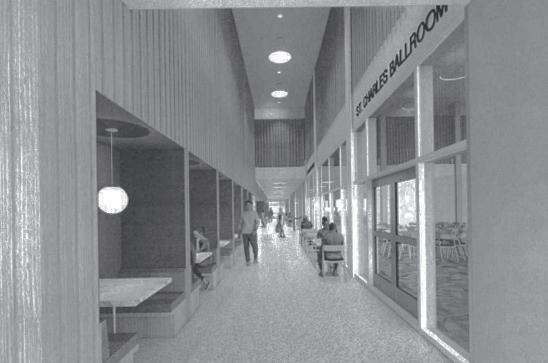
e St. Charles Room has undergone renovations and has been closed since
the start of the spring semester.
As construction nishes in certain areas on campus, like the new residence hall on Calhoun Street and the recent addition of food businesses in the Danna Center, including Smoothie King and
Jimmy John’s, the Loyola community has seen the construction crew transferred to other parts of the Danna Center, including the St. Charles Room.
Kyle Gregore, director of facilities, has been working with a team of experts to
help enhance the Danna Center and other facilities, improving visibility and light while enhancing the scenic view of Loyola.
Gregore said the St. Charles Room closed in December when students left for the holiday break.
He mentioned the amount of strategic planning taken and what’s changing to improve the student center.
“ ere are a few major things that need to take place,” Gregore said. “ e overall renovation plans for the Danna Center call for an improved, direct circulation path that runs straight through the building from the Peace Quad to the Res Quad.”
By February, the path will feature new energy-e cient windows, updated lighting and visibility, and a fresh coat of paint. Construction is set to be completed by this fall.
He said the changes to the kitchen in the Orleans Room were facilitated in part through construction entrances made in the St. Charles Room.
“ e renovation to the St. Charles Room will provide a more elegant, updated, and energy-e cient event space for the community,” Gregore said. “However, it is just one element of a larger project to renovate almost all of the rst oor of the student center, which is such an important space on campus this year.”
e Satchmo’s Lounge is also under construction. Gregore said the construc-
tion happening in the Satchmo’s Lounge will complement the end results of the St. Charles Room and will also be ready in the fall.
Gregore said he is excited for the Loyola community to see the new details being added to the room to attract students.
“My team and I are particularly excited about the glass dividing wall and the opportunity to showcase how dramatically it will change the room’s look and feel,” Gregore said.
“
e renovation to the St. Charles Room will provide a more elegant, updated, and energy-ecient event space for the community.”
Kyle Gregore, The Director of Facilities
Gregore mentioned how respectful the Loyola community has been with the ongoing construction around campus.
“We greatly appreciate all the patience and understanding from everyone in our community as we continue to improve our campus,” he said.
By Abby Barlow aebarlow@my.loyno.edu
Last year, Loyola’s enrollment dropped by more than 100 students for the 202425 school year. e delay in the Free Application for Federal Student Aid caused many issues for students applying to and already in Loyola. Each year, the FAFSA is usually made available in October, but for the 2024-25 academic year, it was made available in December.
Anthony Jones, Loyola’s vice president of enrollment management, said the decline in enrollment can be directly linked to the FAFSA delays.
Over 0% of Loyola students receive some form of nancial aid, with 40% receiving Pell Grants, according to Jones. e delay in nancial aid packages affected many who rely on this support, and some families chose to delay enrollment until later semesters or attend schools with lower costs.
“Windows were closing for universities to send out aid packages to students,” Jones said. “Families in a vulnerable position need a longer window to decide if they’re going to have the money to go to school.”
Loyola students did not receive nancial aid packages until March or April, leaving them just one month to decide before the May deadline.
Biology freshman Carlos Andrade recalled how long the process took for him to receive his nancial aid award package when he applied.
“It was more of a waiting game, and I remember checking my email waiting to see how much I had been awarded,” he said.
“I wasn’t 100% sure of where I wanted to go, and I really needed to know what my expenses were going to be because it de nitely tied into my decision and plays a huge part,” Andrade said. He believed the process this year when applying for nancial aid is much easier.
“A lot of my information was passed on from last year, so I didn’t have to ll out a lot of the basic information again,” Andrade said. “It was more e cient in my opinion.”
Finance and economics senior Angel Allen noticed a big di erence between last year’s application process and the 2025-26 process.
"I wasn’t 100% sure of where I wanted to go, and I really needed to know what my expenses were going to be because it de nitely tied into my decision and plays a huge part."
Carlos Andrade, Biology Freshmen
“In previous years, applying for FAFSA was quite tedious due to the numerous questions and the vast amount of information needed,” Allen said. “However, recently I’ve noticed there are far fewer
questions, making the process easier and quicker.”
Moving forward, students who rely on nancial aid hope there will be no more FAFSA delays, and for better communication from Loyola faculty about nancial options.
“One key recommendation I have for Loyola is to handle FAFSA communication with the same priority as other topics like campus events, religious activities, housing, and bookstore updates,” Allen said. “In 2024, I only got about two emails from Loyola about the FAFSA application process, but received over 50 emails about buying textbooks.”
Film freshman Kassidy Pattain questioned whether Loyola was the right school for her and was very concerned about the cost of housing when she applied.
“It would’ve been a lot easier if the results came out sooner because I would’ve known the cost of attending,” Pattain said. “Towards the end of June, I almost withdrew my application but then was given a full nancial breakdown of where all my nancial aid was going.”
When discussing the university's communication with students about the FAFSA delays, Pattain also felt that Loyola could have communicated more e ectively.
“ e university could’ve helped educate students a little more during the process, or had early in-depth meetings to make sure that everyone was educated on what their options are and what they can be,” she said.
Some students felt a sense of stress

and uncertainty because of the delays, but found that this year's application process went smoother than the process last year.
“I was really concerned about the status of my nancial aid last year,” said

By Matthew Richards mlricha2@my.loyno.edu
e Loyola tennis teams kicked o their 2025 season with a victory against Division I opponents Nicholls State University at City Park Tennis Center.
For the men’s team, it was their rst victory against a Division 1 opponent since the program’s inception in the 2010-2011 season.
“So happy for the men,” head coach Matt Llewellyn said. “Nicholls used to chop us pretty good when I got to Loyola and we knew if we could build this the right way we could beat teams like them regularly.”
e men defeated the Colonels by a score of 5-2, claiming victory in two out of the three doubles matches and four out of the six singles matches.
Senior nance major Akhil Indraba-
lan was crucial to the success of the Wolf Pack, winning both his doubles match (7-5) and his singles match (6-3, 7-6), a feat which earned him his rst Southern States Athletic Conference Player of the Week award for his career.
For the women’s team, the narrow 1-point victory (4-3) was their second victory over the Colonels in two years, as they defeated them by the same margin last spring in April 2024.
e women’s team, which is currently ranked ninth in the most recent National Association of Intercollegiate Athletics polls, swept the three doubles matches and claimed three out of the six singles matches to earn the victory. International business junior Adele Fereres helped clinch the match with a 7-6 and 6-2 victory.
“We played with strong energy, positivity, and competitiveness,” Llewellyn

said. “Our energy and team tennis environment overwhelmed our opponent and helped us win.”
Graduate student Lucy Carpenter was also named the SSAC Women’s Player of the Week for her victories from the No. 1 singles and doubles positions during the match
It was the eighth time Carpenter has won the award in her career, the most of any athlete in conference history and another achievement in what has

Tuesday, Feb. 11 | Perkinston, Miss.
Wednesday, Feb. 12 |
ursday, Feb. 13 | Mobile, Ala.
“ We played with strong energy, positivity, and competitiveness.”
Matt Llewellyn, Head tennis coach
been a historic career for the NAIA’s seventh-ranked singles player nationally. e season quickly ramps up for the
Wolf Pack in the next week as both teams will travel to Mobile, Alabama to take part in the SSAC, Sun Conference, and Appalachian Athletic Conference Crossover Challenge Feb. 6-8. ey won’t play another home match until March 20.
“We want to play with incredible enthusiasm, energy and intensity,” Llewellyn said. “It helped us beat Nicholls, and will continue to help us win as the season continues.”




By Violet Bucaro vabucaro@my.loyno.edu
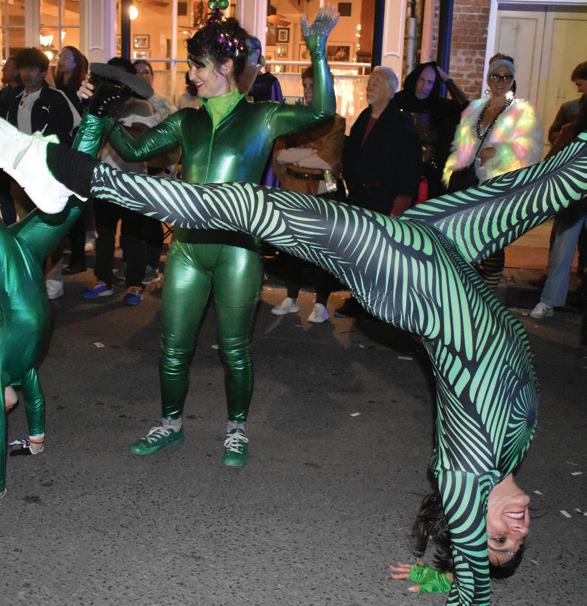
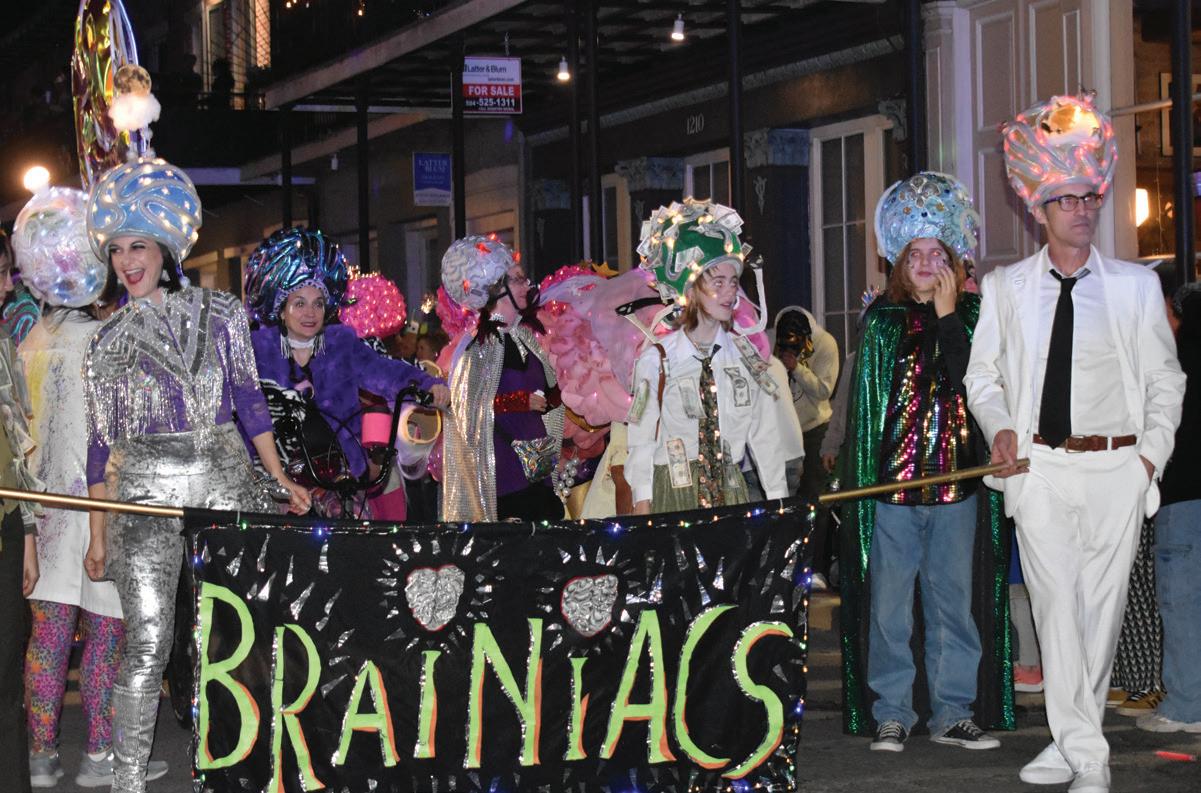
e Intergalactic Krewe of Chewbacchus is a space, alien freak, UFO conspiracy, super nerd themed annual Mardi Gras walking parade that takes place in the French Quarter.
On Saturday, February 1st, Chewbacchus hit the streets earlier than other krewes so as to be held before the Super Bowl. eir signature throws are a variety of handmade crafts, wooden doubloons, quirky stickers, and pocket shrines, according to the krewe. Chewbacchus’s lineup consisted of over 100 krewes and bands, including Men of Black, Chew-Bake-Us, e Stank Wizards of Pomeranian (Cult of Shrek), Muppets from Space, Dungeons & Krayt Dragons, Darth Star Steppers, and more.
According to the krewe, the krewe’s motto is simple, “Saving the galaxy, one drunken nerd at a time.” rough our works, we hope to
elevate all aspects of fandom and celebrate Carnival in our unique way,” according to the Krewe. is year's parade theme was Rise of the Superb Owl and the queen of royalty was Meghan Davis, a local artist of body painting and member of the e Vampire Council. But Chewbacchuus is not just a parade, for it is a religion and a non-pro t. e Cult of Sacred Drunken Wookie regularly performs weddings and religious ceremonies, according to their website.
Ivana Cry is in the krewe of Well-Hung Speakers, the Rocky Horror shadow cast. She said the parade is a place for the quirky community to bond.
“A great place to nd and celebrate your nerdy niche with like-minded individuals,” Cry said.

By Isabella Castillo ivcastil@my.loyno.edu
Six years ago, ames engulfed three historically black churches in St. Landry Parish. e Louisiana community mourned the act of arson as it destroyed three important pillars of the local Baptist community. e act took the lives of community members— it disrupted the heartbeat of a congregation bound by faith and history.
Award-winning choreographer and Kennedy Center Medalist, Cleo Parker Robinson committed to creating a dance piece in remembrance of the community’s strength, sorrow, loss, and unity.
Titled "Sacred Spaces?" the modern ballet piece also connects the 2019 act of arson with the burning of a Denver Church in 1925. e Cleo Parker Robinson Dance Ensemble, based in Denver, Colorado, has now performed the piece, "Sacred Spaces?", for three years. CPRD came to New Orleans to
perform "Sacred Spaces", accompanied by the New Orleans Jazz Orchestra.
Adonis Rose, Grammy-winning Executive Director of the New Orleans Center for Creative Arts Foundation and artistic director of the orchestra, directed the band in performing the music he
“ Humanity should be critical through art.
Cleo Parker Robinson, Choreographer and Kennedy Center Medal of Honor
wrote for the piece. According to Rose, "Sacred Spaces?" marked the rst time he composed music speci cally for a dance work.
Sacred Spaces? became the rst ballet performed at the New Orleans Jazz
Market, christening the venue with an emotional and powerful choreography.
e dancers performed alongside a narrator, singer, and live band while telling the story of loss and resilience, and the consequences of violently losing community members and holy spaces.
“Raising awareness about crimes to places of worship is what this work exempli es,” said Rose on Instagram.
From solos to group pieces, the ensemble danced to Rose’s composition, and a narration developed by Parker Robinson when she spoke to those a ected by the St. Landry res. roughout the piece, the dancers embodied the wide array of reactions and emotions expressed by the community leaders and members who witnessed the after math of the res.
e audience reacted in tears and gasps throughout the performance, as the dancers moved united through their technique and powerful music.
By connecting a modern tragedy with one nearly a century old, Parker

Robinson re ected on the power of storytelling.
“Today, humanity should be critical through art,” she said.
But "Sacred Spaces?" was not just about loss. e performance carried the spirit of endurance and community— qualities that have allowed those
a ected by these tragedies to move forward. In true New Orleans fashion, the night ended with a celebration: the
they



By Eleanor Boucher eabouche@my.loyno.edu
e Super Bowl comes to New Orleans on Feb. 9 and will impact the New Orleans economy and the homeless population.
Gov. Je Landry implemented a sweep of homeless people, temporarily locating them out of the area of the surrounding Superdome and moving them to a “temporary warehouse facility” citing “safety concerns” in a January 1st executive order. e American Civil Liberties Union of Louisiana and 11 other community organizations sent letters to the governor and argued on behalf of the relocated homeless population. ese community organizations are calling this a temporary, “band-aid” solution for the problem. e state of Louisiana released $16 million to operate this temporary housing facility. e city of New Orleans had a con ict with Landry’s plans for the homeless, according to city o cials during Landry’s order to send in state troopers to close homeless encampments. According to UNITY, a homeless services nonprofit, it was given $15 million dollars from the Department of Housing and Urban Development to begin providing permanent housing to homeless New Orleans residents. e Super Bowl sweep caused the city’s plans to be delayed.
“Evidence-based best practices for ending homelessness are centered on permanent housing with supportive services,”
as said by Martha Kegel, Executive Director of Unity, to CNN. ere are “serious concerns” about the conditions at the state center, according to Louisiana Councilperson Lesli Harris in an inter-
view with Verite News. Residents were already in the process of moving into the facility, though the facility was not ready for residents. Upon visiting, Harris identi ed issues, including a need for lined cots and additional bedding, a sewer line issue forces residents to use the only two available outdoor portable toilets, and no television or phones being available for residents to use to contact family and loved ones. Harris also added that services like mental health and case management were not yet functional. e city is continuing its e orts to permanently house the homeless population, saying in a statement from the Mayor’s O ce:
“Despite delays caused by state-led sweeps in the fall, the program has aide signi cant progress: 275 individuals have been housed from inner-core encampments, with eight encampment sites closed and the rehousing completed at an additional six sites throughout downtown.” Along with this, they said, “ e City looks forward to leveraging state support to strengthen its approach and help create sustainable, permanent housing solutions. In 2025, e City of New Orleans will continue to focus its resources on rehousing individuals from encampments and its low-barrier shelter.” Another impact the Super Bowl has is on the economy.
“ is will bring prosperity to the economy,” said Walter Block, an economics professor at Loyola University New Orleans. Block also said the Super Bowl is, “like an export” and is similar to other Louisiana exports, such as jazz. “Local businesses will do better, certainly restaurants. But then, when restaurants do better, so will the shermen, so will the people producing food right

Advertisements for Superbowl LIX on LaSalle St. before the upcoming Superbowl on Feb. 9, 2025.
here. e waiters, the busboys. If it were up to New Orleans, and they o ered us the Super Bowl, we’d be very foolish to say no.” Said Block . According to Jay Cicero, the CEO of
the Greater New Orleans Sports Foundation, in an interview for Fox 15 News, the last time New Orleans hosted the Super Bowl was in 2013 and it brought in $480 million dollars. is year, he expects it to be around $500 million.

By Mark Michel mamichel@my.loyno.edu
It was made legal for Louisiana residents over the age of 18 to conceal and carry a weapon without a permit. At the same time it was made that 17 year olds can be tried and sentenced as adults.
Since October 2024, there have been changes in Louisiana law that have introduced harsher sentencing requirements for minors and previously in July, relaxed certain regulations making it
easier for people to carry rearms without a license.
While intended to increase the ability of people to act in their own self-defense and ensure proper punishment for criminals, some experts worry that the e ects of these laws will have other kinds of consequences.
Former public defender and Louisiana director of the Vera Institute of Justice, and Loyola law professor William Snowden said he believes the one e ect the bills will have is that it will increase
the prison population in Louisiana. ey will increase the ability of the state to punish people, and it will not have that much of an e ect on promoting public safety, which is something we all should be concerned about,” Snowden said.
Snowden credits the recent drop in violent crime in New Orleans to the reforms passed in 2017, which others said actually led to the increased crime in the past several years.
“In 2017, there was this thing called the Justice Reinvestment task force that created a big package of bills that had three goals,” he said. “ e rst goal was really to decrease our prison population.
e second goal was to take those savings and invest those resources in survivors of crime, resources for survivors of crime. And then third was to reduce our recidivism rates from 2017 onward, we saw a decrease in crime,” Snowden said.
Snowden said there was a myth being perpetuated that the 2017 violent crime reforms actually led to an increase in crime, however, areas with no reforms also saw an increase in violent crime.
Last spring, there was a special session in the Louisiana legislature called in order to reform certain aspects of the criminal legal system.
“So the decrease in violent crime in New Orleans and elsewhere in the state is a direct result of those bills that were passed in 2017,” Snowden said. “What's
really concerning is the spring 2024 special session on crime is going to reverse almost all of those successes.”
“ e special session was more focused on increasing the state's ability to
" is special session was more focused on increasing the state's ability to punish people."
William Snowden , Loyola Law Proffesor
punish people,” e special session led to an increase in sentencing ranges and a decrease in opportunities for parole.
“ ere was nothing dedicated towards investing resources into communities’ abilities to thrive, all of those bills that were passed were really focused on making it easier to punish people for committing crimes,” Snowden said.
ere was an e ort to raise the age of charging kids under 18 as kids, but that was recently changed.
“What's concerning about that is all the research when it comes to brain development makes it very clear that young people's brains aren't anywhere close to being developed by the age of 17 or 18,” Snowden said. “With young men, it can be until they’re 25 that their brain
isn’t fully developed.”
In regards speci cally to the laws now allowing open and concealed carry without a license, the New Orleans Police Department attended the legislative session and was one of the loudest voices against these laws and requested special exclusions for certain areas of New Orleans, such as the French Quarter where those laws would have made policing the areas during times like Mardi Gras more di cult.
Recently, the city of New Orleans and other community organizations hosted a gun buyback program in which people traded in their weapons for Playstation 5s.
“Speci cally with Playstations being the kind of compensation that's directly targeted at young people. I think that does nothing but promote public safety,” Snowden said.
In the past year, both open carry and concealed carry were made legal without a license in Louisiana.
“In the state of Louisiana, you have to have a license to get married, you have a license,” Snowden said. “Have to have a license to sh. It makes sense that you should have to have a license to conceal and carry a rearm.”


By Alana Frank anfrank@my.loyno.edu
With 2025 o to a rocky start, award season couldn’t have come at a more interesting time. e 67th Annual Grammy Awards aired Sunday evening, leaving people, including myself, with lots to discuss.
e Grammys started o with many interesting and intriguing red carpet appearances, some owning the red carpet and their expensive gowns, while others decided to leave half of their clothes at home.
roughout the awards show, one of my favorite comedians and former talk show host Trevor Noah helped advocate for the unfortunate who lost their belongings and loved ones in the tragic California wild res. Along with some controversial jokes he made, he asked people at the Grammys, seemingly the wealthiest A-listers and media entertainers, who sipped their champagne in their most expensive out ts, and people watching at home to donate to wild re relief.
e Grammys highlighted the importance of rebuilding the devastated communities a ected by the wild res, and it was a great idea. But perhaps a live celebrity donation would have been better received because the majority at home, who are being asked to donate, are also dealing with the hardships of taxes, tari s, and federal funding cuts, while there are increasing exemptions for wealthy celebrities we watched toast to each other. Nevertheless, they did end up raising $9 million from just the people watching at home.
e performances and award choices were very interesting and had my emotions on a roller coaster ride. ere were so many great artists nominated for awards, and I was very con icted about who would take one home.
Billie Eilish started the show with her song, “Birds of a Feather,” o of one of many of her hit albums, Hit Me Hard and Soft. It’s such a shame she didn’t win a Grammy this year, especially with her seven nominations.
is year, women dominated the award show. Sabrina Carpenter, Lady Gaga, Shakira, and Chappell Roan all won awards, especially Black women like Beyoncé, Alicia Keys, Doechii, and SZA. Beyoncé is the fourth Black woman to win Album of the Year, behind Lauryn Hill, Whitney Houston, and Natalie Cole. Doechii is the third Black woman to win Best Rap Album of the Year, behind Lau-

ryn Hill, Cardi B, and Alicia Keys took home the Dr. Dre’s Global Impact Award, (because she is an icon).
However, Kendrick Lamar makes it onto that list, taking home ve grammys, including Song of the Year and Record of the Year. Although I am happy that Lamar won, (God knows the Grammys needed more representation), I was still con dent Billie Eilish would win Song of the Year. Her song “Birds of a Feather” took over the internet for a long time and was a major hit during her concert performances. I mean, her whole album was a hit.
Although I am happy Beyoncé won Album of the Year for her country album Cowboy Carter, I was totally convinced Billie Eilish would take that one home as well. I wasn’t shocked because of all the controversy over Beyoncé winning 35 Grammys and one of the most awarded artists in Grammy history, but not one award being Album of the Year, and having also a viral album that a lot of people loved.
I think I was either on the wrong side of TikTok or just too much of a Billie Eilish fan because I thought for sure Billie Eilish would win, and she had my vote for Song of the Year and Album of the Year.
Sabrina Carpenter, known for her cool and glamorous out ts, witty energy, and cheeky songs, did not disappoint in her performance and winning her rst Grammy. I was truly happy she won because of the hard work she puts into her performances, and I literally hear her songs everywhere.
Taylor Swift not winning any awards despite being nominated six times and winning at a lot of past Grammy ceremonies was shocking. Her recent album has taken over the world; she literally shut down New Orleans with so many Swifties attending her three concert shows last year. I for sure thought she would win at least one of the six categories.
I loved how supportive and encouraging she was to everyone there who won. She genuinely just looked happy to be
there. I especially loved when she was dancing to Kendrick Lamar’s song “No Like Us.” at was funny to watch.
Shakira’s album, “Las Mujeres Ya No Lloran” won an award for Best Latin Pop Album and was presented by Jennifer Lopez, which was iconic but also ironic in a way.
It wasn’t too long ago when Lopez shared the Super Bowl LIV halftime stage with Shakira, and we heard all about it in Lopez’s documentary Halftime.
Lopez supposedly said, “I’m trying to give you something with substance, not just us out there shaking our fucking asses and fucking belly dancing.” Many, including me, thought she was referring to Shakira. I mean, she has been “Hips Don’t Lie” for a long time.
However, some news outlets report she never said anything targeting Shakira. I was happy for Shakira, though. She hadn’t released any music for seven years because of complications in her life, but she did great on stage for the rst time in seven years. Who doesn’t love a success story?
I liked the nominations for Best New Artist and was de nitely torn about who would win. I’ve seen Chappell Roan, Doechii, Raye, Sabrina Carpenter, Teddy Swims, and Benson Boone’s music everywhere, especially because of funny trends with their music.
I really wanted Raye to win because, again, who doesn’t love a good success story? (If you listen to her music, you’d understand).
However, these were all great nominees, and I was content with Chappell Roan winning. I do hear a lot of her music; I just didn’t think it would win against the others. I was also genuinely happy Doechii won Best Rap Album. She really deserves it, along with some of the other nominees, and I would have been more excited if she won Best New Artist, too. One concerning and quite uncomfortable moment from this year’s Grammys was Kanye West’s red carpet appearance with his wife, Bianca Censori,
By Olivia Sanyal ossanyal@my.loyno.edu
Bob Dylan is a cultural icon who has paved his way through the music industry starting in the 1960s. Hit songs which have been staples throughout the years are, for example, “Knockin’ on Heaven’s Door,” and “Like a Rolling Stone.” Minnesota native Bob Dylan, born in May 24, 1941, started his music journey in New York City writing and performing folk music with a lean to rock inspired music later on in his career resulting in a combination of folkrock as his music genre.
who dropped her fur, exposing her fully nude body. ere has been an in ux of concern for his wife’s well-being. Kanye left early with his wife and claimed they left the Grammys willingly. I think it was embarrassing, to say the least, but I’m not sure if they really thought that was appropriate for an awards show or just wanted to be talked about no matter what was said.
It looked like the Grammys successfully delivered for Generation Z. Generation Z loudly wanted Chappell Roan, Olivia Rodrigo, Charli XCX, Doechii, and Billie Eilish at the Grammys. Not even 24 hours later, Instagram was ooded with priceless and funny reactions, making for the best award-show memes.
I know Charli XCX said her performance was going to be “the least Grammy-appropriate performance,” but I did not expect her to have a whole dance party with half-naked people throwing underwear in the air. I was accepting of it because that is so Generation Z.
I really liked the CEO of the Grammys, Harvey Mason Jr. He touched on the organization’s changes over the years, including having a lot more diversity within their voting members. He mentioned e Weeknd’s three-year boycott for the lack of transparency and fairness within the voting process. His surprise performance left everyone, including myself, shocked, performing two of his hit songs, “Cry For Me,” and a TikTok hit, “Timeless.”
Let’s talk about how long the Grammys actually were. It was three and a half hours, but it felt like it was happening all day. It felt like there were commercial breaks after every award announcement or performance. It was starting to run a little too long toward the end.
I think it’s safe to say the Grammy’s award night was full of fun and shocking surprises, with lots of fashion and celebrity drama. With many awards show sparking debates and discussions, one thing is certain: e Grammy’s never fail to get people talking.
e lm "A Complete Unknown" came out Dec. 25, 2024 with popular actors such as Timothee Chalamet starring as Bob Dylan, Monica Barbaro as Joan Baez, and Elle Fanning as Sylvie Russo. Timothee Chalamet gave a compelling and inspiring performance by giving great impersonations, captivating the songs, and fully embodying the character. Timothee Chalamet has been making his way through many feature lms over the years including "Wonka", "Dune", "Little Women", and more. With each lm, Timothee has been able to make a lasting impression on his audiences. In all honesty, I consider Timothee Chalamet to be one of the best actors of his time. e rst movie I saw with Timothee Chalamet was "Call Me By Your Name" which was one of his breakthrough movies which I also highly recommend as a must watch.
I saw this lm over winter break and, of course, went through the regular movie procedures. I got my large popcorn with butter, medium Dr Pepper, and chilled Junior Mints. I can positively say the build up of snacks and ads sort of transports people into di erent dimensions for that hour and 45 minutes, or however long the lm is. A Complete Unknown was a two-hour and twenty-minute lm, but went by in a ash for me. I think the movies we see can inspire us to create, try new things, or buy a new article of clothing. I was de nitely inspired by this lm and went home after the showing strictly playing Bob Dylan in my car. If you haven't yet, de nitely go purchase a ticket for you and a friend and see A Complete Unknown to be dazzled, blown away, and inspired!
Feb. 7, 2025
In the Catholic faith, which is supposedly the guiding doctrine of our school, it is said that when Jesus saw the temple being used as a marketplace for things that had nothing to do with the worship of God, He destroyed it. Is our school the same? We deserve to know if the money is going towards things that don’t advance social justice, charity, and the mission statement of the school.
Is all our money going towards things such as educating our students well, providing quality food and housing, and paying its employees in a fair and equitable manner? Or is it going towards things that have nothing to do with the intent of education and support?
If seeing God in all things is one of our core tenets, should we not be sure that our school is helping us to do that? And not just helping the Board of Trustees?
Jesus also said in Mark 10:25, “It is easier for a camel to walk through the eye of a needle than it is for a rich man to enter the kingdom of God.” Are you helping your students or lining your own pockets?
We deserve to see where our money is going. We deserve to know. e workers deserve a union because without them, we wouldn’t have food in the Orleans Room, Starbucks, Smoothie King, Bird N Brine, Wild Blue, or Jimmy Johns. Without them, the Biever bathrooms
would never be cleaned, the trash in the buildings would never be taken out, our campus would fall apart, without our Sodexo workers, our custodial sta , and every other member of the campus who doesn’t get paid what they’re worth.
We’d be starving, in a place that never gets cleaned, and trash which never gets taken out. With lights and elevators that don’t work. Internet that’s shut o no water, nothing. We would not have a campus.
President Cole said in an interview with the Maroon that as president of a small Catholic university in the South, he lacks the power that students claim he has over changing the endowment, over the war in Gaza, and over the student code of conduct and its decisions.
Well this is the request, something that is well within the pPresident’s ability, show us the money, tell us where it’s going, and can you justify every investment that’s made that advances charity, social justice, the pursuit of education, and all the other things that the school holds dear?
Hypocrisy, often, has no consequenc-








es, but honesty does. Students have consequences, workers have consequences. When we miss class, miss work, don’t check our email, don’t take out the trash,


we have consequences. We all have responsibilities to each other. We take out the trash in our dorms for our roommates, and bring it to the trash room for the custodial sta . We submit our papers to our professors, they give us a grade, and they give us the tools to succeed on these papers. Professors, students, workers, and faculty are all responsible to each other. We all support each other through our actions because everything we do here keeps this school alive, keeps our GPAs rising, our paychecks coming in, and provides a place for us where we’re told we will be supported in a safe environment to the best of the school’s ability. Obviously, resources are limited and the world is expensive, but is the school doing everything they can? Is the president and the board of trustees responsible to us? Are the administrators responsible to us?
We’re losing students, we’ve been losing money, we’ve been losing the academic ability and drive of our professors





and students.
e palpable apathy in the classroom and the hallways a ects us all. You can pretend that we’re just activists as a trend, that we’re idealistic, but it hasn’t been working. e way you are doing things does not work. Be honest, be transparent, support your students, your professors, your faculty and sta before you support yourselves. Is that not being a leader? We need unions, we need an appeals board. We need more faculty and student representation in the administration, not just what we get from the Student Government Association. Meet with clubs, meet with the Maroon, meet with the summa cum laude, and the 2.5 GPA people and every one in between. We all have concerns, we all struggle, but we also keep this school alive. Without us, there would be no Board of Trustees and there would be no president.
Maybe we’re wrong. Maybe our budget is perfect, every investment, every choice made, is all equal, fair, balanced, in line with Catholic Social Teaching and Jesuit values, and represents the popular will of the students, faculty and sta . If we are, prove it. If we’re not, hypocrisy often goes unpunished.
“Nothing that is hidden will not be revealed” Luke 8:17.

HOWL Super Bowl
GROWL Super Bowl tra c
HOWL Bears for Bae
GROWL broken Smoothie King blenders
HOWL Black History Month
GROWL Erasure
HOWL Awesome RA's
GROWL Construction noises
HOWL Homecoming Week
The editorial on this page represents the majority opinions of The Maroon’s editorial board and does not necessarily re ect the opinions of Loyola University. Letters and columns re ect the opinions of the authors and not necessarily those of The Maroon’s editorial board.
The Maroon does not represent the opinion of administration, sta and/or faculty members of Loyola.
Letters are subject to editing for length, grammar and style. Please limit submissions to 400 words. Submissions are due no later than 4 p.m. the Sunday before publication.
Please send all submissions — The Maroon, 6363 St. Charles Ave., Box 64, New Orleans, LA 70118.
Email us your letters — letter@ loyno.edu.
Submissions may also be made online at www.loyolamaroon.com.




The same personalized support. The same hands-on learning experience. All new possibilities for your career.







Explore versatile programs at Loyola College of Law.







Juris Doctor – full time, part time, and evening programs


Master of Arts in Environmental Law




Master of Arts in Health Law & Administration










Franckiewicz ‘20, JD '23 Bachelor of Accountancy