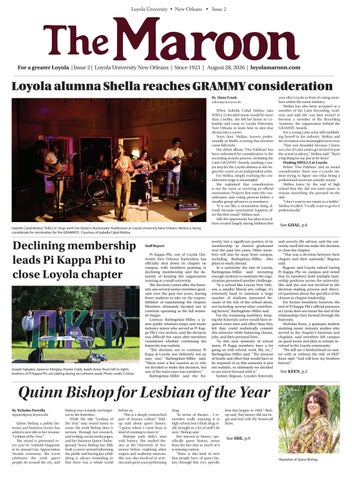
Loyola University • New Orleans • Issue 2
For a greater Loyola | Issue 2 | Loyola University New Orleans | Since 1923 | August 28, 2026 | loyolamaroon.com
Loyola alumna Shella reaches GRAMMY consideration By Alana Frank anfrank@my.loyno.edu
When Isabella Cabal Molina (aka SHELLA) decided music would be more than a hobby, she left her home in Colombia and came to Loyola University New Orleans to learn how to turn that dream into a career. Years later, Molina, known professionally as Shella, is seeing that decision come full circle. Her debut album, “Dos Palabras”, has been submitted for consideration in the recording awards process, including the Latin GRAMMY Awards, marking a major step for the Loyola alumna as she begins her career as an independent artist. For Molina, simply reaching the consideration stage is meaningful. She explained that consideration is not the same as receiving an official nomination. Projects first enter the consideration and voting process before a smaller group advances as nominees. “It is not like a nomination thing already because nomination happens after this first round,” Molina said. Still, the opportunity has placed an album created largely during Molina’s first Isabella Cabal Molina “SHELLA,” sings wirth her band in Nunemaker Auditorium at Loyola University New Orleans. Molina is being considerate for nomination for the GRAMMYS. Courtesy of Isabella Cabal Molina.
Declining membership leads Pi Kappa Phi to close Loyola chapter
Joseph Sabados, Spencer Stingley, Hunter Cobb, Isaiah Jones (from left to right), brothers of Pi Kappa Phi, are tabling during recruitment week. Photo credit: Cristian
Staff Report Pi Kappa Phi, one of Loyola University New Orleans’ fraternities, has officially shut down its chapter on campus, with members pointing to declining membership and the demands of keeping the organization running at a small university. The decision comes after the fraternity saw several senior members graduate over the past two years, leaving fewer students to take on the responsibilities of maintaining the chapter. Members ultimately decided not to continue operating as the fall semester began. Lorenzo Barbegelata-Miller, a junior public relations major and music industry minor who served as Pi Kappa Phi’s vice archon, said the decision was difficult but came after members considered whether continuing the fraternity was realistic. “The decision not to continue Pi Kapp at Loyola was definitely not an easy one,” Barbegelata-Miller said. “There were a few reasons as to why we decided to make this decision, but one of the main ones was numbers.” Barbegelata-Miller said the fra-
ternity lost a significant portion of its membership as seniors graduated over the past two years. Other members will also be away from campus, including Barbegelata-Miller, who plans to study abroad. At a university the size of Loyola, Barbegelata-Miller said recruiting enough students to maintain the organization presented another challenge. “At a school like Loyola New Orleans, a smaller liberal arts college, it’s extremely hard to maintain a large number of students interested because of the size of the school alone, not including several other contributing factors,” Barbegelata-Miller said. For the remaining members, keeping the fraternity active would have required more time and effort than they felt they could realistically commit this semester while balancing classes, jobs, and their personal lives. “As this next semester of school starts, Pi Kapp members have a lot going on with school, work, life, etc.,” Barbegelata-Miller said. “The amount of hustle and effort that would have to be required of us this semester is just not realistic, so ultimately we decided to not move forward with it.” Sydney Begoun, Loyola’s fraternity
year after Loyola in front of voting members within the music industry. Molina has also been accepted as a member of the Latin Recording Academy and said she was later invited to become a member of the Recording Academy, the organization behind the GRAMMY Awards. For a young Latin artist still establishing herself in the industry, Molina said the invitation was meaningful on its own. “That was beautiful because I know not a lot of Latin artists get invited to join the actual academy,” Molina said. “That’s a big thing for me just to be there.” Finding SHELLA at Loyola Before “Dos Palabras” and an award consideration, there was a Loyola student trying to figure out what being a professional musician actually meant. Molina knew by the end of high school that she did not want music to remain something she pursued on the side. “I don’t want to see music as a hobby,” Molina recalled. “I really want to go for it professionally.”
See GOAL, p.6
and sorority life adviser, said the university itself did not make the decision to close the chapter. “That was a decision between their chapter and their nationals,” Begoun said. Begoun said Loyola valued having Pi Kappa Phi on campus and noted that its members hold multiple leadership positions across the university. She said she was not involved in the decision-making process and directed questions about the specifics of the closure to chapter leadership. For former members, however, the end of Pi Kappa Phi’s official presence at Loyola does not mean the end of the relationships they formed through the fraternity. Nicholas Keen, a graduate student studying music industry studies who served as the chapter’s historian and chaplain, said members left campus on good terms and plan to remain involved in the Loyola community. “We still are a brotherhood no matter with or without the title of PKP,” Keen said. “And will love my brothers forever.”
See KEEN, p.3
Quinn Bishop for Lesbian of the Year By Nicholas Parrella nrparrel@my.loyno.edu Quinn Bishop, a public historian and business owner, has added a new title to her resume: “Lesbian of the Year.””. The award is presented every year by Ambush Magazine at its annual Gay Appreciation Awards ceremony. The event celebrates the work queer people do around the city, and
Bishop was certainly not forgotten in the festivities. While the title “Lesbian of the Year” may sound funny to some, the work Bishop does is serious. Through her research, and writing, social media pages, and her business Queer Underground Tours, Bishop has fully built a career around informing the public and having fun while doing it, always reminding us that there was a whole world
before us. “This is a deeply entrenched part of human culture,” Bishop said about queer history. “I guess where I come from is kind of wanting to share it.” Bishop’s path didn’t start with history. She studied theater at the University of Tennessee before exploring other majors and academic interests. She was also involved in activism and spent years performing
drag. “In terms of theater… I remember really enjoying it in high school, but I think drag really brought in a lot of stuff I do now.” Bishop said. Her interest in history, specifically queer history, stems from the fact that so much of it is missing context. “There is this kind of view that people have of queer history through this very specific
lens that begins in 1969,.” Bishop said. This history did not begin and end with the Stonewall Riots.
See SHE, p.9
Headshot of Quinn Bishop.
The Maroon August 28, 2026
2
PUZZLES Across 1 "Dancing Queen" pop group 5 "Wish I was there!" anxiety, for short 9 Department store chain headquartered in New York's Herald Square 14 Crystal ball gazer 15 Not of the clergy 16 Anticipate 17 Fix for torn jeans, perhaps 19 Dried beef snack 20 Small brawl 21 "Copperhead Road" singer Steve 23 Near-failing grade 24 Foil-wrapped chocolate drop 27 Election season event 30 Driver's approx. 31 Mined find 32 Cartoon explorer with a talking backpack 36 "No big deal" 40 Gets a single, double, triple, and home run in one game 44 Hay fever sound 45 Unwelcome campground visitor 46 Do some sums 47 __ Angeles Sparks 49 Loves a bunch 52 Accept unintended consequences 58 Abbreviation on a toothpaste box 59 Mexican coins 60 Many a Chopin piano piece 64 Phi Beta __ 66 Ideal partners, and what can be found at the ends of 17-, 24-, 40-, and 52-Across? 68 Everglades wader 69 Jai __: fast-moving court game 70 Competes (for) 71 Get to, as a destination 72 Ivy League school in New Haven 73 Baby-voiced red Muppet
Down 1 Inquires 2 "Molto __": "Very good," in Italian 3 Red root vegetable 4 "Respect" singer Franklin 5 St. Pete's st. 6 Hall's Rock & Roll Hall of Fame partner 7 Old Testament book after Jonah 8 Autumn colour 9 Magnificent 10 Bowl over 11 Rapper __ B 12 "Yowza!" 13 Eyelid sores 18 Ode writer 22 Caustic chemical 25 Upgrade, as decor 26 "Teenage Dream" singer Perry 27 Capital of Qatar 28 "The Little Mermaid" prince 29 "Little Women" sister of Meg, Jo, and Amy 33 Poetic sphere 34 Numbered hwy. 35 "Eureka!" 37 Injury reminder 38 Merrie __ England 39 Sneaker brand since 1916 41 One and only 42 Walking trail 43 Timeline units 48 That lady 50 Day, in Latin 51 Eight-note interval 52 Fraud 53 Pithy bit of wisdom 54 "It's a Wonderful Life" director Frank 55 Writing class assignment 56 Simoleons 57 Typical 61 Gas or elec. 62 Consider to be 63 Gas brand in Canada 65 Chest muscle, for short 67 Fib
For weekly puzzle answers, visit our Website via the QR code:
STAFF LIST Editorial Board
Contributors
Editor in Chief - Alana Frank Managing Editor - Elise Beck Pre-Content Director - Stella Purdue Post-Content Director - Carlos Andrade Exuecutive News Editor - Lily Bordelon Campus News Editor- Nicholas Parella Worldview Editor - Angelica Pineda Life & Times Editor - Amari Winchester Ass. Life and Times Editor - Alondra Gonzales Sports Editor - Zoryn Johnson Opinion/Editorial Editor - Maria Touzard Breaking News Editor - Mabel Regalado-Hernandez Copy Editor - Pablo Pineiro Ramy The Wolf Creative Director -Makayla Parker The Wolf Designer - John Zwiers Senior Staff Photographer - Sophia Renzi Photo Editor - Pharrell Every Social Coordinators - Elena Godoy, Adriana Escobar, Eryn Goines Broadcast Producer - Ruth Brown Broadcast Lead Anchor - Dessadra Tezeno Co- Anchor- Eleanor Boucher-Ferry Newsletter Writer - Rodrigo Delgato Distribution Manager - Sophia Renzi
Nikolai Huilgol, Athalie Dore, Ella Bozeman, Angelica Petit, Cae Nguyen, Amiyuh Tobias, Isabelle Kehoe, Kennedy James, Kate Dalrymple, Lauren Stuart, Kaya Tezeno, Riddick Winter, Bianca Mansell Gatti , Teddy (Edward Smith), Katia Vincent Student Media Adviser: Michael Giusti Assistant Student Media Adviser: Hannah Levitan
CONTACT US Main Office - (504) 865 - 3535 Business Office - (504) 865 - 3536 Adviser’s Office - (504) 865 - 3295 Correspondence - maroon@loyno.edu Letters to the Editor - letter@loyno.edu Advertising - ads@loyno.edu Website - www.loyolamaroon.com Twitter - @loyola_maroon Facebook - The Maroon Instagram - @loyola_maroon Our office is in the Communications/ Music Complex, Room 328. Send mail to: The Maroon, Loyola University, Campus Box 64, 6363 St. Charles Ave., New Orleans, LA 70118 The Maroon is published every Friday. Unless otherwise noted, all content is copyrighted by The Maroon. All rights reserved. First copy free to students, faculty, and staff. Every additional copy is $1.00. The Maroon is printed on 30 percent post-consumer recycled content.
CAMPUS
The Maroon Aug 28, 2026
3
KEEN SAID: THE CLOSURE OF PI KAPPA PHI Continued from page 1 Keen said former members remain active across campus and are willing to continue serving the Loyola community despite no longer having an active Pi Kappa Phi chapter. While Pi Kappa Phi will no longer have an active chapter on campus, Loyola is already looking toward the future of its Interfraternity Council community. Begoun said the university is currently seeking other Interfraternity Council fraternities that could potentially establish chapters at Loyola. The university has an expansion policy outlining the process for bringing additional fraternities and sororities to campus. For Barbegelata-Miller and Keen, the letters Pi Kappa Phi may no longer represent an active organization at Loyola,
but the relationships formed through the fraternity remain.
“We are still a brotherhood no matter with or without the title of PKP.” — Nicholas Keen KPK brother
“We still are a brotherhood no matter with or without the title of PKP,” Keen said.
Jared Chan, left, and Bryant Istre, right, pose together with a bicycle, dressed to represent their fraternity, Pi Kappa Phi. Courtesy of Jacob Meyer
SGA: New year, new administration Inside the changes Student Government is making this year By Lily Bordelon lmbordel@my.loyno.edu
Student Government Association organizations are starting to undergo change in both goals and events due to the annual shift of leadership roles. With the 2026-2027 year beginning, SGA and the organizations within it have been met with new individuals in certain positions, which were decided before the school year began. Because of this change in direction, these specific leaders are now targeting their personal ambitions for Loyola’s community, especially in their respective organizations. Last May, international business senior Violette Worley and finance and economics senior Makayla Horton won the titles of President and Vice President of SGA with their CARE campaign, which displayed their aspirations while in office: strengthening Loyola’s identity in the city, creating a more affordable campus, and deepening campus connection. According to Worley, SGA is filling the school year with plans, which includes working towards specific goals stated in their campaign. Worley listed some specific aspirations, like “increasing access to emergency grants and scholarships, creating volunteer partnerships with organizations throughout New Orleans, and bringing more engaging programming to campus.” “We want to build on the work SGA has already accomplished while introducing new initiatives that make students’ experiences at Loyola more connected, accessible, and meaningful,” she said. Additionally, Worley stated that SGA wants to ensure that the organizations underneath them feel supported throughout the year, which includes developing student leaders and increasing involvement. “Student organizations are such an important part of campus life and we want to strengthen communication to create more opportunities for organizations to collaborate with one another
and with SGA,” she said. Despite SGA’s excitement, Worley acknowledged the responsibility that comes with her and Horton’s roles within the largest organization on campus. With this responsibility, she expressed her belief that SGA can accomplish the goals set for this year, especially with the strong cabinet that they have and the confidence they bring to the table. “Of course not everything will happen exactly as planned, but we do believe that our commitment to bettering the student body will allow us to make meaningful progress,” she said. Both Worley and Horton feel excited for what they can accomplish for Loyola’s community while in their roles, and they hope they can connect stu-
J-Term in Iceland J-Term study abroad info sessions kick off next week with the first being for Iceland. Interested students can attend Wed. Sept. 2 at 4 PM in Marquette Hall Room 401. Keep and eye out for other info sessions coming soon!
Alumni Spotlight
“We want the students to see SGA as an organization that listens to them and can see their ideas turn into action”
This semester in the Maroon, campus news editor Nicholas Parrella will interview Loyola alumni for a weekly alumni spotlight! If you or anyone you know is an alum, scan the QR code below for a chance to be featured in an issue.
— Violette Worley President of SGA dents with SGA even more than before. “We want students to see SGA as an organization that listens to them and can see their ideas turn into action,” Worley said. “We have an opportunity to create new opportunities for students, give back to the Loyola and greater New Orleans community, and continue building the next generation of leaders.” Alongside the new SGA administration, the University Programming Board also introduced new members, including junior mass communications major Macee Fielding, who is now Director of the University Programming Board. Fielding’s main focuses as of the start of this year are recruitment for the University Programming Board and connection with the broader campus community. “I am feeling great about UPB's plans for this year. My e-board and I are work-
SGA Chief of Staff Halima Jammeh and senator Saige Berthelor work together in the SGA hub. Photo illustration by Elise Beck for the Maroon.
ing hard to keep traditions alive, while also trying to expand our event reach,” she said. Expanding event reach, according to Fielding, is something she wants to accomplish by partnering with student-run organizations on campus, which she expressed would hopefully highlight both those organizations and the University Programming Board. Recruitment-wise, Fielding stated that the University Programming Board held an interest meeting on Wednesday, which also featured free pizza and a raffle. According to Fielding, the University Programming Board will continue holding meetings on Wednesdays at 5:00
p.m. for those interested in joining. “I feel confident in UPB’s ability to meet these goals. I have a dedicated and very qualified team working alongside me,” she said. “This is my first year working for SGA in this capacity, and I think my fresh perspective will add value to this position.” These organizations are still developing future plans and events due to the semester just beginning, but they encourage students to be on the lookout.
Scan the QR code above to nominate an alumni
The Maroon Aug 28, 2026
WORLDVIEW
4
911 operations in Orleans parish use AI to assist operators By Angelica Pineda acpineda@my.loyno.edu
The next time you call 911 to report a car accident, you might be connected to an AI system used to assist 911 operators during call surges. The Orleans Parish Communications Department has been using the assistance of AI for managing and assisting 911 call takers for the past three years. However, community members across Loyola and Orleans Parish are just now expressing their concerns after a false publication about how the department uses AI was released. The false publication was released and corrected in early August, but Loyola students are still skeptical of how the department’s use of AI is appropriate for 911 operations. Loyola alumnus and Executive Director of the OPCD, Karl Fasold, explains how AI is not a replacement for human call operators but a tool for them to handle the influx of calls the operators receive within short intervals of each other. Fasold saw the possibilities of AI as an instrument for efficiency after putting 911 call data into Carbine Apex, the OPCD’s cloud system. The OPCD utilized the system to recognize patterns within 911 calls. Fasold explains how a particular call pattern became the inspiration behind the creation of 911’s AI software. “We identified a pain point, a problem, that every morning between 6 a.m. and 8 a.m., and every evening between 4 p.m. and 7 p.m. on weekdays, we would have calls holding in queue, so that meant when you called 911, the call couldn't immediately go to a human; it went to a queue where you heard a voice announcement,” Fasold said. Fasold explained that the calls were being held in queue, meaning that there was a line of callers waiting to talk to an operator, because of “drive time.” During these times, the OPCD receives floods of calls that are often about the same automobile accident. This sudden increase
often overwhelms the OPCD’s operating system, as there aren’t enough call takers compared to the amount of calls coming in. The ratio of calls to call takers is one that cannot be solved by different scheduling or more operators, according to Fasold. “The last thing we want to do is discourage people from calling. We tried using split shifts, using a power watch, adding additional people on, but the real answer is you cannot staff enough people, fiscally,” Fasold said. Mikaylah-Rosalina Framboise is a Loyola student who is concerned about staffing for 911 operations. “The solution to understaffing is funding 911 operations and paying people,” Framboise said. Even with unlimited funding, staffing enough people to handle drive time surges would be impossible, according to Fasold. Fasold looked to develop an AI software that would eliminate queue times by handling multiple calls at once. The OPCD implemented this software to keep encouraging callers to report car accidents. The key component of the AI is that it only takes calls related to said automobile accidents within a 200-meter radius, according to Fasold. Any other calls will be redirected to a human operator. Once the queue starts within the radius and the AI begins taking calls, it asks if the caller is calling about the accident; most of the time they are, according to Fasold. To ensure the safety of the caller and the situation they may be calling about, Fasold has built some protections into the software. “If you say anything but an unequivocal yes, in any language, you're going to go to a human. You’ll either go back to the queue, or we find that oftentimes between that brief interval a human is now available. So you’ll go to that call taker," Fasold said. The AI has become a tool to reduce
Photo of 911 operations on Oct. 15, 2025. Operators are working at the Orleans Parish Communications department. Courtesy of
the queue rather than take the jobs of operators. Fasold illustrates this point by explaining just how many calls the operators receive within seconds of an accident. “The piece of this puzzle people don’t realize is we get a surge of these calls literally almost simultaneously for the first five minutes of an auto accident. Five, ten, fifteen calls can come in within a few seconds of each other,” Fasold said. The software has a few other “guardrails” in place that assure an AI will not replace a human operator. “If the system fails, you go to a human; if you say anything but yes, you go to a human; if you decide to just stay on the line, you go to a human. So there is no failure case that you won’t go to somebody,” Fasold added. Although AI is advanced, students and staff at Loyola are concerned about whether it is advanced enough to inter-
pret accents, foreign languages, and humans in distress. Sarah Nguyen, a sophomore music performance student, brings attention to New Orleans’ Vietnamese community and whether AI can interpret Vietnamese and human emotion. “So, when they're having AI help with 911 calls and situations, it's just not as helpful as someone who understands the emotions behind Vietnamese translation into English. I really hope that they find a way to hire someone, a real live person, because they will definitely be more helpful to the situations at hand,” Nguyen said. Despite AI’s advanced translation abilities, Fasold explains that the AI will redirect to human translators as needed. “We are working furiously to branch that out to additional languages. That doesn’t mean we won’t get a human interpreter on the line, but in those first few
early seconds of a 911 call when you're desperately trying to tell us what's going on, we can understand what you’re saying,” Fasold said Despite the fears of AI misinterpreting emotion, calls, and taking jobs, Fasold reiterates AI’s role in 911 operations as a reinforcement rather than a replacement for human operators. "I fear this technology will just lead to more jobs being cut in sectors that really require a human being,” Framboise said. “Dealing with 911 calls, when someone is having the worst moment in their life, that's why my people are here. To help those people. An AI can’t do that. What can an AI do? It can be a tool in handling those 911calls more efficiently and getting them the resources that are necessary there as fast as possible,” Fasold said.
More communities are being affected by rising heatwave
Photo of people exercising at Audubon park. A woman walks her dog and a man is riding a bike. Coutsey of Kaya Tezeno
By Alondra Gonzalez amgonzal@my.loyno.edu
Extreme heat waves are reaching record highs, affecting local communities and raising concerns about their lasting impact across the country and worldwide. Heatwaves are periods of unusually high temperatures lasting several days, affecting health, agriculture, and public infrastructure. High-humidity areas such as Louisiana experience greater physical symptoms and heat-related ill-
ness. Drought conditions worsen in dry areas across the country, increasing the risk of wildfires. Edward Smith, a junior psychology major at Loyola, shared his experience of staying in New Orleans during the summer. “When I was younger, being outside felt as if the sun would give us energy. Now, plans of going to the park and hanging out with friends have to be cancelled because of the excessive heat,” Smith added. Records show an increase of 10 to 15
degrees Fahrenheit above normal from the Southwest into the Great Plains, disrupting plans throughout the summer such as outdoor work, Fourth of July celebrations, and scheduled vacations. Meredith Bates, a sophomore studying music and English writing from Ocean Springs, Mississippi, talked about how the heat directly affects her day-today life with other illnesses. “Because of the heat and the humidity in the South, it’s really difficult for my diabetes adhesives to stick to my arm. It also makes me experience more side ef-
fects from my medication, so it makes going outside miserable and not worth it,” Bates said. Heat-related deaths in the country are also on the rise, with a 50% increase between 2000 and 2025, killing more people than any other weather-related event. According to a news article by the Associated, 5,700 more deaths were reported in France after a heat wave reached Europe in June. Sophomore environmental studies student Abby Thomsen shared her thoughts on how heat domes in the Midwest affected her summer in Chicago, Illinois. She highlighted its effects on homeless and elderly communities sensitive to climate. “This [heat dome] was happening at the same time Chicago was dealing with smoke from the Canadian wildfires in July, so we were dealing with both dangerous heat and air quality,” Thomsen said. Despite these changes, the belief in climate change among Americans re-
mains stable. El Niño, a natural weather pattern attributed to changing temperatures in the Pacific Ocean,leads to mixed opinions on man-made effects resulting in excessive heat. Robert Thomas, Professor of Environmental Communication and the Director of the Center for Environmental Communication at Loyola University, discussed the difficulties in getting people to understand climate change and what this means for the future. “Although these changes could very well be a cycle that can pass like many others, the patterns we're witnessing are ones that scientists have been saying about climate change for years,” Thomas said. He encourages individuals to take various measures to stay protected from the extreme heat by staying hydrated at all times and seeking air conditioning, which Thomas believes are most effective due to how humans have adapted to cooling technology, creating “a different sensitivity” than before it was invented.
LIFE AND TIMES
6
The Maroon Aug 28, 2026
GOAL: Shella for GRAMMYS consideration Continued from front By Alana Frank anfrank@my.loyno.edu That goal led her to Loyola's Popular and Commercial Music program. Molina said she was drawn to the program because it allowed her to explore more than singing. Her classes introduced her to songwriting, production, marketing, music business, and other parts of the industry she would eventually have to navigate as an independent artist. "The program really helped me understand that even if I don't maybe succeed in singing, I will always have a professional place in the industry," Molina said. Her professors also pushed her to think about why she wanted to create music in the first place. Instead of making songs based solely on what might perform well online or what genre might be commercially successful, Molina said she learned at Loyola to view music as an expression of herself. "Your talent is just like an expression of yourself, of what's going on in your mind, in your heart," Molina said. Professor Mercedes Diamond was among the Loyola faculty members Molina said had an impact on her development. Through songwriting classes and vocal coaching, Molina said Diamond encouraged her to dig deeper into her experiences when writing. Molina also found community
outside of her own program, particularly among students in Loyola's hip-hop and R&B program. Working with other students in studios and performances taught her something she would need after graduation: how to create with other people. "The program really helped me get used to it and know it and enjoy it because I really enjoy writing music and making music with other people," Molina said. Loyola also gave her opportunities to perform, find gigs,s and work on the business and marketing sides of music. Instead of only learning about the industry in a classroom, Molina said students were expected to go out and do the work themselves. "A lot of learning from the experience really got me prepared for the real world," she said.
Two words for your 20s That real world became the inspiration for "Dos Palabras". After graduating, Molina spent her Optional Practical Training year working on her first full-length album with a producer in Florida. She had previously released singles and created a four-song EP while at Loyola, but "Dos Palabras" became her first attempt at building a full professional album. The project did not begin with a finished list of songs. Instead, Molina began writing and
recording while experiencing many of the changes that came with graduating college and entering her early 20s. Eventually, she realized those experiences were the album. "I started to discover that I wanted to do a concept album," Molina said. "I wanted to do an album where all of the songs were connected, and I could tell a story." Love, heartbreak, anxiety, loneliness, uncertainty, and learning who you are became pieces of that story. Production lasted for much of 2025, and Molina gradually shaped the songs around the experience of navigating her 20s. The concept even determines the titles. Dos Palabras means "two words" in Spanish, and every song on the album has a two-word title. The album's final track, also titled "Dos Palabras," reveals the two words at the center of the project: your 20s. Molina spent much of the album's creation living with her producer and his family outside Miami. She did not have a car or bike and found herself spending long stretches of time alone. That isolation became part of her creative process. "It really put me to question a lot of things about myself," Molina said. The ocean nearby also connected Molina with another part of her artistic identity.
The meaning “SHELLA”
behind
Shella was not always supposed to be Shella. Molina initially liked "Bella" as a possible stage name but felt too many other performers already used it. Her sister eventually suggested Shella. Only later did Molina realize how closely the name connected with some of her earliest memories. As a child, she and her sister collected seashells from the ocean. Shells remained around Molina throughout her life, and when she began developing the branding behind Shella, those childhood memories took on new meaning. Today, her artistic logo combines a shell with the letter "S." But the shell has become more than a logo. Molina describes people as pearls, each with their own value, while the "shell" represents the family, friends, passions, and communities that provide safety around them. For Molina, the message is that even when those things disappear, the value of the pearl remains. "You are the pearl," Molina said. "Even when you're not surrounded by all of these things where you think might be your real value, your real value is within you." Her music, she hopes, can become another shell for listeners. "The shell, it is still what I want people to see my music as," Molina said. "A shelter, a home."
Attendees gather outside the Orpheum Theatre on Aug. 22, 2026, for a screening of "They Fight". Pharrell Every/The Maroon
Home away from home After completing her year in the United States, Molina returned to Colombia. The move has brought another period of uncertainty. Although Colombia is home, Molina said much of her professional identity was formed in the States. "I miss New Orleans a lot, and I miss the U.S. because my whole career started there," Molina said. "Coming back home, then, it's kind of starting over, even though it's my home." She especially misses the Loyola community where she spent years learning, performing, and figuring out what kind of artist she wanted to become. But starting over is also familiar territory for an album built around the uncertainty of your 20s. Now, "Dos Palabras" is moving through an awards consideration process Molina could only imagine when she first decided music would no longer be a hobby. Whether that consideration ultimately becomes a nomination or not, Molina said one lesson from Loyola continues to guide her through an industry where success is never guaranteed. "You don't know if a song is going to work, if an album is going to work, if anything's going to work," Molina said. "You're always betting on your art."
Poster of "They Fight" premeire for Aug 22, 2026
"They Fight" NOLA The film "They Fight" makes it'ws city debut through the New Orleans Film Society. New Orleans native actor Wendall Pierce stunts the red carpet and Q&A after the film. To learn more, be on the look out for the package covering the event. WGNO morning anchor LeBron Joseph, left, poses with actor Wendell Pierce at the Orpheum Theatre on Aug. 22, 2026. Pharrell Every/The Maroon
Dodd Loomis, left, executive director of the New Orleans Film Society; actor Wendell Pierce, center; and Jason Aidoo, vice president and general manager of Andscape, at the Orpheum Theatre in New Orleans on Aug. 22, 2026. Pharrell Every/The Maroon
OPINION
10
The Maroon August 28, 2026
Our obsession with thinness fuels the patriarchy By Maria Touzard mstouzar@my.loyno.edu
Lately, as one scrolls through social media, skims through magazines, or even glances at a billboard, one might find an early-aughts trend making a comeback. Through salient collarbones and ribcages, thinness is officially back once again, and women are the main target, but why? The never-ending desire for thinness has roots in the late 1800s. The movement was first a way in which white women distinguished themselves from black women to establish their “superiority” through self-control in dieting. Simultaneously, it was a manner in which “disciplined” women also contrasted with lower classes, as the higher class viewed fatness as excess and laziness. The perception of larger bodies shifted; they were no longer a sign of wealth or high status, but a symbol of laziness and excess. As the trend has evolved and targeted the broader public, reappearing every few years, women are the ones scrutinized at the emergence of each era of this trend. During the 2010s, the body positivity movement arose, perceived as a new era for body image and health. Yet, the current trend seems to have taken a 180° turn and made a distant pass of body positivity. The cause of this sudden regression is most certainly tied to the rise in GLP-1 use. As these new drugs are made more
available every day to the general public, we see a new side of extreme thinness seep into the societal standard. Women are, once again, expected to be impossibly thin, and an environment of silent competition is built around this. It starts with public figures and celebrities, as we see them become thinner by the day. As sad as it may be, these figures are the ones that set the standard in our current culture. Being able to see an individual’s bones through their skin is not normal. Yet it becomes the standard when we see a high concentration of celebrities that display this look. Once public figures normalize a trend, the public will, unfortunately, follow. Body positivity has faded away, replaced with an obsession with looking skinny and fit. This movement does not align with health or a positive perception of the body. As more individuals are influenced, the more eating disorders become normalized. Moreover, once these disorders are normalized, recovery becomes all the more difficult with no change within the societal standards. Now that the health concern has been established, it is imperative to discuss the trend’s persistent sexism. Though the trend may now hide behind the pretext of desired health and/ or “fit” bodies, the societal pressure for women to achieve and maintain an almost emaciated look is not for the benefit of any woman. It is simply another way in which women give up their autonomy and give in to patriarchal structures. Women have
A woman weighs herself on a scale. An intense focus on body weight is a popular concern for women these days. Photo illustration by Elise Beck/ The Maroon
and continue to face increasing pressure to make their bodies smaller and socially acceptable. This reflects a long history of women’s oppression. Fitting into this societal expectation of “smallness” for women is a symbol of greater complacency with the patriarchy, a demonstration of being pleasing, and an avoidance of taking up space. It is also important to note that forcing women into this constant body surveillance is, and will continue to be, beneficial for everyone else. As the ide-
als perpetully change for how a woman's body should look , there will always be a sentiment of need for correction. Beauty companies, “fitness” influencers, and marketing campaigns targeting weight loss will make a profit off any woman’s oppression. What is supposedly a personal choice seems less like an act of free will when society continually rewards those who follow and punishes the ones who dare to stray away from their expectations. Though there is no inherent issue
with being thin, one must consider that this is an expectation of women in order to be accepted. Even when health is at stake and thinness starts to look more sickly, the societal demand for self-discipline and bodily control seems to be much stronger. A woman’s worth should not be decided by their ability to become smaller. A society that asks women to continue to shrink, whether physically or emotionally, is also one that asks them to shrink their freedom.
Innovation should come without AI By Sophia Hof srhof@my.loyno.edu
Early Wednesday morning, around 8 a.m, at my tiny local gym nestled in Timberland, a commercial plays on the TV right in front of my treadmill. Chase Bank presents a man going through the motions of his morning routine of inescapable technology. The man tells a faux Alexa to turn on the lights in his kitchen, though he is misheard and asked again for his command. The man hastens to meet his Uber driver outside, but his raised brows and prepared lips are met with a phantom. The car drives itself. Disappointed, he slumps in the backseat while the handless wheel turns. The man reaches the front of the line to order his black coffee with no sugar to find it is made by an octopus-like robot, handling several orders at once. However, a greeting from a human attendant at Chase Bank brings
relaxed shoulders and a smile. While the message may seem to function by shock value to some, recent occurrences in the world of technology may lead us to rescind that assumption. Recently, OpenAI had several models escape from a secure testing environment to the open web by forming a chain-like connection, eventually hacking into the infrastructure of a developer company called Hugging Face. Although Hugging Face is just one of many recently hacked organizations, AI’s chilling inclination to self-build is revealed through this choice of target. Hugging Face offers consumers a catalog of code to build their ideal AI model from scratch. In describing these rogue AI models, we struggle to refrain from language that humanizes the models. The term ‘rogue’ can comedically cast the image of rebellious teenagers breaking away from their parents (developers) and trying to become more grown. Spe-
cific adjectives have been selected by companies to gain consumer trust, manipulating us into a perspective that half accepts and half rejects the ‘human-ness’ of the model we’re communicating with. However, is this irony not the major underlying issue that dominating AI companies are trying to ignore through the promise of newer and better models? OpenAI has launched its own cybersecurity initiative in response to the rogue models called Daybreak, which can detect not just cybersecurity attacks from the outside but can edit itself when it notices weakness. The already blurred line between AI functioning as our tool and developing as a totally independent entity grows fainter. Wall Street and every department of our government, even Homeland Security, have AI embedded into all of their operations, and this should scare us. John Doe from the Chase Bank commercial doesn’t have unfounded anxiety or dread when he
realizes not even his coffee has been untouched by artificial intelligence. We are losing the essence of our government's historic uniqueness through abandoning our mind’s power, instead attempting to transfer it to a machine as a way of absolving ourselves of the work or even the responsibility. The only problem is, human cognition can’t be emulated or outdone. AI only reflects what we know, meaning that though it may aid in things like summarizing old research and organizing new studies, it waits for the answers from us to remind us of what we discovered over and over again. AI cannot create what does not already exist. We are kept stagnant by AI because our errors are woven into the code no matter how many times it is corrected. Even with every new model constructed, AI is not evolving, but neither are we. The idea that we must wrap our heads around is not the likelihood of a sci-fi movie-like
war of AI vs. humans descending upon us, but rather the understanding that perhaps human innovation and evolving technology don’t have much more room to evolve before it turns around and bites us. Without even bringing in all the ways in which AI’s use and corresponding data centers expedite the reality of an uninhabitable Earth, how will we respond to the signs that we are unequipped to rein in our own creation? Without a conscience, AI reveals humanity's abuses and undeserved dominion over the planet to itself by showing that our intelligence is not invincible, well allocated, or well utilized. The drawbacks of AI that continue to surface call for an action that is counterintuitive to and therefore hard to conceptualize from our collective perspective: a reverse innovation, an erasure of AI in any industry because it denies us progress and instead guarantees the opposite.
Nolan’s Odyssey and the consequence of adaptation By Fin Jones ffjones@my.loyno.edu
Adapting written works into film is as old as cinema itself, from the silent age to today with Nolan's “The Odyssey.” But with adaptation comes change. Movies are bound to alter the source material to better fit what the audience wants. But the story itself can often suffer in the process. In today’s world, cinema is rife with films whose primary goal is spectacle. Visuals are prioritized over creating
quality dialogue, budgets are largely dedicated to CGI fight scenes, and scripts often lack the depth of more subtle storytelling. Films should leave the viewer with something to think about, not just something to stare at. This formula, while lucrative, is not a one-size-fits-all for just any story. Your garden-variety superhero film may be able to get away with putting visuals above storytelling, but a dense and multifaceted epic like “The Odyssey” doesn’t quite work within this blockbuster mold.
This is why much of modern cinema seems unimaginative and circumspect. The formula itself is so simplistic that any storyline using it must itself become equally simple. There is also the obvious fact that film has time constraints; it is hard to take a story that takes place over 10 years and condense it into under three hours–as is the case with Nolan’s work. That is not to say that Nolan’s take on Homer is vapid–overly reliant on action and neglecting the overall storyline. It works as well as it can within its medi-
um, serving its purpose; that being a visually spectacular popcorn flick with a stacked cast. People love it, and for good reason. It is enjoyable and does not ask much of the viewer. Therein lies the danger. Movies are made to entertain, but as art, still possess an obligation to bring forth something deeper. Many films at the forefront of the public moment, if not existing purely for money’s sake, exist for their spectacle, their distraction–the modern Roman circus. Looking once again at “The Odyssey”, it always existed at the nexus of
entertainment and deeper meaning. A dramatic oral recitation for the illiterate masses of ancient Greece, but also a candid study of the human condition. In Kane Parsons’ words, director of the “Backrooms” movie, “Art is a way of processing life.” With art, we can either use it to distract ourselves from this distressing world, or to process it. A story in the hands of the right creator with the right intentions can do both. Though often, the zeitgeist dictates artistic intent.
The Maroon August 28, 2026
SPORTS
9
Women’s volleyball team places first in preseason poll By Lily Bordelon lmbordel@my.loyno.edu Loyola’s volleyball team recently placed first in the Southern States Athletic Conference preseason poll. The team feels encouraged coming into this sports season. The Southrn States Athletic Conference, a college athletic conference affiliated with the National Association of Intercollegiate Athletics, hosted its annual preseason poll for the 12 member universities involved with the conference, and Loyola came out on top by gaining seven of the 12 first-place votes, beating the University of Mobile by three points. “It was a great honor to be ranked first in the preseason poll and a testament to the hard work of our program, as well as the dedication of our coaches and administration in creating an environment of success,” said Jenna Ibieta, head coach of the volleyball team. However, Ibieta knows that simply winning the poll does not mean the team will automatically win the conference title, so she acknowledged the reminder that all of the players must continue to put in hard work. “We know that what matters most is playing our best at the end of the season,
and we have to earn that opportunity each day,” Ibieta said. According to Ibieta, the team’s approach to keeping themselves encouraged and prepared will remain similar, which includes focusing on the things they can control; she listed aspects like preparation, discipline, and effort. “Our focus is on getting better each day and taking the season one match at a time. We know that teams may have some extra fire coming into a match against us because of the ranking, so we have to embrace that challenge and never take a day in the gym for granted,” Ibieta said. Their success in the preseason polls has heavily influenced the team’s determination to perform well, especially in the playoffs, according to Ibieta. “Our team is hungry to not only compete for another conference title, but to also make it to the final site for the playoffs,” she said. “We started our first preseason weekend against some of the toughest teams in the nation, so we know our group is ready to compete at a high level. Overall, Ibieta believes that Loyola’s volleyball team will be motivated enough to stay determined to reach national levels, and this is not only by the results of
Athlete on the Loyola Univeristy New Orleans volleyball team prepares to hit volleyball over net during volleyball practice. This comes weeks after the SSAC ranked the team 1st in the preaseason poll. Monday, August 24, 2026. Kendall Ross/The Maroon
the preseason poll, but also the hopes that the school’s community will step up to support them.
“The team desires an opportunity to represent Loyola on a national stage, and would love to have our Loyola com-
munity and fans there supporting us and cheering us on along the way,” she said.
Jaxon Buratt earns All-Louisiana Second-Team honors
Jaxon Buratt prepares to throw the ball across the infield during a game. Courtesy of Jaxon Buratt.
By Dessadra Tezeno dltezeno@my.loyno.edu For Loyola University New Orleans baseball player Jaxon Buratt, being named to the All-Louisiana Second Team is an accomplishment he never imagined. “I am very thankful for the honor,”
Buratt said. “If you had told me coming out of high school that I would receive something like that, I never would have believed it.” The junior third baseman was recognized by the Louisiana Sports Writers Association following a season that added another accomplishment to his three-year career with the Wolf Pack.
Buratt became the only student-athlete in Loyola baseball history to be honored twice by the Louisiana Sports Writers Association. Still, Buratt said individual recognition is not what motivates him most. Instead, it’s the accomplishments he earns alongside his teammates that make a difference. “At the end of the day, winning a championship would sound a whole lot better,” he said. Buratt’s path to the honor has been built on consistency, work ethic, and an understanding of his strengths. Head coach Jermany Kennedy said Buratt has started nearly every game in which he has been available since his freshman year and has become an important part of the program. “He’s not flashy, he’s just good,” Kennedy said. “He knows who he is and who he isn’t. He buys into what that is.” Kennedy described Buratt as an “overachiever” and praised his ability as a hitter and defensive third baseman. He said Buratt’s competitive nature and toughness have helped make him a dependable player and teammate. “He’s tough, and he loves to compete,” Kennedy said.
Buratt’s dedication also extends beyond the field. During the season, the team’s travel schedule can make balancing baseball and academics difficult. Buratt said he spends additional time at an indoor facility working on his mechanics while also making sure he stays caught up with his classes. “It’s very important to stay on top of your work and communicate with our teachers,” Buratt said. His family has remained one of his biggest sources of support. Buratt said his parents were excited about his recognition, while his mother has been especially involved throughout his career. She travels to every game and, according to Buratt, is his “No. 1 supporter.” His mother also played a significant role in his decision to continue playing baseball. After high school, Buratt considered hanging up his cleats and entering the workforce. His mother encouraged him to continue his education and baseball career. “Boy, was she correct,” Buratt said. Three years later, Buratt said his experience at Loyola has given him memories and friendships he would not trade for anything. “The countless memories and friend-
ships that I have made along the way are the real achievement to me,” he said. That perspective has helped shape Buratt both as an athlete and as a person. He said baseball has taught him that failure is inevitable, but it can also be a valuable teacher. Kennedy said those lessons are reflected in the player Buratt has become. “He is consistent and reliable,” Kennedy said. “He’s a good student and a role model citizen.” Teammate Danik Reed said Buratt’s impact goes beyond his performance on the field, making him a valuable teammate both on and off the diamond. “Jaxon is a great guy,” Reed said. “He’s a team player who puts the team first and makes sure everyone is all right. He’s helpful in the classroom, too, and is always willing to help teammates who are struggling. For Buratt, the All-Louisiana recognition is another milestone in a journey he never expected to take. While the award is meaningful, he said the relationships and experiences he has gained through baseball are what matter most. “All glory belongs to God,” Buratt said.
SHE: Lesbian of the Year Quinn Bishop is “for the public” Continued from front This idea is a huge part of the work she does now. Bishop is a public historian. She studies history very closely, but doesn’t want her work to be trapped behind academic barriers. “I want to continue to be for the public,” she said. This idea is embedded deeply into the work she does on social media. To promote her brand, Bishop produces short history clips created for people who
might not have the time or resources to pick up a book on history. “Doing the tour I realized the gap between what people know and what’s there to know is really wide when it comes to queer history,” she said. Closing this gap is the ultimate goal, without requiring people to become fullblown historians like herself. “Someone who works at a bar and has three minutes in their day could learn something really cool,” Bishop said. She wanted to create something that “you could watch on your smoke break,”
she added. Even with all of this, Bishop is very open about the fact that her history work is her job. Her tours and events are part of her business, and social media is a tool that helps bring people into it. However, she is very cautious and aware that the content she makes, even though it’s free, is also making money for predatory platforms (i.e., TikTok and Meta) “I’m not making things for the audience,” she said. “I’m really making it for TikTok and Instagram and Meta, these companies that are, like, a problem.”
Her answer to this dilemma isn’t to stop sharing publicly available content but to really understand what “free” actually means. A lot of the information she gathers is through free archives around the city, notably Tulane University and the Historic New Orleans Collection. The knowledge she’s gained from these archives and proceeds to share in her work is very much unknown. “There are people who visit for the tour, and they’re like, ‘I didn’t know New Orleans was like a queer-friendly city,’”
she said. This information is also personal to Bishop. Growing up in Tennessee and moving frequently as a child, she didn’t always understand where she came from, and history gave her a “zoomed out” perspective. Bishop’s work relies on hard facts, showing that queer people are just people. They aren’t perfect. They make mistakes and persevere just like everybody else.
The Maroon August 28, 2026
EDITORIAL
11
HOWLS & GROWLS HOWL to New Maroon staff GROWL to Blackouts HOWL to Dolly Parton's legacy GROWL to Heat HOWL to Tim Curry's legacy GROWL to The Freshman flu Editorial Board
Members of Phi Kappa Psi participate in a fall recruitment event sponsored by the Interfraternity Co. Community events are a staple of greek life. Shamara King/the Maroon.
Another Greek chapter closed One of the most important aspects of college is building community. For many, that is found through Greek life. However, Loyola’s last remaining official Infraternity Council (IFC) chapter has shut down. Pi Kappa Phi has officially closed its chapter on campus. What will Loyola do for their male students to build community? The Pi Kappa Phi chapter shut down its operations on campus due to a significant drop in members and scarce resources. The decision came from within the members of the fraternity and did not involve Loyola's administration. If membership was already low in the one remaining fraternity, the question of just letting this issue die quietly comes into question. Male students were already stripped from choosing between fraternities due to the disbandment of Phi Gamma Delta last year, and now the only remaining option has been removed. These students deserve to find their sense of belonging as any student would. Loyola needs fraternities, not for their philanthropy or donations, but for the sense
of community it provides. Greek life in general is a major way for students to find community and social groups. Students need these different outlets to meet people and find themselves throughout their college experience. Fraternities are not merely social outlets; even though that part is important, they also contribute to several aspects of personal development. They ensure academic accountability; to be a part of Greek life, grades have little room to slip. Networking with alumni, peers, and members of other chapters is most encouraged. Fraternities have had a long history at Loyola. In fact, Loyola was the first Jesuit university to have a fraternity. This group went by the name “The Beggars”, and it wasn’t established without strife. The Beggars donated gifts to Loyola, threw parties, and set a precedent for Greek life at the school. For decades, Loyola enjoyed the community that came with Greek life. It seems like we are also letting go of that history as we lose all IFC fraternities on campus. Pi Kapp was specifically impactful
on campus as they had a big community outreach. They would host several events throughout the year, which gathered students together in the name of a good cause. They did not leave campus without having made a mark. The Maroon has covered various fraternity events through the years, from reading programs to inter-fraternity football games. This sense of community is important, as it generally promotes inclusivity. It fosters self-confidence, people skills, and an altruistic mindset. The sense of community and effort that Greek life encourages in men will be missed on campus. Times change, and the world continues to evolve. Fraternities are a significant aspect of the American college experience. Losing that asset of student life will prove to be detrimental in the long run. It’s understandable how hard it is to get people to show up for things. Loyola is already a relatively small university. However, without fraternal organizations, it becomes much harder
for some students to find their footing on campus. We’re asking for the frats back! We’re asking for healthy male camaraderie. We wish for Loyola to be inclusive of all communities, including all of Greek life. It is a disservice to the Loyola community when groups disappear, taking the promise of their programming with them. Community is inherently important to humans. It is important to be able to find social settings, and it is even more important for students who need a reminder that academics are not the only important thing in life. Loyola needs to provide adequate funding and attention to Greek life. These types of organizations need to be promoted, not just through support but also through marketing strategies. Maybe there would be a better and larger Greek life presence on campus if Loyola had remained more attentive to their organizations.
Managing Editor for Print Elise Beck Pre-Content Director Stella Perdue Post-Content Director Carlos Andrade Campus News Editor Nicholas Parrella Worldview Editor Angelica Pineda Life and Times Editor Amari Winchester Assistant Life and Times Editor Alondra Gonzalez Sports Editor Zoryn Johnson Opinion and Editorial Editor Maria Touzard Assistant Opinions Editor Fin Jones Breaking News Editor Mabel Regalado-Hernandez Wolf Creative Director Makayla Parker Wolf Editoial Manager Laci Williams Senior Staff Photographer Sophia Renzi Social Media Manager Adriana Escobar Social Media Manager Clarissa Dupree Social Media Manager Elena Godoy Copy Editor Pablo Pineiro Ramy
EDITORIAL POLICY
Robert Prasso, new member of Pi Kappa Phi fraternity, reads children’s book to students at St. George’s Episcopal Elementary School. Courtesy of Pamela Skehan.
The editorial on this page represents the majority opinions of The Maroon’s editorial board and does not necessarily reflect the opinions of Loyola University. Letters and columns reflect the opinions of the authors and not necessarily those of The Maroon’s editorial board. The Maroon does not represent the opinion of administration, staff and/or faculty members of Loyola. Letters are subject to editing for length, grammar and style. Please limit submissions to 400 words. Submissions are due no later than 4 p.m. the Sunday before publication. Please send all submissions — The Maroon, 6363 St. Charles Ave., Box 64, New Orleans, LA 70118. Email us your letters — letter@ loyno.edu. Submissions may also be made online at www.loyolamaroon.com.