For a greater Loyola | Issue 12 | Loyola University New Orleans | Since 1923 | November 13, 2026 | loyolamaroon.com
Students furious over gym conditions
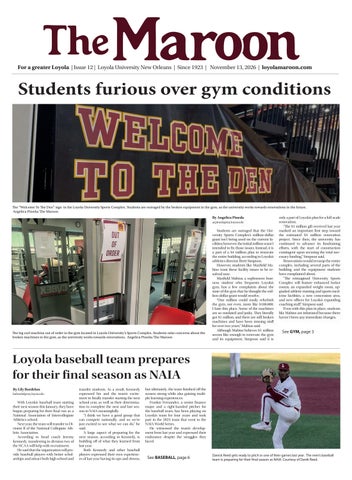
The “Welcome To The Den” sign in the Loyola University Sports Complex. Students are outraged by the broken equipment in the gym, as the university works towards renovations in the future. Angelica Pineda/The Maroon
By Angelica Pineda acpineda@my.loyno.edu
The leg curl machine out of order in the gym located in Loyola University’s Sports Complex. Students raise concerns about the broken machines in the gym, as the university works towards renovations. Angelica Pineda/The Maroon
Students are outraged that the University Sports Complex’s million-dollar grant isn’t being used on the current facilities; however, the initial million wasn’t intended to fix those issues. Instead, it is a part of a $4 million plan to renovate the entire building, according to Loyola’s athletics director, Brett Simpson. However, students like Maxfield Mabius want these facility issues to be resolved now. Maxfield Mabius, a sophomore business student who frequents Loyola’s gym, has a few complaints about the state of the gym that he thought the million-dollar grant would resolve. “One million could easily refurbish the gym, not even, more like $100,000. I hate this place. Some of the machines are so outdated and janky. They literally got $1 million, and there are still broken machines and have been missing stuff for over two years,” Mabius said. Although Mabius believes $1 million seems like enough to renovate the gym and its equipment, Simpson said it is
only a part of Loyola’s plan for a full-scale renovation. “The $1 million gift received last year marked an important first step toward the estimated $4 million renovation project. Since then, the university has continued to advance its fundraising efforts, with the start of construction contingent upon securing the total necessary funding,” Simpson said. Renovations would revamp the entire complex, including several parts of the building and the equipment students have complained about. “The reimagined University Sports Complex will feature enhanced locker rooms, an expanded weight room, upgraded athletic training and sports medicine facilities, a new concession area, and new offices for Loyola’s expanding coaching staff,” Simpson said. Even with this plan in place, students like Mabius are infuriated because there haven’t been any immediate changes.
See GYM, page 3
Loyola baseball team prepares for their final season as NAIA By Lily Bordelon lmbordel@my.loyno.edu
With Loyola’s baseball team starting their next season this January, they have begun preparing for their final run as a National Association of Intercollegiate Athletics school. Next year, the team will transfer to Division II of the National Collegiate Athletic Association. According to head coach Jeremy Kennedy, transferring to division two of the NCAA will help with recruitment. He said that the organization will provide baseball players with better scholarships and attract both high school and
transfer students. As a result, Kennedy expressed his and the team’s excitement to finally transfer starting the next school year, as well as their determination to complete the next and last season in NAIA meaningfully. “I think we have a good group that can compete nationally, and so we’re just excited to see what we can do,” he said. A large aspect of preparing for the next season, according to Kennedy, is building off of what they learned from last year. Both Kennedy and other baseball players expressed their own experiences of last year having its ups and downs,
but ultimately, the team finished off the season strong while also gaining multiple learning experiences. Frankie Fernandez, a senior finance major and a right-handed pitcher for the baseball team, has been playing on Loyola’s team for four years and took part in the 2025 team that went to the NAIA World Series. He witnessed the team’s development from last year and expressed their endurance despite the struggles they faced.
See BASEBALL, page 6
Danick Reed gets ready to pitch in one of their games last year. The men’s baseball team is preparing for their final season as NAIA. Courtesy of Danik Reed.
The Maroon Nov. 13, 2026
CAMPUS
3
GYM: Loyola students question the plan for gym renovations Continued from front “Compared to other colleges, our gym is a laughing joke. I think it’s absurd that you can have one-of-a-kind machines, such as the leg extension, be broken for over four months. A single student’s yearly tuition could pay for most of the repairs and replacements. They act like their budget is zero dollars a year,” Mabius said. A freshman member of Loyola’s baseball team, Logan Katz, felt the gym’s facilities underserved Loyola’s sports programs that rely on it for practices and exercises. “It is pretty worn down and pretty small, so when trying to work out it gets pretty crowded, " Katz said. “We’re very limited in what we can do in the weight room, so I feel like more money could [bring] more opportunities to the teams.” Despite the current complaints, Simpson is committed to improving the University Sports Complex with students in mind. “Improvements to the University Sports Complex are part of Loyola’s ongoing commitment to responsibly and strategically enhance campus facilities and the student experience,” Simpson said. Dutch Buckley, a sophomore business major who goes to the Loyola gym almost every day, felt students weren’t being considered. “Four million dollars is preposterous.
Equipment in the Loyola University gym. With the recent $1 million grant, students want to see new equipment get installed. Angelica Pineda/The Maroon
If your goal is to improve the student experience in the gym, then I think four machines would drastically change the experience: a set of cables at about $1,000, an incline press machine at about $800, a Smith machine in the same range, and a chest-supported seated row machine,” Buckley said. Buckley and other students felt they weren't asking for much when it came to repairs and replacements; they just wanted the bare minimum. “Loyola’s gym is undoubtedly lacking compared to other university gyms. I don’t expect Loyola to have top-of-theline equipment. We’re asking for the bare minimum, or what I think is the bare minimum; having important machines broken for a long time is just unacceptable,” Buckley said. Ryan Ramson, another student who frequents the gym, also considers functional equipment as the bare minimum. “If that’s their plan, then whatever, but that doesn’t mean they can’t fix the equipment,” Ramson said. Other than functional machines, Buckley wanted the complaints and concerns of him and other students to be heard. “It just doesn’t make sense to me, and I think not consulting the student body about these funds that are directed towards improving their experience is a critical mistake,” Buckley said. “It doesn’t make sense to allocate funds to benefit the student body and not ask them what they want.”
Archivists highlight the civil rights movement at Loyola University
1955 Loyola Law School graduates Norman C. Francis (Left), and Benjamin J. Johnson (Right). They were the first two African Americans to graduate from Loyola's Law School. Nicholas Parrella/The Maroon
By Isabelle McDonald iemcdona@my.loyno.edu
Loyola University New Orleans’ Special Collections and Archives assembled an exhibit examining the university’s history during the Civil Rights Movement, including its desegregation efforts and the people connected to that history. The exhibit, “Leading Toward Justice: Loyola, New Orleans and the Struggle for Civil Rights,” was created to complement “The Trail They Blazed,” a traveling exhibit developed through the Historic New Orleans Collection and previously displayed at Xavier University. Janine Smith, university archivist & special collections registrar, and Mare Lodu, digital collections archivist, said they wanted to create a companion exhibit that focused on Loyola’s own history. The project came with a tight dead-
line. According to Smith, they had approximately four months to put the exhibit together, although exhibits of this kind typically take six months to a year to complete. Researching Loyola’s history presented challenges, particularly because the university’s desegregation history was not always clearly documented. The archivists shared that they had to cross-reference different sources to establish historical details and better understand the university’s involvement in the Civil Rights Movement. Smith and Lodu also discussed gaps in the university’s archival collections, especially in records documenting Black students and community members. “Not everyone’s histories are equally documented,” Smith said. “We feel very strongly about making sure that all voices on Loyola’s campus are being told and
A collage created by Loyola's archive about the annual Catholic interracial day. Nicholas Parrella/The Maroon
“There's so much history here that you could create an entire exhibit based on just one of the topics that we uncovered” — Mare Lodu Digital Collections Archivist
preserved.” Among the people discussed in the exhibit’s research were Benjamin Johnson and Norman C. Francis, two of the earliest Black students at Loyola’s School of Law. Both Smith and Lodu also described the work of Jesuit priests Joseph
Student reads a book about the struggle for civil rights at Loyola University New Orleans. Nicholas Parrella/The Maroon
Victor and Father Twomey, who were involved in social justice efforts addressing racial discrimination within the Catholic Church and labor issues. According to the archivists, Father Twomey’s work with labor eventually expanded into the Institute of Human Relations. They said that labor concerns and racial injustice were closely connected to the work being done at the time. Smith and Lodu also discussed the involvement of Loyola-connected individuals in the New Orleans Freedom Marches during the 1960s, as well as the roles of local organizations such as the NAACP and the Congress of Racial Equality. For the exhibit, the archivists selected materials including photographs, newsletters, publications, and other historical documents. Smith and Lodu mentioned that choosing what to include was dif-
ficult because there was more history than could fit into the exhibit’s four display cases. “There's so much history here that you could create an entire exhibit based on just one of the topics that we uncovered,” Lodu said. The archivists shared that understanding this history is important for Loyola students today, particularly because students played a role in pushing for change at the university. Smith and Lodu described how students organized events, wrote newsletters, and advocated for desegregation. “Students do have collective power here on campus to make a change,” Lodu said.
The Maroon Nov. 13, 2026
4
PUZZLES Across 1 Chicago team 5 Atmosphere 9 Put in the rearview mirror 15 Still working 16 Apple variety 17 Beethoven symphony originally intended to honor Napoleon 18 Year of tears? 21 "Hoo boy" 22 Paleozoic, for one 23 Minor progress 24 Little dickens 25 Pumpkin seeds 28 __-bitsy 30 Show bow? 34 Pointillism bit 35 Ribs, e.g. 36 Ashram mentors 37 Class with makeup tests? 39 Countertop option 41 One who keeps on trekkin' 42 Quaint greeting 44 Bird that may be rufous-naped, fire-capped, or black-bibbed 45 Kind of wind? 48 Some postgrad degs. 49 Mixture 50 Poorly lit 51 Big personalities 54 Do one's part 55 "You promise?" 58 Power shower? 62 "Shove it!" 63 Outdated marriage vow word 64 Flooring choice 65 Horse barn sounds 66 Gram 67 Solitaire foundation cards
Down 1 Tool for a quick key change 2 State whose license plates say "Life Elevated" 3 "You'll regret that" 4 Torrid 5 Opera mentioned in the 10,000 Maniacs song "Verdi Cries" 6 Actress Thurman 7 Word with UV or X, but not W 8 Learns to live with 9 Frozen Italian desserts 10 Mine find 11 High-grossing film? 12 Staffer 13 Read quickly 14 Small pie 19 Concert piece 20 Opera solo 25 Dinky 26 Before, once 27 Spitting nails 28 Craters of the Moon locale 29 Elixir 30 Business extension 31 Branch of mathematics 32 __ dreaming 33 Future DAs' exams 35 Carried 38 Semi pro? 39 Put off one's game 40 Many a poem by Clint Smith 42 Bring up 43 Limb lifted in a développé 46 Plays loudly 47 Somewhat blue 48 One hanging around a party? 50 MS Word file 51 Starts to peter out 52 Profit 53 Inflatable pilot in "Airplane!" 55 "Hey there!" 56 Single 57 "__ chic!" 59 Vitals checker, briefly 60 Org. for Suns and Rockets 61 Guest room, in a pinch
STAFF LIST Editorial Board
For weekly puzzle answers, visit our Website via the QR code:
Editor in Chief - Alana Frank Managing Editor - Elise Beck Pre-Content Director - Stella Perdue Post-Content Director - Carlos Andrade Executive News Editor - Lily Bordelon Campus News Editor- Nicholas Parrella Ass. Campus News Editor-Brooke Metoyer Worldview Editor - Angelica Pineda Life & Times Editor - Amari Winchester Ass. Life and Times Editor - Alondra Gonzalez Sports Editor - Zoryn Johnson Opinion/Editorial Editor - Maria Touzard Breaking News Editor - Mabel Regalado-Hernandez Copy Editor - Pablo Pineiro Ramy The Wolf Creative Director -Makayla Parker The Wolf Designer - John Zwiers Senior Staff Photographer - Sophia Renzi Photo Editor - Pharrell Every Social Coordinators - Elena Godoy, Adriana Escobar, Eryn Goines Broadcast Producer - Ruth Brown Broadcast Lead Anchor - Dessadra Tezeno Co- Anchor- Eleanor Boucher-Ferry Newsletter Writer - Rodrigo Delgato
Distribution Manager - Sophia Renzi
Contributors
Robert Cobb, Sadie Bush, Athalie Dore, Ella Bozeman, Angelica Petit, Cae Nguyen, Amiyuh Tobias, Isabelle Kehoe, Kennedy James, Lauren Stuart, Kaya Tezeno, Riddick Winter, Bianca Mansell Gatti, Katia Vincent, Kendall Ross, Alyvia Pierson, Parrish Scheuermann, Sophia Lewis
Student Media Adviser: Michael Giusti Assistant Student Media Adviser: Hannah Levitan
CONTACT US Main Office - (504) 865 - 3535 Business Office - (504) 865 - 3536 Adviser’s Office - (504) 865 - 3295 Correspondence - maroon@loyno.edu Letters to the Editor - letter@loyno.edu Advertising - ads@loyno.edu Website - www.loyolamaroon.com Twitter - @loyola_maroon Facebook - The Maroon Instagram - @loyola_maroon Our office is in the Communications/ Music Complex, Room 328. Send mail to: The Maroon, Loyola University, Campus Box 64, 6363 St. Charles Ave., New Orleans, LA 70118 The Maroon is published every Friday. Unless otherwise noted, all content is copyrighted by The Maroon. All rights reserved. First copy free to students, faculty, and staff. Every additional copy is $1.00. The Maroon is printed on 30 percent post-consumer recycled content.
Meet our Maroon Staff! Meet the Marooner video series on Instagram:
The Maroon Nov. 13, 2026
WORLDVIEW
5
Crescent City Connection construction affects commuter students
Purple lights illuminate the Crescent City Connection and reflect across the Mississippi River in New Orleans. The bridge is going under construction and may affect student's commute to campus. Carlos Andrade/The Maroon
By Elise Beck erbeck@my.loyno.edu
“18 months?” freshman computer science major and West Bank commuter Ximena Vasquez asked, as she rolled her eyes and slumped in her chair. She was reacting to the expected repair time for the bridge that makes up part of her daily commute. Vasquez said that the last time the bridge underwent repairs, she found herself stuck in traffic for hours. The Crescent City Connection is undergoing an 18-month rehabilitation project that requires the closure of one of the bridge's main lanes at a time. The closures have reduced traffic capacity and left some Loyola students adjusting their daily schedules to account for longer commutes. Approximately 378 commuter students (12.6% of all commuters) could be directly affected, according to a study by Loyola’s Office of Institutional Research & Effectiveness, The project will repair deteriorating connections between the bridge's steel beams, according to Daniel Gitlin, public information officer for the Louisiana Department of Transportation and Development. Crews
will begin working on the outside of the bridge before gradually moving toward the inside. The closure of one of the bridge's four main lanes represents a 25% reduction in its lane capacity. The points where the bridge's steel beams connect are exposed to humidity, rain, and extreme temperature changes, which can cause the connections to deteriorate and rust. Crews will clean the damaged areas through sandblasting, install new steel plates, and seal them with a protective paint. The construction has already affected morning commutes for some West Bank students, said Paris Hayes, a senior criminology major and head of Loyola's Commuter Student Association. “I've talked to a few in passing, and they've been like, it's a struggle because they also have to leave earlier, just to make it to their morning classes in time,” Hayes said. The construction has also affected Hayes' work schedule. She works two jobs on campus and had to switch her morning shifts to evenings because of the longer commute. What used to be a 30- to 45-minute commute in the morning now takes closer to an hour,
though she said her drive home at night has remained unaffected. “We only got a one-week notice about the repairs, so that part I wasn't too happy about,” Hayes said, explaining that she saw news about the project a few days before construction began. “If you hadn't been reading the news, you just wouldn't have known.” Gitlin said the department wanted to avoid surprising commuters with the closures. He referenced the LED lighting project on the bridge two years ago, which also required lane closures. “While we were doing that, we observed that it really affected people who were driving on the bridge,” Gitlin said. “The traffic really threw them off as far as getting around. I got phone calls from school bus drivers and people who were going to work, and other emergency vehicles, that type of thing, and they were just explaining how it impacts their day to have the bridge backed up.” Gitlin said those experiences influenced the department's approach to the current project. “We immediately had meetings about how we are going to make as little impact as possible on the traveling
public,” Gitlin said. He said this led to the decision to close only one lane at a time rather than simultaneously closing the outside right lane and the inside high-occupancy vehicle lane. Gitlin also said the department issued press releases well in advance to give commuters time to prepare. Sophomore film major Alejandro Soliz heard about the construction after his family received a call about it the night before. His commute has increased from 25 or 30 minutes to 40 or 50 minutes, though taking the HOV lane with his brother typically speeds up the trip. Soliz now leaves home about 20 minutes earlier than he used to, around 6:30 to 7 a.m., to account for the additional travel time. “It will affect my studies and the time I spend studying, because I have to think about how long it takes me to go from campus to my house,” Soliz said. Though he typically studies at night, the change in his schedule has led him to spend less time studying. Gitlin said some students may be able to use the Huey P. Long Bridge as an alternative route. He also recommended that commuters check traf-
fic applications such as Waze, Google Maps, and Apple Maps before leaving home to account for potential slowdowns. Sophomore criminology major Siiri Fortmayer uses Apple Maps and MapQuest. “As soon as they announced the renovations, I started taking the old bridge again,” Fortmayer said. For Fortmayer, taking the Huey P. Long Bridge is a trade-off; she’ll face more Jefferson area traffic, but she won’t be stuck on the Crescent City Connection for long. Gitlin said accidents can create additional delays, particularly when they block lanes that are already limited by construction. “I look at all the traffic accident reports that come through that area, and the bridge is one place where it tends to have more accidents,” Gitlin said. He attributed some accidents to drivers merging between lanes and ramps and traveling at high speeds. He encouraged commuters to drive carefully through construction zones and leave enough time for their trips.
Crises hit home for international Loyola students By Isabelle McDonald iemcdona@my.loyno.edu
Stasy Cruz was halfway through her first semester of college when the government declared a state of emergency in her home country of Honduras. For students like her, events in their home countries can create challenges while they are studying thousands of miles away. According to Cruz, the Honduran government declared a state of emergency across 75 municipalities due to severe drought conditions associated with the El Niño climate pattern in late August. An estimated 1.8 million people faced potential food insecurity. Meanwhile, concerns about gang violence, extortion, and rising homicide rates continue to affect communities throughout the country. Cruz said living in the United States has given her access to the necessities that are not always readily available to people in Honduras. “It’s been a blessing being in such a country where light, water, and necessities aren’t a worry every day,” Cruz said. “Yet, I know the struggle back home, and
it makes me think about the people who aren’t as blessed as I am.”Cruz also described feeling responsible for making the most of the educational opportunities available to her. She explained how these expectations have contributed to academic burnout and difficulty sleeping. “I have to speak up for every girl who can’t go to school, and for every Honduran without basic needs. I feel like a tool, like it is my responsibility, and if I fail, it’s my fault,” Cruz said. Dr. Kate Yurgil, director of neuroscience, and L. Mulry Tetlow, professor of psychological sciences at Loyola, explained that experiencing a crisis directly or indirectly can significantly affect mental health, including experiencing sadness, anger, confusion, and guilt, particularly when they cannot be physically present to support loved ones. “Uncertainty about the full impact of the disaster can prolong the effects of stress and increase feelings of anxiety,” Yurgil said. Dr. Evan Zucker, a professor of psychology at Loyola, added that communication can become another major challenge. Natural disasters can disrupt
power and communication systems, leaving students unable to contact family members or receive reliable updates. “Ambiguity is another type of stressor— just not knowing what is happening or what to expect,” Zucker said. For Cruz, the hardest part is being unable to comfort her family. “Sometimes we don’t need words; we just need a hug or a person being there,” she said. Both Yurgil and Zucker discussed the importance of maintaining connections and seeking support during difficult circumstances. Yurgil suggested journaling, creating art, and finding meaningful ways to contribute to recovery efforts as possible coping strategies. Zucker emphasized the role of friends, classmates, and faculty in providing support. At Loyola Counseling Center, counselors provide individual counseling, crisis intervention, and referrals. Students can visit room 208 of the Danna Student Center or call (504)-865-3835 for support. Counselors are on call and available 24 hours a day, seven days a week. Loyola may also assist students experiencing academic difficulties related to circumstances at home. With permis-
A woman waits for food aid distributed by the World Food Program in Honduras' drought-prone Dry Corridor after the government declared a state of emergency over worsening drought conditions linked to El Niño in Nueva Concepción, Honduras, Oct. 15, 2026. The Associated Press/Moises Castillo
sion from the student, the counseling center mentioned that they can coordinate with faculty, academic advisors, and Student Affairs to discuss possible flexibilities with the student’s coursework and additional support. Yurgil offered a reminder to students experiencing these circumstances.
“It’s okay to not feel okay. There is no shame in needing some extra support, and Loyola has fantastic academic and counseling support services,” Yurgil said.
6
SPORTS
The Maroon Nov. 13, 2026
Diving into the swim season: Loyola's team hopes to make a splash
Swim team member practices for the upcoming swim meet. The team is getting ready for the 2026 swim season. Sophia Renzi/The Maroon
Swim team members swim laps in a butterfly stroke. The team has different style races that Loyola students compete in. Sophia Renzi/The Maroon.
By Zoryn Johnson
have just two seniors on the team, and we have a lot of underclassmen. And a big improvement that I've seen is the sophomores and juniors stepping up, and stepping into leadership roles before they are seniors,” Dunnuck said. “It's definitely different because almost, if not more than half of the team is new incoming, whether it's from our transfers or freshmen, so it's definitely different.” Ory said. Freshman biology major Brady Hotard feels like he’s been welcomed by his new team while making the adjustment from high school to college sports. “I feel like the upperclassmen have been very nice,” Hotard said. “There are no complaints there. There are just some
zkjohnso@my.loyno.edu
Loyola University’s men’s and women’s swim teams are in the middle of their season. Led by Interim Head Coach, Melanie Dunnuck, the group feels confident in their hard work. Although this is Coach Dunnuck’s first year working with the team as head coach, she also worked with them for the past three years during her time as a graduate assistant. She said that keeping the culture that the team has established in prior seasons is something she wants to carry forward in this current season. “The culture that I'm trying to promote, and with the leadership on the
team trying to promote, is a culture of supporting each other and really creating an ideal environment for each athlete to be able to come to practice and grow,” Dunnuck said. She also believes that the biggest goals this season for the team will be to keep the energy consistent. “A big thing is maintaining continuity from the past seasons and trying to carry that forward for the team,” she said. Carter Ory, a sophomore biology major, feels like the team is gearing up for the biggest part of their season. “I'm excited to see how it goes. We haven't been truly tested, to be honest. We haven't had a big thing to see exactly where we're at, but where we are right
now, I'm feeling pretty good,” Ory said. The team is preparing for their weekend meet at Trinity University on Nov. 20 through Nov. 22., which Ory said is what will truly put the team’s hard work to the test. Right now, the main focus is holding back on training. “So there's this thing where you swim, you have to remove the fatigue from your body. You kind of cut down your training right before the season,” Ory said. “That's the most preparation you're going to do, and that's when you're going to feel the best. It's called tapering.” Dunnuck feels that with the new talent on the team, she’s noticing a new era of camaraderie. “We have a young team this year. We
good leaders on the team who inspire me to be like them.” He has some personal goals that he’d like to meet, but he also hopes that the overall team can accomplish the goal of improving. “I want to go best times in all my events at mid-season and conference. But for the team, I'd like to see some good relays, placing well, or placing better than we did last year,” Hotard said. Ory is looking forward to seeing where the team’s and coaches’ hard work will place them. “It's not easy every day to go and to train, but I feel like as a whole it's definitely at a high,” Ory said. “We're excited to see what happens.”
Baseball: The team works to make improvements from last season Continued from front
Junior pitcher Danik Reed prepares to pitch a ball at a Loyola baseball game. Loyola baseball is currently training for their upcoming season. Courtesy of Danik Reed.
“We struggled as a team towards the end of the year but bounced back extremely well and won the Southern States Athletic Conference Tournament for the second year in a row,” Fernandez said. Kennedy also said he believes this year is going well, especially due to the fact that the seniors who are a part of the team are seasoned players and have matured immensely throughout their time playing. “I feel like we've improved upon a lot of the things that we kind of struggled with last year and we've had really good leadership on this year's team, which most of that is coming from guys that were on the team last year,” he said. “Anytime your senior class is mature and has leadership, it has ownership, it helps things go a lot smoother.” Fernandez had a similar sentiment, praising the character of his teammates
and their ability to work together. “Our team is made of a bunch of role players that understand what their job is and how to execute it and pass the baton to the next guy,” Fernandez said. “If we can stay consistent throughout the season and rely on each other, we will have a successful season.” Pre-season training includes aspects like testing strength and endurance, practicing fundamentals, improving teamwork, and implementing healthy habits. “We had several guys out that just weren't healthy in the fall. And so getting those guys back and the healthy ones, getting them stronger and faster and cleaning up some things that we identified in the fall as weaknesses that we need to improve upon,” Kennedy said. Players are also including personal goals within their preseason training. This includes Johnny Ray, a sophomore majoring in mass communication who plays as a pitcher and designated hitter.
Ray is in his first year after transferring from Gulf Coast State College, and he is excited to bring his experiences to Loyola. “This season, I’m really focusing on what I call ‘Johnny Ray baseball’, which is basically trusting myself, playing with confidence, and doing my thing on the ballfield,” he said. “We’re still growing together as a team, and I want to do my part to help this program win and be successful.” According to Kennedy, no one can predict how a season turns out, so what matters is overcoming unexpected adversities and stepping up when needed. “Each season has its own story, and we're just in the middle of it,” he said.
fRee bEer
fRidAy TakE a frEe TouR Get a FreE pInt BegIns sePteMbeR 18th
eVerY fRidAy tOurS aT 3pm & 4Pm
1645 tChoUpiTouLas
*MusT bE pResEnt foR eNtiRe TouR fOr FreE bEer!
The Maroon Nov. 13, 2026
LIFE AND TIMES
9
A La Mode to host first show of the academic year By Makayla Ferrell mdferrel@my.loyno.edu A La Mode, a student organization that encourages self-expression through fashion, music, and creativity, is preparing to host its first fashion show of the academic year. The event will take place on Nov. 13, 2026, and the theme of this year’s show is “Area Codes.” This show allows participants to represent cities and communities they call home through fashion and personal style. The show will feature music, and styles representing the United States, including Atlanta, Detroit, Los Angeles, and New Orleans. For general body member Morgan Smith, a freshman majoring in biochemistry pre-health, the theme provides an opportunity to celebrate her California roots while representing the city of Oakland. “Because our theme is area codes, you're able to show where you’re from,” Smith said. “I’m not from L.A. I’m from Oakland, which is the main area of Northern California. But it still represents where I’m from. So I’m really excited for it.” For general body member Chris Roache, a freshman majoring in computer science, participating in A La Mode as a model has provided an opportunity to explore an interest in fashion and performance. “I would say it’s really fun to be a model. Like, this is my first time modeling, and I've done dancing stuff in Paris, and so it’s, I’d say it’s really fun,” Roache
said. Roache explained that modeling offers an expressive outlet, particularly through fashion and choreography. Although he has always been interested in fashion and had an artistic eye, he had not previously explored those interests as much as he wanted. A La Mode has also created opportunities for students outside of modeling. A La Mode’s arts and music coordinator, Laura Walls, a junior majoring in hiphop and R&B, is responsible for bringing artists to the stage and coordinating music throughout the show. Walls also helped develop this year’s “Area Codes” theme, drawing inspiration from different cultural and creative identities around the United States. When discussing the music selection, Walls emphasized the importance of keeping the audience engaged and maintaining the energy of the event. “So we have some R&B this time, we’re going to have some rap, some hip-hop, it’s very diverse,” Walls said. Walls also hopes to encourage more music students to join and get involved with A La Mode,
“We are here to boost confidence and to feel confidence in ourselves. That's our biggest thing.” — Sasha Grant A La Mode President
emphasizing how different creative disciplines can complement one another. “I encourage anyone who, even someone who’s just a model, to maybe go out and try right now to write a song, because building your creativity in one area can pour into so many other ways, it just blossoms,” Walls said. She encouraged students to explore creative interests outside of their primary disciplines, explaining that developing creativity in one area can inspire new opportunities in another area. Walls first became interested in A La Mode after seeing its fashion shows during her freshman year. Although she initially considered modeling, she eventually discovered an opportunity to contribute through her interest in music and creativity when she saw the arts and music coordinator position available. Reflecting on this year’s theme, Walls explained that the different cities represented each have distinct fashion identities and musical influences. “You know Houston has a sound, L.A. definitely has a sound, you know Northeast, Southwest, don’t matter, they all have sounds,” Walls said. “Just incorporating that into everything, just being so particular, paying attention to the details, and showing how different each culture really is.” The organization's leaders aim to provide students with an opportu-
nity to showcase their individuality and creativity through personal style while celebrating the different ways fashion can bring people together. A La Mode’s president, Sasha Grant, a senior majoring in public relations, emphasized the importance of confidence and creative expression in A La Mode. “We are here to boost confidence and to feel confident in ourselves. That’s our biggest thing,” Grant said. Grant explained that the modeling industry can be an intimidating field, but the organization hopes to create an environment where students can develop confidence in themselves and their abilities. She also highlighted Loyola’s creative community as an opportunity to bring students together with different creative abilities. Although modeling is a central part of the organization, Grant explained that A La Mode welcomes students interested in other creative roles, including fashion design, DJing, performing, and directing. “I think it’s so important to engage with Mode because we don’t have a fashion program here at Loyola and I think so many people are interested in a fashion show, whether it’s modeling, designing, photography, or performing,” Grant said. “You can really show your skills here at A La Mode. I think whether you want to be in the crowd and just see it, enjoy it, or you want to be involved, I think it’s so important to show our organization.”
Loyola music students reflect on interwoven band culture on campus
Student performs with the Pop Com Ensemble in the Fall 2024 Tipitinas Concert. Students perform here at the end of every semester as part of their final class grade Sophia Renzi/ The Maroon
By Zoryn Johnson zkjohnso@my.loyno.edu For many Loyola music students, the task of juggling multiple bands with your classmates can be a rewarding yet difficult experience. At one point, Micah Dachtler, a
sophomore jazz studies major who is minoring in music industry studies, found himself playing in five to six bands at a time, something that many music majors on Loyola’s campus can relate to. Now, Dachtler is playing in two bands, Delvin and the Shades and Vienna Notarianni’s band. The decision
to downsize came from the realization that being in too many bands was becoming a burden. “I think that when you first come here as a freshman, your goal is to get as many opportunities as possible, no matter where that is. And I feel like for me, that's how I got stuck in a situation where I was in like six bands, and all of a sudden I didn't have a single second of free time and felt burnt out,” Dachtler said. “I would definitely say that a lot of people definitely do struggle with joining too many bands and then having to kind of pull back.” Junior music industry studies major, Isaac Briare, who’s played in a long list of bands since being a Loyola student, including the bands Left Hook and Joy Theory, feels as if the interesting side of these campus bands is that everyone is bringing their personal style to the table. “I mean, as someone who's played with almost every group, it's like I'm taking, like, my sound, like, my musical voice, and I'm implementing it in all these different genres that I play in,” Briare said. Briare has noticed that a lot of people who are asked to join bands are jazz majors, something he attributes to the students’ ability to learn music well. “I think a lot of it comes with the knowledge of harmony and stuff, where jazz musicians are trained on improvisation, which is a huge part of music and being able to interpret
someone's music and improvise with it and create arrangements of it.” he said. Director of Music and Theater Professions Katherine Duncan notes that student-formed bands and musical collaborations have long been a part of the culture in Loyola’s music programs, something she deems exciting. “We're in New Orleans, a city where music isn't just something you study; it's something you live and participate in every day,” Duncan said. “Playing with different musicians, across different genres and in different professional settings, is tremendously valuable. It develops versatility, adaptability, musicianship, and the ability to navigate the realities of working in the music industry,” she said. “But being busy isn't necessarily the same thing as growing! Students also need time to practice, study, reflect, create, and develop their individual artistry.” Sophomore jazz studies and music industry studies major, Nika Nodjoumi was surprised by the amount of opportunities at Loyola. “Honestly, I didn't think I would be playing this many shows. I wanted to join bands, but then all of a sudden I realized this is such a collaborative environment and people love to book gigs, and so it's so easy to do it since we're in New Orleans,” Nodjoumi said. “It's really fun, and I just didn't expect that at all.” Noudjami finds that when a lot of people at Loyola are in the same bands,
it doesn’t affect the music as much as it affects the crowd the performances attract. “I think it's more about the turnout of the gigs, because what I've been witnessing lately is that a lot of our Loyola bands were all friends with each other,” Nodjoumi said. “And when we have small gigs that we put together, let's say like Gasa Gasa or The Rabbit Hole, which are big venues, we tend to watch each other because we don't have that big of an audience yet.” Briare felt similarly, feeling that a lot of Loyola students get sucked into what he likes to call the “Loyola bubble,” where the only gigs people engage with are Loyola gigs. However, he explains that musicians need a space outside of the university in order to thrive after college. “You're still going to have that Loyola community, but it's not going to be all your friends who live on campus with you and stuff, and so I think it's super important to get outside of Loyola.” Despite some of the concerns, students still believe that forming bands on campus is worth it to gain experience, but that it’s also important to have goals in mind, such as touring or releasing music, when joining or creating them. “I think I definitely used to be in that sense of, like,’ I want to get the most experience’, and now I'm like, ‘okay, I actually want to succeed where I am and not just use this as a platform to get to the next level because the next level will
OPINION
10
The Maroon Nov. 13, 2026
Why do we not watch “bad" movies anymore? By Sadie Bush smbush@my.loyno.edu
Watching a movie that is so bad it becomes good is an undeniably special moment. The acting is interesting, the dialogue is confusing, and the plot seems to have been written minutes before filming began. Yet somehow, you find yourself more entertained than you would have been watching the latest Oscar-winning drama. You might even argue that the worse the movie gets, the better the experience becomes. Somewhere along the way, watching movies became a competition. Everyone has lists of films that they believe everyone needs to see, directors they insist you must understand and appreciate, and opinions about cinematography that somehow turn a two-hour movie into a three-hour conversation. I do believe there is value in appreciating well-made cinema, but I would argue that we have become so concerned with watching the right movies that we have forgotten how to simply enjoy watching movies at all. What exactly is a bad movie? Maybe it is a reboot of a superhero story no one asked for, a low-budget horror film with the least convincing special effects, or a movie whose entire plot fails within the first twenty minutes. No matter what it is, they deserve more appreciation. Take the Twilight series, for example. This franchise has been an obsession of mine since the first time I watched it, mostly because of how horrible it is. Whether it has captivated you or you spend the entire movie questioning how the film got approved to air, there is no denying that it is an entertaining watch. The infamous baseball scene, dramatic love triangle, and questionable acting choices all build plenty of material
Audience and critic scores for "The Twilight Saga: New Moon" on Rotten Tomatoes demonstrated a difference in opinion. Sadie Bush argues that movies like "New Moon" ought to be beloved by audiences despite low critical ratings. Courtesy of Rotten Tomatoes.
for both serious fans and enthusiastic critics of the movies to enjoy. Is it a cinematic masterpiece? Probably not. Is it incredibly more entertaining when watched with a group of friends who are equally invested in making fun of it? One hundred percent. In the same vein, I would argue that analyzing horrible movies can be just as entertaining as discussing a critically acclaimed one. There is something near academic about trying to understand how an entire production team managed to all agree upon an absurd final product. How did someone read certain scripts and determine them ready? How did that particular piece of dialogue make it
past editing? And most importantly, why can’t I stop watching? Bad movies offer more than just entertainment. They offer something that most other media do not: community. Imagine watching a serious drama alone and then watching a ridiculous movie with eight friends all crammed into a dorm room. One of these experiences involves quietly sitting and appreciating the perfectly calculated cinematography. The other involves immense laughter, everyone talking over the dialogue, and predicting increasingly ridiculous plot twists. Neither experience is better per se, but I know which one becomes a story you tell later.
It is worth noting the timing of a bad movie. College students spend the majority of their days reading, writing, studying, and attending classes. Between assignments, exams, internships, and social life, sometimes the last thing someone wants is an emotionally draining, thought-provoking film. Sometimes, you just want to watch alien clowns turn innocent people into cotton candy cocoons without having to think twice about the plot. And perhaps that is the point. Not everything we consume needs to be educational, inspiring, or artistically significant. Entertainment is allowed to be entertaining. We do not
need to turn every movie night into a film study or justify every viewing choice with a discussion of its cultural impact. The next time someone suggests watching a movie with a 98% Rotten Tomatoes score, consider offering an alternative. Find the movie with the hilariously questionable reviews, the ridiculous title, and the trailer that makes absolutely no sense. Get some friends together, get comfortable, and prepare to question every decision made throughout its production. After all, a bad movie might not win an Oscar, but it just might make your Tuesday night.
Algorithms polarize young adults and the media profits from it By Audrina Morris ammorris@my.loyno.edu
Jake Gordon and Karhma DeWeese sit at microphones in Loyola University New Orleans’ podcast room for a conversation about media polarization. Audrina Morris argues that social media algorithms amplify this phenomenon among young adults. Carlos Andrade/The Maroon.
Social media’s use of personalized algorithms to provide favorable content has been irresponsibly used to polarize political youth. Today, the majority of adults in the United States consume copious amounts of media either through platforms like X, Facebook, Instagram, or all of the above. Each of these programs works by utilizing consumer interaction and data to create a personalized experience called a “For You” page. Unfortunately, this means that these programs use likes, comments, and watch time to suggest posts that they believe are most appealing to the user, rather than what is relevant or factual. Because of these algorithms, posts that are slower or more likely to induce debate are less likely to receive views. In the political sphere, this means that posts that are statistically more likely to align with one’s own political opinions are more likely to show on users' feeds. If, for example, you take a more liberal leaning user, they will most likely see a shocking feature of police brutality rather than a report about corn production within the same county. This uncon-
sciously causes the viewer to develop more extreme liberal views, effectively leading them to block out more moderate or opposing perspectives. Another destructive consequence of social media is echo chambers, which occur when a user interacts with people who align with them politically, so they are shown these creators more. This creates a vacuum of aligning information while simultaneously censoring opposing opinions, ultimately misleading the user. Additionally, social media users who are subject to more partisan posts develop chilled feelings toward opposing parties. This all too easily allows people to demonize parties and their members. Such demonization actually reinforces the number of personal attacks on character, physicality, and identity seen in recent debates between both citizens and politicians. Resulting animosity from social media inevitably and understandably leads to lower rates of collaboration. This is not the most significant problem, however. Media polarization not only creates unrealistic and violent views of society, but it also generates injustice. Algorithmic exposure often leads to replication or internalization of existing social hierarchies. As young adults
begin to cement their opinions, this catalyzes greater stigma, stereotypes, and discrimination between groups. A really detrimental example of this is the alpha male rhetoric that has been circulating the internet over the last couple of years, where “traditional” influencers lead young, mostly white men to disgustingly believe they own the means of social, political, or economic power and therefore are owed obedience and purity by women. Although social media algorithms were initially created to boost user enjoyment, they continuously prove damaging to political and social cooperation as they disregard varied opinions and traditional news coverage. As a result, consumers who use social media as their primary form of news, especially young adults, will develop skewed political views, leaving them ill-prepared to take important action through voting or activism. Because media platforms refuse to admit responsibility or address negative effects of platform usage in favor of profits, it is crucial for young adults, like Loyola students, to utilize a variety of sources when making political decisions.
The Maroon Nov. 13, 2026
EDITORIAL
11
Dear Loyola, stop ghosting your student body Administration should communicate more about its spending plans with the Loyola community.
HOWLS & GROWLS HOWL to Thanksgiving break GROWL to Finals HOWL to The Hunger Games GROWL to Crescent City Connection HOWL to Late nights at Z'otz GROWL to Burnout Editorial Board
Broken mirror located in the weight room inside of Loyola University's gym. This is just one of the few broken or damaged equipment needing repairs. Angelica Pineda/The Maroon.
Last October, Loyola received a $1 million dollar gift to refurbish the University Sports Complex. Also last fall, Loyola decided to close Biever Hall for renovations. In September, Loyola received around $460,000 for public safety. The common denominator between all of these budget gains is that since their initial press releases, our student body has heard no word from university administration about how this money is being spent nor how renovation projects are progressing. No timelines, no emails — not a peep — creating confusion among expectant students who wish to know exactly how these funds are being tangibly implemented to improve their quality of life here on campus. Last year, Loyola raised students’ tuition by more than $1,500, sparking pushback as students are still unaware of where this money is going. The ongoing renovation projects, such as revamping Biever, have only fueled this pushback, making one thing quite clear: there is a blatant disconnect
between Loyola’s student body and its administration. We are feeling unheard and confused. It’s time to do something about it. When bright-eyed high school students make the decision to commit to a university of their choice, even if it is a private institution, a social contract is created between them. As undergraduates at Loyola, we spend most of our time here and are heavily influenced by the physical environment around us. We place our trust in Loyola: we put our blood, sweat, and tears into it. We exert ourselves day in and day out -– academically, mentally, physically, and even spiritually -– hoping that our leadership will help shepherd us toward future success. Depriving us of information concerning the place we call home for eight months out of the year only leads us to worry that the trust we place in this institution is not mutual. As Loyola continues to receive funding from outside sources while simultaneously raising tuition costs, that social contract can begin to feel one-sided if we
aren’t hearing about how this money is being applied. Loyola, what of the mold in the residence halls? What’s going on behind the closed doors of Biever Hall? Or the infuriating elevator situation in Uptown Hall? The deferred maintenance is getting to a point where it cannot be ignored and it is reducing our quality of life, establishing low expectations. The consensus around campus is that the bar is low and will only continue to get lower if these issues are not addressed. The lack of communication only creates a perceived apathetic attitude emanating from Marquette Hall. It’s like Marquette is an island with a heavily restricted entry point, and not even $51,008 will pay the toll to let us in. Let’s also call attention to the fundamental ideals this university prides itself on: Jesuit values. The Jesuits tell us that critical thinking and effective communication ought to be the backbone of our learning experience at Loyola. If we’re fulfilling our half of the deal, why can’t
Loyola do the same for us? All we are asking for is a little bit of dialogue — an open line of communication between students and leadership. One way to execute this would simply be through email. We want updates on university changes, which could look like a concise timeline of what is going to happen and when, or an explicit breakdown of how Loyola is using the money it attains through fundraising or tuition. Another would be through consistent press releases highlighting university processes as they evolve. The university could even store this information in the weekly newsletters we receive. Or, better yet, a tip line system straight from the president’s office so we can have faith that our voices are at least being heard. The point is that this air of distrust can easily be fixed. If Loyola can raise our tuition, administration is also capable of reaching out a hand to us.
Editor-in-Chief Alana Frank Executive News Director Lily Bordelon Managing Editor for Print Elise Beck Pre-Content Director Stella Perdue Post-Content Director Carlos Andrade Campus News Editor Nicholas Parrella Assistant Campus News Editor Brooke Metoyer Worldview Editor Angelica Pineda Life and Times Editor Amari Winchester Assistant Life and Times Editor Alondra Gonzalez Sports Editor Zoryn Johnson Assistant Opinions Editor Fin Jones Breaking News Editor Mabel Regalado-Hernandez Wolf Editorial Manager Laci Williams Senior Staff Photographer Sophia Renzi Assistant Photo Editor & Social Media Manager Adriana Escobar Social Media Manager Clarissa Dupree Social Media Manager Elena Godoy Copy Editor Pablo Pineiro Ramy Co-Anchor Dessadra Tezeno Co-Anchor Eleanor Boucher-Ferry
EDITORIAL POLICY The editorial on this page represents the majority opinions of The Maroon’s editorial board and does not necessarily reflect the opinions of Loyola University. Letters and columns reflect the opinions of the authors and not necessarily those of The Maroon’s editorial board. The Maroon does not represent the opinion of administration, staff and/or faculty members of Loyola. Letters are subject to editing for length, grammar and style. Please limit submissions to 400 words. Submissions are due no later than 4 p.m. the Sunday before publication. Please send all submissions — The Maroon, 6363 St. Charles Ave., Box 64, New Orleans, LA 70118. Email us your letters — letter@ loyno.edu. Submissions may also be made online at www.loyolamaroon.com.
Catch up. Get ahead. Study abroad. An accelerated two-week session Online and experiential courses Many Loyola Core options Registration starts on November 2.
J-Term takes place January 4 – 15, 2027.