For a greater Loyola | Issue 11 | Loyola University New Orleans | Since 1923 | Novmember 6, 2026 | loyolamaroon.com
What the blue wave means for Loyola Students and faculty reflect on the what it means after the democratic party dominates in the polls. By Angelica Pineda
feeling excited. I feel like it’ll be a better outcome for the people and their rights overall.” Marlania Okolo, a sophomore theater major and Texas local, shares the same excitement as Mose for their state. “At first I was surprised, considering Texas has been red since I have been alive,” Okolo said.
acpineda@my.loyno.edu
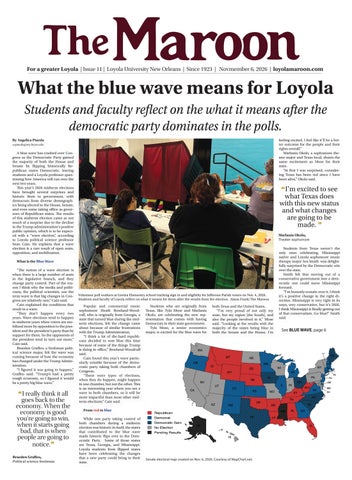
A blue wave has crashed over Congress as the Democratic Party gained the majority of both the House and Senate by flipping historically Republican states Democratic, leaving students and a Loyola professor questioning how America will run over the next two years. This year’s 2026 midterm elections have brought several surprises and historic firsts to government, with democrats from diverse demographics being elected to the House, Senate, and even some taking office as governors of Republican states. The results of this midterm election came as not much of a surprise due to the decline in the Trump administration’s positive public opinion, which is to be expected with a “wave election”, according to Loyola political science professor Sean Cain. He explains that a wave election is a rare result of open seats, opposition, and mobilization.
“I’m excited to see what Texas does with this new status and what changes are going to be made. ” Marlania Okolo, Theater sophomore
What is the Blue Wave “The notion of a wave election is when there is a large number of seats in the legislative branch, and they change party control. Part of the reason I think why the media and politicians, the political scientists, use the term wave is that big changes in Congress are relatively rare,” Cain said. Cain explained the conditions that result in a wave. “They don’t happen every two years. Wave elections tend to happen in midterm years when voters are mobilized more by opposition to the president and the president’s party than by support for them. So the opponents of the president tend to turn out more,” Cain said. Braeden Graffeo, a freshman political science major, felt the wave was coming because of how the economy has changed under the Trump Administration. “I figured it was going to happen,” Graffeo said. “Trump’s had a pretty rough economy, so I figured it would be a pretty big blue wave.”
“ I really think it all goes back to the economy. When the economy is good you’re going to win, when it starts going bad, that is when people are going to notice.” Braeden Graffeo, Political science freshman
Volunteer poll workers at Gretna Elementry school tracking sign in and eligibilty for Jefferson Parish voters on Nov. 4, 2026. Students and faculty of Loyola reflect on what it means for them after the results from the election. Alana Frank/The Maroon
Popular and commercial music sophomore Heath Rowland-Woodruff, who is originally from Georgia, a state that turned blue during the midterm elections, felt the change came about because of similar frustrations with the Trump Administration. “I think a lot of die-hard republicans decided to vote blue this time because of some of the things Trump is doing in office,” Rowland-Woodruff said. Cain found this year’s wave particularly notable because of the democratic party taking both chambers of Congress. “These wave types of elections, when they do happen, might happen in one chamber, but not the other. This is an interesting year where you see a wave in both chambers, so it will be more impactful than most other midterm elections,” Cain said.
Students who are originally from Texas, like Tyla Mose and Marlania Okolo, are celebrating the new representation that comes with having Democrats in their state government. Tyla Mose, a senior economics major, is excited for the blue wave for
both Texas and the United States. “I’m very proud of not only my state, but my region [the South], and also the people involved in it,” Mose said. “Looking at the results with the majority of the states being blue in both the Senate and the House, I’m
From red to blue While one party taking control of both chambers during a midterm election was historic in itself, the states that contributed to the blue wave made historic flips over to the Democratic Party. Some of those states are Texas, Georgia, and Mississippi. Loyola students from flipped states have been celebrating the changes that a new party could bring to their state.
Senate electoral map created on Nov. 6, 2026. Courtesy of MapChart.net.
Students from Texas weren’t the only ones celebrating, Mississippi native and Loyola sophomore music therapy major Ava Smith was delightfully surprised by the Democratic win over the state. Smith felt that moving out of a conservative government into a democratic one could move Mississippi forward. “I’m honestly ecstatic over it. I think it’s a positive change in the right direction. Mississippi is very right in its ways, very conservative, but it’s 2026. I think Mississippi is finally getting out of that conservatism. Go blue!” Smith said.
See BLUE WAVE, page 6
The Maroon Nov. 6, 2026
CAMPUS
3
Fr. Juan Carlos Rivera-Castro, S.J. joins Loyola
Fr. Juan Carlos Rivera-Castro, S.J. delivering a lecture during his 2:30pm Monday class. He is Loyola University's newest Jesuit faculty member. Oct. 19, 2026 Mikaylah-Rosalina Framboise/The Maroon
By Isabelle McDonald iemcdona@my.loyno.edu
Born and raised in San Juan, Puerto Rico, Fr. Juan Rivera-Castro’s journey to philosophy and priesthood began with his upbringing in a Catholic family. The second of three siblings, he attended Catholic School from kindergarten through high school. He credited his mother and maternal grandmother as important influences on his faith, particularly remembering his mother bringing him to church. During his sophomore year of high school, Rivera-Castro began taking his faith more seriously– attending weekday Mass, going to confession, and incor-
porating prayer into his daily life. By his senior year, he began considering the priesthood. After exploring several religious orders including the Franciscans and Dominicans, he chose the Jesuits for their extended formation process and spirituality. He was particularly drawn to the Jesuit emphasis on “finding God in all things,” which he felt aligned with his own spiritual life. Rivera-Castro entered the Jesuits in 2004, leaving college during his second year. He began to take philosophy more seriously while studying in Salamanca, Spain, during his Jesuit formation. Although he initially approached the subject with enthusiasm rather than immediate fascination, his interest grew
throughout his studies. “I think I just saw a lot of my own personality in philosophy, especially the questioning part of it, the looking for the truth,” he said. Philosophy provided him with the vocabulary and tools to articulate ideas he had previously struggled to express. His studies eventually inspired him to pursue further academic work and teaching. Rivera-Castro joined Loyola as part of his return to the USA Central and Southern Jesuit province after spending many years elsewhere. He was drawn to Loyola’s size and the opportunity to participate in a university community where people could get to know one another. He also views his appointment as
an opportunity to give back to his province. As a professor of philosophy of the Human Person, Rivera-Castro hopes students will recognize philosophy as more than an academic subject. “I hope my students realize that philosophy is a way of life,” Rivera-Castro said. “It is not just something completely disconnected with what they do in their lives.” Rivera-Castro’s approach to teaching is also informed by his work as a Jesuit priest. He emphasizes recognizing students as individuals, communicating expectations clearly, remaining available to discuss coursework, and personal reflections. He also encourages his stu-
dents to remain open to spiritual questions beyond material concerns. Professor R. Bentley Anderson, S.J., professor in catholic studies, said, “Fr. Rivera-Castro is a very patient and caring Jesuit priest and professor. He wants his students to fall in love with philosophy, so he takes the time to make his course material accessible. He cares for his students.” Looking ahead, Rivera-Castro hopes to continue developing as a teacher and scholar, while learning from his colleagues in the department of philosophy. He also looks forward to contributing his own perspectives, supporting collaborative work, and enriching students’ experiences at Loyola.
Loyola offers cultural immersion with J-Term study abroad By Angelica Pineda acpineda@my.loyno.edu
You’re only a college student for four years, but you could be a college student on top of a volcano in Costa Rica only once in your life while studying abroad with Loyola’s J-Term program. Alessandro Braga, a business professor at Loyola who runs one of the J-Term programs, makes this experience possible with his J-Term in Costa Rica. This term, like other J-Term courses, offers Loyola core and major-specific core credits that are earned by attending a 10-day course internationally. Although core credits are a requirement for graduation, Braga describes the J-Term experience as much different than any other required course at Loyola. “It’s not just about the course itself, like checking a box and now I’ve done it. It’s about what you actually learn outside of the classroom, and for many study abroad programs there is not even a classroom,” Braga said. J-Term abroad doesn’t always happen in a classroom but mostly through excursions and experiences that happen throughout the 10-day program, with the main goal of professors being to expose
students to different cultures and a different way of learning. For Braga’s J-Term business courses in Costa Rica, he takes students to experience the business and production that go into different companies. “Everyone knows about Boston Scientific, and we get the chance to go there and see the production line, speak with managers, and ask them, how you do things, how is the competition in Costa Rica, what’s the difference between doing business here and another country,” Braga also wants students to experience the beauty that the world has to offer other than learning, but through the country’s landscape. “With a journey, you also have to visit amazing places. For example, I brought students to visit two volcanoes. We were up at 100,000 feet on top of a volcano. We were in the middle of the clouds with very little oxygen, but it was an amazing experience,” Braga said. Outside of excursions, volcano scaling, and consulting with local businesses, students are encouraged to go out and explore when abroad to immerse themselves in a country’s culture. “It’s a very transformative experience because you get to see how things work in a different country, in a different con-
text with different actors with different types of culture, values, and customs. There’s always a very experimental component,” Braga said. “I tell them once we have free time, just go out and try stuff. Try different things, go to a grocery store and buy something, or see if there is an event you can go to, see if you can meet someone, talk to local people.” Amber Harp, a senior international business major who attended J-Term in Costa Rica, took Braga’s advice and explored Costa Rica’s culture. “I met amazing people and made connections that I never imagined would be possible. Being able to step outside of the classroom gave me a new perspective on learning and the knowledge gained by experiencing a new country. Beyond the academic experience, I also enjoyed learning about Costa Rican culture and getting to know people,” Harp said. Tracey Watts, an English professor who is teaching the Iceland course for the Jan. 2027 J-Term, is one of those professors who aims to teach students through exposure to different cultures, particularly through literature.
See J-TERM, page 8
Senior Sofia Mormile standing in front of a waterfall in Iceland during J-Term 2026. Students taking the Iceland trip get to experience Reykjavik and other locations around the country. Courtesy of Sofia Mormile
The Maroon Nov. 6, 2026
4
PUZZLES Across 1 Prince William, to Eddie Redmayne, at 51-Down 11 Ask 15 "This is news to me!" 16 Quechua-speaking highlander 17 Feeling that all roads lead to roam? 18 Some Ivy Leaguers 19 Combine 20 Some are plant-based 21 Winnow 22 Skye of "La Brea" 24 Prince of Moscow from 1325 to 1340 26 "And there it is!" 31 Helps out with a job 32 "Waiting for Godot" role 35 "You don't say!" 36 San Juan's __ de la Princesa 38 Took home 39 Reserved 41 Many a "Hacks" guest star 42 Fixes a situation 45 Needle 46 Strong 47 Farm youngster 48 Peter __ Steak House 51 Federal org. with a flower logo 54 Dance in "Lilo & Stitch" 55 Topic for discussion 58 Cartel headquartered in Vienna 59 List of attractions 60 Forward 61 Fatal attractions?
Down 1 "Boomerang" singer JoJo 2 African lake in four countries 3 Assistance 4 Suspicious 5 Number of former public defenders who have served on the Supreme Court 6 "Perish the thought!" 7 Environs 8 Together, musically 9 Try out 10 Starts to consume 11 Dishes that can be both hot and cold 12 Minecraft, e.g. 13 "Dune" realm 14 From Armenia to Azerbaijan 22 "Oh, yeah?" 23 Kvetching cries 25 Home entertainment staple, once 26 Secures 27 Prominent instrument in "Swan Lake" 28 Novelist's goal 29 Sits for a spell 30 Mistreat, maybe 33 Like much of Pindar's work 34 Ukulele part 36 Warmup stretches 37 Synagogue fixture 40 Some med. professionals 41 Film frame 43 From that point on 44 Firm up 45 Neutral tone 47 Lamb cut 49 Citrus hybrid 50 Neutral, for one 51 College founded in 1440 52 Simon of the "Mission: Impossible" franchise 53 "The West Wing" actor John 56 Donkey 57 Manga artist Junji
STAFF LIST Editorial Board
For weekly puzzle answers, visit our Website via the QR code:
Editor in Chief - Alana Frank Managing Editor - Elise Beck Pre-Content Director - Stella Perdue Post-Content Director - Carlos Andrade Exuecutive News Editor - Lily Bordelon Campus News Editor- Nicholas Parrella Ass. Campus News Editor-Brooke Metoyer Worldview Editor - Angelica Pineda Life & Times Editor - Amari Winchester Ass. Life and Times Editor - Alondra Gonzalez Sports Editor - Zoryn Johnson Opinion/Editorial Editor - Maria Touzard Breaking News Editor - Mabel Regalado-Hernandez Copy Editor - Pablo Pineiro Ramy The Wolf Creative Director -Makayla Parker The Wolf Designer - John Zwiers Senior Staff Photographer - Sophia Renzi Photo Editor - Pharrell Every Social Coordinators - Elena Godoy, Adriana Escobar, Eryn Goines Broadcast Producer - Ruth Brown Broadcast Lead Anchor - Dessadra Tezeno Co- Anchor- Eleanor Boucher-Ferry
Newsletter Writer - Rodrigo Delgato Distribution Manager - Sophia Renzi
Contributors
Robert Cobb, Sadie Bush, Athalie Dore, Ella Bozeman, Angelica Petit, Cae Nguyen, Amiyuh Tobias, Isabelle Kehoe, Kennedy James, Lauren Stuart, Kaya Tezeno, Riddick Winter, Bianca Mansell Gatti, Katia Vincent, Kendall Ross, Alyvia Pierson, Parrish Scheuermann, Sophia Lewis
Student Media Adviser: Michael Giusti Assistant Student Media Adviser: Hannah Levitan
CONTACT US Main Office - (504) 865 - 3535 Business Office - (504) 865 - 3536 Adviser’s Office - (504) 865 - 3295 Correspondence - maroon@loyno.edu Letters to the Editor - letter@loyno.edu Advertising - ads@loyno.edu Website - www.loyolamaroon.com Twitter - @loyola_maroon Facebook - The Maroon Instagram - @loyola_maroon Our office is in the Communications/ Music Complex, Room 328. Send mail to: The Maroon, Loyola University, Campus Box 64, 6363 St. Charles Ave., New Orleans, LA 70118 The Maroon is published every Friday. Unless otherwise noted, all content is copyrighted by The Maroon. All rights reserved. First copy free to students, faculty, and staff. Every additional copy is $1.00. The Maroon is printed on 30 percent post-consumer recycled content.
Meet our Maroon Staff! Meet the Marooner video series on Instagram:
The Maroon Nov 6. 2026
LIFE AND TIMES "WICKER" REVIEW:
5
The fantasy film weaves a new perspective on relationships By Amari Winchester abwinche@my.loyno.edu This man made of a basket has been on the forefront of everyone's mind since the first trailer for “Wicker” came out! Especially since the trailer featured the lovely couple consummating their marriage. Leaving everybody wondering: What the hell is this movie even about? That question was answered as I sat in that movie theater with my ICEE in hand and watched the movie “Wicker”. I can confirm right now that yes, we do get to see a human woman have intercourse with a wicker man, but I was pleasantly surprised by the broader commentary that this film gave on relationships and, more specifically, what makes a happy one. This movie is based on the short story “The Wicker Husband”, and you can tell that the literary format is definitely an inspiration for this film. The movie is split into chapters showing the audience the evolution of this unorthodox fairy tale. In the beginning, we see that the Fisher Woman is a pariah in the small town that she lives in because she didn’t do what was expected of her, which is to be married. She is the only woman who hasn’t gotten a ring on her finger (or, in this case, a collar) that is of age. And as the movie goes on, we see that in this village, the lives of these women revolve around the men in their lives. You’re either someone’s daughter or someone’s wife, and because of her lack of a husband or family, she is the exception. Being this exception causes her to be socially isolated and ridiculed, mainly by the Tailor's Wife. And this torment drives
her to the Basket Maker, who she puts in charge of making her a husband. When she gets the Wicker Man of her dreams, the love is fiery and steamy. And while we do get the raunchy scenes we got in the trailer, the movie quickly gets into the depth of their budding relationship. Their dynamic is loving and caring; you see that they accept each other for what they are wholeheartedly. The Fisher Woman and the Wicker Man not only invest in each other, but also in the home they create for themselves, bringing life into one another. This unfortunately makes them more of an enigma than ever before. The wives of the village are jealous of the loving nature of the Wicker Man, causing them to start having actual expectations for their husbands and feelings of jealousy towards the Fisher Woman. The men are confused on why this man is putting so much effort in his relationship with his wife, getting angry that they now have expectations to look up to all because of this man who looks like a basket. This causes the townspeople to turn on the Fisher Woman and her husband by driving a wedge between them, almost ruining their relationship. The best part of this movie is its commentary on relationships. If a person were to look at this film at face value, they would see it as having themes of anti-marriage when it’s actually quite the opposite It's saying that marriage or relationships in general are at their best when they are not born out of expectation or social normality The best relationships are born when two people see each other for what they are, and still
love each other anyway. The film also shows what happens when you let insecurities about not fitting in those social norms affect your relationship. And how forcing yourself in that box will not guarantee that you will be fulfilled either. When the grieving sister of the Tailor’s Wife commissions the Basket Maker to make her a baby, the Tailor’s Wife uses this as an opportunity to further corrupt the relationship of the odd couple. The Tailor’s Wife already puts the idea of the Wicker Man cheating on the Fisher Woman into the poor woman’s head. Showing up with a wicker baby in the dead of night was the Fisher Woman’s final straw, this caused her to lash out and burn her flammable husband with the lantern that was in her hand. As we look closer at the Tailor’s Wife and her life, we see that she feels unfulfilled, that there is this underlying ambition there that can not be put to use because of her place in society. And if she can’t be happy, she’ll make sure no one else can. Thankfully, the Wicker Man survives and the couple reunites, overcoming their issues and even taking in the wicker baby. After being fed up with the townspeople and their small minded behavior, the Basket Maker comes up with a plan to finally teach them a lesson. And that lesson came in the form of the prickly Wicker Woman, who stabbed her victim with her thorns. The movie ends with the Basket Maker, the Fisher Woman, the Wicker Man, and their child riding off into the sunset, ready to build a new life for themselves.
See WICKER, page 10
The Wicker Man and the Fisher Woman share a warm embrace. "Wicker" movie poster courtesy of Black Bear Pictures
Bayou Bar: a safe haven for Loyola music students to hone their craft
Women drinking and enjoying live music. The bayou bar is a well-know place in the city. Nicholas Parrella/the Maroon
By Katia Vincent kovincen@my.loyno.edu This Tuesday night, you could find
yourself tucked into the low lighting and warm ambiance of Bayou Bar, surrounded by the sounds of local jazz performers. Loyola isn't the final
destination for finding jazz lovers and performers. Students often forget that they are in the heart of New Orleans, which is constantly in a state of abundance of music. Located in the Pontchartrain Hotel, The Bayou Bar offers a vast food and drink list and, of course, some of the rawest live jazz music. This spot has always been the established “happening” place for music majors. These students seek out inspiration constantly in this city, which is clearly shown when looking at the number of students who come out every Wednesday to continue to listen, absorb, and network. Before you see the restaurant, you’ll hear the music. The best part about this experience is that it’s completely free. As college students, it's hard to find places to immerse yourself in interests when you feel stuck in the “campus bubble.” This unique and distinctive jazz bar takes students away from the world of college just for a night. They often feature two sets per nightusually from 8 p.m. to 9:30 p.m. and 10 p.m. to 11 p.m. (or varying start times like 7:30/9:45 p.m. reservations). from Tuesday to Saturday While the late sets get lively, the earlier 7:30 p.m. or 8:00 p.m. sets on Tuesdays and Wednesdays offer a relatively relaxed crowd perfect for sitting in a dim corner with a notebook or sketching out charts. For Loyola music students, the Bayou
Bar isn't just a place to hang out, it's an extension of the classroom. Local jazz legends and regular performers frequently invite Loyola professors, alumni, and upperclassmen to sit in during late-night sets. Music majors have the ability to network at the Bayou Bar; the performance majors should consider this specifically, partly due to how classical music culture can sometimes feel structurally rigid. Immersing themselves in a tavern-style jazz environment pushes classical students to break out of the natural cycle they are comfortable with, which allows them to absorb different types of stage presence, alternative phrasing styles, and timekeeping methods. For sophomore Orlando Martinez, he was encouraged by professor Wessell Anderson to come to sit in with him on one of his sets “At the very last end of the set he had an open jam for all of the other people that had their instruments,” Martinez said. “so me and my friends just got our horns out and started playing” Watching your own instructors or classmates trade solos with New Orleans' finest right next to the tables turns a casual night out into a masterclass in live performance. The real allure of the bar happens in the margins between the sets. Jazz studies student John Gallagher
values the environment that the bar creates, and that it gives a space for musicians to flourish, no matter what stage of their career a person is in. “I think it's definitely a cool sign of the community of musicians that New Orleans has that we can go in and perform at one of the best music clubs in the city, even though we are still students.” The stage regularly features New Orleans icons like bassist Peter Harris and pianist Jordan Anderson, who are deeply connected to the city's academic jazz network. Describing the bar as a resource to students, Harris said, “I think it’s equally important for students to see how the music functions beyond the classroom,”. He emphasized that playing live at a venue like the Bayou Bar teaches students the social and economic realities of being a working musician. “The freedom they’re witnessing is the result of years of discipline, study, and experience. The more deeply you learn the music, the more freedom you have to express yourself through it,” Amari Winchester contributed to this report
6
WORLDVIEW
The Maroon Nov 6. 2026
BLUE WAVE: Students share mixed feelings on midterm election Continued from front Faith in government Despite the optimism of some, students from the Republican Party are concerned about how the government will function under a majority Democratic government. Worries about how their Christian faith will be seen and executed in government are a shared sentiment among two students who identified with the party. Macy Cook, a sophomore marketing major, shared her concerns following the candidates who have come to power with the blue wave. “To me, it’s not necessarily about the ‘Democratic takeover '; it’s about the specific type of Democrats who did take control and gained power. My political views come from my Faith in God, and very few are aligned at all,” Cook said. Ava Shields, a junior biology prehealth major, relies on her faith despite her concerns with the blue wave. “At the end of the day, I’m really not that concerned about it. Jesus Christ is my Lord and Savior, and he has the victory in the end,” Shields said. “I’m not a fan just because my beliefs align with the Republican Party.” Even with these concerns, Cook still has respect for America’s democracy. “We are lucky and extremely bless-
ed to have a system that allows every citizen the right to vote however they want. Although this election didn’t go how I personally would have liked, I will continue to stand firm in my beliefs and speak my truth daily,” Cook said. Diversifying American government Along with the Democratic Party taking control, so did candidates of diverse backgrounds. Several firsts have been made in the United States government, making students optimistic about seeing people who they felt represented their demographics in office. Cain felt this new diversity could offer perspectives in office that were not previously considered, creating mixed dynamics. “The Senate is seeing new Democrats from the South, whether they're white or African American. New Democrats from the Midwest and the Plains states, which haven't seen many Democrats in recent years. Then the party in power gets diversified. So, the president's party adjusts to it. We'll likely see some interesting politics in the next couple of years,” Cain said. Students see the new perspectives from diverse candidates as a way to get more representation in government through candidates that could possibly represent their interests.
Junior hip hop and R&B major, Giancarlo Balossi, was proud of the candidates who came from diverse backgrounds, such as the first Latina and first black female governor elected to office. “I’m Puerto Rican, I’m proud of all my people, black, Latino, everything that we are winning for. The thing that is happening today is history,” Balossi said. Karma DeWeese, a junior music industry major, shared the same optimism with the newfound representation in government. “I am feeling so happy to see so much representation, Texas alone turning blue. I’m from Oregon, so we’ve always been blue, and it’s nice seeing other states get there,” DeWeese said. What about Louisiana Several Republican states turned red, but why didn’t Louisiana? Cain felt Louisiana fell short because of a failure by the Democratic Party to take the risk of running for Senate. The race for Senate between Republican candidate Julia Letlow and Democratic candidate Jamie Davis was close, with Letlow winning by about 25,000 votes. The difference, being just over 1% of the vote, gave students hope about Louisiana’s future as a possible blue state and gave Cain perspective on
Louisiana’s missed opportunities. “I think the Democrats were able to find a lot of Senate races that they could support and provide candidates with resources to win. But there are missed opportunities such as Louisiana,” Cain said. “At the time, candidates had to make decisions about whether to run for office and start raising resources. Democratic candidates didn't see the opportunity ahead of them. So the flip side of wave elections is that they reveal missed opportunities.” Although Louisiana missed this opportunity to flip, Balossi and DeWeese are hopeful that a close election could lead to a democrat being elected in the future. “Louisiana, we were so close; we can still put in that effort. We pray for that blue,” Balossi said. DeWeese felt that having more voters can prompt the change that she hopes to see in Louisiana. “I see all these Southern states [turn blue], and I’m like, ‘wow.’ I’m constantly telling people to go vote, go use your vote, because I know for a fact not everyone voted. That’s the sad truth of it, and the more people that hit the polls, the more opportunities we have to make the change,” DeWeese said. The Associated Press contributed to this report.
How media coverage shapes student perception of crime By Dessadra Tezeno dltezeno@my.loyno.edu
Multiple police and fire units respond near Legion Field in Birmingham, Ala., after a shooting following the 85th Magic City Classic on Saturday, Oct. 31, 2026. Will McLelland /The Associated Press
For many college students, encountering reports of violence has become a regular part of consuming news. Violent incidents frequently appear across traditional news outlets and social media platforms. As students continue to encounter these stories, questions arise about how repeated exposure influences their understanding of violence and public safety. For sophomore nursing major Alaytia Nelson, social media plays a significant role in how younger audiences encounter violence. Although she said she has intentionally curated her social media feed to include more positive content, she believes violence has become normalized among younger generations. “I do think it's normalized for the mass majority of the youth because of a lot of things we have access to now,” Nelson said. She pointed to platforms such as X, formerly Twitter, where incidents and disturbing content can circulate widely. Nelson said she has seen people share violent content jokingly, contributing to what she views as an increasingly desensitized audience. “When you really think about it, it's not really just a hashtag. It's a lot of people suffering every single day,” Nelson said, referencing how audiences engage with coverage of international conflicts and wars. Nelson also believes the continuous circulation of violent content encourages engagement, keeping
audiences scrolling while potentially making them less responsive to the events being reported. “I feel like it keeps people scrolling and thinking,” she said. That perception is also reflected in the news consumption habits of sophomore international business major Talon Craddock, who said reports of international conflicts, bombings, and wars are among the stories she regularly encounters. “I think violence is very normalized in today's society,” Craddock said. “I think pretty much every day, whether it's on the news or social media, I'm seeing something violent.” When asked whether she would believe it if crime rates were actually low, Craddock expressed skepticism. “I would not believe it. I think I woke up in a parallel reality or something like that,” she said. While students describe frequent exposure to violent content, journalism professors Joe Duke and Lisa Collins offered perspectives from inside the newsroom, emphasizing that reporting on violence is not inherently sensationalistic. Duke, Loyola's professional-in-residence in journalism, previously worked as a news director at Channel 4 in New Orleans. He said crime remains a subject of public interest and that journalists have an obligation to inform communities about what is happening around them. “There's a sense that the world each day is a conflict between good and evil,” Duke said. “And of course, crime fits in the evil category.”
However, Duke emphasized that factual accuracy alone does not determine whether a story is presented responsibly. The way an incident is covered, particularly through television imagery and graphic details, can influence whether reporting crosses into sensationalism. When asked whether a factually accurate story could still be sensationalized through its presentation, Duke said it certainly could. He explained that journalists must be careful not to intensify already emotional situations through unnecessary graphic imagery. “I don't think you should ever exploit violence to attract an audience,” he said. Duke, who worked in television news during a period when New Orleans experienced significantly higher murder rates, recalled facing pressure from members of the business community to reduce crime coverage because of concerns about the city's reputation. However, he argued that avoiding crime coverage altogether would be irresponsible because audiences depend on journalists to understand what is happening in their communities. He also cautioned against going too far in the opposite direction by removing the realities of violence from news coverage. “I'm opposed to sensationalizing, but I'm also opposed to sanitizing the news. The news is the news,” Duke said.
See CRIME, page 10
8
CAMPUS
The Maroon Nov. 6, 2026
J-TERM: Students share experience studying abroad Continued from page 3 “Our particular program is lucky that Iceland has such a robust literary culture. Contemporary Icelanders are a particularly prolific bunch -- roughly one in ten of Icelanders will publish a book in their lifetime. Norse myth, the Icelandic sagas, and Icelandic folklore are also complex, dramatic, and highly readable,” Watts said. “There's really nothing like Icelandic literature.” Watts also pushes students to experience the culture through interactions. “Cultural immersion is itself a learning experience. Even the smallest interactions, browsing through grocery stores, observing social behaviors, and hearing new languages spoken on the streets are learning experiences,” Watts said. Sofia Mormile, senior advertising
and environmental studies major, felt her experience with J-Term was shaped by being immersed in a new culture. “My J-term study abroad experience expanded my horizons and transformed the lens through which I see the world. It deepened my appreciation for the beautiful ways different cultures interpret life, humanity, and one another. I would give anything to relive an experience that made my world feel infinitely bigger,” Mormile said. The importance of experiencing culture is emphasized by Braga, who wants students to take advantage of the J-Term abroad program. “A lot of students never have the chance to leave the U.S. so [J-Term abroad] is just a breakthrough experience. As long as you are a student, take
advantage of these opportunities,” Braga said. “They cost more money on top of tuition, but the amount you pay here is a fraction of what you would pay to do the same activities alone when you’re not a student.” Harp also encourages other students to take advantage of the experience that comes with studying abroad. “I would encourage other students to take advantage of the opportunity to study abroad. It allows you to experience things that you may never have the chance to experience at home and see the world from a different perspective,” Harp said.
Photo of student sitting in front of a waterfall in Iceland. Iceland is famous for it's thousands of waterfalls. Courtesy of Sofia Mormile
Celebrating Día De Los Muertos in the Marigny
Women with skeleton face paint and marigold head dress, both are symbols of the celebration. The skeletons represent the dead and the Marigolds are a common flower that is believed to help the dead cross over by forming a bridge with the petals. Sophia Renzi/The Maroon
By Sophia Renzi sdrenzi@my.loyno.edu
A person puts offerings on the community ofrenda to honor their lost family. The ofrenda was open to the public, and organizers invited people to put mementos of their loved ones on it. Sophia Renzi/The Maroon
Día de los muertos is a holiday that honors people who have passed on from this life. The holiday is celebrated predominantly in Mexico but was celebrated this weekend in the Marigny. The celebration was hosted by the Krewe de Mayahuel, a krewe dedicated to celebrating Mexican heritage and culture in New Orleans. Día de los muertos is celebrated because it is believed that spirits are able to cross over a bridge of marigold flowers back home. Families will put out their loved ones' photos to help them on their journey back to the living world. The Altars, known as an ofrenda, are put up in homes and community spaces to honor the deceased. Ofrendas will often have a loved one's favorite food, marigolds, mementoes to those who have passed and anything they may need when in the living world.
Skeleton plays with a kid who is sitting on their dad’s shoulders after the processions for día de los muertos in the Marigny on Monday Nov. 2, 2026. The Skeleton was the tallest of four glowing skeletons that were at the event. Sophia Renzi/he Maroon
fRee bEer
fRidAy TakE a frEe TouR Get a FreE pInt BegIns sePteMbeR 18th
eVerY fRidAy tOurS aT 3pm & 4Pm
1645 tChoUpiTouLas
10
JUMPS
The Maroon Nov. 6, 2026
CRIME: Journalists emphasize context in violent news coverage Continued from page 6 Collins, a professor of practice in journalism at Loyola, said television newsrooms have developed additional ethical standards over time regarding how violent incidents are presented. Drawing from her background in television news, she explained that news organizations consider whether graphic images, booking photographs, and other details are necessary to inform the public. Collins described how some newsrooms have changed their policies regarding booking photographs of people who have been arrested. In some cases, news organizations have moved away from publishing mugshots unless they intend to follow the case through the court process. She explained that individuals sometimes have charges dropped or are acquitted, but their booking pho-
tographs can remain online without audiences ever seeing an update. “Everyone's innocent until proven guilty, right?” Collins said. She also noted that social media has created a different environment for violent content because content creators and news influencers do not necessarily follow the same ethical standards as traditional news organizations. “I think social media is more colorful and violent,” Collins said, explaining that creators may share material that television newsrooms would choose not to broadcast. Collins also challenged the idea that violence dominates all traditional news coverage. She referenced the phrase “if it bleeds, it leads,” describing it as an older approach to journalism in which the most violent story would receive the most prominent placement.
Although violent incidents can have an outsized impact on audiences, she said newsrooms must consider whether their coverage reflects the communities they serve. “If all we show on television news are all the shootings that are happening, who's going to watch that?” Collins said. Beyond the presentation of individual incidents, both professors emphasized the importance of providing context when reporting on crime. Duke explained that crime statistics can help audiences distinguish between isolated incidents and larger patterns of violence. A single murder after several months without another does not necessarily indicate a broader crime wave. Collins similarly said journalists should examine crime data rather than allowing one highly publicized incident to define an entire commu-
nity. “Providing context is definitely part of the journalist's job,” Collins said. She pointed to newsrooms' pressure to publish stories quickly, particularly as staffing and resources decline. When reporters are working with limited time and personnel, police press releases may increasingly become the basis for news coverage without additional reporting or context. “I think newsrooms have to take the time as well to put things in context,” Collins said. She added that shrinking newsrooms can also limit the range of stories audiences see, particularly when crime becomes one of the primary subjects covered by a limited number of reporters. The perspectives of the students and journalism professionals highlight a tension between how fre-
quently audiences encounter violent content and how journalists make decisions about what deserves coverage. While repeated exposure can shape perceptions of public safety, responsible reporting requires more than simply presenting the latest incident. It also requires examining the broader circumstances, providing context and recognizing the impact coverage has on the communities involved. Ultimately, the conversation surrounding violence extends beyond how it is reported. It also raises questions about how individuals and communities respond to human suffering, their responsibility toward others, and the importance of recognizing the people behind the headlines.
WICKER: A Fun, Standalone Film With More Heart Than Expected Continued from page 5 This film was a fun ride. There was a good in between with the raunchiness that was seen in the trailers, from the performances of the stacked cast, the clever writing, and the stellar production design. Coleman really shines in this film as we see her dive into her comedy bag as
well as her dramatic one. Skarsgård also finds a way to portray this yearning man of wicker without making it too cartoonish. These two leads found a way to make this silly story have substance at its core while having fun with it. Truly the back bones of the film. The fact that this movie is based off
of a short story stands out in multiple ways. Not only is this film on the shorter side, but it also doesn’t leave that much for you to ponder upon after you walk out the theater. In an era of movies that are expected to start a franchise or leave 25 different easter eggs, Its a stand alone type of film.
Because of this Hollywood expectation, this might leave viewers wanting more. Or, on the other hand, it could be seen as something refreshing in the 2026 film lineup. It honestly just depends on the person who is watching. Is this the most prolific thing in theaters right now? not really, but it is a fun
time. In this era of young people lacking connection and wanting to form their own relationships, this film is a good reminder on needing to build ones with substance, not because it feels like an expectation.
The Maroon Nov. 6, 2026
SPORTS
13
Women’s rugby prepares for its inaugural season By Meadow Magliolo mlmaglio@my.loyno.edu
Members of Loyola women's rugby team, Abbi Siller (top right), Kayla Castillo (bottom right), Riley Bonds (bottom left), and Tatyanna Watson (top left) pose for a media photo. The team has been training for their first season. Courtesy of the Loyola rugby team.
Loyola University’s women’s rugby team is setting the stage for their very first season. Head Coach Taylor Howden, Assistant Coach James Irey, and Director of Rugby Ryan Fitzgerald have built this team from the ground up. Fitzgerald feels that the first year of any new program will be tough, but worth it. That first year is pivotal in the making of their reputation, character, and culture. He is confident the team will go far and evolve. “Extremely proud of it; what a tremendous honor,” Fitzgerald said. “We're kind of laying the foundation there, so I feel really good about it and to see where it continues to go from here, so really excited.” Considering this is the first-ever women’s rugby team here at Loyola, the girls “feel amazing” as they set the standard for the future of the team. Taty Watson, a second-year nursing major, has been playing rugby for seven years. “We are excited to build this team. I think it has a lot of potential,” Watson said. Practicing multiple times a week, the girls not only gain knowledge of the game, but also of each other. Over the past few months, they have come to learn each other's techniques and styles of play. Feeling like they have a good set of chemistry as a team gives them the potential to go far. “I feel good about all of it, between the student athletes and the coaches, as far as connection and character and the culture that we’re building,” Fitzgerald said Since the start of the recruitment process in spring of 2026, the program has gained many players, but it is still in need of more. The team has put posters all around campus to invite girls interested in joining. In addition to this, the girls have turned to social media to recruit players, starting a new Instagram page just for the women’s team. “So I’m really excited to get new girls on the team, and help girls find a sport if
they haven’t found one already,” Watson said. Remee Raines, a Loyola freshman majoring in engineering, had no experience before joining. She played a completely different sport in high school and heard about it through her athletic director. “Everybody has been very welcoming and wants each other to do well,” Raines said. In rugby, there are two different kinds of teams, the 7s and the 15s. Here at Loyola, we have both. Although the season for the 15s is over, they will be played next fall. The spring is when the 7s compete, which is played with seven players on each team. It is played in two seven-minute halves and is fastpaced. This is typically a high-scoring game with goals being two, three, or five points. Similar to most sports, the goal of the game is to score on the opposite team's goal. One of the many ways you can score is by ‘grounding’ the ball, which is to hold the ball down on the grass behind the try line. Although their tournament on Oct.10 was canceled due to weather, there will be more to come. Hoping the game will be rescheduled, they still have their two spring tournaments. Mardi Gras 7s, a tournament for the 7s team, is set to happen in January. The Tropical 7s tournament will be held in Florida during Easter weekend. With the path paved for the team, both coaches and players are looking forward to the season. “We are all in this together for the first year ever as a varsity rugby program,” Fitzgerald said.
Intramural sports offer students a fun way to stay active By Sophia Lewis slewis1@my.loyno.edu
Intramural sports at Loyola offer students an opportunity for recreational exercise without the pressures of formal collegiate athletics. All students, staff, and faculty are welcome to participate regardless of previous experience or skill level, and without paying any dues. Sophomore accounting major Nicholas Womble feels that intramural sports give students a way to socialize and better adapt to college life. “Intramurals was definitely the best way for me to make friends at Loyola and gave me many opportunities to have a better experience,” Womble said. “The best thing I have gotten is that I made more friends, and I feel more of a community at Loyola with that.” Loyola offers a wide array of options for intramural sports every semester. These sports include volleyball, soccer, and basketball, with plans to potentially include sports like pickleball and kickball in the future. Intramurals take place three times a week: Monday, Tuesday,
Wednesday. Soccer is on Mondays, volleyball on Tuesdays, and basketball on Wednesdays. Coordinator of Student Life Jason Eyanson believes that intramural sports provide a relaxed yet structured environment to unwind, have fun, and gives students an opportunity to step away from their course load. "It offers students just that kind of structured but unstructured way of participating in sports without, like I said, having that long-term commitment of, you know, 'I have to be here every Wednesday night,' type of thing,” Eyanson said. " Sophomore business analytics major Michelle Tran spoke on her experience with intramural sports since joining volleyball and badminton last semester. “It’s fun being around people also having fun,” Tran said. “I met some new people. It’s very easy getting stuck in the cycle of class and sleeping, so it was fun putting myself out there and being around some nice community.” Eyanson elaborated on balancing life and work with participating in the com-
munity. "I think it's just helping them, or talking with them about finding that balance between their classwork, their schoolwork, and the sports,” Eyanson said. "You don't have to worry about school. You don't have to worry about other things. You can just kind of come, have fun, and be active." Whatever your reason may be for joining, intramural sports can offer an enriching and fulfilling extracurricular experience that benefits students. “I really want to emphasize for people to still give it a try even if they believe they’re not good,” Tran said “I am not good at volleyball in the slightest, but everyone is super nice and welcoming.” For additional information on campus recreational sports you can look on Howl Connect or visit @loynocampusrec on instagram. If you are interested in joining an intramural sports team you can email campus recreation at campusrec@loyno.edu with additional questions.
Victor Griego plays soccer with the Loyola soccer team. They played in Kenner every Sunday when they first started.
OPINION
14
The Maroon Nov. 6, 2026
“Brainstacking”: is it performative or meaningful? By Lily Bordelon lmbordel@my.loyno.edu
Now that technology has developed to the point where every form of entertainment is available at our fingertips, physical media has faded into the background. Utilizing a pocket sized device that can go anywhere sounds enticing, but how likely are people to pursue long-standing productivity over other apps that give instant gratification and dopamine? It’s no news that people get addicted to doomscrolling, regardless of the platform, and in turn, hours are wasted consuming videos on other people’s lives. According to the American Brain Foundation, doomscrolling has adverse effects on cognitive abilities like concentration, decision making, and emotional regulation. The time people spend online can significantly affect their mental health as well, causing symptoms of anxiety, depression, and other issues. Yet, we find ourselves falling back into that routine nonetheless, mostly because we believe there is nowhere else to go that doesn’t require immense amounts of effort. We are living in an era where so many individuals are unable to regulate their time, unable to prioritize meaningful activities, and it’s because we have formed a dependency
on our phones. Recently, however, there has been a resurgence in appreciation for physical media: physical books, CD’s, playing cards, etc. The most recent re-
surgence that’s come across my feed is “brainstacking,” which influencer MandyRulez started to “detox” from her phone. She began posting videos of her at a local library, showing her journaling, reading, playing sudoku, and knitting. These videos are usually posted
without any trending audios, letting the reader truly immerse themselves into the scratch of her pen on paper. Brainstacking is not the first trend prioritizing physical media, and it will not be the last. “Hobbymaxing,” which basically means maximizing one’s hobbies, in general makes its way around social media constantly through trends that come and go. I’ve seen countless, including junk journaling, snail mail, scrapbooking, and more. At times, these trends and the evangelization of hobbies seems to contradict itself at some points, becoming a grab for more viewers on social media rather than an attempt to disengage from the technological cycle altogether. It becomes something performative in nature. Despite this, isn’t it beneficial to at least have physical media discussed in these spaces? At the end of the day, the message from these influencers remains the same: people need to pursue the things they love more. And I do believe this message is something we need to keep in mind despite how much these trends are played up on Tiktok or Instagram. So, despite my acknowledgement that these trends have some ulterior motives, I do applaud them. I truly believe that deep down, they are conveying an incredibly truthful message, and in some ways, they can be incredibly helpful and motivational to the people who become inspired to pursue their own hobbies.
Student writes in their journal with books stacked beside them. "Brainstacking" is one of the new trends praising people reconnecting with physical media. Lily Bordelon/ The Maroon.
We’re losing our personal style to internet aesthetics By Zoryn Johnson zkjohnso@my.loyno.edu
From cottage core to the clean girl aesthetic, over the past decade, social media has seen an influx of trends that have shaped the way young people approach their lifestyles. “Are you an iced matcha or an iced coffee girl? Are you a Y2K baddie or a trad wife?” These are the kind of questions that social media asks its users on a regular basis, and the current generation is expected to give an answer up front. Trends have always come and go – it’s just a part of life. However, in this current climate, it seems as if everyone is expected to latch on to an aesthetic that captures your identity in one color palette, mood, or wardrobe style. When everything is so carefully curated for the algorithm, we lose our personality. Much of what used to be subcultures, close-knit communities that bonded over shared passions and interests, are now capitalistic online trends that convince us that we need to buy a product in order to fully become our true selves. When being emo means that you have to go to the store and buy everything that it takes to become emo, is that really who you are, or is that just who you’ve been told that you want to become? We as humans are naturally creative. We’re all different, and it’s nor-
mal to want to bond with others over what we care about. That being said, it’s almost impossible for us to fit ourselves into one box, and when we start scrolling to find what box we can fit into, we wind up losing ourselves in the end. It doesn’t help that the box usually costs a pretty sum of money. I’ve noticed when scrolling on TikTok or Instagram Reels that everything feels a bit shallow – performative, if you will. Nothing feels special anymore, and no one feels particularly passionate about the lifestyles they're attempting to embody. All the clothes are being purchased from the same stores, and none of the trends seem to be rooted in any organic place. As cheesy as it may sound, the most aesthetic thing you can do is be yourself. In a world where algorithms are constantly telling you what you should be interested in and what you care about, try to think about what actually brings you joy. Personal style takes time. There’s a level of it that comes with trying on other skins and seeing what works, but when you pledge to commit to one thing just because it’s what’s pushed your way, you risk never finding that personal style that will probably make you stand out. After all, it's kind of hard to be different when someone’s teaching you how to be.
Young person looking through closet and picking out a brown sweater. This image represents a person's personal style. Wednesday, Nov. 4, 2026. Sophia Lewis/The Maroon.
The Maroon Nov. 6, 2026
EDITORIAL
15
HOWLS & GROWLS HOWL to Voting GROWL to Daylight savings HOWL to Cooler Weather GROWL to Registration stress HOWL to Women's rugby GROWL to The flu Editorial Board
Resident Minister Ken Weber extends a warm greeting to Carlos Cano and David Rall during the Minister Sweet 'n Greet on Tuesday, September 8th. These events are a monthly opportunity for students to bond with each others as well as the ministers. Riddick Winter/ The Maroon
LOUISIANA STAYED RED. Yet that doesn't mean change is impossible In the wake of what many are calling a blue tsunami, Louisiana somehow managed to stay firmly planted in the red. While other states celebrated Democratic victories and historic political shifts, Louisiana seemed perfectly content sticking with what it knows. But don't let the election results fool you. Just because Louisiana stayed red doesn't mean voters weren't ready to shake things up. Republican Julia Letlow defeated Democrat Jamie Davis in Louisiana's U.S. Senate race, but the two were neck and neck until the very end. For a state accustomed to Republican victories, the close race is worth paying attention to. Letlow's victory was historic in its own right, making her the first Republican woman elected to the U.S. Senate from Louisiana. But Davis' performance also raised questions about just how predictable Louisiana politics really is. And Davis doesn't seem ready to throw in the towel just yet. During his concession speech, he hinted at a possible run for governor, directly calling out Louisiana Gov. Jeff Landry. "Jeff Landry, you're on notice, buddy," Davis said. That's not exactly the kind of statement you'd expect from someone who believes his political career is over. Across the country, Democrats celebrated victories, including James Talarico's historic win in Texas. Meanwhile, Louisiana was doing what Louisiana does best: keeping things interesting while somehow managing to stay the same. So, where does that leave us? For many Louisianans, politics can feel like watching the same movie over and over again. The candidates change,
the campaign signs get replaced, and the political advertisements become increasingly unbearable, but the ending always seems familiar. Political fatigue is understandable, especially when issues like the cost of living, education, and infrastructure continue to affect everyday life. And when election after election produces similar results, it's easy to wonder whether showing up to vote is even worth the trouble. But there's a difference between being tired of politics and giving up on the political process entirely. Davis didn't win, but his campaign showed that a Democrat could challenge a Republican in a state where the outcome often feels decided before the first ballot is cast. For years, Louisiana Democrats have struggled to convince voters that they can offer a serious alternative to Republican leadership. Too often, campaigns have seemed to rely on little more than the letter "D" next to a candidate's name. Simply being the opposite of a Republican isn't enough to win an election, especially in Louisiana. Voters deserve candidates who understand the issues affecting their communities and have realistic plans to address them. They need more than campaign slogans, political buzzwords, and promises that sound wonderful until someone asks how they're actually going to happen. Davis' campaign emphasized affordability and economic concerns, issues that many Louisiana residents deal with every day. His performance suggests that candidates who focus on those concerns can attract support even in states where their party has historically struggled. But candidates aren't the only ones responsible for making elections mean-
ingful. Voters have a role to play, too. And that responsibility doesn't begin and end at the ballot box. It means researching candidates, understanding their positions, and paying attention to what elected officials do after they've won. That's especially important for college students, many of whom are voting for the first time or beginning to develop their own political beliefs. At Loyola, we spend plenty of time discussing politics in classrooms, debating issues with friends and sharing our frustrations on social media. But those conversations shouldn't be where our political participation ends. Loyola prides itself on educating students who think critically, question the world around them, and work toward a more just society. Those values should extend beyond the classroom. That doesn't mean every Loyola student has to support the same candidate or political party. It means being willing to ask questions, understand different perspectives, and take an interest in the decisions affecting our lives. Young people are constantly told that they're the future, but we're also living with the consequences of political decisions right now. And while it's easy to criticize politicians for being disconnected from younger generations, it's worth asking how often we engage with politics beyond presidential election years. We don't have to become political experts overnight, but we should care enough to know what's happening around us. Louisiana's Senate race offers a reminder that the state's voters aren't necessarily as politically uniform as its reputation suggests. Letlow's victory shows that Republi-
can support remains strong, while Davis' close finish suggests there is room for more political competition. No politician should be able to take the support of an entire state for granted. And no voter should feel like their voice is automatically irrelevant because of the political party that usually wins. Whether someone identifies as a Democrat, Republican, or independent, everyone benefits when candidates really listen and explain what they plan to do for the people they represent. In Davis' own words, "This race ain't over." And while he may have been speaking about his own political future, the message extends beyond one candidate. An election ending doesn't mean the conversation has to end with it. Don't wait until the next presidential election to start paying attention, or assume your vote doesn't matter because Louisiana has voted a certain way for years, and don't let frustration with politics become an excuse to stop participating altogether. We don't have to agree on what Louisiana's political future should look like to recognize that we all have a stake in it. The 2026 midterms didn't change which party holds Louisiana's U.S. Senate seat, but they challenged the assumption that every election has to look exactly like the last. Louisiana stayed red this time. What happens next remains to be seen. And for students, the question isn't just whether Louisiana can change. It's whether we're willing to pay attention, participate, and have a say in what happens next.
Editor-in-Chief Alana Frank Executive News Director Lily Bordelon Managing Editor for Print Elise Beck Pre-Content Director Stella Perdue Post-Content Director Carlos Andrade Campus News Editor Nicholas Parrella Assistant Campus News Editor Brooke Metoyer Worldview Editor Angelica Pineda Life and Times Editor Amari Winchester Assistant Life and Times Editor Alondra Gonzalez Sports Editor Zoryn Johnson Opinion and Editorial Editor Maria Touzard Assistant Opinions Editor Fin Jones Breaking News Editor Mabel Regalado-Hernandez Wolf Editorial Manager Laci Williams Senior Staff Photographer Sophia Renzi Photo Editor Pharrell Every Assistant Photo Editor & Social Media Manager Adriana Escobar Social Media Manager Clarissa Dupree Social Media Manager Elena Godoy Copy Editor Pablo Pineiro Ramy Co-Anchor Dessadra Tezeno EDITORIAL POLICY The editorial on this page represents the majority opinions of The Maroon’s editorial board and does not necessarily reflect the opinions of Loyola University. Letters and columns reflect the opinions of the authors and not necessarily those of The Maroon’s editorial board. The Maroon does not represent the opinion of administration, staff and/or faculty members of Loyola. Letters are subject to editing for length, grammar and style. Please limit submissions to 400 words. Submissions are due no later than 4 p.m. the Sunday before publication. Please send all submissions — The Maroon, 6363 St. Charles Ave., Box 64, New Orleans, LA 70118. Email us your letters — letter@ loyno.edu. Submissions may also be made online at www.loyolamaroon.com.
Catch up. Get ahead. Study abroad. An accelerated two-week session Online and experiential courses Many Loyola Core options Registration starts on November 2.
J-Term takes place January 4 – 15, 2027.