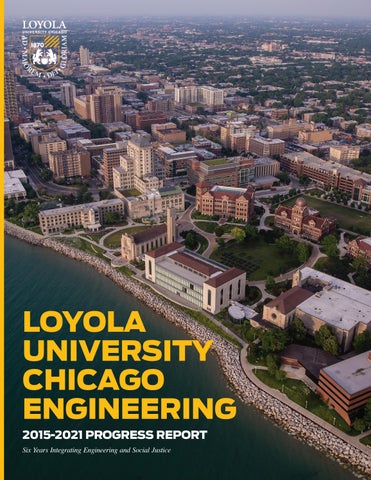
LOYOLA UNIVERSITY CHICAGO ENGINEERING 2015-2021 PROGRESS REPORT Six Years Integrating Engineering and Social Justice
39TH OF 239
BEST UNDERGRADUATE ENGR. PROGRAM (NO DOCTORATE) -U.S. NEWS AND WORLD REPORT, FIRST YEAR ELIGIBLE FOR SURVEY
THE LAST 6 YEARS: FIRST ENROLLED STUDENTS
CLASS OF 2019 GRADUATES
FALL 2021
52% OF LOYOLA ENGR. GRADS ARE WOMEN VS. THE NATIONAL AVERAGE OF 23%
INTEGRATED ENGR. & SOCIAL JUSTICE PROGRAM IN U.S.
4th
ENGR. INSTITUTION TO MANDATE ACTIVE LEARNING IN ALL ENGR. COURSES
100% 12:1 50
FALL 2020
SPRING 2019
FALL 2015
1st
ABET ACCREDITATION
FIRST NATIONAL RANKINGS, U.S. NEWS & WORLD REPORT AND AMERICAN SOCIETY FOR ENGINEERING EDUCATION (ASEE)
OF FACULTY MEMBERS HOLD A PH.D.
ENGR. STUDENT: FACULTY RATIO, FALL, 2021
ALUMNI IN 3 GRADUATED CLASSES: 2019, 2020, 2021
24 8 3
MAX. NUMBER OF STUDENTS IN ANY LOYOLA ENGR. COURSE
YEARS MEAN INDUSTRY EXPERIENCE FOR FACULTY MEMBERS
ENGINEERING SPECIALIZATIONS IN 1 DEGREE
84%
OF 2021 GRADS HAD FULL-TIME OFFERS OR GRADUATE SCHOOL ACCEPTANCE WITHIN 3 MONTHS
6TH OUT OF 429 IN PERCENTAGE BACHELORS DEGREES AWARDED TO WOMEN (ASEE) IN 2020
39TH OF 239
BEST UNDERGRADUATE ENGR. PROGRAM (NO DOCTORATE) -U.S. NEWS AND WORLD REPORT, FIRST YEAR ELIGIBLE FOR SURVEY
THE LAST 6 YEARS: FIRST ENROLLED STUDENTS
CLASS OF 2019 GRADUATES
FALL 2021
52% OF LOYOLA ENGR. GRADS ARE WOMEN VS. THE NATIONAL AVERAGE OF 23%
INTEGRATED ENGR. & SOCIAL JUSTICE PROGRAM IN U.S.
4th
ENGR. INSTITUTION TO MANDATE ACTIVE LEARNING IN ALL ENGR. COURSES
100% 12:1 50
FALL 2020
SPRING 2019
FALL 2015
1st
ABET ACCREDITATION
FIRST NATIONAL RANKINGS, U.S. NEWS & WORLD REPORT AND AMERICAN SOCIETY FOR ENGINEERING EDUCATION (ASEE)
OF FACULTY MEMBERS HOLD A PH.D.
ENGR. STUDENT: FACULTY RATIO, FALL, 2021
ALUMNI IN 3 GRADUATED CLASSES: 2019, 2020, 2021
24 8 3
MAX. NUMBER OF STUDENTS IN ANY LOYOLA ENGR. COURSE
YEARS MEAN INDUSTRY EXPERIENCE FOR FACULTY MEMBERS
ENGINEERING SPECIALIZATIONS IN 1 DEGREE
84%
OF 2021 GRADS HAD FULL-TIME OFFERS OR GRADUATE SCHOOL ACCEPTANCE WITHIN 3 MONTHS
6TH OUT OF 429 IN PERCENTAGE BACHELORS DEGREES AWARDED TO WOMEN (ASEE) IN 2020
OUR STUDENTS LEARN from minimal-lecture teaching. All Engineering courses start with a mini-lecture, with the majority of course time used for conducting collaborative-learning or problem-based learning activities. Even when forced by COVID-19 to learn online, students worked in Zoom breakout rooms, with equipment we sent to their homes. Active learning increases the performance of female students, students of color, and first-generation students.
SUCCEED because they are ALL treated equally. Starting with Orientation the summer before they enroll, our students experience BELONG (Becoming Engineers Leading the Next Generation) program structures, where they see that Loyola Engineering is inclusive and diverse. That’s why our graduating Classes are over 50% women.
ADVOCATE for socially-responsible engineering. Embedded in our curriculum are four social justice case study days, where our students work on projects where they consider the effects of technology on society. After five common semesters, our juniors select an Engineering specialization that emphasizes a social justice application. Our seniors work on two-semester capstone projects, sponsored by companies/institutions such as AbbVie, Baxter, and the Chicago Zoological Society.
BS ENGINEERING SPECIALIZATION SOCIAL JUSTICE APPLICATIONS: Biomedical Engineering - design and testing of high-quality electrical medical devices, so patient care is not affected by payment ability. Computer Engineering - design and integration of hardware and software for smart electrical grids. Environmental Engineering - environmental analysis and management for the water and wastewater treatment industries.
ATTOH-PRASSE AWARD FOR GRADUATE WITH HIGHEST GPA: 2019
Katherine Woodhull-Fuget
2020
James Darrell Gamilla
2021
Michael Mendoza
OUR STUDENTS LEARN from minimal-lecture teaching. All Engineering courses start with a mini-lecture, with the majority of course time used for conducting collaborative-learning or problem-based learning activities. Even when forced by COVID-19 to learn online, students worked in Zoom breakout rooms, with equipment we sent to their homes. Active learning increases the performance of female students, students of color, and first-generation students.
SUCCEED because they are ALL treated equally. Starting with Orientation the summer before they enroll, our students experience BELONG (Becoming Engineers Leading the Next Generation) program structures, where they see that Loyola Engineering is inclusive and diverse. That’s why our graduating Classes are over 50% women.
ADVOCATE for socially-responsible engineering. Embedded in our curriculum are four social justice case study days, where our students work on projects where they consider the effects of technology on society. After five common semesters, our juniors select an Engineering specialization that emphasizes a social justice application. Our seniors work on two-semester capstone projects, sponsored by companies/institutions such as AbbVie, Baxter, and the Chicago Zoological Society.
BS ENGINEERING SPECIALIZATION SOCIAL JUSTICE APPLICATIONS: Biomedical Engineering - design and testing of high-quality electrical medical devices, so patient care is not affected by payment ability. Computer Engineering - design and integration of hardware and software for smart electrical grids. Environmental Engineering - environmental analysis and management for the water and wastewater treatment industries.
ATTOH-PRASSE AWARD FOR GRADUATE WITH HIGHEST GPA: 2019
Katherine Woodhull-Fuget
2020
James Darrell Gamilla
2021
Michael Mendoza
OUR FACULTY
INDUSTRIAL ADVISORY BOARD
EXCELS because professors have real-world experience.
MODELS the diversity we seek in our students.
IS COMMITTED to student care.
Because faculty members have an average of
We are diverse in gender and ethnicity, and
Our twice-weekly faculty meetings start with
8 years industry experience, which is unusual
incorporate an inclusive perspective into our
student review, so we can learn how the best
for academics, we are well-prepared to train
teaching, advising, and research.
support student success.
our students for industry.
Atanu Das, J.D., Distinguished Scholar in Residence, Loyola School of Law and Senior Patent Counsel, Guntin & Gust David Gaw, President & Founder, Sensera Systems
Donald McLauchlan, P.E., Principal and Founder, Elara Engineering Anand Srivastava, M.D., M.P.H., Assistant Professor of Medicine, Northwestern University Feinberg School of Medicine
Thomas J. Sullivan, P.E., Former Managing Principal, Greeley and Hansen, LLC
OUR FACULTY
INDUSTRIAL ADVISORY BOARD
EXCELS because professors have real-world experience.
MODELS the diversity we seek in our students.
IS COMMITTED to student care.
Because faculty members have an average of
We are diverse in gender and ethnicity, and
Our twice-weekly faculty meetings start with
8 years industry experience, which is unusual
incorporate an inclusive perspective into our
student review, so we can learn how the best
for academics, we are well-prepared to train
teaching, advising, and research.
support student success.
our students for industry.
Atanu Das, J.D., Distinguished Scholar in Residence, Loyola School of Law and Senior Patent Counsel, Guntin & Gust David Gaw, President & Founder, Sensera Systems
Donald McLauchlan, P.E., Principal and Founder, Elara Engineering Anand Srivastava, M.D., M.P.H., Assistant Professor of Medicine, Northwestern University Feinberg School of Medicine
Thomas J. Sullivan, P.E., Former Managing Principal, Greeley and Hansen, LLC
OUR FACILITIES ENCOURAGE community. Our lab classrooms are constructed to seat 24 students maximum, which facilitates Active Learning. Only Engineering students have full access to study, design, and collaborate. At night, the Flex Lab and Freshman Design Classroom turn into large study lounges, making it easy to find study partners 7 days a week.
Flex Lab [shown here and on page 2] Biomedical Engineering Teaching Lab, Combined Capstone Lab, Computer Engineering Teaching Lab, Two Study Lounges
Cuneo Hall, third floor Department and Faculty Offices & Freshman Design Classroom
Flanner Hall Environmental Engineering Teaching Lab
We are grateful to friend of the program Tom Migala for his Class of 2024 LEAP (Loyola Engineering Assistance Program) Scholarship. SmithGroup and Dave Burk Photography.
OUR FACILITIES ENCOURAGE community. Our lab classrooms are constructed to seat 24 students maximum, which facilitates Active Learning. Only Engineering students have full access to study, design, and collaborate. At night, the Flex Lab and Freshman Design Classroom turn into large study lounges, making it easy to find study partners 7 days a week.
Flex Lab [shown here and on page 2] Biomedical Engineering Teaching Lab, Combined Capstone Lab, Computer Engineering Teaching Lab, Two Study Lounges
Cuneo Hall, third floor Department and Faculty Offices & Freshman Design Classroom
Flanner Hall Environmental Engineering Teaching Lab
We are grateful to friend of the program Tom Migala for his Class of 2024 LEAP (Loyola Engineering Assistance Program) Scholarship. SmithGroup and Dave Burk Photography.
OUR ALUMNI ARE CHANGING THE WORLD.
WE ASKED OUR ALUMS: “WHAT DO YOU LOVE ABOUT YOUR JOB?” “ I love playing a key role in the City of Visalia’s Storm Water
Management Program, working with a close-knit team and learning from the experience of my colleagues.” Katherine Woodhull-Fuget Environmental Engineering ‘19. Assistant Engineer in the Capital Improvement Projects Engineering Division at City of Visalia
CLASS OF 2021: Our third class graduated on May 14, 2021. During this COVID economy, within three months, 84% of our graduates had full-time offers or graduate school acceptance. Our graduates went to:
“ I love working with clients daily to solve complex problems in the
transmission and distribution industry, and creating business value by implementing new technologies.” Jacob Kueber Computer Engineering ‘19 Technology Architecture Delivery Consultant Accenture
“ I love being a part of a passionate team that truly puts our patients’
health first in developing high quality 3D cardiac mapping systems.” Jarrell Gamilla Biomedical Engineering ‘20 Software Quality Engineer Abbott Laboratories
FOX RIVER WATER RECLAMATION DISTRICT
“ I love combining working to lower emissions, traveling and field
BAXTER INTERNATIONAL
work, and having a direct impact on the environment in the Midwest region.”
[2 GRADS]
BOSTON SCIENTIFIC CORPORATION
NORTHWESTERN UNIVERSITY
Brianna Fenzl Environmental Engineering ‘20 Environmental Engineer, Air Enforcement & Compliance Assurance Branch U.S. Environmental Protection Agency, Region 5
“ I love working with the young minds of our future and being able to teach math in a way that is accessible and exciting!”
CREDO SEMICONDUCTOR, INC.
COAPT, LLC
GOODBEE & ASSOCIATES
PARTNER ENGINEERING AND SCIENCE, INC.
RJN GROUP, INC.
STANTEC, INC.
Image courtesy of NASA. Locations shown are in a stylized placement.
[2 GRADS]
SYSTEM STRATEGY, INC.
HOLLISTER INCORPORATED
Priyana Kumar Biomedical Engineering ‘21 Graduate Student getting a Masters in Secondary Math Education and Social Policy at Northwestern University
PEACE CORPS
“ My position affords me the ability to juggle a lot of hats and allows me to directly make an impact on a prosthetics community I care about.”
LOCKHEED MARTIN
Xavier Oberhelman Computer Engineering ‘21 Research and Development Engineer Coapt, LLC
OUR ALUMNI ARE CHANGING THE WORLD.
WE ASKED OUR ALUMS: “WHAT DO YOU LOVE ABOUT YOUR JOB?” “ I love playing a key role in the City of Visalia’s Storm Water
Management Program, working with a close-knit team and learning from the experience of my colleagues.” Katherine Woodhull-Fuget Environmental Engineering ‘19. Assistant Engineer in the Capital Improvement Projects Engineering Division at City of Visalia
CLASS OF 2021: Our third class graduated on May 14, 2021. During this COVID economy, within three months, 84% of our graduates had full-time offers or graduate school acceptance. Our graduates went to:
“ I love working with clients daily to solve complex problems in the
transmission and distribution industry, and creating business value by implementing new technologies.” Jacob Kueber Computer Engineering ‘19 Technology Architecture Delivery Consultant Accenture
“ I love being a part of a passionate team that truly puts our patients’
health first in developing high quality 3D cardiac mapping systems.” Jarrell Gamilla Biomedical Engineering ‘20 Software Quality Engineer Abbott Laboratories
FOX RIVER WATER RECLAMATION DISTRICT
“ I love combining working to lower emissions, traveling and field
BAXTER INTERNATIONAL
work, and having a direct impact on the environment in the Midwest region.”
[2 GRADS]
BOSTON SCIENTIFIC CORPORATION
NORTHWESTERN UNIVERSITY
Brianna Fenzl Environmental Engineering ‘20 Environmental Engineer, Air Enforcement & Compliance Assurance Branch U.S. Environmental Protection Agency, Region 5
“ I love working with the young minds of our future and being able to teach math in a way that is accessible and exciting!”
CREDO SEMICONDUCTOR, INC.
COAPT, LLC
GOODBEE & ASSOCIATES
PARTNER ENGINEERING AND SCIENCE, INC.
RJN GROUP, INC.
STANTEC, INC.
Image courtesy of NASA. Locations shown are in a stylized placement.
[2 GRADS]
SYSTEM STRATEGY, INC.
HOLLISTER INCORPORATED
Priyana Kumar Biomedical Engineering ‘21 Graduate Student getting a Masters in Secondary Math Education and Social Policy at Northwestern University
PEACE CORPS
“ My position affords me the ability to juggle a lot of hats and allows me to directly make an impact on a prosthetics community I care about.”
LOCKHEED MARTIN
Xavier Oberhelman Computer Engineering ‘21 Research and Development Engineer Coapt, LLC
ALUMNI FOCUS Alumnus Jack Brouillette ’20 is contributing to the improved hearing of cochlear implant patients. Finding a job a few months after the worldwide economy collapsed due to COVID-19 was challenging, but Jack Brouillette ‘20 began working as a V&V (Verification and Validation) Engineer at Medtronic in November, 2020. As Jack recalled, “My first week at Medtronic, the documents I was filling out for these test methods/protocols/requirements were nearly identical to your [Loyola’s FDA Design Control] documents [created in capstone courses]. And when I realized that this is exactly what I learned in college, I felt like I was a step ahead of everyone else that started with me. Medtronic and [my current employer] Med-El are both very impressed by how quickly I’ve been able to get up to speed, and I credit a lot of that to my undergraduate education and the preparation that you provided throughout your program.” Jack worked at Medtronic until he moved to cochlear implant manufacturer MedEl in August, 2021. Med-El had originally offered Jack his current position of Surgical Applications Engineer in 2020, but the position was put on hold for COVID-19. He credits Dr. Gail Baura’s textbook, which she uses to teach her medical device systems course, with helping him at Med-El.
“ I show it to my colleagues, and they say, ‘This is so cool that you learned about Med-El in depth [through the cochlear implant chapter] before you were even here.’” “The book definitely highlighted all those factors that go into medical device development, where the ideas came from and how they went from an idea to an actual device, and all the work that has to be put in. Also, the system diagrams are very crucial to my understanding of medical devices.” A major portion of Jack’s job is support for research cases on objective measures such as auditory nerve testing and electrocochleograms. He is also the topic expert in the U.S. for OTOPLAN, a new surgical planning software system that was recently cleared for use by the FDA. Once a patient’s CT scan is uploaded, a surgeon can, for the first time, visualize the cochlear duct length and how a chosen length of cochlear implant electrode will align. It is known that the “naturalness” of sound, especially musical sound, is achieved by matching pitch to electrode array position. Deep electrode insertion to the apical region of the cochlea is required for a cochlear implant to produce reliable low-frequency pitches, but the range of cochlear length in patients varies by 40%. Jack is meeting with Chairs of Neuro-Otology departments around the U.S. to introduce them to the software. The common reaction he receives from surgeons is, “This is exactly what the industry needs. I don’t know why it took so long to come up with this.” With future iterations of the software, Med-El will be moving towards anatomy-based fitting.
Jack Brouillette ’20 shown at Med-El (near right) and as a junior taking a medical device laboratory course (far right).
ALUMNI FOCUS Alumnus Jack Brouillette ’20 is contributing to the improved hearing of cochlear implant patients. Finding a job a few months after the worldwide economy collapsed due to COVID-19 was challenging, but Jack Brouillette ‘20 began working as a V&V (Verification and Validation) Engineer at Medtronic in November, 2020. As Jack recalled, “My first week at Medtronic, the documents I was filling out for these test methods/protocols/requirements were nearly identical to your [Loyola’s FDA Design Control] documents [created in capstone courses]. And when I realized that this is exactly what I learned in college, I felt like I was a step ahead of everyone else that started with me. Medtronic and [my current employer] Med-El are both very impressed by how quickly I’ve been able to get up to speed, and I credit a lot of that to my undergraduate education and the preparation that you provided throughout your program.” Jack worked at Medtronic until he moved to cochlear implant manufacturer MedEl in August, 2021. Med-El had originally offered Jack his current position of Surgical Applications Engineer in 2020, but the position was put on hold for COVID-19. He credits Dr. Gail Baura’s textbook, which she uses to teach her medical device systems course, with helping him at Med-El.
“ I show it to my colleagues, and they say, ‘This is so cool that you learned about Med-El in depth [through the cochlear implant chapter] before you were even here.’” “The book definitely highlighted all those factors that go into medical device development, where the ideas came from and how they went from an idea to an actual device, and all the work that has to be put in. Also, the system diagrams are very crucial to my understanding of medical devices.” A major portion of Jack’s job is support for research cases on objective measures such as auditory nerve testing and electrocochleograms. He is also the topic expert in the U.S. for OTOPLAN, a new surgical planning software system that was recently cleared for use by the FDA. Once a patient’s CT scan is uploaded, a surgeon can, for the first time, visualize the cochlear duct length and how a chosen length of cochlear implant electrode will align. It is known that the “naturalness” of sound, especially musical sound, is achieved by matching pitch to electrode array position. Deep electrode insertion to the apical region of the cochlea is required for a cochlear implant to produce reliable low-frequency pitches, but the range of cochlear length in patients varies by 40%. Jack is meeting with Chairs of Neuro-Otology departments around the U.S. to introduce them to the software. The common reaction he receives from surgeons is, “This is exactly what the industry needs. I don’t know why it took so long to come up with this.” With future iterations of the software, Med-El will be moving towards anatomy-based fitting.
Jack Brouillette ’20 shown at Med-El (near right) and as a junior taking a medical device laboratory course (far right).
Loyola University Chicago Engineering Cuneo Hall 320 1032 W. Sheridan Rd. Chicago, IL 60660