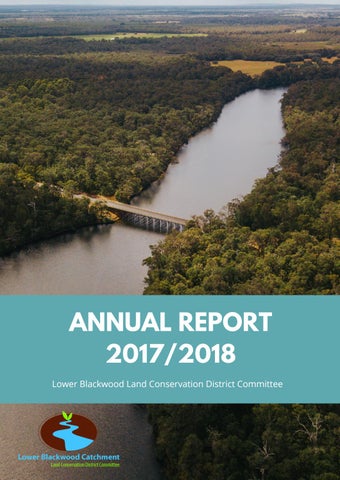
ANNUAL REPORT 2017/2018 Lower Blackwood Land Conservation District Committee
Contents PAGE 1
A Word from the Chair
PAGE 2
About Us
PAGE 3
Our Major Achievements
PAGE 4
Our Projects: Raising Capability
PAGE 6
Our Projects: Regional Estuaries Initiative
PAGE 7
Our Projects: Biodiversity Linkages
PAGE 8
Our Projects: Plantations to Pasture
PAGE 9
Our Projects: Lower Blackwood Vertebrate Pest Management Group (Feral Pigs)
PAGE 10
Our Key Partners
PAGE 11
Our Finances
PAGE 12
Where to Now?
A Word from the Chair
The Lower Blackwood Region is one that is incredibly unique and diverse in so many ways. From my home, a dairy farm in the undulating hills of Rosa Glen, stretching to the Scott Coastal Plain with unique wetland environments, then across to southern section of the Leeuwin coastal ridge from Augusta to Redgate beach, this lower south west corner is home to an enormous variety of landscapes and a vast array of biodiversity including a number of unique species of plant and animals. As if this richness in nature were not enough, we also are home to an incredibly productive, innovative and diverse agriculture industry. One that I as a farmer, a community member and as Chair of the Lower Blackwood LCDC am very proud to be a part of. Not only is there diversity in sector (including beef, viticulture, dairy – dryland and irrigated, sheep, horticulture, forestry, fishing and everything in between!), but we have diversity in farming size, diversity in farming methods and diversity in markets. Combine this with our superb growing conditions and you can easily see why this corner of the world is incredibly special.
We are halfway through our major Department of Water and Regulation’s Regional Estuaries Initiative project, which is focused on improving and maintaining the health of the iconic Hardy Inlet. This has now expanded to include the Scott River Action Plan where we’ll be working with land managers in the Scott River Catchment to describe and map the current state of the Scott River, its tributaries and catchment and establish benchmarks for the current and future health of the waterways and soils in the Scott River Catchment. We have also seen our capability as an organisation increase, enabling us to focus on connecting and engaging with our landholders, and to facilitate information and learning opportunities that work towards our group’s vision. The next year is set to be even more exciting and I look forward to continuing Chairing this passionate and dedicated committee, all working towards a sustainable future for the Lower Blackwood Catchment.
2017-18 has been a very busy and productive year for the Lower Blackwood LCDC.
Lower Blackwood LCDC Annual Report 2017/2018
Tim Crimp Chair
01
About Us Lower Blackwood LCDC is a registered as a Land Conservation District Committee under the Soil and Conservation Act (1945). Our mandate to operate is articulated through our vision: “To promote a sustainable agriculture community in the Blackwood region, where sustainability is measured in economic, social and environmental terms.” Our Committee currently consists of 17 members, including farmers, landowners and representatives from the Augusta-Margaret River Shire, Nannup Shire, Department of Agriculture and Food, Department of Parks and Wildlife, and the Pastoralists and Graziers Association of WA. Their job it is to ensure that all projects & work undertaken, meet the objectives outlined in the Lower Blackwood LCDC’s Business Plan:
Objective 1:
To develop and enhance the profile of the LCDC
Objective 2:
To coordinate and provide expert and independent advice to farmers, land managers and other NRM stakeholders on sustainable land use.
Objective 3:
To identify future needs for productive and sustainable agriculture.
Objective 4:
To maintain and improve the health of the environment and waterways through sustainable farming by minimising pollution and providing support for ecosystem management.
Objective 5:
To identify and support value adding elements of farming through improved economic and marketing support.
The 2017-18 Financial Year has seen a substantial increase in productivity, leading to successful achievement of a number of our objectives. By maintaining a strategic approach to project development, our committee has ensured that projects undertaken, and partnerships developed in the 2017-18 period, provided a significant contribution to the health of our large catchment area and the sustainable productivity of our progressive farmers. 2017-18 has also been a period of growth for the organisation with the addition of extra staff members allowing us to have more of focus on communication engagement, and the enhancement of our presence in the Lower Blackwood region.
Lower Blackwood LCDC Annual Report 2017/2018
02
Our Major Achievements
50% completion of the major Regional Estuaries Initiative project (due for full completion in 2020), with an expansion to include the Scott River Action Plan.
Successful completion of the three year South West Catchment Council ‘Biodiversity Linkages’ project.
Continuation of support (administrative) to the Lower Blackwood Vertebrate Pest Management group in their Feral Pig Control program.
Commencement of a communications and landholder engagement push, funded through the State NRM Capabilities Grant.
Successful completion of the 'Plantations to Pasture' State NRM project culminating in a well received public workshop.
Hosting of the topical National Landcare Programme – Sustainable Agriculture grants funded ‘Pasture and Productivity’ Seminar.
Lower Blackwood LCDC Annual Report 2017/2018
03
Our Projects
Raising Capability Overview The State NRM program for ‘Raising Capability’, is an innovative and much needed project that focuses on providing support and advice to landowners in the catchment on natural resource management and building the capacity and skills of the group to meet the needs of their landowners now and into the future.
Total Project: Funding - $115,000 Length - 2.5 years Completes - Dec 2018
Our Focus Capacity Building Landholder Engagement Governance Understanding Our Catchment
Our Outcomes Capacity Employment of 2 new part-time and one casual staff member bringing the LCDC staff up to 6.
Landholder Engagement Development (ongoing) of the LCDC’s website Enhanced & increased the LCDC’s social media profile (ongoing). Development and implementation of an informative and relevant monthly e-newsletter. Implementation of an efficient and centralised LCDC landholder database (ongoing) Delivery of ten workshops covering topics that included farm mapping, feral pest control, weed identification and soil biological health.
Lower Blackwood LCDC Annual Report 2017/2018
04
Our Outcomes (cont) Governance An independent review of the governance of the committee and its operations. A workshop was held reviewing committee’s operational requirements and member roles.
Understanding Our Catchment Research (conducted by Curtin University’s Sustainable Policy Unit) consisting of participatory community workshops, one on one interviews with Lower Blackwood farmers and stakeholders, capturing social information relating to landuse and food production. Completion of research report ‘Towards a Sustainable Lower Blackwood Region: A whole of landscape perspective’ giving the LCDC a much wider understanding of the district, more than our traditional environment and agricultural focus. • Five ‘Intro to Farm Mapping’ workshops • An electronic database that collated and logged all historical LCDC project data, this can now be used for future project planning to build upon the work that has already been done in our catchment • An LCDC Google Earth map kit that consists of technical and interpretive data layers for the LCDC to use an interactive information recording and management tool
Lower Blackwood LCDC Annual Report 2017/2018
05
Our Projects
Regional Estuaries Initiative Overview Led by the Department of Water and Environmental Regulation, the Regional Estuaries Initiative (or REI) is a $20 million State Government project dedicated to improving the health of six key WA estuaries.
Total Project: Funding - $785,000 Length - 4 years Completes - 2020
Our Focus Working with landholders to improve the health of the iconic Hardy Inlet through a range of on-ground works including: fencing and revegetation of riparian zones management of stock access to waterways soil testing program that provides Lower Blackwood Catchment Landholders with the knowledge and confidence to tailor their fertiliser practices based on the specific needs of their soil and pasture.
Our Outcomes (to date) The project has assisted Lower Blackwood landholders to: install 24.1km of fencing to protect riparian areas and remnant vegetation plan & plant 9.3ha of riparian revegetation complete the REI soil testing program (30 landholders with another 16 scheduled for the 2018-19 soil testing program).
Lower Blackwood LCDC Annual Report 2017/2018
06
Our Projects
Biodiversity Linkages Overview Funded by the South West Catchments Council through the National Landcare Program, Biodiversity Linkages was a key flora & fauna project for the Lower Blackwood region.
Total Project: Funding - $175,000 Length - 3 years Completed - June 2018
Our Focus To improve the water quality in the Lower Blackwood River by: Reducing grazing pressure by fencing off access of stock to creek lines and creating designated stock crossings and watering troughs. Revegetation of creek lines to stabilise the river system. Containing and managing riparian weeds. A Best Practice Bank Stabilisation Workshop to provide landholders with practical and achievable solutions to manage bank erosion on their properties and improve the ecological conditions.
Our Outcomes (to date) Successful engagement of 20 land owners 15km of fencing installed to protect riparian areas and remnant vegetation 2.8ha of riparian vegetation planted using 2250 seedlings 122.5ha of riparian weed control in the Lower Blackwood Catchment.
Lower Blackwood LCDC Annual Report 2017/2018
07
Our Projects
Plantations to Pasture Overview Funded by State NRM, this project aimed to assist landholders making the transition from Bluegum plantations back to productive pasture
Total Project: Funding - $15,000 Length - 1 year Completed - Oct 2017
Our Focus Soil testing and results interpretation to build understanding of soil health. This was facilitated by the delivery of a workshop in which soil chemist Bob Jeffrey presented the soil test interpretations to interested landowners to build their understanding and knowledge in understanding soil health during the transition from long term plantation blocks back to pasture crops.
Our Outcomes Workshop well received and well attended 4 properties tested
The Lower Blackwood LCDC has recognised the extent of landholder interest in a Plantations to Pasture Stage 2, not only in soil health and soil improvements but also in the practical components of plantation conversion and will be seeking future funding to build on their project work.
Lower Blackwood LCDC Annual Report 2017/2018
08
Our Projects
Lower Blackwood Vertebrate Pest Management Group (Feral Pigs) Overview This group aims to control the increase in feral pig population and reduce their impact on our unique environment and agricultural industry through:
Total Project: Funding - $65,000 Length - 1 year Completed - June 2018
Engagement of field officers working across the region to trap & shoot pigs Monitoring & mapping of pig populations Funded by the State NRM office, the Augusta-Margaret River Shire and the Shire of Nannup, the project is facilitated through a continuing partnership with the Lower Blackwood LCDC the Lower Blackwood Vertebrate Pest Management Group.
Our Focus The project funding directly contributes to a very significant threat to both the environment and sustainable agriculture land right here in the Lower Blackwood. Our office and resources assist to financially administer this vitally important project.
Our Outcomes Project funds were managed & administered as per our goal.
Lower Blackwood LCDC Annual Report 2017/2018
09
Our Key Partners
The Lower South West Hub In the first quarter of 2018 we commenced an exciting new partnership, the Lower South West Hub, with Grower Group Southern Dirt. Southern Dirt is one of Western Australia’s leading grower groups, encompassing some of WA’s most productive land and representing some of the states’ most innovative farmers. The benefits of this partnership to our landholders are many and varied and include opportunities to participate in Southern Dirt's high value, high impact research and development activities for farmers, and access to information & demonstrations on innovative technologies and systems. The ability to extend those activities, information and research to the Lower Blackwood Catchment is a fantastic step forward for our Sustainable Agriculture industry.
We have also continued to strengthen our relationships with our very valued and long standing key partners. These partnerships are vital in assisting us to achieve our goals and vision: Augusta-Margaret River Shire Nannup Shire Department of Water and Environment Regulation Department of Primary Industries and Regional Development Department of Biodiversity, Conservation and Attractions Curtin University Western Dairy Scott River Growers Group Lower Blackwood Vertebrate Pest Management Group South West Catchments Council Nature Conservation Augusta-Margaret River Clean Community Energy We thank our partners for their encouragement and support, and we look forward to their continued support over the coming year.
Lower Blackwood LCDC Annual Report 2017/2018
10
Our Finances
Funder
Project / Support
Total Project Funding
2017/18 Funds
Regional Estuaries Initiative
DEWR – Royalties for Regions
$785,000
$260,000
Biodiversity Linkages
South West Catchment Council
$175,000
$50,000
Feral Pig Control
State NRM / Nannup Shire
$65,000
$40,000
Capabilities
State NRM
$115,000
$55,000
Plantations to Pasture
State NRM
$15,000
-
‘Pasture and Productivity’
National Landcare Programme – Sustainable Agriculture grants
$5000
-
LCDC Capacity Support
AMR Shire
-
$43,000
$1,160,000
$448,000
Totals
Total Investment 2017/2018 $448,000
The total funding to Lower Blackwood LCDC for the financial year provided an investment of $448,000 for expenditure within our district.
Lower Blackwood LCDC Annual Report 2017/2018
11
Where to now? In addition to our a vital role in contributing to the health of the Catchment and supporting our innovative and productive Agriculture Industry, the 2017-18 financial year saw a significant growth in capacity for the Lower Blackwood LCDC. This growth provided us with the opportunity to focus on landholder engagement and education which we plan to continue this through our Raising Capability funding into the next financial year (funded to December 2018). We will also be pursuing other funding opportunities that continue to develop the LCDC's role as an information hub for our landholders and allow us to work towards achievement of our key communication objectives.
Our on-ground works to contribute to the health of the Lower Blackwood Catchment, including the Hardy Inlet will continue through the remaining 2 years of the Regional Estuaries Initiative project, along with the addition (in June 2018) of the Scott River Action plan to the our project scope. The Scott River Action Plan will take a snapshot of the current status of the river and develop management recommendations to improve the health of waterways and soils whilst retaining farm productivity. With a good level of farmer engagement at this stage of the project and a strong presence from our group on the REI Sustainable Agriculture Project Reference group overseeing ongoing whole project delivery and commitment, this exciting project will be a significant contribution towards securing the health of the Hardy Inlet. We will also continue to focus on seeking alternative sources of funding for projects that support sustainable agriculture and land care in the Lower Blackwood Region including: supporting the control of feral pigs in the Catchment, promoting the adoption of new farming techniques and technology protecting the unique and special environment of the Lower Blackwood Catchment.
Lower Blackwood LCDC Annual Report 2017/2018
12
The Lower Blackwood catchment is a connected story of natural living and sustainable food production. The community is the caretaker of the land, river and sea with a strong sense of place and a healthy ethos. The rivers and streams are as robust and healthy as in the Dreamtime and are the lifeblood of the region. Bushland and fauna are valued as unique and are adaptively managed to perpetuate a flourishing environment. Soils are healthy, productive and beneficial to agricultural and natural systems. The district is a cornucopia of diverse and varied production that is sustainable and complements the landscape.
Lower Blackwood Land Conservation District Committee PO Box 42, Karridale, WA 6288 | (08) 9758 4021| joannawren@lowerblackwood.com.au | www.facebook.com/LowerBlackwood | www.lower blackwood.com.au