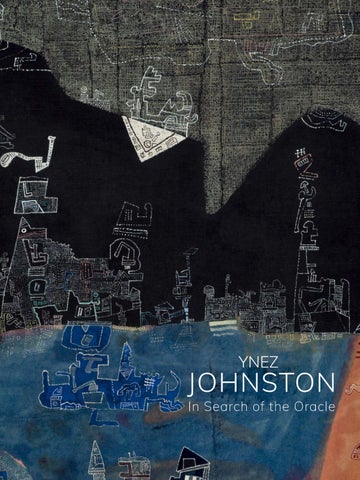
YNEZ
JOHNSTON In Search of the Oracle
YNEZ
JOHNSTON
In Search of the Oracle
Ynez Johnston: In Search of the Oracle
“Through the many permutations of Johnston’s captivating visual language, the restless impulse to manifest dreams in tangible form remained a constant guiding force.”
TABLE OF CONTENTS Foreword My Journey with Ynez Johnston
Louis Stern
Michelle Deziel-Hernandez
Ynez Johnston and the LA Art Scene In Search of the Oracle
14
Suzanne Muchnic
24
Robin Dubin
44 64
Plates What It Takes and What That Gives:
9
David Pagel
122
An Interview with Stanley Edmondson Plates Continued
132
Chronology
174
Selected Exhibitions and Collections
184
Ynez Johnston: In Search of the Oracle
Ynez Johnston in her Mount Washington home, c. 1970s
8
Stern
FORE WORD Louis St er n My intensive engagement with Ynez Johnston’s work began in 2000, around the same time I presented my exhibition l’Art Brut: Jean Dubuffet and the Outsiders. I felt that Johnston’s oeuvre shared a kinship with the work of Dubuffet, as well as that of Lee Mullican and Paul Klee, embodying the same “outsider” spirit. I found myself drawn to the intricate and mysterious worlds she created—realms that are simultaneously ancient, mythical, and deeply personal. I was immediately hooked, and her accomplished and sophisticated work stayed with me long after my first encounter. Driven by this fascination, I began collecting Johnston’s diverse body of work: paintings, works on paper, bas-reliefs, sculptures, and ceramics. I was compelled to pursue an exhibition of her work and ultimately had the pleasure of meeting her in her home studio a few years before she passed in 2019. Though it comes posthumously, I am gratified to see this project now coming to fruition. As an internationalist by sensibility, I find Johnston’s global perspective deeply resonant. Born in the San Francisco Bay Area and educated at the University of California, Berkeley, she eventually settled in Los Angeles, but her vision was shaped by the world. Extensive travels throughout Mexico, Japan, Italy, India, and Nepal allowed her to absorb diverse artistic traditions. She didn’t just observe these cultures; she distilled them into her own unique visual vocabulary. The influence of Latin American Indigenous cultures, in particular, remains a striking aspect of her aesthetic. My gallery has long championed accomplished artists who achieved critical acclaim during their careers but have become under-recognized in today’s market. Johnston gained significant momentum after settling in Los Angeles; she exhibited with important LA galleries including Paul Kantor, was collected by major museums nationwide, and was named a Los Angeles Times Woman of the Year in 1959. Despite these accolades, recognition of her legacy has faded in recent years. I believe a reevaluation of her work and career is both deserved and long overdue. Ynez Johnston: In Search of the Oracle represents the inaugural step of my mission to reintroduce Ynez Johnston’s extraordinary work. This publication is the result of the tireless dedication of the Louis Stern Fine Arts team: Robin Dubin, Gallery Director; John Vokoun, Creative Director; and Deborah Krieger, Outreach and Research Manager. Robin’s thoughtful analysis, John’s elegant and considered design, and Deborah’s dogged research efforts have given life, rigor, and color to this book. I am deeply grateful to Dan Stern for his essential partnership and shared vision for the Ynez Johnston estate. I would also like to thank the following individuals for their vital contributions to this publication: Michelle Deziel-Hernandez, Stanley Edmondson, Suzanne Muchnic, and David Pagel for their sage insights and touching remembrances; Elizabeth Smith for her astute and sensitive edits; and Tom D’Alessandro, Sanford Decker, and David Keaton for their steadfast commitment to sustaining Johnston’s legacy.
9
Ynez Johnston: In Search of the Oracle
I n Se a rc h of the Ora c l e
Yn e z J o h n s t o n
M y Journey with Ynez Johnston Michelle Deziel-Hernandez “Ynez was a creative force who lived for art. She witnessed and participated in Los Angeles’s transformation into a global center for contemporary art in the 1960s and beyond. Her closest companions were the artists, poets, and curators shaping the city’s cultural landscape.”
14
Ynez Johnston: In Search of the Oracle
June Wayne, Stanley Edmondson, Ynez Johnston, and Michelle Deziel-Hernandez in Johnston’s Mount Washington Home, 2006. Photo by Stanley Edmondson
16
Deziel-Hernandez
M Y JOUR NEY with Ynez Johnston Michelle Deziel-Herna n d ez
People say that life is a journey. It is. But journeying itself is also life. In my many voyages, I have discovered life and discovered too that life itself is art. — Ynez Johnston, 2002 Demure, thoughtful, compassionate, reclusive, mysterious, and an artistic genius—these are just a few ways artist Ynez Johnston has been described. As a curator, friend, and custodian of her archives, I have had the privilege of speaking with many who were part of her inner circle over the years. These include artists such as Emerson Woelffer, June Wayne, Nancy Uyemura, Stanley Edmondson, Connor Everts, Sanford Decker, Karen Mortillaro, and Dave Tourjé, as well as Gerald Nordland, Ken Meier, Judy Everts, Jim and Barbara Byrnes, Tobey C. Moss, and Tom D’Alessandro. While each of us knew Ynez in different ways and at different times, we were all fortunate to have known her. She was a beautiful soul and an extraordinary artist. I first met Ynez in the late 1990s while working as a curator at the Norton Simon Museum in Pasadena, California. I was co-organizing a citywide exhibition titled Radical PAST: Contemporary Art and Music in Pasadena, 1960–1974, which celebrated the vibrant local art scene that had revolved around the former Pasadena Art Museum (now the Norton Simon Museum). From 1954 to 1974, this avant-garde institution organized legendary exhibitions of artists such as Marcel Duchamp and Andy Warhol, as well as emerging local artists like Ed Ruscha and Robert Irwin. Ynez Johnston had exhibitions at the museum in 1954–55 and 1962. When the Pasadena Art Museum’s collection was absorbed by the Norton Simon Museum in 1974, many of her works came with it. While preparing for my exhibition, I discovered her watercolors, etchings, and lithographs. I was spellbound by her intricate designs and knew I had to meet her. I will never forget my first visit with Ynez. She lived in Mount Washington, a beautiful and secluded area of Los Angeles between Downtown and Pasadena, with her husband, the novelist and poet John Berry. The couple—both standing no more than five feet tall— greeted me in their driveway with warm smiles and soft-spoken words of welcome. We walked through their entryway garden, populated with towering, exotic bronze sculptures they had designed and cast together at Decker Studios, before stepping into their home. Entering their residence was like stepping into one of Ynez’s paintings. As in her work, her home was meticulously arranged, every surface filled with art and books from floor to ceiling. They had no television, no electronics, and no children—only a life immersed in art. Each room overflowed with Ynez’s paintings and sculptures, John’s assemblages and books, and pieces by friends such as Leonard Edmondson, Emerson Woelffer, and Richard Diebenkorn. Though the space was densely packed, it had a distinct sense of order. Ynez and John lived simply, happily, and authentically for art. Over time, Ynez and I developed a close friendship that spanned two decades. We enjoyed regular lunches at her home in Mount Washington and at the museum in Pasadena.
17
Ynez Johnston: In Search of the Oracle
Sometimes, we gathered with friends at June Wayne’s studio in Hollywood or at Connor and Judy Everts’s home in Torrance. After I left the Norton Simon Museum and moved with my young family to Orange County, Stanley Edmondson would drive Ynez over for monthly lunches. My children grew up knowing and adoring her. It was a beautiful friendship that I will always cherish. I had the honor of curating two major solo exhibitions of her work during her lifetime: The Magical Worlds of Ynez Johnston at the Norton Simon Museum in 2004, and an extensive retrospective titled A Fantastic Voyage: The Art of Ynez Johnston at the Mingei International Museum in San Diego in 2011 as part of the Getty Museum’s Pacific Standard Time initiative. During my tenure at the Norton Simon Museum, I also included her work in numerous group shows and helped expand the museum’s collection of her art through donations from collectors. Today, the museum holds many notable examples of Ynez Johnston’s work, beyond those originally acquired by the Pasadena Art Museum in the 1950s and ’60s. Ynez was a creative force who lived for art. She witnessed and participated in Los Angeles’s transformation into a global center for contemporary art in the 1960s and beyond. Her closest companions were the artists, poets, and curators shaping the city’s cultural landscape. She exhibited widely in galleries and museums, enjoyed numerous artist residencies and fellowships, and taught at institutions such as the Chouinard Art Institute (now the California Institute of the Arts). She received several prestigious awards, including being named Woman of the Year by the Los Angeles Times in 1959. Her works are held in major museum, public, and private collections, including the Museum of Modern Art (MoMA) and the Metropolitan Museum of Art in New York, the National Gallery of Art in Washington, DC, and the Los Angeles County Museum of Art. And yet, despite her extraordinary talent and prolific output, Ynez remains relatively unknown outside the art world. She was a singular artist whose prints, paintings, and sculptures defy categorization. Uninterested in aligning herself with movements such as LA’s “Cool School,” the Beat Generation, feminism, or minimalism, she instead dedicated herself fully to creating the intricate, dreamlike worlds that defined her art. In fact, she continued painting nearly until the end of her life in 2019. I am deeply grateful to Louis Stern and his dedicated team for recognizing Ynez Johnston as the extraordinary artist she was and for preserving her legacy. It is time for all of us to step into the magical worlds she created.
18
Deziel-Hernandez
Ynez Johnston in her Mount Washington home, c. 1978
19
Ynez Johnston: In Search of the Oracle
I n Se a rc h of the Ora c l e
Yn e z J o h n s t o n
Ynez Johnston and the LA Art Scene Suzanne Muchnic “Anyone who discovers Ynez Johnston’s art today might think that her heart and soul— if not her body—resided in a mysterious hideaway. In fact, Los Angeles was her home...”
24
Ynez Johnston: In Search of the Oracle
Ynez Johnston, Leonard Edmondson, and Edmondson’s wife, Grace at the University of California, Berkeley, 1939
26
Muchnic
Y NEZ JOH NSTON and the LA Ar t Scene Suzanne Muc h n i c Anyone who discovers Ynez Johnston’s art today might think that her heart and soul—if not her body—resided in a mysterious hideaway. In fact, Los Angeles was her home from 1949 until her death in 2019, but the sense of time and place that radiates from her work is elusive. During the 1950s, ’60s, and ’70s, when Southern California’s contemporary art scene became known for its revolution in clay, hard-edge abstraction, gritty assemblage, variations of Pop art, and perception-altering explorations of light and space, Johnston thrived in a timeless, borderless territory of her own design. Although much of her work— including paintings, drawings, prints, and sculptures—was inspired by international travels and ancient civilizations, she left viewers free to have their own experiences and draw their own conclusions. In stylistic terms, though, Johnston was labeled a fantasist. “Our leading fantasist,” as Los Angeles art critic Jules Langsner defined her in ART News magazine in November 1953. After noting that Johnston was “back in town after eight months abroad on a Guggenheim Fellowship,” he reported that she “remains true to her private world of strange leaning towers, tipsy gondolas, mosaic-like surfaces, and charming masked, horned or triangulated heads placed within a legendary atmosphere suffused in magically festive color.”1 Seventeen years later, critic Joseph E. Young confirmed that elusiveness contributed to her staying power. As he informed readers of Art International, “Ynez Johnston uses imagery which seems to have sprung from the same sources that inspired Paul Klee, primitive art and children’s art,” but she “presents her imagery in such a way that her latest works seem to have been created only last week.”2 The work of an artist who merged illusionism and abstraction in dream-like evocations of a private universe may be difficult to classify, but the artist herself was firmly grounded in the practicalities of higher education and the vicissitudes of the art scene. Born in Berkeley, California, in 1920, raised in the San Francisco Bay Area, and encouraged to follow her artistic muse during her childhood and youth, Johnston received her bachelor’s and master’s degrees in fine arts from the University of California, Berkeley. She enrolled early—at the age of sixteen, in 1937—but her higher education was extended by a university grant that allowed her to travel and work in Mexico from 1941 to 1943. When she received her master’s degree, in 1946, she had already compiled a distinctive resume, including a solo exhibition at the San Francisco Museum of Art and an art-teaching job at Tule Lake, where many Japanese and Japanese American people were interned during World War II. Post-graduate travel took Johnston back to Mexico, where she spent several months in Yucatán in 1947, and to Europe during the summers of 1948 and 1949. Her subsequent move to Los Angeles seems to have been sparked by her adventurous spirit and supportive colleagues, but her timing was fortuitous. Young and energetic enough to participate in Los Angeles’s growth as an art center, she was also sufficiently independent, focused, and talented to create a distinctive body of work that drew the attention and admiration of art dealers, curators, critics, collectors, and fellow artists. Among Johnston’s first exhibitions in her new home were solo shows at galleries run by dealer Paul Kantor, who is credited with discovering Richard Diebenkorn and presenting the first Los Angeles exhibitions of other leading artists such as Robert Motherwell, Mark Rothko, Adolph Gottlieb, and Willem de Kooning. In the fall of 1951, when Johnston’s work
27
Ynez Johnston: In Search of the Oracle
went on view at Kantor’s Fraymart Gallery, The Galleries column in the Los Angeles Times noted that her “incredibly detailed drawings and paintings” were “built up of mysterious little symbols in a wandering style and then colored like ancient icons.”3 A few months later, the newspaper reported that the Fraymart show was “a complete sellout” and that eighteen of the nineteen Johnston works displayed in a “new talent” exhibition at the Museum of Modern Art (MoMA) in New York had been purchased as well, including five for the museum’s Rockefeller and Mellon collections.4
Paul Kantor Gallery, 1954. Photo by Julius Shulman
At that time, there was no institution remotely comparable to MoMA in Los Angeles. Unlike San Francisco, which opened its major art museum in 1935, the Southern California metropolis did not have a stand-alone, publicly funded art museum until 1965, when the Los Angeles County Museum of Art (LACMA) opened on Wilshire Boulevard. Prior to that landmark event, many artists competed to show their work in the annual Artists of Los Angeles and Vicinity summer exhibition at the Los Angeles County Museum of History, Science, and Art in Exposition Park. Open to all local artists, but curated by a jury, the shows were a perpetual source of controversy. In 1947, two years before Johnston arrived, Life trumpeted the latest problem in a full-page spread titled “Art Battle”: Demonstrations of protesting artists are nothing new in the art world, but normally the protesters are “advanced” or “modern” artists fighting against being locked out by academicians. In Los Angeles, however, where normality is not normal anyway, the tradition was turned about. The museum protesters
30
Muchnic
Ynez Johnston and John Berry in her Santa Monica studio, 1958. Photo by Joseph Carrier
Jules Langsner, Ynez Johnston, and John Berry near Rome, Profile of Ynez Johnston in The Daily Tulean Dispatch,
c. 1965
February 3, 1943
Preceding spread: left two columns and bottom, third from left: Ynez Johnston in her Santa Monica studio, 1958, photos by Joseph Carrier; top, third and fourth from left and center, third and fourth from left: Johnston in her Mount Washington Home, 1962; bottom, fourth from left: Johnston at the beach, 1957 31
Ynez Johnston: In Search of the Oracle
John Berry and Ynez Johnston at an exhibition opening, c. 1960s
James Byrnes, Josephine Kantor, Ynez Johnston, and Paul Kantor at Paul Kantor Gallery in Los Angeles, 1952. Photo by Barbara Cecil Byrnes
32
Muchnic
were a conservative group which turned out pretty, recognizable paintings. They were annoyed because the show favored what they called “radical” and “subversive” art. The outraged painters set up their own canvases on the museum’s steps and terrace and along its walls as examples of what should have been shown inside. Then they marched around the museum, demanding that the director resign.5 Johnston’s work made its first appearance at the troublesome show in 1949, when it was incorporated into the California Centennial Exhibition of Art. She was also represented in 1951, when James B. Byrnes, the museum’s first curator of modern and contemporary art, added a component of East Coast Abstract Expressionism. An early supporter of Johnston’s work, Byrnes resigned in 1954 to direct the Colorado Springs Fine Arts Center, but Johnston participated in several later editions of the annual event as her audience and geographic reach expanded. All things considered, the 1950s was a fruitful decade for Johnston, at home and abroad. In Los Angeles, a Huntington Hartford Foundation residency program offered her an opportunity to work with other creative people, including her future husband, novelist and Ynez Johnston in 1951 with her painting Archaic Vessel, poet John E. Berry (1915– purchased that year by the Los Angeles County Museum for its 2000), at an arts complex in permanent collection. The Berkeley Gazette, August 2, 1951 Rustic Canyon. Then, in 1952, came the Guggenheim Fellowship that provided funds for Johnston to spend six months in Italy, followed by two months in Paris. Her exhibition record grew significantly with the addition of shows in Chicago, New York, Pittsburgh, Washington, DC, Dallas, Albuquerque, Miami, and London, among other locations. In 1955, she participated in the Third São Paulo Art Biennial in Brazil, and in 1959 her work went on view at a prestigious gallery in Guadalajara, Mexico. Another notable event, a 1956 solo show at the California Palace of the Legion of Honor in San Francisco, attracted the attention of Alfred Frankenstein, the San Francisco Chronicle’s music and art critic. His readers learned that the thirty-five-year-old artist had “mastered a fabulous, very personal, very important, and all but indescribable style” that “fuses dream and improvisation . . . in the infinite, unbelievably minute elaborations of her design.” Her deceptive use of scale might lead the eye “through extraordinary shifts and reversals, so
33
Ynez Johnston: In Search of the Oracle
that the microscopic is revealed as immense and the immense vanishes into the small.” Forms were elusive as well. “Half abstract and half representational; they are patches of color and line and they are also towers, battlements, facades, and domes. They are static like aerial photographs, and they flow like old maps. Counterpoints of perspective in a dozen dimensions at once are a major resource.”6 Beyond the art world, Johnston was one of ten winners of the Los Angeles Times Woman of the Year award in 1959. Established in 1950 to recognize the achievements of Southern California women in the fields of science, religion, the arts, education, government, community service, entertainment, sports, business, and industry, the honor was initiated by Dorothy Chandler, wife of Norman Chandler, who was publisher of the newspaper from 1945 to 1960. Otis Chandler, their son and heir, ended the program in 1977, when it seemed outdated. Throughout her career, Johnston explored a wide variety of techniques and materials with astonishing facility. But her versatility is most apparent in the field of printmaking, thanks in part to artists Leonard Edmondson and June Wayne, who were deeply engaged in the field. Johnston and Edmondson met as students in Berkeley and reconnected in Los Angeles. Lacking a printing press of her own, Johnston often worked at Edmondson’s studio in Pasadena, where she learned various skills from him and visiting artists. Wayne, who settled in Los Angeles in 1944 after living in Chicago and New York, began making lithographs in 1948 and was named a Los Angeles Times Woman of the Year in 1952. She established the Tamarind Lithography Workshop, named for its street location, in 1960. Funded by a grant from the Ford Foundation, Tamarind inspired a renaissance of lithography while hosting artists who worked with master printers during two- to three-month residencies. The workshop moved to the University of New Mexico in Albuquerque in 1970, when Wayne resigned as director, but the program had a lasting impact on many participants and subsequent printmaking enterprises. A decade after Johnston’s move to Los Angeles, the city became such an action-packed place for the arts that it inspired several books on the subject. As artist and writer Peter Plagens stated in his lively account, Sunshine Muse: Art on the West Coast, 1945–1970:
Ynez Johnston with Leonard Edmondson’s printing press, c. 1950s
34
During the sixties, a culture explosion— deriving from such disparate socioeconomic origins as youth emphasis, the election of JFK, newly available middle-class affluence and leisure, the bull market, and the fashionableness of colleges and universities as war babies filled them to overflowing— overtook the country. The visual-art
Muchnic
Ynez Johnston signing an edition of her lithograph The Black Pagoda I at the Tamarind Lithography Workshop, 1966
35
Ynez Johnston: In Search of the Oracle
Ynez Johnston in her Mount Washington home, c. 1978
36
Muchnic
portion of the phenomenon meant an increased audience and new quarters for public galleries and the burgeoning of the commercial ones. “Culture” meant “art,” and “art” implied “new,” and “new,” as everybody was informed, meant California— particularly Los Angeles.7 One highly visible result was that Los Angeles became the home of twenty-five or thirty galleries of modern and contemporary art, many of which operated in the vicinity of La Cienega Boulevard between Melrose Avenue and Santa Monica Boulevard, and welcomed the public to “Art Walks” on Monday nights. But the growth of interest and activity in contemporary art could be seen well beyond that enclave, in many parts of greater Los Angeles and a variety of institutions, including art schools and the long-awaited museum on Wilshire Boulevard. “Los Angeles faces the most exciting year that art-minded citizens of this community have ever experienced,” Los Angeles Times art critic Henry J. Seldis wrote in January 1965. “At
The newly-opened Los Angeles County Museum of Art on Wilshire Boulevard, September, 1965. Photo by George Garrigues
last, a fairly old dream, the establishment of a separate art museum, is becoming a physical reality as the handsome museum building complex in Hancock Park nears completion.”8 Dubbed “the temple on the tar pits” because of the history of its site, the Los Angeles County Museum of Art opened just four months after the city’s new music center, causing Time magazine to proclaim that Los Angeles had become “the artistic capital of the U.S. West.”9 For Johnston, the 1960s brought new gallery affiliations and dozens of exhibitions across the country and abroad. Her husband’s receipt of a Fulbright grant in 1964 allowed the couple to travel to India, Nepal, Cambodia, and Japan and gave Johnston an opportunity to pursue her interest in Indian miniature paintings and erotic carvings. In Los Angeles, at the invitation of Wayne, she also produced lithographs at Tamarind. Among Southern California museums with substantial holdings of Johnston’s work, the Pasadena Art Museum, which became the Norton Simon Museum in 1975, acquired eighty-seven examples, including Travels of the Sage Narada: The Other World, a portfolio of sixteen etchings featuring Berry’s poetry. At LACMA, a collection of forty-three works by Johnston includes large gifts
37
Ynez Johnston: In Search of the Oracle
from Wayne as well as Anna Bing Arnold, a major supporter of the museum in the 1960s. Given the geographical reach of Johnston’s exhibition record, it is not surprising that she is represented in the collections of more than one hundred public institutions in the United States and abroad as well as private holdings. And, as various critics have noted, part of her staying power is that her work seems to float free from any specific movement or time. Long after the 1960s faded, her distinctive mode of expression continued to intrigue professional critics as well as casual observers. “It is more than unusual to watch an artist’s work for more than twenty years and find it ever more rewarding,” Seldis mused in 1974. “Both her wit and her techniques are sharper than ever. . . . Along with the irrepressibly pixieish quality of her work there is a sense of exotic decorativeness and of the playful side of mysticism that keeps her incredible inventiveness going full steam.”10 Two years later, Seldis’s colleague William Wilson offered his thoughts on the matter in a review of her exhibition at the Jodi Scully Gallery: For those who count the beginnings of California modernism from the mid-60s, the art of Ynez Johnston will seem positively prehistoric, and maybe, surprisingly au courant. She continues making map-like compositions full of stained colors overdrawn with imaginary cityscapes made up of pictographic signs. The work is always gently humorous and decorative. In this exhibition a series painted on silk takes on a special surface glow. A cut-out wall relief is both intrinsically interesting and a gentle satire of those decorative maps in overdesigned natural history museum exhibitions that somehow never tell you anything. Johnston’s maps invite the imagination to fantasize on ritual grounds in lost civilizations. Like the art of Paul Klee, this comes to the borders of profundity. They teach us, among other things, that a current fascination with primitive religious magic is not new, just more literal. It is the artist longing for his lost power as magician and shaman.11 By 1987, much had changed in Los Angeles’s art scene, but Johnston continued to chart her own course. Critic Colin Gardner described her latest works as “dense, map-like calligraphies of biomorphic forms and mystical creatures that appear to combine the exotic hieroglyphs of Indian, Oriental and Mayan culture with the personal iconographies of Klee and Miro.” At their best, they “simply explode the boundaries between image and ground, East and West, modernism and its historical sources, to create true, idiosyncratic hybrids.”12 And in 1994, when Johnston was seventy-three, critic David Pagel offered practical advice to members of her audience who might be perplexed: “It’s often impossible to know what you see when you look at these hallucinatory images. You just have to sense things, ceding rational control to follow fleeting intuitions. Fortunately, Johnston endows every inch of her delightful pictures with the potential to contribute to any number of wildly open-ended narratives.”13
Opposite page: top left and bottom left and right: Ynez Johnston and John Berry in Japan, c. 1960s; center left: Johnston at her Mount Washington Home, 1962; top right: notice of Ynez Johnston and Leonard Edmondson exhibition at Los Angeles Harbor College, 1968 38
Muchnic
39
Ynez Johnston: In Search of the Oracle
Ynez Johnston in her Mount Washington home, c. 1970s
40
Muchnic
Notes 1
Jules Langsner, “Art News from Los Angeles,” ART News 52 (November 1953): 44.
2
Joseph E. Young, “Los Angeles,” Art International 14 (Summer 1970): 111–15.
3
“Gallery Reports Sale of Johnston Paintings,” In the Galleries, Los Angeles Times, October 1, 1950, Part IV, p 8.
4
“Ynez Johnston Exhibit Nearly Sellout in East,” Art, Los Angeles Times, March 4, 1951, Part IV, p. 6.
5
“Art Battle: Conservative Los Angeles painters protest ‘radicals’ hung in museum,” Life, June 16, 1947, 40.
6
Alfred Frankenstein, This World, San Francisco Chronicle, April 29, 1956, 30.
7
Peter Plagens, Sunshine Muse: Contemporary Art on the West Coast (New York: Praeger Publishers, 1974), 25, 27.
8
Henry J. Seldis, “New Realization of an Old Dream,” Los Angeles Times, January 3, 1965, Calendar, 2.
9
“Museums: Temple on the Tar Pits,” Time, April 2, 1965.
10
Henry J. Seldis, “A Critical Guide to the Galleries,” Los Angeles Times, January 18, 1974, part IV, p. 6.
11
William Wilson, “Art Walk: A Critical Guide to the Galleries,” Los Angeles Times, April 9, 1976, Part IV, p. 12.
12
Colin Gardner, “The Art Galleries,” Los Angeles Times, April 3, 1987, Part VI, p. 11.
13
David Pagel, “Ynez Johnston’s Mythical Flights of Fancy,” Los Angeles Times, April 28, 1994, F9.
41
Ynez Johnston: In Search of the Oracle
42
Muchnic
Ynez Johnston in her Mount Washington studio, 1998. Photo by Stanley Edmondson
43
Ynez Johnston: In Search of the Oracle
In Se a rc h of the Ora c l e
Yn e z J o h n s t o n
In Search of the Oracle Robin Dubin “Johnston’s works returned obsessively to favored themes and forms: fanciful chimeras prowling enchanted forests, sentinels guarding cloud cities studded with royal castles, bulbous ships navigating whirling maelstroms. These subjects more often form visceral impressions than coherent pictures, approaching familiarity but veering into uncharted territory on closer examination.”
44
Ynez Johnston: In Search of the Oracle
FIG 1. EXPEDITION IN SEARCH OF THE ORACLE 1964 INK ON PAPER 11 3/4 X 18 1/8 INCHES; 29.8 X 46 CENTIMETERS
46
Dubin
IN SEARCH of the O rac le R obin D ubi n In her 1964 drawing Expedition in Search of the Oracle, Ynez Johnston mapped an imagined pilgrim’s journey to seek the counsel of a distant prophet (fig. 1). One might imagine that the artist, traveling in Greece at the time, was inspired by legends of the famed Pythia, the Sibyl of Delphi, when she created this intriguing image. A dizzily scribbled Mount Parnassus rises on the page, stacking a jumble of apparitions from base to summit. Winding pathways peppered with monuments to the gods terminate in cavernous doorways to the shadowy belly of the mountain. Clouds of noxious vapors, the hallucinogenic catalysts of the Sibyl’s frenzied prophesies, seep from a crevice in the earth as a plume of sacrificial smoke spirals toward the heavens. The high priestess herself awaits in her chamber, preparing to transmit ecstatic visions of future events via divine possession by the god Apollo. Speaking through his oracle, as the pre-Socratic philosopher Heraclitus mused, Apollo “neither utters nor hides his meaning, but shows it by a sign.” The cryptic wisdom of the god, channeled as it was through a mortal mouthpiece, required thoughtful decoding and interpretation by its recipient. “The Sibyl,” wrote Heraclitus, “with raving lips . . . reaches over a thousand years with her voice because of the god in her.”1 The work of Ynez Johnston, which has often been categorized by its very resistance to categorization, conducts a similarly arcane energy—identified by the artist as “an unconscious channel, a subterranean life-force.”2 James B. Byrnes, the first curator of modern and contemporary art at the Los Angeles County Museum of History, Science, and Art in Exposition Park, described Johnston’s world as one that “begins when the last rays of the objective sun have set in semi-darkness, when solids become shapes, color becomes atmosphere, and all is transformed into mood. It is the art of elsewhere, frequently of other times.”3 In paintings, drawings, prints, and sculptures, produced over a career spanning seven decades, Johnston gave life to enchanting images that hover on the beguiling threshold of recognition. Her dreamy island universes exist on an indeterminate, continuous plane of past and future, fact and fantasy, as if tapped directly from the rushing river of the collective unconscious. These enigmatic works, like the prophesies of Pythia, invite and even demand focused, intimate decrypting. Just as Heraclitus wrote of Apollo’s divine transmissions, Johnston stated that her work “is not representational but it is referential. . . . It refers to something which is not stated overtly.”4 The amalgamation of a lush tapestry of influences, Johnston’s works returned obsessively to favored themes and forms: fanciful chimeras prowling enchanted forests, sentinels guarding cloud cities studded with royal castles, bulbous ships navigating whirling maelstroms. These subjects more often form visceral impressions than coherent pictures, approaching familiarity but veering into uncharted territory on closer examination. Johnston’s whimsical titles enlist the viewer’s imagination, conjuring mind’s-eye visions of mysterious underground cave paintings or intrepid mountain goats traversing a sheer cliff face—even as the caverns defy all earthly geology and the goats sprout extra limbs (fig. 2).
47
Ynez Johnston: In Search of the Oracle
Johnston’s works straddle ancient and modern, plucking indiscriminate imagery from locales both real and imagined. Her artistic life was shaped and defined by travel, from her earliest childhood fantasies of distant sea voyages— dreamily launched from the wharves of her native San Francisco Bay—to the farflung countries she explored throughout her adult life. Writings on her work cite a dizzying assortment of influences in the same breath, including Persian and Indian miniatures, Egyptian hieroglyphics, Maya temple carvings, Tibetan thangkas, and Byzantine icons. These pluralistic forms and structures slide in and out of focus, embodying all and none of them simultaneously. Johnston collapsed a FIG 2. MOUNTAIN CLIMBERS lifetime of absorbed and 2003, MIXED MEDIA ON CANVAS, 20 X 16 INCHES; 50.8 X 40.6 CENTIMETERS invented images into a series of private conventions, tethered to her own strange and romantic interior life. “I refer to ideas of figures, not likenesses,” she claimed. “This is what happens in the picture-making process: One runs images together. And at first I think the images retain some of their separate identities. Well, later on what has happened in my case is that the separate identities gradually lost their specific characters and metamorphosed into new forms. So that in time all these things became a kind of vocabulary of new shapes.”5 Noteworthy exceptions are Johnston’s earlier works, produced mainly in the 1940s while she was obtaining her undergraduate and master’s degrees from the University of California, Berkeley and traveling in Mexico on academic grants. They retain identifiable referents, even as they begin to exhibit the inventive compositional approaches that would characterize her work in subsequent decades. A circa 1947 color woodblock print, rare in its use of legible text, flattens a lively commercial street into a jeweled mosaic of storefronts (fig. 3). Individually discernible buildings are embellished with flamboyant hues and tumbled together in an incomprehensible street plan, creating a frenetic mirage of bustling urban life. Johnston’s 1949 etching Mexico candidly records her fond memories
48
Dubin
of the energetic marketplaces of that country, while indulging in exaggerated anatomies, multiple perspectives, and dense, calligraphic patterning (fig. 4). These compositional features are further developed in her 1950 etching Bullfight #1, in which human and animal figures begin to take on strange features that strain the edges of recognition (plate 3). Johnston’s career quickly accelerated in the early 1950s, dovetailing with an equally rapid development of her unique mature style. Cityscapes, palaces, and misty forests were compressed into multiperspectival, intricately woven tapestries of gossamer lines and innumerable scintillating points, while her imagery became more idiosyncratic and ambiguous. In a work on paper from this period, Village Along Tropical Coast, spindly figures gradually reveal themselves, gazing out of loosely described windows and doorframes. Allusions to buildings, boats, and waves teeming with sea creatures pay no mind to scale or perspective as they are ironed into a single, shimmering narrative fabric (fig. 5). In the mid-1950s, Johnston’s work began to adopt a moody, hazy quality with more painterly features, incorporating looser, open line work and softly mottled washes. At the urging of a friend enamored with the New York School, Johnston began experimenting with Abstract Expressionism later that decade. She felt unfulfilled by the results and
FIG 3. UNTITLED C.1947, COLOR WOODBLOCK, 16 3/8 X 22 1/4 INCHES; 41.6 X 56.5 CENTIMETERS
49
Ynez Johnston: In Search of the Oracle
FIG 5. (preceding spread) VILLAGE ALONG TROPICAL COAST C. 1950 CASEIN ON ARCHES PAPER 14 1/4 X 21 1/8 INCHES; 36.2 X 53.7 CENTIMETERS
FIG 4. MEXICO 1949, ED. 10/20 ETCHING 9 1/2 X 12 1/2 INCHES; 24.1 X 31.8 CENTIMETERS
FIG 6. (below) UNTITLED (LION IN THE FOREST) C. 1953 ED. 2/16 COLOR WOODBLOCK 21 3/8 X 29 INCHES; 54.3 X 73.7 CENTIMETERS
52
Dubin
soon abandoned this direction, but she credited the experience with a newfound interest in spontaneous, automatic artmaking and its facilitation through various unorthodox materials.6 In an experimental series from the early 1960s, Johnston began integrating Plastic Steel, a fast-setting industrial putty, into her oil paintings. Its rapid curing time required that she work quickly, inscribing expressionistic lines into the soft material and rubbing it with dry pigments while still wet. This technique resulted in animated, organic compositions of vigorously tactile character. The drag lines left by her tool’s energetic path through the resistant substance tell a vivid story of the markings’ creation. Johnston continued her investigations of this unconventional material in a 1969–70 series of carved wood Ynez Johnston with a plastic steel painting, 1962 panels, which she coated with incised Plastic Steel and paint. Their shallow, irregularly shaped troughs give the impression of an archaeological excavation in progress, while her hastily scratched markings suggest an unknown proto-language traced on the walls of a prehistoric cave. These cavities are scattered with smooth protrusions, gleaming like precious artifacts discovered after centuries buried in the earth. After taking a course in etching in 1948, Johnston maintained an extensive, lifelong printmaking practice that encompassed numerous techniques. She gravitated toward methods that enabled the most immediate transmission from mind to hand, often combining a single copper plate or woodblock with stenciled color applied with a roller or fingertip.7 This allowed for a less labor-intensive and more expeditious production of intricate prints such as her c.1953 Lion in the Forest (fig. 6) and approximated handcoloring, resulting in prints that were each slightly unique. Extensive travels with her husband in the 1960s ignited a surge of new formal and thematic explorations in Johnston’s work. She drew regularly throughout their stays in India, Cambodia, Nepal, Japan, Greece, and England, using the few materials she could comfortably transport: paper and pen. These diaristic sketches resemble aerial maps or
53
Ynez Johnston: In Search of the Oracle
schematics and feature unplaceable objects and structures that feel nonetheless elusively familiar. They record a chronicle of adventure and give shape to the uncertainties and pleasures of being a visitor in a strange land. In her 1964 drawing Darjeeling, that Indian city’s architecture and environs are inscrutably charted, to be unraveled only through curiosity and openhearted exploration (fig. 7).
Ynez Johnston with her etching press in her Mount Washington studio, 1962
The temple carvings that Johnston encountered in India also inspired a late-1960s series of playful erotic prints (fig. 8). They are compositionally reminiscent of Tibetan thangkas, which became a major aesthetic preoccupation for Johnston after her travels in
Nepal. Their strong borders and dominant central geometric elements formed the structural foundation for much of her work in the 1970s, though she continued to depict her favored subjects of fantastical worlds and their denizens. Johnston visualized this spatial division sometimes “as an aperture and sometimes like a medieval manuscript illumination.”8 After a period of painting with chemical dyes on layered canvas and silk panels, she applied the same framing device to a series of 1980s mixed media works, many featuring borders of thickly textured rice papier-mâché (fig. 9). Johnston’s later years remained artistically rewarding and productive, and she painted prolifically into her nineties. The works she produced in the 1990s and 2000s continued to mine the rich veins of innovative materials and subjects she had developed throughout her career. Johnston’s late paintings on canvas and paper sparkle with extensive overall patterning, evoking the intricacy and opulence
54
FIG 7. DARJEELING 1964, INK ON PAPER, 15 1/2 X 11 INCHES; 39.4 X 27.9 CENTIMETERS
Dubin
Ynez Johnston and John Berry at the Temple of Aphaia in Aegina, Greece, 1964
55
Ynez Johnston: In Search of the Oracle
FIG 8. THE KISS 1967-68 HAND COLORED INTAGLIO 22 7/8 X 15 INCHES; 58.1 X 38.1 CENTIMETERS
56
Dubin
FIG 9. ESCAPE FROM THE MAELSTROM 1989 MIXED MEDIA ON CANVAS 24 X 18 INCHES; 61 X 45.7 CENTIMETERS
57
Ynez Johnston: In Search of the Oracle
FIG 10. ROMAN PAINTING 1996 ACRYLIC AND MIXED MEDIA ON CANVAS 48 X 54 INCHES; 121.9 X 137.2 CENTIMETERS
58
Ynez Johnston: In Search of the Oracle
of a Byzantine mosaic. Countless unintelligible hieroglyphs are neatly assembled like glittering tesserae. In her 1996 work Roman Painting, tightly thumbed daubs of paint weave a luxurious carpet for the peculiar animals that traipse through a forbidden city of pyramids, gateways, and temples (fig. 10). These inhabitants are outlined with thin borders of piped modeling paste, lifting them off the canvas like delicately embroidered appliqués. Beginning in the late 1950s, when she met and married her Carrier husband, poet and novelist John Berry, Johnston embarked on a series of fruitful collaborations that would endure for the rest of her career. Together the couple produced sculptures that propelled Johnston’s bizarre creatures and quirky architecture into three dimensions. A skilled carpenter, Berry closely studied her designs and realized them faithfully in wood, which Johnston then inscribed and painted with her signature forms. Ynez Johnston with her paintings, c. 1971. Photo by Joseph
The wooden beasts, intricately carved with secretive crannies and curious protrusions, are both slightly unsettling and thoroughly delightful. Their manifestation, in Berry’s words, “often takes unexpected turns, as if these guardian demiurges had a will of their own and knew exactly how they wanted to look.”9 Fierce protectors with turrets for spines, they lumber forth on improbably numerous legs and harbor tiny riders within their jaws and hollowed abdomens (fig. 11). In the late 1980s, Johnston and Berry began casting these sculptures in bronze. Together they created the wood maquettes, which were then molded, cast, and patinated by Decker Studios foundry (fig. 12). Partnerships with ceramicists, first with Adam Mekler in the 1970s and then with Stanley Edmondson in the 1990s and 2000s, Ynez Johnston in her Mount Washington home, also provided three-dimensional substrates for 1992. Photo by Don Dickinson
60
Dubin
FIG 11. UNTITLED 1975 MIXED MEDIA ON PARTICLE BOARD 17 X 23 X 7 INCHES; 43.2 X 58.4 X 17.8 CENTIMETERS
FIG 13. UNTITLED C. 2000 GLAZED CERAMIC 8 1/2 X 10 1/4 INCHES; 21.6 X 26 CENTIMETERS
61
Ynez Johnston: In Search of the Oracle
Johnston’s dynamic designs. Mekler and Edmondson created vessels, tiles, and plates to her specification in clay, which she carved and decorated with glazes (fig. 13). Their eccentric shapes give a nod to function, but the furiously inscribed glyphs that cover their surfaces imply the presence of an encrypted message. These symbols do not represent any known lexicon, but suggest a mystical codex that feels at once alien and tantalizingly decipherable. Through the many permutations of Johnston’s captivating visual language, the restless impulse to manifest dreams in tangible form remained a constant guiding force. “There’s the compulsive element,” the artist wrote, “—the drive to create something that seems to come out of an inner life—of images, symbols, that perhaps refer to all sorts of things seen, heard, read about, but that appear on paper or canvas in relationships logical only unto themselves—call it fantasy.”10 In the works that flowed from Johnston’s voluble hand, one cannot help but be reminded of Pythia hunched in her temple at Delphi, feverishly uttering the god’s eternal wisdom through her obscure prophesies. Like the oracle’s transmuted missives, Johnston’s vaporous kingdoms and sparkling harbors exist at the blurry peripheral edge of comprehension, never quite resolving into consciously recognizable form. They bristle with an otherworldly urgency, scratching at the back of the mind like a half-forgotten dream. Johnston’s works offer mythical star maps to parts unknown, awaiting discovery by any bewitched traveler willing to make the pilgrimage.
Notes
62
1
John Burnet, Early Greek Philosophy, 2nd ed. (London: Adam and Charles Black, 1908), 147.
2
Ynez Johnston, “View from the Wind Palace, an Interview with Painter Ynez Johnston,” interview by John Berry, Mankind: The Magazine of Popular History 5, no. 1 (June 1975): 43.
3
James B. Byrnes, Ynez Johnston: Recent Paintings, exh. cat. (Beverly Hills, CA: Paul Kantor Gallery, 1953).
4
Johnston, “View from the Wind Palace,” 68.
5
Johnston, “View from the Wind Palace,” 69.
6
Gerald Nordland, Ynez Johnston (Miami Beach, FL: Grassfield Press, in association with the Kennedy Museum of American Art, 1996), 51–52.
7
Nordland, Ynez Johnston, 29–30, 39–40.
8
Jane Cleave, Ynez Johnston, exh. cat. (Fresno Art Museum, 1992).
9
John Berry, “The Sculpture,” Ynez Johnston, exh. cat. (Beverly Hills, CA: Paul Kantor Gallery, 1964), 11.
10
Nordland, Ynez Johnston, 30.
Dubin
FIG 12. THE FOUNTAIN C. 1987 BRONZE 24 X 19 X 10 3/4 INCHES, 61 X 48.3 X 27.3 CENTIMETERS
63
Ynez Johnston: In Search of the Oracle
I n Se a rc h of the Ora c l e
Yn e z J o h n s t o n
PLATES “Johnston’s works offer mythical star maps to parts unknown, awaiting discovery by any bewitched traveler willing to make the pilgrimage.”
64
Ynez Johnston: In Search of the Oracle
1. ANCIENT STREET C. 1950 ED. 16/25 COLOR ETCHING 17 3/4 X 8 7/8 INCHES; 45.1 X 22.5 CENTIMETERS
66
Plates
67
Ynez Johnston: In Search of the Oracle
2. BRIDGE OF FACES C. 1950 MIXED MEDIA ON PAPER 14 1/2 X 21 INCHES; 36.8 X 53.3 CENTIMETERS
68
Plates
69
Ynez Johnston: In Search of the Oracle
3. UNTITLED (BULLFIGHT #1) C. 1950 ED. 1/20 ETCHING 9 X 11 1/2 INCHES; 22.9 X 29.2 CENTIMETERS
70
Plates
4. INNER COURT 1951 ED. 12/35 ETCHING 11 1/2 X 9 1/8 INCHES; 29.2 X 23.2 CENTIMETERS
71
Ynez Johnston: In Search of the Oracle
5. SQUARE WITH MONUMENTS 1952 ED. 13/25 ETCHING 12 1/4 X 15 5/8 INCHES; 31.1 X 39.7 CENTIMETERS
72
Plates
73
Ynez Johnston: In Search of the Oracle
6. TEMPLES AND SHADOWS C. 1952 OIL ON MASONITE 21 X 28 INCHES; 53.3 X 71.1 CENTIMETERS
74
Plates
75
Ynez Johnston: In Search of the Oracle
7. ADVANCING MIST 1953 CASEIN ON PAPER MOUNTED ON CARDBOARD 28 X 19 1/2 INCHES; 71.1 X 49.5 CENTIMETERS
76
Plates
77
Ynez Johnston: In Search of the Oracle
8. UNTITLED (GUARDIAN OF THE PYRAMID) C. 1953 ED. 2/35 ETCHING 11 1/2 X 9 INCHES; 29.2 X 22.9 CENTIMETERS
78
Plates
9. DARK CITYSCAPE 1956 INK AND CASEIN ON JAPANESE HOSHO PAPER 15 1/2 X 10 INCHES; 39.4 X 25.4 CENTIMETERS
79
Ynez Johnston: In Search of the Oracle
10. UNTITLED COMPOSITION C. 1956 WATERCOLOR ON PAPER 21 1/2 X 29 INCHES; 54.6 X 73.7 CENTIMETERS
80
Plates
81
Ynez Johnston: In Search of the Oracle
11. ENTERING THE ORANGE PALACE 1959 WATERCOLOR, INK, AND CRAYON ON PAPER 26 X 20 1/2 INCHES; 66 X 52.1 CENTIMETERS
82
Plates
83
Ynez Johnston: In Search of the Oracle
12. BLUE CASTLE 1960 CASEIN ON PAPER 16 X 11 INCHES; 40.6 X 27.9 CENTIMETERS
84
Plates
85
Ynez Johnston: In Search of the Oracle
13. UNTITLED 1960 WATERCOLOR ON PAPER 21 X 28 INCHES; 53.3 X 71.1 CENTIMETERS
86
Plates
14. BLACK LUMINOSITY 1961 OIL AND PLASTIC STEEL ON CANVAS 12 X 16 INCHES; 30.5 X 40.6 CENTIMETERS
87
Ynez Johnston: In Search of the Oracle
15. ANCIENT MAN 1961 OIL AND PLASTIC STEEL ON CANVAS 18 X 14 INCHES; 45.7 X 35.6 CENTIMETERS
88
Plates
89
Ynez Johnston: In Search of the Oracle
16. MOONDOOR 1961 OIL AND PLASTIC STEEL ON CANVAS 15 1/2 X 9 1/2 INCHES; 39.4 X 24.1 CENTIMETERS
90
Ynez Johnston: In Search of the Oracle
17. VOLCANO 1961 OIL AND PLASTIC STEEL ON WOOD PANEL 48 1/4 X 33 INCHES; 122.6 X 83.8 CENTIMETERS
92
Plates
18. DARK DIVER 1962 OIL AND PLASTIC STEEL ON CANVAS 27 X 8 INCHES; 68.6 X 20.3 CENTIMETERS
93
Ynez Johnston: In Search of the Oracle
19. INHABITED WORLD 1962 ARTIST PROOF COLOR ETCHING AND AQUATINT 21 1/2 X 16 5/8 INCHES; 54.6 X 42.2 CENTIMETERS
94
Plates
20. HUNTING SCENE II 1962 PROOF COLOR ETCHING AND AQUATINT 16 3/4 X 22 1/2 INCHES; 42.5 X 57.1 CENTIMETERS
95
Ynez Johnston: In Search of the Oracle
21. INSCRIBED FIGURE 1962 CARVED AND PAINTED WOOD 33 X 22 X 20 INCHES; 83.8 X 55.9 X 50.8 CENTIMETERS
96
Ynez Johnston: In Search of the Oracle
22. LEDGE OF DAWN 1962 OIL AND PLASTIC STEEL ON CANVAS 54 1/4 X 7 3/8 INCHES; 137.8 X 18.7 CENTIMETERS
98
Ynez Johnston: In Search of the Oracle
23. FIGURES ON BLACK 1963 OIL AND PLASTIC STEEL ON CANVAS 24 X 18 INCHES; 61 X 45.7 CENTIMETERS
100
Plates
101
Ynez Johnston: In Search of the Oracle
PRECEDING SPREAD
24. MAGNA GRECIA 1963 OIL AND PLASTIC STEEL ON CANVAS 30 X 60 INCHES; 76.2 X 152.4 CENTIMETERS
25. ROYAL DOMAIN 1963 OIL AND PLASTIC STEEL ON CANVAS 50 X 32 INCHES; 127 X 81.3 CENTIMETERS
104
Ynez Johnston: In Search of the Oracle
26. GATE TO THE EAST 1963 OIL AND PLASTIC STEEL ON CANVAS 59 X 45 INCHES; 149.9 X 114.3 CENTIMETERS
106
Ynez Johnston: In Search of the Oracle
27. THE BLACK PAGODA IX 1966 ARTIST PROOF COLOR LITHOGRAPH 30 1/4 X 22 INCHES; 76.8 X 55.9 CENTIMETERS
108
Plates
109
Ynez Johnston: In Search of the Oracle
28. INACCESSIBLE ISLAND 1967 ACRYLIC ON LINEN 37 X 25 INCHES; 94 X 63.5 CENTIMETERS
110
Plates
111
Ynez Johnston: In Search of the Oracle
PRECEDING SPREAD
29. SUN PAINTING 1968 DYE ON CANVAS 42 X 81 INCHES; 106.7 X 205.7 CENTIMETERS
30. LONDON 1969 INK ON PAPER 10 X 16 INCHES; 25.4 X 40.6 CENTIMETERS
114
Plates
115
Ynez Johnston: In Search of the Oracle
31. PURIFICATION RITE 1969 MIXED MEDIA ON CARVED WOOD RELIEF 18 X 30 INCHES; 45.7 X 76.2 CENTIMETERS
116
Plates
117
Ynez Johnston: In Search of the Oracle
32. BLUE ENCOUNTER 1969 MIXED MEDIA ON CARVED WOOD RELIEF 18 1/8 X 17 3/4 INCHES; 46 X 45.1 CENTIMETERS
118
Plates
119
Ynez Johnston: In Search of the Oracle
33. SUBTERRANEAN 1969 MIXED MEDIA ON CARVED WOOD RELIEF 12 X 36 INCHES; 30.5 X 91.4 CENTIMETERS
120
Plates
121
Ynez Johnston: In Search of the Oracle
I n Se a rc h of the Ora c l e
Yn e z J o h n s t o n
W hat It Take s and W h at That Give s: A n Inter v i ew w i th Sta nl ey E d mo nd so n David Pagel “She had a vision. She was articulating a vision. Over and over and over again she would try to get us, to get the culture, to get what she was trying to say.”
122
Ynez Johnston: In Search of the Oracle
Stanley Edmondson, Leonard Edmondson, and Ynez Johnston in Johnston’s Mount Washington home, 2000. Photo by Stanley Edmondson
124
Pagel
W ha t It Ta ke s and W hat That Gives: An Inter view with Stanley Edmondson David Pa g el Stanley Edmondson’s connection to Ynez Johnston spans decades and roles: heroworshipping boy, artist, studio assistant, attentive observer of her singular creative process. As the son of printmaker Leonard Edmondson,1 Stanley grew up surrounded by the rigorous craft and imaginative freedom that defined mid-century Los Angeles artmaking. His fifteen years working alongside Ynez in her studio gave him an intimate understanding of her methods, her convictions, and her uncompromising vision. Over several conversations in Los Angeles and Claremont, California, in the fall and winter of 2025, Stanley shared memories that illuminate not only Ynez’s work in the studio but the intense devotion required to sustain a life wholly given to art as well. You grew up around Ynez. What do you remember about her from your childhood? Ynez is part of my earliest childhood memories. She always was quirky and her hair was wild. She wore weird clothes. She didn’t dress up at all. I was sure she was some witch, or some magical person, because Ynez was very shy, very off-putting. You couldn’t read her or know what she was thinking or anything. She could be nice. She was nice. And mostly she was soft spoken. She hardly spoke. But to me she would always say, “Hey Stanley.” She was a very mysterious person. That was so, so, so intriguing to me. As a kid, I worshipped her. Honestly. I just thought, “Oh god, she has some secret. She has some magic secret, or the secret key to great art.” I always wanted to spend time with her. Because she was a great artist. Her art’s like insane. I loved her work. Because it was about taking a voyage, a dream. Tell me about how you came to work with Ynez. It wasn’t until I was in my thirties that she would allow me to come over without my dad. When I hit thirty or thirty-one, Ynez called one day and said, “Okay, you’re not a kid anymore, and I could use an assistant over here.” I was a grownup. And she allowed me to be her assistant. Which I jumped at. There was no money, but I didn’t care. That was 1992 or ’93—Ynez in her early seventies. What did being her assistant entail? It meant bringing her dinner and bringing her wine and taking her work to the foundry and fabricating ceramics for her and running errands and making sure she had canvas and paint and all that and keeping her company and just making sure everything was good. I’d known her my whole life and I had always worshipped her. To get to hang out with Ynez was the thing. Anyone who knew her knew that. Let’s back up. Your father was Leonard Edmondson—how did he know Ynez? And how did growing up in his world shape you as an artist? My father taught Ynez intaglio printmaking. He helped her out. He’d get her teaching jobs or whatever. They were very close. They were best friends. I’m sure they were lovers. I’ve seen pictures of them. How they interacted. They never talked about it. Back then you didn’t. But it happened. For sure. Emerson Woelffer2 was in their group. Emerson and Ynez were neighbors in Mount Washington. And my dad was in Pasadena. My dad would have parties. I’d go to all the openings. I’d go to her studio with my dad. I was surrounded by great art. Because of my father I learned the language of aesthetics, along with spoken language. I grew up around
125
Ynez Johnston: In Search of the Oracle
art and artists. I grew up with a certain language of aesthetics, an ineffable understanding. Ynez was deeply connected to your family. Your father met Ynez in 1937, when they were undergraduates at UC Berkeley. And as a student, Ynez rented a room from your mom’s younger sister. Aunt Meg rented a big house and sublet rooms in it. She was like a den mom to the girls who lived there. Ynez sometimes paid in drawings. So the earliest works of hers in our family— works from the 1930s, way before she went to Mexico and India—belong to my cousin. Back then, Ynez and a college friend would have contests to see who could paint the goofiest animals, draw the silliest animals, the most outrageous animals. Ynez won, hands down. Hers were the most fantastic creatures. And the innocence of those early works never left her. She locked into it from the beginning. When you started as Ynez’s assistant, she was living with her husband, the novelist and poet John E. Berry, in a home on a steep lot in Mount Washington. John had landed in the hospital after a fall down the stairs, so they had stopped using the lower levels of the house. The kitchen table was Ynez’s studio, and she had a little entrance room, and her printing press was in the entrance room, and she had some flat files, and she just worked right there. It was absolutely integrated in her life. I only saw her paint a couple of times because she was still so very secretive. She never worked in front of anybody except her husband and, on a couple of occasions, me. A lot of her paintings have stippled surfaces. She worked fast. It was unbelievable. It blew my mind. It was like the image just went from her gut out her arm, and she was just like a sewing machine, like a dart, back and forth, back and forth. She would get the paint on dat, dat, dat, dat, dat, dat. She would have sketches laid out on the table to guide her, but when she started to work on a painting, it was already done in her mind, in her gut. It was just a matter of getting it out. Watching Ynez work was amazing. To me, it was like oxygen. You told me that her house was filled with her work—paintings, drawings, and prints on the walls of every room. Her bronze and wood sculptures on shelves, tables, and floor. About fifty fantastic animals, painted and incised on shaped Masonite panels, paraded around the largest rooms, in the spaces above the doorways, right below the ceilings. Ynez kept a lot of her paintings up, her older paintings up, because she was bouncing ideas for future paintings off older paintings. She was about continuity. She was about a narrative. She told, basically, the same story, over and over and over. For her whole life, it was animals, islands, ships, clouds, buildings, and people, often on phantasmagorical journeys to faraway places and far-off times. She just didn’t change that much. That’s what she did, over and over and over. She was just like this snowball. Rolling along, picking up mass and momentum. Yes. James Brown wrote the same song, over and over and over. And they were all good. Ynez painted the same painting, over and over and over. And they were all good. Her work didn’t change. But not in a bad way. She had a vision. She was articulating a vision. Over and over and over again she would try to get us, to get the culture, to get what she was trying to say. It was not in any way that she had hit on something that was marketable and she was sticking with that, to sell. That’s not why she made art. Of course she was happy to sell stuff. But she wasn’t playing any games. Like my dad, Ynez was all about bringing a richness to viewers. All of her paintings were about some kind of a voyage. You could title all of her paintings “Voyage to ____.” As a matter of fact, we did that. She’d finish a work and I’d say, “We’ve got ‘Voyage to’ where, Ynez?” And she’d say, “Okay, Tahiti,” or something like that. And then
126
Pagel
Works by Ynez Johnston in her Mount Washington home, 2006. Photo by Stanley Edmondson
Ynez Johnston, Stanley Edmondson, and Michelle Deziel-Hernandez with a sculpture by Edmondson at Future Studio Gallery, Los Angeles, c. 2011. Photo by Stanley Edmondson
127
Ynez Johnston: In Search of the Oracle
Untitled, c. 1998, glazed ceramic, 13 x 1 1/2 inches; 33 x 3.8 centimeters
128
Pagel
she’d write the title on the back. And she’d sign it on the back. And then if it was a gift to me she’d write—we always had jokes, and one of those jokes was: “To my only friend, Stanley.” We’d joke about how she had no friends. Joking, but also telling the truth? Ynez was a recluse. She certainly didn’t entertain. She didn’t cook. Or anything like that. She had people who loved her. And would do anything for her. But she didn’t get out much. She wasn’t out and about. She just wanted to make art. You’ve said she was mysterious, that you couldn’t read her. Did that change once you were working with her regularly? Later in my dad’s life we were talking about Ynez and I said, “Well, Dad, you know how Ynez is.” And he said, “No. I have no idea how Ynez is.” A mystery all the way through? If you hung out with Ynez, you might think she was not all that bright, that she was so inside her own head that she wasn’t really cognizant of what was going on around her. But that wasn’t true at all. She just couldn’t be bothered with small talk, with making conversation for its own sake. She was brilliant. She could be very critical. There were a lot of artists whose work she didn’t think much of. She had very strong opinions. She had very strong opinions of art critics. She once told me she hated art critics. And then said, “Unless they like my work. Then they’re okay.” You know, honestly, Ynez was not the nicest person. If I made a mistake, she’d be mad at me. She could be severe. Or, if she’d just be having a bad day, and I’d try to cheer her up— that wasn’t going to happen. That was clear. She had no time for distraction. She wanted to take care of business. And she wanted me out of there. More often, she was very much a space cadet. Most of the time she was in her own world. You never knew what she was thinking. She could shut down and just not want to talk. That was okay. We could be silent together. We were very close. There was no need for chitchat. What did your father think of her work? Once I was at Ynez’s with Dad. He was down in West Covina then, and I’d picked him up and brought him for lunch. We were sitting in the kitchen. Ynez had her stuff all over the place. And my dad turned to me and said, “You know, it doesn’t get any better than this. This is the best.” Dad really loved Ynez’s work, and he really admired her. He wasn’t that way with everybody. Certainly not with me. Her stuff gave you goosebumps. You were there regularly, in her space. What did you see? The studio was her world. It was her life. And that’s all she did: Make art. She would wake up and get to work. She lived such a simple life. She didn’t have a washing machine. She just washed her clothes in the sink. Once in a while. She had the same clothes. These wool, really beautiful, almost Incan-looking South American clothes. And that’s all she wore. How did she see you—your relationship to her and her work? Once, we were working very intently on some ceramics that I would fabricate. She would do drawings. I would do a vessel. I would bring it to greenware. She would add clay and sgraffito. And once, half-jokingly, I said, “Hey Ynez, are we collaborating?” And she said, “No. We’re not fucking collaborating.” She was very serious. It was very clear that she was the artist and I was the assistant. There was no crossover. Even if we were just having drinks, shooting the shit, eating dinner, we were talking about the next project. Always. We might have been talking about people or art or her friends, but it was always about work. And she wanted it that way. A work relationship. With Ynez, as with my dad, if you weren’t
129
Ynez Johnston: In Search of the Oracle
talking about art or aesthetics, neither of them had anything to say to you. So if I was going to have a conversation with my dad about anything it would have to be about art—or a certain artist or an aesthetic or a technique or whatever, and then he would get into it. And with Ynez it was same. If we weren’t speaking the language of aesthetics, about something she was trying to evoke, something she was trying to exorcise, something she was trying to show the world—Look at this! This is how it is!—we didn’t have anything to talk about. Very few people understand that. But I did. If Ynez wasn’t making art, she wouldn’t have anything to do. There was nothing else. It was just art. My job was to keep her going. That was important. And then your work as Ynez’s assistant ended. She was no longer making art. That was like death. It was like losing my mother. Ynez was my art mom. My father was my art father. And suddenly she was gone. That part of my life was over. Suddenly and completely. What stays with you from those years? From Ynez I learned what it’s like to give your life to art, to devote your life to an activity, to be completely that activity. How not to give up, how to continue with that activity regardless of any external constraints. It’s really not about technique—or even aesthetics, which are more important. It’s about how you stay creative for your entire life. It’s about what it takes to be an artist. That’s what I learned from being around Ynez. She got up every morning and her primary goal was to get into the studio. No matter how depressed she was, or what was going on, or how dreary she felt, her job was to get into the studio and get down to work. The work ethic is what mattered. My dad absolutely had that work ethic. Ynez had that work ethic. I loved her dearly and she loved me. It was a very tight bond. It was beautiful. We just had so much fun. It was heaven. Always. A gift? I’m the luckiest guy in the world. I have nothing but wonderful memories. Ynez allowed me into her world, and we took care of each other. She certainly took care of me.
Notes
130
1
Stanley’s father, Leonard Edmondson (1916–2002), was, like Johnston, a mid-century California modernist. As a painter, teacher, writer, and etcher, he brought European Surrealism, particularly that of Paul Klee (1879–1940), to the West Coast, bypassing the sturm und drang angst of the New York School and making room for a type of art-making that was more whimsical and trippy, down-to-earth and out-of-this-world, intimate and alien.
2
Emerson Woelffer (1914–2003) was a mid-century modernist whose paintings, sculptures, collages, lithographs, and teaching shaped the artistic landscape of Los Angeles. Born and educated in Chicago, where he was a student of László Moholy-Nagy (1895-1946), Woelffer went on to teach there as well as at Black Mountain College, the Colorado Springs Fine Arts Center, Chouinard Art Institute (now the California Institute of the Arts), and Otis College of Art and Design.
Pagel
Ynez Johnston in her Mount Washington home, c. 2000s
131
Ynez Johnston: In Search of the Oracle
In Se a rc h of the Ora c l e
Yn e z J o h n s t o n
PLATES
continued
“Like the oracle’s transmuted missives, Johnston’s vaporous kingdoms and sparkling harbors exist at the blurry peripheral edge of comprehension, never quite resolving into consciously recognizable form.”
132
Ynez Johnston: In Search of the Oracle
34. GREEN 1970 MIXED MEDIA ON CARVED WOOD RELIEF 11 X 14 INCHES; 27.9 X 35.6 CENTIMETERS
134
Plates Continued
135
Ynez Johnston: In Search of the Oracle
35. A BYZANTINE WINTER 1971 ACRYLIC ON CANVAS 16 X 20 INCHES; 40.6 X 50.8 CENTIMETERS
136
Plates Continued
137
Ynez Johnston: In Search of the Oracle
36. CHIMERA IN YELLOW C. 1973 ACRYLIC ON CARVED WOOD 23 1/2 X 34 1/2 INCHES; 59.7 X 87.6 CENTIMETERS
138
Plates Continued
139
Ynez Johnston: In Search of the Oracle
37. LAKE WITH MOUNTAIN 1979 MIXED MEDIA ON PAPER MOUNTED ON CANVAS 25 X 30 INCHES; 63.5 X 76.2 CENTIMETERS
140
Ynez Johnston: In Search of the Oracle
38. UNTITLED 1980 OIL ON CANVAS 54 X 40 INCHES; 137.2 X 101.6 CENTIMETERS
142
Ynez Johnston: In Search of the Oracle
39. THE VILLAGE 1986 MIXED MEDIA ON CANVAS 14 1/2 X 11 1/2 INCHES; 36.8 X 29.2 CENTIMETERS
144
Ynez Johnston: In Search of the Oracle
40. THE GATE 1987 BRONZE 15 X 10 X 6 INCHES, 38.1 X 25.4 X 15.2 CENTIMETERS
146
Ynez Johnston: In Search of the Oracle
41. WOOD BEAST C. 1991 MIXED MEDIA ON CARVED WOOD 25 X 23 X 4 INCHES; 63.5 X 58.4 X 10.2 CENTIMETERS
148
Plates Continued
42. UNTITLED C. 1991 MIXED MEDIA ON CARVED WOOD 17 1/2 X 26 INCHES; 44.5 X 66 CENTIMETERS
149
Ynez Johnston: In Search of the Oracle
43. THE BRIDGE TO THE CITY 1991 MIXED MEDIA ON RICE PAPER 29 X 21 INCHES; 73.7 X 53.3 CENTIMETERS
150
Plates Continued
44. RIDER WITH BIRD COMPANION 1991 BRONZE 20 1/2 X 22 X 4 1/2 INCHES, 52.1 X 55.9 X 11.4 CENTIMETERS
151
Ynez Johnston: In Search of the Oracle
45. ISTHMUS 1993 CASEIN AND ACRYLIC ON RICE PAPER 29 X 21 INCHES; 73.7 X 53.3 CENTIMETERS
152
Plates Continued
153
Ynez Johnston: In Search of the Oracle
46. BLUE INTERLUDE 1998 MIXED MEDIA ON CANVAS 36 X 24 INCHES; 91.4 X 61 CENTIMETERS
154
Plates Continued
47. STRATA 1998 MIXED MEDIA ON CANVAS 18 X 18 INCHES; 45.7 X 45.7 CENTIMETERS
155
Ynez Johnston: In Search of the Oracle
48. UNTITLED C. 1998 MIXED MEDIA ON CARVED WOOD 23 X 13 1/2 X 2 1/8 INCHES; 58.4 X 34.3 X 5.4 CENTIMETERS
156
Plates Continued
157
Ynez Johnston: In Search of the Oracle
49. THE BAY AREA 1999 ACRYLIC ON CANVAS 24 X 18 INCHES; 61 X 45.7 CENTIMETERS
158
Plates Continued
159
Ynez Johnston: In Search of the Oracle
50. SHIPS IN THE BLACK SEA 2000 GLAZED CERAMIC IN IRON FRAME 12 3/4 X 10 1/2 X 1 INCHES; 32.4 X 26.7 X 2.5 CENTIMETERS
160
Plates Continued
51. THE BOATMAN 2000 GLAZED CERAMIC 18 X 2 1/2 INCHES; 45.7 X 6.3 CENTIMETERS
161
Ynez Johnston: In Search of the Oracle
53. UNTITLED 2000 GLAZED CERAMIC 18 1/2 X 2 1/2 INCHES; 47 X 6.3 CENTIMETERS
162
Plates Continued
52. UNTITLED C. 2000 GLAZED CERAMIC 14 X 7 INCHES; 35.6 X 17.8 CENTIMETERS
163
Ynez Johnston: In Search of the Oracle
54. SEA PALACE 2003 MIXED MEDIA ON CANVAS 30 X 24 INCHES; 76.2 X 61 CENTIMETERS
164
Plates Continued
165
Ynez Johnston: In Search of the Oracle
55. WHEN DINOSAURS RULED THE EARTH 2005 ACRYLIC AND MIXED MEDIA ON CANVAS 36 X 24 INCHES; 91.4 X 61 CENTIMETERS
166
Plates Continued
167
Ynez Johnston: In Search of the Oracle
56. CABERNET VISION C. 2005 MIXED MEDIA ON CANVAS 24 X 18 INCHES; 61 X 45.7 CENTIMETERS
168
Plates Continued
169
Ynez Johnston: In Search of the Oracle
PRECEDING SPREAD
57. CLOUDS OF SUMMER 2006 ACRYLIC AND MIXED MEDIA ON CANVAS 23 3/4 X 36 INCHES; 60.3 X 91.4 CENTIMETERS
58. PORT OF ENTRY 2006 MIXED MEDIA ON PAPER MOUNTED ON CANVAS 14 1/8 X 11 INCHES; 35.9 X 27.9 CENTIMETERS
172
Plates Continued
173
Ynez Johnston: In Search of the Oracle
In Se a rc h of the Ora c l e
Yn e z J o h n s t o n
Chronology “Part of [Johnston’s] staying power is that her work seems to float free from any specific movement or time. Long after the 1960s faded, her distinctive mode of expression continued to intrigue professional critics as well as casual observers.”
174
Ynez Johnston: In Search of the Oracle
Clockwise from top left, brochures for Ynez Johnston’s solo exhibitions at: Paul Kantor Gallery, Beverly Hills, 1964; American Contemporary Gallery, Los Angeles, 1947–1948; Paul Kantor Gallery, Beverly Hills, 1958; Paul Kantor Gallery, Los Angeles, 1953 176
Chronology
CHRONOLOGY 1920
Born on May 12 in Berkeley, California.
1930
Enrolls in classes at the California College of Arts and Crafts in Oakland at age 10, where she develops skills and confidence in drawing and painting. Formative visits with her father to the De Young Memorial Museum in San Francisco’s Golden Gate Park provide Johnston’s first exposure to Persian and Indian miniature paintings.
1937
Completes high school at age 16 and enrolls at the University of California, Berkeley, majoring in fine arts. Studies under Margaret Peterson, Worth Ryder, Ward Lockwood, and Erle Loran and is exposed to the work of Pablo Picasso, Paul Klee, Marc Chagall, Joan Miró, and Georges Braque, among others. Develops an interest in Byzantine art. Meets Leonard Edmondson, who will become a lifelong friend and artistic collaborator.
1940
Graduates from UC Berkeley with a bachelor’s degree in art. Receives the Bertha B. Taussig Memorial Travel Award for the outstanding graduate in fine arts.
1941
Uses the Taussig award to travel and work in Mexico between 1941 – 1943, living throughout the country including in Mexico City, Oaxaca, Acapulco, and Guadalajara.
1943
Returns to California and begins graduate studies at UC Berkeley. Dr. Grace McCann Morley, director of the San Francisco Museum of Art (now the San Francisco Museum of Modern Art), takes an interest in Johnston’s work and presents her first solo exhibition at the museum. Teaches art to interned Japanese and Japanese American people at the Tule Lake Segregation Center in Tulelake, California.
1946
Earns master’s degree in art from UC Berkeley.
1947
Teaches painting part-time at UC Berkeley from 1947 – 1950. Travels to Yucatán, Mexico for several months, then to Los Angeles, where her work attracts the attention of gallerist Barbara Byrnes and her husband, James B. Byrnes, Curator of Modern and Contemporary Art at the Los Angeles County Museum of History, Science, and Art in Exposition Park (now the Los Angeles County Museum of Art). Her work is exhibited at Barbara’s American Contemporary Gallery and at the museum in a series of exhibitions.
1948
Travels in Europe during the summer. Takes course in etching from Glen Wessels while teaching at UC Berkeley.
177
Ynez Johnston: In Search of the Oracle
1949
Lives and works in Paris during the summer. Around this time, moves to Southern California and befriends printmaker June Wayne and art critic Jules Langsner. Without a printing press of her own, makes extensive use of Leonard Edmondson’s press in his studio in Pasadena. Learns and polishes a number of technical printing skills through Edmondson and his associates, who include Kenneth Nack, Richards Ruben, and Shiro Ikegawa.
1950
At the urging of James Byrnes, enters a watercolor in the Los Angeles and Vicinity annual exhibition at the Los Angeles County Museum and wins honorable mention. The exhibition is juried by Andrew C. Ritchie, Director of the Department of Painting and Sculpture at the Museum of Modern Art in New York, who includes Johnston as one of three artists in MoMA’s New Talent in the Penthouse exhibition the same year. Invited to exhibit at Fraymart Gallery in Los Angeles, where Paul Kantor and Johnston’s close friend Josephine Kantor have become partners. Embarks on a 3-month trip to Europe, including travels to Le Havre, France.
1951
Awarded a Huntington Hartford Foundation Residency grant which provides Johnston with a studio cabin in Los Angeles’s Rustic Canyon and meals for several months. She is one of the first women to win this award. Begins first experiments in sculpture. Moves to West Hollywood and becomes good friends with artist, animator, and filmmaker Oskar Fischinger and his wife, Elfriede.
1952
Awarded John Simon Guggenheim Memorial Fellowship, enabling Johnston to spend six months in Italy followed by a brief visit to Paris. Featured in the first solo exhibition held at the new Paul Kantor Gallery in Los Angeles, operated by Paul and Josephine Kantor. The gallery’s program also includes Richard Diebenkorn, Jules Engel, Lee Mullican, Emerson Woelffer, Arshile Gorky, Willem de Kooning, and Robert Motherwell.
1954
Invited by James Byrnes to teach etching at the Colorado Springs Fine Arts Center. Befriends Emerson and Dina Woelffer and meets Robert Motherwell.
1955
Teaches again at the Colorado Springs Fine Arts Center. Meets Jimmy Ernst and Mark Rothko, who makes helpful suggestions about her work. Awarded first of two Louis Comfort Tiffany grants, allowing her to work without the need to supplement her income by teaching.
178
Chronology
Postcard for June Wayne and Ynez Johnston exhibition at the Art Institute of Chicago, 1952
Ynez Johnston with her sculptures in her Mount Washington Home, 1962
179
Ynez Johnston: In Search of the Oracle
Clockwise from top left: works by Ynez Johnston; postcard from Johnston to John Berry, 1957; Berry at an exhibition of Johnston’s works, c. 1970s; early 1960s wood sculptures by Johnston; exterior of Johnston’s and Berry’s Mount Washington home, c. 2000s 180
Chronology
1957
Receives second Huntington Hartford Foundation Residency grant. Meets writer, skilled woodworker, and fellow grant recipient John Berry, whom she marries in 1960. They begin a series of artistic collaborations in 1958.
1959
Named a Los Angeles Times Woman of the Year for her contributions to art in LA. She is honored among costume designer Edith Head and actor Harriet Nelson.
1960
Awarded a MacDowell Colony Grant for a residency at Peterborough, New Hampshire.
1962
Moves to home in the Mount Washington area of Los Angeles, where she will live for the rest of her life.
1964
John Berry receives a Fulbright grant. The couple spends nine months in India, Nepal and Cambodia, and two months in Japan.
1965
Johnston’s relationship with Paul Kantor Gallery ends. She begins exhibiting with Adele Bednarz Gallery in Los Angeles, where Leonard Edmondson also exhibits, the following year.
1966
June Wayne invites Johnston to make lithographic prints at the Tamarind Lithography Workshop in Los Angeles, supported by a Ford Foundation grant. Johnston becomes good friends with fellow artist and printmaker Matsumi Kanemitsu.
1970
Leaves Adele Bednarz Gallery and joins the newly-formed Jodi Scully Gallery in Los Angeles, helmed by Gabriel Mekler, his wife Jodi Scully, and his brother Adam Mekler. Johnston begins collaborating with Adam Mekler on inscribed and decorated ceramic works. The gallery will later become the Mekler Gallery.
1972
Johnston and Berry spend six months painting and writing in Mersea, off Colchester, Great Britain, then travel for a time in Spain.
1976
Receives her first National Endowment for the Arts grant.
1977
Dealer Takis Efstathiou, who represents Johnston in New York, arranges a retrospective of her work at the Wiener Gallery in New York City with works loaned by institutions including the Metropolitan Museum of Art, Museum of Modern Art, NY, and Whitney Museum of American Art. He organizes a solo exhibition in Tokyo at the Mitsukoshi Gallery the same year.
1980
Teaches classes in etching at the Otis Art Institute of Parsons School of Design (now Otis College of Art and Design) in Los Angeles from 1980 – 1982.
1982
Serves as Artist-in-Residence at Fullerton College in California.
181
Ynez Johnston: In Search of the Oracle
1985
Receives her second NEA grant. Around this time, Johnston and Berry begin casting their collaborative wood sculptures in bronze, establishing a longstanding relationship with Sanford Decker at Decker Studios Foundry in North Hollywood, California.
1990s
Begins creating incised and decorated glazed ceramic works in association with her studio assistant, Stanley Edmondson (son of Leonard Edmondson).
1992
Retrospective exhibition is held at the Fresno Art Museum. Receives the museum’s Distinguished Artist Award.
1994
Retrospective exhibitions are presented at the Bakersfield Art Museum and at the Tobey C. Moss Gallery in Los Angeles.
1997
Retrospective exhibition is held at the Kennedy Museum of American Art at Ohio University, which travels to the Lyman Allyn Art Museum in New London, Connecticut.
2000
John Berry dies on July 1.
2004
Retrospective exhibition The Magical Worlds of Ynez Johnston is held at the Norton Simon Museum in Pasadena.
2009
Retrospective exhibition Mythic Fragments/Mysterious Journeys: Visionary Art of Ynez Johnston is held at the Fresno Art Museum.
2011
Retrospective exhibition A Fantastic Voyage: The Art of Ynez Johnston is held at the Mingei International Museum in San Diego.
2019
Dies in Los Angeles at the age of 98.
2021
Retrospective exhibition Sacred Landscapes: The Art of Ynez Johnston is held at the Sonoma Valley Museum of Art in Sonoma, California.
The
Opposite page, clockwise from top: installation photo of Ynez Johnston: Enchanted Cosmos at the Santa Cruz Museum of Art and History, 1997; Ynez Johnston and Michelle Deziel-Hernandez at the opening of The Magical Worlds of Ynez Johnston at the Norton Simon Museum, Pasadena, 2004; installation photo of Ynez Johnston: Recent Paintings and Sculptures in Collaboration with John Berry, Tortue Gallery, Santa Monica, 1994; works by Johnston in her Mount Washington home, c. 1990s; celebration for A Fantastic Voyage: The Art of Ynez Johnston at the Mingei International Museum, San Diego, 2011 182
Chronology
183
Ynez Johnston: In Search of the Oracle
SELECTED SOLO AND TWO-PERSON EXHIBITIONS 1943 San Francisco, California, San Francisco Museum of Art, Paintings by Inez [sic] Johnston, January 19 – February 7. 1947, 1948
Los Angeles, California, American Contemporary Gallery.
1950, 1951
Los Angeles, California, Fraymart Gallery.
1952
Santa Barbara, California, Santa Barbara Museum of Art, Recent Paintings by Ynez Johnston, February 1 – 28. Chicago, Illinois, Art Institute of Chicago, Prints by June Wayne and Ynez Johnston, April 25 – May 25.
1952, 1953, 1955, 1957, 1958, 1961, 1964 Kantor Gallery.
Los Angeles/Beverly Hills, California, Paul
1954 Pasadena, California, Pasadena Art Museum, December 17, 1954 – January 16, 1955. 1955 Colorado Springs, Colorado, Colorado Springs Fine Arts Center. 1956 San Francisco, California, California Palace of the Legion of Honor, Paintings by Ynez Johnston, April 14 – May 27. 1957 Santa Barbara, California, Santa Barbara Museum of Art, Recent Paintings by Ynez Johnston, June 18 – July 21. 1958 Philadelphia, Pennsylvania, Philadelphia Art Alliance, Prints and Drawings by Ynez Johnston, March 12 – 30. London, England, Ohana Gallery, November 13 – 29. 1959 Guadalajara, Jalisco, Mexico, Casa de Cultura Jalisciense, Galería Gerardo Suárez, Exposición de Pinturas de Ynez Johnston, July 2 – 31. 1962 Pasadena, California, Pasadena Art Museum, Travels of the Sage Narada, January 24 – March 7. 1966, 1967, 1968, 1970 1967
Los Angeles, California, Adele Bednarz Gallery.
San Francisco, California, San Francisco Museum of Art, The Graphic Work of Ynez Johnston, March 16 – April 16.
1968 Los Angeles, California, Los Angeles Harbor College, Paintings & Prints by Johnston and Edmondson, January 8 – February 16. 1970, 1971, 1972, 1974, 1976, 1977
Los Angeles, California, Jodi Scully Gallery.
1976 New York, New York, Tokyo Shoten Gallery, Ynez Johnston: Recent Paintings, November 6 – December 4. 1977 Tokyo, Japan, Mitsukoshi Gallery, Masters of Contemporary American Printmaking: Ynez Johnston: A Memorable Journey, August 16 – August 21.
184
Exhibitions and Collections
New York, New York, Wiener Gallery, Ynez Johnston: Selected Works 1950 – 1977, November 1 – 21. 1978 Ithaca, New York, Herbert F. Johnson Museum of Art, Cornell University, Iliados, May – July 16. 1978, 1981, 1982, 1984, 1987, 1989 1980, 1983, 1986, 1988, 2005
Los Angeles, California, Mekler Gallery.
Chicago, Illinois, Worthington Gallery.
1981, 1990, 1991, 1992, 1993, 1994, 1999, 2003, 2005 Tomlyn Gallery.
Tequesta/Stuart, Florida,
1982 Fullerton, California, Fullerton College Art Gallery, Ynez Johnston: Artist in Residence, November 1 – 18. 1992 Fresno, California, Fresno Art Museum, Ynez Johnston: Retrospective, June 5 – August 16. 1994 Bakersfield, California, Bakersfield Art Museum, June 17 – July 31. 1994, 1996 Santa Monica, California, Tortue Gallery, Ynez Johnston: Recent Paintings and Sculptures in Collaboration with John Berry. 1994, 1998, 2003, 2005, 2013
Los Angeles, California, Tobey C. Moss Gallery.
1997 Athens, Ohio University, Kennedy Museum of American Art, Ynez Johnston: A Retrospective, February 7 – April 18; Traveled to New London, Connecticut, Lyman Allyn Art Museum, July – August 15. Santa Cruz, California, Museum of Art and History, Ynez Johnston: Enchanted Cosmos, December 20, 1997 – March 29, 1998. 1998, 2001
New York, New York, Schmidt Bingham Gallery.
2000 North Hollywood, California, Decker Studios, Works by Ynez Johnston and Leonard Edmondson, August 26 – September 29. 2004 Pasadena, California, Norton Simon Museum, The Magical Worlds of Ynez Johnston, April 2 – September 6. 2008 Los Angeles, California, Cardwell Jimmerson Contemporary, Ynez Johnston: Paintings, Prints, Sculpture, March 15 – April 12. 2009 Fresno, California, Fresno Art Museum, Mythic Fragments/Mysterious Journeys: The Visionary Art of Ynez Johnston, May 29 – August 16. 2011 San Diego, California, Mingei International Museum, A Fantastic Voyage: The Art of Ynez Johnston, December 18, 2011 – June 17, 2012. 2012 Fresno, California, Fresno Art Museum, Ynez Johnston: From the Museum’s Permanent Collection, May 31 – September 2. New York, New York, David Findlay Jr. Gallery, Ynez Johnston: Voyages, November 3 – 24.
185
Ynez Johnston: In Search of the Oracle
2020 Santa Fe, New Mexico, LewAllen Galleries, Ynez Johnston & Leonard Edmondson, December 11, 2020 – February 16, 2021. 2021 Sonoma, California, Sonoma Valley Museum of Art, Sacred Landscapes: The Art of Ynez Johnston, June 12 – September 5.
SELECTED GROUP EXHIBITIONS 1941, 1942, 1945, 1949, 1950, 1951, 1952 San Francisco, California, San Francisco Museum of Art, Annual Painting and Sculpture Exhibition of the San Francisco Art Association. 1945, 1946, 1948, 1951, 1954 San Francisco, California, San Francisco Museum of Art, Annual Watercolor Exhibition of the San Francisco Art Association. 1949 Los Angeles, California, Los Angeles County Museum of History, Science, and Art, California Centennial Exhibition of Art, September 30 – November 13. 1949, 1950, 1951, 1952, 1954 San Francisco, California, San Francisco Museum of Art, Annual Drawing and Print Exhibition of the San Francisco Art Association. 1950 New York, New York, Museum of Modern Art, New Talent Exhibition in the Penthouse: Bunce, Johnston, and Mundt, November 28, 1950 – January 14, 1951. 1950, 1951, 1952, 1956, 1957, 1959, 1961 Los Angeles, California, Los Angeles County Museum of History, Science, and Art, Annual Artists of Los Angeles and Vicinity Art Exhibition. 1951 Tulsa, Oklahoma, Philbrook Art Center, Contemporary American Painting, April. San Francisco, California, San Francisco Museum of Art, Phelan Awards Competition in Graphic Arts, May 1 – May 27. New York, New York, Museum of Modern Art, Some American Prints, 1945 – 1950, Recent Additions to the Museum Collection, July 3 – September 13. Los Angeles, California, Los Angeles County Museum of History, Science, and Art, Five Southern California Artists. Pittsburgh, Pennsylvania, Carnegie Institute, Exhibition of Current American Prints, October 18 – December 9. 1951, 1952, 1953, 1954, 1955, 1956 New York, New York, Whitney Museum of American Art, Annual Exhibition of Contemporary American Sculpture, Watercolors and Drawings. 1952 Hartford, Connecticut, Wadsworth Atheneum, Survey of American Watercolors, August 6 – September 28. Rome, Italy, Art show for foreign artists. New York, New York, Metropolitan Museum of Art, American Water Colors, Drawings, and Prints 1952: A National Competitive Exhibition, December 5, 1952 – January 25, 1953.
186
Exhibitions and Collections
1952, 1953, 1955, 1957, 1963 Urbana, Illinois, College of Fine and Applied Arts, University of Illinois at Urbana-Champaign, Illinois Exhibition of Contemporary American Painting. 1953 Colorado Springs, Colorado, Colorado Springs Fine Arts Center, Artists West of the Mississippi, 14th Biennial Invitational Exhibition, March 8 – April 28. New York, New York, Museum of Modern Art, Young American Printmakers, November 25, 1953 – January 31, 1954. 1954, 1956, 1957, 1958, 1961 National Exhibition of the California Water Color Society, traveling exhibition. 1955 São Paulo, Brazil, Museu de Arte Moderna, Pacific Coast Art – United States Representation, Third São Paulo Art Biennial, July 2 – October 12, traveled through June 30, 1957. United States section organized by San Francisco Museum of Art. Santa Barbara, California, Santa Barbara Museum of Art, First Pacific Coast Biennial Exhibition, September 20 – November 6; traveled to San Francisco, California, California Palace of the Legion of Honor, November 19, 1955 – January 2, 1956. Pittsburgh, Pennsylvania, Carnegie Institute, The 1955 Pittsburgh International Exhibition of Contemporary Painting, October 13 – December 18. 1955, 1958, 1966 Brooklyn, New York, Brooklyn Museum, National Print Annual Exhibition. 1956 Ottawa, Canada, National Gallery of Ottawa, Canadian Society of Painters in Water Color and California Water Color Society Joint Exhibition, opened September 16, traveled through 1957. Urbana, Illinois, University of Illinois at Urbana-Champaign, Annual Festival of the Arts, 50 Contemporary American Printmakers, March 4 – 25, traveled through 1957. Long Beach, California, Municipal Art Center, California Painting: 40 Painters, June 5 –26, traveled through 1957. Organized with the San Francisco Museum of Art and circulated by the Smithsonian Institution Traveling Exhibition Service. 1957 San Francisco, California, De Young Museum, 22nd Annual James D. Phelan Award Competition. 1958 Long Beach, California, Long Beach Museum of Art, Arts of Southern California – II: Painting, January 5 – February 2. Urbana, Illinois, Architecture Building, University of Illinois at Urbana-Champaign, 3rd Biennial Exhibition of Recent American Prints, February 16 – March 16. 1959 Pasadena, California, Pasadena Art Museum, James D. Phelan Art Awards Exhibition, April 14 – May 17. 1960 Los Angeles, California, University of California Los Angeles Art Gallery, 50 Paintings by 37 Painters of the Los Angeles Area. Traveled to San Francisco, California, San Francisco Museum of Art, August 16 – September 25.
187
Ynez Johnston: In Search of the Oracle
1962 Japan, Traveling Exhibition of Graphic Art in Japan, arranged by the Japan Foundation for Cultural Affairs, the Ministry of Foreign Affairs, and the International Graphic Arts Society. San Diego, California, Fine Arts Gallery of San Diego, Pacific Coast Invitational, November 1 – 25, 1962. Traveled through 1963. Fort Worth, Texas, Amon Carter Museum of Western Art, The Artist’s Environment: West Coast, November 6 – December 23; Traveled to Los Angeles, California, University of California Los Angeles Art Galleries; January 1 – February 1, 1963; Oakland, California, Oakland Art Museum, March 1 – April 1, 1963. 1963 Los Angeles, California, Otis Art Institute, Second National Invitational Print Exhibition. New York, New York, Society of American Graphic Arts, Inc., Associated American Artists Gallery, 100 Prints of the Year 1962. Madrid, Spain, Palacios de Cristal and Velázquez, Parque del Retiro, Arte de América y España (Art of the Americas and Spain). Presented by the Instituto de Cultura Hispánica. Traveled to Barcelona, Spain, Palau de la Virreina and Antiguo Hospital de la Santa Cruz. Denver, Colorado, Denver Art Museum, 69th Annual for Western Artists, Denver July 9 – September 2. 1964 Tokyo, Japan, American Embassy, Summer 1964 – Spring 1966. 1967 Tucson, Arizona, University of Arizona Art Museum, The West—80 Contemporaries, March 19 – April 30. Vancouver, Canada, Vancouver Art Gallery, Vancouver Print International, October 5 – 29. 1968 San Francisco, California, San Francisco Museum of Art, The Scope of Lithography: Tamarind Lithography Workshop 1960 – 68, December 19, 1968 – January 22, 1969. Florence, Italy, Unione Fiorentina, Palazzo Strozzi, Mostra Internazionale della Grafica, December 21, 1968 – January 30, 1969. 1969 Long Beach, California, Long Beach Museum of Art, Microcosm ’69, January 12 – February 9, traveled through 1970. 1971 Houston, Texas, Rice Media Center, Rice University, Tamarind: A Renaissance of Lithography, September 1 – 30, traveled through 1975. Touring exhibition organized by the International Exhibitions Foundation. 1976 Springfield, Missouri, Springfield Art Museum, Watercolor U.S.A. National Invitational Exhibition, May 2 – July 4. San Antonio, Texas, Marion Koogler McNay Art Institute, American Artists ’76: A Celebration, May 23 – July 31. San Francisco, California, San Francisco Museum of Modern Art, Painting and Sculpture in California: The Modern Era, September 3 – November 21; traveled
188
Exhibitions and Collections
to Washington, D.C., National Collection of Fine Arts, Smithsonian Institution, May 20 – September 11, 1977. 1977 San Francisco, California, San Francisco Museum of Modern Art, World Print Competition 77: An International Exhibition of Prints, January 14 – March 13. 1978 Laguna Beach, California, Laguna Beach Museum of Art, A Tribute to Henry Seldis (1925 – 1978), November 1 – December 18. 1980, 1981 Los Angeles, California, Los Angeles County Museum of Art, Los Angeles Prints, 1883 – 1980, Part I: 1883 – 1959 and Part II: 1960 – 1980. 1981 Laguna Beach, California, Laguna Beach Museum of Art, Southern California Artists: 1940 – 1980, July 24 – September 13. 1987 Los Angeles, California, Wight Art Gallery, University of California Los Angeles, Visions of Inner Space: Gestural Painting in Modern American Art, December 15, 1987 – January 31, 1988. Traveled to New Delhi, India, National Gallery of Modern Art, March 15 – April 3, 1988. 1988 Washington, D.C., Smithsonian Institution, National Museum of American Art, Drawings from the Collection, March 1 – September 25. 1990 Fort Worth, Texas, Amon Carter Museum of Western Art, A Spectrum of Innovation: Color in American Printmaking, 1890, July 28 – September 23, traveled through February 9, 1997. Los Angeles, California, American Gallery, Functionists High, May 20 – June 17. 1991 Nagoya, Japan, Memory’s Gallery, Contemporary Art: California Window, June 3–28 and July 1–27. 1994 Washington, D.C., National Museum of Women in the Arts, Generation of Mentors, June 9 – August 21, 1994. Traveled to Fresno, California, Fresno Metropolitan Museum of Art and Science, September 13 – November 26, 1994; Los Angeles, California, Mount St. Mary’s College, January 25 – April 8, 1995. Washington, D.C., National Museum of Women in the Arts, The Washington Print Club Thirtieth Anniversary Exhibition: Graphic Legacy, December 1, 1994 – February 5, 1995. 1997 Pasadena, California, Armory Center for the Arts, Subliminal Fictions, November 9, 1997 – January 18, 1998. 1999 Pasadena, California, Norton Simon Museum of Art, The Museum: Highlights from the Collection and Archives of the Pasadena Art Museum, February 7 – May 9, 1999. Part of the four-exhibition series Radical Past: Contemporary Art and Music in Pasadena, 1960 – 1974. Pasadena, California, Norton Simon Museum of Art, Art from Stone: Prints from the Tamarind Lithography Workshop, 1960-1970, June 24 – December 12. 2001 Oceanside, California, Oceanside Museum of Art, Chouinard: A Living Legacy, July 7 – August 26.
189
Ynez Johnston: In Search of the Oracle
2005 Evanston, Illinois, Block Museum of Art, Northwestern University, Paths to the Press: Printmaking and American Women Artists, 1910 – 1960, September 23 – December 11, traveled through March 8, 2008. 2006 Fresno, California, Fresno Art Museum, Eighteen Profiles: Distinguished Women Artists of California, Twenty-Year Survey Exhibition, 1986 – 2006, Fresno Art Museum Council of 100, September 5 – November 19. 2007 Riverside, California, Riverside Art Museum, Los Angeles Printmaking Society 19th National Exhibition, September 15 – October 28. 2010 Valley Glen, California, Los Angeles Valley College Art Gallery, Cultural Windows: The Art of Ruth Asawa, Ynez Johnston and Betye Saar, November 3 – December 16. 2011 Washington, D.C., National Museum of Women in the Arts, Pressing Ideas: Fifty Years of Women’s Lithographs from Tamarind, June 17 – October 2. West Hollywood, California, Louis Stern Fine Arts, Gallery Selections, August 19 – September 17. Pasadena, California, Norton Simon Museum, Proof: The Rise of Printmaking in Southern California, October 1, 2011 – April 2, 2012. Los Angeles, California, Natural History Museum, Artistic Evolution: Southern California Artists at the Natural History Museum of Los Angeles County, 1945 – 1963, October 2, 2011 – January 15, 2012. Pasadena, California, USC Pacific Asia Museum, 46 N. Los Robles: A History of the Pasadena Art Museum, November 18, 2011 – April 8, 2012. 2012 Pasadena, California, Pasadena Museum of California Art, L.A. RAW: Abject Expressionism in Los Angeles 1945-1980, From Rico Lebrun to Paul McCarthy, January 22 – May 20. Santa Barbara, California, Santa Barbara Museum of Art, Pasadena to Santa Barbara: A Selected History of Art in Southern California, 1951 – 1969, February 11 – May 11. Philadelphia, Pennsylvania, Pennsylvania Academy of Fine Arts, The Female Gaze: Women Artists Making Their World, November 17, 2012 – April 7, 2013. Washington, D.C., Smithsonian American Art Museum, Abstract Drawings, June 14, 2012 – January 6, 2013. 2013 Logan, Utah, Nora Eccles Harrison Museum of Art, Utah State University, Female + Form, July 1, 2013 – March 14, 2014. 2019 Davis, California, Manetti Shrem Museum of Art, University of California Davis, Landscape Without Boundaries: Selections From The Jan Shrem And Maria Manetti Shrem Museum Of Art, July 14 – December 15. Berkeley, California, Berkeley Art Museum & Pacific Film Archive, University of California Berkeley, Strange, August 21, 2019 – January 5, 2020.
190
Exhibitions and Collections
2020 Logan, Utah, Nora Eccles Harrison Museum of Art, Utah State University, Women, Surrealism, and Abstraction, August 25, 2020 – July 9, 2022. 2024 West Hollywood, California, Louis Stern Fine Arts, A Survey Exhibition: Louis Stern Fine Arts Through the Decades, January 27 – March 9. 2025 West Hollywood, California, Louis Stern Fine Arts, Perspective and Plane, November 15, 2025 – January 10, 2026.
SELECTED COLLECTIONS Achenbach Foundation for Graphic Arts, San Francisco, CA American College of Greece – ACG Art, Athens, Greece Amon Carter Museum of American Art, Fort Worth, TX Art Gallery of Greater Victoria, Victoria, BC Art Institute of Chicago, Chicago, IL Baltimore Museum of Art, Baltimore, MD Benton Museum of Art, Pomona College, Claremont, CA Blanton Museum of Art, University of Texas at Austin, Austin, TX Berkeley Art Museum and Pacific Film Archive, University of California Berkeley, CA British Museum, London, UK Brooklyn Museum, Brooklyn, NY Butler Institute of American Art, Youngstown, Ohio Cantor Arts Center, Stanford University, Stanford, CA Cedars-Sinai Medical Center, Los Angeles, CA Cincinnati Art Museum, Cincinnati, OH Colorado Springs Fine Arts Center, Colorado College, Colorado Springs, CO Crocker Art Museum, Sacramento, CA Dallas Museum of Art, Dallas, TX Detroit Institute of Arts, Detroit, MI El Paso Museum of Art, El Paso, TX Fine Arts Museums of San Francisco, San Francisco, CA Fresno Art Museum, Fresno, CA Fullerton College, Fullerton, CA Georgia Museum of Art, University of Georgia, Athens, GA Grunwald Center for the Graphic Arts, UCLA Hammer Museum, Los Angeles, CA Herbert F. Johnson Museum, Cornell University, Ithaca, NY Hirshhorn Museum and Sculpture Garden, Washington, D.C. Hood Museum of Art, Dartmouth College, Hanover, NH Indianapolis Museum of Art, Indianapolis, IN Israel Museum, Jerusalem, Israel Krannert Art Museum, University of Illinois, Urbana-Champaign, Champaign, IL Laguna Art Museum, Laguna Beach, CA Library of Congress, Washington, D.C. Long Beach Museum of Art, Long Beach, CA
191
Ynez Johnston: In Search of the Oracle
Los Angeles County Museum of Art, Los Angeles, CA Manetti Shrem Museum of Art, University of California Davis, Davis, CA Massachusetts Institute of Technology, Cambridge, MA Marion Koogler McNay Art Museum, San Antonio, TX Mead Art Museum at Amherst College, Amherst, MA Memorial Art Gallery, University of Rochester, Rochester, NY Metropolitan Museum of Art, New York, NY Mills College Art Museum at Northeastern University, Oakland, CA Milwaukee Art Museum, Milwaukee, WI Minneapolis Institute of Art, Minneapolis, MN Montclair Museum, Montclair, NJ Monterey Museum of Art, Monterey, CA Museum of Contemporary Art San Diego, La Jolla, CA Museum of Fine Arts, Boston, MA Museum of Modern Art, New York, NY National Gallery of Art, Washington, D.C. National Museum of Women in the Arts, Washington, D.C. New Mexico Museum of Art, Santa Fe, NM Nora Eccles Harrison Museum of Art, Utah State University, Logan, UT North Carolina Museum of Art, Raleigh, NC Norton Simon Museum, Pasadena, CA Oakland Museum of California, Oakland, CA Orange County Museum of Art, Costa Mesa, CA Palm Springs Art Museum, Palm Springs, CA Pennsylvania Academy of Fine Arts Museum, Philadelphia, PA Philadelphia Museum of Art, Philadelphia, PA Philbrook Museum of Art, Tulsa, OK Portland Art Museum, Portland, OR Rhode Island School of Design Museum, Providence, RI Saint Louis Art Museum, St. Louis, MO San Diego Museum of Art, San Diego, CA San Francisco Museum of Modern Art, San Francisco, CA Santa Barbara Museum of Art, Santa Barbara, CA Smithsonian American Art Museum, Washington, D.C. Spencer Museum of Art, Lawrence, KS Syracuse University Art Museum, Syracuse, NY Toledo Museum of Art, Toledo, OH Tucson Museum of Art, Tucson, AZ University of Arizona Museum of Art, Tucson, AZ University of Michigan Museum of Art, Ann Arbor, MI University of New Mexico Art Museum, Albuquerque, NM Utah Museum of Fine Arts, University of Utah, Salt Lake City, UT Vincent Price Art Museum, East Los Angeles College, Monterey Park, CA Wadsworth Atheneum, Hartford, CT Worcester Art Museum, Worcester, MA
192
Exhibitions and Collections
Ynez Johnston with her artwork in her Mount Washington home, 1977
193
Ynez Johnston: In Search of the Oracle
This publication accompanies the exhibition Ynez Johnston: In Search of the Oracle October 3, 2026 - January 9, 2027 ©2026 Louis Stern Fine Arts Editor: Robin Dubin Copy Editor: Elizabeth Smith Researcher: Deborah Krieger Design: John Vokoun Printed in China Library of Congress Control Number: 2026918436 ISBN Number: 9780983787167 “My Journey with Ynez Johnston” ©Michelle Deziel-Hernandez “In Search of the Oracle” ©Robin Dubin “Ynez Johnston and the LA Art Scene” ©Suzanne Muchnic “What It Takes and What That Gives: An Interview with Stanley Edmondson” ©David Pagel All works ©The Estate of Ynez Johnston Bronze casting by Decker Studios All artwork photographs by Gene Ogami except for the following: Christian Nguyen: plates 1, 3, 4, 5, 8, 11, 12, 14, 18, 19, 20, 27, 28, 30 and figures 1 (page 46), 3 (page 49), 4 and 6 (page 52), 7 (page 54), and 8 (page 56) David Keaton: plates 40 and 44 and figure 12 (page 63) All archival photographs courtesy of Michelle Deziel-Hernandez except for the following: Stanley Edmondson: pages 16, 26, 34, 43, 124, 127, and 183 (celebration for A Fantastic Voyage: The Art of Ynez Johnston) ©J. Paul Getty Trust. Getty Research Institute, Los Angeles (2004.R.10): page 30 ddr-densho-65-150, Densho, Tulean Dispatch Collection, courtesy of Joe Matsuzawa: page 31 (profile in The Daily Tulean Dispatch) George Louis at English Wikipedia, licensed under CC BY 3.0: page 37 The Estates of Luchita Hurtado and Lee Mullican: page 176 (1953 and 1958 Paul Kantor Gallery exhibition brochures) Tom D’Alessandro: page 183 (installation photo of Ynez Johnston: Enchanted Cosmos) Front and back cover: Lake with Mountain, 1979 (detail, see plate 37) Front endpapers: Inner Court, 1951 (detail, see plate 4) Page 3: Port of Entry, 2006 (see plate 58) Pages 6-7: Blue Interlude, 1998 (detail, see plate 46) Pages 10-11: Expedition in Search of the Oracle, 1964 (see figure 1, page 46) Pages 12-13: Mountain Climbers, 2003 (detail, see figure 2, page 48) Page 15: Isthmus, 1993 (detail, see plate 45) Pages 20-21: Hunting Scene II, 1962 (detail, see plate 20) Pages 22-23: Untitled, 1975 (see figure 11, page 61) Page 25: Cabernet Vision, c. 2005 (detail, see plate 56) Page 45: Roman Painting, 1996 (detail, see figure 10, pages 58-59) Page 65: The Bay Area, 1999 (detail, see plate 49) Page 123: Gate to the East, 1963 (detail, see plate 26) Page 133: The Bridge to the City, 1991 (detail, see plate 43) Page 175: Ynez Johnston and John Berry with Johnston’s paintings, c. 1971. Photo by Joseph Carrier Back endpapers: Clouds of Summer, 2006 (detail, see plate 57)
All rights reserved. No part of the contents of this publication may be reproduced in any form by electronic or mechanical means (including photocopying, recording or information storage and retrieval) without the written consent from the publisher. PUBLISHED BY LOUIS STERN FINE ARTS 194
JOHNSTON In Search of the Oracle
www.louissternfinearts.com info@louissternfinearts.com +1 310. 276. 0147
9002 Melrose Avenue West Hollywood, CA, 90069
LOUISSTERNFINEARTS.COM
YNEZ