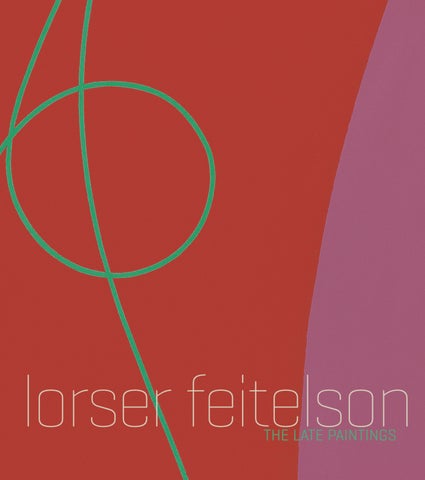
lorser feitelson THE LATE PAINTINGS
Feitelson teaching Advanced Figure Drawing class, Los Angeles, 1956 © Art Center College of Design, Pasadena, CA.
lorser feitelson THE LATE PAINTINGS
September 12 - December 12, 2009
LOUIS STERN FINE ARTS 9002 melrose avenue west hollywood CA 90069 louissternfinearts.com
contents 7 acknowledgment, LOUIS STERN 8 lorser feitelson - the late paintings, FRAN COLPITT 11 plates 36 chronology 40 selected solo exhibitions 42 selected group exhibitions 46 selected public collections
acknowledgment When I first began representing Lorser Feitelson’s estate, I was primarily acquainted with work from his middle years, the Hard Edge paintings. The strength of his colors and the clean, incisive quality of his line seemed marvelously contemporary. I was astonished at the sustained vitality of canvas after canvas after canvas. It was hard to believe that this body of work was produced some fifty-odd years earlier. Given his extraordinary legacy as a teacher, curator, lecturer, and LA art scene legend, I marveled at the accomplishment of his paintings. After our initial exhibition in 2003, Lorser Feitelson and the Invention of Hard Edge Painting – 1945-1965, two years later, we embarked on yet another revelatory look at Feitelson’s earliest, and equally inspired, work, Lorser Feitelson: The Kinetic Series – 1916 -1923. Again, I was struck not only by his natural gifts as a draftsman but the continuous innovation of his canvases. Over the past two years, it has been tremendously gratifying to see his work and vision celebrated in the Orange County Museum’s nationally toured exhibition Birth of the Cool – California Art, Design and Culture at the MidCentury. Post BOTC, it seemed only natural that we now move ahead to revisit works from the last years of his life. In these late works, Feitelson is as fresh eyed, technically sumptuous and flat out gorgeous as ever. Again, I find myself astonished by the power and energy in these effortlessly minimal compositions. I sincerely hope this publication, as well as publications past and future, will continue to focus the general public’s attention on the far too long unrecognized genius of Feitelson and his art. I am indebted to Wendy Van Haerlem and the Feitelson Arts Foundation for their continued support, enthusiasm and scholarship. It has been one of the great pleasures of my professional career to collaborate with them and for that I am ever grateful. I also want to extend a special word of thanks to Fran Colpitt for her thoughtful text. Her voice is a welcome addition to this catalogue. Robert Dirig, College Archivist for the Art Center College of Design in Pasadena, has provided us with invaluable visual records of Feitelson’s career with the school. I sincerely appreciate his labors and am especially grateful for his assistance with this publication. Finally, I would like to thank my staff, Cameron Dubois and Jacob Loeterman, for their dedication and enthusiasm and my gallery director, Marie Chambers, for making it all happen.
LOUIS STERN
Untitled (January 30), 1971 detail, acrylic on canvas, 60 x 60 inches, 152.4 x 152.4 centimeters
7
lorser feitelson - the late paintings A pioneering abstract painter, Lorser Feitelson was one of America’s major, if lesser known, modernists. His productive career spanned six decades, each of which saw the development of an intellectually challenging and experimental style. Five of those decades were spent in Los Angeles, the very fact that has prevented popular acknowledgement of his importance and widespread appreciation of his sumptuous, seductive paintings. Born in 1898 and raised in New York, he frequented the Metropolitan Museum of Art and was schooled in Italian Renaissance art by his amateur-artist father. At fifteen, he was introduced to modernism at the Armory Show and deeply engaged with it in subsequent sojourns in Paris. Feitelson came of age artistically in the twenties, permanently affected by the neoclassical style that was encouraged by le rappel à l’ordre, the call to order following the tumultuous wreckage of the First World War. Shortly after returning to New York, Feitelson and his first wife visited her mother in Los Angeles, in 1927. By that time, the economic downturn that would result in the Crash was palpable and the couple decided to remain on the West Coast. Modern art was then relatively unknown and ignored in southern California, although Feitelson appreciated his independence. While his accomplishments were eventually recognized at home, the hierarchical structure of modernism determined that major developments occurred in art world capitals and willfully disdained “provincial” artists. By the 1960s, when attention was first focused on LA, Feitelson and his modern comrades had already achieved their most significant contribution. Their style of hard-edge painting, which was only then being introduced in New York, had been a common, but elsewhere unacknowledged, practice in the 1940s and ’50s. Feitelson’s work in this exhibition represents the mature phase of a lifelong commitment to eloquent clarity of expression and razor-sharp precision of form. Line is the most important and expressive component of Feitelson’s work. From his earliest kinetic studies in the late teens to the schematic line drawings and arrows included in his figurative paintings of the 1930s to the ribbon paintings here, the liveliness of his work is a result of the disposition of lines and the sense of movement they convey. The emphasis on line is traceable to his interest in the Renaissance. Inherited from antiquity, the linear quality of Renaissance art, as art historian Heinrich Wölfflin argued in the early twentieth century, significantly distinguishes it from the Baroque’s painterly style. As Philip Guston, one of Feitelson’s students in the early thirties, often recalled, Feitelson introduced him to Piero and Uccello, important sources for his own work. Whether reflecting Piero’s serenity or Uccello’s muscular force, both artists use line for expressive purposes. Although Guston’s mature style is more painterly than his mentor’s, Feitelson retained the Renaissance-inspired smooth, clean edges where shape meets shape throughout his career. Hard-edge abstraction, which Feitelson broached as early as 1944, was a classical style, as critic and curator Jules Langsner explained. “Form in a classical work is defined, explicit, ponderable, rather than ambiguous or fuzzily suggestive.”1 Drawing on Feitelson’s style term, Subjective Classicism (which was also known as Post-Surrealism), to describe his figurative work of the 1930s, Langsner identified Feitelson and fellow painters Karl Benjamin, Frederick Hammersley, and John McLaughlin, as Abstract Classicists in a legendary exhibition in 1959, distinguishing them from the dominant group of Abstract Expressionists on the East Coast. “Classical art runs counter to a widespread contemporary belief in the primary value of emotion and intuition in esthetic experience,” he wrote. “The classicist is not preoccupied with art as an opportunity to make autobiographical statements. He is not a narcissist in paint.” 2 Feitelson’s mature work was arrived at through a process of reduction, common to many modern artists. Much as Mondrian’s work developed from representational paintings of trees, whose linear branches sinuously grasp the sky or gracefully arch toward the earth, to Cubist inspired arcs and angles, and finally to rigorous rectangles in primary colors, Feitelson’s paintings show steady progress from complex figurative
8
narratives played out in deep, mostly interior, spaces to simple flat fields of color inflected by one or two elegant lines running from top to bottom of the canvas. His late work recalls Barnet Newman’s slightly more brushy fields and vertical “zips” of contrasting colors, which echo the position of the viewer standing before the canvas. The upward movement of the zip conveys an exalted sense of transcendence, visually experienced and physically felt by the viewer. The differences in their work, however, are equally profound. The zip’s often ragged edges provide a slower, more studious sense of movement than Feitelson’s sleek, streamlined ribbons while the spiritual uplift conveyed by Newman’s work is replaced with a languid, often downwardly spiraling gesture in Feitelson’s. Given the masculine gender of his typical viewer, Newman’s upright lines were identified as male (and the egg- or seedlike circles in his early abstractions, eliminated in the mature work, as female). The graceful sweep of Feitelson’s ribbons is reminiscent of the fluid brushstrokes in de Kooning’s late paintings, recalling the curves of a female body merged with an undulating landscape. Feitelson himself, however, identified his lines as “hermaphroditic,” evoking kinesthetic associations with male as well as female bodies. 3 Although the process of reduction is associated with a formalist interpretation of modern art, Feitelson is less a formalist than an expressionist whose development reflects a reduction to essential expressive elements. The lines to which the figure is reduced in his early drawings, the edges of straight and curved flat shapes of the Magical Space Forms in mid-career, as well as the late ribbons are, as Peter Selz observed, “paths of emotion.” 4 In contrast to the Abstract Expressionist, however, emotion is measured and rational. “I must enter the thing not only completely emotionally but I must enter it completely intellectually,” Feitelson said of his approach to painting. 5 Harmonic balance of form and space results from careful critical assessment, rather than from observation of reality or the use of traditional compositions, which is not to suggest that all of his paintings express the same placid emotion. The Magical Space Forms of the early sixties, for example, were conceived as “metaphor[s] of the prevailing mood of tension and unrest which characterized the Cold War period. Describing these forms as ‘mean and ominous,’ they were to suggest boulders balanced precariously,” according to Diane Moran. 6 Feitelson came to abstraction rather abruptly, emerging from a period devoted to the imaginative figurative compositions associated with Post-Surrealism followed by his service as the Southern California Supervisor of Murals, Paintings, and Sculpture for the Works Progress Administration’s Federal Art Project (WPA/FAP) during the Depression, which left him little time for his own production. His mid-century paintings include flat, solidcolor shapes with crisp, sharp edges. Coining the term “hard-edge” to describe this work, Langsner referred to the shapes as “colorforms,” in which “color and form are indivisible.” Colorforms appear to lock into one another, alternately functioning as figures and grounds or positive and negative spaces. Superficially similar to the tradition of geometric abstraction in Europe and New York, West Coast hard-edge painting does not involve the disposition of discrete geometric elements on a neutral background. The effect is more wholistic, with a seamless surface and either a flip-flop or a total rejection of figure/ground relationships (in which a shape appears to sit on top of a ground continuing beneath it). “Their pictures reflect a fundamentally different approach than the Platonist esthetic advocated by the Dutch and Russian pioneers,” according to Langsner. “Mondrian and Malevitch conceived their geometric forms as timeless archetypes of the visible world. Geometric elements appear in the works of the new hard-edge painters but are not in any way essential, and may be excluded altogether.” 7 In the 1960s, Feitelson’s works were flatly painted, primarily in acrylic, without visible brushstrokes but with the assurance of a confident classicist. As the colorforms in individual paintings decreased in number, they increased in size. Gently nudging one another, the round edges of the boulder-like shapes were surrounded by progressively narrower undulating strips of space. In keeping with the figure/ground reversals of previous 9
paintings, the strips can be read as vertical streams intersecting brightly colored fields as well as interstices between the broad shapes, which often recall hips, thighs, or buttocks as much as boulders. This is especially true of the bold red and blue Untitled (March) (1967), which suggests the profile of a lower torso backwardly inching toward an architectural element. Another hip-like form, in a golden hue against a pink ground, graces the surface of Untitled (April 5) (1971). A red and black double line both separates and unites the two colorforms. The anthropomorphic qualities of the paintings are enhanced by the use of humanly scaled canvases that are five feet square. The reductive nature of Feitelson’s last paintings (he died in 1978) is especially pronounced. Inspired by abstract landscape paintings from the early sixties by his wife, Helen Lundeberg, in which deep vistas are created by colored horizontal bands, Feitelson allowed the sinuously curving narrow lines, seemingly suspended from above, to carry the painting’s meaning rather than serve simply as empty spaces in-between solid forms.8 Untitled (1972) includes a hot pink ground surrounding a sweep of cinnamon-candy red, which is bisected by blue threads on the verge of tying themselves into a knot. In contrast to the rigorous flatness of the Magical Space forms, the looping ribbons in the late paintings carve out slightly more space to exist in, moderating their nonobjective nature with a hint of illusionism. Although the symmetrical figures in the Archimage paintings from 1976 were inspired by Asian Buddhas and Bodhisattvas as well as Archaic Greek statues,9 gone are allusions to the human body or any external references in the ribbon paintings, replaced by the performance of spacearticulating kinetics by twisting strips of color. Feitelson’s range of expression extends from the agitated scrawl of Untitled (June 6) (1971) to the graceful curl of Untitled (February) (1970) and the restrained curve of Untitled (1965 – 71). Enhanced by a rich, idiosyncratic palette, pure gesture engages the viewer with the intimacy of an embrace.
FRANCES COLPITT
Frances Colpitt holds the Deedie Potter Rose Chair of Art History at Texas Christian University in Fort Worth. A corresponding editor for Art in America, where her articles and reviews appear regularly, she is also on the board of contributors for artUS. She is the author of Minimal Art: The Critical Perspective (Washington University Press, 1993) and Abstract Art in the Late Twentieth Century (Cambridge University Press, 2002) and is currently at work on a book on hard-edge abstraction, from 1920 to the present, in Southern California. Her essay, “Hard-Edge Cool,” appears in Birth of the Cool: California Art, Design, and Culture at Mid-Century, published by Prestel and the Orange County Museum of Art in 2007.
1 2 3
Jules Langsner, Four Abstract Classicists (Los Angeles: Los Angeles County Museum, 1959), 8. Ibid., 9. Diane DeGasis Moran, “Lorser Feitelson,” in California: 5 Footnotes to Modern Art History, ed. Stephanie Barron (Los Angeles: Los Angeles County Museum of Art, 1977), 62. 4 Peter Selz, Lorser Feitelson: The Kinetic Series—Works from 1916 – 1923 (Los Angeles: Louis Stern Fine Arts, 2005), 12. 5 Lorser Feitelson Inteviews,1964 May 12 – June 9, Archives of American Art, Smithsonian Institution. 6 Moran, “Feitelson,” in California, 60. 7 Jules Langsner, “America’s Second City,” Art in America no. 2 (1963): 30 8 Joseph E. Young, “Helen Lundeberg: An American Independent,” Art International 15 (September 1971): 50. 9 Diane Degasis Moran, “Lorser Feitelson,” in Lorser Feitelson and Helen Lundeberg: A Retrospective Exhibition (San Francisco: San Francisco Museum of Modern Art, 1980), 21.
Untitled (March 14), 1972 detail, acrylic on canvas, 60 x 40 inches, 152.4 x 101.6 centimeters
10
plates
11
1 Untitled (April 5), 1971 acrylic on canvas, 60 x 60 inches, 152.4 x 152.4 centimeters 12
2 Untitled (April 18), 1971 acrylic on canvas, 60 x 60 inches, 152.4 x 152.4 centimeters 13
3 Untitled (February 4), 1967 oil on canvas, 60 x 60 inches, 152.4 x 152.4 centimeters 14
16
4 Untitled, 1964 oil and enamel on canvas, 60 x 60 inches, 152.4 x 152.4 centimeters 17
5 Untitled, 1966 acrylic on canvas, 90 x 60 inches, 228.6 x 152.4 centimeters 18
6 Untitled (October 25), 1964 oil and enamel on canvas, 72 x 60 inches, 182.9 x 152.4 centimeters 19
7 Untitled (July 14), 1969 acrylic on canvas, 72 x 60 inches, 182.9 x 152.4 centimeters 20
8 Untitled, 1972 acrylic on canvas, 60 x 60 inches, 152.4 x 152.4 centimeters 21
Photo credit: Harry Carmean, Los Angeles, CA, 1977 (Feitelson is holding a copy of New Laguna Art Review, Art International, 1977, Volume III/3-4 with Archimage #1 reproduced on the cover.)
22
9 Archimage #1, 1976 acrylic on canvas board 30 x 24 inches, 76.2 x 61 centimeters
10 Archimage #2, 1976 acrylic on canvas board 30 x 24 inches, 76.2 x 61 centimeters 23
11 Untitled (June 6), 1971 acrylic on canvas, 60 x 60 inches, 152.4 x 152.4 centimeters 24
12 Untitled (March 7), 1971 acrylic on canvas, 60 x 60 inches, 152.4 x 152.4 centimeters 25
13 Untitled (February), 1970 acrylic on canvas, 60 x 60 inches, 152.4 x 152.4 centimeters 26
14 Untitled (January 30), 1971 acrylic on canvas, 60 x 60 inches, 152.4 x 152.4 centimeters 27
15 Untitled (September 22), 1964 acrylic on canvas, 60 x 60 inches, 152.4 x 152.4 centimeters 28
16 Untitled (March), 1967 acrylic on canvas, 60 x 60 inches, 152.4 x 152.4 centimeters 29
17 Untitled (July), 1968 acrylic on canvas, 60 x 54 inches, 152.4 x 137.2 centimeters 18 Untitled (December 24), 1966 oil and enamel on canvas, 60 x 60 inches, 152.4 x 152.4 centimeters 30
19 Untitled, April 1967 acrylic on canvas, 60 x 60 inches, 152.4 x 152.4 centimeters 31
20 Untitled (March 23), 1971 acrylic on canvas, 60 x 60 inches, 152.4 x 152.4 centimeters 32
21 Untitled, 1965-71 acrylic on canvas, 72 x 60 inches, 182.9 x 152.4 centimeters 33
22 Untitled, 1977 acrylic on canvas, 30 x 24 inches, 76.2 x 61 centimeters 34
23 Untitled (April 30), 1977 acrylic on canvas board, 30 x 24 inches, 76.2 x 61 centimeters 35
chronology 1898-1912 Born February 11, 1898, Savannah, Georgia. Family moves to New York City. Before the age of six receives first lessons in figure drawing from his father whose analytical approach makes a deep and lasting impression. Exposed to works and reproductions of the masters as well as contemporary art in his father’s extensive library and periodical collection. At age 12, begins painting in oils.
1923 Visits Corsica, Italy; his sketches from this island will become the basis for later neo-classical works of peasant subjects.
1913 Attends the Armory Show in New York where he is impressed by the work of Cézanne, Duchamp, Matisse and Gauguin. Begins to study the work of Italian Futurist, Boccioni, initiating his own work with kinetic organization.
1925 Premiere solo exhibition at the Daniel Gallery, New York.
1916 Meets Robert Henri, founder of The Eight. Occupies a studio in Greenwich Village. 1917 Moves to a new studio above the Penguin Club on 15th Street. During these early years works alone and educates himself by visiting The Metropolitan Museum of Art. Meets Pascin, the English Cubo-Futurist, at the Penguin Club. 1918 Meets Walter Pach, John Sloan and Arthur B. Davies. 1919 Visited by Gaston Lachaise. Takes first trip to Paris and enrolls himself at the Académie Colorossi as an independent student in life drawing. During his stay in Paris, notes exhaustion of Cubism and revival of classicism. 1920 Returns to New York, moves into a studio on 14th Street. Sees work of Brancusi, most likely at the Société Anonyme. Impressed by the early work of Nadelman. Creates one square of a composite wall-hanging by The Eight, at the request of John Sloan. 1922 Returns to Paris. Aware that artists Picasso, Derain, Théophile Robert and others are working in a classical style; critics proclaim Cubism to be dead and Neoclassicism the new mode. Turns from kinetic organizations towards more formal figure compositions. Travels through Italy and is re-inspired by the early Renaissance masters.
1924 Returns to New York, occupying a studio on East 64th Street. Begins exhibiting at the Daniel Gallery and receives critical acclaim for his neo-classical painting, Judgment of Paris.
1925-26 Brooklyn Museum acquires Feitelson’s large painting, Diana at the Bath. 1926-27 Returns to Paris and takes a studio on Rue de la Seine. Exhibits in the Salon d’Automne. Returns to the United States and travels to Los Angeles in November for a winter stay which becomes his permanent residence. 1928 Moves into a studio on Highland Avenue, in the heart of Hollywood. Exhibits with Nathalie Newking at Wilshire Galleries, directed by an acquaintance of Winslow Homer. Premiere solo museum exhibition at the California Palace of the Legion of Honor, San Francisco. Solo exhibition at the Los Angeles County Museum of Art. Meets Stanton Macdonald-Wright. 1929 Exhibits at the Los Angeles County Museum of Art with Conrad Buff, Nathalie Newking and Hanson Puthuff. Teaches a summer painting course at the Chouinard Art Institute, Los Angeles. 1930 Formulates first ideas of Subjective Classicism, to be known as Post-Surrealism. Los Angeles Times publishes Feitelson’s article, “Eclecticism… What Is It?” on January 26th. Hired as an instructor at the Stickney Hall School of Art in Pasadena, California. Exhibits in a Neo-Classical show at the Brooklyn Museum, New York. Meets art critic and writer, Jules Langsner. 1930-31 Ruben Kadish and Philip Goldstein (Philip Guston) are among Feitelson’s students.
36
of Paris show at the Stendahl Galleries, Los Angeles. Exhibits at the Whitney Museum of American Art, New York, in 1937 Exhibition of Contemporary American Art.
1932 Resides on DeLongpre Avenue in Hollywood. Los Angeles County Museum of Art acquires his painting, Two Peasant Children.
1938 Two of Feitelson’s murals are shown at Los Angeles County Museum of Art and three more murals are completed for The Thomas Edison School.
1933 Resides on Fountain Avenue in Hollywood. Exhibits at Los Angeles County Museum of Art, California Palace of the Legion of Honor, San Francisco.
1939 Lithograph, Reading, is included in the New York World’s Fair. Begins directing exhibitions with Helen Wurdemann at the Los Angeles Art Association. Lithograph, Post-Surrealist Configuration: Biological Symphony is exhibited at the Whitney Annual, New York.
1933-34 Stanley Rose and Murray Youlin open the first contemporary art gallery in Los Angeles at the Centaur bookshop on Selma near Vine in Hollywood. Feitelson directs and designs the gallery. 1934 Feitelson founds Subjective Classicism or Post-Surrealism with Helen Lundeberg. The first Post-Surrealist exhibition is held at the Centaur Gallery in November, includes the work of Feitelson, Lundeberg, Labaudt, Merrild, Ret and Lehman. Creates murals for the Federal Public Works Art Project.
1942 United States enters World War II. WPA/ FAP begins to limit operations. Begins romantic paintings of an introspective, subjective nature.
1935 Designs and directs the new Stanley Rose Gallery, organizing exhibits of Juan Gris, Carlos Merida, Post-Surrealists, Lundeberg, Kadish, Merrild and Goldstein (Guston). Leaves the Rose Gallery to direct the Hollywood Gallery of Modern Art, located across from the Egyptian Theatre. Along with Alexander Archipenko, juries a Modern Art Show. Included in a Post-Surrealist show at the War Memorial Museum in San Francisco, which traveled to the Brooklyn Museum, New York.
1944 Begins teaching at the Art Center School, Los Angeles. Solo exhibition at the Los Angeles County Museum of Art and the San Francisco Museum of Art, featuring romantic paintings and his first abstract paintings, Post-Surrealist Configurations, later to be called Magical Space Forms. Virginia Museum of Fine Arts includes Feitelson in the Fourth Biennial Exhibit of Contemporary American Painting.
1943 WPA/FAP officially ends.
1945 Incorporates principles of abstraction in his courses at the Art Center School.
1936 Included in a critically acclaimed Post-Surrealist exhibition at the Brooklyn Museum, New York. Exhibits in Fantastic Art: Dada and Surrealism, Museum of Modern Art, New York, through 1937.
1947 Becomes director of the Gallery of Mid-20th Century Art on Clark Street, in Los Angeles. Exhibits at the Art Institute of Chicago in Abstract and Surrealist American Art. Exhibits at the Pasadena Institute of Art, California, in Eighteen California Artists. Moves to Clark Street in Los Angeles. Organizes exhibits at the Mid-20th Century Gallery that include De Chirico, Leonor Fini, Eugene Berman, Helen Lundeberg, Lepri, Brauner, Jacques Herold and Matta, et al.
1936-37 Begins work on the Los Angeles County Hall of Records mural for the California Works Progress Administration Federal Art Project (WPA/FAP). 1937 Moves to studio on Western Avenue just north of Melrose where he will remain for ten years. Appointed Supervisor of Murals, Paintings and Sculpture for Southern California, Federal Art Project. Exhibits in the School
1948 Organizes a Stanton Macdonald-Wright exhibition at the Art Center School Galleries. Paints first Magical Space Form, exploring for the first time the ambiguity of space/form which
37
becomes the predecessor of hard-edge abstraction. Moves to Westwood Boulevard in Los Angeles. 1949 Exhibits and lectures widely in Southern California and San Francisco. Moves to studios on Ardmore Street in Los Angeles. 1950 Exhibits at the University of Illinois and in Los Angeles. Paints several small paintings in which he uses the bisected format and manipulation of space within the frame. These works presage his later Dichromatic Organizations of the late 1950s through 1960s. 1951 Named Carnegie Visiting Professor, University of Illinois, Urbana. Exhibits Magical Space Forms, 1951 (68 x 100 inches), at the Los Angeles Art Association, bridging his Magical Forms and Magical Space Forms series. Exhibits in Contemporary Painting in the United States at the Los Angeles County Museum of Art. Juries several exhibitions in Southern California. For the first time, uses plain, primed canvas in a painting. Serves as a juror and is included in the exhibition, American Watercolors, Drawings and Prints at the Metropolitan Museum of Art, New York. Moves to studios on 3rd Street in Los Angeles in September. Functionists West group exhibits for the first time at the Los Angeles Art Association, featuring originators Feitelson, Helen Lundeberg, Stephen Longstreet and Elise Cavanna. 1952 Retrospective exhibition at the Pasadena Art Institute, California, is a critical success. 1953 Exhibits at the Colorado Springs Fine Art Center, Colorado. Second exhibit of the Functionists West group with fourteen new members. Completes a Stripe painting, which derives from ideas taught to students at the Art Center School of Design, using color and spacing to create visual activity. 1955 Thirty year retrospective at the McNay Art Institute, San Antonio, Texas. Exhibits in the Whitney Annual, New York. Exhibits in the 3rd Biennial of São Paulo, Brazil. 1956 Begins a successful television series on NBC entitled Feitelson on Art, which lasts through 1963.
1958 Exhibits at the University of Nebraska Art Galleries in Lincoln. Exhibits with Helen Lundeberg at Scripps College, Claremont, California. Participates in Black and White Exhibition, curated by Jules Langsner in Los Angeles. 1959 Organizes and leads a meeting of Abstract Classicists, including Karl Benjamin, Frederick Hammersley, John McLaughlin, with the critic Jules Langsner. The landmark exhibition, Four Abstract Classicists is held at the Los Angeles County Museum of Art. Organized by Jules Langsner, this show travels to the San Francisco Museum. Later, a revised version under the title of West Coast Hard Edge travels to London (Institute of Contemporary Art) and Belfast, Ireland (Queens College). Exhibits in 50 Paintings by 37 Painters of the Los Angeles Area at the University of California, Los Angeles, Art Galleries, curated by Henry Hopkins. Begins to exhibit at the Paul Rivas Gallery, Los Angeles. Uses masking tape for the first time to create sharp edges in his paintings. 1961 Exhibits in Auckland, New Zealand. 1962 Exhibits in Geometric Abstraction in America at the Whitney Museum of American Art, New York. Solo exhibition at the Long Beach Museum of Art, California. Introduces curvilinear forms, which remain the prominent motif in future work. Joins the Ankrum Gallery in Los Angeles. 1962-63 Museum of Modern Art, New York, acquires and exhibits Feitelson’s painting, Magical Space Forms, 1955. Exhibits at the Whitney Museum, the Walker Art Center, the Albright-Knox Art Gallery and the Des Moines Art Center in Fifty California Artists, organized by San Francisco Museum with assistance from the Los Angeles County Museum of Art. 1963 Begins first paintings of pure lines, which, by 1965 become the major pictorial element in his painting. 1964 Exhibits at Phoenix Art Museum, Arizona. 1965 Exhibits at the Museum of Modern Art, New York, in The Responsive Eye. Exhibits at the Whitney Annual, New York, through January 1966.
38
Photo credit: Harry Carmean, Los Angeles, 1974
1966 Exhibits at the Museum of Modern Art, New York, in the Recent Acquisitions show (Untitled, 1964).
1974 Included in Nine Senior Southern California Painters,” the opening exhibition of the Los Angeles Institute of Contemporary Art.
1968 Joins the David Stuart Galleries, Los Angeles.
1976 Exhibits in Painting and Sculpture in California: The Modern Era, at the San Francisco Museum of Modern Art. The Oakland Museum, California, acquires Feitelson’s line painting, Untitled, 1969.
1969 Awarded honorary degree of Doctor of Fine Arts from the Art Center College of Design. 1969-71 Exhibits at the American Embassy, Moscow, in American Contemporary Art, organized by the Museum of Modern Art, New York.
1977 Exhibits at the Los Angeles County Museum of Art. Exhibits at the National Collection of Fine Art, the Smithsonian Institution, Washington, D.C. David Stuart Galleries presents a solo exhibition of Feitelson’s early works.
1972 Lorser Feitelson: A Retrospective Exhibition is presented at the Los Angeles Municipal Art Gallery in August. Named Chairman Emeritus of the Fine Arts Department, Art Center College of Design.
1978 Feitelson dies of heart failure on May 24th brought on by a recent illness.
1973 Honored by the Otis Art Institute, Los Angeles, as a Distinguished American Artist.
Information compiled from Degasis Moran, Diane. “The Painting of Lorser Feitelson.” Diss. University of Virginia. 1979.
39
selected solo exhibitions The Daniel Gallery, New York. Neumann Galleries, New York. Salon d’automne, Paris. Dudensing Galleries, New York, 1926-27. 1928 California Palace of the Legion of Honor, San Francisco. Los Angeles County Museum, California. Wilshire Gallery, Los Angeles, California. 1931 Fine Arts Gallery of San Diego, California. 1932 California Palace of the Legion of Honor, San Francisco. Ilsley Galleries, Los Angeles, California. 1933 Ebell Salon, Los Angeles, California. Laguna Beach Art Association, California. 1935 Stanley Rose Gallery, Los Angeles, California. 1944 Los Angeles County Museum, California. San Francisco Museum of Art, California. 1947 Hartwell Galleries, Los Angeles, California. 1949 Art Center School Gallery, Los Angeles, California. 1952 Pasadena Art Institute, California. 1955 Marion Koogler McNay Art Institute, San Antonio, Texas. 1958 Scripps College Art Galleries, Florence Rand Lang Art Building, Claremont, California. 1959 Anna Mahler/Lorser Feitelson, Paul Rivas Gallery, Los Angeles, California. Catalogue published. 1960 Paul Rivas Gallery, Los Angeles, California. 1961 Paul Rivas Gallery, Los Angeles, California. 1962 Long Beach Museum of Art, California. Ankrum Gallery, Los Angeles, California. 1963 Chapman College Purcell Art Association, Orange, California. 1964 Ankrum Gallery, Los Angeles, California. 1967 Occidental College, Los Angeles, California. 1968 Feitelson, The Years of Vision: 1920-1950, Los Angeles Art Association Galleries, California. Ankrum Gallery, Los Angeles, California. 1972 Lorser Feitelson, A Retrospective Exhibition, Municipal Art Gallery, Barnsdall Park, Los Angeles, California. Catalogue published. Lundeberg, Feitelson, First Showing: A Series of New Color Prints, Los Angeles Art Association Galleries, California. 1977 Lorser Feitelson, Selection of Small Paintings, David Stuart Galleries, Los Angeles, California. 1978 Lorser Feitelson (1898-1978) A Memorial Tribute, Whitney Museum of American Art, New York. Catalogue published. 1980-81 Lorser Feitelson and Helen Lundeberg: A Retrospective Exhibition, San Francisco Museum of Modern Art, California. Catalogue published. Also shown at The Frederick S. Wight Art Gallery, University of Los Angeles, California. 1982 Lorser Feitelson Paintings 1964-1971, Jan Baum Gallery, Los Angeles, California. 1983 Tobey C. Moss Gallery, Los Angeles, California. 1987 Lorser Feitelson: Magical Space Forms, Boulder Series, Tobey C. Moss Gallery, Los Angeles, California. Catalogue published. 1988 Lorser Feitelson 1895-1978, Tobey C. Moss Gallery, Los Angeles, California. Catalogue published. 1925 1926
40
1989 1990 1992 1995 1996 1998 2001 2003 2005 2006 2009
Lorser Feitelson: Artist / Teacher, Long Beach City College, Fine Arts Gallery, California. The Kinetic Line, Lorser Feitelson, University of California, Riverside, University Art Gallery. Lorser Feitelson: Exploration of the Figure, 1919-1929, Monterey Peninsula Museum of Art, California. Lorser Feitelson: The Organic Line: 1916-1977, Tobey C. Moss Gallery, Los Angeles, California. Lorser Feitelson: Motion as Line, Tobey C. Moss Gallery, Los Angeles, California. Lorser Feitelson / John McLaughlin: Abstract Classicists, Tobey C. Moss Gallery, Los Angeles, California. Lorser Feitelson: The Romantic Years 1919-1949, Tobey C. Moss Gallery, Los Angeles, California. Lorser Feitelson: Magical Forms to Hard Edge, Tobey C. Moss Gallery, Los Angeles, California. Lorser Feitelson, Patricia Faure Gallery, Santa Monica, California. Catalogue published. Lorser Feitelson and the Invention of Hard Edge Painting 1945-1965, Louis Stern Fine Arts, West Hollywood, California. Catalogue published. Lorser Feitelson: The Kinetic Series—Works from 1916-1923, Louis Stern Fine Arts, West Hollywood, California. Catalogue published. Joan Washburn Gallery, New York, New York. Catalogue published. Lorser Feitelson – The Late Paintings, Louis Stern Fine Arts, West Hollywood, California. Catalogue published.
Untitled (June 6), 1971 detail, acrylic on canvas, 60 x 60 inches,, 152.4 x 152.4 centimeters
41
selected group exhibitions 1924 1926 1927 1928 1929
1930 1932 1933
1934
1935
1936
1937 1938 1939 1940 1940 1944 1945 1946 1947 1949
A Group of Modern Painters, The Daniel Gallery, New York. Catalogue published. Independents Exhibition, New York. Whitney Studio Club Exhibition, New York. Ninth Annual Exhibition of Painting and Sculpture, Los Angeles Museum. Catalogue published. Conrad Buff, Lorser Feitelson, Nathalie Newking, Hanson Puthuff, Los Angeles County Museum. Catalogue published. Tenth Annual Exhibition of Painting and Sculpture, Los Angeles Museum. Catalogue published. Eleventh Annual Exhibition of Painting and Sculpture, Los Angeles County Museum. Catalogue published. Thirteenth Annual Exhibition of Painting and Sculpture, Los Angeles County Museum. Catalogue published. Fourteenth Annual Exhibition of Painting and Sculpture, Los Angeles County Museum. Catalogue published. Progressive Painters of Southern California, Palace of the Legion of Honor, San Francisco, California. Catalogue published. Progressive Painters of Southern California, Fine Arts Gallery of San Diego, California. Catalogue published. Fifteenth Annual Exhibition of Painting and Sculpture, Los Angeles County Museum. Catalogue published. Paintings by California Modernists, Foundation of Western Art, Los Angeles. Catalogue published. Progressive Painters of Southern California, Los Angeles County Museum. Catalogue published. Public Works of Art Project, 14th Region Southern California, Los Angeles County Museum. Group Exhibition, El Capitan College of the Theatre, Los Angeles. Surrealisme & Post-Surrealisme (New Classicism), Centaur Gallery, Los Angeles. Fifty-Fifth Annual Exhibition of the San Francisco Art Association, San Francisco Museum of Art. Catalogue published under title “Opening Exhibition.” Post Surrealist Exhibition, San Francisco Museum of Art, California. Also shown at The Brooklyn Museum, New York under title “Postsurrealism.” Post-Surrealists and Other Moderns, Stanley Rose Gallery, Los Angeles. Group Exhibition, Hollywood Gallery of Modern Art, Los Angeles. Fantastic Art, Dada, Surrealism, Museum of Modern Art, New York. Catalogue published. Oil Painting and Water Colors by California Artists, also known as “The Post Surrealist Show,” Brooklyn Museum, New York. 1937 Annual Exhibition of Contemporary American Painting, Whitney Museum of American Art, New York. Catalogue published. Post Surrealism, Stendahl Galleries, Los Angeles. All California Painting And Sculpture Exhibition, Los Angeles County Museum. Southern California Art Project, Los Angeles County Museum. Catalogue published. California Creates, Stendahl Galleries, Los Angeles. Also shown at San Francisco Museum of Art. Exhibition of Contemporary American Art, Whitney Museum of American Art, New York. Catalogue published. The Fifty-Fifth Annual Exhibition: Watercolors and Drawings, The Art Institute of Chicago. Catalogue published. The Fourth Biennial Exhibit of Contemporary American Painting, Virginia Museum of Fine Arts. The First Biennial Exhibition of Drawings by American Artists, Los Angeles County Museum. Catalogue published. Group Exhibition, Fitzsimmons Studio, Los Angeles. Paintings of the Year, National Academy of Design, New York. Catalogue published. Abstract and Surrealist American Art, The Art Institute of Chicago. Catalogue published. Eighteen California Artists, Pasadena Institute of Art, California. California Centennials Exhibition of Art, Los Angeles County Museum. Catalogue published. Ninth Invitational Purchase Prize Art Exhibition, Chaffey Community Art Association, Ontario, California. Catalogue published. Exhibition of Contemporary American Painting, University of Illinois, College of Fine and Applied Arts, Urbana. Catalogue published.
42
1950
1951
1952 1953 1954 1955
1956
1958 1959
1961
1962
1963 1964
Sixth Annual Exhibition by the Artists of Los Angeles and Vicinity, Municipal Art Commission and the Los Angeles City Council, shown at the Greek Theatre. Catalogue published. Exhibition of Contemporary American Painting, University of Illinois, College of Fine and Applied Arts, Urbana. Catalogue published. 146th Annual Exhibition of Painting and Sculpture, Pennsylvania Academy of Fine Arts. Annual Exhibition of Contemporary Painting in the United States, Los Angeles County Museum. Catalogue published. Seventh Annual Exhibition by the Artists of Los Angeles and Vicinity, Municipal Art Commission and the Los Angeles City Council, shown at the Greek Theatre. Catalogue published. Portable Murals, Los Angeles Art Association Galleries. Exhibition of Contemporary American Painting, University of Illinois, College of Fine and Applied Art, Urbana. Catalogue published. American Water Colors, Drawings and Prints / A National Competitive Exhibition, The Metropolitan Museum of Art, New York. Catalogue published. Fourteenth Artists West of the Mississippi, Colorado Springs Fine Arts Center, Colorado. Catalogue published. Functionists West, Los Angeles Art Association Galleries. Annual Exhibition: Paintings, Sculpture, Watercolors, Drawings, Whitney Museum of American Art, New York. Catalogue published. III Bienal de São Paulo, Museu de Arte Moderna de São Paulo, Brazil. Catalogue published. United States section organized by San Francisco Museum of Art. Catalogue published under the title Pacific Coast Art, United States’ Representation at the IIIrd Biennial of São Paulo. Also shown at Cincinnati Art Museum, Ohio; Colorodo Springs Fine Arts Center; Walker Art Center, Minneapolis, Minnesota. California Painting: 40 Painters, The Municipal Art Center, Long Beach, California. A collaboration with San Francisco Museum of Art. Catalogue published. 1956 Annual Exhibition by Artists of Los Angeles and Vicinity, Los Angeles County Museum. Catalogue published. Artists Invite Artists, Esther Robles Gallery, Los Angeles. Sixty–Eighth Annual Exhibition, University of Nebraska Art Galleries, Lincoln. Catalogue published. Four Abstract Classicists, Los Angeles County Museum. Catalogue published. Also shown at San Francisco Museum of Art. Revised version shown at Institute of Contemporary Art, London, England and Queens College, Belfast, Ireland, under the title West Coast Hard Edge 1960. 1949 / 1959 A Decade in the Contemporary Galleries, Pasadena Art Museum, California. Catalogue published. Fifty Paintings by Thirty Seven Painters of Los Angeles Area, San Francisco Museum of Art, California. Catalogue published. The Nude in American Painting, The Brooklyn Museum, New York. Catalogue published. Painting from the Pacific: Japan, America, Australia, New Zealand, Auckland City Art Gallery, New Zealand. Catalogue published. The Artist’s Environment: West Coast, The Amon Carter Museum of Western Art, Forth Worth, Texas. Catalogue published. Also shown at the UCLA Art Galleries, Los Angeles; Oakland Museum of Art, California. Fifty California Artists, Whitney Museum of American Art, New York. Catalogue published. Organized by San Francisco Museum of Art with assistance of Los Angeles County Museum of Art. Also shown at Walker Art Center, Minneapolis, Minnesota; Albright-Knox Art Gallery, Buffalo, New York; Des Moines Art Center, Iowa. Geometric Abstraction in America, Whitney Museum of American Art, New York. Catalogue published. Arts of Southern California-XIV: Early Moderns, Long Beach Museum of Art, California. Catalogue published. California Hard Edge Painting, Pavilion Gallery, Balboa, California. Catalogue published. 1964 Festival of Fine Arts / Art and Anti-Art, Occidental College, Los Angeles. Catalogue published. Of Time and the Image, Ankrum Gallery Artists, Phoenix Art Museum, Arizona. Catalogue published. Southern California Original Hard Edge Painters, Esther Robles Gallery, Los Angeles.
43
1965
1966
1967
1968
1969
1970
1972
1974 1975 1976
Colorists 1950-1965, San Francisco Museum of Art, California. Catalogue published. 1965 Annual Exhibition of Contemporary American Painting, Whitney Museum of American Art, New York. Catalogue published. The Responsive Eye, The Museum of Modern Art, New York. Catalogue published. Also shown at City Art Museum of St. Louis, Missouri; Seattle Art Museum, Washington; Pasadena Art Museum, California; The Baltimore Museum of Art, Maryland. Twelfth Exhibition of Contemporary American Painting and Sculpture, Krannert Art Museum, University of Illinois, Champaign. Catalogue published. Eighteenth Annual Creative Arts Exhibition, Henderson Fine Arts Gallery, University of Colorado. 1966 Invitational, California ’66 Painters and Sculptors, E.B. Crocker Art Gallery, Sacramento, California. Catalogue published. New Modes in California Painting and Sculpture, La Jolla Museum of Art, California. Catalogue published. Contemporary California Art from the Lytton Collection, Lytton Center of The Visual Arts, Los Angeles. Catalogue published. The Search/Ten Leading California Artists in Pursuit of a Personal Vision, Lytton Center of the Visual Arts, Los Angeles. Catalogue published. Artists’ Artists, Lytton Center of the Visual Arts, Los Angeles. Catalogue published. Cubism, Its Impact in the USA, 1910-1930, sponsored by University of New Mexico Art Museum and Junior League of Albuquerque. Catalogue published. Also shown at Marion Koogler McNay Art Institute, San Antonio, Texas; San Francisco Museum of Art, California; Los Angeles Municipal Art Gallery. 1967 Annual Exhibition of Contemporary American Painting, Whitney Museum of American Art, New York. Catalogue published. West Coast Invitational, 1967, E.B. Crocker Art Gallery, Sacramento, California. Catalogue published. 1968 Invitational, West Coast ’68 Painters and Sculptors, E.B. Crocker Art Gallery, Sacramento, California. Catalogue published. Group Exhibition, David Stuart Galleries, Los Angeles. Color in Control, Museum of Fine Arts, St. Petersburg, Florida. Catalogue published. Also shown at the Loch Haven Art Center, Orlando, Florida. Microcosm ’69, Long Beach Museum of Art, California. Catalogue published. West Coast 1945-1969, Pasadena Art Museum, California. Catalogue published. Group Exhibition, David Stuart Galleries, Los Angeles. American Contemporary Art, organized under the auspices of the International Council at the Museum of Modern Art, New York. Also shown at the American Embassy, Moscow. Catalogue published in Russian and English. American Painting 1970, Virginia Museum, Richmond. A Century of California Painting 1870-1970, E.B. Crocker Art Gallery, Sacramento, California. Catalogue published. Looking West, 1970, Joslyn Art Museum, Omaha, Nebraska. Catalogue published. Group Exhibition, David Stuart Galleries, Los Angeles. Los Angeles Painters of the Nineteen-Twenties, Pomona College Gallery, Montgomery Art Center, Claremont, California. Catalogue published. Group Exhibition, Los Angeles Municipal Gallery, Barnsdall Park. West Coast Art from the Permanent Collection, Pasadena Art Museum, California. Renewal Art of the 1930’s-1940’s: Southern California Artists, Los Angeles Art Association Galleries. Nine Senior Southern California Painters, Los Angeles Institute of Contemporary Art. Catalogue published in Los Angeles Institute of Contemporary Art Journal, December 1974 pages 45-53. Avant-Garde Painting and Sculpture in America 1910-1925, Delaware Art Museum, Wilmington, Delaware. Catalogue published. American Artists ’76: A Celebration, Marion Koogler McNay Art Institute, San Antonio, Texas. Catalogue published. Los Angeles: A Continuing Frontier 1940-1961, Occidental College Gallery, Los Angeles. New Deal Art: California, de Saisset Art Gallery and Museum, University of Santa Clara, California. Catalogue published. Painting and Sculpture in California: The Modern Era, San Francisco Museum of Modern Art, California.
44
Catalogue published. Also shown at National Collection of Fine Arts, Smithsonian Institution, Washington D.C. Symbolism, Los Angeles Art Association Galleries. 1977 Los Angeles Hard-Edge: The Fifties and Seventies, Los Angeles County Museum of Art. Catalogue published under the title of “California: 5 Footnotes to Modern Art History.” Surrealism and American Art: 1931-1947, Rutgers University Art Gallery, New Brunswick, New Jersey. Catalogue published. 1978 Selections from the Frederick Weisman Company Collection of California Art, The Art Museum and Galleries, California State University, Long Beach, California. Catalogue published. Also shown at The Corcoran Gallery of Art, Washington D.C.; The Albuquerque Museum of Art, History and Science, New Mexico. 1979 Black and White are Colors: Paintings of the 1950’s-1970’s, Montgomery Art Gallery, Pomona College, California. Catalogue published. 1980 50’s Abstract: A Summary of Los Angeles Painting from 1957-1960, Conejo Valley Art Museum, Thousand Oaks, California. Catalogue published. 1982 Drawings and Illustrations by Southern California Artists before 1950, Laguna Beach Museum of Art, California. Catalogue published. 1984 The Frederick Weisman Collection of California Art, Museum of Contemporary Art, Los Angeles. 1985 Colorforms, Security Pacific National Bank, Gallery at the Plaza, Los Angeles. Also shown at Tobey C. Moss Gallery, Los Angeles. 1986 Aspects of California Modernism 1920-1950, Board of Governors of the Federal Reserve System, Washington D.C., Catalogue published. 1990-92 Turning the Tide: Early Los Angeles Modernists 1920-1956, Santa Barbara Museum of Art, California. Catalogue published. Also shown at Laguna Art Museum, California; Oakland Museum of Art, California; McNay Art Institute, San Antonio, Texas; Nora Eccles Harrison Art Museum, Utah State University, Logan; Palm Springs Desert Museum, California. 1992 California Painting: The Essential Modernist Framework, California State University, Los Angeles. Also shown at California State University, San Bernardino, California. 1994 Independent Visions: California Modernism, Long Beach Museum of Art, California. 1995 Pacific Dreams, UCLA Hammer Museum of Art, Los Angeles. Also shown at Oakland Museum of Art, California. Catalogue published. 1997 On the Edge of America: California Modernist Art, Jack Rutberg Fine Arts, Los Angeles. 1999 Gold Rush to Pop: 200 Years of California Art, Orange County Museum of Art, California. 2000 Four Abstract Classicists Plus One, Tobey C. Moss Gallery, Los Angeles. 2001 American Surrealism, Thomas McCormick Gallery, Chicago. Catalogue published. California Modernism, Tobey C. Moss Gallery, Los Angeles. Four Abstract Classicists, Gary Snyder Fine Art, New York. 2002 Post Surrealism, Pasadena Museum of California Art, California. Catalogue published. 2002-03 Post Surrealism, Nora Eccles Harrison Museum of Art, Utah State University, Utah. 2004 Conversations with the Collection: A Selection from the Permanent Collection, Long Beach Museum of Art, California. 2004-05 The Los Angeles School, Otis College of Art + Design, Los Angeles, California. 2006 Masters, Mentors and Metamorphosis, Fullerton College Art Gallery, Fullerton College, Fullerton, California 2007 Burgoyne Diller and Hard Edge Abstraction: Underpinnings and Continuity, Spanierman Modern, New York, New York. Optic Nerve – Perceptual Art of the 1960’s, Columbus Museum of Art, Columbus, Ohio. 2007-09 Birth of the Cool: California Art, Design and Culture at Midcentury, Orange County Museum of Art, Newport Beach, California; Addison Gallery of American Art, Phillips Academy, Andover, Massachusetts; Oakland Museum of California, Oakland, California; Mildred Lane Kemper Art Museum, St. Louis, Missouri; The Blanton Museum of Art, University of Texas at Austin. 2008 A Seed of Modernism: The Art Students League of Los Angeles, Pasadena Museum of California Art, Pasadena, California. 2008-09 Circa 1958: Breaking Ground in American Art, Ackland Art Museum, The University of North Carolina at Chapel Hill.
45
selected public collections Atlantic Richfield Company, Los Angeles, CA. Brooklyn Museum of Art, New York, NY. Great Western Savings, Los Angeles, CA. Hirshhorn Museum, Smithsonian Institution, Washington, D. C. Honolulu Academy of Arts, HI. Industrial Electronic Engineers, Los Angeles, CA. James B. Lansing Sound. Inc., Los Angeles, CA. San Diego Museum of Contemporary Art, CA. Library of Congress, Washington, D.C. Long Beach Museum of Art, CA. Los Angeles County Museum of Art, Los Angeles, CA. Marian Koogler McNay Museum of Art, San Antonio, TX. Museum of Fine Arts, Boston, MA. Museum of Modern Art, New York, N Y. National Bank of Omaha, Omaha, NE. National Gallery of Art, Washington D.C. Nora Eccles Harrison Museum of Art, Utah State University, Logan, UT. Oakland Museum of Art, CA. Palm Springs Desert Museum, CA. Phoenix Art Museum, AZ. San Francisco Museum of Modern Art, CA. Santa Barbara Museum of Art, CA. Smithsonian American Art Museum, Washington, D. C. Sheldon Memorial Art Gallery, Lincoln, NE. University of Arizona Art Museum, Tucson, AZ. University of Virginia Art Museum, Charlottesville, VA. Whitney Museum of American Art, New York, NY. Frederick R. Weisman Foundation, Los Angeles, CA. Xerox Corporation, New York, NY. Zimmerli Art Museum, Rutgers University, NJ.
46
Untitled (April 5), 1971 detail, acrylic on canvas, 60 x 60 inches, 152.4 x 152.4 centimeters
Feitelson with model during drawing class, Los Angeles, 1945 © Art Center College of Design, Pasadena, CA.
Cover / Back cover: Untitled, 1972
Design: Lilla Hangay, Santa Ana, California Production: Sumi Printing & Bindery, Carson, California Typeface: Geogrotesque Edition of 5,000 © Photography by Gerard Vuilleumier © Essay by Fran Colpitt © 2009 Lorser Feitelson and Helen Lundeberg Feitelson Arts Foundation © Louis Stern Fine Arts, 9002 Melrose Avenue, West Hollywood, California 90069 All rights reserved. No part of this catalogue may be reproduced in any form by any electronic or mechanical means (including photocopying, recording, or information storage and retrieval) without permission in writing from the publisher.
ISBN 978-0-9740092-1-6 Library of Congress Control Number: 2009933917 Printed in the U.S.A.
48