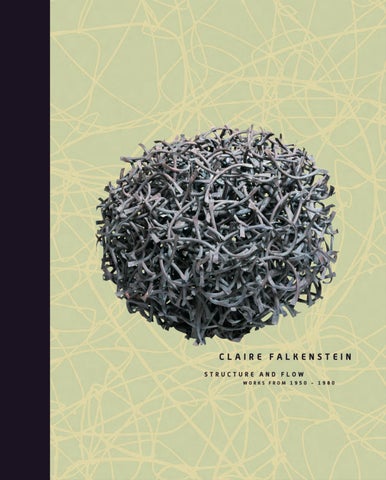
CLAIRE FALKENSTEIN STRUCTURE AND FLOW WORKS FROM 1950 - 1980
LOUIS STERN FINE ARTS 9002 MELROSE AVENUE WEST HOLLYWOOD
CA 90069
T 310-276-0147
F 310-276-7740
E INFO@LOUISSTERNFINEARTS.COM WWW.LOUISSTERNFINEARTS.COM
MAY 20 - AUGUST 26
2006
CLAIRE FALKENSTEIN STRUCTURE AND FLOW WORKS FROM 1950 - 1980
4
CONTENT 7
ACKNOWLEDGMENT
Louis Stern 9
STRUCTURE AND FLOW
Maren Henderson 19
PLATES
114
SHORT BIOGRAPHY
116
SELECTED EXHIBTIONS
120
SELECTED MAJOR PUBLIC AND PRIVATE WORKS
122
EXHIBTIONS CHECKLIST
124
SELECTED BIBLIOGRAPHY
5
6
ACKNOWLEDGMENT
I have always had a great affection for the mavericks of the art world, those artists whose passion to create simply overrode the conventional expectations of an era. Claire Falkenstein is just such a maverick and it gives me great pleasure to present this exhibition of her work. In studying her oeuvre, demonstrated in piece after piece, I marvel at her sure-footed creative audacity, the remarkable variety in her body of work and her genius for unaffected re-invention. I am amazed that she had the courage to re-locate to Paris in 1950 and consequently win over the European elite. I am equally impressed by her utter mastery and fearlessness regarding the use of technical crafts to realize her scrupulously humane and elegant vision. She seems an unfailingly natural craftsperson, immune to conventional wisdom but entirely true to her creative instincts. If ever an artist deserved the term experimental, it was Claire Falkenstein. In this the first in a series of exhibitions, I have chosen to look at the latter section of her career. This period celebrates her deft experimentation with materials and forms, giving rise to an extraordinary series of sculptures. Though long held in high esteem by critics, and not entirely unknown to those of us in Southern California, Falkenstein is not your household name variety of artist. Given the superb quality and abundant heart of this work, I have great hope of beginning to rectify that with this exhibition. First and foremost I want to thank Hal Nelson, Director of the Long Beach Museum of Art and President of the Falkenstein Foundation, for his tireless support and guidance on this project. His genuine passion for this project and for the work itself have impressed and helped me greatly. Maren Henderson, in addition to providing a plainspoken yet keen-eyed text, has been an invaluable source of information. Her deep understanding of the artist’s work and of the artist herself has been an inspiration to us all. We are truly indebted to her for her generous assistance. I want also to add an especially heartfelt thank you to our catalogue and exhibition manager Tamara Devrient. Without her professionalism, drive and devotion this publication simply could not have been realized. We are most fortunate to have secured her participation in this endeavor. Finally, as ever, I extend my profound gratitude to my staff Marie Chambers, Debbie Stern and Jennifer Ward. I could not do it without them. Louis Stern 7
STRUCTURE AND FLOW BY MAREN HENDERSON
Claire Falkenstein welding, Rome, circa 1960
Claire Falkenstein, San Francisco, circa 1940
8
Claire Falkenstein working on “Point as A Set” Series, circa 1965
In an interview regarding her work of the 1950s, Claire Falkenstein said “I never used the word ‘sculpture’ but the word ‘structure’.” 1 She had of course, used the word ‘sculpture’ throughout her career but preferred ‘structure’ and increasingly used it in reference to most categories of her work including many paintings and an entire series of prints. Challenging definitions all along the way, Claire Falkenstein was forever exploring new territory and impatient with the familiar. She ignored conventions, blurred categories, and became one of the most prolific and versatile artists of her time. She produced work from the age of 20 through most of her last year at age 89, from her first solo exhibition in 1930 and through the last in 1997. She worked virtually every day whether on trains, in airport terminals, waiting rooms, and even in hospital beds. At age 80, Falkenstein started yet another studio, specifically for new projects. At age 89, retirement was still unthinkable. To describe her simply as ‘versatile’ would be a crime of understatement. It is unusual for an artist to be sculptor and painter, printmaker and designer, and achieve true distinction in all categories. (Calder and Noguchi can be cited.) But then, she broke down the boundaries between these categories, using the materials and structural systems of her paintings and sculptures in the creation of gates, windows, fountains, and jewelry -- as well as in her prints and even in her short films. Her work is testimony to the ascent of material and process over a definitive form (or object or image). Material was not used to create a form: it was the form. Structure wasn’t used to create an object or image: it became the object. From the early 1940s, Falkenstein’s work had become almost entirely abstract with no reference to anything outside the work; and it consistently maintained a sharp focus on experiment and the invention of structures. The artist clearly reveled in the technical aspects of her work. Often of a tedious nature, the procedures were repetitive and difficult. She was a natural and expert technician and yet held a clear contempt for technique devoid of expression. Expressive content -- that elusive quality -- in her case, derived directly from the character of her raw materials and the processes involved in working them. The resultant structures are obvious in their construction and expressive in every way: in the logic of the structural system involved, in the rawness of the material, its color and nature, the joins, the hammer marks, and the inevitable stains from welding and burning.
9
Claire Falkenstein in her studio in Paris, circa 1955
10
Claire Falkenstein was born in North Bend, Oregon, in 1908 2, and grew up in circumstances far from any art center. Entering the University of California at Berkeley, she had no intention of studying art. It quickly became her passion however, and when she graduated in 1930, she held a major in art with minors in both anthropology and philosophy. Rare in the annals of the art world, the new graduate promptly received a solo exhibition of her drawings at the East-West Gallery in San Francisco. She enjoyed a quick entrée into the professional art world of that city. To support herself and set up a studio, Falkenstein taught art classes in various venues in the Bay Area including UC Berkeley Extension, Mills College, the California Labor School and, from 1948-50, the California School of Fine Arts. Falkenstein’s career subdivides into three distinct phases associated with three quite different cities: San Francisco in the 1930s and 40s; Paris from 1950 to 1963; and Los Angeles for the rest of her life. After her college years, she continued to learn, teaching herself for the most part. One master class with Alexander Archipenko was interesting to her, but more important was meeting Moholy-Nagy and Gyorgy Kepes and other art world luminaries who came to the Bay Area on occasion to lecture, exhibit, or teach. It was in San Francisco that she accomplished her early experiments and realized her first professional successes in exhibitions, critical reviews, and awards. The move to Paris in 1950 was full of risk. Breaking family and professional ties, leaving behind a solid reputation, she traveled halfway around the world. It wasn’t a choice but a necessary relocation. Her work was becoming sterile, as she said, in addition to the fact that she had “won all the awards”. In Paris the direction of her experiments continued, leading her to further innovation, and though seeming unfocused, it was in fact quite the opposite. It was focused, definitive, and would result in a large body of works of impressive originality and variety. Here she received significant critical attention and the opportunity to exhibit in venues throughout Europe. International recognition continued throughout the rest of her life in Los Angeles where she enjoyed a demanding exhibition schedule, many monumental public commissions, and further critical acclaim -- all while she continued to break new ground. PARIS IN THE 1950S In Paris in 1950, World War II had been over for five years, but just barely. Housing was at a premium as were materials of all kinds. In a cramped studio and with limited funds, Falkenstein could not afford stone for carving or bronze for casting -- the traditional materials of fine art sculpture; but, from a lumber yard or hardware store, she could buy more prosaic materials such as a wooden log, stovepipe wire, paint, and even bars of lead. And she did. Humble stovepipe wire, originally a budget compromise, became a source of endless experiment. Wire, distinctively linear, became a key aesthetic in Falkenstein’s work. But then, in ways, this aesthetic always had been. Whether working in two dimensions or three, in painting or sculpture, she said “Everything is drawing. Sculpture is drawing.” 3 Wire, a very simple material after all, held considerable potential as Falkenstein proved again and again through the years. She twisted wire, flattened it, welded it, painted it, and perpetually tested it to see what it could do. She even ran it through a printing press. It became basic to her formal vocabulary albeit with considerable range in size from fine wires to metal rods of all thicknesses to large scale copper tubing and, in a striking variation, even tree trunks. 4 11
Claire Falkenstein, circa 1930
12
THE SIGN A loop of wire or metal strap appeared in various works from the 1940s on. It was only later that Falkenstein, in conversation with her friend Mark Tobey, recognized this as a generating idea in her work and termed it “the sign”. Portentous sounding it was not. It was a beguilingly simple, formal element -- not much more than a mark on a page or a fragment of wire. Not an end, it was raw material. There was nothing mystical about “the sign”. It had no literal or symbolic meaning. Falkenstein insisted “It has no reference to anything, anything, anything in nature. It’s a new kind of alphabet.” 5 AND THE ENSEMBLE Unconscious at first, the “sign” developed from a simple, linear element into use as a module which, by multiplication and linked by hundreds of individual welds, developed into what Falkenstein termed an “ensemble”. These aggregates took on strength and scale and became structures, some on a truly monumental, even architectural, scale. The structures had no surfaces in the conventional sense of a continuous envelope. These ranged from dense and prickly masses (as in the Point as a Set series) to delicately extended membranes (as in certain of the Suns). Some appear impenetrable while others are effectively transparent. The structures were varied in density but all were essentially open, allowing the flow of space and light. They were capable of many sizes, shapes, and densities. The structures could be manipulated like materials in their own right -- able to take on any shape, realize any idea, and used in every possible creative area, including painting and printmaking. Furthermore, the structures were used to make functional objects such as windows, gates, and fountains. Integrating Rectangle (1957) is a structure based on the sign of the rectangle and the ensemble. It is the first time Falkenstein used this system as a conscious strategy, pointing out that the whole composition was a rectangle as was each unit. It is truly a field created by thin wire rectangles in an aggregate structure permeated with space. Falkenstein was insistent that we “see the space”, often admonishing viewers that the work was a “composition of interstices”. Perceived that way, Integrating Rectangle is essentially a space laced through with fine wiry ‘signs’. The decision to remain in Paris, even though unintended (she had originally planned to move to New York City), was a wise strategy and fortuitous in many ways. Falkenstein soon became part of the avant-garde in Paris, which was no small accomplishment in such a competitive atmosphere -- filled as Paris was with monumental achievements in art and the equally monumental personalities of early modernism. Here Falkenstein became part of a circle of European artists including Jean Arp, Alberto Giacometti, Karel Appel, Georges Mathieu, and Antoni Tàpies. Added to this heady company were the burgeoning ranks of American artists, soon to be known as “Les Américains à Paris”. Her work, however, always stood apart. One of the first to appreciate its independence and daring was the renowned French critic, Michel Tapié. He associated Falkenstein’s work with art autre 6 , a particularly radical new direction underway in Paris at the time, strongly conceptual and even more strongly experimental in character. Art autre was pointedly a rejection of Cubism, its legion adherents and, of more concern, the incessant “outbursts of post-Cubism”. Michel Tapié wrote that “sculpturales absolument autre” were so rare that these existed only in the work of some four or five artists, and Falkenstein was one of them. 7
13
STRUCTURE AND FLOW Through the years, Falkenstein developed several distinctive structural systems, which became her personal, formal vocabulary. These included the lattice structure, the sign and ensemble, the set structure, the screen structure, and eventually her truss structure and topological structure. Although she produced an extensive oeuvre which was daunting in its variety, virtually all of her works from the fifties and on were based to some degree on these systems. THE FUSIONS: WELDING METAL AND MELTING GLASS Working on projects in Italy in the 1950s, Falkenstein began to experiment with inserting chunks of colored glass into her structures. This experiment led to further integration of these two unlike materials and resulted in her famous “Fusions”, a relatively extensive body of work. These unique sculptures are based on the principle of structure and flow, and perhaps its most vivid realization: as the glass cools, the process becomes fixed and visible. A compelling contrast, the Fusions combine the drabness of her dark tangles of iron with the colorful translucencies of the glass. Falkenstein spoke of teaching herself regarding the properties of these two materials, especially the problems of heating and cooling. There are different temperatures necessary for welding metal and for melting glass as well as different cooling rates. What began as experiment, concluded with an impressive series of works exhibiting mastery of the process albeit always with the element of chance factored in. The metal network is determined by the artist. The glass, by contrast, is not a foregone conclusion and, at high temperatures, it becomes fluid and amorphous as it collapses through the structure. STRUCTURE AND FLOW #2: SCULPTURED WATER Also known as the Cal Fed Fountain, this is ‘sculpture and flow’ at just about its most monumental. Here the water is the unstable, amorphous component. The metal structure was a powerful network built up from the ‘sign of the U’. It was based on Falkenstein’s Point as a Set series but, “exploded” as the artist said. Falkenstein had been experimenting with combining sculpture and water but was determined not to use water just as a setting for the sculpture as is traditional. She hoped to bring water into full expression as a sculptural medium, intending that it operate as an integral part of the sculpture and not just to provide a pleasing ambience. In the Cal Fed Fountain, the composition of copper tubing took on new meaning: it became more than pure form in that it became the conduit system, directing the streams of water and to a degree, determining their trajectories until they came raining down on the structure. The aesthetics and the mechanics were one and the same as were function and form. Falkenstein wrote to the curator at the Guggenheim: “Excuse me for going on about it, but it is so beautiful when the water courses through the structure that I can hardly stand it.” This system became the matrix for a series of fountains. MOVING POINT The idea of The Moving Point idea began as a drawing on the train from Paris to Rome in 1959. As she explained, one point becomes two points and then three and four points, and they eventually become a surface. She thought of this in terms of a dynamic process and even as “a biological phenomenon”. It is one of her systems in which a basic unit, developed by an aggregate process into a structure, is combined with improvisation and chance.
14
“Structure and Flow” , Long Beach Museum of Art, 1972
“Structure and Flow #2 (Wave)”, detail, California Federal Savings and Loan, Los Angeles, 1965
15
Claire Falkenstein in front of her creation, the gates for the Palazzo Venier dei Leoni, commissioned by Peggy Guggenheim, Venice, Italy, 1961
Maren Henderson received a Ph.D. in art history from UCLA with the work of Claire Falkenstein as her dissertation topic. She is currently a professor of Art History and Coordinator of the Art History Program at Cal Poly University in Pomona. Prior to her present appointment, she served the university as Chair of the Art Department for the College of Environmental Design. In addition to articles on digital art, functional art and industrial design, Ms. Henderson has written extensively on the work of Claire Falkenstein. 16
Falkenstein’s moving point was like a Chinese character and applied with a similar emphasis on gesture and the resultant calligraphic mark. It was clearly a dab of the brush with a head and a tail, calculated but extemporaneous. And like a comet, the ‘point’ began streaking across space, the sequences recording the trajectories, accumulating into networks, and ultimately establishing lively, animated surfaces. STRUTTURA GRAFICA Both in the U.S. and in Europe, Falkenstein continued to make prints. Printmaking is a distinct category in the arts with its own demands, its specialized equipment and skills. Again, Falkenstein mostly taught herself and then, by those very credentials, proceeded to ignore many of the conventions. She laminated metal plates with wires in low relief compositions, intended for printing but which were technically sculptures in their own right. She called these objets gravures. The artist inked these with her own hands and ran them through the press. She was effectively forcing the paper to the point where it frequently broke as did, allegedly, one of the presses. The print studios, she later confessed, hated to see her come and were glad to see her go. But she remained fascinated with the process, producing many editions of prints, as it became one of the most fertile areas of experiment. UNPREDICTABLE PROCESS “Unpredictable process” was a phrase Falkenstein used to describe her work, and she purposively used various techniques, all incorporating chance and the fortuitous accident. She was interested in what a material would do and what it would not; how far she could push it and what could be realized from that push. Falkenstein’s work is not easily comprehensible. With so many others of her generation including the Abstract Expressionist painters, the work was often based on one big idea and endless permutations. Falkenstein differed in that she was interested in many materials and processes -- and her basic method was continuous experiment. Her work was deeply frustrating to dealers and to collectors because, by the time they understood what she was doing and a market for recent work developed, she was on to a new investigation -- a new idea, a new material, and as many techniques as she could discover.
Objet gravure, undated brass plates 27 x 19 inches 68.6 x 48.3 centimeters
Sruttura Grafica, undated graphic structure on paper, print 27 x 19 inches 68.6 x 48.3 centimeters
Her work is never easy. It wasn’t easy to make. It isn’t easy to analyze. It isn’t easy to touch. And it was never predictable. It is a distinct aesthetic. From our current vantage point, the once bewildering variety of her work -- what seemed like (and was criticized as) wayward development -- now appears logical and sure. Today, taking its place in the history of art, Falkenstein’s oeuvre remains one of the most challenging body of works from the 20th century. Maren Henderson, Ph.D.
1 Claire Falkenstein, interviewed by Herb Caen, “Herb Caen,” San Francisco Chronicle,
Sect. CCCCAAA, Sun. July 27, 1958. 2 Falkenstein’s birth certificate notes the date of her birth as July 22, 1908 in North Bend,
Oregon, in Coos County. 3 Personal conversation with the artist. 4 April 1988. 4 Falkenstein used heavy copper tubing for her large fountains. She used cedar logs for
a monumental structure, The Forum, at Cal State Dominguez Hills. 5 Personal conversation with the artist. 1 March 1988. 6 In 1952, Tapié held an exhibition and wrote a catalog, both titled Un art autre.
The term was associated with art informel, another term introduced by Michel Tapié. The latter was used in regard to the work of Riopelle, Dubuffet, and Fautrier among others. 7 “(Telle) est l’oeuvre actuelle de quelque quatre ou cinq artistes, et Claire Falkenstein est de ceux-là.” Michel Tapié, Claire Falkenstein, (Paris: Galerie Rive Droite Jan 1956). n. pag.
17
PLATES
1. FIRST LEDA (MODEL FOR LEDA AND THE SWAN) Pa r i s, 1 9 5 0 i ro n w i re 14 x 13 x 9 inches 35.6 x 33 x 22.9 centimeters
20
21
2. UNTITLED COMPOSITION c i rc a 1 9 5 0 stainless steel 31 x 24 x 14 inches 78.7 x 61 x 35.6 centimeters
22
23
3. UNTITLED COMPOSITION c i rc a 1 9 5 0 glass fused with blown glass 8 inches in diameter 20.4 centimeters in diameter
24
25
4. INTEGRATING RECTANGLE 1957 b ro n ze w i re 62 x 64 x 20 inches 157.5 x 162.6 x 50.8 centimeters
26
27
5. UNTITLED COMPOSITION 1958 g r a p h i c s t r u c t u re p a s t e l o n p a p e r 18 x 11 inches 45.7 x 27.9 centimeters
28
29
6. MICHEL TAPIÉ--PORTRAIT Pa r i s, c i rc a 1 9 5 9 g l a s s f u s e d w i t h b ro n ze a n d g o l d 14 x 12 x 10 inches 35.6 x 30.5 x 25.4 centimeters
30
31
7. LADDER p a r i s, 1 9 6 0 w a t e rc o l o r a n d f e l t t i p p e n o n p a p e r 13 x 10 inches 33 x 25.4 centimeters
32
8. EXPLORATION Pa r i s, 1 9 6 0 w a t e rc o l o r a n d f e l t t i p p e n o n p a p e r 13 x 10 inches 33 x 25.4 centimeters
33
9. SIGN & ENSEMBLE Pa r i s, 1 9 6 0 w a t e rc o l o r a n d f e l t t i p p e n o n p a p e r 13 x 9 inches 33 x 22.9 centimeters
34
35
10. UNTITLED COMPOSITION Pa r i s, 1 9 6 0 w a t e rc o l o r, i n k & f e l t t i p p e n o n p a p e r 13 x 10 inches 33 x 25.4 centimeters
36
37
11. UNTITLED COMPOSITION Pa r i s, 1 9 6 0 w a t e rc o l o r a n d f e l t t i p p e n o n p a p e r 13 1/8 x 10 3/8 inches 33.32 x 26.34 centimeters
38
39
12. LATTICE-- SUN c i rc a 1 9 6 0 b r a ze d c o p p e r w i re 92 x 11 x 11 inches 233.7 x 27.9 x 27.9 centimeters
40
41
13. UNTITLED COMPOSITION N e w Yo r k , 1 9 6 0 ink and felt tip pen on paper 10 5/8 x 14 inches 27 x 35.6 centimeters
42
43
14. UNTITLED COMPOSITION N e w Yo r k , 1 9 6 0 w a t e rc o l o r, i n k a n d f e l t t i p p e n o n p a p e r 14 x 10 5/8 inches 35.6 x 25.4 centimeters
44
15. UNTITLED COMPOSITION N e w Yo r k , 1 9 6 0 w a t e rc o l o r a n d i n k o n p a p e r 17 7/8 x 23 7/8 inches 45.39 x 60.63 centimeters
45
16. BODY CENTERED CUBIC c i rc a 1 9 6 0 g l a s s f u s e d w i t h g o l d a n d i ro n w i re 29 x 29 x 29 inches 73.7 x 73.7 x 73.7 centimeters
46
47
17. UNTITLED COMPOSITION 1960 copper tubing 8 x 12 x 6 inches 20.3 x 30.5 x 15.2 centimeters
48
49
18. THE RIVER (STILL) Rome, 1960 ink and gouache on paper 9 3/8 x 12 inches 23.80 x 30.5 centimeters
50
51
19. SUN 1960-1961 c o p p e r w i re a n d ro d s 30 x 75 x 38 inches 76.2 x 190.5 x 96.5 centimeters
52
53
20. UNTITLED COMPOSITION Ve n i c e , 1 9 6 1 w a t e rc o l o r, i n k a n d f e l t t i p p e n o n p a p e r 14 x 10 5/8 inches 35.6 x 25.97 centimeters
54
55
21. UNTITLED COMPOSITION N e w Yo r k , 1 9 6 1 w a t e rc o l o r g o u a c h e o n p a p e r 17 7/8 x 23 7/8 inches 45.39 x 60.63 centimeters
56
57
22. UNTITLED COMPOSITION c i rc a 1 9 6 2 s o l d e re d c o p p e r 7 x 8 1/2 x 6 inches 17.8 x 21.59 x 15.2 centimeters
58
59
23. NEVER ENDING SCREEN (STRUTTURA GRAFICA) 1963 we l d e d c o p p e r a n d g o l d 16 x 15 inches 40.6 x 38.1 centimeters
60
61
24. VIBRAZIONE VENEZIA 1963 o i l o n c a n v a s w i t h s t e e l a n d Ve n e t i a n g l a s s 55 x 79 inches 139.7 x 200.7 centimeters
62
63
25. NEVER ENDING SCREEN c i rc a 1 9 6 3 we l d e d s t e e l a n d s i l ve r 18 x 12 inches 45.7 x 30.5 centimeters
64
26. NEVER ENDING SCREEN c i rc a 1 9 6 3 copper tubing 15 x 12 inches 38.1 x 30.5 centimeters
65
27. POINT AS A SET 1964 copper tubing 6 inches in diameter 15.2 centimeters in diameter
66
67
28. POINT AS A SET N-10 c i rc a 1 9 6 5 we l d e d c o p p e r 34 inches in diameter 86.3 centimeters in diameter
68
69
29. NEVER ENDING SCREEN c i rc a 1 9 6 5 c o p p e r w i t h g o l d a n d s i l ve r p a i n t 21 x 13 1/4 x 2 inches 53.3 x 33.7 x 5.1 centimeters
70
71
30. UNTITLED COMPOSITION c i rc a 1 9 6 5 copper 15 x 40 x 5 inches 38.1 x 101.6 x 12.7 centimeters
72
73
31. NEVER ENDING SCREEN c i rc a 1 9 6 8 i ro n 15 x 14 inches 38.1 x 35.6 centimeters
74
32. NEVER ENDING SCREEN c i rc a 1 9 6 8 g o l d o ve r c o p p e r 16 x 17 inches 40.6 x 43.2 centimeters
75
33. NEVER ENDING SCREEN c i rc a 1 9 7 0 s o l d e re d c o p p e r 18 inches in diameter 45.7 centimeters in diameter
76
77
34. UNTITLED COMPOSITION c i rc a 1 9 7 0 Ve n e t i a n g l a s s f u s e d w i t h c o p p e r 26 x 37 x 34 inches 66 x 94 x 86.4 centimeters
78
79
35. CHALICE c i rc a 1 9 7 0 Ve n e t i a n g l a s s f u s e d w i t h m e t a l s 11 x 15 x 13 inches 27.9 x 38.1 x 33 centimeters
80
81
36. STRUCTURE AND FLOW c i rc a 1 9 7 0 copper tubing 28 x 33 x 23 inches 71.1 x 83.8 x 58.4 centimeters
82
83
37. UNTITLED (TOPOLOGICAL) c i rc a 1 9 7 0 c o p p e r w i t h r i ve t s 8 x 9 x 11 inches 20.3 x 22.9 x 27.9 centimeters
84
85
38. UNTITLED COMPOSITION c i rc a 1 9 7 0 glass fused with copper 6 x 8 x 6 inches 15.2 x 20.3 x 15.2 centimeters
86
39. UNTITLED COMPOSITION c i rc a 1 9 7 0 glass fused with copper 11 x 16 x 17 inches 27.9 x 40.6 x 43.2 centimeters
87
40. UNTITLED (FUSION) c i rc a 1 9 7 0 glass fused with copper 7 x 30 x 14 inches 17.8 x 76.2 x 35.6 centimeters in diameter
88
89
41. NEVER ENDING SCREEN c i rc a 1 9 7 0 copper tubing 11 x 16 inches 27.9 x 40.6 centimeters
90
91
42. NEVER ENDING SCREEN c i rc a 1 9 7 0 we l d e d a l u m i n u m 21 inches in diameter 53.3 centimeters in diameter
92
93
43. UNTITLED COMPOSITION 1973 Ve n e t i a n g l a s s f u s e d w i t h c o p p e r 31 x 35 x 24 inches 78.7 x 88.9 x 61 centimeters
94
95
44. FLORA 1973 s h e e t b ro n ze - - k i n e t i c 48 x 60 x 36 inches 121.9 x 152.4 x 91.4 centimeters
96
97
45. TOPOLOGICAL 1973 Ve n e t i a n g l a s s f u s e d w i t h c o p p e r 33 x 41 x 16 inches 83.8 x 104.1 x 40.6 cm
98
99
46. LATTICE 1975 India ink on paper 24 x 19 inches 61 x 48.3 centimeters
100
101
47. ALL ON RHYTHM 1975 India ink on paper 19 x 24 inches 48.3 x 61 centimeters
102
48. UNTITLED COMPOSITION 1975 India ink on paper 18 x 24 inches 45.7 x 61 centimeters
103
49. SPACE INTERVALS 1976 India ink on paper 22 x 30 inches 55.9 x 76.2 centimeters
104
105
50. VARIATIONS 1976 India ink on paper 24 x 18 inches 61 x 45.7 centimeters
106
107
51. FLYING PLANE 1976 stainless steel 22 x 33 x 21 inches 55.9 x 83.8 x 53.3 centimeters
108
109
52. SPACE STRUCTURE 1978 n i c ke l p l a t e d i ro n 35 x 39 x 32 inches 88.9 x 99.1 x 81.3 centimeters
110
111
53. UNTITLED (SIGN OF U) c i rc a 1 9 7 9 copper 22 inches in diameter 55.8 centimeters in diameter
112
113
SHORT BIOGRAPHY
114
Claire Falkenstein was born on July 22, 1908 in Coos Bay (North Bend), Oregon. In 1930 she received a bachelor’s degree in Letters and Science from the University of California, Berkeley. She graduated as an Art Major with minors in Anthropology and Philosophy. In 1933 Falkenstein received a career-changing grant to study with Alexander Archipenko at Mills College in Oakland, California. After completion of her studies, Falkenstein moved to San Francisco. She remained there teaching and creating artwork until 1950. During this time, her work began being exhibited throughout the United States. She also had an initial showing of her work in Paris. Then in 1950 Falkenstein relocated to Paris. While based there, she exhibited in solo and group shows throughout Europe with occasional exhibitions in America and Japan as well. In 1960 Falkenstein returned to the United States, choosing to base herself in Southern California. She lived and worked out of her studios in Venice, California until her death on October 23, 1997. Throughout her long and richly productive career, Falkenstein worked in a wide variety of media, some traditional and many distinctly non-traditional. In addition to her large-scale, forged metal sculpture, Falkenstein produced a body of work comprised of paintings, ceramics, prints, stained glass windows, and jewelry. Throughout her life, the internationally recognized sculptor experimented extensively with craft media. She used materials such as clay, wood, metal, fiber, or glass as vehicles through which to explore new ideas and forms. Over the years, her affinity for craft media and her subsequent creation of functional objects reflect one of the artist’s central intentions: a fluid integration of art and daily life.
115
SELECTED EXHIBITIONS
116
1962
1963
1930 1940 1948 1952 1953 1954
1955 1956
1957 1958
1959 1960
1961
East-West Gallery, San Francisco, California San Francisco Museum of Art, San Francisco, California San Francisco Museum of Art, San Francisco, California Metropolitan Museum of Art, New York, New York Werkbund, Berlin, Germany Institute of Contemporary Art, London, England Galleria Montenapoleone, Milan, Italy Galleria Spazio, Rome, Italy Museum of Modern Art, New York, New York Galleria Stadler, Paris, France Galleria Spazio, Rome, Italy Galerie Rive Droite, Paris, France Sculpture d’un Temps Autre, Galerie Interieurs, Angers, France Junge Amerikanische Kunst, Iserlohn, Germany Galerie Stadler, Paris, France Sala Gaspar, Barcelona, Spain Galleria Il Segno, Rome, Italy Galleria Spazio, Rome, Italy Galleria Notizie, Turin, Italy Osaka International Festival, Osaka, Japan San Francisco Museum of Modern Art, San Francisco, California Carnegie International, Pittsburgh, Pennsylvania Bolles Gallery, San Francisco, California New York Art Foundation, New York, New York Gallery Mayer, New York, New York International Center of Art and Costume, Venice, Italy Gallery Stadler, Paris, France Osaka Sky Festival, Osaka, Japan Galerie Parnass, Wuppertal, Germany Gallery Mayer, New York, New York Whitney Museum of American Art, New York, New York, “Annual Exhibition of Sculpture and Drawings” Dusanne Gallery, Seattle, Washington Art Biennale de Paris, France Martha Jackson Gallery, New York, New York, “New Media New Forms” International Center of Aesthetic Research, Turin, Italy World House, New York, New York, “Women of American Art” Jefferson Place Gallery, Washington D.C., “Art from American Cities” Galleria Il Canale, Venice, Italy Galleria Traghetto, Venice, Italy Salon De Mai, Paris, France Musée Rodin, Paris, France, “Sculpture Exhibition International” American Cultural Center, Paris, France
1964
1965 1966 1967 1968
1969 1970
1971
1972
1973
1974
1976
1977
Premio Marzotto, Rome, Italy Salon Nika, Tokyo, Japan Musee des Arts Decoratifs, Palais du Louvre-Pavillion de Marsan, Paris, France Galerie Stadler, Paris, France Galerie Rive Droite, Nice, France Galeria Civica d’Arte Moderna, Turin, Italy Laguna Federal Savings, Laguna Beach, California, “Americans in Paris” Esther Robles Gallery, New York, New York, “Eleven Americans” Salon International de Galeries Pilotes, Lausanne, Switzerland Offices of Robert H. Carter, Los Angeles, California San Francisco Museum of Modern Art, San Francisco, California Martha Jackson Gallery, New York, New York, “Eleven Americans” Galerie d’Arte Moderne il Traghetto, Venice, Italy Esther Robles Gallery, Los Angeles, California Carnegie Institute International Exhibition, Pittsburgh, Pennsylvania Whitney Museum of American Art, New York, New York San Francisco Museum of Art, San Francisco, California, “Collector’s Show” Fine Arts Gallery, Mount Saint Mary’s College, Los Angeles, California Laguna Beach Art Association, Laguna Beach, California Scripps College, Claremont, California Esther Robles Gallery, Los Angeles, California Martha Jackson Gallery, New York, New York Hollis Galleries, San Francisco, California Phoenix Museum of Art, Phoenix, Arizona Long Beach Museum of Art, Long Beach, California Seligman Gallery, Seattle, Washington Victoria and Albert Museum, London, England Gordon Woodside Gallery, San Francisco, California Fresno Art Center, Fresno, California Brooklyn Museum, New York, New York, “Art and Technology” Sherman Foundation, Corona Del Mar, California Malvina Miller Gallery, San Francisco, California Malvina Miller Gallery, San Francisco, California Utah State University, Logan, Utah Galerie Stadler, Paris, France Comsky Gallery, Los Angeles, California Roberts Arts Gallery, Santa Monica, California Polly Friedlander Gallery, Seattle, Washington Pacificulture Asia Museum, Pasadena, California Los Angeles County Museum of Art, Los Angeles, California Tortue Gallery, Santa Monica, California Polly Friedlander Gallery, Seattle, Washington California Museum of Science and Industry, Los Angeles, California “Multiple Interaction Team from M.I.T. and Claire Falkenstein: Topical Image Transducer” Thousand Oaks Arts Council, Thousand Oaks, California Tortue Gallery, Santa Monica, California Phoenix Museum of Art, Phoenix, Arizona Coos Bay Art Museum, Coos Bay, Oregon Smith Anderson Gallery, San Francisco, California Dorothy Rosenthal Gallery, Chicago, Illinois Grossmont College Art Gallery, El Cajon, California Tortue Gallery, Santa Monica, California
117
Swimmer, 1941, pastel on paper
118
1978
1979
1980
1981
1982 1983 1984
1985
Senior Fye Gallery, Long Beach, California Los Angeles Country Museum of Art, Los Angeles, California, “Private Images: Photographs by Sculptors” Humboldt State University, Arcata, California San Francisco Museum of Modern Art, San Francisco, California Stewart Neill Gallery, New York, New York Syracuse University, Lubin House, Syracuse, New York Tate Gallery, London, England California Polytechnic University, Pomona, California Stewart Neill Gallery, New York, New York Guggenheim Museum, New York, New York Newport Harbor Art Museum, Newport Beach, California Fine Arts Gallery, California State University, Northridge, California, “Americans in Paris: The 50s” Muchenthaler Foundation, Fullerton, California, “Sculpture 79” Rutgers University Art Gallery, Rutgers, New Jersey, “Vanguard American Sculpture 1913-1939” Oakland Museum of Art, Oakland, California, “Form, No Title” Seattle Art Museum, Seattle, Washington Crocker Art Museum, Sacramento, California, “Aspects of Abstract Generating a Cube” Palm Springs Desert Museum, Palm Springs, California Neill Gallery, New York, New York Los Angeles County Museum of Art, Los Angeles, California, “Portraits and Palettes—California Artists” Coos Bay Art Museum, Coos Bay, Oregon Crocker Art Museum, Sacramento, California Craft and Fold Art Museum, Santa Monica, California San Bernardino Country Museum, Redlands, California Old Venice Jail, Venice, California, “Cast, Torn, Formed Paper” La Jolla Museum of Art, La Jolla, California Smith Anderson Gallery, Palo Alto, California Tortue Gallery, Santa Monica, California Bellevue Art Museum, Bellevue, Washington Neill Gallery, New York, New York Municipal Art Museum, Los Angeles, California Laguna Museum of Art, Laguna Beach, California Tobey Moss Gallery, Los Angeles, California Sepulveda Junior High School, Sepulveda, California, “Homage to Tecumseh” Loyola-Marymount University Art Gallery, Los Angeles, California City Hall, Los Angeles, California Sacred Heart School for Girls, Menlo Park, California La Quinta Festival of Arts, La Quinta, California Hemmerdinger Gallery, Palm Desert, California University Art Gallery, University of California, Riverside, California Lyons Gallery, Redlands, California California State University, Dominguez Hills, California Helen Lindhurst Gallery, University of Southern California, Los Angeles, California Jack Rutberg Fine Arts, Los Angeles, California National Museum of American Art, Washington D.C., “Tribute to Martha Jackson” Gallery Stadler, Paris, France Laguna Art Museum, Laguna Beach, California Cedars-Sinai Hospital, Los Angeles, California Arbitrage Gallery, New York, New York
1986
1987
1988
1989
1990
1991 1992 1993
1994 1995
1997 2000
2001
2004 2006
Jack Rutberg Fine Arts, Los Angeles, California Fresno Arts Center, Fresno, California Denise Cade, New York, New York Anita Shapalsky Gallery, New York, New York Stanislaus University Gallery, California State University Stanislaus, Turlock, California Hippodrome Gallery, Long Beach, California Loyola Marymount College Art Gallery, Los Angeles, California Cantini Museum, Marseilles, France Art LA 88, Los Angeles, California Gallery Stadler, Paris, France Guggenheim Museum, New York, New York Phoebe Conley Gallery, California State University, Fresno, California Modern Art Gallery, Los Angeles, California Jack Rutberg Fine Arts Gallery, Los Angeles, California Museum of Contemporary Art, Los Angeles, California Knoxville Museum of Art, Knoxville, Tennessee Conejo Valley Art Museum, Thousand Oaks, California American Gallery, Los Angeles, California Transamerica Pyramid, San Francisco, California Lori LeBoy Studios, Los Angeles, California Cadde Delfini, Los Angeles, California Conejo Valley Art Museum, Thousand Oaks, California Pasadena Showcase House of Design, Pasadena, California Hippodrome Gallery, Long Beach, California Museum of Contemporary Art, Los Angeles, California Los Angeles Art Association and the Museum of Contemporary Art, Los Angeles, California, “First Visit and Beyond” program Mountain View Memorial Gallery, Altadena, California Wight Art Gallery, University of California, Los Angeles, California, Jack Rutberg Fine Art, Los Angeles, California Anderson Gallery, Buffalo, New York Fisher Gallery, University of Southern California, Los Angeles, California Parsons School of Design and Corcoran Gallery, Washington D.C. Fresno Art Museum, Fresno, California Armand Hammer Museum of Art and Cultural Center, University of California, Los Angeles, “Pacific Dreams: Currents of Surrealism and Fantasy in California Art, 1934-1957” Fresno Art Museum, Fresno, California, “Claire Falkenstein: Looking Within—A Point of Departure—Collected Works 1927-1997” Michael Rosenfeld Gallery, New York, New York, “The True Grit— Lee Bontecou, Louise Bourgeois, Jay Defeo, Claire Falkenstein, Nancy Grossman, Louise Nevelson, Nancy Spero” Boise Art Museum, Boise, Idaho, “The True Grit—Lee Bontecou, Louise Bourgeois, Jay Defeo, Claire Falkenstein, Nancy Grossman, Louise Nevelson, Nancy Spero” Long Beach Museum of Art, Long Beach, California, “The Modernist Jewelry of Claire Falkenstein” Louis Stern Fine Arts, West Hollywood, California, “Claire Falkenstein: Structure and Flow—Works from 1950-1980”
119
SELECTED MAJOR PUBLIC AND PRIVATE WORKS
1947
Element, Copper and bronze, 6 feet x 18 inches, Warneke Garden, San Francisco, California
1948
Table, Walnut wood and plate glass, 40 inches x 3 feet, for Mr. Joseph Bransten, San Francisco, California
1954
Stair Screen for Galeria Spazio, Mild steel and fused glass, 9 x 9 x 5 feet, for Luigi Moretti, Rome, Italy
1955
Stair Screen for Galerie Stadler, Mild steel with Venetian glass inclusions, 9 x 8 x 5 feet, Rodolphe Stadler, Paris, France
Water Reflector, Marin Garden Show, Marin County, California, 5 x 5 x 5 feet
1956
Light Fixture for Upper Gallery, Galerie Stadler, 14 x 36 x 20 inches, Rodolphe Stadler, Paris, France Tilted Strata, Oil on canvas, 20 x 10 feet, mural for stairwell of the home of Donald Olsen, Berkeley, California
1957
Grotto Gates for the Villa of the Princess Pignatelli, Mild steel with Venetian glass inclusions, 14 x 27 x 4 feet, Rome, Italy
1958
Floor Lamp for Galerie Stadler, 76 X 19 X 14 inches, Paris, France Fire Screen for Johanna Eckstein, 27 X 40 X 8 Inches, Seattle, Washington Never-Ending Screen, Copper and bronze, 27 x 27 x 27 inches, for the San Francisco Art Institute San Francisco, California
1960
Sign of the Pacific, Copper and fused glass, 10 x 8 x 11 feet, sculpture for Dallas Conklin, Long Beach, California
1961
Garden Gates, Mild steel with Venetian glass inclusions, 12 x 8 x 6 feet, Palazzo Venier Dei Leoni, Collection Peggy Guggenheim
1962
Umbrella, Suspended Foundation, Copper, bronze, and Venetian glass inclusions, Dr. and Mrs. Robert Buffum, San Diego, California
Foundation, Venice, Italy Fire Screen, Mild steel with Venetian glass inclusions, 3 x 5 x 11 feet for Baronne Alix de Rothschild, Reux, France 1963
Structure and Flow #1, Copper and Venetian glass fountain, 5 x 20 x 10 feet, for Mr. Robert Robles, Bermuda Dunes, California Never-Ending Screen, Mild steel with Venetian glass inclusions, 10 x 6 x 4 feet, for Mr. Tito Bastianello, Venice, Italy
1965
Wave, Copper and Venetian glass inclusions, 14 x 37 x 30 feet, California Federal Savings and Loan, Los Angeles, California Game Wall, Copper and glass inclusions, 11 x 80 x 3 feet, relief sculpture for the gymnasium at California State University, Fullerton, California “U” as a Set, Copper, 14 x 20 x 10 feet, large structure for a reflecting pool, First International Sculpture Symposium, California State University, Long Beach, California Point as a Set #17, Copper, 27 feet in diameter, for the Joseph Magnin Store, through the Gruen Architectural Office, Los Angeles, California Sky Reach, Copper, 5 x 5 x 5 feet, a sculpture for the existing reflecting pool in front of the Phoenix Art Museum, Phoenix, Arizona
1966
Three Fires, Copper and fused Venetian glass, Spreading Fire: 7 x 10 x 5 feet. Leaping Fire: 20 x10 x 5 feet. Smoldering Fire: 7 x 10 x 5 feet.
1967
Module for Stained Glass Windows for Saint Basil Church, Corten steel with the vocabulary of sixteen colors of glass, 16 feet x 40 inches x
1968-1969
Works for Saint Basil Church: Fifteen window screens, Corten steel and stained glass: Nave: 80 feet high, varying widths from 2 feet to
1968-1970
Sun Dial, Copper metal sheet, 7 x 4 x 4 Feet, memorial for Carolyn Clock Scott, placed at the home of John Sadler, Pasadena, California
1968-1971
Fly and Water Wheel, Aluminum sheet metal, 15 x 10 x 10 feet. Commissioned by the City of New Delhi, India, unfinished
1968-1972
Structure and Flow Fountain #3, Copper and fused Venetian glass, 14 x 10 x 10 feet. Long Beach Museum of Art, Long Beach, California.
Three monumental sculptures for three reflecting pools for the Fresno Mall, Fresno, California 14 inches. Saint Basil’s Church, Los Angeles, California 17 x 4 feet; three tower windows, eight doors. Narthex bronze, rectory screen, and doors: Corten steel. Los Angeles, California
Donated by Dr. Louis Heyn D.N.A. Molecule, Copper and fused Venetian glass, 15 x 5 x 5 feet, for the Court of the Hyland Laboratories for the Investigation of Blood, Costa Mesa, California Point as a Set #25, Copper, 6 feet in diameter, for the entrance to the University of California, Los Angeles Sculpture Garden, Los Angeles, California, donated by Arthur Spitzer
120
1968-1973
Never-Ending Screen, Copper with glass inclusions, 4 x 4 x 4 feet, for Dr. and Mrs. Leon Banks, Los Angeles, California
1968-1974
Entrance Doors, Copper with glass inclusions, 9 x 9 x 9 feet, for Mr. and Mrs. Sam Rubenstein, Palm Springs, California
1973
Structure and Flow Fountain, #4, Copper, 10 x 20 x 10 feet, for Mr. and Mrs. Louis Statham, Lone Pine, California Fire and Ice, lamps, Corten steel with sheet, stained glass, 8 x 14 x 8 feet, surmount 40 feet, pylons of adobe bricks, for Mr. and Mrs. Louis Statham, Lone Pine, California
1974
Accelerating Point, Copper, 5 x 30 x 20 feet, for the Sculpture Garden of the Fine Arts Gallery, San Diego, California Sign of the Pacific, #2, Copper, 8 x 15 x 9 feet, fountain for the Coos Bay Mall, The City Endowment for the Arts, donated by Mrs. Kohler, Coos Bay, Oregon
1975
Living Curve, Copper fountain, 5 x 5 x 3 feet, for Dr. Louis Heyn, Los Angeles, California
1976
Montage/Section, Copper and Lexan plastic sheets, 8 x 20 x 9 feet, for the Eileen Norris Cinema Theater, University of Southern California, Los Angeles, California Continuum, Aluminum, sheet metal, 8 x 8 x 8 feet, for the Bing Theater, University of Southern California, Los Angeles, California Never-Ending Screen, Copper with Venetian glass, 8 x 8 x 5 feet, for Tortue Gallery, Santa Monica, California
1980
Proposed: Forum, Port Orford, Cedar logs, 18 1/2 x 7 x 50 feet, California State University, Dominguez Hills, Carson, California
1981
Tide Pool, Copper, 7 x 17 feet x 14 inches, for Mr. and Mrs. Sam Rubenstein, Palm Springs, California
1982
Sun-Ribbon Wind Screens, with relating gates, four sections, Corten steel and stained glass for wind screens. Gates: Corten steel. Screens: (1)10 x 18 feet, (2)10 x 18 feet, (3)12 x 1 feet, (4)13 x 1 feet. Gates: 10 x 14 feet x 14 inches. Gates not connected to the screens: 10 x 11 feet x 3 inches. For New Town Center, the Court, South Coast Plaza, Costa Mesa, California
1983
Tide Pool Fountain, 17 x 17 x 2 feet, Golden Gateway North, San Francisco, California Surf Fountain, 12 x 23 x 4 feet, for Mr. George Walker, Coos Bay, Oregon
1986 1987
Interchange, Copper frieze for the California Arts Council, 7 x 64 feet, for the Department of Motor Vehicles, Los Angeles, California Forum: Memorial for A. Quincy Jones, Port Orford Cedar logs. 50 x 70 x 18 feet, California State University, Dominguez Hills, California Front Gates, Copper and glass, 10 x 6 x 1 feet, for home of Mr. and Mrs. Henry Segestrom, Newport Beach, California Power Line, Copper and glass, 10 x 6 x 1 feet, for Mr. and Mrs. Henry Segestrom, Newport Beach, California Traffic, welded copper tubing, 17 x 64 feet x 12 inches, for the Department of Motor Vehicles, Los Angeles, California
121
1. FIRST LEDA (MODEL FOR LEDA
12. LATTICE-- SUN, circa 1960
AND THE SWAN),
brazed copper wire 92 x 11 x 11 inches 233.7 x 27.9 x 27.9 centimeters
Paris, 1950 iron wire 14 x 13 x 9 inches 35.6 x 33 x 22.9 centimeters 2. UNTITLED COMPOSITION, circa 1950
stainless steel 31 x 24 x 14 inches 78.7 x 61 x 35.6 centimeters 3. UNTITLED COMPOSITION, circa 1950
glass fused with blown glass 8 inches in diameter 20.4 centimeters in diameter
13. UNTITLED COMPOSITION, New York, 1960
ink and felt tip pen on paper 10 5/8 x 14 inches 27 x 35.6 centimeters 14. UNTITLED COMPOSITION,
New York, 1960 watercolor, ink and felt tip pen on paper 14 x 10 5/8 inches 35.6 x 25.4 centimeters 15. UNTITLED COMPOSITION,
4. INTEGRATING RECTANGLE, 1957
bronze wire 62 x 64 x 20 inches 157.5 x 162.6 x 50.8 centimeters 5. UNTITLED COMPOSITION, 1958
graphic structure pastel on paper 18 x 11 inches 45.7 x 27.9 centimeters
EXHIBITION CHECKLIST
16. BODY CENTERED CUBIC, circa 1960 glass fused with gold and iron wire 29 x 29 x 29 inches 73.7 x 73.7 x 73.7 centimeters
6. MICHEL TAPIÉ--PORTRAIT, circa 1959
17. UNTITLED COMPOSITION, 1960
glass fused with bronze and gold 14 x 12 x 10 inches 35.6 x 30.5 x 25.4 centimeters
copper tubing 8 x 12 x 6 inches 20.3 x 30.5 x 15.2 centimeters
7. LADDER, Paris, 1960 watercolor and felt tip pen on paper 13 x 10 inches 33 x 25.4 centimeters
18. THE RIVER (STILL), Rome, 1960
ink and gouache on paper 9 3/8 x 12 inches 23.80 x 30.5 centimeters
8. EXPLORATION, Paris, 1960
19. SUN, 1960-1961
watercolor and felt tip pen on paper 13 x 10 inches 33 x 25.4 centimeters
copper wire and rods 30 x 75 x 38 inches 76.2 x 190.5 x 96.5 centimeters
9. SIGN & ENSEMBLE, Paris, 1960 watercolor and felt tip pen on paper 13 x 9 inches 33 x 22.9 centimeters
20. UNTITLED COMPOSITION,
10. UNTITLED COMPOSITION, Paris, 1960 watercolor, ink & felt tip pen on paper 13 x 10 inches 33 x 25.4 centimeters 11. UNTITLED COMPOSITION, Paris, 1960 watercolor and felt tip pen on paper 13 1/8 x 10 3/8 inches 33.32 x 26.34 centimeters
122
New York, 1960 watercolor and ink on paper 17 7/8 x 23 7/8 inches 45.39 x 60.63 centimeters
Venice, 1961 watercolor, ink and felt tip pen on paper 14 x 10 5/8 inches 35.6 x 25.97 centimeters 21. UNTITLED COMPOSITION,
New York, 1961 watercolor gouache on paper 17 7/8 x 23 7/8 inches 45.39 x 60.63 centimeters
22. UNTITLED COMPOSITION,
33. NEVER ENDING SCREEN, circa 1970
44. FLORA, 1973
circa 1962 soldered copper 7 x 8 1/2 x 6 inches 17.8 x 21.59 x 15.2 centimeters
soldered copper 18 inches in diameter 45.7 centimeters in diameter
sheet bronze--kinetic 48 x 60 x 36 inches 121.9 x 152.4 x 91.4 centimeters
34. UNTITLED COMPOSITION, circa 1970
45. TOPOLOGICAL, 1973 Venetian glass fused with copper 33 x 41 x 16 inches 83.8 x 104.1 x 40.6 cm
23. NEVER ENDING SCREEN (STRUTTURA GRAFICA), 1963
welded copper and gold 16 x 15 inches 40.6 x 38.1 centimeters 24. VIBRAZIONE VENEZIA, 1963
oil on canvas with steel and Venetian glass 55 x 79 inches 139.7 x 200.7 centimeters 25. NEVER ENDING SCREEN, circa 1963
welded steel and silver 18 x 12 inches 45.7 x 30.5 centimeters 26. NEVER ENDING SCREEN, circa 1963
copper tubing 15 x 12 inches 38.1 x 30.5 centimeters 27. POINT AS A SET, 1964 copper tubing 6 inches in diameter 15.2 centimeters in diameter 28. POINT AS A SET N-10, circa 1965
welded copper 34 inches in diameter 86.3 centimeters in diameter 29. NEVER ENDING SCREEN, circa 1965 copper with gold and silver paint 21 x 13 1/4 x 2 inches 53.3 x 33.7 x 5.1 centimeters 30. UNTITLED COMPOSITION, circa 1965
copper 15 x 40 x 5 inches 38.1 x 101.6 x 12.7 centimeters 31. NEVER ENDING SCREEN, circa 1968
iron 15 x 14 inches 38.1 x 35.6 centimeters 32. NEVER ENDING SCREEN, circa 1968
gold over copper 16 x 17 inches 40.6 x 43.2 centimeters
Venetian glass fused with copper 26 x 37 x 34 inches 66 x 94 x 86.4 centimeters
Venetian glass fused with metals 11 x 15 x 13 inches 27.9 x 38.1 x 33 centimeters
46. LATTICE, 1975 India ink on paper 24 x 19 inches 61 x 48.3 centimeters
36. STRUCTURE AND FLOW, circa 1970
47. ALL ON RHYTHM, 1975
copper tubing 28 x 33 x 23 inches 71.1 x 83.8 x 58.4 centimeters
India ink on paper 19 x 24 inches 48.3 x 61 centimeters
35. CHALICE, circa 1970
37. UNTITLED (TOPOLOGICAL), circa 1970
48. UNTITLED COMPOSITION, 1975
copper with rivets 8 x 9 x 11 inches 20.3 x 22.9 x 27.9 centimeters
India ink on paper 18 x 24 inches 45.7 x 61 centimeters
38. UNTITLED COMPOSITION, circa 1970
49. SPACE INTERVALS, 1976
glass fused with copper 6 x 8 x 6 inches 15.2 x 20.3 x 15.2 centimeters
India ink on paper 22 x 30 inches 55.9 x 76.2 centimeters
39. UNTITLED COMPOSITION, circa 1970
50. VARIATIONS, 1976
glass fused with copper 11 x 16 x 17 inches 27.9 x 40.6 x 43.2 centimeters
India ink on paper 24 x 18 inches 61 x 45.7 centimeters
40. UNTITLED (FUSION), circa 1970
glass fused with copper 7 x 30 x 14 inches 17.8 x 76.2 x 35.6 centimeters
51. FLYING PLANE, 1976 stainless steel 22 x 33 x 21 inches 55.9 x 83.8 x 53.3 centimeters
41. NEVER ENDING SCREEN, circa 1970
52. SPACE STRUCTURE, 1978
copper tubing 11 x 16 inches 27.9 x 40.6 centimeters
nickel plated iron 35 x 39 x 32 inches 88.9 x 99.1 x 81.3 centimeters
42. NEVER ENDING SCREEN, circa 1970
53. UNTITLED (SIGN OF U), circa 1979
welded aluminum 21 inches in diameter 53.3 centimeters in diameter
copper 22 inches in diameter 55.8 centimeters in diameter
43. UNTITLED COMPOSITION, 1973
Venetian glass fused with copper 31 x 35 x 24 inches 78.7 x 88.9 x 61 centimeters
123
SELECTED BIBLIOGRAPHY
124
Tapié, Michel. Un Art Autre, Paris, France: 1952 Hayes, Bartlett H. The Naked Truth and Personal Vision, Andover, Massachusetts: 1955 Tapié, Michel. Claire Falkenstein, Rome, Italy, 1958 Gallery Stadler, edited by Douglas MacAgy and Gallery Stadler. Paris, France: 1960 Choay, Francoise. “L’objet en Face du Produit.” Su Art International, 1962 Morucchio, Berto. “Aspects de la Peinture Europeenne au Prix Marzotto.” Aujourd’hui, number 39, Paris, France: November 1962 Eckbo, Garrett. “Recent Structures.” Arts and Architecture, Los Angeles, California: February 1963 Phoenix Museum of Art, edited by Herbert Read. Phoenix, Arizona: 1967 Long Beach Museum of Art, edited by Jason Wong. Long Beach, California: 1968 Kuh, Katherine and Seldis, Henry. Homage to Structure and Flow, California Federal Savings and Loan, Los Angeles, California: 1971 Polly Friedlander Gallery, edited by Allen Temko. Seattle: 1974 Thousand Oaks Arts Council, edited by Kristin Drake. Thousand Oaks, California: 1975 Cott, Barbara F. “Exhibition Review, Neill Gallery.” Arts, New York: 1978 Gibson, Eric. “Review, Exhibition, Neill Gallery.” Art International, New York, New York: 1978 Campbell, Lawrence. “Review, Exhibition, Neill Gallery.” Art in America, New York, New York: 1978 Sleight, Frederick, and Plake, Katherine. Palm Springs Desert Museum, Retrospective Exhibition, Palm Desert, California:1980 Lerman, Ora. “General View of Work of Claire Falkenstein.” Arts: 1982
125
126
Henderson, Maren, and Slatkin, Wendy. The Continuing Vision of Claire Falkenstein, 1947-1984, Riverside, California: 1984 Brommer, Gerald F., and Gatto, Joseph A. Careers in Art, Worcester, Massachusetts: 1984 Williamson, Katya. “Seeking Beauty Bare.” Artweek: October 1986 Welles, Eleanore. “Profile: Claire Falkenstein.” Artscene: September 1986 Schipper, Merle. “Claire Falkenstein.” ARTnews: December 1986 “Art in Public Places.” Art in America:1987 “Sculpture 1989.” Art News: 1989 Marrow, Marva. Inside the L.A. Artist: 1988 “Graphic Art Chases the Line.” Los Angeles Times, Arts/Entertainment: November 15, 1990 “Falkenstein Retrospective.” Pasadena News Chronicle, Pasadena, California: November 23, 1990 Carmichael, Jae. “Praise for a Great Museum.” Pasadena News Chronicle, Pasadena, California: November 30, 1990 Leddy, Pat. “Review, L.A. Stories, Jack Rutberg Fine Arts.” Artweek: March 4, 1993 Plante, Michael. “Sculpture’s Autre: Falkenstein’s Direct Metal Sculpture and the Art Autre Aesthetic.” Art Journal, volume 53: Winter 1994 Armand Hammer Museum of Art and Cultural Center. Pacific Dreams: Currents of Surrealism and Fantasy in California Art, 1934-1957, Los Angeles, California: 1995 Fresno Art Museum. Claire Falkenstein: Looking Within—A Point of Departure, Collected Works 19271997, Fresno, California: 1997 Michael Rosenfeld Gallery. True Grit: Lee Bontecou, Louise Bourgeous, Jay DeFeo, Claire Falkenstein, Nancy Grossman, Louise Nevelson, Nancy Spero, New York, New York: 2000 Long Beach Museum of Art. The Modernist Jewelry of Claire Falkenstein, Long Beach, California: 2004 Louis Stern Fine Arts. Claire Falkenstein: Structure and Flow—Works from 1950-1980, West Hollywood, California: 2006
127
Untitled Composition, 1943, pencil and pastel on paper
Front cover: Claire Falkenstein, Point as a Set n-10, circa 1965 Opposite title page: Falkenstein on site at St. Basil’s Church, Los Angeles, California, 1969
Photography by Ed Glendinning Design: Lilla Hangay, Santa Ana, California Production: C & C Offset Printing, Portland, Oregon Typeface: Alwyn, Myriad Pro Printed on Japanese white matte art Edition of 5000 © Essay by Maren Henderson All rights reserved. No part of this catalogue may be reproduced in any form by electronic or mechanical means (including photocopying, recording, or information storage and retrieval) without permission in writing from the publisher. © 2006 Louis Stern Fine Arts, 9002 Melrose Avenue, West Hollywood, California 90069 © Falkenstein Foundation, Los Angeles, California
ISBN 0-9749421-5-4 Library of Congress Control Number: 2006921422 Printed in China
128