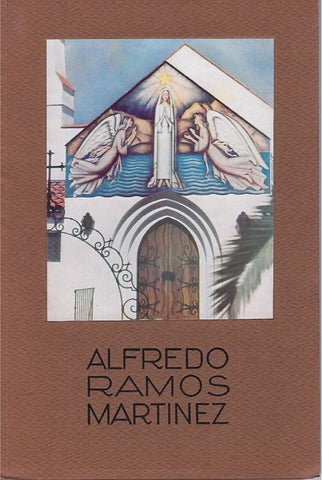
ALFREDO
R A M O S
MARTINEZ
ALFREDO
RAMOS
MARTINEZ by
MARIA SODI DE RAMOS MARTINEZ Translated by BERTA DE LECUONA
with articles by DONALD BEAR
f EDERICO CANTU EVERETT GEE JACKSON REGINALD POLAND
tIAR TINEZ FOUNDATION 2301 WEST THIRD STREET LOS ANGELES, CALIFORNIA
I
"Caravan"
Copyright 1949 by
THE MARTINEZ FOUNDATION II
MARIA, MY DAUGHTER:
To you and to our friends in California, who have contributed so 11u1chto the happiness of
yom· father, I dedicatethis biographyof one who was gt·eat in his work and a child in the simplicity of his heart.
III
IV
ALFREDO RAMOS MARTINEZ 1872-1946
V
CONTENTS --'--"-.:..EDORAMOS MARTINEZ
b.; Maria
Sodi de Ramos
Martinez
...............Pages
15 - 41
Cantu ....................................................... Pages
43 - 48
- - 7ES IX AP PRECIATION OF --~-'FREDO RAMOS MARTINEZ
r.; Reginald
Poland
Everett
Gee Jackson
Federico :-
P.-U~TINGS AND FRESCOS OF .-...I.FREDO RAMOS MARTINEZ
by Donald
Bear............................................................... Pages
49 - 5 3
_-_c.z. ,OWELDGEMENT.......................................... ......................... Page
68
--- I:--DIA DE Los FLORIPONDIOS" .................................... Page
69
PLATES :....-. 1:--:DIADE Los FLORIPONDIOS" (full color).................. Cover Collection
Miss Corinne
Griffith
L-\RA VAN''··························································-····························Copyright Page DEDICATION..................................................................................................... Page III
.-.:.FREDO RAMOS MARTINEZ-a .~FREDO Co~TE
photograph...............
IV
RAMOS MARTINEZ-1872-1946........................
V
TS................................................................................................... Pages 1 - 2
~\f.:\RY, STAR OF THE SEA" -
fresco
(full
colot)............
~:E:--,DEDORADE CARTUCHos'' ............,.............................................. L\.
3 4
VIRGIN Y NINO''................................................................................ 5
Los CHARROS DEL PUEBLO"..............................................................
6
L-\ MALIN CHE'' •••••••••••••••••••••••••••••••••••••••••••••••••••••••••••••••••••••••••••••••••••••••••• 7 L.\ INDIA DEL LAGO"................................................................................. 8
PEON EN BLANCO''.................................................................................
9
Cu,IELIAS BLANCAS".............................................................................. " 10 LA INDIA DE TEHUANTEPEc" ...........-.............................................."
11
TRABA JADORES'' ......................................................................... . Page INDIA'' ...................................................................................... .
12 12
"EL VALLE DE MEXICO" ....................................................................... .
13
··Los
''FAMILIA
ALFREDO
RAMOS MARTINEZ
''LA
PAINTING
THE FRESCO
COLLEGE ........................................................... .
14
CAPILLITA·' ......................................................................................... .
43
AT SCRIPPS
''ZAPATJSTA'·
................................................................................................. .
48
''R1co
GuARDIAs'·
49
Y Los
FRESCOS -
SANTA
.................................................................... .
BARBARA CEMETERY
CHAPEL
"Peace Be Unto You" ................................................... . 55 ''Suffering Humanity'' ....................................................... . 56 ''Procession of Nuns'' ........................................................ . 57 "Procession of Nuns and Races"............................ .. 58 ''Procession of Monks''.................................................. . 59 ''Procession of Nuns'· ........................................................ . 60 "Procession of Nuns and Races"............................. . 61 "Off ermgs • t o th e R.1sen Ch ns • t" ................................ . 62 FRESCO-SCRIPPS ''RosAs··
CLAREMONT,
CALIF .......
......................................................................................................... ..
63
64
.............................................................. .
65
............................................................................. .
66
MADRE'· .............................................................................................. ..
67
"VENDEDORA ''BEBIENDO ''LA
COLLEGE,
DE FRUTAS" PULQUE''
2
Fresco by Alfredo R.amos 1"\1a1'ti11ez - Main Entrance of Chttfch of Ma,-y Star of the Sea La Jot/a, California.
3
"V endedora de Cartuchos"
"La Virgin y Nino"
5
"Los Charros del Ptteblo" Collection The Fine Arts Gallery of San Diego
6
"La Malinche"
7
"La India del Lago"
8
rrPeon en Blanco"
9
"Camelias Blancas"
Collection Mr. and Mrs. Dalzell Hatfield
rrLa
India de Tehuantepec"
11
"Los Trabajadores"
"Familia India"
12
"El Valle de ,Mexico"
13
at
S.:.1:_,~~.., <;'~\\~e.
Painting the fresco
RAMOS MARTINEZ
ALFREDO
""'
.... u._.
_\LFREDO RAMOS MARTINEZ First Years ==. ~e city of Monterrey, Mexico, on the twelfth of Noveme. :.s-2,a ninth child was born to Jacobo Ramos and his wife, !:...C..53.~fartinez-this
child was the future artist, Alfredo Ramos ---.L-:mez. His first years were passed like those of the greater --=-"of the old families of Mexico - a life deeply religious
~i 5lled with respectand love for parents,brothers,and sisters. Alfredo's father was a merchant whose business was made -? of many branches - jewelry, fine fabrics, silver, embroidered :.arro suits, beautiful hand-woven zarapes from Saltillo, and ::.:..u:nerous other items. At this time there was no railroad be:-:-:·eenMonterrey and Mexico City and it was necessary, in o::-derto make the annual purchases, to undertake the long trip ::>ystage-coach. Before leaving on this journey the father delighted to gather his children around him, asking each one what gift he or she would like him to bring back upon his return from Mexico City. The older ones generally asked for new suits, the daughters for pretty dresses, the youngest child, a doll, but when he inquired, "And you Alfredito, what do you want?" As always, his eyes filled with expectant eagerness, he would implore but one thing, "Colors" ... upon receiving them he would remain speech1ess for a long time, his eyes devouring the impatiently awaited gift.
1.5
From his earliest years he would lose himself in delight over the color and beauty of flowers, the shape of the trees, and the rugged strength of the mountains. Above all there remained in his memory and deep in his heart the savage profile of the inaccessible peak of "La Silla", the famous mountain of his native land, whose grand and forbidding outlines drew from him the most profound emotions of his life and which he incorporated in so many of his works. His first years at school were happy. Reading and writing, which permitted him to draw letters and to trace lines, interested him greatly, but when he began to study mathematics, he suffered his first disillusionment. The professor would dictate a problem and upon looking at a sequence of numbers on his tablet, like a flash Alfredo's imagination darted from the figures and commenced to give them a diffeient shape. That which had been the number eight, he quickly converted, by means of a few lines, into a tiny rider which he mounted upon a little horse, and thus these figures shortly became a "plaza" filled with bulls and bull-fighters or any other subject foreign to that of mathematics. The professor naturally suspected that he had not been following the lesson and calling him to his desk demanded the problem that he was supposed to have solved. Alfredo's ears were rather large and he always attributed their growth to the violent ear-pullings that he had endured at the hands of the professor of mathematics. In the State of Nuevo Leon, as in all the other states of the republic, fairs were held, to which the father of Alfredo sent merchandise in charge of his older sons, who undertooR the transportation and sales. With what impatience the young Alfredo awaited the return of his brothers in order to drink in the most minute descriptions of the animation and gaiety of the fair. He listened enraptured to their picturesque depictions of the "charreadas" (rodeos); stories of the market places where the Indian women sold strange, tropical fruits, hand
16
cloth embroidered in primitive designs, oddly ..::;.z;::::=~ ~:.:ers and pottery decorated with brilliant colors, _ ::::s die constant goings and comings of the Indians ::.::;::: ::ypical dress of their native villages. ...x::::::i:::::_ c.n.-e
nine and ten years of age the youthful Alfredo did o: the Governor of Monterrey, which was sent to an :::...~!.!lSan Antonio, Texas, and won the first prize. This ..;:.:i._ceda scholarship to the Academy of "Bellas Artes" ~:oOty.
-=
-
-::.e family of Alfredo had always engaged in commercial ~-::r=..ses, and in those times, it w:as considered almost a dis-.-.-ie ±ar a member of a family, which for generations had =-===itself on being "honorable merchants", should choose ..... G.;.S career that of an artist. _--'..!Eredo's mother was not only an intelligent woman but a .....:._-of great culture, and, far from upholding the family's ....:-,;~ents, began to encourage her little son, talking with fiim a:-.:and reading to him the life stories of the great masters.
-=
\\'hen Alfredo was twelve years old he went to live with ·::e of his older brothers in Mexico City and from that time .::e~ocedhimself to his studies. He worked with intensity and 51.!cceededalmost invariably in carrying off the first prizes. As ze grew physically and developed mentally, little by Little he .:,ecame dissatisfied with the instruction that he was receiving. was then that fie began to absent himself from his classes, only attending them the last two months of the course in order m be able to take the examinations. Very much displeased with his conduct and at the same time astonished at his progress in drawing and in watercolors, the director wrote to Alfredo's father telling him of his son's strange conduct and also how much more he would advance, if he would be present at his classes.
=~
17
With the utmost discretion and without jumping at conclusions bis father wrote asking him why he had not attended his classes regularly throughout the year. "Papacito, I cannot tell you what unhappiness it gives me to cause you and my mother, whom I love so tenderly, the slightest pain and I should have confided in you before others sent you word of my conduct. The classes in the "Bellas Artes" do not allow me to express the feeling and emotions that fill my heart; they insist upon my painting dead models that say nothing to my spirit. I love life, color and nature. I study like mad, work all day long; movement fills me with excitement and I go out in search of it. For that reason it is impossible for me to attend my classes they would end by crushing all my ideals." These were the words that A1fredo wrote to his parents and, as always, they were read with sympathy and understanding. In spite of the fact that he never attended his classes regularly, Alfredo always received the first prize which consisted of a box of colors and one hundred pesos for the purchase of art materials. And so were passed his childhood years and his early youth, a time consecrated to joy and delight in his work. His parents left Monterrey to reside in Mexico City, as their sons, one by one, had gone there to live and the family found the separation unbearable. At that time Alfredo had already become famous for his watercolors and had received so many orders for them, that, to his great happiness, he was able to contribute liberally to the expenses of the family. There had always existed between him and his mother a great spiritual bond of sympathy, and she, who had contributed so much to strengthening his faith in his art, was filled with gratification and pride to witness his achievements. As the years passed his desire to go to Europe to continue his studies increased, but at no time did his financial circumstances permit him to realize his aspirations. His mother became
18
..__ anxiety was such that he gave up all idea _ _ .c_.;:.d so it was that his journeyings were to such ..: -5 C.1_emavacaand similar points, where under .:::::::::::i:::n=-.; ~,1oerance of a lush nature he painted his most ezs and landscapes. -
~:; illness, and while still quite young, his mother ::iefore her death she called her children to her, .:: to each she gave some words of wise counsel ----s.-±em for the happiness that they had given to her . . -.::~o's rum came, with a voice filled with tender love -. _- .,..l,. my dear son, have been the greatest joy of my _-=::=-:-step I have followed your achievements in the : 2-:., and now I have the presentment that someone is _ - ~!:-? you and that soon you will realize the dream of -==- ~o go to Europe to continue your studies." -
- .:_"i'
six months the prophecy of his mother was _______: Porfirio Diaz, the President of Mexico at that time, -
___
!:55 than
;:eat receptionin honor of the wealthy American phil?.:.5~:\frs. Phoebe Hearst, who was visiting Mexico. The
-
the President's table were beautifully decorated with =-~painted by Alfredo Ramos Martinez. Nothing attracted _ ...... --rendonof this cultured lady so much as these marvelously watercolors. "Will you tell me," she asked of the min-~ Don Jose Yves Limantour, "who painted these flowers?" -:.S it
They were done by a young man of twenty-two, very much :::s:=e:nedand admired by us," he replied. I would like to have a talk with this young man," said the .:::e:-icanlady, "please tell him I invite him to lunch with me ~<! ask him to kindly bring all of the watercolors that he i:.ZY have." d
.
Ir is impossible to describe with what enthusiasm Alfredo received this invitation, thinking that, if this lady should buy :.:: of his watercolors, he would at last be able to realize his dreamed-of ambition.
19
Many years have passed, but whenever he spoke of that interview, he was so moved that his eyes filled with tears. Besides buying all of his watercolors, after luncheon, Mrs. Hearst asked, with the greatest tact and very much as though she were requesting a favor, if he would accept her offer to go to Europe to continue his studies in art - the words of his mother were fulfilled and Alfredo went to Europe at the end of the nineteenth century.
Paris.' To dream- and then to awaken to a so fervently longed-for reality is an indescribable happiness. His arrival at Le Havre - and then Paris! - the desire to study and to admire the achievements of the great masters - to work as he had always done with untiring zeal - all this was now being realized. His allowance was very generous, five hundred francs a month, which in those times permitted him the luxury of traveling. He began his first studies in Montmartre where he worked without relaxation. With enthusiasm he paid homage to the beauty of Paris, which held him in a state of ecstasy. The days were too short for him to transfer to paper what he had stored in his brain. He had studied French diligently in Mexico and the knowledge of this language proved of great value to him; later he spoke it as fluently as Spanish.
An exhibition was being held to which he sent some of his watercolors; his success was such that he was admitted as a member to the "Societe des Aquarellistes Francaises", at that time a rare privilege. Each year he left Paris for some quiet spot in order to prepare for the exhibition of the "Salon". On one of these
20
ro Plumanac, a little village in Brittany. This -=c:.e :>eatentrack of travel and its inhabitants were _-:.::r.-.illredo delighted to paint the clumsy move:e!.igious humility of these people! _!-.:
day and night and for that reason the simple
;:...m"Le Magicien", as they could not understand
.- -c2.;edco paint by the faint light of the streets the -· .... ..-ed in his canvases. --~ ·-:y on going out for his accustomed work he found --=-- ili'"'"...::JOUtpaper. Where to procure some? The single _ n.llage certainly carried no art materials. It was -==~..:.:-; :o send to Paris for some paper and to wait with resig'::.: i.s arrival. This was a great hardship for one of -=.Y-==.illlent.
-=:edo stood on the beach one night watching the shadowy -=~es of the fishermen as they cast their nets into the sea. ~c:"·:y of the scene filled his spirit with such longing that ~~ed hastily to the inn and in desperation inquired of =.e ~eeper whether he did not have at least some newspapers _ .::i_;hr serve as drawing material. 0:.i. my good sir, I have plenty of newspapers - all that _ -.:.sb - "And so Alfredo's newspaper pictures came into :e::.;. examples of which are to be found in many museums - in innumerable private collections. .-\.Jredo grew to enjoy more and more the use of newspapers medium for painting. He preferred this paper to any other :-e--...ause he found that it had the same quality as a fresco - the ?,i.per absorbed the paint and produced an effect similar to that c: a wall. Moreover the vertical lines of the columns and the ;:1y of the printing blended perfectly with the characteristic xckgrounds of his pictures. The medium that he used was :empera and, in spite of the apparently fragile type of this paper, die water did not soak in or destroy the surface of the paper.
21
Upon his return to Paris his friends and fellow-students hastened to see what &ehad prepared for the "Salon", and with them came the already famous artist Zuloaga. Alfredo showed them his oils, watercolors and drawings, omitting his newspaper creations entirely. But Zuloaga discovered in a corner of the studio a roll of newspapers on which he glimpsed some sketches. "What surprise have you for us here, my friend?", he asked. "I beg of you do not look at those," cried Alfredo, "my paper gave out and I was forced to use these newspapers for awhile - they are of no value!" The curiosity that exists between artists to see each others' work caused Zuloaga to insist upon being shown the slighted drawings. "What you have here is marvelous," he exclaimed with delight. "What strength in the drawing and what simplicity!" Alfredo did not take this praise seriously and thought that Zuloaga must be joking. "In order to prove that I mean what I say," he said, "I am going to give a showing of them in my studio." The studio of Zuloaga was the rendezvous of the French aristocracy and it was crowded on this occasion. Of the forty newspapers that comprised that showing all were sold and later, whenever the artist spoke of this piece of unexpected goodfortune, it was always with mingled surprise and gratitude. With the money obtained from these sales Alfredo made his first trip to Italy. Alfredo had been in Paris six years when his painting "Le Printemps" was awarded the first prize in the "Salon". It would be difficult to describe the joy and satisfaction that this honor brought him. Automatically with this triumph the generous allowance of Mrs. Hearst ceased, and he was now on his own. Naturally the ensuing period was a struggle and the young artist was obliged to make copies of famous paintings in order
22
....,-.-- :o carry on his work. But he always referred -;:-:c.areer, which placed him entirely upon his -:s::::::::i5.::.sa:.r=rin!ege that brought him incalculable bene_?C:SOnal happiness.
- :-ve:: for fourteen contented and successful years 2 ;nany portraits and was a welcome figure in : : :::e French aristocracy. One of his best patrons .._-<=IS~ :::ceods was the distinguished Marquise de la Tour ~=,:,-asa frequent visitor at her beautiful and pic=-:s:::z:L, ~~-eel estate on the Mediterranean. ...--:::!
D-2--io,the beloved and famous Central American -=.ocher one of his intimate friends. For years the _:---"'X>OS spent the summer months together, and in - hls :x>oksthe poet dedicated verses and prose to his -=.o::?eof his articles he wrote: "Ramos Martinez has ,. !.:L:: many other great painters, his artistic pilgrimages; oc.e 0£ the friendships that I recall with the greatest
,_
eJ
I w-illnever forget the hours when he painted golden in Majorca, landscapes in Holland, and gray melan_::-s in Paris. One must understand the intimate union --.:: between a painter and a poet. There is much painting and much of poetry in painting. One is but to be re-~ diac in the Renaissance nearly all painters were poets did not write verses painted poems. Ramos Martinez e 0£ those who paints poems; he does not copy, he inter'::eunderstands how to express the sorrow of the .fishermen ..___:. :be melancholy of the villages." -~.:..>•-.;~
On one of his journeys with Ruben Dario they found lodg-:;s i.a the ancient Carthusian monastery of Valdemosa, in - ,.J:ca, which at one time had sheltered George Sand and C:;.opin. The cell that the two friends occupied had a window .:.::.::permitted them not only a view of the rugged grandeur : .he mountains, but also a glimpse of the beautiful shore line -: ilie Mediterranean and the distant islands.
23
This period was fascinating in Alfredo's life. He painted from daybreak until the shadows lengthened into darkness, delighting equally in the gaiety or melancholy of the landscape. An old highway running down the lofty mountainside connected the monastery with the village. Often at sunrise the horizon glowed with a fiery splendor and in the distance, like a faint shadow, one could discern the shores of Spain. Back in Paris, after a day's intensive work, Alfredo was in the habit of joining a group of his friends, among whom were Pablo Picasso, Claude Monet, Rodin, Ruben Dario, and others. One night a friend asked him whether he would not like to meet Remy de Gourmont, the idol of the intellectuals at that time. Alfredo was delighted with the idea and went with his friend to one of the well known cafes on the Boulevard. After finding himself for a short time in a circle of young men who did nothing but pay homage to de Gourmont and who did not venture to speak or even raise a glass, if he did not do the same, Alfredo could no longer contain himself and rose from his seat. With extreme courtesy he addressed the great man. "Monsieur de Gourmont, I am leaving because I have work to do." • His friends, not understanding the reason for Alfredo's action, came to his studio that same night and found him calmly reading "Philosophic Nights in Paris", the last work of de Gourmont. One of the most famous pictures that Alfredo painted while in Europe was "La Merienda". At that time the great art critic, Camille Mauclair, in writing of the paintings of Ramos Martinez, classed them with the finest examples of impressionistic landscapes to have been exhibited in the art galleries of Paris. "La Merienda" was purchased by Lord X . . . Later the artist gave a most successful exhibition in the Carlton Hotel in London. During his stay in London his good fellowship and
24
:-=::::.:;::::::i:~- ~ess
of his heart drew to him, as always, w::e:: - :?nd admirers.
:: ::=e ...-\.:.fredohad promised his family that he --- -a-=. bm he had become identified in such a way ..:::::: _:e o: Pa...--is that the years slipped by without his - ~-J'::n.J..Se.
.,A,_....__., -_s ,?:eparing to celebrate the centennial of her ~c Alfredo accompanied a group of his friends _! ~rn.J.ig&om the port of Santander, Spain, to take 0:5= :esrincies. As the time approaclied to bid them -- •.::eco experienced such a nostalgia for his native _ ';:..e=as unable to resist the longing to be with his =-7"nat same afternoon he left for Mexico, abandon_,:_,:; Paris, to which he never again returned.
Mexico and the OutdoorSchools of Painting
-= heart overflowing with love, Alfredo arrived at the 2.
....__._""_ ~t!Se at Coyoacan where his family awaited him im-::==-'-. Sarita, the only sister still living, was exceptionally ~~:, with a nature tender and maternal; she had never - -::::.,e-.:: and was like a mother to each of ner brothers. There !S ~::ch in common between her and Alfredo; they were _=--.::,ya deep and understanding love. And now he had so _.::::;. ~o rel! them . . . ,:,.1.,-ira and her brothers listened, transported; they hung upon -ozds and considered it a real miracle that he should have :: d:ie determination to leave those surroundings that had so _ w?!erely attracted and possessed him and where he had passed ~-,e :>est years of his youth.
25
Later there were quieter hours when he thought of his beloved parents, the brothers and sisters who had passed away during his absence, and in such moments of quiet repose his eyes examined the watercolors that covered the walls of the house. "But what is this", he reflected, "how is it possible that this is the work of my boyhood and that these fourteen years which I have dedicated to study have destroyed this simplicity and originality of design!" "But Alfredo, why do you_talk like that," his sister protested tenderly, "you do not know what you are saying. Your work has been accredited by the French critics, by the award that you received in the "Salon", and by the many triumphs which you have achieved in different countries." "This that you see here, Sarita, this is what I sought there; this is what I longed to paint. But all the great masters whom I admired so much, completely absorbed me and destroyed my personality." It would not be easy to describe his disillusionment and the profound melancholy that consumed him at this period. For two years he painted nothing. In 1912 he was offered the post of Director of the Academia de San Carlos, which he refused. A strike took place among the students, who united in demanding Alfredo Ramos Martinez as director. Finally with the ardent desire to free the young students from the cut and dried academic teachings, he accepted the directorate and it was then that he founded in Santa Anita his first "Outdoor School of Painting." With enthusiasm he threw himself into the task of helping these young people to express their own feelings, showing them how to approach life without fear and with complete confidence in themselves. This was the beginning of the "Outdoor Schools of Painting" in the Renaissance of Mexican Art. One of his early pupils was the now famous David Alfaro Siqueiros.
26
-::::;s::cs !'--=:e-2oRamos Martinez resigned the
--~
ce Bellas Artes and for some years -=--~ .:hen chat be became the favorite ?.fexican circles.
~:i:::.; in speaking of Alfredo's life to ...::::!S _ =S ;:o::}e,where there existed at one and ~?:::e.::e of patriarchal formality, simplicity ;;:::.:=:;=..-::-:= - :?1:iliry. The house situated near the _s _o......rambling structure, in a large garden .___ ~e ~ees, banana plants and roses. Pears, --u: :x>~gainvillaea vines hung over the high :.c
__ .,.,.... __ , c:::. sixty guests were in the habit of congre--~e:noons in the old colonial house in Coyoa-:::x--.e.:s.a11friendly, charming and cultured and one .c '!X-==?cionally sweet and attractive nature, exerted =:::::=::.:~::-3 way to give pleasure to their guests. ::: die evening the traclitional "chocolate" was :-- s oocolare was especially ground in the house and ...._.___:=:..med by an infinite variety of fine pastries and cakes .:;::::n::r~ 0£ the country. Each Friday and Saturday two _;: sezvants prepared these delicacies under the expert __,;::,._~a: Sarita.
- -s. tliar I were able to portray the charm of that house, "-'-'
•!T"'- now that so many years have passed and all those dear
::.:e gone, the old colonial home of the Ramos Martinez
n=:.:- ..n Coyoacan is still remembered - a home filled with furnishings, collections of curios and with its walls - e..tt. with the pictures painted by their famous brother.
.c::;:;:,.
i=.:917 Alfredo. Ramos Martinez was again appointed Ditec-
-='"':. che Academia de Bellas Artes. He accepted the position i± :he stipulation that there should be a complete renovation c dle old academic professorships that were destroying all the L~a.;ioation and the ideals of the youthful students. From that
27
time he dedicated himself completely to the task of organizing the "School of Action", so called, as its students were allowed to follow freely their own inclinations, applying their efforts to carrying out all that nature inspired in them. No objections were advanced, should a child prefer sculpture to painting. The distinguishing trait in the character of Alfredo Ramos Martinez was his enthusiasm: his optimism that when the seed is sown one already perceives the growing plant, even to the point of gathering the ripened fruit. With this unswerving and fervent faith he brought his pupils to triumph. In 1920, Jose Vasconcelos was Minister of Education in Mexico and in him Ramos Martinez found an excellent collaborator. The students were furnished canvas, paints, and all the materials for modeling and sculpture. At this time in the scfiool at Churubusco, Jean Charlot, Diaz de Leon, and Fernando Leal executed the first modern wood-engravings made in Mexico. The instruction that was given to the young artists was simple but at the same time one of profound knowledge. After a preliminary talk in which he awakened the enthusiasm of the student he made him create that which was in his heart. There were boys and girls in these classes between the ages of nine and twenty years, the majority of whom came from the poorer people and many of them were Indians. The remarkable strides made by these students brought Ramos Martinez intense happiness. He considered these schools one of his most important works. The stir created by the amazing progress of the "Outdoor School of Painting" led to the formation of new schools in Tlalpan, in the Villa de Guadalupe, in Xochimilco, in Los Reyes and in Cholula. Ramos Martinez appointed as their directors the more proficient and advanced of his pupils. In 1923, King Albert of Belgium created him "Knight of the Order of Leopold" and decorated him with the "Grand Cross of the Order", in recognition of his work for the advance-
28
ment of pictorial culture in all its expressions, in the international field of art. The famous Pan-American Exposition was held in 1925 in Los Angeles, California. At that time Mr. William Alanson Bryan was the Director of the Museum. A communication received from this director announced that the three first prizes and one second prize conferred by the Museum were awarded to Mexico. Diego Rivera received a first prize for his picture, "La Fiesta de las Flores", and the other three were given to the pupils of the "Outdoor School of Painting" directed by Ramos Martinez. One of the successful students was the youth, Manuel Villareal, who won the "Earl Stendahl Purchase Prize" of three hundred dollars, presented for the best landscape in the LatinAmerican section. His picture, "Cloister in Churubusco", is in the permanent collection in the Museum at Exposition Park. The other first prize went to Luis Martinez for his "Don Panchito" which is also owned by the museum. A second prize was won by the Senorita Maria Ramirez Bonfilio, whose figure painting received the highest commendation. In 1926, during the administration of Plutarco Elias Calles, as President of Mexico and Puig Casaurane as Secretary of Education, an excursion to Europe was organized by the Chambers of Commerce, in order to create an interest in the products, industries and handicrafts of Mexico. At the same time, Ramos Martinez was appointed to present an exhibition of the young artists of the "Outdoor School of Painting". Two days before their departure, the President received the representatives in the Castle at Chapultepec, and, one by one, each assured him of his complete cooperation. When Martinez reached the President he said to him: "I carry with me, Mr. President, some two hundred pictures, work of the 'Outdoor Schools of Painting' and with these pictures go the hearts of the children and youths of Mexico. I promise you that they will
29
triumph, and if they should not, I shall never return to my country!" Whatever Alfredo Ramos Martinez expected from this exhibition, certainly his expectations never reached the astonishing triumphs that he experienced in Europe. The opening in Paris, in the "Sociedad Paris-America Latino", not only attracted the attention of all the French critics but of the newspapers as well, from those dedicated to brief articles, like "Le Journal", to those of a political character, as "Le Quotidien" and "L'Humanite"; these newspapers devoted entire columns to the exhibition, praising the genius of the Mexican children to the point of placing it on a par with the work of the great artists. Picasso was so interested when he saw the photographs of the pictures, that, in his haste to see them before leaving on his vacation, he personally assisted Alfredo Ramos Martinez to unpack them and then remained for several hours admiring and studying the creations of these young Mexican artists. Foujita, the famous Japanese painter, was a frequent visitor to the exhibition, as well as the painters, Raoul Dufy, HermaonPaul, Jean-Gabriel, Rene Domergue and many others. The sculptors Lipschitz and M.ateo Hernandez and the art critics and writers, Walter Pach, who was at that time in Paris, Gustave Kahn, Andre Warnod, Francois de Miomandre, Rene-Jene, were equally enthusiastic. "These youthful prodigies have astonished our great artists, their proficiency is disconcerting", declared the Parisian newspaper "Excelsior", July 21, 1926. The Director of the Beaux Arts, Paul Leon acquired two of the pictures for the French Government. The paintings that were purchased were a "Still Life", the work of a young girl, Cristina de la Cadena, and "Interior of Churubusco Convent" by Manuel Villareal, the same youth who won the award in the Exposition in Los Angeles. The Minister of Mexico in Paris, Licenciado Alfonso Reyes wrote to the Secretary of Education in Mexico, offering the
30
;;;escion that in view of the great success of the exhibition, -·mild be expedient to take it to various other European .::r:?..rals, and also to accept the invitation of the organizers of 'Salon d'Automne" in Paris to dedicate a room for the ec:bition of pictures painted by the children of Mexico. This -.s highly significant, as it had to do with the work of foreign ::::dren and the "Salon" was the most important showing of :::.-eyear in Paris. Ramos Martinez was invited by the "Preventorium of ~ers" to demonstrate his method of teaching before a group _: ,en children, who were patients in this institute. Docteur ~aux, director of the school, had visited the exposition and =-:!.S so impressed that, without awaiting the arrival of Ramos - !l.rtinez, he began to put into practice that which the artist ..:...dexplained in his lectures. Later an exposition was held in Berlin and another in Aadrid. The success in Madrid was as remarkable as that ..::Paris. An excerpt from the conference by the great painter and ::icic, Don Gabriel Maroto, entitled "The Artistic Mexican :1evolution" is as follows: - "Mexico through her 'School of _-\ction',through the art born of this movement, has awakened :...:iterest in the highest Spanish cultural life, ruled by the purest desires and winning for the spirit an unforgettable battle." Ramos Martinez returned to Mexico after eleven months in Europe, bringing with him a full measure of honors for his :>elovedcountry and for its children. In 1908, when Alfredo was studying in Paris, Ruben Dario wrote in one of his books: "Ramos Martinez possesses a great ideal - that soon Mexico shall fill a shining place in the art of the world, which, if it is realized will accomplish in painting what Grieg has done musically for his northern land". Ramos Martinez realized this ideal when he returned from Europe
31
bringing with him the laurels gained there by the young painters of Mexico. In 1928 Alfredo Ramos Martinez married Senorita Maria Sodi Romero, a native of the state of Oaxaca, and in 1929 their daughter was born. On account of the child's delicate health Alfredo was obliged to give up his position as Director of Bellas Artes and come with his family to the United States to consult specialists.
California In October, 1929, Ramos Martinez, his wife and little daughter left Mexico for New York and from there went to the Mayo Clinic in Rochester, Minnesota, anxiously seeking a doctor who might effect a cure for their child. Seven months were spent in this place, seven months of hopes and disillusionments as they became aware that the improvement which they had looked forward to was not being realized. A stroke of destiny, that the doctors of the clinic had a hand in, brought them to California, in the hope that the climate might prove beneficial to their child. New treatments were tried here but to no avail. In these days of sorrow Martinez found consolation in spending all the time that he could in drawing and painting. In a small apartment in Los Angeles, in the simplest of surroundings, but with th.e same vigor and interest which he always put into his work, he began to develop that which bad existed in his soul since childhood, now strengthened by the deep knowledge acquired through so many years of effort and study. Here for the first time since his youth, he freed himself completely from the influence which had dominated him since the fourteen years that he had devoted to study in Paris. From the beginning the pictures that he painted were like the outpouring of a living spring - of his own life in Mexico and as a Mexican; it brought his art to the point of kinship with
32
..a;::c~·s primitive race of Indians, close to the strength of his _?.:.:al homeland and of her mountains that were the inspiraof his .firstyears. :-here was still another reason that animated the work of - -os Martinez in those days, his sorrow and that of his wife _ -imessing the sufferings of their child; this caused him to ro painting pictures of a religious nature inspired by the --=-ep-rooted memories of his early training. He worked without the least thought of seeking recognition .= California, his idea being to return to Mexico as soon as the ::mdition of his little daughter would permit. But fate changed :.=ecourse of his life and he was invited by the Director of the ~foseum at Los Angeles to hold an exhibition there of the works -:.hicb he had painted while in that city. A few weeks later the Assistance League opened its new Art Gallery with a showing of the pictures of Ramos Martinez. The press began to write of his work and a number of his paintings were acquired locally.
-=
In a few months there followed an exhibition in the Fine Arts Gallery of San Diego, in Balboa Park, which met with great success. Over half of the pictures were sold and the Museum purchased two for its permanent collection. Day by day his life in California became more interesting. Under the care of an eminent doctor his child was rapidly gaining in health and strength. He would lose himself in contemplating the countryside and the beautiful Pacific, but above all, here he found himself again. The brown earth of Mexico and her beautiful Indian race came to life on his canvases in vivid and enchanting pictures. In April of 1933 he held an exhibition in the California Palace of the Legion of Honor in San Francisco-oils, temperas, drawings and murals filled one of the largest rooms. When Alfredo arrived at the museum he found the director highly delighted at the interest and enthusiasm shown at the opening.
33
On this occasion he met Mr. Albert Bender, collector and patron of art in all branches, who became a real friend and sincere admirer of Alfredo's. Mr. Bender acquired "El Indio Solitario" for the Legion of Honor, "El Prisionero" for the San Francisco Museum of Art; "The Three Sisters" for the Gallery of Mills College and "Padre Junipero Serra" for the California Historical Society. Besides these he purchased a number of other pictures for his personal collection.. The following year in 1934, he held a show in the Faulkner Memorial Art Gallery, in Santa Barbara, where his work was exhibited for the first time. At that time upon learning through the press that their famous countryman was arriving in Santa Barbara, the Mexican residents of that town went to the Art Gallery to receive him with music and bouquets of flowers. It was then that he was commissionedby Mrs. George Washington Smith and the well-known violinist and composer, Henry Eichheim, to paint the frescos in the Chapel of the Cemetery of Santa Barbara which is so beautifully situated, overlooking the sea and with a background of majestic mountains. These frescos are among his most notable works. Every atom of his artistic faith, knowledge and strength, he incorporated into the composition, which is at once an expression of the love of his art and his love of God. A procession of monks, nuns and women of all nations are moving in the direction of "God, the Resurrection and the Life". White lilies comprise the offerings that they are carrying and the same flowers adorn the arches of the dome and are held in the hands of the angels. "Grief-stricken Humanity" - a group of large heads bent by the weight of sorrow and covering their faces with their hands symbolizes mortal suffering and misery. Before them, "The Christ of Peace", like a spiritual consolation, extends his hands to those who weep for the loved ones that they have lost. Leo Katz, in his profound and interesting book, "Understanding Modern Art", referring to Ramos Martinez, expresses
34
--~.: thus: - "Martinez's drawings are simple, large and - ; ro the extreme, as if created by nature without the slights.::-0wof technical ability. They are drawn with such devotion _ ii.tensity that some of his outlines seem to burn into the ~He achieves in black and white a brilliancy and a citing intensity which are hard to forget. Without copying .::.--of the pre-Columbian styles he revives the grand power of -?lincation and the great mastery of architectural design .:...chwere so characteristic of the unknown masters of ancient
, .
- -EX1CO.
"The Chapel of Santa Barbara was designed by the architect, _Ir. George Washington Smith. Its simple, dignified structure ::::akesan ideal background for Martinez's murals. In this chapel :.ne artist naturally made use of religious themes. The whole -:'""Ork is executed mostly in black and white with a few touches of natural ochre and lightened by occasional small areas of ~1uesor greens or reddish brown. There is nothing spectacular,
nothingsuper.6.cially excitingin the wholechapel;yet someday it may be recognized as one of the noblest and most impressive creations of its kind in or out of this country." After Ramos Martinez had finished his frescos in the chapel, he remained another year in Santa Barbara painting a number of frescos in several residences in Montecito. Returning to Los Angeles in 1935, he painted his "Mexican Adam and Eve", a more than life-size picture in oils, which was bought by Mr. Bender and presented to the San Francisco Museum of Art. Meanwhile a traveling exhibition of his oils, temperas and drawings made the round of the principal cities of the western states. In 1937 he was commissioned by Dr. Jesse Albert Locke to paint a fresco over the main portal of the Roman Catholic Church of Mary, Star of the Sea, in La Jolla, California. Its
35
composition shows the blue waves of the ocean caressing the feet of Mary, "Star of the Sea". Two angels hovering at both sides pay homage to Our Lady. In the background shines the star, symbol of her name. A few months after finishing the fresco at La Jolla he painted the murals in an attractive restaurant in Coronado. The subject was typically Mexican. Upon returning to Los Angeles he dedicated several months to intensive work in preparation for his one man show that was to be held in the San Francisco Museum of Art, which was another triumph in his artistic career. Alfredo Ramos Martinez loved California and, even more, the many good friends that he had made here. In each place where he began a fresco, or held an exhibition of his pictures, he created new sympathizers, who became lifelong friends and admirers. His life, although simple, was .filledwith continuous gratifications and one of his greatest was to realize that the persons who had acquired his paintings loved them. In an exhibition that he held at the University of California at Los Angeles, he showed a small oil painting of the head of a Mayan Indian girl, with a background of flowering cactus. At the close of the exhibition he received a letter from a young university student telling him, that owing to the feeling of beauty that this painting had given him, he visited the hall daily; he begged that he might be permitted to call upon Mr. Martinez at his studio from time to time further to enjoy the picture. Those and similar experiences of appreciation .filled his heart with joy. In the summer of 1940 he gave a course in art at the Fine Arts Gallery of San Diego. In a few weeks he had his pupils painting with different media - even fresco. At the end of the six weeks course he held a show of their pictures. After his day's work he generally continued at night for three or four hours drawing designs for murals. From this, one
36
readily note the contrast of his spiritual strength with that of his small and delicate body. Whoever might see his "Indian ~fother" or one of his large Aztec or Mixtec heads, would i.::nagine,without knowing him that the artist who painted these works must be a man of great muscular strength and of gigantic proportions. In his case the physical strength disappeared, leaving in its place a dynamic spiritual force that urged him to create these monumental works. (2.ll
Last Visit to Mexico After an absence of twelve years from his native land, in September of 1942, he made a trip to Mexico. Arriving at Monterrey he felt a strong desire to renew the memories of his early years. His eyes longed to embrace the fertile and beautiful valley of Santa Clara, where this city is located, to gaze again on the range of the Sierra Madre, with the peaks of the "Mitre" and the "Saddle Mountain" standing out in bold relief. He would have pref erred to remain unnoticed, but in his home town this was impossible. An hour after he had registered at the hotel word got around of his arrival and at once his friends came to greet him. His stay in Monterrey was an event; his last visit there had been just after the triumphs won by his schools in Europe. Then he came with notices from the art critics of Europe praising the pictures of the Mexican children; now he brought the photographs of his own work done in California. He had the joy of revisiting Sabinas Hidalgo, a small town not far from Monterrey, birthplace of his mother, where, as a child, he had spent many hours admiring the golden fruit and shining green leaves of the orange trees that grew on his grandfather's hacienda. Alfredo always insisted that an orange tree was his first teacher. After ten days as guest of the city of Monterrey, he continued his journey to Mexico City. Upon arriving there he was
37
interviewed by the press, and the papers published reproductions of many of the pictures that he had painted in California. The Minister of Public Education, Licenciado Vejar Vasquez, commissioned him to paint a series of frescos in the Normal School for Teachers in Mexico City. Under the heading "Impressionistic Murals by Alfredo Ramos Martinez", the writer, Maria Elena S. de Pallares, wrote: - "Alfredo Ramos Martinez has produced an important pictorial work in the Normal School for Teachers; in gigantic frescos he has depicted some of the most comprehensive historical deeds of Mexico. Over the door that opens into the library of the school he has painted a colossal head that represents 'The Race'. The woman shows in her features her Indian origin which seem also to tell of her Oriental affiliation. The expression of this face is of august serenity, perhaps supernatural; femininity is noted only in the decorative braids that in vertical lines outline her head and in which are caught a few rays of light. On either side of this impressive head extend curving walls; on them Ramos Martinez has painted the great educators and protectors of the race: Martin de Valencia, Gante, Zumarraga and 'Tata Vasco' initiate an imposing procession of noteworthy men. In the marching file of illustrious men are even the faces of modern and contemporary persons; we discover Rebsamen, Justo Sierra, Ezequiel Chavez, Ezequiel Obregon, Antonio Caso, Vasconcelos . . . The figures are attired in several plain garments whose perpendicular lines give an impression of stone columns of architectural importance. Their countenances are illumined by an inner light which conveys benevolence and human understanding. In front of these two circular walls are others parallel with them that are also decorated with frescos. On them appear Indian scenes of events antedating the Conquest. We see the magic mountain of Monte Alban and men and women who
38
--:ing their gods and golden ornaments, their talismans -=.:hes,which are destined to accompany the illustrious the journey to the life beyond the grave. The .figures .=.e women are graceful. In their hands they are holding .....___::;g jewels, while youths with hieratic countenances and -:! mrsos that show their muscular strength, are excavating :?Cning in the earth wherein to bury the treasures. Forming ~--,ckgroundto this religious portrayal are typically Mexican --55 and mountain ridges; rugged and inhospitable, as strong ...::.c indomitable as the men who inhabit them. The frescos have the virtue of establishing a unified effect -:rh architecture and of heightening the beauty of the walls. :-aey are part of them. The .figuresand the surroundings have =eated their own perspectives and in spite of their stylized .'.:.andling,they by no means detract from but rather add to the :.armony of the edifice,giving the crowning glory to the severity of its architecture." During these two and a half years of his last stay in Mexico, whenever his work permitted, Ramos Martinez enjoyed visiting the tiny villages where the Indians still preserve their primitive customs. He delighted to bear away in his mind faces and forms which, upon arriving at his studio, he put into his pictures. One market day in Amecameca his attention was attracted by a little Indian boy some .fiveyears old, who was carrying an immense piece of sugar-cane. Upon returning to his studio, his mind filled with the image of this child, he proceeded to give it life in a charming picture which he called "El Nino de Amecameca". Alfredo had a great love for Mexico and for the Mexican Indian. "Our Indians," he said, "shaping their clay and decorating it, are as great in their artistic honesty as Michaelangelo and Titian. They put into the work all their being. It is as though they themselves became part of the same clay. Our people are all love, all spontaneity, in the sparkling representation of their art."
39
Last Days Although the Minister of Education offered Ramos Martinez walls for other frescos in Mexico, he declined the offer and returned to California in February, 1945. He brought with him a large collection of temperas and oils which he had painted in Mexico for his next exhibition that was held two months after his arrival in Los Angeles at the Dalzell Hatfield Galleries. After his return to California one might say that Fortune smiled upon him; most important was the great success of his exhibition. The critics were eloquent in their praise of his work and many of the pictures became part of private collections. Close upon this he was invited to become a member of the Summer Session in Claremont. For a period of six weeks he conducted a course in rut and gave a number of talks on Latin America. The Fine Arts Foundation of Scripps College held a show of his paintings in September of that same year. It was then that he was commissioned by the Foundation to paint a series of frescos in the Memorial Garden of the college. In January, 1946, he spent a most enjoyable time in San Diego at the invitation of the Director of the Fine Arts Gallery of San Diego and of the Art Guild. At the same time came the opening of his exhibition in the Gallery. The Gallery acquired another of his paintings for its permanent collection. Alfredo Ramos Martinez could not begin his frescos in Scripps College, where he was received as guest of honor, until March of the same year. Here he was surrounded by an atmosphere of culture and affection and experienced the joy of seeing the interest which the young students took in the fresco that was to measure a hundred feet in length. He drew the entire composition on the south wall of the Memorial Garden. This treatment is architectural in design, like all of his compositions. The simple and dignified figures, the brilliant
40
colorings of the tropical flowers and fruits, combined with the earth and ochre tones, make for a decoration of perfect harmony. He worked three months and then was obliged to stop because the excessive heat made it impossible to preserve the necessarymoisture in the wall, which a fresco painting requires. He hoped to continue and complete the frescos in autumn. Meanwhile the New York press was publishing highly com~ plimentary notices of his pictures, at that time on exhibition in the Lilienfeld Galleries. Upon returning to Los Angeles from Claremont, he was asked to execute the decorations of St. John's Catholic Church, then in the course of construction and on which he immediately began to work. During the summer months, when it was too hot to continue the work at Claremont on the Scripps College frescos, he made fourteen drawings, nine feet in length for the stained-glass windows of St. John's and commenced to paint the Stations of the Cross. In October he interrupted this work in order to return to the unlinished frescos at Scripps College, which he was most anxious to complete. But unfortunately he was able to work there only three weeks, when a severe attack of grippe obliged him to return home. At the age of seventy-three, with undiminished vigor and creative power, thus he was busily engaged on two major projects in fresco, when on the eighth of November, 1946, he succumbed to a cardiacal attack. With his death Mexico lost not only one of her great artists, but one of her devoted sons, whose work, inspired by the deeprooted ties of his race, will ever proclaim his patriotism and the love that he bore the Mexican people.
MARIASom DE RAMOS MARTINEZ
41
La Capillita"
11
Notes in Appreciationof AlfredoRamosMartinez by REGINALD POLAND Director, The Fine Arts Gallery of San Diego EVERETT GEE JACKSON Chairman, Art Department, State College, San Diego FEDERICO CANTU Mexican Artist
43
An Appreciation A true work of art possesses a complete life of its own; and because of this its pa:i:ticu!ar~ar_acter .µid beauty unfailingly move ~e ·spectator. The fine spirit of Alfredo Ramos· Martinez lives·in and through his paintings. They are as much , ~e expression of ~-e !ban as they are·of the artist, whether the work be an "Ecce·Homo" or a simple still life. Almost from the beg1nning,Martinez cast a style that was unmistakably identified with his own personality. His work consequ~ntly defied .imitation. The very directness and simplici~yof_his art ~u~cess•fully reflected· the emotional integrity of his character and of his great love for his chosen subject matter. What other artist could have painted more sympathetically the Indian family kneeling humbly and devoutly before the simple altar of that village church? It has been said that only God can make an artist. Probably so. And quite probably that is one reason why Martin~z and his art have such loveliness. But Martinez came close to producing not only one fine artist more, but many artists. Had he done nothing more than to teach and inspire all those children in Mexico, that alone would have made him great. A work of art either does or does not have meaning for each of us. It has been one of my great pleasures to own some of the work of Martinez and to share it with others. It is generally conceded that his frescos in the cemetery chapel at Santa Barbara are among the most distinguished examples of wall painting in this country. In this form we see Martinez at the height of his powers. Ruskin said, "When love and skill work together, expect a
44
masterpiece." Our dear friend was not only a "born artist" but as such he worked untiringly to develop his talents and skill as draftsman, print maker and painter. As the true creative worker, his art, due to his devotion to his work and his intense love for all that makes the human scene and adds to the wealth of our common life, has had its inevitable effect upon his fellow men. Director The Fine Arts Gallery of San Diego
REGINALD POLAND,
45
A Letter It is well known that Senor Martinez played an important part in the modern Mexican movement in art and for those of us who knew him personally the nature of the part he played is perfectly clear. Nor is it at all difficult for us to understand why even Diego Rivera speaks of him in terms of deep admiration, tenderness and respect. If the truth were known, all real artists work not for the sake of production but for the attainment of a closer and more complete harmony with universal life. Their works are only the by-products of this activity. Senor Martinez was such an artist. At an early age he had achieved a spiritual view of all things so that the slightest comment he might make would be animated by a quality of beauty. His creative perception was such that all things were beautiful to him. Ugliness did not exist simply because, finding it to contain the elements of all images, his imagination instantaneously rearranged those elements into a form of beauty. And this attitude which discovered beauty in all directions seems also to have illuminated only the good. Everything and everybody was good. Martinez took no part in the social and political controversies which raged among most of the modern artists of Mexico. He was not concerned with this or that ideology. And I believe it would be true to say that all the revolutionary artists of his time felt that influence would prove in the end as great a force toward social and economic justice as their own. Martinez was really a Saint Francis of our time. Alfredo Ramos Martinez was appointed director of the Academia Nacional de San Carlos in 1913, and it is quite possible that this event was of greatest importance for the future . of Mexican art. For Martinez introduced into this official institution (the government's academy), an art approach which was entirely creative rather than academic. Although he was at that time regarded as an impressionist, he himself thought
46
of impressionism simply as a_direct communion with nature. The important fact here seems to be that a truly creative artist was in charge of the training of students in an institution which ordinarily would have been in the hands of a stuffed shirt. Later on, Mexican official art, that which was sponsored and paid for by the government for public buildings, was produced not by academicians, but by creative artists. And Martinez' happy connection with the Academy must have been a factor contributing to this end. As for his position relative to the other modern Mexicans insofar as art form is concerned, it is difficult to make a satisfactory general statement. However, it would be correct to say that his form arises from a creative force which is more completely emotional and spontaneous than that of such men as Rivera and Orozco, whose form is always modified by greater deliberation. EVERETT GEE JACKSON
Chairman, Art Department State College, San Diego
47
A Statement "It is a pleasure, though a very small tribute, remembering Maestro Ramos Martinez, a mutual friend and the man who guided my first clumsy steps in painting. As you know, I have a great curiosity for his technique and I must thank you again for graciously showing me that series of little treasures by Martinez. They aroused my jealousy, both as a pupil and as a Mexican, for I had to admit that he left in California the most mature accomplishments of his fruitful talent." FEDERICO CANTU
"Zapatista" 48
"Rico y Los G.uardias''
THE PAINTINGS AND FRESCOS OF ALFREDO RAMOS MARTINEZ
• by DONALD BEAR Director, Santa BarbaraMuseum of Art
49
For many reasons, the past fifty years have been the most eventful and revolutionary ones in art history. There have been any number of artists whose names seem to symbolize a movement in modern art. Some of these movements and contributions have been much more important and of wider and more lasting influence than others. Among the many discoveries and contributions which have led to creative schools, particularly in the United States, are two of special significance coming to us from Mexico. First the methods and results of the creative teaching of children and young people and secondly the mighty impact of a school of mural painting or architectural wall decoration. The part played by Alfredo Ramos Martinez in all of this can hardly be over estimated, since he was in a large measure the originating spirit. Specifying this function of Martinez is not to by any means overlook his importance as a creative painter. Except for a very few artist-teachers, working more or less in isolation, there was almost no widespread teaching of the young which was of interpretative value. As has been noted several times, the results .achieved by Martinez in his organization of classes for youthful students in his capacity as Director of the Academy of Bellas Artes marked a turning point in the contemporary art of Mexico. The results again engaged the serious interest of well-known European painters such as Picasso and Foujita. Exhibitions were held in Paris and Madrid which were received with wide acclaim. Mingling with some of the ideals already established by Austrian educators such as Franz Cizek and the American, Arthur Wesley Dow, teachers and educators in our own country were even further stimulated by the striking creative work that came out of the Mexican schools under Martinez's leadership. This was further accentuated by the definitive and personal style of this artist's own work. Illustrating his persuasive point of view were his compositions painted on newspapers and first discovered for the public through the enthusiasm of Zuloaga, the noted Spanish painter. Nor should it be overlooked that Martinez was one of the very
50
first men to make the world outside of Mexico acquainted with the great wealth of pictorial beauty inherent in the everyday life of his own people. He described them and their environment through a series of canvases devoted to landscapes with figures, and still Iif e compositions of compelling invention and richness. Throughout there is no message other than his enormous appreciation for the beauty of life and his desire to share his own creative vision of it with others. Added to these achievements was the artist's distinguished experimentation and accomplishment in the field of wall painting, or the pictorial mural. Through these he laid the ground work for an entire national school of mural painters. Both Martinez and his subsequent followers have had the greatest influence in this art form in the United States. Again, unlike many of his national confreres and students, he was happy in the act of creation without making use of any attendant means of propaganda. But then it must be remembered that he was deeply religious in the most profound and simple sense of that term. Except for the chapels in New Mexico, which after all represent an archaic and foreign culture, the United States has had no tradition of ecclesiasticalart, and almost none of the mural.* There are, of course, a number of murals in this country, most of them painted during the 1930's, and a great many of them inspired by the movement which was then typified by "the modern Mexican Renaissance." Too, there are a number of famous works done by well-known Mexican artists. A great many of these have been sources of both inspiration as well as controversy. Unquestionably, each of these has regarded the tradition of the mural as it originated in the fresco schools of Italy, and has therefore been of tremendous value in our own contemporary artistic development. *I am thinking particularly of the great altar-piece in the mode1t chapel of San Joie de la LAguna, 1ituated between Gallup and Albuquerque.
51
One of the effects that always accompany the mural painting of Martinez is that of an all-over serenity. This quality is not only the result of his own personal thinking and temperament, but an almost profound intuition for the problems and even exigencies of filling space in relation to a given architectural structure. Perhaps the greatest achievement of this artist's career is to be found in a series of murals in place in the chapel of the cemetery at Santa Barbara. This chapel, dedicated in 1926, was designed by the late George Washington Smith. It is done after the mode of the Catalonian XVth Century period, which lingers between Romanesque and Gothic. The building itself is beautifully set on a wooded hill that overlooks the sea. The simple, intimate, yet somehow noble beauty of the building is a genuine tribute to the landscape. Inside the chapel this very beauty is further sustained by the Martinez murals which were presented to the chapel by Mrs. George Washington Smith and Mr. Henry Eichheim, as a memorial to George Washington Smith, and Ethel Roe Eichheim. Mr. Eichheim having been a distinguished musician and composer, the chapel becomes notable as marking the confluence of three distinguished creative artists. Though the function of the chapel is non-denominational, I hardly know of a more convincingly reverential and truly devotional work of art in the mural usage than the Martinez frescos placed here. Spiritually, these are akin in degree, if not in kind, to the best of the altar-pieces in the Southwest. I can think of no greater tribute. The theme of the Resurrection dominates the interior and with the handling of the processionals of figures on either side of the chapel along with the garlands of Easter lilies used on the frieze, here is a singing and lyrical beauty not unremindful of Fra Angelico. This is a matter of spirit, rather than in any sense a physical treatment. There is a fine feeling of slowly rising tempo and gathering of cadence which resolves with the
52
Christ whose uplifted hands dominate the space above the altar. This portion is topped by a dome finished with gold leaf. At the other end of the building and facing the Christ, is one of the most moving compositions of all. This depicts grieving humanity shown as a group of Mexican women with faces buried in hand. This depicting of the phenomenon of death and its attendant grief, then leads, via the moving procession on the side walls to the figure of the Risen Christ at the opposite end. The whole of the decoration is executed in secco, which is a form of wall or fresco painting, with the use of tempera. The color is simple, being mainly kept to black and white with a few flashes of blues, an occasional ochre and green complimented by reddish-brown. There is great strength in the structural drawing of the figures and the details scatter a rich pattern over all. However, the color is quietly luminous and seems to have been struck in terms of purity and light while the figures themselves are deeply moving in a way that defies any actual description.
The f,·escos by Alfredo Ramos Martinez in the Santa Barbara Cemetery Association Chapel, reproduced on the foJ/ot11ing eight pages, represent one of the major t11orksof his career, a distinguished contribution to the art of California.
., /.
..
,
---- •
··, I'.
,w,
•
.
I
"Peace Be Unto You"
55
i.
"Suffering Humanity"
56
...
...... , , '"'"
nAU'(f•"',r,f
•HI
lllf ..
"Procession of Nuns"
57
,... .....
"Procession of Nuns and Races"
58
"P,rocessionof i\Jf.onks"
59
"P1·ocessionof Nuns"
60
"P1·ocessionof Nuns and Races"
61
"O/Jerings to the Risen Christ"
62
8 V)
....
V
I-I-<
63
"Rosas" Collection Mrs. W. W. Seymour
64
"V endedora de F1·utas" Collection Mr. and Mrs. Henry Mayers
65
"Bebiendo Pulque"
66
67
ACKNOWLEDGMENTS Grateful acknowledgment is made to the following for their interest and support: Mr. and Mrs. Henry Mayers and Mr. and Mrs. Dalzell Hatfield for originating and developing the plan for preserving the work of Alfredo Ramos Martinez through reproduction; to Miss Corinne Griffith for the loan of her painting "La India de los Floripondios" for reproduction as the first Serigraph of a work by Alfredo Ramos Martinez· Mr. Donald Bear, Mr. Reginald Poland, Mr. James ormile for work in organization and membership; Mr. Donald Bear Senor Federico Cantu, Mr. Everett Gee Jackson and Mr. Reginald Poland for articles for this book; Houghton Mifflin Company for permission to reproduce the Martinez illustrations made for THE JOURNEY OF THE FLAME and RICO BANDIT AND DICTATOR by Antonio de Fierro Blanco; The Santa Barbara Cemetery Association for the loan of halftones of the Alfredo Ramos Martinez frescos in the Santa Barbara Chapel; to the Liturgical Art Society for lending the color plate of "Mary, Star of the Sea"; Mr. Jarvis Barlow, Mrs. Gwen Behr, Miss Beulah Bondi, Col. and Mrs. R. Hunter Clarkson, Miss Alma May Cook, Miss Kay English, Mr. and Mrs. Everett Gee Jackson, Miss Freda L. Klapp, Mrs. Berta de Lecuona, Dr. Jesse A. Locke, Mr. David Manners, Mr. Arthur Millier, Mr. and Mrs. Oscar Moss, Mr. Myron Nutting, Mr. and Mrs. Reginald Poland, Mr. Herman Reuter, Mr . Jane Keck Reynolds, Mr. Kenneth Ross, Mrs. May Keck Scott, Mrs. W. W. Seymour, Col. and Mrs. Robert A. Sharrer, Mr. Millard Sheets, Mr. and Mrs. Irving T. Snyder, Mr. and Mrs. E. V. Staude, Mrs. A. L. K. Volkmann and Miss Mary Gordon Volkmann for sponsoring this organization. Thanks and sincere appreciation is hereby expressed also to all those art lover and collectors who contributed so generously to the fund of the foundation. THE MARTINEZ FOU DATIO
68
"LA INDIA DE LOS FLORIPONDIOS", the Serigraph Print reproduced on the cover in full color was done by Maria Sodi de Ramos Martinez, wife of the artist, from the original oil painting by Alfredo Ramos Martinez in the collection of Miss orinne Griffith. The Serigraph edition is limited to 200 prints, size 30" x 24". Price each 35.00. Prints may be had by contacting THE MARTI FOUNDATIO 2301 West 3rd Street Los Angeles, California
69