BIOLOGICAL SCIENCE 6TH EDITION FREEMAN
Full download at link:
Test Bank: https://testbankpack.com/p/test-bank-for-biologicalscience-6th-edition-by-freeman-quillin-allison-black-taylor-podgorskicarmichae-isbn-9780321976499-0321976495/
Solution Manual: https://testbankpack.com/p/solution-manual-forbiological-science-6th-edition-by-freeman-quillin-allison-black-taylorpodgorski-carmichae-isbn-9780321976499-0321976495/
Biological Science, 6e (Freeman/Quillin/Allison)
Chapter 9 Cellular Respiration and Fermentation
1) The glucose molecule has a large quantity of energy in its ________.
A) C H bonds
B) C N bonds
C) number of oxygen atoms
D) polar structure
Answer: A
Bloom's Taxonomy: Remembering/Understanding
V&C Core Concept: EM
V&C Core Comp: PS
LO: 9.1
Section: 9.1
2) What is the term for metabolic pathways that release stored energy by breaking down complex molecules?
A) anabolic pathways
B) catabolic pathways
C) fermentation pathways
D) thermodynamic pathways
E) bioenergetic pathways
Answer: B
Bloom's Taxonomy: Remembering/Understanding
Copyright © 2017 Pearson Education, Inc.
V&C Core Concept: EM
V&C Core Comp: PS
LO: 9.1
Section: 9.1
3) The molecule that functions as the reducing agent (electron donor) in a redox or oxidation reduction reaction ________.
A) gains electrons and gains potential energy
B) loses electrons and loses potential energy
C) gains electrons and loses potential energy
D) loses electrons and gains potential energy
E) neither gains nor loses electrons but gains or loses potential energy
Answer: B
Bloom's Taxonomy: Remembering/Understanding
V&C Core Concept: EM
V&C Core Comp: PS
LO: 8.6
Section: 9.1
Copyright © 2017 Pearson Education, Inc.
4) Which of the listed statements describes the results of the following reaction?
C6H12O6 + 6 O2 → 6 CO2 + 6 H2O + Energy
A) C6H12O6 is oxidized and O2 is reduced.
B) O2 is oxidized and H2O is reduced.
C) CO2 is reduced and O2 is oxidized.
D) C6H12O6 is reduced and CO2 is oxidized.
E) O2 is reduced and CO2 is oxidized.
Answer: A
Bloom's Taxonomy: Remembering/Understanding
V&C Core Concept: EM
V&C Core Comp: PS
LO: 8.6, 9.1
Section: 9.1
5) When a glucose molecule loses a hydrogen atom as the result of an oxidation reduction reaction, the molecule becomes ________.
A) hydrolyzed
B) hydrogenated
C) oxidized
D) reduced
E) an oxidizing agent
Answer: C
Bloom's Taxonomy: Remembering/Understanding
V&C Core Concept: EM
V&C Core Comp: PS
LO: 8.6, 9.1
Section: 9.1
6) Which of the following statements about NAD+ is TRUE?
A) NAD+ is reduced to NADH during glycolysis, pyruvate oxidation, and the citric acid cycle.
B) NAD+ has more chemical energy than NADH.
C) NAD+ is oxidized by the action of hydrogenases.
D) NAD+ can donate electrons for use in oxidative phosphorylation.
E) In the absence of NAD+, glycolysis can still function.
Answer: A
Bloom's Taxonomy: Remembering/Understanding
V&C Core Concept: EM
V&C Core Comp: PS
LO: 9.1
Section: 9.1
Copyright © 2017 Pearson Education, Inc.
7) How many oxygen molecules (O2) are required each time a molecule of glucose (C6H12O6) is completely oxidized to carbon dioxide and water via aerobic respiration?
A) 1
B) 3
C) 6
D) 12
E) 30
Answer: C
Bloom's Taxonomy: Applying/Analyzing
V&C Core Concept: EM
V&C Core Comp: PS, QR
LO: 9.1
Section: 9.1
8) What is the major adaptive advantage of cellular respiration?
A) to reduce an electron acceptor molecule
B) to supply the cell with fixed carbon
C) to produce adenosine triphosphate (ATP)
D) to generate oxygen
E) to utilize glucose
Answer: C
Bloom's Taxonomy: Remembering/Understanding
V&C Core Concept: EM
V&C Core Comp: PS
LO: 9.1
Section: 9.1
9) What kind of molecules serve as electron acceptors in cellular respiration?
A) water
B) polar molecules
C) molecules with high potential energy
D) molecules with low potential energy
E) molecules in an excited state
Answer: D
Bloom's Taxonomy: Remembering/Understanding
V&C Core Concept: EM
V&C Core Comp: PS
LO: 9.1
Section: 9.1
Copyright © 2017 Pearson Education, Inc.
10) Why might adding inorganic phosphate to a reaction mixture where glycolysis is rapidly proceeding help sustain the metabolic pathway?
A) It would increase the amount of glucose available for catabolism.
B) It would increase the oxygen supply available for aerobic respiration because each phosphate group contains four oxygen atoms as constituents.
C) The metabolic intermediates of glycolysis are phosphorylated.
D) It increases the energy level of the electrons that are transferred to the electron transport chain where ATP is produced.
Answer: C
Bloom's Taxonomy: Applying/Analyzing
V&C Core Concept: EM
V&C Core Comp: PS
LO: 9.2
Section: 9.2
11) Canine phosphofructokinase (PFK) deficiency afflicts Springer spaniels, affecting an estimated 10 percent of the breed. Given its critical role in glycolysis, one implication of the genetic defect resulting in PFK deficiency in dogs is ________.
A) early embryonic mortality
B) elevated blood-glucose levels in the dog's blood
C) an intolerance for exercise
D) a reduced life span
Answer: C
Bloom's Taxonomy: Applying/Analyzing
V&C Core Concept: EM
V&C Core Comp: PS
LO: 9.2
Section: 9.2
12) Which process in eukaryotic cells will proceed normally whether oxygen (O2) is present or absent?
A) electron transport
B) glycolysis
C) the citric acid cycle
D) oxidative phosphorylation
E) chemiosmosis
Answer: B
Bloom's Taxonomy: Remembering/Understanding
V&C Core Concept: EM
V&C Core Comp: PS
LO: 9.2
Section: 9.2
Copyright © 2017 Pearson Education, Inc.
13) Substrate-level phosphorylation accounts for approximately what percentage of the ATP formed by the reactions of glycolysis?
A) 0 percent
B) 2 percent
C) 10 percent
D) 38 percent
E) 100 percent
Answer: E
Bloom's Taxonomy: Applying/Analyzing
V&C Core Concept: EM
V&C Core Comp: PS
LO: 9.2
Section: 9.2
14) During glycolysis, when each molecule of glucose is catabolized to two molecules of pyruvate, most of the potential energy contained in glucose is ________.
A) transferred to ADP, forming ATP
B) transferred directly to ATP
C) retained in the two pyruvates
D) stored in the NADH produced
E) used to phosphorylate fructose to form fructose 6-phosphate
Answer: C
Bloom's Taxonomy: Remembering/Understanding
V&C Core Concept: EM
V&C Core Comp: PS
LO: 9.2
Section: 9.2
15) In addition to ATP, what are the end products of glycolysis?
A) CO2 and H2O
B) CO2 and pyruvate
C) NADH and pyruvate
D) CO2 and NADH
E) H2O, FADH2, and citrate
Answer: C
Bloom's Taxonomy: Remembering/Understanding
V&C Core Concept: EM
V&C Core Comp: PS
LO: 9.2
Section: 9.2
Copyright © 2017 Pearson Education, Inc.
16) Starting with one molecule of glucose, the energy-containing products of glycolysis are ________.
A) 2 NAD+, 2 pyruvate, and 2 ATP
B) 2 NADH, 2 pyruvate, and 2 ATP
C) 2 FADH2, 2 pyruvate, and 4 ATP
D) 6 CO2, 2 pyruvate, and 2 ATP
E) 6 CO2, 2 pyruvate, and 30 ATP
Answer: B
Bloom's Taxonomy: Remembering/Understanding
V&C Core Concept: EM
V&C Core Comp: PS
LO: 9.2
Section: 9.2
17) In glycolysis, for each molecule of glucose oxidized to pyruvate ________.
A) two molecules of ATP are used and two molecules of ATP are produced.
B) two molecules of ATP are used and four molecules of ATP are produced.
C) four molecules of ATP are used and two molecules of ATP are produced.
D) two molecules of ATP are used and six molecules of ATP are produced.
E) six molecules of ATP are used and six molecules of ATP are produced.
Answer: B
Bloom's Taxonomy: Remembering/Understanding
V&C Core Concept: EM
V&C Core Comp: PS
LO: 9.2
Section: 9.2
18) Which kind of metabolic poison would most directly interfere with glycolysis?
A) an agent that reacts with oxygen and depletes its concentration in the cell
B) an agent that binds to pyruvate and inactivates it
C) an agent that closely mimics the structure of glucose but is not metabolized
D) an agent that reacts with NADH and oxidizes it to NAD+
E) an agent that blocks the passage of electrons along the electron transport chain
Answer: C
Bloom's Taxonomy: Applying/Analyzing
V&C Core Concept: EM
V&C Core Comp: PS
LO: 9.2
Section: 9.2
Copyright © 2017 Pearson Education, Inc.
19) Why is glycolysis described as having an investment phase and a payoff phase?
A) It both splits molecules and assembles molecules.
B) It attaches and detaches phosphate groups.
C) It uses glucose and generates pyruvate.
D) It shifts molecules from cytosol to mitochondrion.
E) It uses stored ATP and then forms a net increase in ATP.
Answer: E
Bloom's Taxonomy: Remembering/Understanding
V&C Core Concept: EM
V&C Core Comp: PS
LO: 9.2
Section: 9.2
20) Why is glycolysis considered to be one of the first metabolic pathways to have evolved?
A) It produces much less ATP than does oxidative phosphorylation.
B) It does not involve organelles or specialized structures, does not require oxygen, and is present in most organisms.
C) It is found in prokaryotic cells but not in eukaryotic cells.
D) It relies on chemiosmosis, which is a metabolic mechanism present only in the first cells' prokaryotic cells.
E) It requires the presence of membrane-enclosed cell organelles found only in eukaryotic cells.
Answer: B
Bloom's Taxonomy: Applying/Analyzing
V&C Core Concept: EM
V&C Core Comp: PS
LO: 9.2
Section: 9.2
21) Phosphofructokinase is an allosteric enzyme that catalyzes the conversion of fructose 6phosphate to fructose 1,6-bisphosphate, an early step of glycolysis. In the presence of oxygen, an increase in the amount of ATP in a cell would be expected to ________.
A) inhibit the enzyme and thus slow the rates of glycolysis and the citric acid cycle.
B) activate the enzyme and thus slow the rates of glycolysis and the citric acid cycle.
C) inhibit the enzyme and thus increase the rates of glycolysis and the citric acid cycle.
D) activate the enzyme and thus increase the rates of glycolysis and the citric acid cycle.
E) inhibit the enzyme and thus increase the rate of glycolysis and the concentration of citrate.
Answer: A
Bloom's Taxonomy: Applying/Analyzing
V&C Core Concept: EM
V&C Core Comp: PS
LO: 9.2
Section: 9.2
Copyright © 2017 Pearson Education, Inc.
22) Glycolysis is active when cellular energy levels are ________; the regulatory enzyme, phosphofructokinase, is ________ by ATP.
A) low; activated
B) low; inhibited
C) high; activated
D) high; inhibited
Answer: B
Bloom's Taxonomy: Remembering/Understanding
V&C Core Concept: EM
V&C Core Comp: PS
LO: 9.2
Section: 9.2
23) During cellular respiration, acetyl CoA accumulates in which location?
A) cytosol
B) mitochondrial outer membrane
C) mitochondrial inner membrane
D) mitochondrial intermembrane space
E) mitochondrial matrix
Answer: E
Bloom's Taxonomy: Remembering/Understanding
V&C Core Concept: EM
V&C Core Comp: PS
LO: 9.3
Section: 9.3
24) Even though plants cells photosynthesize, they still use their mitochondria for oxidation of pyruvate. This will occur in ________.
A) photosynthetic cells in the light, while photosynthesis occurs concurrently
B) nonphotosynthesizing cells only
C) cells that are storing glucose only
D) all cells all the time
E) photosynthesizing cells in the light and in other tissues in the dark
Answer: D
Bloom's Taxonomy: Evaluating/Creating
V&C Core Concept: EM
V&C Core Comp: PS
LO: 9.3
Section: 9.3
Copyright © 2017 Pearson Education, Inc.
25) Following glycolysis and the citric acid cycle, but before the electron transport chain and oxidative phosphorylation, the carbon skeleton of glucose has been broken down to CO2 with some net gain of ATP. Most of the energy from the original glucose molecule at that point in the process, however, is in the form of ________.
A) acetyl CoA
B) glucose
C) pyruvate
D) NADH
Answer: D
Bloom's Taxonomy: Remembering/Understanding
V&C Core Concept: EM
V&C Core Comp: PS
LO: 9.4
Section: 9.4
26) Which electron carrier(s) function in the citric acid cycle?
A) NAD+ only
B) NADH and FADH2
C) the electron transport chain
D) ADP and ATP
Answer: B
Bloom's Taxonomy: Remembering/Understanding
V&C Core Concept: EM
V&C Core Comp: PS
LO: 9.4
Section: 9.4
27) If you were to add one of the eight citric acid cycle intermediates to the culture medium of yeast growing in the laboratory, what do you think would happen to the rates of ATP and carbon dioxide production?
A) There would be no change in ATP production, but we would observe an increased rate of carbon dioxide production.
B) The rates of ATP production and carbon dioxide production would both increase.
C) The rate of ATP production would decrease, but the rate of carbon dioxide production would increase.
D) Rates of ATP and carbon dioxide production would probably both decrease.
Answer: B
Bloom's Taxonomy: Applying/Analyzing
V&C Core Concept: EM
V&C Core Comp: PS
LO: 9.4
Section: 9.4
Copyright © 2017 Pearson Education, Inc.
28) A substrate-level phosphorylation occurs in the citric acid cycle when ________.
A) GDP is phosphorylated to produce GTP
B) NAD+ is phosphorylated to NADH
C) oxaloacetate is phosphorylated
D) acetylation of oxaloacetate takes place
Answer: A
Bloom's Taxonomy: Remembering/Understanding
V&C Core Concept: EM
V&C Core Comp: PS
LO: 9.4
Section: 9.4
29) Fatty acids usually have an even number of carbons in their structures. They are catabolized by a process called beta-oxidation. The end products of the metabolic pathway are acetyl groups of acetyl-CoA molecules. These acetyl groups ________.
A) directly enter the electron transport chain
B) directly enter the energy-yielding stages of glycolysis
C) are directly decarboxylated by pyruvate dehydrogenase
D) directly enter the citric acid cycle
Answer: D
Bloom's Taxonomy: Applying/Analyzing
V&C Core Concept: EM
V&C Core Comp: PS
LO: 9.4
Section: 9.4
30) Carbon dioxide (CO2) is released during which of the following stages of cellular respiration?
A) glycolysis and the oxidation of pyruvate to acetyl CoA
B) oxidation of pyruvate to acetyl CoA and the citric acid cycle
C) the citric acid cycle and oxidative phosphorylation
D) oxidative phosphorylation and fermentation
E) fermentation and glycolysis
Answer: B
Bloom's Taxonomy: Remembering/Understanding
V&C Core Concept: EM
V&C Core Comp: PS
LO: 9.4
Section: 9.4
Copyright © 2017 Pearson Education, Inc.
Use the accompanying figure to answer the question(s) below.
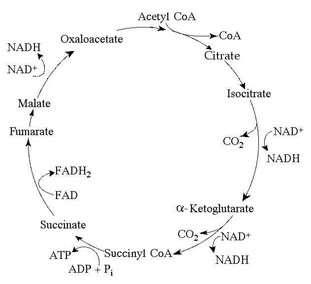
The citric acid cycle.
31) If pyruvate oxidation is blocked, what will happen to the levels of oxaloacetate and citric acid in the citric acid cycle shown in the accompanying figure?
A) There will be no change in the levels of oxaloacetate and citric acid.
B) Oxaloacetate will decrease and citric acid will accumulate.
C) Oxaloacetate will accumulate and citric acid will decrease.
D) Both oxaloacetate and citric acid will decrease.
E) Both oxaloacetate and citric acid will accumulate.
Answer: C
Bloom's Taxonomy: Applying/Analyzing
V&C Core Concept: EM
V&C Core Comp: PS
LO: 9.4
Section: 9.4
32) Starting with citrate, which of the following combinations of products would result from three acetyl-CoA molecules entering the citric acid cycle (see the accompanying figure)?
A) 1 ATP, 2 CO2, 3 NADH, and 1 FADH2
B) 2 ATP, 2 CO2, 3 NADH, and 3 FADH2
C) 3 ATP, 3 CO2, 3 NADH, and 3 FADH2
D) 3 ATP, 6 CO2, 9 NADH, and 3 FADH2
E) 38 ATP, 6 CO2, 3 NADH, and 12 FADH2
Answer: D
Bloom's Taxonomy: Applying/Analyzing
V&C Core Concept: EM
V&C Core Comp: PS
LO: 9.4
Section: 9.4
Copyright © 2017 Pearson Education, Inc.
33) Which of the following statements about cellular metabolism is FALSE?
A) Glycolysis is inhibited when cellular energy levels are abundant.
B) Citric acid cycle activity is dependent solely on availability of substrate; otherwise, it is unregulated.
C) In the electron transport chain, electrons decrease in energy level as they are transferred from one electron carrier to the next.
D) Reactions of the citric acid cycle take place in the mitochondrial matrix.
Answer: B
Bloom's Taxonomy: Remembering/Understanding
V&C Core Concept: EM
V&C Core Comp: PS
LO: 9.1, 9.2, 9.4, 9.5
Section: 9.1, 9.2, 9.4, 9.5
34) The oxygen consumed during cellular respiration is involved directly in which process or event?
A) glycolysis
B) accepting electrons at the end of the electron transport chain
C) the citric acid cycle
D) the oxidation of pyruvate to acetyl CoA
E) the phosphorylation of ADP to form ATP
Answer: B
Bloom's Taxonomy: Remembering/Understanding
V&C Core Concept: EM
V&C Core Comp: PS
LO: 9.5
Section: 9.5
35) Which of the following events takes place in the electron transport chain?
A) the breakdown of glucose into two pyruvate molecules
B) the breakdown of an acetyl group to carbon dioxide
C) the extraction of energy from high-energy electrons remaining from glycolysis and the citric acid cycle
D) substrate-level phosphorylation
Answer: C
Bloom's Taxonomy: Remembering/Understanding
V&C Core Concept: EM
V&C Core Comp: PS
LO: 9.5
Section: 9.5
Copyright © 2017 Pearson Education, Inc.
36) C6H12O6 (glucose) + 6 O2 → 6 CO2 + 6 H2O
Where is most of the water in this reaction produced?
A) during glycolysis
B) in the citric acid cycle
C) during fermentation
D) in the electron transport chain
Answer: D
Bloom's Taxonomy: Remembering/Understanding
V&C Core Concept: EM
V&C Core Comp: PS
LO: 9.5
Section: 9.5
37) The energy of electron transport serves to move (translocate) protons to the outer mitochondrial compartment. How does this help the mitochondrion produce ATP?
A) The hydrogen ions (protons) are transferred to oxygen in an energy-releasing reaction.
B) The translocation of protons sets up the electrochemical gradient that drives ATP synthesis in the mitochondria.
C) The protons pick up electrons from the electron transport chain on their way through the inner mitochondrial membrane.
D) The protons receive electrons from the NAD+ and FAD that are accepted by electrons in glycolysis and the citric acid cycle.
Answer: B
Bloom's Taxonomy: Remembering/Understanding
V&C Core Concept: EM
V&C Core Comp: PS
LO: 9.5
Section: 9.5
38) The constituents of the electron transport chain have similar capabilities, with the exception of ubiquinone (coenzyme Q). What is different about ubiquinone?
A) Ubiquinone is a protein that begins the electron transport chain, so it accepts the highestenergy electrons.
B) Ubiquinone is a protein that serves as a regulator of the rate of redox reactions in the electron transport chain.
C) Ubiquinone is a protein that is a constituent of all cells, prokaryotic or eukaryotic; hence its name, originating from "ubiquitous."
D) Ubiquinone is not a protein, is lipid soluble, and can move through the inner mitochondrial membrane.
Answer: D
Bloom's Taxonomy: Remembering/Understanding
V&C Core Concept: EM
V&C Core Comp: PS
LO: 9.5
Section: 9.5
Copyright © 2017 Pearson Education, Inc.
39) The primary role of oxygen in cellular respiration is to ________.
A) yield energy in the form of ATP as it is passed down the respiratory chain
B) act as an acceptor for electrons and hydrogen, forming water
C) combine with carbon, forming CO2
D) combine with lactate, forming pyruvate
E) catalyze the reactions of glycolysis
Answer: B
Bloom's Taxonomy: Remembering/Understanding
V&C Core Concept: EM
V&C Core Comp: PS
LO: 9.5
Section: 9.5
40) Inside an active mitochondrion, most electrons follow which pathway?
A) glycolysis → NADH → oxidative phosphorylation → ATP → oxygen
B) citric acid cycle → FADH2 → electron transport chain → ATP
C) electron transport chain → citric acid cycle → ATP → oxygen
D) pyruvate → citric acid cycle → ATP → NADH → oxygen
E) citric acid cycle → NADH → electron transport chain → oxygen
Answer: E
Bloom's Taxonomy: Remembering/Understanding
V&C Core Concept: EM
V&C Core Comp: PS
LO: 9.4, 9.5
Section: 9.4, 9.5
41) Energy released by the electron transport chain is used to pump H+ into which location in eukaryotic cells?
A) cytosol
B) mitochondrial outer membrane
C) mitochondrial inner membrane
D) mitochondrial intermembrane space
E) mitochondrial matrix
Answer: D
Bloom's Taxonomy: Remembering/Understanding
V&C Core Concept: EM
V&C Core Comp: PS
LO: 9.5
Section: 9.5
Copyright © 2017 Pearson Education, Inc.
Another random document with no related content on Scribd:
 The Project Gutenberg eBook of Legends of Old Testament characters, from the Talmud and other sources
This ebook is for the use of anyone anywhere in the United States and most other parts of the world at no cost and with almost no restrictions whatsoever. You may copy it, give it away or re-use it under the terms of the Project Gutenberg License included with this ebook or online at www.gutenberg.org. If you are not located in the United States, you will have to check the laws of the country where you are located before using this eBook.
Title: Legends of Old Testament characters, from the Talmud and other sources
Author: S. Baring-Gould
Release date: November 30, 2023 [eBook #72268]
Language: English
Original publication: London: Macmillan and Co, 1871
Credits: David Edwards, David King, and the Online Distributed Proofreading Team at https://www.pgdp.net. (This file was produced from images generously made available by The Internet Archive.)
*** START OF THE PROJECT GUTENBERG EBOOK LEGENDS OF OLD TESTAMENT CHARACTERS, FROM THE TALMUD AND OTHER SOURCES
Legends of Old Testament Characters.
Legends Of Old Testament Characters, From
The Talmud and Other Sources.
By TheRev. S. Baring-Gould, M.A.,
Author of “Curious Myths of the Middle Ages,” “The Origin and Development of Religious Belief,” “In Exitu Israel,” etc.
London and New York: MACMILLAN AND CO. 1871.
[The Right of Translation and Reproduction is reserved.]
LONDON
R. CLAY, SONS, AND TAYLOR, PRINTERS, BREAD STREET HILL.
PREFACE.
An incredible number of legends exists connected with the personages whose history is given in the Old Testament. The collection now presented to the public must by no means be considered as exhaustive. The compiler has been obliged to limit himself as to the number, it being quite impossible to insert all. He trusts that few of peculiar interest have been omitted.
The Mussulman traditions are nearly all derived from the Talmudic writers, just as the history of Christ in the Koran is taken from the Apocryphal Gospels. The Koran follows the “Sepher Hajaschar” (Book of the Just) far more closely than the canonical Scriptures; and the “Sepher Hajaschar” is a storehouse of the Rabbinic tradition on the subject of the Patriarchs from Adam to Joshua.
The Jewish traditions are of various value. Some can be traced to their origin without fail. One class is derived from Persia, as, for instance, those of Asmodeus, the name of the demon being taken, along with his story, from Iranian sources. Another class springs from the Cabbalists, who, by permutation of the letters of a name, formed the nuclei, so to speak, from which legends spread.
Another class, again, is due to the Rabbinic commentators, who, unable to allow for poetical periphrasis, insisted on literal interpretations, and then coined fables to explain them. Thus the saying of David, “Thou hast heard me from among the horns of the unicorns,” which signified that David was assisted by God in trouble, was taken quite literally by the Rabbis, and a story was invented to explain it.
Another class, again, is no doubt due to the exaggeration of Oriental imagery, just as that previously mentioned is due to the deficiency of
the poetic fancy in certain Rabbis. Thus, imagination and defect of imagination, each contributed to add to the store.
But when we have swept all these classes aside, there remains a residuum, small, no doubt, of genuine tradition. To this class, if I am not mistaken, belong the account of Lamech and his wives, and the story of the sacrifice of Isaac. In the latter instance, the type comes out far clearer in the Talmudic tradition than in the canonical Scriptures; and this can hardly have been the result of Jewish interpolation, knowing, as they did, that Christians pointed triumphantly to this type.
With regard to Jewish traditions, it is unfortunate that both Eisenmenger and Bartolocci, who collected many of them, were so prejudiced, so moved with violent animosity against the Rabbinic writers, that they preserved only the grotesque, absurd, and indecent legends, and wholly passed over those—and there are many of them —which are redolent of poetry, and which contain an element of truth.
A certain curious interest attaches to these legends—at least, I think so; and, should they find favour with the public, this volume will be followed by another series on the legends connected with the New Testament characters.
The Author is not aware of any existing collection of these legends, except that of M. Colin de Plancy, “Legendes de l’Ancien Testament,” Paris, 1861; but he has found this work of little or no use to him in composing his volume, as M. de Plancy gives no reference to authorities; and also, because nearly the whole of the contents are taken from D’Herbelot’s “Bibliothèque Orientale” and Migne’s “Dictionnaire des Apocryphes.”
It will be necessary to add a few words on certain works largely quoted in the following pages.
1. Dr. G. Weil’s “Biblische Legende der Muselmänner,” Frankfurt a. M., 1845, is derived from three Arabic MS. works—“Chamis,” by
Husein Ibn Mohammed Ibn Alhasan Addiarbekri; “Dsachirat Alulun wanatidjat Alfuhum,” by Ahmed Ibn zein Alabidin Albekri; and “Kissat Alanbija,” by Mohammed Ibn Ahmed Alkissai.
2. The Chronicle of Abou-djafar Mohammed Tabari was translated into Persian by Abou Ali Mohammed Belami, who added sundry traditions circulating in Persia; and has been rendered into French, in part, by M. Hermann Zolenberg, for the Oriental Translation Fund, Paris, 1867.
3. The “Sepher Hajaschar,” or Book of Jasher (Yaschar), is quoted from the translation by Le Chevalier P L. B. Drach, inserted in Migne’s “Dictionnaire des Apocryphes.”
4. Eisenmenger, “Neuentdektes Judenthum,” 2 vols. 8vo, Königsburg, 1711, contains a great many Rabbinic traditions collected from sources inaccessible to most persons.
5. Bartolocci, “Bibliotheca Magna Rabbinica,” 4 vols. fol., Rome, 1675-93, is a very valuable storehouse of information, but sadly disfigured by prejudice.
CONTENTS.
P . . . v
I. T F A . . . 1
II. A . . . 7
1. The Creation of Man . . . 7
2. The Pre-Adamites . . . 14
III. E . . . 15
IV. T F M . . . 21
V. A E F . . . 34
VI. C A . . . 55
VII. T D A . . . 62
VIII. S . . . 66
IX. C E . . . 69
X. E . . . 70
1. The Translation of Enoch . . . 70
2. The Book of Enoch . . . 73
XI. T G . . . 77
XII. L . . . 82
XIII. M . . . 84
XIV. N . . . 85
XV. H L D . . . 91
XVI. T P V 106
XVII. T S N . . . 109
XVIII. R A . . . 111
XIX. C D H . . . 113
XX. S 116
XXI. T P E . . . 117
XXII. T P S . . . 122
XXIII. T T B . . . 130
XXIV A 135
1. His Youth and early Struggles . . . 135
2. The Call of Abraham, and the Visit to Egypt . . . 148
3. The War with the Kings . . . 152
4. The Birth of Ishmael . 157
5. The Destruction of Sodom and Gomorrah . . . 158
6. The Birth of Isaac . . . 163
7. The Expulsion of Hagar and Ishmael . . . 167
8. The Strife between the Shepherds . 171
9. The Grove in Beer-sheba . . . 172
10. The Offering of Isaac . . . 174
11. The Death of Sarah . . . 183
12. The Marriage of Isaac . 187
13. The Death of Abraham . . . 189
XXV. M . . . 191
XXVI. O I W Z . . . 196
XXVII. E J 201
XXVIII. J . . . 213
XXIX. T T T P 229
XXX. J . . . 231
XXXI. J . . . 237
XXXII. M . . . 238
1. Israel in Egypt . 238
2. The Birth and Childhood of Moses . . . 245
3. The Youth and Marriage of Moses . . . 252
4. Moses before Pharaoh . . . 261
5. The Passage of the Red Sea . 268
6. The giving of the Law . . . 273
7. The Manna . . . 278
8. The smitten Rock . . . 279
9. Moses visits El Khoudr . 281
10. The Mission of the Spies . . . 284
11. Of Korah and his Company . . . 287
12. The Wars of the Israelites . . . 290
13. The Death of Aaron . 293
14. The Death of Moses . . . 296
XXXIII. J . . . 301
XXXIV. T J . . . 304
XXXV S 305
XXXVI. S . . . 311
1. War with the Philistines.—Goliath slain . . . 311
2. Saul’s Jealousy of David . . . 315
3. The Death of Saul . 317
XXXVII. D . . . 318
XXXVIII. S 333
1. How Solomon obtained Power . . . 333
2. How Solomon feasted all Flesh . . . 335
3. The Building of the Temple . . . 337
4. The Travels of Solomon . 339
5. The History of the Queen of Sheba . . . 344
6. Solomon’s Adventure with the Apes . . . 350
7. Solomon marries the Daughter of Pharaoh . . . 350
8. How Solomon lost and recovered his Ring . 352
9. The Death of Solomon . . . 355
XXXIX. E . . . 356
XL. I . . . 359
XLI. J 362
XLII. E . . . 363
XLIII. E . . . 364
XLIV. Z . . . 366
THE FALL OF THE ANGELS.
In the beginning, before the creation of heaven and earth, God made the angels; free intelligences and free wills; out of His love He made them, that they might be eternally happy. And that their happiness might be complete, He gave them the perfection of a created nature; that is, He gave them freedom.
But happiness is only attainable by the free will agreeing in its freedom to accord with the will of God. Some of the angels by an act of free will obeyed the will of God, and in such obedience found perfect happiness; other angels by an act of free will rebelled against the will of God, and in such disobedience found misery.
Such is the catholic theory of the fall of the angels.
Historically, it is represented as a war in heaven. “And there was war in heaven: Michael and his angels fought against the dragon; and the dragon fought and his angels, and prevailed not; neither was their place found any more in heaven. And the great dragon was cast out, that old serpent, called the Devil, and Satan, which deceiveth the whole world; he was cast out into the earth, and his angels were cast out with him.”[1] The reason of the revolt was that Satan desired to be as great as God. “Thou hast said in thine heart, I will ascend into heaven, I will exalt my throne above the stars of God; I will sit also upon the mount of the congregation in the sides of the north; I will ascend above the heights of the clouds; I will be like the Most High.”[2]
The war ended in the fall of Satan and those whom he had led into apostasy; and to this fall are referred the words of Christ, “I saw
Satan like lightning fall from heaven.”[3]
Fabricius, in his collections of the apocryphal writings of the Old Testament, has preserved the song of triumph which the Archangel Michael sang on obtaining the victory. This is a portion of it:—
“Glory to our God! Praise to His holy Name! He is our God; glory be to Him! He is our Lord! His be the triumph! He has stretched forth His right hand; He has manifested His power, He has cast down our adversaries. They are mad who resist Him; they are accursed who depart from His commandments! He knoweth all things, and cannot err His will is sovereignly just, and all that He wills is good, all that He advises is holy. Supreme Intelligence cannot be deceived; Perfect Being cannot will what is evil. Nothing is above that which is supreme, nothing is better than that which is perfect. None is worthy beside Him but him whom He has made worthy. He must be loved above all things and adored as the eternal King. You have abandoned your God, you have revolted against Him, you have desired to be gods; you have fallen from your high estates, you have gone down like a fallen stone. Acknowledge that God is great, that His works are perfect, and that His judgments are just. Glory be to God through ages of ages, praises of joy for all His works!” This song of the Archangel is said to have been revealed to S. Amadeus. [4]
According to the Talmudists, Satan, whose proper name is Sammael, was one of the Seraphim, with six wings.[5] He was not driven out of heaven till after he had led Adam and Eve into sin; then Sammael and his host were precipitated out of the place of bliss, with God’s curse to weigh them down. In the struggle between Michael and Sammael, the falling Seraph caught the wings of Michael and tried to drag him down with him, but God saved him, whence Michael derives his name (the Rescued). This is what the Rabbi Bechai says in his commentary on the Five Books of Moses.[6]
According to a Talmudic authority, the apostate angels having fallen in a heap, God laid his little finger on them and consumed them.[7]
Sammael was the regent of the planet Mars, and this he rules still, and therefore it is that those born under the influence of that star are
lovers of war and given to strife.[8]
He was chief among the angels of God, and now he is prince among devils.[9] His name is derived from Simmé, which means to blind and deceive. He stands on the left side of men. He goes by various names; such as the Old Serpent, the Unclean Spirit, Satan, Leviathan, and sometimes also Asael. In his fall he spat in his hatred against God, and his spittle stained the moon, and thus it is that the moon has on it spots.
After his fall, Satan took to himself four wives, Lilith and Naama the daughter of Lamech and sister of Tubal-Cain, Igereth and Machalath. Each became the mother of a great host of devils, and each rules with her host over a season of the year; and at the change of seasons there is a great gathering of devils about their mothers. Lilith is followed by four hundred and seventy-eight legions of devils, for that number is comprised in her name (478—תיליל). According to some, Lilith is identical with Eve. She rules over Damascus, Naama over Tyre, Igereth over Malta and Rhodes, and Machalath over Crete.[10]
Many traditions date the existence of angels and demons from a remote period before the creation of the world, but some connect the fall of Satan and his host with the creation of man.
Abou-Djafar-Mohammed Tabari says that when God made Adam, He bade all the angels worship him as their king and superior, as says the Koran, “All the angels adored Adam” (xv. 30), but that Satan or Eblis answered God, “I will not adore Adam, for he is made of earth and I of fire, therefore I am better than he” (vii. 11), and that God thereupon cursed Eblis and gave him the form of a devil, because of his pride, vain confidence, and disobedience.[11]
Abulfeda says, “After God had made man He thus addressed the angels. ‘When I have breathed a portion of my spirit into him, bow before him and adore.’ After He had inspired Adam with His spirit, all the angels of every degree adored him, except Eblis; he, through pride and envy, scorned to do this, and disobeyed God. Then God cursed him, and He cut him off from all hope in divine mercy, and He called him Scheithanan redjiman (Satan devoted to misery), and He
cast him out who had been before an angel of the earth, and keeper of terrestrial things, and a guardian of Paradise.”[12]
But the general opinion seems to have been that the fall of the angels preceded the creation of man. Ibn-Ezra dates it on the second day of creation, others on the first day when God “divided the light from the darkness.” Manasseh Ben Israel says that God has placed the devils in the clouds, that they might torment the wicked with thunder and lightnings, and showers of hail and tempests of wind, and that this took place on the second day, when the firmaments were divided.
As the fall of Satan took place through his aspiration to be God, so it is closely connected with the origin of idolatry and false worship; for now that Satan is cast out of heaven, he still seeks to exalt himself into the place of God, and therefore leads men from the worship of the true God into demonolatry. Thus the gods of the heathens were regarded by the first Christians as devils aspiring to receive that worship from men on earth which they sought and failed to obtain in heaven. Thus St. Paul tells the Corinthians that “the Gentiles sacrifice to devils.”[13] The temptation of Christ can only be fully understood when we bear in mind that pride and craving for worship is the prime source of Satan’s actions: “All these will I give thee,” he said to Christ, “if Thou wilt fall down and worship me.” It was a second attempt of Satan to set himself above the Most High.
Among the heathen, traditions of the Angelic apostasy and war have remained.
The Indian story is as follows:—
At the head of the apostate spirits is Mahisasura, or the great Asur; he and those who followed him were once good, but before the creation of the world they refused obedience to Brahma, wherefore they were cast down by the assistance of Schiva into the abyss of Onderah.[14] Mahisasura is also represented as the great serpent Vrita, against which Indra fought, and which after a desperate struggle he overcame.
The Persian tradition is that Ahriman, the chief of the rebels, is not by nature evil. He was not created evil by the Eternal One, but he became evil by revolting against His will, and the ancient books of the Parsees assert that at the last day Ahriman will return to obedience, and having been purified by fire, will regain the place among the heavenly beings which he lost. In this war the Izeds fought against the Divs, headed by Ahriman, and flung the conquered into Douzahk or hell.
The Norse story is that Loki, the spirit of evil, is one of the gods, and sat with them at their table till he declared himself their enemy, when he with his vile progeny, the wolf and the serpent, were cast out. The wolf is bound, Thorr constrains the serpent, and Loki is chained under the mountains, and a serpent distils poison on his breast; when he tosses in agony, the earth quakes.
In Egypt, Typhon was brother of Osiris, but he revolted against him. Maximus of Tyre, and Apollonius of Rhodes, following Orpheus, speak of the war of the gods against the angels who rebelled under their chief Ophion, or the Serpent, and Pherecydes, according to Origen, sang of this event as having taken place in pre-historic times; so that the knowledge of it could only have reached man by revelation. He described the two armies face to face,—one commanded by Saturn, the supreme Creator; the other by Ophioneus, the old Dragon, and the defeat of the latter and its expulsion from the realms of bliss to Ogenos, the regions of annihilation.[15] The story of the Titans is connected with this. They were the sons of Uranus (heaven) and Ge (earth), and dwelt originally in heaven, whence they are called Uranidæ. They were twelve in number. Uranus threw out of heaven his other sons, the Hecatoncheires and the Cyclopes, and precipitated them into Tartarus. Whereupon Ge persuaded her sons, the Titans, to rise up against their father, and liberate their brethren. They did as their mother bade them, deposed Uranus, and placed on his throne their brother Cronus, who immediately re-imprisoned the Cyclopes. But Zeus with his brothers fought against the reigning Titans, cast them out of heaven, and enthroned himself on the seat of Cronus; and the Titans he enchained in the abyss under Tartarus.
This is simply the same story told over twice, and formed into a dynasty. Chronos Titan is the same as the Arabic Scheitan, the Erse Teitin, the Time-god, and the Biblical Satan, or Lucifer, the Son of the Morning.
Amongst the Battas of Sumatra exists a myth to this effect: Batara Guru, the supreme God, from whose daughter Putiarla Buran all mankind are descended, cast the mountain Bakkara out of heaven upon the head of the serpent, his foe, and made the home of his son Layanga-layaad-mandi on the top of this mountain. From this summit the son descended that he might bind the hands or feet of the serpent, as it shook its head and made the earth rock.
Connected with the fall of Satan is his lameness. The devil is represented in art and in legend as limping on one foot; this was occasioned by his having broken his leg in his fall.
Hephæstus, who pursued Athene and attempted to outrage divine Wisdom, was precipitated from heaven into the fire-island Lemnos, and was lamed thereby. Hermes cut the hamstring out of Typhon, therewith to string his lyre. The Norse god Loki lusted after Freya, and was lamed therefore. Wieland the smith (Völundr), who ventured to do violence to Beodohild, was lamed, and was known thereby. Phaethon, daring to drive his father’s chariot of the sun, was cast out and thrown to earth.
The natives of the Caroline Islands relate that one of the inferior gods, named Merogrog, was driven by the other gods out of heaven, and he took with him a spark of fire which he gave to men.[16] This myth resembles that of Prometheus, “the contriver, full of gall and bitterness, who sinned against the gods by bestowing their honours on creatures of a day, the thief of fire,” as Hermes calls him. He reappears as Tohil among the Quiches, the giver of fire, hated, yet adored.
The Northern Californians say that the supreme God once created invisible spirits, of whom one portion revolted against him, headed by a spirit named War or Touparan, and that the Great Spirit having overcome him, drove him from the plains of heaven, and confined
him along with his comrades in a cavern, where he is guarded by whales.[17]
The Egyptian Typhon, already alluded to, did not belong to Egypt alone, but also to Phœnicia and Asia Minor, and thence the story passed into Greece, where it took root, and has been preserved to us as the attack of the hundred-headed dragon against the heavengod Zeus. Typhon desired to obtain supremacy over gods and men, and, in order to win for himself this sovereignty, he fought against the gods; but he was defeated, bound, and precipitated into Tartarus, or, according to another version, was buried under the flaming mountains.
According to a tradition of the Salivas, a people of New Granada, a serpent slew the nations, descended from God, who inhabited the region of the Orinoco, but a son of the God Puru fought him and overcame him, and bade him depart with his curse, and never to enter his house again, and, say these Salivas, from the flesh of the serpent sprang the Caribees, their great foes, as maggots from putrid meat.[18]
But these stories might be infinitely extended. How far they refer to a tradition common to the human race, and how far they relate to the strife between summer and winter, sun and storm-cloud, I do not pretend to decide. It is one of those vexed questions which it is impossible to determine.