reflection and historical background By Bill Doggett
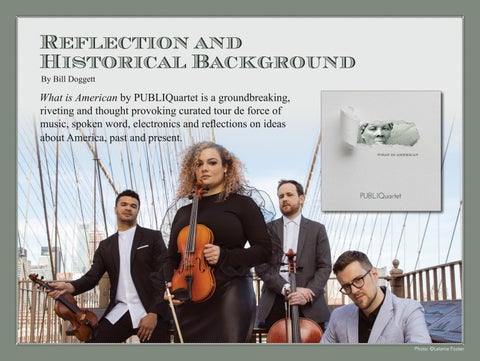
What is American by PUBLIQuartet is a groundbreaking, riveting and thought provoking curated tour de force of music, spoken word, electronics and reflections on ideas about America, past and present.
Photo: ©Lelanie Foster
This is a cutting edge concept album which features a reimagining of Antonin Dvořák’s famous “American” Quartet and new music by composers Rhiannon Giddens, Vijay Iyer, and Roscoe Mitchell, as well as improvisations inspired by legendary women who claimed their independence from oppression. The experience is a cerebral journey that is larger than the sum of its parts. What Is American is a collection of contemporary reflections on 21st Century America viewed through multiple lenses and prisms.
The CD opens, expands upon, and returns to its two centerpieces of ideations about America: Oliver Wendell Holmes’ Civil War-inspired Fifth Verse setting of Francis Scott Key’s “The Star-Spangled Banner” and Antonin Dvořák’s “American” Quartet. What is extraordinary about this curated programmatic journey is its call to reimagine America as a nation built and sustained by a collective trauma, yet transformed by the resilience of generations of non-white men and women who overcame forced states of invisibility and oppression to triumph in spite of it all.
VIjay Iyer
Photo: Ebru Yildiz
Antonin Dvořák
Roscoe Mitchell
Photo: ©Barbara Barefield
Rhiannon Giddens Photo: Ebru Yildiz
historical background america … When our land is illum’d with Liberty’s smile, If a foe from within strike a blow at her glory, Down, down, with the traitor that dares to defile The flag of her stars and the page of her story! By the millions unchain’d who our birthright have gained Art/collage: ©Bill Doggett
We will keep her bright blazon forever unstained! And the Star-Spangled Banner in triumph shall wave While the land of the free is the home of the brave
T
he unofficial fifth verse of Francis Scott Key’s “The Star-Spangled Banner” was set as a reflection and meditation on an America challenged by the Civil War. Holmes’ setting belies a tearing back of a varnished mythology of an illusory American past and the ideation of Key’s Ode to a nationalist statement of a transfigured and resilient America of landowning white men. This mythological purity of an idealized America was enshrined in the original lyrics of the “The Star-Spangled Banner” by Francis Scott Key, who was himself a slave owner.
Key was imbued with the ideology of cultural and nationalist pride of his fellow Southern male elites enriched by a capitalist economy based on enslaved African free labor. Key’s triumphant and anointed America of landed white male aristocracy shined a bright light on the mythology of an American exceptionalism. That is to say Key’s anthem celebrates the noble democratic experiment which was in fact based on multigenerational trauma and exploitation endured for centuries by enslaved Africans and maligned multiethnic groups.
In spite of the oppression, their scion in the 20th and 21st Century invested in the idyllic mythology of an American dream validated by France’s gift to America of The Statue of Liberty in 1886.
T
Art/collage: ©Bill Doggett
hat dream of a welcoming America of opportunity and merit transformed into a challenged state of being confronted by indomitable movements of social justice from Suffrage to Civil Rights to LGBTQIA and more recently by the “Bend a Knee” movement of Colin Kaepernick which expressly called us to revisit the hidden racialized texts in the underknown original verses of Key’s “Star-Spangled Banner”.
Art/collage: ©Bill Doggett
It is the collective cultural memory of black, brown and beige, Asian and other immigrant populations which enabled an embrace of the dream of Liberty’s statue, a dream for a transformative state of being which Langston Hughes wrote about in “I Dream a World” and “Let America be America Again”.
T
To understand the historic and present day impact of Dvořák’s “American” Quartet through PUBLIQuartet’s lens requires us to explore and understand the times of Dvořák’s American experiment. During his residency at the American Conservatory of Music in New York in 1892–1895, Antonin Dvořák famously called on American composers to look to the melodies of its native peoples instead of replicating Euro-centric models of Classical Music. “In the Negro {and Native American} melodies of America I discover all that is needed for a great and noble school of {American} music.” In making this ideologically progressive call for American composers to move beyond the internalized American struggle with racial identity and racial hierarchy, it was Dvořák’s status as
Art/collage: ©Bill Doggett
he bucolic world of Antonin Dvořák’s “American” Quartet (Op. 96) is an ode to a mythic ideation of cherished Native American peoples. Written in 1893, it charms with its bucolic Indian melodies while it is oblivious to and negates the historical trauma of colonialist removal of Native Americans from their lands and the genocide of their race in response to nationalist visions of an American “manifest destiny.”
a revered leader in Western European music that validated the exploration of African American and Native American melodies exemplified and showcased in his gifts to American Classical Music: Symphony No. 9 (“From the New World”) and the “American” Quartet. Dvořák’s urgent call to embrace a nativist nationalism in organic American melodies, replicating the ethnic nationalist music of German, Czech and Hungarian composers (Smetana, Brahms and later Mahler, Bartok, Kodaly and Janacek) was embraced in early 20th-century compositions by white American composers Arthur Falwell, Edward McDowell, and Charles Wakefield Cadman.
That urgency also extended to the “Negro circle” — Harry Thacker Burleigh and the Black Broadway composer and violinist Will Marion Cook — to foster and celebrate a “Negro aesthetic” in American classical music.
Art/collage: ©Bill Doggett
Dvořák was the first Classical composer to authenticate an organic use of a “Negro aesthetic”, inspiring by extension “Racial Uplift” in the embrace of this aesthetic in the popular music of Scott Joplin, Louis Moreau Gottschalk, and the blues of W.C. Handy.
Y
et Dvořák’s call to American composers to uplift the Black and Native American races — and by extension, to foster a Black and Native American aesthetic — represented his status as a foreigner unaware of the darker sides of the lived experiences of America’s native peoples.
America infatuated with its antebellum-era characterization of Blacks as comic yet conniving Jim Crows, uppity Zip Coons, neutered Mammies, and loyal Old Black Joes of minstrel shows. Native Americans had been progressively removed from their lands by Congressional statutes that would lead to a cultural genocide in concentration camps known as reservations.
That is to say the cultural and entertainment backdrop of America at the time of Dvořák’s American residency found a white
Art/collage: ©Bill Doggett
Art/collage: ©Bill Doggett
The Jim Crow American South of Antonin Dvořák’s visit to America was by design a restrictive state, a holding camp for maligned and displaced migrants whose plight overwhelmed a still-divided Union dawning into a new century. It was still Harriet Tubman and Frederick Douglass’ America, consumed by antebellum dissonances over structural racial hierarchy and crimes against humanity, articulated poignantly in Douglass’ 1852 speech “What to the Slave Is the Fourth of July?”.
T
he glorification of the “lost cause” narrative of the Southern Confederacy — before, during and after Dvořák’s American visit — enshrined a story about the necessity of white supremacy through entertainment technologies: sheet music, sound recordings and silent film. These emphasized a commercialization of the plight of “the Negro Sisyphus” condemned to a perpetual status of “double consciousness” and the existential necessity of the Native American race forced into a state of invisibility and annihilation.
These are the critical inflection points of historical understanding which PUBLIQuartet’s extraordinary exploration of hidden stories and hidden truths demands us to understand as both centerpiece and point of departure.
Art/collages: ©Bill Doggett
This was the raw, the ugly, the unvarnished and unrevealed America of Dvořák’s residency before, during and after his return to his native Bohemia.
album reflection 5th Verse: Prelude, Page of Her Story, Land of the Free, and Interlude (Tracks 1, 7, 10, and 15) are improvisations on the Civil War-era fifth verse of “The StarSpangled Banner” by Oliver Wendell Holmes, as cited earlier.
Art/collage: ©Bill Doggett
These tracks use spoken word performance art: art installation-like word fragments with electronics which anchor themes of our journey to reimagine and reevaluate our American past. Tracks 2-5 are improvisations on Dvořák’s String Quartet No.12, Op 96, “American”. The inspiration to improvise through the four movements of what is considered to be a pillar of the classical string quartet repertoire is sourced from the afore-discussed ideas of Antonin Dvořák for American composers to embrace the nativist and by extension “nationalist melodies” of its African American and Native American cultures. That the Slave Song become Negro Spiritual has been a foundation of an organic American music from the blues to folk to country blues to jazz and beyond thematically connects to Dvořák’s ideations providing an extraordinary soundscape of ideas within the structure of the original.
Hence Track 2 opens with staccato and hard bowed ideas as if a casket is opened and then proceeds into the written bucolic page of Dvořák’s Ode to an America of Currier and Ives “ First Thanksgiving”. This improvisation unfolds into a conversation between players as if peeling back the layers of knowing lost on Dvořák’s limited exposure to America. The improvisation presents us with the bucolic contented Indian and Slave melodies that infuse Dvořák’s Quartet and then returns to its ascerbic hard bowing and staccato phrases infused with
‘‘
’’
You can take my body / You take my bones You can take my blood/ but not my soul.
Historic Huguenot Street
wailing of pain and untold stories. Throughout this track there is a return to both the bucolic ideation of Dvořák’s happy America melody, closing with veiled references to the Eurocentric Mozartian ideal of string quartet movement endings. In Track 3, the idea of the unearthing of hidden stories is beautifully articulated, suggesting the storytelling of an enslaved African woman. The lost and or hidden story of the slave woman comes into articulation in a beautiful haunting arching melody played first by the cello and then the violin, with block scored pizzicati that act as a form of call and response. Punctuated over and over in staccato phrases and hard bowing that evolves into a wailing and bemoaning of collective trauma by the full quartet. These ideas are provocative and immediately visual. Both tracks call us to sit in an alternative place of understanding — to listen to a different story beneath the bucolic Dvořák ideation. It is exceptional in how these improvisations are achieved and then interwoven with the original. West African slave traditions of hand and body patting are heard in the final page. Opening with Dvořák’s written page of the 3rd Movement that re-invokes an imagined Currier and Ives painting of a Lewis and Clark exploration of an early 19th century America of bucolic expansive natural beauty, the improvisations of Tracks 4 and 5,
— Rhiannon Giddens
here as before change to reveal an unvarnished story within a story, employing ideas and blue notes that call us to hear something more. This unveiling and peeling back of the polished veneer of the original Dvořák becomes a very modern and earthy conversation about a series of stories hidden beneath the bucolic surfaces. One hears over and over the staccato and bluesy phrases, with col legno sounds bringing to mind a more authentic and diverse American landscape, aided by vocal intonations that evoke organic singing of Native American songs at twilight, as they might have sounded in the time of Dvořák’s Quartet. There is a feeling of a conversation about originalism through a modern understanding, presentism vs. historicism of Dvořák’s ideal. Collectively, the improvisations offer modernist insights which bring the listener to an experience of the Dvořák Quartet that is completely liberated from its original 19th century ideation. “At The Purchaser’s Option” (Track 6) is Rhiannon Giddens’ song inspired by a haunting 19th century Slave ad “for a Negro wench and her nine month old baby” to be sold together or apart. It opens with whispered spoken word incantations of the text of Giddens’ song: “You can take my body / You take my bones / You can take my blood / but not my soul.” These words act as powerful statements of a defiant resilience
‘‘
Photo: ©Barbara Barefield
and intentionality to reclaim self worth and empowerment of existential right to dignity in the face of extraordinary odds. This new arrangement by PUBLIQuartet is a haunting contemporary expansive country blues improvisation, using singular and blockscored playing that passes from one instrument to another and returns to a full quartet articulation of the permanence of the trauma of the slave auction experience that the woman and child endured.
guest-narrated by Madam Walker’s great-greatgranddaughter A’Lelia Bundles (and drawn from On Her Own Ground, Bundles’ biography of Walker), this track is a meditation on the importance that Madam Walker placed on platforming her financial business success as a vehicle for lifting Black lives and Black lived potentials.
The spoken text includes the lines, “I want to live to help my Race…saving Black men’s bodies and The whispered spoken white men’s souls” — incantation returns at the here electronically — Madam C.J. Walker ending to bring us back sampled and looped to to center of the trauma of this singular woman and her child but create an impactful statement amidst the intertwining of riffs also extends an invitation to imagine both the trauma and the from Fats Waller’s wistfully light and playful “Honeysuckle defiant resilience of all the thousands more enslaved people who Rose” as a point of ironic contrast against an expansive freewould be offered at auction for sale to the highest bidder. form improvisation suggestive of pride, with elements of Afro Futurist music. Track 7 features improvisations on Fats Waller’s “Honeysuckle Rose”, here nicknamed “Pavement The improvisation ends with the intermixing of more Walker text Pounding Rose”. It is a movement from Reflections on posing the question about a Black woman’s future in a Jim Crow Beauty, a larger multimedia work created about the life of segregated society, set against a backdrop of a Fats Wallerian Madam C. J. Walker, the legendary turn-of-the-20th-century bluesy wistfulness that is impervious to the seriousness of the Black hair and cosmetics millionaire. Interspersing spoken text text. It is indeed a work of delicious and creative ironies. PUBLIQuartet and A’Lelia Bundles, C.J. Walker’s great-great-granddaughter.
’’
I want to live to help my Race… saving Black men’s bodies and white men’s souls.
Photo: ©Barbara Barefield
ro-funk syncopated rhythms, counterpoint, and varied uses of West African and African Slave in the New World diaspora hand and body patting to replicate African drumlike call-andresponse rhythmic conversations.
Throughout the Quartet, this is heard in the patting of the instruments by bow and hand. Iyer creates a rhythmic palette that ushers in an audio ideation Track 9 features improvisations on of Afro Futurism. The writing is declar“Law Years” and “Street Woman” ative for both individual players and by Ornette Coleman, works from the ensemble, with an African diasporic Coleman’s 1971 Science Fiction DNA. The second movement is a album that were brought to PUBLImeditation which harkens us back to a Quartet by its cellist, Hamilton Berry. time and place of “the distant land” of This is a series of free improvisations a nurturing pre Trans Atlantic Slave based on Coleman’s music that are trade “Mother Africa”. It creates audio bluesy and questioning, adding a images of what the experience of being philosophical depth and probing the prayerful in a mosque in the kingdom album’s title concept. This track is James Brown, Ann Arbor Blues & Jazz Festival, 1974. of Mali and beholding the wonders of from a live performance at Caramoor its fabled libraries in the City of Timbuktu must have been like. Center for Music and the Arts (Katonah, NY) on June 24, 2021.
Ornette Coleman, Ann Arbor Blues & Jazz Festival,1973.
Photo: ©Barbara Barefield
Vijay Iyer’s “Dig The Say” (Tracks 10-14), written in 2012, is a celebration of the life, legacy and gift to American music of the great James Brown. It was inspired by Brown’s song “I Don’t Want Nobody to Give Me Anything, Just Open Up the Door and I’ll get it myself”. The song title is in itself an affirmation of individual power and self determination against a backdrop of limitations in structural access to opportunity. In four movements, “Dig The Say” is the ultimate counterpoint to Dvořák’s bucolic and staid “American” Quartet, with Af-
The third movement is a development of the aforementioned syncopated West Africa in the New World, with African drumming and call-and-response rhythmic energies at the center of West African tribal and celebratory life. The fourth movement is a delicious recapitulation of the Afrofunk syncopated rhythm which inhabits the DNA of James Brown’s music. As throughout and in the first movement, the syncopated repetitive aura of call and response ends with a declarative note of affirmation.
Roscoe Mitchell’s “CARDS 11-112020” (Track 16) is part of a suite of three of Roscoe’s “Cards” works which was commissioned to commemorate the 43rd anniversary of composer A. Spencer Barefield’s arts organization Creative Arts Collective (a Detroit-based arts organization that Roscoe Mitchell and A. Spencer Barefield founded in the 1970s).
Photo: ©Barbara Barefield
Roscoe Mitchell was inspired to write the second movement of the suite, “CARDS 11-11-2020”, specifically for PUBLIQuartet. With its Bartok Quartets references, it is a meditation on mid-20th century atonality that also evokes symbolisms and explorations of the Black lived experiences of pain, anxiety and disorientation seen in the paintings of 20th century African American painter and collagist, Romare Bearden.
A. Spencer Barefield Super String Symphonica with Roscoe Mitchell and PUBLIQuartet, Detroit Institute of Arts, May 20, 2022.
The other movements — “CARDS The Maple Just Turned Red” and “CARDS The Detroit Deck” — are for larger ensemble and were premiered at the Detroit Institute of Arts on May 20, 2022. Roscoe’s “CARDS” are part of a larger series of works that integrate and incorporate different improvisational skill sets. Many of these works contain what Roscoe refers to as a “deck” of cards — pages that the player can assemble in any order they choose.
“CARDS 11-11-2020” is a through-composed piece that comes with a set of cards given to each player as a reference to create improvisation. Roscoe is fond of patterns and palindromes — this piece was composed during the pandemic, and the date 11-11-2020 holds numeric significance. Roscoe’s composition was commissioned by A. Spencer Barefield Creative Arts Collective, with support from the John S. and James L. Knight Foundation, New Music USA, Sphinx Organization, and Rebirth Inc.
Tracks 17-20 are works in tribute to legendary women who claimed their independence. They are an interwoven series of folksy bluesy statements that are earthy in their collectiveness.
Original track https://www.youtube.com/ watch?v=g7GgziI8gug Track 18 – “They Say I’m Different”– Alice Coltrane, Detroit Institute of Arts, 1984. Betty Davis ideas about spirituality and the universe. Her music is a spiritual A soulful funk song of declaration by Betty Davis, this song in its journey that can be experienced as meditations on ideas about the interpretation by PUBLIQuartet is an affirmation of the right to cosmos and our journey and greater purpose to align with the be and the value of being Different. With intoned words from the power of spiritual truths of the universe. original song, it is affecting. Original track https://www.youtube.com/watch?v=EKWPynScqgw Track 19 – “Er Ra” – Alice Coltrane Alice Coltrane’s music has deep spiritual roots which are a reflection of her exploration and embrace of Eastern religion’s
Influenced by her late husband, the renowned tenor saxophone musician, John Coltrane’s embrace of Eastern religion, “Er Ra” is performed by PUBLIQuartet as a reimagination of Alice’s probing meditative composition for harp. In this reimagination, the Quartet presents us with individual and collective statements about purpose and journey. These statements of exploration also
Photo: ©Barbara Barefield
Track 17 – “Black Coffee”– Tina Turner An iconic song from the high priestess of Rock-Soul, this improvisation on the original opens with rhythmic hand clapping and intoned words that lead to a folksy bluesish statement of self affirmation and declaration that is in the DNA of the original song:
‘‘
’’
Wild Women don’t worry, Wild Women don’t have no blues! — Ida Cox
evoke the power of the declarative and probing solo dance Cry, made famous by Judith Jamison of Alvin Ailey’s Dance Theater of the 1960s. Original track https://www.youtube.com/watch?v=utKj0qXWm1o
Original track https://www.youtube.com/ watch?v=4vVjpoKEwjU
Ida Cox, 1924. Rosetta Records, cover of Wild Women Don’t Have the Blues,1981. Photo courtesy of Frank Driggs to Rosetta Reitz.
Judith Jamison, Alvin Ailey Dance Theater. Notes and Collaged Graphic design photographs in “Historical Background” by historian and musicologist ©Bill Doggett. https://billdoggettproductions.com Photos (unless otherwise credited) and design by ©Barbara Barefield. barbarabarefield.com
Photo: ©Barbara Barefield
Track 20 – “Wild Women Don’t Get the Blues” – Ida Cox Inspired by the 1920s Blues Singer Ida Cox’s raunchy lyrics, this ideation of the song is an earthy folk-blues for Quartet with its folksy and country blueslike declarations of defiance and self determination. This improvisation on “Wild Women Don’t Get The Blues” ends an extraordinary sonic and cerebral journey that celebrates the individual and collectively transformative resilience of not only Black women but America’s richly diverse peoples and histories.