1. Libertango 2. Asturias 3. Bordel 1900 4. Introducción al Ángel 5. Milonga en el Viento 6. Jalousie 7. Oblivion 8. Al Colón 9. Ave Maria 10. La Cumparsita 1 1. Tientos 12. Malagueña
Total Run Time: 62:48
Recognized around the globe, harpist Anna Maria Mendieta delivers her dynamic command of tangoʼs romance and passion, showing us that harp and tango are truly a match made in Heaven.
It was in 2004 when I was first introduced to the music of Astor Piazzolla and thus the world of tango. I was captivated, intrigued, and mesmerized. The music is not only fiery and passionate but intricately rhythmic. To faithfully express on the harp all that this music has to offer, was a challenge I was driven to undertake. I had to develop my own technique and create my own arrangements in order to make it work. It has been a rewarding journey in every way. My hope and prayer is that when you listen to the music, it will take you on an amazing journey as well.
Photo: Mark A. Vieira
Libertango (1974) – Astor Piazzolla Arranged by Jeremy Cohen Libertango is one of Astor Piazzollaʼs most famous tangos. The name merges the Spanish word for “liberty” (libertad) and “tango” symbolizing Piazzollaʼs break from classical tango and opening the stage for “tango nuevo” (new tango). I felt this was the perfect piece to open this album as it also speaks to the “breaking free” from the traditions of classical harp!
Asturias (Leyenda) (1892) – Isaac Albéniz Arranged by Vincent Russo & Anna Maria Mendieta Transcription contribution by Susann McDonald & Linda Wood Rollo Violin solo: Matthew Szemela, Flamenco dancer: Fanny Ara Asturias was originally titled Leyenda (Legend) by the composer as the prelude to a three-movement piece called Chants dʼEspagne. It was renamed Asturias (a principality in Northern Spain) by the publisher. Albeniz composed this piece in 1892, during a time when the exchange between the musical cultures of Spain and Latin America was particularly vibrant. “Cantes de ida y vuelta”, meaning “Round Trip Songs” refers to a style of musical form which traveled from Spain to Latin America and back, often passing through Cuba. It would be reintroduced in Spain as a part of traditional flamenco music. Albeniz composed this piece for piano to mimic a guitar. I adapted it for harp, which creates the tonal qualities of guitar, but with the musical range of a piano. This piece expresses the full spectrum of the flamenco experience: the dancer, singer and accompaniment.
Bordel 1900, from Histoire du Tango (1986) – Astor Piazzolla Arranged by Jeremy Cohen & Anna Maria Mendieta Violin solo: Jeremy Cohen Piazzollaʼs Histoire du Tango is made up of four movements: Bordel 1900, Café 1930, Nightclub 1960, and Concert D'Aujourd'hui. It was originally composed for flute and guitar, the instruments commonly used when tango originated by the docks in La Boca, Buenos Aires in the 1880ʼs. It was Piazzollaʼs lifeʼs work to bring tango out of the bordellos and dance halls and to the concert stage. His success led the Argentine government to commission him to compose new works and perform weekly concerts in the main square. Today, his music is embraced worldwide by musicians of all instruments and styles. I created this arrangement for harp in 2005 and Jeremy Cohen has brilliantly expanded it for orchestra.
Photo: Israel Soler
Introducción al Ángel (1962) – Astor Piazzolla Harp Cadenza and Arrangement by Pablo Ziegler Piazzolla was asked to write a ballet titled Tango del Angel. The story describes an angel that comes down from Heaven to Buenos Aires to cleanse and purify the city. Introducción al Ángel was composed to establish the opening scene. Interestingly, the Introducción was never written down or published while Piazzolla was alive. It was Pablo Ziegler, Piazzollaʼs pianist for many years, who told me he wrote it down from memory just the way Piazzolla had always played it. I feel honored that Pablo created this arrangement for me and thrilled that he felt inspired to compose the opening harp cadenza.
Milonga en el Viento (1992) – Pablo Ziegler Prelude (2007) – Michael Touchi Pablo was inspired by the music of Brazilian composer Ivan Lins to create the haunting melody of Milonga en el Viento (Dance of the Wind). This is a slow milonga, a dance originally from the southern provinces of Argentina. It has become one of his most popular melodies. While we were working on Introduccíon al Ángel, I happened to hear this milonga and asked him about a possible arrangement. He didnʼt think it would be possible to play on the harp considering all the chromatic changes involved. I asked him to write what he ultimately wanted to hear and I would figure out how to play it. I love a challenge, and indeed, this piece contains a daunting 200 pedal changes! Composer Michael Touchi was commissioned to compose a cadenza as a transition between Introduccíon al Ángel and Milonga en el Viento for a premier performance in 2007. I have since kept Michaelʼs amazing cadenza as the perfect prelude to Pabloʼs haunting Milonga en el Viento.
Jalousie (1925) – Jacob Gade Arranged by Jeremy Cohen Violin solo: Jeremy Cohen Jalousie was written as an accompaniment to the silent film Son of Zorro in 1925 starring Douglas Fairbanks. The piece was wildly popular in Europe but unknown in the US until Arthur Fielder, conductor of the Boston Symphony, purchased the sheet music in the bargain bin at a local music store for only 10 cents. He quickly drew up an orchestration, recorded it in 1935, and sold over a million copies. It has remained a popular classic ever since. In our recording, Jeremy Cohen is featured playing his famous violin that belonged to Lou Raderman, the concertmaster of the MGM orchestra during the Golden Age of Hollywood from 1939 - 1969. His violin is heard in the movies Wizard of Oz, An American in Paris, Doctor Zhivago and other classics.
Photo: Glenn Preuett
Orchestra: 1st Violin: Jeremy Cohen - Concertmaster Matthew Szemela Karen Shinozaki-Sor Kayo Miki Adrienne Sengpiehl
Photo: Glenn Preuett
2nd Violin: Petr Masek Jenny Bifano Tamara Dyer Hande Erdem
Viola: Chad Kaltinger Emily Onderdonk Darcy Rindt Elizabeth Prior
Cello: Joseph Hebert Joel Cohen Andres Véra
Bass: Richard Worn Sascha Jacobsen Percussion: Antonio Gomez – World Allen Biggs – Symphonic
Oblivion (1982) – Astor Piazzolla Arranged and Conducted by Jorge Calandrelli Oblivion was composed for the Italian film Enrico IV and has become one of Piazzolla's most beloved compositions. I am greatly honored to have had Jorge Calandrelli standing at the conductors podium for the recording of this piece. When Jorge was a budding composer in Argentina, Piazzolla, his friend and mentor, asked him to create an orchestration of Oblivion. It was during the recording of Jorge's orchestration with the Royal Philharmonic in London, that news came of Piazzollaʟs sudden passing. Production was halted and during that time Jorge composed an interlude to be inserted within the piece as a tribute to his dear friend. It is that recording of Jorgeʟs arrangement that won Piazzolla his first Grammy award posthumously. For this album, Jorge has chosen to use that famous arrangement, but to present it with harp as the primary voice and also include a special introduction just for harp. I am deeply honored that Jorge would create this arrangement for me and this project!
Al Colón (2006) – Jeremy Cohen After winning an international tango competition at the Argentine consulate in New York City, Jeremy Cohenʼs ensemble, Quartet San Francisco, was awarded a trip to Buenos Aires for three congratulatory performances. One concert venue was the legendary home of tango, Cafe Tortoni, and when they finished their performance the audience applauded and began chanting, "Al Colón! Al Colón!" Honored yet bewildered by this reaction, Jeremy later learned that Argentine audiences bestow their highest praise with this chant to signal that the performance was so “magnífico!” it belongs on the most celebrated stage in Buenos Aires, and one of the finest in the world, that of the grand opera house Teatro Colón. Jeremy wrote this piece to commemorate that moment when they were so beautifully received by their Argentine audience.
Ave Maria (1982) – Astor Piazzolla Arranged by Anna Maria Mendieta Cello improvisation: Joseph Hebert Along with Oblivion, Piazzolla also composed this Ave Maria for the 1984 Italian drama Enrico IV. It was originally published for oboe and piano. I purchased the sheet music for this piece on impulse, not knowing what it sounded like. Upon playing through it for the first time, I remember my father commenting how beautiful it was. Normally, he would not make comments regarding the music I was working on, but this was indeed special. I knew I had to create a solo harp arrangement. Then to have Joseph Hebertʼs passionate cello added to it, makes this Ave Maria a perfect prayer. We recorded it in 2007 and I now dedicate this piece to my father who is now in Heaven. Photo: Cristian Ardito
La Cumparsita (1916) – Gerardo Matos Rodríguez & Roberto Firpo Arranged by Jeremy Cohen La Cumparsita (The Little Parade) has become one of the most popular tangos of all time. The piece was originally composed as a Uruguayan carnival march in 1916 by Gerardo Rodríguez, then only 18 years old. Orchestra leader Roberto Firpo turned it into tango, adding a third part from his own tangos La Gaucha Manuela and Curda Completa, as well as a portion of the song Miserere from Verdiʼs opera Il Trovatore. In Argentine tradition, when La Cumparsita is played at a milonga (a tango dance party), it signals that the event has come to an end and time for guests to return to the person with whom they arrived for that last special dance.
Tientos – from Rythmes Espagnols (1913) – Raoul Laparra Arranged by Marjorie Chauvel & Anna Maria Mendieta Raoul Laparra was a scholar and composer who contributed greatly to the study of Spanish Music. His collection titled Rythmes Espagnols was originally composed for chromatic harp, a harp invented in Spain during the late 16th century with two rows of strings crossing in the middle. Tientos is the last piece in that collection and is also a type of flamenco dance. A friend had discovered this piece while traveling in Spain and upon her return gave it to Marjorie Chauvel, one of my harp teachers, who began an arrangement for the classical pedal harp. I have since expanded on it and perform it often as a prelude to Malagueña.
Photo: Todd Rafalovich
Malagueña (1933) – Ernesto Lecuona Arranged for solo harp by Marcel Grandjany Malagueña-Milonga (2009) – Anna Maria Mendieta Orchestrated by Jeremy Cohen Flamenco dancer: Fanny Ara Malagueña is one of the most famous pieces by Ernesto Lecuona who is considered to be the most legendary Cuban composer of his time. Malagueña is the sixth movement in his suite Andalucía. Malagueñas is also a traditional flamenco style from the city of Málaga in Southern Spain. When Lecuona was to present an all Chopin concert in Havana, the theater manager suggested that he play something to connect the audience with their Spanish roots. So, at the last moment, he composed Malagueña and it became an overnight sensation. When creating my Tango Del Cielo touring show, I wanted something to merge Argentine tango with classical flamenco as a finale to the show. I wanted it to be upbeat, thrilling, ecstatic, and joyful. And what better way to do that than with an upbeat milonga. I composed Malagueña-Milonga as a coda to Lecuonaʼs Malagueña, and thus created a fusion of the two styles to complete the program. – Anna Maria Mendieta
Producers: Anna Maria Mendieta, Russell Bond, Jeremy Cohen Engineers: Russell Bond – Recording, Editing, Mixing Leslie Ann Jones – Recording Engineer, Skywalker Sound Dann Thompson – Assistant Engineer, Skywalker Robert Gatley – Assistant Engineer, Skywalker Andre Zweers – Assistant Engineer, Skywalker, Screaming Lizard Judith Kirschner – Assistant Engineer, Skywalker, Screaming Lizard Piper Payne - Mastering, Infrasonic Sound Recorded at: Skywalker Sound, a Lucasfilm Ltd. Company, Marin, CA Music Annex, Menlo Park, CA, Howling Point Studios, Los Gatos, CA Anna Maria Mendieta performs on a Lyon & Healy Salzedo harp. Jeremy Cohen performs on a Jean Baptiste Vuillaume, Paris, 1868 violin. This album and my project is dedicated to God with profound love and appreciation. I am grateful for everything He has led me through in life. He has been the perfect dance partner... hence the title “Tango del Cielo” - Tango of Heaven.
Photo Editing, Layout & Design: Dave Bond
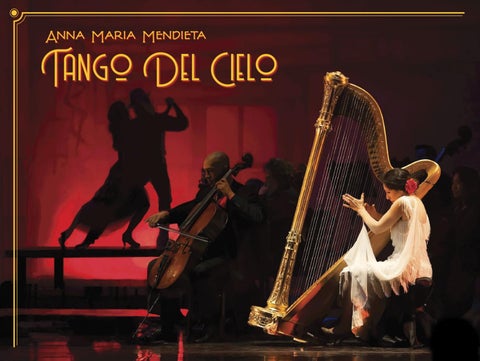
Front Cover Photo: Glenn Preuett Photography
"People talk about styles of tango, but there is only one tango. It accommodates itself to every place and every era." Eduardo Arquimbau
Thank you to my family and friends for their unwavering support. A heartfelt thank you to my co-producers Russell Bond and Jeremy Cohen; engineers Leslie Ann Jones and the team at Skywalker. Sincere praise and admiration to composers Jeremy Cohen, Jorge Calandrelli, Pablo Ziegler, Michael Touchi, and Vincent Russo for their beautiful compositions and arrangements; and to the very talented musicians performing on the album. Thank you to Dave Bond and Ted Viviani for their outstanding artwork contributions. Y un abrazo grande para Javier Cohen en Argentina‌ for embracing my vision.
Photo: Lisa Keating