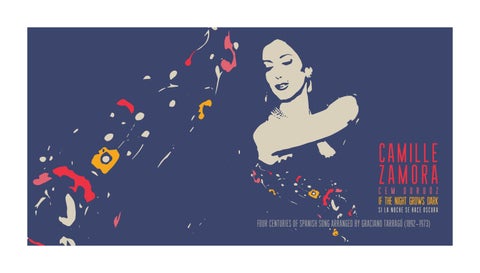
CAMILLE ZAMORA
C E M D U R U Ö Z
IF THE NIGHT GROWS DARK SI LA NOCHE SE HACE OSCURA
FOUR CENTURIES OF SPANISH SONG ARRANGED BY GRACIANO TARRAGÓ (1892-1973)
SPANISH SOUL: THE LEGACY OF GRACIANO TARRAGÓ Music informs identity. The little tune that floats into an open window from the street below, the lullaby that vibrates in a low hum from a nearby room, the half-remembered refrain of a long-ago love song these souvenirs in sound tell us where we’re from and where we’re going. And in sharing our songs of joy, sorrow, passion, and peace, we reconnect with ourselves and each other, and rediscover who we really are. Composers have long taken inspiration from homegrown tunes. Classical standard-bearers from Haydn to Beethoven crafted countless arrangements of folksongs, and the Romantics who followed Brahms, Bruckner, Tc h a i k o v s k y , M a h l e r , F r a n c k , S a i n t - S a ë n s b r e a t h e d n e w l i f e i n t o s y m p h o n i c f o r m s t h r o u g h t h e i r u s e o f regional song. In folksong, they discovered the sinuous, singable melodies and bracing rhythms that refreshed their concert halls like so many country breezes. During the first decades of the 20th century, composers intensified what Australian composer/arranger Percy Grainger called their “folk-fishing trips.” (Grainger himself had traveled the back roads of the British isles in 1905, early phonograph in hand, recording elderly villagers in nearly forgotten ballads, shanties, and lullabies.) As industrialization and urban migration continued to erode rural identity, more composers began to tap their musical roots and notate what previously had been a purely oral tradition of cradle, campfire, and countryside. ^ Composers including Dvorák, Holst, Vaughan Williams, Britten, Bartók, and Kodály ushered in a nationalist music movement that sought to preserve what totalitarian regimes were threatening. Later, the use of regional song in the work of Hindemith, Lutoslawski, Górecki, and others became a deeply personal way to assert identity and register protest. These local musical expressions would blossom in the “Singing Revolutions” of Estonia, Latvia, and Lithuania, contributing to the end of Soviet rule.
Fernando Sor (1778-1839) was the first of the great Spanish guitar maestros and, like Tarragó, he collected and arranged folksongs.
G r a c i a n o Ta r r a g ó ( 1 8 9 2 - 1 9 7 3 ) w a s a m o n g t h e 2 0 t h c e n t u r y c o m p o s e r s w h o m i n e d t h e i r c o u n t r i e s ’ m u s i c a l g o l d , i n h i s c a s e a g a i n s t t h e b a c k d r o p o f F r a n c o ’ s S p a i n . A t e a c h e r , c o m p o s e r , a r r a n g e r , a n d p e r f o r m e r , Ta r r a g ó w a s p a r t of the lineage of Catalonian guitar maestros from Fernando Sor to Francisco Tárrega to his own teacher, Miguel Llobet whose contributions elevated the guitar from humble “tavern accompanist” to serious solo instrument deserving of dedicated study and nuanced composition. Ta r r a g ó ’ s s t u d i o a t B a r c e l o n a ’ s C o n s e r v a t o r i d e l L i c e u n u r t u r e d a g e n e r a t i o n o f S p a n i s h m u s i c i a n s t h a t i n c l u d e d h i s d a u g h t e r , t h e v i r t u o s a R e n a t a Ta r r a g ó , a n d t h e y o u n g s o p r a n o V i c t o r i a d e l o s A n g e l e s . W o r k i n g w i t h i n t h e Late Romantic aesthetic of his youth, he delved into Spain’s two particular motherlodes: its early music treasury and its rich folk tradition. From these complementary veins, he forged an inimitable Spanish voice.
Detail from a mid-16th-century Spanish painting by Juan de Juanes featuring the vihuela, Tarragó’s Renaissance instrument of choice
F o r Ta r r a g ó , w h o p l a y e d R e n a i s s a n c e v i h u e l a i n a d d i t i o n t o g u i t a r , e a r l y m u s i c w a s a n artistic touchstone. The musicologist Felip Pedrell had recently recovered the c o m p o s i t i o n s o f R e n a i s s a n c e m a s t e r To m á s L u i s d e V i c t o r i a ( “ t h e S p a n i s h P a l e s t r i n a ” ) a n d his contemporaries, offering new clues to the origins of Spanish musical identity. The perfectly balanced contrapuntal and harmonic elements of this early repertoire spoke to Ta r r a g ó ’ s d i r e c t s t y l e a n d h o n e d t e c h n i q u e . I n a r r a n g i n g t h e s e w o r k s , h e f o u n d a p u r i t y o f musical structure that demanded utmost tonal clarity and focus. Like Bach’s arias, Ta r r a g ó ’ s a r r a n g e m e n t s o f t h e s e p i e c e s l o c a t e t h e i r m a g i c , a s w e l l a s t h e i r d i f f i c u l t y , i n their deceptive simplicity.
B y c o n t r a s t , Ta r r a g ó ’ s f o l k s o n g a r r a n g e m e n t s o f f e r t h e f i e r y , e x t r o v e r t e d e l e m e n t s typically associated with Spanish sound: driving dance rhythms, exotic flamenco scales reminiscent of their Arab origins, and impassioned, quasi-improvisatory flourishes. Many of these songs are colored by flamenco cante jondo (literally “deep singing”), with arching melismatic phrases that soar and plunge to express tenderness, longing, and desire. In these works, we hear what the composer Isaac Albéniz referred to as the essence “of the people, our Spanish people...color, sunlight, flavor of olives... like the carvings in the Alhambra,
those peculiar arabesques that say nothing with their turns and shapes, but which are like the air, like the sun, like the blackbirds, like the nightingales in the gardens...” *** M y o w n j o u r n e y w i t h Ta r r a g ó b e g a n o n a h o t a f t e r n o o n i n M a d r i d w h e n , t a k i n g r e f u g e from the midday sun in a dusty music shop on a side street, I stumbled across some o u t - o f - p r i n t f o l i o s . M y Te x a n - S p a n i s h - N e w - Yo r k e r s e l f r e c o g n i z e d i n t h e y e l l o w e d pages certain essential parts of my own musical makeup: the canciones my father sang to me as a child, the stories of my grandfather serenading my grandmother, and my very first classical album featuring Victoria de los Angeles singing zarzuela in her Graciano Tarragó sharing trade secrets with a young crystalline soprano. (The fact that her family hailed from the town of Zamora allowed student, 1919 me to imagine her as my angelic distant cousin.) Flipping through those old scores that afternoon and humming under my breath, I fell in love with the songs. I could hear the light-dark Spanish sensibility built into the melodies as into the chiaroscuro of my voice the quicksilver vacillations between major and minor, the deep shadows even in the brightest noon, the cocina counterpoint of comfort and spice, the awareness of sorrow in joy and joy in sorrow.
My grandfather, Adolfo Zamora, worked long hours in a refinery, but after work, he cleaned up well and courted my grandmother with the folksong, “No me mates con tomates,” accompanied on his beloved guitar.
I bought all the collections I could get my hands on that day, and in the weeks that followed, I read through song after song, noticing one arranger’s name in particular: G r a c i a n o Ta r r a g ó . I t w a s n o t a n a m e I h a d h e a r d b e f o r e . Ta r r a g ó w a s v i r t u a l l y unmentioned in music history books, but I was struck by his gentle genius. Each song seemed an opera in miniature, a tiny window on a vast world of emotion, identity, and story-telling. These were songs infused with duende, the heightened emotional/spiritual connection that exists in a realm beyond technique what could be loosely translated as “soul.”
I n Ta r r a g ó ’ s s e t t i n g o f t h e 1 6 t h c e n t u r y s o n g “ S i l a n o c h e s e h a c e o s c u r a ” ( “ I f t h e n i g h t g r o w s d a r k ” ) , w e h e a r a woman’s soul. In her exposed opening phrases, she calls out to her love. The night is dark and the road is short, so why does he not come to her? She pours all of her vulnerability, tenderness, and desire into a melodic arc that rises and falls as inexorably as nightfall itself. It is a song of heartache and withdrawal. It is also a song of the quiet joy of choosing to love completely, with abandon, even in the face of separation and uncertainty. D e l i v e r e d b y Ta r r a g ó a c r o s s c e n t u r i e s t o t h i s m o m e n t , t o a w o r l d s u d d e n l y d e f i n e d b y l o c k d o w n a n d d i s t a n c i n g , it feels like a gift. Music can be a delivery system for shared hope, for individual passion, for ancestral coding, for peace. A simple song can allow us to send our voice, our breath, out across the night air, over hills and highways, to c u r l a r o u n d o u r b e l o v e d i n t h e d a r k n e s s . T h r o u g h s o n g , Ta r r a g ó s e e m s t o s a y , w e h o n o r o u r t e a c h e r s , o u r heritage, our hearts. Through song, we are restored to the people and places we love; we are restored, ultimately, to ourselves. Aun si la noche se hace oscura. Even if the night grows dark. Camille Zamora N e w Yo r k C i t y , M a r c h 2 0 2 0
EL ALMA ESPAÑOLA: EL LEGADO DE GRACIANO TARRAGÓ La música revela la identidad. La pequeña tonada que flota a través de una ventana abierta a la calle, el arrullo que vibra desde un cuarto cercano, la memoria del estribillo de una antigua canción de amor estos sonidos recordados nos dicen de donde venimos y a donde vamos. Al compartir nuestros cantos de alegría, tristeza, pasión y paz, nos reconectamos con nosotros mismos y con los demás, y descubrimos de nuevo quienes somos en realidad. A través de los años, los compositores se han inspirado en tonadas autóctonas. Los representantes del clacisismo desde Haydn a Beethoven compusieron infinidad de arreglos folklóricos, así como los románticos que l o s s i g u i e r o n B r a h m s , B r u c k n e r , Tc h a i k o v s k y , M a h l e r , F r a n c k , S a i n t - S a e n s l e i n s u f l a r o n n u e v a v i d a a l a s formas sinfónicas al usar la canción regional. En la canción folklórica descubrieron melodías sinuosas y cantables, así como ritmos estimulantes que animaron sus salas de conciertos como brisas campestres. Durante las primeras décadas del siglo 20, los compositores intensificaron lo que el compositor y arreglista australiano Percy Grainger llamó sus “viajes de pesca populares.” (El mismo Grainger había recorrido los caminos ocultos de las Islas Británicas en 1905, con fonógrafo primitivo en mano, grabando a viejos aldeanos en baladas casi olvidadas, canciones de cuna y “shanties”). Cuando la industrialización siguió erosionando la identidad rural y la migración urbana muchos compositores empezaron a recordar sus raíces musicales y anotar lo que había sido puramente tradición oral de la cuna, el campamento y el campo. Algunos compositores que incluían a Dvorak, Holst, Vaughan Williams, Britten, Bartók y Kodály introdujeron un movimiento de música nacionalista que buscaba preservar lo que los gobiernos totalitarios amenazaban destruir. La inspiración de la canción regional en el trabajo de Hindemith, Lutoslawski, Górecki y otros se convirtió en una forma profundamente personal de establecer la identidad y registrar la protesta. Estas expresiones musicales locales florecerían en las “Revoluciones Cantadas” de Estonia, Latvia y Lituania, que contribuyeron al fin del régimen soviético.
G r a c i a n o Ta r r a g ó ( 1 8 9 2 - 1 9 7 3 ) e s t u v o e n t r e l o s c o m p o s i t o r e s d e l s i g l o 2 0 q u e e x t r a j o e l o r o m u s i c a l d e s u t i e r r a , e n s u c a s o f r e n t e a l t e l ó n d e l a E s p a ñ a f r a n q u i s t a . M a e s t r o , c o m p o s i t o r , a r r e g l i s t a y a r t i s t a , Ta r r a g ó f u e p a r t e del linaje de los maestros catalanes de guitarra de Fernando Sor a Francisco Tárrega hasta su propio maestro Miguel Llobet cuyas contribuciones elevaron a la guitarra de humilde “acompañamiento de taverna” a instrumento de solo, merecedor de estudio y composición matizada. E l e s t u d i o d e Ta r r a g ó e n e l C o n s e r v a t o r i o d e l L i c e u d e B a r c e l o n a , f o r m ó a u n a g e n e r a c i ó n d e m ú s i c o s e s p a ñ o l e s q u e i n c l u y ó a s u h i j a , l a v i r t u o s a R e n a t a Ta r r a g ó , y a l a j o v e n s o p r a n o V i c t o r i a d e l o s A n g e l e s . Tr a b a j a n d o d e n t r o d e l a e s t é t i c a d e l r o m a n t i c i s m o t a r d í o d e s u j u v e n t u d , Ta r r a g ó a h o n d ó e n d o s v e t a s o r i g i n a r i a s d e m ú s i c a española: su música ancestral y su rica tradición folklórica. A partir de estas venas complementarias, forjó una voz española inimitable. P a r a Ta r r a g ó , q u e t o c a b a l a v i h u e l a r e n a c e n t i s t a a d e m á s d e l a g u i t a r r a , l a m ú s i c a a n t i g u a e r a u n a m a r c a a r t í s t i c a . E l m u s i c ó l o g o F e l i p P e d r e l l h a b í a r e c u p e r a d o l a s c o m p o s i c i o n e s d e l m a e s t r o r e n a c e n t i s t a To m á s L u i s d e Victoria (“el Palestrina español”) y sus contemporáneos, que ofrecieron nuevas claves sobre los orígenes de la identidad musical española. Los elementos contrapuntales y armónicos perfectamente balanceados de su r e p e r t o r i o o r i g i n a l s e c o m u n i c a b a n c o n e l e s t i l o d i r e c t o y l a t é c n i c a r e f i n a d a d e Ta r r a g ó . A l a r r e g l a r e s t o s trabajos encontró una pureza de estructura musical que exigía la máxima claridad y enfoque. Como las arias de B a c h , l o s a r r e g l o s a Ta r r a g ó e n c u e n t r a n s u m a g i a , a s í c o m o s u s d i f i c u l t a d e s , e n s u e n g a ñ o s a s e n c i l l e z . E n c o n t r a s t e , l o s a r r e g l o s d e c a n c i o n e s p o p u l a r e s d e Ta r r a g ó , p r e s e n t a n l o s e l e m e n t o s f o g o s o s y e x t r o v e r t i d o s que comúnmente se asocian con la música española: ritmos bailables, escalas flamencas con reminiscencias de exotismo árabe en sus orígenes, y adornos cercanos a la improvisación. Muchas de estas canciones se encuentran teñidas por el “cante jondo” (literalmente canto profundo) con frases “melismáticas” que se elevan y se hunden para expresar ternura, añoranza y deseo. En estos trabajos se escucha lo que el compositor Isaac Albéniz llamaba una esencia “esencia, la de nuestro pueblo español...su color, sol, sabor a aceitunas...como los bajorrelieves de la Alambra, esos arabescos peculiares que no representan nada con sus volutas pero que son como el aire, como pájaros, como los ruiseñores en los jardines...”
M i p r o p i a j o r n a d a c o n Ta r r a g ó s e i n i c i ó u n a t a r d e c a l i e n t e , c u a n d o a l r e f u g i a r m e d e l s o l e n u n a c a l l e j u e l a polvorienta de Madrid encontré en una tienda de música unos folios descontinuados. Mi personalidad tejano-española-neoyorquina reconoció en esas páginas amarillentas ciertas partes esenciales de mi propia estructura musical: canciones que me cantaba mi padre de niña, historias de mi abuelo cantandole a mi abuela y mi primer album clásico de Victoria de los Angeles cantando zarzuela con su cristalina voz de soprano. (El hecho de que su familia provenía del poblado de Zamora me permitía imaginarla como un familiar angelical). Al hojear esas notas esa tarde, tarareando en voz baja me enamoré de esas canciones. Pude escuchar la sensibilidad española contenida en las melodías así como en el claroscuro de mi voz las vacilaciones entre mayor y menor, las sombras profundas aún en el mediodía más brillante, y la conciencia de tristeza en la alegría y alegría en la tristeza. Compré todas las colecciones que pude conseguir ese día y durante las semanas que siguieron. Leí todas las c a n c i o n e s , t o m a n d o n o t a d e u n a r r e g l i s t a e n p a r t i c u l a r : G r a c i a n o Ta r r a g ó . N u n c a h a b í a o í d o e s e n o m b r e . Prácticamente no lo mencionaban en los libros de historia musical pero me asombró su genio gentil. Cada canción parecía una ópera en miniatura, una pequeña ventana a un gran mundo de emoción, identidad y relato. Estas canciones estaban saturadas de duende, del intenso contacto emocional/espiritual que habita más allá de la técnica lo que en un sentido amplio podríamos llamar “alma.” E n e l c o n t e x t o d e l a c a n c i ó n d e Ta r r a g ó d e l s i g l o X V I “ S i l a n o c h e s e h a c e o s c u r a ” o í m o s a l a l m a d e u n a m u j e r . E n sus frases iniciales llama a su amado. La noche es oscura y el camino corto, luego ¿porqué no viene él a ella? Ella expresa toda su vulnerabilidad, su ternura y deseo en un arco melódico que sube y baja de manera tan i n e x o r a b l e c o m o l a m i s m a n o c h e . E s u n a c a n c i ó n d e d o l o r y a u s e n c i a . Ta m b i é n e s u n a c a n c i ó n d e d e l e i t e a l e s c o g e r a m a r c o m p l e t a m e n t e , c o n a b a n d o n o , a ú n e n f r e n t a n d o l a s e p a r a c i ó n y l a i n c e r t i d u m b r e . Tr a í d a h a s t a e s t e m o m e n t o p o r Ta r r a g ó a t r a v é s d e l o s s i g l o s , u n m u n d o r e p e n t i n a m e n t e d e f i n i d o p o r e l e n c i e r r o y e l d i s t a n c i a m i e n t o , s e convierte en un regalo. La música puede ser una forma de compartir esperanza, pasión individual, códigos ancestrales, paz. Una canción
sencilla nos puede permitir enviar nuestro aliento a través de la noche, de montañas y caminos, para acercarnos a n u e s t r o s a m a d o s e n l a o s c u r i d a d . C o n s u s c a n c i o n e s , Ta r r a g ó p a r e c e d e c i r q u e h o n r a m o s a n u e s t r o s m a e s t r o s , nuestra herencia, y nuestros corazones. A través de sus la canción, regresamos a la gente y los lugares que amamos, finalmente nos restituimos a nosotros mismos. Aun si la noche se hace oscura. Camille Zamora N e w Yo r k C i t y , M a r c h 2 0 2 0
TENGO QUE SUBIR
(TRADITIONAL, ASTURIAS)
/
I MUST GO UP
1
AY, TRISTE QUE VENGO
TENGO QUE SUBIR, SUBIR, AL PUERTO Y A LA MONTAÑA. TENGO QUE SUBIR, SUBIR, QUE ALLÍ ESTÁ LA QUE ME AMA.
I MUST GO UP, GO UP, TO THE PASS AND THE MOUNTAIN. I MUST GO UP, GO UP, FOR SHE WHO LOVES ME IS THERE.
SI LA NIEVE QUE CAE CUBRE EL SENDERO, YA NO VERÉ EN EL MONTE LA QUE MÁS QUIERO. ¡AY, AMOR! SI EN LA NIEVE RESBALO, ¿QUÉ HARÉ YO?
IF THE SNOW THAT IS FALLING COVERS THE PATH, I WILL NOT BE ABLE TO SEE ON THE MOUNTAIN THE ONE I LOVE MOST. AH, LOVE! IF I SLIP IN THE SNOW, WHAT SHALL I DO?
CANCIÓN DE TRILLA
(TRADITIONAL, MALLORCA)
/
(JUAN DEL ENCINA [1468-1539])
THRESHING SONG
3
AY, COME VA MES MI EN FUNT, ENTENIRTE PASIO, AY, PASIO.
AY, THE MORE IT GOES THROUGH ME, THE MORE I UNDERSTAND YOU, AY, PASSION.
JO VOLDRIA QUE FIBLÓ, AY, QUE FIBLÓ, D’AMOR TE CAIGUÉS DAMUNT.
I WISH THAT THE STING, AY, THE STING OF LOVE WOULD FALL UPON YOU.
/
O H , S A D LY I C O M E
2
AY, TRISTE QUE VENGO VENCIDO D'AMOR, MAGUERA PASTOR!
O H , S A D LY I C O M E , CONQUERED BY LOVE, A L T H O U G H I A M O N LY A S H E P H E R D .
MÁS SANO ME FUERA NO IR AL MERCADO, QUE NO QUE VINIERA TÁN AQUERENCIADO, QUE VENGO, CUITADO, VENCIDO D’AMOR, MAGUERA PASTOR.
IT WOULD HAVE BEEN WISER NOT TO HAVE GONE TO THE MARKET SO AS NOT TO HAVE FALLEN S O D E E P LY I N L O V E , THAT NOW I COME, HEAVY-HEARTED, CONQUERED BY LOVE, A L T H O U G H I A M O N LY A S H E P H E R D .
CON VISTA HALAGUERA MIRÉLA Y MIRÓME, YO NO SÉ QUIÉN ERA, MÁS ELLA AGRADÓME, Y FUÉSE Y DEJÓME VENCIDO D’AMOR, MAGUERA PASTOR.
WITH LOVING GAZE I LOOKED AT HER AND SHE AT ME, I DO NOT KNOW WHO SHE WAS, BUT SHE PLEASED ME, THEN SHE WENT AND LEFT ME, CONQUERED BY LOVE, A L T H O U G H I A M O N LY A S H E P H E R D .
5 JAENERAS
(TRADITIONAL, ANDALUSIA)
/
ADIÓS, MEU HOMIÑO (TRADITIONAL, GALICIA)
SONGS FROM JAÉN
4
JAENERAS QUE YO CANTO, CANTOS DE TRISTEZA SON. SON LOS CANTOS DE MI TIERRA QUE SALEN DEL CORAZÓN.
THE SONGS FROM JAÉN THAT I SING ARE SONGS OF SADNESS. THEY ARE THE SONGS OF MY HOMELAND THAT COME FROM MY HEART.
EN JAÉN VINE A NACER, EN JAÉN QUIERO MORIR, JUNTICO A LA CARA DE DIÓS QUE ES LA QUE VELA POR MI.
IN JAÉN I CAME TO BE BORN, IN JAÉN I WISH TO DIE, RIGHT NEXT TO THE FACE OF GOD WHO KEEPS WATCH OVER ME.
DE LA TIERRA DEL RONQUÍO, DEL LAGARTO Y DEL MANTÓN, ¿DONDE ESTÁN LAS JAENERAS, QUE EN LA TIERRA CRIÓ DIÓS?
FROM THE LAND OF RONQUÍO,* OF THE LIZARD AND THE EMBROIDERED SHAWL, WHERE ARE THE GIRLS OF JAÉN, WHOM GOD RAISED ON THIS LAND?
EN JAÉN VINE A NACER...
IN JAÉN I CAME TO BE BORN... *”RONQUÍO” IS A DERIVATIVE OF “RONQUIDO” (SNORING), A JOKING REFERENCE TO THE REGION’S GUTTURAL PRONUNCIATION OF [X], AS IN THE OPENING SOUND OF THE WORD “JAÉN.”
/
FAREWELL, MY LITTLE MAN
¡ADIÓS, MEU HOMIÑO, ADIÓS! XA QUE TE MARCHAS PRA GUERRA, N O N T ’ O LV I D E S D A P R E N D I Ñ A QUE CHE QUEDA ACA N’A TERRA.
FAREWELL, MY LITTLE MAN, FAREWELL! NOW THAT YOU’RE GOING OFF TO WAR, DON’T FORGET ABOUT THE LITTLE TREASURE WHO IS STAYING BACK HERE IN YOUR HOMELAND.
NON TE VAYAS, PEPE MEU, DEIXA ESOS OUTROS MARCHAR, MIRA, NO ME DEIXES SOLA, QUE LA PENA ME LE VAI LEVAR.
DON’T GO, MY PEPE, LET THOSE OTHERS GO, LOOK, DON’T LEAVE ME ALONE, FOR MY PAIN WILL CARRY ME AWAY.
¡ADIÓS, MEU HOMIÑO, ADIÓS!
FAREWELL, MY LITTLE MAN, FAREWELL!
ARRORRÓ, MI NIÑO, DUERME (TRADITIONAL, CANARIAS)
/
LULLABY, MY BOY, SLEEP
6
ARRORRÓ, MI NIÑO, DUERME, QUE TU MADRE NO ESTÁ AQUÍ QUE FUÉ A MISA EN SAN ANTONIO Y HA PRONTO DE VENIR.
LULLABY, MY BOY, SLEEP, FOR YOUR MOTHER IS NOT HERE, SHE IS AT MASS IN SAN ANTONIO AND WILL COME BACK SOON.
ARRORRÓ, MI NIÑO, DUERME, QUE TU MADRE NO ESTÁ AQUÍ QUE FUÉ A MISA EN SAN ANTONIO PARA ROGARLE POR TÍ.
LULLABY, MY BOY, SLEEP, FOR YOUR MOTHER IS NOT HERE, SHE WENT TO MASS IN SAN ANTONIO TO PRAY FOR YOU.
ARRORRÓ, MI NIÑO, DUERME...
LULLABY, MY BOY, SLEEP...
PASTORCICO, NON TE ADUERMAS (ANONYMOUS, 16TH CENTURY)
AHÍ TIENES MI CORAZÓN (TRADITIONAL, SALAMANCA)
/
THERE YOU HAVE MY HEART
7
AHÍ TIENES MI CORAZÓN, QUE SI LO VIERAS AHORA, COMO LOS NIÑOS DEL LIMBO SIN TENER PENA NI GLORIA.
THERE YOU HAVE MY HEART, IF YOU COULD BUT SEE IT NOW, LIKE THE CHILDREN IN LIMBO, WHO HAVE NEITHER PAIN NOR GLORY.
SALE DEL PASEO LA TRISTE CRIADA, Y LLEVA MÁS LUJO QUE EL AMO Y EL AMA, LLEVA SOBRE FALDA COLA Y ABANICO, SORTIJAS Y LAZOS, MOÑOS Y MOÑITOS.
THE SAD MAID GOES OUT WALKING, M O R E L U X U R I O U S LY D R E S S E D THAN HER MASTER AND MISTRESS, WITH HER FLOWING SKIRT AND FAN, RINGS AND BOWS, CHIGNONS AND RIBBONS.
NO TE ACUERDAS DEL FUENTE NI DEL BAILE DEL SOLANO. ¡CUÁNTA MENTIRA EN TUS OJOS! ¡CUÁNTA PERFIDIA EN TUS LABIOS!
YOU DO NOT REMEMBER THE FOUNTAIN OR DANCING WITH THE EAST WIND. SUCH LIES IN YOUR EYES! SUCH BETRAYAL ON YOUR LIPS!
/
LITTLE SHEPHERD, DON’T FALL ASLEEP
PASTORCICO, NON TE ADUERMAS, QUE MAL SE REPASTAN LAS OVEJAS. SON MUY MALAS DE GUARDAR. TIENEN ME DESATINADO. Y YO TRISTE, DE CANSADO, NO LAS PUEDO REPASTAR.
LITTLE SHEPHERD, DON’T FALL ASLEEP, F O R Y O U R S H E E P A R E G R A Z I N G P O O R LY . THEY ARE VERY HARD TO WATCH. THEY HAVE ME BEWILDERED. AND I, SAD, EXHAUSTED, CANNOT GET THEM TO GRAZE.
CUIDO QUE ME HAN DE MATAR, O ME MIENTEN MIS OVEJAS. ¿PORQUÉ ESTÁS ADORMECIDO? ZAGAL, HÁGOTE SABER QUE SI LAS DEJAS PERDER YO TE CUENTO POR PERDIDO.
I FEAR THAT MY SHEEP WILL KILL ME, OR PLAY ME FALSE. WHY ARE YOU SLEEPY? LAD, YOU MUST KNOW THAT IF YOU LOSE THEM, I WILL COUNT YOU LOST.
YA NO ME PUEDO APARTAR DE GUARDAR A MIS OVEJAS.
I CANNOT AVOID WATCHING OVER MY SHEEP.
9
DE ANTEQUERA SALE EL MORO
(CRISTÓBAL DE MORALES [1500-1553], MIGUEL DE FUENLLANA [1500-1579]) DE ANTEQUERA SALE EL MORO, DE ANTEQUERA SE SALÍA, CARTAS LLEVABA EN SU MANO, CARTAS DE MENSAJERÍA.
/
8
THE MOOR RODE OUT FROM ANTEQUERA THE MOOR RODE OUT FROM ANTEQUERA, HE LEFT ANTEQUERA, HE WAS CARRYING LETTERS IN HIS HAND, LETTERS BY COURIER.
LA VI LLORANDO
(TRADITIONAL, CASTILE)
/
I SAW HER CRYING
10
LA VI LLORANDO Y DIJE, “¿POR QUIÉN SUSPIRAS?” “¡SE ME HA MARCHA’O MI AMANTE, LE ESTOY CANTANDO LA DESPEDIDA!”
I SAW HER CRYING AND SAID, “WHO ARE YOU SIGHING FOR?” “MY LOVE HAS LEFT, I AM SINGING HIS FAREWELL!”
LA DESPEDIDA ES CORTA, LA AUSENCIA ES LARGA. ¡ADIOS, PRENDA QUERIDA, PRENDA DEL ALMA!
FAREWELL IS BRIEF, BUT ABSENCE IS LONG. FAREWELL, DEAR TREASURE, TREASURE OF MY SOUL!
LA VI LLORANDO.
I SAW HER CRYING.
EL ROSSINYOL
(TRADITIONAL, CATALONIA)
/
12
THE NIGHTINGALE
11
NIGHTINGALE, NIGHTINGALE, NIGHTINGALE, NIGHTINGALE,
GOING TO FRANCE, COMMEND ME TO MY MOTHER, FROM A BEAUTIFUL FOREST, FROM A FLIGHT.
ENCOMANA'M A LA MARE, ROSSINYOL, A MON PARE NO PAS GAIRE, ROSSINYOL, D'UN BELL BOSCATGE ROSSINYOL, D'UN VOL.
NIGHTINGALE, NIGHTINGALE, NIGHTINGALE, NIGHTINGALE,
COMMEND ME TO MY MOTHER, BUT NOT SO MUCH TO MY FATHER, FROM A BEAUTIFUL FOREST, FROM A FLIGHT.
A MON PARE NO PAS GAIRE, PERQUÈ A UN PASTOR ME N'HA DADA, ROSSINYOL, D'UN BELL BOSCATGE ROSSINYOL, D'UN VOL.
NOT SO MUCH TO MY FATHER, BECAUSE HE GAVE ME TO A SHEPHERD, NIGHTINGALE, FROM A BEAUTIFUL FOREST, NIGHTINGALE, FROM A FLIGHT.
ROSSINYOL, ROSSINYOL, ROSSINYOL, ROSSINYOL,
QUE VAS A FRANÇA, ENCOMANA'M A LA MARE, D'UN BELL BOSCATGE D'UN VOL.
DUÉLETE DE MÍ, SEÑORA
(MIGUEL DE FUENLLANA [1500-1579])
/
FEEL MY PAIN, MY LADY
DUÉLETE DE MÍ, SEÑORA, SEÑORA, DUÉLETE DE MÍ. QUE SI YO PENAS PADEZCO TODAS SON, SEÑORA, POR TI.
FEEL MY PAIN, MY LADY, MY LADY, FEEL MY PAIN. IF I SUFFER PAINS, IT IS ALL, MY LADY, FOR YOU.
EL DÍA QUE NO TE VEO MIL AÑOS SON PARA MÍ. NI DESCANSO, NI REPOSO, NI TENGO VIDA SIN TÍ.
THE DAY THAT I DO NOT SEE YOU IS A THOUSAND YEARS FOR ME. I CANNOT REST, I CANNOT RELAX, I CANNOT LIVE WITHOUT YOU.
LOS DÍAS NO LOS VIVO, SUSPIRANDO SIEMPRE POR TÍ. ¿DÓND’ESTÁS QUE NO TE VEO; ALMA MÍA, QUÉ ES DE TI?
ON THOSE DAYS, I DO NOT EVEN LIVE, S I G H I N G A LW A Y S F O R Y O U . WHERE ARE YOU THAT I CANNOT SEE YOU, MY SOUL, WHAT HAS BECOME OF YOU?
DUÉLETE DE MÍ, SEÑORA...
FEEL MY PAIN, MY LADY...
SEVILLANAS: TODAS LAS MAÑANITAS PLAYERA: HINCARSE DE RODILLAS (TRADITIONAL, ANDALUSIA)
/
(TRADITIONAL, ANDALUSIA)
SONG OF MOURNING: FALL ON YOUR KNEES
AY, QUE YA VIENE DIÓS, VA A RECIBIR LA MARE E MI ARMA DER MIO CORAZÓN.
AY, GOD IS COMING HE IS GOING TO RECEIVE THE MOTHER AND THE SOUL OF MY HEART.
HINCARSE E RO’ILLAS QUE YA VIENE DIÓS.
FALL ON YOUR KNEES FOR GOD IS COMING.
AY, DEJAME LA VER DEJARME LA VER AQUELLA MARE MARECITA MIA POR ULTIMA VEZ.
AY, LET ME SEE HER, LET ME SEE HER, THAT MOTHER, MY LITTLE MOTHER FOR THE LAST TIME.
DEJAR QUE LA VEA, DEJARME LA VER, AY.
LET ME SEE HER, LET ME SEE HER, AY.
13
/
SONG FROM SEVILLE: ALL THE MORNINGS
TODAS LAS MAÑANITAS AL AIRE CANTO QUE NO HAY COSA EN EL MUNDO COMO MI BARRIO. COMO MI BARRIO, QUE NO HAY COSA EN EL MUNDO COMO MI BARRIO, QUE NO HAY COSA EN EL MUNDO COMO MI BARRIO.
EVERY MORNING I SING OUTDOORS THAT THERE IS NOTHING IN THE WORLD LIKE MY NEIGHBORHOOD. LIKE MY NEIGHBORHOOD, THERE IS NOTHING IN THE WORLD LIKE MY NEIGHBORHOOD, THERE IS NOTHING IN THE WORLD LIKE MY NEIGHBORHOOD.
Y DE SEVILLA, QUE NO SE HA VISTO NUNCA MÁS MARAVILLA, QUE NO SE HA VISTO NUNCA MÁS MARAVILLA.
AND OF SEVILLE, NO ONE HAS EVER SEEN MORE OF A MARVEL, NO ONE HAS EVER SEEN MORE OF A MARVEL.
QUIEN TENGA OJOS QUE VEA DONDE HE NACIDO, EN EL BARRIO MÁS BLANCO QUE HAY JUNTO AL RÍO, EN EL BARRIO MÁS BLANCO QUE HAY JUNTO AL RÍO. ESE ES MI PUEBLO, UN CACHITO DE GLORIA CAIDO DEL CIELO, UN CACHITO DE GLORIA CAIDO DEL CIELO.
WHOEVER HAS EYES THAT SEE WHERE I WAS BORN, IN THE BRIGHTEST NEIGHBORHOOD THAT THERE IS NEXT TO THE RIVER IN THE BRIGHTEST NEIGHBORHOOD THAT THERE IS NEXT TO THE RIVER THAT IS MY TOWN, A LITTLE PIECE OF GLORY FALLEN FROM THE SKY, A LITTLE PIECE OF GLORY FALLEN FROM THE SKY.
14
NIK BADITUT
(TRADITIONAL, BASQUE COUNTRY) NIK BADITUT MORTUETAN ARDIAK ARTZAI NARE KIN, ITSA SUAN AMAR ONTZI BEREN MARIÑO LAREKIN, KATALUNIAN AMAR MANDO ZILAR MONEDAREKIN.
/
WHAT I HAVE
15
16
I HAVE IN THE FIELDS FLOCKS OF SHEEP WITH THEIR SHEPHERDS, ON THE SEA TEN SHIPS WITH THEIR SAILORS, IN CATALONIA, TEN MULES
SEGUIDILLAS MANCHEGAS (TRADITIONAL, CASTILE)
/
SEGUIDILLAS FROM LA MANCHA
AUNQUE LA MANCHA TENGA DOS MIL LUGARES, NO HAY OTRO MÁS SALADO QUE MANZANARES.
ALTHOUGH LA MANCHA HAS TWO THOUSAND PLACES, THERE IS NONE SALTIER THAN MANZANARES.
VIVA LA MANCHA, VIVAN LOS OJOS NEGROS DE MI MUCHACHA.
LONG LIVE LA MANCHA, LONG LIVE THE BLACK EYES OF MY GIRL.
17
CAMPANILLAS DE PLATA (TRADITIONAL, SANTANDER)
/
S I LV E R B E L L S
CAMPANILLAS DE PLATA, BUEYES RUMBONES, ESTAS SON LAS SEÑALES DE LABRADORES. ESQUILONES DE PLATA, TEMPLE DE ACERO, ESTA ES LA GRANDEZA DEL CARRETERO.
S I LV E R B E L L S , RUMBLING OXEN, THESE ARE THE SIGNS OF FARMERS. S I LV E R S H E A R S , TEMPLE OF STEEL, THIS IS THE GREATNESS OF THE CARTER.
MOLINERA, MOLINERA, LA DE LA VEGA DE PAS, BUENA MOLINERA ERES PERO A MI NO ME LAS DAS.
MILLER GIRL, MILLER GIRL, OF VEGA DE PAS, GOOD MILLER GIRL YOU ARE BUT YOU DON'T GIVE TO ME.
CORAZÓN ME LO DECÍA QUE VIVÍAS ENGAÑADO, Y HOY VIVES ABORRECIDO PUDIENDO SER ESTIMADO.
MY HEART TOLD ME THAT YOU WERE FOOLED, AND TODAY YOU LIVE BORED THOUGH YOU COULD BE CHERISHED.
MOLINERA, MOLINERA...
MILLER GIRL, MILLER GIRL...
REDOBLE
(TRADITIONAL, EXTREMADURA)
/
ROUND
18
LOS DEL CAMINITO LLANO, SE LAVAN CON AGUARDIENTE, LOS DE LA CALLE CALEROS, CON AGÜITA DE LA FUENTE.
THOSE WHO COME FROM THE LITTLE FLAT ROAD, T H E Y W A S H T H E M S E LV E S W I T H B R A N D Y , THOSE OF CALEROS STREET, WITH WATER FROM THE FOUNTAIN.
R E D O B L E , R E D O B L E , V U E LV O A R E D O B L A R , CON ESE REDOBLE, ME VAS A MATAR, ME VAS A MATAR, ME VOY A MORIR, C O N E S E R E D O B L E , V U E LV O A R E P E T I R .
GO ROUND, GO ROUND, I RETURN TO GO ROUND, WITH THAT ROUND, YOU'RE GOING TO KILL ME, YOU'RE GOING TO KILL ME, I'M GOING TO DIE, WITH THAT ROUND, I REPEAT AGAIN.
LOS SEÑORES DE LEVITA, SE MUEREN POR LAS DEL MOÑO POR ESO A LAS SEÑORITAS, SE LAS LLEVAN LOS DEL MOÑO.
THE LORDS IN THEIR TAILCOATS DIE FOR THOSE WHO WEAR THEIR HAIR IN A CHIGNON THAT'S WHY THE LORDS TAKE THEM.
REDOBLE, REDOBLE…
GO ROUND, GO ROUND...
EN EL EL CAMINITO LLANO, EL SOL, CHIQUITA, SE PARA, LOS DE LA CALLE CALEROS, AL POZO DE SANTA CLARA.
ON THE LITTLE FLAT ROAD, THE SUN, LITTLE GIRL, STOPS, THE ONES FROM CALEROS STREET, AT THE WELL OF SANTA CLARA.
REDOBLE, REDOBLE...
GO ROUND, GO ROUND...
19
SI LA NOCHE SE HACE OSCURA (ANONYMOUS, 16TH CENTURY)
/
IF THE NIGHT GROWS DARK
SI LA NOCHE SE HACE OSCURA Y TÁN CORTO ES EL CAMINO, ¿CÓMO NO VENIS, AMIGO?
IF THE NIGHT GROWS DARK AND THE ROAD IS SO SHORT, WHY DON’T YOU COME, LOVE?
LA MEDIANOCHE ES PASADO, Y ÉL QUE ME PENA NO VIENE.
MIDNIGHT HAS NOW PASSED, AND HE WHO MAKES ME ACHE DOES NOT COME.
HÁCEME VIVIR PENADA Y MUÉSTRASEME, ENEMIGO. ¿CÓMO NO VENIS, AMIGO?
MAKE ME LIVE AS A PRISONER, AND SHOW YOURSELF TO ME, ENEMY. WHY DON’T YOU COME, LOVE?
CAMILLE ZAMORA, SOPRANO “A singer blessed with intense communicative ability who blazes with p a s s i o n ” ( O p eerraa MMaag ga az zi ni en ,e ,U KU ) , C a m i l l e Z a m o r a b a l a n c e s a v i b r a n t c a r e e r o f opera, recital, and concert performances. She has received acclaim for her “ d r a m a t i c a n d n u a n c e d ” ( T h e NNeeww YoYor rk k T iTmi me se ) i n t e r p r e t a t i o n s o f r e p e r t o i r e ranging from Mozart to tango, and is known for her “dignity and glowing s o u n d ” ( T h e NNeeww YoYor rk k T iTmi me se ) i n “ l u m i n o u s , t r a n s c e n d e n t l y l y r i c a l ” p e r f o r m a n c e s ( O p e r a N eewwss ) t h a t “ c o m b i n e g e n t i l i t y a n d e m o t i o n a l f i r e ” ( T h e HHoouussttoon n C Ch hr or no incilce l ) . R e c e n t s e a s o n s h a v e f e a t u r e d p e r f o r m a n c e s w i t h Yo - Yo M a a t t h e U . S . Capitol, her Kennedy Center recital debut, and operatic debuts including the Photo by Liron Amsellem principal soprano role in Hindemith’s The Long Christmas Dinner with A m e r i c a n S y m p h o n y O r c h e s t r a a t L i n c o l n C e n t e r , t h e l i v e r e c o r d i n g o f w h i c h t o p p e d T h e N e w Yo r k T i m e s ’ C l a s s i c a l P l a y l i s t a n d w a s o n e o f O p e r a N e w s ’ B e s t R e c o r d i n g s o f t h e Ye a r . O t h e r r e c e n t h i g h l i g h t s i n c l u d e h e r a w a r d - w i n n i n g a l b u m T h e L a s t S o r c e r e r , a 2 0 1 9 O p e r a N e w s C r i t i c ’ s C h o i c e ; G r a n a d o s s o n g s w i t h Yo - Yo M a a n d Cristina Pato in the documentary film The Music of Strangers ; American Songbook classics with The Late Show w i t h S t e p h e n C o l b e r t b a n d l e a d e r J o n B a t i s t e i n L o s A n g e l e s a n d N e w Yo r k C i t y ; a n d T w i n S p i r i t s : R o b e r t a n d C l a r a Schumann at Lincoln Center and LA’s Music Center with Joshua Bell, Jeremy Denk, Natasha Paremski, Nina Kotova, N a t h a n G u n n , Tr u d i e S t y l e r , a n d S t i n g . Hailed as a leading interpreter of classical Spanish repertoire by NBC Latino and the Congressional Hispanic Caucus, Camille has performed and recorded principal roles in the zarzuelas La Verbena de la Paloma, La R e v o l t o s a , L u i s a F e r n a n d a , a n d L a Ta b e r n e r a d e l P u e r t o . H e r p e r f o r m a n c e s o f S p a n i s h s o n g h a v e b e e n h e a r d o n f i v e c o n t i n e n t s i n v e n u e s r a n g i n g f r o m C a r n e g i e H a l l t o Z i m b a b w e ’ s H a r a r e I n t e r n a t i o n a l F e s t i v a l . TaTannggoo CCaalliieennttee and Sueños de España, her symphonic pops concerts of Spanish songs arranged for her by Grammy® Award winner
J e f f Ty z i k , h a v e b e e n p r e s e n t e d w i t h l e a d i n g o r c h e s t r a s i n c l u d i n g D a l l a s S y m p h o n y , E d m o n t o n S y m p h o n y , Milwaukee Symphony, and Rochester Philharmonic, with upcoming performances with Austin Symphony, Santa Barbara Symphony, Portland Symphony, and more. Camille has sung with many of the world’s leading orchestras, including Orchestra of St. Luke’s, London Symphony Orchestra, Guadalajara Symphony, and American Symphony Orchestra, and in live broadcasts on NPR, BBC Radio, Deutsche Radio, and Sirius XM. A champion of new music, she made her Lincoln Center Festival debut in Bright Sheng’s Poems from the Sung Dynasty for Soprano and Orchestra , performed Aaron Jay Kernis’ Simple Songs for Soprano and Orchestra under the baton of the composer, sang the premiere of Christopher Theofanidis’ Song of Elos at Carnegie Hall, and performed works of Ricky Ian Gordon at Lincoln Center with the composer at the piano. She has performed with opera companies including Houston Grand Opera, Boston Lyric Opera, Glimmerglass Opera, Auckland Opera, LA Opera, Opera on the James, and more in signatures roles including Elle (La voix h u m a i n e ) , D o n n a E l v i r a ( D o n G i o v a n n i ) , I l i a ( I d o m e n e o ) , M i m ì ( L a b o h è m e ) , T h e G o v e r n e s s ( T h e Tu r n o f t h e S c r e w ) , and the title roles in Susannah and Anna Bolena, of which The Houston Chronicle wrote, “Camille Zamora digs deep into Anna Bolena with the richness of her colorful and unwaveringly powerful soprano instrument... a consummate actress whose ability to get inside her character is phenomenal.” An advocate for the arts in education, Camille is the Co-Founder of Sing for Hope, an “arts peace corps” that presents initiatives such as NYC’s Sing for Hope Pianos that make the arts accessible to all. A Kennedy C e n t e r C i t i z e n A r t i s t , C a m i l l e h a s b e e n h o n o r e d w i t h a W o r l d H a r m o n y To r c h - B e a r e r A w a r d , a C o n g r e s s i o n a l Hispanic Caucus Recognition, and a 100 Hispanic Women Community Pride Award, and has been named NY1 ’s New Yo r k e r o f t h e W e e k a n d o n e o f CCNNNN ’ s M o s t I n t r i g u i n g P e o p l e . C a m i l l e i s a g r a d u a t e o f T h e J u i l l i a r d S c h o o l , w h e r e she gave the 2019 Commencement Address.
CEM DURUÖZ, GUITARIST Tu r k i s h - b o r n g u i t a r i s t C e m D u r u ö z , a s f e a t u r e d i n C l a s s i c a l G u i t a r m a g a z i n e , is an “extraordinarily gifted player” and “cultural ambassador who has delivered a generous and landmark introduction of new repertoire.” American Record Guide has praised “his flawless classical technique, depth of color, long flowing lines, clean playing and tight rhythmic style that made everyone listen in an entirely different way.” Cem has performed on four continents, in countries including Argentina, Brazil, Peru, Bolivia, Paraguay, Japan, France, Greece, Bosnia, the UK, Serbia, K o s o v o , P o l a n d , M e x i c o , a n d t h r o u g h o u t Tu r k e y a n d t h e U S A . R e c e n t c o n c e r t appearances include a return performance to Carnegie Hall, his London Photo by Devon Cass recital debut at the Purcell Room, Concierto de Aranjuez performances with t h e Tu r k i s h N a t i o n a l S y m p h o n y O r c h e s t r a , a F r e n c h B a^r^o q u^e c o n c e r t a t t h e I s t a n b u l F e s t i v a l , a n d s o l o r e c i t a l s a t , the Guitarras del Mundo Festival in Argentina, the Bascarsijske Noci Festival in Bosnia-Herzegovina, the Hondarribia Guitar Festival in France, the Gliwice Guitar Festival in Poland, the Semana de Guitarra Sainz de la Maza in Spain, the Minnesota Guitar Society, Marlow Guitar Series, and Redwood Arts Council Series. C e m D u r u ö z h a s r e l e a s e d f o u r a l b u m s t o i n t e r n a t i o n a l c r i t i c a l a c c l a i m . H i s d e b u t a l b u m , “P i è c e s d e V i o l e , ” featured his arrangements of Marais’ French baroque gamba music and received rave reviews in magazines such a s A m e r i c a n R e c o r d G u i d e , To d a y , C l a s s i c a l G u i t a r , a n d B B C M u s i c . H i s s o l o C D “D“ Deessddee eell AAllmmaa -- TaTannggoo CCllaassssiiccss ” was released in 2006 under ADA-Müzik label and called “a masterpiece” by Argentine critics. Cem completed his graduate guitar studies at The Juilliard School with Sharon Isbin. An enthusiastic educator, he gives masterclasses throughout the world and teaches guitar performance at Wesleyan University.
CREDITS
PRODUCERS: KABIR SEHGAL, MARLAN BARRY, CAMILLE ZAMORA | RECORDING ENGINEER, MIXER, DIGITAL EDITOR & MASTERING: MARLAN BARRY EXECUTIVE PRODUCERS: LOUIS LEVITT, CAMILLE ZAMORA | ASSOCIATE PRODUCERS: JAMI GREENBERG, JENNIFER WALSEY, MONICA YUNUS ALBUM NOTE TRANSLATION: ROSARIO FARAUDO | SONG TRANSLATIONS: CAMILLE ZAMORA COVER ART, ALBUM PACKAGE, AND BOOKLET DESIGN BY MARIAN C. HOLMES TRACKS 1,4,19 RECORDED LIVE AT ACADEMY OF ARTS AND LETTERS, NEW YORK CITY (DECEMBER, 2016) TRACKS 2-3, 5-8, 9-17 RECORDED LIVE AT ACADEMY OF ARTS AND LETTERS, NEW YORK CITY (APRIL, 2018)
PARA SOPHIE, OTIS, Y TODOS LOS ÁNGELES GUARDIANES.