EATDOCUMENTTHE
Recorded live at HERE as part of the 2025 PROTOTYPE Festival, Eat the Document was directed and developed by Kristin Marting; music direction by Mila Henry; scenic design by Peiyi Wong; lighting design by Ayumu Poe Saegusa; costume design by Rashidah Nelson; sound design by Kenny Feldman; line producer, Amanda Cooper; production manager, Sydney Prince; stage manager, Sarah Herdrich.
Lead commissioning support from Gene Kaufman & Terry Eder-Kaufman and Marie & Mike Rourke. Further support
provided by: Anonymous, Nancy & Jim Barton, John Conklin, Joan Desens and Simon Carr-Ellison, Roz Lasker, Ann D. McChord, Helen Mills, Thomas Simpson, Robert Ellis, Michael Young, and Faith E. Gay & Francesca Zambello. Eat The Document received developmental support from American Opera Projects, Baryshnikov Arts Center, The Center for Fiction, Joe’s Pub and HERE. We also thank the following individuals and organizations who have been a part of the development and creation of this work: Justine Aronson, Leah Asher, Mikaela Bennett, Gelsey Bell, Jules Biber, Big Reuse, Boswell Books, Catherine Brookman, Centanni Percussion, Jamie Danner, Joan Desens, Ethan Ellis, Matt Evans, Liz Faure, Abi Fayette, Christian Mark Gibbs, Bev Grant, the amazing HERE Staff, Terrance Johnson, Kaufman Music Center, Marina Kifferstein, Tesia Kwarteng, Leeda Marting, Charlotte Maskelony, Materials For The Arts, Bill Mazza, Grey McMurray, Jessica Meyers, Milwaukee Opera Theatre, Pedja Muzijevic, Ed Napier, Eva Pinney/Tribeca Lighting, Jill Anna Ponasik, Remix Market, Rachel Shapiro, Griffin Skutsch, Andrew Wilkowske, Jason Wirth, Caleb Wright, Jonathan Woody. And of course none of this would have been possible without Dana Spiotta’s incredible creation and support.
Paul Chwe MinChul An (Henry, Newscaster, Dennis Wilson, Dr. Fieser)
Danielle Buonaiuto (Mary, Caroline, Miranda)
Adrienne Danrich (Mom, Mel, Gabi, Betsy, Rose)
Amy Justman (Louise, Beth, Dana D)
Michael Kuhn (Josh, Commercial Announcer, Pop Genius)
Paul Pinto (Nash)
Tim Russell (Bobby, Jason, Roland)
Natalie Trumm (Sissy, Berry, Kid)
Mila Henry (Music Director, Piano) Shayna Dunkelman (Drums)
Michiko Egger (Guitars)
Elena Moon Park and Domenic Salerni (Violin)
Carrie Frey (Viola) Andrew Yee (Cello)
Music by John Glover, Libretto by Kelley Rourke
Based on the novel by Dana Spiotta Music & Conductor Mila Henry Directed and Developed by Kristin Marting Cover image by Peiyi Wong
Produced by John Glover and Kelley Rourke Engineered and Mastered by Sheldon Steiger Music Published by John Glover
- 01/15/2025
When Kelley and John first encountered Dana Spiotta’s Eat the Document, each of them was immediately struck by the novel’s operatic potential. The complex and passionate inner lives of main characters seemed to cry out for music. And in fact, Dana wove references to pop music commercial hits and deep cuts through the book. The music that accompanies the characters is as much a part of their identities as their individual responses to the world around them.
One of our great challenges and delights in writing this opera was figuring out how to channel the energy of Dana’s musical references to create original “pop” songs that sit within the larger musical architecture of the piece. Over a series of workshops, with Mila at the helm, a collection of terrific musicians brought their best “garage band” sensibility and taught us how the songs worked.
Eat the Document is set in the early 1970s and late 1990s, exploring the connection between the two eras — their activism, language, technology, and music. As we considered how to use a small ensemble to portray a variety of characters spanning two distinct time periods, including younger and older versions of two central figures, it was Kristin’s idea to put Louise and Nash, the older versions of Mary and Bobby, in conversation with the actors who play younger versions of each other in the 1990s. Thus, young Bobby of 1972 reappears as Louise’s son in 1998, while young Mary shows up as Miranda, one of the kids who frequent Nash’s bookstore.
Reimagining Dana’s multilayered novel as an opera meant leaving behind so many great sentences, scenes and characters. Dana generously gave us the space and freedom we needed to do our work, which inevitably included cuts and conflations. As she pointed out early on, no matter what choices we made, her novel would continue to exist. (If you haven’t read the book, we highly recommend it!)
We began work on the opera in 2019, a time when its conversations around activism felt almost unbearably relevant. In the time since then, each day’s news has brought fresh horror — a global pandemic, fighting in Ukraine and Gaza, mass shootings that have become an everyday occurrence, the widening chasm between rich and poor. How do we exist within a broken system? What obligation — and what power — does any individual have to confront and change systems that lead to suffering? Eat the Document examines a kaleidoscope of responses and their potential effects: intended and accidental, positive and negative, political and personal, immediate and ever-unfolding.
Kelley, John, Kristin and Mila January 2025
© 2026 • BSTD-0245 • brightshiny ninja • All rights reserved
Unauthorized replication & distribution prohibited
SYNOPSIS
Prologue: A young person begins a protest song (“No More”) and is joined by others. Bobby and Mary emerge from the ensemble and discuss precautions they must take as they plan a radical action against the Vietnam War. As the song continues, Henry relives a traumatic memory of war.
1972: A motel room. Mary is alone onstage. Her hair is freshly dyed. She tries out potential names (“My Name Is Caroline”). Once she has filled in the details of her new identity for herself, she turns on the television and catches the end of a news report, confirming her fears: One person has been killed in a recent bombing attributed to student radicals opposed to the Vietnam War.
1998: Mary, now Louise, has a brief exchange with her teenage son, Jason, about his “Garage Sale Finds.” After she exits, Jason plays a record from the late 60s (“On Repeat”) and muses about his mother’s inscrutability.
1998: Nash leads a meeting at Prairie Fire, an alternative bookstore that serves as a gathering place for counterculture kids a generation younger than himself. Against the backdrop of an anti-capitalist performance (“Unsustainable”), Nash banters with Miranda, an earnest young woman. Nash opens the floor (“Anyone Else?”) and Miranda takes her turn at the mic (“Did It Ever Occur to You?”). When the store closes, Nash reflects on his life — few possessions, fewer connections (“Unyielding”).
1972: Berry takes Caroline to a potluck meeting of a women’s group (“Nixon/Nut Loaf”), where Mel leads “Write On,” a song about changing the system from within. Afterwards, as Caroline and Berry share a joint, Berry speaks of her struggle with sexual politics (“Men”). Caroline lets a small detail from her past slip, then flashes back to her last conversation with Bobby (“Don’t Try to Contact Me”).
1998: At Prairie Fire, a rousing anthem takes a violent turn (“Global Village/Blow It Up”). Nash tries to talk down the kids who are in favor of extreme tactics, imagining a whimsical, choreographed protest (“Because We Like to Dance”).
1998: Henry is haunted by memories of Vietnam (“Smells”).
1998: Miranda has cooked Nash dinner for his birthday (“Thank You for Dinner”). He responds to a question with a song that says more than she realizes (“Plastic”). Slightly tipsy, Miranda admits her crush and kisses Nash. He is kind but will not reciprocate.
1998: Jason rocks out in his room (“Anything Can Be Mine”). At the dinner table, when Louise asks Jason about the music playing in the background, he launches into a lecture about the importance of Dennis Wilson (“Sonsplaining”). She interrupts with a story (“I Met Dennis Wilson Once”). After Louise exits, Jason tries to reconcile this story with the few facts that his mother has told him about her past (“My Mother”). Something doesn’t add up.
1972. Mel pulls Caroline aside (“You Have No Right”); she has figured out Caroline’s identity and has arranged for Caroline to take refuge at a women’s commune in upstate New York. Berry, who still doesn’t know Caroline’s story, decides to go with her.
1998: Jason stumbles on an old movie that begins to unlock his mother’s secret (“Lost Love Movie”).
1998: At Prairie Fire, Nash enacts a familiar ritual (“I’m Calling This Meeting to Order”). Josh, a “Hacktivist,” describes hacking corporate websites to include information about corporate misdeeds, environmental damage, ongoing lawsuits (“Parasites/A Veneer of Normalcy”). Miranda is impressed. Nash notices and explodes (“Nicknames Are for Friends”).
1998: Jason is investigating his mother. He follows her to work, a cooking class at the local community college. Seen through his eyes, the cooking class takes on a surreal quality (“Cooking Class”).
1998: Outside Prairie Fire, Josh pulls out a joint while explaining his philosophy to Miranda (“You Control What People Believe to Be True”). He tells her that Allegecom, the company whose site he recently hacked, wants to fly him to New York. “New tactic — instead of prosecuting me, hire me.”
1972: Caroline has found sanctuary in a women’s commune (“How Did You Find This Place Again?”). She and Berry are weary of the commune’s strict rules and decide to sneak out to go to a bar (“What Are You Thinking?”).
1998: Jason’s room. He has solved the mystery (“My Mother Is Not Just My Mother”).
1972: A motel room. Caroline and Berry are sprawled over the covers of the bed, still dressed, beginning to stir after what was clearly a long, late night, in which Caroline confessed her story to Berry (“Look, Berry”). As they begin to stir, Caroline tells Berry they must never, ever speak of it.
1998: Henry relives a memory of the war, the most brutal one yet (“Early Morning”).
1972: Alone and on the run again, Caroline changes her identity once more, letting go of the last vestiges of her past life. The singer playing the 70s version of the character hands off her identity to Louise, the 90s version of the character (“Leave the Memory Behind”).
2000: As Nash is closing Prairie Fire, Miranda appears (“And What Does Miranda Want with Me?”). He gives in, takes her home. The next morning, Miranda leaves Nash to meet Josh at a coffee/retail spot. At a display of activist-themed merchandise, Miranda is horrified by the commodification of human beings, while Josh is impressed by “the purity of capitalism.” Against Miranda’s protests, Josh buys her a deck of “Rebels, Outlaws and Fugitives” cards. When Josh tells Miranda that Allegecom is running with his idea for a franchised alternative community (“Green for What Is Seen”), she parts ways with him — for good. Flipping through the cards, she sees one for Bobby DeSoto: “Allegedly planted bombs at the summer homes of corporate board members. Still at large.” Miranda recognizes Nash, the first in a series of revelations that will propel us to the story’s end (“Unraveling/No More”).
2000: At the dinner table, Jason angrily confronts Louise with what he has learned about her past. While she does not defend the bombing, which she now feels was a terrible mistake, it is important to her that Jason understands her intentions. Jason hands his mother a piece of paper with a phone number. He explains how he found out that Bobby, now going by “Nash,” runs a bookstore a few towns over.
On another part of the stage, we see Mary (in 1972) plant the bomb.
Louise meets Nash at a bar and tells him she is turning herself in. He encourages her to get a better deal by turning him in, as well. She refuses. They argue about who was most culpable for what happened in the 70s, digging deep to reflect on their own intentions and expectations at the time.
We see Jason put on a record, playing “No More,” the protest song that began the show. We see characters of 70s, 90s, today, join in, singing about taking action as though their lives depended on it. Because that is the truth. The song ends. Jason lifts the needle. Blackout.
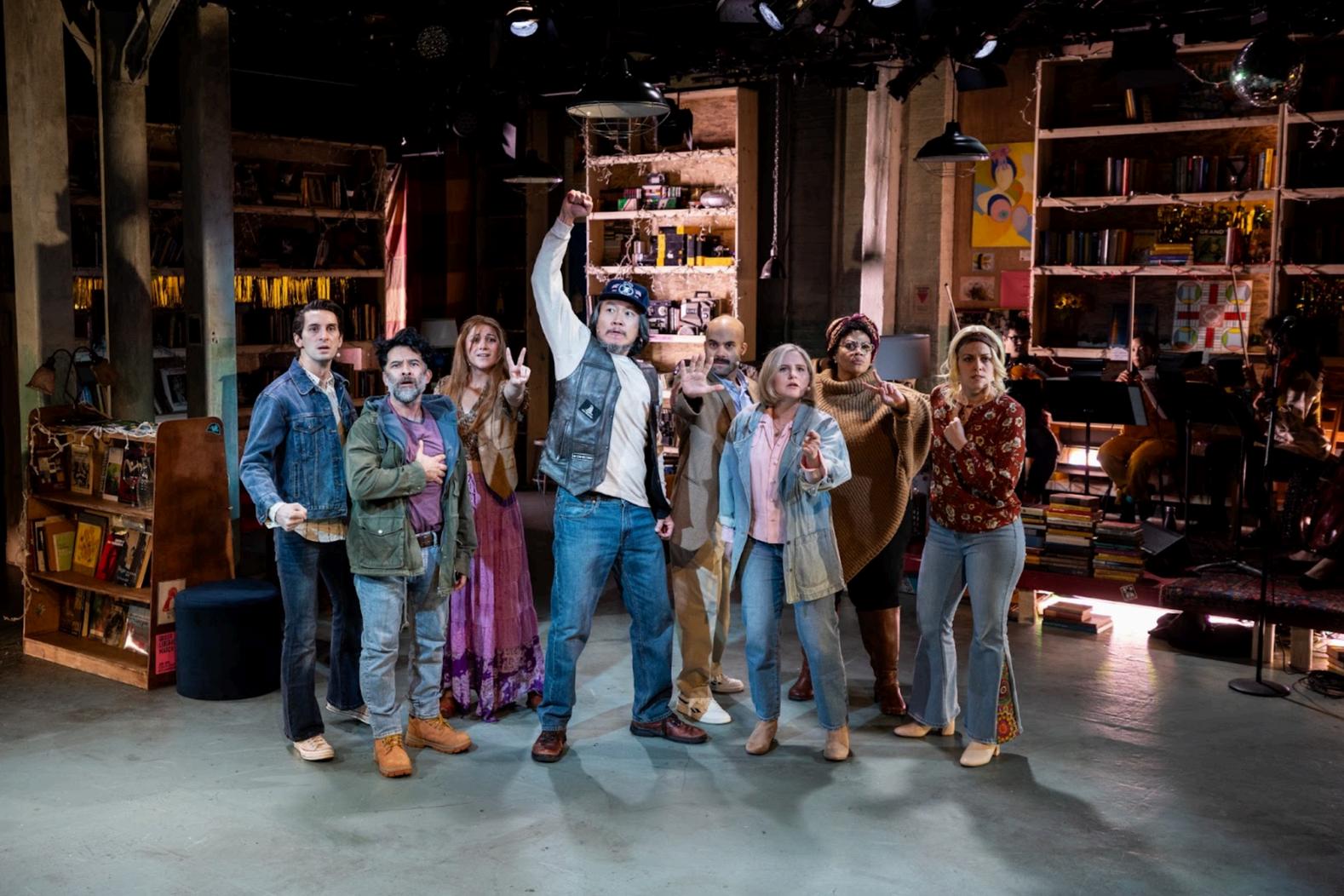
Tim Russell, Paul Pinto, Natalie Trumm, Paul Chwe MinChul An, Michael Kuhn, Amy Justman, Adrienne Danrich and Danielle Buonaiuto in the world premiere production of Eat the Document. Photo by Maria Baranova.