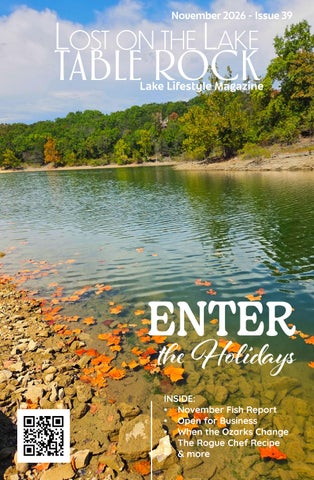
November 2026 - Issue 39
Lost on the Lake TABLE ROCK
Lake Lifestyle Magazine
ENTER
the Holidays INSIDE: • November Fish Report • Open for Business • When the Ozarks Change • The Rogue Chef Recipe • & more
1- Lost on the Lake
From my Side of the Dock The Other Side of Summer
There comes a time every year when Table Rock Lake seems to exhale. The boats become fewer, the docks grow quiet, and the summer crowds head home with their photographs, sunburns, and stories of the fish that got away. And while I love the wonderful chaos of summer, there‘s something pretty special about November around the lake. The mornings are quieter, the hills are changing, and the lake takes on a beauty all its own. Meanwhile, just down the road, Branson is doing precisely the opposite. Pumpkins are disappearing, Christmas lights are going up, and the theaters are preparing for another spectacular holiday season. One part of the Ozarks is putting its feet up while the other is plugging in several million Christmas lights. This issue celebrates both sides of the season, from fall fishing and migrating wildlife to holiday entertainment and the quieter pleasures of lake life. And with Thanksgiving approaching, I hope we‘ll all take a moment to appreciate the people who make this community so special. Check on a neighbor, reach out to an old friend, or invite someone who might otherwise spend the holiday alone to join your celebration. After all, we spend our summers making room for one more person on the boat. Surely we can find room for one more at the table. Summer may be what brings us to Table Rock Lake, but the other seasons have a wonderful way of reminding us why we stay. Happy Thanksgiving, and I‘ll see you around the lake!
See you on the lake.
2- Lost on the Lake
Myra Thornton
CREATIVE EDITOR Myra Thornton CONTRIBUTING WRITERS The Rogue Chef Tracey Lightfoot Myra Thornton CONTRIBUTING PHOTOGRAPHERS The Rogue Chef Tracey Lightfoot Myra Thornton ADVERTISING SALES Myra Thornton COVER PHOTO: Find us on Facebook
Publisher Myra Thornton www.lostonthelake.us
email: hello@lostonthelake.us
Phone: 417-593-1167
3- Lost on the Lake
5- Lost on the Lake
8
13
18
NOVEMBER FISHING
OPEN FOR BUSINESS
THE ROGUE CHEF RECIPE
Fishing
6- Lost on the Lake
Community
Cooking
Contents
NOVEMBER 2026 - Issue 39
20
24
28
WHEN THE OZARKS CHANGE THEIR TUNE
WILD ON TABLE ROCK
THE LAKE HAS A SECOND SEASON
Local Life
Wildlife
Cooking
7- Lost on the Lake
November
FISHING
Summer may be over, but November brings a whole new fishing season to Table Rock Lake. By November, most of the summer crowd has packed away the swimsuits, pulled the boats out of the water, and reluctantly accepted that another season on Table Rock Lake has come to an end. The docks are quieter, the boat ramps are less crowded, and the familiar soundtrack of wake boats and personal watercraft has faded into something considerably more peaceful. Apparently, nobody bothered to tell the 8- Lost on the Lake
fish. Beneath the cooling surface of Table Rock Lake, an entirely different kind of activity is taking place. As autumn settles into the Ozarks, baitfish shift locations, bass adjust their feeding patterns, and anglers willing to brave a little cooler weather discover that November can offer some of the most rewarding fishing opportunities of the year. For those who know the lake, this is hardly a secret. While summer may attract the largest number of recreational boaters, fall
brings a devoted group of anglers who understand that fewer boats and cooler temperatures can make for a very productive day on the water. A Lake in Transition November fishing on Table Rock Lake is largely a story of change. As water temperatures fall, the lake gradually loses the warmth it accumulated throughout summer. Conditions can vary considerably between the main lake, its tributary arms, and the protected coves tucked into the surrounding hills. As the lake moves through its seasonal turnover, bass may become scattered across a variety of depths and locations. One day, fish may be feeding aggressively around shallow cover. On another, they may be holding near steep rocky banks, submerged timber, or deeper points where baitfish have gathered. Threadfin shad are an important food source for bass in Table Rock Lake, and their movements often provide valuable clues. As water temperatures change, schools of shad may concentrate in creek arms, pockets, and other favorable areas, drawing hungry bass along with them. Anglers who pay attention to baitfish activity, wind direction, water clarity, and changing weather conditions often have an advantage. Modern electronics can help locate schools of baitfish and suspended fish, but understanding the lake remains just as important as having the latest equipment. The fish, unfortunately, have never shown much interest in explaining their decisions. Three Bass, Three Personalities
FISHING Table Rock Lake is famous for its largemouth, smallmouth, and spotted bass, often called Kentucky bass by local anglers. Each species offers its own challenges during the cooler months. Largemouth bass may be found around creek channels, docks, submerged wood, and other cover, particularly when baitfish are nearby. Under favorable conditions, they may move into relatively shallow water to feed. Smallmouth bass favor rocky habitat, making gravel points, chunk-rock banks, and bluff transitions worth exploring. Their strength and spirited fight make them a favorite among anglers, regardless of the season. Spotted bass are especially well suited to Table Rock’s clear, deep-water environment. They frequently relate to points, steep banks, submerged structure, and schools of baitfish suspended away from shore. Although each species has its preferences, changing conditions can produce overlapping patterns. Finding fish often requires flexibility and a willingness to explore different depths. What’s Working in Cooler Water? November offers opportunities to use a variety of techniques, but successful anglers generally adjust their presentations to match the conditions. Spinnerbaits and crankbaits can be effective around windblown banks and rocky shorelines when bass are actively feeding. Jerkbaits become increasingly popular as temperatures fall, particularly in clearer water, where their darting action can imitate an injured baitfish. cont page 10
9- Lost on the Lake
10- Lost on the Lake
Finesse presentations, including dropshot rigs, shaky heads, and small swimbaits, can be productive when bass are holding deeper or responding poorly to faster-moving lures. Jigs remain reliable around rocky points and submerged cover, while shad-imitating baits may work well when fish are feeding on suspended schools of baitfish. Weather also plays an important role. A warm, windy afternoon may produce entirely different results from a calm morning following a cold front. Water clarity, changing temperatures, and recent rainfall can all influence where fish are located and how aggressively they feed. The most successful anglers are often those willing to abandon yesterday’s pattern and pay attention to what the lake is telling them today. Of course, purchasing another expensive lure is always an option, although the fish have yet to demonstrate any appreciation for the size of an angler’s tackle collection. More Than Bass Although bass receive much of the attention on Table Rock Lake, they aren’t the only species worth pursuing in November. Crappie can provide enjoyable fall fishing around submerged brush, standing timber, and other suitable structure. Small jigs and minnows remain popular choices, particularly when anglers locate schools of fish gathering at favorable depths. White bass may also offer opportunities where baitfish are concentrated. These energetic fish can provide fast action when actively feeding, although locating them
may require covering water and watching for signs of activity. Whatever the target, anglers should check current Missouri Department of Conservation regulations before heading out. The Reward of a Quieter Lake November fishing has its advantages, but cooler weather also requires additional preparation. Water temperatures can become dangerously cold, even on pleasant afternoons, making properly fitted life jackets, layered clothing, and appropriate safety equipment particularly important. Shorter daylight hours and unpredictable Ozarks weather also deserve attention. Checking the forecast, monitoring wind conditions, and allowing plenty of time to return before dark can make a significant difference. For those willing to prepare, the rewards extend well beyond the catch. With fewer recreational boats on the water, anglers can explore familiar areas without the constant interruptions of summer traffic. The hills provide a colorful backdrop, the air feels crisp, and even a slow fishing day can offer the kind of peace that is increasingly difficult to find. A successful outing might include a memorable smallmouth, a productive stretch of shoreline, or a school of bass feeding aggressively on shad. It might also include a thermos of coffee, cold fingers, and a fish that somehow manages to steal the last expensive lure in the tackle box. Either way, the lake has a way of making the effort worthwhile. 11- Lost on the Lake
Nick & Amy Morris
Licensed Insurance Agents
TRIBUTE
OPEN The Lake Doesn’t Close for the Season The boats may be fewer, the mornings a little cooler, and the docks considerably quieter. But around Table Rock Lake, some of the best days arrive after summer has packed its bags. There comes a point every autumn when Table Rock Lake seems to take a collective breath. The steady parade of boats begins to thin, the familiar rumble of personal watercraft becomes an occasional interruption rather than the soundtrack of an entire afternoon, and finding a parking spot near the water no longer requires the patience of a saint or the competitive instincts of a professional athlete. Summer, with all its glorious chaos, has finally loosened its grip. For some, this signals the end of another lake season. Boats are winterized, lake houses are closed
for Business
for the year, and calendars begin filling with holiday obligations instead of weekend plans on the water. The swimsuits disappear into drawers, the sunscreen migrates to the back of the bathroom cabinet, and thoughts of Table Rock Lake are tucked away until spring. But for those who live here, and for visitors who have discovered the quieter side of the Ozarks, November isn’t an ending at all. It’s simply a different kind of lake season. And depending on whom you ask, it might be one of the best. When the Water Gets Quiet There is a particular beauty to Table Rock Lake when the activity slows. Without the constant movement of summer traffic, the water often becomes a broad reflection of the surrounding hills, catching the changing colors of the trees and the soft light of shorter autumn days. cont page 14
13- Lost on the Lake
Early mornings can be especially remarkable. Mist sometimes gathers above the surface, drifting between wooded shorelines and disappearing as the sun climbs over the ridges. The air is cooler, the sounds carry farther, and the lake takes on an almost private quality that is difficult to find during the height of vacation season. Even familiar places can look entirely different. The bluffs rising above the water seem more dramatic against the thinning trees, while the long fingers of the lake stretch into quiet valleys where the changing season has painted the hills in muted shades of copper, gold, and brown. There is no shortage of beautiful scenery around Table Rock Lake in July, but November offers something that can be harder to find in midsummer. Room to appreciate it. The Shoreline Has a Season, Too One of the great misconceptions about Table Rock Lake is that enjoying it requires owning a boat. While spending time on the water is certainly part of the region’s appeal, some of the most memorable experiences happen without ever leaving dry land. November is a particularly good time to rediscover the trails, overlooks, parks, and wooded landscapes surrounding the lake. At Table Rock State Park, visitors can explore wooded trails and enjoy the changing scenery along 14- Lost on the Lake
the shoreline. The Table Rock Lakeshore Trail provides a more leisurely experience, following portions of the water’s edge near the dam and state park marina. The cooler temperatures make these outings especially enjoyable. Trails that feel uncomfortably warm during summer become inviting again, and thinning vegetation opens views into the forest that are often hidden during the growing season. Wildlife activity also becomes easier to notice. Deer move through the woods, squirrels busily prepare for winter, and bald eagles may be spotted soaring over the lake or perched in shoreline trees. A quiet walk through the woods can reveal an entirely different side of lake life, one that doesn’t involve boat fuel, dock reservations, or remembering where someone put the cooler. The Towns Come Back to Themselves The communities surrounding Table Rock Lake experience their own transformation when the summer crowds depart. In places such as Kimberling City, Shell Knob, and the smaller lakeside neighborhoods scattered around the shoreline, the pace begins to settle. Restaurants that spent the summer serving vacationing families return to a more familiar rhythm, and local businesses shift their attention toward the residents who keep these communities alive through-
out the year.
utive hours in the sun.
Conversations last a little longer. A stop for breakfast doesn’t necessarily involve waiting behind a dozen hungry families, and the person sitting at the next table may have lived on the lake long enough to remember when the roads, businesses, and neighborhoods looked very different.
In November, a leisurely morning might begin with coffee overlooking the water, followed by a drive along the winding roads that connect the lake’s many communities. An afternoon could include a hike through the woods, a visit to a local attraction, or an unhurried lunch at a favorite restaurant.
Not every business remains open year-round, of course, but those that do become important gathering places, offering a sense of community that is sometimes difficult to appreciate during the busiest months.
Fishing remains a popular pursuit, and boating can still be enjoyable when weather and water conditions cooperate. For those who prefer dry land, the surrounding Ozarks offer scenic drives, wooded trails, and plenty of opportunities to enjoy the outdoors without a complicated itinerary. By evening, the cooler air makes a warm meal and a comfortable place to gather particularly inviting. Outdoor fire pits, lakeside cabins, and quiet decks overlooking the water take on a different appeal when the temperature begins to fall.
For visitors accustomed to seeing Table Rock Lake only during summer vacation, discovering this quieter atmosphere can be a pleasant surprise. For those who live here, it is simply home. A Different Kind of Weekend There is no rule requiring a lake weekend to include swimming, tubing, or spending eight consec-
There is something wonderfully uncomplicated about a weekend that doesn’t require a carefully coordinated schedule of water activities. Sometimes the best plan is simply to see where the day goes. The Season That Belongs to the Locals Ask someone who lives around Table Rock Lake what they enjoy about the off-season, and the answer may have very little to do cont page 16
15- Lost on the Lake
with the weather.
chose to be here.
For many residents, the return of quieter roads, uncrowded restaurants, and peaceful coves is a welcome change after months of summer activity.
Perhaps We’ve Been Thinking About Lake Season All Wrong
That doesn’t mean the visitors aren’t appreciated. Tourism supports businesses, jobs, and attractions throughout the region, and the energy of summer is part of what makes Table Rock Lake such a vibrant destination. But there is a natural rhythm to life in a resort community, and the quieter months provide an opportunity to reconnect with the place itself. Neighbors have time to visit. Familiar faces become easier to recognize. Community gatherings and local traditions take on greater importance as daily life settles into something more predictable. The lake, meanwhile, continues doing exactly what it has always done. The sun rises over the hills. Fishing boats head out in the early morning. Deer wander through wooded neighborhoods, and the occasional bald eagle passes overhead, entirely unconcerned with whether tourist season has officially ended. For the people who call Table Rock Lake home, these moments are not simply the leftovers of a busy summer. They are part of the reason they 16- Lost on the Lake
It is easy to associate Table Rock Lake with the experiences that fill summer advertisements: boats cutting across blue water, children leaping from swim platforms, families gathered on docks, and long afternoons spent soaking up the sunshine. Those moments are wonderful, but they represent only one chapter of life around the lake. There are mornings in November when the water is so still that the shoreline seems to exist twice, once above the surface and once reflected below it. There are cool afternoons when the woods are filled with rustling leaves, and evenings when the lights of distant homes begin appearing across the darkening hills. There are quiet fishing trips, unexpected wildlife encounters, conversations over coffee, and scenic drives that remind us why people have been drawn to these mountains for generations. None of these experiences requires summer weather. Perhaps the real beauty of Table Rock Lake is that it doesn’t offer just one kind of experience. It changes with the seasons, revealing different landscapes, different activities, and different reasons to appreciate the place.
17- Lost on the Lake
Fresh Recipe The Rogue Chef Red Wine Braised Beef Short Ribs Time: 3 Hrs 40 Min Servings: 4-6 Ingredients • • • • • • • • • • • • • • • • •
4–5 lbs. Bone-In Beef Short Ribs 2 Tbsp. Olive Oil 1 Large Yellow Onion, Diced 2 Carrots, Diced 2 Celery Stalks, Diced 5 Garlic Cloves, Smashed 2 Tbsp. Tomato Paste 2 C Dry Red Wine (Cabernet Sauvignon or Merlot) 2 C Low-Sodium Beef Stock 1 Tbsp. Balsamic Vinegar 1 Tbsp. Dijon Mustard 3 Sprigs Fresh Rosemary 4 Sprigs Fresh Thyme 2 Bay Leaves 2 Tbsp. Cold Unsalted Butter Kosher Salt and Freshly Ground Black Pepper, To Taste Fresh Parsley, Chopped, for Garnish
Instructions: 1. Preheat oven to 325°F. Pat short ribs dry with paper towels and season generously with kosher salt and black pepper. 2. Heat olive oil in a large Dutch oven over medium-high heat. Sear short ribs in batches for 3–4 minutes per side until deeply browned. Remove and set aside. 3. Reduce heat to medium. Add onion, carrots, and celery to the Dutch oven. Sauté for 5–7 minutes until softened. Add garlic and tomato paste, stirring for another 1–2 minutes. 18- Lost on the Lake
4. Pour in red wine, scraping the bottom of the pot to release the browned bits. Simmer for 8–10 minutes to reduce slightly. 5. Stir in beef stock, balsamic vinegar, and Dijon mustard. Add rosemary, thyme, and bay leaves. 6. Return short ribs to the Dutch oven, bone-side down. The liquid should reach approximately halfway up the meat. Bring to a gentle simmer, cover, and transfer to the oven. Braise for 21⁄2–3 hours until fork-tender. 7. Remove short ribs and keep warm. Strain braising liquid into a saucepan and skim excess fat. Simmer until slightly thickened and concentrated. Remove from heat and whisk in cold butter for a silky finish. 8. Place short ribs over creamy mashed potatoes or Parmesan polenta. Spoon the red wine reduction over the beef and garnish with fresh parsley. GO ROGUE: For an unexpected layer of flavor, add 1–2 teaspoons of finely grated orange zest to the finished red wine reduction. The subtle citrus notes brighten the richness of the beef without overpowering the savory herbs. Chef Jeff’s Tip: The secret to exceptional short ribs isn’t an expensive cut of meat. It’s allowing collagen-rich beef to cook gently until the connective tissue softens into gelatin. Keep the braising liquid at a gentle simmer and resist the temptation to turn up the heat.
Want The Rogue Chef to make this delicious dish for you? Contact us at www.TheRogueChef.com.
19- Lost on the Lake
When The Ozarks
Change their tune
From autumn color to Christmas lights, November brings a remarkable transformation to Table Rock Lake and the surrounding hills. There is a peculiar moment in the Ozarks when autumn hasn’t quite finished its performance, but Christmas is already waiting in the wings. The hills surrounding Table Rock Lake are still dressed in shades of amber, rust, and gold, the afternoons can be warm enough to tempt boaters onto the water, and the last of the season’s pumpkins are holding their ground. Yet just a few miles away, an entirely different season is taking shape. Behind the scenes at Branson’s theaters and attractions, costumes are changing, 20- Lost on the Lake
decorations are appearing, and the familiar sounds of summer entertainment are giving way to sleigh bells, Christmas carols, and holiday productions. It is a transformation that happens every year, but the sheer scale of it remains remarkable. November around Table Rock Lake is not simply the end of one season. It is the beginning of another, and the Ozarks have become particularly good at making the transition something worth experiencing. Perhaps nowhere is that transformation more dramatic than at Silver Dollar City, where the final days of October bring the conclusion of the park’s Harvest Festival. The glowing pumpkins,
the length of its predecessor. Elaborate floats, illuminated displays, familiar holiday characters, and a Nativity finale will wind through the park, adding another dimension to an already impressive celebration. The transformation extends well beyond the decorations. The park’s entertainment schedule takes on an entirely different character, with productions such as *A Dickens’ Christmas Carol*, *The Living Nativity*, and seasonal musical performances filling its theaters. Craftsmen continue their work, shops fill with handmade holiday gifts, and the familiar aromas of the park take on decidedly festive notes.
PHOTO BY: SILVER DOLLAR CITY
autumn decorations, and seasonal celebrations that filled the park throughout the fall give way to one of the most elaborate Christmas displays in the country. When An Old Time Christmas opens on November 7, visitors will enter a park illuminated by more than 6.5 million lights. The transformation reaches into nearly every corner of Silver Dollar City, from the towering displays of Christmas in Midtown to the eight-story animated tree in Town Square. The park’s 54-foot Grand Fir returns to the Plaza, where nightly lighting ceremonies bring music and holiday tradition together. For 2026, Silver Dollar City is introducing its new Stars, Lights & Christmas Nights Parade, a production twice
It is difficult to imagine the amount of work required to turn an entire 1880s-themed village from autumn into Christmas in a matter of days. Somewhere behind the scenes, there must be a decorating crew that has developed a very complicated relationship with extension cords. Just down the road, another Ozarks landmark is preparing for its own seasonal transformation. The Shepherd of the Hills, a destination deeply connected to the history and storytelling traditions of the region, begins its holiday programming in early November. The historic homestead becomes the setting for Christmas productions, illuminated trails, family adventures, and celebrations that combine familiar holiday traditions with the character of the Ozarks. cont page 22
21- Lost on the Lake
The Trail of Lights returns in early November, carrying visitors through a winding landscape of illuminated scenes and colorful displays spread across the property’s 160 acres. For families who have made the drive an annual tradition, the experience is as much about the memories as the lights themselves. Children who once watched from the back seat eventually return with children of their own, following the same glowing route through the hills. The property’s North Pole Adventure begins November 13, adding a walkthrough holiday experience with Santa visits, family activities, and a hayride through portions of the decorated grounds. Inside the theaters, the holiday season brings a different kind of entertainment. *A Shepherd’s Christmas Carol* combines a traditional Christmas tale with the characters and setting of the Ozarks, while *A Christmas Story* brings a familiar family favorite to the stage. Other seasonal productions add music, comedy, and a touch of Western character to the holiday lineup. It is a reminder that the Ozarks have always been a place where storytelling matters, whether those stories are told around a campfire, on an outdoor stage, or beneath thousands of Christmas lights. Throughout Branson, the transformation continues. The city’s theaters, long associated with country music, comedy, variety performances, and family entertainment, begin shifting their attention toward Christmas. Holiday ar22- Lost on the Lake
rangements find their way into musical productions, stage sets take on a festive appearance, and familiar performers trade portions of their regular shows for seasonal favorites. For visitors who know Branson primarily as a summer destination, the November entertainment calendar can feel like discovering an entirely different city. Many of the venues are familiar, but the atmosphere changes considerably. The same theaters that welcomed vacationing families during the warmer months now offer evenings filled with holiday music, elaborate costumes, nostalgic stories, and Christmas traditions. At Sight & Sound Theatres, *Miracle of Christmas* returns November 3 and continues through December 31. The large-scale production brings the Nativity story to the stage through elaborate scenery, live animals, music, and theatrical effects. The theater’s expansive stage and immersive presentation make the production a distinctive part of Branson’s holiday entertainment season. Meanwhile, the Branson Scenic Railway begins its Polar Express holiday excursions on November 12. The train departs from the historic downtown depot, offering families a journey inspired by the beloved Christmas story. For children, the experience brings the familiar tale to life; for adults, it offers an opportunity to revisit a little of the anticipation and wonder that once made Christmas Eve seem impossibly long. The holiday transformation is not limited to the major attractions. Throughout the region, shops begin filling their win-
dows with seasonal displays, restaurants introduce comforting winter flavors, and communities prepare for tree lightings, parades, markets, and celebrations that will continue into December. The change is particularly noticeable after dark. Where autumn evenings once settled quietly over the hills, November begins to introduce pockets of color and light. Roads that wind through wooded landscapes lead toward illuminated attractions, decorated storefronts, and theaters welcoming another audience. The region that spent its summer entertaining visitors on the water now offers an entirely different collection of reasons to venture out. Yet for all the activity taking place in Branson, Table Rock Lake itself seems content to move into November at a more leisurely pace. The lake does not suddenly become less beautiful because the calendar has turned. In many ways, the cooler months reveal details that summer’s constant activity can obscure. The shoreline becomes more visible as leaves begin to fall, the morning light takes on a softer quality, and the water reflects the changing hills without quite so many boats interrupting the view. There are still warm afternoons that invite a final cruise, fishing trips that begin in the cool morning air, and scenic drives that seem particularly rewarding when the trees are showing off their last colors. Hiking trails become more comfortable, lakeside restaurants offer a quieter atmosphere, and the communities surrounding the water begin settling
into their off-season routines. It is this contrast that makes November such an interesting time to experience the Table Rock region. A morning might begin with coffee overlooking a peaceful cove, followed by an afternoon exploring a trail or wandering through a lakeside community. By evening, the same visitors can find themselves surrounded by millions of Christmas lights, watching a holiday production, or enjoying a festive dinner just a short drive from the water. Few destinations offer such distinctly different experiences within such a small geographic area. The natural beauty that draws people to Table Rock Lake remains, while the entertainment and attractions of Branson begin an entirely new season. There is something rather fitting about the way the season unfolds here. The hills do not surrender their autumn colors all at once, and the lake makes no particular effort to announce the end of summer. Instead, the landscape changes gradually while the surrounding communities prepare for Christmas with considerably more enthusiasm. By the time the last pumpkins disappear and the holiday lights begin glowing across the hills, the transformation is nearly complete. The Ozarks have changed their tune once again. And around Table Rock Lake, there is still plenty worth staying for. 23- Lost on the Lake
Wild on Table Rock:
The Great Autumn Passage As November settles over the Ozarks, the skies, shorelines, and forests surrounding Table Rock Lake become part of one of nature’s most remarkable seasonal journeys.
While residents around Table Rock Lake are preparing for the approaching holidays and settling into the quieter days of autumn, an extraordinary movement is taking place throughout the natural world. High above the wooded hills, across the open water, and through the valleys of the Ozarks, thousands of birds are following migratory routes that have existed for countless generations. Some are traveling from northern breeding grounds, while others have already completed journeys spanning hundreds or even thousands of miles. For certain species, the Ozarks provide a temporary resting place before they continue south. For others, the region offers the food, shelter, and open water needed to spend the winter. Although spring migration often receives the greatest attention, autumn brings an 24- Lost on the Lake
equally fascinating transformation to the wildlife surrounding Table Rock Lake. By November, many familiar summer birds have departed, and an entirely different collection of seasonal visitors begins appearing in the forests and waterways. A Changing Population Throughout spring and summer, the Ozarks provide breeding habitat for numerous migratory birds, including warblers, flycatchers, and swallows. As daylight hours shorten, many begin their journeys south, often leaving well before the first significant cold weather arrives. By November, winter visitors such as dark-eyed juncos, white-throated sparrows, and yellow-rumped warblers become more noticeable. Dark-eyed juncos, sometimes called snowbirds, are frequently seen hopping beneath shrubs and backyard feeders, searching for seeds among fallen leaves. White-throated sparrows are recognizable by their striped heads and yellow markings near the eyes, while yellow-rumped warblers can supplement their insect diet with berries, allowing them to remain in colder regions than
many other warbler species. These subtle seasonal movements, often taking place in familiar backyards and wooded neighborhoods, represent part of a vast annual migration that reshapes bird populations across North America. Eagles Return to the Water Among the most impressive seasonal visitors are bald eagles, whose presence around Table Rock Lake can become more noticeable during late autumn and winter. Although some bald eagles remain in the Ozarks throughout the year, additional birds may arrive from northern regions as lakes and rivers begin to freeze. The open waters of Table Rock provide opportunities to find fish, making the reservoir and surrounding waterways attractive winter habitat. November can be especially rewarding for eagle watching because thinning foliage reveals large shoreline trees that were partially hidden during summer. Younger bald eagles may be less recognizable because they lack the distinctive white head and tail of mature adults. Their plumage is primarily brown, often with irregular white markings, and they generally develop their familiar adult appearance around five years of age. Despite their impressive hunting abilities, bald eagles are also opportunistic feeders, readily scavenging or taking food from other birds when the opportunity arises. New Arrivals on the Lake The waters of Table Rock Lake also become part of the seasonal migration of
ducks and other waterbirds. As temperatures decline farther north, species such as buffleheads, common goldeneyes, and mergansers may appear on larger bodies of water throughout the Ozarks. Unlike dabbling ducks that feed near the surface, diving ducks search underwater for fish, aquatic insects, and other food. Hooded mergansers are particularly distinctive, with their prominent crests and narrow bills adapted for catching fish. American coots, although frequently mistaken for ducks, are another familiar sight on protected waters during the cooler months. The variety of waterbirds present changes with weather conditions, available food, and migration patterns. A sheltered cove that appears quiet one week may become a temporary gathering place for migrating birds the next. The Journeys We Never See One of the most remarkable aspects of autumn migration is that much of it takes place after dark. Many songbirds travel primarily at night, when cooler temperatures and favorable atmospheric conditions can make long-distance flight more efficient. These birds navigate using a combination of natural abilities, including sensitivity to the Earth’s magnetic field, celestial cues, and geographic features. Although the peak migration of many long-distance songbirds through Missouri occurs earlier in autumn, November still brings movement among later-migrating species and birds responding to changing winter conditions. cont page 26
25- Lost on the Lake
On favorable nights, large numbers of birds may pass over the Ozarks without being seen by the people below, reminding us that the natural world remains active even when the landscape appears peaceful and still. Changes Along the Shoreline Bird migration is only one part of the seasonal transformation around Table Rock Lake. November also brings noticeable changes in the behavior of mammals inhabiting the surrounding forests. White-tailed deer become particularly active during their autumn breeding season, commonly known as the rut. Bucks may travel greater distances in search of receptive does, making deer more visible along woodland edges, open fields, and roadsides. Motorists should remain especially alert during early morning and evening hours. Squirrels continue gathering acorns, hickory nuts, and other food sources, while wild turkeys may be observed moving through wooded areas in groups. Raccoons, foxes, and other mammals remain active as they adjust to cooler temperatures and changing food availability. As leaves fall, the forest becomes more open, revealing wildlife, nests, animal trails, and other signs of activity that were concealed during summer. Watching the Season Unfold One of the pleasures of wildlife watching around Table Rock Lake is that memorable encounters often happen without elaborate planning. A quiet morning overlooking the water may provide a glimpse of an eagle passing overhead, while a 26- Lost on the Lake
walk through a wooded neighborhood can reveal wintering songbirds searching through fallen leaves. Table Rock State Park, nearby conservation areas, and the wooded shorelines surrounding the reservoir offer opportunities to observe these seasonal changes. Binoculars can make identifying unfamiliar species easier, but patience and careful observation are often the most valuable tools. Wildlife should always be observed from a respectful distance, particularly during migration and winter, when conserving energy is important. As November gives way to December, the landscape around Table Rock Lake will continue its gradual transition toward winter. Some migrating birds will have traveled farther south, while others will remain in the Ozarks until spring, taking advantage of the region’s forests, sheltered valleys, and open water. For those of us who call Table Rock Lake home, these seasonal changes offer another reason to appreciate the remarkable natural environment surrounding our communities. The lake may be quieter without the summer crowds, but the wildlife inhabiting its waters and woodlands continues following rhythms that have shaped the Ozarks for generations. Whether it is the arrival of a small winter songbird, waterfowl gathering in a protected cove, or a bald eagle soaring above the shoreline, November offers countless opportunities to witness the changing season. Sometimes, discovering the most remarkable things happening around the lake requires nothing more than slowing down long enough to notice them.
When was the last time you visited Table Rock Lake without a summer agenda and discovered just how good the off-season can be?
27- Lost on the Lake
The Lake Has A Second Season Written By: The Rogue Chef www.theroguechef.com
There’s a moment every fall when Table Rock Lake seems to take a deep breath. The boats thin out, the docks get quieter, and suddenly you can hear things you forgot existed. Birds. Wind moving through the trees. Your neighbor’s dog barking three coves away. The lake hasn’t closed for the season. It’s just changed its personality. Summer gets most of the attention around here, and rightfully so. There’s nothing quite like a lake full of families, boats, sunshine, and people trying to remember which cove they parked in. But those of us who spend time around Table Rock Lake know something the summer crowds sometimes miss. The lake has a second season, and it might be one of its best. 28- Lost on the Lake
COOKING
When the Lake Slows Down November doesn’t arrive with much fanfare. The water cools, the mornings turn crisp, and the hillsides trade their bright summer greens for the last shades of autumn. The pace changes, too. You can take a drive without planning around boat traffic, enjoy a quiet view of the water, or sit outside with a cup of coffee without feeling like you should be doing something else. And while the lake settles into its quiet-
er rhythm, something interesting starts happening in the kitchen. We start cooking differently. The Science of Slowing Down Summer cooking tends to move quickly. Hot grills, fresh ingredients, and meals that don’t keep anyone away from the water longer than necessary. Cooler weather gives us a reason to slow things down. Braising is a perfect example. It’s a cooking method that combines an initial sear with gentle cooking cont page 30
29- Lost on the Lake
in a small amount of liquid. Tougher cuts of meat, like beef chuck or short ribs, contain connective tissue rich in collagen. Given enough time and moisture, that collagen gradually converts into gelatin, creating tender meat and a rich, silky cooking liquid. That’s why a cut of meat that might be tough after twenty minutes can become fork-tender after several hours.
pened hours earlier. That’s one of the things we appreciate about this kind of cooking. It allows the cook to enjoy the day, too. And if someone asks what you’ve been doing all afternoon, you can tell them you’ve been developing flavor. It sounds considerably more impressive than admitting you’ve been watching football.
And here’s something worth remembering: low and slow doesn’t mean the lower the temperature, the better. The cooking liquid should maintain a gentle simmer, not a rolling boil. Too much heat can tighten muscle fibers and dry out the meat, even when it’s surrounded by liquid.
It’s easy to associate Table Rock Lake with summer vacations, packed docks, and long afternoons on the water. Those memories are part of what makes this place special.
It’s a little science, a little patience, and a whole lot of flavor. Of course, patience is easier when you’re not trying to get dinner on the table between two boat rides. A Different Kind of Lake Day There’s something wonderful about coming inside after spending time in the cool November air and smelling dinner that’s been cooking for hours. You don’t need a complicated menu or an elaborate occasion. Sometimes it’s a pot of beef slowly braising, fresh bread warming in the oven, and a kitchen that smells better than any candle you’ll find at the store. The best part? Much of the work hap30- Lost on the Lake
The Season We Almost Miss
But November offers something different. There’s room to notice the little things. The reflection of bare trees on still water. A quiet shoreline. The warmth of coming back inside after a chilly afternoon. And perhaps that’s what makes this second season worth appreciating. It reminds us that a place doesn’t have to be busy to be beautiful, and a meal doesn’t have to be elaborate to be memorable. Summer will return, bringing its boats, sunshine, and wonderful chaos. Until then, there’s a quieter side of the lake waiting to be enjoyed.
31- Lost on the Lake
The A Doing Absolu An underrated November pastime at Table Rock Lake. Somewhere along the way, we developed the idea that a day at the lake ought to involve doing something. There should be a boat ride, a fishing trip, a hike, a project around the house, or at the very least, a plan for lunch. But November has a rather wonderful way of reminding us that not every hour needs an itinerary. There is something especially appealing about sitting outside on a cool autumn afternoon with a warm cup of coffee and absolutely nowhere to be. The summer crowds have disappeared, the water has 32- Lost on the Lake
settled, and the hills surrounding Table Rock Lake are slowly trading their brilliant autumn colors for the softer shades of winter. A few leaves drift across the deck. Somewhere in the distance, a fishing boat makes its way along the shoreline. An eagle might pass overhead, although there’s a very good chance you’ll miss it because you’ve become completely absorbed in watching a squirrel investigate something beneath a tree. And that’s perfectly fine. During the summer months, lake life tends to move at a rather enthusiastic
EXPLORE LIFESTYLE
Art of utely Nothing pace. There are friends to entertain, boats to launch, coolers to pack, and an endless list of things everyone wants to squeeze into a weekend. Even relaxation can begin to feel suspiciously like a scheduled activity. November offers a different invitation. Take the long way home. Sit on the dock a little longer. Watch the last sunlight settle across the water without feeling compelled to photograph it, post it, or do anything particularly productive with the experience. For those fortunate enough to live around Table Rock Lake, these quiet moments are among the greatest privi-
leges of calling this place home. And for visitors who have only experienced the excitement of summer, the slower season reveals a side of the lake that is every bit as beautiful. There will be plenty to do soon enough. The holidays are approaching, calendars are filling, and before long we’ll all be wondering how another year managed to disappear so quickly. For now, though, there’s a perfectly good chair overlooking the water, a little afternoon sunshine, and no compelling reason to move. Sometimes, that’s enough. 33- Lost on the Lake