YO U R S T O K E E P
VO L 2 6 I S S U E 1 4 4
Step into the region’s original mineral bathing destination As the historic heart of Hepburn Springs, this landmark Bathhouse continues its long tradition of mineral‑rich bathing in beautifully updated spaces. Enjoy Private, Sanctuary or Bathhouse Mineral bathing, restorative spa treatments, and quiet moments at the Apothecary or Hepburn Pavilion Cafe. A short stroll from Daylesford, it remains the area’s timeless source of renewal.
Scan here to learn more
hepburnbathhouse.com
P: (03) 8727 8901
E: reservations@hepburnbathhouse.com
S: @hepburnbathhousespa
CO N TE N TS C R E AT E
PL ACE
The Art of Wild & Slow
Objects with Intention
10
34
PRODUCE
E AT
Wholefoods, Wholehearts
Framed by Forests
18
42
F E AT U R E
DRINK
The Joy & the Energy
The Classic 100
26
50
L O S T N E W S
PAG E 07
R E A S O N S T O G E T L O S T
PAG E 6 0
L O C A L Q & A
PAG E 62
low commissions, high returns 100% Daylesford based, owned and operated
At The Houses Daylesford, we specialise in curating a collection of handpicked, beautifully styled accommodations that offer something truly special.
join the region’s most
popular portfolio of
holiday homes
0430 068 999 thehousesdaylesford.com stay@thehousesdaylesford.com
LO S T M AG A Z I N E | 3
VO L 2 6 I S S U E 1 4 4 | AU TU M N 2 0 2 6 ABOUT LOST MAGA ZINE
Lost Magazine is an independent magazine circulating throughout Daylesford, Hepburn Springs, Kyneton, Trentham, Glenlyon, Castlemaine, Woodend, Creswick, Clunes and surrounds. We also distribute to select Melbourne venues and to an ever-growing subscriber base.
LOST TEAM
PUBLISHER
PUBLISHER
EDITOR
Tony De Marco
Theresa Albioli
Melissa Jenkins
Taylor Albioli
F E AT U R E W R I T E R
F E AT U R E W R I T E R
F E AT U R E W R I T E R
PHOTOGR APHER
Larissa Dubecki
Mahmood Fazal
Michael Harden
Kaiya Rae
LOST MAGA ZINE
COVER IMAGE
PO BOX 463 Daylesford VIC 3460 editor@lostmagazine.com.au 03 5348 2008
ALL RIGHTS RESERVED
DISTRIBUTION
editor@lostmagazine.com.au ADVERTISING
editor@lostmagazine.com.au 03 5348 2008 | 0408 523 716 SOCIAL MEDIA
@lostmagazine
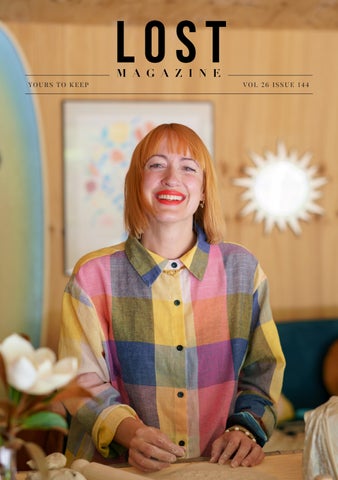
Miriam McWilliam by photographer Kaiya Rae. Read the full story on page 10 All content in this publication is copyright and may not be reproduced in whole or in part in any form without express permission of the publisher. All care is taken to ensure accuracy in editorial and advertising however the publishers and any contributors accept no responsibility for errors or omissions. All material herein constitutes information and not advice.
DESIGN
LO S T N EW S
LO S T N E WS
W
elcome to the season of vibrance in our region! No one embodies it quite like our cover star, and Blackwood local, Miriam McWilliam. Her work, alive with energy and thoughtful detail, mirrors the energy of autumn and the festivals that fill our towns at this special time of year. Also in Blackwood, we venture into the town’s 1868 hotel which has been restored with care and conviction, reopening as a true seven-day hub for locals and travellers alike. It’s a reminder that in a small town, a pub is never just a pub. Down the road in Trentham, The House of Marcelle and Mr John offers a quiet counterpoint to fast retail. It feels less like a shop and more like stepping into someone’s home, where instinct guides the selection and invites customers to linger. In an era of frictionless transactions, that deliberate pace feels quietly radical. And in Woodend, Stephanie and Saman have built Woodend Wholefoods on something far steadier than trend. Their belief that health is nurtured, not promised, underpins a store that is as much about trust and supporting the community, as it is about produce.
We also meet Matt Clarke, whose path to chairing the ChillOut Festival is layered and deeply human. Raised in the country with a strong work ethic, Matt’s story took a harder turn before he made the decision to seek help and step into leadership. Today, his focus is clear: strengthening the festival’s heart and ensuring it continues to create welcoming spaces where people can simply exist without explanation. All of this storytelling is thirsty work, so in Daylesford we pop into the newly relocated Back Bar, now with a main street frontage. Owner Liam Oliver is exacting about provenance and technique, a Martini or Old Fashioned made properly, in honour of the bartenders who invented them. But there’s no snobbery here. Blue Lagoons and Harvey Wallbangers sit comfortably alongside the storied greats. So settle in to read the stories within, and then I hope this autumn edition of Lost sends you out the door to explore. There is so much to see, and even more to be part of. Melissa Jenkins Editor
LO S T M AG A Z I N E | 7
Daylesford and Kyneton Urgent Care Centres From urgency to ease – we have you covered 24/7 Professional primary care provided by our nurses, with support from on-call GP’s and virtual medical support. We triage, treat or transfer patients depending on the nature of the visit. Conditions we can assess include:
Allergic reactions Asthma Burns (minor) Chest infections Dehydration Dental or mouth pain/infection Diarrhoea Dressings Eye conditions, such as foreign body or abrasion Falls Lacerations Mental health/ anxiety Nosebleed (epistaxis) Pain and pain management (analgesia) Sprains and strains Daylesford Urgent Care – 17 Hospital Street, Daylesford 5321 6500 Kyneton Urgent Care – 7-25 Caroline Chisholm Drive, Kyneton 5422 9900 Best Care. Every Person. Every Time. In an emergency always call 000.
As directors of Spa Country Real Estate, Sebastian & Suzi Browne personally represent a limited number of homes — delivering prestige service with integrity, genuine care, and decades of real industry experience. SEBASTIAN BROWNE 0410 400 919
TIME FOR A NEW CHAPTER? IT BEGINS HERE. 03 5348 1388 SPACOUNTRYRE.COM.AU
SUZI BROWNE 0438 886 848
LO S T C R EATE
The
Artof
Wild & Slow
STUDIO MIMI MOON S TO RY BY M A H M O O D FA Z A L P H O T O S B Y K A I YA R A E
LO S T C R EATE
F
or Miriam McWilliam, the real work begins long before anything is designed. “Behind every bright idea is a well-explored path of discovery,” she says, describing a process that is deliberate, investigative and quietly obsessive. “Time put in at the beginning, thoroughly researching a project, asking the right questions, clarifying the key objectives, listening carefully to the core of what makes a brand tick, is what it’s all about.” She laughs that, in another life, she might have been a detective. The comparison fits. “Discovery and collaboration inform a clear direction ahead. Without it, a project can feel unfocused and drift off course.” That early phase is rigorous. Before quoting a job, she sends clients a detailed brief, then dives “deep, through extensive research, brainstorming, mood boards and conceptual development to find the ideas that stick.” It’s a method shaped by years of working with large brands, but refined through a conscious shift away from them. “Being a small business myself, I tend to relate more to small-medium businesses and their journey from having an idea to building something from scratch,” she says. “It excites me seeing their vision become a reality.”
The move towards local clients was as philosophical as it was practical. “It’s more grass roots and intimate being one on one,” she explains. “You can sift out some of the extra noise and opinions that come with bigger studios. Important information can get watered down, rather like Chinese whispers.” Her work now arrives largely through word of mouth, a reflection of community as much as reputation. Miriam believes identity should never be fixed. “A healthy identity should evolve over time,” she says. “If we’re evolving as individuals, it’s likely our business is evolving too.” There may be a core essence, but it needs checking in on. “Every now and again, it’s good to ask: does my business genuinely reflect its intention?” She likens the process to seeing a health professional, an external perspective that helps clarify what’s working and what’s not. “It might lead to a refresh, or something more extensive, but it’s essentially a brand review.” That sensitivity to story became central when she was commissioned to rebrand the Blackwood Hotel. Walking through the building before renovation, she noticed a poem framed on the wall. “I’m always looking for a story, a strong concept,”
L O S T M A G A Z I N E | 13
LOST CREATE
she says. “The best brands communicate meaningful stories; being honest and genuine.” The poem, A Haven in the Hills, written by a much-loved local, became the anchor. “With such a rich history, it made sense to draw on the past and bring it into the present.” Today, the line sits enlarged on the wall, echoing the pub’s intention: a place to pause, look out over the forest, and feel briefly held by it. Her one-on-one approach is embedded even in the studio’s logo. “The ‘OO’ in Studio Mimi Moon represents the relationship
14 | L O S T M A G A Z I N E
between client and designer,” she says. “A full and half crescent moon; balanced, collaborative.” She describes her practice as “slow-cooked and hand-crafted,” rejecting mass production in favour of depth. “The more insight I can gather into a client’s thinking, the better the outcome.” That ethos has deepened since moving to Blackwood, where she found herself surrounded by makers. “It’s teeming with talented creatives,” she says. The environment nudged her towards clay. Ceramics, she explains, offered “a healthy
LO EATU RE LO LO SSS TTTFC CRREATE EATE
counterpoint to working on a screen; more earthy, organic, three-dimensional.” The name Slow Rise emerged from a quiet resistance to speed. “When you rush things, the golden nuggets slip through the cracks.” Clay, for her, is “a way to slow down and catch my breath.” Her home, widely featured, functions as an extension of this thinking. “Creativity doesn’t stop when I close my laptop,” she says. “I’m a collector by nature.” From shells gathered as a child to ceramics made now, the through-line is intention.
Looking ahead, she imagines a studio that blurs boundaries further. “Custombranded tableware, ceramic artworks for hospitality, collaborations with beauty or perfumery brands,” she says. Longer term, she envisions a gallery and ceramic studio on her property, “a space that celebrates ‘The Art of Wild & Slow’.” It’s a future built deliberately, by hand. Studio Mimi Moon Miriam McWilliam studiomimimoon.com
L O S T M A G A Z I N E | 15
OPEN 7 DAYS BREAKFAST, LUNCH AND DINNER INDOOR AND ALFRESCO DINING
77 MAIN ROAD, HEPBURN SPRINGS CLUB WYNDHAM BELLINZONA HEPBURN SPRINGS, DAYLESFORD – PH (03) 5348 2271
NE
UMMER ME S W
NU
THOUGHTFULLY CRAFTED WARES FOR EVERYDAY LIVING Timeless, functional, made to be loved.
LO S T P RO D U C E
Wholefoods,
Wholehearts
WOODEND WHOLEFOODS S TO RY BY M A H M O O D FA Z A L P H O T O S B Y K A I YA R A E
LO S T P RO D U C E
S
tephanie Bahrami doesn’t begin with rules. She begins by looking down at the earth.
“Food isn’t just about what we avoid,” she says. “When the earth is cared for, it gives back food that carries vitality.” She speaks slowly, as if the sentence itself has weight. “Our bodies are so smart and capable of healing when supported by wholefoods.” This isn’t the language of wellness trends or dietary allegiance. It is closer to faith. Or memory. “Eating wholefoods mindfully,” she continues, “we become connected with our farmers, the land and our bodies regulate to function more freely.” Woodend Wholefoods was built on that belief long before it was built on paper. Stephanie is careful with absolutes. Health, she says, is not promised. “Health is not guaranteed, it’s nurtured.” When she speaks about her recovery, remarkable by any medical measure, she does not credit luck alone. “I understood that not only my young age played a part, but it was also my healthy lifestyle.” Organic wholefoods were never fashionable for her. “It has not been a trend for me,” she says. “It is rooted in lived experiences.” What followed was not obsession, but clarity. “I just knew I had to continue eating well and clean to live a healthy longevity.”
Health, in her telling, sits beneath everything else. “When your body is compromised every single day is shaped by it,” she says. “Nothing else matters without your health. It is the most valuable asset anybody can have.” Possessions, businesses; those can be rebuilt. “You can replace possessions; you can rebuild a business.” Health cannot be substituted. Motherhood didn’t soften this belief. It sharpened it. “When you become a mother, you are no longer thinking about yourself,” Stephanie says. “Motherhood sharpens your sense of responsibility, not in a heavy way, but a purposeful one.” She wanted her daughter to grow in what she calls “the cleanest most supportive environment possible.” Becoming a mother didn’t change her values. “It clarified that my next steps needed to align with longevity, integrity and contribution.” What had once been intention became obligation. “It turned my intention into action and my vision into responsibility.” “Lots of quiet time,” she says. In that stillness, reflection set in. “I found myself reflecting on who I was. My daily choices reflect my deepest values.” And then, something shifted outward. “I had this urge to share with a wider community,” she says, “not only with my small following, closest friends and family, but a much larger community.”
L O S T M A G A Z I N E | 21
LOST PRODU CE
“I felt ready to take on a business I was so passionate about. With my husband’s help, of course.”
are ready. “We will not sell anything we would not use ourselves,” she says. “We do not push our beliefs but guide.”
The timing was unforgiving. A baby. A move. A store. “Destiny,” she calls it, and then qualifies herself. “But I also knew there was a lot of hard work ahead, harder than motherhood.” There were questions, practical and sharp. “Can we really do this? Are we capable? Do we have the money?” And then certainty. “Of course, I knew we could.”
Presence, too, is part of the offering. “Just being present as much as possible is key,” she says. “Stephanie, Saman and Wilhelmina in store mostly.”
She had been working since she was thirteen. Saman had left his country and learned a new language. “Both of us have so much passion,” she says. “Definitely faith that the timing wasn’t accidental.” She pauses. “Maybe crazy that we did it at the same time as having a baby and moving our entire lives…but why not?” Woodend Wholefoods was never conceived as a transaction. “The atmosphere, the vibe, the conversations had and the trust that grows over time,” Stephanie says, listing them as essentials. “We truly want to help our community. Customers who walk through our door, they are not just a transaction.” Guidance matters more than persuasion. “We would love to guide everybody in the right direction rather than just sell to them.” The shelves reflect that restraint. “Making sure we do not sell anything unsustainable, toxic in any way whatsoever.” Products are labelled. When they are not, explanations
22 | L O S T M A G A Z I N E
Flowers sit among the food, not as ornament but as principle. “Food nourishes the body, but flowers nourish the spirit,” Stephanie says. “They remind us to slow down, notice beauty and reconnect with the rhythms of nature.” When they are grown locally, spray-free, in season, “they carry the same integrity as the wholefoods on our shelves.” She is precise here. “They aren’t just decorative, they’re an extension of our values.” Stephanie knows what the shop is, technically speaking. “Of course we are a shop,” she says. Certified organic wholefoods. Pantry staples. Trusted products. But she is more interested in what remains after the purchase. “Our deeper hope is that we become a steady presence in people’s lives.” A place of pause. “A place that feels grounding in a world that often feels rushed and overwhelming.” She returns, finally, to trust. “I hope we are a place of trust,” she says. “Trust that we listen. Trust that we care.” Woodend Wholefoods 81F High St Woodend woodendwholefoods.com.au
THE INSIDE STORY
2
1
Lithia Guest House
SHEPHERDS FLAT
What was the original vision behind Lithia Guest House? We moved our young family from our home in North Fitzroy after we had completed our mudbrick home in 1999 on 80 acres that we purchased some years before. The first few years of living here we enjoyed a constant stream of family and friends visiting so we decided to build a guest house so they could stay rather than drive back. The design of the guest house was influenced by that of the main house, incorporating local stone, mudbrick and recycled timbers creating a gentle curving structure which overlooks the undulating landscape and the beautiful vista of the horizon framed by the olive grove. What do guests most often comment on when they first arrive at the property? Guests express surprise at how spacious the guest house is and the peace and quiet that settles around them. The beautiful view of the olive grove often solicits the comment "we could be in Tuscany”. The solid but organic feel of the mudbrick structure wraps around guests creating a sense tranquillity. What makes Lithia Guest House an ideal getaway for visitors to Hepburn Springs and Daylesford? The setting creates a sense of retreat from the business noise and demands of urban life. The property offers the opportunity to walk some of the bush tracks around the area. The house, like the view, is uncluttered and comfortable adding to a sense of relaxation and calm.
STAY AT LITHIA GUEST HOUSE WITH
4
2
1
The Houses Daylesford offers a curated collection of beautiful, bespoke holiday accommodation in Daylesford and beyond. With over 100 unique properties, we cater to discerning travellers, from intimate one-bedroom escapes to grand residences featuring up to 20 ensuited bedrooms.
can accommodate up to 40 guests in a single property
MakeUnlock Memories your next holiday with us
03 5348 2008
thehousesdaylesford.com stay@thehousesdaylesford.com
The
Joy & the Energy
M AT T C L A R K E S TO RY BY M A H M O O D FA Z A L P H O T O S B Y K A I YA R A E
LO S T F EATU R E
LO S T F EATU R E
M
att Clarke grew up in a town of about a thousand people, the youngest of six, a surprise arrival nine years after the rest. “My mum and dad had five children in eight years,” he says, “and then nine years later, I came along.” By then, his siblings were already edging toward adulthood. “They were finishing school, heading off into the big, wide world. I was only just ending primary school.” Wycheproof, “up towards the central part of Victoria,” was small, quiet, and largely untouched by technology in the late eighties and early nineties. “There was barely any technology,” he remembers. “We rode bikes, we swam, every day after school we were at the pool doing bombs off the diving boards.” Winters were for squash and golf, summers for tennis. “We just made the town work.” It was, by his account, a good childhood. “I had really good friends, a really good schooling and education.” And unlike many queer stories that follow a script of early fracture, his did not. “I didn’t have a really difficult life growing up as a gay kid,” Matt says. “I never disclosed my sexuality, not through fear, not through not being accepted. I just didn’t need to.” He pauses. “I always knew I was gay.” There were small, ordinary recognitions, “putting my mum’s high heels on and clunking around the house,” and later, certainty. “From the age of twelve or thirteen, I was attracted to other males.” What stands out is not concealment but ease. “There was no moment in my
youth where I had a really challenging life because of my sexuality.” Years later, he would reconnect with men from that same generation. “We all came out later on in life,” he says, laughing. “And we all agreed we had a great childhood.” His devotion to horses arrived mysteriously. “I don’t know where it came from,” he says. There were no horses at home, no obvious lineage. Just a pull. “I wanted to read about them, touch them, learn about them.” After Year 12, the limitations of small-town life made themselves clear. “If you didn’t grow up on a farm, you had to leave town to better your life.” He moved to Melbourne, briefly attempted cooking school. “It just didn’t sit well. I forced myself into it.” Harness racing, however, felt immediate and exact. “I enrolled, got accepted, and away I went.” Bendigo. A share house. Total immersion. “I absolutely threw myself into it.” He graduated top of his cohort. “I won an all expenses paid trip to New Zealand.” Soon after, he joined the Manning stable in Great Western. “That was a really significant moment in my life,” he says. “They were world-class trainers.” For more than a decade, it was not employment but rhythm. “It was never a job. It was life.” Mornings with horses. Nights at the track. “That work ethic has really stayed with me.” It was later, “in my late twenties,” that difficulty arrived. Not as spectacle, but as pressure. “I was feeling isolated and stuck,” he says. “You fall in love, you have relationships, but you keep everything
L O S T M A G A Z I N E | 29
LOST DR INK
secretive.” He resisted the idea that his life should be defined by disclosure. “I didn’t want my personality defined by who I slept with.” But, as he puts it plainly, “society makes it really difficult for you not to come out.” What followed was a reckoning. He speaks about it not to centre pain, but to insist on honesty. “I really wanted to talk about this,” he says. “People know who I am in my workplace, but they don’t know my story.” What matters, he insists, is the outcome. “I asked for help.” He found professional support. “I established a really remarkable relationship with a psychologist in Ballarat,” he says simply. “That saved my life.” 30 | L O S T M A G A Z I N E
The urgency to speak now comes from watching the present. “We see so much in the media about homophobia,” he says. “About the pressure people are under to become themselves.” His frustration is precise. “People say stop shoving it down our throats.” He pauses. “But society is already talking about us behind closed doors.” The contradiction is exhausting. “You don’t have a choice.” This is where ChillOut Festival enters his life not as spectacle, but as shelter. “It’s the most beautiful little queer festival we have in Australia,” he says. He joined the committee quietly. “I didn’t know anyone. I just walked in.” Within a year, he was chair.
LO S T F EATU R E
He brought instinct and structure. “We needed to think about ChillOut as a business and a brand.” The name was trademarked. “If people want to use it, they need to contribute.” What we know as “basic economics” became sustainability. “We own the story now.” But the heart of the festival remains people, especially young ones. “We’re trying to create free, welcoming spaces for youth,” he explains. Spaces where they can arrive without being exposed, without explanation. “You stay for fifteen minutes or four hours.” No pressure. “Just be yourself in your own time.”
Urging everyone to take part, when he talks about the famous bush dance, “nine hundred people outdoors in flannelette they just bought for the night,” he laughs. But underneath is conviction. “The joy and the energy,” he says, “that’s what matters.” Each year carries a theme. Not branding, but invitation. “Last year was circus, joy, fun.” This year, “Planet Love.” His voice lifts. “A universe where everyone belongs.”
Matt Clarke President - ChillOut Festival chilloutfestival.au
L O S T M A G A Z I N E | 31
FEATURE PROPERTY
Queensberry hill View
Nestled in the heart of Daylesford, Queensberry Hill View sets the scene for a memorable getaway. Boasting an impressive six bedrooms and three bathrooms, making it the ideal destination for family & group accommodations. Queensberry Hill View reveals a host of high-quality amenities. gourmet kitchen, air-conditioning, hydronic heating. The outdoor area features a large pool and captivating view. Unwind in the spa bath or in front of the woodfire after a day spent exploring the region.
12
6
3
(03) 5348 2008 thehousesdaylesford.com stay@thehousesdaylesford.com
A compilation of beautiful accomModation thehousesdaylesford.com (03) 5348 2008 stay@thehousesdaylesford.com
The Houses Daylesford have a portfolio of beautiful accommodation rental properties interspersed throughout the Daylesford region Our portfolio of properties provide the perfect setting for couples, families, groups, corporates, photo shoots and location hire.
LO ST PLACE
Objects with Intention THE HOUSE OF MARCELLE AND MR JOHN S TO RY BY M A H M O O D FA Z A L P H O T O S B Y K A I YA R A E
T
he House of Marcelle and Mr John does not announce itself. People hesitate at the door. They ask, politely, “Can we come in?” or “Are you open?” The question is less about trading hours than permission; whether they are entering a shop or stepping into someone’s home. That ambiguity is deliberate. The business, tucked quietly in Trentham, began not with a business plan but with what its owners John D’Agata and Sjaak Berg later described as “one of those moments”. A lunch nearby, a stroll past a shop long ignored. “The shop itself felt wasted,” John said. “A bit lost. I just thought it could
34 | L O S T M A G A Z I N E
be something more important.” Nothing dramatic presented itself; only a sense that the space was underused, its position misread. The couple were in good spirits that day, unhurried, receptive. The shop, suddenly, stood out. A week later, the property appeared on realestate.com.au. The timeline that followed reads almost unreal: the ad on Friday, inspection Saturday, offer Monday, keys Tuesday. “If you’d asked me a week earlier whether I’d be buying a shop and starting a business,” he said, “I would have said it was the furthest thing from my mind.” He described the process less as a decision than a momentum. “We were being pushed along somewhere, by some force.”
LO ST PLACE
At first, the idea was to rent it out. That notion did not last long. Over the summer holidays, a quieter realisation settled in: this could be something personal. “I thought, maybe I could do something for myself. I don’t need to work for someone else.” The thought hardened into resolve.
trend, but by feeling. The layout resists convention. Objects sit as they might in a lived-in home. There are dogs at the door. Comfort before commerce. “We want people to feel like, I’m comfortable here,” John said. “Like they could have this in their own home.”
John and Sjaak have spent their lives in retail. Jewellery. Pre-owned luxury. Faceto-face selling at the upper end of the market; Hermès, Salvatore Ferragamo, Le Louvre Melbourne. They had watched the industry flatten into metrics and online carts. “This was our last hurrah,” John said, “at old-fashioned retail.” What they wanted was not scale, but presence. Not efficiency, but welcome.
Every item passes a single test: Would I have this in my own house? It is not a commercial filter. He admits it would be easier to stock proven sellers, to fill the space repeatedly with safe profit. “But I choose things that come from the heart,” he said. “So I can stand by what I’m selling.”
He remembers shopping at Goyard in Paris years earlier, dressed plainly, wandering in without expectation. They were treated, he said, “like kings.” The purchase, a wallet, was modest, but the experience was not. The history of the object was explained, time was given freely. “They made us feel great about what we bought.” That memory stayed. It became a benchmark. The House of Marcelle and Mr John was arranged accordingly. Not by category or
36 | L O S T M A G A Z I N E
The result is an eclectic, quietly confident mix: Floris fragrances, Truefitt & Hill grooming, Guerlain, Steiff teddy bears, modern Delftware from Heinen Delfts Blauw, Adorabella, Islander knits from the UK, and exclusive lighting sourced from Paris; pieces unavailable anywhere else in Australia. Local and international sit side by side, unconcerned with period or fashion. “People think a period home needs period items, a modern home needs modern things,” John said. “I’ve never worked that way.” His belief is simpler: surround yourself with what you love. Meaning, not cohesion, does the work.
LO S T P L AC E
Customers seem to understand this instinctively. After purchases, many send photographs; objects placed into their homes, absorbed into their own lives. “They’ve taken on part of our taste and made it their own,” he said. This, more than turnover, feels like success. When asked to name a favourite item, he hesitates. “That’s a torturous question.” He is attached to too many things. One-off pieces especially. “I’ve been the custodian,” he said. “And then I pass it on.” He recalls the sale of a painting; a nude, somewhat risky, that a couple fell in love with together. “That meant something to me.” The House of Marcelle and Mr John is not loud about what it is. It doesn’t need to be. It trusts instinct; its own, and that of the people who step tentatively inside. What it offers is increasingly rare: time, taste, and the feeling that you are not being sold to, but welcomed.
The House of Marcelle and Mr John 20 Market St Trentham thehouseofmarcelleandmrjohn.com
L O S T M A G A Z I N E | 39
RD AT U
AY
SUNDA
Discov Y y Day e r t S 2 & 3 MAY 2026 S
r i a F et
LO S T EAT
Framed
by Forests
THE BL ACK WOOD HOTEL STORY BY L ARISSA DUBECKI P H O T O S B Y K A I YA R A E
EDITORIAL PLACE
LO S T EAT
W
hen you live in a country town and buy a pub, it’s essential to get it right.
That’s the case for Jerry Dimas, who risked incurring the wrath of Blackwood’s 387 residents – plus countless others on the central Victorian tourist trail – when he took over the Blackwood Hotel. After pouring its first beer in 1868, the character filled pub has a claim to fame as Victoria’s oldest continuously licensed weatherboard hotel. It was, however, in need of some love, which Dimas and business partner John Scardamaglia gave it in a major renovation last year. “It was definitely a rundown country hotel that just hadn’t had much attention,” Dimas says. “There was a lot of work… everything needed a freshen up.” Reopened just before last year’s Australia Day weekend, the pub has become a new hub in a town born from the gold rush but now more economically wedded to tourism. Surrounded by the sweeping greenery of the Wombat State Forest, the Blackwood Hotel (“a haven in the hills”, as the sign’s subhead puts it) has become a gathering place for locals and travellers. “We’re in the middle of the forest, which makes it pretty special,” says Dimas. “Out the front, we’re looking at the forest. Look out the back, you’ve got the forest, so it’s quite unique like that.”
One of the biggest changes was simply opening the doors more often. Previously trading only a few days a week, the hotel now operates seven days. “The locals have really embraced us,” Dimas says. Monday nights have become a standing date for residents, complete with food and drink specials, while Wednesday steak nights are a midweek drawcard. On weekends, the tables fill with visitors from Melbourne, Geelong, Ballarat and Bendigo, thanks to the hotel sitting conveniently in the middle of them all. “A lot of people use us as the meeting point,” Dimas says. As the central Victorian cold takes hold, the Blackwood’s focus is shifting to comfort: two open fireplaces in the bar, mulled wine, hot toddies and a menu built around seasonal produce. Head chef Andrew Papagiannis leads a kitchen influenced by Mediterranean flavours. The menu balances the essentials of a country pub - steaks and parmas - with dishes less common in regional venues, from paella to slow-cooked lamb shoulder that leans into Papagiannis’ Greek heritage served as an open souvlaki. Local sourcing is key, including Sher wagyu from near Bacchus Marsh. “We still want to be a country hotel,” Dimas explains, “but give people a few options that aren’t the same generic menu.”
L O S T M A G A Z I N E | 45
LOST EAT
Behind the bar, eight taps pour mostly Victorian beers, alongside a wine list that mixes local drops with international varieties, offering regulars something different. Community spirit runs strong here. On the third Sunday of every month, bluegrass and old-time musicians gather beneath a magnificent 120-year-old oak tree in the beer garden. Fiddles, banjos and double basses appear, and anyone is welcome to join in. The beer garden itself is still evolving, with further landscaping planned, but families are already spreading out on picnic tables and beanbags beneath the sprawling branches. “It’s a really good community-based thing,” Dimas says. “Super chill, with games for the kids so parents can relax. That’s what it’s all about.” The Blackwood Hotel 1 Golden Point Rd, Blackwood blackwoodhotel.com.au
46 | L O S T M A G A Z I N E
Experience Autumn at Wombat Park Estate
2026 AUTUMN OPEN GARDEN STEP INTO A WORLD OF ROMANCE
Sunday 17th May 2026, 10am - 4 PLEASE NOTE :
Tickets can also be purchased at queues each day we highly reco
We are delighted to welcome guests back for this rare autumn opening - the first autumn open garden in over 12 years.
Children under 10yrs free entry adult.
Don’t miss the chance to see Wombat Park Estate's display of colour and history. Our magnificent 250-acre historic estate transforms in
Please enquire directly for large batparkestate.com.au hues; the stately conifers stand in deep green contrast; and the autumn. The grand avenues blaze with rich reds, golds and amber
tranquil garden rooms take on a serene, timeless beauty that only this
No dogs are allowed at this even season can bring. Food, beverages and local produce will be available for purchase on the day at our country market on the croquet lawn.
Our open garden event will proc
WOMBAT PARK ESTATE DAYLESFORD
SATURDAY 16TH & SUNDAY 17TH MAY 10-4PM
BOOK YOUR TICKET HERE
FOR TICKET ENQUIRIES 0408 523 716 or events@thhgroup.com.au
The
Classic
100
BACK BAR STORY BY MICHAEL HARDEN P H O T O S B Y K A I YA R A E
Nick Skinner Photography
LO S T D R I N K
I
t says something about the health of Daylesford’s hospitality scene that the town has a dedicated cocktail bar on its roster. It’s not just about its existence though. Back Bar, which recently moved from a tiny back alleyway to freshlyrenovated and more visible premises on Howe Street, also delivers serious cocktail cred. Back Bar owner and head bartender Liam Oliver is a classic cocktail afficionado, meticulous about the quality and provenance of both the booze and the technique of the drinks on his list. “I’m a brand whore so I like a good quality ingredient being poured,” he says. “I love a house list as much as anyone but when I order a classic, I want it to be the classic recipe. What we do at Back Bar is to respect the integrity of the recipe and to pay homage to the bartenders who invented these incredible drinks, to give them a kind of nobility.” If this sounds a little too hushed and serious, think again. For starters, there are 100 cocktails on Back Bar’s list and storied classics like the Martini or the Old Fashioned rub shoulders with drinks like Blue Lagoon, Screaming Orgasm, Harvey Wallbanger and White Russian.
“I feel a big part of our personality is that we don’t have a snobbery or hierarchy about cocktails,” says Oliver. “We wholeheartedly embrace those cocktails and love the whimsical ones. We love classics in all their forms, whether they’re from the 1920s or the 1980s. The only proviso is that they’re made properly using the right ingredients.” Oliver grew up in Daylesford, working in local hospitality businesses as a teenager before being poached by Melbourne institution Cookie – “with its 100-page wine list and every cocktail under the sun” – where he worked as a cocktail bartender for five years. The pandemic brought him back to his hometown where he realised the dream he’d had of opening a cocktail bar in his hometown was possible. The first iteration of Back Bar was a tiny barebones place with no refrigeration, just an ice well and a sink as the only ‘technology’. The new version is double the size with a beautiful six-metre-long bar made from local blackwood, an outside courtyard (soon to be equipped with a roof and a pool table) and actual refrigeration for the local-leaning wine and beer lists that accompany the cocktails. Then there’s the extended hours (Back Bar is open until 1am most nights), which
L O S T M A G A Z I N E | 53
LOST DR INK
has meant that it’s become something of a defacto clubhouse for Daylesford’s hospitality workers, something of a dream for Oliver. “As a bar owner, having the hospo crew adopt you is all I’ve ever wanted – it gives you a quiet credibility,” he says. The “analogue” heart of the business remains. Music is vinyl-only played on vintage turntables and speakers, lighting is dim and augmented by candlelight, the glassware is vintage and the mood is set to slightly worn comfort over sleek glossiness. Add DJs, live music and the embrace of the local community through events like book launches, trivia nights and forums for discussions of local issues and it’s little wonder the place has been embraced by the town. “At its heart, Back Bar is about hospitality,” says Oliver. “We do a lot but we do it well and I love that you can come here and order an Espresso Martini or a Pornstar Martini without shame. It’s the dream. I’m hoping our red neon sign will shine over Daylesford forever.” Back Bar 3 Howe St Daylesford backbar77.com
54 | L O S T M A G A Z I N E
LANCEFIELD & DISTRICT FARMERS MARKET iginal authentic es or ang R n do farmers market ce a M e s t.2 003
9am - 1pm FOURTH SATURDAY of the MONTH (THIRD SAT IN DEC)
Hosting 85 local & regional producers year round on the gorgeous Centre Plantation of High St Lancefield
2026 24 January 28 February 28 March 25 April 23 May 27 June 25 July 22 August 26 September 24 October 28 November 19 December
Call 0493 452 757 for more information Find us on Facebook & Instagram!
56 | L O S T M A G A Z I N E
Passing Clouds Winery cellar door & Dining Room 9 minutes from daylesford Cellar Door: THURSDAY - MONDAY 10am -5pm TUES & WED BY APPOINTMENT Dining Room: FRIday - Monday for Lunch 30 Roddas Lane Musk VIC 3461 passingclouds.com.au | (03) 5348 5550 For Dining Room reservations VISIT OUR website
Over 20 years of storytelling
lostmagazine.com.au editor@lostmagazine.com.au IN PRINT, ONLINE & SOCIALS
be found with lost magazine
Ritual. Extraction. Experience. The Enki Farm & Apothecary. Now Open.
EXPERIENCE DAYLESFORD’S HERBAL APOTHECARY NATURAL SKINCARE RITUAL ARTISAN HERBS & MEDICINAL MUSHROOMS
www.enki.au connect@enki.au
LOST RE A SONS
Reasons to get LOST
W H AT T H E L O S T T E A M A R E E X P L O R I N G T H I S A U T U M N
Autumn in our region is a celebration... From the iconic ChillOut Festival, to food and flowers, books, heritage and bold new creative collaborations, the calendar is bursting with events that invite us into the heart of community life.
Clunes Booktown Festival ChillOut Festival Australia’s largest and longest-running regional LGBTQIA+ Pride festival transforms Daylesford into a joyful explosion of colour, cabaret, music and community spirit. From the iconic street parade to parties, performances and intimate events across our town, ChillOut is a vibrant celebration of diversity, inclusion and unapologetic fun. 5–9 March For info and tickets visit chilloutfestival.au
Ballarat Begonia Festival A riot of colour in the Ballarat Botanical Gardens, the Begonia Festival pairs stunning floral displays with live entertainment, family activities and market stalls — the perfect way to welcome autumn in bloom. 7–9 March ballaratbegoniafestival.com
60 | L O S T M A G A Z I N E
For one glorious weekend, the historic streets of Clunes become a book lover’s paradise. Meet authors, browse rare finds and literary treasures, and lose yourself in conversations, ideas and the unmistakable charm of Australia’s only Booktown. 21-22 March clunesbooktown.org.au
Lost Trades Fair A mesmerising showcase of rare and endangered skills, from coopers and blacksmiths to glassblowers and milliners. The Lost Trades Fair is both nostalgic and inspiring — a living tribute to craftsmanship that shaped our past and continues to influence contemporary makers. 28 – 29 March – Hanging Rock losttradesfair.com.au
CresFest A joyful, grassroots music festival that transforms Creswick into a vibrant celebration of folk, roots and world music. With intimate venues, roaming performers and a welcoming community atmosphere, CresFest is all about discovery — and dancing in the streets. 10-12 April cresfest.com.au
LO S T R EA S O N S
Ballarat Craft and Design Week Ballarat’s much-loved Craft Lab evolves into a bold new 10-day celebration of collaboration, creativity and connection. Set within the historic Mining Exchange, visitors can wander through five immersive experiences exploring the 2026 theme Bound — where textiles, memory and restorative practice intersect with Ballarat’s rich design legacy as a UNESCO Creative City of Crafts and Folk Art. Expect exhibitions, workshops, open studios and thought-provoking talks throughout the city. 1–10 May creativeballarat.com.au
The Great Trentham Spudfest
Events at Wombat Park May at Wombat Park Estate promises a true feast for the senses. From 8–10 May, immerse yourself in a weekend art retreat with landscape painter Lana Daubermann, with two nights’ accommodation in the heart of Daylesford, guided tuition, all meals, and full access to the Estate’s stunning grounds for en plein air painting. Then, on 16 & 17 May, wander the gardens during the first autumn open weekend in 12 years, where you can enjoy the autumn colour, falling leaves in the magnificent gardens. Plus the country market on the croquet lawn will be back with food, drinks, plants, and local wares. Two weekends, two ways to experience the incredible beauty of Wombat Park Estate. Landscape Painting Retreat 8-10 May Open Garden Weekend 16 & 17 May wombatparkestate.com.au
Celebrating Trentham’s famous potatoes, this much-loved festival blends local food, music, family fun and serious spud appreciation. Think farm-fresh produce, gourmet dishes, community spirit and a deliciously country atmosphere. 2-3 May trenthamspudfest.org.au
Heritage Harvest at Sovereign Hill Set within the atmospheric streets of Sovereign Hill, Heritage Harvest brings together regional producers, traditional skills demonstrations and hearty seasonal fare — a hands-on celebration of food, farming and history. 23–24 May hhw.sovereignhill.com.au
Image: Marnie Hawson
From classical viola to folk fiddle, music has shaped your whole life. How do you see live music, especially in small regional towns, contributing to wellbeing in a way nothing else quite can?
Judy Turner Judy Turner, Founder and President of CresFest, has spent her life bringing people together through music. What is it about Creswick, and this region more broadly, that makes it such fertile ground for community connection? I've always loved the energy of country towns. Since touring all over Victoria as a fiddler with Paradiddle Band in the early 80s, then living in Benalla in the 90s, I have really admired the way people in country towns come together to solve problems and to make things happen. You’ve spoken beautifully about the power of volunteers and letting people do what they’re best at. What have you learned about leadership, ageing and community by working with Team CresFest? Never underestimate what people know. Never overestimate what they want to do in their spare time. Never forget that everything you think of has been thought of before. Always respect the ideas people bring to the table. Expect life to happen and wonderful volunteers to move on - amazingly, there will always be someone else willing to step up.
62 | L O S T M A G A Z I N E
Music is energising, engrossing, mentally stimulating, challenging, joyful and collaborative, and (when led right) totally non combative! It’s not like sport where there is always a winner and therefore a loser - when you play in a band or sing in a choir, you focus on bringing the best possible sound to your audience, on behalf of the entire group. And of course, harmony is pure magic! Nothing (for me) is quite so uplifting as hearing people playing and singing in many parts - it triggers feel-good chemicals in the brain. When you’re not directing a festival or making music, how do you like to spend time in our region? Are there favourite walks, cafés, hidden corners or simple rituals that make this place feel like home to you? Totally! We love St George's Lake in Creswick. It's the best open-air swim you can find in our area, and on a hot afternoon it’s alive with families and visitors, with never a shortage of space. Also in our town, Leaver’s Hotel does an incredible job bringing great live music to town all year round. Further afield, Neil and I are thrilled that The Hepburn Palais is back, and when in Daylesford we gravitate to Lake Daylesford and to Wombat Hill House at the Botanic Gardens - the food is always first rate, and the vibe just perfect.
Creswick’s Folk & Roots Festival
WEEKEnD & Day tiX/ FuLL PRogRaM at cREsFEst.coM.au
ity, Magic! n u M M o c , c i M us cREsFEst is about thE joy oF LivE Music – PLaying it, hEaRing it, Watching it, Dancing to it, LEaRning it anD bEing insPiRED by it. it haPPEns acRoss a PacKED WEEKEnD in thE LovELy hERitagE toWn oF cREsWicK in cEntRaL victoRia, haRnEssing thE sPEciaL WaRMth oF onE sMaLL coMMunity just 15 MinutEs FRoM baLLaRat.
THE CHILLOUT OF CHILLOUT
The Farmers Arms is the place to be this Chillout. Relax in the biggest beer garden in the region or one of our beautiful rooms; front bar, cocktail lounge or dining space. Enjoy free entry all weekend with causal dining all day Saturday and Sunday. With a new bar menu and drinks specials for Chillout. Come and enjoy DJs and tunes all weekend. OPEN 7 DAYS LUNCH + DINNER
03 5348 2091 1 EAST ST, DAYLESFORD farmersarmshoteldaylesford.com