CORSAIR NOV, 16 2016 | VOLUME 112 ISSUE 05 | SANTA MONICA COLLEGE
FIRST COPY OF THE CORSAIR IS FREE, EACH COPY AFTER IS 25
LOS ANGELES FREE PRESS
SEPTEMBER 11, 2020
PAGE 2
The First Underground Newspaper ANNA KUNKIN
CONTRIBUTING WRITER
EDITORIAL STAFF STEVEN M. FINGER........................Co-Founder, Publisher ZACH LOWRY...................Co-Founder, Creative Director MYA TAYLOR...............................Editor-in-Chief KATIE NELSON............Head of Operations, West Coast ERI PAPPAS....................................... Copy
Editor
MARISA VASQUEZ......................Managing
Editor
DANIEL BOWYER...............................Page Layout Editor SUNNY.............................................................Art Director
CONTRIBUTING WRITERS Olivia Fletcher, Chase Richardson, Thomas Quinn, Ravyn Ariah Wingz, Lorra Toler, Madison Hoiby, Zoë Van Tieghem, Sheridan Wilbur, Samantha Grasso, Caitlin Schneider CONTRIBUTING ARTISTS Alfonzo Gonzalez Jr., Ed Ruscha
AD INQUIRIES: info@losangelesfreepress.com
TAKE A READ AND PASS IT ON
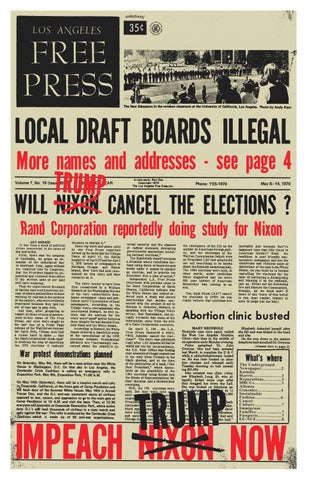
“Six months earlier or six months later, and ‘The Los Angeles Free Press’ never would have made it,” its founder and editor, Art Kunkin, was known to say. It was a moment of crazy turmoil, ripe for a vehicle to bring together all the diverse alternative communities that existed in their own bubbles. The Vietnam War was raging and the draft and possible death was a constant, looming over the heads of young men and their families. The government’s covert FBI operation “Cointelpro” was at work infiltrating and causing havoc among any dissenting groups. The Civil Rights movement was in full swing; the second wave of the Women’s movement. President Kennedy was murdered in Dallas the year before, leaving the country in traumatized tatters… and the Beatles had just invaded the shores, changing music and the culture forever. In the vast sprawl of Los Angeles without an internet or Zoom to bring people together, people worked in isolated groups to make sense of it all and to create positive change, many times unaware that a group across town might be working on the same thing. “It’s time to stop reinventing the wheel,” Art used to say. And so the “Freep” was born. In 1964, the Los Angeles Free Press caught the tidal wave and the imagination of the sixties, championing and representing what was happening in the streets. Art said, “If there’s a rock concert or a riot, the Free Press will be there.” He encouraged readers to contribute stories. “Every reader is a reporter,” he said. In that spirit the paper did more than simply be present and report news. The Freep became a reflection of the activities of all the LA activist and minority communities. For the first time there was a space in print for Blacks, Gays, Women, Chicanos, Hippies, Poets, and War Resisters. No one was excluded.
REPRINT REQUEST
Re-publishing from the LosAngelesFreePress.com.
Neither photos nor any text found here or in any Issue of the LA Free Press is to be stored, used, reproduced or altered without our written permission. For same - which is usually granted without charge write to: Steven@LosAngelesFreePress.com
which drugs were safe and which ones to stay away from. The paper published regular columns of writers like Charles Bukowski and Harlan Ellison, launching their careers as iconic writers of their time. The Free Press classifieds became famous for accepting personal ads from any group or gender. Gilbert Shelton’s “The Fabulous Furry Freak Brothers” were a regular feature, as were Ron Cobb's famous satirical drawings. Major events, Love-Ins, Be-Ins, and concerts that attracted “Freaks” from everywhere were hosted by the Freep. “GUAMBO,” the Great Underground Arts Masked Ball and Orgy, in July 1966, was the Freep’s second anniversary and the party that launched Frank Zappa’s “Mothers of Invention.” The paper covered all the important news stories of the time… and more. It was a living part of the community. The first Underground newspaper. Art encouraged people in other cities to produce their own local versions of alternative papers. He gave them the template and taught them how to do it. Before long there was a loose network of over 600 “Underground” papers throughout the country based on the LA Free Press model. The Vietnam War was raging and the Free Press was circulated among soldiers in and out of Vietnam. Soon soldiers and veterans were producing their own papers which contributed to the ending of the war. By that time the Freep had a distribution of 125,000 and an uncountable readership when you consider how many times a paper would be passed around. Its empire had also grown to three bookstores, a publishing company, and a printing plant. In August 1969 Art was offered a list of 80 undercover narcotics agents’ names, phone numbers, and home addresses to publish. The agents had been guilty of staging unlawful raids, breaking into people’s homes without war-
rants and falsely setting them up and arresting them. They were the ultimate enemy at the time and Art felt justified in exposing them. The headline read, “There Should be no Secret Police.” This was a huge tactical error as it caused a spiral of lawsuits and expenses which ultimately destroyed the Free Press and the entire publishing project. Art finally declared bankruptcy in 1973 and was forced to sell the paper to the porno mafia. Now we find ourselves in an era equally if not more tumultuous. And even with the internet, with its power of uniting people worldwide, there is a dearth of good journalism. With all the division that exists, not by accident, there is an urgent need to find a way to create community bonds between individuals and groups. At this moment, in the midst of all the current chaos, Zach Lowry was handed a copy of the Free Press. The “Narc” issue. He saw it and was inspired to believe that it was the missing vehicle necessary to help create change. And maybe this is the moment. The moment for getting to the gritty core of life in this mess and digging it out. Because the “Freep” can’t be just another newspaper reporting stories. It must come alive and become a part of the world it wants to report on. The Los Angeles Free Press was never intended to be a venture of “balanced journalism.” The Freep was always a “movement” paper. And in Art’s words, “a true movement paper is an organizing paper.” It lets people know what is happening, what is being organized, and how to get involved. Is it risky? Yes. The Freep offices were bombed numerous times, and the paper had the federal and local governments on its back all the time. It did what civil rights hero and later Congressman John Lewis, called “getting into good trouble.” That’s what’s needed.
What put the LA Free Press on the map was an in-depth analysis it did of the 1965 Watts Riots (now called rebellion), which put the LA Times reporting to shame and forced them to issue a retraction of their so-called analysis. After that the Times and the other local mainstream paper, the Herald Examiner, “lived in fear” - according to journalist Lionel Rolfe - of how the Freep would report on events, and it went from a little community paper with a readership of around 5,000 to a contender that would eventually claim a worldwide distribution of over 125,000. The “Freep” became an integral part of the community. Street kids picked up bundles of papers from a warehouse weekly and sold them on the street, providing an income for the kids and putting the paper everywhere. In the heady times full of drug experimentation, there was a weekly column that people came to depend on with a list of
FOLLOW US FOR MORE ARTICLES, ARCHIVES, AND MERCHANDISE AT LOSANGELESFREEPRESS.COM •
@THELAFREEPRESS • IG:@LOSANGELESFREEPRESS
LOS ANGELES FREE PRESS
SEPTEMBER 11, 2020
PAGE 3
Kamala Harris: A Woman of Firsts
Beyond studies: One city’s tangible steps toward repairing racial disparities through reparations.
ERI PAPPAS
Tom Quinn
eligible if they can prove housing discrimination.
Evanston, Illinois, a northern suburb of Chicago, is the first city in America to begin collecting money for a reparations fund aimed at healing racial divisions.
Enforcement disparities of recreational marijuana, the source of the funding, also contributed to the city’s commitment to the fund. According to the city’s internal data during the three years leading up to November 2019, 71 percent of arrests for cannabis possession were Black and 15 percent were white. Meanwhile, the US Census Bureau estimates that Black residents make up 16 percent of the city’s population.
STAFF WRITER Joe Biden announced in August that he’d chosen California Senator Kamala Harris as his Vice Presidential running mate. Harris has served in the Senate since 2016. Prior to her congressional service, she was California’s Attorney General and San Francisco’s District Attorney. Harris is a woman of firsts. She’s the first Black, first South Asian, and first woman to have held both her California District Attorney and Attorney General positions. She’s the first Black and first South Asian woman to accept the nomination on a major party ticket. She’s also only the second Black woman ever to be elected to the U.S. Senate. Trump has already recycled onto Harris the “birther” attacks he once used to attack President Barack Obama. Feeding a rumor, Trump told reporters he questioned whether she would be eligible for the Vice Presidency because her parents were immigrants. Her parents did immigrate to the U.S. from Jamaica and India. However, Harris was born in Oakland, California, so she is, of course, eligible. Trump has also called her “nasty” and “a mad woman.” As was Obama, Harris has been the target of racist and hateful attacks from U.S. residents, politicians, and many others. Barry Presgraves, the Mayor or Luray, Virginia, posted on Facebook that Biden had “announced Aunt Jemima as his running mate.” These attacks are not new; throughout her career Harris has faced criticism centering on both her race and gender. But many, including Hillary Clinton, have assured us that Harris can handle it.
Harris reinforced her solidity in her speech at the 2020 DNC Convention, crediting her mother with raising her and her sister “to be proud, strong, Black women.” In a political sphere riddled with name-calling and pointed defamation, it’s not surprising that a woman like Kamala Harris has heard it all. What is striking, though, is that her nomination which was expected to thrill a progressive population instead roused only a lukewarm reception. Prime among the faults that liberal voters have found with Harris is her history of prosecution. In her first three years as San Francisco’s District Attorney, the city’s conviction rate rose from 52 to 67 percent. Harris prosecuted for truancy, convicting parents who didn’t send their children to school. This is a far cry from the defund-the-police mantra that has become a pillar of the liberal movement. Harris has also upset both sides of the capital punishment debate. She publicly opposed the death penalty and refused to implement it in 2004 against a man who had shot and killed a police officer, much to the fury of the police. But she has also taken action to uphold the death penalty, choosing not to support measures to end it in a case in 2014. Despite her role as a prosecutor, she still has, on many occasions, criticized the criminal justice system. “I was born realizing the flaws in the criminal justice system,” she said in an interview with NPR. Many of the moves she’s made seem strategic; she uses the system as a means to activate other programs. ---------------------------------------------To read full article please go to losangelesfreepress.com
CONTRIBUTING WRITER
The fund, which was passed by the town council merely two months before the sale and consumption of recreational marijuana in Illinois, became legal on January 1, is generated from a three percent tax on recreational cannabis as well as donations. Evanston began collecting the tax on July 1 and is expecting an income of at least $10 million in the first 10 years. Evanston Alderman Robin Rue Simmons, a leader in the passage and enactment of the fund, said, “The reparations work is in response to the years of discrimination, historic redlining, oppressive zoning, and other polities in our city. The reparations fund will repair damages done to the Black residents in the city of Evanston.” A conservative timeline has the fund’s first $400,000 worth of payments, in the form of $25,000 forgivable loans or direct benefits toward mortgages and home renovations, starting to be distributed in 2021. Black residents will be eligible for funds if they are a resident or descend from a resident of Evanston between 1919 and 1969. The Northshore suburb has determined these dates, before the Fair Housing and Discrimination Act, to be when Evanston banks engaged in redlining, which reduced Black home-ownership by discriminating against Black borrowers. Residents will also be
“There was a clear over policing problem that resulted in criminalizing residents that now have arrest records and felony records that are keeping them from job opportunities, business opportunities, access to renting houses and student loan opportunities to further advance their education and learn a living wage,” Rue Simmons said. “Damages due to the over policing of cannabis are trickled down to generations within one household and therefore within one neighborhood.” Rue Simmons recognizes her city’s plan as a “model that should be considered in cities across the nation,” noting Evanston’s disparities in income, life-expectancy, education and home-ownership are like those of many other cities across the country. Evanston Alderman Ann Rainey said she and her colleagues have been “bombarded” by other cities hoping to learn from and replicate steps taken by her city. In late June, Evanston’s southern neighbor, Chicago, passed a resolution establishing a subcommittee aimed at
determining the best course of action with regard to city-wide reparations. Rainey also recognizes Evanston's responsibility as a leader in actions on reparations. “We have a spotlight on us,” Rainey said. “We are not going to make mistakes.” On August 20, the National African American Reparations Commission (NAARC) endorsed Evanston’s reparations fund. The convener of the NAARC, Dr. Ron Daniels, said, “we view Evanston as a model which can be replicated around the nation.” The nationwide Black Lives Matter protests in the wake of George Floyd’s murder by a Minneapolis police officer have elevated a national conversation about social justice and America’s racial disparities. In response to the movement, Rue Simmons said, “the awareness and the awakening has put [the fund] on the radar of residents that perhaps needed more education on why this is urgent and why this is a priority.” Rainey expects the fund to continue generating income as Evanston and Illinois expand cannabis operations throughout the city and state. Rainey said the COVID-19 pandemic has increased demand for marijuana, and that the city can expect to take in around $50,000 per month. Evanston currently has one dispensary; however, Rainey is optimistic that one or two more will open in the near future. “Evanston is one of the friendliest cannabis municipalities in the state of Illinois,” Rainey said. ----------------------------------------
To read full article please go to losangelesfreepress.com
The Only Solution Is To Burn It All Down Originally Published on Discourse Blog
SAMANTHA GRASSO CONTRIBUTING WRITER
Memories may fade, but screenshots and trauma last forever. A few nights ago, I was going through some screenshots, and videos and texts, not because I wanted to remember the incident they had memorialized, but because I couldn’t. It was an incident so difficult, my brain had smoothed away its details. And after piecing back together the arguments and the meetings, I felt so much pain all over again. In recent days, innumerable Black journalists and journalists of color have recounted how their white editors treated them like shit. In comparison to the tens of stories I’ve read about, part of me feels like I barely experienced anything at all. But I still agonized and cried myself into a panic attack over the incident, which, in its broadest details, had to do with the internal handling of race and staffing at a publication I worked for. I went to HR and had my meeting cut short by the very person who I was reporting. I tried to complain and my complaint was ignored. The incident shifted something into focus for me, something I think I always understood, but never wanted to confront — that the person paying me to write about racism and my experiences with racism was profiting off my labor with zero understanding of it. Or worse, that he understood racism and decided to employ fuckwit attacks anyway. That I was selling my work to a bastard who saw race coverage as something that might get him rich. As my rage bubbles, the understandable, long-withheld rage of hundreds of journalists in newsrooms nationwide is bursting forth. Black journalists at the New York Timesbroke with their paper’s social media policy by openly tweeting against the op-ed by Sen. Tom Cotton which called for protesters against police violence to be met with military force, fairly assessing that running the piece
put their lives in danger. (NYT op-ed editor James Bennet was forced to resign soon after.) Former writers and editors of color at Refinery29 have come forward with accounts of discrimination and pay disparity by their white editors. (Refinery29 editor Christene Barberich was also forced to resign.) Black staffers and staffers of color at Bon Appétit have come forward with accounts of the newsroom’s racist culture after a photo of editor-in-chief Adam Rapoport in brownface resurfaced. (Rapoport was also forced to resign, though he has not stopped being a complete dickhead.) The Pittsburgh Post-Gazette told a Black journalist, Alexis Johnson, that she couldn’t cover the protests because she criticized racist coverage of looting. And those are just a handful of the newsrooms experiencing a reckoning—one that is directly connected to the broader uprising that has emerged in the wake of the racist killings of George Floyd in Minneapolis, Breonna Taylor in Louisville, KY, and Ahmaud Arbery in Brunswick, GA. The reckoning has been a long time coming. White newsroom leaders have underpaid and overworked Black journalists and journalists of color. They have told them to be grateful for their opportunities, and made racist comments that were ignored by other white peers. They’ve told them to stay in their lane and discouraged them from asking for more work or money. They have told them to leave their humanity at the door when reporting out stories that pertain to their humanity, or the right for people who look like them to live. Johnson’s bosses in Pittsburgh told her that her race disqualifies her from reporting on protests against police violence. They have done all of this even while expecting journalists of color to carry the heaviest kinds of weight on their shoulders. Black journalists, for instance, have been open about the level of trauma they are forced to contend with while reporting on police violence in the past few weeks. But they are still at the mercy
of a system which repeatedly treats them as second-class citizens, and which still treats their basic existence as a debating point. This isn’t just happening at the newsrooms where people have spoken up. It’s happening everywhere. Legacy newsrooms, newer publications operated by legacy corporations, and even startup newsrooms uphold white supremacy through their discrimination against Black and other journalists of color. Racism isn’t a bug of majority-white and white institution-led newsrooms — it’s a feature. It manifests itself in the experiences of journalists of color, and in the codes of conductthat these publications expect their journalists to adhere to, and in the ways stories are framed, written and edited. An institution that upholds white supremacy also perpetuates white supremacy. If a newsroom like the Post-Gazette actively invalidates Black perspectives, they’re signaling that white perspectives are supreme and virtuous and correct. The op-ed by Tom Cotton which the Times so hastily and recklessly published is also indicative of that. Newsrooms that preach “objectivity” and being “unbiased” are indicative of that, specifically because their understanding of objectivity is based upon decades of work by white people who do not experience racism, and have validated the argument forracism as part of this search for truth and balance. News is, and has always been, a prod uct of choices — what writers and editors choose to put into stories, and what they choose to leave out. Focusing upon the criminal history of a Black person who was extrajudicially killed by the state is a choice. Focusing on looters in order to delegitimize a protest’s power, or even separating rioters and looters from protesters as a way to withhold humanity from the former, is a choice. Framing protesters throwing stones and water bottles as engaging in behavior that reasonably provokes state violence,
or is somehow equal to state violence, is a choice. Being a stenographer for police and using their euphemisms for state violence like “rubber bullets,” “bean bag rounds,” or “less lethal” weapons, instead of calling them plastic and metal coated in rubber or packets of lead pellets, shot out of a shotgun at several hundred feet per second, is a fucking choice. All of these choices uphold and perpetuate white supremacy, and it is rich that news institutions demand this false moral objectivity and transparency and righteousness when they don’t practice it themselves. Meanwhile, Black journalists and journalists of color are left handwringing over every journalistic choice they make, rubbing their skin raw in fear of retribution for appearing too empathetic to people killed mercilessly by the state who look like them, while attempting to merely do their communities justice. Objectivity is a figment of the white imagination, because objectivity is simply a validation of the world as they see it. What will come from this reckoning? So many Black journalists and journalists of color have shared their truths, and others are standing with them, even withholding their labor in solidarity. But I fear this will become an opportunity missed. Firing the white people at the top who’ve gotten themselves into trouble and are easy to blame is but a kiss on a festering wound. Singular leadership replacement, or recommitments to diversity, or diversity working groups comprised of mostly staffers of color, or progressive style guides that let newsrooms pat themselves on the back, aren’t enough. What good does a newsroom’s diversity initiative do if it doesn’t raze the systems perpetuating white supremacy, not just remove one of the people involved? The actual beginning of the end of white supremacy in newsrooms will come with the end of the prioritization of white perspectives. That will only come with
FOLLOW US FOR MORE ARTICLES, ARCHIVES, AND MERCHANDISE AT LOSANGELESFREEPRESS.COM •
an entire systemic upheaval, from the people financing news institutions and controlling the business side of operations, to the people writing and editing news stories. A commitment to ending white supremacy in newsrooms requires white executives and editors and writers to give equal power to executives and editors and writers of color — in other words, to give up some of the vast power that white people have hoarded for so long. This, of course, comes into direct conflict with the agendas and power of white newsroom leaders. Who would want to give up power and change the system when it’s easier to fire a few people and leave new Black leadership isolated and resourceless in their place? I don’t want this opportunity to be wasted, and so I want to contribute to its weight by listening to the demands of Black journalists; by participating in protests that withhold my labor as part of a demand for justice; by calling upon my former white coworkers to do more than share their salary figures, and instead direct their attention to how their publication perpetuates white supremacy and makes racist demands of the few employees of color they have; and by telling younger journalists that objectivity is a lie and that HR is only there to tell you that it’s all in your head. It’s a start, at any rate. I’d like to think that we’re doing something special here at Discourse Blog, by being an experimental refuge after Splinter’s demise, an attempt to break from a traditional journalism business model and prioritize quality over quantity. But we don’t have any Black staff members, and Aleks Chan and I are the only people of color, and I’m not going to be silent about that fact. We’re not making any money right now (though we’ll be announcing further details about that soon), but when we do, I want us to help support a better system — one that fights the poison of objectivity and allows Black journalists and other journalists of color to do the kind of work they’ve always deserved to do.
@THELAFREEPRESS • IG:@LOSANGELESFREEPRESS
LOS ANGELES FREE PRESS
SEPTEMBER 11, 2020
FOLLOW US FOR MORE ARTICLES, ARCHIVES, AND MERCHANDISE AT LOSANGELESFREEPRESS.COM •
PAGE 4
@THELAFREEPRESS • IG:@LOSANGELESFREEPRESS
LOS ANGELES FREE PRESS
SEPTEMBER 11, 2020
FOLLOW US FOR MORE ARTICLES, ARCHIVES, AND MERCHANDISE AT LOSANGELESFREEPRESS.COM •
PAGE 5
@THELAFREEPRESS • IG:@LOSANGELESFREEPRESS
LOS ANGELES FREE PRESS
SEPTEMBER 11, 2020
PAGE 6
BUSINESS (NOT) AS USUAL Part I CORONAVIRUS UNRAVELS THREADS IN FASHION INDUSTRY Sustainability changemakers across the world adjust during the pandemic and emphasize slow, sustainable and digital fashion to replace fast fashion. SHERIDAN WILBUR CONTRIBUTING WRITER
BUSINESS (NOT) AS USUAL Part l: CORONAVIRUS UNRAVELS THREADS IN FASHION INDUSTRY The COVID-19 crisis ignites a permanent shift possibility from oversaturated fast-fashion and in-person shopping towards slow, sustainable, and digital consumerism. The economic slowdown sped up an inevitable burst in fast-fashion, expected to decline from $35.8 billion in 2019 and to $31.4 billion in 2020, according to the Globe Newswire. Production slowed or ceased. Employees lost jobs. Retailers closed. Demands plummeted. Fashion weeks, typically a physical hub of creative inspiration for new outfits and emerging trends, and they adapted to digital versions of live events. Many summer and spring lines were pushed to a 2021 collection. “Fashion is almost at a halt,” Mikovhe Nengovhela, an economic researcher for the Southern African Clothing and Textile Union, said. “There is little interaction in the fashion world domestically and internationally.” Under a dystopian era of lockdown restrictions, those who work from home or collect unemployment have liberty to lounge in old college sweats or underwear. White collar workers have less need for expensive dress pants.
They wear what the Zoom camera cannot see. Sweatpants purchases were up 80% in April, according to the New York Times. The pandemic drove the fashion industry as we know it into the ground. “Many jobs have been lost since March, due to factories closing down,” said Nengovhela. “We face job loss threats since the economy is far away from full recovery.” Research by Accenture reports 33 percent of consumers find themselves “shopping more consciously” based on less disposable income prior to the pandemic. Those were the days when fashion was the world’s second leading industry, generating $2.5 trillion in global annual revenues, according to the British Broadcasting Corporation. Then in March, clothing sales fell more than 50 percent for the United States. In April, sales sank to 79 percent of original revenue according to NPR. The spike in comfort clothes was not enough to upend fashion’s economic dive. August 22 marked Earth’s official “offshoot day.” The apparel industry accounts for 8-10 percent of the world’s greenhouse gas emissions, reported by Quantis. In other words, fashion’s next demand will offshoot nature’s yearly resource supply. Everything we consume from this point on in 2020 is taken from the future. Yet the outbreak forced many textile and clothing factories to close and report
lower emissions. Clear skies in China began to emerge where people were mandated to stay inside. Based on an analysis by the Carbon Brief, emissions fell nearly 25 percent. The state of our global economy ushers the fashion industry to use resources differently and responsibly. In 2016, according to a study by Environmental Health, the world consumed about 80 billion pieces of new clothing each year. Stores like J.Crew or Gap take styles from high design fashion houses, reproduce them quickly, and often rely on low wage labor overseas. They expect people to consume superfluous amounts of cheap, trendy clothes in low quality that go to waste after a few wears. Earlier this year, J.Crew, Neiman Marcus, Brooks Brothers, and J.C. Penney filed for bankruptcy. Diane von Furstenberg announced in July she’ll close all but one of her nineteen stores. Westfair Communications reported Gap has been sued for $120K in unpaid rent. Consumers are changing their spending habits. A survey from Retail Customer Experience found over half admitted they spent less on fashion over the past six months because they are not going out. “There’s no way I’m going into a store and dealing with trying on clothes with a mask.” Noor Bchara, a fashion designer and founder of Noorism, an up-cycled denim brand in Brooklyn, New York, said.
Passport to Nowhere
American passport value declines after poor COVID-19 response MADISON HOIBY
CONTRIBUTING WRITER As countries ease back on border restrictions to welcome international travelers, the United States’s exclusion from many of these countries reflects a declining value of the American passport. While a U.S. passport used to grant Americans access to a magnitude of countries with open arms, our country leadership’s poor response to the COVID-19 outbreak has prompted many of these once-accepting countries to reject U.S. citizens in safety of their own residents. Up until this year’s temporary international travel restrictions, the U.S. passport was consistently ranked within the top 10 of the Henley Passport Index, which ranks countries’ passports based on the amount of destinations citizens can travel to without obtaining a visa. Compared to its pre-COVID-19 7th place ranking in 2020 - and even more significantly, its 1st place ranking in 2014 - the U.S. passport now grants just about as much travel freedom as Mexico’s and Uruguay’s, which rank 25th and 28th, respectively. Tayla Myree, a graduate student at the Central European University in Vienna, managed to depart from Atlanta on Friday, August 7 with an American passport and student verification. Despite arriving in Vienna successfully, Myree shares her experience was significantly different from anything she’s experienced prior.
port wouldn’t have been very helpful.” Myree traveled for educational purposes, received two negative COVID-19 tests, and was placed in self-quarantine upon arrival in Vienna. While the U.S. used to hold one of the most travel-permitting passports, extra precautions and orders restricting Americans from international travel clearly display otherwise. On July 14th, the European Union released their latest update detailing countries permitted to enter their borders unrestricted. The council recommendation listed 13 countries — many of which were ranked similarly or significantly lower than the U.S. on the Henley Passport Index — yet excluded the U.S. from the list. When comparing the resources and cultures of many of these countries, the U.S. appears to have been better equipped to handle a virus outbreak. According to the Bureau of Transportation Statistics, Americans are more likely to drive cars than take public transportation and statistically have more space surrounding them to aid social distancing. Comparatively, citizens in Japan, who were originally permitted to enter the EU, have over 9 times less space than the average American, and utilize public transportation nearly 50% of the time, according to the Japan Guide, a site dedicated to Japanese tourism.
rance and irresponsibility are to blame, the problem at large is due to the Trump Administration's insufficient handling of the virus. Aside from recommending that citizens take a life threatening drug, chloroquine, as medicine and hosting a sequence of indoor rallies, the Trump administration has failed the nation by undermining the virus, disregarding science, and prioritizing the economy over the lives of citizens. From urging schools to reopen and threatening to cut funding, ceasing unemployment benefits from over 30 million Americans and blaming rising case statistics on access to testing, President Trump’s actions continue to encourage Americans to go against CDC guidelines and inevitably spread the novel virus. While the current regulations placed on the American passports are temporary, Benjamin J. Cohen, a Political Science professor at the University of California, Santa Barbara, stresses they are nonetheless severe. “There’s never been anything like this,” Cohen said. “The world sees that a large part of the American population has been quite irresponsible, and I would assume that they would be cautious of admitting Americans. [Once] a vaccine is readily available, I would expect that American international travel would resume fairly quickly, though.”
“The idea of going to a store sounds really stressful right now.”
demic foreshadow a more conscious producer and consumer.
The COVID-19 crisis sped up an existing problem: consumers are not matching the rate of production. One example is Burberry, a luxury label in Britain, who burned 28.7 million pounds ($37 million) of clothing and cosmetics to destroy unsold items in 2018.
Cabello, a small business owner, is eager for retailers to rebuild their model. “Sustainable brands have a spotlight. Not to mention, everyone is online.”
People cannot keep up with the rate of fast-fashion. Now, people are not as interested in buying clothes when essential items are a priority. “I haven’t bought any clothes over the last six months. I have no reason to,” said Bchara. “There’s no sense of urgency anymore,” said Conchi Ruiz Cabello, the owner of Mariposa Vintage, a secondhand store out of Atlanta, Georgia. Mariposa Vintage has been in lockdown for over three months. “We haven’t been sourcing or bringing new inventory. We have been shipping less frequently.” Insufficient production creates an opportunity for workers to rest too. Nengovhela said “SACTWU (Southern African Clothing & Textile Union) has worked with the government to release funds and pay the workers while they are at home.” Whether we choose to slow down based on sustainable values or are coerced by stay-at-home orders, the changes in fashion during the pan-
This is a marked shift for fashion. It was once reported more than 80 percent of transactions happen in physical stores. Noor Bchara is certain that “the virus caused an acceleration in the [digital] shift.” People are online but digital fashion retailers report a 23% yearon-year decline in sales for March accord-ing to the most updated IMRG Cap-gemini Online Retail Index. Bchara said, “The stores I was selling in pre-COVID-19 shut down.” Like many sustainable business owners, Bchara faces sourcing struggles and pauses in the pandemic. Bchara’s raw materials come from a rag house facil-ity out of NYC where clothing gets donated. The rag house closed its doors due to the COVID-19 crisis in March. “I thought about buying clothes in person, then realized Target was probably not open. I didn’t call to ask or drive over,” said Elise Papazian, a student at Northeastern studying Environmental Engineering. --------------------------------------------To read full article please go to losangelesfreepress.com
IMMIGRANT FAMILIES TOGETHER ZOE VAN TIEGHEM
CONTRIBUTING WRITER Two years ago, I helped start Immigrant Families Together, a grassroots organization that helpsreunite families separated at the U.S./Mexico border. It was then, that a small group of women, both advocates and asylum seekers, changed my life. I hid in the bathroom - at a job that I would later quit - and began crowdfunding for the bond and travel expenses of our first mother, Yeni Gonzales. I had no idea what was in store. I had no idea about the atrocities I would hear of and witness. And that is a big part of my job, beyond fundraising, pushing for policy change, or coordinating travel: bearing witness, listening, and believing what these children and their families have been though. Here are some injustices that are happening right now, as we speak. To understand and address them is paramount to our collective freedom and humanity. Children are being deportedwithout their parents, some as young as 10-yearsold, right back into dangerous situations they worked laboriously to flee. Over 41,000 legal asylum seekers have been removed from the United States without due process. At least 2,000 of them are children, many unaccompanied. These children are often not given a voice; they are alone, scared and confused. Therefore, it is up to adults to speak up on their behalf, listen to their stories, and keep them safe, at the bare minimum. The Department of Homeland Security has stopped at least 11,000 asylum cases in their tracks, stranding many in Mexico due to the cruel “Remain in Mexico” policy. These asylum seekers are forced to live in situations without food, clean water or the ability to social distance. This forces parents to make an impossible decision. They must either stay in these situations, or cross the border and risk being forcibly separated from their children who will then be put into inhumane detention centers where COVID19 is running rampant. Anyone who has fled a city or a dense area due to the
Yet, despite the U.S.’s apparent potential to tackle COVID-19, poor Due to the unprecedented nature government leadership instead resulted in one of the world’s largest of the COVID-19, it is unclear when “My American Passport felt like outbreaks. According to Statista data, international travel restrictions will a red flag for the first time...,” Myree the United States has more reported be lifted. Though the restrictions may said. “I’ve traveled to 16 countries COVID-19 cases than any other be temporary, the current recession and this is the first travel experience country, totaling over 5,700,000 cases of the U.S. passport will serve as a where [airport officials] had to inte- as of August 24. This is nearly twice historic reminder of what poor leadgrate and question me about where I as many cases as in India, which ranks ership and irresponsibility can do to was from and what I was doing there. 3rd on the Statista chart, despite a country. If I didn’t have documentation on my India’s significantly higher population university enrollment, my U.S. pass- count. While individual acts of ignoFOLLOW US FOR MORE ARTICLES, ARCHIVES, AND MERCHANDISE AT LOSANGELESFREEPRESS.COM •
COVID-19 pandemic to protect their family, but doesn’t support parents fleeing dangerous situations and crossing the border to protect their children is, at best, a hypocrite. Fleeing danger is one of many realities of Black, Indiginous, People of Color and immigrants that white and affluent communities are finally being forced to confront. I n the last few months we have witnessed an emergence of secret police (plain clothed federal agents) who use unmarked vehicles to unwarrantedly grab protestors off the street, oftentimes in broad daylight. These acts are perceived by the public as a blatant disregard to the right of peaceful protest and as a terrifying violation of human rights. Last year I got a phone call from an immigrant woman whose friend had been detained on public transportation, solely because she wasn't carrying her ID. Although she had been in this country for 5 years already, border patrol agents boarded the bus (out of the blue) without identifying themselves, and demanded everyone who looked non-white show ID. She was taken into custody and escorted off the bus, then held in a Buffalo, New York detention center with a bond of ten thousand dollars. All for not carrying an ID, which is not illegal under any circumstances. Her family and friends could not afford to payher bond,meaning she faced the possibility of being detained for years. Her detention was the result of no discernable reason besides blatant cruelty, the apparent value by which the Department of Homeland Security operates upon. This was just one example of the utterly horrific, everyday events that immigrants and BIPOC are forced to face in this country. Too often mainstream media doesn’t report on situations such as these and the public does not hear about it. An important reminder is that: one day you will be asked what you did when all of this was happening. Your actions now will determine how you’ll be able to answer that. For more information visit w ww. immigrantfamiliestogether.org
@THELAFREEPRESS • IG:@LOSANGELESFREEPRESS
LOS ANGELES FREE PRESS
SEPTEMBER 11, 2020
PAGE 7
No Heroes: The Racist Legacy of John Muir and American Conservation Originally Published on Discourse Blog
CAITLIN SCHNEIDER CONTRIBUTING WRITER
In 1903, famed naturalist John Muir and President Theodore Roosevelt embarked on a camping trip in California’s Yosemite Valley. During the now muchmythologized trip, the men talked over campfires, sat out under the stars, woke up to a surprise snowstorm, joked at each other’s expense, tried to out-talk each other, and even evaded the president’s entourage like kids playing hooky. As the story goes, it was on this trip that Muir convinced Roosevelt to help preserve the region containing the Yosemite Valley and Mariposa Grove by returning it to federal protection as part of Yosemite National Park. Within a few years, the deed was done, marking a pivotal moment in the history of American conservation. During the course of his presidency, Roosevelt went on to establish five national parks, eighteen national monuments, and a hundred and fifty national forests. Muir, meanwhile, is considered the “father” of the National Parks System to this day, and is himself a mythic figure. As the story goes, he was a gentle and hirsute Scotsman who, at 22 years old, suffered an accident at a factory in Indianapolis that left him temporarily blind. When he regained his eyesight, Muir left his life of industry and pledged himself to the natural world. He walked all the way to Florida before eventually making his way to California, studying plants along the way. Muir spent the rest of his life advocating for the environment. He co-founded The Sierra Club, wrote essays, lobbied for conservation, and became a national and historical icon.
Among his talents, Muir had a knack for writing reflections on nature that read like scripture: “Thousands of tired, nerve-shaken, over-civilized people are beginning to find out that going to the mountains is going home; that wildness is a necessity; and that mountain parks and reservations are useful not only as fountains of timber and irrigating rivers, but as fountains of life.” Beautiful. Muir also wrote this: “Occasionally, a good countenance may be seen among the Mono Indians, but these, the first specimens I had seen, were mostly ugly, and some of them altogether hideous. The dirt on their faces was fairly stratified, and seemed so ancient and so undisturbed it might almost possess a geological significance...Somehow they seemed to have no right place in the landscape, and I was glad to see them fading out of sight down the pass.” And this: "...most Indians I have known are not a whit more natural in their lives than we civilized whites." And this: "The worst thing about them is their uncleanliness. Nothing wild is unclean." And this: “The negroes are easy-going and merry, making a great deal of noise and doing little work. One energetic white man, working with a will, would easily pick as much cotton as half a dozen Sambos and Sallies.” And this: “As to Indians, most of them are dead or civilized into useless innocence.” John Muir held the natural world sacred and made it his life’s work to protect it, but his reverence for his fellow humans (as illustrated in much of his writing) is often indifferent at best, and
the conservation efforts he championed frequently came at the expense of people who occupied the land long before evangelizing white settlers arrived. It makes sense that Muir is lauded in American history, because his story is perfectly American: enacting colonization and calling it enlightenment. As far as the record shows, Muir doesn’t have literal blood on his hands, and plenty of ink has been spilled over forgiving him for views that were perhaps more about the time than the man, or documenting how his views evolved and changed over time. Those might be fair assessments, and indeed he does have more favorable writingsabout the indigenous people he encountered. Still, ignorance and erasure is its own kind of evil, especially considering the fact that Muir’s aims benefitted from the occupation and brute force of white settlers. Take the Yosemite area, this supposedly pristine and untouched paradise that sent Muir into such raptures. While platitudes surrounding conservation are often nods to “wild” and “untouched” land, Yosemite was neither. The Native population of the Yosemite Valley— specifically, the Ahwahneechee Tribe, a subset of a larger group of Miwok tribes—had spent years not only maintaining the land, but actually helped create it and steward it with strategic fires that led to greater health and biodiversity. Then, in 1851, a 49er aptly named James Savage pulled up to the area. He established a trading post, used and deceived the Ahwahneechee people, and incited violence that eventually led to military occupation and drove them out. And when the Ahwahneechee people were gone, so was their work; in the
subsequent years, the forests became overcrowded and vulnerable. Over 100 years after they were forced out, Yosemite’s Native people are still fighting for government recognition while it simultaneously uses them as an attraction. Shortly after his camping trip with Muir, Roosevelt spoke to a crowd in Sacramento. During his address he said: Lying out at night under those giant Sequoias was lying in a temple built by no hand of man, a temple grander than any human architect could by any possibility build, and I hope for the preservation of the groves of giant trees simply because it would be a shame to our civilization to let them disappear. They are monuments in themselves, I ask for the preservation of the other forests on grounds of wise and farsighted economic policy. I do not ask that lumbering be stopped at all. On the contrary, I ask that the forests be kept for use in lumbering, only that they be so used that not only shall we here, this generation, get the benefit for the next few years, but that our children and our children’s children shall get the benefit… We are not building this country of ours for a day. It is to last through the ages. “Our children and our children’s children shall get the benefit.” That sounds nice (the references to lumbering and economic policy, less so), but who are the children Roosevelt is referencing? In his mind, who was he protecting nature for and who was he protecting it from? Roosevelt also said these words in 1886, which should give you some idea of where his priorities were: I don’t go so far as to think that the only good Indian is the dead Indian, but I believe nine out of every ten are, and
I shouldn’t like to inquire too closely into the case of the tenth. Roosevelt was also perhaps the most famous imperialist in American history. The common thread linking all of these things together is the unabashed expansion of (white) American empire, whether at home or abroad—and no matter who or what gets trampled along the way. This is all part of why the word “preservation” itself becomes itchy when you start to look under the surface. (Remember Blake Lively’s failed lifestyle brand Preserve, which featured, among other things, a post called “The Allure of Antebellum”?? No, probably not.) Descriptors like “pristine” and “pure” are a lot darker when accompanied by proper context, and it’s no wonder that long after they were established, National Park attendance is still overwhelmingly white. I wonder if Teddy would be proud of the crushing economic wall preventing many Americans from stepping inside nature’s cathedrals in 2020. Looking back at Roosevelt’s calls for building a lasting legacy and his praise for nature’s monuments, it’s hard not to think about the many, newly impermanent man-made monuments being torn down around the world. A deeply racist statue of Roosevelt himself will soon be removed from the hallowed exterior of the American Museum of Natural History in New York (though the Theodore Roosevelt Memorial Hall and Theodore Roosevelt Rotunda will still remain standing just inside). -----------------------------------------To read full article please go to losangelesfreepress.com
Unlearning Cancel Culture
It’s time to find new ways of resolving issues that don’t involve cancelation RAVYN ARIAH WINGZ CONTRIBUTING WRITER
Cancel culture is not often described for what it really is: a modern day public stoning. Its violence masked in the language of accountability, anti-oppression/ racism, and feminism. It’s carceral logic to disappear people when they make decisions you don’t like. I’m reminded of being chased for wearing pink. The door slammed behind me by my family after I was outed at age 17. The way my family violently stopped me from showing up as my full self at my own mother’s funeral for fear I’d wear a dress. Identity erased but still expected to participate as a respectable family member. My choice to stop all communication and promise never to forgive. We as people who are born into mindsets of white supremacy are being asked to reckon with our own toxic behaviors and to reimagine a present time where love and care are at the center of our movements. To be in relationship with each other involves radically committing to conflict, not disposing of anyone. It means staying in the process, showing up in new ways, and deeply rooting our work in love. There are so many self-proclaimed 'woke' people who understand their job to be that of deciding who is worthy of attention, praise, and celebration, or who is, at their worst, worthy of destruction. Folks who pride themselves on possessing the best qualities of humanity are out there, "rooting out" the people they deem to be dangerous, problematic, or whose platforms need to be can-
celed. While professing abolitionist values of collective care, protection, and justice on the one hand, they seem unaware of or unbothered by utilizing the same behaviors and tactics they call out. Revenge is not justice. When discussing controversial topics we must consider multiple views in our interrogation. We need to understand the micro and
express violent language and behaviours and cause harm (thinking of a certain wizard writer here). I’ve heard the phrase "cancel culture is political correctness gone amuck.” How dreadful! Political correctness is a long, co-opted and weaponized phrase used by oppressors against marginalized communities that include LGBTTIQQ2S and African, Indigenous, and people of color communities who are fighting for our basic human rights. When we ask to be treated with justice and humanity we are said to be policing language and being "politically correct.” No. We are being alive, free, and human. We deserve justice and humanity!
the macro when peeling back the layers. We must understand and resist the ways that white supremacy squashes nuance. One such nuance is that people who are victims of harm often face injustice. They feel forced by their understanding that punishment is the only way to unlearn harmful behaviour. This results in calling for the canceling of people who haven’t been held accountable or haven’t shown remorse. In some cases, we call for the canceling of people who are celebrated for their talent, but they
James Baldwin reminds us that children have never been good at listening to their elders, but never fail at imitating them, for what other models do they have? We’ve learned white supremacist systems of punishment and cancelling from white supremacists who enslaved Africans and who have continued the mass genocide of Indigenous peoples all over the globe. It's time to unlearn their lessons. It's time to build new ways of resolving issues. It's time to recognize all of us in our whole humanity, and to work to dismantle the state systems that create the wicked conditions that contribute to harm in the first place. For our children, let's do this work. Love does not begin and end the way we seem to think it does. L ove is a battle, love is a war, l ove is growing up.
FOLLOW US FOR MORE ARTICLES, ARCHIVES, AND MERCHANDISE AT LOSANGELESFREEPRESS.COM •
@THELAFREEPRESS • IG:@LOSANGELESFREEPRESS
LOS ANGELES FREE PRESS
SEPTEMBER 11, 2020
FOLLOW US FOR MORE ARTICLES, ARCHIVES, AND MERCHANDISE AT LOSANGELESFREEPRESS.COM •
@THELAFREEPRESS • IG:@LOSANGELESFREEPRESS