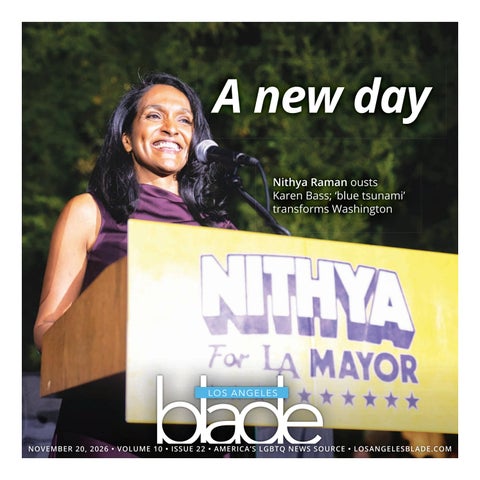
A new day Nithya Raman ousts Karen Bass; ‘blue tsunami’ transforms Washington
NOVEMBER 20, 2026 • VOLUME 10 • ISSUE 22 • AMERICA’S LGBTQ NEWS SOURCE • LOSANGELESBLADE.COM
LOCAL
Nithya Raman wins Los Angeles mayoral election, ousting Karen Bass Mayor-elect commits to protecting queer Angelenos from Trump attacks By CALEB KAUFMAN Nithya Raman is the projected winner of the Los Angeles mayor’s race, beating out incumbent Karen Bass in a contentious campaign to lead the second largest city in the nation. Raman has won 52% of the vote with 75% of precincts reporting. Earlier in the year, City Council member Raman’s chances of pulling off a victory seemed slim. Mayor Bass won handily in the June mayoral primary, and Raman came in a distant second, inching out the bombastic former reality TV star Spencer Pratt to secure a spot in the runoff. Raman ran on a progressive platform that promised to address chronic issues in Los Angeles, like homelessness, affordability, and lack of housing supply. Raman made the case that the Bass administration had not confronted these challenges effectively and that Los Angeles needed new leadership that could. A newcomer to politics, Raman first ran for office in 2020 when she won a seat on the Los Angeles City Council, the first time a challenger had defeated an incumbent for a city council seat in nearly two decades. Her election was a shock to the L.A. political establishment and taught Raman how to effectively organize a grassroots campaign, a skill that would be invaluable to her 2026 mayoral victory.
NITHYA RAMAN addresses supporters on election night at the Greek Theater in Los Angeles, CA, on Nov. 3, 2026.
02 • NOVEMBER 20, 2026 • LOSANGELESBLADE.COM
Despite lacking establishment backing, earning no endorsements from her fellow council members, Raman was supported by many progressive organizations and unions, including the L.A. chapter of the Democratic Socialists of America, Unite Here! Local 11, and the Western States Carpenters union. They provided her with thousands of eager canvassing volunteers and organizers. These canvassing efforts helped sway public opinion and introduce Raman to voters who had likely never heard of her. Homelessness was a particular flashpoint in the election. In April, reporting by the L.A. Times showed 40% of the people who participated in Mayor Bass’s signature anti-homelessness program ended up back on the streets within a year, and overall homelessness levels increased across the city in the last year. Raman pointed to her district’s near 50% decline in unsheltered homelessness between 2025 and 2026 as proof she could confront the issue more effectively. But time will tell if she can translate this success city-wide. Mayor Bass served a hectic and tumultuous term as the first woman mayor of Los Angeles. In early 2025, she had to deal with the fallout of the Palisades fires, one of the most destructive wildfires the city has ever seen. Only a few months later, Immigration and Customs Enforcement raids shocked immigrant communities around L.A. and subsequent protests shut down the city. In response, President Trump deployed the National Guard to the streets in a move many saw as federal overreach, further inflaming tensions. These remarkable challenges ingrained anti-incumbent sentiment among some voters who believed Mayor Bass could have done more to help Angelenos in both instances. Raman spent her campaign painting the mayor as insufficiently proactive in countering the policies of the Trump-Vance administration. Raman has promised to protect L.A.’s queer community from federal actions that could harm them, especially emphasizing her support for the transgender community, which has been the target of numerous attacks from President Trump. The Mayor-elect said she would pressure Children’s Hospital Los Angeles to reevaluate its ending of gender-affirming care services. The hospital’s center for Transyouth Health closed in 2025 following federal pressure to end trans healthcare for minors, impacting more than 2,000 patients who were receiving care when the closure occurred. Despite federal threats, gender-affirming care remains legal in California. Speaking with the Blade last month, Raman said she would “reach out to [CHLA’s] board and speak to them about that decision and see how we can push them to do better [for] trans patients,” outreach she said had not happened under the Bass administration. In her election night speech to an energized crowd at the Greek Theater, Raman reiterated her support for the queer community, committing to “show up for our gay and trans siblings,” across Los Angeles. Caleb Kaufman is a California Local News Fellow placed with the Los Angeles Blade. The California Local News Fellowship is a state-funded initiative to support and strengthen local news reporting. Learn more about it at fellowships.journalism.berkeley.edu/cafellows.
NOV 30TH, 7:30PM
LOCAL
Xavier Becerra wins California governor’s race Governor-elect has long track record of LGBTQ support By CALEB KAUFMAN Just minutes after polls closing, Democratic candidate Xavier Becerra was named the projected winner of California’s governor’s race by the Associated Press, beating out the Republican Steve Hilton. Becerra has a long history in elected office, serving as a congressman representing parts of Los Angeles and East LA, then as California Attorney General, and most recently as the Secretary of Health and Human Services under President Joe Biden. He also has XAVIER BECERRA in speaks at an HHS conference in 2023 a long history of supporting pro-LGBTQ policies. As a congressman, he voted against the 1996 Defense of Marriage Act, which banned same-sex marriage on the federal level. As California attorney general, he sued the Trump-Pence administration in 2017 over a policy that aimed to ban transgender people from serving in the military. As HHS Secretary, he publicly defended access to gender-affirming care for transgender patients, including for minors, noting that it has been shown to reduce suicidality among transgender youth. This is a major contrast to the current HHS Secretary Robert F. Kennedy Jr., who has since made the agency’s official policy that it “rejects gender ideology and condemns the harms it causes to children.” In his campaign for governor, Becerra has continued to support gender-affirming care, saying in a statement on X that “as Governor, I will stand firm to secure California’s status as a sanctuary state for trans youth and their families,” and posting an image with the
phrase “protect trans youth.” Becerra’s opponent Steve Hilton made LGBTQ issues a small but loud part of his campaign. He opposed transgender participation in women’s sports, attending and speaking at a “Save Girl’s Sports” rally that called for a ban on transgender people playing in women’s sports in California. In an interview with the San Francisco Standard, Hilton was asked about his favorite girl’s sport, responding “I don’t follow girl’s sports,” and declined to make any commitments to further women’s competition in sports beyond calling for an end to transgender participation. Hilton came under further criticism from the LGBTQ community for releasing an innuendo-laced campaign advertisement in October that appeared to show two women in an intimate setting before revealing that one is trying to convince the other to vote for Hilton. Jorge Reyes Salinas, communications director at Equality California, called the ad “a disgusting attempt to exploit lesbian intimacy for political attention” in an interview with the Blade. It was also unpopular among conservatives, with Evangelical Pastor Jack Hibbs stating that the ad was distasteful and that “lesbianism among college girls and some high school girls right now is an actual pandemic of social ill.” Becerra’s victory in the governor’s race is no surprise in California where registered Democrats outnumber registered Republicans nearly 2:1. The real challenge was making it past the primary election. After former Congressman Eric Swalwell dropped out of the Democratic primary amid allegations of sexual misconduct, Becerra seized on the opportunity and became the frontrunner. He later beat out billionaire Tom Steyer in the June primary to become the Democratic nominee. In the general election, Becerra ran a quiet campaign for governor, counting on support from the overwhelmingly Democratic California electorate. As a result, Becerra has been sparse on many specific policy commitments on the campaign trail. However, his track record indicates that California’s next governor will likely support pro-LGBTQ policies. Caleb Kaufman is a California Local News Fellow placed with the Los Angeles Blade. The California Local News Fellowship is a state-funded initiative to support and strengthen local news reporting. Learn more about it at fellowships.journalism.berkeley.edu/cafellows.
Stephen Post wins final seat on WeHo City Council Edges past Duran, Brazeal to join Byers, Krieger By CALEB KAUFMAN Stephen Post has won the final seat on the West Hollywood City Council, joining Chelsea Byers and Helen Krieger as the winners of this election cycle. Post beat out candidates John Duran and Kyle Brazeal in the tight race for third. While ballots are still being counted, Post leads fourth place Duran by nearly 500 votes and his lead has been growing with each new vote count. Duran conceded to Post on Saturday morning. In Los Angeles County, younger and more progressive voters tend to cast their ballots closer to Election Day, meaning they often get counted later. This is what caused Post’s seeming comeback victory, although this is more a factor of California’s slow ballot counting process. Post ran a progressive campaign, focusing on an aggressive opposition to Flock cameras, which he said posed serious privacy concerns for WeHo residents, amounting to mass surveillance. He also supported the plan for bike lanes on Fountain Avenue and building more housing in WeHo, including in large apartment buildings. Post was the only candidate endorsed by the Los Angeles chapter of the Democratic Socialists of America, whose members vigorously canvassed for him and helped him reach voters. Post is a newcomer to politics as City Council will be his first time in elected office. He works as a business improvement district manager and previously was a non-profit advocate for criminal justice reform. These election results illustrate a progressive sweep of the Council, with Byers and Krieger supporting many of the same policies as Post. All winning candidates were endorsed by the Unite Here! Local 11 union, which has become a powerful player in Los Angeles campaigns, as they also backed the successful campaign of Mayor-elect Nithya Raman. More 04 • NOVEMBER 20, 2026 • LOSANGELESBLADE.COM
moderate candidates like Duran, Brazeal, and Larry Block all placed in fourth, fifth, and sixth place respectively. With Council member John Erickson staying on the Council after losing his state Senate election to Brian Goldsmith, progressives will have a 4-1 majority meaning they will be able to pass their agenda with relative ease. Vice Mayor Danny Hang is more moderate but has often collaborated with Erickson and Byers on a case-bycase basis. The voters have spoken and a progressive agenda is coming to West Hollywood. Younger and first time candidates have won out over experienced WeHo political figures. Caleb Kaufman is a California Local News Fellow placed with the Los Angeles Blade. The California Local News Fellowship is a state-funded initiative to support and strengthen local news reporting. Learn more about it at fellowships.journalism.berkeley.edu/cafellows.
NATIONAL
LGBTQ+ advocates look to new Congress for path forward on federal protections Ricardo Martinez (GLAD Law) spoke about the future of LGBTQ protective policy under the 120th Congress By JOE REBERKENNY Following Democratic victories in the midterm elections, LGBTQ+ advocates are looking to the incoming Congress for renewed opportunities to pass pro-LGBTQ+ legislation. For decades, advocates and lawmakers have pushed for a federal law prohibiting discrimination based on sexual orientation and gender identity. With Democrats set to take control of both chambers in January, advocates say the new majority could provide an opening to advance legislation that has repeatedly stalled in Congress, even as the Trump administration continues its efforts to roll back existing protections. The Equality Act remains at the top of the legislative wish list. The legislation would amend the Civil Rights Act of 1964 and related federal laws to explicitly prohibit discrimination based on sexual orientation and gender identity in employment, housing, public accommodations, education, federally funded programs, credit, and jury service. The latest version was introduced in the House by Equality Caucus Chair Rep. Mark Takano (D-Calif.) and in the Senate by Sen. Jeff Merkley (D-Ore.), with Sen. Ed Markey (D-Mass.) among its co-sponsors. Other proposals include the Transgender Bill of Rights, reintroduced in February by Markey and Rep. Pramila Jayapal (D-Wash.), with Reps. Sara Jacobs (D-Calif.) and Takano among its co-sponsors. The resolution calls on the federal government to take steps to protect transgender and nonbinary people and ensure access to medical care, shelter, safety, and economic security. Rep. Bonnie Watson Coleman (D-N.J.), a co-chair of the Congressional Equality Caucus, has also backed legislation aimed at addressing discrimination against LGBTQ+ people. She has co-sponsored the Therapeutic Fraud Prevention Act of 2025, which would prohibit commercial sexual orientation conversion therapy, as well as the Tyler Clementi Higher Education Anti-Harassment Act, which would require colleges and universities to establish policies addressing homophobia and transphobia on campus. But while advocates see a Democratic-controlled Congress as an opportunity to advance those proposals, they are also approaching the next two years with an understanding of the political and legislative challenges ahead. The Los Angeles Blade spoke with Ricardo Martinez, executive director of GLAD Law, about the future of federal LGBTQ+ policy under the new Congress and what the midterm results revealed about the priorities of American voters. “The first thing that I think of when I think of the election is that this election showed that people are tired of division, and they want leaders who are focused on everyday concerns like healthcare, safety, economic security,” Martinez told the Blade by phone Tuesday. “I think a lot of people in the United States, including LGBTQ people, are hurting.” Martinez said the incoming 120th Congress has tools to protect LGBTQ+ people, even if passing sweeping new federal protections proves difficult in the near term. “Passing new federal protections for LGBTQ people spe-
cifically may be hard in the near term, and we are realistic about that,” Martinez said. “But still, Congress can lay the groundwork now, either through hearings or bill development.” He pointed to healthcare and economic policy as areas where lawmakers could make progress that benefits LGBTQ+ people alongside the broader public. “But there’s a lot Congress can do on healthcare minimum wage that would apply and benefit LGBTQ people,” he said. “Lasting progress has always depended on the support of both parties, so that’s a coalition that I think is worth building, and hopefully, in the not so near future, the Equality Act can be a thing that moves.” Beyond passing legislation, Democrats are preparing to use their new majority to scrutinize the Trump administration. Rep. Robert Garcia (D-Calif.), the gay lawmaker who won reelection, is slated to chair the House Oversight Committee when Democrats take control of the chamber. Garcia has pledged to investigate the administration and hold officials accountable for actions he believes violated the law. That promise has already drawn a response from the White House, where Trump administration officials have warned against efforts to intimidate or threaten executive branch employees.
Rep. MARK TAKANO (D-Calif.) at the reintroduction of the Equality Act in 2023. (Washington Blade photo by Michael Key)
In response to those warnings, the Democratic staff of the House Oversight Committee defended Congress’ authority to investigate the administration, arguing that its oversight powers come from the Constitution and do not depend on White House approval. Martinez said that kind of oversight is particularly important when government actions affect personal privacy, healthcare, and community programs. “Oversight of the executive branch is one of Congress’s basic responsibilities, no matter who is in office,” Martinez said. “So, recent federal actions on personal privacy and data cuts to healthcare, research, and community programs deserve careful review.” He said the consequences extend beyond LGBTQ+ people, warning that government actions targeting one group’s
privacy or access to services can threaten protections for everyone. “Their effects reach Americans broadly, not only LGBTQ people,” Martinez said. “And when the government can single out one group’s privacy or services, everyone’s rights are less secure, and transparency protects all of us.” Democrats could also use their control of congressional spending negotiations to push for funding for programs serving LGBTQ+ communities. Martinez specifically pointed to the Ryan White HIV/AIDS Program and said lawmakers should oppose discriminatory policy riders in federal spending bills. According to the Human Rights Campaign, House Republicans introduced more than 50 anti-LGBTQ+ policy riders across federal funding bills over the past year. The proposed provisions sought to restrict gender-affirming care, permit discrimination against same-sex couples and undermine diversity, equity and inclusion (DEI) initiatives, which have been a longstanding target of the president’s agenda. Separately, significant cuts have affected federal funding for HIV/AIDS programs. Under the Trump-Vance administration, funding shortfalls pushed by the administration have emerged in programs serving LGBTQ+ people and other vulnerable communities. The HIV and Hepatitis Policy Institute says $1 billion in cuts to domestic HIV prevention, surveillance, and support programs have left some of the communities most affected by HIV struggling to cover medical costs. “Last year was full of disruptions in HIV prevention grants and services, which created great instability. Not only do we need to maintain current funding levels, but increases are urgently needed, particularly for the AIDS Drug Assistance Program (ADAP) due to rising enrollment and insurance premium costs,” said Carl Schmid, executive director of the HIV+Hepatitis Policy Institute, earlier this year. Still, congressional oversight and funding decisions will not necessarily stop the administration from pursuing policies LGBTQ+ advocates oppose. Martinez said GLAD Law plans to continue challenging those actions in court. “Our plan has always been and will remain consistent, which is we are in the process of a surge in litigation, which means that we’re going to try to stop as much of the bad as possible,” Martinez said. The organization’s work will also extend to state governments, where many laws directly affecting LGBTQ+ people’s daily lives are passed. Martinez said GLAD Law will continue challenging harmful state policies while pursuing legislation to strengthen legal protections for LGBTQ+ families, including in adoption, assisted reproduction and parental recognition. The election also offered hope on transgender rights, despite continued political attacks targeting transgender people. Martinez said advocates must continue challenging misinformation and helping Americans better understand the lives of LGBTQ+ people. CONTINUES AT LOSANGELESBLADE.COM
LOSANGELESBLADE.COM • NOVEMBER 20, 2026 • 05
NATIONAL
Anti-trans ballot measures pass in four states, setting up new legal battles Sarah McBride after the election said Democrats cannot abandon transgender people By JOE REBERKENNY
Five states across the country had ballot initiatives targeting transgender people and seeking to restrict their rights in some form, from bathroom restrictions to limitations on access to school sports. Arizona, Colorado, Missouri, Nebraska, and Washington all considered measures targeting transgender people during the 2026 election. Missouri’s anti-trans ballot initiative failed; while voters in Arizona, Colorado, Nebraska, and Washington approved their respective measures. Arizona In Arizona, voters passed Proposition 318, also known as the Protect Girls’ Sports in Arizona Act, with approximately 58.7 percent of the vote. The proposition, which was placed on the ballot by the state’s Republican-controlled Legislature, expands the state’s existing Sports Participation Ban, passed in 2022, which restricts trans girls from competing on public school girls’ sports teams. The amendment further restricts athletic participation based on biological sex and addresses access to restrooms, locker rooms, and changing areas in public schools. Arizona also has a surgery ban in place that prohibits physicians from providing “irreversible gender reassignment surgery” to minors under the age of 18. The state also excludes “gender reassignment surgeries” from Medicaid coverage. Joel Edman, a spokesman for Progress Arizona, a local advocacy group, criticized the measure following its passage, warning of the broader consequences it could have for trans people and girls in general. “The negative impacts this will have, not only on trying to bully and shame transgender people of all ages back into closets, into the shadows, but also to enforce a stereotype of what girls are supposed to look and dress and act like,” Edman told the AZ Mirror. “The real risk that this measure poses is having all girls potentially scrutinized for being too tall, or too strong, or too good at whatever sport they want to play with their friends.” Colorado In Colorado, voters approved two anti-trans propositions, both targeting trans youth. Proposition 134 requires public schools and colleges to designate sports teams according to students’ sex, while restricting trans athletes from participating on teams that align with their gender identity. The Associated Press called the race, with support for trans restrictions at 52 percent of the vote. Proposition 135, which prohibits health care professionals from knowingly performing any surgery on a minor “for the purpose of altering biological sex characteristics,” also passed, receiving 51.92 percent of the vote. Bruce Parker, executive director of Rocky Mountain Equality, described the results as a setback for transgender youth, their families and the state’s broader LGBTQ+ community. “Today is a bad day for Colorado. While we certainly have some good news from the results, including the rejection of Amendment 81, our fundamental commitment to privacy and freedom has been undermined by the passage Propositions
134 and 135, two misleading and discriminatory ballot measures. This is devastating for a lot of kids, families, and communities. “The impact of these measures on Colorado families is real. Right now, parents are wondering what this means for their children’s healthcare. Students are wondering if they’ll be allowed back on their teams or what they might have to do to be allowed to play. To those kids and families I want to say: you are not alone, and we are not going anywhere.” Parker continued, saying the language of the measures was intentionally vague, creating a chilling effect for those unsure whether they were violating the law. He argued that this would lead more people to err on the side of caution and preemptively act in ways that align with the legislation, regardless of whether those actions are actually illegal under the new measures. “Props 134 and 135 were written broadly and vaguely on purpose. They leave basic questions unanswered about who enforces them, how decisions get made, and what safeguards exist. That ambiguity is what the proponents want. They want for there to be gray areas where the policies could potentially reach even farther into our private lives. He also added that, while they lost the final tally, the close race indicated that many people in the state genuinely care about protecting trans youth, making the issue more of a fight than conservatives had made it out to be. “More than a million Coloradans voted against these harmful measures. The vote was close, and we are so grateful for every person who made calls, knocked doors, and voted. Now the newly elected Colorado legislators have an opportunity to negate the damage these policies will cause, and we expect them to step up. “To every transgender kid and family, we’ve got your back. This is your home too. This vote doesn’t change that,” Parker finished with. Mardi Moore, chief executive officer of Rocky Mountain Equality Action Fund, similarly criticized the measures, arguing that voters had been misled into supporting policies that would disproportionately affect trans youth and their families. “While we elected many pro-equality candidates and defeated a measure targeting our immigrant neighbors, voters were misled into accepting policies that unnecessarily and unfairly target trans youth and their families,” Moore said. “Supporting the hateful priorities in Project 2025, these poorly written measures will cause confusion and harm for real kids, families, schools, and doctors. We will continue to fight for every person’s freedom and privacy, and we will work with newly elected lawmakers to mitigate the harm these policies can do to Colorado kids.” Missouri Missouri, one of the most consistently Republican states on the list, was the only state to reject its anti-trans ballot measure, with 55.42 percent of Missourians voting “No.” Voters in the Show Me State rejected Amendment 3, a legislatively referred constitutional amendment that attempted to enshrine a ban on gender-affirming care for minors in the
06 • NOVEMBER 20, 2026 • LOSANGELESBLADE.COM
A participant in the World Pride March in Amsterdam on Aug. 8, 2026, holds a sign in support of the rights of transgender youth. (Washington Blade photo by Michael Key)
state constitution, alongside abortion restrictions. LGBTQ+ advocates in the state attributed the outcome to grassroots organizing that emphasized the right to live free from discrimination, rather than the expansive and often dangerous rhetoric anti-trans politicians have been injecting into this race and others across the country. PROMO Communications Director Robert Fischer said the organization views the result as part of a longer-term effort to build political support for trans Missourians. “Our goal is to build a pro-trans majority in Missouri, which means that the majority of voters in Missouri would reject any candidate, law, or ballot initiative that tries to discriminate against trans Missourians,” Fischer said. “We understand that this would be a 5-10 year goal, which is why our deep canvassing work is about power building. We set out to have 10,000 completed conversations with voters across the state and we are proud to say that we exceeded that number, hitting over 13,000 by Election Day.” “We’ve seen the beginnings of people’s hearts and minds shift in Missouri as we talk to voters. There are so many people in each of our regions that simply are eager to talk with a trans person — to hear more from them and learn more about them. Our deep canvassing program started in 2024 and it will continue after this year’s election.” Fischer also said he believes the outcome reflects a broader national shift in how voters view political attacks targeting trans people. “Nationally,” Fischer added, “I think you’ll see Missouri is on pace with the rest of the country in that voters are tired of politicians using trans people as political fodder.” Nebraska Voters in Nebraska approved Initiative 442, the Fairness for Girls constitutional amendment. The proposal received 67.81 percent of the vote, the highest level of support among the anti-trans ballot measures considered during this election cycle. The measure bars students assigned male at birth from participating in sports designated for girls and women, enshrining sex-based athletic eligibility requirements in the state’s constitution. OutNebraska, an advocacy organization for LGBTQ+ people in the state, was a vocal opponent of the measure. Although the policy had already been enacted through state law, the ballot initiative made it part of the state constitution, making it more difficult to change or challenge. CONTINUES AT LOSANGELESBLADE.COM
REQUEST FOR STATEMENT OF QUALIFICATIONS FOR AS-NEEDED HARBOR ENGINEERING AND ARCHITECTURAL DESIGN CONSULTANT SERVICES The County of Los Angeles Department of Beaches and Harbors is seeking qualified and experienced Vendors to enter into Master Agreements to provide as-needed consultant services in the disciplines of Engineering (including Coastal and Harbor Engineering), Architecture and/or Landscape Architecture, Planning and other Design Services, and Professional Cost Estimating for Department projects located in County-owned and unincorporated areas of Marina del Rey, Marina del Rey Harbor, and at County-owned and operated beaches. The successful Vendors must demonstrate their experience in marine development and be able to provide consulting services to the County related to improvement efforts in Marina del Rey. The selection of Vendors will be based on the qualifications of the firms that submit proposals. Vendors submitting Statement of Qualifications (SOQs) must have a minimum of five years of relevant experience performing work for governmental agencies or private organizations in the following categories: Engineering Services, Design Services - Architectural and/or Landscape Architectural, and Planning and Other Design Services. The County may require additional minimum qualifications. The deadline for submitting SOQs will be 5:00 p.m., December 22, 2026, however, County will continuously accept SOQ’s throughout the duration of the Master Agreement. Further information regarding the RFSQ is available at: https://doingbusiness.lacounty.gov/. To view and print a copy of the RFSQ, please visit: http://beaches.lacounty.gov/request-for-proposals/. The County reserves the right to cancel the RFSQ and to modify any and all terms and conditions of the RFSQ, including minimum qualifications. For further information, email Jean Dao at Contracts@bh.lacounty.gov. CN131485 12-22-2026 Nov 20, 2026
LOSANGELESBLADE.COM • NOVEMBER 20, 2026 • 07
VIEWPOINT
KEVIN NAFF is editor of the Washington Blade. Reach him at knaff@washblade.com
Let’s hear it for the LGBTQ midterm heroes Rep. Garcia should let the subpoenas fly in new Congress By KEVIN NAFF Many of us are still reeling with excitement and relief from the midterms. I won’t go so far as to say my faith in America and its voters is restored but it’s certainly a terrific start. Although we were hopeful about Texas and confident about Georgia, who could have predicted Kansas, Mississippi, and South Carolina? Amazing night. There were many LGBTQ storylines and heroes that emerged on Election Night. Rep. Sarah McBride won her historic re-election bid in Delaware, overcoming overt transphobia from her opponent and an avalanche of social media trolls. She ran a positive, uplifting campaign, visiting each of Delaware’s 57 municipalities in just 57 hours. Her TV commercials focused on solving the problems of everyday citizens and veterans. Kudos to McBride for her fearless positivity. One underreported story is the enhanced role that LGBTQ lawmakers will have in the new Congress, chief among them: Rep. Robert Garcia, who boldly advised Republicans on Election Night to “lawyer up.” He received some criticism for the Tweet, as some have expressed concerns that Democrats should focus on legislation and not impeachment and investigations. But Garcia is right to embrace his likely upcoming role as chair of the House Oversight Committee, one of the most powerful committees in Congress, with broad authority to investigate the operations of the federal government, examine potential misconduct, and scrutinize actions taken on behalf of the United States, including those of the executive branch, as the Blade has reported. The chair is one of only three House committee chairs with the authority to issue subpoenas without a committee vote or consultation with the ranking member. The scope of corruption and criminality in the Trump administration is truly breathtaking. Trump and his sons have made more than a billion dollars in crypto schemes and conveniently timed stock trades. His son-in-law Jared Kushner should follow in his father’s footsteps to prison for his shady Saudi dealings. The list goes on and on. Although the mainstream media focused mostly on the price of gas and the Iran war as reasons voters wanted change, the reality is that corruption and accountability factored strongly into the results. “Ninety percent of
voters said that corruption was a crucial or major factor in their vote, with roughly half saying it was ‘crucial,’ on par with the cost of living, and with immigration enforcement, the war in Iran, or AI data centers following behind,” according to the 2026 SSRS Voter Poll. Let’s hope Garcia and others in power remember that mandate and push forward with investigations into all the rampant corruption and grift in this sick administration. Let the subpoenas fly! Impeach Pete Hegseth and Todd Blanche on day one! And put a stop to the fleecing of America by Trump and all his vulgar spawn. Garcia isn’t the only out gay lawmaker about to take on an enhanced role. Rep. Mark Takano (D-Calif.), ranking member of the House Veterans’ Affairs Committee, is also in line to assume more power. If named chair, Takano would have a direct role in advancing new bills, which could become important as the Trump administration continues its attacks on trans service members. Rep. Mark Pocan (D-Wisc.), a senior member of the House Appropriations Committee, could be up for a leadership post. As the Blade reported, “A Democratic-led appropriations process could give lawmakers greater power to establish positive funding decisions for federal LGBTQ related programs and protections. It could also provide opportunities to challenge spending priorities that support the administration’s efforts to roll back LGBTQ-inclusive policies, including the significant cuts the Trump-Vance administration has made to HIV and AIDS funding, which disproportionately affects LGBTQ people.” Meanwhile, in the Senate, Sen. Tammy Baldwin of Wisconsin could seek a leadership role on the Senate Appropriations Committee. The new Congress will include at least 17 openly LGBTQ members of Congress, a record. And with the midterms in our rearview mirror, the race for 2028 begins with an out gay man at the top of the pack in Pete Buttigieg. We have suffered tremendous setbacks over the last two years following Trump’s cruel and racist crackdown on anything he deems “DEI.” But the pendulum is swinging. It’s time for accountability as a new day dawns in Washington. And it dawns with more LGBTQ officials than ever in key positions of power and influence.
V O L U ME 10 I S S U E 22 PHONE 310-230-5266 E-MAIL arodriguez@losangelesblade.com INTERNET losangelesblade.com PUBLISHED BY Los Angeles Blade, LLC PUBLISHER ALEXANDER RODRIGUEZ arodriguez@losangelesblade.com, 310-230-5266 x 8080 EDITORIAL NATIONAL EDITOR KEVIN NAFF knaff@washblade.com, 202-747-2077 x 8088 CONTRIBUTING WRITER KAREN OCAMB karenocamb@losangelesblade.com CONTRIBUTORS
MICHAEL K. LAVERS, TINASHE CHINGARANDE, JOHN PAUL KING, LOU CHIBBARO JR., SUSAN HORNIK, JOE REBERKENNY, ISAAC AMEND, PETER ROSENSTEIN, TERRI SCHLICHENMEYER, JOE PHILLIPS, ANKUSH KUMAR, ESTEBAN RIOSECO, AJ SLOAN, AYMAN ECKFORD, TOM SITUMO
SALES & ADMINISTRATION SALES EXECUTIVE SHANA WONG SOLARES swong@losangelesblade.com, 808-386-0872 MARKETING DIRECTOR BRIAN PITTS bpitts@washblade.com, 202-747-2077 x 8089 NATIONAL ADVERTISING RIVENDELL MEDIA sales@rivendellmedia.com, 212-242-6863 ADMINISTRATION PHILLIP G. ROCKSTROH prockstroh@washblade.com, 202-747-2077 x 8092 CREATIVE DESIGN/PRODUCTION MEAGHAN JUBA production@azercreative.com DISTRIBUTION CHRISTOPHER JACKSON, 562-826-6602 All material in the Los Angeles Blade is protected by federal copyright law and may not be reproduced without the written consent of the Los Angeles Blade. The sexual orientation of advertisers, photographers, writers and cartoonists published herein is neither inferred nor implied. The appearance of names or pictorial representation does not necessarily indicate the sexual orientation of that person or persons. Although the Los Angeles Blade is supported by many fine advertisers, we cannot accept responsibility for claims made by advertisers. Unsolicited editorial material is accepted by the Los Angeles Blade, but the paper cannot take responsibility for its return. The editors reserve the right to accept, reject or edit any submission. A single copy of the Los Angeles Blade is available from authorized distribution points, to any individual within a 50-mile radius of Los Angeles, CA. Multiple copies are available from the Los Angeles Blade office only. Call for rates. If you cannot reach a convenient free distribution point, you may receive a 26-week mailed subscription for $125 per year or $5.00 per single issue. Checks can be sent to Phil Rockstroh at prockstroh@washblade.com. Or send him an email to request directions to make a payment online. Postmaster: Send address changes to the Los Angeles Blade, PO BOX 60664 Washington, DC 20039. The Los Angeles Blade is published bi-weekly, on Friday, by Los Angeles Blade, LLC. Rates for businesses/institutions are $450 per year. Periodical postage paid at Los Angeles, CA., and additional mailing offices. Editorial positions of the Los Angeles Blade are expressed in editorials and in editors’ notes as determined by the paper’s editors. Other opinions are those of the writers and do not necessarily represent the opinion of the Los Angeles Blade or its staff. To submit a letter or commentary: Letters should be fewer than 400 words; commentaries should be fewer than 750 words. Submissions may be edited for content and length, and must include a name, address and phone number for verification. Send submissions by e-mail to knaff@washblade.com.
2023 GLAAD Media Awards
08 • NOVEMBER 20, 2026 • LOSANGELESBLADE.COM
©2026 LOS ANGELES BLADE, LLC.
Andrew Scott talks ‘Elsinore,’ Hamlet, and AIDS Awards buzz for portrayal of HIV-positive actor Ian Charleson By SUSAN HORNIK “It’s unimaginable — ‘Hamlet’ is a great, very physically challenging role…I honestly One of the standouts this awards season is “Elsinore,” the inspirational true story think it took me about three months to get over it when I did it, because it’s an enorof Ian Charleson, a gifted British actor who movie fans may remember from the Osmous theater,” acknowledged Scott. car-winning, 1981 historical drama, “Chariots of Fire.” “As Charleson says in the film, it’s 1,500 Shakespearean lines. There are nine soliloIn “Elsinore,” the deeply touching film focuses on how Charleson (played by Andrew quies. There’s a sword fight in hour three. There are two intervals. You are playing the Scott) courageously takes on the role of Hamlet at the National Theatre in London, prince, you are playing the grieving son. You are dealing with literally soliloquies about while battling AIDS in the final months of his life. life and death. You have to be an orator. You have to be a prince. You have to be a Scott is terrific as Charleson, who faces his mortality with humility and grace. lover. It requires so much of you, and that’s when you are healthy. But to do that when “I felt a huge responsibility to capture how joyful he was,” Scott said during an inyou are in the mornings going to get blood transfusions and waiting around at the Royterview. “He was a wickedly funny person, and was always looking toward the light. al Free Hospital, when you Even his decision to do that are physically just so low at the very end of his life, to and your immune system surround himself with his is so destroyed, it’s comtribe and be in a rehearsal pletely heroic for him to do room, was very represenit…he has the courage of tative of who he was as a 100 men.” man.” The first open-access For many Generation Z HIV clinic and women’s viewers, the film is a histoHIV clinic at the Royal Free ry lesson in how the LGBTQ Hospital was renamed the community had to stay in Ian Charleson Day Centre the closet for fear of reper(ICDC) in 1992. Today, it cussions…and sadly, many continues to provide care were dying of AIDS. for those living with HIV. “What I think is really imOne of the most poiportant is that it was only gnant moments in “Elsinoone generation ago that re” was when Charleson this happened; we lost so discusses choosing quality many people. The freedom of life over quantity; a conthat so many young people cept that deeply resonated enjoy now, in many more with Scott. parts of the world — that “So many of the issues freedom has been won by that Ian experienced, I a hard fight, because the feel like I’ve experienced stigma really remained.” myself,” said Scott. “I’ve Scott well understands entered into a profession Charleson’s choice to keep that is not stable. When his private life away from you’re starting out, people the public. say, ‘you know, you don’t “We wanted to show the really get a pension, only breadth of what that stig5 percent of actors work,’ ma was, to use the nucleus but the quality of my life of the film and theater inANDREW SCOTT stars in ‘Elsinore.’ (Photo courtesy StudioCanal) has been completely wondustry, showing how diffiderful.” cult it was for people to get In addition to starring in the film, Scott is one of the executive producers, which in opportunities that were afforded his straight counterparts. He was closeted, and had early days, proved challenging. to deal with so much homophobia that he chose to stay in the closet.” “The most difficult part of it was the pre-production of the film, trying to get it made, Just like audiences see how Charleson’s passion for acting helped his emotional well because I felt so passionately about it. My mother died a year and a half before ‘Elsibeing, Scott’s own artistic creativity has been equally healing. nore’ was made, and I was living with enormous grief, which gives you some sort of “I have no qualms in saying that art in some way, has saved my life. This idea that art energy as well as a kind of desolation. This story just felt so personal to me, and it is a luxury for people, that is preposterous to me at this stage. When COVID happened, became more and more personal.” the first thing that people did was go to movies, television, books and music to comfort Scott was thrilled when they were able to get the financing and cast together to themselves, when they were alienated from other human beings. That’s the first place make the story that he very much believed in. that we go to connect with other people and we should be so proud of it. That’s why “When we were on the set making the film and acting it, I was so happy that we were it should be taken seriously…it should be treated and funded as such, to my mind.” getting to kind of do the creative thing rather than worrying about the finances and Having played the multi-dimensional “Hamlet” for more than 150 performances onwhether we would get to do it.” stage, Scott was blown away that an ailing Charleson could have deftly taken on perElsinore opens Nov. 20 in limited release and wider during the holidays. forming Shakespeare with such passion.
LOSANGELESBLADE.COM • NOVEMBER 20, 2026 • 09
FILM
Andrew Scott triumphs again in ‘Elsinore’ Ian Charleson’s story is no run-of-the-mill biopic By JOHN PAUL KING Some movies carry their power through an overall vision – the inspirations of its writers and directors, the great themes and influences from which they are shaped, the creative unity of all its collaborative talent – while some derive it from the contributions of their most visible asset. “Elsinore,” it might be said, does both; but by the very nature of the true story it tells, it hinges on the second factor, because without the powerhouse talent entrusted with its central role, it might be no more than a run-of-the-mill biopic. Considering the pre-release buzz that surrounds it, most cinema enthusiasts – especially those with an interest in queer storytelling – are doubtless already aware that director Simon Stone’s film (and its screenplay by Stephen Beresford) is a showcase for the talents of lead actor Andrew Scott, the out-and-proud gay Irish actor who rose to international fame as twisted genius archnemesis Moriarty opposite Benedict Cumberbatch’s modernized “Sherlock” and the “Hot Priest” in “Fleabag” before going on to achieve renown for his powerfully authentic performances in such queer-centric hits as Netflix’s “Ripley” and filmmaker Andrew Haigh’s beautifully bittersweet “All of Us Strangers.” To be sure, the buzz is well-deserved, to the point that it feels nearly impossible for him not to be the favored Best Actor nominee in all of the year’s “award season” races – but that doesn’t mean the film itself exists only as a vehicle for his star power, formidable though it may be. Rather, his performance becomes the vehicle not only for the movie’s deeply affecting celebration of an unsung queer hero, but an expression of the resilience and determination that helped an entire queer generation turn tragedy into triumph by standing tall against the horror of AIDS and simply refusing to “go gentle into that good night” without putting up an almost unimaginable fight. “Elsinore,” a title that refers to the Danish castle that serves as the setting for Shakespeare’s “Hamlet,” tells the story of the final few months in the life of Ian Charleson, a Scots actor who gained international recognition in two Oscar-winning Best Pictures (“Chariots of Fire” and “Gandhi”) but who achieved his greatest acclaim onstage in the London theater scene. Openly gay to his circle of colleagues and friends, he was – like most other queer actors of his era – closeted in the public eye, but his film career faltered, nevertheless. Stone’s film picks up his story in 1989, when Charleson, frustrated by a movie career that has devolved from award-worthy epics to formulaic Z-movie crime thrillers, is offered the chance of any actor’s lifetime: an opportunity to return to the stage with the title role in “Hamlet” at London’s National Theatre, after the abrupt mid-performance departure of superstar thespian Daniel Day-Lewis. The timing is both synchronistic and terrible; Charleson is already exhibiting advanced symptoms, including the tell-tale lesions of Kaposi’s Syndrome, and his health is far from up to the challenge of taking on Shakespeare’s most demanding role – both in terms of psychological intensity and physical endurance – through several weeks of rehearsal, let alone weeks of nightly performances after the show opens before a live audience. Despite the daunting challenges, however, he seizes his
ANDREW SCOTT stars in ‘Elsinore.’ (Image courtesy of Focus Features)
chance; embracing it as a path toward the artistic and professional transcendence that has so far eluded him, as well as a way to achieve triumph and fulfillment in the last chapter of his life. He persuades his doctor – Margaret Johnson (Olivia Colman), a pioneer in Britain’s battle against the AIDS crisis – to help him stay healthy enough to do it, despite her misgivings about the impact it will have on his condition, and he begins the ordeal of preparing for the role through the filter of his own health status while keeping his condition a secret from his fellow cast members, knowing full well that the effort will take more from his failing body than it has to give. Recognizing that it’s a true and well-documented chapter of queer history, “Elsinore” doesn’t bother to frame Charleson’s heroic struggle as a “will he or won’t he” scenario; instead, it focuses its attention on the theme of living life to its fullest; indeed, while the specter of AIDS hovers over everything that happens, and the film takes pains to evoke the grim reality of the days when a diagnosis was a promise of death, Beresford’s screenplay hones in on Charleson’s determination to turn his own final days into a story of personal victory. Drawing inspiration from the “sports mortgage” style that has fueled so many inspirational films about athletes, Stone’s direction does the same for actors, honing in on the process of bringing a character — and the entire world of a play, illuminated wholly by the real-life circumstances that surround it – to tangible and authentic life. Yet the movie refrains from making the eternal touchstone of “Hamlet” – “To be or not to be” notwithstanding – the central inflection point of its narrative. Yes, there are plenty of scenes in which Scott – who has himself played Hamlet on the English stage to great acclaim – connects the play’s immortal language to Charleson’s personal journey, but it’s only in service to the meaning it provides to the real-life context
10 • LOSANGELESBLADE.COM • NOVEMBER 20, 2026
of the story; faced with the reality of Charleson’s imminent death, Shakepeare’s words take on added significance, refracting their power through the lens of his circumstance in a way that underscores their universal resonance but never threatens to take the spotlight away from the personal story being told. Of course, it’s Scott’s gifts as an actor, capable of both negotiating the epic scope of that classic text and embodying the deeply intimate nuance of personal experience, that make “Elsinore” work. He disappears into the character, emphasizing quiet authenticity over classical bombast, and honors a deeply personal story of queer experience by never letting us forget that this is a movie about a man determined to live life to its fullest instead of simply disappearing into oblivion as just another victim of the plague. It’s not a “showy” performance, full of bombast and histrionic intensity; instead, it’s a showcase of quiet, honest dignity, in which the epic scope of a classical tragedy merges with the simple struggle to exist on one’s own terms, and in so doing honors the real-life tragedy of a generation of queer men forced to suffer in the shadows in a time when they were expected to make their peace with death and be quiet about it. “Elsinore” is one of those movies that is defined by the performance of its star – and Scott rises to the occasion flawlessly – but it also features a strong supporting cast, quietly precise direction by Stone, and a literate, loving screenplay from Beresford; and while it might be seen as a kind of “prestige tearjerker,” it’s a movie that contains as much celebration and joy – not to mention a healthy dose of gallows humor – as it does heartbreak. In any case, in a year that’s shaping up to be one of the best in recent memory for queer films and filmmaking, it’s a standout, and it will haunt you – in a good way – long after the final credits roll.
BOOKS
New book delivers inclusive, powerful truth of American history ‘America in 25 Revolutions’ by Garrett Graff deftly revisits LGBTQ injustices By CHARLES FRANCIS Deep inside the Smithsonian National Museum of American History there is a walk-in vault filled with the nation’s political treasures. It is a warren of locked cabinets, pull-out drawers and containers holding two centuries of American political campaign memorabilia. At age 81, gay civil rights pioneer Dr. Franklin E. Kameny was there in 2006 to present the museum with a dozen gay and lesbian rights historic pickets carried decades before in front of LBJ’s White House. To provide context for his acceptance of the pickets, the Smithsonian curator shared some objects from the cabinets: the original table-top writing desk used by Thomas Jefferson to write the Declaration of Independence; the inkwell President Lincoln used to write the Emancipation Proclamation; and a small box with a “Jail for Freedom” pin worn by Quaker Suffragette Alice Paul, brutally imprisoned for demonstrating in front of President Wilson’s White House. “Frank,” the curator said, “alongside your pickets, these objects are all part of the same story: the promise and expansion of liberty to ever-widening circles of Americans.” Widen the lens from this secured vault to encompass 250 years of American history re-centered on the stories of 25 revolutionary leaders like Frank Kameny. Reflect on the giants who fought and prevailed in their quests to expand liberty, and you will have some sense of the grandeur of journalist and historian Garrett Graff’s “America in 25 Revolutions, The Story of Our Imperfect Nation’s 250 Year Quest to Become a More Perfect Union.” “America is the story of revolutions, plural. Not one, but many. America has never been one thing, and it’s never been static,” writes Graff. I began my reading with Kameny’s homosexual “militancy” in the ‘60s but soon realized I was missing the point of the entire book. Graff’s revolutions are drawn from the same well-spring of intellectual ferocity and courage, the world of America’s alpha-political outsiders. Who were these revolutionaries living their lives in a shared high-stakes war with different battles? The endpaper at the front of the book sets the stage. It is a breathtaking double-sized photograph of the “Woman Suffrage Procession” down Pennsylvania Avenue in 1913, the day before the presidential inauguration of Woodrow Wilson. The first large-scale civil rights demonstration to take place in Washington, Graff revisits the story of women’s suffrage — a political and cultural brawl that spanned generations. Parents were advised not to bring children to the “procession.” This was no parade. The potential for violence was too great. Indeed, it took federal troops to confront the thugs who harassed and attacked the women in their state delegations. Graff unpacks what happened over generations of this claw-throat fight, culminating in the disgusting force-feeding of Alice Paul on her hunger strike, bound in a federal prison. Oh how we take for granted the passage and ratification of the 19th Amendment! An eight decades-long drive, “The story of women’s
suffrage in the United States is simultaneously one of the simplest and most complex in the country’s history,” Graff writes in the most gripping chapter of the book. Entitled “A Voice at Last” his contemporary telling will be especially exciting for those still processing this year’s midterm elections. An estimated 64 million women voted, electing a record-breaking number of women to Congress. Take that, President Wilson, who fought the women every step of the way, until they crushed him with their moral rightness. For gay and lesbian Americans, it was not an Alice Paul-style force-feeding but a similar personal violation by organized psychiatry and the psychiatrists who classified homosexuality as a mental illness. Graff deftly revisits the history of horribles faced by LGBTQ Americans from the hanging of “sodomite” Richard Cornish by the Virginia colony in 1625 to the founding of the original Mattachine Society in Los Angeles. Younger queer readers who remain clueless about the hard-fought freedoms they have inherited should be assigned this chapter. “America’s Greatest Cure” is a super-smart primer leading to Frank Kameny’s and Barbara Gittings’s war against organized psychiatry. Graff deftly builds to the moment when Kameny seized the microphone: “Psychiatry has waged a relentless war against us…you may take this as a declaration of war against you!” So it is unfortunate Graff gives the final word to a gender-scholar who decades later undermines the activists: “One of the lessons we might take away is that the strategy of ‘respectability’ — of making homosexuality healthy and normal to lead to (the acceptance of) the gay and lesbian citizen — not only failed because it sold out so many different ways of life that weren’t respectable,” the academic authority says leading up to transphobia and anti-trans politics to come. This is a debatable retrospective summary to cloud the victory in 1973 as a “sell out” when the American Psychiatric Association surrendered and de-listed homosexuality as a mental disorder. Frank Kameny wrote his supporters: “We are cured! En masse.” There is too much history here for anyone to agree with every jot and tittle. “America in 25 Revolutions” delivers the power of American history with the geological force of collisions, upward thrusts, eruptions and the creation of new ground. Beginning with The Bill of Rights and concluding with the story of final justice for Native American tribes in Oklahoma whose ancestral lands were stolen by Andrew Jackson’s Indian Removal Act (1830), these revolutions are not over, thank goodness. Supreme Court Justice Neil Gorsuch wrote the majority opinion, restoring the historic reservation claims for about 19 million acres of the Creek Nation in Eastern Oklahoma (McGirt v Oklahoma, 2020). Justice Gorsuch wrote, “At the far end of the Trail of Tears was a promise.” Garrett Graff nails it. (Charles Francis is president of the Mattachine Society of Washington, D.C., and author of ‘Archive Activism: Memoir of a ‘Uniquely Nasty’ Journey.’)
LOSANGELESBLADE.COM • NOVEMBER 20, 2026 • 11
Wellness Centers Wellness on Western 1811 N Western n8555 78332434
West Adams
2146 W Adams Blvd d8555 78332434
Long Beach
3500 Pacific Coast Hwy y5622 49444983
Free STD Screening & Treatment | HIV Testing & Linkage to HIV Care | PrEP Services