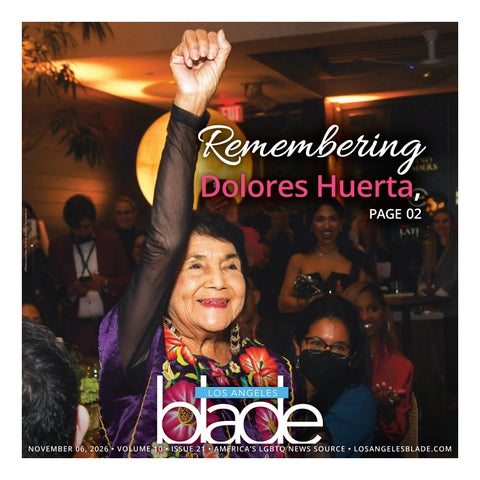
Remembering (Photo courtesy Dolores Huerta Foundation)
Dolores Huerta, PAGE 02
NOVEMBER 06, 2026 • VOLUME 10 • ISSUE 21 • AMERICA’S LGBTQ NEWS SOURCE • LOSANGELESBLADE.COM
LOCAL
Remembering Dolores Huerta, AHF’s Michael Weinstein on his friend and midterms Dolores Huerta has passed away at age 96 By KAREN OCAMB
In a world fraught with anxiety and fear, waking up Wednesday morning, Oct. 28, with a Goldilocks feeling that everything was just right was just odd. And then breaking news confirmed it: Dolores Huerta, icon, civil rights legend, hero to the long, too-often-ignored farm workers movement, had died of cancer at her home in Bakersfield, CA, at age 96. Dolores’ impact was beyond what could ever be documented. As a 15-year-old in Westport, Connecticut, for instance, I stopped eating grapes to support the Farm Workers Grape Boycott that Dolores and Cesar Chavez started as founders of the United Farm Workers in 1965. Decades later, as a working reporter, I could only beam as I introduced myself, asked for a quote, and took numerous photos of Dolores with young delegates to the California Democratic Party convention. They loved and appreciated her, just as they knew she loved and appreciated them. But as Goldilocks timing would have it, I was already scheduled to interview Michael Weinstein, co-Founder of the AIDS Hospice Foundation and Founder of its successor, the AIDS Healthcare Foundation. Michael felt very honored to have worked often with Dolores and to call her a friend. He was scrambling with his team to immediately set up an ofrenda (sacred altar) at the site of Dolores Huerta‘s mural - by world-renowned Los Angeles muralist Robert Vargas – at the Barclay Hotel in DTLA, starting at 1:00 pm through Nov. 2. A more official public ofrenda at the Día de Los Muertos altar at the Barclay Hotel mural at 6:00 pm featured speakers including CHIRLA (Coalition for Humane Immigrant Rights Los Angeles), LA Federation of Labor, SEIU, Sen. Maria Elena Durazo, Father Gregory Boyle, and Michael Weinstein. (The Barclay Hotel is located at 103 W. 4th St., DTLA. The mural is on the rear North-facing wall.) Michael’s official statement: “Dolores Huerta was a towering figure who embodied everything that was best about the progressive movement. Her singular voice encompassed fighting all forms of discrimination. AHF was so honored to have Dolores as a close friend and supporter in our struggles for renter rights and defense of our democracy. She marched with us. We lobbied together. She rode on our Food for Health float in the Rose Parade and was to speak at our 40th anniversary World AIDS Day event on November 30 at The Forum. A piece of the best of us is gone, but she would have told us the fight goes on.” Here’s just some of what Michael told me during our roughly one-hour Zoom conversation. Michael has to separate the legend, the icon, from the person that he knew. “What’s so singular about her was the fact that she embraced all aspects of the battle against discrimination and for people’s human rights with great energy and sincerity. She is just a very unique figure in the world, but particularly
in California. He didn’t want to think of this day coming. At one of her birthday events, he said, “There are dog years - but there are Dolores Huerta years, given her vitality despite her age.” But as a person, “Dolores, to me, is my friend,” Michael says. “First of all, she understood loyalty at a level that not enough people do in this day and age. You hear about the expression ‘speaking truth to power.’ But in really tangible ways, she was a conscience, because when she gets on your case about something that she knew wasn’t right….I know that she dressed down [Gov.] Gavin Newsom when he had told her that he wasn’t going to take a position in the rent control initiative, and two days later, he did. “But in very quiet moments when she would share about her history, or she would share about a lesson she learned and give advice if I requested it - just the feeling that she exuded that you know there really wasn’t a separation between her as an individual, and her commitment to the movement, to the struggle. “And also, she had a zest for life. She wasn’t a dour person. She was a very smiling, friendly person.” Michael Weinstein doesn’t giggle, but if he did, it would be in the unguarded telling of a “little anecdote” about attending her last birthday celebration. He spoke during the program and, as he often does, he left when the program was over. Dolores approached one of his AHF colleagues and asked where I was. “Susie said, ‘Oh, Michael left. And Dolores said, ‘Yeah, he’s not really a party animal, is he?’ Oh, she got that one,” Michael says, cracking up as if you had to be there. “She was so fulsome in her praise of me, personally, and AHF, to the point where it was embarrassing, because I don’t handle compliments that well. I mean, when she was chanting ‘Viva Michael Weinstein’ at the dedication of her mural, it was embarrassing. She meant it,” Michael says, briefly hiding his face in his hands. “I’m so happy that we dedicated that mural in her lifetime. I think it’s such a beautiful monument to her spirit. It’s a great work of art by Robert Vargas, the muralist,” Michael says, noting it’s right across from the Reagan office building, where she can keep an eye out. “She is the conscience of the state. She’s going to be looking right in there at them, saying, ‘You do your job and be true to the cause of serving the people.’ “I hope [the mural] keeps some people’s hearts more open. Some of our cynical politicians who admired her and some of our no-good activists - pretend activists. I hope that maybe it gives them a moment to reflect on what it really means to give your life to these struggles and what it really means to be in solidarity. “I mean, no one could be a better ally of the LGBT community,” Michael says, “because I saw her raise those issues anywhere and everywhere.” Among the meaningful moments and funny stories, Michael says that when he closes his eyes tonight, the one thing he’ll think about Dolores Huerta is her courage.
02 • NOVEMBER 06, 2026 • LOSANGELESBLADE.COM
AHF We the People March MICHAEL WEINSTEIN and DOLORES HUERTA (Photo AHF)
“Courage is not the absence of fear, right? It’s doing what you have to do in the face of all your fears,” Michael says. “The last part of her life had to do with the revelation that she had been raped by Cesar Chavez. And what she told me, what she said publicly, was the fact that she wasn’t going to allow that terrible chapter to wipe out all the good that the Farm Workers Union had done. “She made a great sacrifice keeping that secret because she did not want to see the harm to that movement,” he continues. “That was a moral dilemma that she had to cope with, and she had the strength to do it. And when the time came, she didn’t hide from it. That’s just one example of the strength that she had.” “I found it interesting how much of an affinity she had for LGBT people,” Michael says. She had a daughter who’s a lesbian. She has other people in the family. But I think she saw the central similarity between the way that Latinos were marginalized and the way that LGBT people were also on the margins. Another genius was the ability to make these connections very understandable to people. “Dolores was so special, so unique that I think her place in the history of all the communities she touched is well cemented,” Michael says. While most of our conversation was about honoring Dolores Huerta, we also discussed the midterm elections. “I voted for Nithya Raman. I was a supporter of Karen Bass,” Michael tells me. “The last four years have been very disappointing and, really have failed us as a city.” He’s especially critical of Bass’ Inside Safe program to combat homelessness, an issue he thinks can be handled by smart legislation rather than another rent control ballot initiative. “It was a terrible idea,” Michael says. “That’s the program that basically scoops people up and puts them in temporary motel rooms, and then a large percentage of them wind up out on the street in short order. It is not a solution. They have a very simple solution to the housing crisis. House people.” On the other hand, “the centerpiece of Nithya’s campaign is that the city doesn’t work and it’s impossible to argue with it.” Michael also says he voted for the Billionaires Tax. “I was very disappointed that Gov. Newsom is once again the lead attack dog against a progressive proposal. I voted against 41 and 42, which were put on by the billionaires to try to declaw Prop 40. I voted against 45, which is trying to weaken the environmental regulations.” CONTINUES AT LOSANGELESBLADE.COM
LOCAL
Could this be the new Weho? Jeff McMullen and The Rainbow Village
A Navy veteran turned real estate executive wants to transform West Hollywood with a 630-foot Rainbow Arch, thousands of homes, and what he boasts will become the world’s premier LGBTQ+ cultural destination By AJ SLOAN West Hollywood has never been accused of thinking small, but Jeff McMullen may have raised the bar, or perhaps… the skyline. His proposal for The Rainbow Village envisions an LGBTQ+ cultural destination strapped with housing, retail, a convention center, a museum, civic gathering spaces, and the centerpiece, a 630-foot Rainbow Arch designed to stand as a global symbol of inclusion, resilience, and queer Pride. For some folks, it’s a solid urban planning proposal. For others, it’s the kind of audacious dream that could only be imagined in WeHo. McMullen’s journey to this moment is nearly as dynamic as the project itself. A Navy veteran, attorney, real estate executive, and proud gay man who happened to come out later in life, he speaks about The Rainbow Village with the conviction of someone who spent decades searching for a place where he truly belonged, and then decided to build one. Whether discussing civic development, LGBTQ+ history, faith, identity, or the future of queer community spaces, McMullen brings a refreshing mix of pragmatism and idealism to the table. The Blade snagged the opportunity to discuss the vision, the controversy, and why McMullen believes The Rainbow Village could become an unwavering beacon for LGBTQ+ folks worldwide. You’re proposing a convention center, a national monument, and a complete reimagining of one of West Hollywood’s most recognizable districts. At what point did this idea turn into a plan and project? I first conceived of what became The Rainbow Village in September 2021. At that time, I was living with my then, boyfriend in an apartment in West Hollywood. Both of us were working from home and social distancing due to the Covid-19 pandemic. I was obsessed with The Rainbow Village. I spent every spare moment researching the site and sketching and drafting the buildings. I talked about it nonstop. Exasperated, my boyfriend finally snapped, demanding I stop talking about it and instead go out and build it. I thought to myself, “Yes, I can do that.” Soon thereafter I used my considerable connections gained over a 20-year career in commercial real estate to recruit a very talented team of architects, developers, and investors who shared my enthusiasm for and helped shape the vision and bring The Rainbow Village to life. Among the many people who helped turn my idea of The Rainbow Village into a plan included Bryan Benso, Jeff Causey, David McCullough, Nick Sherkerjian, and my partners in Aspire – Marty Reiner and Michael Turner. What convinced you that WeHo was ready or something this ambitious? Interesting question. You describe The Rainbow Village as “ambitious”. Perhaps it is. I would note, however, that every component of The Rainbow Village is modeled after something that already exists. The Rainbow Arch is modeled after the Gateway Arch in St. Louis, which was built in 1968. The Rainbow Village Violet towers (the project’s multifamily housing component) are as tall as the Sierra Towers, West Holly-
wood’s current tallest building, built in 1965. The Rainbow Village Square (the project’s retail component) is modeled after Westfield Century City and the Grove. Instead, you might ask, “How did I know West Hollywood was ready for The Rainbow Village?”. Charles Cohen, the owner of the Pacific Design Center (PDC), proposed developing the Los Angeles County Metropolitan Transportation Authority (LA Metro) Division 7 bus depot (Bus Depot) and adjacent Los Angeles County West Hollywood Sheriff Station (Sheriff Station) in 2013. Mr. Cohen proposed the Design Village, and Mr. Cohen and LA Metro entered into a joint development agreement for that purpose. The project was, however, ultimately defeated by the City of West Hollywood for lack of cultural relevance. The Design Village was very informative. It demonstrated that all the stakeholders – LA Metro, LA County, LA Sheriff, Charles Cohen, even the City of West Hollywood – wanted to develop the Bus Depot and Sheriff Station. The only thing they needed was a galvanizing concept, something that would meet everyone’s requirements while speaking to the very soul of West Hollywood. Hence, The Rainbow Village.
The Rainbow Village by Jeff McMullen (Rendering by David McCullough)
If everything goes exactly as planned, what will someone standing in the Pacific Design Center area twenty years from now be experiencing? Let me be clear: although my vision for The Rainbow Village imagines a fully integrated project that includes the Pacific Design Center, I do not have any control or influence over the PDC. Charles Cohen owns it. I met with Charles Cohen in May 2022 and with Spero Plavoukos in June 2025 to present The Rainbow Village. On both occasions, however, Mr. Cohen declined to pursue the project. Accordingly, we are proceeding with a scaled-down version of The Rainbow Village that only includes the Bus Depot and Sheriff Station. Notwithstanding, I have tremendous respect and admiration for Mr. Cohen. He has been an exceptional steward of the Pacific Design Center. In fact, under Mr. Cohen’s leadership, Cesar Pelli’s original vision for the PDC was completed with the construction of Center Red in 2012. It would be an incredible honor to work with Mr. Cohen on The Rainbow Village. Thus, it is my hope that Mr. Cohen might choose to collabo-
04 • NOVEMBER 06, 2026 • LOSANGELESBLADE.COM
rate in the future. We would welcome his participation, which would no doubt be beneficial to all concerned. With that caveat, allow me to return to a slightly different version of your question. Twenty years from now, I hope someone standing at The Rainbow Village will experience a dynamic, universally loved, international center for LGBTQ+ culture, community, and civic life. What’s the most controversial part of your proposal, the part that keeps community meetings interesting? The Rainbow Arch seems to be the most controversial part of The Rainbow Village. It is intended to stand as a symbol of inclusivity, diversity, and resilience. Yes, for us in the LGBTQ+ community who adopted the six-colored rainbow flag as our banner. The Rainbow Arch includes the colors of the LGBTQ+ flag, but it also includes all seven colors of the rainbow. That was intentional. Indigo was included in the Rainbow Arch and as the color of one of the buildings to represent our heterosexual and cisgender fellows. They too are welcome at The Rainbow Village. The height of the Rainbow Arch – 630 feet – has also raised eyebrows. It is important to understand, however, the dimensions of the Rainbow Arch. The Rainbow Arch is designed as an equilateral triangle that measures 54 feet at its base while tapering up to 17 feet at its peak. Thus, the volume of space The Rainbow Arch occupies is relatively small. Moreover, its north-south orientation means that people in the West Hollywood Hills, for example, looking down on it will only see a relatively narrow gold spire reaching into the sky. Accordingly, shadows and visual obstruction are nominal compared to, say, a 630-foot office building. Notwithstanding, the overwhelming sentiment toward the Rainbow Arch is positive. Most people appreciate how impactful such a monument will be for West Hollywood, Los Angeles County, and the larger LGBTQ+ community. You’ve spent a good portion of your career managing large-scale real estate portfolios and investment strategies. How does this experience prepare you to think on a civic scale? First, let me say humbly that nothing in my professional career prepared me for The Rainbow Village. Moreover, I am not relying on my knowledge, skills, and experience alone to bring The Rainbow Village to fruition. Rather, I have sought the support of my partners and industry colleagues who have successfully executed projects of this scale. Nevertheless, my professional experience as a real estate asset manager primarily in the multifamily industry has been very informative. What makes me exceptional as an asset manager is my ability to study a property and its context, imagine its highest and best use, create a strategy to manifest that use, and execute the strategy efficiently and effectively. I know how to create value. I simply applied those same skills when designing The Rainbow Village, only on a civic scale, as you say. CONTINUES AT LOSANGELESBLADE.COM
FEATURES
LGBTQ+ pioneer Rev. Troy Perry to young people: ‘Don’t be afraid’ From abused runaway teen to global icon, Troy Perry found the courage to shake fear and fight for liberation By KAREN OCAMB Thursday, Oct. 23. Sixteen days after the 58th anniversary of the founding of the Metropolitan Community Church in Rev. Troy Perry’s living room in Huntington Park, California. Troy’s not feeling well today, but he’s determined to convey to LGBTQ+ folks the importance of using their vote as their voice in a hallowed chorus hollering for freedom, lest we lose it. Troy is brimming with stories of what it took to get to that historic moment on October 6, 1968, when 12 people responded to his small ad in the new gay newspaper, The Los Angeles Advocate. That first congregation included a Jew with his Gentile lover, a person of color, and a heterosexual couple who came with their gay brother and her gay brother-in-law. Troy preached that “God loves me, so God has to love all of you, too,” Troy told August Bernadicou of the LGBTQ History Project. It is a belief Troy hopes LGBTQ+ people - trans people, in particular - will hear at a time when Donald Trump espouses such hate. I met Troy Perry in the late 1980s at the McCadden Place home of longtime anti-Vietnam War activist Morris Kight. I was interviewing the co-founders of Christopher Street West about the upcoming Pride Parade for Frontiers Magazine. What I got was a Master Class in gay history explaining why the June 28, 1969 Stonewall Riots happened and why it was important to celebrate that burst of gay liberation every year thereafter. The two gay activists regaled me with stories about founding CSW, the dedicated mission of the Gay Liberation Front/ LA, and the horrors regularly faced by gay people at the hands of the Los Angeles Police Department, whose tacit blanket immunity enabled them to violently go after gays and lesbians through bar raids, entrapment, and selective enforcement. Later, we learned the LAPD code for gays was “NHI,” no human involved. But it was the police murder of Howard Efland that radicalized Rev. Troy Perry. Just after midnight on March 9, 1969, LAPD vice officers raided the bathhouse-style Dover Hotel at 525 S. Main Street in downtown L.A., looking for “faggots.” Hearing “a loud ruckus” on the second floor, hotel patrons rushed to investigate. They witnessed Efland being kicked and stomped by five LAPD officers. Efland, a 37-year-old, married, slightly-framed male nurse, was handcuffed as he was being beaten. The officers, who claimed Efland had groped them, arrested him and dragged his naked, bleeding body by his feet down a flight of stairs as he screamed for help. On the street, the officers kneedropped him onto his stomach and beat him as they dragged him to a police car. Witnesses heard Efland scream from the back seat, “Help me! My God—someone help me!” The LAPD finally took Efland to LA County Hospital at 1:30 am; he was declared dead 30 minutes later. Police told his parents he died of a heart attack. The coroner later ruled his death an “excusable homicide.” Ignored by the mainstream press, The Los Angeles Advocate kept Efland’s story on the front page, demanding public accountability. First, Efland’s body couldn’t be found because he was registered at the Dover under a pseudonym. But the pressure forced authorities to finally locate Efland’s mutilated
body, which prompted a coroner’s inquest on April 4, 1969 to determine the actual cause of death while in LAPD custody. All 50 seats in the inquest hearing room were filled by witnesses and those seeking justice for Efland, including Rev. Troy Perry. The seven-man jury heard questions from a City Attorney, who reportedly favored the police. The LAPD contended that one of the officers had “fallen” on Efland, rupturing his spleen, and that the broken bones and cuts were a result of him having fallen out of the squad car. “There were two eyewitnesses,” Troy said later. “The City Attorney asked the first one, a drag queen wearing female clothes, ‘Are you a homosexual?’ She answered, ‘Yes,’ and the eyes of the jurors closed. They didn’t want to hear any more.” The jury ruled Efland died from a massive hemorrhage caused by a ruptured pancreas, confirming the coroner’s ruling of “excusable homicide.” “The only good fag was a dead fag,” Gay Liberation Front/ LA co-founder Don Kilhefner later wrote decisively in the LA Progressive about Efland and anti-gay violence before Stonewall. Troy was furious. “In my church, I had members who would come to me and tell me horror stories that had just happened to them,” Troy recalls. “I said, ‘I have to fight for my rights, and everybody’s around me. I’d rather die fighting than to not fight this battle.’” Efland’s murder was a lightning bolt, a thunderclap waking up a younger West Coast generation already attuned to the counter-cultural, anti-war, and non-violent social liberation revolutions happening around them. With his Pentecostal Southern Baptist background, Troy delivered fiery rhetorical sermons about the grievous injustices faced by gay people and went on hunger strikes and led passionate marches, emulating his civil rights hero, Rev. Martin Luther King Jr. And like King – and later, his friend South African Archbishop Desmond Tutu – Troy Perry also felt spiritually driven to deliver a God-given message of love, compassion, empathy, and outreach to friend and stranger alike. Larry Turner, a Black gay drag queen, was also killed by police in 1969. His murder did not get the same attention as Efland’s, but Troy cared. “When they murdered him, I went to his church, and they asked me to speak - and I did,” Troy recalls. “I invited his mother and family, and they came to MCC the next week, and I introduced them to our church.” A year later, on March 9, 1970, Troy asked his new church members to muster up the courage and join him to commemorate Efland’s death. He led 120 marchers to the Dover in DTLA. Troy has marched, protested, preached, prayed, and tried to heal dispirited souls – including the darkest days of AIDS, when the LAPD hurt him during a protest. Troy has seen at least 21 MCC churches burned down and desecrated and has lost six pastors to murder. MCC Rev. Bill Larson couldn’t squeeze through the bars and burned to death in full view of onlookers below during the devastating fire on June 24, 1973, at the UpStairs Lounge in New Orleans, where MCC was holding a fundraiser for the local Crippled Children’s Hospital. 32 people died that night, and none of the local politicians,
the mayor, or religious and civic leaders would recognize the tragedy and help Troy and Morris find a church to hold funeral services. “One local radio jockey joked, ‘What will they bury the ashes of queers in? Fruit jars,’” The Advocate later reported. Troy has also been invited to the White House by three presidents; long pushed for and finally helped win full marriage equality with his husband Phillip De Blieck and their friends Robin Tyler and Diane Olson through a lawsuit brought by famed feminist attorney Gloria Allred; and he’s used his initial personal struggles reconciling his deep faith and his sexuality – including a suicide attempt - as a truth buoying his oratory – his voice – to share the gift of God’s love he’s been given.
Rev. TROY PERRY celebrating the 50th anniversary of the MCC Church on Oct. 6, 2018 as his husband PHILLIP DE BLIECK looks on. (Photo by Karen Ocamb)
Now, at age 86, Troy tells me he’s looking back on history and forward, as well, celebrating the MCC Church’s new Steps to Liberation. Looking back takes a more casual, intimate turn – like two old friends reminiscing over tall glasses of iced tea. And in telling me about his early life, Troy reveals that after his father died and his mother remarried – the man who lived with his mother detested him so much that he brought another man – supposedly his brother - into their house and had him sleep in Troy’s bed. That man raped the teenage boy that night – after which Troy ran away. This is only the second time in his long life that Troy has revealed this haunting secret. But he folds it into a gritty story of a young boy making his way, having several women he suspects were lesbian support him and tell him God has a plan for him. He also explains how being drafted into the Vietnam War helped him learn to stand up for himself. Troy also shares how he met Philip in a leather bar when they were both with other gay dates. But they couldn’t stay apart and eventually went to Canada to marry and returned to the US to fight for legal gay and lesbian marriages in other states and countries to be recognized in California. Now, Troy says he is focusing on encouraging young people to become activists. “I want to encourage young people - that’s a big thing with me,” Troy says. “I don’t understand elders who say we have all the answers. Well, we had all the answers back then. But now we’ve got to tell young people, ‘you have to come to terms with what’s happening around you.’ CONTINUES AT LOSANGELESBLADE.COM
LOSANGELESBLADE.COM • NOVEMBER 06, 2026 • 05
NATIONAL
Democrats take Congress in historic rebuke of Trump ‘Voters delivered a resounding message: equality wins’ By JOE REBERKENNY | jreberkenny@washblade.com
Midterm elections are traditionally viewed as a check on the party in control of the White House. With Republicans holding control of all three branches of government, President Donald Trump was able to advance his agenda with few congressional obstacles. From getting the United States involved in a war in Iran to imposing tariffs that have increased the cost of everyday goods, Trump has faced mounting criticism over his priorities, including his insistence on pursuing vanity projects in the nation’s capital rather than addressing issues affecting most American voters. Following the midterm elections, both chambers of Congress will now be controlled by the Democratic Party. Affordability was a key issue in this year’s midterms. As Americans watched Trump receive a brand-new Air Force One from a foreign government and continue a war that has directly affected everyday costs, particularly gasoline and groceries, voters delivered a devastating and historic rebuke to the president and his party. Republicans spent $305 million on advertisements, compared with $256 million spent by Democrats, in competitive Senate, House and gubernatorial races between Oct. 23 and 29, according to The Washington Post, which analyzed data from AdImpact, a political advertising tracking firm. Republican attempts to use LGBTQ issues as culture-war talking points appeared to be less effective in 2026 than they were in 2024. This year’s advertisements targeting transgender people primarily focused on two policies: transgender athletes’ participation in women’s and girls’ sports and gender-affirming medical care, particularly surgery, for minors. Despite Republican efforts to make LGBTQ identity a political liability, the midterm elections resulted in a historic number of LGBTQ candidates being elected to federal office. Chris Pappas, the senator-elect from New Hampshire, will become the first openly gay man elected to the U.S. Senate, joining Sen. Tammy Baldwin (D-Wis.), an out lesbian who has held her seat since 2012. Meanwhile, a record number of LGBTQ representatives have been elected and reelected to the U.S. House. They include Sarah McBride, the first openly transgender member of Congress, who retained Delaware’s seat; JD Ford, who flipped Indiana’s seat; and Cait Conley, who defeated incumbent Mike Lawler. Following the election results, LGBTQ advocacy groups celebrated Democratic victories and the election of several LGBTQ candidates. The Human Rights Campaign (HRC), the largest LGBTQ advocacy organization in the United States, issued a statement following Democrats’ securing control of both chambers of Congress. “Tonight, voters delivered a resounding message: equality wins. After two years of MAGA Republicans waging a culture war, wasting taxpayer dollars attacking LGBTQ+ people, and spending $340 million on anti-trans ads while families suffered, voters have had enough,” said HRC President Kelley Robinson. “In a historic rebuke, voters didn’t just reject LGBTQ+ hate, they have elected a historic number of LGBTQ+ elected officials. Chris Pappas is the first-ever out gay man elected to the U.S. Senate, and JoAnna Mendoza, Cait Conley, and Jeremy Moss will join Sarah McBride, who won by a huge margin, in the U.S. House — and that’s just the start. Virginia reaffirmed that love is love. Missouri rejected an anti-trans, anti-abortion ballot measure. And we are seeing victories up and down the ballot across the country,” she added. “The message from LGBTQ+ voters could not be any more clear: Our rights are not up for debate, our community will not be a political punching bag, and we are not going anywhere.” Emily Wagner, a communications official with the Transgender Freedom Alliance, also weighed in on the results, arguing that the relentless anti-transgender advertising Republicans ran across the country failed to deliver the electoral results they sought. 06 • NOVEMBER 06, 2026 • LOSANGELESBLADE.COM
Minority Leader HAKEEM JEFFRIES is poised to become House Speaker after the Democrats’ overwhelming victories on Tuesday. (Blade file photo)
“Massive anti-trans spending failed to prevent important Democratic victories. Republicans spent nearly $400 million on anti-trans ads altogether—and still lost key races to candidates who pushed back,” Wagner said in an email. “These victories reinforce TFA’s research: candidates can answer attacks effectively by speaking confidently about shared values, addressing voters’ concerns, and challenging their opponents’ priorities without abandoning transgender people.” There were early predictions that a Democratic “blue sprinkle,” or even a modest wave, could serve as a check on Trump’s power by installing Democratic lawmakers in a Congress over which he had previously exercised significant influence. Instead, the results amounted to a blue tsunami. Democrats won several states Trump carried by double digits in 2024, as voters voiced their disapproval of the president. Democrats flipped seven previously Republican-held seats, including in Iowa, Kansas, Maine, North Carolina, South Carolina, Ohio and Texas. Some of those states had gone decades without electing a Democratic leader. The seismic shift in federal power has also prompted changes in Republican leadership. Speaker Mike Johnson (R-La.) told his staff during a phone call Wednesday morning that he will not remain Republican leader in the new Congress, according to four sources on the call cited by NBC News. Republicans are scheduled to hold an internal election to select their candidate for the position next week, on Nov. 10. With control of the House and expanded oversight powers, more LGBTQ Democrats could also be positioned to take on leadership roles in the new Congress. Incumbent Congressman Robert Garcia (D-Calif.) is poised to become chair of the House Oversight Committee, giving him greater authority to investigate the TrumpVance administration, subpoena officials and oversee federal agencies. Garcia responded to the confirmation of Democratic control with a two-word statement: “Lawyer up.”
NOV 30TH, 7:30PM
VIEWPOINT
LGBTQ+ History Month reminds us: the future we imagine can become reality Movement leaders, Lambda Legal call for new LGBTQ+ Bill of Rights By CATHRYN OAKLEY Recently, I was chatting with an 11-year-old girl about a movie character who carried a secret about herself that was so terrifying she worried that the people who loved her most would reject her for it if they learned her truth. As we talked, I mentioned that some people see the character’s story as a metaphor for being LGBTQ. The girl asked, “why wouldn’t people want the people who love them to know that they’re LGBTQ?” What struck me was how bewildered she was. I shared that coming out has historically been frightening for many LGBTQ+ people who feared rejection. While keeping one’s own status as part-demon from one’s demon-hunting best friends was easy for her to wrap her mind around, the idea that a queer person might feel the same way was truly news to her. The idea simply didn’t fit her view of the world. That 11 year-old is my daughter. She has grown up with two mothers who have been legally married since before she was born, and she has lots of LGBTQ+ youth and adults in her life. Being LGBTQ+ is not something she sees as different. She has never known a time when our family lacked legal recognition or the acceptance of our neighbors or schoolmates. To her, equality is not an aspiration, but an everyday expectation. And at the same time that too many youth do not have that safety, I know there are thousands of young people across the United States growing up with that same expectation of dignity, equality, inclusion, and respect.
(Photo via Bigstock/Kingmap)
As we honor LGBTQ+ History Month this October, that conversation reminded me how profoundly the world can change in a single generation, and how much is possible when we dream of and work toward that future. In 1968, LGBTQ+ advocates adopted what they called then the “Homosexual Bill of Rights,” demanding an end to criminalization, immigrants’ rights, government and military service, and employment equity. While many Americans viewed those goals as unthinkably distant or difficult, many were achieved over the decades. Sodomy laws were struck down thanks to Lambda Legal’s
Lawrence v. Texas case. “Don’t Ask Don’t Tell” was passed and then repealed. Employment protections for LGBTQ+ expanded. Marriage equality became the law of the land. What once sounded impossible became reality. That’s a testament to what our movement has achieved in more than half a century. But marriage was never the finish line. It was a milestone. Today, millions of LGBTQ+ people still face barriers to health care, discrimination in schools and workplaces, threats to their families, and efforts to exclude them from public life. In particular, transgender and nonbinary people continue to face coordinated attacks from every level of government. And people living with HIV still confront stigma and inequities that should never have existed — and should not continue to exist today. Our work to achieve full equality remains unfinished. That is why it’s time for a New LGBTQ+ Bill of Rights as part of our long-term vision of equality and belonging for our community. Inspired by the visionaries of 1968, this New Bill of Rights asks a simple but powerful question: What kind of society do we want LGBTQ+ people to live in 25, 50, or even 100 years from now? We are centering five priorities: health, education, opportunity, family, and democracy. We envision quality health care for all LGBTQ+ people and everyone living with HIV; school communities that allow every student to thrive; genuine economic opportunity; a culture of belonging for LGBTQ+ families; and a vibrant democracy that fully represents all of us. Some might think that those aspirations are too ambitious. They might be — but no more so than was the Homosexual Bill of Rights in 1968. History has shown us that today’s impossible can become tomorrow’s new normal. Culture changes hearts and minds, and people change laws. Over time, with empathy and humanity, what once seemed radical becomes the law of the land. My daughter’s reaction is proof of that change. The fact is that many young people today find anti-LGBTQ+ discrimination unacceptable because generations of advocates challenged injustice and expanded what was possible. When we create a society where everyone has the freedom to live openly, safely and authentically, we all rise. The original 1968 Bill of Rights challenged America to imagine something better. Fifty years later, it’s our turn to chart a new vision for our country. One that doesn’t just fight today’s attacks but proactively reimagines the future. One day, I hope that when future generations hear stories about discrimination against LGBTQ+ people they respond exactly the way my daughter did: with incredulity. I hope they look back on unequal access to health care, housing, and education as a regrettable chapter of the past. I hope they see the relentless attacks on transgender youth of this era as a transparently desperate attempt to hold on to a culture war that was already lost. Our movement won’t stop working until that day comes. That will be how we know we have won. It’s going to be golden.
08 • NOVEMBER 06, 2026 • LOSANGELESBLADE.COM
V O L U ME 10 I S S U E 21 PHONE 310-230-5266 E-MAIL arodriguez@losangelesblade.com INTERNET losangelesblade.com PUBLISHED BY Los Angeles Blade, LLC PUBLISHER ALEXANDER RODRIGUEZ arodriguez@losangelesblade.com, 310-230-5266 x 8080 EDITORIAL NATIONAL EDITOR KEVIN NAFF knaff@washblade.com, 202-747-2077 x 8088 CONTRIBUTING WRITER KAREN OCAMB karenocamb@losangelesblade.com CONTRIBUTORS
MICHAEL K. LAVERS, TINASHE CHINGARANDE, JOHN PAUL KING, LOU CHIBBARO JR., SUSAN HORNIK, JOE REBERKENNY, ISAAC AMEND, PETER ROSENSTEIN, TERRI SCHLICHENMEYER, JOE PHILLIPS, ANKUSH KUMAR, ESTEBAN RIOSECO, AJ SLOAN, AYMAN ECKFORD, TOM SITUMO
SALES & ADMINISTRATION SALES EXECUTIVE SHANA WONG SOLARES swong@losangelesblade.com, 808-386-0872 MARKETING DIRECTOR BRIAN PITTS bpitts@washblade.com, 202-747-2077 x 8089 NATIONAL ADVERTISING RIVENDELL MEDIA sales@rivendellmedia.com, 212-242-6863 ADMINISTRATION PHILLIP G. ROCKSTROH prockstroh@washblade.com, 202-747-2077 x 8092 CREATIVE DESIGN/PRODUCTION MEAGHAN JUBA production@azercreative.com DISTRIBUTION CHRISTOPHER JACKSON, 562-826-6602 All material in the Los Angeles Blade is protected by federal copyright law and may not be reproduced without the written consent of the Los Angeles Blade. The sexual orientation of advertisers, photographers, writers and cartoonists published herein is neither inferred nor implied. The appearance of names or pictorial representation does not necessarily indicate the sexual orientation of that person or persons. Although the Los Angeles Blade is supported by many fine advertisers, we cannot accept responsibility for claims made by advertisers. Unsolicited editorial material is accepted by the Los Angeles Blade, but the paper cannot take responsibility for its return. The editors reserve the right to accept, reject or edit any submission. A single copy of the Los Angeles Blade is available from authorized distribution points, to any individual within a 50-mile radius of Los Angeles, CA. Multiple copies are available from the Los Angeles Blade office only. Call for rates. If you cannot reach a convenient free distribution point, you may receive a 26-week mailed subscription for $125 per year or $5.00 per single issue. Checks can be sent to Phil Rockstroh at prockstroh@washblade.com. Or send him an email to request directions to make a payment online. Postmaster: Send address changes to the Los Angeles Blade, PO BOX 60664 Washington, DC 20039. The Los Angeles Blade is published bi-weekly, on Friday, by Los Angeles Blade, LLC. Rates for businesses/institutions are $450 per year. Periodical postage paid at Los Angeles, CA., and additional mailing offices. Editorial positions of the Los Angeles Blade are expressed in editorials and in editors’ notes as determined by the paper’s editors. Other opinions are those of the writers and do not necessarily represent the opinion of the Los Angeles Blade or its staff. To submit a letter or commentary: Letters should be fewer than 400 words; commentaries should be fewer than 750 words. Submissions may be edited for content and length, and must include a name, address and phone number for verification. Send submissions by e-mail to knaff@washblade.com.
CATHRYN OAKLEY is deputy legal director for policy at Lambda Legal. 2023 GLAAD Media Awards
©2026 LOS ANGELES BLADE, LLC.
Meet the talented makeup artist behind Broadway’s ‘Rocky Horror’ Sterling Tull remains true to characters while imbuing them with her own eclectic style By NOAH CHRISTIANSEN NEW YORK – Before Sterling Tull was creating the makeup for “The Rocky Horror Show” Broadway revival, its mad scientist, Dr. Frank-N-Furter, was watching over her bedroom from a poster on the wall. Purchased by her mother, the poster hung there from the time Tull was 13 until she was 18, offering a glimpse into a world where self-expression was something to celebrate. Now, as makeup designer and makeup artist for the Broadway show, Tull, a queer transgender artist, brings that world to life eight shows a week. “Sometimes it doesn’t feel real,” Tull tells the Blade. “I would’ve killed for this job, and I know many others would have too, so I feel very, very lucky and blessed.” The opportunity arrived in a fittingly theatrical fashion: on Halloween night. Tony-nominated costume designer David Reynoso reached out to interview Tull for the production. Given the incredible opportunity, Tull couldn’t believe what she was reading. “I thought the email was fake at first, ” she explained. “It turns out it wasn’t!” From there, things fell into place. The email led to an interview, and the interview led to a job, giving Tull the opportunity to translate a deeply personal attachment into an artistic vision. Long before joining the production, she had found something in “Rocky Horror” that extended beyond its eclectic style and audacious characters: a community in which she could recognize herself. “Over the years, I grew into the culture of Rocky Horror and felt safe in the community,” Tull tells the Blade. “It let me understand that I wasn’t so different, and that, as a little Mormon kid, I could be myself.” That commitment to being herself now informs the faces audiences encounter onstage. Her challenge was to preserve the characters’ immediate recognizability while allowing for her own artistic spin. Familiarity offers the starting point – Tull uses makeup to make it her own. “I wanted to honor the source material and what fans are expecting from a production of this size with huge audacious makeup looks that capture Club Kid New York culture, New Romantics, English trad goth, and 1970s Studio 54 sleaze,” she tells the Blade. The designs took shape through collaboration with Reynoso, hair designer Albee Alvarado, director Sam Pinkleton, and associate makeup designer Vee Sadiku, whom Tull affectionately calls her “best friend” and “work wife.” Yet even with that support, sharing her vision came with its own uncertainty. Tull explains, “I would say the scariest part is just hoping that both your collaborators and fans like what you’re creating.” Behind the performance, however, is time, precision, and a practice shaped by attention to detail. Tull works at the theater six days a week, applying makeup to actors in a way that would be difficult for any makeup artist. She tells the Blade, “The makeup is incredibly ephemeral and applied in a time span that would challenge any makeup artist.”
‘Rocky Horror’ cast members perform on Broadway. (Photo by Joan Marcus)
None of Tull’s work is about ego or adding another credit to her resume. It is about honoring a performance and creating a moment for people to come together, laugh, and enjoy themselves. She respects all those involved, especially the actors who bring the show to life. “It is so important to respect where the actors are every day while honoring the integrity of the work,” Tull says. Ultimately, the show will end, and the makeup will come off. The next performance will bring another round at the makeup table. Yet that temporary nature gives Tull’s work an intimacy: The world that once helped a young “Rocky Horror” fan feel welcome is now something she helps bring to life for others, one face at a time. “The Rocky Horror Show” continues through May 30 at Studio 54 theater in Manhattan. Follow Sterling on IG: @SterlingTullNYC.
LOSANGELESBLADE.COM • NOVEMBER 06, 2026 • 09
FILM
Epic ‘La bola negra’ delivers powerful romance for the ages The must-see queer film of the year By JOHN PAUL KING It’s rare for a film reviewer to feel as if they’re being gifted – by the accidental fortune of being alive in a particular time and present in a particular place – the opportunity to see a future cinema classic before it becomes one. I’ve certainly had the experience of seeing such movies; I’ve been around long enough to see a few of them embraced as classics as years went by, but I didn’t foresee it at the time. I may have had a feeling about a few of them, and occasionally I might even have been right, but never have I known, as I watched it, that it would become one. Never, that is, until seeing “La bola negra.” It’s not as if I went into it expecting it to be anything less than excellent. After its glowing premiere at Cannes in May, where it took the festival’s “Best Director” prize for Javier Ambrossi and Javier Calvo (known collaboratively as “Los Javis”), the buzz began to spread; it won further accolades throughout the festival circuit, the major studios had a bidding war over its American release rights, it became the third and by the time fall arrived there were already people in the cinematic web-osphere floating the possibility that it could win Oscars. Even so, I have learned from experience to be wary of “buzz,” and I approached the film with a touch of reserved skepticism. I dropped that pose only a few minutes into the opening sequence. Immersed in a visceral experience of the Spanish Civil War and forced to confront the cold absurdities of war itself, I had no space available for such intellectual baggage. Instead, I found myself drawn – almost without noticing it – into a multi-generational saga constructed like a puzzle, expressed with passion and style, and executed with the kind of grandeur that conjures comparisons to some of cinema’s greatest epics. Inspired – and haunted – by an unfinished play from queer Spanish poet, playwright, theater artist, surrealist, and revolutionary Federico García Lorca, it tells a sweeping story that transverses three timelines – 1932, 1937, and 2017 – to intertwine the lives of three queer men into a fictional exploration of queer experience and its omission (or erasure) from history, where it can often be gleaned only through the hidden implications of secret lives that ended long ago. In one of them, the young scion of a wealthy family (Milo Quifes) is “black-balled” (hence the title) from membership to a prestigious social club, rejected over rumors of his homosexuality, and is forced to choose between denying his own identity or leaving his family in disgrace for a life of free expression in the theater. In the second, Sebastián, a young Nationalist soldier (Guitarricadelafuente) falls in love with Rafael, a wounded Republican prisoner (Miguel Bernardeau) he has been assigned to guard, awakened to his own homosexual desires in an impossible scenario where the notion of a “happy ending” is all but unimaginable. In the third, a disillusioned queer historian (Carlos González) is informed of an inheritance from his estranged grandfather, leading him to discover a link in his family’s past that has been obscured by secrets, trauma, and resentment. In each of them, a grounded humanism becomes the connecting thread, and it’s impossible not to feel the pull of emotional resonance as the connections grow increasingly clear. Throughout these interwoven narratives, we confront the inevitable recognition that the history of queer experience is something that must be unearthed, whether in honor of the lives of those who came before us or in celebration of having survived in spite of it all. Ambrossi and Calvo – along with Alberto Conejero, with whom they co-wrote the screenplay, expanding his play “La piedra oscura” into a larger narrative that merges it with the surviving fragments of Lorca’s to create an imaginative work of speculative fiction – accomplish an inventive feat of cinema, building something that feels almost
10 • LOSANGELESBLADE.COM • NOVEMBER 06, 2026
Spanish actor GUITARRICADELAFUENTE stars in ‘La bola negra.’ (Image courtesy of Netflix)
mystical in scope from a conceit built on the real-life historical mysteries surrounding Lorca’s death (he was reportedly assassinated by Nationalist forces in 1936 but his body was never found) and expanded into an unforgettable epic romance that confronts the monstrosities of fascist oppression and the madness of warfare while celebrating the resilience of queer truth that, somehow, manages to exist “between the lines” and transcend the horror and tragedy that surround it. Combining a flowing, florid, and fantastical sensibility with an unvarnished realism that refuses to soften its sting for the sake of emotional comfort, one might almost call it “bittersweet” if that term were not inadequate to encompass the symphonic heights toward which it successfully aspires in its stubborn belief in the long-reaching arm of redemption. They also create a visually stunning masterpiece of cinematic art, blending the harsh realities of life under the turmoil of militarily-enforced oppression with the elegant poetry of resilience to build a film that invites favorable comparison to the most beloved epic films in our history, from the expansive-but-intimate humanity of “Lawrence of Arabia” (also, by the way, a story of queer experience) to the surreal darkness of “Apocalypse Now,” with cinematographer Gris Jordana delivering a movie that feels “vintage” yet distinguishes itself as a distinctly modern – and anti-nostalgic – reinvention of stylistic imagery, filling its margins with echoes of the past while remaining firmly rooted in a contemporary mindset that continually reminds us of a heritage, both artistic and sociological, that exists as a sort of generational lifeline constructed from imagery, association, and emotional wisdom. Naturally, the ensemble cast provides a crucial element in making it all work. As the film’s romantic center, Guitarricadelafuente (an actor/musician who rose to Spanish fame by self-posting videos during Covid) and Bernardeau are heartbreakingly tender and infinitely relatable to any queer person who has ever had to navigate the difficulties of attraction in a circumstance of enforced distance, and Quifes captures the kind of fatalistic self-determination that has probably fueled queer rebellion since it first became “a thing.” Spanish superstar Penelope Cruz lends invaluable support as a” cupletista” performer who introduces Sebastián to the underground world of campy queer performance, and González delivers the perfect mix of resigned cynicism and reluctant hope as the modern historian, while Glenn Close provides stolid gravitas as an expert on Garcia Lorca who guides him toward a final revelation. It’s worth mentioning that a handful of critics have been put off by the film’s romanticism, complained about its ”melodramatic” emotions, or quibbled about its historical re-imagination of Lorca and his legacy to brand it as disingenuous. Respectfully, I disagree. By the end of this remarkable film, I, as a queer man, felt not only as if I had been “seen” and acknowledged, but as if my own life was somehow part of its story. I’m willing to wager that millions of other queer moviegoers will feel the same way, so I’m calling “La bola negra” the must-see queer film of the year – and yes, I could be wrong (I have been so many times before), but I’m fairly certain that you, like me, will recognize an instant classic when you see one.
FEATURES
AFI Fest 2026: Five best queer films to put on your watchlist ‘La Gradiva,’ ‘Mouse’ among this year’s standouts By MATT MINTON AFI Fest returned to Los Angeles last week for its 40th edition, ushering in a new group of queer filmmakers, writers and actors into the spotlight during the busy award season. The line-up brought expected heavyweights like “Elsinore” starring Andrew Scott and “The Man I Love” from beloved auteur Ira Sachs. But the five-day, star-studded festival also provided an opportunity for audiences to check out smaller indie films that are more likely to go under the radar come Oscar nomination morning. “It’s important for a festival like AFI Fest that is more generalized and not specialized to still have such a great showing of queer films, films about marginalized people. Obviously, specialized LGBTQ+ film festivals or those with other focuses are so important for the community,” AFI Fest feature films programmer Anna Li told The Blade prior to the festival. “Queer films are not just for queer people; it’s universal, and it’s intersectional.” Read below for the Blade’s picks for the standout queer films of this year’s AFI Fest, many of which are (quite impressively!) directorial debuts. “La Gradiva” It’s hard to believe you’re watching a directorial debut when you sit down for Marine Atlan’s tender but heartbreaking first feature, which won the Grand Prize at the Cannes Film Festival as part of the Critics’ Week selections. The film completely sweeps us into the lives of a group of high school kids taking their final school trip right before college admissions start to roll in. It’s a transformational trip to Naples near the Pompeii explosion, of all places, and the film centers the awkwardness of growing up, searching for belonging and discovering intimacy at a young age. Beyond the film’s picturesque cinematography that makes each museum visit, each trip the class takes in Naples feels larger than life, Atlan’s real gift as a director is in working with the first-time actors that make up just about the entire cast. Colas Quignard (who nabbed a well-deserved Gotham nomination for his work earlier this week) and Mitia Capellier-Audat are two standouts in the cast as Toni and James, two characters with an unbreakable, intimate male bond that no one around them can ever fully register. By the end, it feels like we’ve known these two for years after watching them on-screen for merely two-and-a-half hours. “Tangles” Leah Nelson’s directorial debut made quite the impression earlier this year when it premiered at Cannes, instantly becoming one of the year’s must-see animated features. Filmed entirely in black-and-white and adapted from Sarah Leavitt’s 2010 graphic novel, “Tangles”tells the story of a young queer woman named Sarah (Abbi Jacobson) as she travels back home to her conservative town to take care of her mother (Julia Louis-Dreyfus) after she’s been diagnosed with Alzheimer’s disease. The exceptional voice cast includes the talents of Louis-Dreyfus, Bryan Cranston, Seth Rogen and Beanie Feldstein, all of whom bring Sarah’s chaotic family to life in distinct, memorable ways. While the film is emotional and hard to watch at times, as the synopsis implies, Nelson embeds Sarah’s unique sense of humor into her visual style. The expressive 2D animation is modeled after Sarah’s own magazine illustrations in the film, painting a vivid, ever-changing portrait of an artist’s inner world and how she makes sense of an emotionally draining period in her family life. It’s a film that is easy to recommend to just about anyone… perhaps with a box of tissues ready to go. “Mouse” Alex Thompson and Kelly O’Sullivan follow up their tender 2024 indie “Ghostlight”with another quiet but graceful drama that explores the way adults and adolescents grapple with grief in different, often unexplainable ways. Starring Sophie Okonedo (also in “Clarissa,” another AFI Fest selection) and Katherine Mallen Kupferer (who starred in “Ghostlight”) this coming-of-age drama follows a high school student, Minnie (Mallen Kupferer) during her senior year of high school as she navigates the sudden death of her best friend (Chloe Coleman). Minnie and Helen (Okonedo) strike up a surrogate mother-daughter relationship, much to the dismay of Minnie’s own mother (Tara Mallen). Okonedo, in particular, is a standout in the cast, as is
‘Mouse’ is a coming-of-age drama that follows a high school student as she navigates the sudden death of her best friend. (Photo courtesy Films du poisson/Bibi Film TV/Arte France Cinema)
Kupferer’s depiction of a young girl fighting for her voice. Among many things, what’s remarkable about this film is how naturally Minnie’s queerness is explored — it’s never a point of conflict or contention, but simply a part of who she is. Thompson and O’Sullivan have delivered another remarkable, warm film that thrives on the simple gestures. “Elephants in the Fog” Abinash Bikram Shah makes a strong statement with this moving family drama (chosen to represent Nepal at the 2027 Oscars after winning the Un Certain Regard Jury prize at Cannes) that quickly evolves into an unpredictable, time-ticking thriller. Set in a small Nepalese village on the outskirts of society, “Elephants in the Fog”follows a group of trans women who belong to the Kinnar community, complete with their own rituals and tribulations around the wild elephants that roam their lands. After Pirati’s (Pushpa Thing Lama) daughter goes missing, she finds her values challenged as she confronts society’s prejudices against her family, as well as her own prejudices against her daughter’s sexual activities. Lama (an activist in her daily life) brings this complicated lead character to life with so much nuance, it’s hard to believe she’s never acted before. The film turns a story of found family on its head, which is precisely why Shah is able to leave us breathless by the end. “Flesh & Fuel” Sometimes the simplest stories can be the most emotionally nuanced and textured. Pierre le Gall’s directorial debut, which premiered at Cannes as part of the Critics’ Week selections, stars Alexis Manenti (the French actor known for starring in and co-writing Oscar nominee “Les Misérables”) and Julian Świeżewski as two truck drivers who strike up a romance while making pit stops. Gall shoots the sex scenes and labor scenes with the same sense of intimacy, a decision that feels key to the film’s statement on the inherent conflict between the time we dedicate to work and the time we dedicate to the people we love. While there’s another layer of emotional heartbreak the film could’ve unlocked with more time devoted to developing the central romance, “Flesh & Fuel”mostly thrives in isolation. And as much as the film is proudly a swooning love story, it’s also a story about labor that asks the audience to consider the tangible impact truck drivers have on our lives in a consumerist culture.
LOSANGELESBLADE.COM • NOVEMBER 06, 2026 • 11
Did you know that AIDS Healthcare Foundation (AHF) is the largest provider of HIV medical care in the world? We offer a complete circle of care that includes free HIV testing, expert providers, and specialty pharmacy services, where 96 cents of every dollar made goes back into HIV care. Regardless of ability to pay, we’re committed to providing the most advanced care and treatment available today.
Scan to find HIV testing & care near you.