PAC I F I C H O M E B UY E RS · S AC RA M E N TO & B AY A R E A
Behind on Your Mortgage in California? The Homeowner's Checklist
Timeline, first 72 hours, documents, offer worksheet, buyer questions and scam red flags. Updated September 2026. General information, not legal or financial advice. Pacific Home Buyers is a cash home buyer, not a law firm, lender, or licensed real estate agent. We are also one of the options in this guide, so weigh what we say accordingly and get a second opinion from a free HUD-approved counselor.
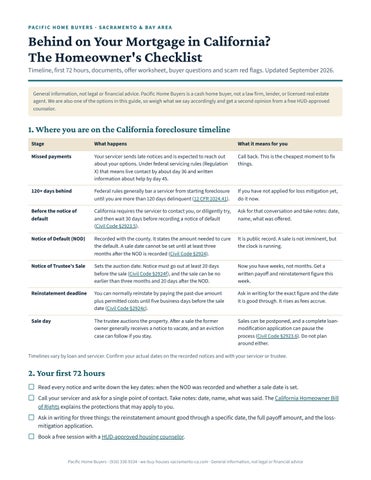
1. Where you are on the California foreclosure timeline Stage
What happens
What it means for you
Missed payments
Your servicer sends late notices and is expected to reach out about your options. Under federal servicing rules (Regulation X) that means live contact by about day 36 and written information about help by day 45.
Call back. This is the cheapest moment to fix things.
120+ days behind
Federal rules generally bar a servicer from starting foreclosure until you are more than 120 days delinquent (12 CFR 1024.41).
If you have not applied for loss mitigation yet, do it now.
Before the notice of default
California requires the servicer to contact you, or diligently try, and then wait 30 days before recording a notice of default (Civil Code §2923.5).
Ask for that conversation and take notes: date, name, what was offered.
Notice of Default (NOD)
Recorded with the county. It states the amount needed to cure the default. A sale date cannot be set until at least three months after the NOD is recorded (Civil Code §2924).
It is public record. A sale is not imminent, but the clock is running.
Notice of Trustee's Sale
Sets the auction date. Notice must go out at least 20 days before the sale (Civil Code §2924f), and the sale can be no earlier than three months and 20 days after the NOD.
Now you have weeks, not months. Get a written payoff and reinstatement figure this week.
Reinstatement deadline
You can normally reinstate by paying the past-due amount plus permitted costs until five business days before the sale date (Civil Code §2924c).
Ask in writing for the exact figure and the date it is good through. It rises as fees accrue.
Sale day
The trustee auctions the property. After a sale the former owner generally receives a notice to vacate, and an eviction case can follow if you stay.
Sales can be postponed, and a complete loanmodification application can pause the process (Civil Code §2923.6). Do not plan around either.
Timelines vary by loan and servicer. Confirm your actual dates on the recorded notices and with your servicer or trustee.
2. Your first 72 hours Read every notice and write down the key dates: when the NOD was recorded and whether a sale date is set. Call your servicer and ask for a single point of contact. Take notes: date, name, what was said. The California Homeowner Bill of Rights explains the protections that may apply to you. Ask in writing for three things: the reinstatement amount good through a specific date, the full payoff amount, and the lossmitigation application. Book a free session with a HUD-approved housing counselor. Pacific Home Buyers · (916) 338-9334 · we-buy-houses-sacramento-ca.com · General information, not legal or financial advice
Look up your property on the Sacramento County Clerk-Recorder (or your county's site) and save copies of anything recorded against it. Keep the house insured and secured, especially if it is empty. Keep opening your mail. Missed notices are the most common way owners lose options. Do not sign a deed, a power of attorney, or any contract you have not had reviewed. Do not pay anyone upfront to "fix" foreclosure. Tell everyone in the house, including tenants, what is happening so nobody is surprised by a notice on the door. Line up a second opinion: a HUD counselor, a legal aid office, or an attorney.
3. Documents to gather Loan and property
You and your finances
Latest mortgage statement, plus the note and deed of trust if you have them Every notice from the servicer or trustee (NOD, notice of sale) Written payoff and reinstatement figures Property tax bill and homeowner insurance declarations page HOA statements and any special assessments Details of every other lien: second mortgage, HELOC, tax lien, judgment Photos of the property and a list of known repairs
Government photo ID Two recent pay stubs or proof of other income Last two months of bank statements Last two years of tax returns A short hardship letter: what changed, and what is different now If you have tenants: leases, rent roll, deposit records If the owner has died: death certificate, probate letters or trust documents
4. Your options, side by side Option
Often a fit when
Watch out for
Reinstate
You can come up with all past-due payments plus Get the exact figure in writing. Fees keep growing until you costs. pay.
Modification, repayment plan, or forbearance
Your income is back, or the hardship was temporary.
Needs a complete application and a written decision. A free HUD counselor can help you package it.
List with an agent
You have equity, the house is in decent shape, and you have several months.
Commissions, closing costs, repairs and showings. The timeline may not fit your sale date.
Short sale
You owe more than the house is worth.
Needs lender approval and can be slow. Ask a CPA about tax effects.
Cash sale to a direct buyer
You need speed and certainty, the house needs work, or you do not want showings.
Usually below full market value. Vet the buyer first (see the questions and red flags below).
Deed in lieu
Little or no equity, house in good condition, no other liens.
The lender must agree. Second mortgages and liens complicate it.
Bankruptcy
You need legal protection while you reorganize debts.
Talk to a bankruptcy attorney first. It has serious credit and legal consequences.
Pacific Home Buyers · (916) 338-9334 · we-buy-houses-sacramento-ca.com · General information, not legal or financial advice
5. Compare every offer by what you take home Sale price (or offer) − Loan payoff (get it in writing, with a date) − Second mortgage / HELOC, liens, back taxes − Commissions, closing costs and transfer tax you'd pay − Repairs and credits to the buyer − Cost of waiting (payments, taxes, insurance, utilities) = What you actually walk away with A lower offer with no fees can net about the same as a higher listing price once commissions, repairs and months of payments are counted. Run the numbers both ways before you decide.
6. Questions to ask any buyer Are you buying for yourself, or will you assign the contract to someone else? Can I see proof of funds? Who pays escrow, title and closing costs? Is that written into the contract? Which title and escrow company will handle it, and can I look them up first? Is there any fee, deposit, or "processing cost" I have to pay? (It should be no.) What happens if you don't close? What is the deposit and who keeps it? Under what conditions can the price change after I sign? Inspection re-trades are common. What is the exact closing date, and can it move if I need more time? Can I take the contract home and have an attorney or counselor read it before I sign? If I'm in foreclosure: do I have my right to cancel? For qualifying home equity sales it runs to midnight of the fifth business day, or 8 a.m. on the day of the sale if that comes first (Civil Code §1695.4). If you are offering a rent-back or buy-back: is it in the contract, in writing, with price and dates? You should get clear written answers from any buyer, including us. If someone dodges, that is your answer.
7. Foreclosure scam red flags Money up front. A foreclosure consultant cannot be paid until every promised service is done (Civil Code §2945.4). The FTC says the same for mortgage relief: never pay upfront. A real buyer is paid at closing, not before.
Guarantees. No one can guarantee they will stop a foreclosure or win you a modification. "Sign the deed over temporarily". Deeding the property to someone, adding them to title, or signing a power of attorney is how equity-skimming schemes start. A foreclosure consultant is barred from acquiring an interest in your home (Civil Code §2945.4(e)).
"Stop talking to your lender". Anyone who tells you to stop contacting your servicer or your counselor is protecting their deal, not you.
Pressure. "Sign today or it disappears." A real cash offer is still there tomorrow, and you are entitled to time to review it.
Pacific Home Buyers · (916) 338-9334 · we-buy-houses-sacramento-ca.com · General information, not legal or financial advice
Blank spaces and verbal promises. Everything, especially a rent-back or buy-back, belongs in the written contract. Mystery closing. They will not name the title or escrow company, or want you to close somewhere you cannot verify. No proof of funds, no track record. Ask for proof of funds and recent local purchases. Recorded deeds are public at the county recorder.
8. Free help and official resources HUD-approved housing counselors (free) — Find a counselor near you who can walk through your options. California Homeowner Bill of Rights — Which protections may apply and how to report violations. CFPB: options if you cannot pay your mortgage — Plain-English overview of your choices. CFPB: complain about your servicer — File a complaint if your servicer is not following the rules. Legal Services of Northern California — Free legal help for eligible homeowners in the Sacramento region. California Courts Self-Help Center — Court forms and guides in plain language. California DRE license lookup — Check whether an agent or broker is licensed. FTC: mortgage relief scams — What the scams look like and where to report them. Sacramento County Clerk-Recorder — Search recorded notices and see a buyer's recorded purchases.
Want a written cash offer to compare? Free walkthrough, written offer, no fees or commissions, no obligation. Call (916) 338-9334 or visit we-buy-housessacramento-ca.com/cash-offer.
Pacific Home Buyers · (916) 338-9334 · we-buy-houses-sacramento-ca.com · General information, not legal or financial advice