• Section A: Comprehension -you will have one unseen text each with a 10 mark question. You should spend 40 minutes (E T 50) on this question.
• Section B: Extended reading and writing task, writing to persuade. You should spend 40 minutes (E.T. 50) on this question.
▪ Read plenty of ambitious non -fiction, such as broadsheet newspapers, online articles or travel writing
▪ Revise the form of PETAL paragraphs
▪ Revise literary devices (and understand their effects) – know the FATPIS… acronym.
▪ Apply the FATPIS...acronym to the non -fiction texts you are reading and analyse how these techniques are used by the text to achieve the writer’s purpose.
▪ Look over previous answers to check and address EBIs
▪ Write exemplar answers and self -assess references to quotations, techniques, effect on the reader etc.
▪ Practise writing in timed conditions
• Look over previous answers to check and address EBIs
• Plan example answers
• Write practice pieces
• Subscribe to Word of the Day or similar to increase vocabulary
• Correct and revise spelling errors made in the past
• Read ambitious examples of descriptive writing, such as high -level fiction
• Use a CGP book or online resources to revise punctuation
• Practise writing under timed conditions
• Revise the descriptive writing techniques.
• Be confident about how to vary sentence openings, sentence lengths and punctuation for effect.
• Know how to use DAFOREST to persuade your reader.
• Know how to structure a letter/article/speech
Success criteria for ENGLISH LANGUAGE Section B WRITING
Persuasive Writing
Use the three bullet points.
Be clear on your form, purpose and target audience.
Go over the features or an article/letter/speech
Use DAFOREST/PERSUADER.
Use emotive language.
Uses a range of sentence lengths incl. a one -word/one-sentence paragraph
Uses an example of : and ; and ! and ? and …
Appeals to the target audience.
Uses compound adjectives (sea -green eyes with a hyphen)
Covalent bonding: drawing dot -and-cross diagrams , properties of simple molecular structures, properties of giant covalent structures
Allotropes of carbon: diamond, graphite, graphene, nanotubes and fullerenes
Metals: structure of metals, properties of metals, properties of metal alloys
Energetics
Calculating moles of a substance from mass and relative formula mass
Exothermic and endothermic changes
Calculating energy changes in a chemical reaction from bond energies
Chemical analysis
Pure substances : testing melting and boiling point
Formulations
Chromatography
Required practicals
REQUIRED PRACTICAL: Measuring energy changes in a reaction
REQUIRED PRACTICAL: Using paper chromatography to identify unknowns and calculate Rf values
Physics Paper
Particle Model of Matter
Density of materials ρ=m/v
Changes of state
Internal energy
Changes of state and specific latent heat (E=mL)
Electricity
Circuit diagram symbols
Electrical charge and current Q=It
Current, resistance and potential difference V=IR
Resistance of a wire practical
Series and parallel Circuits
Forces
Resultant forces
Newton's 3 Laws of motion
Force, mass and a cceleration practical
Forces and elasticity F=ke (E e=1/2ke 2)
Properties of Waves
Longitudinal and transverse waves
Measuring waves
Frequency and Period wave equation
Wavespeed equation and practical
Sound waves and measuring the speed of sound
Reflection and Refraction
Required practicals
Use appropriate apparatus to make and record the measurements needed to determine the densities of regular and irregular solid objects and liquids
Investigate the relationship between force and extension for a spring.
investigate the effect of varying the force on the acceleration of an object of constant mass and the effect of varying the mass of an object on the acceleration produced by a constant force.
Use circuit diagrams to set up and check appropriate circuits to investigate the factors affecting the resistance of electrical circuits
Us e of the wavespeed equation to measure the speed of a water wave in a ripple tank, and the wave travelling through a solid (string).
Religious Studies
Exam board: AQA (GCSE Religious Studies)
Exam Format
Paper length 40 minutes
Format
Topic Checklist
You will answer questions on these TWO themes:
1. Human Rights, Wealth & Poverty
2. The Existence of God & Revelation
You will complete 1-6 ma rk questions for BOTH themes.
You will complete a 12 mark essay for ONE theme . You will be given two essay statements to choose between, one from each theme.
Human Rights, Wealth & poverty
Human Rights
• Prejudice and discrimination in religion and belief, including the status and treatment within religion of women and those in same sex relationship s.
• Issues of equality, freedom of religion and belief including freedom of religious expression.
• Human rights and the responsibilities that come with rights, including the responsibility to respect the rights of others.
• Social justice.
• Racial prejudice and discrimination.
• Ethical arguments related to racial discrimination (including positive discrimination), including those based on the ideals of equality and justice.
Wealth & Poverty
• Wealth, including:
▪ the right attitude to wealth
▪ the uses of wealth.
• The responsibilities of wealth, including the duty to tackle poverty and its causes.
• Exploitation of t hose living in poverty including issues relating to:
▪ fair pay
Themes
RAG
The
Existence of God & Revelation
▪ excessive interest on loans
▪ people -trafficking.
• The responsibilities of those living in poverty to help themselves overcome the difficulties they face.
• Charity, including issues related to giving money to th ose living in poverty .
Philosophical arguments for and against the existence of God
• The Design argument, including its strengths and weaknesses.
• The First Cause argument, including its strengths and weaknesses.
• The argument from miracles, including its strengths and weaknesses, and one example of a miracle.
• Evil and suffering as an argument against the existence of God.
• Arguments based on science against the existence of God.
The nature of the divine and revelation
• Special revelation as a source of knowledge about the divine (God, gods or ultimate reality) including visions and one example of a vision.
• Enlightenment as a source of knowledge about the divine.
• General revelation: nature and scripture as a way of understanding the divine.
• Different ideas about the divine that come from these sources:
▪ omnipotent and omniscient
▪ personal and impersonal
▪ immanent and transcendent.
• The value of general and special revelation and enlightenment as sources of knowledge about the divine, including:
▪ the problems of different ideas about the divine arising from these experiences
▪ alternative explanations for the experiences, and the possibility that the people who claimed to have them were lying or mistaken.
Resources & Where To Find Them
All the resources you need for revision are in your Class Notebook. In addition to your notes from each lesson, make sure that you refer to:
• The specification – use this as a checklist to ensure you cover everything.
• Glossaries – test yourself on this vocabulary, or you could misunderstand a question!
• Quote lists – memorise these to support your answers.
Ace that test
1. Include specialist vocabulary in your answers – especially keywords from the specification .
2. Memorise quotes to support your answers. Remember to say what the source is.
3. Make plans for essay questions – list 3 arguments for and 3 against. Which is strongest?
History
Exam Board: AQA
Exam format
Paper length 40 minutes
The exam uses the GCSE style of questions you have been practicing. There are 4 questions on the paper, all on the GCSE module you have studied this term: Germany, 1890 -1945 Democracy and dictatorship
Format
These are the question types:
Q1 Interpretation based, 2 differences (4 marks)
Q2 Why might the authors be different (4 marks)
Q3 Which interpretation is more convincing (8 marks)
Q4 In what ways were the lives of.. ..... changed by........ (8 marks)
Topic Checklist
Theme Topics
• The experience of Germans during WW1
• The Depression and the end of the Weimar Government.
Germany 18901945
Democracy and Dictatorship
• The rise of the Nazis and what they believed
• Adolf Hitler becoming chancellor in 1933.
Resources & Where To Find Them
• https://www.bbc.co.uk/bitesize/topics/zskcg82
• https://www.johndclare.net/Weimar1.htm
General
• Class OneNote pages – provide a step by step guide through the entire course
Ace that test
1. Practise answering past paper questions in timed conditions. Then self -mark using the mark schemes.
2. Remind yourself of the structures required to answer each question type. Explained in your One Note.
3. Remind yourself of the mark schemes for each question type. They tell you what you need to focus on.
4. Create flash cards with key events on one side and details of the event on the other
5. Turn your One Note pages on these topics or the information on the useful links (above) into Cornell Notes, ie condensed using main headings
Preparation for 4 th Form
Give yourself the head start by understanding the following key events:
• Inside Germany during WW1 1914 -1918
• The Wall Street Crash and the Depression
• The Nazis and the principles upon which they were created
To understand formation of and factors affecting waves
To understand the differing types of waves
To understand the physical processes at work on the coastline
You will complete IGCSE Edexcel past -paper type questions ranging from multiple choice and short answer questions which are tick marked to 8 -marker levelled questions based around assessing a source where you are asked to make direct reference to the sourc e (4 marks) and make evaluative comments (4 marks).
The paper is split between ‘2. Coastal Proces ’s and ‘6. Urban Environments ’. There will be a full paper on 2. Coastal Processes with 25 marks and a shorter paper with 6. Urban Environments with 10 marks. This is a 40-minute length paper.
For online support please use Seneca, your teacher has set this up for you.
To explain how erosional landforms are created and give a case study for each
• I can explain how waves form
• I can describe the factors affecting waves
• I can describe the terms swash and backwash
• I can contrast two types of waves
• I can explain how LSD operates
• I can explain the differing types of marine erosion (including hydraulic action, attrition, abrasion and solution)
• I can explain the differing types of weathering (including types of physical, chemical and biological weathering)
• I can explain the differing types of mass movement (including soil creep, rotational slumping and falls)
• Explain the formation of headlands and bays CASE STUDY 1: Swanage
• Describe how wave refraction causes beaches.
• I can explain the formation of a cave, arch, stack and stump CASE STUDY 2: Old Harry’s Rock
RAG
To be able to explain factors that affects the rate of erosion and weathering at the coastline
To explain how depositional landforms are created and give a case study for each
• I can explain the formation of a wave cut platform and cliff CASE STUDY 3: Kimmeridge Bay
• I can explain different factors of geology, bedding planes, ecosystem type, sea level change that affect the rate.
• Formation of beaches and their differing parts CASE STUDY 4: Swanage beach
• Formation of spits and salt marshes CASE STUDY 5: East Head Spit, West Wittering or Hurst Castle Spit, Hampshire
• Formation of a bar CASE STUDY 6: Loe Bar
• Formation of a Tombolo CASE STUDY 7: Chesil Beach, Swanage
2.2 Coastal Ecosystems
To investigate the distribution and features of coral reefs
To be able to describe the threats to coral reef ecosystems
To investigate the distribution and features of the mangrove ecosystem.
• I can describe the distribution of coral reefs
• I can explain the conditions in which coral reefs grow.
• I can describe the main features and three main types of coral reef.
• Global threat of climate change (warming oceans (zooxanthellae), acidification of ocean and sea level rise).
• Local threats of blast fishing, tourism, shipping lanes oil, fertilisers COTS)).
• I can describe the distribution of mangrove ecosystems
• I can explain the conditions mangroves need for growth
• I can describe the main features of mangrove ecosystems
• I can describe the main threats to mangrove ecosystems
To investigate the distribution and features of salt marshes
To investigate the distribution and features of sand dunes and their threats
• I can describe the distribution of salt marshes.
• I can describe the conditions in which salt marshes grow
• I can describe the distribution of sand dunes
• I can describe the conditions in which sand dunes grow CASE STUDY 8: Studland Bay, Swanage
• I can describe the main features of sand dunes, including biotic and abiotic characteristics
• I can describe the threats to sand dunes including human activity
To investigate the conflict between different users of the coast, with different views on coastal management.
2.3 Coastal Management
To understand the causes of coastal flooding and evaluate different methods of predicting and preventing coastal flooding
To be able to describe how are coastlines are managed and the differing approaches to management.
To examine key coastal management strategies used to protect the coastline and evaluate its impacts, challenges, and controversies
6.1 Urban Environments
To investigate the contrasting trends in urbanisation
To investigate the factors that affect the rate of urbanisation
To examine the trends in suburbanisation and counterurbanisation over the last fifty years
To investigate the location of megacities and expected changes
To examine the factors that affect the
• I can outline what economic activities take place on the coast.
• I can describe the different stakeholders and their perspectives.
• I can suggest what conflicts might emerge, and suggest how they can be managed CASE STUDY 8: Studland Bay, Swanage
• Explain at least two causes of coastal flooding with real-world examples, including storm surges, tsunamis, and climate change.
• I can evaluate different methods of predicting and preventing coastal flooding, such as forecasting, building design, planning, and education.
• I can describe how a coastline is managed by a shoreline management plan
• I can explain at least 3 hard engineering and 3 soft engineering techniques CASE STUDY 9: Minehead, Somerset Sub cell 7d
• I can describe the location, significance, and hazards of the CASE STUDY 10: Palisadoes Peninsula, Jamaica
• I can explain the coastal management strategies and their functions.
• I can assess the effectiveness and challenges of the project
• I can define urbanisation, counter-urbanisation and urban sprawl
• I can describe the contrasting trends in urbanisation over the last 50 years
• I can list factors that affect the rate of urbanisation such as rural to urban migration and natural increase and explain their impacts
• I can define push and pull factors
• I can define suburbanisation and counter-urbanisation
• I can explain the trends in suburbanisation and counter-urbanisation over the last fifty years with regards to HICs and LICs/NICs
• I can define the term megacity
• I can explain the location and likely future changes in megacity locations (from HICs to LICs/NICs)
• I can explain the factors that affect the rate of urbanisation.
rate of urbanisation including the opportunities and inequalities
To investigate the problems that arise from rapid urbanisation.
• I can explain the opportunities and inequalities that arise from urbanisation.
• I can explain the problems arising from rapid urbanisation (congestion and transport, employment and crime and environment and housing) CASE STUDY 11: Mumbai, India and Case Study 12: London, UK.
Resources & Where To Find Them
• Under the Exams and Revision OneNote pages you will find the following to help you revise.
o A Read Me First document outlining the mock exam details.
OneNote
o 2. Coastal Environments RAG List, Revision Booklet, Recap Lessons and GIZMO online learning.
o 6. Urban Environments RAG List, Revision Booklet, Recap Lessons and GIZMO online learning.
o Past Paper Questions and mark schemes
Ace that test
• Complete your RAG Lists to find areas in Amber and Red, work on these first. Looking to move Red to Amber to Green.
• Use the Recap Lessons to complete your Revision Booklets. If still unsure then use the Revision Notes.
• Review and write the Exam Techniques onto the question paper during the exam and then review at the end of your exam.
• Using the RAG Lists c reate cue cards with question on one side and the answer on the other side, keep these for these mock and future exams
French
Exam Board: Pearson Edexcel
Exam format
Reading: 40 minutes
Reading: Various exercises including true/false, multiple choice and short answer
Translation: 8 short sentences from French into English
Writing:
Listening 40 minutes
Topic Checklist
Writing: Describe a photo in French (4 sentences)
Translation: Five short sentences into French
Listening: various excersis es including true/false, multiple choice and short answer
Dictation: listen in French and write in French
Topic Theme
Mon monde et moi
- D escribing yourself and others https://www.textivate.com/2n9on1
- Relationships with reflexive verbs https://www.textivate.com/2n9on1
- Past and future celebrations https://www.textivate.com/3n9on1
- Activities after school https://www.textivate.com/zm9on1
Projects d’avenir
- What you want to do in the future https://www.textivate.com/5n9on1
- Part time and weekend jobs https://www.textivate.com/4n9on1
Ma vie en musique
- Music and opinions on music https://www.textivate.com/6n9on1
- Music in the past and today https://www.textivate.com/8n9on1
RAG
- What you were like when you were little https://www.textivate.com/7n9on1
- What your primary school was like https://www.textivate.com/an9on1
- Young refuges https://www.textivate.com/9n9on1
Les meilleurs des mondes - Eating meat and the environmental impact https://www.textivate.com/bn9on1
- What we do to help the planet https://www.textivate.com/cn9on1
- What we would like to do in the future to help the environment https://www.textivate.com/dn9on1
Resources & Where To Find Them
General (especially for writing).
Reading & Listening practice online
Ace that test
Translation to English
Translation to French
Reading & Listening
- Vocabulary, grammar and topic sheets in OneNote
- Textivates in OneNote and for each topic above
- Describe a photo https://www.textivate.com/gn9on1
www.languagenut.com
- Your log in for Language Nut is on your One Note
- KS3 French - BBC Bitesize
Think carefully about the tenses used.
Check key vocabulary; can you work out unknown vocabulary from the context, do unknown words look like English words (cognates), do they look like French words that you know from other contexts?
Check your tenses.
Check the spelling of key vocabulary.
Think about how to convey the meaning accurately in French.
Practise using your online resources.
Use the revision Textivates to extend your knowledge of vocabulary.
Writing When describing a photo, you could mention the people, what they are doing, the weather and where they are. Use this link to practice vocab: https://www.textivate.com/gn9on1
Spanish
Exam Board: Pearson Edexcel
Exam format
Reading: 40 minutes
Reading: Various exercises including true/false, multiple choice and short answer
Translation: 8 short sentences from Spanish into English
Writing:
Listening 40 minutes
Writing: Describe a photo in Spanish (4 sentences) https://www.textivate.com/sq2on1
Translation: Five short sentences into Spanish
Listening: various exer cises including true/false, multiple choice and short answer
Dictation: listen in Spanish and write in Spanish
Learn vocabulary from these topics
Topic Checklist
Topic Theme RAG
Mis Vacaciones
Todo sobre mi vida
- On holiday textivate
- What did you do textivate
- The last day textivate
- What was it like - textivate
- My life, my mobile phone - Mobile technology: https://www.textivate.com/c6uln1 - Mobile technology 2: https://www.textivate.com/8zwln1
- Mobile technology 3: https://www.textivate.com/7lxln1
- What type of music do you like - textivate
- I prefer comedies!
- TV programmes: https://www.textivate.com/cuuln1
- Films: https://www.textivate.com/b1qln1
Qué hacemos - Would you like to go to the cinema? https://www.textivate.com/i19on1
- I am sorry, I cannot go.
- https://www.textivate.com/j79on1
- Getting ready to go out
- What are you goin g to wear?
- textivate
- Describing sporting events
- https://www.textivate.com/9i7mn1
En Forma
- Talking about what you eat and drink and healthy v unhealthy diet
- · Food & drink: https://www.textivate.com/ed7on1 · In a restaurant: https://www.textivate.com/tv7on1 · Mealtimes: https://www.textivate.com/tm7on1
- Talking about an active lifestyle
- Free time activities: https://www.textivate.com/rb2mn1
Una Aventura en Madrid - Meeting and greeting people
- https://www.textivate.com/y5hon1
- Comparatives and superlatives
- https://www.textivate.com/z5hon1
Resources & Where To Find Them
General (especially for writing).
- Vocabulary, grammar and topic sheets in OneNote - Textivates in OneNote and for each topic above - Describe a photo : https://www.textivate.com/sq2on1
Reading & Listening practice online www.languagenut.com
- Your log in for Language Nut is on your One Note KS3 Spanish - BBC Bitesize
Ace that test
Translation to English Think carefully about the tenses used.
Check key vocabulary; can you work out unknown vocabulary from the context, do unknown words look like English words (cognates), do they look like Spanish words that you know from other contexts?
Translation to French Check your tenses. Check the spelling of key vocabulary.
Think about how to convey the meaning accurately in Spanish .
Reading & Listening Practise using your online resources.
Use the revision Textivates to extend your knowledge of vocabulary.
Writing When describing a photo, you could mention the people, what they are doing, the weather and where they are. Use this link to practice the vocabulary : https://www.textivate.com/sq2on1
Grammar t extivates from these topics:
Grammar exercises to practise verbs and tenses:
Present tense: textivate
Past tense: textivate
Future tense: textivate
Physical Education
Exam board: Cambridge OCR
Exam format
Paper length 40 minutes
Format A spread of AO1, AO2 & AO3 questions
Topic Checklist
Theme
Musc ular and S keletal System
Bones:
Components of Fitness
Diet and Nutrition
Cardiovascular System
Respiratory System
Leadership
Muscles:
Topics
• N ames and location
• Joints function
• Type of joints and movement patterns
• N ames and location
• Antagonistic pairs
• Agonist, antagonist, fixator
• Practical application in sport
• Key components of fitness:
• All 10 components for fitness
• H ow to test for them
• Types of training
• Components of a balanced diet
• D ifferent nutritional requirements based on sports performance
• Vegan vs Meat Diet
• Flow of blood through the heart
• Blood vessels
• Double Circulatory System
• Effects of exercise
• Parts of the respiratory system
• Gas exchange (oxygen in, carbon dioxide out)
• Effects of exercise on breathing rate and tidal volume
• Traits of a leader
• Different leaderships styles
Resources & Where To Find Them
General
• Slideshows, topic information can be found here: Revision Resources (sharepoint.com)
• Video revision resources: The EverLearner - YouTube
Ace that test
1. Remember to include practical examples and read what the question is asking for.
2. Remember to use key terms and full names (Quadriceps and not Quads for example).
3. Revise each topic in blocks so you are clear on what the question is asking
Computer Science
GCSE Exam board: Pearson Edexcel
Exam format
Paper length 40 minutes
Format Written Exam
Topics
Topic Checklist
Math in Compuitng
Programming in Python
Data Security
• Math in Computing
• Programming in Python
• D ata Security
• Conversions(Decimal, Binary, Hexadecimal
• Binary Addition
• Logic Gates
• Writing basic programs in Python
• Selection (IF) and Iteration (Loops –FOR)
• Programming vocabulary
• Types of Malware
• Social Engineering Techniques
• Encryption
Resources & Where To Find Them
General
Ace that test
• Glossary and notes in the knowledge section for each topic in your OneNote
• Programming workbook
1. Create flash cards and learn the keyword for each topic. Be able to identify the keywords for a topic and relate them together
2. Revisit activities in your OneNote
3. Practice Coding regularly, go over past questions and try to rewrite the code without looking at the previous answers.
Link to specification: https://qualifications.pearson.com/content/dam/pdf/GCSE/Computer%20Science/2020/specifica tion -and -sample -assessments/GCSE_L1_L2_Computer_Science_2020_Specification.pdf
Music
Exam Board: Pearson Edexcel
Exam format
Format
SECTION A: 40 minutes - 4x short -answer listening questions
SECTION B: 40 minutes - 5x short -answer theory questions
Topic Checklist
Topics
The Elements of Music (Dr A Smith)
• Revise the Elements of Music – what each element means and how it affects the sound of the music:
• D Dynamics
• R Rhythm
• A Articulation
• S Structure
• M Melody
• I Instrumentation
• T Tempo, Texture and Tonality
• H Harmony
The History of Western Classical Music (‘Music Through Time’)
• Revise the following periods in musical history (revision resource below). For each one you need to know the key characteristics , instruments and composers associated with that period.
• Medieval
• Renaissance
• Baroque
• Classical
• Romantic
• Describing the sound of a piece of unfamiliar music using correct technical vocabulary (see glossary below - ‘General Musical Terms’)
RAG
Electronic Dance Music
• Key characteristics of the following EDM styles: House , Trance , Dubstep and Downtempo
• The core functions of Logic Pro X and key vocab associated with the use of music technology and production (see glossary below - ‘Music Technology Terms’)
Resources & Where To Find Them
• The Elements of Music and General Musical Terms: 3rd Form - The Elements of Music.pptx (in Student Hub, under ‘Studies’ > ‘Music’ > ‘Resources’ > ‘3rd Form’)
• Periods of Western Classical Music: 3rd Form - Music Through Time - Fingerprints of Periods.pptx (in Student Hub, under ‘Studies’ > ‘Music’ > ‘Resources’ > ‘3rd Form’ > ‘Unit 2 – Music Through Time’)
• Electronic Dance Music / Logic Pro X: 3rd Form - Electronic Dance Music & Logic Pro X.pptx (in Student Hub, under ‘Studies’ > ‘Music’ > ‘Resources’ > ‘3rd Form’ > ‘Unit 3 – Electronic Dance Music’)
• Instruments of the Orchestra: 3rd Form - Instruments of the Orchestra.pptx (in Student Hub, under ‘Studies’ > ‘Music’ > ‘Resources’ > ‘3rd Form’)
• Pitches in the Treble Clef: 3rd Form - Pitches in the Treble Clef.pptx (in Student Hub, under ‘Studies’ > ‘Music’ > ‘Resources’ > ‘3rd Form’)
• Note Values: 3rd Form - Note Values.pptx (in Student Hub, under ‘Studies’ > ‘Music’ > ‘Resources’ > ‘3rd Form’)
Ace that test
Do lots of listening to prepare. Music from each period listed above. Practice describing the sound of the music using technical terminology. Listen to at least two pieces from each period (Medieval, Renaissance, etc.) and from each style of Electronic Dance Music.
Ensure you know the main famil ies within an orchestra (woodwind, brass, etc.) and the main instruments within each family. You will need to recognise instruments by ear during the exam.
Memorise the mnemonics for the notes on the lines and spaces in the treble clef . (EGBDF and FACE)
Ensure you know your note values (semibreve, minim, crotchet, quaver, semiquaver)
Learn your musical vocabulary (see detailed list on next page)
Know your terminology! When describing the sound of music, make sure you use precise musical terminology to describe what you are hearing. Use these words:
General musical terms
Dynamics Crescendo Diminuendo
Piano (p)
Mezzo -piano (mp)
Mezzo -forte (mf)
Forte (f)
Rhythm Ostinato
Articulation Staccato Legato
Structure Binary Ternary
Melody Conjunct Disjunct Imitation
Ornaments ( e.g. trill, acciaccatura, mordent)
Instrumentation ‘a cappella’ Instruments of the Orchestra Historical instruments associated with each period
Regular adjective endings: 1st/2nd declension and 3rd declension
Pronouns: is, ea, id hic, haec, hoc ille, illa, illud qui, quae, quod
Comparative ( -ior-) and superlative ( -issim-) adjectives and adverbs
Irregularly formed comparatives and superlatives eg magnus, malus etc
Time how long: Accusative case Time when: Ablative case
Ways of comparing: using Ablative of Comparison and using quam
The cases taken by the prepositions
Commands using the Imperative
Negative commands using noli / nolite : Don’t…
Asking questions: question word / -ne / num…/ nonne… ?
RAG
Resources & Where To Find Them
General
Ace that test
• GCSE vocabulary Latin to GCSE Chapters 1 -7 Flashcards | Quizlet
• Use lesson material on OneNote and exercise books
• Use GCSE vocab lists – paper and OneNote copies.
1. Learn the vocab – flash cards will help with this.
2. Practise translation of passages.
3. When translating, always start with the main verb.
Exam Board: OCR
Exam format
Exam Length
Format
• 2 sessions of 40 minutes
• Drawing From Observation
• You will create a drawing from a reference photo
• You will work on the same drawing across both sessions
Revision Checklist:
Why do we need to practice Drawing skills?
Drawing is a fundamental skill in Art. It helps you understand perspective, form, texture, and shadow, key elements for creating realistic and expressive work.
Developing control in how you apply graphite (pressure, shading, and line quality) is essential.
While this isn’t something you can revise in the traditional sense, regular practice will help you refine your skills and build confidence.
How do I practice drawing?
• Keep a sketchbook
Use it to record ideas, experiments, and quick sketches not just finished work.
• Draw from observation
Practise drawing real objects around you (e.g. shoes, hands, mugs, plants) rather than copying images.
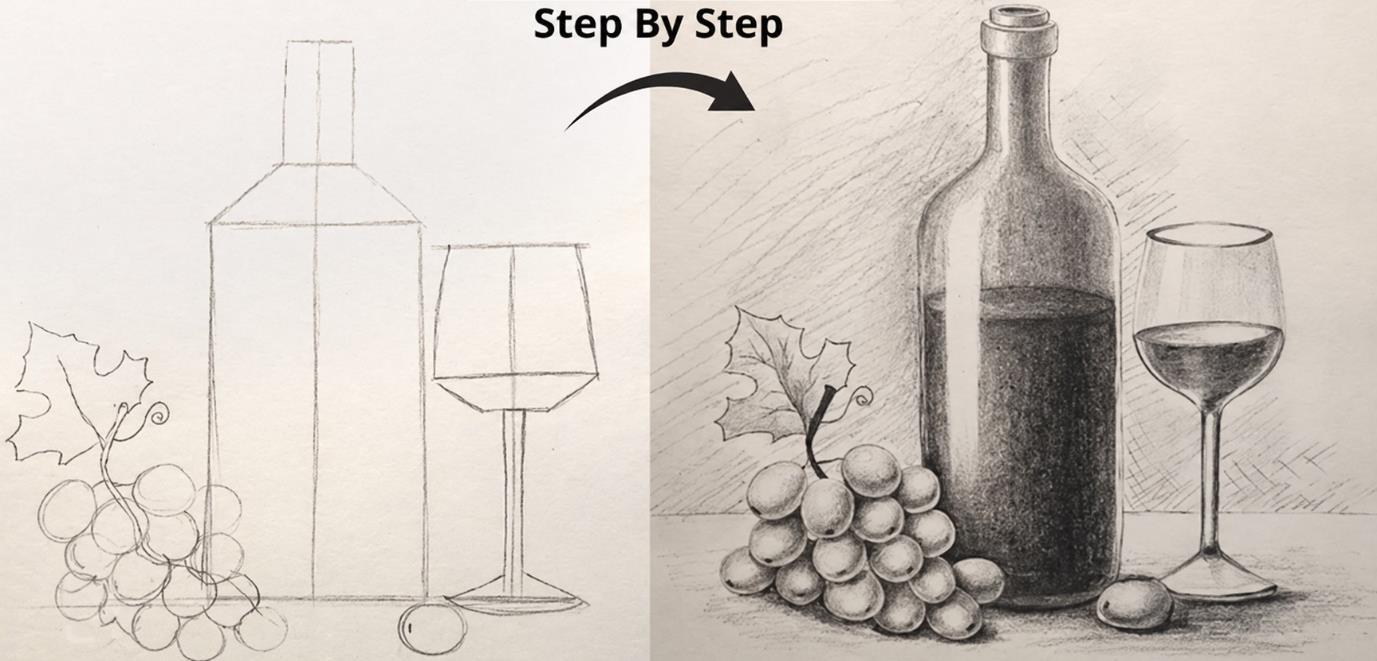
• Focus on shapes first Break objects down into simple shapes (circles, squares, cylinders) before adding detail.
• Practise shading techniques Experiment with:
• Hatching
• Cross -hatching
• Blending
Tips to support drawing practice
• Stippling (dots)
• Work on light and shadow
Look carefully at where the light hits objects and where shadows fall.
• Try contour drawing
Draw the outline of an object slowly, without looking at your paper much, this improves observation.
• Do quick sketches (gesture drawings)
Spend 1 –5 minutes capturing the basic form or movement of a subject.
• Draw what you enjoy Interests (fashion, characters, nature, objects) keep you motivated.
• Look at artists for inspiration
Study how different artists use line, tone, and composition then try similar techniques.
• Reflect and improve
Ask yourself: What went well? What could I improve next time?
• Don’t aim for perfection
Mistakes are part of learning focus on progress, not flawless drawings
• I start lightly with my pencil so I can adjust and correct my drawing
• I sketch basic shapes first to map out proportions before adding detail
• I check and measure proportions as I draw (comparing sizes and angles)
• I build up tone gradually, pressing harder only when I’m confident
• I vary my pencil pressure to create a range of light and dark tones
• I look closely at where the light source is and add shadows accordingly
• I use blending carefully (if needed) to create smooth transitions
• I add texture by changing my marks (lines, dots, strokes)
• I refine outlines and details at the end, not at the start
• I keep my work clean by avoiding smudging (resting hand carefully)
• I step back and check my drawing, making improvements as I go
Success Criteria for Drawing from Observation
• Accuracy of proportions and overall shape
• Effective use of perspective to show depth and space
• Clear understanding of form (successful 3D appearance)
• Use of a full tonal range (light to dark)
• Quality and control of pencil
• Successful representation of texture through mark -making
• Use of space on the page
• Overall presentation and personal creativity
• Evidence of effort and focus throughout the task
Drawing to Shading
Resources & Where To Find Them
Pinterest - for examples of drawings to copy technique or tips on how to plan
You tube - for drawing tutorials
BBC bitesize for Art and Design drawing techniques for AO3 or AO2
(AO = Assessment Objective)
Rapid Fire Art – a website with free drawing tutorials