Fall / Winter 2024 - 2025
Lebovitz Forest Conserved • 3 Improving Access • 5 Protecting Maine Forests • 6 Notes from the Trail • 8
Jerry Monkman - ecophotography.com
Inside:
Organization Updates
Welcome, Sam! We’re thrilled to welcome Samantha Blackadar to the LELT team as our Operations Coordinator. Sam joined LELT in September and has hit the ground running providing essential support to our daily operations, ensuring smooth financial processes and assisting with events and communications. Samantha holds a Bachelor's degree in Psychology and a Master’s degree in Social Work from the University of New Hampshire. From her career as a clinical social worker, Samantha brings experience in collaboration, advocacy, and community outreach. As an outdoor enthusiast who values the environment, Sam is thrilled to contribute to Loon Echo’s work of protecting and fostering meaningful connections to Maine’s natural spaces. Outside of work, Sam enjoys hiking, climbing, paddling, and playing outside with her dogs, often with a good cup of coffee in hand.
Celebrating 20 Years of Service After 20 years of service to LELT, Carol Sudduth stepped off the Board of Directors in August. Carol joined the LELT Board in the midst of the effort to conserve Pleasant Mountain in the early 2000's. She was instrumental in the fundraising effort and helped connect many Camp Wyonegonic alumni to conservation in the Lake Region. Many of you know Carol as the owner and Director at “Wyo.” She is an icon in Maine’s summer camp world and a fixture throughout the Lake Region as a dedicated community member. Carol helped guide LELT from a small land trust with a single staff person, to a larger organization conserving thousands of acres across the Lake Region.
We celebrated Carol with a send off at her home in Denmark at the end of the summer. While Carol won’t be joining us for Board meetings any longer, she intends to stay connected to LELT and land conservation in the Lake Region and beyond. Thank you, Carol!
16 Years and Counting 2024 marks Jon Evans’ 16th year working for Loon Echo Land Trust. Jon has been a consistent and invaluable ambassador for LELT during his long tenure as Stewardship Manager. You’ve probably met him out on the trails, and hopefully you’ve had an opportunity to tap into his endless knowledge about local history and ecology. We were glad to have the opportunity to recognize Jon’s commitment to the lands and trails of the Lake Region at our Summer Celebration in August. LELT and the Lake Region wouldn’t be what it is today without Jon’s dedication and care. Thank you, Jon! 2 | Loon Echo News FALL / WINTER 2024 - 2025
“Thank you for the opportunity to live, work and play hard in the place I was born.” - Jon Evans
Project Updates
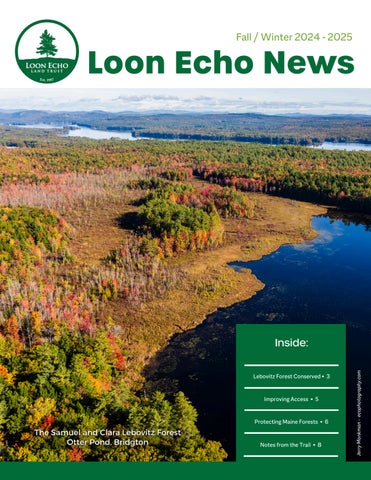
Lebovitz Forest Conserved Loon Echo became the stewards of the Samuel and Clara Lebovitz Forest, 192 acres of undeveloped forest and wetlands in Bridgton, earlier this year. The forest is rich in habitat and is home to several rare species of damselflies. The conservation effort protects a half-mile of shoreline on Otter Pond, a mile of tributary streams, and over 70 acres of wetlands. Under LELT’s ownership, permanent public access for hunting, fishing, hiking, and other recreational activities is now secured. The property was donated to LELT by the Lebovitz family. “We are pleased to be able to continue our decadeslong partnership with LELT by creating the Clara & Samuel Lebovitz Forest Preserve,” said Peter Lebovitz, grandson of Clara and Samuel Lebovitz. “We know the land will be stewarded in the manner Clara & Sam always wanted it to be, and preserved for future generations to enjoy.” Lebovitz Forest was identified as a high priority for protection by Sebago Clean Waters, a collaborative of eleven partners including LELT working to conserve forestland in the Sebago Lake watershed for water quality protection and other benefits. The 192-acre property is located entirely within the Sebago Lake watershed, and plays an important role in safeguarding the water quality of Sebago Lake, which is the source of drinking water for over 200,000 Mainers and many Cumberland County businesses on a daily basis. LELT is developing a forest and recreation management plan for the property that will outline forest management goals to promote carbon sequestration and biodiversity, maintain water quality protections, and consider future recreation opportunities on the land. We’re grateful to the Lebovitz Family for working with us to keep their property forested and open to the public forever. Our work to protect Lake Region forests, ponds, and public access to the outdoors depends on the generosity of landowners like the Lebovitz family.
Lebovitz Forest does not have any formal trails, but you are welcome to explore the land by foot if you’re up for an adventure. More information is available at LELT.org/lebovitz-forest. Jerry Monkman - ecophotography.com
LELT.org | 3
Project Updates
Community Care Lake Region Woodshed
Learn more about forest management at Tiger Hill on page 9.
Loon Echo’s dedication to community has always been at the heart of our work, a value that dates back to the first kitchen-table meetings of the Board in Casco during the late 1980s. With that core value in mind, LELT has launched a pilot firewood bank program to support members of our community who are in need of wood to heat their homes during the cold season. Funded initially with proceeds from a recent timber harvest at Tiger Hill Community Forest, the wood bank is managed by LELT and supported by Kheil Logging, who delivers the wood to those in need. The wood does not cost anything to those who receive it. Our intention is to expand this wood bank program from a pilot to a larger program in 2025 so that we can respond quickly to anyone who is experiencing a home heating crisis. For more information, please contact Maggie Lynn at maggie@lelt.org. Tiger Hill Community Forest from above Photo by Jerry Monkman, ecophotography.com
Support for Trails Maine Trails Bond Passes
On November 5th, Maine voters passed the Maine Trails Bond, investing $30 million in support of the maintenance, design, and construction of trails across the state over the next five years. The funding will be available to nonprofits, municipalities, and other divisions of government to help build and care for motorized, nonmotorized and multi-use trails. We are proud to be one of more than 500 organizations, businesses, and towns across Maine who signed on in support of this bipartisan effort. LELT’s Matt Markot also testified in support of the bond effort in Augusta. The work of ensuring everyone has access to safe and well maintained trails in their community is a strategic priority for LELT. Thank you for loving and supporting Maine trails and communities!
Bald Pate Mountain, Bridgton
4 | Loon Echo News FALL / WINTER 2024 - 2025
Access Improvements Pondicherry Park If you’ve visited Pondicherry Park this fall, you might have noticed a new improvement. The old, worn wooden staircase at the Ham Memorial Bridge has been replaced with a 60-foot ramp made of composite materials and aluminum, designed by Great Northern Docks in Naples. LELT raised the funds for this new ramp to make Bridgton’s most popular outdoor spot easier to access, especially for students from Stevens Brook Elementary School who often use the Ham Bridge entrance. Thanks to funding from L.L. Bean, the Quimby Foundation, the Kendal and Anna Ham Foundation, private donors, and a discount from Great Northern Docks, the ramp was installed at the end of summer. We’ll also be improving the trail that connects the ramp to the all-persons trail near the Hancock Amphitheater. Speaking of the all-persons trail, it’s hard to believe it’s already been two years since it was completed! To find out how many people are using it, we installed a TRAFx infrared trail counter at the Dunning Bridge. The data is impressive—over 36,000 individual visits were recorded between August 2023 and August 2024. Thanks to your support, Pondicherry Park continues to be a beloved place and valuable community resource, helping connect people of all ages with nature and each other.
Mayberry Hill Preserve In our ongoing commitment to improving outdoor access across the Lake Region, we’re excited to announce a new trail project at Mayberry Hill Preserve in Casco. Donated by the Gillis family in 1992, Mayberry Hill is LELT’s oldest preserve. With the addition of a new off-street parking area and trail improvements at the end of 2022, the preserve has seen more visitors. In response, and as part of LELT’s strategic goal to enhance outdoor access in every Lake Region community, we’ll be building a new all-persons trail at Mayberry Hill Preserve in spring 2025. Trail Consultant Enock Glidden of ‘Beyond the Fence’ joins LELT Stewardship Manager Jon Evans at Mayberry Hill. Incremental improvements have been made to the trail by volunteers over the past few years, covering up roots and filling in big dips in the trail to create a more even surface. Donations to support the Mayberry Hill access improvement project can be made online at link.LELT.org/mhpaccess
The new trail will be similar to the all-persons trails at Pondicherry Park and Peabody-Fitch Woods: six feet wide, with a gravel surface, gentle slopes and stretching just over a half-mile. Thanks to funding from Maine’s Recreational Trail Program and Athletic Brewing Company, we have already raised $60,000 of our $90,000 goal. This winter, we’ll announce an opportunity to help support the trail project through a limited time trail-side memorial bench program. If you have a loved one in mind who you would like to honor with a custom built trail-side bench, stay tuned for more details in early 2025. In the meantime, donations can be made at any time to support the trail project. For more information, please contact Matt Markot at matt@lelt.org.
LELT.org | 5
From White Pines to Ash Trees: Protecting Maine Forests by Matt Markot, Executive Director
At the start of the 20th century, a serious problem began to spread through Maine’s forests. A fungus introduced from Eastern Europe started to kill off Maine's beloved eastern white pine trees. This fungus, known as white pine blister rust, spread quickly across the state, and by the 1920s, dead trees were a common sight. “Protecting Maine’s forests takes a community effort. Fortunately, that’s part of our DNA here in the Lake Region.” -Matt
But there was hope. Researchers figured out what was causing the disease and came up with an idea to stop it. Blister rust is an unusual pest because it can't infect white pines on its own. It needs another plant, members of the Ribes genus, commonly known as currant or gooseberry, to help it spread. So, the Maine Forest Service began a decades-long effort to remove Ribes plants across the state. It was a huge task that brought people from all over Maine to the woods to pull these plants out by hand.
Courtesy of Drew & Margaret Sanborn
And it worked! While blister rust was not completely eliminated, efforts to control its spread succeeded and prevented significant tree loss. Today, the white pines in the Lake Region stand tall thanks to the hard work of community members from across the state. Why share this story now? Because Maine’s forests are facing a new crisis, with ash and beech trees under threat. Over the next few years, we expect to see many of these trees die due to emerald ash borer and beech leaf disease. LELT is committed to bringing back the same community spirit that helped save the white pines. Working with the Maine Forest Service, we’re releasing a biocontrol that we hope will help future generations of ash trees survive. We’ve also partnered with The American Chestnut Foundation to lay the groundwork for the return of the American chestnut to our landscape, and we’re monitoring for hemlock woolly adelgid so we can act as soon as it appears in our area. When a promising treatment for beech leaf disease becomes available, we’ll be ready to try it. Thanks to your support, we’re ready to respond to these ecological challenges. When the time comes to roll up our sleeves en masse and get back in the woods, we’ll let you know. For now, your support makes it possible for us to partner with government agencies and researchers so that we can experiment with novel approaches on the lands you’ve helped conserve. We’re also able to share information across the Lake Region and beyond to keep landowners informed. The future of our forests depends on all of us, and with your support and participation, we’ll do everything we can to overcome these new threats—just as Mainers did with white pine blister rust. 6 | Loon Echo News FALL / WINTER 2024 - 2025
Bridgton Ribes removal crew. L to R: Andy Sanborn, Joe Pike, Tom P, David Steward, Sandy, Bruce Chalmers, H. Flint, Herbert Allen, Richard Allen. In a Bridgton parking lot, date unknown, likely late 50's or early 60's.
LELT Stewardship Manager Jon and Maine Chapter of the American Chestnut Foundation volunteer Kim Colson plant American Chestnut seedlings at PeabodyFitch Woods in July 2024.
Forest Pests Beech Leaf Disease Beech leaf disease is a rapidly spreading forest health issue caused by a microscopic worm called a nematode. It affects American beech trees, causing dark banding on leaves, reduced canopy cover, and eventual tree decline. LELT staff identified the first case of beech leaf disease in Casco this summer, and its continuing to spread across Maine, threatening forest ecosystems and wildlife that depend on beech trees for food and habitat.
Hemlock Wooly Adelgid Hemlock woolly adelgid (HWA) is an invasive insect that feeds on the tree’s sap, causing needle loss, branch dieback, and eventual death if untreated. First detected in southern Maine in 2003, it continues to spread, jeopardizing critical ecosystems where hemlocks provide shade, regulate water temperatures, and support wildlife. Early detection and management are key to slowing its impact.
Emerald Ash Borer The emerald ash borer (EAB) is a destructive invasive beetle that poses a serious threat to Maine's ash trees. EAB larvae burrow beneath the bark, disrupting the tree’s ability to transport water and nutrients, leading to death of the tree within 3-5 years. Since its detection in Maine in 2018, it has spread rapidly, threatening forests, ecosystems, and Wabanaki cultural traditions reliant on ash wood. The best way to prevent the spread of EAB is by burning firewood where you buy it. There are strict quarantine rules prohibiting the movement of non-heat treated ash wood. EAB has been found throughout the Lake Region. If you have ash trees on your property, now is the time to determine how you would like to manage them. For more information and links to resources for landowners, visit LELT.org/forest-pests.
As we look toward 2025, your financial support is more important than ever. Every donation to Loon Echo Land Trust helps protect the lands and waters that sustain us, ensuring these spaces remain a source of joy, connection, and healing for generations to come. Together we can ensure the future has healthy and connected ecosystems, clean water, access to outdoor spaces for everyone, forever forests managed to store carbon and fight climate change, and deeper relationships to each other and the world around us. Visit lelt.org/donate for ways to give.
Samantha Blackadar
Toward a Brighter Future
Photo from Peabody-Fitch Woods on October 11th, 2024 when the Aurora Borealis put on a magnificent show.
Contact Maggie at maggie@lelt.org with any questions about donating to LELT.
LELT.org | 7
Notes From the Trail Learnings From a New Field by Jon Evans, Stewardship Manager
This fall, LELT staff attended Rally, the National Land Conservation Conference, in Providence, Rhode Island. It was a unique opportunity to learn about land conservation from Hawaii to Maine and how each region offers its own set of inspirations and challenges. The sessions I attended offered great perspectives on a variety of topics including invasive species management, forest products, and how land trust lands can provide for communities in lots of ways. In one session, land trusts were encouraged to consider timber harvests as a way of keeping renewable products in the building and construction pipeline. When we conduct a timber harvest at LELT, our pine logs go to Hancock Lumber to be turned into renewable building products whenever possible, and some of our hardwoods will help heat homes in our communities. What about the rest? As Loon Echo builds more resilient forests through careful management, low grade wood is often left to nurture soils and provide habitat. However, low grade wood is now being turned into fiber insulation and batting for home use by innovative companies, including TimberHP here in Maine.
“The good weather this summer and fall allowed LELT staff to connect with our neighbors and offer many great public walks, hikes and events that celebrate conservation and community. The state of our trails and lands is good despite the destructive storms over the past year.” -Jon
Another day took us to Lowell, Massachusetts to see how conservation looks in an urban setting. Trails, interpretive displays, housing and gardens dot the industrial landscape. One recently conserved farm in the city provides food, education, exercise and enhanced quality of life to a few thousand folks within walking distance. Other examples included urban garden plots available to those that could use them. The benefits go far beyond fruits and vegetables and it was very inspiring. Loon Echo lands provide enormous benefits to our mental and physical health, our local economy and our quality of life. How can they be more productive and help meet community needs? In the not-to-distant future, LELT fields that have been dormant for decades may be contributing to the local food supply, and wood from our forests could be used in the construction of thousands of energy efficient buildings in Maine and beyond. These uses would provide new benefits to the Lake Region, Maine, and the world. It was great to have the opportunity to expand our horizons and I am excited about Loon Echo’s future. If you have questions about any of these topics, I would be happy to answer them.
8 | Loon Echo News FALL / WINTER 2024 - 2025
Stewardship Updates
Jerry Monkman // ecophotography.com
Sebago Cove Forest Trail
Tiger Hill Community Forest Management
One year ago, LELT conserved 362 acres on the shoreline of Sebago Cove in Naples. We have recently received funding from the Land for Maine’s Future Program to build a new loop trail at Sebago Cove Forest. Construction is set to begin in 2025, along with a new off-street parking area on Burnell Road. This 2-mile loop trail will improve public access to Sebago Cove Forest, guiding visitors right to the shore of Sebago Cove.
Under the guidance of consulting forester Jesse Duplin of Northwest Forest Management, LELT is carrying out a selective forest management operation on approximately 70 acres of the 1,400-acre Tiger Hill Community Forest in Sebago. This management effort aims to increase age diversity and species composition by selectively harvesting overstory trees, allowing more light to reach the forest floor and fostering the growth of young trees.
Stay tuned for volunteer opportunities with this project—there will be plenty of chances to help out if you enjoy getting your hands dirty.
Andy Gagne Photography
Selective harvesting mimics natural disturbances, such as wind, ice, and fire, to promote a forest ecosystem that supports multiple stages of succession and ecological function. This particular site was selected because it currently consists of an even-aged stand of mostly white pine. Even-aged, single-species stands are more vulnerable to disease and do not support ecological function as effectively as diverse stands.
Rolfe Hill Access Improvements
Mathew Trogner
Additionally, these forest management operations generate revenue that LELT reinvests into our land conservation and community programs. This year, a portion of the proceeds is supporting wood heat assistance in the Lake Region.
The Northwest River at Tiger Hill Community Forest in Sebago.
If you've driven along Quaker Ridge Road in Casco recently, you may have noticed a new off-street parking area for Rolfe Hill Forest, which was conserved in January 2024. This parking area now provides safe access to the forest, with a kiosk and map to guide visitors along an improved 2-mile loop trail that reaches the high point of Rolfe Hill. Please note that part of the loop is shared with ATVs and snowmobiles. The trail has already become a favorite of LELT Stewardship Manager, Jon. In the future, this new parking area will be the starting point for even bigger adventures at Rolfe Hill, with exciting news about further trail development coming in 2025. LELT.org | 9
Conservation in Action Community Through Shared Experiences by Maggie Lynn, Director of Partnerships
Loon Echo Land Trust holds a fundamental belief that access to land has the power to support individuals and whole communities by sustaining economic, ecological, and social well-being. By creating opportunities for everyone - regardless of ability, economic status, or social barriers - we’re working to ensure everyone can enjoy and benefit from conserved lands. Through programs like guided hikes, workshops, and accessibility-focused events, LELT brings people together to build community on the trails and beyond. 2024 included numerous walks and hikes, story time on the trail, opportunities to learn from expert naturalists, and kite day, yoga, sunset concerts and an outdoor film screening on Hacker’s Hill. New this year, LELT Program Coordinator Laurie Bernier created a series of events focused on helping people get back on the trail. During each “Walk in Progress” event, healthcare professionals offered participants tips on balance, how to warm up, gait, and staying active after injury, surgery, or sedentary period.
We want to hear from you! Help us understand what you care about and ensure our programs remain relevant and accessible to you. Please fill out our community survey by scanning the QR code below or visiting link.LELT.org/survey.
Community is built through through shared experiences and connection to this place we all love. It brings me great joy to spend time with so many of you out on the trail, at events, and when you make the long trek up the stairs to our office in Bridgton. Your participation and support make a difference in people’s lives, including mine. Thank you.
Thank you volunteers and partners! Many LELT programs are made possible thanks to time, energy and expertise donated by dedicated volunteers and organizations. We’re grateful to: Nichole and Alice for hosting weekly yoga classes this summer, Leigh and Dawn for sharing their endless knowledge about the natural world, John for making kites with kids, Addie and Scott for devoting many hours to building a new trail at Crooked River Forest and organizing three trail races, Paula for sharing her expertise to help get people moving outdoors again, Heather and Cassy for hosting group Trek hikes, Ed, Lorne, Dana, Jimmy, Dennis, Steve and Sandra for welcoming hikers to our trailheads, and Casco Rec, Bridgton Public Library, Casco Public Library, Bridgton Historical Society, The Maine Chapter of the American Chestnut Foundation, Magic Lantern Movie Theatre, Maine Adaptive, Veterans Adaptive Sports & Training, Maine Association for New Americans, Maine Appalachian Trail Land Trust for your continued partnership. 10 | Loon Echo News FALL / WINTER 2024 - 2025
Loon Echo Race Series This fall, the inaugural Loon Echo Race Series took place across three LELT trail networks. The Fluvial 5k was held at Crooked River Forest in August, the Bald Pate 10k at Five Fields Farm in September, and the Pleasant Mountain Race half marathon in October. 143 trail runners participated in the series, with proceeds from the events supporting LELT trails and conservation work. The series was a resounding success and a true community effort led by volunteer race directors Addie Casali and Scott Eugley. Over 30 volunteers supported the race series, with first-aid and rescue services provided by the Wilderness Rescue Team and Pleasant Mountain Ski Patrol members. Thank you to Revision Energy, Pleasant Mountain Ski Area, Five Fields Farm, Fleet Feet, Fluvial Brewing, Maine Micro Roasters, and Norway Brewing for sponsoring the race series.
“We have a passion for the sport, a love of our local trails, and a desire to give back to the community that has given us so much.” -Addie and Scott
Thank you, sponsors!
Trek for the Trails presented by Norway Savings Bank With over 100 participants, the Trek for the Trails, LELT’s largest fundraising event of the year, was a huge success! Trekkers logged more than 6,000 miles by running, walking, rolling, hiking, paddling, and biking throughout September and October. Thanks to their efforts, every dollar from the community match pool has been secured. A heartfelt thank you to our sponsors who contributed to the match pool: Norway Savings Bank, Hancock Lumber, Good Life Market, and Jones & Matthews PA. In addition to the $6,000 raised through the community match pool, Trekkers raised another $6,000 from friends and family, bringing the total amount raised for the Trek to over $12,000! All funds raised during the Trek directly support the maintenance and expansion of LELT’s 35-mile trail network across the Lake Region. A special shoutout to John Keller, the top Trek fundraiser for over a decade. Thank you, John, for your incredible dedication to LELT trails!
Staff
Board
Executive Director - Matt Markot | matt@lelt.org Director of Partnerships - Maggie Lynn | maggie@lelt.org Stewardship Manager - Jon Evans | stewardship@lelt.org Stewardship Assistant - Harry von Hasseln | harry@lelt.org Operations Coordinator - Samantha Blackadar | sam@lelt.org Program Coordinator - Laurie Bernier | laurie@lelt.org
President - Sheila Bourque Vice President - Quincy Van Winkle Treasurer - Bob Gowdy Secretary - Melissa Rock Alanna Yannelli Connie Cross
David Suitor Eric Dibner Geoff Homer Lee Bearse
LELT.org | 11
Loon Echo Land Trust 8 Depot St, STE 4 Bridgton, ME 04009
STAY CONNECTED LELT.org | info@LELT.org 207-647-4352
L O O N E C H O L A N D T R U S T, a nationally
accredited nonprofit, has been dedicated to protecting the land and natural resources of Maine's Sebago Lake region since 1987. Today, LELT conserves over 9,300 acres of land, manages 35+ miles of recreational trails, and runs free community events in Bridgton, Casco, Denmark, Harrison, Naples, Raymond, and Sebago, Maine. You can contribute to preserving and enhancing the region’s natural resources and outdoor recreation opportunities by donating, volunteering, or being an advocate for conservation in your community.
JOIN THE LELT EMAIL LIST Get the latest LELT news delivered straight to your inbox year-round! Project updates Event notifications Information on LELT lands & trails Photos and videos Volunteer opportunities
Sign up today at LELT.org or send an email to Maggie at maggie@lelt.org.