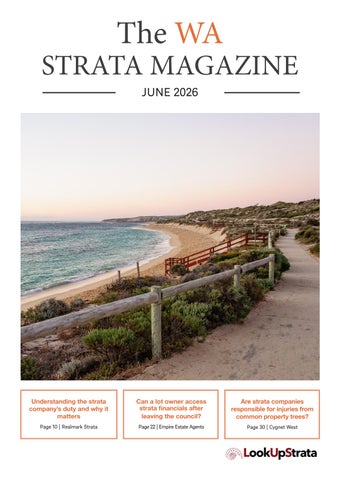
Understanding the strata company’s duty and why it matters
Page 10 | Realmark Strata
Can a lot owner access strata financials after leaving the council?
Page 22 | Empire Estate Agents
Are strata companies responsible for injuries from common property trees?
Page 30 | Cygnet West
About Us
Welcome to the latest issue of The LookUpStrata Magazine!
For over a decade, LookUpStrata has been Australia’s premier resource for everything related to strata living. Our mission is to keep strata communities informed and connected, providing thousands of lot owners, strata managers, and professionals with reliable, unbiased, easy-to-understand information to help you solve your strata problems and make informed decisions.
The WA Strata Magazines, published bi-monthly, are just one of the many ways we’re dedicated to supporting you. They’re packed with articles from industry experts and include our comprehensive printable strata directory.
Beyond these pages, we also offer:
• Q&A Service: Our team of leading strata specialists answer hundreds of your questions every month, which helps shape the magazine topics we cover.
• Newsletters: Our weekly newsletters deliver timely updates on legislative changes and the latest strata news straight to your inbox.
• Webinars: Join our founder, Nikki Jovicic, for weekly webinars where she hosts and partners with industry experts to discuss key topics.
• The LookUpStrata Directory: A free resource that showcases hundreds of trusted strata service professionals nationwide. You’ll find it at the end of every magazine and on our website.
• Website: Find all our resources, articles, and news in one convenient location, accessible 24/7.
Subscribe now at no cost. To enjoy unrestricted access and connect with our strata community simply click here
Stay Connected - follow us on LinkedIn, Facebook, and YouTube. Thank you for being a vital part of what makes our community so vibrant and trusted.
Nikki Jovicic Managing Director I Founder lookupstrata.com.au
a
The most expensive thing an owners corporation can do.
How should small strata schemes manage trip hazards identified in a WHS report? Craig
Understanding the strata company’s duty and why it matters
Xian Burton, Realmark Strata
Should all units be checked after concrete cancer is found in one block
Bruce McKenzie, Sedgwick
Can a non-owner have invoice approval rights in strata?
Marietta Metzger, magixstrata
Can our strata manager remove a valid by-law during strata consolidation?
Luke Downie, WA Strata Consultant
Can a lot owner access strata financials after leaving the council?
Jamie Horner, Empire Estate Agents
Does the strata council report to Landgate?
Andrew Chambers, Chambers Franklyn Strata
Which lift components need regular replacement and which reach end-oflife?
Andrew Batynski, ABN Lift Consultants
Do owners need to agree to a slight colour change?
Are strata companies responsible for injuries from common property trees?
Amy McCaffrey, Cygnet West
Thanks to our sponsors
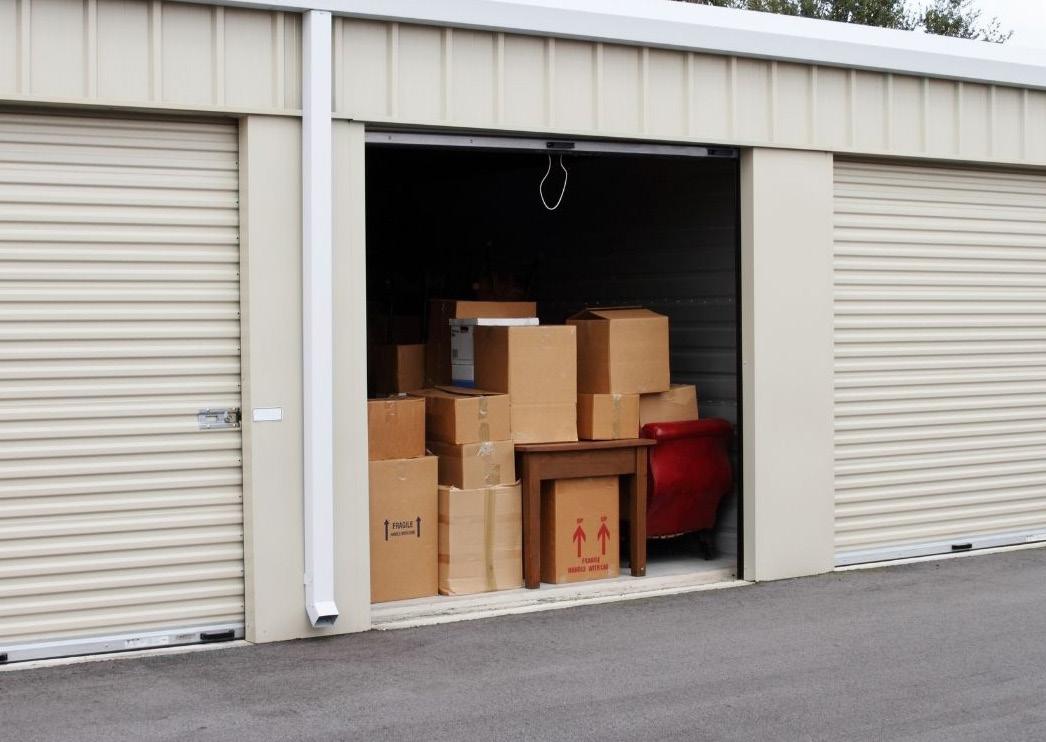
Do owners need separate insurance to rent a storage cage in strata?
Can a strata committee rent out unused storage cages? Are the renting owners required to take out insurance?
Our strata scheme has eight unused storage cages in the garage. Some owners have expressed an interest in renting the cages. The committee agree, in principle, to rent them out for a small fee. Our strata management company requires each renter to take out an insurance policy for $10,000,000 before renting a cage.
Is it reasonable or required for the committee to impose this insurance requirement? If renters do not take out insurance, could the owners corporation or committee be exposed to liability?
From the committee’s perspective, the key issue is risk management rather than mandating a specific insurance product.
It is not necessarily standard or required for each lessee of a storage cage to take out a separate $10,000,000 public liability policy. In many cases, lot owners (or tenants) will already hold appropriate cover under an existing contents or landlord insurance policy, which typically includes a public liability component.
What is important is whether their existing policy responds to this specific use — i.e. storing personal belongings in a rented storage cage on common property at the address they are also residing at. This is something the individual should confirm with their insurer. If the cover extends to this situation, there would generally be no need to arrange a separate standalone liability policy.
From the committee’s perspective, the key issue is risk management rather than mandating a specific insurance product. The owners corporation should already carry public liability insurance covering common property, which would respond where the owners corporation is negligent (for example, failure to maintain the building area, being common property, leading to injury or damage).
Conversely, if a loss arises due to the actions or negligence of the storage cage user (for example, unsafe storage of items causing damage or injury), liability may rest with that individual.
Because liability is always determined based on the specific facts of an incident, it isn’t possible to prescribe a one-size-fits-all outcome in advance.
In this instance, I would recommend first checking with your contents or landlord insurer to confirm whether this use is covered under your existing policy and if it is, reverting to the strata manager to clarify whether it meets the requirements.
Mention this offer when requesting a quote from us, and we will provide a discount off our standard fee for service of $250 (GST Inc) for buildings with 10-25 lots or $500 (GST Inc) for buildings with more than 25 lots for the first year you insure with Strata Insurance Solutions
To redeem this offer email a copy of your current policy schedule to Strata Insurance Solutions within 1 month of the publication of this magazine Your policy can expire any time in the next 12 months However we can only provide quotes 30 days prior to the expiry of your policyif your policy is not due now, we will schedule a quote at the appropriate time To ensure we apply this offer to our quotes, please specifically mention you would like to redeem the "LookUpStrata Special Offer".
COMMISSION TO YOUR STRATA MANAGER. Take the test todaysee how much you can save.
NOTHING!
The most expensive thing an owners corporation can do.
A decision not to act is still a decision.
You’re deciding to do this ‘later.’ And later will almost always cost you more.
Across Victoria, owners corporations are facing a perfect storm: rising costs, ageing buildings. This is not unique to our state. What is unique is the degree of difficulty in taking action in a state with Australia’s highest voting hurdles for raising a special levy or taking out a loan to get things done. This makes it harder than anywhere else in Australia to gain owner approval for necessary works and finance.
The result is predictable. Motions get voted down. Decisions get deferred. And while committees deliberate, project scopes grow and costs climb –turning what started as a manageable repair into a major, unplanned capital works project.
Is The Cost of Delay Purely Financial?
Rarely. Kicking the can down the road tends to compound the initial problem and blow out the budget with:
• growing repair scopes
• urgent compliance pressures
• stress on committees and strata managers
• greater risk in the long-term condition and value of the building
The stakes grow and costs will only continue to rise.
Why Are Strata Repair Costs Rising?
Over the past five years, construction costs in Australia have surged by nearly 50% thanks to labour shortages, COVID-era supply chain disruptions and now geopolitical tensions in the Middle East. Sustained pressure on petrol and freight costs will continue to directly affect the cost of building materials, logistics and contractors for some time to come.
For many Victorian apartment owners, this has meant significant and unexpected increases in repair and maintenance costs.
How Doing Nothing Turned
a $250,000 Repair into a $1 Million Project
One of our Victorian clients learned firsthand how costly doing nothing can be.
A Melbourne property first approached us in 2022 looking to fund $250,000 of necessary repair works. They chose to do it ‘later’. It cost them an additional $750,000.
Two years later, when they chose to act, continued deterioration combined with rising labour and material costs pushed the same project to nearly $1 million –almost four times the original estimate.
The delay didn’t just defer the cost. It multiplied it.
Defects don’t patiently wait while owners and committees deliberate. They spread, they sprawl, they worsen and cost your community more.
This is not an isolated case. Across Australia, delayed maintenance and necessary works are routinely escalating into costly, large-scale projects they weren’t prepared for.
Acting Early Protects Your Building… and Your Budget
Australia is now home to more than four million people living in strata – in buildings collectively worth over an estimated $1.4 trillion. With infrastructure ageing and compliance regulations tightening, proactive maintenance is no longer optional. It’s essential!
Tackling necessary works now stops small problems from becoming big, costly ones. Committees can proactively plan, make more informed decisions and prioritise the right projects to protect and grow the value of owners’ assets.
Is Having a Maintenance Fund Enough for Strata Works?
Many apartment owners think their maintenance fund will be able to finance necessary works. But in most cases, it simply doesn’t keep pace with the cost of the works it’s supposed to cover.
By law, tier one and tier two owners corporations must operate a maintenance fund that is held in accounts with approved banking institutionsmeaning low risk, low returns and slow growth. The same protections that keep your money safe also keep it from growing, making a maintenance fund one of the least cost-effective ways to fund capital works in strata.
What Happens when Rising Costs Outpace
Your Maintenance Fund?
In simple terms, it means the real value of your maintenance fund is quietly shrinking. The money you contribute today will buy less tomorrow – and in the current rising cost environment, the gap will only get bigger.
You save. Costs rise faster. Your fund falls behind. The repair and maintenance bill continues to grow… then what?
Are Special Levies the Best Option for Capital Works in Strata?
No, not always. In today’s economic climate, special levies can create significant delays and financial stress for owners. However, special levies have an important role to play in strata and are the default first option considered by most strata communities. There are better ways to fund.
Not every household has $5,000 or $15,000 to spare at short notice. Household budgets are already strained, particularly for retirees and families facing rising living costs. Investors managing multiple properties have their own cash flow pressures.
Concerns about affordability often result in delays. Delays increase costs and reduce affordability, compounding the stress and the concerns they were trying to avoid.
For many owners corporations, a Lannock Strata Loan is the faster, more flexible way to fund capital works – without the delays, the stress or the burden of a large, unexpected lump sum.
The Real Cost of Doing Nothing
“We’ll deal with that later” is one of the most expensive sentences in strata.
It really means “we’ll be paying a lot more for it later”.
Delays almost always equal higher costs. The damage and impact go beyond the budget. Deferred decisions create uncertainty, stress and unexpected costs for all owners down the line.
The funding decisions owners corporations make directly impact:
• Community wellbeing and livability
• The cost and tax liabilities for owners
• Each owner’s return on investment
Buildings do not repair themselves. Issues don’t wait patiently... they escalate. They compound. They multiply.
But timely, informed decisions can positively change the outcome. The hurdle for owner approval may be higher than other states, but the case for prompt action is compelling.
For Victorian owners and owners corporations, the message is clear: acting early isn’t just responsible… it’s economical
Josh Klemm Business Development Manager Victoria
P 0400 006 988
E joshua@lannock.com.au
W www.lannock.com.au
How should small strata schemes manage trip hazards identified in a WHS report?
Do we have to follow a WHS report recommending yellow markings and signage for trip hazards on a small strata driveway?
We are a small strata complex of five villas, about 25 years old, with a shared common driveway leading to our individual garages. All residents are retired or semi retired owner occupiers.
On our strata manager’s advice, we arranged a work health and safety report. We have addressed most items, but one issue remains.
The driveway is stamped decorative concrete, long, and slightly undulating in places that are not always obvious. The report says we must highlight all edges, drains, and non level areas with yellow non slip paint and install a “shared pedestrian zone” sign at the entrance to minimise any potential trip hazards.
All owners agree this would look unsightly, detract from the complex, and feels unnecessary for a small scheme. We have not seen other small strata complexes with this type of driveway marking.
Do we have to implement these specific markings and signs, or can we use a less industrial option, such as a smaller sign and more subtle markings, for example, in light grey instead of bright yellow?
Dealing with safety issues requires consideration of a hierarchy of controls. This methodology prioritises removing a risk rather than relying on human behaviour to address an issue.
Undulating, uneven, and disjointed driveways are a common occurrence in strata properties, small and large, and also a common cause of tripping/falling incidents across the country. Maintenance and remediation of damaged or irregular surface finishes should be part of any property’s ongoing maintenance budget.
Based on the information you have provided, the advice appears sound. The signage at the complex’s entry would advise residents and visitors to maintain a low speed and reduce the likelihood of an impact incident. It will warn vehicles of the undulating concrete.
However, smaller complexes need to consider that their driveway is not just for vehicles but also serves as the pathway for the property, and therefore, increased maintenance obligations may need to be considered over and above those that would normally be required for vehicles. Dealing with safety issues requires consideration of a hierarchy of controls. This methodology prioritises removing
a risk rather than relying on human behaviour to address an issue. The best way to deal with a hazard is to eliminate it: repair the undulation, repair any uneven drains, and remove any lips that may result in an incident. As an alternative, highlighting the areas would be considered an administrative control designed to change how people act in the area.
Therefore, the recommended highlighting is not to “minimise any potential trip hazards” but to draw attention to them in an effort to avoid potential incidents. Yellow is the preferred colour, as it remains bright, is highly visible to area users, and is actually quite commonly used for this purpose. Alternative colours may be considered so long as they are sufficiently contrasting to the surrounding colours to achieve the same goal. For this reason, grey is not usually a good colour.
Ultimately, any highlighting should be considered a short term option as the long term benefit of the property will be best served by repairing the affected areas.
Craig Welsh | QIA Group info@qiagroup.com.au
READ MORE HERE
Understanding the Strata Company’s duty and why it matters.
The Strata Titles Act 1985 places a clear responsibility on strata companies to maintain common property and keep it in good and serviceable repair.
Section 91 of the Act requires a strata company to manage common property for the benefit of all owners and properly maintain, renew and replace shared assets where necessary. Importantly, this obligation applies whether deterioration results from fair wear and tear, inherent defects or any other cause.
For strata communities across Western Australia, this legislation plays an important role in protecting property values, resident safety and the long-term financial health of a scheme.
Planning Ahead
Professional strata management extends beyond administration. It involves helping schemes plan ahead, manage risk and make informed decisions around maintenance, budgeting and long-term asset planning. From coordinating repairs and contractor engagement through to supporting capital works forecasting, a proactive approach can help strata companies meet legislative obligations with confidence.
This becomes increasingly important as strata developments age. Roofing, lifts, plumbing, security systems and external finishes all require ongoing attention to remain safe, functional and compliant. Delayed maintenance can quickly lead to larger and more expensive repairs, it is vital that schemes are future planning for these works and contributing to their reserve funds (“saving accounts”) so that the owners are able to fund the required works.
Improvements/Alterations
The legislation also recognises that some works go beyond maintenance and fall into the category of improvements or alterations. Projects such as CCTV installation, access control upgrades or electric vehicle charging infrastructure may require specific owner/strata scheme resolutions/approvals before works proceed. Understanding these requirements helps strata companies avoid governance issues while continuing to improve their communities and your strata manager should be able to help you differentiate between the requirements.
At Realmark Strata, proactive maintenance planning, long-term asset protection and strong governance are considered fundamental to building sustainable and well-performing strata communities. Supporting councils of owners to think ahead, manage risk responsibly and protect shared assets aligns closely with the team’s approach to professional strata management across Western Australia.
As legislative requirements and community expectations continue to evolve, having the right guidance and strategic support can make a meaningful difference to the long-term success of a strata scheme.
Strata experts that help you make informed decisions.
Effective strata management is about clarity, compliance and making the right decisions at the right time.
At Realmark Strata, our experienced managers work alongside council of owners and stakeholders to support the smooth operation of schemes across residential, commercial and mixed-use properties.
From governance and financial management to maintenance planning and legislative guidance, our team provides considered, proactive advice at every stage of the strata lifecycle.
Connect with Realmark Strata for a tailored management proposal or to discuss how your community can be better supported.
Should all units be checked after concrete cancer is found in one block
Concrete cancer has been found and remediated in one of our strata scheme’s three blocks. Should we check all units?
Our strata scheme has three blocks under the same strata title. We discovered concrete cancer in one block and it has now been remediated.
Should every unit be checked? How is that done? Owners will be reluctant. If more concrete cancer is found, the cost of remedial works could be colossal.
If concrete cancer is found in one part of a strata building, it is highly recommended to check all areas of similar design or construction.
It is highly recommended to check any areas of similar design or construction for signs of concrete cancer if it has been previously discovered elsewhere.
If it is the same strata property under the same title, it would have been the same builder who constructed the units, and likely the same trades used. Unfortunately, we do see a high volume of defects duplicated in strata schemes due to repeat installation issues. Therefore, it is always best practice to check.
A building consultant or engineer can undertake a visual assessment for telltale signs. If there are any suspicious areas, further investigation can be undertaken. It is possible that only minor works may be required (if any) in comparison to the work already undertaken. Owners should understand that detecting and addressing concrete cancer early can result in significant cost savings, as opposed to leaving it to further deteriorate.
Bruce McKenzie | Sedgwick bruce.mckenzie@au.sedgwick.com
What are the insurance options for survey strata owners?
We can no longer cover our survey strata scheme under a joint policy. What insurance options are available to individual lot owners?
We own 1 lot in a duplex of seven duplexes built around 2000. Each duplex has a common wall between the two lots. Four of the duplexes are two-storey.
Our strata manager informed us that, because we are survey strata, we can no longer be jointly insured and each owner will need separate property insurance.
We are getting the common areas valued so that the strata manager can get quotes for insuring just the common areas.
How do owners get a quote for their unit’s insurance? It doesn’t appear to be as easy as freestanding houses or regular strata.
1. Some insurers won’t insure individual units in groups of more than five.
2. Some insurers won’t insure the common area because two of the seven duplexes are holiday rentals.
3. One quote was high because the lot was not owner-occupied.
4. Some brokers don’t respond or return calls.
Survey strata insurance is challenging, but a CHU policy, a sympathetic home insurer, or a scheme-wide strata policy are all worth exploring with a specialist strata insurance broker.
It can certainly be challenging to secure insurance for survey-strata properties, but a few options available may help in your situation:
1. CHU’s Policy Option: CHU has an arrangement where the common areas are insured under one policy, and then separate policies are arranged for the individual dwellings. It may be worth reaching out to see if this option is available for your scheme.
2. Home Insurers: Some home insurers may be willing to cover your unit once they understand that it is on a survey-strata and you cannot get insurance under a standard strata policy. It’s often necessary to escalate the enquiry to a manager or someone with a higher level of delegation. If you clearly explain the situation, some insurers may reconsider their stance and provide cover.
3. Strata Insurers for the Entire Scheme: In some cases, a strata insurer may consider covering all lots under one policy, but this would generally require all lot owners to participate. If this is an avenue you’d like to explore, discuss this with your strata insurance broker. They can approach insurers willing to provide this type of cover.
Given the complexities involved, I’d recommend speaking with an insurance broker who specialises in strata and survey-strata properties. They can guide you through the process and help find the most suitable solution.
n g w i t h i n t h e c a p a n d t h e m e d i a n h o u s e p r i c e n e a r l y d o u b l e i t , a s i g n i f i c a n t s h a r e o f t h e s e
e n t r a n t s a r e h e a d i n g i n t o u n i t s a n d a p a r t m e n t s a c r o s s t h e c o u n t r y .
U r b a n C o n n e c t S h a r e d E q u i t y i s p r o v i d i n g 1 , 0 0 0 W A l o a n s w i t h a 2 % d e p o s i t o n a p a r t m e n t s
a n d t o w n h o u s e s u p t o $ 7 3 0 , 0 0 0 .
H e l p t o B u y h a s o p e n e d a f u r t h e r 1 , 1 0 0 W A p l a c e s u n d e r a s h a r e d e q u i t y a r r a n g e m e n t o f u p t o
T h e i m p a c t o n s t r a t a i s s i g n i f i c a n t . W A s c h e m e s
a r e r e c e i v i n g a w a v e o f f i r s t h o m e o w n e r s a r r i v i n g
w i t h t h e d e p o s i t s u p p o r t t o b u y , b u t w i t h o u t t h e
p r o p e r t y o w n e r s h i p e x p e r i e n c e t h e s t r a t a
g o v e r n a n c e m o d e l w a s b u i l t t o a s s u m e . e s m s t r a t a . c o m . a u | + 6 1 ( 0 ) 8 9 3 6 2 1 1 6 6 |
F o r c o u n c i l s a n d s t r a t a m a n a g e r s , t h e q u e s t i o n i s n ' t w h e t h e r m o r e f i r s t h o m e b u y e r s w i l l
e n t e r s t r a t a . . . t h e y a l r e a d y a r e . I t ' s w h e t h e r t h e s c h e m e s t h e y ' r e j o i n i n g a r e s e t u p t o b r i n g
t h e m a l o n g .
T H E S H A R E D E Q U I T Y W R I N K L E
U n d e r b o t h U r b a n C o n n e c t a n d H e l p t o B u y , t h e g o v e r n m e n t h o l d s a r e g i s t e r e d e q u i t y
s h a r e o n t i t l e T h e l o t o w n e r v o t e s , p a y s l e v i e s , a n d i s b o u n d b y b y - l a w s b u t t h e i r
f i n a n c i a l p o s i t i o n i s m o r e c o n s t r a i n e d t h a n a f u l l y - f u n d e d o w n e r . A $ 1 5 , 0 0 0 s p e c i a l
l e v y l a n d s v e r y d i f f e r e n t l y o n s o m e o n e w h o c a n ' t e a s i l y r e f i n a n c e t o a b s o r b i t .
F o r y e a r s
b u d g e t t o b e s e t w i t h r e f e r e n c e t o t h e 1 - y e a r p l a n W h e n a m e a n i n g f u l s h a r e o f o w n e r s
b u d g e t t o b e s e t w i t h r e f e r e n c e t o t h e 1 0 - y e a r p l a n W h e n a m e a n i n g f u l s h a r e o f o w n e r s
u d g e t t o b e s e t w i t h r e f e r e n c e t o t h e 0 - y e a r p l a n W h e n a m e a n i n g f u l s h a r e o f o w n e r s
h o l d a 2 % d e p o s i t a n d a g o v e r n m e n t e q u i t y s h a r e o n t i t l e , a n u n d e r f u n d e d p l a n d o e s n ' t j u s t
h o l d a 2 % d e p o s i t a n d a g o v e r n m e n t e q u i t y s h a r e o n t i t l e , a n u n d e r f u n d e d p l a n d o e s n ' t j u s t
i n c o v e n i e n c e t h e m . I t b r e a k s t h e m . P r i c e t h e p l a n h o e s t l y f r o m y e a r o n e .
i n c o n v e n i e n c e t h e m . I t b r e a k s t h e m . P r i c e t h e p l a n h o n e s t l y f r o m y e a r o n e .
h o l d a 2 % d e p o s i t a n d a g o v e r n m e n t q u i t y s h a r e o n t i t l e , a n u n d e r f u n d e d p l a n d e s n ' t j u s t i n c o n v e n i n c e t h e m . I t b r a k s t h e m . P r i c e t h e p l a n h n e s t l y f r o m y e a r n e .
O N B O A R D I N G I S T H E N E W C O M P I A N C F U N C I O N
O N B O A R D I N G I S T H E N E W C O M P L I A N C E F U N C T I O N
O N B O A R D I N G I S T H E N E W C O M P L I A N C E F U N C T I O N
S t r a t a m a n a g e r s t r e a t c o m p l i a n c e a s t h e r e g u l a t e d s t u f f S T A 2 0 , A G M n t i c e s ,
S t r a t a m a n a g e r s t r e a t c o m p l i a n c e a s t h e r e g u l a t e d s t u f f S T A A 2 0 1 8 , A G M n o t i c e s ,
S t r a t a m a n a g e r s t r e a t c o m p l i a n c e a s t h e r e g u l a t e d s t u f f S T A A 0 8 , A G M n o t i c e s ,
i n s u r a n c e . O w n e r e d u c a t i o n h a s s a t o u t s i d e t h a t f r a m e .
i n s u r a n c e . O w n e r e d u c a t i o n h a s s a t o u t s i d e t h a t f r a m e .
i n s u r a n c e . O w n e r e d u c a t i n h a s s a t o u t s i d e t h a t f r a m e .
T a t d i s t i n c t i o n l o n g e r h o l d s W h e n a m e a n i n g f u l s h a r e o f a s c h e m e h a s n v e r o w n e d
T h a t d i s t i n c t i o n n o l o n g e r h o l d s W h e n a m e a n i n g f u l s h a r e o f a s c h e m e h a s n e v e r o w n e d
T h a t d i s t i n c t i o n n o l g e r h o l d s W h e n a m e a n i n g f u l s h a r e o f a s c h e m e h a s n e v e r o w n e d
p r o p e r t y b e f o r e , t h e c h e a p e s t r i s k - m a n a g e m e n t t o l a m a n a g e r h a s i s m a k i n g s u r e o w n e r s
p r o p e r t y b e f o r e , t h e c h e a p e s t r i s k - m a n a g e m e n t t o o l a m a n a g e r h a s i s m a k i n g s u r e o w n e r s
p r o p e r t y b e f o r e , t h e c h a p e s t r i s k - m a n a g e m e n t t o o l a m n a g e r h a s i s m a k i n g s u r e o w e r s
u d e r s t a n d h o w t h e s c h e m e w o r k s . O n b o a r d i n g m o v e s f r o m c o u r t e s y t o c o r e s e r v i c e a n d
u n d e r s t a n d h o w t h e s c h e m e w o r k s . O n b o a r d i n g m o v e s f r o m c o u r t e s y t o c o r e s e r v i c e a n d
n d e r s t a n d h o w t h e s c h e m e w o r k s . O n b a r d i n g m v e s f r o m c u r t e s y t o c o r e s e r v i c e a n d
s t r a t a c o m p a n i e s n e e d t o e n s u r e n e w o w n e r s a r e p r o p e r l y o t o p o f t h e i r o b l i g a t i o s
s t r a t a c o m p a n i e s n e e d t o e n s u r e n e w o w n e r s a r e p r o p e r l y o n t o p o f t h e i r o b l i g a t i o n s
s t r a t a c o m p a n i e s n e d t o e n s u r e n e w o w n e r s a r e p r o p e r l y n t o p o f t h e i r o b l i g a t i n s
S E C T O R R E A D I N E S S I S A S H A R E D R E S P O N S I B I L I T Y
S E C T O R R E A D I N E S S I S A S H A R E D R E S P O N S I B I L I T Y
E C T O R R E A D I N E I S A S H A R E D R E S P O N S I B I L I T Y
T e s c h e m e s d i d w h a t t h e y w e r e d e s i g n e d t o d o , b u t t h e r e s p o s i b i l i t y f o r r e a d i n e s s w i l l
T h e s c h e m e s d i d w h a t t h e y w e r e d e s i g n e d t o d o , b u t t h e r e s p o n s i b i l i t y f o r r e a d i n e s s w i l l
T h e s c h e m e s d i d w h a t t h e y w e r e d e s i g n e d t o d o , b u t t h e r e s p n s i b i l i t y f o r r e a d i n e s s w i l l
n e e d t o b e s h a r e d a c r o s s p a r t i c i p a n t s i n S t r a t a T i s i n c l u d e s D e v e l o p e r s ( s e t t i n g r e a l i s t i c
n e e d t o b e s h a r e d a c r o s s p a r t i c i p a n t s i n S t r a t a T h i s i n c l u d e s D e v e l o p e r s ( s e t t i n g r e a l i s t i c
n e e d t o b e s h a r e d a c r o s s p a r t i c i p a n t s i n S t r a t a h i s i n c l u d e s D e v e l o p e r s ( s e t t i n g r a l t i c
b u d g e t s a t r e g i s t r a t i o n ) , g o v e r n m e n t a n d l e g i s l a t i o n ( p r o m o t i n g e d u c a t i o n t o n e w o w n e r s ) ,
b u d g e t s a t r e g i s t r a t i o n ) , g o v e r n m e n t a n d l e g i s l a t i o n ( p r o m o t i n g e d u c a t i o n t o n e w o w n e r s ) ,
u d g e t s a t r e g i s t r a t i o n ) , g o e r n m e n t a n d l e g i s l a t i o n ( p r o m o t i n g e d u c a t i o n t o n e w o w n e r s ) ,
S t r a t a M a n a g e r s ( s u p p o r t i n g w i t h o n b o a r d i n g n e w o w n e r s ) a n d , o f c o u r s e , t h e c o u n c i l m e m b e r s .
S t r a t a M a n a g e r s ( s u p p o r t i n g w i t h o n b o a r d i n g n e w o w n e r s ) a n d , o f c o u r s e , t h e c o u n c i l m e m b e r s .
S t r a t a M a n a g e r s ( s u p o r t i n g w i t h b o a r d i n g n e w o w e r s ) a n d , o f c o u r s e , t h e c u n c i l
m e m b e r s .
A t E S M S t r a t a , a l l n e w o w n e r s r e c e i v e o n b o a r d i n g a n d w e l c o m e p a c k s , a n d w e h a v e
A t E S M S t r a t a , a l l n e w o w n e r s r e c e i v e o n b o a r d i n g a n d w e l c o m e p a c k s , a n d w e h a v e
d e v e l o p e d a c o m p r e h e n s i v e c u s t o m e r - f a c i n g k n o w l e d g e b a s e t o s u p p o r t o w n e r s w i t h
d e v e l o p e d a c o m p r e h e n s i v e c u s t o m e r - f a c i n g k n o w l e d g e b a s e t o s u p p o r t o w n e r s w i t h
A t E S M S t r a t a , a l l n e w o w n e r s r e c e i v e o n b o a r d i n g a n d w e l c o m e p a c k s , a n d w e h a v e d e v e l o p e d a c o m p r e h n s i v e c u s t o m e r - f a c i n g k o w l e d g e b a s e t o s u p o r t o w e r s w i t h
u d e r s t a n d i n g l e g i s l a t i o a n d s t r a t a W o r k i n g t o g e t h e r t o s u p o r t o r s t r a t a c o m m u i t i e s i s
u n d e r s t a n d i n g l e g i s l a t i o n a n d s t r a t a W o r k i n g t o g e t h e r t o s u p p o r t o u r s t r a t a c o m m u n i t i e s i s
n d e r s t a n d i n g l e g i s l a t i n a n d s t r a t a W o r k i n g t o g e t h e r t o s u p p o r t o u r s t r a t a c o m m u n i t i e s i s
g o i g n t o e n s u r e t h e s m o o t h r u i n g o f s t r a t a c o m p l e x e s i n W A
g o i g n t o e n s u r e t h e s m o o t h r u n n i n g o f s t r a t a c o m p l e x e s i n W A
g o i g n t o e n s u r e t h e s m o t h r u n i n g o f s t r a t a c o m p l e x e s i n W A
Can a non-owner have invoice approval rights in strata?
Can the partner of a council of owners chairperson be authorised to approve invoices when they are not an owner?
How can the partner of our council of owners chairperson be an external approver of invoices when our bylaws clearly state one vote per lot owner? Despite the partner having no voting rights, both the chairperson and their partner have approval rights. How does that work?
Invoice approval is an administrative function, not a vote, so a non-owner can be involved if formally authorised by the council of owners.
Under the Strata Titles Act 1985 (the Act) (WA) (as amended), voting rights and operational functions within a strata company are distinct matters. The Standard Schedule 1 bylaw 14, prior to the 2018 amendment to the Act, provided for votes of proprietors; the Act, as amended in 2018, deleted Schedule 1 Bylaw 14. Now, section 120 of the Act provides that the owner of each lot is entitled to 1 vote on the proposed resolution of the strata company. The “one vote per lot” applies to decision-making at general
meetings or outside meeting resolutions of the strata company. That provision governs how lot owners vote on motions and does not extend to administrative or day-to-day functions such as invoice approval.
Invoice approval is not, in itself, a “vote” under the Act. Instead, it is an administrative or financial control process that the strata company typically delegates to the council of owners. The council may, in turn, establish procedures for authorising payments (for example, requiring two approvers). The Act does not expressly prohibit non-owners from being involved in administrative functions, provided they are properly authorised by the council.
However, there are important governance considerations:
• Only elected council members have formal decision-making authority under the Act.
• If a non-owner (such as the chairperson’s partner) has been given approval authority, this must come from a properly documented council decision or delegation
• Caution should be exercised in transferring or informally extending council functions to non-owners, as this can undermine accountability, create ambiguity around authority, and increase the risk of conflicts of interest
• The arrangement should be transparent, minuted, and consistent with any by-laws or conflict of interest obligations.
• If the chairperson is involved in appointing their partner to a financial control role, this may raise concerns about conflicts of interest and good governance, even if not strictly prohibited.
In summary, while the “one vote per lot owner” rule is not directly breached by an administrative approval role, the key question is whether the council of owners has formally authorised this arrangement and whether it meets standards of transparency and proper governance under the Act.
If this has not been clearly resolved or documented, it’s reasonable to request clarification from the council and ask that the authority for invoice approvals be formally minuted and reviewed.
The above information is general in nature and should not be considered legal advice. As we are not familiar with the specific circumstances of the strata scheme, including the registered strata plan and by-laws, you may wish to seek independent legal advice. Marietta Metzger | magixstrata
Helping the strata community navigate their building concerns
BUILDING CONSULTANCY
• Defect reports and forensic engineering
• Scope of works
• Dilapidation and risk surveys
• Dispute mediation and expert witness
• Contrator procurement and cost validation
• Construction management
• Capital works funds / maintenance plans
• Digital capability
• Façade assessments
REPAIR SOLUTIONS
• Emergency make safe
• Fire water damage restoration
• Leak detection
• Contamination response
• Building repairs
• Cost validation services
• Digital capability
Can our strata manager remove a valid by-law during strata consolidation?
Can a strata manager remove a valid by-law during consolidation, or does that require a formal resolution?
Our strata scheme includes a by-law that places maintenance responsibility for each unit on the individual owner, given that the units are for their exclusive use.
The strata manager deleted this when they rewrote our by-laws for consolidation. Did they have a right to do this? If an owner claims their maintenance on the strata, so will all owners, which will result in higher strata fees.
A valid by-law cannot be removed during consolidation without a formal resolution to repeal it, and if omitted without that resolution, it remains legally in force.
In my opinion, the first consolidation of by-laws after the commencement of the amended Strata Titles Act 1985 (the Act) on 1 May 2020 allowed strata companies to tidy and reformat their by-laws without requiring a vote. This administrative consolidation permitted renumbering, reformatting, and the removal of by-laws that were automatically invalidated by the amended legislation.
However, this process did not authorise strata managers to delete or alter valid by-laws. A bylaw requiring owners to maintain their own lots is not inconsistent with the Act. It aligns with section 91, which already places maintenance obligations on lot owners. Because it is not invalid, discriminatory, or contrary to the Act, it cannot be removed during consolidation unless the strata company has passed a formal resolution to repeal it.
Accordingly, if no such resolution was passed, the by-law remains legally in force even if it was omitted from the consolidated document.
It’s also important for owners to understand that “maintaining your own lot” refers only to the boundaries of the lot as shown on the strata plan. External walls, roofs, balconies and other structural elements may be, and often are, common property, and therefore the responsibility of the strata company unless a valid by-law shifts that responsibility. It is important to understand from the strata plan where the boundaries of the lot sit.
This explanation reflects my professional experience in the strata industry, but it is not legal advice. For a definitive position, a legal opinion should be obtained from a lawyer who specialises in strata titles law.
Luke Downie | WA Strata Consultant luked0876@gmail.com
Can a lot owner access strata financials after leaving the council?
If a member resigns from the council of owners, do they have the right to access the strata company’s financial records?
After several years as chairperson of our council of owners, I recently resigned due to family health matters. Until a few days ago, I could view our daily financial statement through an online portal, along with several documents and invoices for our unit.
Our strata manager says that I no longer have access to the statement of financial affairs because I am no longer a strata council member.
I am still a lot owner in the complex, so should I have the same right to view the financial records as any strata council member?
Lot owners have a right to inspect records under the Strata Titles Act 1985, but digital portal access to current financials is generally reserved for the council of owners, not individual owners.
Subdivision 6 — Provision of information under the Strata Titles Act 1985 (the Act) covers the rights of owners and those with a proper interest regarding what information they can receive and in what format.
As an owner in the scheme, it is noted you have a proper interest and under section 107(1)(b) have a right to an ‘inspection of material’. Under section 109, an inspection of material is a physical inspection of the records of the scheme.
There is no requirement under the Act to provide owners with digital portal access to information, including the scheme’s current financial records. Your strata management company’s management agreement will generally set out the terms for providing the financial statements to the scheme, but generally, this is for the council of owners.
New strata education requirements are now in effect.
Complete your CPP40521 Certificate IV in Strata Community Management by 1 NOVEMBER 2027.
Get qualified now and secure current pricing before EOFY.
Flexible, role-specific strata training from REIWA Training. Complete the full qualification or only the four or six units required for your role.
“REIWA is the first RTO offering this certification in WA, and with the regulation changes now in effect, I’m glad to be ahead of the game.”
NIKKI D’AGOSTINO, REZZI STRATA REIWA Training graduate
REIWA’s CPP40521 Certificate IV in Strata Community Management offers flexible, self-paced study with individual support from industry-leading trainers.
• Interest-free payment plans available
• Individual support sessions with experienced trainers
• Self-paced online learning — start anytime via REIWA’s world-class training portal
• Delivered by WA’s trusted real estate training provider Get started today
Does the strata council report to Landgate?
Who regulates the strata council’s performance and compliance? Does it report to Landgate?
Who regulates the performance of our strata council, its decision-making and compliance with legislation? Does the strata council submit information and reports to Landgate?
The council of owners does not report to Landgate or any regulatory authority. Its performance is regulated by owners at the AGM, and serious disputes are referred to the State Administrative Tribunal.
The Strata Titles Act 1985 (the Act) is the legislation that governs strata titles in Western Australia.
The council of owners is covered under Division 4 and 5, sections 135 to 142. In particular, section 137 covers the general duties and conflict of interest for council members.
Section 135(1) states:
The functions of a strata company, subject to this Act and to any restriction imposed or direction given by ordinary resolution, are to be performed by the council of the strata company.
Section 134 covers the performance of restricted council functions in a general meeting.
As for the regulation of the performance, the council of owners does not submit any reports or returns to Landgate or any other regulatory authority.
In essence, the performance of the council of owners is determined by the owners at the
Annual General Meeting. If owners don’t believe the council of owners is performing its role in accordance with the Act, they can vote not to re-elect them or impose restrictions as per section 134.
For any serious disputes or contraventions of the Act, an application can be made to the State Administrative Tribunal seeking a resolution.
Andrew Chambers | Chambers Franklyn Strata Management andrew@chambersfranklyn.com.au
Chambers Franklyn Strata Management
Where Expertise Meets Excellence
Dedicated Strata People Helping Strata Owners
Over 3 Decades of Strata Industry Leadership and Expertise
Cultivating long-lasting relationships offering a personalised experience and understanding your property’s needs.
Experienced, Accredited Strata Community Managers
For a proposal and to discuss how we can help benefit your Strata Scheme Please email strata@chambersfranklyn.com.au or call 9440 6222
www.chambersfranklyn.com.au | 3/47 Cedric Street, Stirling WA 6021
Which lift components need regular replacement and which reach end-of-life?
Which lift components are most commonly replaced during modernisation projects, and which parts reach end-of-life?
Which components are most commonly replaced during lift modernisation projects? Which parts of a lift require regular replacement, and which parts reach full end-of-life?
The building height, population and usage behaviour will have a huge impact.
Lift controllers, drives, buttons, indicators, door operators, and landing door mechanisms are used each time the lift is moving, and thus typically need replacement after 10 to 15 years. It will depend on the type and model, as some components
become obsolete and replacement is not possible. Also, the building height, population and usage behaviour will have a huge impact. However, with low-rise lifts of 10 to 12 levels, replacing the entire lift would be more costeffective.
Andrew Batynski | ABN Lift Consultants Andrew@abnlift.com
Do owners need to agree to a slight colour change?
If a colour scheme approved at the AGM needs slight changes, does the strata company need to issue a circular resolution, or is an email to owners sufficient?
Our strata company presented a colour scheme at the AGM that has slight variations from our current paint colours. Due to the colour change, does the strata company need to send a circular resolution through the strata manager for owners’ approval? Or is there a quicker, easier way to get approval, such as an email to all owners?
“Slight variation” is subjective, so a circular resolution is the most appropriate course, though an informal email to gauge owner sentiment first can be a practical initial step.
The term “slight variation” is inherently subjective. As such, the most appropriate course of action is to submit the proposed colour change to all owners by way of a circular resolution for formal consideration.
As an initial, informal step, particularly in smaller schemes or where owner responsiveness is high, it may be practical to circulate the proposed change via email to identify any objections. Subject to the feedback received, the matter can then proceed to a formal circular resolution.
For example, in a five-lot scheme, it is generally easier to gauge potential objections compared to a larger scheme of thirty lots, where broader consultation is typically required.
SVN | Strata | SVN Perth info@svnperth.com.au
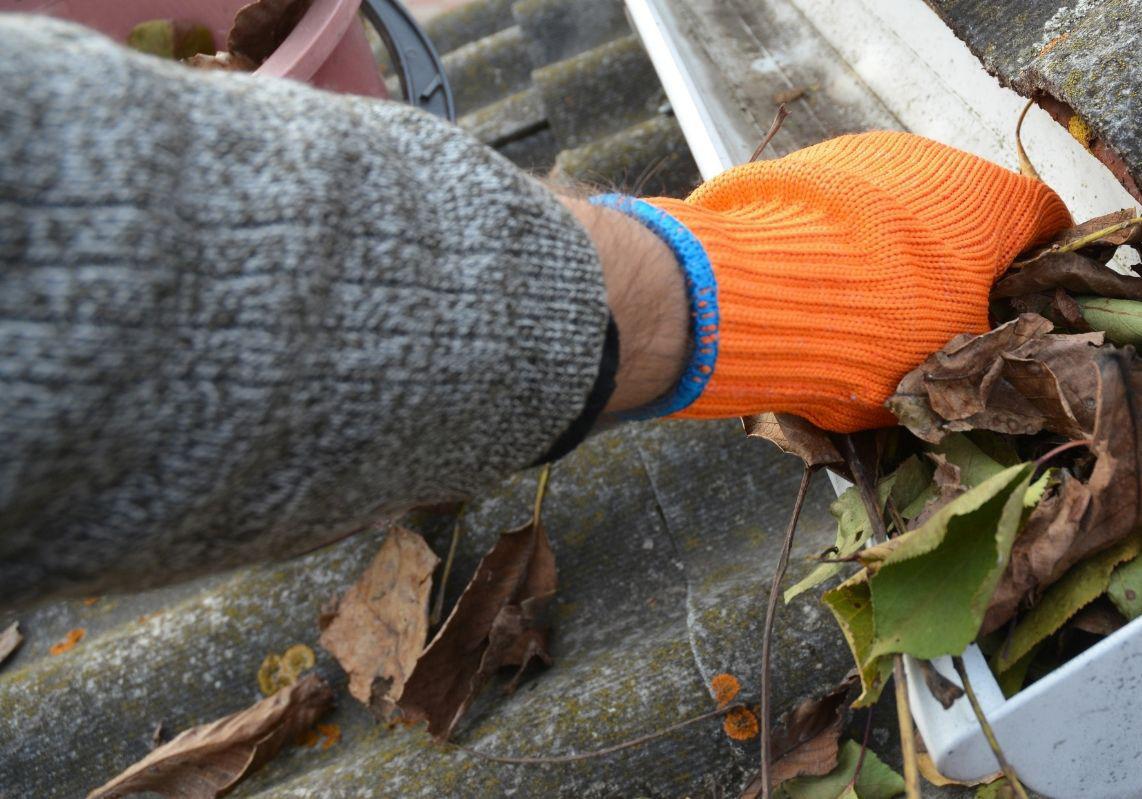
Are strata companies responsible for injuries from common property trees?
Does a strata company have a duty to manage Marri trees causing injuries on common property, even where a Tree Preservation Zone limits what they can do?
Our estate is a large single-storey survey strata with no direct employees. It is located in a Shire Tree Preservation Zone. Marri trees on the estate’s common property drop lots of honky nuts. Several people have fallen and sustained injuries.
Is the strata company required to provide a safe environment for contractors, volunteers, residents and visitors?
A strata company has an obligation to take reasonable steps to manage known hazards on common property, and where injuries have already occurred, proactive management and documentation are essential.
Yes, a strata company in Western Australia has obligations to take reasonable steps to provide a safe environment for owners, occupiers, contractors, volunteers and visitors when they are on common property.
Under section 91(1)(b) and (c) of the Strata Titles Act 1985 (the Act) (WA), a strata company must:
• “control and manage the common property for the benefit of all the owners of lots”; and
• “keep in good and serviceable repair, properly maintain and, if necessary, renew and replace” the common property.
While the Act does not specifically impose workplace safety obligations on a residential strata scheme with no employees, a strata company still owes a general duty of care under common law principles and may also have obligations under the Occupiers’ Liability Act 1985 (WA).
In this situation, where Marri trees on common property are regularly dropping honky nuts and there have already been injuries from slips or falls, the strata company should treat this as a foreseeable hazard. Once a risk is known or reasonably foreseeable, it is important that the strata company can demonstrate it has taken reasonable and proactive steps to manage that risk.
Importantly, “reasonable steps” does not necessarily mean removing the trees, particularly where the estate is located within a Shire Tree Preservation Zone. Local government restrictions may limit pruning or removal without approval. However, these restrictions do not relieve the strata company of its responsibility to actively manage known hazards on common property.
Practical measures the strata company could consider include:
• increasing the frequency of common property cleaning or grounds maintenance during peak shedding periods;
• engaging a qualified arborist to inspect the trees and provide written recommendations;
• obtaining advice or approval from the local Shire regarding permissible pruning or maintenance works within the Tree Preservation Zone;
• installing warning signage in higher-risk areas;
• reviewing pedestrian pathways and lighting to minimise slip or trip risks;
• documenting all incidents, inspections and maintenance undertaken; and
• notifying the strata insurer if there is an ongoing or recurring hazard that may give rise to claims.
The key consideration is often not whether the strata company can completely eliminate the risk, but whether it can demonstrate it acted reasonably once aware of the issue.
I also recommend that the council of owners obtain professional arborist advice in writing and retain records of all reports, contractor recommendations and correspondence with the local authority. Demonstrating due diligence and a documented maintenance approach may assist the strata company should any future liability claim arise. Where injuries have already occurred, or where the risk is considered significant, the strata company should also consider obtaining independent legal advice specific to the scheme and circumstances.
Amy McCaffrey | Cygnet West Amy.McCaffrey@cygnetwest.com
Join WA’s Award Winning Strata Team Proudly Recognised for Strata Excellence
Cygnet West took home five major awards at the 2025 CHU SCA (WA) Strata Community Excellence Awards.
Ready to build your future in Strata Management with an industry‑leading team?
Scan the QR code to explore your next opportunity.