Does the legislation require a three-box Yes, No, Abstain ballot for committee elections?
Page 12 | SOCM
How concerning is it if our strata manager moves funds between accounts without a clear audit trail?
Page 20 | Forensic Auditors Melbourne
When will the proposed strata legislation reforms be approved and implemented?
Page 24 | Chambers Russell Lawyers
About Us
Welcome to the latest issue of The LookUpStrata Magazine!
For over a decade, LookUpStrata has been Australia’s premier resource for everything related to strata living. Our mission is to keep strata communities informed and connected, providing thousands of lot owners, strata managers, and professionals with reliable, unbiased, easy-to-understand information to help you solve your strata problems and make informed decisions.
The VIC Strata Magazines, published bi-monthly, are just one of the many ways we’re dedicated to supporting you. They’re packed with articles from industry experts and include our comprehensive printable strata directory.
Beyond these pages, we also offer:
• Q&A Service: Our team of leading strata specialists answer hundreds of your questions every month, which helps shape the magazine topics we cover.
• Newsletters: Our weekly newsletters deliver timely updates on legislative changes and the latest strata news straight to your inbox.
• Webinars: Join our founder, Nikki Jovicic, for weekly webinars where she hosts and partners with industry experts to discuss key topics.
• The LookUpStrata Directory: A free resource that showcases hundreds of trusted strata service professionals nationwide. You’ll find it at the end of every magazine and on our website.
• Website: Find all our resources, articles, and news in one convenient location, accessible 24/7.
Subscribe now at no cost. To enjoy unrestricted access and connect with our strata community simply click here
Stay Connected - follow us on LinkedIn, Facebook, and YouTube. Thank you for being a vital part of what makes our community so vibrant and trusted.
Nikki Jovicic Managing Director I Founder lookupstrata.com.au
4 Does our tier level change our insurance requirements
Tyrone Shandiman, Strata Insurance Solutions
6 Funding the fix: Getting large scale remediation and sustainability works moving in Victorian owners corporations
Josh Klemm, Lannock Strata Finance
8 How should small strata schemes manage trip hazards identified in a WHS report?
Craig Welsh, QIA Group
10 OC Case law update
Phillip Leaman, Tisher Liner FC Law
12 Does the legislation require a threebox Yes, No, Abstain ballot for committee elections?
Alex McCormick, SOCM
14 Should all units be checked after concrete cancer is found in one block
Bruce McKenzie, Sedgwick
16 Can an owners corporation force a non-responsive owner to allow access for mandatory fire safety works?
Phillip Leaman, Tisher Liner FC Law
18 Which lift components need regular replacement and which reach endof-life?
Andrew Batynski, ABN Lift Consultants
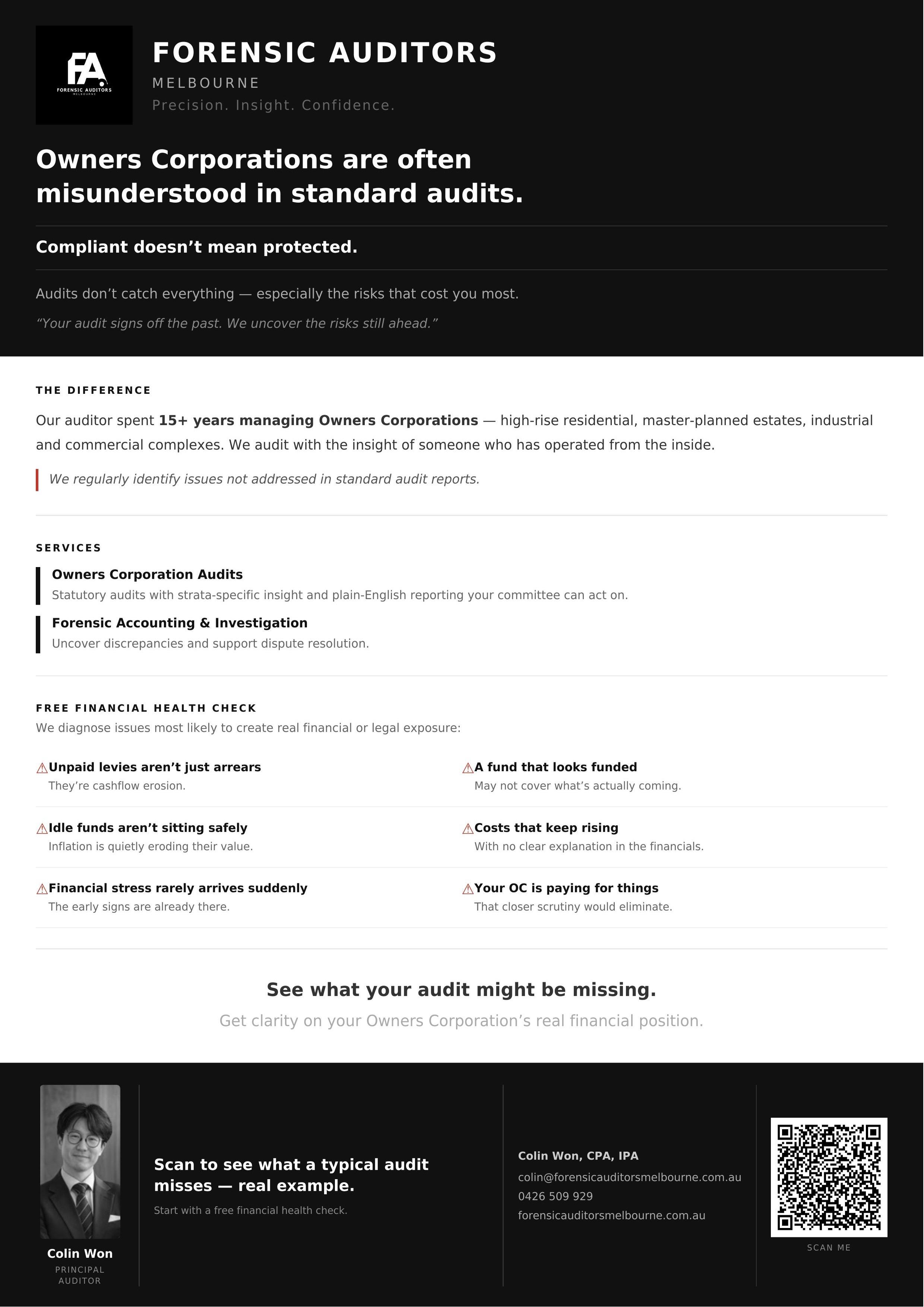
20 How concerning is it if our strata manager moves funds between accounts without a clear audit trail?
Colin Won, Forensic Auditors Melbourne
22 How do we set up a proper email system for our strata committee records?
Leya
Wall, Town Square
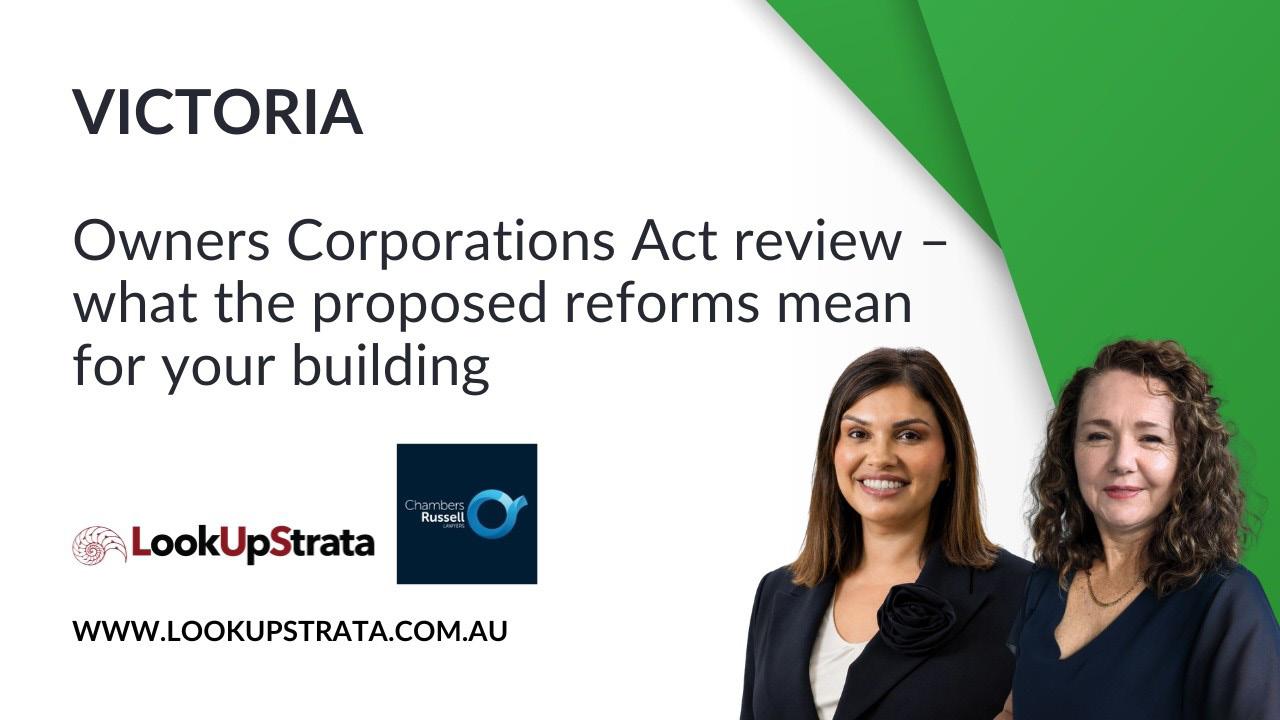
24 When will the proposed strata legislation reforms be approved and implemented?
Fabienne Loncar, Chambers Russell Lawyers
26 The VIC LookUpStrata Directory
Thanks to our sponsors
Does our tier level change our insurance requirements
Does the five-tier system change insurance cover requirements, or only valuation timing and reporting?
I’ve read that Victoria moved to a five-tier system for owners corporations. Our building is a tier 2. I think this affects how often we need a valuation, but does it change anything about the type or amount of insurance cover we’re required to carry, like minimum sums insured or specific cover types?
Or is the tier system only really about valuation timing and reporting, and the actual cover requirements are the same regardless of tier?
The five-tier system doesn’t change insurance requirements. Only tier five carries exemptions.
The introduction of the five-tier system in Victoria does not change the insurance requirements for Tier 1 to Tier 4 owners corporations. These tiers are all subject to the same legislative requirements regarding building insurance and valuations.
For Tier 1 to Tier 4 owners corporations:
• The owners corporation is required to insure the building for its full replacement and reinstatement value in accordance with the Owners Corporations Act 2006.
• The level and type of insurance required do not change based on the tier classification.
• An independent insurance valuation is generally required at least every five years to ensure the building is insured for its full replacement and reinstatement value. The exception is Tier 5, which generally includes two-lot subdivisions and certain services-only owners corporations. Tier 5 owners corporations are exempt from the statutory requirement to obtain a valuation every five years. They also have certain exemptions from the Act’s insurance provisions. For example, two-lot subdivisions are generally not required to arrange owners corporation building or public
liability insurance under the Act, although obtaining appropriate insurance is still strongly recommended. In some circumstances, owners may instead arrange insurance individually rather than through the owners corporation.
Accordingly, unless your owners corporation falls within the Tier 5 exemptions, the insurance and valuation requirements are effectively the same regardless of whether the owners corporation is classified as Tier 1, 2, 3 or 4.
Mention this offer when requesting a quote from us, and we will provide a discount off our standard fee for service of $250 (GST Inc) for buildings with 10-25 lots or $500 (GST Inc) for buildings with more than 25 lots for the first year you insure with Strata Insurance Solutions
To redeem this offer email a copy of your current policy schedule to Strata Insurance Solutions within 1 month of the publication of this magazine Your policy can expire any time in the next 12 months However we can only provide quotes 30 days prior to the expiry of your policyif your policy is not due now, we will schedule a quote at the appropriate time To ensure we apply this offer to our quotes, please specifically mention you would like to redeem the "LookUpStrata Special Offer"
TO YOUR STRATA MANAGER Take the test todaysee how much you can save.
Funding the Fix
Getting large scale remediation and sustainability works moving in Victorian owners corporations.
Getting a Victorian owners corporation to agree on funding for major works takes real leadership. The legislative bar is high and the stakes are real, but it’s entirely achievable with the right approach.
Few owners corporations will have the funds to pay for large scale remediation works sitting idly in the bank. So, the committee will need to ask its members to green light a special levy or strata lender to pay for the works. People don’t like unexpected expenses at the best of times let alone with cost of living pressures as they are at present. Achieving the consensus you need to move forward calls for strong leadership with sure solutions.
For illustrative purposes, let’s say your block of 100 apartments needs a new roof. Your goal is to get a quorum at a meeting to discuss it and then agreement from 75% of the owners to proceed with the work. Failing that you may need to issue a ballot, or start with the process of one.
Here’s your playbook.
Communicate Early. Communicate often. Having an open line of communication with every member of your owners corporation is a great place to start. Whether it’s a group email, a modern WhatsApp chat or an old-school letterbox drop, it’s good to reach out and remind everyone that we’re all in the same boat/apartment block.
Share useful news and good news every now and then. That way, you’re not just getting in touch with bad news.
So, when a potential issue with a common asset is being investigated, be sure to let the group know early without being too alarmist.
Remember, common areas are everyone’s responsibility, so make sure you use language in your emails/chats/letters that reinforces this. For example, saying “We have discovered a major leak in our roof” leaves no room for misinterpretation as it’s everyone’s roof and everyone’s responsibility.
Time is not your friend.
Time might heal all wounds, but it won’t fix a building issue. In fact, it’s quite the opposite. The longer you leave most issues, the worse and more expensive they’ll eventually be to fix.
By presenting options clearly and simply, you’ll help people make decisions faster.
People
like options when inaction is not an option.
While there may only be one solution, the pathway can vary depending on the financial circumstances of your owners corporation and its members.
Do you have enough in the bank to pay for the fix? Is it small enough to be covered by a one-off levy? Or could finance help amortise the payments over time to lessen the burden?
Lannock Strata Finance has a bespoke tool for this. LevyPlanner helps you calculate and score the real cost of every funding option for any capital works plan whatever your scheme or mix of owners.
Simply enter your scheme details and owner profile and LevyPlanner instantly calculates and visualises the pre-tax and after-tax cost of each option, helping your scheme make an informed decision.
If you’ve managed everyone’s expectations that money needs to be spent, this will help make it a much easier conversation.
Call a meeting.
Call a meeting for the owners corporation, explain the situation and present the options available to move forward with the works.
In Victoria, signing off on funding for major works usually requires a special resolution, meaning 75% of total lot entitlements need to vote in favour, not just those attending on the night.
If you’ve followed the advice to this point you’ll be well prepared to proceed, but there’s a couple of strong arguments for bringing in some outside help at this point. The meeting can be used to inform, with a ballot sent out later, or a formal vote with an agenda issued in the appropriate time frame.
Bring in an expert.
People don’t vote ‘yes’ for things they don’t understand. Especially when that yes is going to cost them money. It’s also hard to argue against facts and external expertise.
Make sure the issue has been diagnosed by a verifiable, reputable source. It removes any doubt that the work needs to be done.
An experienced finance manager can also help demystify the options available to you for funding. Lannock Strata Finance will send a representative to your owners corporation meeting to help answer any questions.
From our experience, it also helps compartmentalise the issue so you can be part of the team sourcing the solution, not the ones representing the problem.
Remember, communication is key and you’re not alone. With the right process and the right advice, most owners corporations will get things moving despite the hurdles.
If you’ve been putting off significant works due to financing concerns, you can try LevyPlanner for free to see what options are available to you.
Or call Lannock Strata Finance any time to discuss your specific circumstances.
Josh Klemm Business Development Manager VIC
How should small strata schemes manage trip hazards identified in a WHS report?
Do we have to follow a WHS report recommending yellow markings and signage for trip hazards on a small strata driveway?
We are a small strata complex of five villas, about 25 years old, with a shared common driveway leading to our individual garages. All residents are retired or semi retired owner occupiers.
On our strata manager’s advice, we arranged a work health and safety report. We have addressed most items, but one issue remains.
The driveway is stamped decorative concrete, long, and slightly undulating in places that are not always obvious. The report says we must highlight all edges, drains, and non level areas with yellow non slip paint and install a “shared pedestrian zone” sign at the entrance to minimise any potential trip hazards.
All owners agree this would look unsightly, detract from the complex, and feels unnecessary for a small scheme. We have not seen other small strata complexes with this type of driveway marking.
Do we have to implement these specific markings and signs, or can we use a less industrial option, such as a smaller sign and more subtle markings, for example, in light grey instead of bright yellow?
Dealing with safety issues requires consideration of a hierarchy of controls. This methodology prioritises removing a risk rather than relying on human behaviour to address an issue.
Undulating, uneven, and disjointed driveways are a common occurrence in strata properties, small and large, and also a common cause of tripping/falling incidents across the country. Maintenance and remediation of damaged or irregular surface finishes should be part of any property’s ongoing maintenance budget.
Based on the information you have provided, the advice appears sound. The signage at the complex’s entry would advise residents and visitors to maintain a low speed and reduce the likelihood of an impact incident. It will warn vehicles of the undulating concrete.
However, smaller complexes need to consider that their driveway is not just for vehicles but also serves as the pathway for the property, and therefore, increased maintenance obligations may need to be considered over and above those that would normally be required for vehicles. Dealing with safety issues requires consideration of a hierarchy of controls. This methodology prioritises removing
a risk rather than relying on human behaviour to address an issue. The best way to deal with a hazard is to eliminate it: repair the undulation, repair any uneven drains, and remove any lips that may result in an incident. As an alternative, highlighting the areas would be considered an administrative control designed to change how people act in the area.
Therefore, the recommended highlighting is not to “minimise any potential trip hazards” but to draw attention to them in an effort to avoid potential incidents. Yellow is the preferred colour, as it remains bright, is highly visible to area users, and is actually quite commonly used for this purpose. Alternative colours may be considered so long as they are sufficiently contrasting to the surrounding colours to achieve the same goal. For this reason, grey is not usually a good colour.
Ultimately, any highlighting should be considered a short term option as the long term benefit of the property will be best served by repairing the affected areas.
Craig Welsh | QIA Group info@qiagroup.com.au
Understanding Common Property Rights & Responsibilities
One of the most frequent sources of owner confusion is understanding the difference between what falls under “common property ” versus “lot property.” Misunderstandings in this area can lead to disputes over who is responsible for maintenance or repair, particularly for shared elements such as balconies, windows, roofing, or external walls. Without clarity, minor issues can es calate into disagreements, d elays in necessary works, or frustration among owners and the committee. Clear, consistent communication about the responsibilities of the owners’ corporation / bodies corporate versus individual lot owners helps prevent these disputes, supports smoother day-to-day operations, and ensures maintenance is carried out appropriately and efficiently. Proactive education and documentation make it easier for owners to understand their obligations and for managers to maintain compliance
How QIA Group Can Help
QIA Group provides clear, expert reports that strata managers can use to explain responsibilities and compliance requirements to owners, helping reduce confusion and prevent disputes. Our reports also give committees and managers a reliable, professional reference to support decision-making and ensure consistent communication with owners.
Plans & Diagrams
• Cladding Inspections & Reports
• Building Maintenance Assessments
• Plant & Equipment / Asset Registers
Does the legislation
require a three-box Yes, No, Abstain ballot for committee elections?
Do ballots for committee elections need a Yes, No, and Abstain box against each nominee’s name?
I read a recent Q&A on the LookUpStrata site that says ballots need three boxes against each nominee’s name: Yes, No, and Abstain. I’ve never heard of this committee voting method before, and I can’t find it mandated anywhere in the Act.
Isn’t withholding your vote for a candidate another way to vote No? By adding a separate No column, members effectively get two chances to say No to the same nominee.
My understanding is that committee elections are treated like resolutions, but they’re not the same thing. A resolution decides whether the owners corporation will or won’t do something, which is why it needs Yes, No and Abstain columns. Electing a committee member isn’t a yes or no decision, you vote for the candidates you want. Company boards aren’t elected this way, and neither are MPs.
Electing a committee member is itself a resolution under the Act, so the Yes, No and Abstain structure applies in the same way it does to any other owners corporation decision.
At a high level, every decision of an owners corporation is made by a resolution, whether at the level of all owners or at committee level only. The resolutions must be passed by a vote of each owner, and a majority of owners or committee members determines whether it passed. If the owners corporation hasn’t resolved for something to happen, including electing committee members, then it hasn’t happened.
Voting for a committee member absolutely does take place via resolutions. This is reflected in minutes and is also how VCAT and the courts have always, at least to my knowledge, treated any appointment or disputed appointment of committee members. A resolution elects a committee member or a group of members, and voting determines the outcome.
Owners have a right to vote for or against a motion, but they also have a right to actively not vote. There is nothing in the Owners Corporations Act 2006 (the Act) that forces an owner to vote for or against a motion; hence the need to allow for and register any abstentions.
Is this different to a company board or political election? Yes. Owners corporations differ, with different legislation and particulars. There are many similarities, but it is not identical.
Alex McCormick | SOCM alex@socm.com.au
Excellence Transparency Partnership
Contact SOCM for a free and confidential assessment of your owners corporation functions, or a formal proposal for your management needs.
W socm.com.au E info@socm.com.au T 03 9495 0005
OWNERS CORPORATION MANAGEMENT SERVICES
At SOCM, we have developed an approach that focuses on delivering personalised service of the utmost quality and demonstrating exceptional professionalism in every aspect of our work. Our impressive property portfolio and positive testimonials serve as evidence of our position as a top Owners Corporation Management company in Victoria. We consistently maintain this position by prioritising comprehensive communication and promptly responding to our clients’ needs.
ACCOUNTING & FINANCIALS
COMMISSION FREE INSURANCE
DOCUMENTATION
MEETINGS & BALLOTS
LEGISLATIVE ADVICE & GUIDANCE
MAINTENANCE
“SOCM has provided an extensive service in Owners Corporation Management for more than a decade.”
Should all units be checked after concrete cancer is found in one block
Concrete cancer has been found and remediated in one of our strata scheme’s three blocks. Should we check all units?
Our strata scheme has three blocks under the same strata title. We discovered concrete cancer in one block and it has now been remediated.
Should every unit be checked? How is that done? Owners will be reluctant. If more concrete cancer is found, the cost of remedial works could be colossal.
If concrete cancer is found in one part of a strata building, it is highly recommended to check all areas of similar design or construction.
It is highly recommended to check any areas of similar design or construction for signs of concrete cancer if it has been previously discovered elsewhere.
If it is the same strata property under the same title, it would have been the same builder who constructed the units, and likely the same trades used. Unfortunately, we do see a high volume of defects duplicated in strata schemes due to repeat installation issues. Therefore, it is always best practice to check.
A building consultant or engineer can undertake a visual assessment for telltale signs. If there are any suspicious areas, further investigation can be undertaken. It is that only minor works may be required (if any) in comparison to the work already undertaken. Owners should understand that detecting and addressing concrete cancer early can result in significant cost savings, as opposed to leaving it to further deteriorate.
Bruce McKenzie | Sedgwick bruce.mckenzie@au.sedgwick.com
Helping the strata community navigate their building concerns
BUILDING CONSULTANCY
• Defect reports and forensic engineering
• Scope of works
• Dilapidation and risk surveys
• Dispute mediation and expert witness
• Contrator procurement and cost validation
• Construction management
• Capital works funds / maintenance plans
• Digital capability
• Façade assessments
REPAIR SOLUTIONS
• Emergency make safe
• Fire water damage restoration
• Leak detection
• Contamination response
• Building repairs
• Cost validation services
• Digital capability
Can an owners corporation force a non-responsive owner to allow access for mandatory fire safety works?
Our building is under a Victorian Building Authority (VBA) notice requiring the replacement of non-fire-resistant common property windows. How can the owners corporation compel a nonresponsive owner to comply?
Our building is under a VBA notice for the replacement of non fire resistant windows in the common property. The owners corporation (OC) is proceeding with a project plan to remedy the issue. Builders require access to units to complete the works. One owner does not respond to correspondence and, in the past, has not provided access for mandatory fire safety inspections.
How can the OC compel this owner to comply?
The owners corporation can apply to VCAT for an access order if the owner refuses entry.
The OC has the power to authorise a person to enter a lot on its behalf to carry out repairs, maintenance or other works under section 50 of the Owners Corporations Act 2006 (the Act) if carrying out repair or maintenance of a service, but not generally common property.
A service includes something necessary for the support, shelter or protection, full and uninterrupted access to and use of light for windows, doors or other openings, passage of water, drainage, and other easements pursuant to section 12(2) of the Subdivision Act 1988
We presume that the windows are common property, but you should check your plan of subdivision to determine whether they are private lot property or common property. If they are private lot property, the OC should issue a section 48 of the Owners Corporations Act notice on the lot owner.
If there is a basis for access under section 50, unless in the case of an emergency, the OC must give at least 7 days’ notice in writing to the lot owner and the occupier of the lot. If access is then denied, the OC may issue proceedings in VCAT and seek an order for access against the lot owner or occupier through an order of the Tribunal.
Lot owners should be wary of refusing access, as they may find themselves facing a claim for damages from the OC if the OC’s works are delayed.
Phillip Leaman | Tisher Liner FC Law
ocenquiry@tlfc.com.au
Which lift components need regular replacement and which reach end-of-life?
Which lift components are most commonly replaced during modernisation projects, and which parts reach end-of-life?
Which components are most commonly replaced during lift modernisation projects? Which parts of a lift require regular replacement, and which parts reach full end-of-life?
The building height, population and usage behaviour will have a huge impact.
Lift controllers, drives, buttons, indicators, door operators, and landing door mechanisms are used each time the lift is moving, and thus typically need replacement after 10 to 15 years. It will depend on the type and model, as some components
become obsolete and replacement is not possible. Also, the building height, population and usage behaviour will have a huge impact. However, with low-rise lifts of 10 to 12 levels, replacing the entire lift would be more costeffective.
Andrew Batynski | ABN Lift Consultants Andrew@abnlift.com
How concerning is it if our strata manager moves funds between accounts without a clear audit trail?
Our strata manager has transferred funds from our maintenance fund to cover admin fund deficits. It appears that the manager has paid some invoices into their account without a clear audit trail. How concerning is this?
After concerns about our strata manager, I asked my accountant to review our finances and contract of appointment. The accountant is concerned that the strata manager has excessive control over our finances. They transfer funds from our maintenance fund to cover admin fund deficits, and despite levy income, the maintenance account continues to fund the shortfall, including the insurance renewal payment.
My accountant also pointed out that our strata manager pays invoices into their own account without a clear audit trail of payments. Am I correct to find this very concerning?
Routine transfers to cover admin fund deficits are a likely breach, and the invoice irregularities warrant investigation.
The Victorian Owners Corporations Act 2006 (the Act) deals with payments from the maintenance fund under sections 43 to 45
Whilst payments from the maintenance fund are required to follow the approved maintenance plan, section 45 of the Act allows exemptions for payments from the maintenance fund, one of which relates to insurance and reads:
“to enable the owners corporation to obtain adequate insurance for the property that the owners corporation is required to insure.”
On that basis, the single use of the maintenance fund to cover the insurance shortfall appears to fall within the section 45 exemption and is arguably within the law. However, it is important to distinguish this from the broader pattern of
ongoing transfers from the maintenance fund to cover deficits in the admin fund. The Act requires two separately maintained funds applied to their respective purposes. Routine transfers from the maintenance fund to address admin fund shortfalls are not sanctioned by section 45 or any other exemption. They are likely to constitute a breach of the manager’s duties and, potentially, of the Act itself.
The maintenance fund exists to ensure the owners corporation (OC) can meet its future capital replacement obligations. The ongoing erosion of this fund through under-budgeting of the administrative fund is concerning for two reasons:
1. The building’s long-term capital replacement reserves are being depleted; and
2. Continued practice could result in insufficient funds when major assets need replacement. This outcome usually leads to large special levies or delayed replacements, causing service disruptions. This ongoing practice is likely to constitute a breach of the Act and may expose the OC to legal action by lot owners.
Regarding the manager paying invoices into their own account, this requires careful analysis. It is a legitimate and expected transaction for the manager to pay their own management fees and remit the amounts to their account. However, if the manager receives payments for third-party contractor invoices into its own account and then on-pays those contractors, this is a serious concern and creates an opportunity to present the OC with inflated invoices and retain the difference. Investigate this concern by cross-referencing invoices submitted to the OC against the amounts received by the relevant contractors.
Inflated invoices or misappropriated funds would potentially constitute a breach of section 122 of the Act, which governs the manager’s duties in handling and accounting for trust money and the matter should be referred to Consumer Affairs Victoria, which regulates OC managers in Victoria, and if warranted, to Victoria Police. The OC may have an action against the manager at VCAT.
Colin Won | Forensic Auditors Melbourne colin@forensicauditorsmelbourne.com.au
How do we set up a proper email system for our strata committee records?
How do we set up a shared email system that reliably captures out of meeting decisions and gives owners a clear way to contact the committee?
Our strata committee meets only once per year. All communication between members and decisions made are conducted via private email. Unless the body corporate manager is included, these emails do not form part of the strata record. How do we set up a shared email system to ensure decisions are part of the strata record and to assist owners and occupiers to contact the committee?
A purpose-built strata communications platform creates an audit trail, keeps correspondence accessible to all committee members, and gives owners a consistent point of contact.
Really common pain point, and a great example of where the right technology solves two problems at once. Refer to your body corporate manager (BCM) on the compliance and record-keeping requirements in your state.
Regarding the technology, the first problem is internal. Decisions via private email mean no shared record, no visibility, and no audit trail. When a committee member leaves, that history goes with them.
The second problem is external. Owners have no clear, consistent way to reach the committee. That creates frustration and a feeling of being shut out.
What you’re really looking for is a shared, structured communication layer, something that sits between private inboxes and the formal strata record. For me, the answer here is a purpose-built strata communications platform.
Three things to look for: does it create a clear audit trail, can multiple people access it without it living in one person’s inbox, and does it give owners a professional and consistent way to make contact. Loop in your BCM on the compliance piece, but the conversation about the communication infrastructure is worth having now.
Grow & Sell With Real Estate Dynamics
Interested to Know What Your Strata Business Is Worth?
35,000+ buyers on file
13,000+ lots transferred
2,000+ properties transferred
22+ years’ experience
Nationwide exposure
Current opportunities available in Melbourne and Sydney
Whether you are considering acquiring, selling, or you simply wish to have a confidential conversation, we can assist.
Leya Wall | Town Square Leya.Wall@townsquare.au
When will the proposed strata legislation reforms be approved
and implemented?
What is the timeline for when the recommendations for the changes to the legislation may be approved and implemented? Some of us have been waiting a very long time for change. Will this result in rolling changes to VIC strata legislation over the next few years?
A first tranche addressing financial hardship is already before parliament, with manager licensing and further reforms expected to roll out over the next 12 to 18 months and beyond.
They are currently before parliament. There is the consumer bill, which deals with what the government sees as the immediate issue: financial hardship, and changing the legislation in those two sections. That is currently before parliament.
In terms of what I think is the next most critical level, manager licensing and penalties for non-compliance. The government responded that it needed more industry consultation, so I expect any changes to take at least 12 to 18 months.
Having said that, let’s not forget that changes are coming into place soon that have already been passed. Mandated professional training for managers and officers in effective control starts in June 2027. We should see many of these changes over the next year or two.
I do think this will result in rolling changes. A lot of the comments are, “Let’s review this again in 3 years to make sure we’re on the right track.” And I think that’s all we can ask for, that the legislation keeps up with what they’re seeing in the market. We’ve got to keep doing reviews. I hope it’s a more condensed, faster process because the law is always slow to catch up, but it’s particularly slow in this area.
Fabienne Loncar | Chambers Russell Lawyers floncar@chambersrussell.com.au
As of April 2022, The Strata Magazines received a national audience engagement of around 20,000 views within one month of their release. For the Strata Magazine Media Kit
LookUpStrata’s Newsletters have a national audience of over 16,000 subscribers.