
Peter Mallett Staff Writer
Peter Mallett Staff Writer
A recent Change of Command ceremony in Esquimalt saw two Halifax-class frigates swap not only their captains but also a majority of their crews.
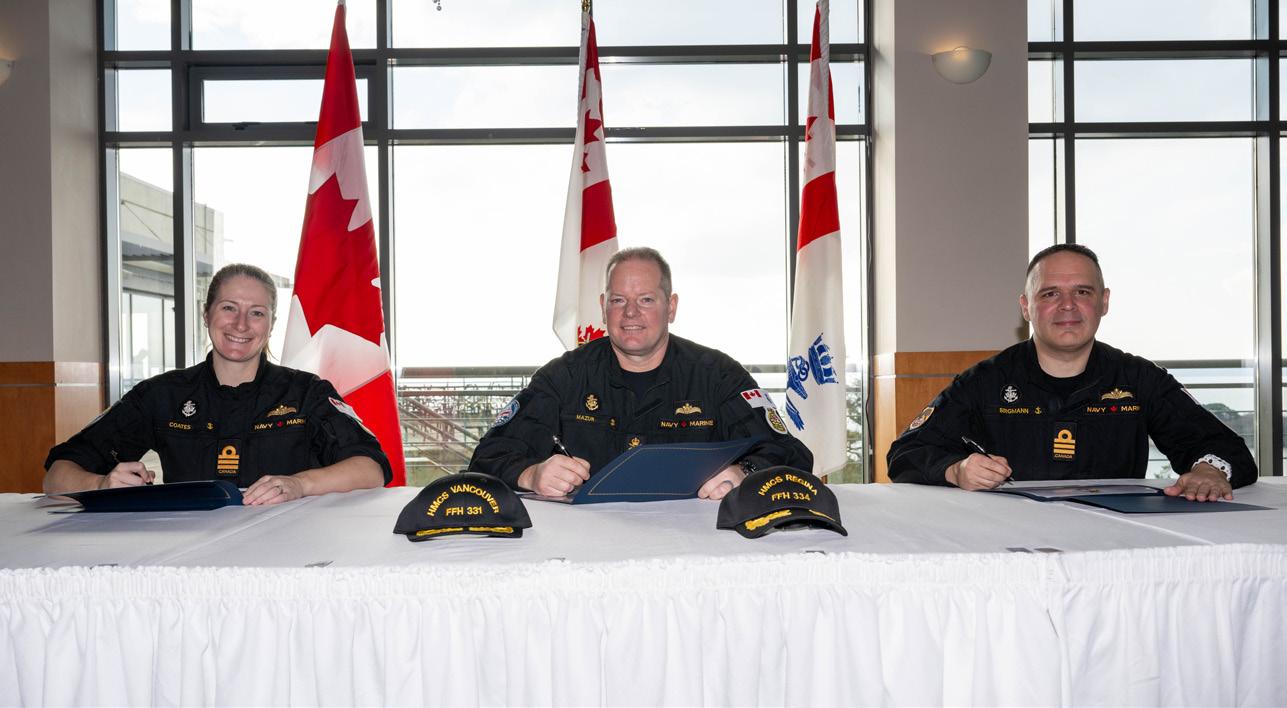
The Feb. 7 ceremony at the Wardroom saw a rare hull swap between the two vessels when Commander (Cdr) Meghan Coates relinquished her command of HMCS Vancouver and immediately assumed command of HMCS Regina, with most of her crew coming along for the new posting. Meanwhile, Cdr Tyson Bergmann with most of Regina’s commissioned and non-commissioned members went the other way and will now reside in Vancouver
The Navy’s ongoing attrition crisis and sailor shortage, combined with the recent conclusion of Vancouver’s deployment to the Indo-Pacific region in December 2023, were the determining factors in the swap, says Commodore (Cmdre)
David Mazur, Commander of Canadian Fleet Pacific.
“It is not standard procedure to do a hull swap, but several options were looked at and this was determined the best for the Navy and its sailors,” Cmdre Mazur said. “This was the best mechanism to give Vancouver and crew a little time off after their recent deployment and then embark on a completely new challenge of putting a ship back together.”
A full hull or crew swap has not occurred in the Pacific Fleet in several years, Cmdre Mazur added. On the East Coast, HMCS Charlottetown and HMCS Montreal underwent a similar transition in February 2023.
‘Starting from Scratch’
Cdr Bergmann was born and raised in Port Alberni, B.C., and joined the Royal Canadian Navy in 1997. He served as Director of Operations for Canadian Fleet Pacific with other notable positions, including Executive
Officer of HMCS Ottawa, Commanding Officer (CO) of the Patrol Craft Training Unit, Operations Room Officer for HMCS Algonquin and Bridge Watchkeeper in HMCS Toronto
Cdr Bergmann said the hull swap and transfer to a new frigate do not come without challenges.
“The biggest challenge is promoting ownership of the ship,” he said. “The crew that were on Regina felt connected to the ship and its namesake city, and took ownership of its equipment; going over to another ship is like starting from scratch.”
Today, Cdr Bergmann and his crew focus on preparing the new ship for the Rim of the Pacific (RIMPAC) exercise later this summer. A subsequent Indo-Pacific deployment will likely follow.
Originally from St. Stephen, N.B., Cdr Coates became a Naval Warfare Officer in 1999. Her postings included Bridge Watchkeeper aboard HMCS Fredericton in 2005, Above


Warfare Officer for HMCS Calgary in 2008 and Executive Officer of Calgary from July 2020 to August 2021.
Cdr Coates took command of Vancouver on Feb. 3, 2023, and proceeded to prepare the ship for deployment on Operation Horizon. This is Cdr Coates’ second appointment as Regina’s Commanding Officer, as she was appointed the vessel’s CO in June 2022.
“It’s going to be a full-circle moment for me when Regina goes back to sea, so I am really looking forward to working with my crew in bringing this vessel back,” Cdr Coates said. “Cdr Bergmann, I am also so excited to see what you and your team do in the next few months, and I know Vancouver could not be in better hands.”
The crew will continue restoring and reactivating Regina after its recent Victoria Shipyard repairs. The following steps will be sea training trials and ensuring the ship is adequately prepared to proceed to sea safely and equipped for damage control to fight fires and floods.




Peter Mallett Staff Writer
Nothing sounds as refreshing as spending the only snowy day on Vancouver Island trapped inside a capsized boat in the cold waters of Esquimalt Harbour.
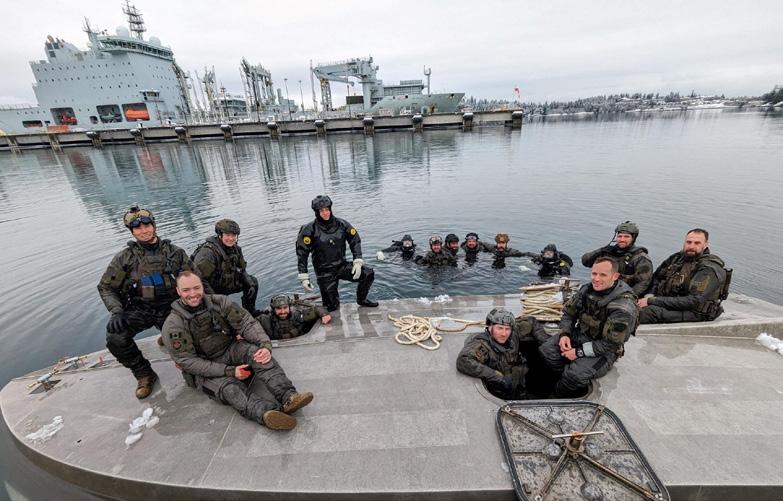
Luckily for a team of 20 Royal Canadian Mounted Police (RCMP) members, the situation was not a real-life emergency but part of training scenario. The Marine Tactical Operations instructors from across Canada gathered on Jan. 17 at Fleet Diving Unit (Pacific) in the waters of ‘D’ Jetty for a capsized vessel training.
Corporal (Cpl) Andrew Michaud of the RCMP’s National Tactical Training Section Emergency Response Team located in Ottawa, said the training will help develop the RCMP Tactical Operations Course planned for early 2025.
“The training was conducted to ensure our procedures offered a safe progression for candidates to become confident in the water and can escape an overturned vessel if trapped inside,” said Cpl Michaud.
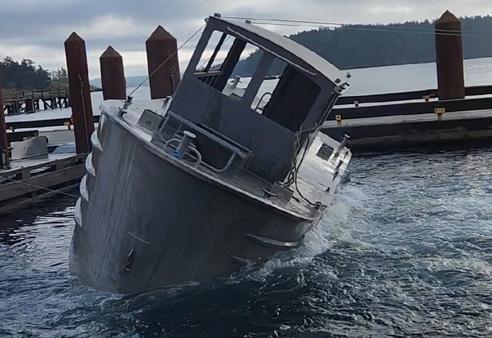
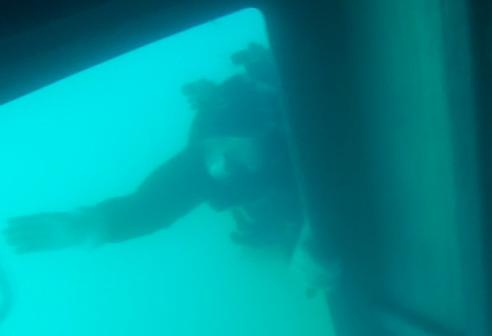
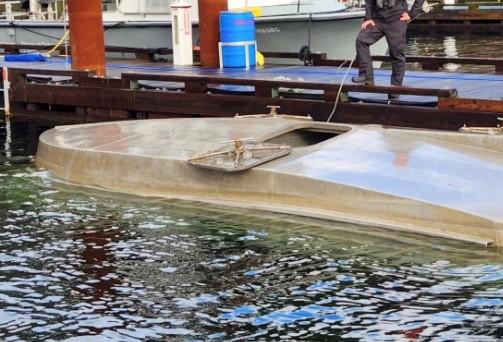
The scenario saw five operators plus an instructor in the boat at a time plus two divers outside the boat. The groups trained in a specially designed flipped and submerged training vessel at two to eight meters in depth that would quickly fill with water. The teams climb through a hatch, which is then shut, trapping the team. They must escape the boat by crawling and swimming through an open exit.
The RCMP training vessel was built with
several airtight compartments that allow it to float upside down and adjust the air pocket inside, explained Sergeant Jay White of the RCMP’s National Underwater Training Recovery Centre, based in Nanaimo. Lines that run between a nearby Rigid Hull Inflatable Boat (RHIB) and the jetty help adjust the boat into a capsized or upright position, with pumps removing the water from the cabin. Locked inside the overturned boat’s cabin, the instructors wore an Emergency Response Team Marine Kit, including a dry suit, belt, vest, helmet, and Survival Egress Air bottle.
As part of their training, the participants progress through three different exits. The route of their escape was determined by the depth of the submerged boat, the size of the air pocket and how much water was inside the cabin. The training, Cpl Michaud said, went very well.
“We discussed and tried new things such as which hatches to use first and how much water to let in the overturned vessel,” Cpl Michaud said. “We completed a safe yet challenging progression.”

For the past several years, the national police service of Canada has held marine operator training courses at CFB Esquimalt or nearby. Cpl Michaud says the Fleet Diving Unit and the Base have helped find suitable training locations and assisted with any necessary support.
“We are very fortunate to have their support, and have enjoyed working with the Department of National Defence because of the professional relationship we have and the willingness of everyone on their team to go that extra mile to make our training possible,” said Cpl Michaud.

MANAGING EDITOR
Jazmin Holdway jazmin.holdway@forces.gc.ca
EDITOR
Kate Bandura
WRITER
250-363-3130
kateryna.bandura@forces.gc.ca
Peter Mallett mallett.peter@cfmws.com
PRODUCTION
Teresa Laird production @lookoutnewspaper.com
Leslie Eaton 250-363-8033
leslie.eaton @lookoutnewspaper.com
ACCOUNTS
Jazmin Holdway jazmin.holdway@forces.gc.ca 250-363-3127
ADVERTISING
Joshua Buck
778-977-5433 military.base.advertising@gmail.com
EDITORIAL ADVISORS
Capt Christopher Dubé 250-363-4006
Ashley Evans 250-363-7060
Published each Monday, under the authority of Capt(N) K. Whiteside, Base Commander.
Le LOOKOUT est publié tous les lundis, sous l’égide du Capv K. Whiteside, Commandant de la Base.
The editor reserves the right to edit, abridge or reject copy or advertising to adhere to policy as outlined in PSP Policy Manual. Views and opinions expressed are not necessarily those of the Department of National Defence.
Le Rédacteur se réserve le droit de modifier,de condenser ou de rejeter les articles, photographies, ou annonces publicitaires pour adhérer au Manuel des politiques des PSP. Les opinions et annonces exprimées dans le journal ne réflètent pas nécéssairement le point de vue du MDN.

Thomas Goenczi Lookout contributor
Circulation: 2,000 plus online engagement per week
Follow us on Facebook, Twitter and Instagram to join our growing social media community.
A Division of Personnel Support Programs
CFB Esquimalt, PO Box 17000 Stn. Forces Victoria, BC V9A 7N2 Web: www.lookoutnewspaper.com Fax: 250-363-3015
Canadian Mail Product Sales Agreement 40063331

After the initial reactions of shock and denial settle into our psyche following a traumatic event, we yearn for psychological protection. This is a natural psychic occurrence; when something strips us of our very essence, we feel incredibly vulnerable and begin to seek shelter. Our reality is stirred up, and we pursue safety and stability – this can manifest as indulging in our predisposed coping methods. If not caught, this behaviour can lead to avoidance after clashing with trauma.
We all have ways of coping with difficult situations; undeniably, some are more beneficial to our mental well-being than others. Coping strategies help us return to a baseline where we can function like we used to. However, traumatic incidents can reveal that these methods often cannot help us address emotions and thoughts of the trauma adequately.
For instance, you can use alcohol as a coping mechanism for stress, anxiety, and trauma. The hope is that you begin to realize and question drinking as a coping strategy and look for another technique to try and ease the anguish.
What becomes dangerous with any coping method is that overindulgence or firm dependency on a single strategy to process trauma can make that strategy become the driving force of our lives. It slowly creeps into our lives, shrouding our capacity to use our will. We become indentured servants to our one technique.
For most of us, avoidance is unavoidable. Immediately after being exposed to trauma, we often need to avoid the cold, hard reality of it. We are stunned by what just happened; we need some time to revisit and process the bounds of reality – that, yes, something like this can happen.
The reaction of avoidance after a traumatic event is an immutable law in the trauma process. However, it is essential to
acknowledge that, ultimately, we have a choice in the length and intensity of how we use avoidance, even though it doesn’t feel as we do at times. One thing is for sure: when it comes to processing trauma, we have to engender a sense of creativity and sure-footedness to combat the struggles the trauma has placed upon us. Next week, we look at ways to overcome avoidance to help employ a disposition that will grant you a path forward with healing the pain from the trauma.
Thomas Goenczi is an RCN Veteran and MA Clinical Counsellor with Private Practice: Well Then Therapy.
The content is not intended to substitute professional advice, diagnosis, or treatment. Always seek the advice of your mental health professional or other qualified health provider with any questions regarding your condition.









Capt Louis-Philippe Thériault Master Warrant Officer Aaron Arnold
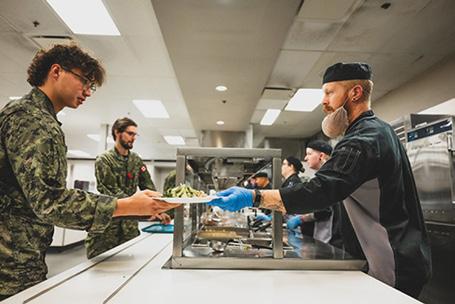
One essential capability in the Canadian Armed Forces (CAF) is that of the CAF Cooks, who ensure soldiers are well-nourished for their demanding duties. And yet, Force Generating this trade, like many others, remains a challenge.
One initiative to improve this is developing customized training such as the ‘Chef Revival’ pilot project, developed by Master Warrant Officer (MWO) Aaron Arnold and the New Brunswick Community College (NBCC).
The desire to innovate was born out of the need to assist qualified Private/Sailor Third Class cooks in completing their On-Job-Performance-Record (OJPR) package. The OJPR is required to ensure candidates are ready for follow-on challenges during their Corporal/Sailor First Class course.
“Inside the CAF model, they have a 24-month period to complete their OJPR. For Regular Force folks that’s usually not a problem. However, Reserve Force personnel historically have only been able to hit 60 per cent of the required material,” explained MWO Arnold. “It’s important to shorten that timeline because that gap in time is causing skill fade, and cooking is a perishable skill.”
Having Cooks attempt to complete their entire OJPR package while employed in a large kitchen detracted from the learning experience and reduced the productivity of those validating competency.
NBCC assigned a Red Seal-certified chef with over 15 years of cooking experience to assist with this project. Chef Jason Rosado worked as a Chef at a couple of big hotels, a golf course and a four-star restaurant in Fredericton before cooking with the military.
“I was extremely nervous about it,” he said, “but

within the first week, I’ve integrated into the team. I can’t say enough good things about the Gagetown kitchen team and the staff.”
For his outstanding work with the program, Chef Rosado received the Commander 5th Canadian Division Commendation; he calls it ‘one of the proudest moments’ in his career.
“I felt appreciated and accomplished for doing something I thought I wouldn’t be able to do,” he said. “This made me realize that I’m good at this.”
This new collaborative program is designed with Reservists in mind but is also open to the Regular Force. It ran as two six-week blocks, out of 5th Canadian Division Support Base – Gagetown’s kitchen, in the summer of 2023 to complete 40 per cent of the OJPR package in only 12 weeks.
A total of seven students took part and completed the program. During that time, they honed their knife, butchering, and baking skills and learned how to prepare the most common sauces, sometimes called the ‘five mother sauces’ of traditional dishes.
During their instruction, the students prepared about 30 litres of stock, 22 salmon, 30 chickens, approximately 300 individual desserts, 400 pieces of pie, 400 bread rolls and a multitude of other products.
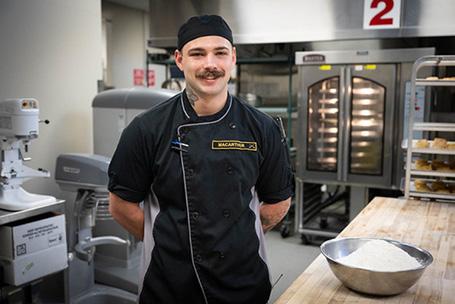
Private (Pte) Brodie MacArthur, the course’s Top Student posted at the 4th Artillery Regiment (General Support), said he discovered he likes to try different cooking styles since he completed the program.
“I was cooking almost exclusively in French cuisine, studying that for a while, but I’ve moved on to Italian cuisine,” he said. “I try to do things normally not seen in the base kitchen, little things to help morale, especially if the troops are out in the field for a couple of weeks.”
“A good meal can make a real difference,” Pte MacArthur concluded.

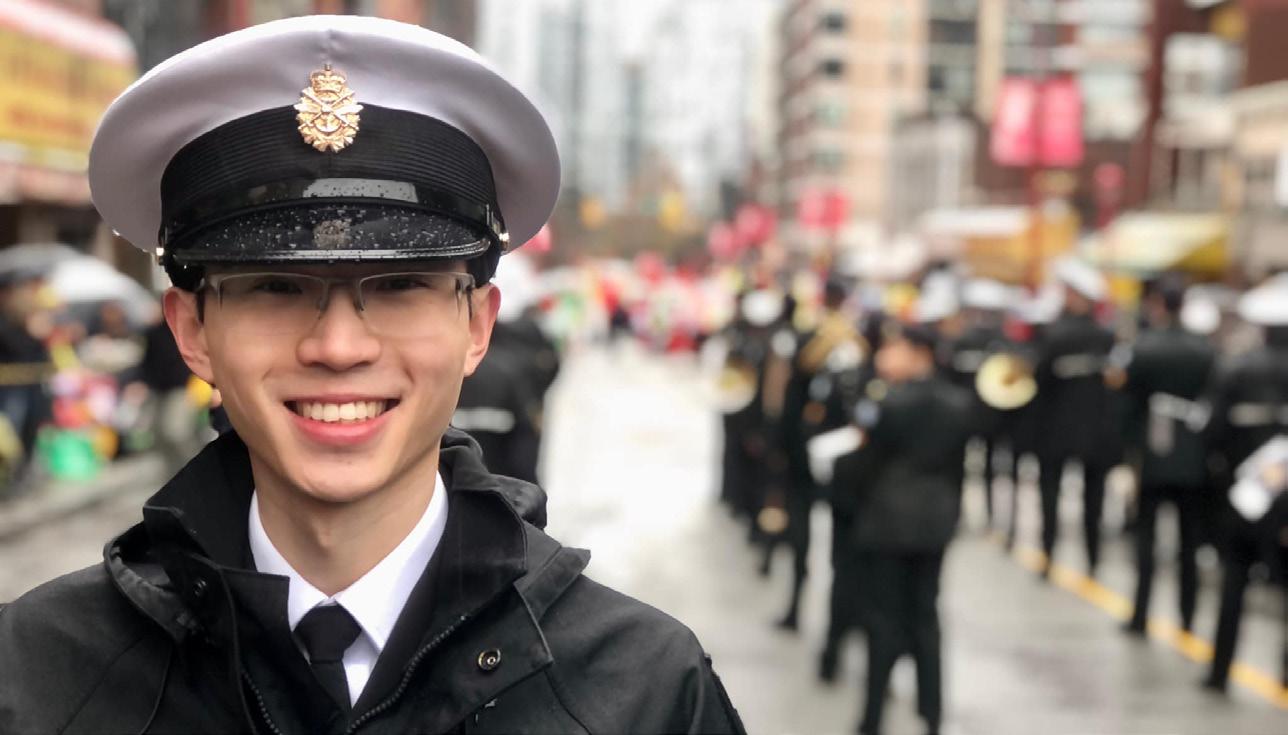
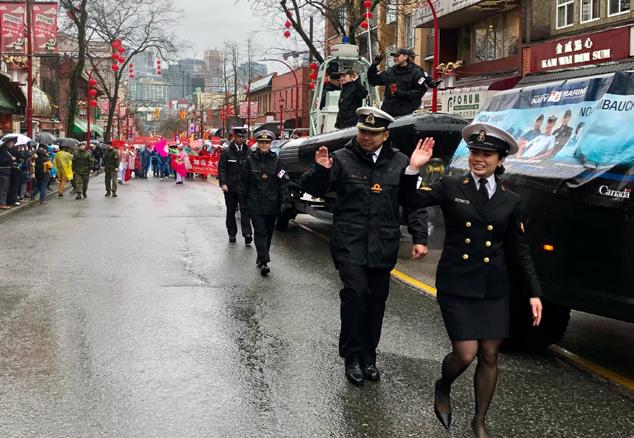
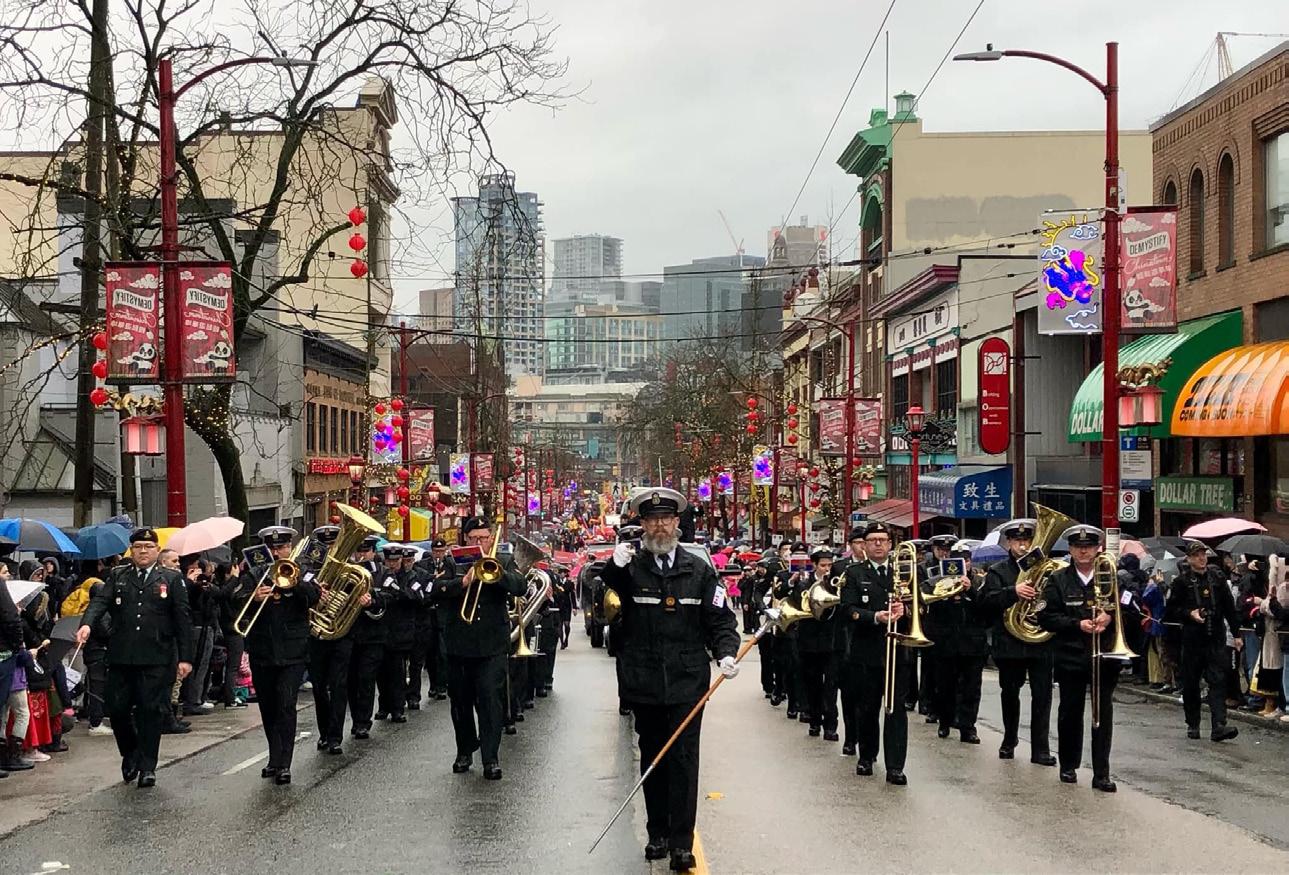
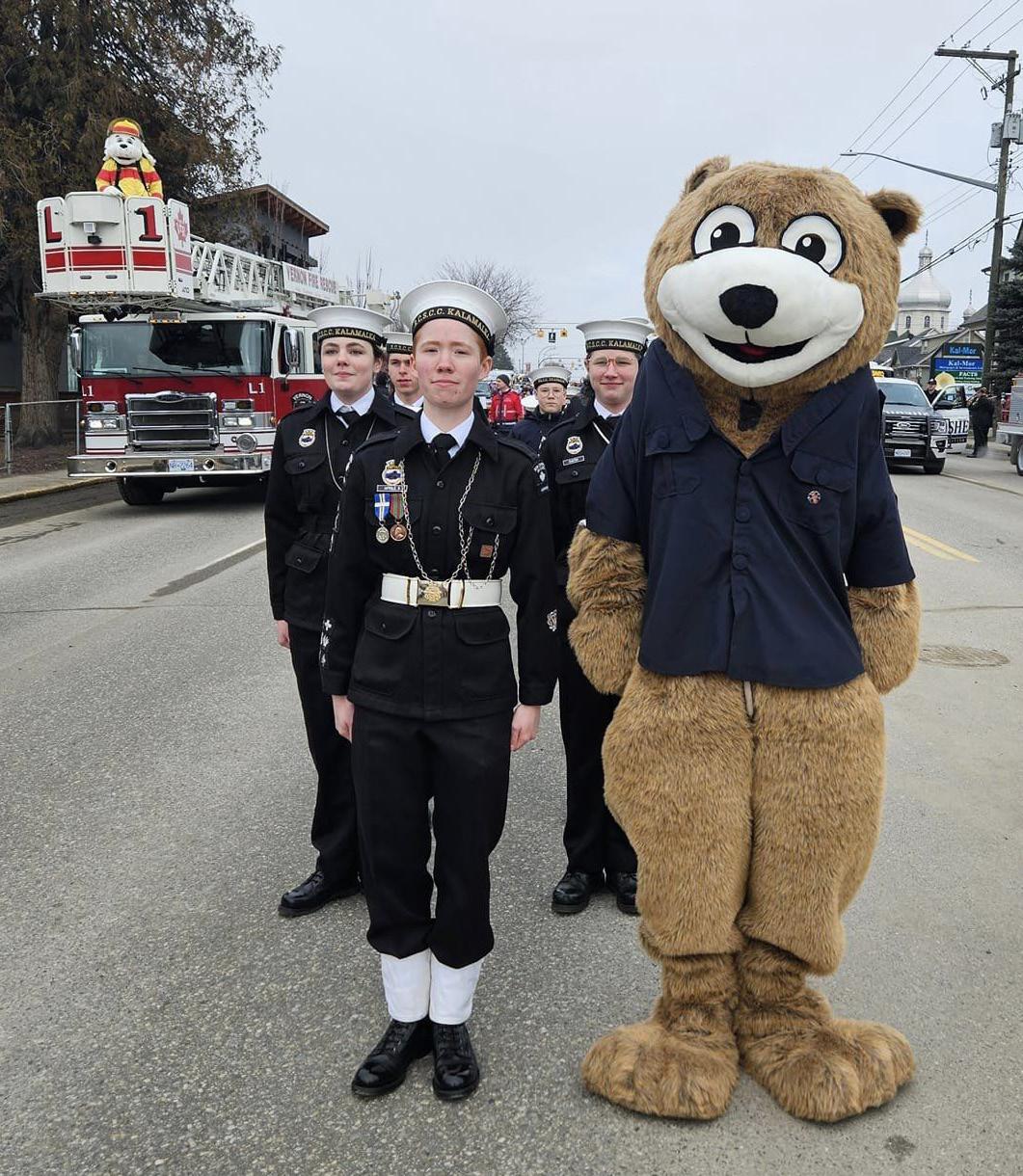
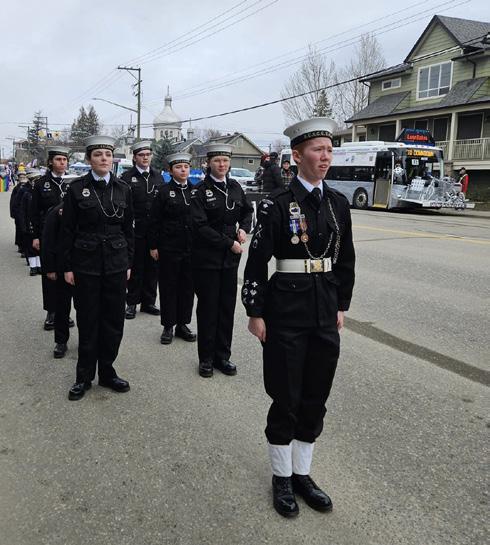
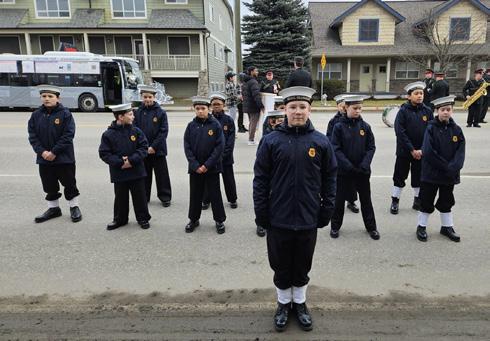
HMCS Discovery, a Naval Reserve division in Vancouver, embraced the spirit of the Year of the Dragon at Vancouver's Annual Spring Festival Parade on Feb. 11.
Photos: Sub-Lieutenant Ariel Rouhi



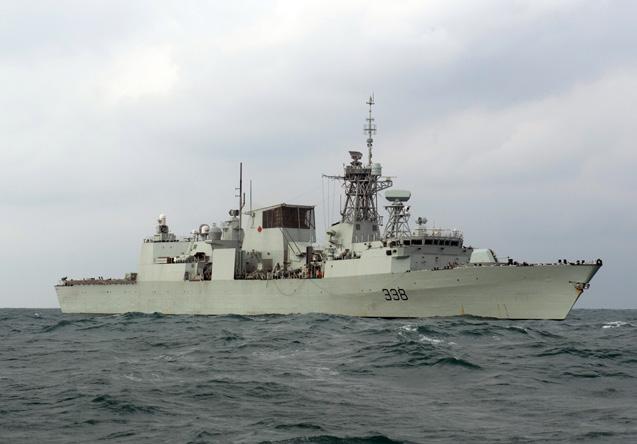


HMCS Winnipeg has opened its decks to Canadian Naval Reserve (NAVRES) personnel in a strategic move to bolster recruitment efforts.
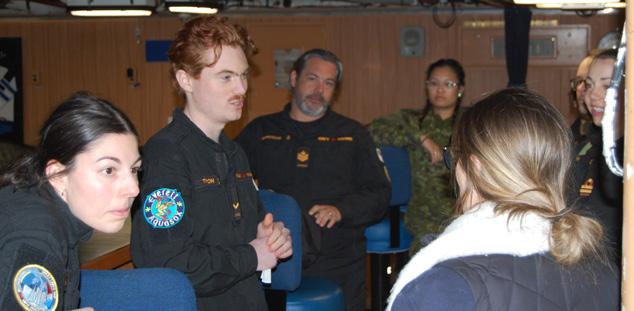
On Feb. 8, NAVRES personnel, tasked with informing possible recruits about naval service opportunities, boarded HMCS Winnipeg for a guided tour. The initiative aims to provide recruiters with firsthand experience and a deeper understanding of the Canadian Navy’s operations, enabling them to better inform potential recruits about the unique aspects of naval service.
The NAVRES recruiters explored the intri-
cacies of naval vessels, gaining insights into the advanced technologies, teamwork, and daily life aboard Canadian warships. Acting SubLieutenant (A/SLt) Brent Martindale, overseeing the tours, emphasized the importance of arming recruiters with accurate and compelling information.
“This initiative ensures our recruiters can confidently convey the challenges and rewards of naval service, painting a vivid picture of life in the Canadian Navy,” A/SLt Martindale said.
The immersive experience not only strengthens the connection between recruiters and potential recruits but also underscores the commitment of the Canadian Navy to fostering a well-informed and capable reserve force.

Show









Major Jose Areekadan Deputy Commanding Officer 4th Canadian Ranger Patrol Group
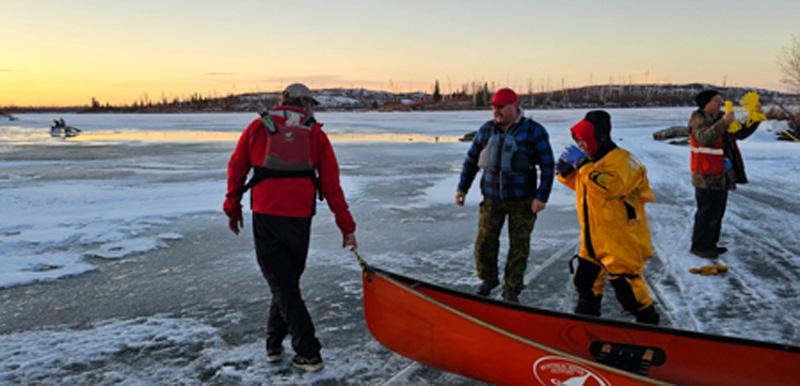
La Ronge Canadian Rangers and local RCMP officers collaborated to execute a coordinated ice rescue, saving a woman and her dog from the frigid temperatures of the frozen lake in Lac La Ronge, Sask., on Feb. 2.
The woman and her dog ventured onto the frozen lake in a vehicle, seemingly unaware of the thin ice beneath them. As they drove further onto the lake, the ice gave way, plunging the vehicle into the freezing water. The La Ronge RCMP, Canadian Rangers, and local emergency services promptly responded to the 911 call.
Equipped with specialized gear, including dry suits, life jackets, and a canoe, the Canadian Rangers navigated icy waters to rescue the distressed duo. Both the woman and her dog, visibly shaken but stable, received immediate first aid and were then transported to La Ronge Health Centre for further evaluation.
The rescue mission was led by La Ronge RCMP Detachment Corporal Shane Marion, who emphasized the importance of immediate action in such situations.
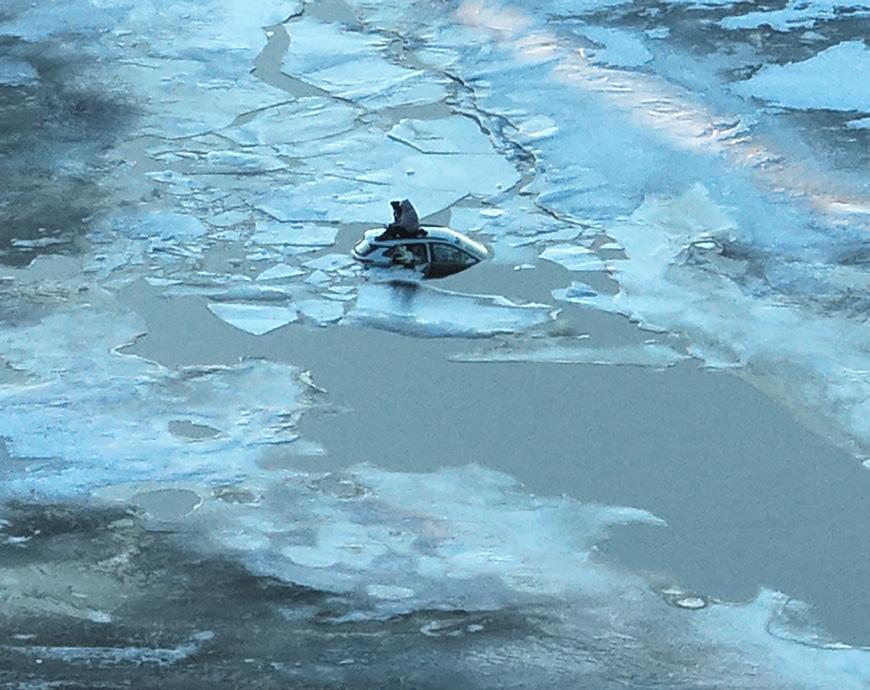
“Utilizing the expertise of the local community, I contacted the (La Ronge Canadian Ranger Patrol) and requested the assistance and expertise of the Canadian Rangers in rescuing the stranded woman whose vehicle had broken through the ice. By employing the RCMP drone and with the cooperation of attending members, a detailed risk assessment was conducted,” explained Cpl Marion.
The ice rescue highlights the dedication of both the RCMP and Canadian Rangers in La Ronge, showcasing their commitment to ensuring the safety and well-being of the community.
Cpl Marion commended the quick response of the CRs and emphasized the importance of interoperability between the RCMP officers and the Patrol.
“With the rotation of RCMP members in and out of the detachment, the retention of common knowledge and expertise of the local Canadian Rangers within the community serves as a tremendous asset,” he added.
“The positive working relationship between the RCMP and the local Canadian Rangers proved crucial to the successful outcome of this perilous rescue. As nightfall approached rapidly, the rescue mission grew increasingly hazardous. The prompt response of the La Ronge Canadian Rangers was instrumental in ensuring the success of the operation.”














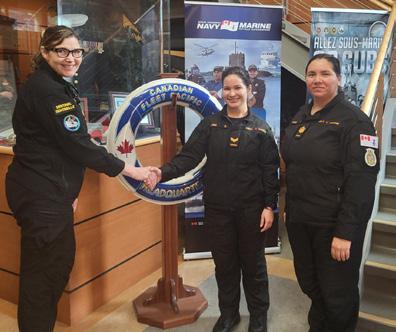
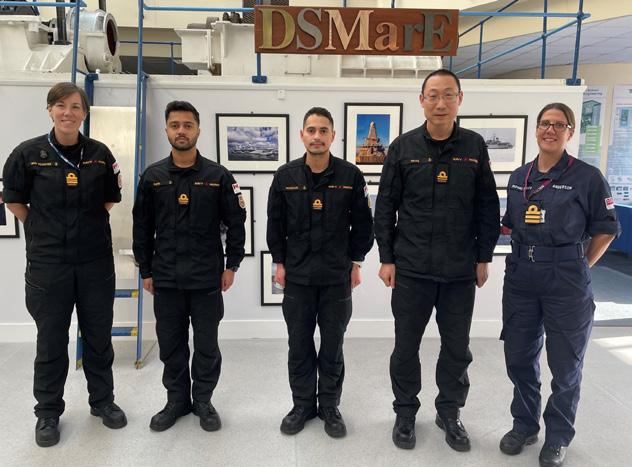
Commander Anderson, Commander Training at HMS Sultan (right) in Gosport, England, and LieutenantCommander Haley van Poorten of HMCS Venture (left) promote students to their current rank on Feb. 9 during the Systems Engineering Management Course at HMS Sultan. (L-R) Sub-Lieutenant (SLt) Rohan Patel, SLt Jose Manzano Clemente and SLt Hao Wang.
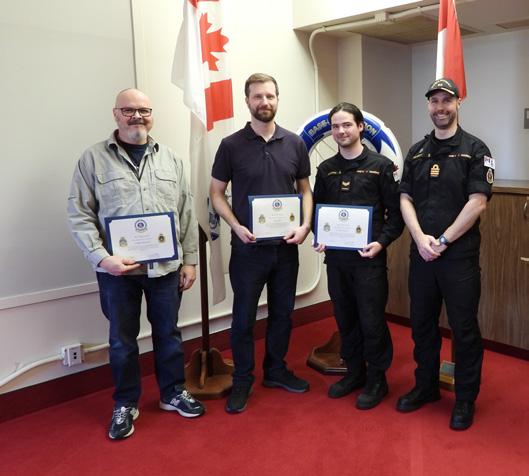
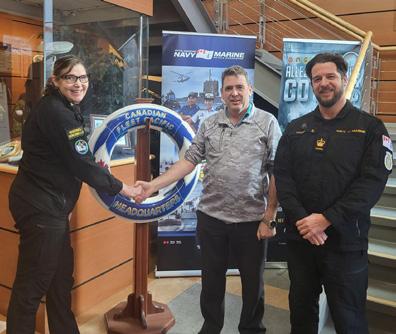
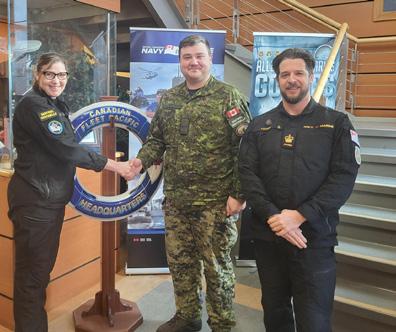
(R–L): Sailor First Class (S1) Conor Fauchon, S1 Steven Millar and S1 Stephane Blanchard receive Unit Commander BZs from Commander Daniel Wilmott to members of Base Information Services.

2-bedroom apartment @ 636 Admirals Road available March 1. 672 sq ft, recently renovated. $2,100/ month. $50 reduction for military. Parking available. Electricity not included. Contact Murray Harris @ murrh@shaw.ca to view.
The Lookout is seeking content creators and contributors! If you're interested in trying your hand at writing or in expanding your writing portfolio, we want to hear from you! Everyone has a story to tell. Please reach out to Kate: kateryna.bandura@forces.gc.ca









Help is at hand: Powell River-based Sunshine Coast Health Centre and Georgia Strait Women’s Clinic— Canada’s only trauma program exclusively serving women—provide highly personalized addiction, mental health and trauma treatment for male and female clients respectively. We’ll pick you up from the ferry for our daily inpatient treatment tailored to your unique needs.
Services include 24 hour-medical service, psychiatric assessment, EMDR, rTMS, psychotherapy, a dedicated group for military clients and much more.

Serving the Department of National Defence and Veterans A airs Canada since 2009.