





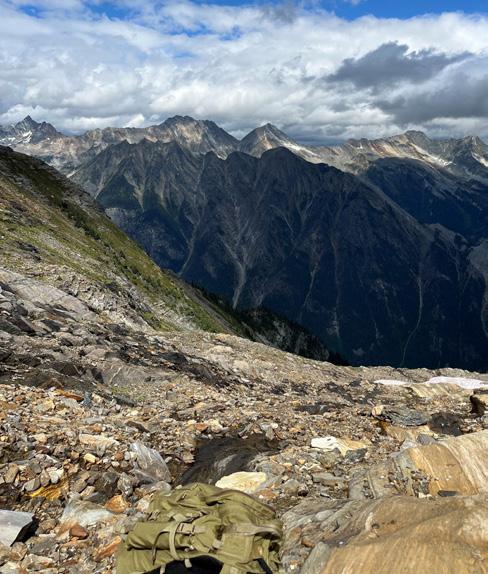
As the helicopter climbs above 2,000 metres, two Explosive Ordnance Disposal (EOD) Operators gaze out across the rugged peaks of the Rocky Mountains, the serene beauty in stark contrast with their dangerous mission ahead. For safety, one EOD Tech holds the C4 plastic explosives in his pack, while the other carries the detonators. Soon they will land and begin the precarious task of locating and disposing of the ordnance, ensuring the safety of this majestic environment for future generations.
Flying in a helicopter loaded with explosives over a high mountain pass might sound like a scene out of a James Bond movie, but for the Fleet Diving Unit (Pacific)’s (FDU[P]) Maritime Explosive Ordnance Disposal (MEOD) cell, it’s just another Tuesday.
But why are highly specialized Navy Divers tasked with blowing up projectiles on the side of a mountain? The answer lies in FDU(P)’s unique responsibilities. This elite team is tasked with disposing military ordnance. Their expertise ensures that even the most challenging and austere locations – whether the bottom of the sea, or the jagged ridges of Glacier National Park – are made safe from the dangers of leftover military explosives.
This most recent tasking had them travelling to Revelstoke, B.C. to dispose of two pieces of unexploded ordnance (UXO) from a prior Operation (Op) Palaci found in remote locations at Crossover and Ross Peak, far off the path for all but the most intrepid hiker. Op Palaci is a joint operation with the Canadian Armed Forces (CAF) and Parks Canada Agency (PCA) in Rogers Pass, B.C., with the goal to reduce the risk of naturally occurring avalanches. This is done using precise artillery strikes to create controlled avalanches, before the snowpack reaches a point where the avalanche could become far more destructive.
After months of planning, tracking weather patterns, and a day of travel to Revelstoke, Petty Officer 1st Class (PO1) Burrell and Petty Officer 2nd Class (PO2) Paquette were on scene. PO1 Burrell, head of the MEOD department, said that “On average, we get about 100 calls a year for ordnance disposal across B.C.”
Preparation for the mission was meticulous, with the operators selectively choosing their loadout to ensure only the essentials were included. The need for minimal equipment was driven by the importance of weight, with the helicopter having to ascend to such high altitudes. Alongside their explosives and specialized tools, they also packed essential survival gear for the mountains. This included emergency supplies, first aid kits, and bear spray, given the possibility of encountering grizzlies on the trail.
The morning of the mission saw a safety brief on the UXOs, and an overview of the plan to safely explode them, including potential escape routes in case of an emergency.
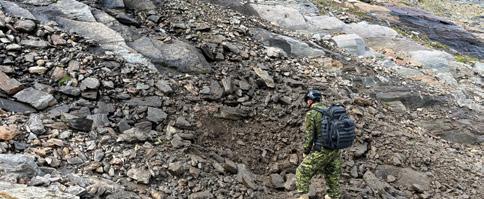
After being dropped off at a designated landing zone, the team trekked to Crossover Peak and located the first UXO, a 105mm Howitzer Artillery Round. While each EOD task is different, the basic approach remains the same. Once the location is deemed safe for disposal, the team rigs their own explosive charge, moves to a safe location, then triggers the detonation. The second UXO, a 106mm Recoilless Rifle Round, proved just as straightforward. A quick hike back down to a rendezvous point with the helicopter for extraction, and the mission was complete.
When questioned how it feels to deal with explosives on a regular basis, PO1 Burrell jokes, “It’s fun, but you get used to it after a while. Cool guys don’t look at explosions.” He ends, stating, “I get a lot of satisfaction out of the job. We’re making the world a safer place, one bang at a time!”
Kateryna Bandura Lookout Contributor
A new book in Canadian military history illuminates the extraordinary life of a Canadian aviation pioneer whose daring exploits and contributions to early flight have largely faded from public memory.
Tom Douglas’ Whispering Duke Schiller: Canadian Aviation Pioneer resurrects the remarkable story of Clarence Alvin ‘Duke’ Schiller, a man whose aerial feats rivaled those of his more famous contemporaries.
Douglas, a veteran journalist and author with a deep passion for Canada’s military heritage, discovered this compelling tale through a personal connection: Duke Schiller was his great-uncle.
“I grew up hearing stories about his heroics and escapades but never saw anything about him in print,” Douglas says.
Inspired by family lore and armed with a treasure trove of personal documents, Douglas embarked on a journey to uncover the full scope of Schiller’s adventures. The book chronicles Schiller’s life from his family’s roots as Hessian settlers in Ontario to his death-defying exploits as a pilot in the 1920s and 30s. Along this illustrious career, Schiller would pick up nicknames, including ‘Whispering Duke’ and ‘Foghorn Duke’ ironic references to the loud, barking voice he had developed due to his father being extremely hard of hearing.
One of the most gripping episodes recounts Schiller’s pivotal role in rescuing the crew of The Bremen, the first aircraft to successfully complete a transatlantic flight from east to west. When the plane crashed on remote Greenly Island off Labrador, it was Schiller’s skill and courage that saved the stranded aviators from certain death in the harsh winter conditions.
“But those who held the pessimistic view that the fate of the three European fliers would turn out to be only death delayed hadn’t taken into account the aeronautical know-how and steel nerves of one Clarence Alvin ‘Whispering
Duke’ Schiller,” Douglas says.
Douglas’ research draws on family archives and extensive newspaper records. The story tells of a man who repeatedly risked his life in the name of progress and human compassion.
“I was surprised to learn that Duke was mistaken for a government agent during the Prohibition era in the United States and was beaten nearly to death by rumrunners in The Bahamas,” Douglas says. “He spent ten days in a coma in Nassau. Ironically, just days before, he had saved the life of a Bahamian resident living on one of the Out Islands by flying a doctor and medicine to her.”
Yet, as Douglas notes, “You could mention his name to the first one hundred people you stopped on the street and no one would know who I was talking about.”
The author’s passion for military history and veterans’ stories is deeply rooted.
“My father was a Second World War vet, and I have always admired those who laid everything on the line to fight for their country,” Douglas says.
His career path, including stints as a teacher in DND schools overseas and as a Communications Assistant to the Minister of Veterans Affairs, further fueled his interest in preserving these important narratives.
Douglas hopes his work will inspire a new or renewed respect for the sacrifices made by the men and women who set aside their own safety and comfort to safeguard democracy. The book’s creation was not without its challenges. Douglas describes the research process as ‘an ordeal, [but] it was a labour of love’.
This Remembrance Day, as we honor those who served in uniform, let us also remember pioneers like Duke Schiller, whose daring spirit and unwavering commitment to progress helped shape the world we inherit. Through Douglas’s vivid storytelling, we ensure that remarkable Canadians like Duke Schiller are never forgotten, their courage continuing to inspire generations to come.


MANAGING EDITOR
Jazmin Holdway jazmin.holdway@forces.gc.ca
WRITER
Paul Dagonese dagonese.paul@cfmws.com
PRODUCTION
Teresa Laird production @lookoutnewspaper.com
Leslie Eaton
250-363-3127 eaton.leslie @cfmws.com
ADMINISTRATION AND ACCOUNTS
Andrea Modesto
ADVERTISING
Joshua Buck
250-363-3127
Andrea.Modesto@forces.gc.ca
778-977-5433 military.base.advertising@gmail.com
EDITORIAL ADVISORS
Rodney Venis
250-363-7060
Published every other Monday, under the authority of Capt(N) K. Whiteside, Base Commander.
The editor reserves the right to edit, abridge or reject copy or advertising to adhere to policy as outlined in PSP Policy Manual. Views and opinions expressed are not necessarily those of the Department of National Defence.
Circulation bi-weekly print and online: 4,000 per issue plus social media engagement
Follow us on Facebook and Instagram to join our growing social media community.
A Division of Personnel Support Programs
Web: www.lookoutnewspaper.com
Fax: 250-363-3015
Canadian Mail Product Sales Agreement 40063331

Fardous Hosseiny
President and CEO, The Atlas Institute for Veterans and Families
As Remembrance Day approaches, I find myself pondering a new question this year: ̍̔In remembrance, who might be the forgotten?’
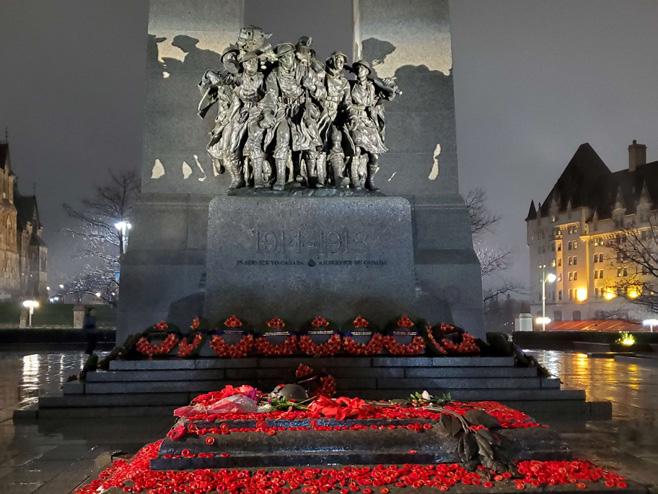
Here in Canada, we know that more than 118,000 brave soldiers did not return home to their loved ones throughout our short history as a nation. Canada’s eight Books of Remembrance, which record the names of every Canadian who died in service to our country, are currently displayed at Parliament Hill’s Visitor Welcome Centre in the Room of Remembrance.
Veterans Affairs Canada and the Commonwealth War Graves Commission ensures the maintenance of more than 300,000 markers and grave sites of Canadian Armed Forces members here and around the world, including those whose deaths were not directly attributed to service. It is particularly meaningful to know this exists to maintain
those that might have fallen into disrepair or where no living relative remain to continue to provide for the upkeep.
Whether they lie marked in Flanders, Bénysur-Mer, Beechwood, or unmarked throughout the world, these are places where valour lies. Their lives and their service must be honoured.
Beyond these numbers though there is growing recognition of a number not accounted for — those lost to psychological wounds sustained as a result of service. As conversations become more open and honest about mental health and how this has been a real impact of service, when we lose a former serviceperson (or currently serving member) to suicide, the question many grapple with now is: How do we officially honour those lives?
At the Atlas Institute for Veterans and Families, the feedback we hear from our community is that mental health injuries are no different than the physical injuries which our Veterans incur and should be treated as
such. They are no less heroes than those who died in uniform. We can make that statement unequivocally and stand on November 11 with our Veterans and Family members in honouring their loved ones who died both in service and post-service as a result of injuries sustained. It is welcome to see this year’s Memorial Cross Mother (also known as the Silver Cross Mother) recognized for her loss of two sons to the impacts of posttraumatic stress disorder.
As we expand our remembrance practices to include all types of injuries, we have an opportunity to become leaders in advocating for comprehensive recognition of Veterans’ sacrifices and extending these into everyday acts of awareness, support and education around the complex realities of military service.
Perhaps we can move forward with a renewed understanding: Service is service, the blood of all heroes never dies and our remembrance of all should be equally enduring, regardless of the nature of their wounds.




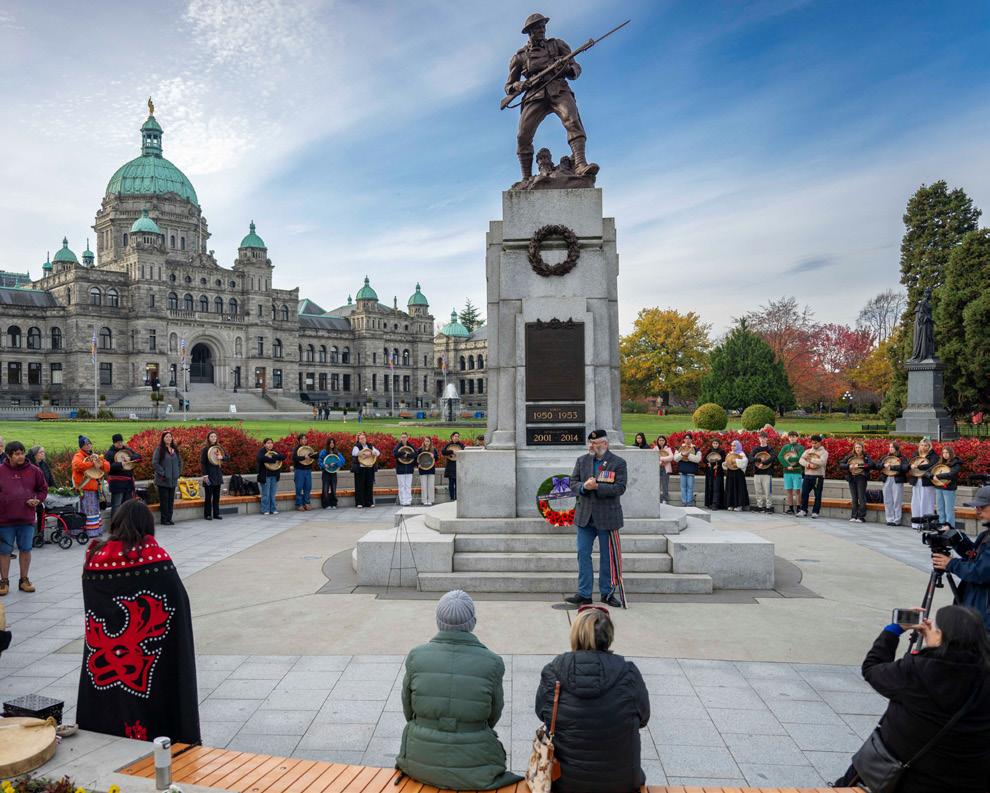
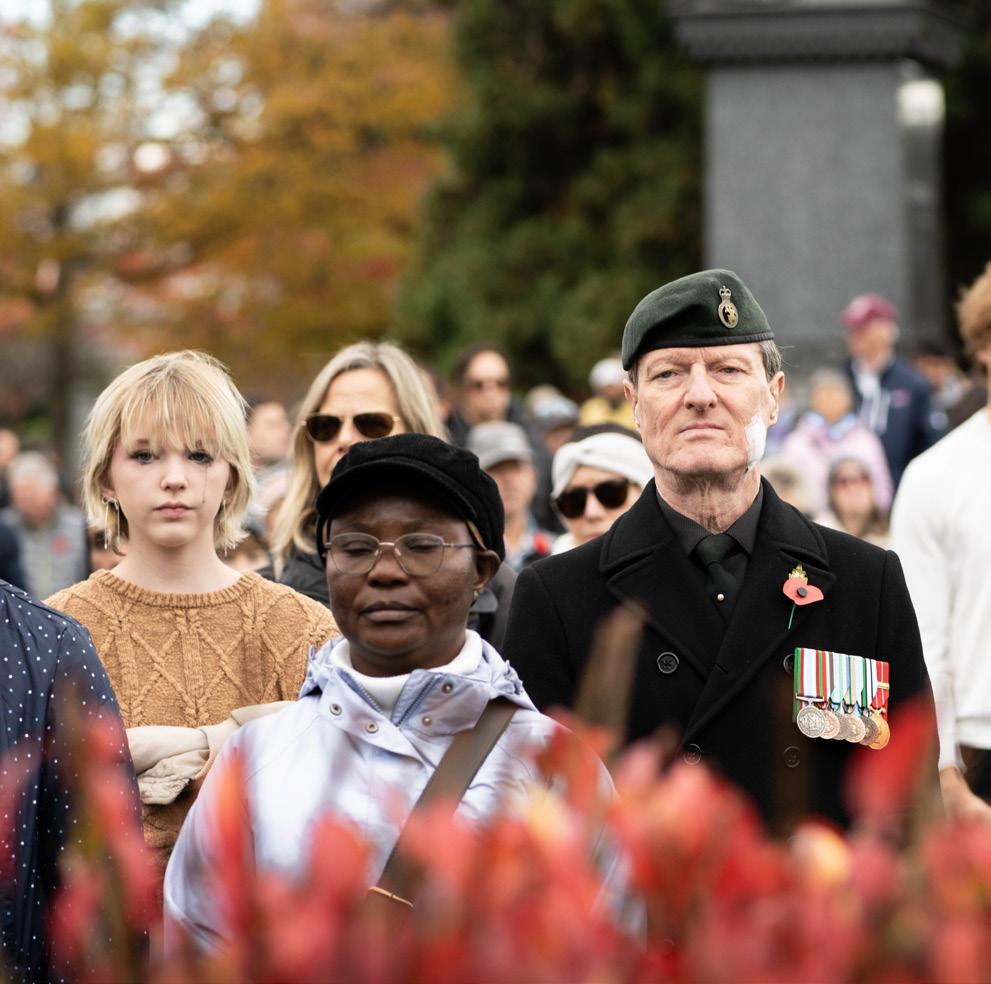
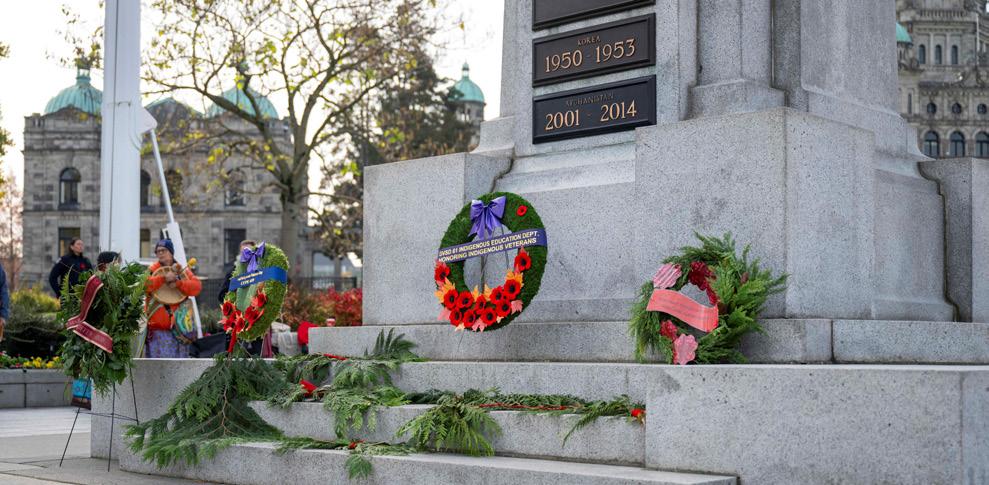
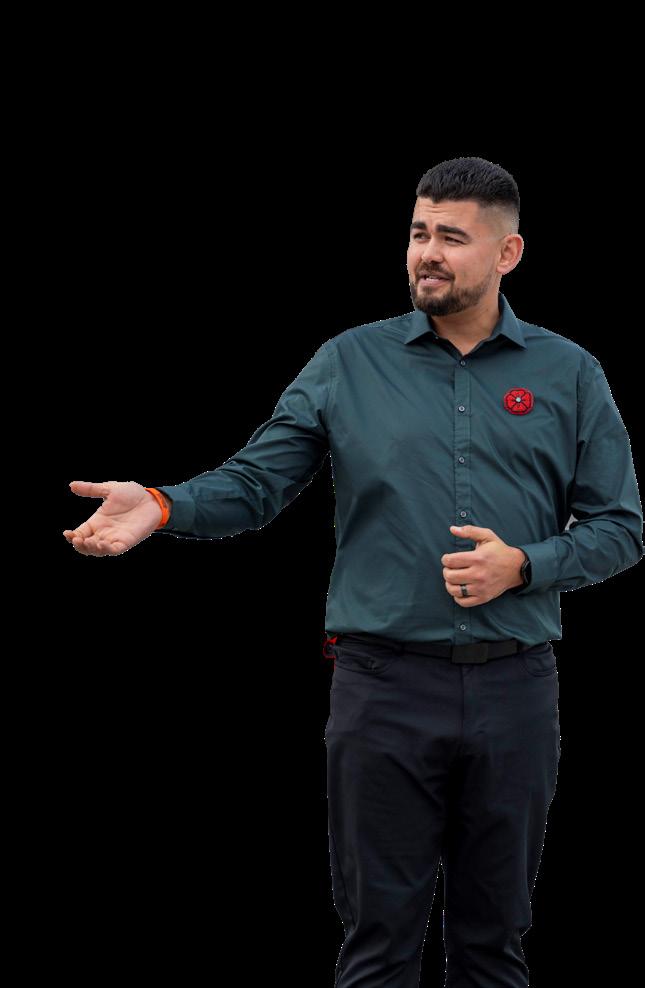
National Indigenous Veterans Day was recognized by members of CFB Esquimalt and local Indigenous communities in a ceremony held Nov. 8, Downtown Victoria. It is an important day of remembrance that honours the contributions of First Nations, Métis and Inuit people who participated in Canada’s military efforts. Thousands of Indigenous Peoples served in the First World War, Second World War, the Korean War, and other conflicts.







■
■ Aircrew cyclo exams






SLt Simon Gonsalves MARPAC Public Affairs
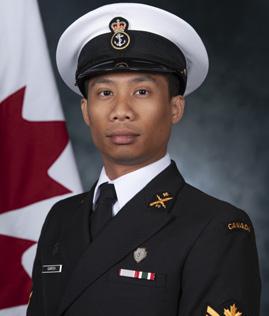
In 2022, Master Sailor (MS) Jed Garcia was posted to Canadian Forces Base (CFB) Esquimalt Base Information Services as a Naval Communications Services Support Technician, ensuring communications to Canada’s Pacific Fleet remain secure at sea.
However, MS Garcia was recently offered a high-profile opportunity that was anything but normal—quite extraordinary, in fact.
From Oct. 7 through to Nov. 11, MS Garcia was selected to take part in the prestigious National Sentry Program (NSP).
The program involves a rotation of members from across various branches of the Canadian Armed Forces (CAF) and the Royal Canadian Mounted Police. Members from units of Royal Canadian Navy (RCN), the Canadian Army, the Royal Canadian Air Force, and the Canadian Ranger units from across Canada,
from coast to coast, volunteer to participate, but fewer than a dozen are selected. Program participants are chosen based on exemplary conduct, deployment experience, community involvement, as well as physical fitness.
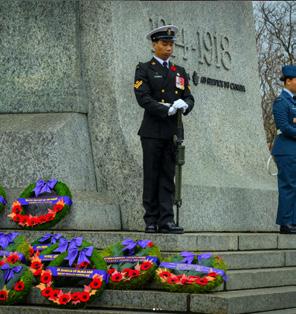
This year, the CAF posted 11 of 12 sentries, who stoically guard the Tomb of the Unknown Soldier, Canada’s most iconic and visible reminder of military service and sacrifice. At the start of the new millennium, the remains of an unidentified Canadian soldier from the First World War were repatriated from France and buried in a special tomb in front of the National War Memorial in Ottawa. Starting in 2007, CAF representatives have diligently stood guard over the Tomb, paying tribute to the 116,000 Canadians who lost their lives championing the cause of peace and freedom as well as those who served in the twentieth century’s major wars and the myriad conflicts that followed them.
When asked why he initially volunteered
for the NSP, MS Garcia said that he was motived by the gratitude he felt for “the life my parents had made for my brothers and I here in Canada, volunteering was my way of giving back to them, my country, and community.” Although MS Garcia was posted to B.C. after joining the RCN, his family remained in Ontario and recently moved to the Ottawa area in 2021. After 20 years in Canada and 14 years in uniform, he described the National Sentry Program as an “amazing opportunity to represent my fellow sailors, and I’m incredibly excited for my family to join me during the ceremonies—I know I’ll make them proud.”
Throughout his Navy career, MS Garcia has taken immense pride in “not only embodying the values of service and integrity, but also setting a positive example for his peers and the broader naval community.”
























































































just a Ferry

Away
Help is at hand: Powell River-based Sunshine Coast Health Centre and Georgia Strait Women’s Clinic— Western Canada’s only trauma program exclusively serving women—provide highly personalized addiction, mental health and trauma treatment for male and female clients respectively. We’ll pick you up from the ferry for our daily inpatient treatment tailored to your unique needs.
Services include 24-hour medical service, psychiatric assessment, EMDR, rTMS, psychotherapy, a dedicated group for military clients and much more.

Serving the Department of National Defence and Veterans A airs Canada since 2009.




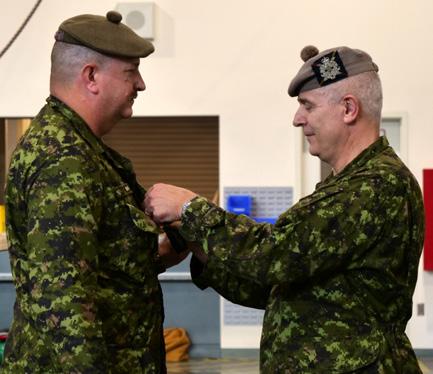
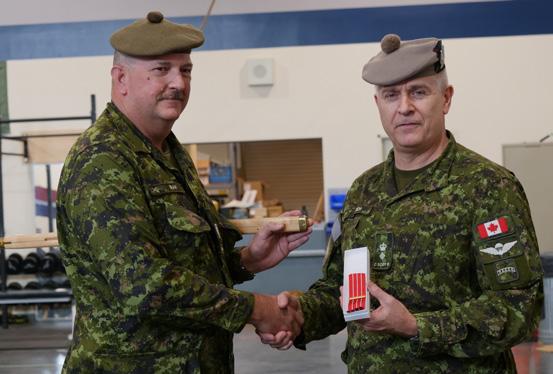
During a recent ceremony in Nanaimo, B.C. Army Reservist Master Warrant Officer (MWO) Mike Bean of The Canadian Scottish Regiment (Princess Mary’s) was promoted to his current rank by Commanding Officer Lieutenant

was called forward again to receive another significant award – the second clasp for his Canadian Forces’ Decoration (CD), signifying 32 years of service in the Canadian Armed Forces (CAF).
The Canadian Scottish Regiment (Princess Mary’s) is Vancouver Island’s own infantry regiment and a unit in the Army Reserve (ARes)
of the CAF. The ARes is a part-time component of the CAF. Like MWO Bean, members of the ARes learn soldier skills in a variety of trades while training one night a week and one weekend a month. Many members of the ARes work full-time for the CAF during the summer months on training courses. Soldiers in the ARes gain many important skills and experiences while also maintaining full time civilian careers.
MARPAC Public Affairs
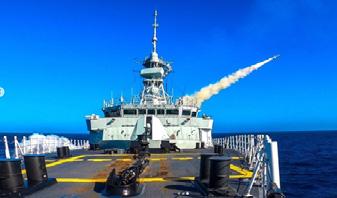
Under the bright Southern Californian sky, sailors onboard His Majesty’s Canadian Ship (HMCS) Regina participated in Joint Littoral Targeting Exercise 2024 (JoLTEX 24). During this training event, the crew had the rare opportunity to launch two advanced Block II Harpoon missiles soaring over the horizon and far beyond.
This live-fire training exercise, conducted in partnership with Canadian Joint Operations Command, was held on Oct. 23 at the United States Navy’s Point Mugu Sea Range, located off the Californian coast near San Diego. This year’s JoLTEX aimed to develop and test targeting processes to enable Royal Canadian Navy ships to strike targets effectively on or near land.
The Harpoon missile system, which has a maximum range of 124 kilometres, is the anti-surface missile carried by Canadian frigates, which can quickly engage a variety of surface targets with a high degree of precision. The lessons learned from Regina’s fire-support experience can now be leveraged by other Canadian warships operating in proximity to land.
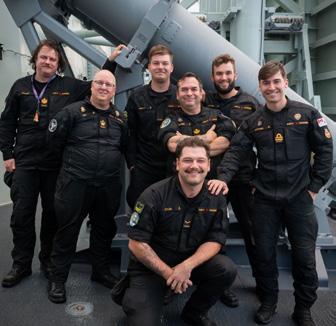
According to Commander Jeremy Samson, the Canadian Patrol Frigate’s Commanding Officer, “HMCS Regina’s precise delivery of surface-to-surface kinetic effects during JoLTEX 24 demonstrates the crew’s commitment to combat readiness and their professional excellence.” When asked about the ship’s performance during the exercise, Commander Samson stated that he “couldn’t be prouder to be part of Regina’s outstanding team and what they’ve accomplished.”
However, not everything went according to plan
initially—the first Harpoon missile fired by HMCS Regina during JoLTEX 2024 was aborted by American range staff shortly after launch. As safety is paramount during any military live-fire exercise, constant communication is required between the missile and the range facility. After launch, if connection is lost – even temporarily, and for any reason – the range will terminate the missile in flight.
HMCS Regina’s crew were well-prepared for this possibility. Realistic live-fire naval exercises are conducted to test a warship’s ability to quickly adapt and overcome changing circumstances, whether expected or unanticipated. After the first strike didn’t succeed, HMCS Regina’s combat team was able to rapidly launch a followon missile that successfully struck its target.
The exercise was more than just the successful missile hit on a near-shore target—JoLTEX 24 was also designed to test Canada’s high-level military targeting processes. Commodore (Cmdre) David Mazur, Commander Canadian Fleet Pacific, considers this year’s JoLTEX a success. Cmdre Mazur outlined that Canada’s Pacific Fleet “developed several important capabilities, as we honed our ability to streamline communication to and from a deployed warship and improved how we develop and strike targets in the maritime domain.”
JoLTEX 24, like many other realistic training opportunities, provided a valuable opportunity for both the sailors of Canada’s Pacific Fleet, as well as the operators of Canadian Joint Operations Command, to gather useful intelligence, determine valid targets, and strike them with advanced sea-based weaponry. By exercising the Halifax-class’s surface-to-surface missile system in near coastal environments, JoLTEX 24 affirmed that the RCN remains a vital partner in maintaining peace and security.


LCdr (Ret'd) Paul Seguna, CD CFB Esquimalt Naval & Military Museum
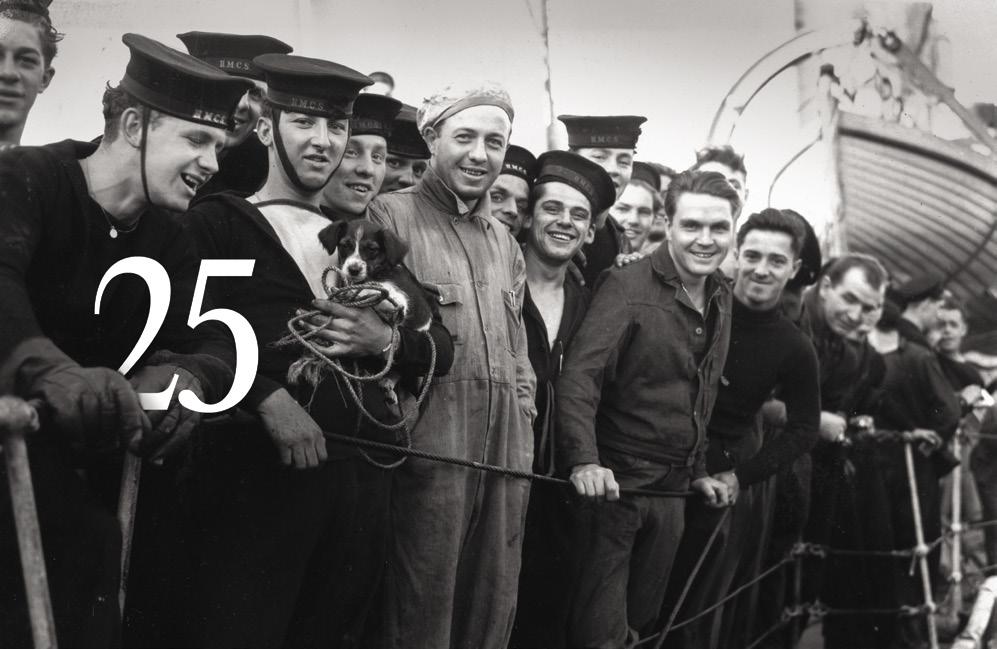
The date of the Thanksgiving holiday this year held a special significance in linking the histories of two Vancouver Island families. On Oct. 14, 1939, just over a month after the outbreak of the Second World War, the battleship HMS Royal Oak suddenly sank while at anchor in Scapa Flow – a British fleet anchorage located in the Orkney Islands off the northern tip of Scotland. The ship was the victim of torpedoes fired by the German submarine U-47 in the early morning hours after having penetrated the protected anchorage defences. The battleship capsized within minutes with 835 of the Ship’s Company of 1,234 perishing.
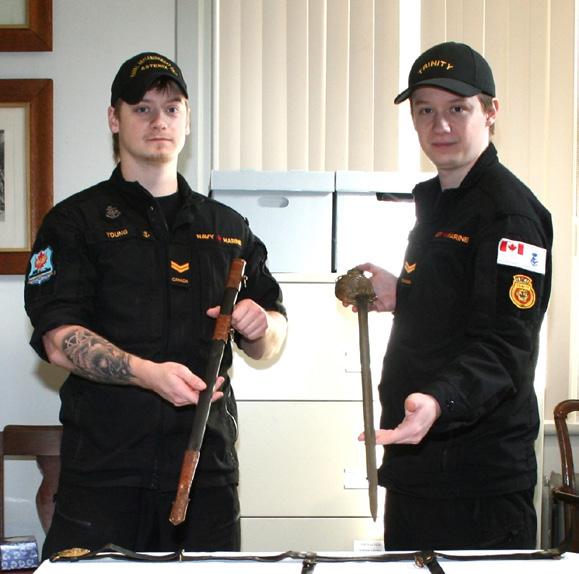
Last year, the existence of artifacts from the sinking belonging to the family of James Atwood, a retired Royal Canadian Air Force officer living in Victoria, emerged during a dinner conversation. The items were a naval officer’s sword with scabbard and sword belt given to James’ grandfather in the U.K. after the war by a friend who had been a professional diver and had recovered the items from the ship’s wreckage field. James received the sword and associated items from his grandfather in the 1980s while visiting in England and brought them back to Canada as family heirlooms. After doing some research, James decided the Scapa Flow Museum in Lyness, Scotland should be engaged. The museum subsequently expressed an interest in accepting the artifacts as part of the HMS Royal Oak collection there. Hence, the sword and accoutrements were destined for return to the Orkney’s where they once were the personal possession of an unidentified officer serving in HMS Royal Oak.
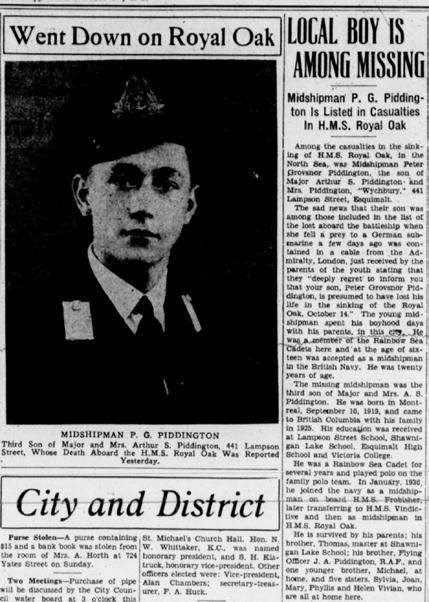
During the research into the provenance of the sword, another local link arose – Peter Grosvenor Piddington, Midshipman RN, was listed as a casualty and the son of Arthur Grosvenor and Helen Mary Piddington from Esquimalt, BC. Peter had been a member of the local Rainbow Sea Cadet Corps before joining the Royal Navy
in the late 1930s. Although no direct link exists with the sword as Midshipman would have carried a Dirk (short sword); Peter certainly knew of the sword’s owner as one of the Ship’s Officers. In this context, it was appropriate to exhibit the sword and accoutrements at the CFB Esquimalt Naval & Military Museum for a period to tell the story of the local connection to the loss of HMS Royal Oak until the repatriation of the sword to the U.K.
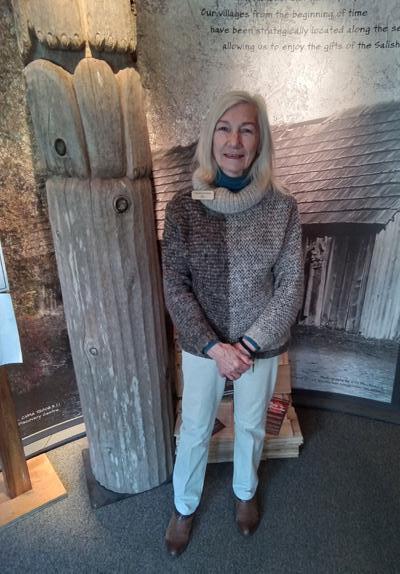
Research into the Piddington family yielded further background information on the family history but no contact with local family members. That is, until this past August during an unrelated visit to the Cowichan Valley Museum in Duncan, BC. While chatting with a museum volunteer, Kim Vivian, she mentioned that her two grandsons were current members of the Royal Canadian Navy (RCN) and that a relative perished in the sinking of HMS Royal Oak. To this, I immediately volunteered that his name was Peter Piddington – and it was! Yet another remarkable coincidence in this tale. Kim, with her two grandsons Bailey, and Aiden Young, both serving RCN members in the rank of Sailor 1st Class as a Naval Acoustics Operator and Boatswain respectively, recently toured the museum and had the opportunity to view the artifacts associated with their family history. Kim related that in memories from her youth, just the mention of Scapa Flow always carried a poignant sense with it at the memory of her great uncle Peter’s loss.
The concluding chapter of the sword’s story will be when the sword artifacts become part of the museum exhibit memorial for the tragic loss of life in HMS Royal Oak’s sinking. A loss that still resonates 85 years later.
As a postscript note: In reviewing the donated documents of the late Lieutenant Commander Ralph Wills, who served in the RNR (Royal Naval Reserve) during the war and RCNR (Royal Canadian Naval Reserve) post war; it is recorded that he was also a Midshipman in HMS Royal Oak concurrent with Peter Piddington from May to September 1939 – only being saved from the possible same fate by a posting off the ship just before its loss!









SAXE POINT
Bright fully furnished, one bedroom self-contained suite with private entrance, full bathroom, storage, queen bed, washer/dryer, dishwasher, fridge, range, microwave, large tv, and small appliances. 10 minute walk to Work Point and Naden, near oceanfront parks, running trails, cycling and bus routes and all amenities. Includes 1 parking spot. Available for one person. No smoking, no pets. $1,750/mo includes hydro. 250-216-9030. 10/08
SHARED ACCOMMODATION, SINGLE BEDROOM
Partly or unfurnished room for a mature female (Oak Bay Junction) Non Smoker. Shared bathroom, kitchen, common area. Quiet, safe neighbourhood in Victoria, close to downtown and Oak Bay Village. Royal Jubilee Hospital, transit and amenities. Parking not incl. (can be requested if one available). $900 a month, includes: heat, hydro, hot water, WiFi, Secure Bike Room. Laundry facilities in building. . Contact Leslie at winterpeg100a@gmail.com 10/08
FURNISHED CONDO FOR RENT
1-3 month house-sitting, furnished, 2 bed 2 bath in Belmont Park, under-
ground parking, $2500 per month, no smoking, no pets. Contact James at James@rayndt.com 11/11
ROOM FOR RENT
$900/m for 1 br in shared house. Prvt bath, shared kitchen, laundry + prk space available. Private entrance. No sm/vape/party or pets allowed. 250 893 4003 11/04
TWO BEDROOM FURNISHED SUITE: SHORT TERM RENTAL AVAILABLE NOV. 10:
Comfortable, 2 bed suite, fully furnished, in quiet residential area, 10 minute walk to CFB Esquimalt. All utilities and wifi included. Full kitchen, full bath. The kitchen equipped; all linens provided. Garden level, private entry, shared laundry, outdoor patio. Street parking. No smoking or pets. Landlords live in the house. Please note: minimum stay 30 days, maximum 6 months. $2200 per month. Call Margaret 240 740 1300. 11/04
SHORT STAY RENTAL
December 8 to end of February, $500 per month. Warm and comfortable basement suite with separate bedroom, living room, small cooking area with access to a full kitchen. Perfect for base personnel, in vicinity of Gorge and Admirals, 15 minutes by car 40 walk to base. Call John 250721-3814 or 250-889-0459 (cell) 11/18
MODERN + SPACIOUS PLACE
Oceanview Oasis, 1100 sqft, 2-bed, 1-bath, furnished suite with own entrance. ocean + mountain vistas, private deck. Located in Colwood, 18-minute drive to the CFB Esquimalt. Short to mid-term rental, starting at $150/nt for up to four people. Price negotiable based on length of stay. Contact mayandfraser@gmail.com. 11/04
COOK ST VILLAGE
2 bed suite with hardwood floors. Quiet and well maintained apartment building. Heat, hot water and parking included. No pets. No smoking. One year lease. $2,300 per month. Available Dec 1, 2024. Call 250 588 5457. 11/04
RENOVATED BASEMENT SUITE, kitchen w/ SS appliances inc. dishwasher. 4-pc bath, large main bdrm, gas FP, electric heat. Private patio, shared yard, off-street parking. Lots of storage. Building is a four-plex w/ shared laundry room / 2 sets of machines. Near Gorge Park on transit route. 10 mins to downtown. Available Nov. 15 or Dec. 1. Some dogs considered, sorry no cats, exotic pets, No tabacco, cannabis permitted outside. Max two adults + children. Contact sharlotj@gmail.com
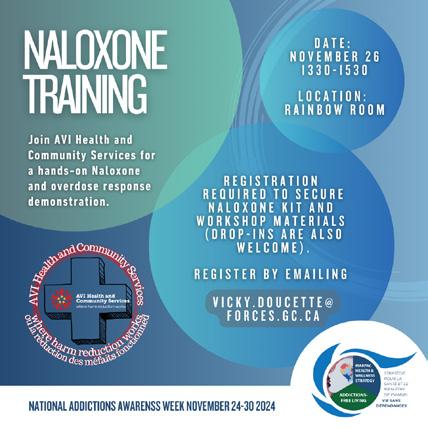
NALOXONE TRAINING
Join AVI Health and Community Services for a hands-on Naloxone and overdose response demonstration. Registration required to secure Naloxone kit and workshop materials. Drop-ins are also welcome. Nov. 26, 1330-1530. Register by email: vicky. doucette@forces.gc.ca
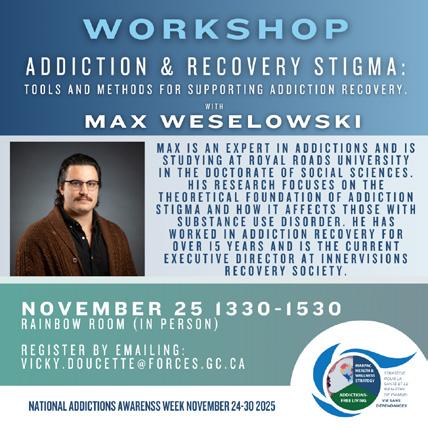
ADDICTION AND RECOVERY STIGMA WORKSHOP. Join MARPAC Health and Wellness Strategy's Addiction Free Living Workshop with Max Welsowski, an expert in addictions and social sciences forusing on the foundation of addiction stigma and how it affects those with the disorder. Nov. 25 1330-1530 at C&POs'
Mess Register by email: Vicky. doucette@forces.gc.ca
HOLIDAY SHOP & SIP. Dec. 1 at C&POs' Mess. Come finish your holiday shopping list with local vendors offering all kinds of wares for sale. Meanwhile enjoy a treat and drink during your shopping experience. Entrance by food donation for charity. FMI jazmin.holdway@ forces.gc.ca
for the Holiday Shop & Sip. Dec. 1, 1-5 pm, Chief and POs mess. . No charge for active CAF, PSP & CAF Civil Employees. $30 for General Public. Amazing venue
PSP Health Promotion
This year, the Canadian Centre on Substance Use and Addiction (CCSA) National Addictions Awareness Week is from Nov. 24 – 30. The theme for this year’s campaign is “Forging Connections”, emphasizing the power of collaboration in fostering a supportive and understanding environment. Substance use affects individuals, families, and workplaces in profound ways, but by building meaningful connections among peers, leadership, and support services, we can create a strong network that encourages prevention, early intervention, and recovery. We can strengthen these connections by

engaging in open dialogue, increasing awareness of available resources, and promoting a culture of compassion.
When working together— whether through peer support, leadership mentorship, or partnerships with health services—we can reduce stigma, improve access to care, and support one another in facing the challenges of substance use. Let’s take this opportunity to forge stronger bonds, ensuring everyone has the tools and community they need to thrive.
The Addictions-Free Living Working Group of the MARPAC Health & Wellness Strategy is working to drive change here at
MARPAC by creating a culture that encourages healthy lifestyle choices and reduces the risk of problems with alcohol, cannabis, gambling, gaming and other potentially harmful substances and behaviours. The working group continues to work towards creating a culture of health and wellness at MARPAC, and encourages members of the Defence Team to visit the CCSA National Addictions Awareness Week website (www. ccsa.ca/national-addictions-awareness-week) for more information, and to seek help and support if you or someone you know is struggling with an addiction or substance abuse.
“Alcohol and cannabis are legal, so they are safe.”
FACT: Recent guidelines highlight the risks associated with alcohol use and cannabis use. These guidelines and research studies can be viewed at:
www.ccsa.ca (alcohol)
www.canada.ca/en/health-canada/ services/drugs-medication/cannabis/resources/lower-risk-cannabisuse-guidelines.html (cannabis).
MYTH #2:
“If I see a Base Addictions clinician for help with substance use / an addiction I will need inpatient treatment.”
FACT: Base Addictions clinicians complete an initial full assessment and treatment recommendations vary between inpatient and out-

patient care depending on prevalence and severity of a substance use disorder or addiction.
MYTH #3:
“If I seek support for my substance use, I will be required to be 100% abstinent.”
FACT: Base Addictions clinicians work with clients on their personal goals around substance use and communicate regularly with primary care to ensure medical employment limitations are put in place as needed.
MYTH #4:
“Cannabis is found in nature so I cannot be addicted to it.”
FACT: Addiction to cannabis is possible and cannabis use can cause numerous risks associated with
CFB ESQUIMALT
Health Services/Base Addictions
250-363-4122
Members Assistance Program (CFMAP) 1-800-268-7708
Military Family Resource Centre (MFRC) 1-800-353-3329
The Chaplains Service
250-363-4106 (office)
250-363-4032 (after hours)
GREATER VICTORIA
CARE (Centralized Access and Rapid engagement Services) Addictions Outpatient Treatment. Support and education groups, counselling, day treatment, assessment, referrals and consultations with physicians. 250-519-3485
Alcoholics Anon: Support Line 250-383-7744
BC Alcohol and Drug Information
Referral Service Line Info and referrals for alcohol and drug use and misuse. 1-800-663-1441 (24hr)







mental health. Learn more at: www.canada.ca/en/health-canada/ services/drugs-medication/cannabis/resources/lower-risk-cannabisuse-guidelines.html
“If I disclose to a Base Addictions clinician that I use illicit substances, it will end my military career.”
FACT: Base Addictions clinicians communicate with primary care clinicians to make recommendations for future employment. Treatment recommendations for help with a substance use disorder focus on recovery and gainful employment when possible.
CAF members should speak to their primary care clinician to determine if a referral to a Base Addictions clinician is appropriate.

Foundry: foundrybc.ca
250-383-3552
Narcotics Anon. Support Line 250-383-3553
Problem Gambling Help Line 1-888-795-6111
Gambling Support BC Gamblingsupportbc.ca
Umbrella Society 250-380-0595
Homewood Health – Ravensview Addiction treatment for military members and veterans. 1-866-203-1793