Solemn the drums thrill; Death august and royal Sings sorrow up into immortal spheres, There is music in the midst of desolation And a glory that shines upon our tears.
They went with songs to the battle, they were young, Straight of limb, true of eye, steady and aglow. They were staunch to the end against odds uncounted: They fell with their faces to the foe.
They shall grow not old, as we that are left grow old: Age shall not weary them, nor the years condemn. At the going down of the sun and in the morning We will remember them.
Exerpt from For the Fallen by Laurence Binyon 1869 – 1943
tRemembrance Day
Rear-Admiral Robinson
As we approach Remembrance Day, I invite all Canadians to pause and reflect on the sacrifices made by our brave service members in uniform. This day reminds us of the courage and dedication of those who have served and continue to serve our country, ensuring our freedoms and values are upheld.
Each year, on November 11th, we gather to honour the memory of those who fought in conflicts around the world. From the trenches of World War I to the on-going missions of today, our service members have faced unimaginable challenges. Their sacrifices—whether in battle or on the home front—form the backbone of our national identity.
This year, as we remember the fallen, let us also acknowledge the families who have stood beside them. The loved ones of our service members have endured their own hardships, showing remarkable strength while their family members were away. We owe them our gratitude as well. Their sacrifices are often overshadowed, yet they are vital to the stories we honour today.
Remembrance Day is not only about looking back; it also calls us to action today. We must strive to show courage, integrity, and service in our daily lives. In doing so, we honour those who have made the ultimate sacrifice and ensure that their legacy lives on in our communities.
As we wear our poppies, let us take a moment to reflect on the freedoms we enjoy—freedoms that were hardwon and must be protected. It is a day to remember the sacrifices of the past while recommitting ourselves to peace and unity in the future.
In these times of uncertainty, let us come together as a nation to uphold the spirit of Remembrance Day. Attend ceremonies, share stories, and educate future generations about the importance of honouring our veterans. Each act of remembrance strengthens our shared commitment to those who have served and deepens our understanding of the sacrifices that protect our way of life.
Lest we forget.
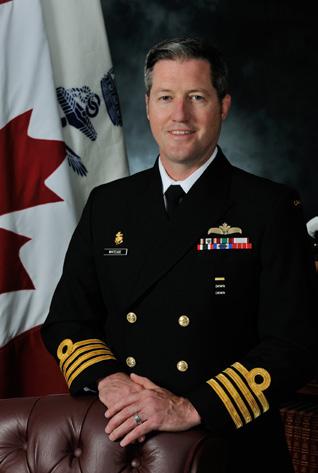
Captain (N) Kevin Whiteside, Base Commander, CFB Esquimalt
We take pause to reflect on the courage, valour and sacrifice made by those who fought for this country, contributing to peace and stability around the world. This Remembrance Day I find myself struck by the advance of time and the diminishing numbers of those veterans still with us.
Two names come to mind.
Last April we lost Peter Godwin Chance, a veteran of the Royal Canadian Navy (RCN), at the age of 103. The history of Mr. Chance in many ways mirrors the RCN’s coming of age in the early part of the 20th century – becoming a navigator at the start of the Second World War; experiencing the grim toll of convoy duty; and helping mount coastal operations in support of a
fledgling United Nations during the Korean War.
Yet, during his memorial service, it was not his naval-combat exploits that his family and friends dwelled on but his life and service in peacetime founded on his mantra of being kind above all else. This was a lesson that Peter Chance took from years of war at sea – a generosity of spirit that he shared until his final hours.
That dedication to humanity was also embodied by John Hillman, who passed away last July at 105. Hillman, a veteran of the Royal Air Force, spent the last birthdays of his life walking hundreds of laps around the courtyard of his home in Oak Bay. In doing so, he raised hundreds of thousands
of dollars for charity and, along the way, inspired people of all ages across Vancouver Island and beyond.
In times of both war and peace veterans, like Peter Chance and John Hillman, exemplify what it means to give of oneself to better the lives of many. On November 11th, I will reflect on their service and on the sacrifices made by them and their fallen comrades who marched with that cause of freedom and hope.
I will also endeavour, as the poet John McCrae implored, to take the torch from them and hold it up high.
Lest we forget.
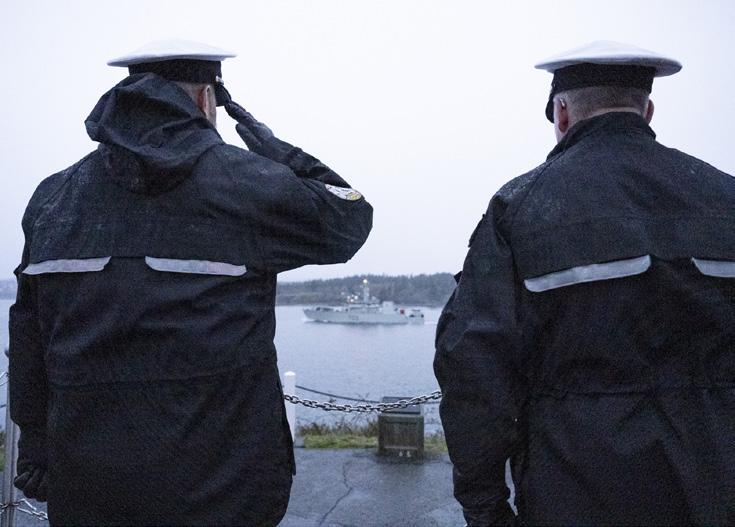
Rear-Admiral C. Robinson, Commander Maritime Forces Pacific salutes from Duntze Head. Photo by: Master Corporal Andre Maillet, MARPAC Imaging Services
A Solemn Tribute to HMCS Kootenay and the Legacy of Remembrance
Paul Dagonese Lookout Writer
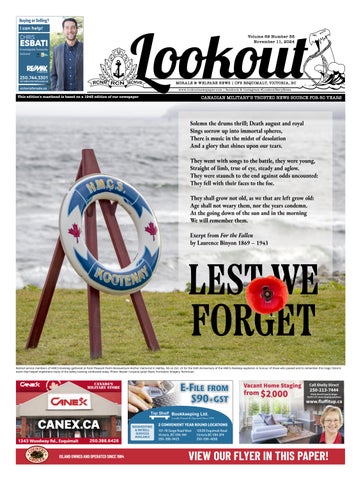
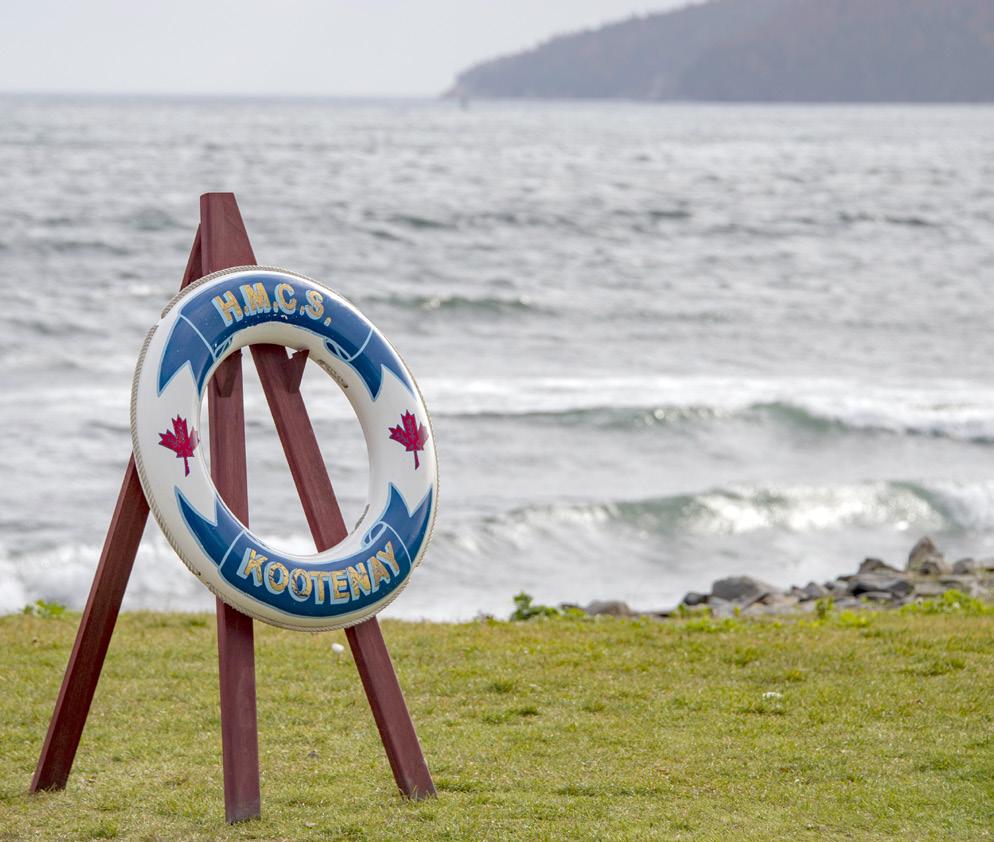
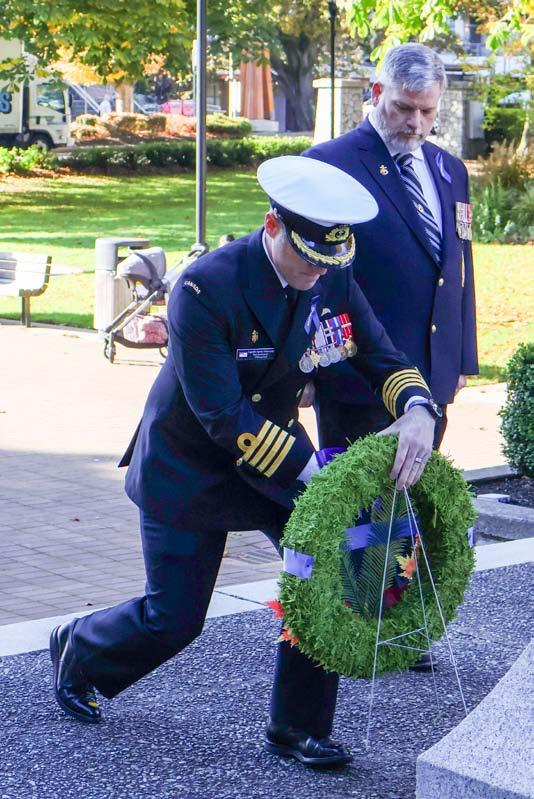
Members of the Royal Canadian Navy gathered at Memorial Park in Esquimalt on Oct. 23 for a solemn ceremony honouring the nine sailors lost in the 1969 tragedy aboard HMCS Kootenay. The wreath-laying event, marking Canada’s largest peacetime naval loss, drew veterans, sailors, and officials in an act of remembrance. Leading the ceremony was retired Chief Petty Officer 1st Class (CPO1 (ret’d)) Al Darragh who has championed this West Coast tribute, preserving the memory of those who served.
“It is through acts of remembrance such as those led by CPO1 (ret’d) Al Darragh, our former Base Chief, who was instrumental in organizing the first of these ceremonies, that the memory of HMCS Kootenay will continue to shape our Navy today,” said Captain Navy (Capt(N)) Kevin Whiteside, CFB Esquimalt Base Commander in his address, thanking Darragh for his efforts.
CPO1 (ret’d) Darragh served aboard the Kootenay from 1987 to 1992.
As an engineer, he vividly recalls the Kootenay’s harrowing “full power” trial 320 kilometers off the southwest coast of England, during which the ship caught fire and exploded while testing new equipment post-maintenance. The
crew bravely battled the flames, ultimately saving the ship and steering it back to England.
CPO1 (ret’d) Darragh also took part in a 25thanniversary re-enactment of the explosion, a tribute that held profound significance. He was on watch as the I/C of the boiler room during the re-enactment at the exact time and location of the blast that struck two and a half decades earlier.
“It was somewhat eerie being the guy in charge of it all, as you were re-doing what had happened, and those people who were on watch with me would have died,” he shared, explaining how two of the three people in the engine room with him that day lost their lives.
Throughout his service on the Kootenay, CPO1 (ret’d) Darragh and his crew remained deeply aware of the tragedy’s impact. Since it was primarily engineers who perished in the explosion, he noted, a positive outcome was the introduction of significant safety improvements.
The Kootenay Wreath Laying Ceremony commemorated not only the nine lives lost but also those who continue to carry forward their memory. When asked why he felt compelled to bring this tribute to the West Coast, CPO1 (ret’d) Darragh explained, “In order to honour those who gave their lives and to see the survivors come out so we can show them that we remember.”
Remembering the Sacrifices of Punjabi-Canadians
A/SLt Josh Grinstead PAO, MARPAC
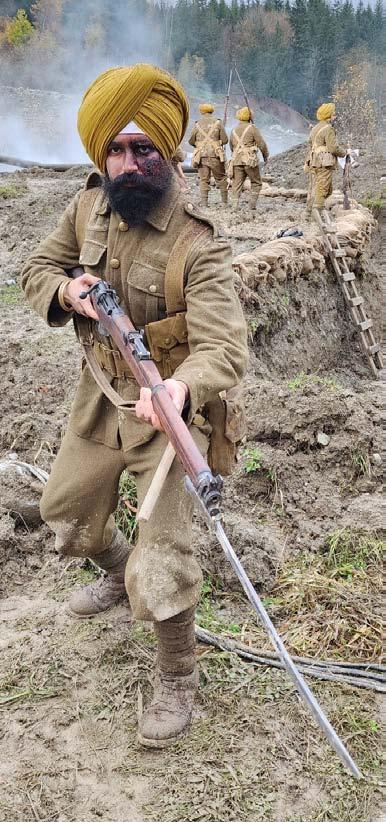
As Remembrance Day approaches, Canadians reflect on the sacrifices made by those who have served. For Lieutenant (Navy) (Lt(N)) Dhinsa, a Royal Canadian naval officer of Sikh background from Canadian Forces Base (CFB) Esquimalt, this means working on the short film Promises. Directed by Steven Purewal, the movie aims to shed light on the significant contributions of Punjabi forces to the Allied cause during both World Wars—a history often overlooked in mainstream narratives.
As a Sikh sailor with a deep family history of military service, Lt(N) Dhinsa’s participation in Promises underscores the importance of remembrance and the need to honour the sacrifices of all who fought for freedom. Promises highlights that many of the soldiers who fought against Axis tyranny during key battles throughout both world wars were Punjabi men from India, who fought valiantly as citizens of the British Empire. The film specifically focuses on the important battles of Neuve Chapple in 1915 and Monte Cassino in 1944, which were largely won by soldiers from the British Raj. Lt(N) Dhinsa expresses a profound sense of responsibility in bringing these stories to light: “The history has been dead for so long; if we if we don’t establish it now, it will be lost.”.
The director, Steven Purewal, emphasizes the film’s mission to unveil the marginalized
“It’s
histories of Punjabi contributions during the World Wars. “It’s really important for the next generation to see that we’ve come together at important points in our history to accomplish great things,” he states. Purewal wants to create a film that resonates not only with those who know this history, but also with future generations who may be unaware of the sacrifices made by these soldiers in the pursuit of Allied victory. “If we had not been united at that time, those victories would not have been secured. Millions of volunteers fought for the crown against that Axis. If there was no unity at that point, we’d have a completely different world order,” he adds.
When discussing his most memorable moments on set, Lt(N) Dhinsa recounts the connection he feels with his ancestors who served. “We tie our turbans and, by the first break of sunlight, were filming. It’s very long days, all the way to sunset around 6 PM. The challenging part for this shoot was all the mud. Even in my military career, I’ve never seen that much mud! But I guess that’s great; this is how our forefathers fought, so it gives me a glimpse of how they would have felt.”
The film’s focus on Punjabi soldiers is particularly significant in today’s context, as it encourages a broader understanding of the diverse backgrounds that contribute to our nation’s military heritage. Lt(N) Dhinsa believes that the stories told in Promises are essential for fostering respect and recognition among diverse communities. “I know in World War II, my grandpa’s two brothers,
they died in action during the Burma campaign. I think this was a great way to honour their legacy,” Lt(N) Dhinsa says.
Looking to the future, Lt(N) Dhinsa hopes that Promises will ignite curiosity in young Canadians about their history. He expresses his desire for all young Canadians to have the opportunity to engage with their heritage in ways he wasn’t always able to. “I don’t really know my history for World War I. If [my family] were in World War II, I’m pretty sure someone from my family did volunteer in World War I. Anybody with a Punjabi history always has somebody that has served in both of those Wars,” he reflects. Lt(N) Dhinsa hopes future generations will be able to find the answer to such questions.
Promises serves as a powerful reminder of the often-overlooked contributions of Punjabi soldiers in the World Wars, offering a vital opportunity for reflection and education. Through Lt(N) Dhinsa’s personal involvement and director Steven Purewal’s vision, the film not only honours the sacrifices of these soldiers but also sheds light on the diverse histories that shape our collective identity. As Canadians prepare to observe Remembrance Day, Promises encourages future generations to recognize the complexity of our shared past, fostering a deeper understanding and respect for the diverse backgrounds that have contributed to the freedoms we enjoy today.
really important for the next generation to see that we’ve come together at important points in our history to accomplish great things,” Director, Steven Purewal
Caption: Captain (Navy) Kevin Whiteside, CFB Esquimalt Base Commander lays a wreath at Memorial Park in Esquimalt in honour of those who died during the HMCS Kootenay explosion, accompanied by CPO1 (ret'd) Al Darraugh, who was onboard that fateful day.
THE LOOKOUT TEAM
MANAGING EDITOR
Jazmin Holdway jazmin.holdway@forces.gc.ca
WRITER
Paul Dagonese dagonese.paul@cfmws.com
PRODUCTION
Teresa Laird production @lookoutnewspaper.com
Leslie Eaton
250-363-3127 eaton.leslie @cfmws.com
ADMINISTRATION AND ACCOUNTS
Andrea Modesto
ADVERTISING
Joshua Buck
250-363-3127
Andrea.Modesto@forces.gc.ca
778-977-5433 military.base.advertising@gmail.com
EDITORIAL ADVISORS
Wilson Ho
250-363-4006
Published every other Monday, under the authority of Capt(N) K. Whiteside, Base Commander.
The editor reserves the right to edit, abridge or reject copy or advertising to adhere to policy as outlined in PSP Policy Manual. Views and opinions expressed are not necessarily those of the Department of National Defence.
Circulation bi-weekly print and online: 4,000 per issue plus social media engagement
Follow us on Facebook and Instagram to join our growing social media community.
A Division of Personnel Support Programs
Web: www.lookoutnewspaper.com
Fax: 250-363-3015
Canadian Mail Product Sales Agreement 40063331
A Hero Gets His Wings
Paul Dagonese Lookout Writer
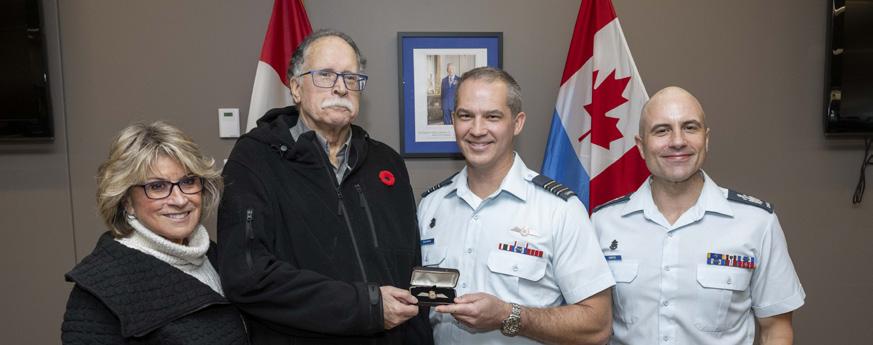
As the Royal Canadian Air Force (RCAF) marks its Centennial year, two exceptional Canadians were celebrated for their significant contributions to Canada’s military history. In a ceremony on Oct. 18 at 443 Maritime Helicopter Squadron in North Saanich, Jay Hammond and Maureen Thom were recognized for their dedication over the past 13 years to find the site where their uncle’s plane went down in the Second World War and exhume the wreckage from seven metres below ground.
On May 12, 1944, Halifax Bomber LW682 carrying seven RCAF and one Royal Navy crew members was shot down by a Luftwaffe Messerschmitt Bf 110. The aircraft and its crew perished in the crash. Their remains were submerged in a Belgian marsh for decades. Fifty-three years later, the remains of Hammond’s uncle, Pilot Officer (P/O) Wilbur Boyd “Wib” Bentz, a Canadian bomber pilot, along with two of its crewmembers, Sergeant (Sgt.) J.W. Summerhayes and Sgt. F. Roach, were discovered at their Halifax Bomber’s crash site near Geraardsbergen, Belgium. Lieutenant-Colonel Matt Dukowski, Commanding Officer of 443 Squadron, opened the ceremony by presenting Hammond with a unique tribute from the RCAF, a set of wings (rare for a civilian to receive) crafted from the aluminum of his uncle’s Halifax Bomber. In 2021, the RCAF began using material from
the recovered bomber in the wings awarded to all active flight-qualified members. The metal serves as a link between today’s RCAF and the fallen aviators who laid its foundation. Since then, every wing bears the bomber’s tail number inscribed on the back.
LCol Dukowski called this a “very personal connection” for each recipient, as it represents a direct piece of RCAF history. “Hammond’s efforts created an enduring legacy that honours both his family and the entire RCAF community,” he said.
In a letter by Lieutenant-General Eric Kenny, Commander of the RCAF, read aloud at the ceremony, LGen Kenny commended Hammond’s 13 years of dedication to recovering the bomber and its crewmembers. “His dedication not only brought closure to his family but preserved a vital piece of Canada’s military heritage,” he wrote. “Jay is someone who has preserved his uncle’s memory in an incredibly special way.”
Hammond and Thom, who followed in her uncle’s footsteps to become a pilot, were also presented with the Commander’s Coin and the 443 Squadron Coin, limited to only 100 being presented in the RCAF’s Centennial year.
Moved by letters from his uncle, Hammond embarked on a journey to uncover his family’s wartime past. Determined to locate the crash site, Hammond worked closely with the Belgian Aviation History Association (BAHA), an organization committed to preserving aviation history.
In September 1997, Hammond joined by
Thom, arrived at the Belgian marshlands to witness the initial dig. Volunteers gathered to assist, and soon, the aluminum fragments with the Halifax LW682 emerged from the soil, confirming they had found the right location. The dig was extensive, reaching nine meters below the surface and taking three full days to complete.
Hammond recalled the excitement when the first recognizable artifact surfaced.
“You could hear the squeal of the bucket of the excavator crushing aluminum,” he recounted. “And when we found the tail number, LW682, there was no doubt we had the right site.”
The excavation yielded poignant artifacts: a watch stopped at the moment of impact, a signet ring belonging to crew member Jack Edwin McIntyre, and parachutes. Hammond’s journey took a surprising turn when he reached out to the Luftwaffe pilot who was known to have shot down the Halifax, Martin Drewes. Remarkably, Drewes accepted Hammond’s invitation to attend the funeral for the recovered crew in Belgium. On Nov. 10, 1997, eight headstones were placed for each fallen crew member at the site. At the back of the ceremony, Hammond recognized Drewes, who had quietly traveled from Brazil to pay his respects.
As Hammond reflected, he saw his connection to his uncle expand into a profound bond with the RCAF and its history while he admitted to looking at it through a lens of war. It could have been his uncle who shot down Drewes’ plane. The
two men maintained a connection until Drewes’ passing in 2013.
The recovered bomber has contributed to projects commemorating the sacrifice of Canadian aircrews. Parts of the aircraft were incorporated into the restored Halifax NA337, now on display in Trenton and aluminum from the wreckage has been melted into ingots, some of which formed the roof of the Bomber Command Memorial in London, England, including the ceiling of the Hyde Park memorial where Queen Elizabeth dedicated the monument in 2012.
“Standing there, knowing a piece of our history was now a part of something so grand was indescribable,” Hammond said of attending the ceremony. “It was quite an honour to see that aluminum used in such a prestigious place.”
Today, artifacts from the crash Hammond has collected—a photograph of Bentz, his leather flying gloves, pieces of the Halifax aluminum, and defused incendiary shells, serve as lasting reminders of courage. Through Hammond’s devotion, these symbols continue to honour the legacy of a nephew’s mission to ensure his uncle’s memory endures in the RCAF’s proud heritage. As the RCAF celebrates its 100th anniversary, this tribute to Jay Hammond and Maureen Thom underscores the Air Force’s commitment to honouring its legacy and those who shaped it. By recognizing their dedication, the RCAF ensures the memory of Canada’s fallen airmen continues to inspire future generations.
Mr. Jay Hammond recieves a set of wings created using the aluminum of his uncle's recovered Halifax bomber during a Commendation Presentation at 443 Maritime Helicopter Squadron on Oct. 18. Photo: Sailor 3rd Class Jordan Schilstra, MARPAC Imaging Services
Making a mark in memory of Hong Kong veterans
A/SLt Taylor Rhuland
As Remembrance Day approaches, Canadians prepare to honour those who served, including the often-overlooked heroes of the Second World War Battle of Hong Kong.
The journey of ‘C’ Force began Oct. 27, 1941, when troops boarded the AWATEA and the PRINCE ROBERT, traveling through Canada to Hong Kong with brief stops in Honolulu, Hawaii and Manila, the capital of the Philippines. They arrived Nov. 16 but, unfortunately, essential equipment meant for ‘C’ Force was rerouted to Manila and never reached them.
In December, around 2,000 Canadian troops engaged in fierce combat against the Imperial Japanese Army. ‘C’ Force included soldiers from the 1st Battalion Royal Rifles of Canada. After 17 days of intense fighting, many Canadians were taken as a prisoner of war (POW) or killed.
Derrill Henderson is a passionate advocate for Hong Kong veterans, driven by his family’s military history. His father, Corporal Stewart Henderson, was a POW during the Korean War and rarely spoke of his experiences, motivating Derrill to honour the sacrifices of veterans.
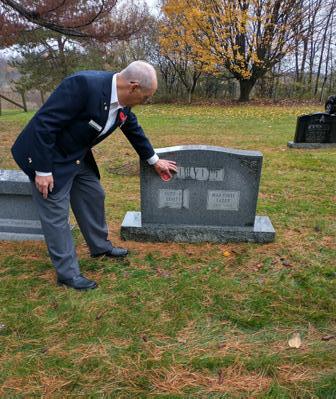
Since the mid-1990s, Derrill has played a crucial role in transitioning leadership from the Hong Kong Veterans Association (HKVA) to the Hong Kong Veterans Commemorative Association (HKVCA), empowering veterans’ children to take charge. This shift not only continues to recognize the bravery of these individuals, but also brings fresh perspectives to the association’s mission. Through Derrill’s efforts, many veterans’ gravestones have been located and marked, ensuring their stories endure on the HKVCA website.
He has compiled detailed accounts of each veteran’s experiences, including recorded messages from POW camps, preserving their voices for future generations.
One veteran who particularly inspired Derrill is Philip Doddridge from New Richmond, Que. Doddridge joined the Army in July 1940 and served with “D” Company of the Royal Rifles of Canada. On Christmas Day 1941, only 45 of the original 120 men in his unit remained.
After enduring four years in various POW camps, Doddridge was liberated and went on to dedicate his life to education. He was the last national president of the HKVA before its transition to the HKVCA. Derrill aims to fulfill Doddridge’s vision of marking every veteran’s grave with an HK grave marker.
The process of identifying and marking graves is a labour of love for Derrill and his team, relying on support and information from families and local communities. They often make surprising discoveries, such as finding the gravestone of another Hong Kong veteran while searching for a different individual.
Since HK markers were first proposed in 1998, approximately 250 gravestones have been marked, although interest waned over the years. Recently, demand surged, prompting Derrill to order more markers.
Once he receives permission from relatives or cemetery officials, he applies the markers and cleans the gravestones to enhance their appearance.
For those interested in helping or learning more, visit hkvca.ca for valuable resources, including a searchable database of Hong Kong veterans.
Above: Hong Kong Veterans Commemorative Association volunteer Derrill Henderson points to the “HK” marker being added to gravestones across Canada, including that of John Levitt, a member of 1st Battalion, The Royal Rifles of Canada Canadian Active Service Force (CASF); in Trenholm, Que. Top: Close up of the HK marker that is being added to gravestones across Canada. Photos provided.
In Flanders Fields
In Flanders fields, the poppies blow Between the crosses, row on row, That mark our place; and in the sky The larks, still bravely singing, fly Scarce heard amid the guns below.
We are the Dead. Short days ago We lived, felt dawn, saw sunset glow, Loved and were loved, and now we lie, In Flanders fields.
Take up our quarrel with the foe: To you from failing hands we throw The torch; be yours to hold it high. If ye break faith with us who die We shall not sleep, though poppies grow In Flanders fields.
WARRIOR
Lieutenant Colonel John McCrae
S1 Jacob Barrett Awarded Sailor of the Quarter Sailor of the Quarter
Paul Dagonese Lookout Writer
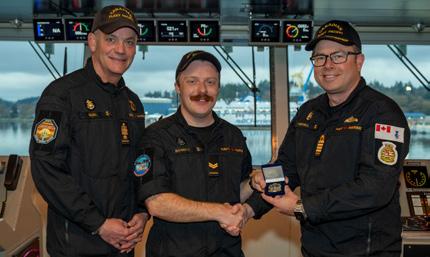
The Royal Canadian Navy (RCN) has named Sailor 1st Class (S1) Jacob Barrett as its Q3 Sailor of the Quarter (SOQ) for the months of July-September. S1 Barrett was presented his award aboard his serving ship, HMCS Max Bernays and presented the coveted SOQ coin from both Commander Sam Patchell, Deputy Commander of Canadian Fleet Pacific and Chief Petty Officer 1st Class David Bisal, Fleet Chief.
Chief Petty Officer 2nd Class (CPO2) Jeffrey Maynard nominated Barrett for the award. When asked how he knew Barrett qualified, Maynard said simply, “by popular demand”.
“I’m new to Max Bernays, but I quickly figured out how well the whole ship thinks of him as the ‘go-to guy’,” said CPO2 Maynard. S1 Barrett has quite the military resume. He joined RCN as a Marine Engineer in 2015 and completed his Marine Engineer QL3 course shortly after joining. He was then posted to HMCS Ottawa and later HMCS Vancouver. S1 Barrett continued to grow as he earned his Basic Machining Operator Certificate (BMOC) and later
posted to HMCS Regina and later, HMCS Yellowknife. He earned his Marine Engineer QL5 from 2018 to 2020 and was posted to several Kingston-class vessels, where he earned his Engineer Watch Keeper (EWK) Certificate. S1 Barrett helped in the RCN’s coastal transfer of Max Bernays from Halifax to Victoria and has participated in multiple RIMPAC exercises over the years.
Now serving on Max Bernays as its EWK, Barrett is surpassing his previous accolades—
and his crewmates are taking notice.
They’ve seen him consistently dedicating extra volunteer-hours, taking time to train his peers and subordinates, and always exhibiting a positive attitude, according to CPO2 Maynard.
Barrett has led repair efforts on Max Bernays’ black water treatment, diagnosed and restored its rod plant back to full capacity, and used its 3D printer to fabricate new replacement parts.
He even took the lead on procuring an engraving machine that creates commissioning plaques and templates for awards that are responsible for acknowledging exemplary crew members.
CPO2 Maynard explained S1 Barrett’s “thirst for knowledge and his drive to understand his surroundings” as key in setting him apart, qualities especially needed aboard a class of ship like the Max Bernays
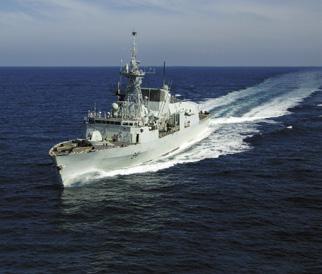
HMCS Max Bernays is the RCN’s third ever Arctic & Offshore Patrol Ship (AOPS), which was commissioned a little over two years ago. A new ship always comes with unknowns and learning curves to adapt to, says CPO2 Maynard.
“Barrett pushed himself and stepped up to this challenge, so much so, that he often accompanies the Senior Mechanical Propulsion Manager when briefing the Commanding Officer on equipment updates and management; he’s now considered an expert on the subject,” says CPO2 Maynard.
When S1 Barrett was asked what he thought made him unique to receive the award, he said, “It’s always nice to be recognized, but it’s not really why I do it…I’m just doing my job.”
Caption: S1 Jacob Barrett is presented with the Sailor of the Quarter coin by Commander Sam Patchell, Deputy Commander of CANFLTPAC and CPO1 David Bisal, Fleet Chief on Sept. 16.
ESQUIMALT’S HIDDEN HEROES: The Byrnell family’s military legacy
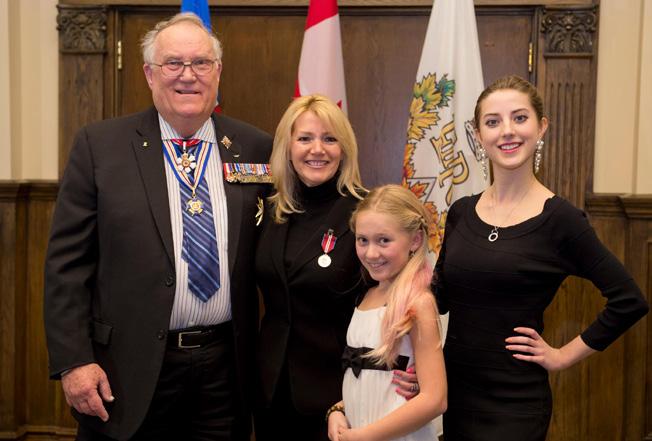
Wes Byrnell’s remarkable career spans both military service and pioneering work in sports medicine, leaving an indelible mark on the Canadian Armed Forces (CAF) and the field of athletic therapy.
In 1976, Byrnell was awarded the prestigious Order of Military Merit, one of the highest honours in the Canadian military. This recognition underscored his significant contributions to the CAF and his dedication to service.
A substantial portion of Byrnell’s military career was spent at Royal Roads Military College, where he trained and mentored young cadets, preparing them for future leadership roles. His impact on the institution was so profound that upon his retirement, he was granted the rare honor of taking the salute on the parade grounds – a privilege typically reserved for commanding officers.
“It was usually the commanding officer who would do this, but they made an exception for Dad,” his daughter Carrie Kohan recalls emotionally. “It was a beautiful goodbye from all the cadets and graduates. It still makes me cry that they honoured Dad that way.”
Byrnell’s commitment to serving his fellow military personnel didn’t end with his retirement from Royal Roads. He established a sports clinic at CFB Esquimalt’s Naden, where he volunteered extensively, treating personnel from all military branches. This clinic became a testament to his ongoing dedication to the welfare of servicemen and women.
At the Naden clinic, Byrnell’s innovative spirit shone through. He introduced groundbreaking hydrotherapy techniques and invented several tools that are still used by athletes today, including the tilt board and the Velcro sock holder, made for soccer players which was used in the 1976 Olympics. His contributions to sports medicine earned him a place in the Victoria and B.C. Sports Hall of Fame.
The Byrnell family’s military ties run deep. Kohan’s mother was a veteran of the Women’s Royal Canadian Naval Service, and she herself joined the Air Cadets from ages 13 to 16.
“I played the glockenspiel in the band, marched, and spit-polished my boots like nobody’s business,” she says.
Life on the military base in Belmont Park, Royal Roads Military College, and Esquimalt, held fond memories for the Byrnell family.
“The children could play hide and seek and
stay out till the streetlamps came on. The sense of safety and community was incredible in Esquimalt,” Kohan says. “But my fondest memories are of when my father would work with up-and-coming athletes at his clinic at the Esquimalt pool, or with all the people he brought into our tiny home to be taped for sports events. Olympic athletes would show up on short notice at the door with their trainers and say, ‘Wes, can you work your magic on these injuries?’
Kohan volunteered at her father’s hydrotherapy clinic at the Esquimalt Pool in the 1980s and witnessed many transformations, such as with a young mother who was paralyzed in a wheelchair from an epidural.
“The doctors told her she’d never walk again, but Dad welcomed her into his clinic started her on a weekly program of using his homemade, welded, steel paddles in the pool (which were the first hydrotherapy equipment ever made by him),” Kohan recalls. “This was the kind of work Wes Byrnell did at the Esquimalt Pool. He helped people heal, especially people who came with no hope.”
The mother went from a wheelchair to crutches, to a cane, and to walking on her own within the year. Despite his world-renowned
reputation, Byrnell never sought personal financial gain and remained a humble man in the community.
He worked with the Olympic Soccer Teams, the Shamrocks, the James Bay Rugby team, the Vic West Soccer Teams and local amateur and professional athletes such as Wayne Gretzky, the LA Kings, the Montreal Canadiens, the Victoria Cougars athletes such as Grant Fuhr, Bobby McGill, Geoff and Russ Courtnall and the Robertson Brothers (Tory and Geordie).
“All these teams and athletes excelled, and I believe much of their success was due to their strong fitness and conditioning levels they developed in their weekly sessions with Wes Byrnell at the Esquimalt Pool,” Kohan says.
As Canadians marked Heritage Day on Aug. 5, Kohan hopes her father’s contributions to the Esquimalt community will be remembered.
“I’m sure Dad would have been thrilled to have his name remembered like his good friend Archie Browning was,” she says. “If there are any athletes and civilians who benefited from my father’s work–- I’d hope they’d ask for Wes Byrnell’s dedication to both military service and sports medicine be highlighted and honored by the community he dedicated his life and expertise to.”
The Byrnell family while being awarded the Queen Elizabeth II Diamond Jubilee Award.
Kate Bandura Lookout Contributor
Career Transitioning Military
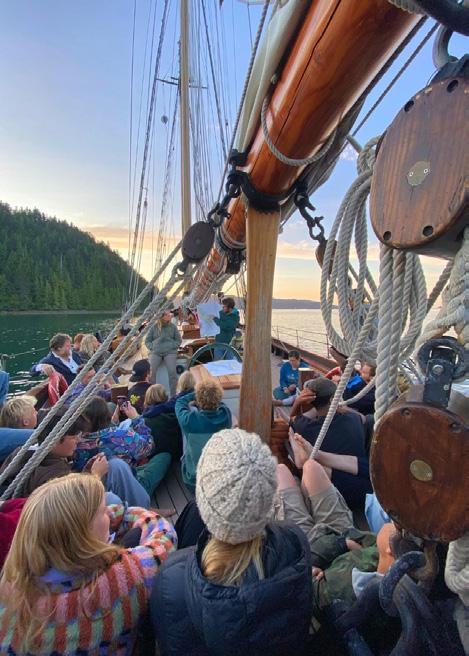
Do you have a passion for helping youth grow, love spending time outdoors, and want to sail on board a tall ship?
Apply now to join the SALTS crew!
Not an experienced sailor? That’s okay – SALTS provides all training necessary to safely operate our ships and fulfill your role. Experienced sailor? We have senior officer roles too.
We are currently accepting applications for the paid crew positions of Captain, First Mate, Bosun, Watch Officer, and Cook, with positions starting as soon as suitable candidates are available.
SALTS is an independent Christian-based registered charity located in Victoria BC. We seek to create an environment that is caring and re-
spectful, where young people from all walks of life are encouraged, inspired, and heard. If you are passionate about supporting our mission and values, we want to hear from you!
All crew members guide and mentor the young people who sail with us, and each role has an additional focus on either group leadership, ship maintenance, or cooking. SALTS operates two schooners based out of Victoria BC, and each year 1700 young people participate in our program as trainees, on 4-10 day trips in coastal BC waters.
Annual crew salaries range from $40K-$90K (up to $109K total compensation). Employment for all roles is typically full-time, year-round, but we also have need for some experienced relief (part-time) crew members.
Able Seaman Comrade Allan White: A
Legacy of Duty and Humility from the Prairies
At 101 years old, Allan White, a humble yet remarkable man from Saskatchewan, was presented with France’s highest distinction, the Knight of the Legion of Honour, in recognition of his role in the liberation of France during the Second World War while serving in the Royal Canadian Navy (RCN). On Aug. 12, surrounded by friends, family, fellow veterans, and members of His Majesty’s Canadian Ship (HMCS) Unicorn, a solemn ceremony at Mont St. Joseph Home in Prince Albert, Saskatchewan, honored White’s dedication and courage—a man whose service story continues to inspire.
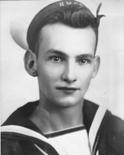
Born in rural Saskatchewan, Allan White wasn’t always destined for naval service. During the war, White made his way to Saskatoon to enlist in the Air Force. However, a last-minute decision would change his course. “I thought, ‘I don’t want to be a prisoner of war,’” White remembered. The idea of being shot down and captured was unsettling. Similarly, he had no interest in the army trenches, muddy and wet from endless days of rain. The Navy, however, held a certain appeal: “As long as your ship is afloat, you’ve got a dry bed—not a bed, but a hammock.” And so, White found himself joining the Royal Canadian Naval Volunteer Reserve (RCNVR).
White served on several naval ships, but his most notable assignment was aboard the HMS Guysborough. As part of the British 14th Minesweeping Flotilla, the Guysborough played a crucial role in clearing the way for the D-Day invasion. On the fateful nights of June 5 and 6, 1944, White and his com-
rades swept Channel 2 of the American Sector, ensuring the invasion force’s safe passage. The minesweeping operations resumed shortly after the initial assault, and it was this relentless effort to clear the treacherous waters that contributed significantly to the success of the mission. It is no surprise that France, a nation deeply appreciative of its liberators, bestowed such an honor on White.
What makes White’s story even more remarkable is his sense of modesty. Despite his vital role in the war, he insists that many others were far more deserving of the Knight’s honor. “There’s lots of people who deserve it, and there were far more than me,” White said. His humility is evident in the way he speaks about the war, recalling how many of his fellow sailors didn’t make it back home. White narrowly escaped this fate himself—he was transferred off the HMS Guysborough just two weeks before it was torpedoed and sunk by a German U-Boat.
White’s service did not end with the conclusion of the war. After his discharge in July 1945, he returned to Saskatchewan, where he became a founding member of the Smeaton Legion, a testament to his dedication to his fellow veterans. Over the past 77 years, White has been an active and enduring presence in the Royal Canadian Legion. Even at 101, he still attends fundraising events, encouraging the next generation of Legion members to carry forward the legacy of service.
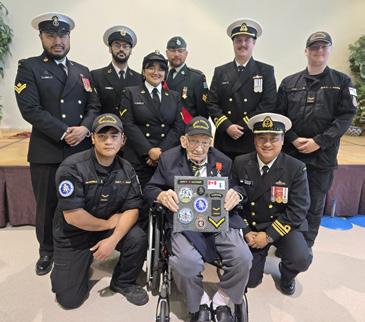
As part of the recent ceremony, White was presented with a Ship’s ball cap and a collection of patches and insignia from HMCS Unicorn, where he had trained decades earlier. The presence of
His story, like that of so many veterans, reminds us of the sacrifices made in the name of freedom and the profound impact of one individual’s service.
Lieutenant-Commander Michael Su and other military officials highlighted the respect White has earned throughout his life. The event was more than just an acknowledgment of his wartime service; it was a celebration of a man who dedicated himself to his country, his community, and his family.
White’s reflections on family are particularly touching. During the ceremony, he spoke warmly about the support of his loved ones, saying, “There’s many things in this world, but you can’t beat a good family.” Surrounded by his children, grandchildren, and great-grandchildren, White’s legacy is not just one of military service but of the values of loyalty, humility, and love.
Allan White’s story is one of quiet heroism. He is a man who, despite the dangers he faced, refuses to place himself in the spotlight. The Knight of the Legion of Honour is a fitting tribute to a man who served not for glory, but out of a sense of duty. His story, like that of so many veterans, reminds us of the sacrifices made in the name of freedom and the profound impact of one individual’s service. Allan White passed away on Sept. 16, 2024.
SLt Gokhan Nas HMCS Unicorn
Photo: Top: During the Second World War, Allan White joined the Royal Canadian Naval Volunteer Reserve (RCNVR) at HMCS Unicorn in Saskatoon, Sask.
Photo bottom: Allan White and members of HMCS Unicorn following the Knight of the Legion of Honour ceremony in Prince Albert, Sask. on Aug. 12. Photos provided.
Remembrance Reads
As the cooler weather approaches and the rainy days inspire quiet afternoons indoors getting lost in a book, Greater Victoria Public Library’s Margie Thompson has a book list of military-related titles to enjoy this season.
Her recommendations are:
NONFICTION
And No Birds Sang
A Most Ungentlemanly Way of War: the SOE and the Canadian Connection
Battle of the Atlantic: Gauntlet to Victory and Dam Busters: Canadian Airmen and the Secret Raid Against Nazi Germany
Failed to Return : Canada’s Bomber Command
Sacrifice in the Second World War
Hunt the Bismarck : the Pursuit of Germany’s Most Famous Battleship
Masters of the Air : America’s Bomber Boys who Fought the Air War Against Nazi Germany
One Day in August: the Untold Story Behind Canada’s Tragedy at Dieppe
Rescue at Los Baños: the Most Daring Prison Camp Raid of World War II
Rogue heroes : a History of the SAS, Britain’s Secret Special Forces Unit that Sabotaged the Nazis and Changed the Nature of War
The Battle of Arnhem: the Deadliest Airborne Operation of World War II
The Corvette Navy: True Stories from Canada’s Atlantic War
The Ghost Ships of Archangel: the Arctic Voyage that Defied the Nazis
The Longest Day: A Bridge too Far; Other World War II Writings
Unsinkable: Five Men and the Indomitable Run of the USS Plunkett
When the Sea Came Alive: an Oral History of D-Day
FICTION
Catch-22
Eye of the Needle
The Commodore
The English Patient
The Huntress
The Twilight World
Farley Mowat
Bernd Horn
Ted Barris
Keith Ogilvie
Angus Konstam
Donald Miller
David O’ Keefe
Bruce Henderson
Ben Macintyre
Anthony Beevor
James Lamb
William Geroux
Cornelius Ryan
James Sullivan
Garrett Graff
Joseph Heller
Ken Follett
Peter Deutermann
Michael Ondaatje
Kate Quinn
Werner Herzog
FOR RENT
SAXE POINT Bright fully furnished, one bedroom self-contained suite with private entrance, full bathroom, storage, queen bed, washer/dryer, dishwasher, fridge, range, microwave, large tv, and small appliances. 10 minute walk to Work Point and Naden, near oceanfront parks, running trails, cycling and bus routes and all amenities. Includes 1 parking spot. Available for one person. No smoking, no pets. $1,750/mo includes hydro. 250-216-9030. 10/08
SHARED ACCOMMODATION, SINGLE BEDROOM Shared bathroom, kitchen, common area. Includes: heat, hydro, hot water, WiFi, Secure Bike Room. Laundry facilities in building. In Victoria, close to downtown and Oak Bay Village. Royal Jubilee Hospital, transit and amenities. Parking not incl. (can be requested if one available). Quiet, safe neighbourhood, nice neighbours. 900.00 a month, Partly or unfurnished room for a mature female (Oak Bay Junction) Non Smoker. Contact Leslie at winterpeg100a@gmail.com 10/08
FURNISHED CONDO FOR RENT 1-3 month housesitting, furnished, 2 bed 2 bath in Belmont Park, underground parking, $2500 per month, no smoking, no pets. Contact James at James@rayndt.com
ROOM FOR RENT $900/m for 1 br in shared house. Prvt bath, shared kitchen, laundry + prk space available. Private entrance. No sm/vape/ party or pets allowed. 250 893 4003 11/04
TWO BEDROOM FURNISHED SUITE: SHORT TERM RENTAL AVAILABLE NOV. 10: Comfortable, 2 bed suite, fully furnished, in quiet residential area, 10 minute walk to CFB Esquimalt. All utilities and wifi included. Full kitchen, full bath. The kitchen equipped; all linens provided. Garden level, private entry, shared laundry, outdoor patio. Street parking. No smoking or pets. Landlords live in the house. Please note: minimum stay 30 days, maximum 6 months. $2200 per month. Call Margaret 240 740 1300. 11/04
LOOKING FOR A MODERN + SPACIOUS PLACE TO STAY? Oceanview Oasis, 1100 sqft, 2-bed, 1-bath, furnished suite with own entrance. ocean + mountain vistas, private deck. Located in Colwood, 18-minute drive to the CFB Esquimalt. Short to mid-term rental, starting at $150/nt for up to four people. Price negotiable based on length of stay. Contact mayandfraser@gmail.com. 11/04
COOK ST VILLAGE 2 bedroom suite with hardwood floors. Quiet and well maintained apartment building. Heat, hot water and parking included. No pets. No smoking. One year lease. $2,300 per month. Available Dec 1, 2024. Call 250 588 5457. 11/04
RENOVATED BASEMENT SUITE, kitchen w/ SS appliances inc. dishwasher. 4-pc bath, large main bdrm, gas FP, electric heat. Private patio, shared yard, off-street parking. Lots of storage. Building is a four-plex w/ shared laundry room / 2 sets of machines. Near Gorge Park on