




The 2024 Provincial General Election is on Saturday, October 19, 2024. There are many ways (and many days) to vote.
CAN VOTE
You can vote in the 2024 Provincial General Election if you are:
• 18 or older on October 19, 2024
• a Canadian citizen, and
• a resident of British Columbia since April 18, 2024
VOTER REGISTRATION
Register now to save time when you vote.
You can register or update your voter information at elections.bc.ca/register or by calling 1-800-661-8683
Registration online and by phone closes at 11:59 p.m. (Pacific time) on October 7.
After October 7, you can still register when you vote, but voting will take longer. Remember to bring ID when you go to vote.
VOTE IN PERSON
Vote at a District Electoral Office
Voting at district electoral offices is available now during office hours until 4 p.m. (Pacific time) on Final Voting Day.
Vote at Advance Voting
There are six days of advance voting: October 10 - 13 and 15 - 16, from 8 a.m. to 8 p.m. (local time).
Advance voting places will be closed on October 14 (Thanksgiving).
Vote on Final Voting Day
Final Voting Day is Saturday, October 19. Voting places will be open from 8 a.m. to 8 p.m. (Pacific time) on Final Voting Day.
VOTE BY MAIL
To vote by mail, request your voting package as soon as possible. Visit elections.bc.ca/votebymail or call 1-800-661-8683
WHERE TO VOTE
Visit wheretovote.elections.bc.ca to find voting places near you and when they are open.
There are new electoral districts for the 2024 provincial election. To see a map of your new electoral district, enter your address at elections.bc.ca/mydistrict
Paul Dagonese
Lookout Staff Writer
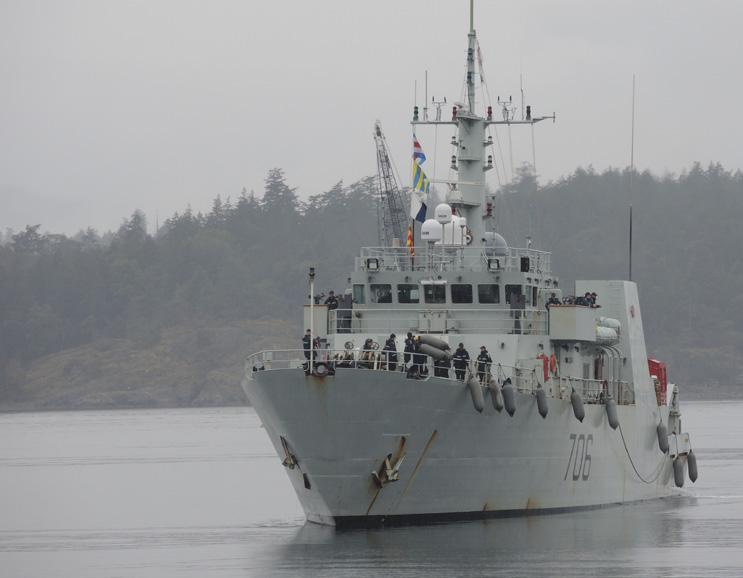
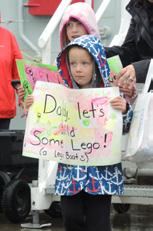
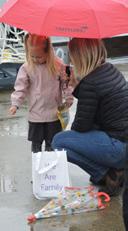
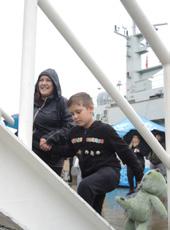
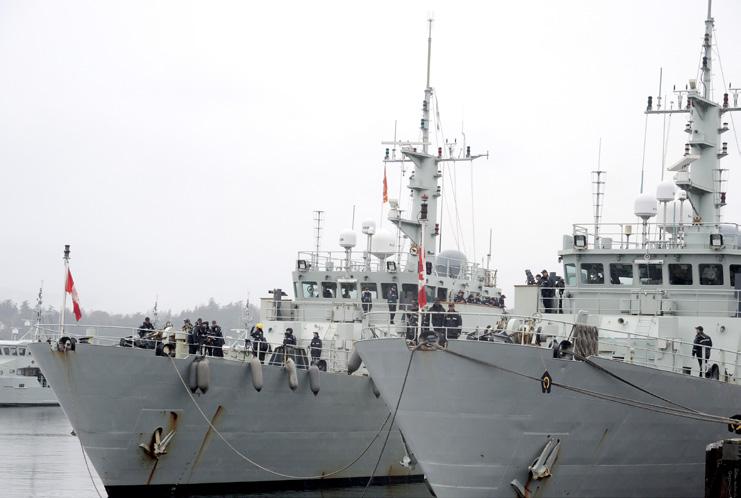
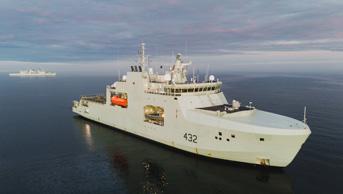
Y-jetty is packed for another homecoming of HMC Ships Edmonton and Yellowknife as they return from their Operation (Op) Caribbe deployment.
Despite just being docked and seeing family members donned in rain gear eagerly awaiting them ashore, LieutenantCommander (LCdr) Tyson Babcock, Commanding Officer (CO) of HMCS Yellowknife, and LCdr Stuart MacDonald, CO of HMCS Edmonton remained on board to complete a few final tasks.
Op Caribbe is an ongoing operation in support of the Joint Interagency Taskforce South that began in 2006. The Canadian Armed Forces and United States Coast Guard Law Enforcement Detachment are
tasked to counter narcotics smuggling in the eastern Pacific.
LCdr Babcock described the joint interdiction as a success.
They were out at sea a little over six weeks, but when the action started, things accelerated quickly.
They weren’t in the target area long before receiving signs of activity. Then, Yellowknife’s bridge wing called to intercept a potential target, which was only 20 yards away.
“We caught it sooner than expected which was outstanding,” says LCdr Babcock. “From there, we sprang into action”.
Yellowknife made first contact. It was the middle of the night, and visibility was limited.
The mission wasn’t as straight-forward as planned, though. “We had to think outside the box on this one”, says LCdr Babcock.
LCdr MacDonald and Edmonton acted as the backstop, supporting Yellowknife in the seize, explains Babcock.
The Royal Canadian Navy’s (RCN’s) strength in these operations is its covertness. But at times, overtness is needed. It turns out the Targets of Interest (TOI) on these missions are challenging to locate. They’re slippery. So, Edmonton was tasked, if needed, to push back on the TOI, leading it back to Yellowknife
After spending six hours with the TOI, Edmonton and Yellowknife helped disembark the approximately 1,400 kg of “presumptive cocaine”, and apprehended the vessel, which was no longer seaworthy. Both contraband and ship were handed over by RCN to the United States Coast Guard jurisdiction and brought back to San Diego.
The operation was a success. Two RCN
ships worked well in tandem and were able to work seamlessly with a foreign ally. But how do the two COs feel about being back home?
“It’s always amazing to come back,” says LCdr MacDonald. “I think anytime you have a successful mission it feels even better coming back. But anytime you go out, whether it’s for training or operations, it’s always exciting to come home, to see your family, see your friends, to get back into that home life routine.”
When asked, LCdr Babcock wasn’t sure if anyone was more excited than a certain member of his family. “One of my sons tried to cross the brow I think before anyone else. He’s very excited”.
Babcock says he’ll spend time with his wife and kids and eat some good food that evening.







Managing Editor
Jazmin Holdway jazmin.holdway@forces.gc.ca
Writ E r Paul Dagonese dagonese.paul@cfmws.com
P rod UC tion
Teresa Laird production @lookoutnewspaper.com
Leslie Eaton
250-363-3127 eaton.leslie @cfmws.com
a d Ministration and aCC oU nts
Andrea Modesto
adv Ertising
Joshua Buck
250-363-3127
Andrea.Modesto@forces.gc.ca
778-977-5433 military.base.advertising@gmail.com
Editoria L advisors
Lt(N) Wilson Ho
250-363-4006
Published every other Monday, under the authority of Capt(N) K. Whiteside, Base Commander.
The editor reserves the right to edit, abridge or reject copy or advertising to adhere to policy as outlined in PSP Policy Manual. Views and opinions expressed are not necessarily those of the Department of National Defence.
Circulation bi-weekly print and online: 4,000 per issue plus social media engagement
Follow us on Facebook and Instagram to join our growing social media community.
A Division of Personnel Support Programs
Web: www.lookoutnewspaper.com
Fax: 250-363-3015
Canadian Mail Product Sales Agreement 40063331


With any pattern of behaviour, there is an identifiable cycle that propels one forward. Sometimes we are acutely aware of this pattern and other times we dwell in dense unconsciousness. Both are equally painful in their own right.
What makes addiction out of trauma difficult is that the mind begins to rationalize the necessity for the behaviour through its emotional reinforcement. In other words, addiction becomes an alluring alternative because all the other options cause us to confront our despair. By defaulting into our compulsiveness, we are pushing away the internal anguish of the trauma. What seems apparent is that there is a handing over of consciousness through the veil of complacent routine.
One of the first things we must do to interrupt a psychological pattern is to identify the cycle of addiction. Each cycle of addiction is nuanced and complex in its own right. However, there is usually a generalized formula that makes up the pattern of trauma-based addiction:
Overwhelm: this appears physically, emotionally, and mentally.
Physically, our bodies don’t feel aligned with reality, we notice our bodies tense up, and our breathing deviates from its natural rhythm. The common physical sensations of being overwhelmed include sweating, tension around the jaw, neck and shoulders, bouncing of legs, unable to sit still, and the classic pit in one’s stomach.
Emotionally, anxiety begins to well up,
feelings of sadness and anger have a pulse to them, and our ability to regulate our emotions becomes non-existent.
Mentally, our thoughts begin to be ruminative, and we find ourselves following the same thread of thought. We have very little to no control in this overwhelmed state of mind, and our inner dialogue becomes overly critical and judgemental.
Escape: Due to the psychological immensity of the moment, we look to bypass this confrontation with ourselves. This could be due to being internally or externally triggered. When this happens we look to distract ourselves to avoid our suffering.
Action: This can be a conscious or unconscious act. We do the thing that gives us the relief we are seeking, that feeling of no longer needing to face the trauma and its subsequent consequences, an out. In a way, we are psychologically searching for an experience that tries to transcend the enduring horror. We are in pursuit of a psychic high that pulls out. These actions vary from substance abuse, overworking (workaholicism), sex and love, social media, phone usage, gaming, etc.
Deterioration: After the action and the menial gratification that comes from it, our psyche plummets into a deeper state of angst. Our attempt to repress or suppress causes our psychological well-being to become a more deflationary state. The high lifted us only to make the fall that much worse.
The trouble with trauma-based addiction is that sometimes we are conscious of the cycle and even its outcome, but
other times we are flying unconsciously. However, when one can begin to associate their addiction to trauma, it gives us a starting point.
A traumatic event pulls a lot of psychic energy away from our ability to live. Addiction out of trauma occurs as a way to pull that energy into another direction; it is a pursuit of living a life we once had before our trauma. In a way, we are looking for a way to live that surpasses our trauma. Identifying where you are in the addiction cycle helps with gaining back some control in the moment. Of course, we would all like to be able to manage and cope better when we are in a state of overwhelm. However, the first step to combatting any addiction is witnessing our unique psychological patterns. When we become aware of how we get to the point of psychic deterioration, we bring a light to our compulsiveness. Once we know what the pattern is, then we can finally learn to accept it.
Thomas Goenczi is an RCN Veteran and MA Clinical Counsellor with Private Practice: Well Then Therapy.
The content is not intended to substitute professional advice, diagnosis, or treatment. Always seek the advice of your mental health professional or other qualified health provider with any questions regarding your condition.




Pedram mohyeddin Public Affairs Officer, HMCS Vancouver
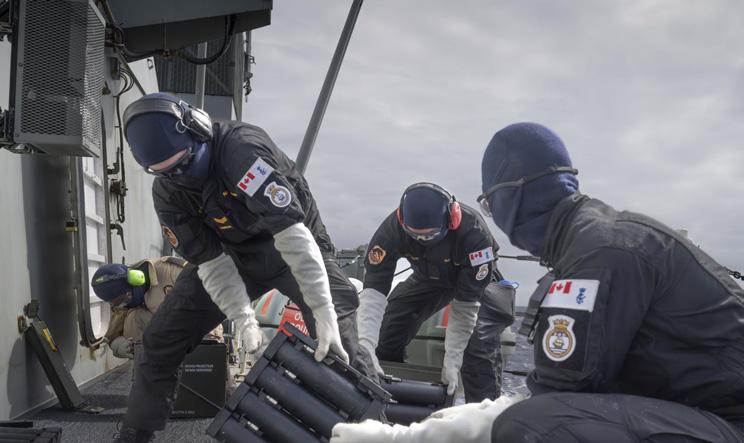
Morale was running high in His Majesty’s Canadian Ship (HMCS) Vancouver as their time in and around the Hawaiian Islands came to an end at the beginning of August. For a little over five weeks, HMCS Vancouver took part in Exercise Rim of the Pacific (RIMPAC) 2024 from Jun. 27 to Aug. 1, along with HMCS Max Bernays and Motor Vessel (MV) Asterix
Belonging to the fictional nation of Orion, Canadian ships took on another persona. Featuring a new national anthem and patriotic posters around the ships, this new nation would define their role within the exercise.
Comprising of just one tenth of the entire RIMPAC at sea force, Orion was the simulated opposing force played by the Royal Canadian Navy (RCN), along with two American ships and one Japanese ship. As an aggressive force, it was their job to aggravate their enemy of RIMPAC coalition ships in a simulated war game that put common allies against each other to test their readiness.
As the world’s largest international maritime exercise hosted every two years by the United States Pacific Fleet, RIMPAC is more than just a singular training exercise – it’s a unique platform for increasing communication and interoperability among the fleets.
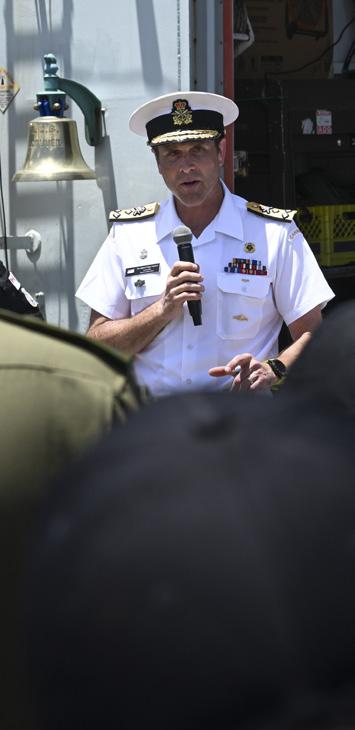
“We are here to build relationships and show our commitment,” said Commander Tyson Bergmann, Commanding Officer of HMCS Vancouver. “Canada has set out to increase its participation in multinational training exercises and to engage regional partners and militaries to promote peace, resilience, and security.”
RIMPAC is split into two phases: the shore phase, taking place in the first week; and the sea phase, which lasts approximately four weeks.
One of the main purposes of the shore phase is to allow the planners of the exercise, along with the ships, to meet and discuss the final planning
stages of the exercise. There are specific medical and legal symposiums that allow members from participating nations within those occupations to connect and share ideas for professional development. The shore phase is also a time of cultural exchange where each night a different country hosts a reception displaying their food, culture, and hospitality.
The sea phase consists of a variety of naval activities from crew exchanges to missile shoots. HMCS Vancouver was able to successfully fire both its MASS system, an anti-ship-missile system, and two of its Evolved SeaSparrow Surface to Air Missiles. Concurrently, MV Asterix conducted a total of 34 replenishments-at-sea, the most out of all replenishment vessels at RIMPAC. That included 16 different vessels from nine nations – Canada, Australia, Germany, Italy, Japan, New Zealand, Republic of Korea, Singapore, and the United States. It was the first time that MV Asterix had ever conducted a replenishment-at-sea with ships from Italy and the Republic of Korea. The operation tempo was so high that for one 48-hour period, MV Asterix conducted seven replenishments-at-sea. They also conducted their largest ever ammo transfer to, none other than, HMCS Vancouver.
“The Vancouver crew displayed the kind of professionalism for which the RCN is known, and I have no doubt they will continue to do so during Operation Horizon,” says Commander Bergmann.
RIMPAC 2024 is the 29th iteration of its kind that began in 1971 with just five countries: Australia, Canada, New Zealand, the United Kingdom, and the United States. This year, 29 nations, 40 surface ships, three submarines, 14 national land forces, more than 150 aircraft, and 25,000 personnel participated in RIMPAC.
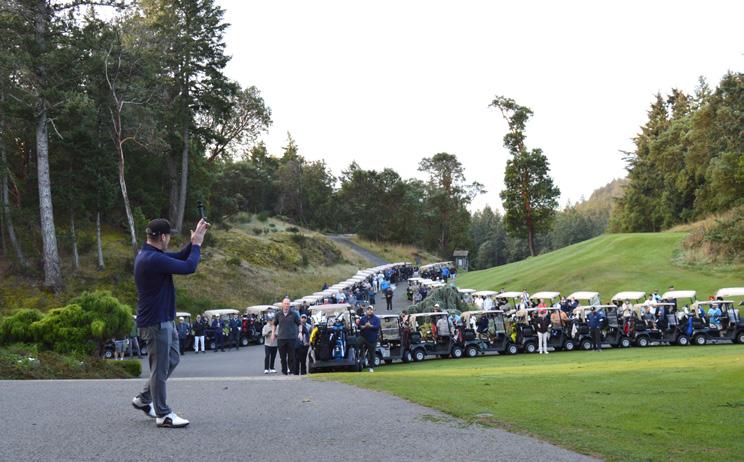
each hole, there was never a dull moment on the green.
Starting
Reigning champions Roy Elson, Mohamed Gudal, Steve Melnick and Steve Wist squeaked in another incredible round to take home the win for another year. Congratulations to all the golfers on another incredible tournament! The event would not have been possible without the generous support of our sponsors. A huge thank-you to Seaspan, Babcock, WestJet, SISIP, BC Yukon Royal Canadian Legion, Pomerleau, Golf Town, United Rentals, Hotel Grand Pacific, Golf and Grind, Royal Roads, Saje, Crag X, Grainger, South Island Physio, and




bers to attend training locally, reducing the time spent away from home.
Last month, 13 Financial Services Administrators (FSAs) gained the fundamental skills needed to achieve specialist qualification as cashiers. This training equips them to effectively perform essential functions in cash offices on HMCS ships and across various Canadian Armed Forces (CAF) bases.
As part of training modernization efforts, CFB Esquimalt successfully hosted the first decentralized cashier course for FSAs. Since the Chief of Defence Staff published the Reconstitution Plan in 2021, FSA trade advisors and the Military Personnel Generation Training Group have been actively implementing initiatives to address trainee backlogs and modernize training, with a focus on improving worklife balance. By decentralizing the course, we enable mem-
A Sergeant FSA from the Canadian Forces Logistics Training Centre (CFLTC) delivered the course material and ensured that all qualification standards were met. Additionally, a highly experienced FSA from the Base Comptroller (BCompt) office provided valuable insights and answered questions related to coastal and shipboard operations.
On the West Coast, FSAs occupy over 12 cashier positions within the Fleet and Formation, including ten onboard ships and two at BCompt. Typically, CFLTC conducts this course in Borden with a maximum capacity of 20 personnel. Due to the number of limited seats, accommodating West Coast members can be challenging, especially when the course is open to all FSAs across the CAF. In many cases, only two West Coast person-
nel are enrolled per session. In addition, those FSAs who are posted to ships may also encounter difficulties scheduling their attendance due to operational commitments.
The localized nature of this course has many advantages, including the networking potential among others they may not have known yet. This training will increase the availability of personnel who are available to assist with claims payments either on ship or at the BCompt office. Additionally, the cost of Temporary Duty is significantly reduced by sending one instructor to the location rather than transporting members to a centralized site. This course would not have been possible without the support of the BCompt staff, who initiated and managed the logistics to make this vision a reality. We also extend our gratitude to the CFLTC staff for coordinating and providing an instructor for the ‘Best’ Coast.











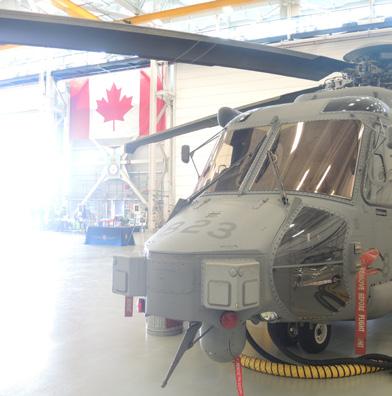
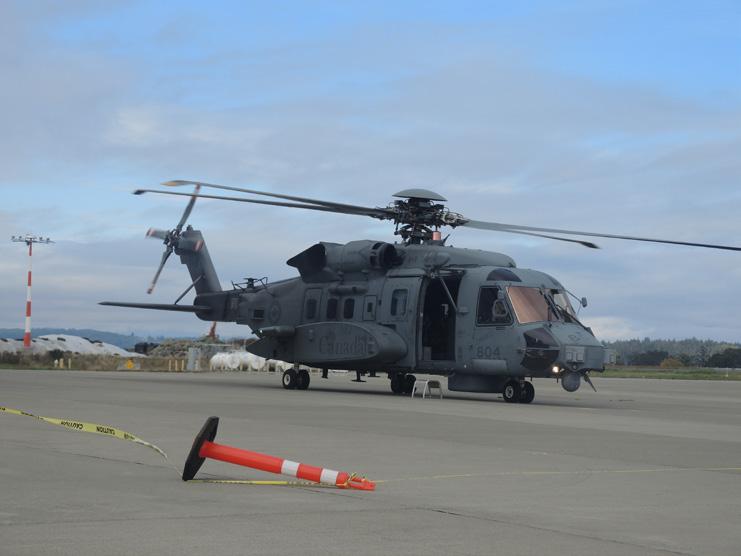
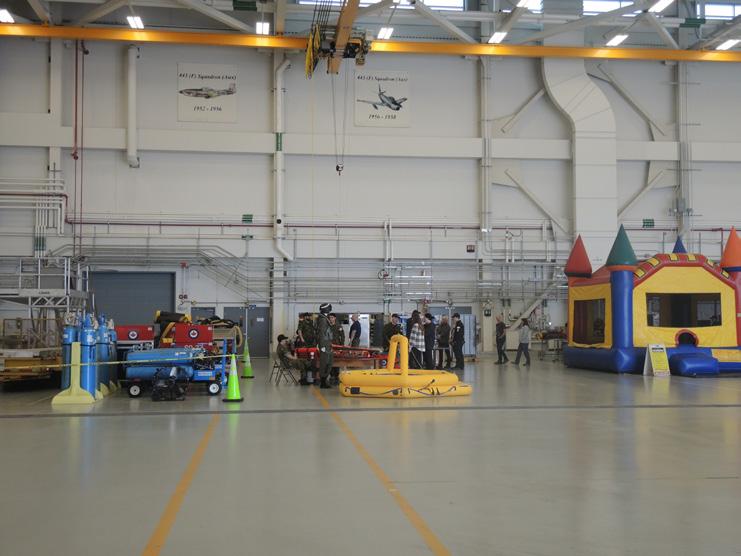
Sikorsky CH-148 Cyclone stationed at the southeast corner of the hanger captured the interests of all. Corporal (Cpl)
asked what got him interested in the military, he says his family, specifically his dad, who was a Submariner.
443 Maritime Helicopter Squadron opened its hangers to family and friends for its annual Family Day event, offering a rare glimpse into the life of the Royal Canadian Air Force in North Saanich on Sept. 23.
Entering the gate and seeing the CH124A Sea King Helicopter with its hull emblazoned with Navy livery, you can’t help but be reminded of 443 Squadron’s ties to the Royal Canadian Navy.
With the accented bright red, sharp blue and bright orange colours contrasting against its lead-gray body, you know you are in for something special.
But thoughts of rotor blades, and vistas of the Pacific from high above get put on hold for guests and family members — if but only for a moment. Guests make their way past the Commissionaires’ security check, leading themselves down the hallway to Hanger 12 where the festivities were being held.
As the giant yellow, blue, and red bouncy castle obstacle course captured the attention of excited kids, the
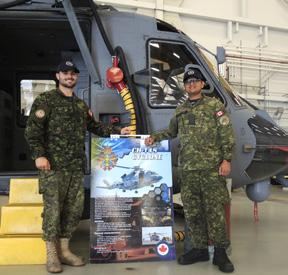
Thomas Desbiens, an Aviation Systems Technician and Cpl Harveer Grewal, an Avionics Systems Technician were tasked with explaining the job of the Cyclone to families. Terms like ‘pings’, ‘thermal climbs’, ‘precision’, and ‘tactical configurations’ were being explained to all who gathered to learn more.
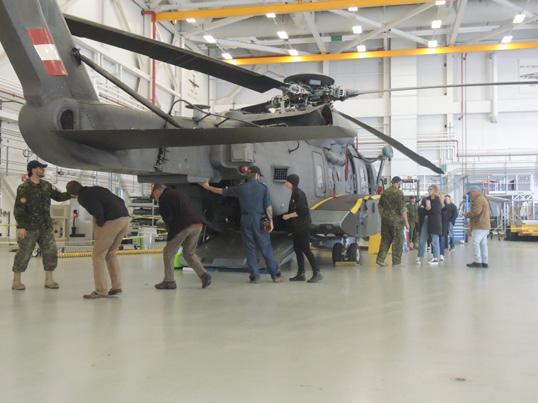
Aviator Sam Aryavong, an Avionics Technician, arrived with his family and, despite being new to the squadron, was excited to share his abundance of knowledge on the CH-148. He ran his hands along the hull, pointed and explained to his family many of the intricate machine’s working parts. Without hesitation, and with confidence, he removed the iconic bright orange cover over the sensor camera and explained its task for identifying items and objects in many circumstances, night or day.
When asked what he does, Sam says, “Avionics Systems: working and fixing electronics, such as radios, navigational devices, and lights.” He explains that ‘anything with a wire attached to it’ he knows about and has worked with during his three years as an Avionics Tech. Sam started as an Air Cadet and when
As parents continued to watch and wait for the kids to let out some steam on the bouncy castle, they couldn’t help but overhear Master Corporal (MCpl) Malcolm Martin, an Air Weapons Systems Technician describe the weapons and tools on display. The Expandable Mobile SSW Training Targets (EMATT), and the Signal Underwater Sounder (SUS), which explodes out at sea and listens for feedback for up to four hours were showcased and explanations given on how these are specifically used by the CH-148 to search for enemy subma rines. He discussed the explosives, reassuring guests that they “will not go boom” while live torpedoes, War Shot, or live exercise training torpedoes, are his ‘bread & butter’.
When asked how he ended up at 443 Squadron, MCpl Martin says it’s a family thing. His dad, who served a career in the Canadian Armed Forces for 43 years—7 years in the Navy, and 36 in the Air
continued next page





Maggie Claydon, PsyD


continued from previous page
Force— shared 443 Squadron as his very first posting. MCpl Martin was posted in 2018, following those footsteps. In the late 80’s, 443 Squadron relocated from Shearwater, N.S. where his father was originally posted, to North Saanich B.C., where he started his own military career and serves today.
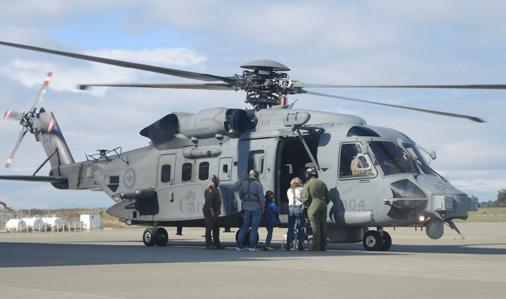
As MCpl Duncan Taylor was seen sweeping in and out of Hanger 12, tasked with making 443’s Family Day go off smooth and without a hitch, family members were treated with rides in one of two Sikorsky CH-148 Cyclones in operation that day.
The staff lunchroom was converted into a flight waiting area, flight crew members helped guests don their floatation vest, goggles, and ear protection, and guests were explained the dos and don’ts for safety. When the helicopter arrived, crew members quickly gathered those scheduled to take flight and escorted them like a swarm of bees as a single unit across the tarmac. They boarded the helicopter and buckled in. Once everyone was secured, they taxied along, reached the launch site, and lifted slowly and gradually up.
Within minutes, they reached an approximate altitude of 500 ft. Steadily they cruised, hugged along the Eastern Pacific coast of the Island, paralleled mountain edges, cut west across the Island, swerved elegantly around and up the north along the channel, then gradually came back full circle, descending, landing, and taxiing back to Hanger 12.
As the day came to a close, families left with a new understanding and appreciation of the contributions 443 Squadron provides to the Canadian Armed Forces. With smiles and memories to cherish, 443 Squadron’s Family Day served as a meaningful reminder of the support and camaraderie that fuels the squadron’s success, both on the ground, at home, and in the air.





• Smoke alarms should be installed on every level of the home (including the basement), outside each sleeping area, and inside each bedroom.
• For the best protection, interconnect all the smoke alarms so when one sounds, they all sound.
• It is important to have interconnected smoke alarms if you sleep with the bedroom doors closed.
• A smoke alarm should be on the ceiling or high on a wall.
TyPeS oF Smoke ALArmS
• It is important to buy smoke alarms that are listed by a qualified testing laboratory.
• The two most common types of smoke alarms are ionization and photoelectric.
• For the best protection or where extra time is needed to wake up or help others, both types or dual sensor ionization-photoelectric alarms are recommended.
• An ionization alarm is more responsive to flaming fires, and a photoelectric smoke alarm is more responsive to smoldering fires.
• Photoelectric smoke alarms are the best type of alarms to be installed near the kitchen and bathrooms to reduce nuisance alarms.
• Make sure smoke alarms meet the needs of all family members, including those with sensory or physical disabilities.

• Test all smoke alarms at least once a month by pushing the test button.
• Demonstrate how to test a smoke alarm and what to do if it fails the test.
• Follow the manufacturer’s instructions for cleaning to keep the smoke alarms working.
• Smoke alarms with non-replaceable (long-life) batteries are designed to remain effective for up to 10 years.
• If the smoke alarm chirps, warning that the battery is low, replace the entire smoke alarm right away.
• For smoke alarms without nonreplaceable batteries, replace batteries at least once a year.
• If the alarm chirps, replace the battery.
• Replace smoke alarms when they are 10 years old or if they don’t respond when tested.
For rent
Private 1250+ sq ft suite on acreage
$2,380/ month. Available the first week of September. Private entry, bright sunny southern exposure with sound proof ceiling, semi-furnished or unfurnished; with wood-burning air-tight fireplace (firewood included), heated bathroom floor, insuite washer and dryer, wifi and parking spot close to entry. Located on a quiet, private 2 acre property on the Saanich peninsula with greenspace in abundance accented by penned free-range chickens. Contact luisdawn@ proton.me 08/12 suite in LangforD $1,800/month. Near View
Royal, bright, modern, clean, private, and quiet 1 bedroom suite with patio, appliances. Incl. dishwasher, microwave, washer & dryer. Quiet neighbourhood. Beautiful view. Easy access to bike paths. Parking available. 1 yr lease, then month to month. No smoking/vaping, pets, or sub-letting. Renter’s insurance with proof of coverage, references and proof of employment mandatory. Utilities and wi-fi included. Contact Max by text 613-449-2836 08/12
short stay 30-90 day accommodation in quiet family home. Fully furnished renovated 1 bedroom basement suite ideal for relocating or military employee on temporary assignment. No smoking, no pets, parking for 1 car, laundry. Located in Colwood. $2,000 per month, all inclusive. Available now. Call Shelly direct 250-213-7444. 08 / 12 cook st viLLage 2 bedroom suite with hardwood floors. Quiet, very clean, well maintained apartment building. Heat, hot water and parking included. No pets. No smoking. One year lease. $2,400 per month. Available Sept 1, 2024. Call 250 588 5457. 08/12
saxe Point Bright fully furnished, one bedroom self-contained suite with private entrance, full bathroom, storage, queen bed, washer/dryer, dishwasher, fridge, range, microwave, large tv, and small appliances. 10 minute walk to Work Point and Naden, near oceanfront parks, running trails, cycling and bus routes and all amenities. Includes 1 parking spot. Available for one person. No smoking, no pets. $1,750/mo includes hydro. 250-216-9030. 10/08 900.00 a month, Partly or unfurnished room for a mature female (Oak Bay Junction) 10/08 shareD accommoDation, singLe beDroom Shared bathroom, kitchen, common area. Includes: heat, hydro, hot water, WiFi, Secure Bike Room. Laundry facilities in building. In Victoria, close to downtown and Oak Bay Village. Royal Jubilee Hospital, transit and amenities. Parking not incl. (can be requested if one available). Quiet, safe neighbourhood, nice neighbours. Non Smoker. Contact Leslie at winterpeg100a@gmail.com














chris Fraser SISIP Financial Security Advisor, Life Insurance
It’s common knowledge among the Canadian Armed Forces (CAF) that members of both the Regular Force and Reservists can get life insurance with SISIP. The policies we offer include features specifically designed for CAF members including the ‘no act of war’ exclusion which most other life insurance policies have, and we don’t charge higher premiums for having what most insurance companies consider a highrisk occupation. So, it certainly makes sense for CAF members to come to SISIP for their life insurance needs.
What’s not so common knowledge is that serving members are not the only members of the CAF community that can get life insurance through SISIP. SISIP believes that every CAF member, veteran and their family deserve lifetime financial security. Our products, services and advice are available to serving CAF members, veterans and their
families (typically spouses and children).
Spouses of CAF members and veterans can apply for all our insurance products with some options for children as well.
A common misconception we hear is that spouses don’t need life insurance because they don’t have the same occupational risks that CAF members have. While I would agree that spouses typically don’t have the same risks at work, life insurance protects people from all kinds of unexpected deaths. In thinking about whether a spouse (or anyone) does or does not need life insurance, it’s important to think about the financial implications if they were to pass away unexpectedly. Are they contributing to household income through a civilian job or as a stayat-home parent providing childcare? Either way, passing away unexpectedly would have a negative financial impact on the family.
So, if you have a spouse, or are a military spouse, I encourage you to meet with one of our friendly, expert advisors to discuss your insurance needs and get the right coverage in place to protect you and your family.





Addiction, Mental Health & Trauma Treatment just a Ferry Ride Away
Help is at hand: Powell River-based Sunshine Coast Health Centre and Georgia Strait Women’s Clinic— Western Canada’s only trauma program exclusively serving women—provide highly personalized addiction, mental health and trauma treatment for male and female clients respectively. We’ll pick you up from the ferry for our daily inpatient treatment tailored to your unique needs.


Services include 24-hour medical service, psychiatric assessment, EMDR, rTMS, psychotherapy, a dedicated group for military clients and much more.
Serving the Department of National Defence and Veterans A airs Canada since 2009.