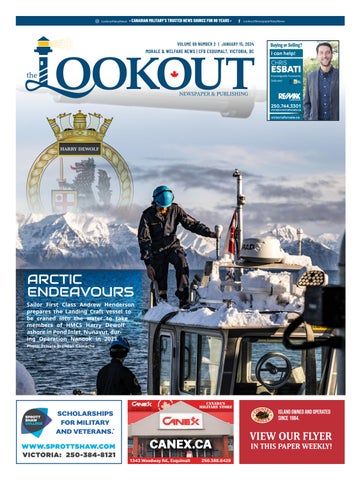
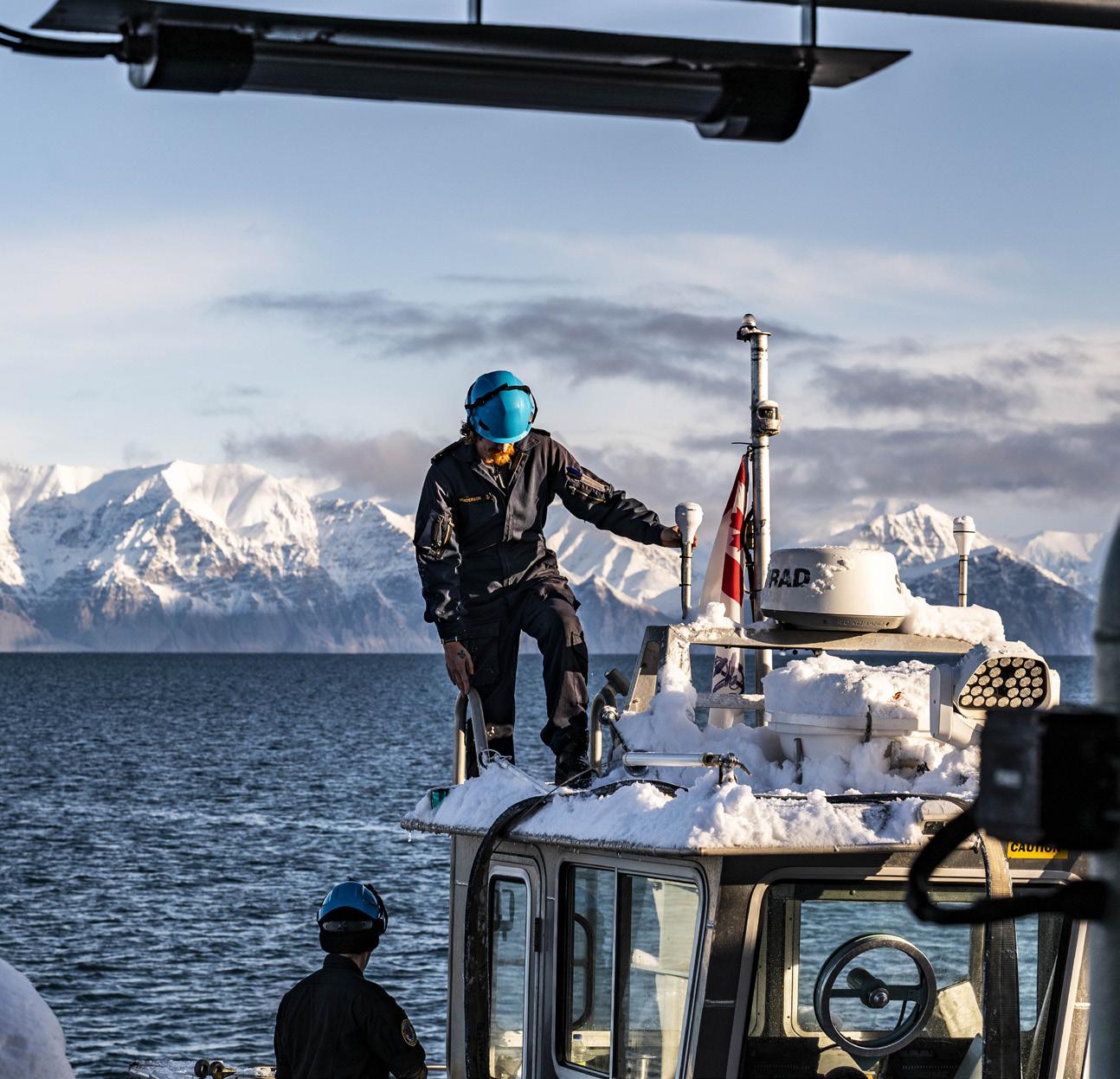
Sailor First Class Andrew Henderson prepares the Landing Craft vessel to be craned into the water to take members of HMCS Harry Dewolf ashore in Pond Inlet, Nunavut, during Operation Nanook in 2023.
HARRY DEWOLF
Photo: Private Brendan Gamache
Peter Mallett Staff Writer
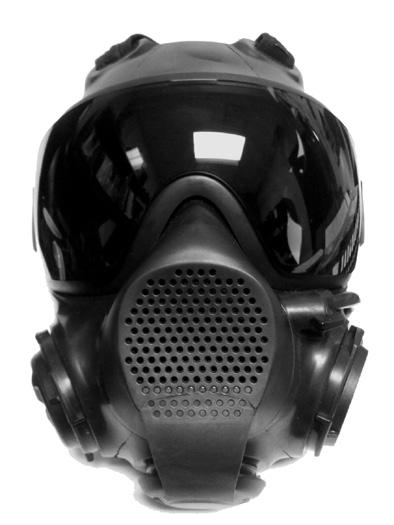
A made-in-Canada invention is poised to make respirators used in Basic Military Qualification (BMQ) training more inclusive for all Canadian Armed Forces (CAF) members.
The final testing phase for the C5B respirator occurred at CFB Esquimalt’s Damage Control Training Facility Galiano in Colwood at the end of November. Those leading the phase have declared the C5B respirators a technological breakthrough.
Dr. Paul Bodurtha of Defence Research Development Canada (DRDC) confirmed his team’s goal of providing a more inclusive respirator mask for BMQs is nearing fruition.
“It’s a basic question of human rights and I am happy to say we are the first nation whose military is taking this onboard and looking at how to better accommodate all members,” he said.
The mask has been received well among trial participants.
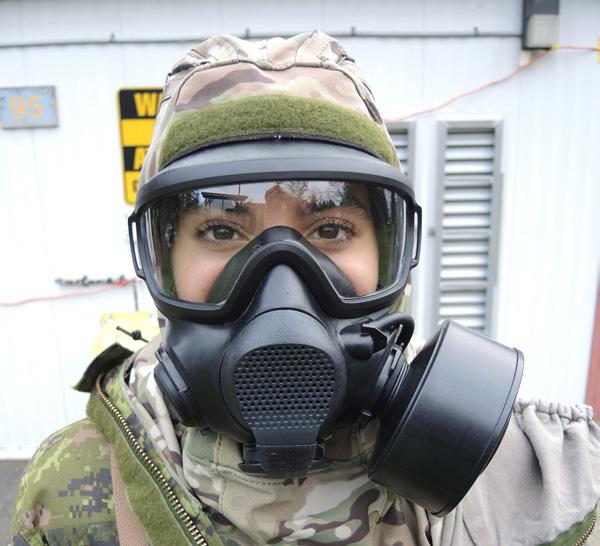
Corporal (Cpl) Ouiam Meftah, from the 35 Combat Engineer Regiment of Quebec, said she likes what she sees in the final respirator design.
“It is great to see this day and have equipment that fits everybody and that everyone can feel safe in and protected,” said Cpl Meftah. “In the past, I always dreaded going into the gas hut, but now the C5B protected me better than before.”
The combat engineer is Muslim and wears a hijab. She previously participated in three other trials.
Bodurtha says validating the C5B for operational uses by military members in combat situations will be part of phase two of the testing.
BMQ Confidence booster
Inside the Gas Hut in Colwood, 26 military members put the new respirators through a complete testing battery. Along with the C5B, they also wore long rubber gloves and standard military Chemical, Biological, Radioactive and Nuclear (CBRN) coveralls to protect them from tear gas dispersed inside the hut.
The participants ensured the typical body movements and CBRN respirator drills conducted during a standard BMQ gas-hut test will not result in any tear gas penetrating the respirator or the C5B’s protective aerosol filtration membrane.
Canada leads the way in building better fitting respirators
Major (Maj) Christian Doucet of the Canadian Army Directorate Joint CBRN Defence led military members through the trials. He says having confidence in personal protective equipment (PPE) is essential for the morale of all military members. He is happy to report it has been a success with all those involved in the final testing phase.
“Some people in our testing who have been CAF members for 30 years never had a properly fitting respirator, but now, for the first time, they smell nothing inside the gas hut,” said Maj Doucet. A team of scientists led by Bodurtha measured and recorded whether the protection in the C5B was maintained throughout, ensuring no significant amount of of tear gas had penetrated the masks. Besides the hands-on tests, members participated in multiple tabletop discussions and reviews of the new product with the scientists. They were instructed to report any irritation, smells, or other signs the tear gas had bypassed their new PPE.
The C5B is the invention of the Canadian technology company AirBoss Defense Group. Mario Champigny, AirBoss Director, says he and a team of 15 have been working on developing the mask since August 2020.
“We are very encouraged by the testing we are seeing today because it confirms all our previous testing and the lessons that have come with them,” said Champigny. “Today is the first time all of our recruits could succeed through the entire exercise required by recruits without any serious issues.”
The trial has validated the C5B can be part of BMQs training, but it is still up to the Canadian Forces Leadership and Recruit School (CFLRS) to implement the mask in training, said a spokesperson for DRDC.
After clearing the final hurdles, the C5B could be available for BMQ recruits in the late fall of 2024. Bodurtha believes the C5B also has the potential to become a piece of equipment used in combat operations, but this will require further design improvements and testing in the coming months and years ahead.
How It Works
The key design feature of the C5B respirator, says Dr. Paul Bodurtha of Defence Research Development Canada, is the hood that attaches to a standard C5 gas mask currently used in BMQs across the country. Closely resembling a beekeeper’s helmet, the hood provides an extra layer of protection to the traditional gas mask. The hood is sealed to the outside rubber seal of the gas mask and easily slides down over the top of the C5 for easy removal and storage in a carrier while not in use. The C5B also has a drawstring to tighten and seal around the head and neck to prevent gas seepage.
The hood’s protective aerosol filtration membrane works similarly to filtering facepiece respirators, such as N95s and medical face masks, removing particulates from the air. A CBRN protective hood consisting of a chemically absorbent, carbon-impregnated textile, is also worn over the C5B to further add an additional layer of protection and tightening of the C5B around the neck.
The C5B gas mask and its protective hood were specially designed for individuals with beards, religious headdresses including turbans, patkas or hijabs, long hair and abnormal facial features that do not fit within an inservice respirator.
Testing was conducted by a team of scientists from the Suffield Research Centre from Defence Research Development Canada (DRDC), the science and technology organization of the Department of National Defence, and from the CBRN Protection Group of the Royal Military College of Canada.
Trial participant Corporal Ouiam Meftah of 35 Combat Engineer Regiment displays her C5B gas mask outside the gas hut, Nov. 29, 2023, at CFB Esquimalt's Damage Control Training Facility Galiano. Photo: Peter Mallett/Lookout
MANAGING EDITOR
Jazmin Holdway jazmin.holdway@forces.gc.ca
EDITOR
Kate Bandura
WRITER
250-363-3130 kateryna.bandura@forces.gc.ca
Peter Mallett mallett.peter@cfmws.com
PRODUCTION
Teresa Laird production @lookoutnewspaper.com
Leslie Eaton
250-363-8033 leslie.eaton @lookoutnewspaper.com
ACCOUNTS/RECEPTION
Trina Winters
ADVERTISING
Joshua Buck
Impulsively Impulsive?
250-363-3127
778-977-5433 military.base.advertising@gmail.com
EDITORIAL ADVISORS
Capt Christopher Dubé
Ashley Evans
Rodney Venis
250-363-4006
250-363-7060
Published each Monday, under the authority of Capt(N) K. Whiteside, Base Commander.
Le LOOKOUT est publié tous les lundis, sous l’égide du Capv K. Whiteside, Commandant de la Base.
The editor reserves the right to edit, abridge or reject copy or advertising to adhere to policy as outlined in PSP Policy Manual. Views and opinions expressed are not necessarily those of the Department of National Defence.
Le Rédacteur se réserve le droit de modifier,de condenser ou de rejeter les articles, photographies, ou annonces publicitaires pour adhérer au Manuel des politiques des PSP. Les opinions et annonces exprimées dans le journal ne réflètent pas nécéssairement le point de vue du MDN.
Circulation: 2,000 plus online engagement per week Follow us on Facebook, Twitter and Instagram to join our growing social media community.
A Division of Personnel Support Programs
CFB Esquimalt, PO Box 17000 Stn. Forces Victoria, BC V9A 7N2 Web: www.lookoutnewspaper.com Fax: 250-363-3015
Canadian Mail Product Sales Agreement 40063331
We’ve all been subject to our whims, instantaneous urges that percolate to the forefront of our conscious mind. When these arise, we often press forward without reflection. When we think of impulse, we often think of thoughtless actions; for example, when we start to feel the pangs of silence around us, we impulsively grab our phones to fill the void. However, there is more to impulse than just the result of action.
Impulsivity has two distinct characteristics: acting without appropriate deliberation, and disregarding potential long-term gain for short-term gratification. Impulse pressures us to follow through with what we want, and we obey.
Most of us don’t recognize we are
in the grips of our impulses. We continuously follow our urges aimlessly, with little regard for long-term consequences. After a while, perpetually submitting to whims leads us to become driven by hapless desires. We develop an inability to delay gratification, which leads us to fill our mind, body, and soul with vacuous delights. We often think of impulse as a behavioural follow-through of an action. However, we can also be impulsive in a psychological sense, such as when we are critical of ourselves. We might feed ourselves a narrative that we aren’t good enough, or we can’t reach our potential, and if we did, we wouldn’t be worthy of it.
We must be aware of our impulses. An excellent place to start is to reflect upon our past moments of impulse. Look back to times when a sense of spontaneity guided you and see how that decision affected you over time –follow the single thread as far as you think is relevant.
Once you’ve completed an internal review, consider why you followed through with the impulse. Was it because you needed an injection of
excitement? Were you going through struggles with the people closest to you? Were you feeling down that day and looking for something to pull you out of it? Once you know the conditions, you can recognize the setting in which your impulse usually fires. The goal with impulse control or deferring gratification is to eventually become aware of the impulse’s crossroads, to know when we must slow down when our urges rise and consciously make a choice. That is when we disarm the impulse because we have allowed ourselves to choose and make time for deliberation. Reflection of the impulse has the potential to offset the pressure through reason, intuition, sensation, and emotion
Thomas Goenczi is an RCN veteran and MA Clinical Counsellor with Private Practice: Well Then Therapy.
The content is not intended to substitute professional advice, diagnosis, or treatment. Always seek the advice of your mental health professional or other qualified health provider with any questions regarding your condition.
Thomas Goenczi Lookout contributor
A heartfelt farewell to an incredible veteran
Peter Mallett Staff Writer
The rack of medals attached to Murray Edwards’ green service jacket sparkled and glistened in the afternoon sun like precious diamonds.
Members of Princess Patricia’s Canadian Light Infantry (PPCLI) past and present stood with Edwards’ friends beside the Second World War and Korean War veteran as he received his PPCLI 90th Birthday Certificate.
That award ceremony was a poignant moment to appreciate Edwards, explains his best friend, Commander (ret’d) Peter Chance.
Edwards served during the Second World War, the Korean War and the Battle of Kapyong, followed by Cyprus and the Six-Day War in the Middle East. He retired in 1969 and moved into Broadmead Care’s long term care home for veterans in 2015, shortly after a stroke.
On Oct. 14, 2023, Edwards passed away of natural causes at 103 in his home at Veterans Memorial Lodge in Saanich. Approximately 150 people, including friends, family, Veterans Memorial Lodge staff, and residents, gathered for a memorial service for Edwards on Nov. 7 at Victoria’s Christchurch Cathedral.
Remembering Murray
The Lookout sat with Chance at his home in Sidney to reflect on Edwards’ impressive career.
“Murray and I were among the last Second World War veterans,” said Chance, 103. “All our contemporaries are gone, and nobody else I know is left.”
Chance has an incredible military legacy, too. His 30-year-career in the Royal Canadian Navy included
service in the Battle of the Atlantic, the longest continuous military campaign of the Second World War, and service aboard various warships, including HMCS Skeena, HMCS Seacliffe, and HMCS Gatineau.
Chance and Edwards became instant friends back in 1975. Edwards volunteered with the Cadet Corps program at CFB Esquimalt while Chance worked for the Duke of Edinburgh’s Award. Chance came looking for support at the Base and said that before he could blink, the program had the support of the Rear Admiral because of Edwards.
“We saw eye-to-eye on so many things and were always very simpatico,” said Chance. “Murray was a very warm-hearted soul and we had been kindred spirits for so many years.”
Army, was selected for officer training, and was promoted to Lieutenant upon graduation.
Edwards spent much of the war training other soldiers as a member of the 2nd Battalion of the Queen’s Own Rifles, stationed in Aldershot, N.S. He was then appointed Intelligence Officer for the Pacific Brigade. He admitted that having a job where he never saw combat duty likely saved his life.
The promptness and diligence were unsurprising as Chance got to know Edwards over the years. According to Chance, Edwards was brilliant and dependable in getting the job done.
Second World War
Edwards was born in Cambridgeshire, England, and in his early years relocated with his family to East Orange, New Jersey. Edwards was old enough to recall attending a parade for American Civil War veterans.
As the Second World War raged, he started military service. In June of 1942, Edwards travelled to Toronto to enlist in the Canadian
Edwards would, however, face his share of peril on the front lines of a different war less than a decade later.
After the Second World War, Edwards left the military briefly to work for Canada Post, but his civilian career didn’t last long. He reenlisted in Canada’s newly created Korean Special Force in 1950 and became part of PPCLI. After five months in Korea, he was appointed Battalion Field Quartermaster at Tactical Headquarters.
A Writer's Hand
Since his childhood, throughout his military service and retirement, Edwards was seldom seen without a book in his hand. He was a great storyteller and remembered as such by Veterans Memorial Lodge employee and friend Shannon Donnelly. ‘Bookish’ is also the way many others remembered him.
“He was an incredible man with an incredible intellect,” said Chance. “He was an excellent researcher who produced several instruc-
tional books over the years and was a great teacher and communicator.”
Many years after he returned from Korea, Murray published two books with thorough, detailed and historically accurate accounts of the events encountered by his battalion during the Korean War. They included the Battle of Kapyong, where Edwards and PPCLI’s Second Battalion received the United States Presidential Unit Citation for Gallantry.
His booklets describe Canada’s battle plans, complete with photos of training, tactics and equipment. More importantly, they added the critical ‘boots on the ground’ perspective and the many challenges Canadian soldiers faced in Korea.
They also include Edwards’ blow-by-blow account at Kapyong and the nightmare that unfolded on Hill 677 in April 1951. Kapyong is now seen as a defining moment in Canadian military history, where 700 Canadian troops were vastly outnumbered by the advancing North Korean and Chinese soldiers, an estimated 60,000 enemy troops marching on Allied lines.
“It’s a historical record, and I successfully persuaded him to send book copies and his documents to the National War Museum,” said Chance.
Throughout Edwards’ accounts of Kapyong and the war, his writing always focused on what others in PPCLI faced. And yet, Murray seldom wrote about himself, says Chance.
“That’s the type of man Murray was, and his care and concern for others is what I think people will remember him most for,” said Chance. Life still goes on for Chance, but he admits all his current affairs pale compared to his time with Edwards.
Major (retired) Murray Edwards Rest in Peace
October 14, 2023
Life after 100
In a recent interview, Edwards reflected on his friendship with Chance, PPCLI and all members of Canada’s military.
“They are the essence of my military family as we are one and support and care for each other,” he said. “We look after our own people, and it is that support that keeps us going when times are tough.”
Major (ret’d) Murray Edwards’ response to receiving his 90th Birthday Certificate captured the hearts and feelings of all in attendance.
“I’ve got a lot of medals here, but they don’t mean half as much to me as this certificate,” said Edwards. “These medals came from the government and the United Nations, but this award came from my fellow Patricians and that is all I could ever ask for.”
At his side, Chance instantly exclaimed, “Well put, Murray!”
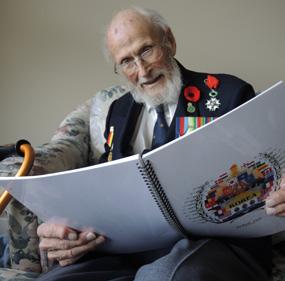
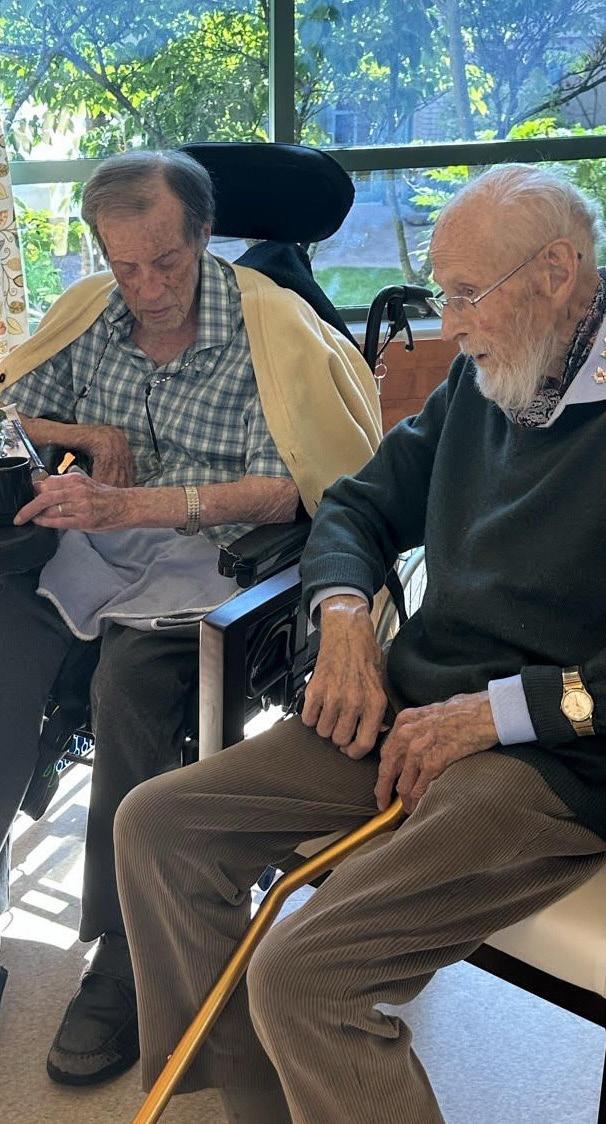
(left) Major (retired) Murray Edwards and Commander (retired) Peter Chance get together at Veterans Memorial Lodge. Edwards, a Second World War and Korean War veteran passed away on Oct. 14. He was 103.
Photo: Paul Seguna/CFB Esquimalt Naval and Military Museum
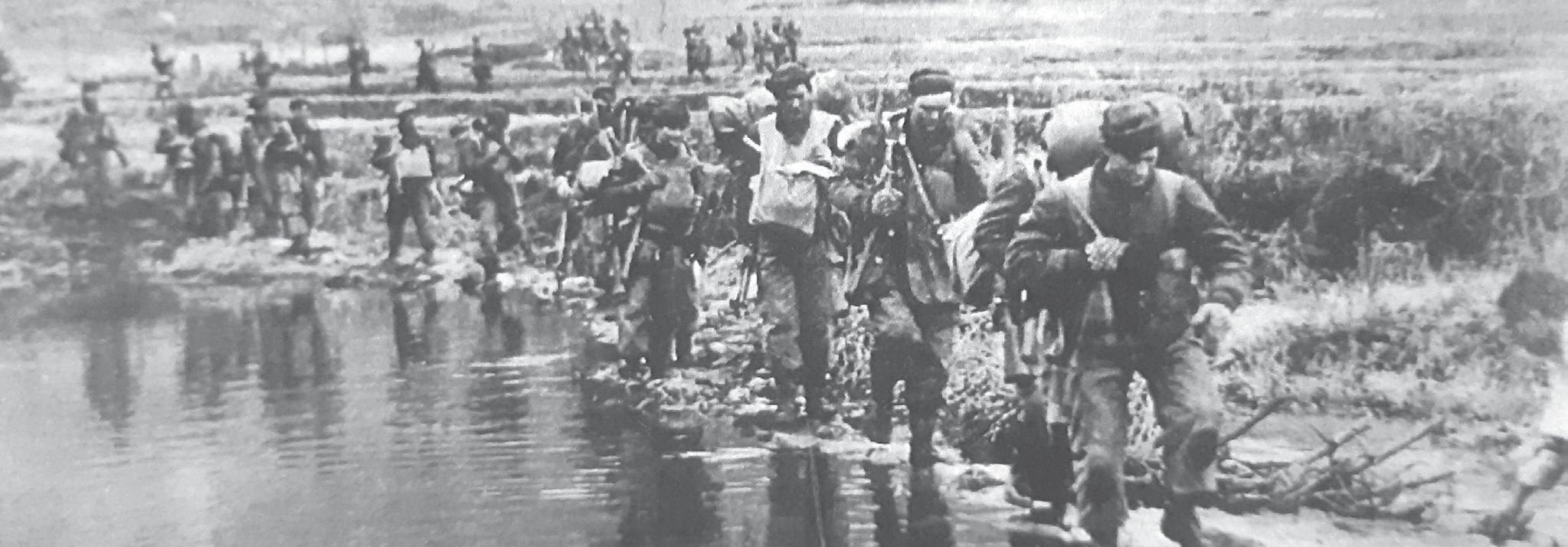
PPCLI and the platoon of then-Lieutenant Murray Edwards during an advance in early March 1951 during the Korean War. Photo provided
(inset) Commander (ret'd) Peter Chance reads a copy of Murray Edwards' book on the Korean War while discussing the life of his close friend at his home in Sidney.
Photo: Peter Mallett/Lookout Newspaper
New Museum painting, a nod to the past
HMS Griffin returns to homeport
Peter Mallett Staff Writer
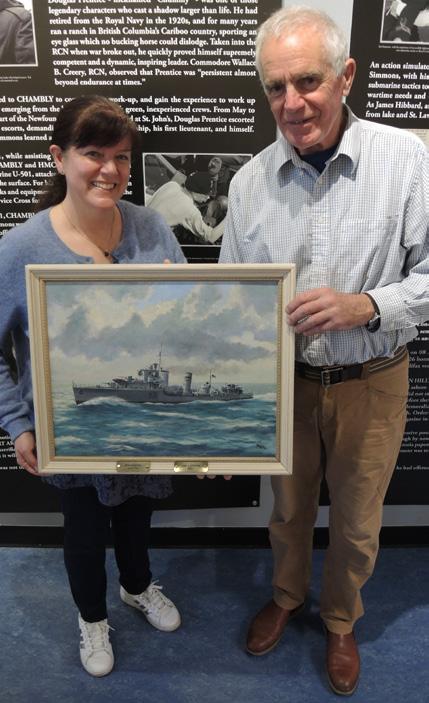
CFB Esquimalt Naval and Military Museum now boasts another great addition to its collection: a historic painting of the Royal Navy (RN) vessel HMS Griffin.
The acrylic on canvas rendering of the Griffin is the creation of Hugh Knollys, former Royal Navy (RN) LieutenantCommander and marine artist who died in 2006.
The painting was presented to Tatiana Robinson, Curator of the museum, by Alan Dennis, whose father, former RN Commander (Cdr) John Alexander ‘Alec’ Dennis, was a good friend of Knollys.
“The painting has been in our family for decades, but I know my father would be happy to know it has made its way back to the Navy,” said Dennis.
The Griffin was a G-class destroyer commissioned for Britain’s Royal Navy in 1936. The ship became an escort destroyer for the Royal Canadian Navy (RCN) and was renamed HMCS Ottawa in April 1943.
Knollys became friends with John Dennis while attending Britannia Royal Naval College at Dartmouth in 1931. Dennis
is unsure how the painting made its way to the family but thinks his father either commissioned Knollys or he gifted it to his father.
Robinson said initial conversations about the painting began with Dennis in the summer of 2023, and she was delighted to accept the painting into the museum’s collection.
“The museum is delighted to add this wonderful painting to our collection,” she said. “It really captures the true essence of HMCS Ottawa H31 (originally HMS Griffin) at sea while celebrating the legacy of the Royal Navy and its strong ties to the RCN.”
Cdr Dennis served 27 years in the RN before retiring in 1957 and immigrated to Canada shortly after. During the Second World War, he served in naval destroyers Griffin, HMS Savage, and HMS Valorous. Following the war, he served in minesweeper HMS Tetcott. He passed away in 2008 at the age of 90.
“HMS Griffin was considered a lucky ship and the only one of its flotilla to survive the war, so I hope the same good fortune for Ottawa on its sails,” Dennis said.
CFB Esquimalt Naval and Military Museum is open Monday–Sunday from 10 a.m.–3:30 p.m.
The Museum is situated inside the Naden Gate, and visitors must present a government-issued photo ID before entering. Once inside the gate, the blue arrows on the road will guide you to the Museum.
To learn more, visit, navalandmilitarymuseum.org.
Alan Dennis presents a painting of Royal Navy vessel HMS Griffin to Tatiana Robinson, CFB Esquimalt Naval and Military Museum Curator, Nov. 17.
Photo: Peter Mallett/Lookout
25 years of giving
Peter Mallett Staff Writer
The sailors of HMCS Regina brightened up another holiday season for young patients at Victoria General Hospital (VGH) with a large delivery of toys.
This year’s 25th annual fundraiser for the VGH Child Youth Family Department saw $4,000 worth of toys and gift cards donated by the ship through the Dave Barber Charity. This foundation honours the memory of Master Sailor (MS) Dave Barber, former HMCS Regina Fire Control and Radar Technician, who died of Leukemia in 1997.
MS Zachary Kowalchuk, a Fire Control Maintainer at HMCS Regina, organized this year’s charitable initiative. He says playing Santa and spreading some joy to youth undergoing medical treatment is a big pay-off for him and the ship’s company.
“The hospital staff were overjoyed with the donation and appreciative of our efforts when we dropped the toys off at the hospital. We know the children loved their gifts,” said MS Kowalchuk.
VGH staff provided the
crew with a wish list for the children, and it was up to them to do the shopping and toy drop-off. The first toy delivery occurred in early November, with a second batch donated in early December. Gifts included virtual reality headsets, Lego, Barbie dolls, various superhero toys, books, and gift cards from Amazon, Sephora and Starbucks, all items the children and youth had hoped for.
MS Kowalchuk and his shipmates were involved in many initiatives to bring this fundraiser to light. One of the more significant efforts involved organizing a charity golf tournament in the fall at the Metchosin Golf and Country Club, led by MS Kowalchuk and Sailor First Class Billy Turner. The turnout of 70 participants included current and former Royal Canadian Navy members and friends of Dave Barber.
Donations from the Ship’s Company and its three messes also contributed to the campaign, as were proceeds from weekly barbecues hosted yearly by Naval Fleet School (Pacific).
MS Kowalchuk extended a special thank you to MS Kayleigh Ferris, who has puts in a lot of work to maintain the BBQ at NFS(P).
(L).
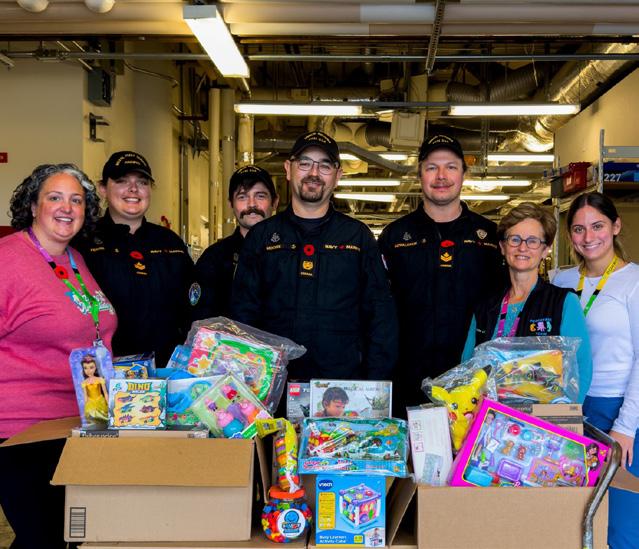
Angela Morehouse (left), Diane Edwards (second from right) and Daniella Palmieri (right), Victoria General Hospital Child Life Department Staff, accept a $4,000 delivery of toys and gift cards from Master Sailor (MS) Kayleigh Ferris of Naval Fleet School (Pacific) and HMCS Regina members Sailor First Class Billy Turner, Chief Petty Officer Second Class Trevor Moore and MS Zachary Kowalchuk. Monies raised for the donation came through the ship's Dave Barber Charity, named in honor of the ship's former Fire Control and Radar Technician who died of Leukemia in 1997. Credit: HMCS Regina
Hull Technician trade evolution
Butch Boucher
CPO2 (ret’d) Hull Technician
The Hull Technician trade has seen significant developments since its birth, and yet its importance to the Royal Canadian Navy’s (RCN) operational readiness remained steadfast throughout all changes.
In the 1950s, the RCN launched the ‘Direct Entry Petty Officer Program’ to recruit Naval personnel based on their civilian tradesman skills. As such, tradespeople with journeyman status (such as shipwrights, carpenters, railway carmen, welders, blacksmiths, plumbers, painters and sheet metal workers) joined the Hull trade as Petty Officer Second Class (PO2) Shipwrights. The decade also saw the introduction of the 39-month Technical Naval Apprenticeship Plan, which also trained Hull Technicians and other trades graduating at the rank of PO2 Hull Technicians.
In January 1960, the RCN developed and implemented a new trade structure, and the Hull Technician trade was born as a result. Training courses included formal phases of academics, 'Nuclear Biological Chemical Defence,' welding, fibreglass and plastic repair, sheet metal, plumbing, blacksmithing, painting, ship’s carpentry, ship’s husbandry (maintenance, cleaning, and general upkeep of the hull, rigging, and equipment of a ship), and ship’s construction.
In 1960, those entering the branch as Ordinary Seaman in both Trade Group One and Trade Group Two tradesmen were issued the plumber’s badge. Upon completion of Trade Group Three, tradesmen replaced the plumber’s badge with the shipwright badge. Interestingly, the Direct Entry Petty Officers automatically wore the shipwright badge as did the Technical Naval Apprentices. When the new trade structure took effect, the old plumber’s badge became the official Hull Mechanics trade badge (HM1 and HM2),
and the old Shipwright badge (crossed axe and hammer) became the Hull Technicians trade badge (HT3 and HT4).
The apprenticeship recruitment effort of the 60s exceeded expectations and successfully trained so many PO2s that in the late 1960s, the RCN passed a decree stating that Hull Technicians, with the exception of the last few courses, will graduate at a more junior rank of Leading Seaman instead of PO2.
In 2017, the Hull trade was amalgamated with the Electrical and Marine Engineering trades to form the combined trade of Marine Technicians (Mar Tech).
Regardless of the official name or training program, the Hull trade will always carry out the necessary onboard maintenance and oversee new construction and refits within the shipbuilding industry. Hull Technicians, also known as ‘Shipwrights’, express appreciation for their trade through short poetry:
In the beginning, God created the heavens, the earth, the seas, and the trees.
Looking at his creation, God thought it was good, but something was missing, so he created the Shipwright.
The Shipwright seeing all the trees, set out to build a boat to travel the seas.
God looked upon the boat and was pleased.
Each year, Hull Technicians gather to celebrate their trade during the holidays. This season, the Hull Technician Holiday Party had record attendance with retired veterans all in their 80s who joined the trade in the 50s. All were pleased to re-unite with so many old shipmates, many whom they have not seen for many years.
The author wishes to thank Ed Paquette and Chuck Scammell for their contributions.
CLASSIFIED ADS
RENTALS
Cook Street Village 1 bedroom suite available Feb. 1. Quiet, clean, hardwood floors, in a well maintained apartment building. Heat and hot water included. No pets, no smoking, one year lease. $1,700 per month. Call 250 588 5457.
PARTIALLY FURNISHED 2 bedroom suite available Feb. 1, $2,150 per month includes utilities. Great for Royal Roads, UVic, Camosun Interurban, VGH, CFB Esquimalt and Naden. Bright living area in the first floor of family home with large windows and laminate floors, off street parking for 1 vehicle. No pets, no smoking. For additional details, please contact Sean at hayes.dsi@gmail.com // 250-516-3282
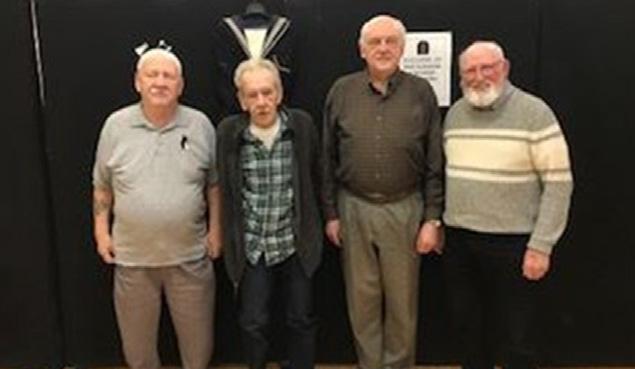
Don Bendall graduated from the Technical Naval Apprenticeship Plan in 1957; Sandy Graves graduated from the Hull Mechanic Program in 1960; Darwin Robinson graduated from the Technical Naval Apprenticeship Program (TNAP) in 1959; and John Davoren graduated from the TNAP in 1959. Photo taken at the Hull Technician Christmas Gathering on Dec. 7, 2023.
Celebration of music, generosity, and community spirit
also their leadership and organizational skills to bring the concert to life. Both are dedicated members of the HMCS Tecumseh Band and the National Band of the Naval Reserve.
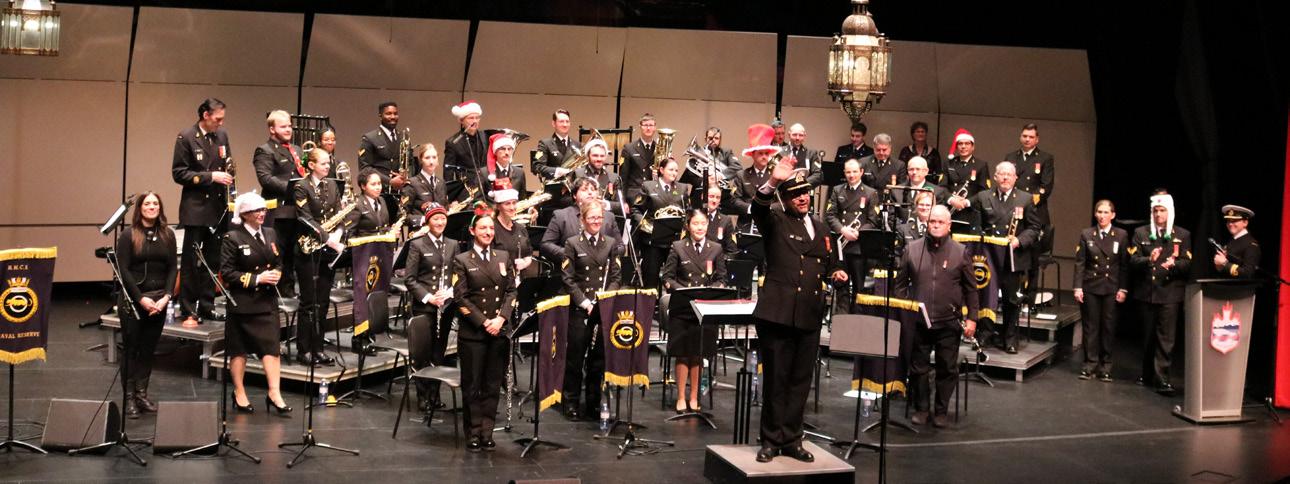
His Majesty’s Canadian Ship (HMCS) Tecumseh Band teamed up with the National Band of the Naval Reserve guests to orchestrate a magical holiday concert at the Webber Academy Performing Arts Theatre in Calgary this holiday season.
The performance marked the centennial of the Naval Reserve and HMCS Tecumseh, and the 23rd edition of their annual festive celebration.
This was also the first time the concert took place in an auditorium, stepping away from the familiar grounds of the parade deck of HMCS Tecumseh
The 23rd annual HMCS Tecumseh Band’s holiday concert was a spectacular, family-friendly event showcasing the musical talent, community spirit, and generosity of Calgarians. The response from the community was overwhelming as the tickets were sold out before the concert on Dec. 3. The live stream allowed a global audience to partake in the joyous celebration and contribute to the cause.
Master Sailor (MS) Brandi Sidoryk together with MS Lisa Foggin contributed not only their musical talents but
MS Sidoryk, as the show’s producer, curated a diverse program that showcased the band’s versatility. The concert featured a concert band, jazz band, flute ensemble, vocalists, and a brass ensemble, captivating the audience both in the theatre and online with Christmas classics such as Let It Snow, Let It Snow, Let It Snow, Feliz Navidad, I’ll be home for Christmas, My Favorite Things, and O Holy Night, as well as A Centennial Celebration, Wavy Navy, Marching Upon the Seas to celebrate the Centennial of the Naval Reserve and HMCS Tecumseh. During the intermission, families could place candy canes on a giant Christmas tree and take pictures with Santa and Mrs. Claus.
MS Foggin spearheaded the collection of donations for the Veterans Association Food Bank (VAFB). She inspired concert attendees to open their hearts and wallets to support the VAFB. The audience’s generosity was overwhelming, with approximately $1,500 collected in cash and online donations during the concert. Commander Andy Paschke, Commanding Officer of HMCS Tecumseh, presented the cash donations to Mr. Charles Redeker, the President of the Calgary VAFB.
Following the concert, members of the HMCS Tecumseh Band, under the guidance of MS Foggin, loaded up a van with donated goods and delivered them to the VAFB. The association, run by Veterans for Veterans, provides essential support to military and frontline emergency personnel, regardless of their service status.
The VAFB, dedicated to serving those who served the nation, relies on financial support and donations to fulfil its mission. The generous contributions from the concert will help purchase perishable items and provide much-needed assistance to veterans and frontline heroes.
“We are grateful we could play a small role in helping them out,” shared the band. The heartfelt support aligns with the Food Bank’s commitment to treating clients with dignity and respect, ensuring they receive the necessary assistance.
The HMCS Tecumseh Band’s commitment to music, community, and philanthropy resonates with Calgarians. The 23rd edition may have been a departure from tradition, but it certainly reinforced the band’s enduring spirit and its dedication to making a positive impact, both in the world of music and in the lives of those they seek to support.
SLt Gulshan Sharma HMCS Tecumseh
HMCS Tecumseh’s Band, including guests from the National Band of the Naval Reserve, conclude the Centennial Christmas concert on Dec. 3 at the Webber Academy Performing Arts Theatre in Calgary, Alta. Photo credit: Master Sailor Janeil Lentz, Unit Public Affairs Representative, HMCS Tecumseh
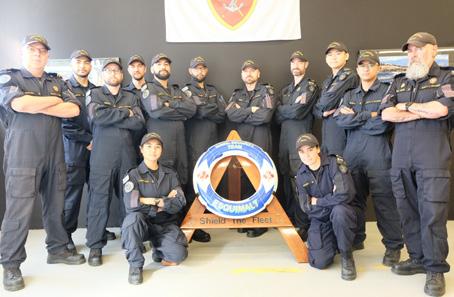
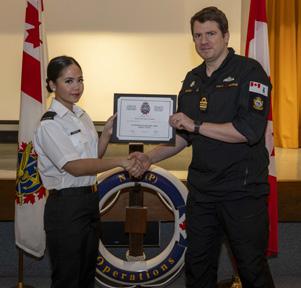
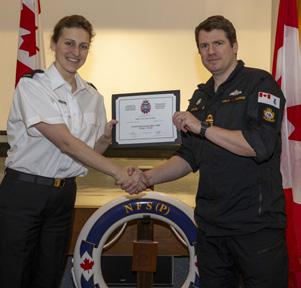
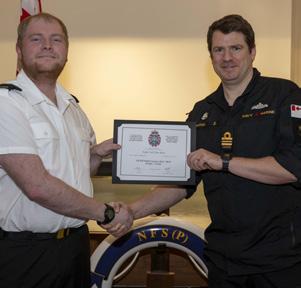
BRAVO ZULU Naval Security Team
Naval Fleet School (Pacific)
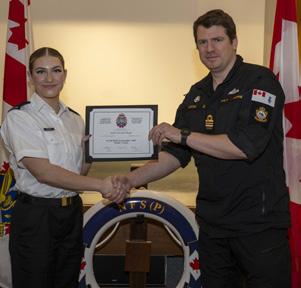
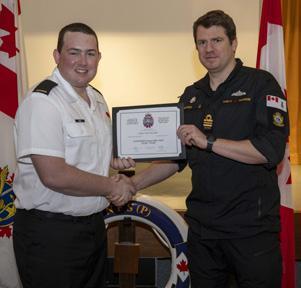
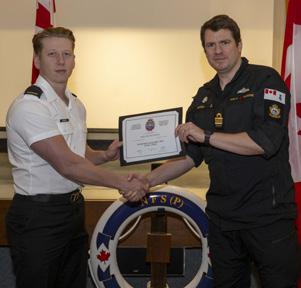
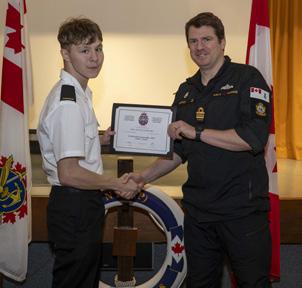
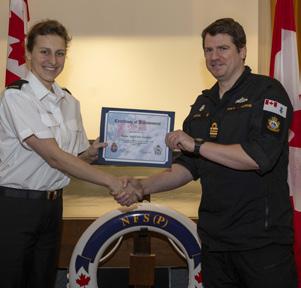
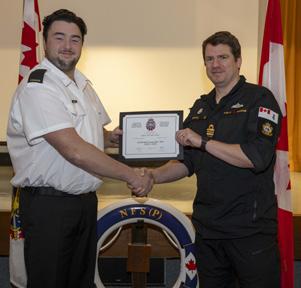
Qualification Level Three Naval Combat Information Operator course graduation ceremony, Nov. 30, 2023.
All photos: Corporal William Gosse, MARPAC Imaging
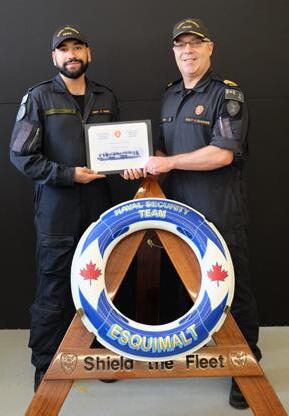
NST awarded Certificates of Military Achievement in a recent ceremony.
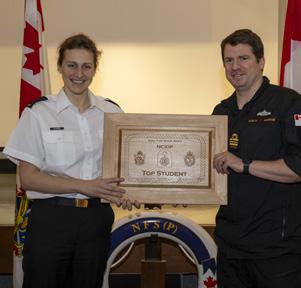
Sailor Third Class Soubry receives a plaque for achieving top candidate.
Sailor Third Class Waugh receives a certificate for completing the Qualification.
Sailor Third Class Hale receives a certificate for completing the Qualification.
Sailor Third Class Sumera receives a certificate for completing the Qualification.
Sailor Third Class Gorkavenko receives a certificate for completing the Qualification.
Sailor Third Class Soubry receives a certificate for achieving top student.
Sailor Third Class Lillew receives a certificate for completing the Qualification.
Sailor Third Class Costales receives a certificate for completing the Qualification.
Sailor Third Class Soubry receives a certificate for completing the Qualification.
Sailor Third Class Rees receives a certificate for completing the Qualification.
in POWELL RIVER, BC, CANADA
Sunshine Coast Health Centre and Georgia Strait Womens Clinic are registered B Corp, licensed, and accredited mental health facilities that use an evidencebased, non-12-step, meaning-centred, strengths-based approach that interconnects all our services and therapies including medical withdrawal, anger management, rTMS, trauma therapy, and PTSD treatments.
Our gender-speci c* programs provide a safe space for clients to get help with underlying issues driving trauma, mental health su ering, or addictive behaviour that can be hard to address in co-ed environments. Moving beyond a focus on abstinence and symptom reduction allows clients to experience the full, transformative bene t of our treatment programs.
*Individuals a end the program with the gender they identify as or, for gender uid and non-binary individuals, the program they are most comfortable and safe in. Our admissions coordinators will work with prospective clients to determine which program is the best t.