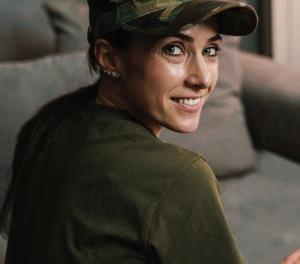
Q. How do you balance being a father at home and a leader at the Base? Can you share some strategies you use to manage both effectively?
A. It’s not easy and is something that requires constant focus. I am fortunate to have an incredible spouse who is an absolute superhero, who has somehow found a way to raise our three awesome kids while I have been away at sea for so many years. This posting has allowed me to be in the same location as them and afforded me the ability to eat dinner at home as a family a few nights per week, which has been a gift to us all. My advice being, when afforded the opportunity to be at home with family, be present.
Q. How does your family support you in your military career, and how do you involve your family in Base activities and events?
A. As my incredible spouse reminds me, I am a teacher’s husband, she is not a military spouse. While this may seem light-hearted, it is important to
CFB Esquimalt Base Commander
Captain (Navy) Kevin Whiteside
Father’s Day Edition
note. My spouse and I have always endeavoured to support each other in our careers, although the demands of service do not always allow for equity in this support. The biggest way I feel I have been able to support her is to listen when she needs an ear, while aiming to communicate any schedule changes as early as possible to maintain a family plan. We are not perfect, nobody is, but I would not be here today still in uniform if I did not have such a resilient and supportive family who understand the needs of service.
Q. What are some key lessons you’ve learned from being a father that you apply in your leadership role at the Base? Conversely, are there lessons from your military career that you bring into your role as a father?
A. Be humble, be kind, listen to the needs of others, face adversity head on, and overcome challenges as a team. Admit your mistakes and try to make every day incrementally better than the one before.
Q. Does your family have any special traditions or rituals for Father’s Day, particularly given the unique circumstances
of military life? What does this day mean to you personally?
A. Rare is it that I am home for Father’s Day. Usually, I receive an email while at sea. But, when I am here for the day, we spend time together at the beach with our dogs and head out for a meal or have a family BBQ; and of course, we try to take part in the Navy Run which usually happens on or about that day! This year it’ll be on June 22nd.
Q. If your kids could describe you as a superhero based on your role as both a father and base commander, what superpowers do you think they would say you have, and what would your superhero name be?
A. According to my kids, my superhero name would be ‘Duplicating Dad’ and the superpower would allow me to be in two places at the same time: at work and at home!
Q. Bonus: What is your go-to ‘dad’ joke that never fails to make your kids groan/ laugh?
A. How does the ocean say hi to ships? It waves!
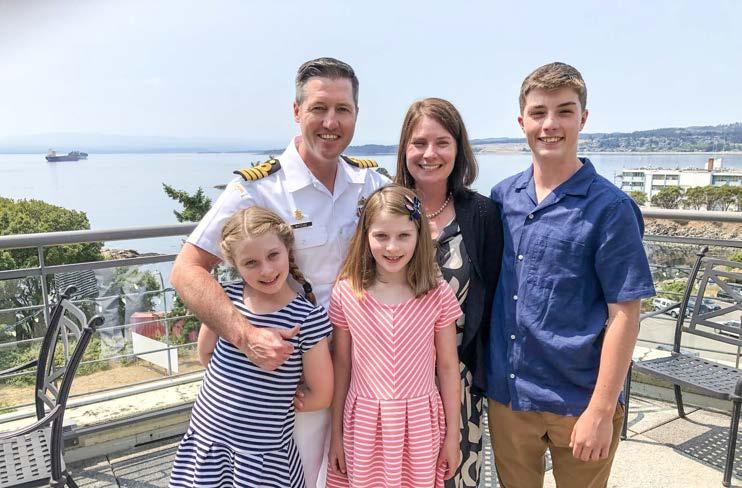
Captain (Navy) Kevin Whiteside with his family.
Naval Training Group turns ten!
“Everyone in the Royal Canadian Navy (RCN) shares the same professional goal: to force generate maritime capabilities for employment at the direction of the Government of Canada,” said Commander (Cdr) Darren Sleen, Commander Naval Training Group (CNTG), during a recent address.
The assembly of military and civilian members gathered at Work Point’s Nixon Building to commemorate the creation of Naval Training Group (NTG) on June 11th a decade earlier.
Today, NTG employs approximately 1,000 military and civilian personnel at its modest headquarters and across four training establishments in Halifax (Naval Fleet School (Atlantic)), Quebec (Naval Fleet School (Quebec)), and Esquimalt (Naval Fleet School (Pacific) and HMCS Venture).
“We have made many incremental improvements over the past ten years,” said Cdr Sleen, “and will continue striving to improve our efficiency and effectiveness”.
NTG is the principal organization responsible for developing and delivering individual training and education across the RCN. Its mission is to enable and equip all personnel with the knowledge, skills, and leadership attributes essential to Canada’s Navy. That translates into roughly 8,000 training sessions annually.
The event coincided with the start of National Public Service Week (June 9-15).
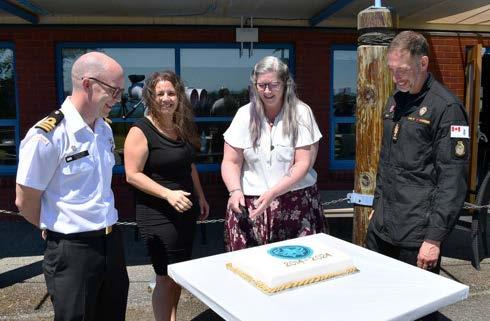
Appropriately, Cdr Sleen thanked NTG’s civilian Defence Team members and acknowledged the service of two original members, Laura Brackenbury and Josée Lafontaine, who were invited to perform the ceremonial cake cutting.
“Being a part of the NTG leadership team since its creation has been highly rewarding,” said Josée Lafontaine, Head of Department: Group Services. “I am proud to have contributed to the progress we’ve made collectively over these past ten years. There certainly have been challenges coordinating the programmes of four geographically dispersed training establishments, but we are better managed today than any point in our history.”
“I tell people there’s never a dull day at work,” said Laura Brackenbury, Head of Department: Training Technologies. “Training infrastructure is the key component for success. The past decade has largely been an effort towards recapitalization and digitization of aging facilities; however, the next ten years will emphasize the introduction of new vessel platforms and the trainers and schoolhouse required to prepare our sailors for what’s ahead. From Arctic and Offshore Patrol Ships to Joint Support Ships to Canadian Surface Combatants –the future is fast approaching and exciting.”
“There are several values we espouse in the military and your service over the past decade exemplifies excellence, accountability and loyalty,” stated Cdr Sleen. “Like most endeavours, NTG’s successes are based on the talent, energy, motivation, and determination of our people.”
“So, Happy 10th Anniversary Naval Training Group! Your efforts help assure the continuing vitality, professionalism, and operational excellence of our navy!” concluded Cdr Sleen.
NTG Public Affairs
Commander Darren Sleen (left) and Chief Petty Officer 1st Class André Aubry (right) invite Josée Lafontaine and Laura Brackenbury to cut the cake.
Published each Monday, under the authority of Capt(N) K. Whiteside, Base Commander.
The editor reserves the right to edit, abridge or reject copy or advertising to adhere to policy as outlined in PSP Policy Manual. Views and opinions expressed are not necessarily those of the Department of National Defence.
Le LOOKOUT est publié tous les lundis, sous l’égide du Capv K. Whiteside, Commandant de la Base.
Le Rédacteur se réserve le droit de modifier,de condenser ou de rejeter les articles, photographies, ou annonces publicitaires pour adhérer au Manuel des politiques des PSP. Les opinions et annonces exprimées dans le journal ne réflètent pas nécéssairement le point de vue du MDN.
Circulation: 4,000 plus online engagement per week Follow us on Facebook, Twitter and Instagram to join our growing social media community.
A Division of Personnel Support Programs Web: www.lookoutnewspaper.com Fax: 250-363-3015
Canadian Mail Product Sales Agreement 40063331
The Editor’s Corner
A Royal Encounter
‘Canadian Fleet Pacific’ ballcap and ‘HRH’ name tag, seemed less like the distant Royalty of my youth and more like a committed member of our Defence community.
commitment, as she comes from a serving family herself.”
As I stood in the presence of Her Royal Highness, I couldn’t help but be flooded with memories of the first time I met her a decade ago. It was a crisp Remembrance Day morning when I had the privilege of escorting Princess Anne to the National War Memorial in Ottawa in her colours party. That day was marked by a profound sense of awe and formality, characteristic of a young sea cadet from an immigrant family meeting Royalty for the first time. The gap between a cadet and a princess felt enormous.
Other attendees also reflected on their own encounters with members of the Royal Family.
“I met royalty back in the 80s during the Commonwealth Games,” said Christine Richard, EMFRC Board Member. “I’m excited to meet Princess Anne in person because of her work ethic. I think she is one of the hardest workers and one of the best representatives for the Royal Family.”
Fast-forward ten years to today, and I find myself in a remarkably different yet strikingly similar context. This time, the setting was an intimate gathering with the Esquimalt Military Family Resource Centre (EMFRC), where Princess Anne’s visit was not just a formal event but a deeply personal interaction. The room buzzed with excitement and mutual respect—a testament to the shared values of dedication, service, and community between the royal family and the military community. It was a powerful demonstration of how the royal family understands and appreciates the sacrifices and contributions of our military.
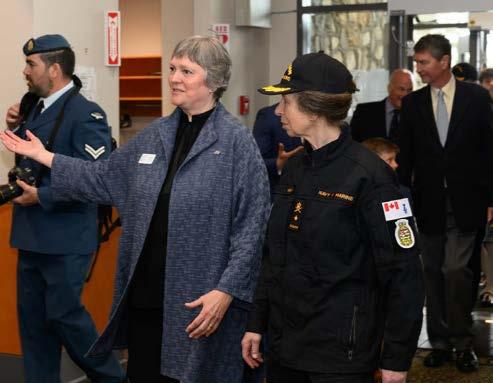
While my previous encounter was an overwhelming impression of a distant, almost mythical figure, today, Princess Anne felt approachable and engaging. This transformation is not just a reflection of my own growth but also of the shifting dynamics in royal engagements. The Princess Royal, dressed in combat dress with a
Princess Anne was genuinely interested in the stories of military families, their challenges, and the EMFRC’s support. She took the time to ask each person in the room insightful questions, and her ability to connect with everyone individually was extraordinary.
“Her Royal Highness was so gracious and spoke with everybody, and I think our people felt really appreciated,” said Jackie Carlé, EMFRC Executive Director. “Of all the places she could have visited during her visit to Victoria, she chose to spend time with our military families. And that speaks volumes to how she really understands the
I found this experience to be profoundly humbling and inspiring. Meeting Her Royal Highness as a cadet was a moment of awe; meeting her now was a moment of personal connection. As I left the event, I concluded that Princess Anne’s visit was more than just a royal engagement; it was a celebration of the strategic significance of our Pacific Fleet. Princess Anne’s presence as the Honorary Commodore-inChief of the Pacific Fleet was a powerful affirmation of our naval forces’ vital role in maintaining regional security and fostering international cooperation.
Captain (Navy) Kevin Whiteside, CFB Esquimalt Base Commander, echoed the visit’s significance.
“Seeing Her Royal Highness show up today in our combat dress I think set us all at ease, showing us that she is a person who has been doing incredible work for so many years,” he said. “This, to me, was probably the most special moment of my tenure so far.”
His words resonated with many of us, highlighting the profound impact Princess Anne’s visit has had on our community. Perhaps much has changed over the past decade, yet the core values of dedication, service, and community remain steadfast. These values inspire cadets like me to pursue careers supporting the Royal Canadian Navy, base commanders like Capt(N) Whiteside to lead with integrity and vision, and all Canadian Armed Forces members to work together toward global peacekeeping and maritime stability.
Kate Bandura Lookout Editor
Jackie Carlé, Esquimalt Military Family and Resource Centre (EMFRC) Executive Director, introduced Her Royal Highness (HRH), Princess Anne, to the EMFRC staff, Board of Directors and families during HRH’s visit to Victoria in May. Photo supplied
FMF shops hit their mark for royal 21-gun salute
Peter Mallett Staff Writer
Perched atop a bluff at Black Rock Naval Battery, a nine-member gun crew of Naval Fleet School (Pacific) fired off the traditional 21-gun salute with expert precision. The thunderous roar echoed across the Esquimalt Harbour for Princess Anne’s visit last month.
The five-pound blank casing shells detonated from the barrels of three Quick-Firing 12-pounder, 12 cwt, 3” pedestal mount guns.
Getting the artillery to properly fire and keeping it well-maintained for future uses is no small trick, explains Tim Christy, a supervisor at Fleet Maintenance Facility (FMF) Cape Breton’s Surface Weapons Work Centre, also known as Shop 162A.
“It’s always good to see the finished product in use as we never usually get to see our work in action,” says Christy. “FMF takes pride in all the weapons we maintain and do our best to supply the Navy with what they need to stay safe when deployed.”
Making sure the weapons are firing on all cylinders takes teamwork from a variety
of FMF workers and shops, whose job is to support the fleet and operations of Maritime Forces Pacific.
To ensure the 12-pounders were ‘up to snuff’ for the royal visit, workers at Shop 162A carefully stripped the guns down into a collection of parts. Then, the parts were sent over to FMF’s Chemical Cleaners Shop 125 for descaling and prep work followed by a trip to FMF’s Sandblasters Shop 111. The artillery then paid a visit to the paint and graphics department at Shop 123 to get a brand-new look. After the guns were reassembled, workers at Shop 142 (Non-Destructive Testing) made sure the firing components were safe to fire. The entire process took approximately six months to complete, says Christy.
“I am so proud of all the crews at FMF, the different experience they bring to the job and the meticulous work they do,” said Christy.
“Our shop is required to diagnose many of the repairs and maintenance we perform through phone calls, pictures and emails from different ports. We even travel to repair anything we service, and I can count on them to always get the job done.”
Shop 162A is responsible for all things
surface-weapons related, including Close-In Weapons Systems (CIWS), 57mm guns, guided missiles, harpoons, 50 caliber and remote 50 caliber mounts, MultiAmmunition Softkill Systems (MASS) launchers and Surface Off-board Passive Decoy (SOPD) launchers.
Christy notes there are also items that come into his shop with much greater historic value.
“Some of the saluting cannons that we maintain and repair for [naval] cadets are very old but in amazing condition when we leave,” said Christy. “We have taken some pretty poor conditioned guns and made them look like new, and I am always impressed with the work we do from cleaning to machining and everything in between.”
The last time the 12-pound guns were refurbished was in 2017. Christy and his crews returned to Black Rock Gun Battery on June 7 to thoroughly clean the barrels and chambers of artillery. They then wrapped up the guns in protective fabric covers, customfitted and designed by FMF’ Sail Loft 124E, to protect them from the elements.
Did you know?
In British service, “12-pounder” was the rounded value of the projectile weight, and “12 cwt (hundredweight)” was the weight of the barrel and breech, to differentiate it from other “12-pounder” guns.
The hundredweight is a customary unit of weight or mass, which has two meanings. In British imperial measurement, the hundredweight is also known as “centum weight”, while in the United States it is known as “quintal”. The two values are distinguished in American English as the “short” and “long” hundredweight and in British English as the cental and imperial hundredweight. Under both conventions, there are 20 hundredweight in a ton, producing a “short ton” of 2,000 pounds (907.2 kg) and a “long ton” of 2,240 pounds (1,016 kg).
The QF (Quick-Firing) 12-pounder 12-cwt gun was a common, versatile 3-inch (76.2 mm) calibre naval gun introduced in 1894 and used until the middle of the 20th century. It was produced by Armstrong Whitworth, Elswick and used on Royal Navy warships, exported to allied countries, and used for land service.
Happy Retirement!
The Lookout would like to thank Christine Farrington for all her support and work as Special Events Coordinator in PSP over the past decade at CFB Esquimalt and wish her the very best in her retirement.
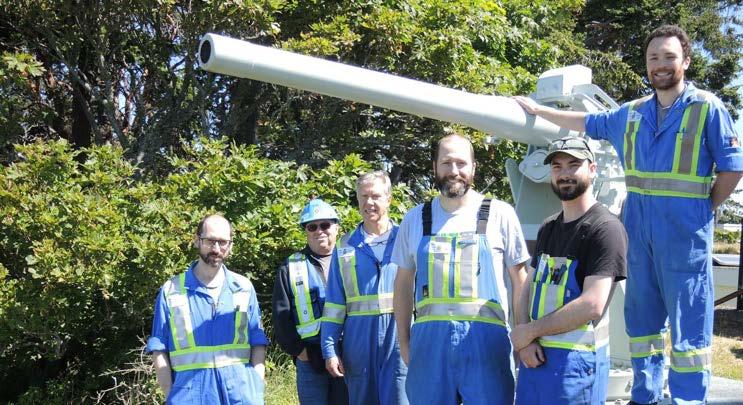
Members of FMF Cape Breton’s Surface Weapons Work Centre, Shop 162A, gather for a group photograph in front of the quickfiring 12-pounder gun located at Black Rock Naval Battery in HMC Dockyard. Photo: Peter Mallett/ Lookout Newspaper
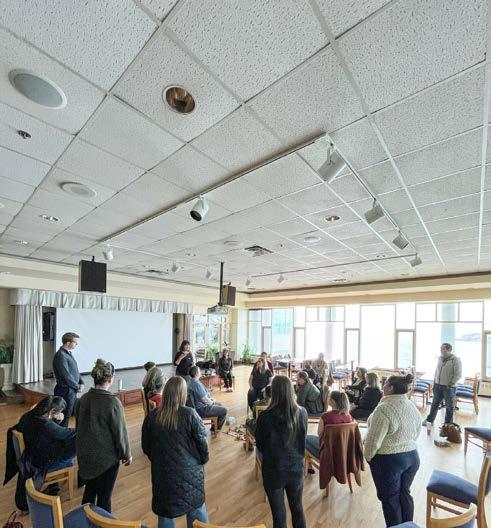
Facilitator Kathi Camilleri says it takes a village of likeminded individuals to interact, learn, heal and move forward from a traumatic past. The day-long seminar was designed as ground zero in the process of truth and reconciliation for CFB Esquimalt members.
“Participants wholeheartedly interact and deeply engage in the experience,” said Camilleri. “It’s about hands-on learning as there is no Power Point or extensive lecture.”
Camilleri says the first-hand learning
experience offers insights into the love, respect, kindness and generosity that existed in pre-contact times. Participants build a village together and learn about how these values contributed to a collaborative community. Role-playing helped participants gain a fundamental understanding of how life and relationships in Indigenous villages worked.
Captain (Navy) Alex Kooiman says the workshop was one of the most powerful learning experiences he has ever had.
“It’s hard to describe the connections you make with the lessons until you become part of the story and thereby develop an understanding to the plight of Indigenous People and their communities,” said Capt(N) Kooiman, Commanding Officer of the Canadian Submarine Force.
Andrea Lam, a Health Promotion Specialist of Personnel Support Programs (PSP), said the workshop creates a non-judgmental space for participants to engage at their comfort levels.
“The workshop was an incredibly impactful learning experience to be involved in,” said Lam. “People came with an understanding of the topic on
a cognitive level, but many said they left with a deeper emotional understanding.”
“Meeting these calls requires that people be aware of our country’s history with Indigenous Peoples and how it is all still impacting them today,” said Camilleri.
The next workshop is planned for September and will be in support of the National Day for Truth and Reconciliation.
Follow @pspesquimalt_hp on Instagram and the MARPAC noticeboard for updates and information on how to register.
On June 21, for National Indigenous Peoples Day, we recognize and celebrate the history, heritage, resilience and diversity of First Nations, Inuit and Métis across Canada.
National Indigenous Peoples Day National Indigenous Peoples Day
National Aboriginal Day, now National Indigenous Peoples Day, was announced in 1996 by Roméo LeBlanc, then-Governor General of Canada, through the Proclamation declaring June 21 of each year as National Aboriginal Day. On June 21, 2017, the Prime Minister issued a statement announcing the intention to rename this day National Indigenous Peoples Day.
The visual includes:
• The sun, represented by the date ‘June 21’;
• First Nations, Inuit and Métis as well as the four elements of nature (earth, water, fire and air), represented by different symbols and colours;
• A multicoloured smoke, reminding us of Indigenous spirituality but also the colours of the rainbow, symbol of inclusion and diversity of all First Nations, Inuit and Métis communities and their members. *Smoke is used in different ways by all three Indigenous groups in Canada. Whether it is to smoke fish and meat, to burn sage and tobacco or for sacred ceremonies or celebrations, it is a significant symbol in Indigenous culture.
• The eagle represents First Nations
• The narwhal represents Inuit
• The violin represents Métis
HMCS Calgary’s
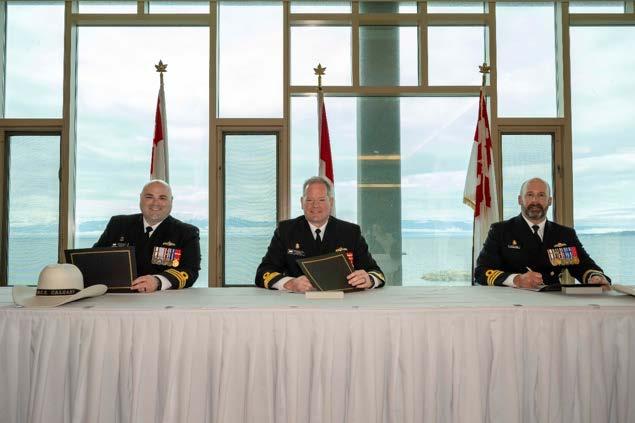
On May 13, the Officers and Crew of HMCS Calgary assembled in the Chief and Petty Officers’ Mess for the Change of Command ceremony, where Commodore (Cmdre) David Mazur presided over the transfer of Command from Commander (Cdr) Jeremy Samson, outgoing Commanding Officer (CO), to Cdr Matt Woodburn.
Calgary’s outgoing and incoming COs have much in common as they both have over 20 years of experience in the service, which includes time on both the Iroquois Class, Kingston Class, and Halifax Class ships, and have deployed and crossed paths with each other numerous times throughout their careers.
“It’s an honor to be in the position with you once again,” said Cdr Samson. “Our third time, passing the torch. First in HMCS Kingston, then HMCS Toronto and now HMCS Calgary. I don’t
think there is a more blessed pair of dating lobsters in the fleet.”
“We deployed together on HMCS Iroquois, for our D-levels, and we were in a role reversal for the change of command on HMCS Kingston I turned over Executive Officer duties on HMCS Toronto and I couldn’t be more honored to do so,” said Cdr Woodburn, sharing the sentiment.
This heartfelt exchange between them demonstrated the deep respect and camaraderie they share. Their families, present for the ceremony, were recognized for their essential and unwavering support.
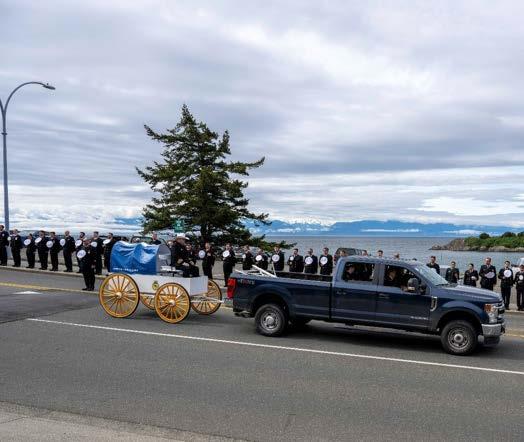
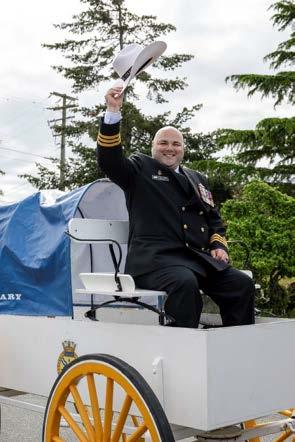
On completion of the ceremony, in true Calgary tradition, Cdr Samson was transported by Chuck Wagon to his next ship, HMCS Regina as the ship’s company cheered him on with three rousing cheers along the way.
To Cdr Samson, we wish you fair winds and following seas in your future endeavors.
To Cdr Woodburn, Calgary is wishing the warmest welcome to both you and your family!
(L-R): Commander (Cdr) Jeremy Samson, outgoing Commanding Officer (CO), Commodore David Mazur, Reviewing Officer, and Cdr Matthew Woodburn, incoming CO, sign the Change of Command papers at the Change of Command Ceremony in the Rainbow Room of the Chief and Petty Officers’ Mess on May 13.
Members of HMCS Calgary row ashore Commander Jeremy Samson (above), their outgoing Commanding Officer. Photos: Corporal Tristan Walach, MARPAC Imaging Services
Ask the Expert
An ‘Exercise Nudge’ is not a body check
Defence Stories
I’m proud to now be a competitive runner, but it wasn’t until I did poorly on a high school fitness test that I realized something needed to change. My gym teacher invited me to join the after-school fitness club and I was hooked on exercise. Her gentle, well-intended nudge significantly changed my life and I try to pay it forward by regularly encouraging others to be more active. Despite having good intentions, I’m not sure how I can impact others? -Grateful Gerry
Dear Gerry: The positive influence other people can have in our lives is amazing. Your gym teacher is living proof that ‘Nudge Theory’ works.
Nudge Theory is the idea that giving people a gentle push in the right direction helps them make positive changes in their lives. Growing research shows this approach works to promote physical activity. Even small amounts of social support can produce large and lasting changes in people’s levels of physical activity. Interventions as simple as automated phone reminders and talking to fitness counsellors were very effective and remained effective even when they were provided less frequently. Additionally, stair use increased in response to something as basic as posting signs nudging people to take the stairs at the base of an airport staircase/escalator.
The following are some examples of ‘exercise nudges’ you can use with others or with yourself:
• Lead by example – seeing someone being physically active is a powerful motivator.
• Share your story (email, chat, social media post) on how you became active and benefits you experience from it.
• Post a visual reminder in high traffic areas at home and at work listing the benefits of exercise.
• Put footprints on the floor leading to stairwells at work.
• Use a motivational quote as a screen saver on your computer or phone.
• Offer to team up with a friend to do regular physical activity.
• Make exercising your ‘go-to’ choice – like ensuring your bike is readily available for local errands; and
• Schedule a dedicated block of time to exercise into your busy routine.
‘Exercise nudges’ motivate people to be more physically active and can have lasting positive influences in your home, your workplace, and your community. Exercise is medicine – so give someone you care about a little exercise nudge today.
Dr. Darrell Menard OMM MD, Dip Sport Med
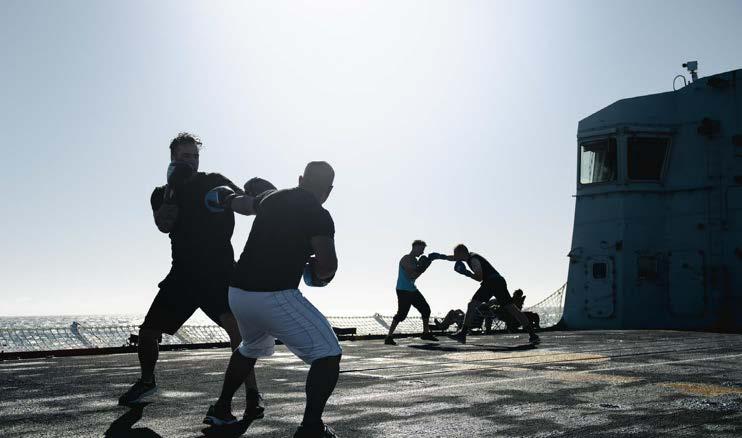
A few members from the HMCS Winnipeg crew practice their boxing skills on the flight deck for physical training during their last deployment. Photo: S1 Melissa Gonzalez, Canadian Armed Forces Imagery Technician
Advancing Maritime Defense
FMF’s Torpedo
Extension Project
Rory Theriault
Strategic Communications Officer, FMF CB/CS
Fleet Maintenance Facility Cape Breton (FMFCB) continues to showcase its capabilities with the current torpedo extension project.
The project focuses on upgrading from Mark 46 to Mark 54 torpedoes as part of Canada’s National Defence Strategy to advance the Cyclone Torpedo program, transitioning to Mark 54 torpedoes for their longer range and advanced tracking capabilities.
The process begins in FMFCB’s Shop 164, where a large slab of 8-inch-thick aluminum, which serves as the foundation for the project, is transformed into more manageable ‘donut-like pieces’. Boilermaker Jarrod Worth uses a water jet cutter to slice the aluminum into manageable rings.
“Each ‘donut-like ring’ takes approximately 3.5 hours to cut out amidst the thunderous noise of the machining process,” Jarrod says. The water jet cutter operates at 60,000 psi and uses grit garnet for abrasion, ensuring precision cuts that save time and material.
Once these manageable pieces are ready, they are sent to the machine shop for the next stage of the project. From here, the design of the extension pieces begins to form, as extensive work begins on the CC lathe. A lathe is a machine tool used for shaping materials by rotating the workpiece against cutting tools. It requires technical skill, experience, and attention to detail to achieve accurate and high-quality results. This is an integral part of the project as the extension pieces are crafted to match the concise design and measurements.
Next, the aluminum pieces are anodized by Group #2 electroplaters in Shop 125. The anodizing process involves immersing the aluminum in a sulfuric acid bath that is electrically charged, resulting in non-conductive or ‘insulated’ aluminum, making it
resistant to corrosion. This process bears similarity to anodizing techniques used in industries such as mountain biking and automotive manufacturing.
“Aluminum by itself is a highly reactive metal, but once it’s anodized, it becomes much less reactive,” explains Rod Miller, Work Centre Supervisor for Shop 125. “Anodizing is an electrolytic process causing a surface conversion, which provides a protective oxide layer.”
This project is an example of ‘type 3’ anodizing, also known as ‘hard’ anodizing, a process that transforms aluminum surface into one of the hardest substances, Aluminum Oxide.
Once anodized, the pieces return to the machine shop for a final quality control examination to ensure they meet design specifications. It’s critical for the material to align with the drawings that have established the concise measurements and accuracy needed for the correct alignment with the weapon technology they support.
Ending the project, the machine shop puts their final touches by assembling the material, resulting in the successful extension of the Mark 46 to Mark 54 torpedoes. With extension pieces designed and crafted at FMF, the weight and dimensions of the Mark 46 torpedo now match to the Mark 54. This allows the Cyclone program to test loading, mounting, delivery, and retrieval to certify the aircraft for the eventual delivery of the Mark 54 next year. Additionally, the Halifax Class frigates are being developed to accept the Mark 54 as well, as these prototypes will be used aboard the shipboard launchers.
The success of this project is the culmination of efforts by multiple teams, highlighting sophisticated capabilities of our workforce and the collaborative approach that defines our organization. From design to final assembly, each step represents a crucial contribution to enhancing the material capabilities and project success.
Job well done!
Captions: 1. Conversion build for a Mark 54 Torpedo. 2. The conversion piece being manufactured on a lathe. 3. The final conversion piece ready to assemble as an extension to the Mark 54 torpedo. Photos supplied
Victoria bids fond farewell to beloved veteran
Hundreds of mourners gathered at Christ Church Cathedral in downtown Victoria on June 5 for a memorial service for Commander (ret’d)
A veteran of the Second World War, Battle of the Atlantic and Korean War, Chance passed away peacefully at Royal Jubilee Hospital, April 9, 2024.
On June 6, in a service at Veteran’s Cemetery in Esquimalt, Cdr Chance’s ashes were committed to posterity in the columbarium facility. His family then conducted a tour of the CFB Esquimalt Naval and Military Museum and Battle of the Atlantic exhibit, named in honour of Chance in November 2021
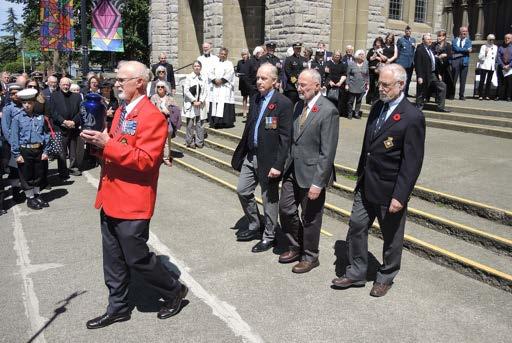
Simon Chance, S/Sgt RCMP (ret’d), carries the ashes of his father, Cdr (ret’d) Peter Chance, with members of a memorial party as they exit Christ Church Cathedral in Victoria following a memorial service on June 5.
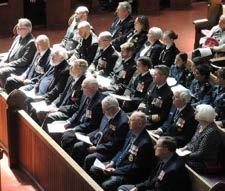
Left: Parishioners participate in a memorial service for Cdr (ret’d) Peter Chance at Christ Church Cathedral in Victoria, Jun. 5.
Photos: Peter Mallett/Lookout Newspaper
SISIP Financial:
Preparing you for tough questions – PART II
SISIP Financial Esquimalt
How to build a budget and stick to it?
Many people think budgeting sounds painful, but what’s really painful is getting into a financial trap. A good budget will put you in control and keep you safe. Here are the main steps:
1. Calculate your income. This may seem simple if you receive the same pay every month, but don’t forget things like income tax returns, child tax benefits, GST rebates, interest income, and gifts.
2. Set some goals. They should be realistic and something you can measure. And really try to distinguish between needs and wants. Needing to pay the mortgage has to rank above wanting to go on vacation.
3. Make a list of your expenses. Separate fixed costs like housing and insurance from variable ones like food and gas. Also identify optional expenses like coffees and subscriptions.
4. Compare your income and expenses. If your expenses exceed your income, you’re going to have to look at ways to increase your income and/or reduce your expenses.
5. Develop a spending plan. The budget is useless unless you keep track of your
The Evolution of the Flag
spending and stick to the plan.
6. Pay yourself first. One of the best parts of budgeting is being able to regularly put money into your investments and watch it grow.
7. And finally, review and adjust as you go. No budget is perfect, but if you’re always keeping an eye on it and adjusting as your life and your goals change, you will be successful.
When is financial counseling needed?
There are obvious times, and also some not-soobvious times.
One obvious time is when there’s a big change happening in your life, or you’re making a big financial decision, such as being posted, having a baby, buying a home or vehicle, or getting married or divorced. These events almost always trigger financial changes in your life. Another obvious time is when you’re feeling stressed. Maybe your debts are feeling unmanageable, or you have a garnishment on your wages or debt collectors calling. One of the less obvious times is when things seem relatively stable on the surface, but you’re really not sure where you’re heading. Maybe you don’t have a budget, so you don’t know where your money is going. Maybe you’re not saving for the future. Maybe your debts are slowly creeping up and you’re worried. Maybe you wish you had an emergency fund. Let’s talk and together we can help find a solution.
SISIP Financial is located at 98 CFB Naden, 1343 Woodway Rd, Esquimalt. Call (250) 363-3301.
There are very few people who don’t recognize the rainbow flag as a symbol of the queer community; the original design was the work of several artists and activists collaborating after Harvey Milk, an American influential gay leader, challenged Gilbert Baker to devise a symbol of pride for the gay community. The result was the rainbow flag, which was first debuted at the San Francisco Gay Freedom Day Parade on June 25, 1978.
Original eight stripes had a specific meaning:
• Hot pink – sex;
• Red – life;
• Orange – healing;
• Yellow – sunlight;
• Green – nature;
• Turquoise – magic;
• Indigo – serenity;
• Violet – spirit.
After the assassination of Harvey Milk in 1978, the demand for the flag greatly increased, and the Paramount Flag Company began selling a ‘stock’ version with seven stripes, omitting the hot pink and replacing indigo with blue.
As our understanding of gender and sexuality expand, it seems fitting to revise our symbols to fully represent the diversity of the 2SLGBTQI+ community; to this end, in June of 2018, Daniel Quasar created a new design for the Pride flag with the six-colored rainbow stripes and a five-colored chevron. Black and brown chevrons represent marginalized people of color and those who are living with, or have died from, AIDS; white, pink, and light blue chevrons incorporated the colors of the Transgender Pride flag (designed by Monica Helms in 1999). Arrows pointing to the right show forward movement, while being along the left edge show that progress still needs to be made.
In 2021, the ‘intersex-inclusive’ redesign of the Progress Pride flag by Valentino Vecchietti embedded a yellow triangle with a purple circle to the aforementioned chevrons, those in the queer community who have genitals, chromosomes or reproductive organs that don’t fit into a male/female sex binary.
As we grow as a society and people, so should the symbols that we use to recognize the different communities within our country; the Progress Pride flag of 2018 was the official flag flown at all of Government of Canada buildings in 2022, representative of our government’s dedication to acknowledging and celebrating the diversity of 2SLGBTQI+ Canadians.
Capt Krystle Sloan 435 Transport and Rescue Squadron
For rent
$3,100/month June 15th or July 1st. Rental is in family friendly walk-up unit offering 3 bedrooms & 1 bathroom condo split on two levels, newly updated. Bedrooms and bathroom located upstairs, kitchen, dining/living room and storage on main floor. This unit has a sunny & bright open main living floor plan with a full-length deck in a private quiet setting. Shared laundry is available on the second floor as well as offering secure bike and kayak storage. It also comes with one parking space. The property is located on the Saxe Point border of Esquimalt. NON SMOKING building and NO DOGS allowed per strata bylaws. Easy walk to Macaulay Point & Saxe Point oceanfront parks, Esquimalt Rec Centre, Archie Browning, library, school, shopping at the Esquimalt Plaza and more!
For further information
please contact 778-8889927 between 9:00 a.m. to 7:00 p.m. Must be able to complete application and provide references. 06/10
Fully furnished and equipped 3Bed-2Bath house for rent in cul-desac in Langford. Large garage, fenced yard. 200m from bus, 10ms walk to G. Goose and Westshore mall. 1Yr+ lease. No pets, $3,600/Mth + utilities. Details Liliane 819-992 3380. 06/03
SUITE IN LANGFORD near View Royal. Bright, modern, clean, private, and quiet 1 bedroom suite with patio, appliances. Incl. dishwasher, microwave, washer & dryer. Quiet neighbourhood. Beautiful view. Easy access to bike paths. Parking available. 1 yr lease, then month to month. No smoking/vaping, pets, or sub-letting. Renter’s insurance with proof of coverage, references and proof of employment mandatory. $2,200/month furnished or $2,000/month unfurnished. Utilities and wi-fi included. Contact Max by text 613-449-2836 06/10
For Sale
Esquimalt - House with inlaw suite - 5 bed - 2 bath - on Wollaston St. South facing deck & back yard. $965,000 Call Vicky 250380-7323 06/03
WorDSearcH
Answer key to previous crossword:
Treatment IS WITHIN REACH
Addiction, Mental Health & Trauma Treatment just a Ferry Ride Away
Help is at hand: Powell River-based Sunshine Coast Health Centre and Georgia Strait Women’s Clinic— Canada’s only trauma program exclusively serving women—provide highly personalized addiction, mental health and trauma treatment for male and female clients respectively. We’ll pick you up from the ferry for our daily inpatient treatment tailored to your unique needs.
Services include 24 hour-medical service, psychiatric assessment, EMDR, rTMS, psychotherapy, a dedicated group for military clients and much more.
Serving the Department of National Defence and Veterans A airs Canada since 2009.