/ PHEV Twin Motor System / Innovative Pedal (One-Pedal Driving) / 7 Passenger Seating (5+2) / Power Panoramic Sunroof with Sunshade / 9” Smartphone Link Display Audio with Android Auto™ & Apple CarPlay® / 671 km of Combined Range** / 3-Zone Automatic Climate Control / Multi View Camera System / Super All-Wheel Control (S-AWC) with Drive Mode Selector (ECO/NORMAL/ SNOW/GRAVEL/TARMAC/ MUD/POWER)
A small ship doing BIG SHIP THINGS
SLt Phillip Schenk HMCS Nanaimo
‘Small ship doing big ship things’ – I keep hearing this over and over. I know what the words mean, but I have no other experience to compare against.
I was posted to HMCS Nanaimo in August 2023, along with a couple of other Sub-Lieutenants from my class, after completing our Charge phase on this ship, the last sea-going phase of Naval Warfare Office Training prior to joining the fleet. Even during our Charge phase, I kept hearing ‘small ship doing big ship things’.
Since then, Lieutenants have come and gone on the Y-Jetty: to consolidate their Director Level, in preparation for the Fleet Navigator course, or posted as post-Operations Room Officer Executive Officers. They each have the same thing to say: “On the heavies [big ships], this is how we do XYZ”. Fair enough, my peers and I shrug at each other, standing by. But it does get me thinking: are we really a small ship doing big ship things? Or are we just doing what we do and doing it well?
During my time on this ship, I’ve had the distinct privilege of sailing to Portland as part of a multi-week Task Group sail, sailed five weeks in Search-and-Rescue (SAR) Zone North (where my peers and I were awarded our Minor War Vessel ticket), and spent most of November even further North working with the Canadian Rangers and the Gitxaala Nation. Now, I
find myself in Alaska, acting as a Bridge Watchkeeper for a Charge phase, the final phase of assessments during a Junior NWO time at Venture
A Charge phase, which I can’t help but notice, looks a lot like a Task Group sail, given the number of ships we’ve operated with these last four weeks.
Our Commanding Officer’s (CO) adamance in using tactical signals, though increasingly challenging to implement as we venture forth through the fjords of the great North, serves to prove my point. Pushing through Grenville Channel with our consorts astern of us, I have to admit prepping tactical signals to close distances between ships, manoevring around corners and making contact avoidance alterations for all three of us while juggling Bridgeto-Bridge Safety comms to warn of the proverbial minefield of logs ahead created a real air of co-ordination and big-picture thinking.
I know, I know, a freshly ticketed ‘subby’ thinks tactical signals are the height of naval sophistication. But two weeks ago myself, a cook, a Marine Systems Engineer, two NWO IV students and a NavComm from a total of four different ships (including Wolf 59) were all boat-transferred to the French Ship (FS) Prairial, where we then proceeded to conduct Manoeuvre with our friends back on our respective ships. I remember checking the photo on my phone of the Watch rotation and making a mental note to give a playful ribbing to the student who very obviously
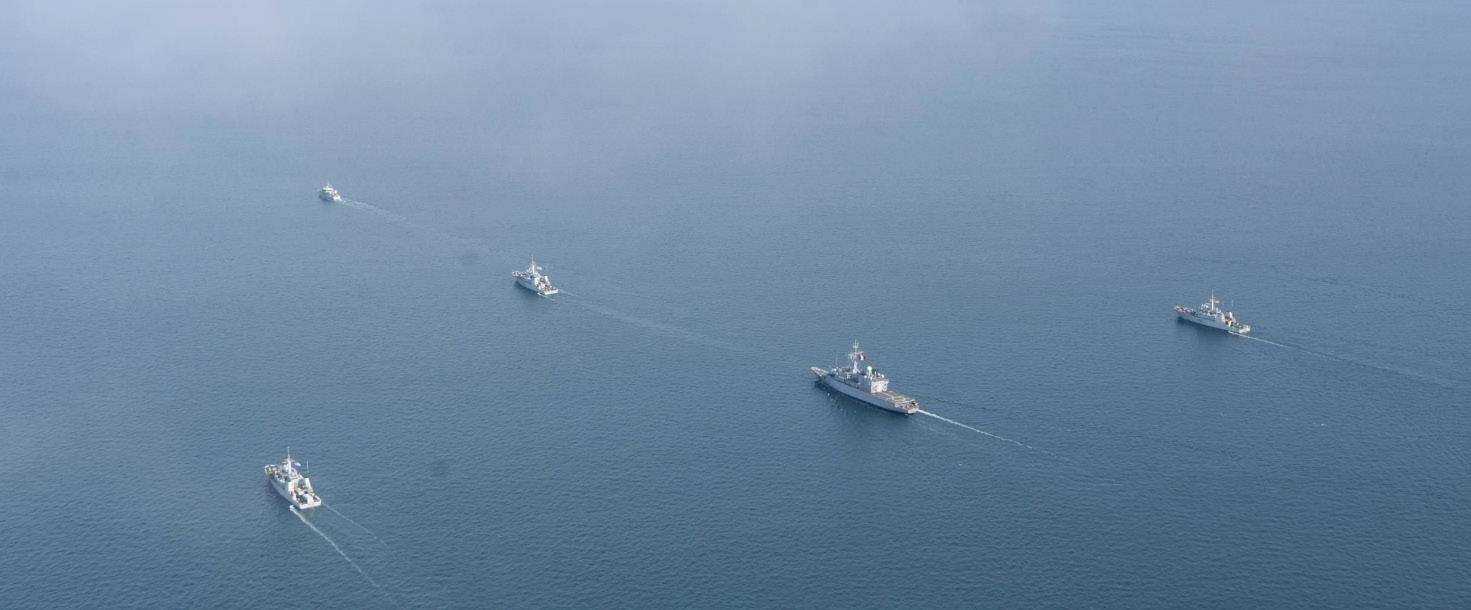
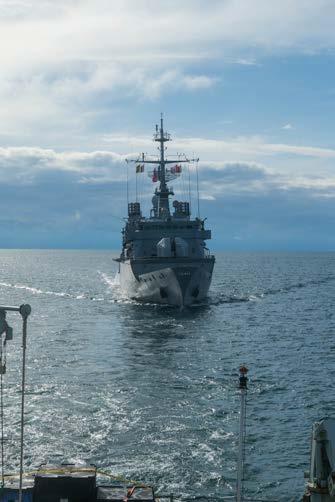
realized too late that they were not driving fast enough to get the ship where it needed to be. We were treated to lunch at the FS Prairial, swapped stories with the CO, and then boat-transferred back to our ships, where we proceeded to conduct a four-ship 50cal shoot on deployed targets. For the next hour or so, HMCS Nanaimo, Edmonton, Yellowknife and FS Prairial manoeuvred with one another in Sea State 2, taking turns firing rounds. For those keeping count, that’s two languages, three (destroyed) High Speed Inflatable Towed Targets, and four ships.
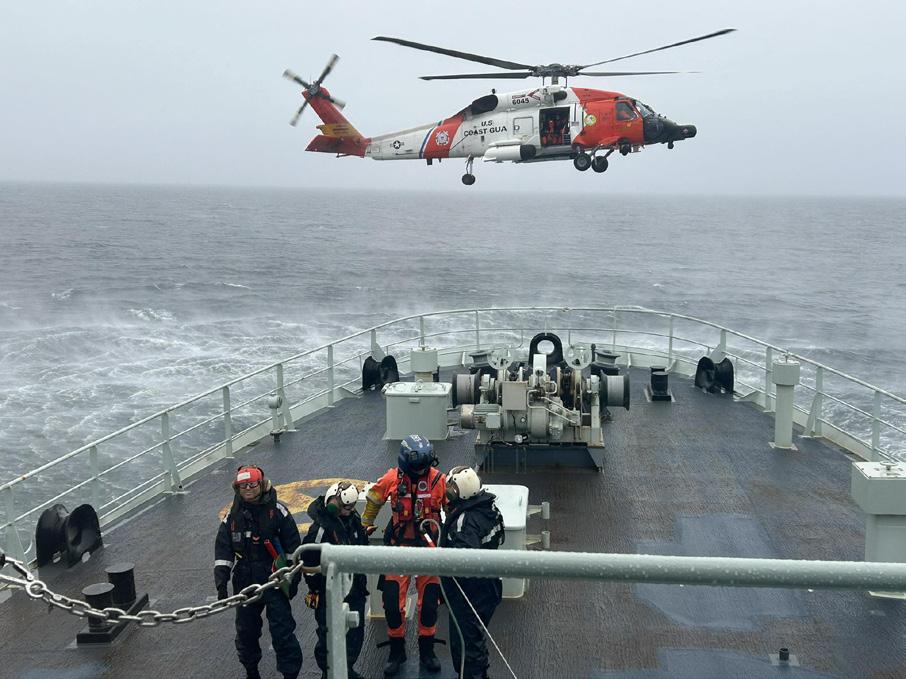
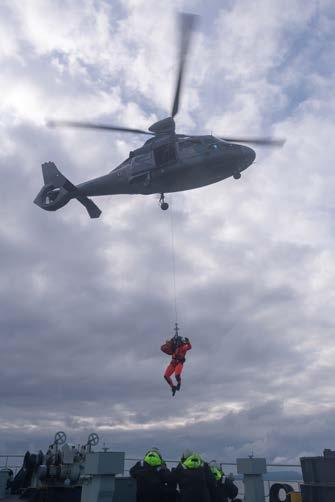
Five ships operating together, in one day. It’s pretty good for small ships. But last week, each of the three MCDVs participating in this sail was partnered with a corresponding US Coast Guard Cutter, a class of ship roughly 50 per cent our tonnage, to conduct towing serials, and SAR patterns, and Edmonton even managed to get a Helo Hoist in before supper. Now, we’re up to six ships and a helicopter. That’s pretty close to the seven-ship Manoeuvre serial we conducted on my Charge Phase.
I ask again: small ship doing big ship things, or just doing what we do and doing it well? I’m inclined to believe the latter. At the time of writing, we’ve just departed Ketchikan, Alaska, and I catch myself thinking back fondly on everything we’ve accomplished. Sure, it’s been a busy few weeks, but that’s par for the course. Soon, we’ll be home, waiting for the next big ship thing.
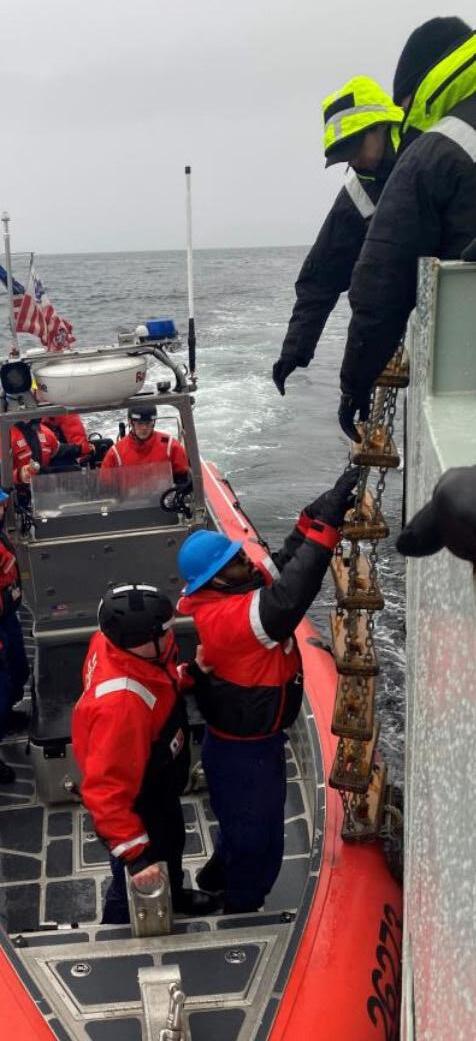
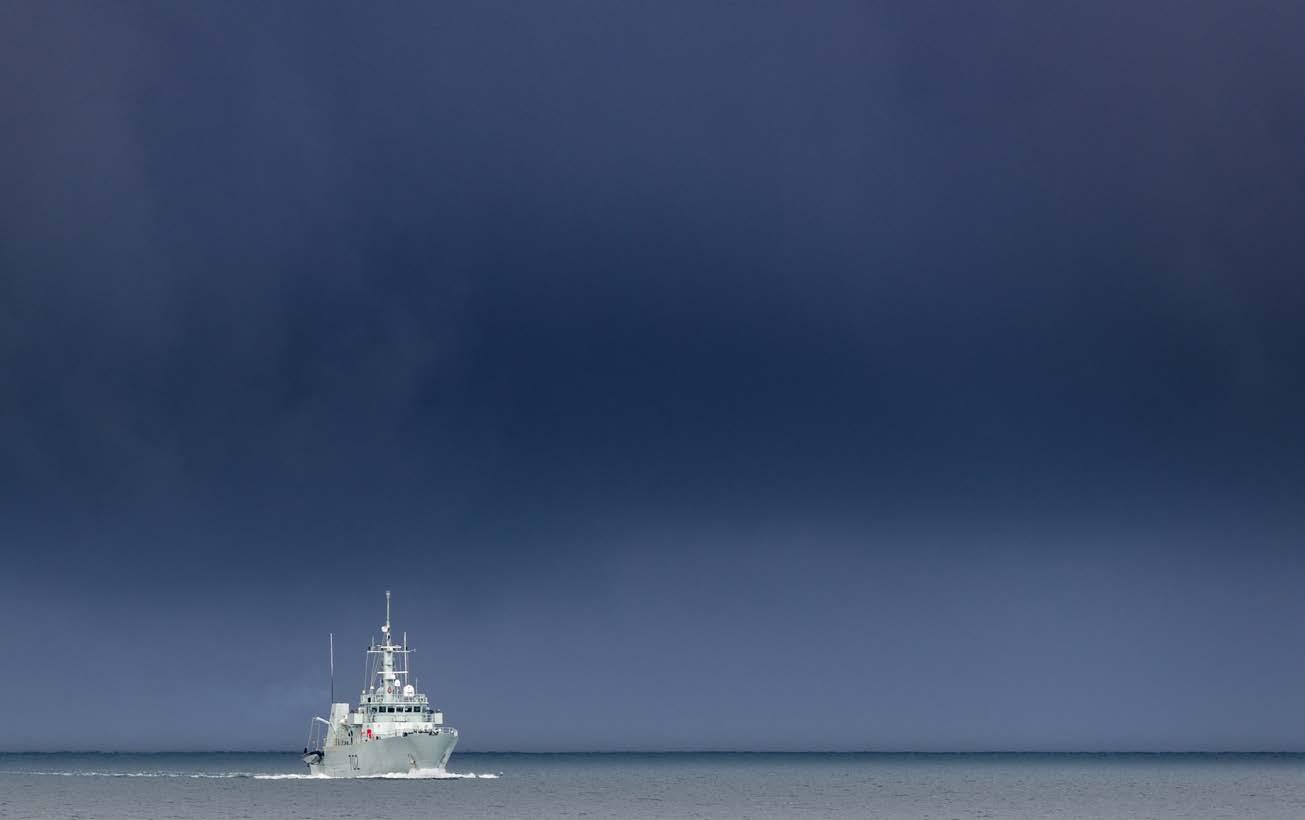
Below: A towing
as part of a
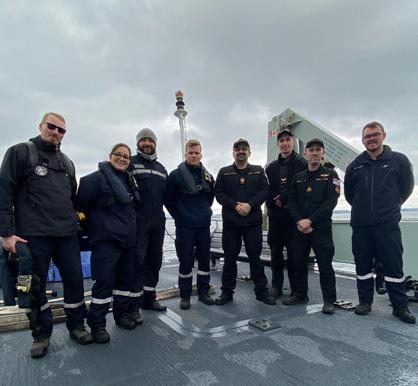
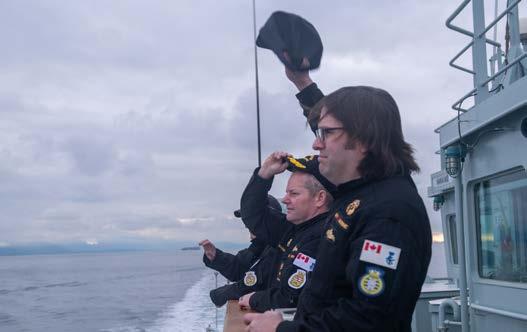
Members on the French Ship Prairial pay a visit to HMCS Nanaimo while conducting exercises off the coast of Constance Bank in March. Photo: Sailor 1st Class Amanda Giesinger
exercise
joint Search-and-Rescue exercise off the coast of Ketchikan, Alaska, in March. Photo: Lt(N) Vince Charlebois
MANAGING EDITOR
Jazmin Holdway jazmin.holdway@forces.gc.ca
EDITOR
Kate Bandura
WRITER
250-363-3130 kateryna.bandura@forces.gc.ca
Peter Mallett mallett.peter@cfmws.com
PRODUCTION
Teresa Laird production@lookoutnewspaper.com
Leslie Eaton
ACCOUNTS
Jazmin Holdway
ADVERTISING
Joshua Buck
250-363-3127 leslie.eaton@lookoutnewspaper.com
250-363-3127 jazmin.holdway@forces.gc.ca
778-977-5433 military.base.advertising@gmail.com
EDITORIAL ADVISORS
Capt Christopher Dubé
Ashley Evans
250-363-4006
250-363-7060
Published each Monday, under the authority of Capt(N) K. Whiteside, Base Commander.
The editor reserves the right to edit, abridge or reject copy or advertising to adhere to policy as outlined in PSP Policy Manual. Views and opinions expressed are not necessarily those of the Department of National Defence.
Le LOOKOUT est publié tous les lundis, sous l’égide du Capv K. Whiteside, Commandant de la Base.
Le Rédacteur se réserve le droit de modifier,de condenser ou de rejeter les articles, photographies, ou annonces publicitaires pour adhérer au Manuel des politiques des PSP. Les opinions et annonces exprimées dans le journal ne réflètent pas nécéssairement le point de vue du MDN.
Circulation: 2,000 plus online engagement per week Follow us on Facebook, Twitter and Instagram to join our growing social media community.
A Division of Personnel Support Programs
CFB Esquimalt, PO Box 17000 Stn. Forces Victoria, BC V9A 7N2 Web: www.lookoutnewspaper.com Fax: 250-363-3015
Canadian Mail Product Sales Agreement 40063331
In the aftermath of trauma, the mind and the senses hold captive some aspects of the event. When memories of the trauma burst through our awareness, it’s called a flashback. A flashback makes us feel like we are re-experiencing the traumatic moment. It can be formed through the body or the mind, and they work together to inform one another about what’s happening.
On a somatic level, our body begins to sense a rise in tension, evoking a feeling that is not all that dissimilar to the event. Sometimes, it feels like we get washed over by a cool sweat. Our heart thumps a little harder and quicker. A lump in our throat balloons, and panic ensues alerting the mind.
Although the sensation you feel during a flashback typically overlaps with what the body felt during the trauma, the body may react in a way that causes the trauma to continue. For example, the body may want to continue to process the trauma through crying or any other somatic development.
Other times, the mind initiates a flash-
back through an encounter with a memory that draws you back into the mouth of the traumatic experience. It can occur through a burst of unassuming consciousness, like an intrusive thought, or by consciously revisiting the event. This reflection can be highly developed in length and detail or merely a snapshot.
On a cognitive level the mind places you right at the door of the trauma. It creates a world where the feelings and thoughts of the traumatic experience appear very much alive. Not only that, but the mind can also re-imagine what occurred and create an endless loop of what-if scenarios. It is important to note that you must discern what happened versus what your mind is creating about the event. Processing many re-imagined memories is much more difficult than the singular event. So, you must be as conscious as possible during the flashback.
But why does a flashback occur?
First, it indicates that the traumatic experience has yet to be fully processed. Some part of us still has yet to emotionally, physically, or cognitively accept what occurred, and thus, our psyche flings us
back into the moment.
Second, there may be a trigger that sets off the flashback. For instance, you encounter someone who may have looked like someone who was part of the trauma. This causes the mind to return to its Rolodex of memories and sets off the flashback. Moreover, catalysts to a flashback aren’t merely bound to a visual association but can also be brought on through sound, smell, taste, or touch.
Flashbacks are one of the most challenging elements of PTSD. They can be spurred on at a moment’s notice, enveloping us in the same feelings and thoughts we had during the event. It’s incredibly horrifying. However, there are ways to manage these flashbacks, and we will look into them in next week’s article.
Thomas Goenczi is an RCN Veteran and MA Clinical Counsellor with Private Practice: Well Then Therapy.
The content is not intended to substitute professional advice, diagnosis, or treatment. Always seek the advice of your mental health professional or other qualified health provider with any questions regarding your condition.
Thomas Goenczi Lookout contributor
Test driving Eagle and Osprey
Michael McWhinnie Public Affairs Advisor, NTG
When Juliet declares, “That which we call a rose by any other name would smell as sweet”, she argues that Romeo’s name is irrelevant to his character.
In the same vein, Shakespeare fans might be forgiven for concluding no tangible change resulted from the Sail Training Vessel (STV) naming ceremony hosted by Naval Fleet School Pacific (NFS(P)) staff on March 26. But they would be wrong.
“Naming these two boats is not merely symbolic,” explained Lieutenant (Navy) Ellery Down of the Royal Canadian Navy (RCN) Sail program. “It represents an important milestone on their path to operational readiness.”
Since taking delivery of the second Bavaria C45 in late November, NFS(P) has progressed work to particularize their configuration, including installing critical safety equipment.
“We completed initial cadre training and continue to enlarge our pool of qualified skippers and instructors. We have established operating conventions and created necessary training plans,” added Lt(N) Down.
The ceremony was conducted in two phases. To start, staff and invitees gathered on the small boat floats adjacent to building N126, where they heard remarks from the guest of honour, Rear-Admiral (RAdm) Christopher Robinson, Commander Maritime Forces Pacific.
As the Canadian Armed Forces Patron for Conseil International de Sport Militaire (CISM) Sailing, it’s no surprise that RAdm Robinson strongly advocates for the sport.
“The RCN has long recognized the value of sail training amongst its personnel,” he explained. “From fostering teamwork to better understanding the
maritime environment to mastering specific sailor skills such as navigation and planning; the benefits are many. We are in great shape and these vessels will help ensure our sail program remains viable and vibrant for decades to come,” RAdm Robinson said.
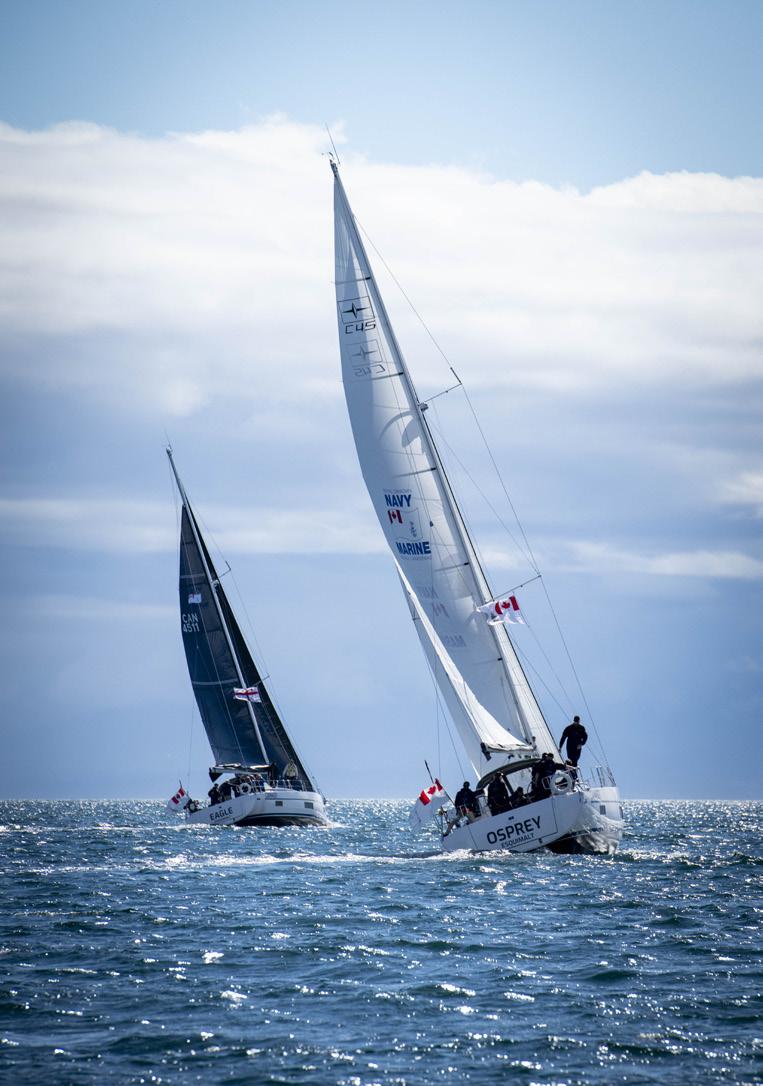
After a brief pause for dramatic effect, small fabric covers were pulled back to reveal the newly-declared monikers: STV Eagle and STV Osprey
“Just like warships, these boats now have identities that will foster crew cohesion and esprit de corps for competitions,” Lt(N) Down said.
Everyone was allowed to step aboard and tour the boats. Before long, the rumble of diesel inboards signalled the start of the sea phase. Some departed, while others were transported under power away from the jetty to the harbour entrance, where the crews of RCN Sail instructors conducted manoeuvres under sail.
“We never really had room to sail with guests onboard Tuna and Goldcrest,” said Lt(N) Down. “The added size of Eagle and Osprey not only allows us to offer larger classes and participate in longer races, but they will also greatly enhance our outreach ability. Nothing can replace HMCS Oriole, but I am eager to start promoting the Navy with Eagle and Osprey.”
The weather was cooperative, and a brisk wind made for lively cruising. The two boats and their crews performed flawlessly, and for just over an hour, guests enjoyed what few are privileged enough to experience: the sheer happiness of being carried by the wind on water.
“It’s an occupational risk that, over time, a sailor can grow accustomed to the sight of boats,” stated RAdm Robinson. “But being out on the water today with Eagle and Osprey brandishing their custom RCN sails was inspirational and helped build awareness of the RCN Sail program amongst the other mariners we share the water with.”
Call for Nominations:
Defence Indigenous Advisory Group (DIAG) Civilian and Military Co-Chair
The MARPAC Defence Indigenous Advisory Group (DIAG) is seeking nominations for the Civilian and Military Co-Chair positions. Interested personnel are encouraged to identify themselves for consideration. Supervisors are encouraged to put forth names of individuals they feel would be an asset to the Co-Chair position. Participation is voluntary and must have supervisor or manager support and approval.
Please forward all submissions – including a brief bio – to Vanessa Nicholson, Employment Equity, Diversity & Inclusion Coordinator at vanessa.nicholson@forces.gc.ca. Nominations are now being accepted! About the Defence Aboriginal Advisory Group
The DIAG is a voluntary organization led by a Military Co-Chair and Civilian Co-Chair. The Co-Chairs are supported by a senior leader or Champion who advocates for and promotes the DIAG within the Formation. Meetings are held monthly and provide an opportunity for DIAG members to raise issues
of a systemic nature that prevent the full participation of Indigenous members within the Department of National Defence. The group also provides advice on policies and directives that affect their members as well as advising on ways to promote and celebrate the contributions that Indigenous people make to the Defence Team.
Time Commitment
It is foreseeable that the Co-Chair will spend 2.5 hours per week on DIAG activities. A Co-Chair is expected to complete one term of two years.
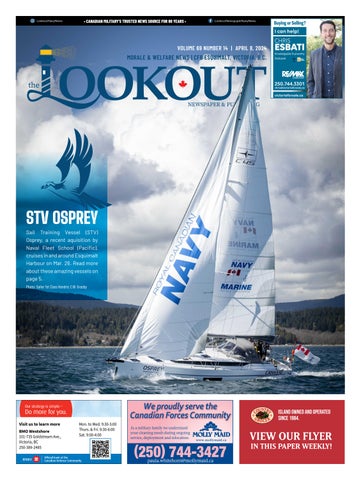
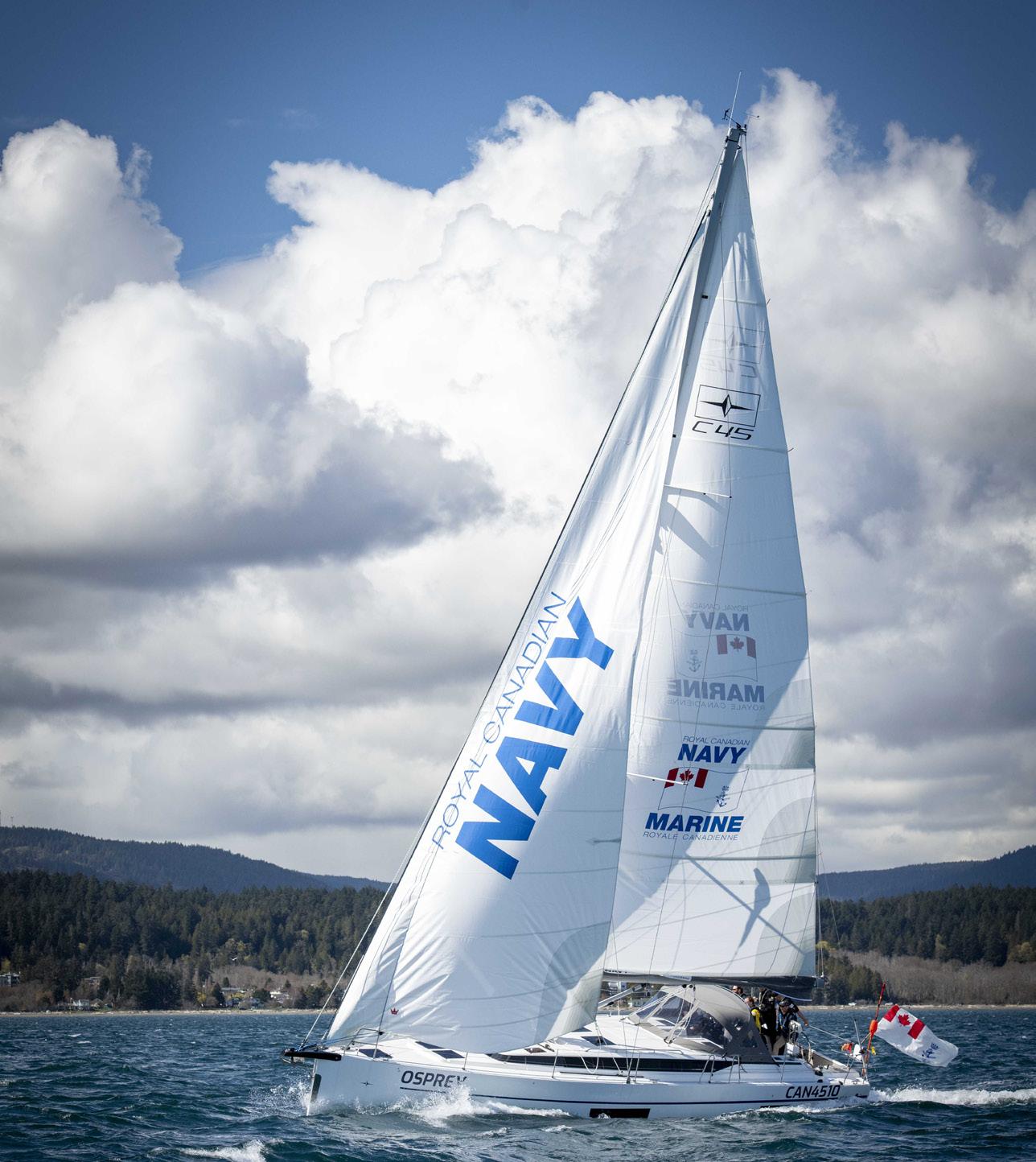
Naval Fleet School (Pacific)’s newly acquired Sail Training Vessels (STV) STV Eagle and STV Osprey are seen during a short cruise in the approaches to Esquimalt Harbour on Mar. 26. Photo: Sailor 1st Class Kendric C.W. Grasby
Clearance Divers, NTOG mine Army event for recruits
Kateryna Bandura Lookout Editor
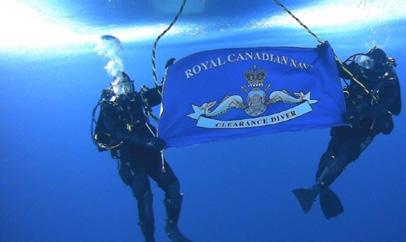
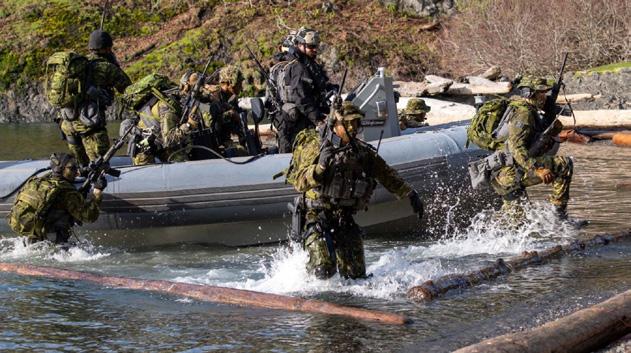
The best way to recruit high-level fitness members to high-intensity trades is to go where these people are, says one Clearance Diver (CD). In search of new recruiting grounds, Master Sailor (MS) Mark Littler partnered with MS David Aubin from the Naval Tactical Operations Group (NTOG) for a 5-day recruiting campaign in Petawawa, Ont., during Exercise (Ex) Olympian Bear
The endeavour marks the first time CDs and Naval Tactical Operators have worked together towards the same goal. Both offer unique opportunities to Canadian Armed Forces (CAF) members seeking a challenging career and a faster pace.
“Ex Olympian Bear attracts the fittest, motivated, competitive CAF members, which is our target audience,” MS Littler said. “Typical recruiting relies on social media or members contacting the trade themselves. In my opinion, faceto-face is the most valuable recruiting method.”
Olympian Bear is a three-day sporting event held by Garrison Petawawa. Teams from each unit compete against each other in different sports, including basketball, hockey, powerlifting, volleyball and more. The team with the most points wins the year’s Olympian Bear Champion and bragging rights.
The Ex takes place when most members are not deployed, which ensures a perfect opportunity to speak to suitable candidates. CDs and
NTOG set up a booth at the Dundonald Hall Fitness Centre while the teams competed in sports. NTOG showcased their Full Fighting Order, which is different and more advanced than the Army one.
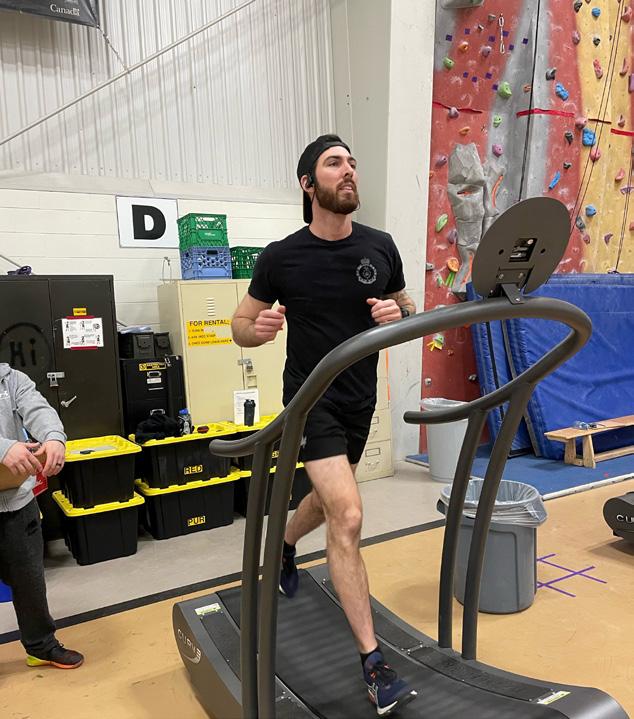
To back up their talk, the sailors signed up at the last minute to compete against Army units in their triathlon challenge, which consisted of 1 mile on an assault treadmill, 100 calories on the assault air bike, and a 200-meter swim.
“Competing in this event allowed us to engage at a more personal level with the members and show them what we’re made of,” MS Littler said.
MS Littler says much information about eligibility is unknown, and that’s why recruiting is important. While basic information about specialty trades can be found online and through BPSOs, the personal aspects are best discussed one-on-one in an informal setting.
MS Littler says creating relationships and spreading the word that these trades exist as an option for the highly motivated Army members was accomplished to a high degree.
“We each had approximately 50 members with whom we engaged in lengthy discussions about our special trades and the application process,” MS Littler said. “Over the week, we spoke with well over 300 Army members about what the Clearance Diver and NTOG specialist trades have to offer. Our efforts were absolutely worth it.”
The team will continue to strengthen the bond and collaborate on similar recruiting projects in the near future, including a recruiting event on June 13 in Halifax.
February Formation 5K Results
PSP is excited to announce the following results from the March FORMATION 5K Run. Congratulations to all who participated, and we look forward to seeing you all out month after month! Our next run will be April 26.
PARATI ENIM TEMPESTAS STRENGTH N DEPTH
Master Sailor Mark Littler participates in a triathlon competition during Exercise Olympian Bear hosted by Garrison Petawawa. Photos provided
Sailor, author revels in ‘C H I L D I S H ’ birthday bash
Peter Mallett Staff Writer
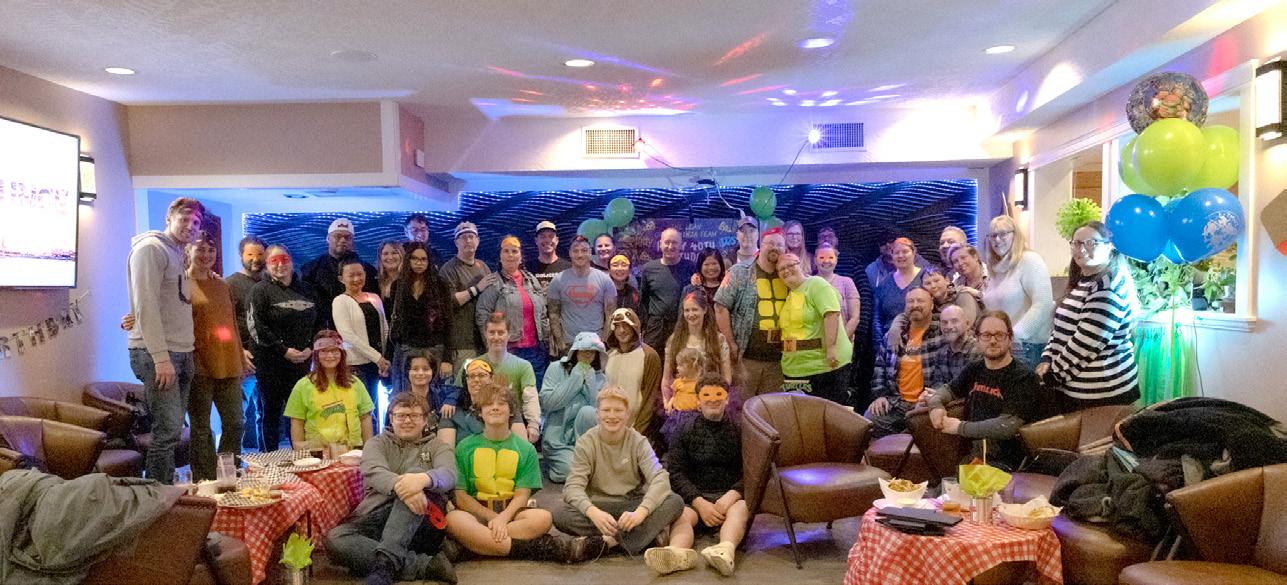
If a stranger entered Hardy’s Bar and Grill in Colwood on March 2, they would assume they’re crashing a 10-year-old’s birthday party based on the decorations, dress code, and themed cake. But that would be a wrong assumption.
The party was actually to celebrate the birthday of Lieutenant (Navy) Stephen Tomlinson, who turned 40 on Feb. 29, but only ten if you count in leap years.
Lt(N) Tomlinson, a Divisions Operations Officer of HMCS Venture, marked his 10th/40th birthday with a Teenage Mutant Ninja Turtles-themed party. It was a smashing success for ‘children’ of all ages, says Lt(N) Tomlinson.
“We had a great party, supported local charities and had an awesome time doing it,” he said. “People dressed up in costumes and clothes they wore decades ago. This generated a lot of fun and really brought people closer together.”
The snacks people brought to the party were not eaten but instead donated to a local food bank, and the presents went to local children’s charity Toy Mountain. It was also a chance for Lt(N) Tomlinson to celebrate finding a publisher for his book.
“It was deeply touching to see this support,” he said.
The book, titled Onward, describes Lt(N) Tomlinson’s fight for survival following his testicular cancer diagnosis in 2017. His doctor gave him no hope for survival, but Lt(N) Tomlinson was having none of that and waged a successful, against-all-odds war against cancer as it spread to his brain, lymph nodes and lungs. He underwent 350 hours of chemotherapy and 11 radiation treatments, survived a seizure and had five surgeries, including the removal of a plum-sized tumour from his brain in 2018. The treatments eventually worked and today he is 100 per cent cancerfree. He says he wouldn’t trade the experience of his do-or-die fight for the world.
“The man I became after my fight is the person I am happiest with,” he said. “Going through such an extreme experience makes everything else less stressful, and I have learned resilience from beating cancer, which makes me feel I am better than I used to be.”
Lt(N) Tomlinson says he was also inspired to write Onward because he learned very few books were written on the pervasive disease. While testicular cancer is the most common form of cancer in Canadian men ages 15 to 29, there isn’t much supportive literature to read for those who receive a diagnosis, he notes.
After Onward’s first printing, all 350 copies were snapped up. Lt(N) Tomlinson realized that his story might have broader appeal outside Esquimalt’s military community. He is currently in contract discussions with a U.S.-based publisher to get Onward
onto Amazon and the shelves of book retailers such as Chapters and Indigo.
The publishing agreement will cost him approximately $3,000 out-of-pocket, so the most important thing about his birthday party is that it also served as a fundraiser. The birthday bash raised $1,200 for the publishing cause, so Lt(N) Tomlinson says he remains ‘un-cautiously’ optimistic that he will reach his target. His wife Stephanie, their 13-year-old son Seth, and daughter Sophia, 10, also attended the birthday party.
There are other reasons for him to be downright giddy about his fortunes: Lt(N) Tomlinson was recently cleared by his Chain of Command to return to sea. In mid-March, he was elated to be aboard Orca-class Patrol Craft Training Unit vessels as he began training for his Operations Room Officer (ORO) course through Fleet School. He hopes to become an ORO aboard a deployed Canadian Navy warship.
“Throughout my fight with cancer, all I really wanted to do was get my life back, be reunited with my family as a healthy father and go back out to sea and perform the duties I have sworn to do as a sailor of the Royal Canadian Navy,” he said. “Now I am living that dream again and couldn’t be happier.”
The Tomlinson family has set up a GoFundMe account for people to support Stephen’s publishing goal at gofund. me/9eec60da.
Lt(N) Stephen Tomlinson celebrated his 10th/40th birthday on Feb. 29, also marking finding a publisher for his book on his fight with cancer.
The Teenage Muntant Ninja Turtles-themed party raised $1,200 for the publishing, and collected donations for a local food bank and a children’s charity. Photos provided.
HMCS Windsor doc embraces challenge of undersea medicine
More than three decades into his military career, one Canadian Armed Forces (CAF) healthcare provider has literally taken his job to challenging new depths.
While it may initially seem odd to have an Army Captain fill out the crew of a Royal Canadian Navy submarine, Captain (Capt) Michael Jerrott explains that it’s actually nothing out of the ordinary.
“We’re a ‘purple’ trade – we can go anywhere,”
Capt Jerrott said, noting he’s not the first non-Navy member to serve in his current role as Physician Assistant (PA) for His Majesty’s Canadian Submarine (HMCS) Windsor, in recent years.
That being said, he does find himself fielding occasional questions.
“I had an NWO (Naval Warfare Officer) and a Log (Logistics) Officer come up to me in Borden and say ‘We’re confused; you’re wearing Army ranks and Navy Diver’s overalls’, so sometimes I do have to explain,” he said with a laugh.
Originally from Nova Scotia’s Annapolis Valley, Capt Jerrott’s CAF career began in the early 1990s in the Army. He joined the medical branch in 2000 as a Medical Technician before becoming a qualified PA in 2011. He’s provided care in several challenging and unorthodox environments, from combat tours in Afghanistan to the High Arctic, jungles and deep wilderness across Africa, Central America, and Eastern Europe. He’s served with the Canadian Army, Royal Canadian
Air Force, and Canadian Forces Special Operations Command units.
“I felt this was an opportunity to bring all that experience to one of the most remote and austere environments, where help could be days or weeks away,” he said of his decision to pursue the submarine PA role.
“I also appreciate the small-team dynamic and the opportunity to continue challenging myself and learning new things.”
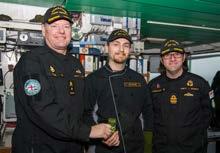
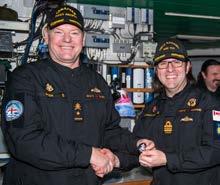
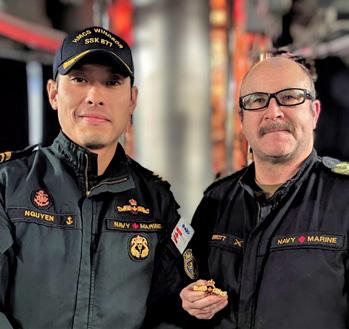
Those opportunities have been abundant over the last year or so, as Capt Jerrott began working through the training required to safely integrate into the crew of Windsor, beginning with the three-month basic submarine course before joining the sub in Halifax to start applying that new knowledge. In November 2023, he became a qualified submariner after being presented his ‘dolphins’ badge from Windsor Commanding Officer Lieutenant-Commander Harrison Nguyen-Huynh.
This doesn’t mean the learning is over, and Capt Jerrott said he works each day to get more comfortable on the platform.
The PA position’s responsibilities go beyond health care—he needs to be ready to stand, watch, and drive the boat and have extensive knowledge of the sub’s weaponry/ Command and Control and other key systems. At the same time, keeping up with advances in medical care and keeping his clinical skills sharp is also crucial.
“There’s 47 other submariners to help support the boat, but I’m the only medical provider. Whether it’s mental health care, trauma care, advanced cardiac life support, or any major illness, I’m the only person here with the professional knowledge to deal with that, so it’s very important,” he said.
The lack of space is the most significant change from previous jobs. Capt Jerrott has no dedicated office, and discussions with a member dealing
with an injury or ailment take place in any free space he can find.
“We have options; we can use the Junior Rank’s Mess for a casualty, but for everyday things, we improvise,” he says.
This also means the care that can be provided aboard the boat is very limited. Having the expertise and experience of a PA lends weight and credibility to his advice in the event Capt Jerrott suggests to the command team that Windsor head to shore to seek help for a crewmember, he added.
Assimilating with the team and earning the trust of his fellow submariners has been a process, but Capt Jerrott described the hard work as rewarding.
“I’ve shown the crew I care and I’m here to support them, and they, in turn, have supported me in my submarine learning,” he said, noting that his rapport with the team is also important when it comes to monitoring mental health on board. “I’ll walk the boat. I’ll go to each space and hang around, have a chat with folks, and try to get the pulse of what’s going on during my off-watch time. I try to be as available as possible.”
As a message to others considering the silent service as a career option, Capt Jerrott said he has no regrets and has enjoyed the challenge so far – but it’s not for everyone.
“You need to have personal perseverance; the learning is not going to be easy or fast. It’s a different lifestyle, but it’s a great thing to be a part of – this is an amazing small team with great people,” he says.
FOR SALE
SAILBOAT 1974 CS 22 for sale. Located at CFSA. 4 head sails. All safety gear, too many accessories to list. Outboard motor needs carburetor work. $1,500. Call 250-208-4845.
BUSINESS FOR SALE
– Great for a retiring member! Opportunity to own a well established, luxury limousine service in Victoria – Ascot Limousine Services. Seller wishes to retire after 29 years. Business purchase includes: special authority (3) licences, 3 limousines, website, phone #, legal and accounting (if required), loyal clients & goodwill, and help with the transition. $110,000. Contact Gilles at 250-812-2775 or gilles@ ascotlimo.com. More
information available at ascotlimo.co.
FOR RENT
$2,195/MONTHRENOVATED 2 BDRM in EsquimalT Top-floor, corner suite in a serene, adultoriented building. Prime location near Esquimalt Plaza, gym, library, Naval base, and downtown Victoria. New carpets, fresh paint, updated bathroom, and appliances. Cat-friendly. For inquiries, please contact 250-8881212, between 9 a.m.-5 p.m., Mon.-Fri.
BRIGHT, NEWLY RENOVATED, 3 BEDROOM plus den condo in the heart of Esquimalt. Close to all amenities, this home boasts 1100 square feet of beautiful space, quartz
countertops, new appliances, fresh paint and new floors throughout. $3,300/ month, available April 15. Contact 778-967-3122 mymymclean@gmail.com
ESQUIMALT PLAZA AREA, Available now 2 Bedroom late 50s building, suite approx 850 sq feet, 2nd floor private entrance, in 4 unit building, views of the Olympic range from living room, oak floors though the main living spaces, hot water heat included. Parking for 1 vehicle, coin laundry access from back door of the apartment to common area and back entrance. Rent below market at $2,000. per month. Call 250-686-8090 9 a.m. to 6 p.m. Often available to make appointments to show weekends.
Ryan Melanson Trident Staff
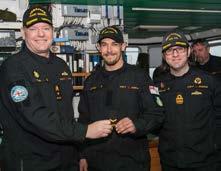
Capt Michael Jerrott (right) was presented with his submariner qualification in November 2023 by LCdr Harrison NguyenHuynh, Commanding Officer of HMCS Windsor.
Training Ukrainian soldiers in Latvia
planning and executing operations to gathering intelligence.
In June of 2023, Lieutenant-Commander (LCdr) Paul Kasianov deployed on what would be an emotional yet rewarding experience.
He would spend the next six months working as a Chief Linguist in Latvia as part of Operation Unifier, a military training and capacity-building effort in support of Ukraine and its armed forces.
“I met doctors, engineers, teachers, and some other people who were just regular people,” LCdr Kasianov said. “And now they’re fighting, and all of them are officers in the Ukrainian armed forces.”
LCdr Kasianov has been a marine systems engineer in the Royal Canadian Navy for 21 years. Born in Ukraine, he moved to Canada nearly 30 years ago. Deploying on Operation Unifier allowed LCdr Kasianov to provide direct help to people who needed it while also allowing him to reconnect with his Ukrainian roots.
Launched by the Canadian Armed Forces in 2015, Operation Unifier was created at the request of the Ukrainian Government, which sought support after Russia’s annexation of the Crimean Peninsula. While efforts to assist Ukraine with training were temporarily halted following the February 2022 full-scale Russian invasion, Operation Unifier remains active today in the U.K., Poland, and Latvia.
“It’s a tool. It gives them the ability to do their job more efficiently. And that’s important,” LCdr Kasianov said.
As the Chief Linguist, LCdr Kasianov provided daily translation services to the instructors and students. He was also responsible for various tasks, from greeting the students on the first day to translating lecture slides.
While the training is typically taught over several months in Canada, the Ukrainian officers cycle through a condensed three-week session, training every day except Sundays.
Once the three-week period ends, the students return to battle, and a new group is cycled into the program. When new students arrive, they often require support to deal with physical and emotional battle injuries in addition to their training.
“A lot of people were coming from the front lines, directly from the trenches,” LCdr Kasianov said. “They are in active fight. They are losing friends. They’re concerned about their families because they’re scattered all over the place.”
LCdr Kasianov noticed that while students tended to be more reserved during the first few days of training, they slowly began to open up as the Canadian and Latvian instructors gained their trust. For LCdr Kasianov, the program’s final day was always the busiest because everyone wanted to communicate with one another, expressing various sentiments, from gratitude to farewells.
When the operation was first created, LCdr Kasianov was flagged as a potential translator for the program due to his linguistics profile, being fluent in both Ukrainian and Russian. But the timing never felt right, both professionally and personally, to deploy on the mission. That is until 2023 – when LCdr Kasianov received another request to assist with Operation Unifier
“When I received that email with the request for a linguist, I thought, ‘this is it, I can do this’,” he recalled.
The program was an emotional experience for everyone involved. LCdr Kasianov said many instructors described the experience as more than just training; it was like giving every student a part of their soul.
“You hear all kinds of stories, all kinds of examples, and you couldn’t be impartial. You get involved, you become part of that conversation, part of that emotion,” LCdr Kasianov explained.
Six weeks later, he was on a flight to Latvia.
In Latvia, the Canadian Armed Forces have been working alongside the Latvian National Armed Forces to deliver Junior Officer Leadership Development training. The training provides Ukrainian officers the necessary tools to defend their nation and regain sovereignty. Students of the program are instructed on various military skills, from
Since 2015, the Canadian Armed Forces has helped train over 39,000 members of the Ukrainian military. More than 300 Canadian Armed Forces members are deployed on Operation Unifier across Europe. Canada and its international partners are committed to providing Ukraine with the support and training they require to continue fighting for their freedom and independence.
Gabrielle Brunette FMF CS
LCdr Paul Kasianov (left) deployed in June of 2023 for six months on Operation Unifier – a training program in support of the Armed Forces of Ukraine.
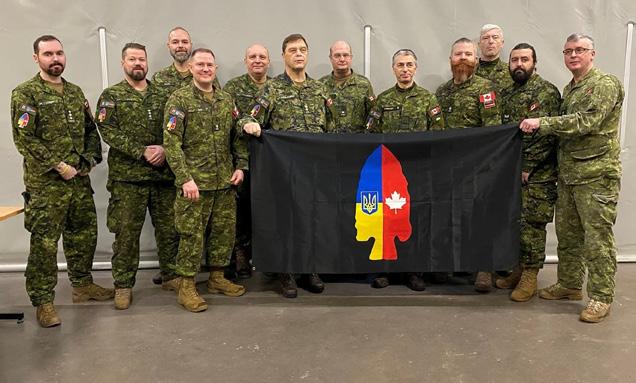
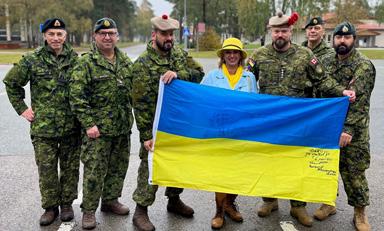
Members of the Canadian Armed Forces stand with the official patch for Operation Unifier The design was chosen by the first Canadian Unit sent on the operation.
Treatment IS WITHIN REACH
Addiction, Mental Health & Trauma Treatment just
Help is at hand: Powell River-based Sunshine Coast Health Centre and Georgia Strait Women’s Clinic— Canada’s only trauma program exclusively serving women—provide highly personalized addiction, mental health and trauma treatment for male and female clients respectively. We’ll pick you up from the ferry for our daily inpatient treatment tailored to your unique needs.
Services include 24 hour-medical service, psychiatric assessment, EMDR, rTMS, psychotherapy, a dedicated group for military clients and much more.
Serving the Department of National Defence and Veterans A airs Canada since 2009.
Georgia Strait Women’s Clinic is Canada’s only trauma program exclusively serving women