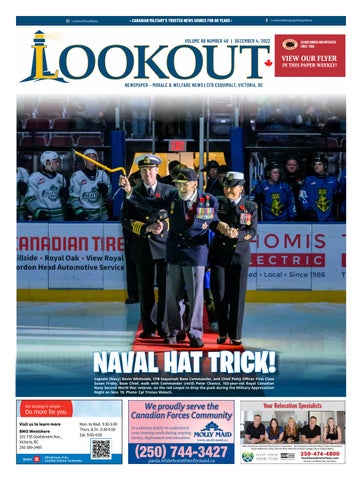
NAVAL HAT TRICK!






STRENGTH IN DEPTH
Bomb disposal teams train for ‘emerging’ IED threats
Peter Mallett Staff Writer
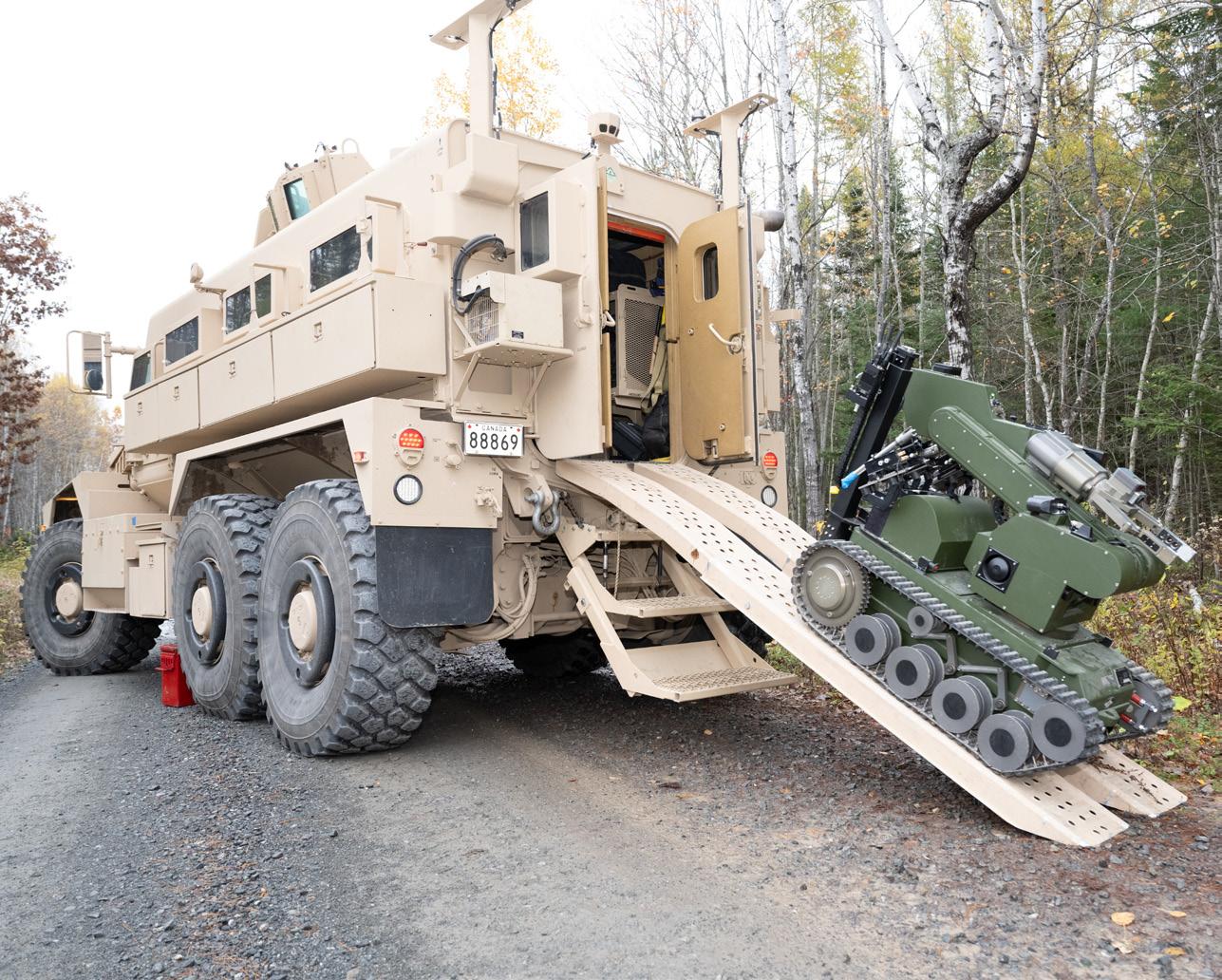
One of many tasks performed by Fleet Diving Unit (Pacific) (FDU(P)) is confronting evolving threats posed by Improvised Explosive Devices (IEDs).
Four members from CFB Esquimalt’s bomb disposal team had a chance to enhance those skills during a multinational Exercise Ardent Defender at 5 Canadian Division Support Base in Gagetown, N.B., Oct. 20–Nov. 2. The Canadian-led exercise involved 180 Canadian Armed Forces (CAF) members and approximately 150 military members from partner nations of Belgium, Denmark, Germany, the Netherlands, New Zealand, Sweden, the United Kingdom and the United States.
Lieutenant (Navy) (Lt(N)) Jesse Deason, Explosive Ordinance Disposal Officer (EOD) of FDU(P), says the training exercise was beneficial for his EOD Team, giving them an opportunity to practice and hone their skills with other allied nations.
“The instructors keep a finger on the pulse of the latest IEDs and enemy tactics used in current conflict zones,”
said Lt(N) Deason. “This exercise gave them a chance to showcase some of the devices found in Ukraine to all multinational IEDD Operators, which was very educational.”
The use of improvised and conventional explosive ordinances has resurfaced in Ukraine and Eastern Europe and evolved in recent years.
Ardent Defender gave participants a chance to leverage lessons learned from this contemporary operating environment.
Brigadier-General Stéphane Masson, Commander 5th Canadian Division, added that the exercise served as an opportunity for the CAF to confirm and consolidate individual and collective skills in countering explosive threats.
“The ability to pull lessons from the battlefield and inject them into our training as quickly as practicable helps the Canadian Army build a strong, relevant capability for Canadian Armed Forces operations,” said B-Gen Masson.
While participants were not allowed to discuss specific details of procedures or tactics, Lt(N) Deason shared he was second in charge (2IC) and Operations Officer of 44 Search and EOD Squadron, a multinational squadron with both EOD and Search Teams.
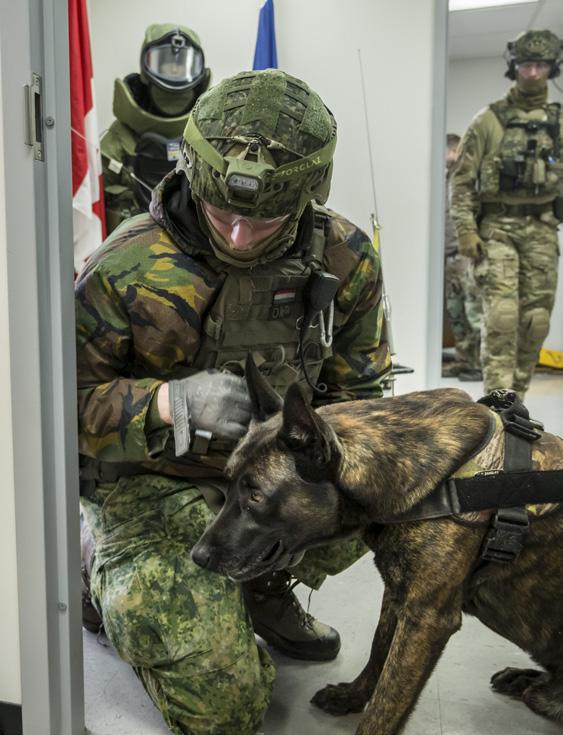
The three FDU(P) members were part of separate teams that searched for hidden nonlive IEDs over a large swath of rugged, forested terrain at Gagetown.
“Our teams responded to numerous varying scenarios involving IEDs,” said Lt(N) Deason. “Typically, a report would come in of a potential IED at a high-profile event or location and our teams would respond.”
Critical in the training was the collection of evidence and involvement of Level II Exploitation Lab personnel who analyzed the retrieved IED components. The analysis provided intelligence on the IEDs such as their nature, what components were used and what devices and tactics the enemy is employing. This analysis helps build the bigger threat picture and the team can better inform Improvised Explosive Device Disposal (IEDD) Operators what they can expect to encounter.
Lt(N) Deason was happy to report one of FDU(P)’s IEDD Operators received his recertification during the exercise. It was the 10th iteration of Ardent Defender, normally held in Canada on an annual basis at different locations across the country.


MANAGING EDITOR
Jazmin Holdway jazmin.holdway@forces.gc.ca
EDITOR
Kate Bandura
WRITER
250-363-3130 kateryna.bandura@forces.gc.ca
Peter Mallett mallett.peter@cfmws.com
PRODUCTION
Leslie Eaton
250-363-8033 workstation3@lookoutnewspaper.com
ACCOUNTS/RECEPTION
Trina Winters
ADVERTISING
Joshua Buck
250-363-3127
778-977-5433 NEW military.base.advertising@gmail.com
EDITORIAL ADVISORS
Capt Christopher Dubé
Ashley Evans
Rodney Venis
FRENCH EDITORIAL ADVISOR
250-363-4006
250-363-7060
A/Slt Alexandre Springer alexandre.springer@forces.gc.ca
Published each Monday, under the authority of Capt(N) K. Whiteside, Base Commander.
Le LOOKOUT est publié tous les lundis, sous l’égide du Capv K. Whiteside, Commandant de la Base.
The editor reserves the right to edit, abridge or reject copy or advertising to adhere to policy as outlined in PSP Policy Manual. Views and opinions expressed are not necessarily those of the Department of National Defence.
Le Rédacteur se réserve le droit de modifier,de condenser ou de rejeter les articles, photographies, ou annonces publicitaires pour adhérer au Manuel des politiques des PSP. Les opinions et annonces exprimées dans le journal ne réflètent pas nécéssairement le point de vue du MDN.
Circulation: 2,000 plus 300 pdf downloads per week Follow us on Facebook, Twitter and Instagram to join our growing social media community.
A Division of Personnel Support Programs
CFB Esquimalt, PO Box 17000 Stn. Forces Victoria, BC V9A 7N2 Web: www.lookoutnewspaper.com Fax: 250-363-3015
Canadian Mail Product Sales Agreement 40063331




Decisions, decisions, decisions. On an average day, we face making a choice every two seconds. That’s approximately 35,000 choices we make every day. In fact, you’re probably making the decision right now if you want to continue reading this or move on to other things.
What’s obvious about decisions is that there are ones that are easier, such as going to work when we are feeling healthy, and ones that are more demanding of your attention like deciding if a career change is a worthwhile endeavor. When those difficult choices arise, we begin to notice uncertainty and doubt creep into our decision-making process.
Doubt and uncertainty aren’t necessarily a “bad” thing in those challenging circumstances. We need them to appropriately evaluate our path forward. In a way, uncertainty and doubt are the brakes in our decision-making process; they stop us from mak-
Uncertainty & Control
ing rash and crude choices that may be myopic if not properly assessed. However, uncertainty becomes detrimental when it prevents us from making a choice altogether. When uncertainty is at its worst it causes paralysis in the mind, which eventually leads to the body feeling stuck. One becomes frozen in time. This state when lingered in for too long becomes comfortable. I think this is due to the individual consciously or unconsciously recognizing that there is a level of control here – whether that control is hollow is another question. Nevertheless, the individual’s world demands action, yet they have too much doubt in their ability and in their hearts to make the best choice and act on it. They become crippled by inertia. This is when that indelible feeling of watching the world go by rips at your soul.
Uncertainty in its negative form breeds loneliness to oneself. You’ll often notice people who struggle with making decisions ask others for guidance. I believe it is absolutely appropriate to ask others for insights, but when you heed the advice of others more often than not, then you have to truly question who’s running your life. So, what does one do when shrouded by uncertainty? I think part of it has to do with control and learning to let go of it. Our current trajectory with history shows us that we have a predis-
position toward being safe. Through a self-preservation and evolutionary lens, it makes sense. However, I think to a degree, as a collective, we have become quite neurotic about control and this is a sign that we are neurotic on an individual level. Neurosis isn’t a bad thing either, it is just a signal that represents the tension of opposites, and in this case, it is the tension between control and no control.
We have to learn to know when it is best to give up control in a situation and when to take it. When we recognize that, we become active participants in our lives and begin to feel a sense of autonomy; we’re actually living. This, however, is a peculiar balancing act, of when to give up control and embrace what is necessary or learn to be at peace with situations that you have no control over.
Thomas Goenczi is an RCN Veteran and MA Clinical Counsellor with Private Practice: Well Then Therapy.
The content is not intended to substitute professional advice, diagnosis, or treatment. Always seek the advice of your mental health professional or other qualified health provider with any questions regarding your condition.
Thomas Goenczi Lookout contributor
Catching up with HMCS Vancouver
Capt Véronique Sabourin HMCS Vancouver PAO
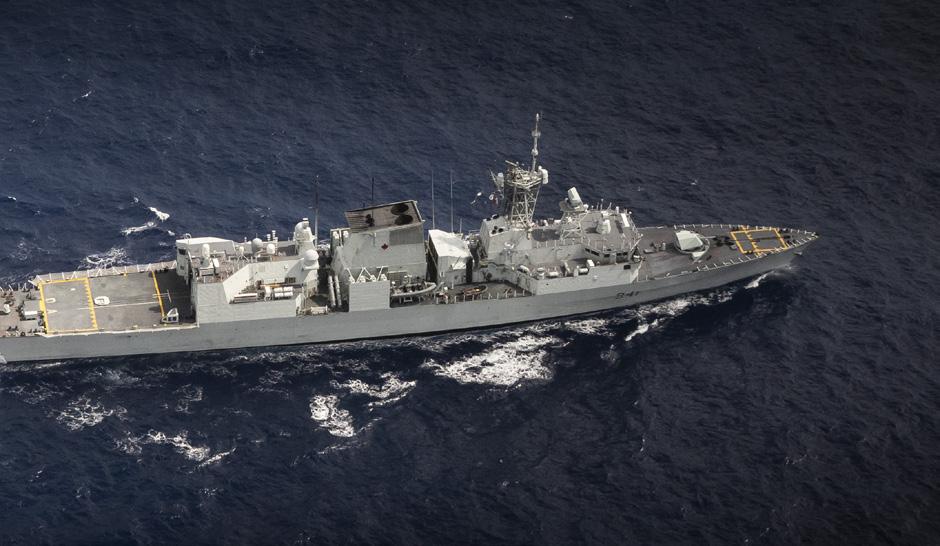
After the concluding Exercise Sama Sama with our partners in the Philippines in mid-October, we continued our sail in the East China Sea as part of Operation Neon to support enforcing UN Security Council sanctions against North Korea. At that time, a Royal Canadian Air Force CP-140 Aurora Air Detachment joined our efforts to monitor the waters. An additional s-eye view of our embarked CH-148 Cyclone helicopter increased our ability to detect illicit ship-to-ship transfers.
Vancouver arrived at White Beach Naval Facility for a port visit to Okinawa, Japan, on Oct. 16. Fun fact: our hockey team played at the same arena where the Prime Minister of Canada dropped the puck 23 years ago for a hockey game between Japanese and Canadian players on the occasion of the G-8 Summit. The hockey game between our team and a local team at the Sports World Southern Hill Ice Arena in Okinawa showcased the lasting and enduring friendships between our people and nations.
We left Okinawa on Oct. 19 to return to sea on Operation Neon Vancouver sailed with His Majesty’s Australian Ship Toowoomba II (FFH 156) in the East China Sea on Oct. 22, working with partners and allies in a coordinated effort to help identify suspected maritime sanctions evasions, bolster security and strengthen defence relationships.
We then came alongside Busan, Republic of Korea, for a rest and maintenance period on Oct. 23. It is with mixed feelings that we said
goodbye to those who completed their training and welcomed new sailors onboard to pursue their training and our mission in the IndoPacific region. In Busan, Commander Maritime Forces Pacific and the Canadian Defence Attaché to South Korea, with crew members from Vancouver, laid wreaths at the United Nations Memorial Cemetery. We honoured the buried 376 Canadians and 2,300 United Nations Command service members who lost their lives in the service of peace during the Korean War and those whose burial places remain unknown. Seventy years ago, the signing of the Korean Armistice Agreement ended over three years of fighting on the Korean Peninsula.
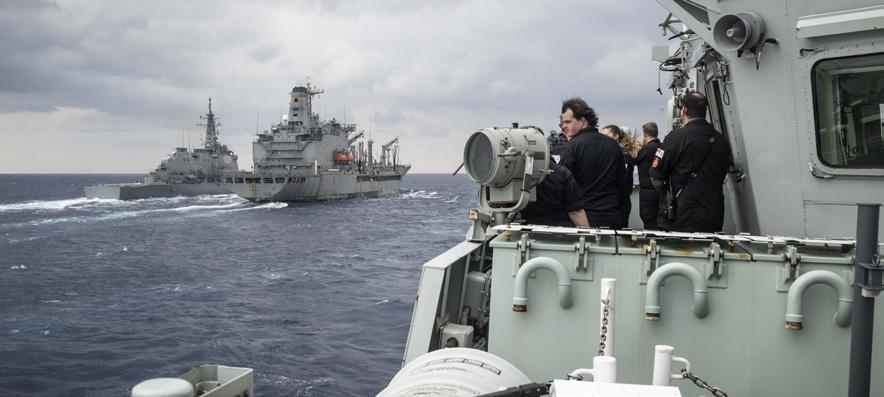
Back at sea, Vancouver further strengthened defence relationships, naval cooperation and mutual trust as we conducted a replenishment at sea with Republic of Korea Ship Daechong (AOE-58) in waters south of Jeju Island on Nov. 3. In early November, Vancouver completed its support to Op Neon followed by our ship’s port visit in Sasebo Nov. 5 to 9, our third port visit to Japan during this deployment.
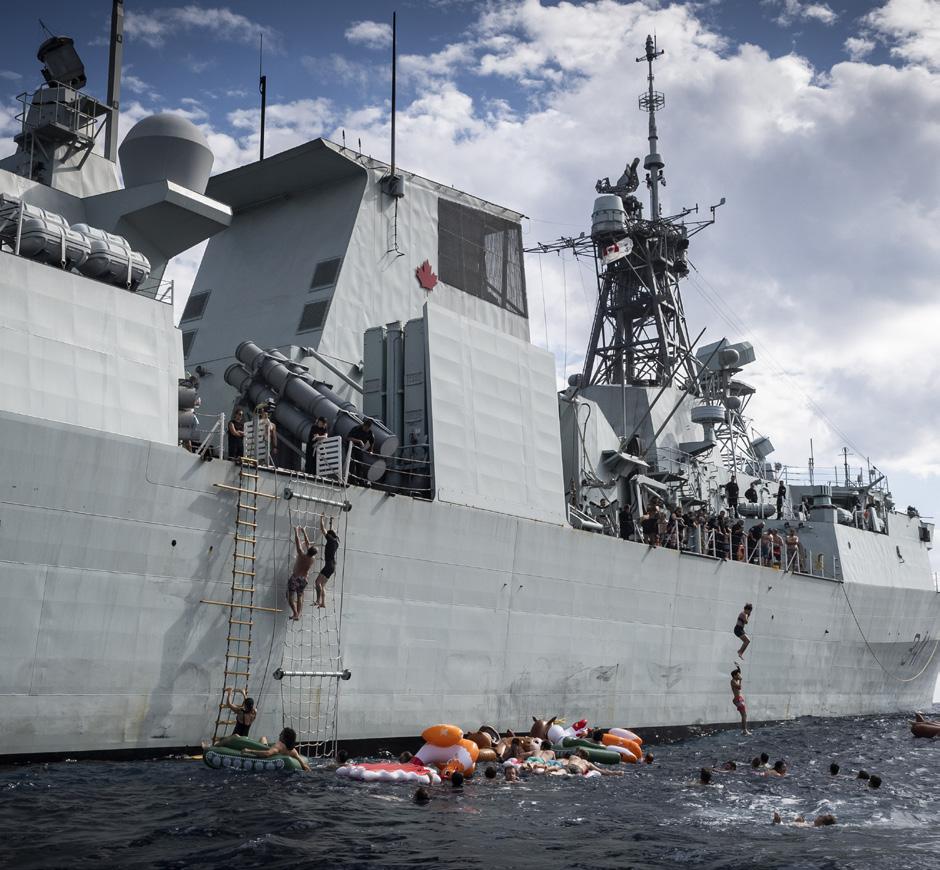
During the past month, we enjoyed plenty of social activities onboard, including our routine ‘Sunday Sundaes’, get-togethers on the flight deck, movie trivia nights and fundraisers for the National Defence Workplace Charitable Campaign. During ‘The Shave it or Save it Charity Event’, some made the tough call to let go of their deployment mustache for a good cause.
On Halloween, departments decorated their work spaces, and some

got dressed in costumes for trick-ortreating. Our galley went out of its way with Halloween-themed cookies, caramel, and chocolate-covered Asian pears. What a morale booster that was!
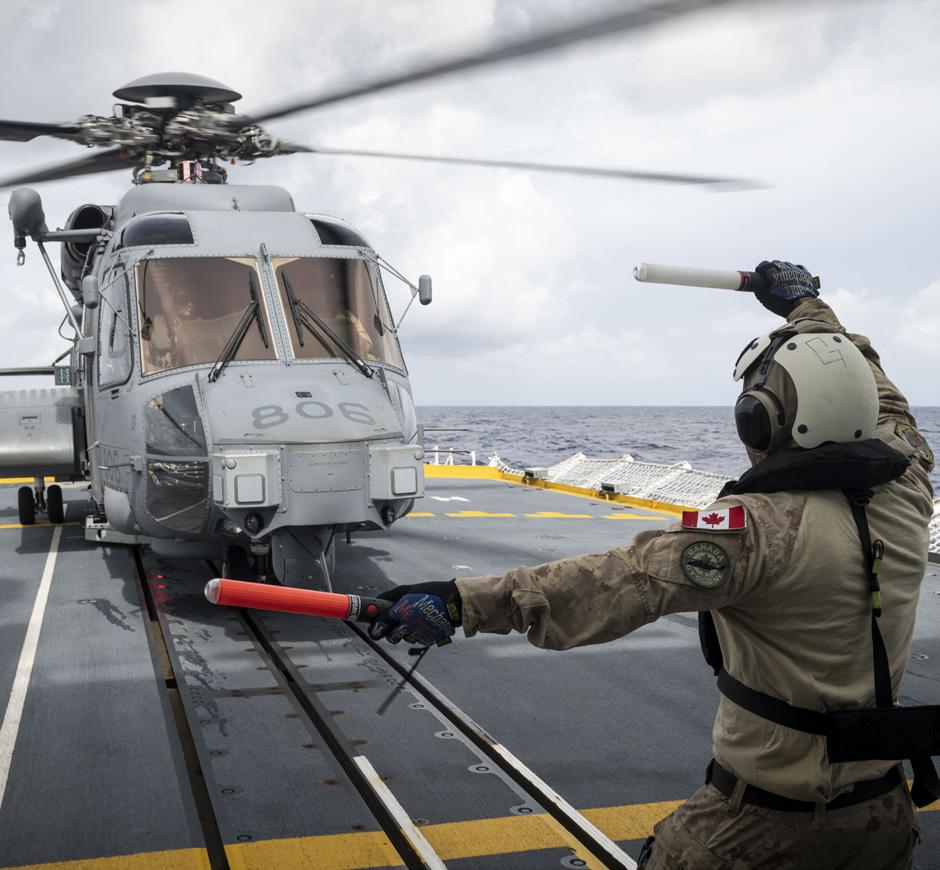
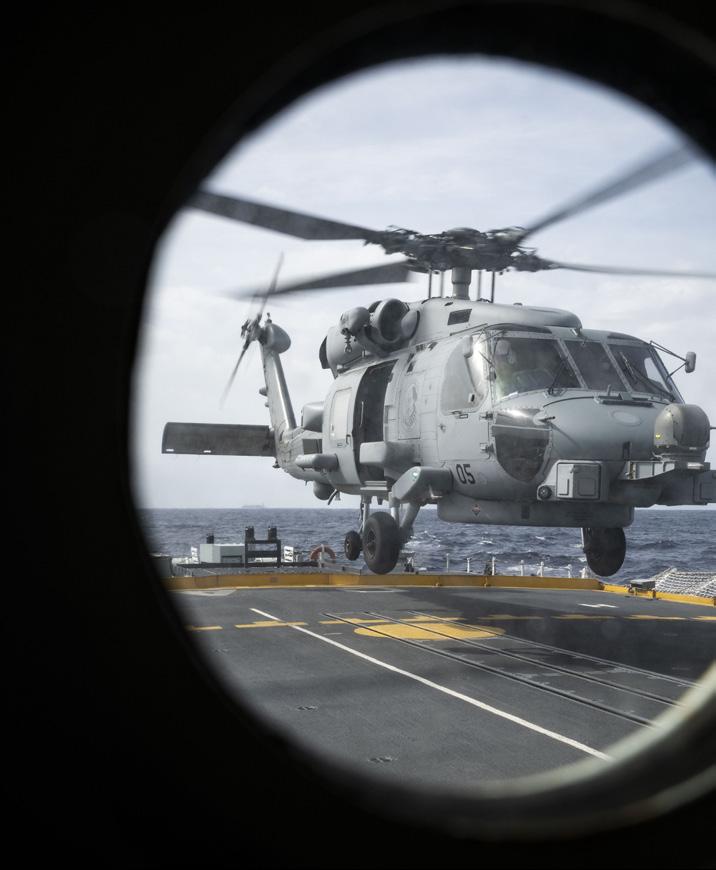
Our sailors have also had the unique opportunity to be flight passengers in our embarked CH-148 Cyclone helicopter. They can also volunteer to be lowered on the flight deck of our ship by a hoisting cable as the helicopter hovers over. What an experience it is to fly over our ship in the Pacific Ocean!
Our crew resumed operations with HMCS Ottawa and MV Asterix, continuing to promote peace and stability alongside international partners in the Indo-Pacific region. We are now at sea as part of Exercise AnnualEx, a naval training event led by the Japan Maritime Self-Defense Force (JMSDF) on Nov. 10-20 in the Philippine Sea. Throughout the exercise, the Royal Australian Navy, the Royal Canadian Navy, the JMSDF, and the U.S. Navy engaged in various events comprising enhanced maritime communication tactics, anti-submarine warfare operations, air warfare operations, and replenishments-at-sea, among others. We continue further strengthening the bonds between our nations and our navies.
As always, thank you for being our biggest supporters and following along with us on our journey. Please continue to share these broadcasts and help us spread the word about the amazing things Vancouver is doing overseas.
Ever on Guard, The Battle Cats
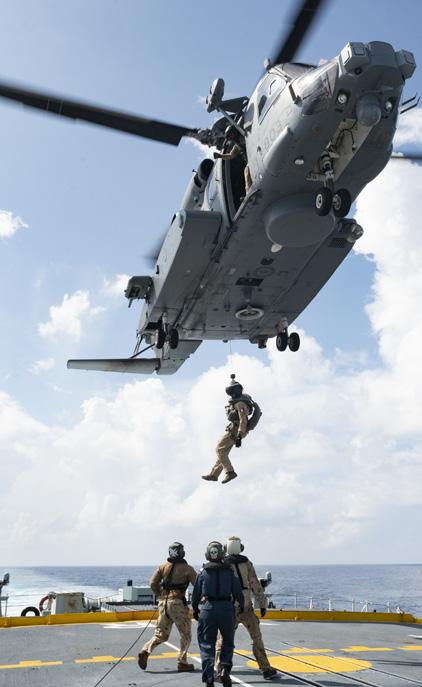


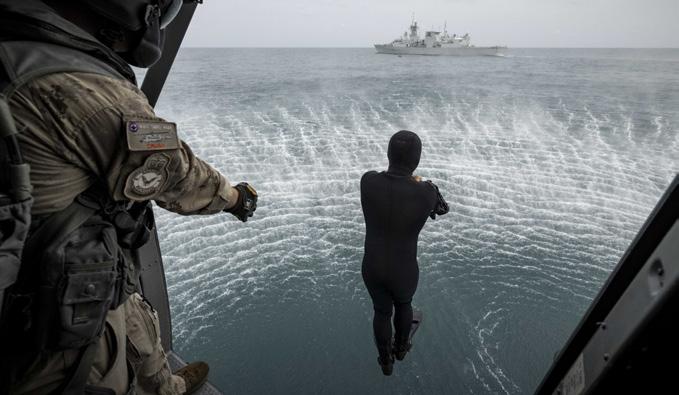
HMCS Vancouver flight crew hoist crew members from a CH-148 Cyclone helicopter during Operation Neon in the South China Sea on Sept. 28.
Photo credit: Corporal Alisa Strelley









Peter Mallett Staff Writer
We are all soldiers in the war to combat drug overdoses and the fentanyl public health emergency sweeping British Columbia.
In 2018, the number of opioid deaths in the province surpassed the combined total number of suicides, homicides, and deaths due to motor vehicle collisions, and the situation is not getting much better, according to data from the provincial government.
A Nov. 22 Naloxone Training Session at the Chief and Petty Officers Mess gave military members of CFB Esquimalt the tools, procedures, and education they need to respond to individuals experiencing a drug overdose from opioids and fentanyl.
“This is the one of the most important training sessions people can attend because this training may help them save a life,” said Captain (Navy) (Capt(N)) Alex Kooiman, Champion of the Maritime Forces Pacific Health & Wellness Strategy Addictions-Free Living Working Group and Commander of the Canadian Submarine Force. “There is still stigma in the military around talking about drug and opioid use, but this shouldn’t be the case because we live in a community where so many people are affected by it.”

Life-saving Naloxone training underway
ities across the province, said Paige Aoki, Educational Team Coordinator with AVI (Aids Vancouver Island) Health and Community Services.
Aoki is one of the foot soldiers leading the fight against opioid deaths. She explained there are two main reasons for the skyrocketing deaths.
“Fentanyl cross-contaminating other drugs, and inconsistent potency of streetlevel fentanyl is the issue,” she said. “Also, the number of people smoking their drugs is on the rise; I noticed this prevalence since I started working in the field five years ago.”
She noted those numbers began to decline ahead of the COVID-19 pandemic but skyrocketed again in subsequent years due to many people using opioids in isolation and experiencing overdoses while alone. While isolation is one part, agencies closing due to COVID protocols also reduced supports and access to safe consumption sites and services.
essential procedures and techniques. AVI also provided participants with a free Naloxone kit to take with them after the training session. The kit contains three doses of Naloxone, three VanishPoint syringes, a pair of gloves, alcohol swabs, a pocket mask for rescue breathing, and an infograph with the SAVE ME overdose response steps.
Aoki is already looking forward to the next training session in early 2024.
“I have been pleasantly surprised by the level of kindness and concern exhibited by this community, and how military members are super-engaged and always ask very meaningful questions,” she said. “Everyone at CFB Esquimalt is always incredibly eager to learn and be part of that conversation.”
The public health emergency is the result of an unpredictable, highly toxic drug supply and has a staggering impact on individuals, families and commun-
Aoki held the training session, discussing the signs of an overdose, how to properly care for someone who is experiencing a drug overdose, and the proper and safe use of Naloxone, a highly effective medication used to temporarily reverse opioid overdoses. Combined with rescue breathing, Naloxone can save a life, she said. Participants learned to use proper tools (provided by AVI) required to respond safely and effectively to a drug overdose, which included a sponge, two syringes, a vile of Naloxone, a pair of medical gloves, a pen and a pamphlet covering
Vicky Doucette, Health Promotion Specialist for Personnel Support Programs (PSP), helped facilitate the training session. She was also impressed with the interest-level and questions asked by participants.
“They were genuinely curious about what to do in a practical real-life-scenario in different situations and I was really encouraged by this interaction that the training and education is sinking in,” said Doucette.
The next training session is Feb. 7, 2024, from 1:30 to 3:30 at the Rainbow Room in the Chief and Petty Officers' Mess. Sign-up information is available through Health Promotion or on the Base Splash Page.








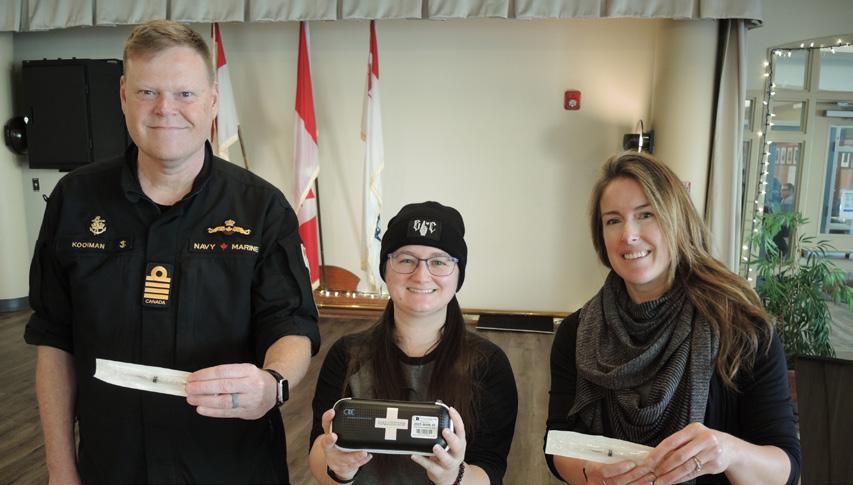
(Left) Vicky Doucette, Health Promotion Specialist, Personnel Support Programs, Paige Aoki, Education Coordinator, AVI Health and Community Services and Captain (Navy) Alex Kooiman, Champion of the MARPAC Health & Wellness Strategy Addictions-Free Living Working Group display syringes and a Naloxone kit during a Naloxone Training Session, Nov. 22 at the Chief and Petty Officers' Mess. Photo: Peter Mallett/Lookout
New Formation Master Sailor appointed
Maritime Forces Pacific / Joint Task Force (Pacific)
Commander of Maritime Forces Pacific (MARPAC) has appointed Master Sailor (MS) Ingeborg Haley LeClair as the new Formation Master Sailor and President of the Mess Committee for the Pacific Fleet Club. The Formation MS is considered part of the MARPAC Command Triad and is essential in the morale and welfare of the Junior Ranks within our Formation. The position is the voice of the Junior Ranks and is critical in ensuring the two-way communication between Senior Leadership and the Junior Ranks remains open.
MASTER SAILOR INGEBORG HALEY
LECLAIR
MS LeClair (née Proctor) is a Boatswain based in Esquimalt. She was born in Vancouver to a military family who soon moved to Winnipeg, Man., while she was still young. There, she enrolled at His Majesty’s Canadian Ship Chippawa in March 2015. She completed Basic Training in Quebec City, Que., in the summer of the same year and subsequently completed her Trades Training in Halifax, N.S., in the spring of 2016. Once trained, she commenced multiple long-term, full-time periods of employment on the East Coast. She deployed with HMCS Moncton to the Arctic Circle for Operation Limpid before transferring ships and becoming a member of the final ship’s company of HMCS Athabaskan, sailing and participating in the paying off/decommissioning ceremonies for this historic vessel.
MS LeClair met her spouse within the service. She requested to relocate to beautiful British Columbia when he was posted to Esquimalt in 2017 following his Component Transfer to
the Regular Force as a Marine Technician. She moved while pregnant with their first child, so MS LeClair initially worked clerical duties at the Naval Reserve Coordination Center. Since then, she has risen through the ranks and was promoted to Master Sailor in 2023, immediately upon returning from her second parental leave.
MS LeClair spent the spring and summer of 2023 as a member of the Personnel Coordination Centre (Pacific) GEO Team, where she oversaw the movements of all Boatswain GEO members, as well as creating, developing, and supervising the implementation of various training initiatives, such as mass training activities with the Naval Fleet School (Pacific) Replenishments At Sea Trainer, and the movement on Temporary Duty to Nanaimo where junior sailors augmented HMCS Nanaimo’s Duty Watch as Force Protection to complete Naval Environmental Training Program (NETP) On-the-Job Practical Requirements.
MS LeClair earned multiple Commanding Officer Bravo Zulus while sailing in HMCS Whitehorse for her hard work during Operation Caribbe and Search-And-Rescue Zone, both in 2020, including for acting as Social Media Coordinator/Unit Public Affairs Representative and for professionalism despite adversity.
MS LeClair has been an active member of the Junior Ranks Mess Committees onboard multiple ships, serving as Entertainment Representative, Vice President and President of the Mess Committee. She has attended Positive Space Ambassador and Sentinel training, which has aided her in helping shipmates in times of crisis.
MS LeClair works at the Personnel Coordination Center (Pacific) as the assistant Reserve Boatswain Analyst.
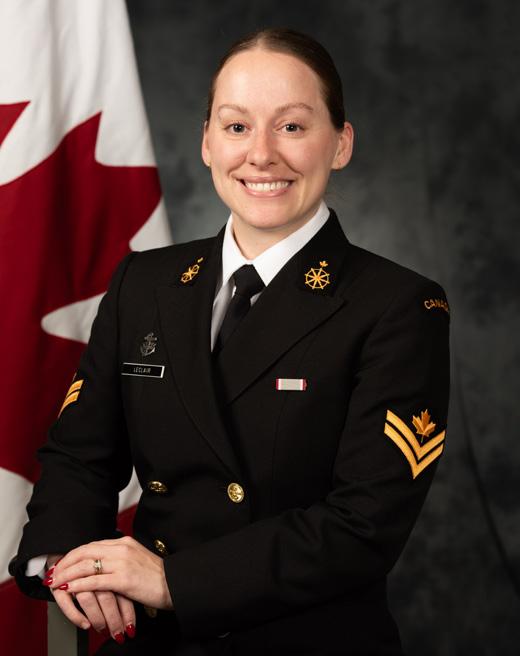


Master Sailor Ingeborg Haley LeClair




































































Every dollar makes a difference for NDWCC
Peter Mallett Staff Writer
Every donation to the National Defence Workplace Charitable Campaign (NDWCC) and grass-roots organizations positively impacts our community.
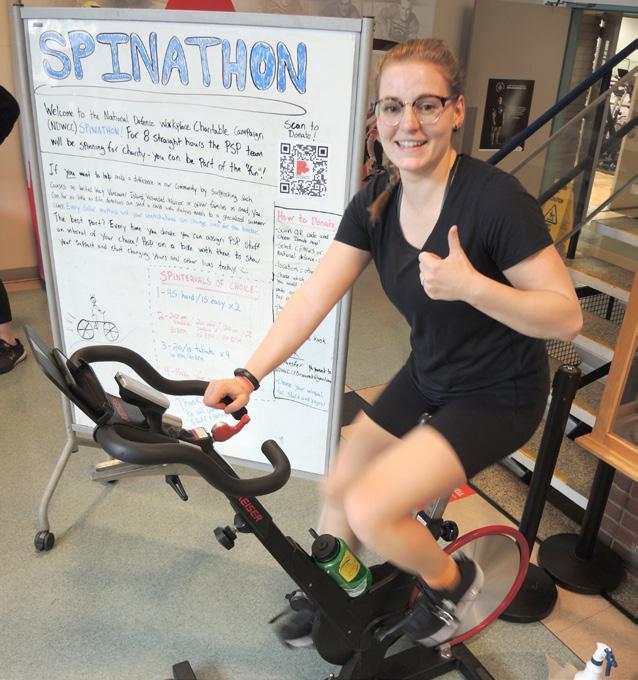
To benefit Esquimalt’s NDWCC, employees at the Naden Athletic Centre hosted a Spin-a-thon in the main lobby on Nov. 8.
While wiping away the sweat from her brow, volunteer spinner Kim Kuemper said the event allowed her to do something she doesn’t usually do during work hours and help the community in which she works and lives.
“Each time people donate, I am required to peddle a bit harder, so this is also a good way for some of my students to get a small revenge for my pushing them in our fitness classes,” she said.
The Spin-a-thon saw Personnel Support Programs (PSP) fitness instructors hop aboard a stationary bike and cycle for one-hour shifts. The spinners engaged patrons as they arrived or departed for their workouts and encouraged them to donate to the collection bucket.
All the funds raised during the eight hours of spinning will add to the campaign’s final dollar figure, says Matt Carlson, CFB Esquimalt Projects Officer.
“The NDWCC motto this year is ‘every dollar makes a difference’ and NDWCC events are as much about awareness as the total number of dollars collected,” says Carlson.
This year’s NDWCC campaign at the Base wrapped up last week. Half the money raised will go to the United Way of Southern Vancouver Island, and the remaining amount will go to Health Partners. Donors can also donate money to a charity of their choice.
Carlson says the campaign expects a significant boost in dollar contributions in its final few weeks. The second installment of the highly popular Bring Your Dog to Work Day on Nov. 22 saw dozens of military and civilian employees paying $10 to bring their always well-behaved and leashed pets to work for the day. A fundraiser with local chocolatier Purdys concluded on Nov. 26, where up to 25 per cent of proceeds from online sales went to NDWCC.
Carlson says several units of CFB Esquimalt are doing an assortment of smaller fundraisers this month, including holiday bake sales and chilli cookoffs. He says these smaller events will all go a long way in boosting their fundraising total.
“We are hoping the spirit of the holidays and helping the less fortunate will provide a late boost to our campaign,” said Carlson. “We appreciate the support of the PSP and all other units who are working hard to put the ‘fun’ into fundraising.”
Later in 2024, Carlson and NDWCC organizers at the Base will announce this year’s fundraising total and present the monies raised to the campaign’s two primary beneficiaries.
Kim Kuemper, Personnel Support Programs Fitness Instructor, participates in a Spin-a-thon in support of the National Defence Workplace Charitable Campaign on Nov. 8 at the Naden Athletic Centre.
Photo: Peter Mallett/Lookout Newspaper

Military members given the ‘Royals’ treatment
Peter
Mallett Staff Writer
The Victoria Royals scored a big win on the ice but also a victory for CFB Esquimalt’s Defence Team community.

Defence Team members from CFB Esquimalt were the guests of The Western Hockey League club for its Canadian Armed Forces (CAF) Appreciation Night on Nov. 10 at the Save On Foods Memorial Centre. The team offered discounted tickets at its box office and 150 free tickets were distributed to military members through the Base Chief Petty Officer First Class (CPO1) Sue Frisby. On the ice, the Royals celebrated a thrilling 3-2 comeback over the Seattle Thunderbirds before 3,978 attendees, its second-largest crowd in event history.
Matt Carlson, CFB Esquimalt Projects Officer, says this year’s edition of the Royals CAF Appreciation Night was likely
one of the best-attended events in recent memory.
“Our annual Canadian Armed Forces Appreciation community relations event at the Victoria Royals game celebrates teamwork and the strong partnership between the sports community and CFB Esquimalt,” Carlson said. “Our alliance with the Royals has continued to strengthen over the years and we look forward to further collaboration moving forward.”
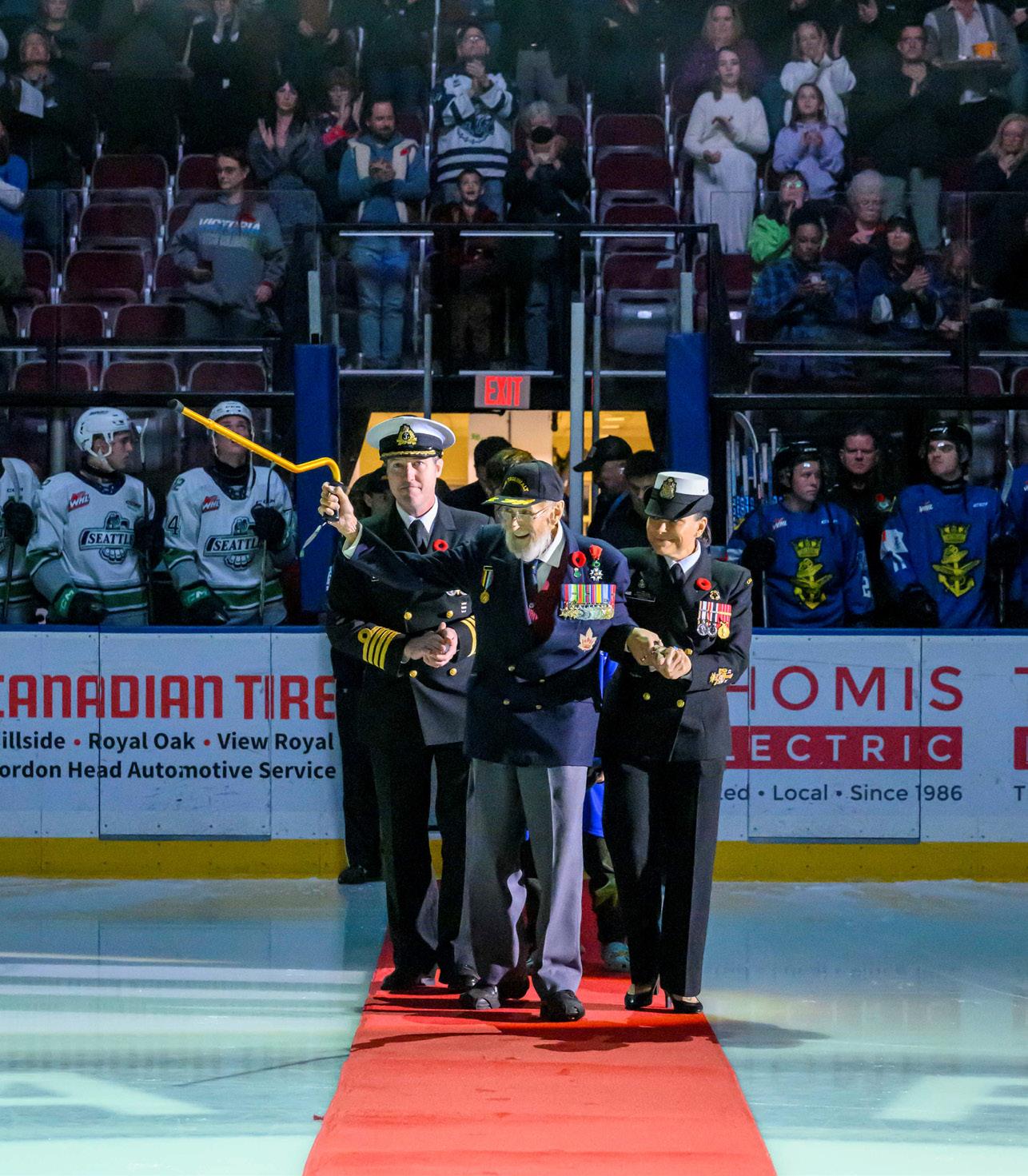
Captain (Navy) Kevin Whiteside, CFB Esquimalt Base Commander, and Commander (ret’d) Peter Chance, 102-yearold Royal Canadian Navy Second World War veteran, got things started with a ceremonial puck drop at center ice and received a standing ovation from the crowd. They were accompanied on the ice by the band of the 5th (BC) Field Regiment, the Royal Canadian Artillery, and the Canadian Scottish Regiment Pipes and drums, who provided
musical accompaniment for the opening ceremonies and throughout the evening.
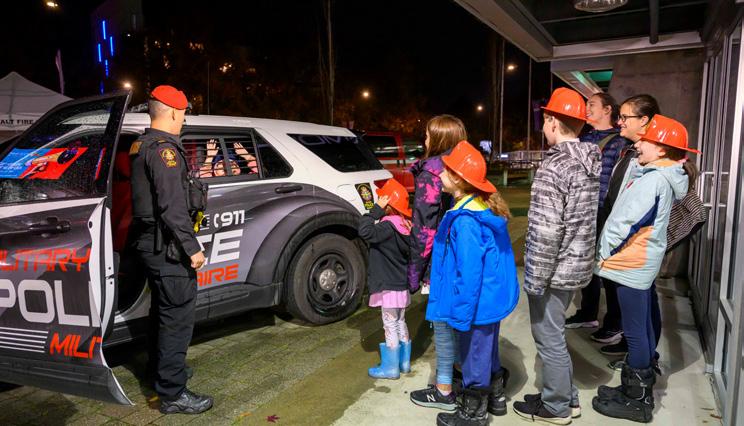
Other participating units provided dynamic displays and public engagement, including CFB Esquimalt Base Fire Services, the CFB Esquimalt Naval and Military Museum, Esquimalt Military Police Unit, Base Executive Services, HMCS Venture, Fleet Diving Unit (Pacific), Canadian Fleet Pacific (CANFLTPAC), HMCS Malahat, and the Naval Tactical Operations Group.
Victoria’s MacDonald Realty donated 18 seats in its luxury suite as part of a draw for attendees to win. The MFRC selected from entries by 186 military families. The private box attendees were treated to free pizza and drinks by the MFRC and a visit by their mascot, Bravo. The MFRC also held a 50/50 draw during the game, with proceeds to benefit the organization.



DLR#



Victoria Royals hosted a Canadian Armed Forces Appreciation night at the Save-On Foods Memorial Centre where units from around Canadian Forces Base Esquimalt brought attractions and members to watch the game between the Royals and the Thunderbirds.
Photo: Corporal Tristan Walach
Steps to a stress-free holiday budget
SISIP
It's that time of year again when we find ourselves deep into autumn activities, and lo and behold, the holiday season has snuck up on us again. Fortunately, SISIP is here to offer advice and tips that could save you time and money to help make it the best festive season ever.
At this time of year, many folks tell us they are concerned about how to finance the upcoming holiday season. It was reported that in 2022, the average amount of holiday spending in Canada was $1442. The costs can add up no matter your celebration or budget. This can pressure a household, making the January blues a deeper shade of blue. So, how can you make the 2023 holiday season less stressful, enjoyable, and affordable?
CONSIDER THESE HELPFUL TIPS:
• Visit your local SISIP office for tips on saving and budgeting.
• Open a savings account and set up a preauthorized deposit each payday specifically for special occasion spending (and keep it going year-round).
• Start a holiday journal to record all the ‘must-dos and the want-tos’; start your gift list now, as this will help you develop a budget you are more likely to stick with.
CONSIDER HANDMADE/ HOMEMADE GIFT GIVING:
• Host baking and craft nights to make cookies and tree decorations for gifts. This will create memories for those giving and those receiving such thoughtful, unique gifts. Create experience and service gift certificates for friends and family, such as a night of babysitting, or household help for family members.

Get organized, talk to your local SISIP representative, and most importantly, have fun. Let your creative side shine through to experience a wonderful holiday season without breaking the piggy bank.










The Canadian Armed Forces reintroduces uniformed Nurse Practitioners
November 12-17 marked Nurse Practitioner (NP) Week in Canada, a week devoted to recognizing the unique contributions NPs make to healthcare every day across the country. NPs are graduate-prepared healthcare providers with an autonomous and legislated scope of practice. With a role dating back to the 1960s, NPs are self-regulated by provincial legislation to provide direct care to patients, diagnose diseases, manage acute and chronic conditions, prescribe medications, order and interpret laboratory and diagnostic tests, and initiate referrals to specialists.
In 2001, 11 Nursing Officers were selected for sponsored NP training to complement the in-garrison health care team and deployed taskings.
Following the implementation of this project, a review of uniformed NP employment was conducted, and ‘the NP profession was found to be suitable and adaptable to a broad spectrum of military deployments’. NPs were deemed employable in areas including, but not limited to:
• wide-scale Search and Rescue disaster relief,
• international humanitarian assistance,
• surveillance and control of Canadian territory and its approaches,
• protection and evacuation of Canadians overseas,
• peace support operations, and collective defence operations.
In 2004, despite successful employment, the uniformed NP concept still needed to be adopted, and sponsored training ceased. An occupational structure was never established for
the uniformed NP at the time of their introduction. Over time, these practitioners returned to the parent occupation and were employed in nursing.
Over 20 years later, the concept of reintroducing uniformed NPs was assessed. In April 2021, Health Services approved the creation of 40 Reserve Force (Res F) NP positions.
Two weeks following the Res F NP implementation, a Res F NP was successfully deployed to Task Force Poland to aid in the medical care of Ukrainian Refugees. Domestically, three Class B contracts were initiated within Canadian Forces Health Services (CF H Svcs) Centres across Canada. Additionally, Direct Entry for the NP trade is now accepted into the Reserve Force!
In December 2022, the establishment of 11 Regular Force (Reg F) NP positions was approved by the Canadian Forces Health Services (CFHS) Health Services Board. This enabled CFHS to allocate postgraduate funding for six Reg F candidates in Fall 2023 and five in Fall 2024. These Reg F positions will support the CAF through primary care delivery in designated CF H Svcs Centres as early as 2024, as well as some isolated positions in the near future.
The establishment of a Total Force NP sub-occupation enables financial stewardship, enhances the timely delivery of care in garrison and on operations, and promotes optimization of resources in a resource-scarce system. It allows the Canadian Armed Forces (CAF) health system to evolve in line with the Canadian Health System and promotes the delivery of needs-based healthcare.
www. broadmeadcare. com/veteranslegacy to make your donation today.
When you donate to the Veterans Legacy Fund, you ensure the best in comfort and care for Canada’s veterans today, and in the future.
To find out more through a confidential conversation, contact Mandy at Mandy.Parker@broadmeadcare.com, or visit www.broadmeadcare.com.


















Chinese Canadian sailor liberated POWs in Hong Kong
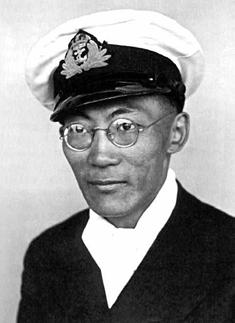
Chinese Canadian William Lore wanted to serve his country during the Second World War. But, all three of his applications were rejected due to his heritage.
“I think they just saw on my application ‘Chinese’ and threw it in the waste basket,” Lore would later remember during an interview.
At the onset of the War, the Canadian government introduced restrictive immigration policies.
The Chinese Immigration Act of 1923 barred nearly all Chinese immigrants from coming to
Canada, with those restrictions extending to military recruiting throughout the Commonwealth.
In 1943, an Order in Council removed racial restrictions on Canadian Armed Forces (CAF) recruits. Applying again, Lore was finally admitted, becoming the first Chinese-Canadian officer in the Royal Canadian Navy (RCN).
Lore completed naval training and was posted to Ottawa at the newly formed Combined Services Radio Intelligence Unit. In 1944, he was loaned to the Royal Navy (RN), where his character, skillset, and multilingualism set him apart.
After reading and interpreting ‘two lines of a Chinese Epigram on screen’, he was selected to be part of a two-person team in the Combined Services Detailed Intelligence Corps in Burma (present-day Myanmar).
In January 1945, he was sent to Colombo, Ceylon (presentday Sri Lanka), where he travelled deep into the jungle to a top-secret RN transit camp, where he played an instrumental role in the development of a significant, joint amphibious and air attack on Japanese forces in Rangoon, Burma (present-day Myanmar).
The plan saw British and AngloIndian forces successfully liberate the city, contending with limited Japanese opposition, mostly
AS A MILITARY MEMBER,
snipers. By May of 1945, the enemy had been fully expelled.
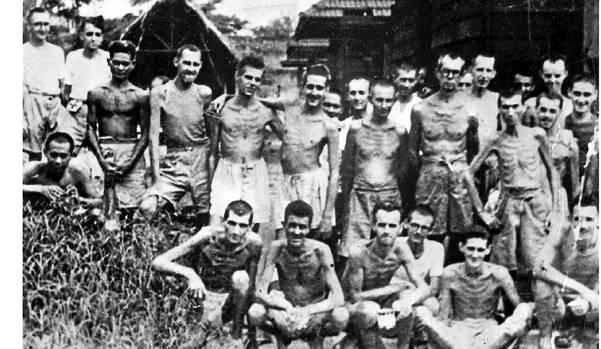
After the Japanese government began negotiating terms to surrender, Lore led a party of British Royal Marines to negotiate an official surrender with the Japanese in Hong Kong. They took control of the RN shore base and liberated Canadian, British and Hong Kong prisoners at the notorious Sham Shui Po Prisoners of War (POW) camp. The still-posted Japanese guards first laughed at Lore, but his persuasive attitude and the accompanying Marines convinced the guards of Japan’s surrender.
Lore’s account of discovering the Canadian POWs is harrowing.
“I went into the first building I came to, and it was very dark,” he said. “There were about 40 men in there, Canadians, sitting at tables and so forth. I said, ‘Hi you guys, don’t you want to see a Canadian?’
Then they ran forward and saw my cap badge. Those men were really skeletons. You could see their bones through the skin.”
“Then they were crying and weren’t ashamed of crying. And finally, I cried, too, because they were telling me what they had suffered,” remembered Lore.
Despite the War’s end, Lore stayed on loan to the RN before returning to Canada a year later.
Lore served in Hong Kong again during the Korean War, doing intelligence work. He settled in Hong Kong in 1957 and became an insurance agent. Then, at 51,
Lore earned a law degree at Oxford University and opened his practice in 1962.
He died on Sept. 22, 2012, at 103 years of age.
“William Lore’s drive and determination to serve his country and to achieve recognition of Chinese Canadians as full members of Canadian society serve as a wonderful example to all of us and show we all can make a difference. As a sailor, LieutenantCommander Lore made Canada proud,” said Peter MacKay, the Minister of National Defence at the time of Lore’s passing.

Royal Canadian Navy
A group of Canadian prisoners of war at the infamous Sham Shui Po Prisoner of War Camp, which Lieutenant-Commander Lore liberated with a group of Royal Marines.
William Lore. Photo: Chinese Canadian Military Museum Society.

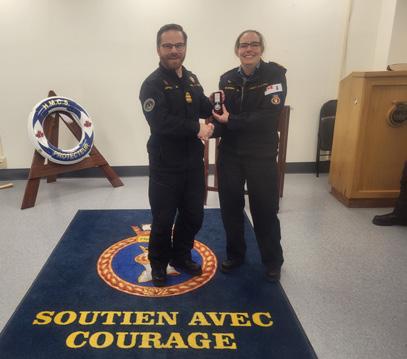
Lieutenant (Navy) Gillian Herlinger is presented her Operational Service Medal – Expedition for Operation Neon by Lieutenant-Commander Ryan DeForest, Executive Officer of HMCS Protecteur.
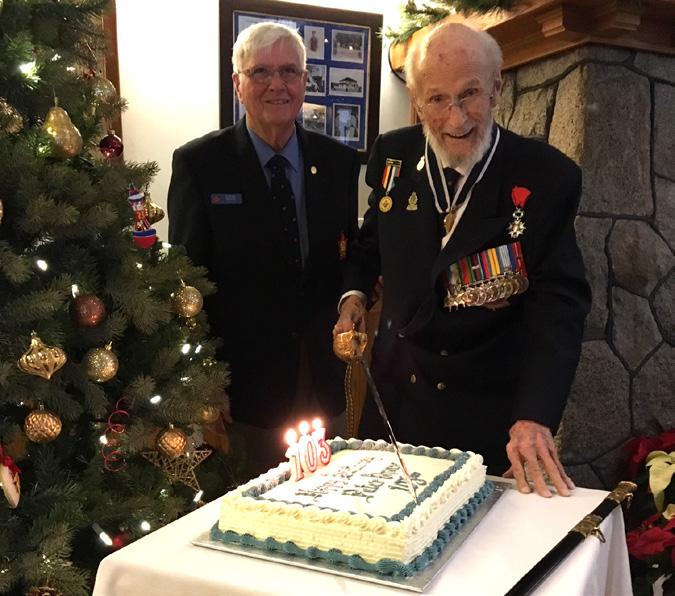
Peter Chance, Commander RCN (Retired), cuts the birthday cake celebrating his upcoming 103rd birthday during the Naval Association of Canada – Vancouver Island (NAC VI) gathering at the Royal Victoria Yacht Club on Nov. 23. The naval sword used once belonged to LieutenantCommander J.A. Bryant, a Royal Canadian Naval Volunteer Reserve (RCNVR) Officer, who had served on HMCS Gatineau, the same Second World War destroyer that Peter had served on. Steve White, NAC VI President, is also pictured.
HMCS Gatineau was the former HMS Express with service during the Dunkirk evacuation and in rescuing survivors of the sinkings of HMS Prince of Wales and Repulse on Dec. 10, 1941, before transfer to the RCN in 1943. During RCN service, Gatineau served in the Battle of the Atlantic and is credited in the sinking of U 744. The ship supported the D-Day landings on June 6, 1944, before the end of the war and its service in the RCN.



Photo: Paul Seguna


in POWELL RIVER, BC, CANADA


Sunshine Coast Health Centre and Georgia Strait Womens Clinic are registered B Corp, licensed, and accredited mental health facilities that use an evidencebased, non-12-step, meaning-centred, strengths-based approach that interconnects all our services and therapies including medical withdrawal, anger management, rTMS, trauma therapy, and PTSD treatments.
Our gender-speci c* programs provide a safe space for clients to get help with underlying issues driving trauma, mental health su ering, or addictive behaviour that can be hard to address in co-ed environments. Moving beyond a focus on abstinence and symptom reduction allows clients to experience the full, transformative bene t of our treatment programs.
*Individuals a end the program with the gender they identify as or, for gender uid and non-binary individuals, the program they are most comfortable and safe in. Our admissions coordinators will work with prospective clients to determine which program is the best t.