






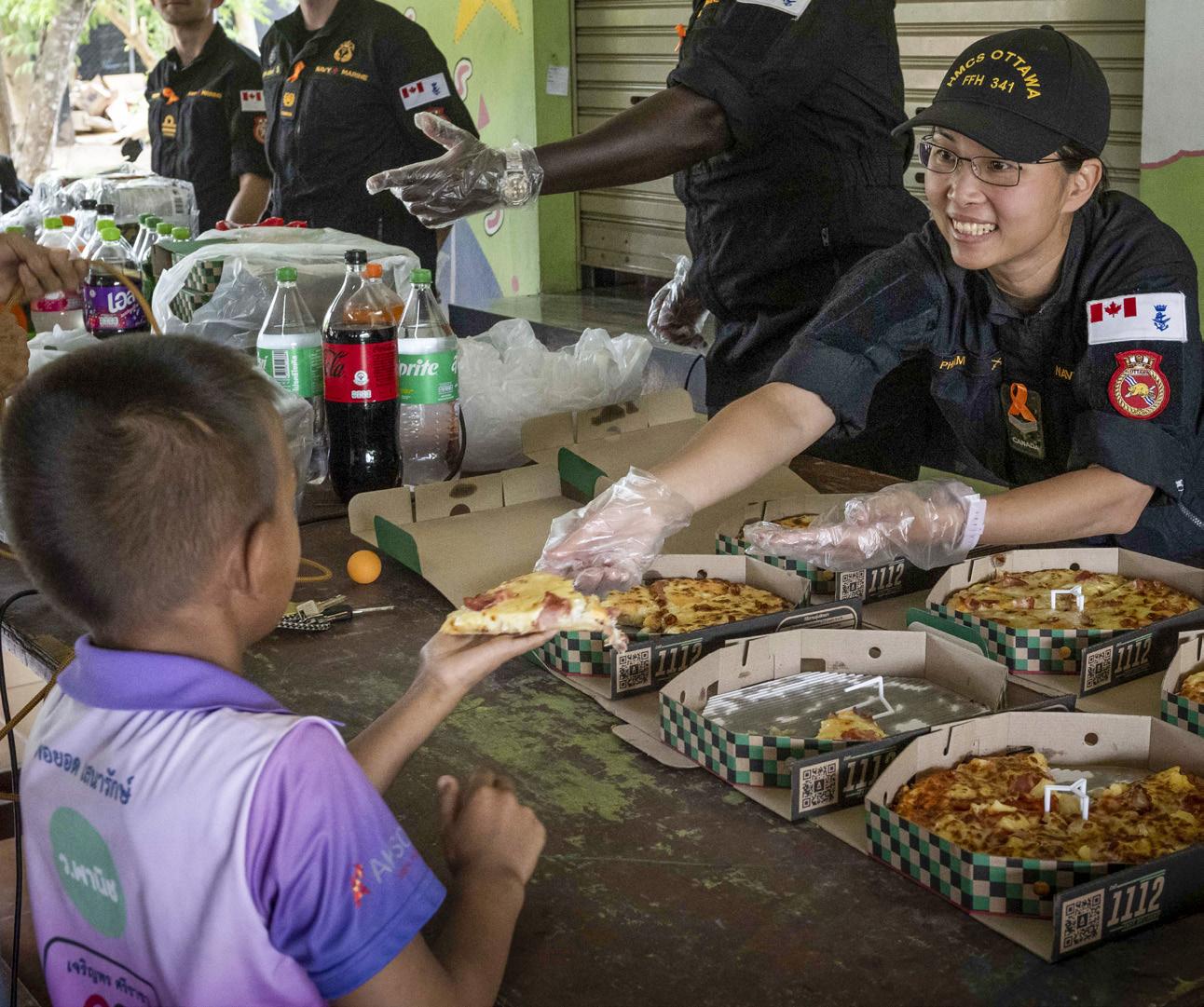





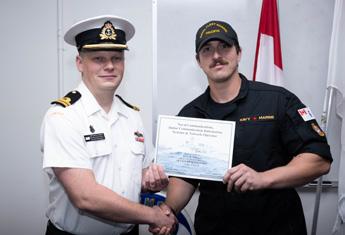
Photo: Aviator Gregory Cole
Kateryna Bandura Lookout Editor
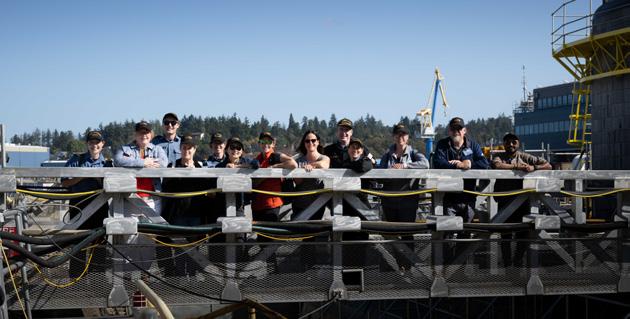
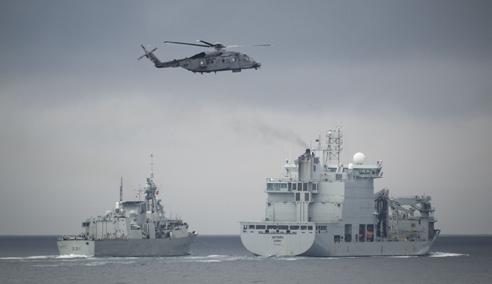
After a significant turnover amongst the Command Team in September, HMCS Edmonton set out on a three-week Basic Single Ship Readiness Training (BSSRT).
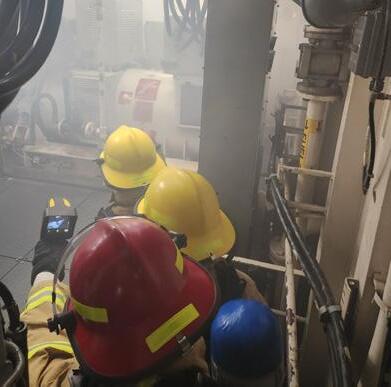
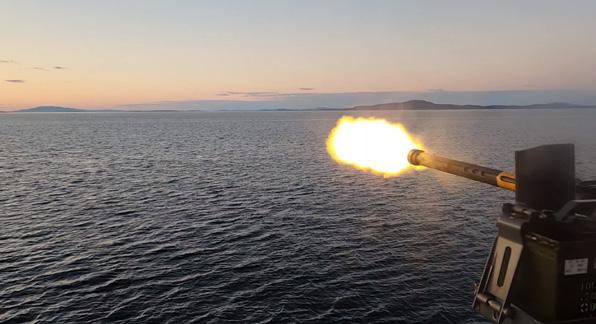
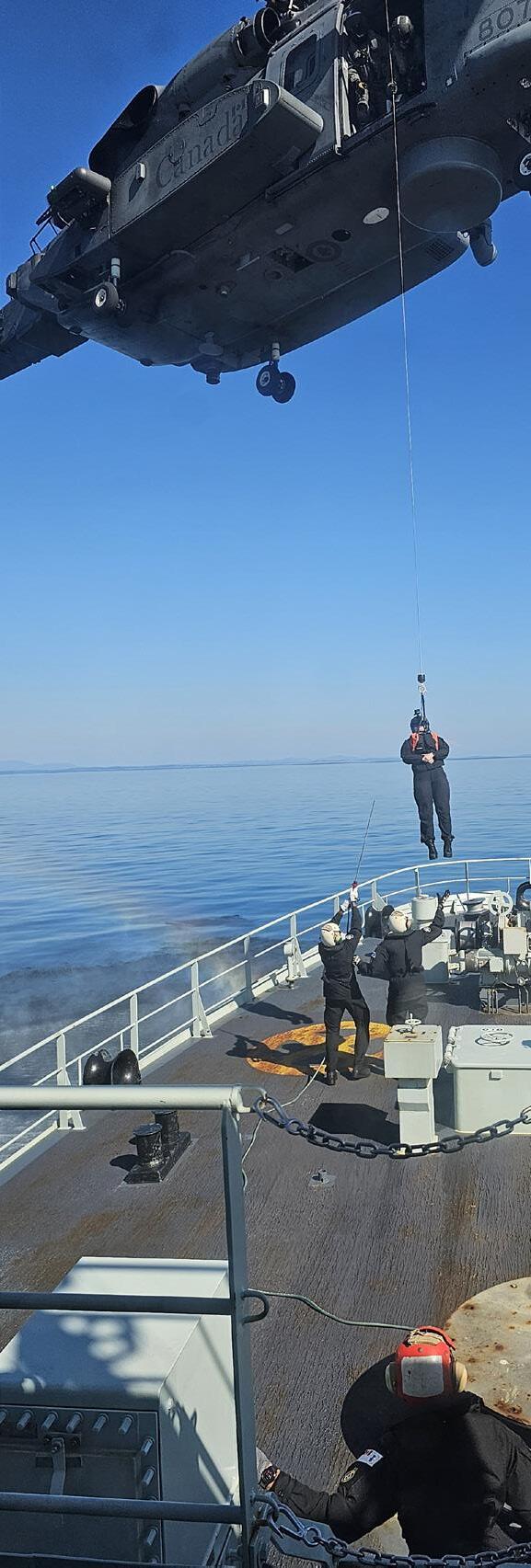
The training helped refresh core skills and competencies, including damage control, force protection and weapons firing, mission planning, navigation and ship handling, and responses to emergencies.
“The crew must prove it can conduct basic evolutions and emergencies for the Commodore to feel comfortable tasking that ship with going to sea,” said Lieutenant (Navy) (Lt(N)) Andrew Pink, HMCS Edmonton’s Operations Officer.
Commander Canadian Fleet Pacific orders the training in the approval of the Fleet Schedule. While there may be confusion over the necessity of BSSRT, especially post-deployment, it ensures the ship is always ready to serve.
Lt(N) Pink organized and executed Edmonton’s training program, which comprised the lectures and practical exercise requirements phases. The lectures phase consisted of two parts: the Do On Their Own (DOTO) (Sept. 4-8), where members presented materials to the rest of the ship’s company, and Phase I (Sept. 11-15), where Sea Training staff supervised the execution of more complex lectures. During the at-sea practical phase (Sept. 18-22), Sea Training staff initiated 25 unannounced drills on the

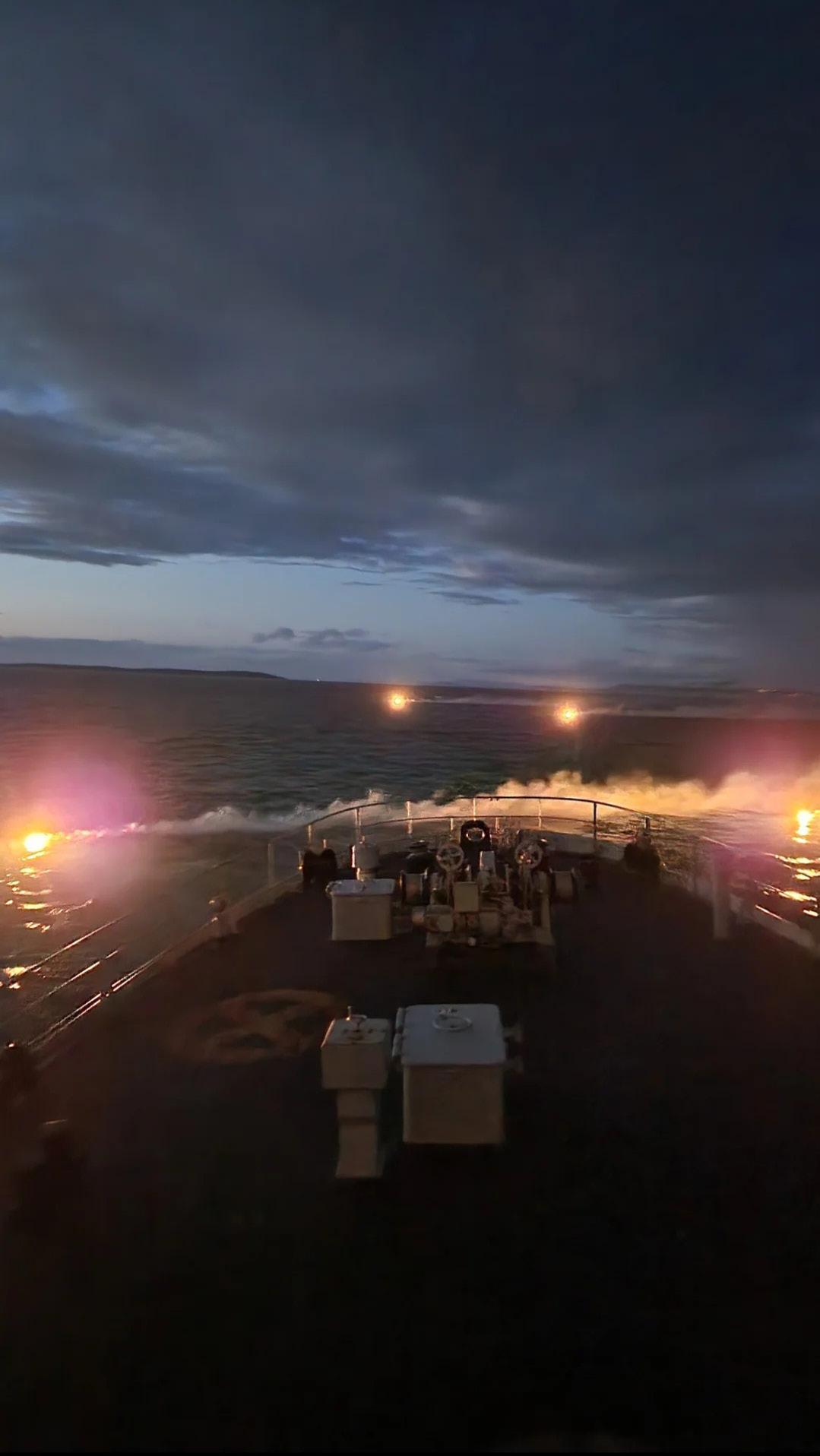
ship’s company, where they assessed and improved the ship’s capability in each.
As the ship’s Operations Officer, during the at-sea phase, Lt(N) Pink spent most of his days split between the bridge as an officer of the watch for eight hours of the day, and planning and executing serials for the rest.
“Getting down into the ship and working with the crew during emergency exercises, and see ing their resiliency, resolve, and determination, was by far my favourite part of the sail,” Lt(N) Pink said.
With many new personnel in the Wardroom and Chief and Petty Officers’ Mess, Lt(N) Pink said the coordination amongst the departments needs the most improvement. Once the ship receives the final report from Sea Training with grad ing, the crew will know they have achieved the training goal.
“Edmonton had a very experienced crew to help support all the new personnel in key positions and achieved the standard,” Lt(N) Pink said. “It was a very challenging and demanding program, and they did an amazing job ensuring Edmonton passed BSSRT.”
Edmonton will conduct another Readiness Training level before its next deployment.
Sabina Kukurudziak NTG
‘Out of sight, out of mind’. The saying’s origin is lost to time, but surely, a sailor must have uttered it first.
For years, the Royal Canadian Navy (RCN) has endeavoured to overcome ‘maritime blindness’: low levels of awareness amongst Canadians of their Navy’s defence and security roles. The effect obscures our ships and sailors operating around the globe at sea, as well as all those working behind gates and fences in restricted access areas at our two coastal naval bases.
“It’s unrealistic to expect Canadians to support something they don’t know or understand,” said Lieutenant-Commander (LCdr) Anne Gardam, Senior Staff Officer Outreach and Attractions at Maritime Forces Pacific Headquarters. “Although there is no single solution to the problem, there are things we all can do to improve the situation.”
One example of such an initiative is Canadian Leaders Alongside (CLA) – a program that invites civilian managers and executives to learn about the RCN and the wide range of military and civilian career opportunities it offers.
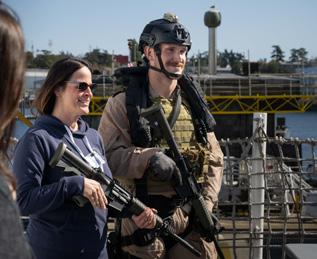
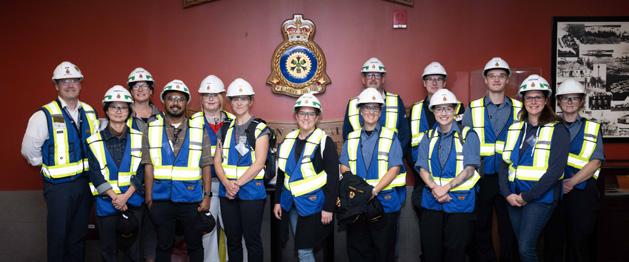
On Sept. 18, a select group of eight Vancouver Island educators in the secondary and post-secondary sectors were given privileged access to CFB Esquimalt to explore its units and facilities and, more importantly, to meet its people.
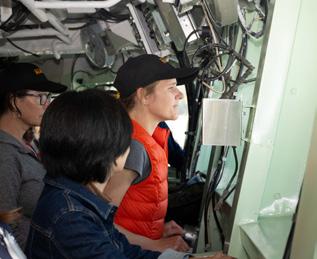
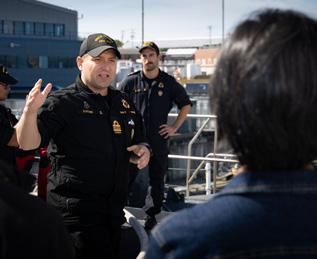
The tour began at HMCS Venture’s world-class Navigation and Bridge Simulator (NABS). Participants observed junior officers train in a simulated maritime environment before being whisked away by bus to HMC Dockyard to explore HMC Submarine Corner Brook, one of four RCN long-range patrol submarines. Guests got a rare glimpse of living conditions aboard the boat and discussed aspects of submarine service with crew representatives. Next, they visited Fleet Maintenance Facility Cape Breton, one of the largest indoor industrial facilities on North America’s West Coast. Here, they learned about the many employment opportunities available across civilian technical trades. Guests got a ‘taste of the Navy’ by lunching at Nelles Galley before resuming the tour of HMCS Regina, where they interacted with sailors who explained the military occupations that comprise a ship’s company.
“Our sailors are our best ambassadors,” said LCdr Gardam. “When given the opportunity, they share their knowledge and experience proudly and enthusiastically with the public.”
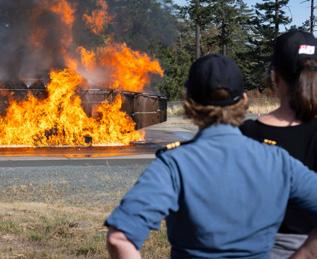
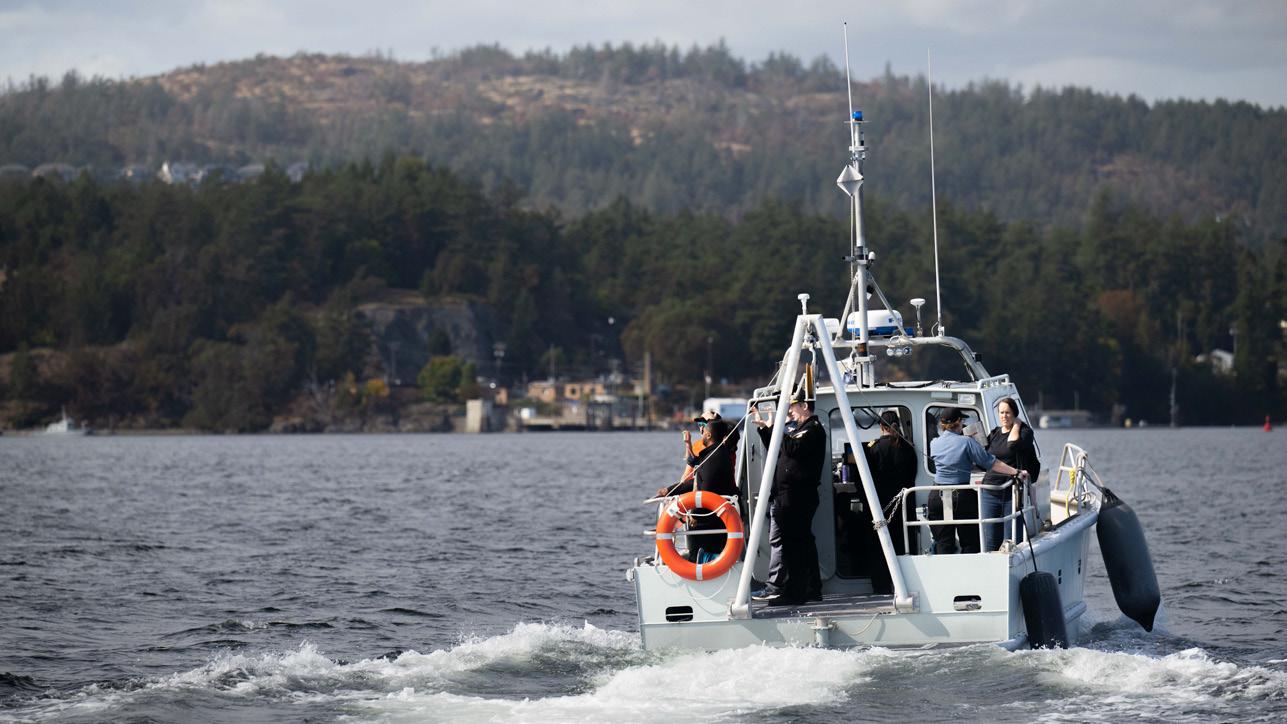
The educators briefly developed their ‘sea legs’ while traversing the harbour by jet boat to meet with Fleet Diving Unit (Pacific) divers before ending their day at Damage Control Training Facility Galiano. There, they learned how every sailor must undergo damage control training before joining a ship and that even participants in the new Naval Experience Program (NEP) must complete the Naval Environmental Training Program.
The first NEP participants had already arrived in Esquimalt and begun training. The hosts stressed that the one-year program allows candidates to experience life in the RCN while learning about various trade options before deciding if they wish to commit to a longer service period.
“I think the one-year gap program is such a great opportunity for people to try the Navy without the long-term commitment,” said Carmen deGoey, Department Chair for Electrical Trades at Camosun College. “I am already sharing things I’ve learned during this visit with my staff and students.”
The tour ended with a return bus ride from Colwood to Work Point. LCdr Gardam said this was a very successful day.
“The time and resources shared by organizations hosting these engagements is a smart investment in the effort to attract and recruit the next generation of sailors who are essential to maintaining our maritime capability,” LCdr Gardam said.


MANAGING EDITOR
Jazmin Holdway jazmin.holdway@forces.gc.ca
EDITOR
Kate Bandura
WRITER
250-363-3130 kateryna.bandura@forces.gc.ca
Peter Mallett mallett.peter@cfmws.com
PRODUCTION
Leslie Eaton
250-363-8033 workstation3@lookoutnewspaper.com
ACCOUNTS/RECEPTION
Trina Winters
ADVERTISING
Joshua Buck
250-363-3127
778-977-5433 NEW military.base.advertising@gmail.com
EDITORIAL ADVISORS
Capt Christopher Dubé
Ashley Evans
Rodney Venis
FRENCH EDITORIAL ADVISOR
250-363-4006
250-363-7060
A/Slt Alexandre Springer alexandre.springer@forces.gc.ca
Published each Monday, under the authority of Capt(N) K. Whiteside, Base Commander.
Le LOOKOUT est publié tous les lundis, sous l’égide du Capv K. Whiteside, Commandant de la Base.
The editor reserves the right to edit, abridge or reject copy or advertising to adhere to policy as outlined in PSP Policy Manual. Views and opinions expressed are not necessarily those of the Department of National Defence.
Le Rédacteur se réserve le droit de modifier,de condenser ou de rejeter les articles, photographies, ou annonces publicitaires pour adhérer au Manuel des politiques des PSP. Les opinions et annonces exprimées dans le journal ne réflètent pas nécéssairement le point de vue du MDN.
Circulation: 2,000 plus 300 pdf downloads per week Follow us on Facebook, Twitter and Instagram to join our growing social media community.
A Division of Personnel Support Programs
CFB Esquimalt, PO Box 17000 Stn. Forces Victoria, BC V9A 7N2 Web: www.lookoutnewspaper.com Fax: 250-363-3015
Canadian Mail Product Sales Agreement 40063331



Thomas Goenczi
Lookout contributor
We often unknowingly find ourselves in certain patterns or cycles of thoughts, emotions and actions. These cycles show up in our daily routines, at work, and in our relationships. And, for whatever reason, we think we are perpetually bound to our past choices, thus continuing the cycle. Then, we start all over again…
How do we avoid being pawns to these maladaptive patterns?
We must become aware of their inner functions to no longer be held captive by our cycles. Without awareness, we become driven by our unconscious impulses and drives, which only cement the reoccurring cycles.
Undoubtedly, breaking these cycles is hard. Sometimes, we don’t even notice we’re in one until we slowly begin to feel less like our optimal self and can’t figure out why. Other times, and argu-
ably more distressingly, we realize we are in the grips of our default pattern but don’t know how to overcome it and end up suppressing that awareness.
Let’s look at an example of how a maladaptive cycle can appear in our lives.
You stayed up late the night before scrolling through your social media accounts because you had a tough day at work. You wake up in the morning not feeling well-rested, so you doze off for a couple of more minutes. Then you realize you’ll be late for work, so you stress out and rush. You make it on time, and the stress dissipates slightly, but you feel distracted and can’t focus on your work. You feel ashamed that you can’t concentrate, and you go back to your phone to take the edge off and distract yourself from the feeling.
In this example, the cycle goes like this: lack of self-care (not getting enough sleep), inability to meet internal obligations (waking up late) –> stress about external responsibilities (going to work), stress causes failure to perform (challenging to focus) –> uncomfortable feeling arises (shame) –> distract (using a phone) –> lack of self-care (due to using distraction to avoid and cope with discomfort).
can begin to break it. An excellent way to keep tabs on our cycles is to write down their root causes. This helps to identify where we may be in the sequence of the events.
Another approach is witnessing the cycle and going through the motions of it, but not necessarily feeding into it. This is difficult to do at first because it is so easy to slip into a cycle at the early stages of identification. However, the more we approach the cycle with a witnessing perspective, the less power it has over us because we only observe it rather than actively participate.
Breaking any cycle is no small feat. Sometimes, we get the best of it, and sometimes, it gets the best of us, but we should continue breaking the pattern and strive towards greatness.
Thomas Goenczi is an RCN Veteran and MA Clinical Counsellor with Private Practice: Well Then Therapy.
























When we can identify the cycle, we
The content is not intended to substitute professional advice, diagnosis, or treatment. Always seek the advice of your mental health professional or other qualified health provider with any questions regarding your condition.
SLt Wilson Ho HMCS Oriole PAO
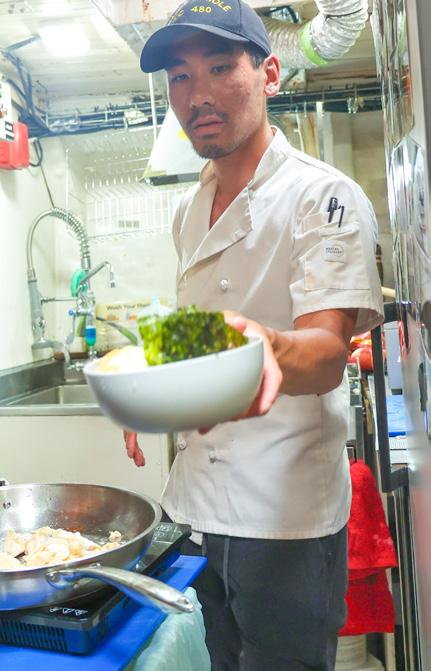
Making a hearty meal at home can be difficult, and preparing and cooking meals at sea can be even more difficult. Working in a galley that can only fit one person comfortably at a time, with the ship rocking back and forth due to the sea state, Petty Officer Second Class (PO2) Gabriel Lau created nourishing and filling meals three times a day to feed all the crew members onboard His Majesty’s Canadian Ship (HMCS) Oriole while the ship participated in the Royal Canadian Navy’s (RCN) annual Great Lakes Deployment.
Originally from St. Johns, Nfld., PO2 Lau joined the Royal Canadian Navy in 2009 at HMCS Cabot as a Reserve Naval Communicator. At the time, he was a first-year university student studying Computer Engineering and was looking for an interesting job.
“It was my first summer off, and I wanted to do something interesting. I applied to my local Recruiting Centre, and they took me in immediately,” said PO2 Lau. In 2015, PO2 Lau switched to become a Cook in the RCN.
During the Great Lakes Deployment, PO2 Lau made over two hundred meals for the crew. One of the best and most complex meals PO2 Lau made on this deployment were poké bowls.
“Poké bowls were the hardest meal to do on the Oriole because of the many flavours and components. There are multiple complexities and techniques to a poké bowl, such as making the rice, which protein to add, the greenery, garnishes, sauces, etc. Depending on how many toppings you want, it can be a multi-step process,” said PO2
Lau. “Making these individual components in my small galley, and then combining them to create a poké bowl was a challenge, but it was rewarding to see the end product and see everyone enjoy my work.”
PO2 Lau was contacted last year by HMCS Oriole to ask if he would like to be the Chief Cook onboard. Unfortunately, he was on a Professional Leadership Qualification (PLQ) Course and could not sail. However, PO2 Lau has had a consistent desire for challenges.
“Things that interest me are working on different platforms (in the Navy) and in different locations. I like things that are out of the mundane, and if it is novel, I will probably say yes to it,” he said. Therefore, early this year, PO2 Lau contacted the Coxswain of HMCS Oriole to see if the position of Chief Cook was open again. Fortunately for him, it was, and he was offered the opportunity to sail soon after.
Besides his primary duties as Chief Cook, PO2 Lau takes time to help with evolutions on the upper decks during breaks.
“I always go and help. We have 21 people onboard, and complex evolutions onboard HMCS Oriole require every available person to help where and when they can,” he said.
After being the Chief Cook onboard HMCS Oriole for this year’s Great Lakes Deployment, he says the best advice he can give and the best lesson that he has learned from this experience is to pack light and to remember to take breaks.
“Mental health is important,” said PO2 Lau. “There is limited personal space on a 102ft long ship. It is therefore essential to take regular breaks to avoid burnout!”




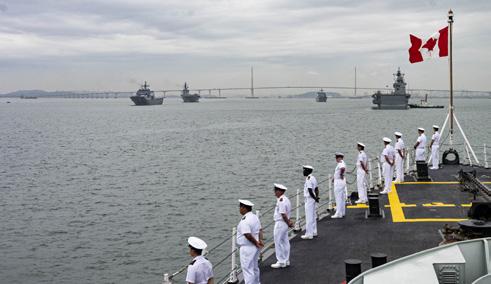
On Sept. 15, HMCS Vancouver participated in a re-enactment of the Incheon landings operation and a fleet review with Republic of Korea Navy Ships, the United States Navy Ship USS America, and military aircraft and service members. On this historic day, we honoured those who served and continue to serve in support of peace and stability on the Korean Peninsula. Seventy-three years ago, United Nations forces began landings at Incheon, South Korea, to drive the North Koreans back across the 38th Parallel. Long seen as a forgotten war, the Korean War is now recognized as an essential chapter in Canada’s military history.
During its deployment, Vancouver continues contributions to the multinational initiative to enforce United Nations sanctions against North Korea through Operation Neon . Periodically, during the past month, our crew has been on the lookout to identify suspected maritime sanctions evasion activities. In particular, we have been looking for ship-to-ship fuel transfers and other commodities banned by the United Nations Security Council resolutions sanctions imposed against North Korea.
After two weeks at sea on Operation Neon, our crew looked forward to land as we prepared to come alongside at Incheon, South Korea. On Sept. 17, crew members visited the demilitarized zone. A two-kilometre buffer zone along the 38th Parallel, known as the DMZ, was established 70 years ago as part of the Korean Armistice Agreement to end the Korean War. Our visit was a unique opportunity to
learn more about this important chapter in history and the importance of our work to support peace and stability on the Korean Peninsula. On Sept. 18, Vancouver’s Hockey Club hit the ice in Incheon, playing with three local hockey teams: the Incheon Iceholes, Seoul Chiefs and Anyang Geckos. This hockey game fostered friendships, camaraderie and morale.
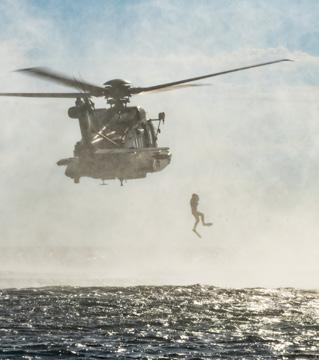
While at sea, Vancouver conducted replenishments at sea with Japanese Ship Towada, USNS Yukon. We also facilitated several training serials, including crane operation, divers’ deployment, spill cleaning, casualty clearing, first aid and damage control, to name a few. During rest days, our sailors partook in social events, including trivia night, musical bingo and Spanish and Filipino discussions.
Vancouver arrived alongside Manila in the Philippines on Sept. 29. Our cooks, servers, ushers, dishwashers, piping party, hosts and crew gave an extraordinary and welcoming Canadian experience to our partners in the Indo-Pacific region during our latest receptions on our flight deck. The ice also sizzled with excitement on Sept. 30 as the Philippines Men’s National Team clashed sticks with Vancouver’s hockey team in a friendly showdown for Hockey Night in Manila. It was a night filled with epic hockey and sportsmanship at its finest!
During our goodwill visit to the Philippines, Vancouver crew members donated school supplies and sports equipment to the Sen Benigno Aquino Elementary School in Manila. Our crew members also par-
ticipated in the Women, Peace and Security Forum as part of Exercise Sama Sama. The exchange focused on best practices and challenges of creating a more inclusive, gender-equal environment. Topics discussed included diversity and inclusion and gender integration, working closely with regional partners to support the meaningful participation of uniformed women across the Indo-Pacific.
During our port visits, our Command Team attended strategic engagement events with diplomats and partner nations while crew members had some well-deserved time off to discover Incheon, South Korea, and Manila, Philippines. We are now back at sea as part of Exercise Sama Sama with the Philippines and partner navies. During the sea phase, Vancouver participates in exercises focused on building partnerships, maritime domain awareness, interdiction, search and rescue, humanitarian assistance and disaster relief operations. This phase includes patrols, cross-deck landing of embarked helicopters, and search and rescue exercises to synchronize efforts with partner navies.
As we spent Thanksgiving away from home, we think of you – our families, friends and greatest supporters. We are grateful for the opportunity to wear the uniform and to represent Canada in the Indo-Pacific region.
As always, we look forward to sharing more about our future adventures.


It’s important to prioritize your relationship all year long. Relationship health is not just a oneand-done deal; it requires ongoing maintenance and effort to stay strong. That’s why we have so many resources and tips available year-round to help you build and strengthen your bond: cfmws.ca/support[1]services/health-wellness/healthyrelationships
Holly Flower Esquimalt MFRC
Relationships are life’s most meaningful and powerful experiences and one of the most difficult. People in past or current relationships know sharing life with another human rarely reflects the storylines from movies and storybooks.
Fairy tales and romcoms are not the reality. After the oxytocin-fueled bliss and intoxication of new love wear off, so do the rose-coloured glasses, and the work of being in a relationship with another truly begins. Sometimes, behaviours that didn’t seem too bad initially may become increasingly alarming or may have raised safety concerns.
The Healthy Relationship Campaign is an opportunity for military members and those they call family to reflect on the health and quality of their relationships. During stressful times such as deployments or a new posting, couples may find their communication strained or their connection stretched. Most couples will find their footing again. Learning to show up and communicate in conflict is part of the hard work of being in a relationship. Couples should continually focus on creating an emotional and physical climate of safety, love and connection, regardless of the stressors or disagreements.
However, in some relationships, no amount of work or self-reflection will change their partner’s violent behaviours. Those in abusive relationships focus on emotional and physical survival. This issue cannot be ignored or dismissed as someone else’s problem. The use of violence in families and with intimate partners impacts every aspect of a person’s life, sometimes for
generations.
Those experiencing violence in a relationship are often asked, ‘Well, why don’t you just leave if it’s so bad?’
Historically, conversations about what constitutes abuse have not acknowledged the impact of emotional, financial, or technological abuse. Coercion, manipulation and psychological control can significantly damage a person’s sense of self and autonomy. Those who are part of the military lifestyle are often posted away from friends and family, which leaves them increasingly more vulnerable to abuse and control. Unfortunately, violence in a relationship can increase and become more dangerous before, during or after a separation. Some may stay in an abusive relationship because they think it may be safer than trying to leave, especially if there’s potential shared custody with the abusive parent. The issue of whether to stay or leave is complex and societal, financial, and emotional implications may hinder that decision. Some may wonder whether their experiences are normal or problematic. They might believe their situation isn’t ‘that bad’ because of past experiences in family or other relationships. Important questions to ask include:
• What is my relationship’s overall emotional and physical climate?
• Do I feel safe?
• Can I express myself and my needs?
• Do I feel like I’m walking on eggshells?
• Can my children show up fully as children, or do I need to ensure they don’t set their parent/my partner off?
SLt Alexander Nicholson HMCS Calgary
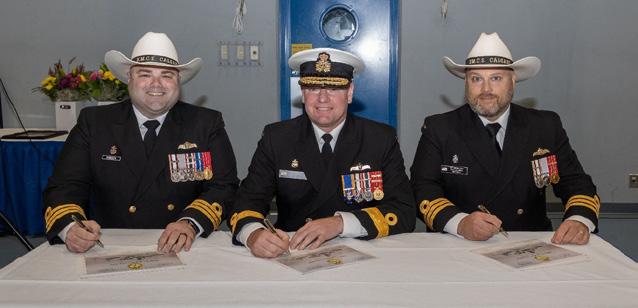
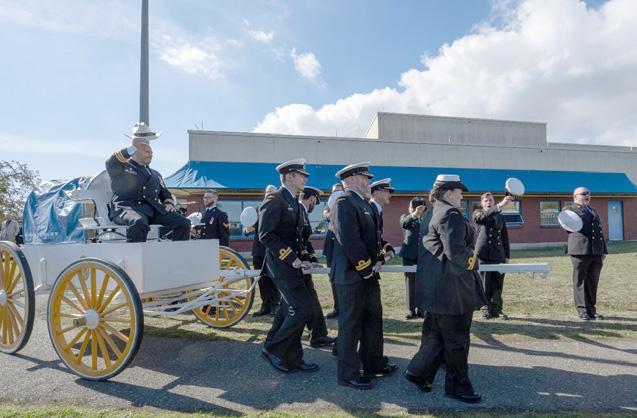
On an unseasonably warm fall day in Esquimalt on the deck of the Nixon Drill Hall, HMCS Calgary’s ship’s company witnessed the Change of Command Ceremony between Commander (Cdr) Adriano Lozer, outgoing Commanding Officer (CO), and Cdr Jeremy Samson, the incoming CO.
The Oct. 5 ceremony was presided over by Commodore David Mazur, Commander Canadian Fleet Pacific, accompanied by Chief Petty Officer First Class David Bisal, the Fleet Chief Petty Officer. Also in attendance, demonstrating the deep ties between the Ship and its namesake city, was city councillor Kourtney Penner and Todd Nabozniak of the Calgary Firefighter’s Burn Treatment Society.
Characteristic for Calgary’s Change of Command ceremony, Cdr Samson was presented with HMCS Calgary CO accoutrements – a spatula for pancake breakfasts serviced by the crew during the many community engagements such as the Calgary Stampede, and, most importantly, the white Stetson proudly worn by the crew.
Cdr Lozer assumed command of Calgary on April 29, 2022, and led the ship to its refit
period at Seaspan’s Victoria Shipyard while the crew support the fleet and the Maritime Forces Pacific out of the CFB Esquimalt Dockyard. The highlight of Cdr Lozer’s tour was the ship’s participation in the annual Calgary Stampede this July. Cdr Lozer will take command of HMCS Ottawa, currently deployed on the newly named Operation Horizon along with HMCS Vancouver and MV Asterix
Cdr Samson brings 23 years of experience as a Naval Warfare Officer to Calgary. A career east coaster, he returns to the Pacific Command for the first time since completing his initial training as a Naval Warfare Officer in 2003. He has previously served as Commanding Officer of the Maritime Coastal Defence Vessel HMCS Kingston based in Halifax, N.S. As the CO, he will oversee the Calgary’s return to the fleet in 2024 and its progression toward the high state of readiness required for international operations.
The Calgary will be equipped with significant deck and combat systems upgrades for future operations and will exit the docking work period with substantially more capable deck crane systems to handle advanced Overthe-Horizon Rigid Hull Inflatable Boats (RHIBs), and a new Anti-Submarine Warfare Combat Systems suite.




Peter Mallett Staff Writer
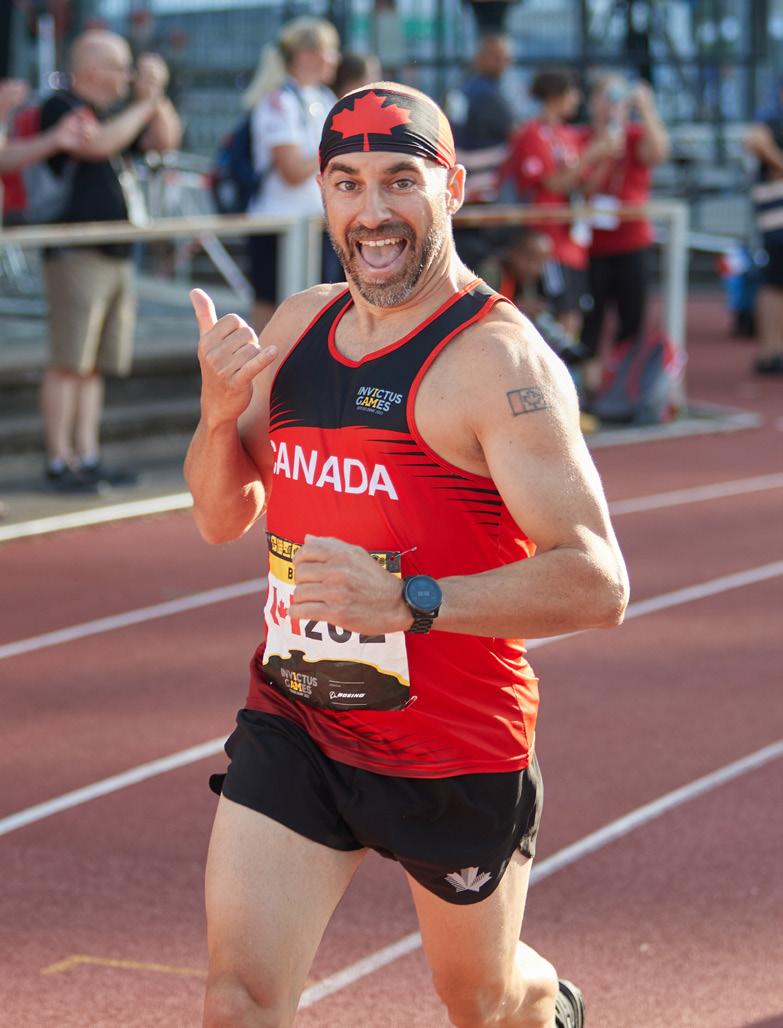
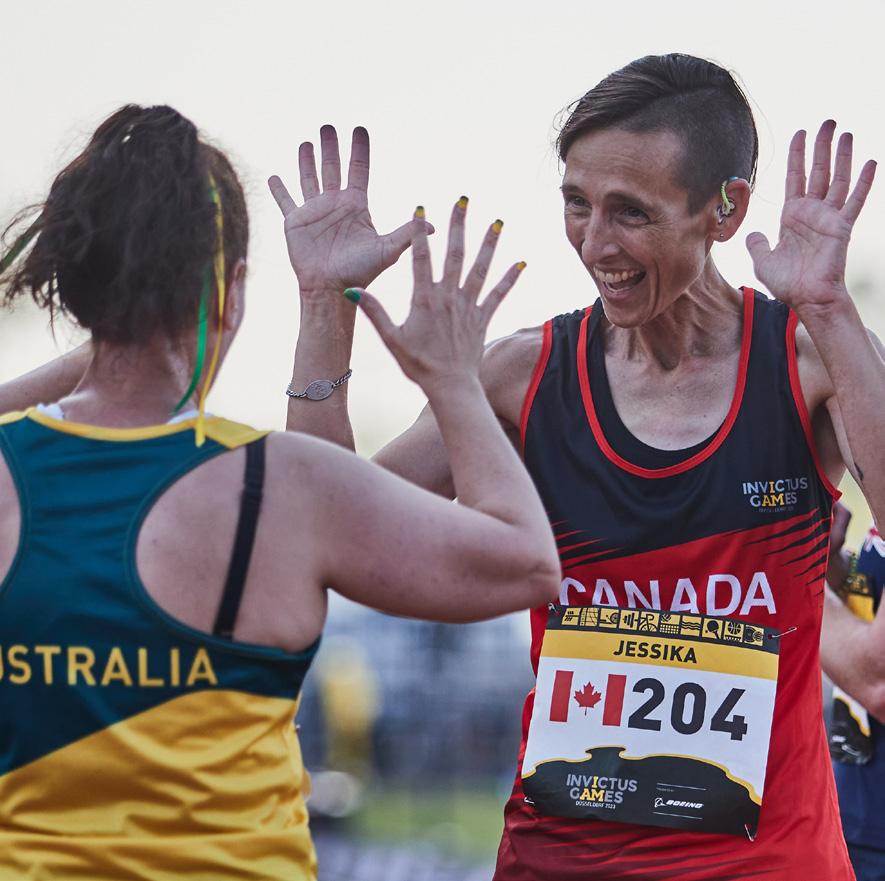
Two members of Team Canada praise the powerful mental health benefits of the 2023 Invictus Games in Germany.
Team Canada’s 31-person contingent included 12 Canadian Armed Forces (CAF) members and 19 veterans who have each acquired physical or mental health injuries while serving Canada.
Locally, Major (ret’d) Nick Holyome of Comox and LieutenantCommander (LCdr) Tracey Barlow, former CFB Esquimalt logistician now posted to Ottawa, were part of the team that competed Sept. 9-16 in Dusseldorf. Both are diagnosed and in recovery from Post-Traumatic Stress Disorder (PTSD) and other mental health injuries.
“My participation in the Invictus Games was a life-changing experience,” said LCdr Barlow. “From the moment I attended the first Team Canada training camp, I was accepted for who I really am and not judged because of my injuries.”
Her teammate was equally impressed by the healing power of Invictus.
“It was an epic experience considering how much hard work, preparation and sacrifice I had put into being there,” said Holyome. “I had a lump in my throat for both the opening and closing ceremonies and hearing 23,000 people chant ‘CA-NA-DA’ was truly amazing.”
The fifth edition of the Invictus Games brought together approxi-
mately 500 competitors from 21 nations, competing in 10 adaptive sports. Canada’s Invictus team is funded by Soldier On, a program of the Canadian Armed Forces which contributes to the recovery of ill and injured CAF members and veterans by providing opportunities and resources through sport, recreational, and creative activities.
Four tours oF
AFghAnistAn
Holyome’s Invictus experience brought the four-year journey of waiting to represent Canada to an end.
“There were certainly some periods when I thought I might never compete and complete my journey,” he said. “I am so happy with my progress and preparation.”
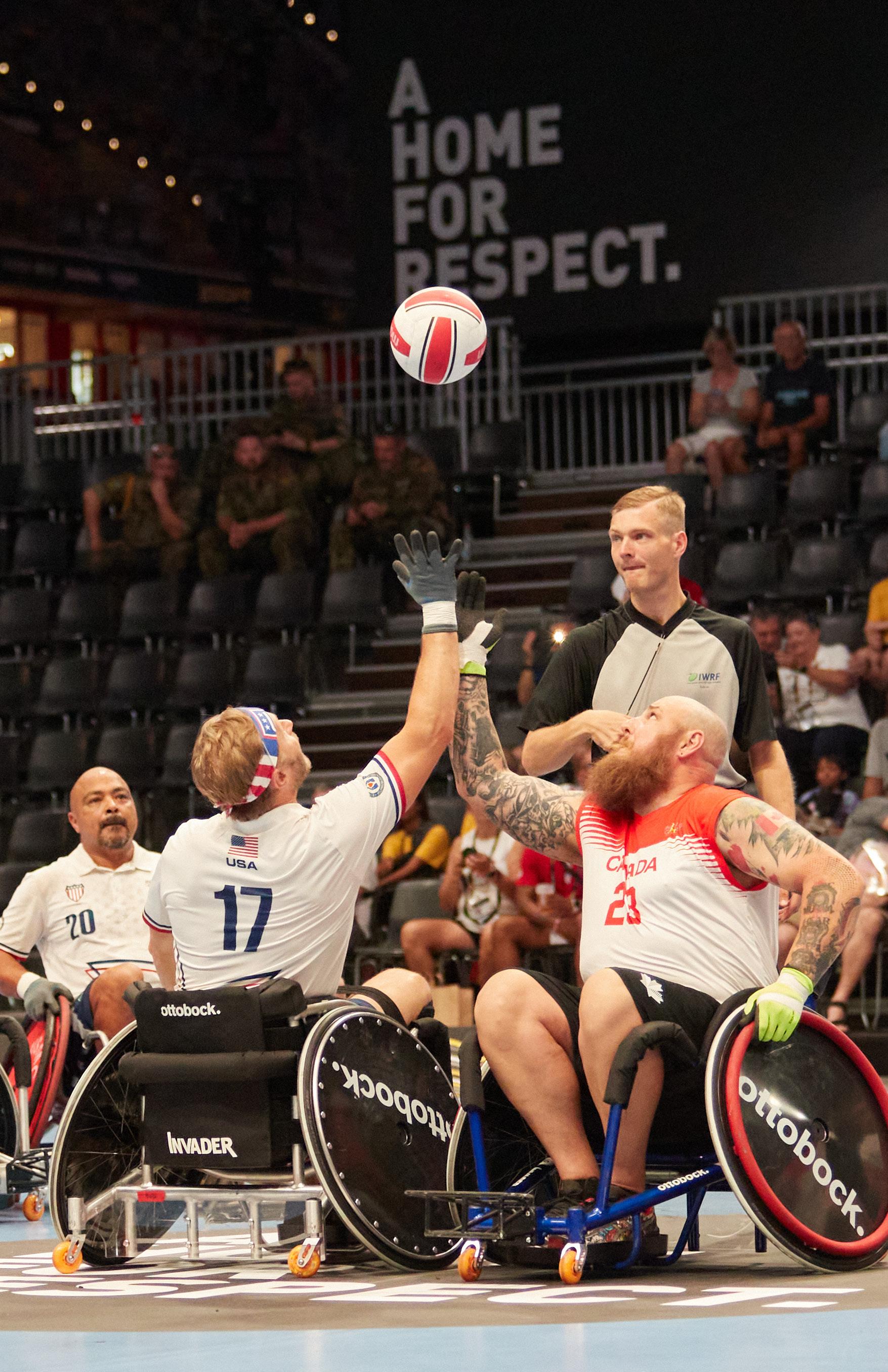
He was first named to Team Canada’s roster in 2019, planning to compete at the 2020 Games in The Hague. Not only were they postponed until 2021 due to COVID-19 concerns, but Holyome contracted COVID19 hours after the 2021 Opening Ceremonies, spending the second half of his trip quarantined in a hotel room. Holyome, 49, was an Intelligence Officer and a Naval Warfare Officer that served 24 years in the Navy, Army, Special Operations and Air Force. He completed four tours of Afghanistan and was diagnosed with PTSD, anxiety and depression in 2015. At the 2023 Games, he competed in wheelchair rugby, indoor rowing and cycling.
Although he didn’t win any gold
The handoff for the 2025 Invictus Games Vancouver Whistler is now complete.
During the closing ceremony of last month’s 2023 Invictus Games in Dusseldorf, Germany, organizers presented the flag of the Invictus Games Foundation to members of the organizing committee for the 2025 Invictus Games.
The moment marked the beginning of Canada’s journey to host its second Invictus Games, the first-ever hybrid competition in Games’ history.
The 2025 Games will feature winter sports along with its more traditional sports.
Nordic skiing, skeleton, and wheelchair curling will be added to the list of adaptive sports at the 2025 edition of the Games. The other sports competitions will be indoor rowing, sitting volleyball, swimming, wheelchair basketball and wheelchair rugby.
The Government of Canada – through Veterans Affairs Canada – committed $15 million in funding to support the Invictus Games Vancouver Whistler 2025 and an additional $ 1 million to support the Soldier On program to train and equip Team Canada.
“The Invictus Games is an outstanding opportunity to recognize resilience, dedication and athletic excellence,” said Bill Blair, Canada’s Minister of Defence. “I look forward to welcoming hundreds of competitors to our country, but in particular, I look forward to cheering on Team Canada.”
medals, Holyome said he was happy with his performances at the Games and says the experience has boosted his confidence level.
“There were so many ‘gold medal moments’, but the highlight for me was just competing in the cycling races,” he said. “The athletes I was up against were so strong and fast, I just put my head down and pedaled as hard as I could.”
He wants to continue cycling and is planning a multi-day excursion to the United States next year. He has also arranged a few speaking engagements in the Comox Valley to discuss the importance of sport and injury recovery.
overcoMing sexuAl trAuMA
LCdr Barlow is a survivor of Military Sexual Trauma (MST). She competed for Canada in wheelchair rugby, archery and indoor rowing. The 49-yearold Naval Logistics Officer is posted to Ottawa’s Transition Unit and has served 30 years in the CAF.
She previously worked in Esquimalt as a member of the Comptroller staff until January 2021 before being posted to RCN Comptroller staff in Ottawa. In addition to managing naval finances for the Base, she was posted to HMCS Vancouver and the Canadian Submarine Force as
Command Logistics Officer for all submarines on both coasts.
A former high school musician who completed in rugby and Karate, LCdr Barlow says getting the chance to train and compete at Invictus and meeting other MST survivors has been a gamechanger in her life. She describes walking out for the opening and closing ceremonies under the banner of the maple leaf as both a proud and ‘surreal experience’ with most athletes having tears in their eyes.
During the competition, she earned a bronze medal in archery and achieved a personal best in both the endurance and sprint rowing events. She also assisted on some of Canada’s scoring plays in wheelchair rugby as Canada earned its first-ever rugby victory at the Games. The overall focus at the Games is camaraderie and recovery, said LCdr Barlow, adding that most participants are on the same page regarding recovering from mental and physical injuries. She heard about the healing power of the Invictus Games during her own recovery through a friend and coworker who had previously participated in the Games. The payoff has been greater than expected – the games are helping her look forward to a brighter future.
Canada’s hotel in Dusseldorf, Germany, housed athletes from nine nations.
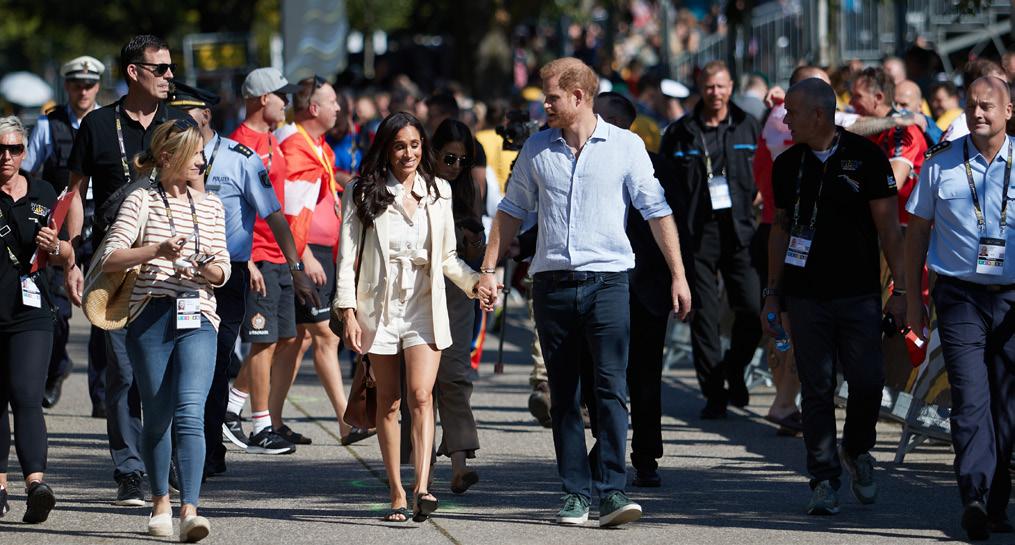
One unforgettable experience Holyome and other athletes will remember for years was meeting Prince Harry.
The Duke of Sussex helped launch the Invictus Games in 2014 and remains an unwaver
ing supporter and spokesperson for its objectives. At this year’s closing ceremony in Dusseldorf, the Prince gave an impassioned speech paying tribute to MCpl James Gendron, a member of Team Canada and a devoted bagpiper who works for the Canadian Forces Transition
Centre in Kingston, Ont. MCpl Gendron played his bagpipes at no fewer than 63 repatriation ceremonies for deceased Canadian soldiers as their caskets were unloaded from a Hercules aircraft. Until playing them at the Games, he said he doubted if he could ever play them again.
“What had once haunted him, dare I say it, may now be what helps heal him,” said Prince Harry. “Thank you, James, for your service, for your courage and sharing your gift.” Holyome says he briefly encountered the Duke of Sussex and told him how much he appreciates his efforts to celebrate injured military veterans on the world stage.
“He is truly genuine in his support for the Invictus Games Foundation and really wants to see ill and injured veterans thrive after their military service,” concluded Holyome.



Military members and their families are frequently on the move. When big things happen in life, their financial situation may also change. The good news is every military member, veteran, and their family members have access to free, confidential financial education, counselling and investment advice tailored to their military lifestyle. Here are a few tips on how to ensure finances keep pace when the below situations arise:
1. YOU ARE IN NEED OF A FINANCIAL PLAN AND HOUSEHOLD BUDGET TO TRACK EXPENSES
Develop a budget with an expert and learn budgeting techniques for improved financial success.
Learn how to set financial goals, pay down debt efficiently, understand how to use credit well and know when your budget requires adjustments, all with your financial advisor.
2. YOU HAVE A BIG PURCHASE
Talk to a financial expert if you’re on the verge of making a big financial decision. Any big purchase can impact your budget and financial plan. Reach out for expert advice before you buy. This could include buying or selling a house, buying a vehicle, starting a new business, or planning home renovations.
3. YOU’RE FACING A MAJOR LIFE CHANGE.
Military members and their families have an active lifestyle. Check in with your advisor whenever there’s a significant change in life. This could be a posting message, a promotion or job change, marriage, separation, a death in the family, taking on a caregiving role, or a new baby/child com-
ing into your home. SISIP experts can help you adapt your budget, ensure your savings are on track, and have the right insurance in place to meet your needs.
4. YOU FEEL WORRIED
Eliminating stress about money is easy when you have expert advice just a phone call away. If you’re concerned about your budget, you feel like debt is creeping up on you, or you’re simply unsure about your financial plan, sit down with a SISIP expert.
5. YOU’RE EXPERIENCING FINANCIAL STRESS
There’s nothing worse than feeling things are out of your control. Many people face financial hardship at certain times in their lives. If you have collectors calling, a garnishment on your wages, or you feel your financial situation is spiralling, reach out for a confidential appointment with a SISIP Financial counsellor. Free financial support will allow you to create a plan to get back on track and feel comfortable about money again.
6. YOU WANT TO START SAVING A PORTION OF YOUR INCOME
It’s easier than you think to start saving and investing money regularly. SISIP advisors can help you craft a plan designed with your financial goals at the forefront.
7. YOU WANT TO MAKE SURE YOUR FAMILY IS PROTECTED
Many military members and their families have adventurous lifestyles, including hobbies that match their zest for life. SISIP Financial has unique life insurance policies with no exemptions for dangerous occupations or pastimes, making it easier to get out and do what you love while leaving your worries behind.
SISIP experts are part of the military community. Reach out whenever you have financial concerns. We’ll work together to get your finances on track.
A/SLt Lauren Froats
Digital Solutions Strategic Communicator
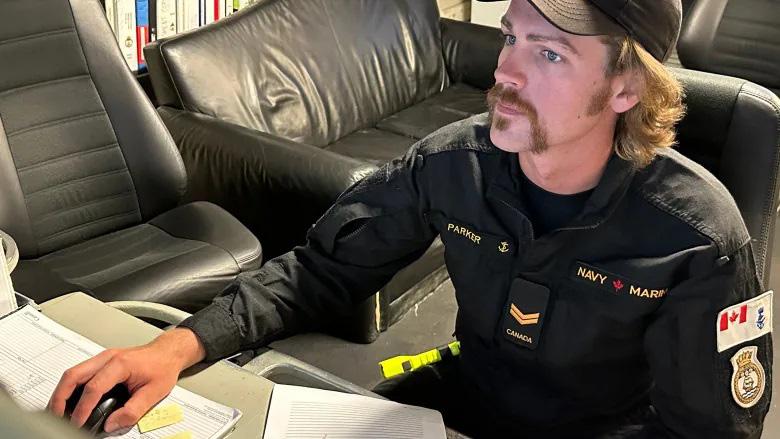
When I joined the Royal Canadian Naval Reserves in 2021, I was unaware of the variety of work available, especially the opportunities not directly tied to my defined occupational training.
While searching the Reserve Employment Opportunities (REO) database, where jobs for Naval Reservists are promoted for establishments worldwide, I found my current job.
I now work with the Digital Navy, a job that has improved my digital literacy. These skills are increasingly sought after by all levels of leadership. I eagerly jumped at the chance to contribute to the Navy’s digital transformation actively as it is, after all, a key enabler to Commander Royal Canadian Navy’s most recent Direction & Guidance.
Working with data wasn’t on my radar at first – I come from a background in literature. Now, I enjoy exploring and sharing what the Digital Navy is up to, especially from the Digital Solutions
section. In an ever-changing technological environment, I’m grateful I can develop new skills which prepare me for various challenges, and I get to share some insights along the way.
You don’t have to join the Digital Navy to benefit from digital enablement. Working with the Digital Navy team has exposed me to the fantastic opportunities the Royal Canadian Navy (RCN) has to offer to improve our digital skills. One of the best ways is through RCN contracted With You With Me (WYWM) training.
The platform teaches sailors to tackle various challenges, covering topics from IT fundamentals to programming or data analysis. Each learning path includes several modules that participants progress through, including Data Foundations, Data Analysis with Excel, and Data Visualizations with Power BI. While we may have some experience using these tools, the courses truly unlock our decision-making potential.
Any sailor, regardless of rank or occupation, can learn using this resource with little background knowledge.
The Data Foundations module helps build an understanding of Excel func-
tions and how they can be used to organize raw datasets meticulously. This leads nicely into the next module, Data Analysis with Excel, where previously developed skills are refined through exercises such as analyzing real-world problems through Excel and applying that data to solve those problems. With the final module, Data Visualizations with Power BI, the data analysis tools are combined with the ability to present information in a succinct and easy-to-read manner well suited to the briefing.
With the wealth of programs available through WYWM, all sailors can find something applicable to their current occupation. This learning helps to build transferrable skills and adds something to our toolbox to address future problems.
Sailors interested in improving their data literacy skills through the WYWM program can visit withyouwithme. com/bootcamp/rcn-data-bootcamp to enroll.
We also have information on our homepage: collaboration-navy.forces. mil.ca/sites/DGFSC/DIDN/DIDN3/ SitePages/DDN3.aspx












Embark on a transformative journey with The Masonic Brotherhood, enriching your
and legacy. Regardless of your background or profession, we invite you to elevate your commitment to service and brotherhood. Join us at our exclusive open house at: 650 Fisgard Street on Sunday, October 29 • 2:00 – 5:00 PM Register by sending your contact info to camosun60jw@gmail.com camosunlodge60.com


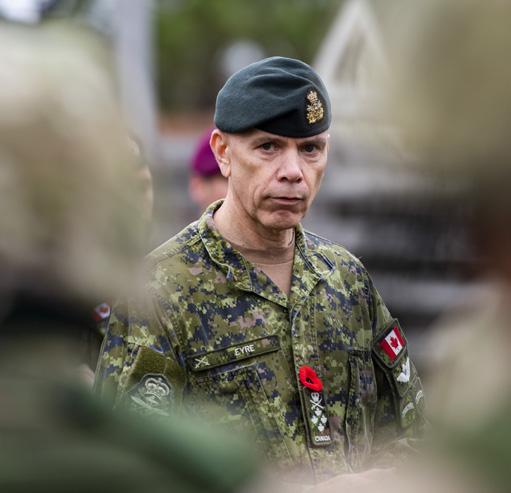
Dear members of the Canadian Armed Forces,
We are grateful for your exceptional work in response to this year’s unprecedented forest fire season. Your unwavering dedication to our mission and the wellbeing of those in distress embodies the true essence of service and resilience.
This year’s support to Operation Lentus spanned 131 consecutive days across six provinces and territories and involved deploying 2,135 members despite resource demands and incessant challenges. You demonstrated that protecting Canadians here at home is our main effort. You have once again showcased an incredible readiness to respond rapidly and effectively. Your unwavering support to communities affected by forest fires across Canada was remarkable.
Whether you were on the front lines, providing logistical support, or working tirelessly behind the scenes, each of you played a vital role in keeping Canadians safe. Your dedication has not gone unnoticed. Your tireless efforts and unwavering dedication brought solace and relief to those who were most vulnerable. Your work was not just commendable; it served as a source of inspiration amidst challenging circumstances.
As we move forward, let us remember the lessons learned during Operation Lentus and continue to ensure we remain ready to fulfill our mission. Together, we will face whatever challenges the future may bring with the same unwavering commitment and dedication you have demonstrated during this operation.
General Wayne Eyre Chief of the Defence Staff Chief Warrant Officer Bob McCann Canadian Armed Forces Chief Warrant Officer
























Provided by PSP
In 1987 a shimmering glimmer of opportunity descended upon the abandoned Canadian military camp. A developer named Richard Alden saw the overgrown land as a canvas for a vibrant community where families could build their futures. Armed with plans, ambition, and a vision for transformation, he purchased the land determined to breathe new life into the forgotten camp.
However, as construction began and the bulldozers cleared the underbrush, an unsettling atmosphere settled over the site. Workers reported strange occurrences from the onset – tools disappearing only to reappear in inexplicable locations, eerie whispers carried on the wind, and the sensation of being watched even in the most secluded corners of the camp. Richard brushed off these stories as the imaginative tales of a workforce experiencing the unfamiliarity of the location.
The activity escalated as the foundations were laid and the first structures rose from the ground. Hammer blows echoed through the
camp at odd hours as if an invisible hand was completing unfinished tasks. Electrical devices malfunctioned with regularity, despite rigorous testing and inspections. One worker claimed to have seen a fleeting figure in a military uniform standing at attention beside a half-constructed building before vanishing into thin air.
The haunting melody that had captivated the soldiers in the 1950s returned, drifting on the wind during moonlit nights. Richard, once skeptical, found himself drawn to the source of the ethereal music. On one such night, he ventured into the partially completed mess hall, his heart pounding as the melody enveloped him. The air seemed to thicken with memories, and for a brief moment, he could almost sense the presence of those who had walked the same halls decades ago.
The unrest grew more pronounced as the community’s planned unveiling date approached. Workers began to experience vivid dreams of distressed soldiers, their faces etched with sorrow. Shadows danced along the walls of the newly constructed homes, and furniture rearranged itself without any human inter-
vention. The presence of the otherworldly became undeniable, and fear gripped even the most stalwart of the construction crew.
The night before the grand opening, when the moon cast an eerie glow upon the camp, the hauntings reached their crescendo. A dense fog rolled in, enveloping the camp in an impenetrable shroud. Lights flickered and dimmed, leaving the scene bathed in an unsettling, spectral glow. As the clock struck midnight, the haunting melody reverberated throughout the camp, joined by anguished cries and phantom footsteps that echoed in every corner.
The homes in the community seemed to tremble with a life of their own, and their windows flickered with ghostly apparitions. Overwhelmed by the intensity of the supernatural display, Richard ventured into the camp’s heart, desperate to understand the cause of the unrest. In the mess hall, where soldiers had once gathered in camaraderie, he saw the figures—spectral soldiers frozen in time, trapped between a world of the living and the realm beyond.
The figure at the forefront, their gaze fixed upon Richard, emanated an aura of sor-
row and longing. It was as if the soldiers were bound by their unfulfilled ambitions, seeking solace and release. Humbled by the weight of the past, Richard realized that his dreams of a thriving community might come at the cost of the restless spirits trapped within the camp’s history.
With a heavy heart, he made the decision to abandon the project. The grand opening was canceled, and the workers were sent home. Once poised for a new beginning, the camp was left in a state of unfinished transformation. The spectral presence within the camp remained as if appeased by the decision to halt the development. The fog lifted, and the haunting melody grew faint, a last serenade to the man who had dared to disrupt the equilibrium of the past.
Haunted by his experiences, Richard vowed to preserve the camp’s memory differently. He ensured that the story of the abandoned military camp, its restless spirits, and the dreams of those who once inhabited it were recorded and shared. The land was left untouched, a sanctuary for the lingering memories within its boundaries.
And so, the abandoned Canadian military camp stood,

a testament to the intertwining of past and present, the living and the departed. The haunting melodies, the whispers, and the phantoms of soldiers frozen in time remained as a reminder that some stories were too powerful to be silenced. Once slated for transformation, the land had found its true purpose as a repository of history, a guardian of memories, and a cautionary tale for those who dared to disturb the slumber of the past.
Step into the heart of the unknown as Part 3 of our haunting tale unfolds. In 2017, the abandoned Canadian military camp beckons with mysteries that refuse to remain buried. Join three soldiers as they navigate a world where time and reality intertwine and the lines between the living and the spectral blur. With each report, the chilling truth unravels – a tale of apparitions, haunting melodies, and a camp’s relentless grip on the souls of the living. As the final chapter looms, prepare for a conclusion that will send shivers down your spine and leave you questioning the nature of existence.
Part 3 awaits, ready to plunge you into a world of the supernatural and the macabre.














































































Saturday October 28 Two sessions: 0930-1130 & 1230-1430
Saturday October 28 Two sessions: 0930-1130 & 1230-1430
Haunted Houses with three levels of scare – haunted, scary, and if you’re brave enough, terrifying!! PLus - Pumpkin carving!
Haunted Houses with three levels of scare – haunted, scary, and if you’re brave enough, terrifying!! PLus - Pumpkin carving!
Location:
Location:
Chief and Petty Officers’ Mess
Chief and Petty Officers’ Mess
Individual Rate | $7 (1 pumpkin included)
Individual Rate | $7 (1 pumpkin included)
Family Rate (4 people max) | $25 (2 pumpkins included)
Family Rate (4 people max) | $25 (2 pumpkins included)
Sponsored by:

Light snacks, juice, coffee and tea will be available.