Few of us have visited Canada’s North, and even fewer will sail the Arctic Ocean. Only the more adventurous of us would attempt such a voyage and dare to disturb Neptune!
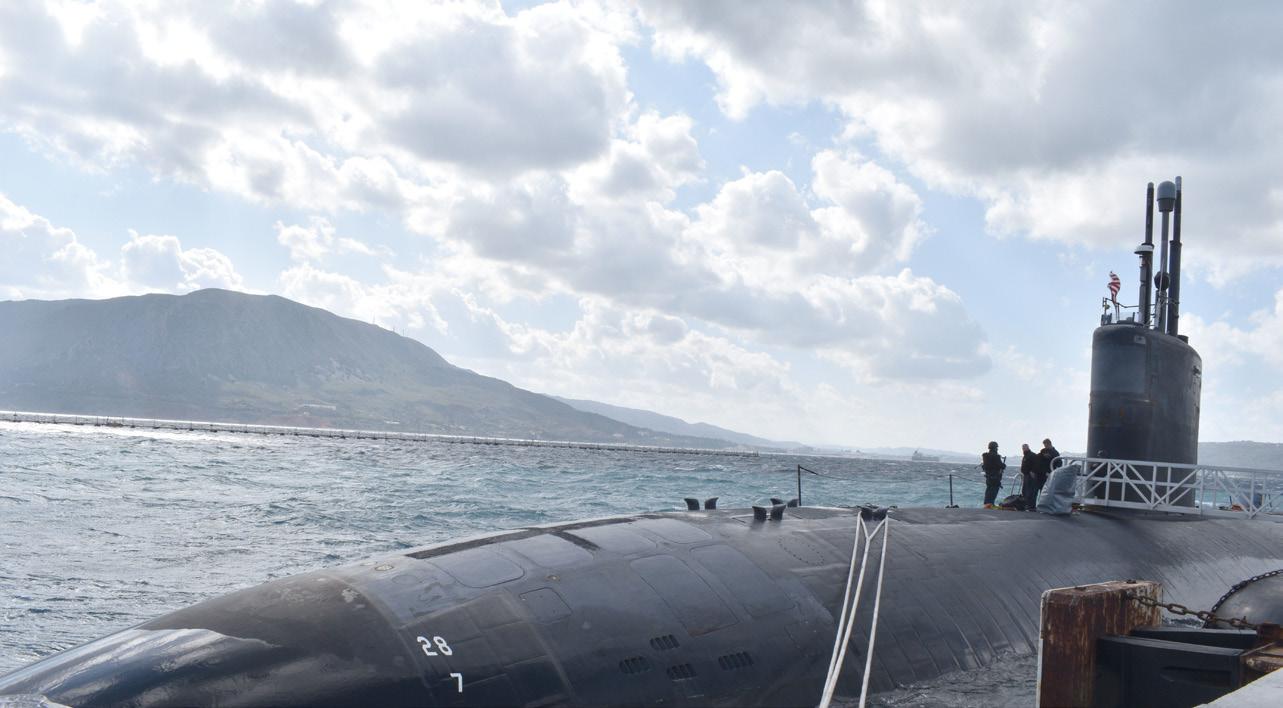
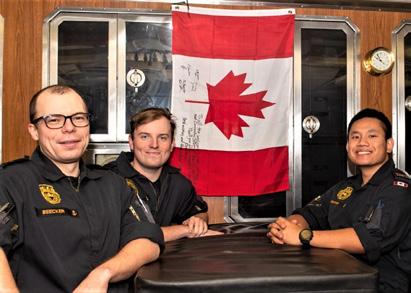
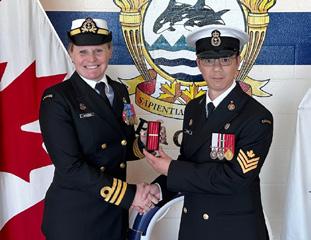
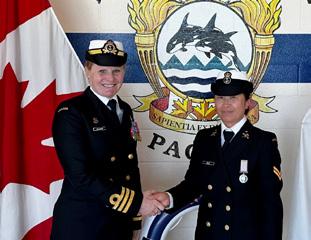
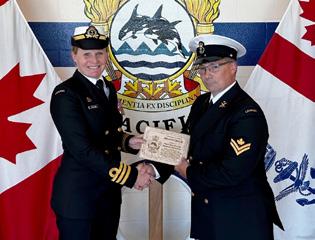
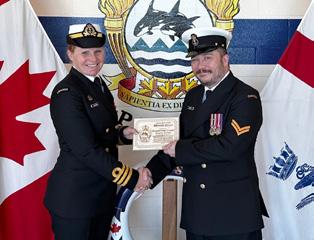
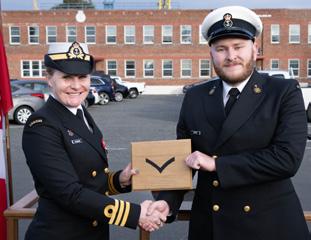
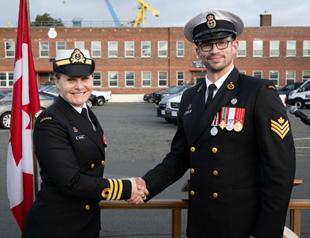
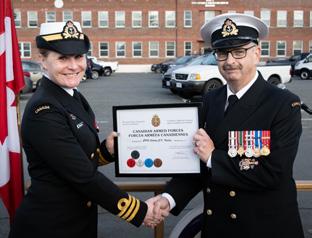
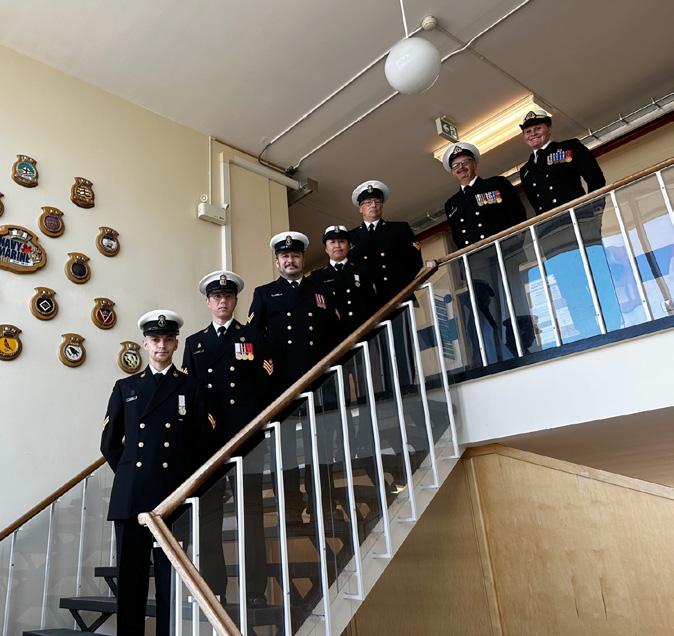
Four members of the Canadian Submarine Force recently took this opportunity when they sailed through the Northwest Passage as part of a cross-pollination on the United States Submarine San Juan. Lieutenant (Navy) (Lt(N)) Benjamin Courchene, Sailor First Class Kyle Beecker, Sailor Second Class (S2) Van Long Nguyen, and S2 Miguel Wilson joined the San Juan for a month-long transit from Groton, Connecticut, to
Bremerton, Washington, to deepen their knowledge of submarine operations.
“We learned so much,” said S2 Van Long Nguyen. “I’m so happy I was a part of this.”
Like all submariners, the crew and officers of the USS San Juan are trained to operate underwater and all the complexities it entails. Add to this Arctic conditions and shallow water operations, and the stakes are higher.
“Even during the most gruelling and shallow portions of the trip, ‘Overprepared and underwhelmed’ motto of Lieutenant Daniel Stikles, San Juan’s navigator, held true,” said Lt(N) Courchene. “The seas were pleasantly calm below the ice, and we sailed through without an incident.”
The transit was part of Operation Nanook-
Tuuglik 2023, Canada’s annual sovereignty exercise. This year’s iteration included Royal Canadian and United States Navies and Royal Canadian Air Force assets.
Included in the trip was an Arctic Circle crossing-of-the-line ceremony, much like the ones sailors have undergone for centuries in the French and Royal Navy. It has roots in ancient times and is thought to appease Neptune before approaching his realm. Such ceremonies are also conducted when crossing the date line, the Equator and the Antarctic Circle.
Once completed, the ‘tadpole’ is reborn as a ‘shellback’ and earns the title of ‘Bluenose’.
“This was an amazing, once-in-a-lifetime experience, and I really enjoyed the camaraderie,” said S2 Nguyen.
USS San Juan. Photo: U.S. Navy Mass Communication Specialist Second Class Kelly M. Agee
Defence Team gathers for harbour cleanup
Peter Mallett Staff Writer
It was ‘mission accomplished’ for a hardy group of volunteers in their goal to remove waste from the shoreline of Esquimalt Harbour.
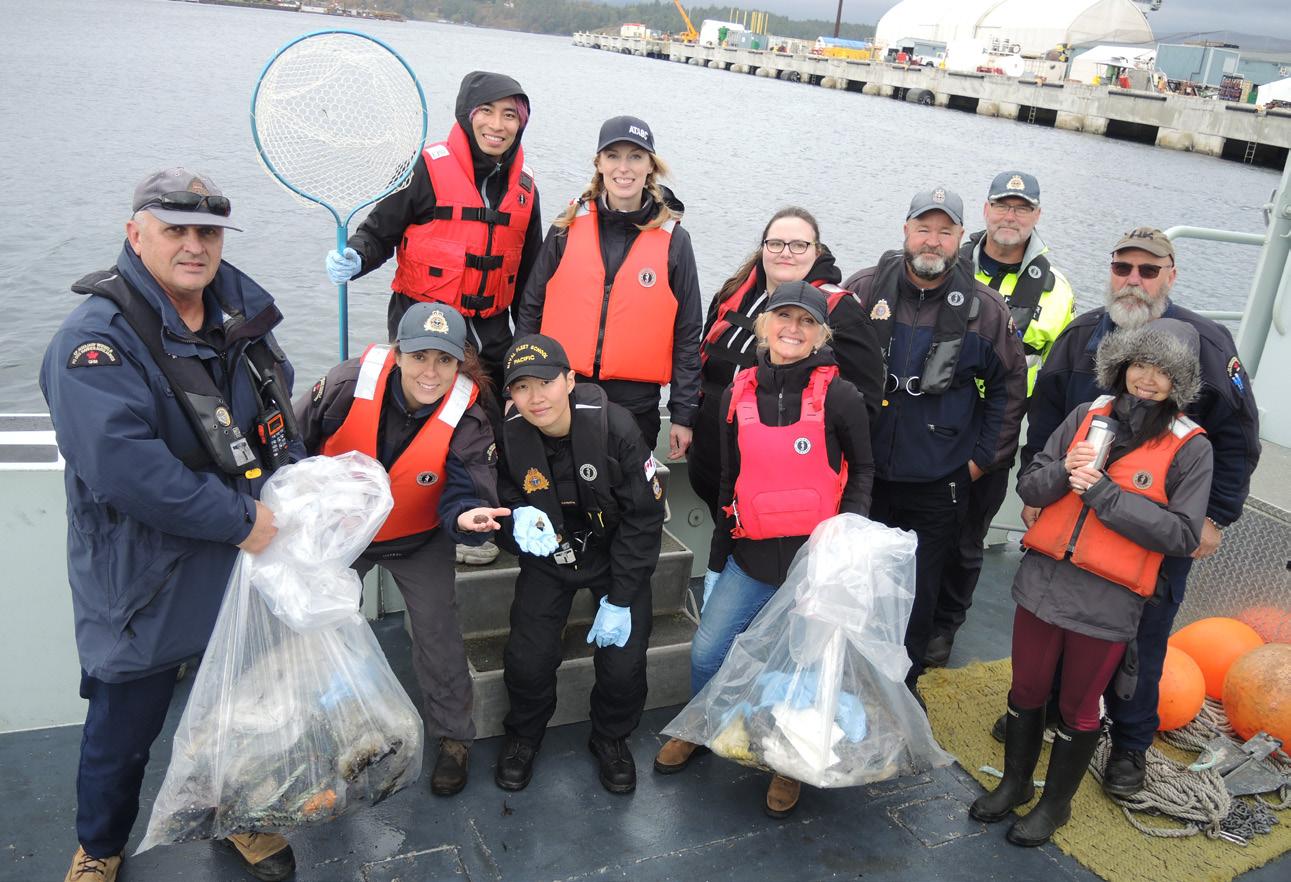
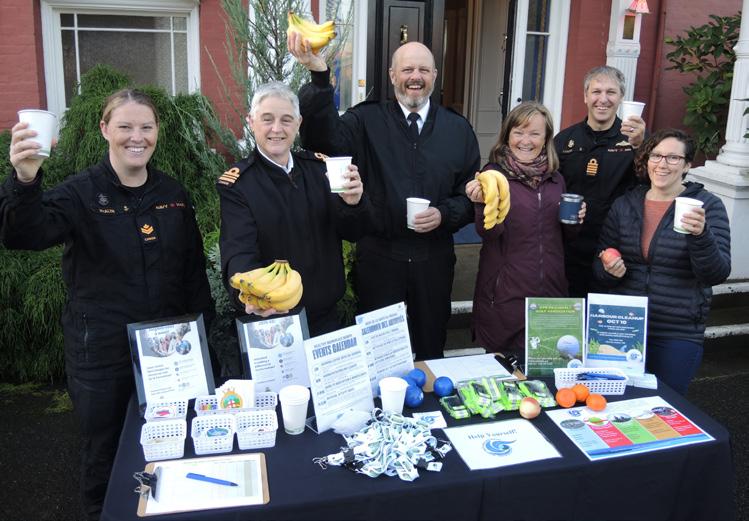
Military members and Department of National Defence civilian employees of CFB Esquimalt volunteered to clean up the Harbour on Tuesday morning following the Thanksgiving long weekend. Starting at the Small Boats Jetty in Naden in wet and blustery conditions, the team boarded a 38-foot-long Sea Truck vessel of the King’s Harbour Master (KHM) and set out to complete their morning task.
The Harbour Cleanup event was part of the MARPAC Health and Wellness Strategy’s (MHWS) Healthy Workplace Month. It included five employees of the Port Operations and Emergency Services Branch (POESB).
The typical autumn weather for Victoria didn’t seem to faze most attendees, including Sailor Third Class (S3) Jade Mok of Naval Fleet School (Pacific).
“I really wanted to come out today and help in the efforts,” said S3 Mok, a Naval Combat Information Officer in Training. “I have read about the sea creatures that live in Esquimalt Harbour and I don’t want them to be threatened by plastic waste and
the garbage that builds up here. Participating in this event gave me a sense of accomplishment.”
Armed with nets, garbage bags and plastic gloves, S3 Mok and the rest of the clean-up team got to work under the guidance of the KHM crew who guided the flat bottom boat and its landing ramp to the edge of the fenders.
The team pulled 55 kg of waste in total from the compression fenders that line the ‘F’ Jetty in Colwood and ‘C’ Jetty in Dockyard.
The items recovered included plastic cups, chocolate bar wrappers, rope, plastic zip ties, a tiny Lego man, BBQ sauce bottle, bubble wrap, ear plugs, a flare shell, and plastic bags.
Lorraine Crinkley of POESB’s Environmental Protection Office who guided the team says she was delighted to take part.
“We at POESB are very passionate about keeping our harbour clean,” said Crinkley. “We welcomed guests from other units who share the same passion and everyone had an enjoyable experience while doing the job.”
The Harbour Shoreline Cleanup was facilitated by the MHWS’ Organizational Wellness Working Group. Jessica Wyllie, organizer of the event and Health Promotion Specialist with Personnel Support Programs (PSP), says the wet and windy conditions caused some addi-
tional challenges but those who came out to the event really seemed to enjoy themselves.
“This was part of our community well-being initiative for Healthy Workplace Month and a really cool opportunity for people who never get a chance to get out and explore the harbour,” said Wyllie.
Their excursion through Esquimalt Harbour wasn’t just about picking up garbage, says Wyllie. It also gave the volunteers an up-close look at some of the sea life that lives in the harbour including seals, eagles, otters, blue herons, crabs, starfish and fishes. Participants also visited the historic Cole Island where they viewed its restored colonial-era buildings including the Royal Navy’s former guardhouse and ammunition magazine stores buildings.
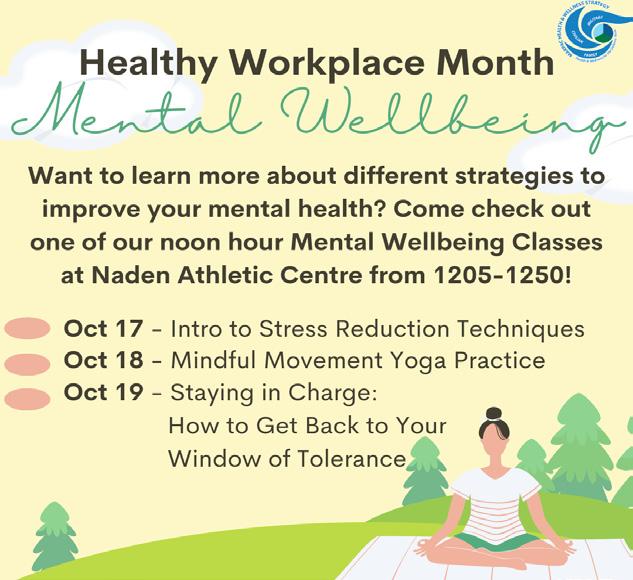
Healthy Workplace Month kicked off on Oct. 3. This week, join the activities with three events hosted at noon at the Naden Athletic Centre (NAC): Introduction to Stress Reduction Techniques on Oct. 17, Mindful Movement Yoga Practice on Oct. 18, and Staying In Charge, How to get back to your Window of Tolerance on Oct. 19.
Healthy Workplace Month wraps up with fitness classes in the NAC and Dockyard Gym, Go-By-Bike Week Celebration (Oct. 25), National Sports Day (Oct 26) and the monthly Formation Run on Oct. 27.
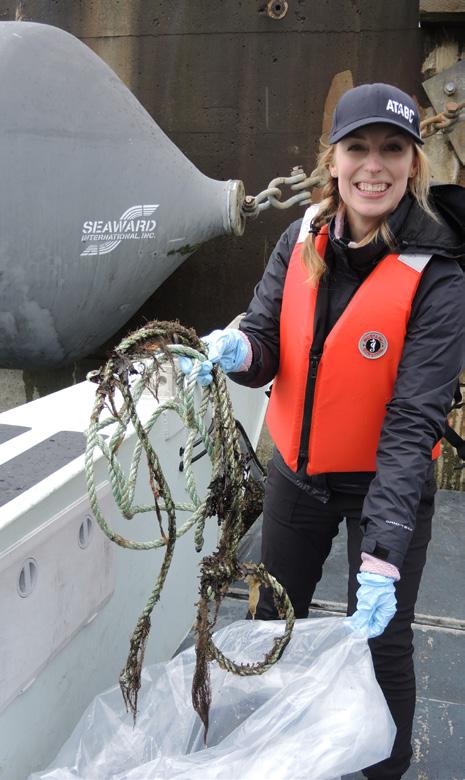
Jessica Wyllie, Health Promotion Specialist, displays a piece of rope she picked from the compression fender at C-Jetty in Dockyard during the Harbour Shoreline Cleanup.
Members of the Harbour Shoreline Cleanup team gather at the Small Boats Jetty in Naden for a group photo following the successful completion of their mission.
Photos: Peter Mallett/Lookout Newspaper
MANAGING EDITOR
Jazmin Holdway jazmin.holdway@forces.gc.ca
EDITOR
Kate Bandura
WRITER
250-363-3130 kateryna.bandura@forces.gc.ca
Peter Mallett mallett.peter@cfmws.com
PRODUCTION
Leslie Eaton
250-363-8033 workstation3@lookoutnewspaper.com
ACCOUNTS/RECEPTION
Trina Winters
ADVERTISING
Joshua Buck
250-363-3127
778-977-5433 NEW military.base.advertising@gmail.com
Published each Monday, under the authority of Capt(N) K. Whiteside, Base Commander.
Le LOOKOUT est publié tous les lundis, sous l’égide du Capv K. Whiteside, Commandant de la Base.
The editor reserves the right to edit, abridge or reject copy or advertising to adhere to policy as outlined in PSP Policy Manual. Views and opinions expressed are not necessarily those of the Department of National Defence.
Le Rédacteur se réserve le droit de modifier,de condenser ou de rejeter les articles, photographies, ou annonces publicitaires pour adhérer au Manuel des politiques des PSP. Les opinions et annonces exprimées dans le journal ne réflètent pas nécéssairement le point de vue du MDN.
Circulation: 2,000 plus 300 pdf downloads per week Follow us on Facebook, Twitter and Instagram to join our growing social media community.
A Division of Personnel Support Programs
CFB Esquimalt, PO Box 17000 Stn. Forces Victoria, BC V9A 7N2 Web: www.lookoutnewspaper.com Fax: 250-363-3015
Canadian Mail Product Sales Agreement 40063331
Unifying the Mind with the Body
Do you love your body? I mean it... Ask yourself when you gave your unconditioned gratitude to your body last time.
We don’t often ask this ourselves because we are disconnected from our mind and body. The psyche and body connection is frayed, which leads to a splitting between our external reality and our internal existence. This causes a circulatory blame game, where the mind faults the body, and the body condemns the mind. When the mind is perpetually antagonistic toward the body, we lose faith in its potentiality. Whether it’s our mind or body that we accuse, we can admit we are extremely hard on both.
When our mind begins to neglect our body, we find ourselves in psychological turmoil. This is due to how often we have access to seeing ourselves. Whether we’re walking in the streets and catching a glimpse of our-
selves in the window of a car, going to the restroom and glancing at ourselves in the mirror, taking a selfie, or merely looking down and witnessing ourselves, one thing is sure: our mind (for the most part) is inescapably tied to this physical being. These constant negative reminders of the body’s appearance can become the feeding ground for depression, anxiety, and a lack of self-esteem.
So, how does one begin to mend the connection between mind and body?
First is attention. Witnessing what we do to our bodies is an excellent way to bring awareness. Do you engage in activities knowing they will harm your body, or do you not recognize what the body is doing to itself? The former can indicate some form of satisfaction in the harm – you’re punishing your body because you think it deserves to be punished. The latter scenario indicates addiction, where a pattern is formed and becomes unconscious due to the repetition.
The second is love. Without love, there is no potential to reconnect the mind and body. We need this feeling to flow through the body. We have all felt that ineffable sense of euphoria course through our bodies at one time or another. An excellent way to build the skill of giving love to the body is by channelling the sensations you’ve felt
in those ecstatic moments of divine appreciation. Take yourself back to a moment where you recognized your body’s resilience and the gratitude that sparked from it.
Lastly is work. Working out or exercising are excellent ways to reconnect the mind and body. However, they only go so far—work towards being more in the body throughout the day. Every so often, notice your breath, be conscious of the nourishing food you give, be aware of points of tension in your body, and relentlessly explore ways that bring you back into your body. The mind and body connection has been studied for centuries and transposed through religious, scientific, philosophical, and theological lenses. However, one thing is sure: when we unify the mind and the body, our capacity to reach our full potential significantly increases.
Thomas Goenczi is an RCN Veteran and MA Clinical Counsellor with Private Practice: Well Then Therapy.
The content is not intended to substitute professional advice, diagnosis, or treatment. Always seek the advice of your mental health professional or other qualified health provider with any questions regarding your condition.
Thomas Goenczi
Lookout contributor
Celebrate Healthy Workplace Month at CFB Esquimalt
Kateryna Bandura Lookout Editor
In October, the Defence community marks Healthy Workplace Month, focusing on four health and well-being aspects.
Organized by Maritime Forces Pacific (MARPAC) Health and Wellness Strategy’s Organizational Wellness Working Group, the month’s activities aim to foster a healthy work environment, says Jessie Wyllie, Health Promotion Specialist at Personnel Support Programs (PSP).
“Creating a healthy workplace is so important right now, especially for the military,” she said. “People who feel like they are a part of a healthy and inclusive work environment are overall happier and less likely to experience burnout. Productivity increases, job satisfaction improves, and people genuinely want to engage and perform to a higher standard.”
Wyllie encourages individuals to make at least one change, big or small, to work to create a healthier workplace. These changes will become habits and carry on into longterm positive changes.
According to Wyllie, a healthy workplace is a safe space for people to come to work, prioritizes diversity and equity initiatives, encourages education and incorporates aspects of social, community, physical and mental well-being.
“Most people can get caught up on just physical aspects such as using standing desks or holding walking meetings, which are great and have their place for creating a healthier workplace, but are not the only ways. There are so many ways people can start to create a healthier workplace,” she said.
Healthy Workplace Month started with a focus on social well-being, which featured an opportunity for the community to have an informal morning coffee at the Admiral’s Residence. Visitors mingled with Rear-
Admiral Christopher Robinson, Commander Maritime Forces Pacific, at the historic Dockyard residence while enjoying coffee and refreshments provided by the messes.
“A social event with the Admiral showed that senior leadership understands and values the importance of creating a healthy work environment and wants everyone to feel welcomed and included in this space,” Wyllie said.
Week two activities started with community well-being, which involved cleaning the harbour and shorelines. As a Navy base, the ocean is a massive part of the physical work environment, Wyllie said.
“Whether people are out sailing, conducting maintenance, or on dive training, we need a clean and healthy harbour to do our work to the best of our abilities,” she said.
Week three activities bring attention to mental well-being. During the lunch hour breaks on Oct 17-19, trained Health Promotion staff are offering lessons about mindfulness, meditation and yoga at the Naden Athletic Centre. The PSP Health Promotion team will help people try out different activities that can help improve their mental well-being.
“There are so many different options that we hear about that are beneficial for mental health that it can be a little overwhelming sometimes,” Wyllie said. “These classes will provide a better understanding of how to identify when we are struggling and when we need to prioritize our own well-being.”
October’s final week will be all about getting the body moving. Among many opportunities to be active, Wyllie listed various fitness classes available at both Naden and Dockyard Gyms, the Go-By-Bike Week marked on Oct. 25, which promotes active transportation to work, and the National Sports Day on Oct. 26, where members can try out for various sporting activities at the Naden Athletic Centre. The week ends with the monthly Formation Run on Friday, Oct. 27.
How you can create a healthier workplace:
• Encourage members to take part in Positive Space Ambassador training or join one of the Defence Advisory Groups (DAGs)'
• Create a gratitude tree for the workspace where members can post things they are grateful for throughout the week;
• Have your unit join in the monthly Formation Run / Walk to get everyone active and socializing;
• Bring a packed lunch from home instead of eating out;
• Check in with your coworkers and genuinely ask how they are doing;
• Have a unit step challenge;
• Organize a food/toy drive within a unit; and
• Organize workplace social events that centre around other activities than alcohol.
“Creating any type of change takes time and helping people understand there is more to a healthy workplace than just focusing on physical well-being can be a new way of thinking in some cases,” she said. “This is an annual campaign so we will continue to find ways to highlight healthy workplaces every October.”
The Organizational Wellness Working Group aims to deliver on several initiatives
each year. The group’s priorities for this year include assisting the chaplaincy with converting the Naden chapel into a more inclusive multi-faith/community practice space and collaborating with the Defence Advisory Groups to provide support for all commemorative events. The group also looks to find ways to collaborate with the Naval Reserve.
RNSA 2023 Mess dinner
Horton
The Royal Naval Sailing Association (RNSA) is celebrating two significant anniversaries in 2023.
First is the 100th anniversary of the Canadian Naval Reserve, and second is the 50th anniversary of the founding of the RNSA’s British Columbia Squadron.
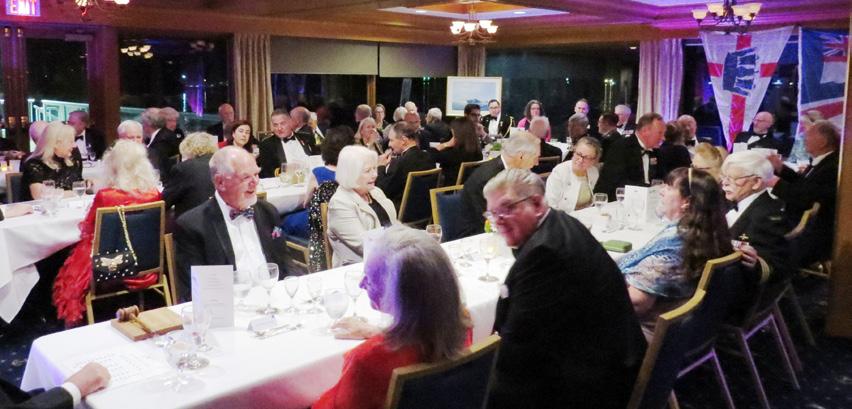
The RNSA marked these events at its annual naval mess dinner at the Royal Vancouver Yacht Club on Oct. 6. Commodore (Cmdre) Pat Montgomery and Kelly, his charming wife, were guests of honour. Also at the head table were Cmdre Jody Sydor Jones of the West Vancouver Yacht Club and her husband, David Jones; John Horton, Captain of the B.C. Squadron RNSA, was mess President. Horton
oversaw the 58 lively diners. Tales of past escapades of the Naval Reserve, the RNSA, and the usual friendly banter amused guests.
Retired Reserve Commanding Officers were acknowledged during dinner, including Cmdre Brian Cook, Cmdre Bryan Price, Cmdre Arthur Hastings, Cmdre King Wan, and 13 other attendees who had also served in Canada’s Naval Reserve.
Cmdre Montgomery gave a fascinating speech on the Reserve – past, present, and future – after which he presented John Horton with a centennial coin. Horton, not to be outdone, reciprocated with a special RNSA medallion. RNSA medallions were recognized for years of excellent service to Court Touwslager and Susan Steele as race chairs for the single-handed Race
and Annie Pedersen, branch treasurer.
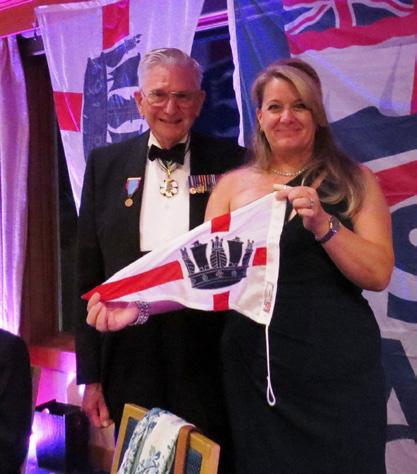
An RNSA burgee was presented to Cmdre Sydor Jones to mark the growing relationship with the West Vancouver Yacht Club’s organization of the annual Single-Handed Race.
The RNSA is thankful for the many years of partnership with the False Creek Yacht Club, helping to organize the Race. The 2023 Race from Vancouver to Nanaimo and return saw the yachts compete under perfect racing conditions. Over the years, this Race has seen many of the finest sailors from the Pacific Northwest compete for an extensive collection of trophies.
2024 will mark the 50th anniversary of this fabulous Race, and RNSA hopes to have a fleet of at least 50 to follow its slogan, ‘50 yachts for 50 years’.
Ooverview of the event. Photos supplied
John Horton and Jody Sydon Jones.
Admiral welcomes guests for morning coffee
Peter Mallett Staff Writer
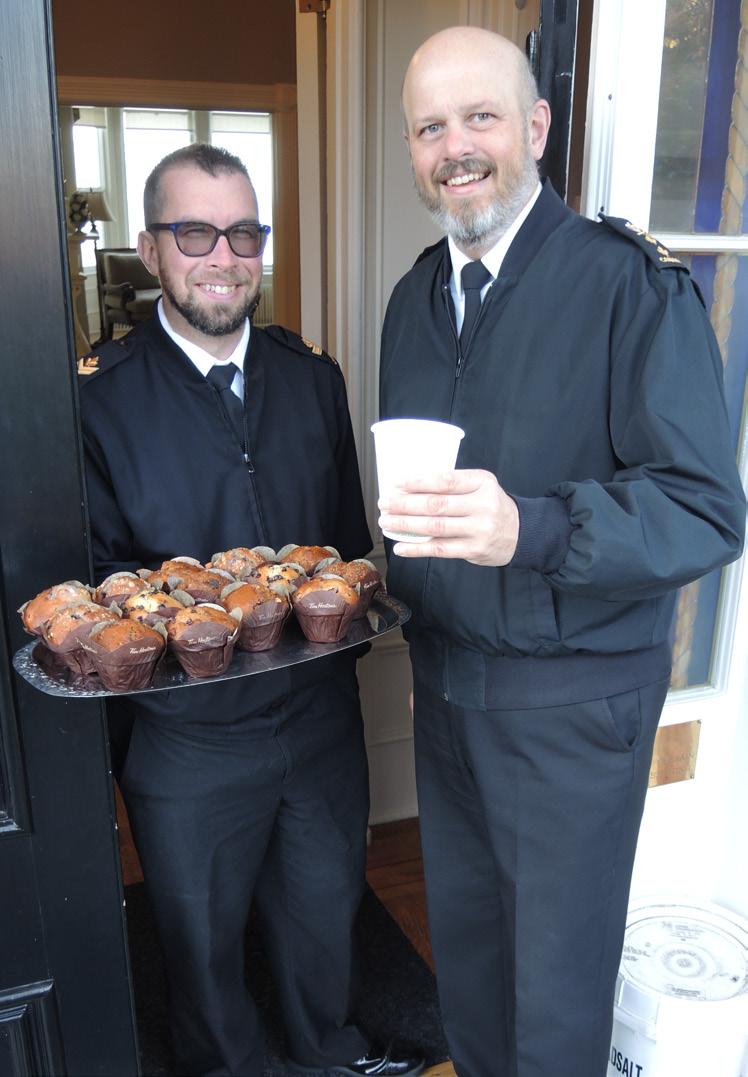
The conversation was casual, coffee fresh, and muffins abundant as Rear-Admiral (RAdm) Christopher Robinson welcomed visitors on the morning of Oct. 3.
The Commander of Maritime Forces Pacific played gracious host at his historic Dockyard Residence for Morning Coffee with the Admiral. This event was the kick-off of four weeks of events in the MARPAC Health and Wellness Strategy (MHWS) Healthy Workplace Month, with refreshments provided by the messes.
With a hot cup of java, RAdm Robinson welcomed visitors and emphasized the importance of a healthy workplace for all military members and Department of National Defence (DND) civilian employees.
“Being physically and mentally healthy allows people to bring their best self to work, and events such as this remind people that maintaining their health is also part of their responsibilities at work,” RAdm Robinson said. “That could mean getting up from your desk and taking a break, going to the recently re-opened gym here in the Dockyard, taking a walk or taking time out for conversation and coffee with your coworkers.”
Standing by his side to greet visitors was Captain (Navy) (Capt(N)) Matthew Coates from Naval Training Group and Champion of the Organization Wellness Group. Capt(N) Coates agreed with the Admiral that taking a time-out during your workday is highly encouraged because of its health benefits.
“Every day doesn’t need to be 100 miles per hour, and you can actually get more work done during your day if you take a break to socialize with your colleagues in an informal setting,” said Capt(N) Coates.
Dockyard D-101, the Admiral’s Residence, was constructed in 1885 from designs by John
Teague, and has served as the principal dockyard residence for most of its existence. RAdm Robinson does not live in the historic home but instead keeps his home in a more modest nearby cottage adjacent to the property.
The conversation among guests ranged from the impacts of the National Day for Truth and Reconciliation events, and the sucess of the National Defence Workplace Charitable Campaign (NDWCC) pancake breakfast, the reopening of the Dockyard gym, deployments and activities of HMC ships and submarines, traffic woes, and upcoming winter weather issues for bicycle commuters.
Master Sailor (MS) Dana Kimoto of Canadian Submarine Force (CANSUBFOR) HQ stopped by the gathering to say hello to the Admiral while getting a look at the residence building for the first time.
“It was so nice to enjoy the refreshments and the company of the Admiral and see this historic building; it was certainly a healthy way to start the day,” she said.
MHWS’ Organizational Wellness Working Group organized each event as part of their initiatives for Healthy Workplace Month:
1. Harbour/Shoreline Cleanups took place the mornings of Oct. 10 and 12.
2. An introduction to Meditation and Mindfulness classes are available at noon in the Upper Gym at the Naden Athletic Centre (NAC) from Oct. 17 to 19.
3. Physical Activity Week, Oct. 24 to 27, will feature several events designed to promote a healthy workplace, including fitness classes in the NAC and Dockyard Gym, Go-By-Bike Week Celebration (Oct. 25), National Sports Day (Oct. 26) and the monthly Formation Run on Oct. 27.
Above: Commander MARPAC, Rear-Admiral Christopher Robinson and his Steward Master Sailor Cory McMillan welcome visitors to the Admiral's Residence for Morning Coffee with the Admiral.
Admiral Christopher Robinson, Commander MARPAC; Claire Grant, MARPAC Health and Wellness Strategy Assistant; Captain (Navy) Matthew Coates, Naval
Training Group and Champion Organizational Wellness Group; and Caroline Wylie, Formation Safety and Environment, gather for a photo during Morning Coffee with the Admiral. Photos: Peter Mallett Lookout Newspaper
HMCS Ottawa Indo-Pacific Deployment 2023
HMCS Nanaimo forges ties with Coast Guard in Northern B.C. waters
Kateryna Bandura Lookout Editor
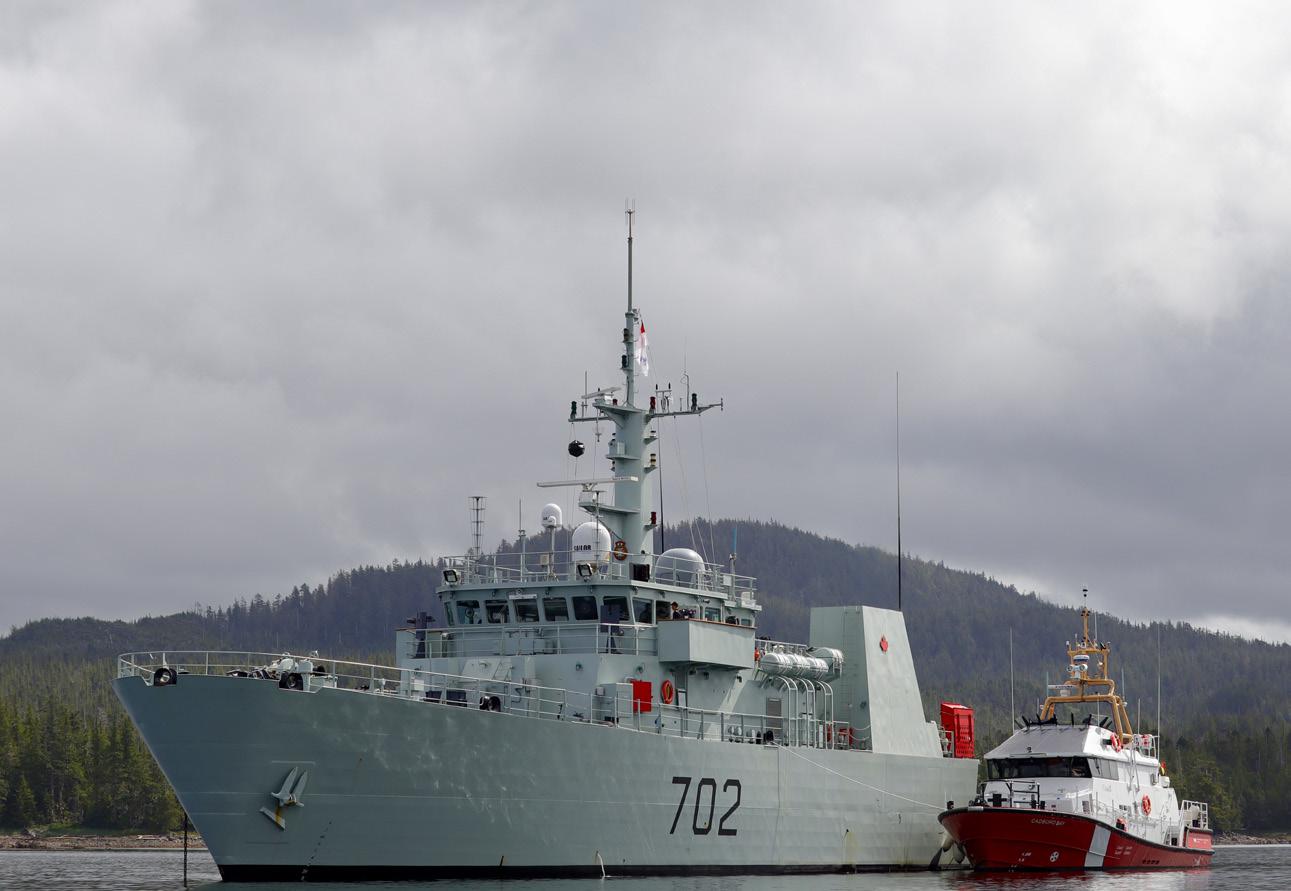
HMCS Nanaimo traversed the northern British Columbia waters in September with the Canadian Coast Guard (CCG) while conducting Search and Rescue (SAR) operations.
The Search and Rescue Zones (SARZONE) program follows a yearly tasking within Maritime Forces Pacific (MARPAC) that supports continued interoperability between the two organizations and allows the CCG to maintain 24/7, 365 SAR coverage in Canadian waters.
SARZONE is a month-long tasking in which a Royal Canadian Navy (RCN) vessel backfills the Canadian Coast Guard, ready to help at all times. The crew operates in zones 1 (North, from Bella Bella to Dixon Entrance) or 2 (South, Bella Bella south to Barkley Sound) with 30 minutes notice to respond to SAR taskings from the Joint Rescue Coordination Center (JRCC).
Lieutenant-Commander (LCdr) Michael Vanderveer, HMCS Nanaimo’s Commanding Officer, said the crew enjoyed working with the CCG.
“The Rescue Specialist from the CCG was a great addi-
tion to our team,” he said. “Our two organisations are so similar yet so different; working with and learning from each other is truly the win of this trip.”
A Rescue Specialist is a highly skilled first responder trained in advanced first aid and coastal SAR techniques with proficiency in Fast Rescue Craft operation. The CCG prides itself on having well-trained Rescue Specialists throughout the fleet, ready to respond to distress on or near waters across Canada, said Darren Edwards, Rescue Specialist representing the CCG.
“I enjoyed learning from the Navy and merging our knowledge for the common goal of Search and Rescue on the B.C. coast,” he said. “I felt instantly welcomed and the Nanaimo crew were very professional.”
Aside from participating in planning sessions and briefings, Edwards also learned about the culture on RCN vessels. He received an HMCS Nanaimo morale patch and participated in off-watch team-building fun.
“If I was asked to participate in this type of patrol again, I wouldn’t hesitate to say ‘yes’. Any Rescue Specialists reading this should jump at the chance to volunteer for this type of patrol, honestly an invaluable experience,” Edwards said.
LCdr Vanderveer said one of the best moments of the operation was witnessing how his crew switched from relaxing at anchor to engaging in planning for a JRCC tasking and going full speed towards the task area within 20 minutes.
“The team switched mental states on a moment’s notice and off we went,” he said. “The tasking was fortunately a false alarm, but the ship’s response was as real as it gets, and I was very proud of the team that night.”
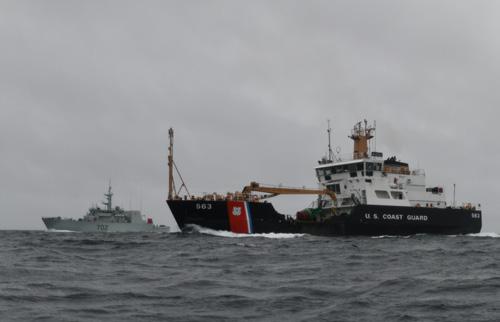
The ship also overlayed the operation with multiple individual and collective training opportunities, including engineering drills twice daily to train junior MARTECHs, and night steams to ensure bridge time for bridge watchkeepers in training. Besides balancing training and being at anchor, the crew conducted a towing exercise with the CCG lifeboat in Prince Rupert and a high-seas encounter with the United States Coast Guard Cutter Henry Blake
HMCS Nanaimo plans a Force Generation sail in November, intending to conduct a Humanitarian and Disaster Relief Operation with the 4th Canadian Rangers Patrol Group.
HMCS Nanaimo's crew participated in a Search and Rescue (SAR) exercise with the Canadian Coast Guard.
HMCS Nanaimo with the U.S. Coast Guard Cutter Henry Blake.
HMCS Nanaimo conducts a training exercise with the Canadian Coast Guard lifeboat in Prince Rupert, B.C.
New doc useries from Victoria features more Naval Heroes
The big takeaway in season 2 is how many people and entities come together to get a ship ready to sail.
The mild-mannered seafaring heroes of the Royal Canadian Navy (RCN) are about to ‘Go Bold’ again.
Victoria digital content creator Joetey Attariwala has released his second season of docuseries featuring in-depth interviews with sailors of the Pacific Fleet. Season 2 of Go Bold With Joetey Attariwala: Talking to Real Life Heroes is a sixpart docuseries just launched on TELUS Optik TV Channel 9 and the Go Bold and STORYHIVE YouTube Channel.
The goal is to educate Canadians on the RCN.
“Many people have no conception of the Navy, let alone who its sailors are, the scope of naval operations or its capabilities,” says Attariwala. “The series enables people to learn about our sailors and what they do during their time in Canada and abroad.”
Attariwala, 50, is a medical doctor turned military journalist, photographer, podcast host, defence blogger and a familiar face to many in the Pacific Fleet.
The Go Bold docuseries debuted last year and served as a compendium to the Go Bold with Joetey Attariwala podcast, with the new filmmaker focusing his lens on diversity within the RCN. Season 2 shifts the attention to sailors and their departments, who bring a Halifax-class warship to high readiness.
“It’s an incredible process and what amazed me during filming is that I was only able to interview just a handful of these people,” Attariwala said. “My intention is to give viewers an appreciation for the scope of what’s involved to get a ship to sea. I really have to thank Davie Shipbuilding, who was a huge help in sharing perspectives on the Halifax-class for this season.”
Attariwala says the first season was a resounding success. The numbers support his claims. Season 1 has amassed 21,950 views on Attariwala’s Go Bold YouTube Channel, equivalent to 12,400 viewing hours. He expects Season 2 to equal or surpass those numbers.
Attariwala’s series is produced with the support of TELUS STORYHIVE Voices. The program offers production funding, training, a community of support, and distribution for new and emerging digital content creators. The intention is to share the stories new local creatives are passionate about.
Attariwala produced, wrote, directed, and edited the entire series. To film the interviews, he enlisted local videographer Karan Mann to assist.
Not ready to rest on his laurels, Attariwala says he will begin filming a third season of his documentary in the coming weeks, with its release planned for late 2024.
A sneak preview of each episode and the focus of discussions in Season 2:
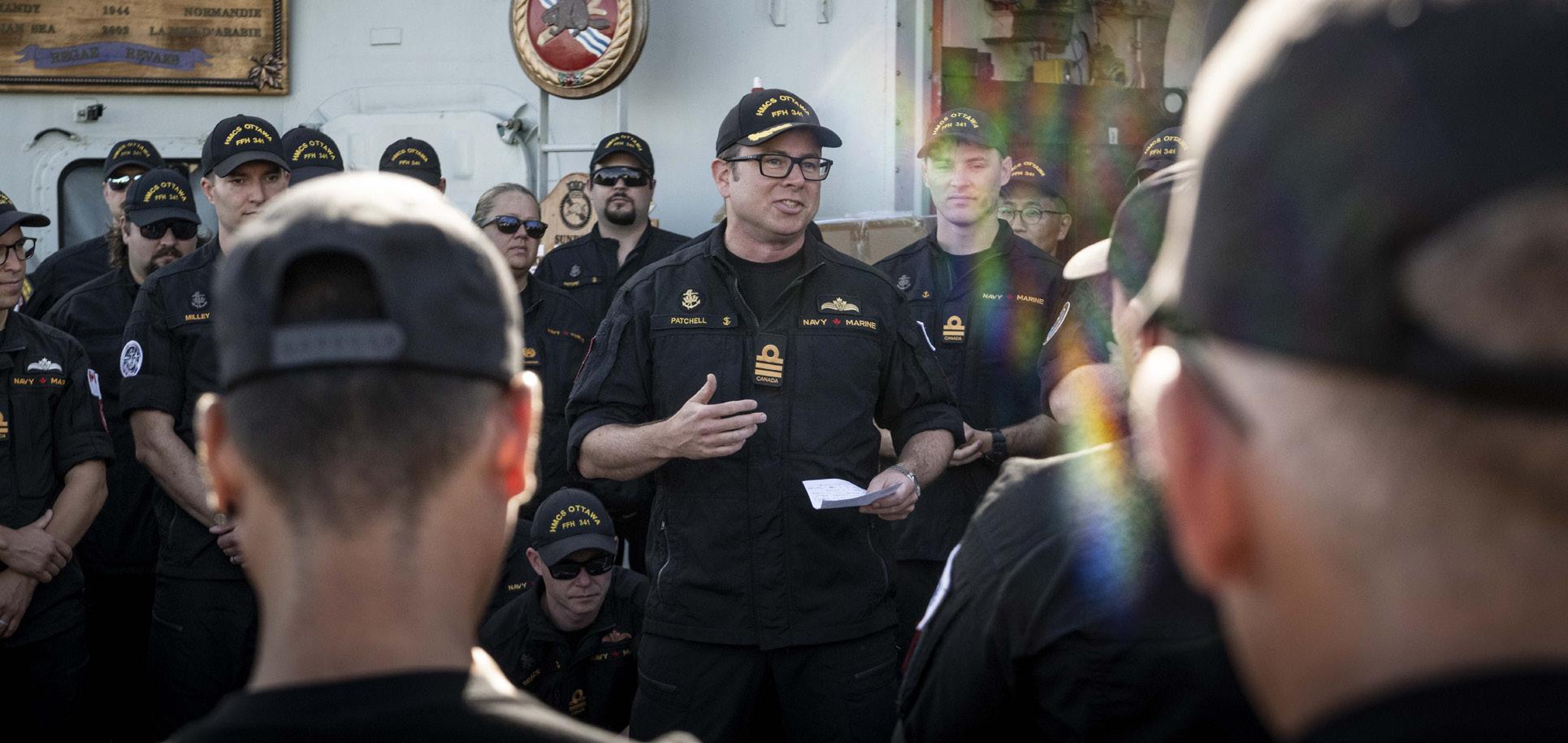
Episode 1, The Command Triad, focuses on commanding a Halifax-class warship and includes interviews with Commander (Cdr) Sam Patchell, HMCS Ottawa Commanding Officer, Lieutenant-Commander (LCdr) Justin Simmons, Executive Officer, and CPO1 Steve Sheffar, the ship’s Coxswain.
Episode 2, Touring the Halifax-class: An interview with Vice-Admiral Angus Topshee, Commander Royal Canadian Navy, and an above-deck tour of HMCS Ottawa with LCdr Simmons.
Episode 3, Simulation: A visit to HMCS Venture and interview with LCdr Clay Erickson, Naval Warfare Officer Division Commander. Viewers learn about the training centre’s Navigation and Bridge Simulator as experienced by Ottawa sailors.
Episode 4, Damage Control : A visit to Damage Control Training Facility Galiano that prepares sailors for emergencies on RCN Ships and interviews with the students and teachers.
Episode 5, Naval Boarding Party and Force Protection: Filmed at the Naval Tactical Operations Group (NTOG) and aboard HMCS Ottawa, the episode focuses on sailors who help protect ships and the evolution of boarding parties in the RCN.
Episode 6, Employing the Halifax-class Warship : Commodore David Mazur, Commander Canadian Fleet Pacific, and Cdr Patchell speak to the role of the Halifaxclass while its weapons systems and combat systems engineering are discussed.
Peter Mallett Staff Writer
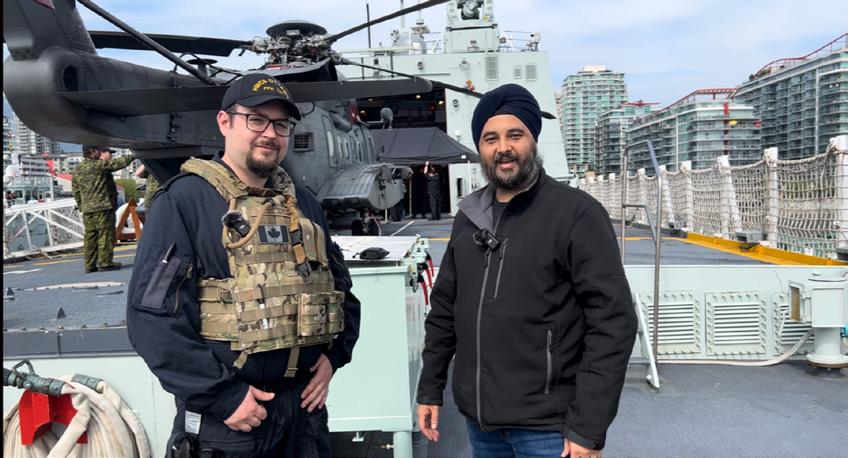
Go Bold host Joetey Attariwala (right) on HMCS Ottawa with Sailor First Class Corey Moore. Photo supplied
Sailor helps share Terry Fox’s dream in the UK
The dream of Canadian icon Terry Fox and his Marathon of Hope lives on foreign shores.
For Chief Petty Officer Second Class (CPO2) Brian Whitman, getting military members to participate in a Terry Fox Run in England was about love and hope.
“Since losing my mother and older brother to cancer and cancer-related causes many years ago, I have taken every opportunity to fundraise for charities that fight cancer,” he said.
After learning about the United Kingdom’s
Institute of Cancer Research (ICR) efforts and how badly funds were needed, he felt compelled to help. His team included 50 runners from Canada and seven other NATO countries, including Italy, the United States, the United Kingdom, France, Germany, Spain and Bulgaria.
This year’s 5-km run took place on Sept. 17 at Battersea Park in London and saw over 300 participants raise awareness and money for cancer research.
“Other nations were very receptive to participating,” CPO2 Whitman says. “While most did not know who Terry Fox was, they were very interested to learn his story.”
CPO2 Whitman is the Chief Naval Combat Information Officer (NCIOP) and was posted
to NATO Maritime Command (MARCOM) in England in 2021. He started organizing teams from the Royal Canadian Navy to participate in the annual Terry Fox Run over ten years ago. Last year, he gathered six Canadian military members from Northwood HQ to participate. This year’s CFB Esquimalt members posted to the UK included LieutenantCommander Christopher Beardmore and Lieutenant (Navy) Julian Ordonez.
The run raised $3,550 (CDN) for the ICR, helping boost England’s total fundraising for the Marathon of Hope to over $23,000.
“I was very happy and proud of the response from military members and the great feedback from the people of London during the event,” he said. “Many of the
Canadian families who took part pointed out they felt as if a bit of Canada was with them at Battersea Park during the run.”
Fox, an amputee and cancer survivor, embarked on his coast-to-coast run to raise money and awareness for cancer research in 1980. His cancer spread, eventually forcing him to end his run at 5,373 km, and the disease ultimately cost his life. His dream lives on today with the annual Terry Fox Run involving millions of participants in 60 countries worldwide.
Anyone interested in donating to Team MARCOM can do so at: justgiving.com/page/ terryfoxrun-team-marcom.
Peter Mallett Staff Writer
Team photo: Front row (kneeling) left to right: Felix Goldstein, Constantin Ratz, Stabsfeldwebel Ronny Ratz (Germany) , Torvi Ratz, Hauptfeldwebel Sandra Ratz (Germany), Jose Dorado (Spain), Canessa Obando (Spain), Cassie Wood and Nook (Commander Wood's Dog). Back row, Left to right: Soe Goldstein, Commander Sebastian Goldstein (Germany), Frauke Goldstein, Commander Michael Wood (Canada), Chief Petty Officer David Serrec (France), Lieutenant-Commander (retired) Ellie Haevens (Canada), Emily Harty (daughter, in between parents), Commander (retired) Hazen Harty (Canada), Carson Wood, Elisa Nicodano (Italy), Staff Sergeant David Bussiere (USA), Commander Georgi Pavlov (Bulgaria), Lieutenant-Commander Chloe Lea (Great Britian), Poppy Lea (Daughter, in front in arms), Chief Petty Officer Second Class Brian Whitman (Canada), Mandi-Lynn Whitman, Lieutenant (Navy) Samuel Kehler (Canada) and guest (Canada).
Part 1
Provided by PSP
Amidst the dense, evergreen forests of the Canadian wilderness, a forgotten relic of the past stood silently. Once bustling with the energy of young soldiers undergoing training in the 1950s, the abandoned military camp had now succumbed to time. The buildings were weathered and the grounds overgrown, as if nature had taken it upon her shoulders to veil the memories that resided within.
During the autumn of 1954, the camp was at the peak of its activity. Brimming with vigor and patriotism, young men had marched through its gates with dreams of serving their country. The training was grueling, the days long and the nights even longer. It was beneath the crisp Canadian night sky that the true nature of the camp’s haunting began to unravel.
The camp’s mess hall, a dilapidated building with peeling paint and shattered windows, bore witness to the first inexplicable event. One evening, as darkness fell upon the camp, the remaining winds
of daylight seemed to carry whispers on their breeze. The soldiers, seated around makeshift tables, paused mid-conversation, their eyes darting in confusion. The whispers grew louder, morphing into an ethereal choir of voices. Some claimed they heard the distant echoes of laughter, while others swore they heard desperate pleas for help.
No sooner had the voices begun, they faded into nothingness, leaving the soldiers in a state of unease. It was as if the very walls of the mess hall had absorbed the memories of the past and were replaying them in a haunting symphony.
An air of solemnity lingered that night, and the soldiers retired to their bunks, each plagued by the weight of an unseen presence.
As the weeks passed, the occurrences escalated. Footsteps echoed through the empty hallways, distinct but ghostly. Shadows danced across walls that should have been void of life. Many soldiers reported waking up in the middle of the night to find their belongings rearranged as if someone had been pacing around their bunks. A few
A Story for the Halloween Season
even claimed to have glimpsed figures in old military uniforms, phantoms lost in time, their faces twisted into expressions of longing.
But the most chilling incident occurred on a moonlit night in October. A group of soldiers, drawn together by curiosity and unease, gathered around a crackling campfire outside the barracks. A soft, mournful melody floated through the air as they exchanged stories. Its source remained a mystery, but the melody struck a chord deep within the hearts of the listeners. Tears welled in the eyes of some as they recognized the tune—a song sung by the soldiers who once called the camp home.
Over time, the story of the haunted Canadian military camp spread beyond its overgrown borders. Those who ventured near spoke of the whispers, the footsteps, and the melancholic melody that refused to be silenced. Paranormal investigators arrived with their equipment, hoping to capture evidence of the spectral inhabitants. Yet, even their advanced gadgets seemed powerless against the force that had taken resi-
dence within the abandoned buildings.
Local legends swirled around the camp, their details shifting with each telling. Some believed the spirits were those of soldiers who had perished in accidents during training, forever trapped within the confines of their former barracks. Others thought it was the collective yearning of these young men for lives left unfinished. No matter the origin, the camp’s haunting presence was undeniable.
As the years turned into decades, the abandoned military camp became a magnet for those seeking to experience the supernatural. Thrillseekers and believers in the afterlife ventured to the site, their flashlights piercing the darkness as they hoped to glimpse the otherworldly. Yet, the camp’s spirits remained elusive, choosing when and how to reveal themselves.
And so, the Canadian military camp, once a symbol of discipline and bravery, had transformed into a canvas upon which the echoes of the past were etched. The whispers, footsteps, and haunting melody resonated through
the generations, reminding all who dared to listen that the veil between the living and the departed was not always as impenetrable as it seemed. The abandoned camp stood as a testament to the notion that even in desolation, the stories of those who once walked its grounds could not be erased, and their spirits, bound by a shared history, would forever linger in the shadows.
Embark on a journey into the heart of the supernatural in Part 2 of our gripping ghost story. Set in 1987, the abandoned Canadian military camp becomes the stage for a developer’s ambitious dreams, but as construction progresses, the haunting forces within the camp refuse to be ignored. Uncover the chilling events that unfold as the past and present collide in a tale of spectral soldiers, ethereal melodies, and unfinished legacies. Stay tuned for a story that will make you question the thin veil between life and the afterlife.
Part 2 awaits, promising to captivate and terrify in equal measure.
Stock photo
and October 5
in POWELL RIVER, BC, CANADA
Sunshine Coast Health Centre and Georgia Strait Womens Clinic are registered B Corp, licensed, and accredited mental health facilities that use an evidencebased, non-12-step, meaning-centred, strengths-based approach that interconnects all our services and therapies including medical withdrawal, anger management, rTMS, trauma therapy, and PTSD treatments.
Our gender-speci c* programs provide a safe space for clients to get help with underlying issues driving trauma, mental health su ering, or addictive behaviour that can be hard to address in co-ed environments. Moving beyond a focus on abstinence and symptom reduction allows clients to experience the full, transformative bene t of our treatment programs.
*Individuals a end the program with the gender they identify as or, for gender uid and non-binary individuals, the program they are most comfortable and safe in. Our admissions coordinators will work with prospective clients to determine which program is the best t.